EP0242417B1 - Morphinane-skeletoned hydrazone derivatives, process for preparing them, pharmaceutical composition and use - Google Patents
Morphinane-skeletoned hydrazone derivatives, process for preparing them, pharmaceutical composition and use Download PDFInfo
- Publication number
- EP0242417B1 EP0242417B1 EP86105584A EP86105584A EP0242417B1 EP 0242417 B1 EP0242417 B1 EP 0242417B1 EP 86105584 A EP86105584 A EP 86105584A EP 86105584 A EP86105584 A EP 86105584A EP 0242417 B1 EP0242417 B1 EP 0242417B1
- Authority
- EP
- European Patent Office
- Prior art keywords
- hydrogen
- methyl
- different
- formula
- hydroxy
- Prior art date
- Legal status (The legal status is an assumption and is not a legal conclusion. Google has not performed a legal analysis and makes no representation as to the accuracy of the status listed.)
- Expired - Lifetime
Links
Classifications
-
- A—HUMAN NECESSITIES
- A61—MEDICAL OR VETERINARY SCIENCE; HYGIENE
- A61K—PREPARATIONS FOR MEDICAL, DENTAL OR TOILETRY PURPOSES
- A61K31/00—Medicinal preparations containing organic active ingredients
- A61K31/33—Heterocyclic compounds
- A61K31/395—Heterocyclic compounds having nitrogen as a ring hetero atom, e.g. guanethidine or rifamycins
- A61K31/435—Heterocyclic compounds having nitrogen as a ring hetero atom, e.g. guanethidine or rifamycins having six-membered rings with one nitrogen as the only ring hetero atom
- A61K31/47—Quinolines; Isoquinolines
- A61K31/485—Morphinan derivatives, e.g. morphine, codeine
-
- C—CHEMISTRY; METALLURGY
- C07—ORGANIC CHEMISTRY
- C07D—HETEROCYCLIC COMPOUNDS
- C07D221/00—Heterocyclic compounds containing six-membered rings having one nitrogen atom as the only ring hetero atom, not provided for by groups C07D211/00 - C07D219/00
- C07D221/02—Heterocyclic compounds containing six-membered rings having one nitrogen atom as the only ring hetero atom, not provided for by groups C07D211/00 - C07D219/00 condensed with carbocyclic rings or ring systems
- C07D221/22—Bridged ring systems
- C07D221/28—Morphinans
-
- C—CHEMISTRY; METALLURGY
- C07—ORGANIC CHEMISTRY
- C07D—HETEROCYCLIC COMPOUNDS
- C07D489/00—Heterocyclic compounds containing 4aH-8, 9 c- Iminoethano-phenanthro [4, 5-b, c, d] furan ring systems, e.g. derivatives of [4, 5-epoxy]-morphinan of the formula:
-
- C—CHEMISTRY; METALLURGY
- C07—ORGANIC CHEMISTRY
- C07D—HETEROCYCLIC COMPOUNDS
- C07D489/00—Heterocyclic compounds containing 4aH-8, 9 c- Iminoethano-phenanthro [4, 5-b, c, d] furan ring systems, e.g. derivatives of [4, 5-epoxy]-morphinan of the formula:
- C07D489/06—Heterocyclic compounds containing 4aH-8, 9 c- Iminoethano-phenanthro [4, 5-b, c, d] furan ring systems, e.g. derivatives of [4, 5-epoxy]-morphinan of the formula: with a hetero atom directly attached in position 14
- C07D489/08—Oxygen atom
Definitions
- the present invention relates to novel morphinane-skeletoned hydrazone derivatives of the formula (I) or steric isomers thereof, and the pharmaceutically acceptable salts thereof, a novel process for producing the same, pharmaceutical compositions comprising the same as active ingredient and their use in the therapy as analgetic or morphine-antagonistic agents.
- US-A-2797221 describes a process and intermediates for producing 1-bromocodeinone, including 2,4-dinitrophenylhydrazones.
- FR-A-1078467 refers to the total synthesis of morphine, during which synthesis 2,4-dinitrophenylhydrazones of morphinone derivatives (thebainone) have been prepared.
- I. Am. Chem. Soc. 72 (1950) 3247 discloses the preparation and properties of codeinone and of derivatives thereof, e.g. the 2,4-dinitrophenylhydrazone.
- hydrazone derivatives are very interesting from pharmacological point of view, therefore our experiments were extended to further morphine-skeletoned ketons (dihydrocodeinone, dihydromorphinone, dihydrotebainone, codeinone, 14-hydroxy codeinone, 14-hydroxy dihydrocodeinone).
- hydrazone derivative of more morphine-skeletoned ketone has been described. They were prepared mainly for analytical purposes, as the semicarbazones, phenylhydrazones, 2,4-dinitro phenylhydrazones can be well crystallized.
- composition which comprises at least one compound of formula (I), the steric isomers or the pharmaceutically acceptable salts thereof in association with at least one excipient.
- novel compounds of the invention are represented by the formula (I) and (I)' wherein Z, R1, R2, R3 and Y have the following meanings:
- the present invention also covers the stereoisomers and the pharmaceutically acceptable salts of the above compounds.
- the preferred pharmaceutically acceptable salts are inorganic or organic, e.g. the salts formed with hydrochloric, sulfuric, phosphoric acid or tartaric, fumaric, malic, acetic, formic acid.
- the invention is based on the recognition that the hydrazone derivatives of the formula (I), which are the mixture of stereoisomers (syn and anti) as crude products, can be prepared in stereo-chemically uniform form by crystallization and/or chromatographic purification.
- the present process is suitable for the economic, industrial scale preparation of the analgetic, expectorant or morphine-antagonist morphinane derivatives being important from pharmacological and pharmaceutical points of view in stereo-chemically uniform form.
- hydrazone derivatives prepared by our process which chemical structure was verified by modern analytical methods (IR, PMR, MS) had significantly different physical characteristics compared to the literary data. It was found that when alcohol (ethanol or methanol) or dimethyl formamide is used in the reaction as solvent, some ketazine (10 to 20 % by weight) is also formed. The structure of the ketazines was also verified besides the instrumental experiments by preparing them from hydrazone and ketone as well.
- ketons codeinone L. Knorr; H. Hörlein: Ber. 40 2032 (1907)
- dihydrotebainone J. M. Gullend; R. Robinson: J. Chem. Soc. 1923 998
- dihydrocodeinone semicarbazone A. Stein: Pharmazie 10 180 (1955)] are known from the prior art.
- the thiosemicarbazones were prepared, the thiosemicarbazones of dihydrocodeinone, dihydromorphinone and 14-hydroxy dihydromorphinone were obtained as a mixture of the stereoisomers, however, they could not be separated.
- the thiosemicarbazones of 14-hydroxy codeinone and 14-hydroxy dihydrocodeinone were obtained in stereochemically uniform form.
- the 2,4-dinitrophenylhydrazone of 14-hydroxy codeinone and 14-hydroxy dihydrocodeinone are homogenous upon examining by thin-layer chromatography while they are stereochemically uniform on the basis of the PMR spectra.
- dihydromorphinone and 14-hydroxy dihydromorphinone were used as starting materials always the mixture of the syn and anti isomers could be obtained even the reaction conditions were changed, and these isomers could not be separated.
- the dihydrotebainone-2,4-dinitrophenyl hydrazone is uniform on the basis of thin-layer chromatographic analysis, however, the PMR spectra does not form a ground for the decision whether it is the syn or anti isomer.
- the inhibition is high, i.e. the value of the specific bond of the labelled Naloxon is low, the compounds bind to the opiate receptors with high affinity. Those compounds which decreased the specific bond only in low extent (even in a concentration of 10 ⁇ 5) cannot be considered as significantly bound to the opiate receptors.
- the membrane preparate was prepared according to the following article: G.W. Pasternak, H.A. Wilson, S.H. Snyder: Molecular Pharmacol. 11 340-51 (1975).
- the specific radioactivity of the labelled Naloxon was 72.4 Ci/mmole [G. Töth, M. Kramer, F. Sirokmán, A. Borsodi, A. Rónai: J. Label. Comp. Radiopharm. 19 1021 (1976)].
- the analgetic activity of the compounds of the invention is summarized in Table II.
- Table II The analgetic activity of the compounds of the invention Hot plate test ED50 mg/kg.sc Tail Flick ED50 mg/kg.sc.
- the compounds wherein a methyl group is bound to the nitrogen are effective analgetic agents, they also have cataleptogenic activity, further potentiorate the effect of barbiturates.
- dihydromorphinone hydrazone 0.90 g are prepared from 1.0 g of dihydromorphinone according to Example 3.
- the product is a colourless oil, it comprises about 15 to 20 % of ketazine according to PMR and TLC experiments. Even the substance purified by preparative thin-layer chromatography does not crystallize and it is a mixture of stereoisomers according to the PMR spectra.
- PMR (CDCl3): 6.6-6.7m (H-1.2; cis + trans), 5.3s (NH2 + OH), 5.23s (H-5 ⁇ ; 1H cis), 4.85s (H-5 ⁇ ; 1H trans), 2.4s (N-Me; 3H).
- the cis/trans ratio is 30:70.
- Example 1 According to the method described in Example 1 1.8 g of 14-OH-codeinone hydrazone were obtained using 2.0 g of 14-OH-codeinone as starting material. Upon examining the endproduct by thin-layer chromatography, two spots were observed. The pure main component can be obtained by preparative thin-layer chromatographic method. The melting point of the title compound is 212-15 o C after recrystallization from ethanol.
- Example 6 The method of Example 6 was followed except that 3.0 g of 14-OH-dihydrocodeinone were used as starting material. 3.2 g of crude product were obtained, which is a mixture of the syn and anti isomers according to thin-layer chromatographic examinations. After recrystallization from a mixture of chloroform and ethanol, pure semicarbazone can be achieved. M.p.: 236-238 o C. PMR (DMSO-d6): 9.25s (NH; 1H), 6.8dd (H-1.2; 2H), 6.4s (NH2; 2H), 4.81s (H-5 ⁇ ; 1H), 3.75s (OCH3; 3H), 2.3s (N-Me; 3H).
- Example 6 The procedure of Example 6 was followed except that the reaction was carried out within 2 hours. 2.5 g of semicarbazone were obtained from 3.0 g of 14-OH-dihydromorphinone, which proved to be homogenous upon examining by thin-layer chromatography. The melting point of the product is 217-220 o C after recrystallization from ethanol. PMR (CDCl3): 8.35s (NH; 1H), 6.6dd (H-1.2; 2H), 6.0s (NH2; 2H), 4.93s (H-5 ⁇ ; 14; trans), 2.3s (N-Me; 3H) MS (C18H22N4O4 - 358.39) 358(5) 327(49)
- Example 10 The procedure of Example 10 was followed except that 2.85 g of dihydromorphinone were used as starting material. 3.2 g of dihydromorphinone semicarbazone were obtained, which gave more spots upon examining by thin-layer chromatography (eluent: eluent systems A and B). The minor impurity component could be removed by recrystallization from methanol and a homogenous product could be achieved. M.p.: 195-198 o C.
- Example 10 The procedure of Example 10 was followed except that 0.65 g of Naloxon and 0.25 g of semicarbazide chlorohydrate were used as starting materials. 0.5 g of Nalaxon semicarbazone were formed, which proved to be homogenous upon examining by thin-layer chromatography.
- PMR DMSO-d6
- MS C20H24N4O4 - 384.42) 384(6) 298(12)
- Example 6 The procedure of Example 6 was followed except that 3.0 g of dihydrotebainone were used as starting material 2.7 g of crude dihydrotebainone semicarbazone are obtained which are homogenous upon examining by thin-layer chromatography. The melting point of the product is 226-227 o C after recrystallization from ethanol.
- PMR (CDCl3): 8.48s (NH; 1H), 6.65dd (H-1.2; 2H), 6.15s (NH2; 2H), 3.8s (OCH3; 3H), 2.4s (N-Me; 3H) MS (C19H26N4O3 - 358.43) 358(42) 341(23) 299(100)
- dihydrocodeinone 3.0 g are suspended in 15 ml of water, thereafter it is dissolved with the aid of 10 ml of 1N hydrochloric acid. 1.0 g of thiosemicarbazide is added, and the solution is heated on a water bath for two hours. The hot solution is filtered off and the dihydrocodeinon thiosemicarbazon hydrochloride salt (4.0 g) quickly precipitates. This salt is recrystallized from water. M.p.: at 210 o C the product becomes yellow and decomposes between 250-255 o C.
- the hydrochloride salt well crystallizes from water, its melting point (capillary) is 230-235 o C (decomp.).
- Example 15 According to the method described in Example 15 3.7 g of 14-OH-codeinone-thiosemicarbazone hydrochloride are prepared from 3.1 g of 14-OH-codeinone. After recrystallization from water it melts at 290-295 o C (decomposition).
- the base After several recrystallization of the hydrochloric salt, the base is prepared. On the basis of thin-layer chromatographic examinations (eluent: A or B solvent mixture) the base comprises two components.
- Example 15 According to the method of Example 15 2.8 g of 14-OH-dihydromorphinone thiosemicarbazone hydrochloride are prepared from 3.0 g of 14-OH-dihydromorphine.
- the hydrochloride salt does not have a defined melting point even after several recrystallization from water.
- the base comprises two components according to thin-layer chromatographic analysis. The base well crystallizes from ethanol or methanol, but it is not homogenous upon examining by thin-layer chromatography.
- Example 25 The method of Example 25 is followed except that 1.55 g of 14-OH-codeinone is used as starting material. 2.2 g of 14-OH-codeinone-2,4-dinitrophenyl hydrazone hydrochloride are obtained. The base liberated from the salt crystallizes from ethyl acetate, mp.: 157-160 o C.
- Example 25 2.0 g of dihydromorphinone-2,4-dinitrophenyl hydrazone hydrochloride are prepared from 1.4 g of dihydromorphinone.
- the base liberated from the salt is composed of two components, it is the mixture of the syn and anti isomers according to thin-layer chromatographic analysis (eluent: A and B eluent system).
- the precipitated base is composed of two components according to thin-layer chromatographic analysis.
Landscapes
- Chemical & Material Sciences (AREA)
- Organic Chemistry (AREA)
- Health & Medical Sciences (AREA)
- Emergency Medicine (AREA)
- Medicinal Chemistry (AREA)
- Pharmacology & Pharmacy (AREA)
- Epidemiology (AREA)
- Life Sciences & Earth Sciences (AREA)
- Animal Behavior & Ethology (AREA)
- General Health & Medical Sciences (AREA)
- Public Health (AREA)
- Veterinary Medicine (AREA)
- Pharmaceuticals Containing Other Organic And Inorganic Compounds (AREA)
Description
- The present invention relates to novel morphinane-skeletoned hydrazone derivatives of the formula (I) or steric isomers thereof,

and the pharmaceutically acceptable salts thereof, a novel process for producing the same, pharmaceutical compositions comprising the same as active ingredient and their use in the therapy as analgetic or morphine-antagonistic agents. - The reaction of 14-hydroxy dihydromorphinone, Naloxon and Naltrexon with hydrazine was reported first time in 1980 (G.W. Pasternak; E.F. Hahn: J. Med. Chem. 23 674 (1980)). When the condensation products thus formed, the hydrazones were submitted to pharmacological examinations, it turned out that the original activity of the starting molecules (analgetic or morphine-antagonistic activity) is retained, however, the duration of the effect of the compounds significantly increased
(cf. also CA, Registry Handbook, Number Section 1965-1971, pages 2629R, 5967-81-7 and page 2661R, 6047-08-1, CA 103 (23) 189654a (1985); CA 104 142069 n (1986); EP-A-0077521). - US-A-2797221 describes a process and intermediates for producing 1-bromocodeinone, including 2,4-dinitrophenylhydrazones. FR-A-1078467, refers to the total synthesis of morphine, during which synthesis 2,4-dinitrophenylhydrazones of morphinone derivatives (thebainone) have been prepared. I. Am. Chem. Soc. 72 (1950) 3247 discloses the preparation and properties of codeinone and of derivatives thereof, e.g. the 2,4-dinitrophenylhydrazone.
- It was established in the course of the further examinations that the activity of the hydrazone derivatives can be attributed to the formation of ketazines [E.F. Hahn, M. Carroll-Buatti; G. Pasternak: J. Neuroscience 2 (5) 572 (1982); E.F. Hahn, G. Pasternak: Life Sci. 31 1385 (1982); S. Saletta, G.S.F. Ling, L. Wolfin, G.W. Pasternak: Life Sci. 31 1389 (1982)]. The authentic ketazines selectively link to opiate receptors in vitro 20-40 times better, than the corresponding hydrazone analogues.
- When the ¹³C-NMR analysis of the hydrazones was carried out, it was found, that they are the mixture of syn and anti isomers, wherein the sterically less crowded anti isomer is the dominant [V.M. Kolb, J.R. Gober: Life Sci. 33 Suppl. I 419 (1982); V.M. Kolb; D.H. Hua: J. Org. Chem. 49 3824 (1984)]. According the above authors only the anti isomer product was formed in the reaction of oxymorphone, Naloxon, and Naltrexon with N,N-dimethyl hydrazine.
- Hungarian researchers prepared Naloxone phenylhydrazine [Szücs M., Tóth G., Benyhe S.: MTA Biol. Oszt. Közl. 25 655 (1982) ,
CA 100 (19) 150886r (1984), CA 102 (23) 198310 s (1985), CA 103 (1) 892n (1985)]; in these documents naloxone phenylhydrazone is described as having a much weaker membrane affinity than naloxone. - Chinese authors described the hydrazones and N,N-dimethyl hydrazones of 14-hydroxy morphinone and 14-hydroxy codeinone [M. Liu, C. Chi, Y. Gvo, C. Zhu: Yaoxue Xuebao 18 475 (1983); C.A. 100 (15) 121411b (1984)].
- As the hydrazone derivatives are very interesting from pharmacological point of view, therefore our experiments were extended to further morphine-skeletoned ketons (dihydrocodeinone, dihydromorphinone, dihydrotebainone, codeinone, 14-hydroxy codeinone, 14-hydroxy dihydrocodeinone).
- In the prior art the hydrazone derivative of more morphine-skeletoned ketone has been described. They were prepared mainly for analytical purposes, as the semicarbazones, phenylhydrazones, 2,4-dinitro phenylhydrazones can be well crystallized.
- The preparation of the hydrazone of 14-hydroxy codeinone and 14-hydroxy dihydrocodeinone was reported even in 1924 [E. Speyer, K. Sarre: Ber. 57 1422 (1924)].
- Subject matter of the present invention are novel morphinane skeletoned compounds of formula (I) or the steric isomers thereof according to claim 1.
- Preferred embodiments of these compounds are subject matter of claim 2 and 3.
- Further subject matter of the present invention is a pharmaceutical composition which comprises at least one compound of formula (I), the steric isomers or the pharmaceutically acceptable salts thereof in association with at least one excipient.
- Further subject matter is also a process according to claim 5 for the preparation of the compounds of formula (I) or steric isomers thereof.
- Preferred embodiments of this process are subject matter of claims 6 to 9.
- Further subject matter is a process for the preparation of pharmaceutical compositions according to claim 10, and the use of the compounds according to the present invention for the preparation of an analgetic or morphine-antagonistic medicament.
- The novel compounds of the invention are represented by the formula (I) and (I)'

wherein Z, R₁, R₂, R₃ and Y have the following meanings: - 1. Novel morphinane skeletoned compounds of formula I and I' or the steric isomers thereof

- Z
- represents-CH₂ -CH₂ or -CH=CH-,
- R₁
- stands for methyl, -CH₂CH=CH₂,

- R₂
- is hydrogen or hydroxy,
- R₃
- is hydrogen or methyl,
- Y
- stands for NH₂, -NH-CONH₂, -NH-CSNH₂, -NHC₆H₅, -NH-C₆H₃(NO₂)₂, -NHCOC₆H₅, -NH-SO₂C₆H₄-pCH₃,

- The present invention also covers the stereoisomers and the pharmaceutically acceptable salts of the above compounds.
- The preferred pharmaceutically acceptable salts are inorganic or organic, e.g. the salts formed with hydrochloric, sulfuric, phosphoric acid or tartaric, fumaric, malic, acetic, formic acid.
- According to the invention the compounds of the formula (I), wherein
- Z
- represents CH₂-CH₂ or -CH=CH-,
- R₁
- stands for methyl, -CH₂CH=CH₂,

- R₂
- is hydrogen or hydroxy,
- R₃
- is hydrogen or methyl,
- Y
- stands for NH₂, -NH-CONH₂, -NH-CSNH₂, -NHC₆H₅, -NH-C₆H₃(NO₂)₂; -NHCOC₆H₅, -NH-SO₂C₆H₄-pCH₃
- The invention is based on the recognition that the hydrazone derivatives of the formula (I), which are the mixture of stereoisomers (syn and anti) as crude products, can be prepared in stereo-chemically uniform form by crystallization and/or chromatographic purification. The present process is suitable for the economic, industrial scale preparation of the analgetic, expectorant or morphine-antagonist morphinane derivatives being important from pharmacological and pharmaceutical points of view in stereo-chemically uniform form.
- The hydrazone derivatives prepared by our process, which chemical structure was verified by modern analytical methods (IR, PMR, MS) had significantly different physical characteristics compared to the literary data. It was found that when alcohol (ethanol or methanol) or dimethyl formamide is used in the reaction as solvent, some ketazine (10 to 20 % by weight) is also formed. The structure of the ketazines was also verified besides the instrumental experiments by preparing them from hydrazone and ketone as well.
- From the starting ketons codeinone [L. Knorr; H. Hörlein: Ber. 40 2032 (1907)], dihydrotebainone [J. M. Gullend; R. Robinson: J. Chem. Soc. 1923 998] and dihydrocodeinone semicarbazone [A. Stein: Pharmazie 10 180 (1955)] are known from the prior art.
- Besides the above compounds the semicarbazone of dihydromorphinone, 14-hydroxy dihydromorphinone, 14-hydroxy codeinone, 14-hydroxy dihydrocodeinone, Naloxon , Naloxon methylether were also prepared.
- All of the crude products proved to be composed of two components, but the pure compounds could be isolated by crystallization and/or chromatographic methods. The crude products were the mixtures of the syn and anti isomers according to PMR analysis results.
- When the thiosemicarbazones were prepared, the thiosemicarbazones of dihydrocodeinone, dihydromorphinone and 14-hydroxy dihydromorphinone were obtained as a mixture of the stereoisomers, however, they could not be separated. The thiosemicarbazones of 14-hydroxy codeinone and 14-hydroxy dihydrocodeinone were obtained in stereochemically uniform form.
- Besides the phenylhydrazone of dihydrocodeinone [A. Stein Pharmazie 10 180 (1955)], 14-hydroxy codeinone and 14-hydroxy dihydrocodeinone [L.J. Sargent, L.H. Schwartzman, L.f. Small: J. Org. Chem. 23 1247 (1958)] known from the prior art dihydromorphinone phenylhydrazone and 14-hydroxy dihydromorphinone phenylhydrazone were also prepared. The separation of the syn and anti isomers of these latter compounds could not be solved. The phenylhydrazone derivatives known from the prior art are stereochemically uniform compounds.
- The 2,4-dinitrophenylhydrazone of 14-hydroxy codeinone and 14-hydroxy dihydrocodeinone are homogenous upon examining by thin-layer chromatography while they are stereochemically uniform on the basis of the PMR spectra. When dihydromorphinone and 14-hydroxy dihydromorphinone were used as starting materials always the mixture of the syn and anti isomers could be obtained even the reaction conditions were changed, and these isomers could not be separated.
- The dihydrotebainone-2,4-dinitrophenyl hydrazone is uniform on the basis of thin-layer chromatographic analysis, however, the PMR spectra does not form a ground for the decision whether it is the syn or anti isomer.
- In order to analyse the PMR spectra, the prior art 2,4-dinitrophenyl hydrazone of codeinone [S.P. Findlay; L.F. Small: J. Am. Chem. Soc. 72 3247 (1950)] and dihydrocodeinone [A. Stain: Pharmazie 10 180 (1955)] were also prepared.
- The activity of the compounds of the invention was examined as follows.
- The effect of the 10⁻⁷ and 10⁻⁵ M concentration of the compounds was examined to tritiated Naloxon bond in rat brain membrane preparates. The results show how the compounds are able to compete for the specific binding positions of the labelled Naloxon. Table I summarizes the measure of the residual tritiated specific bonds of Naloxon.
- If the inhibition is high, i.e. the value of the specific bond of the labelled Naloxon is low, the compounds bind to the opiate receptors with high affinity. Those compounds which decreased the specific bond only in low extent (even in a concentration of 10⁻⁵) cannot be considered as significantly bound to the opiate receptors.
- A comparative data the tritiated Naloxon bond (concentration: 1 nanomole) was taken as 100 % (without excipients).
Table I Compound Concentration 10⁻⁷ mol 10⁻⁵ mol Oxycodeinone hydrazone 92±25 13±7 Dihydrocodeinone semicarbazone 43±4 9±7 Dihydromorphinone semicarbazone 69±13 4±6 Dihydrocodeinone phenylhydrazone 75±9 5±1 Dihydromorphinone phenylhydrazone 4±5 10±14 Dihydromorphinone dinitrophenylhydrazone 17±2 0.5±0.7 Oxymorphone dinitrophenylhydrazone 33±1 1±0.3 Dihydromorphinone thiosemicarbazone 16±5 19±4 Oxymorphone thiosemicarbazone 37±9 0 - The membrane preparate was prepared according to the following article: G.W. Pasternak, H.A. Wilson, S.H. Snyder: Molecular Pharmacol. 11 340-51 (1975).
- The specific radioactivity of the labelled Naloxon was 72.4 Ci/mmole [G. Töth, M. Kramer, F. Sirokmán, A. Borsodi, A. Rónai: J. Label. Comp. Radiopharm. 19 1021 (1976)].
- The analgetic activity of the compounds of the invention is summarized in Table II.
Table II The analgetic activity of the compounds of the invention Hot plate test ED₅₀ mg/kg.sc Tail Flick ED₅₀ mg/kg.sc. Dihydromorphinone semicarbazone 0.085 0.13 Oxycodone semicarbazone 0.58 0.45 Dihydroceinone semicarbazone 0.38 0.35 Dihydrocodeinone thiosemicarbazone 1.7 0.6 Oxycodone phenylhydrazone 0.8 1.2 Dihydrocodeinone phenylhydrazone 2.4 2.3 Oxymorphone dinitrophenylhydrazone 0.37 0.27 Dihydromorphinone dinitrophenylhydrazone 0.27 0.18 Oxymorphone semicarbazone 0.9 0.9 Morphine 3.6 5.0 - The compounds wherein a methyl group is bound to the nitrogen are effective analgetic agents, they also have cataleptogenic activity, further potentiorate the effect of barbiturates.
- The compounds wherein an allyl or cyclopropylmethyl group is bound to the nitrogen, exhibit morphine antagonistic activity.
- The invention is illustrated by the following, non-limiting examples.
- For the thin-layer chromatographic tests Merck 5554 silica gel 60 F₂₅₄ foils were used. As eluents the following mixtures were applied:
- A:
- chloroform/acetone/diethyl amine = 5:4:1
- B:
- chloroform/methanol/cc. ammonium hydroxide = 90:10:5
- C:
- chloroform/methanol = 9:1
- D:
- benzene/methanol = 8:2
- The PMR spectras were taken in a Bruker W200SY instrument, the chemical shift is given in ppm.
- When the steric isomers are characterized, the trans (E) and cis (z) isomer is given compared to the 5β protone.
- The mass spectras were taken on a VG-7035 (GC-MS-DS) instrument. The relative intensities are indicated after the mass numbers in parenthesis.
- 5 ml of 100 % hydrazine hydrate are dissolved in 10 ml of dimethyl formamide, then 2.0 g of 14-OH-dihydrocodeinone are added in small portions to the above solution under stirring. The solution is kept over a water bath for 2 hours, then poured into 100 ml of ice water after cooling. The precipitated crystalline substance is filtered off, washed with cold water. 1.5 g of crude product are obtained. The pure fractions obtained after chromatographing on silica gel (eluent: a 9:1 mixture of chloroform and ethanol) (further eluent B) are recrystallized from methanol. M.p.: 192-4 oC.
PMR (CDCl₃): 6.6; 6.7 dd (H-1.2; 2H), 5.33 s (NH₂; 2H deuterable), 4.93s (H-5β; 1H), 3.8s (OCH₃; 3H), 2.35s (N-CH₃; 3H)
MS (C₁₈H₂₃N₃O₃; 329.38) 329(92) 313(10) - 0.6 g of 14-OH-dihydrocodeinone hydrazone and 0.7 g of 14-OH-dihydrocodeinone are dissolved in 30 ml of dry benzene and refluxed for 4 hours. According to thin-layer chromatographic examinations (using eluent B) the hydrazone has transformed, a new spot can be observed besides the spot of the ketone used in an excess. After evaporation off of the benzene, the residue is recrystallized from ethanol twice. 0.25 g of azine are obtained with a melting point of 199-202 oC.
PMR (CDCl₃): 6.65 d (H-1.2; 2H), 4.95s (H-5; 1H), 3.75s (OCH₃; 3H), 2.35s (N-Me; 3H)
MS (C₃₆H₄₂N₄O₆; 626.73) 626(8) 611(7) 313(43) - 4 ml of dry hydrazine are dissolved in 20 ml of dry methanol and 1.0 g of dihydrocodeinone are added in small portions under stirring. After two hours stirring the methanol is evaporated off under vacuo, 50 ml of sodium tetraborate are added to the residue and the solution is extracted with 3x25 ml of chloroform. The chloroform phase is washed with saline and dried over magnesium sulfate. 1.0 g of oily hydrazone comprising a very small amount of azine determined by thin-layer chromatography (using eluent B) is obtained.
- Pure hydrazone can be achieved by preparative thin-layer chromatography, but this substance also is a mixture of stereoisomers.
PMR (CDCl₃): 6.7dd (H-1.2; 2H), 6.3s (NH₂; 1H trans), 5.25 s (H-5β and NH₂; 2H cis), 4.9s (H-5β; 1H; trans), 3.8d (OCH₃), 2.35s (N-CH₃; 3H), The cis/trans ratio is 67/33.
MS (C₁₈H₂₃N₃O₂ - 313.38) 313(40) 298(11) - 0.90 g of dihydromorphinone hydrazone are prepared from 1.0 g of dihydromorphinone according to Example 3. The product is a colourless oil, it comprises about 15 to 20 % of ketazine according to PMR and TLC experiments. Even the substance purified by preparative thin-layer chromatography does not crystallize and it is a mixture of stereoisomers according to the PMR spectra.
PMR (CDCl₃): 6.6-6.7m (H-1.2; cis + trans), 5.3s (NH₂ + OH), 5.23s (H-5β; 1H cis), 4.85s (H-5β; 1H trans), 2.4s (N-Me; 3H). The cis/trans ratio is 30:70. - According to the method described in Example 1 1.8 g of 14-OH-codeinone hydrazone were obtained using 2.0 g of 14-OH-codeinone as starting material. Upon examining the endproduct by thin-layer chromatography, two spots were observed. The pure main component can be obtained by preparative thin-layer chromatographic method. The melting point of the title compound is 212-15 oC after recrystallization from ethanol.
PMR (CDCl₃): 6.7dd (H-1.2; 2H), 6.3m (H-7.8; 2H), 5.65d (NH₂; 2H deuterable) 5.38s (H-5β; 1H), 3.75s (OCH₃; 3H), 2.4s (N-Me; 3H)
MS (C₁₈H₂₁N₃O₃ - 327.37) 327(52) 309(17) 281(41) - In 50 ml of water 1.25 g of semicarbazide chlorohydrate are dissolved, thereafter 3.0 g of dihydrocodeinone (base) are added. The mixture is heated on a water bath for 30 minutes, thereafter it is made alkaline with concentrated sodium carbonate solution (pH ∼ 9-10) after cooling to a temperature of +5 oC. The precipitated crystals are filtered, washed with cold water. 3.0 g of crude product are obtained. This crude product comprises two components according to thin-layer chromatographic examination (with eluent mixtures A and B), which are the syn and anti isomers of the title product. After recrystallization from propanol or aqueous ethanol chromatographically homogenous product can be obtained. M.p.: 244-247 oC.
PMR (CDCl₃): 9.65s (NH; 1H), 7.8s (NH₂; 2H), 6,7dd (H-1.2; 2H), 4.92s (H-5β; 1H), 3.85s (OCH₃; 3H), 2.4s (N-CH; 3H). The 5-β-H shifts in the crude product comprising 50-50 % syn and anti isomers are as follows: 5.2 (cys) and 4.92 (trans) ppm.
MS (C₁₉H₂₄N₄O₃ - 356.41) 356(51) 339(38) 297(100) 284(37) - The method of Example 6 was followed except that 3.0 g of 14-OH-dihydrocodeinone were used as starting material. 3.2 g of crude product were obtained, which is a mixture of the syn and anti isomers according to thin-layer chromatographic examinations. After recrystallization from a mixture of chloroform and ethanol, pure semicarbazone can be achieved. M.p.: 236-238 oC.
PMR (DMSO-d₆): 9.25s (NH; 1H), 6.8dd (H-1.2; 2H), 6.4s (NH₂; 2H), 4.81s (H-5β; 1H), 3.75s (OCH₃; 3H), 2.3s (N-Me; 3H). The 5-β-H shifts in the crude product comprising the isomers in a weight ratio of 1:1 are as follows: 4.85 (trans) and 5.17 (cys) ppm (CDCl₃).
MS (C₁₉H₂₄N₄O₄ - 372.41) 372(25) 355(58) 313(70) - The method of the preceeding example was followed except that 3.0 g 14-OH-codeinone were used as starting material. 2.8 g of crystalline crude product are formed, which is a mixture of the syn and anti isomers according to thin-layer chromatographic examinations. After recrystallization from methanol, a uniform product can be achieved.
M.p.: 260-263 oC (dec.)
PMR (CDCl₃): 8.72s (NH; 1H), 6.7dd (H-1.2; 2H), 6.3d (H-8; 1H), 5.85d (H-7; 1H), 5.19s (H-6β; 1H; trans), 5.0s (NH₂; 2H 3.8s (OCH₃; 3H), 2.4s (N-CH₃; 3H)
MS (C₁₉H₂₂N₄O₄ - 370.40) 370(35) 353 (22) 313(29) - 1.2 g semicarbazide chlorohydrate are dissolved in 50 ml of water and the solution is heated on a water bath for a hour after the addition of 3.0 g of codeinone. After cooling to +5 oC, the solution is alkalified by concentrated sodium carbonate solution (pH∼9-10), and the separated oil is extracted with 3x30 ml of chloraform. The chloroform phase is washed with saline, dried over magnesium sulfate and evaporated off. The residue is crystallized from ethanol and small chloroform. The melting point of codeinon semicarbazone (1.3 g) is the same as referred to in the prior art [Knorr, L., Hörlein, H.: Ber. 40 2032 (1407)], but it gives two spots on a chromatoplate According to the PMR spectra the product is the mixture of the syn and anti isomers.
PMR (CDCl₃): 8.75s (NH; 1H), 6.7m (H-1.2; 2H), 6.2dd (H-8; 1H), 5.85dd (H-7; 1H), 5.2s (H-5β; 1H; trans), 3.8s; 3.81s (OCH₃; 3H), 2.4s (N-Me; 3H)
MS (C₁₉H₂₂N₄O₃ - 354.40) 354(100) 337(23) - The procedure of Example 6 was followed except that the reaction was carried out within 2 hours. 2.5 g of semicarbazone were obtained from 3.0 g of 14-OH-dihydromorphinone, which proved to be homogenous upon examining by thin-layer chromatography. The melting point of the product is 217-220 oC after recrystallization from ethanol.
PMR (CDCl₃): 8.35s (NH; 1H), 6.6dd (H-1.2; 2H), 6.0s (NH₂; 2H), 4.93s (H-5β; 14; trans), 2.3s (N-Me; 3H)
MS (C₁₈H₂₂N₄O₄ - 358.39) 358(5) 327(49) - The procedure of Example 10 was followed except that 2.85 g of dihydromorphinone were used as starting material. 3.2 g of dihydromorphinone semicarbazone were obtained, which gave more spots upon examining by thin-layer chromatography (eluent: eluent systems A and B). The minor impurity component could be removed by recrystallization from methanol and a homogenous product could be achieved. M.p.: 195-198 oC.
PMR (DMSO-d₆): 6.6dd (H-1.2; 2H); 6.4s (NH₂; 2H), 4.9s (H-5β; 1H), 2.3s (N-Me; 3H),
The 5-β protons' shifts in the crude product comprising the trans and cys isomer in a weight ratio of 71:29 are as follows: 4.9 (trans) and 5.34 (cys) ppm.
MS (C₁₈H₂₂N₄O₃ - 342.39) 342(58) 325(85) 283(86) - The procedure of Example 10 was followed except that 0.65 g of Naloxon and 0.25 g of semicarbazide chlorohydrate were used as starting materials. 0.5 g of Nalaxon semicarbazone were formed, which proved to be homogenous upon examining by thin-layer chromatography. M.p.: 239-242 oC (dec.)
PMR (DMSO-d₆): 9.15s (NH; 1H), 6.45dd (H-1.2; 2H), 5.8m (allyl-proton; 1H), 5.0-5.2m (allyl-proton; 2H), 4.75s (H-5β; 1H)
MS (C₂₀H₂₄N₄O₄ - 384.42) 384(6) 298(12) - In 15 ml of water 0.25 g of semicarbazide chlorohydrate are dissolved and 0.68 g of Naloxon-methylether are added, then the solution is heated on a water bath for two hours. After cooling the solution is made alkaline by adding a concentrated sodium carbonate solution (pH ∼ 9), the crystalline substance is filtered off, and washed with water. 0.6 g of crude product are obtained, which gives two spots upon examining by thin-layer chromatography. The two spots are the syn and anti isomers.
PMR (DMSO-d₆): The OCH₃ group has two signs (3.75 ppm).
The shifts of the 5β protons are as follows: 4.70 (trans) and 4.82 (cys) ppm. Weight ratio of the isomers:21:79.
MS (C₂₁H₂₆N₄O₄ - 398.45) - The procedure of Example 6 was followed except that 3.0 g of dihydrotebainone were used as starting material 2.7 g of crude dihydrotebainone semicarbazone are obtained which are homogenous upon examining by thin-layer chromatography. The melting point of the product is 226-227 oC after recrystallization from ethanol.
PMR (CDCl₃): 8.48s (NH; 1H), 6.65dd (H-1.2; 2H), 6.15s (NH₂; 2H), 3.8s (OCH₃; 3H), 2.4s (N-Me; 3H)
MS (C₁₉H₂₆N₄O₃ - 358.43) 358(42) 341(23) 299(100) - 3.0 g of dihydrocodeinone are suspended in 15 ml of water, thereafter it is dissolved with the aid of 10 ml of 1N hydrochloric acid. 1.0 g of thiosemicarbazide is added, and the solution is heated on a water bath for two hours. The hot solution is filtered off and the dihydrocodeinon thiosemicarbazon hydrochloride salt (4.0 g) quickly precipitates. This salt is recrystallized from water. M.p.: at 210 oC the product becomes yellow and decomposes between 250-255 oC. The hydrochloric salt is dissolved in water (1.0 g in 100 ml of water) and the base is liberated by adding a concentrated sodium carbonate solution (pH∼9). This product is filtered and washed with water. The product is a mixture of steric isomers according to the PMR spectra.
PMR (DMSO-d₆): 10.32s (NH; 2H cis and trans) 8.32s (NH₂; 2H cis and trans), 7.75s (NH₂; 1H cis), 7.45s (NH₂; 1H trans), 6.6-6.75m (H-1.2), 5.45s (H-5β; 1Hc); 4.87s (H-5β; 1Ht), the isomer ratio is 63:37 = = trans:cis.
MS (C₁₉H₂₄N₄O₂S - 372(29) 355(17) 297(20) 242(48) - 3.1 g of 14-OH dihydrocodeinone are transformed into 4.2 g of 14-OH-dihydrocodeinone thiosemicarbazone hydrochloride according to the method of Example 15.
- The hydrochloride salt well crystallizes from water, its melting point (capillary) is 230-235 oC (decomp.).
- The melting point of the base is 150-154 oC (decomp.).
PMR (CDCl₃): 8.63s (NH; 1H), 7.48s (NH₂; 1H), 6.65dd (H-1.2; 2H), 6.4s (NH₂; 1H), 4.92s (H-5β; 1H), 3.8s (OCH₃; 3H), 2.35s (N-Me; 3H). Pure trans isomer.
MS (C₁₉H₂₄N₄O₃S - 388.47) 388)72) 371(100) 313 (42) - According to the method described in Example 15 3.7 g of 14-OH-codeinone-thiosemicarbazone hydrochloride are prepared from 3.1 g of 14-OH-codeinone. After recrystallization from water it melts at 290-295 oC (decomposition).
- The melting point of the base is 233-234 oC (dec.).
PMR (DMSO-d₆): 10.15s (NH; 1H), 8.48s; 7.95s (NH₂; 2H), 6.6dd (H-1.2; 2H), 6.25d (H-7; 1H), 6.05s (H-8; 1H), 5.87 (H-5β; 1H), 3.7s (OCH₃; 3H), 2.35s (N-CH₃; 3H),
MS (C₁₉H₂₂N₄O₃S - 386.46): 386(100); 369(50) 311(43) - According to the method described in Example 15, 2.5 g of dihydromorphinone thiosemicarbazone hydrochloride are prepared from 2.8 g of dihydromorphinone. Though the endproduct well crystallizes from water, it does not have a defined melting point.
- After several recrystallization of the hydrochloric salt, the base is prepared. On the basis of thin-layer chromatographic examinations (eluent: A or B solvent mixture) the base comprises two components.
PMR (DMSO-d₆): 10.41s (NH; 1H cis), 10.32s (NH; 1H trans), 9.10s (C₃-OH), 8.25s (NH₂; 2H cis and trans), 7.67s (NH₂; 1H cis), 7.52s (NH₂; 1H trans) 6.55 s (H-1.2; 2H), 5.45s (H-5β; 1H cis), 4.85s (H-5β; 1H trans) 2.3s (N-Me; 3H) isomer ratio is 69:31 = = trans:cis.
MS (C₁₈H₂₂N₄O₂S - 358.45) - According to the method of Example 15 2.8 g of 14-OH-dihydromorphinone thiosemicarbazone hydrochloride are prepared from 3.0 g of 14-OH-dihydromorphine. The hydrochloride salt does not have a defined melting point even after several recrystallization from water. The base comprises two components according to thin-layer chromatographic analysis. The base well crystallizes from ethanol or methanol, but it is not homogenous upon examining by thin-layer chromatography.
PMR (DMSO-d₆): 10.18s (NH; 2H cis + trans) 8.32s (NH₂; 2H; cis + trans) 7.65s (NH₂; 1H cis) 7.55s (NH₂; 1H trans) 5.33s (H-5β; 1H cis), 4.76s (H-5β; 1H trans), 2.3s (N-Me; 3H) isomer ratio: cis/trans 21/79.
MS (C₁₈H₂₂N₄O₃S - 374.45) - 1.5 g of dihydrocodeinone are dissolved in 30 ml of dry ethanol, then 1.5 ml of freshly distilled phenylhydrazine and 1.0 ml of glacial acetic acid are added. The solution is boiled on a water-bath for 30 minutes, thereafter cooled and made alkaline by concentrated ammonium hydroxide. The product quickly crystallizes.
PMR (CDCl₃): 7.3-6.8m (C₆H₅; 5H), 6.7dd (H 1.2; 2H), 5.13s (H-5β; 1H), 3.8s (OCH₃; 3H), 2.35s (N-Me; 3H), pure trans isomer.
MS (C₂₄H₂₇N₃O₂ - 389.48) 389(90) 252(8) 212(15) - Using 1.55 g of 14-OH-dihydrocodeinone as starting material 1.7 g 14-OH-dihydrocodeinone phenylhydrazone were prepared according to the procedure used for the preparation of dihydrocodeinone phenylhydrazone. After recrystallization from ethanol, the product melts at 174-176 oC.
PMR (CDCl₃): 9.5s (NH; 1H), 7.3-7.0m (C₆H₅; 5H), 6.7dd (H-1.2; 2H), 5.37s (H-5β; 1H), 4.9s (OH; 1H), 3.75s (OCH₃; 3H), 2.4s (N-Me; 3H), pure cys isomer.
MS (C₂₄H₂₇N₃O₃ - 405.48) 405(100) 386(7) 228(17) - Using 1.55 g of 14-OH-codeinone as starting material 1.4 g of 14-OH-codeinone phenylhydrazone was prepared according to the method of Example 20. The product well crystallizes from ethanol. M.p.: 192-194 oC. The product is sensitive to light, it turns to yellow due to the effect of light.
PMR (CDCl₃): 8.75s (NH; 1H), 7.3-6.9m (C₆H₅; 5H), 6.7dd (H-1.2; 2H), 6.45d (H-8; 1H), 5.7d (H-7; 1H), 5.42s (H-5β; 1H cis), 3.75s (OCH₃; 1H), 2.4s (N-Me; 3H)
MS (C₂₄H₂₅N₃O₃ - 403.46) 403(8) 385(77) 370 (13) - 1.4 g of dihydromorphinone and 1.3 ml of freshly distilled phenylhydrazone are dissolved in 30 ml of dry ethanol, thereafter refluxed for 30 minutes. The ethanol is distilled off, then the residual red oil is triturated with ether. The crystalline substance thus obtained is filtered off, washed with ether and small cold ethanol. 1.0 g of dihydromorphinone phenylhydrazone is obtained which is composed of two components according to thin-layer chromatographic examinations (eluent: A or B eluent mixture). According to PMR analysis the two components are the syn and anti isomers (trans/cis = 28/72).
PMR (DMSO-d₆): 9.67s (NH; 1H cis), 8.82s (NH; 1H trans) 7.3-7.0m (C₆H₅; 5H), 6.6-6.7m (H-1.2), 5.4s (H-5β; 1H; cis), 5.12s (H-5β; 1H; trans), 2.4s (N-Me; 3H),
MS (C₂₃H₂₅N₃O₂ - 375.45) 375(100) 283(19) 212(20) - 1.2 g of 14-OH-dihydromorphinone phenylhydrazone were prepared according to the method of Example 23 starting from 1.5 g of 14-OH-dihydromorphinone. The product is composed of two components, they proved to be the syn and anti isomers.
PMR (CDCl₃): 9.3s (NH; 1H), 7.2-7.0m (C₆H₅), 6.7-6.5m (H-1.2; 2H), 5.3s (H-5β; 1H; cis) 5.05s (H-5β; 1H; trans) 2.3s (N-Me; 3H),
MS (C₂₃H₂₅N₃O₃ - 391.45) 391(100) - 1.0 g of 2,4-dinitrophenyl hydrazine is dissolved in 40 ml of concentrated hydrochloric acid, thereafter 200 ml of water and 1.5 g of dihydrocodeinone are added (hot). The mixture is slightly boiled for 5 minutes, thereafter left to cool. The yellow dihydrocodeinone-2,4-dinitrophenyl hydrazone hydrochloride quickly crystallizes. The weight of the product is 2.3 g after filtration and washing with cold water. The base can be precipitated from the diluted aqueous solution of the hydrochloric salt with the aid of concentrated sodium carbonate solution (pH∼9). The melting point of the base is 207-208 oC after crystallization from ethanol or n-propanol.
PMR (CDCl₃): 12.85s (NH; 1H), 9.1d (Ar-H; 1H), 8.25dd (Ar-H; 1H), 7.9d (Ar-H; 1H), 6.7dd (H-1.2; 2H), 5.32s (H-5β; 1H cis), 3.75s (OCH₃; 3H), 2.4s (N-Me; 3H)
MS (C₂₄H₂₅N₅O₆ - 479.48) 479(100) 462(M-17; 20) - The method of the preceeding example is followed. 2.1 g of 14-OH-dihydrocodeinone-2,4-dinitrophenyl hydrazone hydrochloride are obtained from 1.55 g of 14-OH-dihydrocodeinone. The base can be crystallized from a mixture of chloroform and ethanol. M.p.: 232-233 oC.
PMR (CDCl₃): 12.8s (NH; 1H), 9.15d (Ar-H; 1H), 8.33dd (Ar-H; 1H), 7.9d (Ar-H; 1H), 6.75dd (H-1.2; 2H), 5.33s (H-5β; 1H cis), 3.8s (OCH₃; 3H), 2.4s (N-Me; 3H),
Ms (C₂₄H₂₅N₅O₇ - 49.548) 495(40) 478(M-17; 16) - The method of Example 25 is followed except that 1.55 g of 14-OH-codeinone is used as starting material. 2.2 g of 14-OH-codeinone-2,4-dinitrophenyl hydrazone hydrochloride are obtained. The base liberated from the salt crystallizes from ethyl acetate, mp.: 157-160 oC.
PMR (CDCl₃): 12.15s (NH; 1H), 9.2d (Ar-H; 1H), 8.44dd (Ar-H; 1H), 7.95d (Ar-H; 1H), 6.7dd (H-1.2; 2H), 6.5d (H-8; 1H), 6.1d (H-7; 1H), 5.43s (H-5β; 1H cis), 3.8s (OCH₃; 3H), 2.4s (N-Me; 3H)
MS (C₂₄H₂₃N₅O₇ - 493.46) 493(27) 476(M-17; 10) - 1.2 g of codeinone and 0.9 g of 2,4-dinitrophenyl hydrazine are stirred in 20 ml of 96 % of acetic acid on a water bath for 30 minutes. The mixture is cooled (0 - 5 oC) and alkalified by concentrated ammonium hydroxide solution (pH 9). The precipitated oil is extracted with 3x25 ml of chloroform. The chloroformic solution is washed with brine and dried over magnesium sulfate. After evaporation of the solvent the yellow crystalline residue (1.3 g) is crystallized from a mixture of ethanol and chloroform. Weight: 0.75 g M.p.: 259-261 oC.
PMR (CDCl₃): 12.18s (NH; 1H), 9.2d (AR-H; 1H), 8.4dd (Ar-H; 1H), 7.95d (Ar-H; 1H), 6.7dd (H-1.2; 2H), 6.35dd (H- ; 1H), 6.05dd (H- ; 1H), 5.43s (H-5β; 1H cis), 3.8s (OCH₃; 3H), 2.3s (N-Me; 3H)
MS (C₂₄H₂₃N₅O₆ - 477.46) 477(100) 460 (M-17; 8) - According to the method of Example 25 2.0 g of dihydromorphinone-2,4-dinitrophenyl hydrazone hydrochloride are prepared from 1.4 g of dihydromorphinone. The base liberated from the salt is composed of two components, it is the mixture of the syn and anti isomers according to thin-layer chromatographic analysis (eluent: A and B eluent system).
- The two isomers cannot be separated either by crystallization (ethanol or methanol) or chromatographically (column chromatography or preparative thin-layer chromatography). The recrystallization of the hydrochloride from water does also not give the desired result.
PMR (CDCl₃): 13.17s (NH; 1H;cis), 11.10s (NH; 1H, trans) 9.15dd (Ar-H; 1H), 8.25dd (Ar-H; 1H), 6.7m (H-1.2; 2H), 5.35s (H-5β; 1H cis), 5.07s (H-5β; 1H trans), 2.4s (N-Me; 3H) cis-trans ratio 27:73.
MS (C₂₃H₂₃N₅O₆ - 465.35) 465(63) 448(M-17; 12) 431(M-34; 34) - According to the method of Example 25 1.5 g of 14-OH-dihydromorphinone-2,4-dinitrophenylhydrazone hydrochloride are prepared from 1.5 g of 14-OH-dihydromorphinone.
- The precipitated base is composed of two components according to thin-layer chromatographic analysis.
- The two isomers (syn and anti) cannot be separated either by crystallization or preparative thin-layer chromatography.
PMR (CDCl₃): 13.1s (NH; 1H trans), 11.15s (NH; 1H cis) 9.2m (Ar-H), 8.3m (Ar-H), 8.1d and 7.9d (Ar-H), 6.7m (H-1.2), 5.38s (H-5β; trans), 5.10s (H-5β; cis) PMR (C₆D₆) 12.95s (NH; trans) 10.60s (NH; cis) 8.8d; 8.6d (Ar-H), 7.8m (Ar-H), 7.65d; 7.4d (Ar-H), 6.8m (H-1.2), 5.03s (H-5β; cis), 4.73s (H-5β; trans) isomer ratio trans/cis = 60/40.
MS (C₂₃H₂₃N₅O₇ - 481.45) 481(62) 464(M-17; 18), 447(M-34; 32)
R₃ represents methyl then Y must be different from -NH-CONH₂, -NHCOC₆H₅, -NH-C₆H₃(NO₂)₂,
when Z represents -CH=CH-, R₂ represents hydrogen and R₃ represents methyl then Y must be different from -NH-CONH₂, -NH-C₆H₃(NO₂)₂, and
when Z represents -CH₂-CH₂- or -CH=CH-, R₂ represents hydroxy, R₃ represents methyl; then Y must be different from -NHC₆H₅,
when Z is -CH₂-CH₂-, R₂ is hydrogen, R₃ is methyl and the dotted line represents a bond, Y must be different from -NH-CONH₂
with the following provisions applying to the isomer mixture:
when Z represents -CH₂-CH₂-, R₂ represents hydrogen, R₃ represents methyl then Y must be different from -NH-CONH₂, -NHCOC₆H₅, -NH-C₆H₃(NO₂)₂;
-NH₂, -NHC₆H₅, when Z represents -CH=CH-, R₂ represents hydrogen and R₃ represents methyl, then Y must be different from -NH-CONH₂, -NH-C₆H₃(NO₂)₂, and
when Z represents -CH=CH-, R₂ represents hydroxy, R₃ represents methyl, then Y must be different from -NHC₆H₅,-NH₂,-NHC₆H₄(NO₂)₂,
when Z represents-CH₂-CH₂-, R₂ represents hydroxy, R₃ represents methyl, then Y must be different from -NHC₆H₅ and -NH₂,
when Z is -CH₂-CH₂-, R₂is hydroxy, R₃ is hydrogen, the dotted line represents a bond, then Y must be different from -NH₂,
when Z represents -CH₂-CH₂-, R₂ is hydroxy, R₃ is hydrogen, the dotted line represents a bond, then Y must be different from -NH₂,
when R₁ represents methyl or -CH₂-CH=CH₂, R₂ represents hydroxy, R₃ represents hydrogen, Z is -CH₂-CH₂-, the dotted line represents a bond, then Y must be different from -NHC₆H₅,
when R₁ is methyl, R₂ is hydrogen, R₃ is methyl, Z represents -CH=CH-, and the dotted line represents hydrogen, then Y must be different from -NHC₆H₄(NO₂)₂.
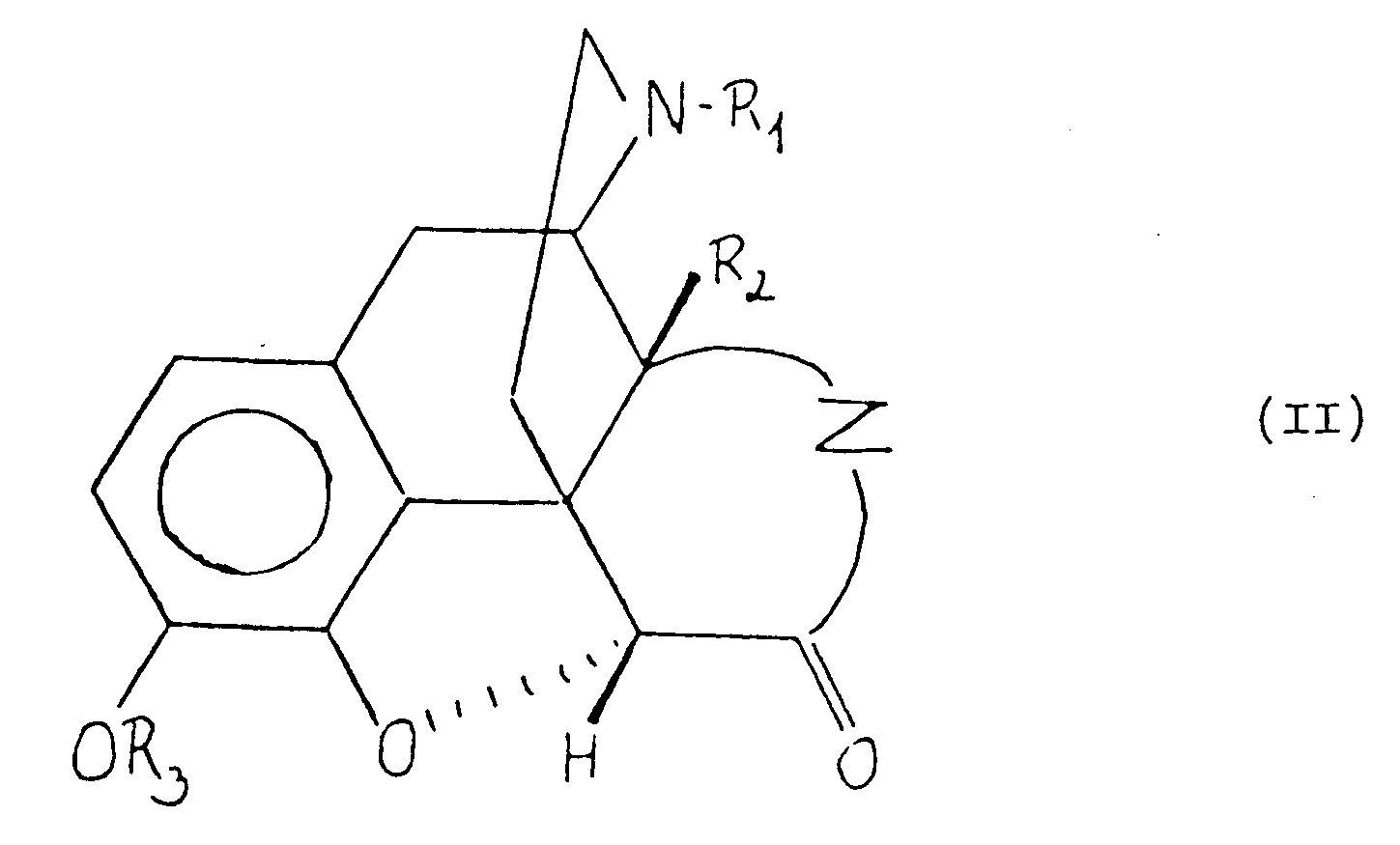
wherein Z, R₁, R₂ and R₃ are the same as defined hereinabove, the dotted line represents an optional bond, with a compound of the formula (III)
NH₂-Y (III)
wherein Y is the same as defined hereinabove.
Claims (11)
- A process for the preparation of the compounds of formula I and I' or steric isomers thereof
 Z represents CH₂ -CH₂ or -CH=CH-,R₁ stands for methyl, -CH₂CH=CH₂,
 R₂ is hydrogen or hydroxy,R₃ is hydrogen or methyl,Y stands for NH₂, -NH-CONH₂, -NH-CSNH₂, -NHC₆H₅, -NH-C₆H₃(NO₂)₂, -NHCOC₆H₅, -NH-SO₂C₆H₄-pCH₃;the dotted line represents a bond or hydrogen, with the following provisions applying to the isomers:
when Z represents -CH₂-CH₂-, R₂ represents hydrogen, R₃ represents methyl then Y must be different from -NH-CONH₂, -NHCOC₆H₅, -NH-C₆H₃(NO₂)₂,
when Z represents, -CH=CH-, R₂ represents hydrogen and R₃ represents methyl then Y must be different from -NH-CONH₂, -NH-C₆H₃(NO₂)₂, and
when Z represents -CH₂-CH₂- or -CH=CH-, R₂ represents hydroxy, R₃ represents methyl; then Y must be different from -NHC₆H₅,
when Z is -CH₂-CH₂-, R₂ is hydrogen, R₃ is methyl and the dotted line represents a bond, Y must be different from -NH-CONH₂
with the following provisions applying to the isomer mixture :
when Z represents -CH₂-CH₂-, R₂ represents hydrogen, R₃ represents methyl then Y must be different from -NH-CONH₂, -NHCOC₆H₅, -NH-C₆H₃(NO₂)₂, -NH₂, -NHC₆H₅,
when Z represents -CH=CH-, R₂ represents hydrogen and R₃ represents methyl, then Y must be different from -NH-CONH₂, -NH-C₆H₃(NO₂)₂, and
when Z represents -CH=CH-, R₂ represents hydroxy, R₃ represents methyl; then Y must be different from -NHC₆H₅,-NH₂, -NHC₆H₄(NO₂)₂,
when Z represents-CH₂-CH₂-, R₂ represents hydroxy, R₃ represents methyl, then Y must be different from -NHC₆H₅ and -NH₂,
when Z is -CH₂-CH₂-, R₂ is hydroxy, R₃ is hydrogen, the dotted line represents a bond, then Y must be different from -NH₂,
when Z represents -CH₂-CH₂-, R₂ is hydroxy, R₃ is hydrogen, the dotted line represents a bond, then Y must be different from -NH₂,
when R₁ represents methyl or -CH₂-CH=CH₂, R₂ represents hydroxy, R₃ represents hydrogen, Z is -CH₂-CH₂-, the dotted line represents a bond, then Y must be different from -NHC₆H₅,
when R₁ is methyl, R₂ is hydrogen, R₃ is methyl, Z represents -CH=CH-, and the dotted line represents hydrogen, then Y must be different from -NHC₆H₄(NO₂)₂. which comprises reacting the morphinane-skeletoned ketones of the formula (II)
NH₂Y (III)
wherein Y is the same as defined hereinabove, in aqueous or alcoholic solution and separating the stereoisomers by crystallization and/or chromatography and if desired, transforming the compound thus obtained into a pharmaceutically acceptable salt or liberating the base from the salt thus obtained. - The process as claimed in Claim 1 which comprises carrying out the reaction at a temperature of 20-100 oC.
- The process as claimed in Claim 1 which comprises using the ketones of the formula (II) and the hydrazones of the formula (III) in a molar ratio of 1:10 if Y=NH₂, while in a molar ratio of 1:15 in all the other cases.
- The process as claimed in Claim 1, which comprises purifying the crude product of the formula (I) which is the mixture of steric isomers by crystallization and/or chromatography.
- The process as claimed in Claim 1 which comprises carrying out the reaction of the ketones of the formula (I) and the hydrazines of the formula (II) in methanol or ethanol if Y = -NH₂, -NHCOC₆H₅, -NHSO₂C₆H₄OCH₃, in water or in a mixture of ethanol and water or methanol and water if Y = -NHCONH₂, -NHCSNH₂, while in diluted hydrochloric acid or acetic acid if Y = -NH-C₆H₃(NO₂)₂.
- A process for the preparation of pharmaceutical compositions which comprises mixing at least one morphinane-skeletoned compound of the formula (I) according to claim 1 and/or the stereoisomers and/or the pharmaceutically acceptable salt thereof with at least one excipient and forming a pharmaceutical formulation.
- Use of the compounds of formula (I) according to claim 1 for the preparation of an analgetic or morphine-antagonistic medicament.
Priority Applications (1)
| Application Number | Priority Date | Filing Date | Title |
|---|---|---|---|
| AT86105584T ATE85611T1 (en) | 1986-04-23 | 1986-04-23 | HYDRAZONE DERIVATIVES WITH MORPHINES FRAMEWORK, PROCESS FOR THEIR MANUFACTURE, PHARMACEUTICAL COMPOSITION AND USE. |
Applications Claiming Priority (2)
| Application Number | Priority Date | Filing Date | Title |
|---|---|---|---|
| HU5685A HU199901B (en) | 1985-01-08 | 1985-01-08 | Process for production of derivatives of hydrazon with morfinane carcass |
| DD86290095A DD258006A5 (en) | 1985-01-08 | 1986-05-09 | PROCESS FOR THE PREPARATION OF HYDROZON DERIVATIVES |
Publications (2)
| Publication Number | Publication Date |
|---|---|
| EP0242417A1 EP0242417A1 (en) | 1987-10-28 |
| EP0242417B1 true EP0242417B1 (en) | 1993-02-10 |
Family
ID=25748053
Family Applications (1)
| Application Number | Title | Priority Date | Filing Date |
|---|---|---|---|
| EP86105584A Expired - Lifetime EP0242417B1 (en) | 1985-01-08 | 1986-04-23 | Morphinane-skeletoned hydrazone derivatives, process for preparing them, pharmaceutical composition and use |
Country Status (4)
| Country | Link |
|---|---|
| EP (1) | EP0242417B1 (en) |
| JP (1) | JPS62258380A (en) |
| DD (1) | DD258006A5 (en) |
| IN (1) | IN163125B (en) |
Families Citing this family (7)
| Publication number | Priority date | Publication date | Assignee | Title |
|---|---|---|---|---|
| HU208633B (en) * | 1991-02-04 | 1993-12-28 | Alkaloida Vegyeszeti Gyar | Process for production of analgetic compositions as applicable for blocking of opioid-binding spaces /2-receptors/ causing respiration depression |
| US6323212B1 (en) | 1992-01-23 | 2001-11-27 | Toray Industries, Inc. | Morphinan derivative and its pharmaceutical applications |
| EP0663401B1 (en) | 1993-07-23 | 2000-06-07 | Toray Industries, Inc. | Morphinan derivative and medicinal use |
| AU2003234621A1 (en) | 2002-05-17 | 2003-12-02 | Jenken Biosciences, Inc. | Opioid and opioid-like compounds and uses thereof |
| US7923454B2 (en) | 2002-05-17 | 2011-04-12 | Jenken Biosciences, Inc. | Opioid and opioid-like compounds and uses thereof |
| US7501433B2 (en) | 2002-05-17 | 2009-03-10 | Jenken Biosciences, Inc. | Opioid and opioid-like compounds and uses thereof |
| US8017622B2 (en) | 2003-05-16 | 2011-09-13 | Jenken Biosciences, Inc. | Opioid and opioid-like compounds and uses thereof |
Family Cites Families (4)
| Publication number | Priority date | Publication date | Assignee | Title |
|---|---|---|---|---|
| FR1078467A (en) * | 1952-02-18 | 1954-11-18 | Merck & Co Inc | Total morphine synthesis process |
| US2797221A (en) * | 1954-06-22 | 1957-06-25 | Merck & Co Inc | Process and intermediates for producing 1-bromocodeinone |
| CA1258674A (en) * | 1981-10-16 | 1989-08-22 | Sloan-Kettering Institute For Cancer Research | Opiate agonists and antagonists |
| US4608376A (en) * | 1981-10-16 | 1986-08-26 | Carolyn McGinnis | Opiate agonists and antagonists |
-
1986
- 1986-04-18 IN IN291/MAS/86A patent/IN163125B/en unknown
- 1986-04-23 EP EP86105584A patent/EP0242417B1/en not_active Expired - Lifetime
- 1986-04-25 JP JP61094988A patent/JPS62258380A/en active Pending
- 1986-05-09 DD DD86290095A patent/DD258006A5/en active Search and Examination
Non-Patent Citations (10)
| Title |
|---|
| A. Stein: Die Pharmazie, 10, 180 (1955) * |
| CHEMICAL ABSTRACTS, vol. 100, no. 15, April 9, 1984, pages 623-624, ref. no. 121411b; Columbus, Ohio, US; M. LIU et al.: "Synethesis of long-acting analgesic hydrazone derivatives of 14-hydroxycodeinone and 14-hydroxymorphinone"& YAOXUE XUEBAO 1983, 18(6), 475-7 * |
| CHEMICAL ABSTRACTS, vol. 100, no. 19, May 7, 1984, page 38, ref. no. 150886r; Columbus, Ohio, US M. SZUCS et al.: "Characterization of opiate receptors in rat brain membrane fractions" & MAGY. TUD. AKAD. BIOL. TUD. OSZT. KOZL. 1982, 25(4), 655-9 * |
| CHEMICAL ABSTRACTS, vol. 102, no. 23, June 10, 1985, page 96, ref. no. 198310s; Columbus, Ohio, US; M. SZUCS et al.: "Binding of revisible and irrevisble ligands to rat brain opiate receptor(s)" & NEUROPEPT. PSYCHOSOM. PROCESSES, INT. CONF. INTEGR. NEUROHUMORAL MECH. 1982 (Pub. 1983) 105-10. * |
| CHEMICAL ABSTRACTS, vol. 103, no. 1, July 8, 1985, page 86, ref. no. 892n; Columbus, Ohio, US; M. SZUCS et al.: "Binding of revisible and irrevisible ligands to rat brain opiate receptors" & METHODOL. SURV. BIOCHEM. ANAL. 1984, 13(Invest. Membr.-Located Recept), 493-6 * |
| CHEMICAL ABSTRACTS, vol. 103, no. 23, December 9, 1985, page 69, ref. no. 189654a; Columbus, Ohio, US; L. LI et al.: "Four long acting analgesic hydrazone derivatives of opiates which bind more firmly with opiate receptors" & ZHONGGUO YAOLI XUEBAO 1985, 6(3), 152-6 * |
| CHEMICAL ABSTRACTS, vol. 104, 1986, page 56, ref. no. 142069u; Columbus, Ohio, US; E.F. HAHN et al.: "Irreversible opiate agonists and antagonists. III. Phenylhydrazone derivatives of naloxone and oxymorphone" & J. PHARMACOL. EXP. THER. 1985, 235(3), 846-50 * |
| L. Knorr, H. Hörlein: Ber., 40, 2032 (1907) * |
| L.J. Sargent, L.H. Schwartzman, L.F. Small, J. Org. Chem. 23 1247 (1958) * |
| M. Szücs et al., MTA Biol. Uszt. Közl., 25, 655 (1982) * |
Also Published As
| Publication number | Publication date |
|---|---|
| JPS62258380A (en) | 1987-11-10 |
| EP0242417A1 (en) | 1987-10-28 |
| IN163125B (en) | 1988-08-13 |
| DD258006A5 (en) | 1988-07-06 |
Similar Documents
| Publication | Publication Date | Title |
|---|---|---|
| Rice | Synthetic opium alkaloids and derivatives. A short total synthesis of (.+-.)-dihydrothebainone,(.+-.)-dihydrocodeinone, and (.+-.)-nordihydrocodeinone as an approach to a practical synthesis of morphine, codeine, and congeners | |
| US4272541A (en) | 7,8 and 7-8 Substituted 4,5α-epoxymorphinan-6-one compounds, and methods of treating pain and drug dependence with them | |
| Portoghese et al. | Binaltorphimine-related bivalent ligands and their. kappa. opioid receptor antagonist selectivity | |
| EP0915094B1 (en) | Morphinane derivatives and medicinal use thereof | |
| US3995039A (en) | Pyrazolo [1,5-a] [1,3,5] triazines | |
| US4658023A (en) | Porphyrin derivatives | |
| EP0242417A1 (en) | Morphinane-skeletoned hydrazone derivatives, process for preparing them, pharmaceutical composition and use | |
| CA1203531A (en) | 1-substituted n-(8 alfa-ergolinyl)-n',n' diethyl- ureas and processes for producing thereof | |
| US5232926A (en) | Morphinane-skeletoned hydrazone derivatives | |
| US4473573A (en) | N-(2-methoxyethyl)-noroxymorphone and pharmaceutical compositions for relieving pain containing same | |
| US4678779A (en) | Weight control method | |
| AU615203B2 (en) | Tertiary 2,5-dialkyl-3-phenylpiperidine derivatives having opiate-antagonistic activity | |
| AU2002224086B8 (en) | Indole derivatives and use thereof in medicines | |
| JP4110579B2 (en) | Indolomorphinan derivatives and therapeutic / preventive agents for brain disorders | |
| JPH0360834B2 (en) | ||
| DE3872425T2 (en) | SUBSTITUTED TETRAHYDROISOCHINOLINE COMPOUNDS, THEIR PRODUCTION AND THEIR PHARMACEUTICAL AGENTS CONTAINING THEM. | |
| KR850000452B1 (en) | Method for preparing carbamoyloxyamino-1, 4-benzodiazepine | |
| SU1487812A3 (en) | Method of producing hydrazone derivatives of morphinan in the form of steroisomers or their mixtures | |
| CA1113468A (en) | Process for the preparation of new 4,5,6,7- tetrahydroimidazo-[4,5-c]-pyridine derivatives | |
| US3880862A (en) | 6{62 -Azido-17-cycloalkylmethyl-4,5{60 -epoxymorphinan-3-ols | |
| US3592816A (en) | N-substituted piperazides of lysergic acid | |
| CS266583B2 (en) | A method for producing hydrazone derivatives with a morphine structure | |
| JPS61286390A (en) | Method for producing 2-bromo-α-ergocriptine | |
| EP0101633A1 (en) | Pyridinecarboxylic esters of dopamine and of its N-alkyl derivatives | |
| JPS60218390A (en) | Method for producing aryl-substituted pyrido[1,4]benzodiazepine |
Legal Events
| Date | Code | Title | Description |
|---|---|---|---|
| PUAI | Public reference made under article 153(3) epc to a published international application that has entered the european phase |
Free format text: ORIGINAL CODE: 0009012 |
|
| AK | Designated contracting states |
Kind code of ref document: A1 Designated state(s): AT BE CH FR GB IT LI NL SE |
|
| 17P | Request for examination filed |
Effective date: 19880311 |
|
| 17Q | First examination report despatched |
Effective date: 19900219 |
|
| GRAA | (expected) grant |
Free format text: ORIGINAL CODE: 0009210 |
|
| AK | Designated contracting states |
Kind code of ref document: B1 Designated state(s): AT BE CH FR GB IT LI NL SE |
|
| REF | Corresponds to: |
Ref document number: 85611 Country of ref document: AT Date of ref document: 19930215 Kind code of ref document: T |
|
| ET | Fr: translation filed | ||
| ITF | It: translation for a ep patent filed | ||
| PLBE | No opposition filed within time limit |
Free format text: ORIGINAL CODE: 0009261 |
|
| STAA | Information on the status of an ep patent application or granted ep patent |
Free format text: STATUS: NO OPPOSITION FILED WITHIN TIME LIMIT |
|
| 26N | No opposition filed | ||
| EAL | Se: european patent in force in sweden |
Ref document number: 86105584.6 |
|
| PGFP | Annual fee paid to national office [announced via postgrant information from national office to epo] |
Ref country code: FR Payment date: 19980330 Year of fee payment: 13 |
|
| PGFP | Annual fee paid to national office [announced via postgrant information from national office to epo] |
Ref country code: GB Payment date: 19980414 Year of fee payment: 13 |
|
| PGFP | Annual fee paid to national office [announced via postgrant information from national office to epo] |
Ref country code: SE Payment date: 19980416 Year of fee payment: 13 |
|
| PGFP | Annual fee paid to national office [announced via postgrant information from national office to epo] |
Ref country code: NL Payment date: 19980427 Year of fee payment: 13 Ref country code: AT Payment date: 19980427 Year of fee payment: 13 |
|
| PGFP | Annual fee paid to national office [announced via postgrant information from national office to epo] |
Ref country code: CH Payment date: 19980501 Year of fee payment: 13 |
|
| PGFP | Annual fee paid to national office [announced via postgrant information from national office to epo] |
Ref country code: BE Payment date: 19980615 Year of fee payment: 13 |
|
| PG25 | Lapsed in a contracting state [announced via postgrant information from national office to epo] |
Ref country code: GB Free format text: LAPSE BECAUSE OF NON-PAYMENT OF DUE FEES Effective date: 19990423 Ref country code: AT Free format text: LAPSE BECAUSE OF NON-PAYMENT OF DUE FEES Effective date: 19990423 |
|
| PG25 | Lapsed in a contracting state [announced via postgrant information from national office to epo] |
Ref country code: SE Free format text: LAPSE BECAUSE OF NON-PAYMENT OF DUE FEES Effective date: 19990424 |
|
| PG25 | Lapsed in a contracting state [announced via postgrant information from national office to epo] |
Ref country code: LI Free format text: LAPSE BECAUSE OF NON-PAYMENT OF DUE FEES Effective date: 19990430 Ref country code: CH Free format text: LAPSE BECAUSE OF NON-PAYMENT OF DUE FEES Effective date: 19990430 Ref country code: BE Free format text: LAPSE BECAUSE OF NON-PAYMENT OF DUE FEES Effective date: 19990430 |
|
| BERE | Be: lapsed |
Owner name: ALKALOIDA VEGYESZETI GYAR Effective date: 19990430 |
|
| PG25 | Lapsed in a contracting state [announced via postgrant information from national office to epo] |
Ref country code: NL Free format text: LAPSE BECAUSE OF NON-PAYMENT OF DUE FEES Effective date: 19991101 |
|
| GBPC | Gb: european patent ceased through non-payment of renewal fee |
Effective date: 19990423 |
|
| REG | Reference to a national code |
Ref country code: CH Ref legal event code: PL |
|
| PG25 | Lapsed in a contracting state [announced via postgrant information from national office to epo] |
Ref country code: FR Free format text: LAPSE BECAUSE OF NON-PAYMENT OF DUE FEES Effective date: 19991231 |
|
| NLV4 | Nl: lapsed or anulled due to non-payment of the annual fee |
Effective date: 19991101 |
|
| EUG | Se: european patent has lapsed |
Ref document number: 86105584.6 |
|
| REG | Reference to a national code |
Ref country code: FR Ref legal event code: ST |
|
| PG25 | Lapsed in a contracting state [announced via postgrant information from national office to epo] |
Ref country code: IT Free format text: LAPSE BECAUSE OF NON-PAYMENT OF DUE FEES;WARNING: LAPSES OF ITALIAN PATENTS WITH EFFECTIVE DATE BEFORE 2007 MAY HAVE OCCURRED AT ANY TIME BEFORE 2007. THE CORRECT EFFECTIVE DATE MAY BE DIFFERENT FROM THE ONE RECORDED. Effective date: 20050423 |