EP0242169A2 - Divinyl compounds and chromogenic recording material prepared by use thereof - Google Patents
Divinyl compounds and chromogenic recording material prepared by use thereof Download PDFInfo
- Publication number
- EP0242169A2 EP0242169A2 EP87303230A EP87303230A EP0242169A2 EP 0242169 A2 EP0242169 A2 EP 0242169A2 EP 87303230 A EP87303230 A EP 87303230A EP 87303230 A EP87303230 A EP 87303230A EP 0242169 A2 EP0242169 A2 EP 0242169A2
- Authority
- EP
- European Patent Office
- Prior art keywords
- divinyl compound
- bis
- ethenyl
- phenyl
- group
- Prior art date
- Legal status (The legal status is an assumption and is not a legal conclusion. Google has not performed a legal analysis and makes no representation as to the accuracy of the status listed.)
- Granted
Links
- TVSMLBGFGKLKOO-UHFFFAOYSA-N CC1CCN(C)CC1 Chemical compound CC1CCN(C)CC1 TVSMLBGFGKLKOO-UHFFFAOYSA-N 0.000 description 1
- SJRJJKPEHAURKC-UHFFFAOYSA-N CN1CCOCC1 Chemical compound CN1CCOCC1 SJRJJKPEHAURKC-UHFFFAOYSA-N 0.000 description 1
- GXRGFUUWNOGVQI-WFLLZGNZSA-N COc(cc1)ccc1Oc1ccc(C(C2c(cc3)ccc3N3CCCC3)/C2=C\C(C(/C=C(/c(cc2)ccc2N2CCCC2)\c(cc2)ccc2Oc(cc2)ccc2OC)c(c(Cl)c2Cl)c3c(Cl)c2Cl)OC3=O)cc1 Chemical compound COc(cc1)ccc1Oc1ccc(C(C2c(cc3)ccc3N3CCCC3)/C2=C\C(C(/C=C(/c(cc2)ccc2N2CCCC2)\c(cc2)ccc2Oc(cc2)ccc2OC)c(c(Cl)c2Cl)c3c(Cl)c2Cl)OC3=O)cc1 GXRGFUUWNOGVQI-WFLLZGNZSA-N 0.000 description 1
Images


Classifications
-
- C—CHEMISTRY; METALLURGY
- C07—ORGANIC CHEMISTRY
- C07D—HETEROCYCLIC COMPOUNDS
- C07D455/00—Heterocyclic compounds containing quinolizine ring systems, e.g. emetine alkaloids, protoberberine; Alkylenedioxy derivatives of dibenzo [a, g] quinolizines, e.g. berberine
- C07D455/03—Heterocyclic compounds containing quinolizine ring systems, e.g. emetine alkaloids, protoberberine; Alkylenedioxy derivatives of dibenzo [a, g] quinolizines, e.g. berberine containing quinolizine ring systems directly condensed with at least one six-membered carbocyclic ring, e.g. protoberberine; Alkylenedioxy derivatives of dibenzo [a, g] quinolizines, e.g. berberine
- C07D455/04—Heterocyclic compounds containing quinolizine ring systems, e.g. emetine alkaloids, protoberberine; Alkylenedioxy derivatives of dibenzo [a, g] quinolizines, e.g. berberine containing quinolizine ring systems directly condensed with at least one six-membered carbocyclic ring, e.g. protoberberine; Alkylenedioxy derivatives of dibenzo [a, g] quinolizines, e.g. berberine containing a quinolizine ring system condensed with only one six-membered carbocyclic ring, e.g. julolidine
-
- B—PERFORMING OPERATIONS; TRANSPORTING
- B41—PRINTING; LINING MACHINES; TYPEWRITERS; STAMPS
- B41M—PRINTING, DUPLICATING, MARKING, OR COPYING PROCESSES; COLOUR PRINTING
- B41M5/00—Duplicating or marking methods; Sheet materials for use therein
- B41M5/124—Duplicating or marking methods; Sheet materials for use therein using pressure to make a masked colour visible, e.g. to make a coloured support visible, to create an opaque or transparent pattern, or to form colour by uniting colour-forming components
- B41M5/132—Chemical colour-forming components; Additives or binders therefor
- B41M5/136—Organic colour formers, e.g. leuco dyes
- B41M5/145—Organic colour formers, e.g. leuco dyes with a lactone or lactam ring
-
- B—PERFORMING OPERATIONS; TRANSPORTING
- B41—PRINTING; LINING MACHINES; TYPEWRITERS; STAMPS
- B41M—PRINTING, DUPLICATING, MARKING, OR COPYING PROCESSES; COLOUR PRINTING
- B41M5/00—Duplicating or marking methods; Sheet materials for use therein
- B41M5/26—Thermography ; Marking by high energetic means, e.g. laser otherwise than by burning, and characterised by the material used
- B41M5/30—Thermography ; Marking by high energetic means, e.g. laser otherwise than by burning, and characterised by the material used using chemical colour formers
- B41M5/323—Organic colour formers, e.g. leuco dyes
- B41M5/327—Organic colour formers, e.g. leuco dyes with a lactone or lactam ring
-
- C—CHEMISTRY; METALLURGY
- C07—ORGANIC CHEMISTRY
- C07D—HETEROCYCLIC COMPOUNDS
- C07D307/00—Heterocyclic compounds containing five-membered rings having one oxygen atom as the only ring hetero atom
- C07D307/77—Heterocyclic compounds containing five-membered rings having one oxygen atom as the only ring hetero atom ortho- or peri-condensed with carbocyclic rings or ring systems
- C07D307/87—Benzo [c] furans; Hydrogenated benzo [c] furans
- C07D307/88—Benzo [c] furans; Hydrogenated benzo [c] furans with one oxygen atom directly attached in position 1 or 3
-
- C—CHEMISTRY; METALLURGY
- C07—ORGANIC CHEMISTRY
- C07D—HETEROCYCLIC COMPOUNDS
- C07D405/00—Heterocyclic compounds containing both one or more hetero rings having oxygen atoms as the only ring hetero atoms, and one or more rings having nitrogen as the only ring hetero atom
- C07D405/02—Heterocyclic compounds containing both one or more hetero rings having oxygen atoms as the only ring hetero atoms, and one or more rings having nitrogen as the only ring hetero atom containing two hetero rings
- C07D405/06—Heterocyclic compounds containing both one or more hetero rings having oxygen atoms as the only ring hetero atoms, and one or more rings having nitrogen as the only ring hetero atom containing two hetero rings linked by a carbon chain containing only aliphatic carbon atoms
-
- C—CHEMISTRY; METALLURGY
- C07—ORGANIC CHEMISTRY
- C07D—HETEROCYCLIC COMPOUNDS
- C07D405/00—Heterocyclic compounds containing both one or more hetero rings having oxygen atoms as the only ring hetero atoms, and one or more rings having nitrogen as the only ring hetero atom
- C07D405/02—Heterocyclic compounds containing both one or more hetero rings having oxygen atoms as the only ring hetero atoms, and one or more rings having nitrogen as the only ring hetero atom containing two hetero rings
- C07D405/10—Heterocyclic compounds containing both one or more hetero rings having oxygen atoms as the only ring hetero atoms, and one or more rings having nitrogen as the only ring hetero atom containing two hetero rings linked by a carbon chain containing aromatic rings
Definitions
- the present invention relates to a recording-material such as pressure-sensitive recording paper, heat-sensitive recording paper, electro-heat sensitive recording paper, etc. More in detail, the present invention relates to a recording-material prepared by using a divinyl phthalide compound represented by the formula (I): wherein A represents X1 represents an alkyl group, an alkoxy group, an alkoxy-alkoxy group, an aryloxy group, a cycloalkoxy group, a haloalkoxy group, an alkenyloxy group, an aralkyloxy group, a halogen atom or a combination thereof, X2 represents a halogen atom or a combination thereof, X3 represents an alkyl group of less than eight carbon atoms, an alkoxy group of less than eight carbon atoms, a halogen atom or a combination thereof, R1 represents a heterocyclic ring having one or more nitrogen atoms, R2 and R3 represent respectively a hydrogen atom,
- the divinyl phthalide compounds represented by the formula (I) are the novel compounds synthesized for the first time by the present inventors.
- the compounds are by themselves almost colorless, extremely stable in the atmosphere, have no subliming property and spontaneously chromogenic property and dissolve extremely well in organic solvents. They give a blakish color rapidly by a developer and its color image is excellent in light-resistance and moisture-resistance.
- the color image has a strong absorption between 700 and l000 nm in addition of the visible region, the color image has a distinctive feature that it is possible to be read by the optical letter-reading apparatus using the near infrared rays (such as OCR and OMR) and the barcord reading apparatus.
- the divinyl phthalide compound of the present invention (hereinafter referred to as the present compound) is an extremely valuable and novel compound which can be used as a chromogenic agent for an ordinary recording-material developing black color, of which demand is rapidly increasing recently, as well as the material readable with OCR, OMR, etc.
- the compound (B) of Japanese Patent Publication No. 58-5940/l983 and the compound (C) of Japanese Patent Application Laid-Open (KOKAI) No. 60-230890/l985 have been themselves strongly colored in yellow and besides, they are strong in the spontaneous coloring. These defects have very bad effect on production of the recording materials.
- each of compounds (B), (C) and (D), when developed color, is green and accordingly, to obtain blackish color, another chromogenic agent giving red or black color must be added in a large amount, and since the chromogenic property and the chromogenic speed of each agent are different from those of compounds (B), (C) and (D) and particularly, the light-resistance of red-chromogenic agent is generally poor, bad influences such as unbalance of color-development and reduction of light-resistance could not be avoided.
- Japanese Patent Publication No. 58-5940/l983 (refer to Japanese Patent Application Laid-Open (KOKAI) No. 60-230890/l985). (refer to Japanese Patent Application Laid-Open (KOKAI) No. 59-l99757/l984).
- the present invention has been attained by the present inventors who have found out that the divinyl compounds (I) are unexpectedly excellent in several properties such as the solubility, the coloring of the compound itself, the hue of the developed color, the chromogenic property, the absorbancy of near infrared rays and the stability of color image and have studies further the problems, and the present invention provides the compounds represented by the formula (I) and a chromogenic recording materials, which contains the compound (I) as a chromogenic agent.
- the object of the present invention lies in offering a novel divinyl compound represented by the following formula (I):
- the object of the present invention lies in offering a chromogenic dye-precursor material of blackish color represented by the formula (I).
- the object of the present invention lies in offering a recording-material characterized in that it contains the divinyl compound represented by the formula (I) as a chromogenic agent.
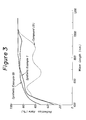
- Figures l and 2 are the reflection spectra of a color images of pressure-sensitive and heat-sensitive recording papers, respectively, prepared with the present compound and the referenced compound and Figure 3 is the reflection spectra of a texture of heat- sensitive recording paper prepared with the present compound and the referenced compound.
- the present compound is a divinyl compound represented by the following formula (I): and as the concrete example thereof, the following compounds may be exemplified. Every compound is an almost colorless solid and develops a blue-black to black color rapidly by the action of activated clay.
- the divinylphthalide compounds according to the present invention can be synthesized by the method shown below.
- an ethylene derivative represented by the formula (2) is synthesized from a ketone by one of the following Grignard reactions a, b and c: wherein X represents a halogen atom.
- phthalic acid derivatives represented by the formula (3) for instance, the following compounds can be mentioned.
- Tetrachlorophthalic anhydride 4-chloro-3,5,6-tribromophthalic anhydride; 4,5-dichloro-3,6-dibromophthalic anhydride; 4-bromo-3,5,6-trichlorophthalic anhydride; 4,5-dibromo-3,6-dichlorophthalic anhydride; tetrabromophthalic anhydride; tetrafluorophthalic anhydride; tetraiodophthalic anhydride; 4,5-dichloro-3,6-difluorophthalic anhydride; 4-chloro-3,5,6-triiodophthalic anhydride and 4,5-dichloro-3,6-diiodophthalic anhydride.
- one or more of the compounds can be used.
- the chromogenic property and the stability in preserving the color image are improved.
- various known chromogenic agents which give various hues can be used with the present compound to the extent not to damage the facilities of the present compound.
- the present compound can be used with the chromogenic agent which has the fundamental skeleton such as 3,3-bis(aminophenyl)-6-aminophthalide, 3,3-bis(indolyl)phthalide, 3-aminofluoran, aminobenzofluoran, 2,6diaminofluoran, 2,6-diamino-3-methylfluoran, spiropyrane, phenothiazine, phenoxazine, leucoauramine, diarylcarbazolylmethane, 3-indolyl-3-(aminophenyl)azaphthalide, triaminofluorenephthalide, tetraaminodivinylphthalide.
- the fundamental skeleton such as 3,3-bis(aminophenyl)-6-aminophthalide, 3,3-bis(indolyl)phthalide, 3-aminofluoran, aminobenzofluoran, 2,6diamino
- a solvent for a chromogenic agent various solvents of alkylbenzene series, alkylbiphenyl series, alkylnaphthalene series, diarylethane series, hydrogenated terphenyl series and chlorinated paraffin series can be used singly or as a mixture, and for encapsulation, a coacervation method, an interfacial polymerization method or an In-situ method can be applied.
- clays such as bentonite, activated clay, acid clay, etc.; metal salt of salicylic acid, salicylic ester derivatives, salicylic acid derivatives, etc.; hydroxy compounds such as 2,2-bis(p-hydroxyphenyl)propane (bisphenol A), esters of p-hydroxybenzoic acid, etc.; p-phenylphenol-formaldehyde resin, p-octylphenolformaldehyde resin and metal salt thereof, are used.
- polyvinyl alcohol methylcellulose, hydroxyethylcellulose, carboxymethylcellulose, gum arabic, gelatine, caseine, starch, polyvinyl pyrrolidone, copolymer of styrene and maleic anhydride, can be used.
- one or more of the following hydroxy compounds can be used: p-phenylphenol, p-hydroxydiphenyl ether, methyl p-hydroxybenzoate, benzyl p-hydroxybenzoate, 2,2-bis(p-hydroxyphenyl)propane, 4,4 ⁇ -thiodiphenol, bis-(4-hydroxy-3-methylphenyl) sulfide, 4,4 ⁇ -dihydroxydiphenylsulfone, 4-hydroxy-4 ⁇ -methyldiphenylsulfone, 4-hydroxy-4 ⁇ -ethyldiphenylsulfone, 3,4-dihydroxy-4 ⁇ -methyldiphenylsulfone, 4-hydroxy-4 ⁇ isopropoxydiphenylsulfone, 4,4 ⁇ -dihydroxy-3,3 ⁇ -dimethyldiphenylsulfone, 4,4 ⁇ -dihydroxy-3,3 ⁇ -diallyldiphenylsulfone, l,5-di(4-hydroxyphenyl
- acetoanilide As a sensitivity-improving agent, acetoanilide; paraffin wax; carnauba wax; higher fatty acids; esters of a higher fatty acid; amides of a higher fatty acid; phthalic esters; terephthalic esters; benzyl 4-benzyloxybenzoate; naphthol benzyl ether; l,4-dialkoxynaphthalene; m-terphenyl; p-benzylbiphenyl, dibenzylbenzene; esters of l-hydroxy-2-naphthoic acid; l-phenoxy-2-naphthoxy-l-ethane; l,2-di(3-methylphenoxy)ethane; l-(2-isopropylphenoxy)-2-naphthoxy-2-ethane; esters of 2-hydroxy-3-naphthoic acid; 4,4 ⁇ -dialkoxydiphenyl
- the compound was colored rapidly into blue-black by activated clay and the ⁇ max thereof in methanol ⁇ stannic chloride was 900 nm.
- a solution was prepared by mixing l9.7 g of 4-methoxy-4 ⁇ -pyrrolidinobenzophenone (melting at l52 - l54°C) and l00 ml of tetrahydrofurane, and the solution was slowly added to the liquid reaction mixture and the whole matter was stirred for one hour at a temperature of 40 to 50°C. Then the whole matter was mixed with 400 ml of water and 300 ml of toluene and after making the mixture weakly acidic by dilute hydrochloric acid, the acidified mixture was stirred for a while at 80°C and separated into an aqueous layer and an organic layer (toluene layer).
- the compound was colored rapidly into blue-black by activated clay and the ⁇ max thereof in methanol ⁇ stannic chloride was 897 nm.
- reaction mixture Into 200 ml of water the reaction mixture was added and after making the mixture alkaline by adding sodium hydroxide, the alkaline reaction mixture was extracted with 70 ml of toluene. The solid matter obtained by evaporating toluene from the extract was recrystallized from ethyl alcohol while purifying with activated carbon and obtained l8.2 g of pale yellow crystals melting at 95°C (decomposed).
- the compound was colored rapidly into blue-black by activated clay and the ⁇ max thereof in methanol ⁇ stannic chloride was 9l0 nm.
- any publicly known method can be used, for instance, the coacervation method disclosed in U.S. Patents Nos. 2,800,458 and 2,806,457.
- a publicly known method for instance, the method disclosed in Japanese Patent Publication No. 45-l4039/l960, can be used.
- dilute acetic acid was added to the mixture to adjust the pH to 4.5 and after stirring for about one hour at 50°C, the mixture was cooled to 0 to 5°C and stirred for 30 minutes. Then, 35 parts by weight of an aqueous 4% solution of glutaraldehyde were slowly added to the mixture to harden the resulting capsules and pH of the mixture was adjusted to 6 by adding a dilute aqueous solution of sodium hydroxide to complete the capsulation. During the operations, no coloring was observed.
- the capsule suspension obtained was uniformly coated on a sheet of paper by a wire-bar so that the coated weight of capsules after drying became 6 g/m2 and the sheet was dried to obtain a capsule-coated paper sheet (the upper paper sheet).
- the color image appeared were excellent in light-resistance and moisture-resistance and since the image had a strong absorption in the range of 800 to l000 nm, it was possible to read the letters by OCR. Furthermore, the surface of the paper coated with the capsules had an excellent light-resistance, and its color and chromogenic ability were not reduced by sun light.
- PRODUCTION EXAMPLE 2
- a mixture of the following recipe was pulverized by a paintshaker (made by TOYO-SEIKI Co., Ltd.) until the mean diameter of the particles of the chromogenic agent became 2 ⁇ m: 5 parts by weight of 3,3-bis[2-(p-pyrrodinophenyl)-2-(p-methoxyphenyl)ethenyl]-4,5,6,7-tetrachlorophthalide (Synthetic Example l), l5 parts by weight of kaoline, l00 parts by weight of an aqueous l0% solution of polyvinyl alcohol and 85 parts by weight of water.
- a mixture of the following recipe was pulverized by a paintshaker until the mean diameter of the particles of developer and sensitizer became 3 ⁇ m: l5 parts by weight of bisphenol A, l0 parts by weight of zinc stearate, l5 parts by weight of stearic amide and l50 parts by weight of an aqueous l0% solution of polyvinyl alcohol.
- a liquid heat-sensitive material was obtained.
- the liquid material was coated on a sheet of paper by a wire-bar uniformly so that the coated weight of solid materials after drying became 6 g/m2 and the sheet of paper was dried to obtain a heat-sensitive recording paper.
- the heat-sensitive recording paper was nearly colorless and did not show any spontaneous coloring (refer to Figure 3).
- the heat-sensitive recording paper showed a dark-black color by the heating with a heated pen.
- the color image obtained was excellent in light-resistance and moisture-resistance and as the color image had a strong absorption in the range of 700 and l050 nm, it was possible to read the image by OCR.
- the divinyl compound according to the present invention is the excellent chromogenic agent for the recording materials.
Landscapes
- Chemical & Material Sciences (AREA)
- Organic Chemistry (AREA)
- Chemical Kinetics & Catalysis (AREA)
- General Chemical & Material Sciences (AREA)
- Physics & Mathematics (AREA)
- Optics & Photonics (AREA)
- Color Printing (AREA)
- Plural Heterocyclic Compounds (AREA)
Abstract

Description
- The present invention relates to a recording-material such as pressure-sensitive recording paper, heat-sensitive recording paper, electro-heat sensitive recording paper, etc. More in detail, the present invention relates to a recording-material prepared by using a divinyl phthalide compound represented by the formula (I):


X² represents a halogen atom or a combination thereof,
X³ represents an alkyl group of less than eight carbon atoms, an alkoxy group of less than eight carbon atoms, a halogen atom or a combination thereof,
R¹ represents a heterocyclic ring having one or more nitrogen atoms,
R² and R³ represent respectively a hydrogen atom, an alkyl group, an alkoxyalkyl group, a haloalkyl group or a combination thereof, and
m and n represent an integer of 0, l, 2 or 3, respectively. When m and n are not less than 2, X¹ of (X¹) n, X² of (X²)₄ and X³ of (X³)m can be same or different.
(Hereinafter the same sign means the same meaning.) - The divinyl phthalide compounds represented by the formula (I) are the novel compounds synthesized for the first time by the present inventors. The compounds are by themselves almost colorless, extremely stable in the atmosphere, have no subliming property and spontaneously chromogenic property and dissolve extremely well in organic solvents. They give a blakish color rapidly by a developer and its color image is excellent in light-resistance and moisture-resistance. Furthermore, since the color image has a strong absorption between 700 and l000 nm in addition of the visible region, the color image has a distinctive feature that it is possible to be read by the optical letter-reading apparatus using the near infrared rays (such as OCR and OMR) and the barcord reading apparatus. Namely, the divinyl phthalide compound of the present invention (hereinafter referred to as the present compound) is an extremely valuable and novel compound which can be used as a chromogenic agent for an ordinary recording-material developing black color, of which demand is rapidly increasing recently, as well as the material readable with OCR, OMR, etc.
- The color image due to the black-coloring fluorane compound (A), which has been used as a conventional chromogenic agent for a recording-material, does not have any absorption in the near infrared region and accordingly, the color image could not be read by an optical letter-reading apparatus (refer to Figure 2):

- On the other hand, as the chromogenic agents having an absorption in the near infrared region, some compounds have been recently proposed in Japanese Patent Publication No. 58-5940/l9B3, Japanese Patent Application Laid-Open (KOKAI) No. 59-l99757/l984 and Japanese Patent Application Laid-Open (KOKAI) No. 60-230890/l985. However, each of the proposed compounds has the following defects and any satisfactory chromogenic agent has not been obtained in the present situation.
- Namely, the compound (B) of Japanese Patent Publication No. 58-5940/l983 and the compound (C) of Japanese Patent Application Laid-Open (KOKAI) No. 60-230890/l985 have been themselves strongly colored in yellow and besides, they are strong in the spontaneous coloring. These defects have very bad effect on production of the recording materials.
- Although the fluorene compound (D) of Japanese Patent Application Laid-Open (KOKAI) No. 59-l99757/l984 is colorless, the chromogenic property and the stability of color image are poor.
- Furthermore, the hue of each of compounds (B), (C) and (D), when developed color, is green and accordingly, to obtain blackish color, another chromogenic agent giving red or black color must be added in a large amount, and since the chromogenic property and the chromogenic speed of each agent are different from those of compounds (B), (C) and (D) and particularly, the light-resistance of red-chromogenic agent is generally poor, bad influences such as unbalance of color-development and reduction of light-resistance could not be avoided.


- As a result of the present inventors' earnest studies to improve the defects of the conventional chromogenic agents, the present invention has been attained.
- The present invention has been attained by the present inventors who have found out that the divinyl compounds (I) are unexpectedly excellent in several properties such as the solubility, the coloring of the compound itself, the hue of the developed color, the chromogenic property, the absorbancy of near infrared rays and the stability of color image and have studies further the problems, and the present invention provides the compounds represented by the formula (I) and a chromogenic recording materials, which contains the compound (I) as a chromogenic agent.
- The object of the present invention lies in offering a novel divinyl compound represented by the following formula (I):

- Furthermore, the object of the present invention lies in offering a chromogenic dye-precursor material of blackish color represented by the formula (I).
- Still more, the object of the present invention lies in offering a recording-material characterized in that it contains the divinyl compound represented by the formula (I) as a chromogenic agent.
- Of the attached drawings, Figures l and 2 are the reflection spectra of a color images of pressure-sensitive and heat-sensitive recording papers, respectively, prepared with the present compound and the referenced compound and Figure 3 is the reflection spectra of a texture of heat- sensitive recording paper prepared with the present compound and the referenced compound.
- The present compound is a divinyl compound represented by the following formula (I):

- 1. 3,3-Bis[2-(p-pyrrolidinophenyl)-2-(p-methoxyphenyl)ethenyl]-4,5,6,7-tetrachlorophthalide,
- 2. 3,3-Bis[2-(p-pyrrolidinophenyl)-2-(p-ethoxyphenyl)ethenyl]-4,5,6,7-tetrachlorophthalide,
- 3. 3,3-Bis[2-(p-pyrrolidinophenyl)-2-(p-propoxyphenyl)ethenyl]-4,5,6,7-tetrachlorophthalide,
- 4. 3,3-Bis[2-(p-pyrrolidinophenyl)-2-(p-iso-propoxyphenyl) ethenyl]-4,5,6,7-tetrachlorophthalide,
- 5. 3,3-Bis[2-(p-pyrrolidinophenyl)-2-(p-butoxyphenyl)ethenyl]4,5,6,7-tetrachlorophthalide,
- 6. 3,3-Bis[2-(p-pyrrolidinophenyl)-2-(p-iso-butoxyphenyl)ethenyl]-4,5,6,7-tetrachlorophthalide,
- 7. 3,3-Bis[2-(p-pyrrolidinophenyl)-2-(p-sec-butoxyphenyl)ethenyl]4,5,6,7-tetrachlorophthalide,
- 8. 3,3-Bis[2-(p-pyrrolidinophenyl)-2-(p-tert-butoxyphenyl)ethenyl]4,5,6,7-tetrachlorophthalide,
- 9. 3,3-Bis[2-(p-pyrrolidinophenyl)-2-(m-methyl-p-methoxyphenyl)ethenyl]4,5,6,7-tetrachlorophthalide,
- l0. 3,3-Bis[2-(p-pyrrolidinophenyl)-2-(3,4-dimethoxyphenyl)ethenyl]-4,5,6,7-tetrachlorophthalide,
- 11. 3,3-Bis[2-(p-pyrrolidinophenyl)-2-phenyl-ethenyl]4,5,6,7-tetrachlorophthalide,
- 12. 3,3-Bis[2-(p-pyrrolidinophenyl)-2-(p-methylphenyl)ethenyl]-4,5,6,7-tetrachlorophthalide,
- 13. 3,3-Bis[2-(p-pyrrolidinophenyl)-2-(p-methoxyphenyl)ethenyl]-4,5,6,7-tetrabromophthalide,
- 14. 3,3-Bis[2-(p-pyrrolidinophenyl)-2-(p-pentyloxyphenyl)ethenyl]-4,5,6,7-tetrachlorophthalide,
- 15. 3,3-Bis[2-(p-pyrrolidinophenyl)-2-(p-iso-pentyloxyphenyl)ethenyl]-4,5,6,7-tetrachlorophthalide,
- 16. 3,3-Bis[2-(p-pyrrolidinophenyl)-2-(p-chlorophenyl)ethenyl]-4,5,6,7-tetrachlorophthalide,
- 17. 3,3-Bis[2-(p-pyrrolidinophenyl)-2-(p-ethoxyphenyl)ethenyl]-4,5,6,7-tetrabromophthalide,
- 18. 3,3-Bis[2-(p-pyrrolidinophenyl)-2-(m-methoxy-p-ethoxyphenyl) ethenyl]-4,5,6,7-tetrachlorophthalide,
- 19. 3,3-Bis[2-(p-pyrrolidinophenyl)-2-(m-methyl-p-ethoxyphenyl)ethenyl]-4,5,6,7-tetrachlorophthalide,
- 20. 3,3-Bis[2-(p-pyrrolidinophenyl)-2-(p-methoxyphenyl)ethenyl]-5,6-dichloro-4,7-dibromophthalide,
- 2l. 3,3-Bis[2-(p-pyrrolidinophenyl)-2-(p-methylphenyl)ethenyl]-5-chloro-4,6,7-tribromophthalide,
- 22. 3,3-Bis[2-(p-pyrrolidinophenyl)-2-(p-methylphenyl)ethenyl]-4,5,6,7-tetrabromophthalide,
- 23. 3,3-Bis[2-(p-pyrrolidinophenyl)-2-(o-methyl-p-methoxyphenyl)ethenyl]-4,5,6,7-tetrachlorophthalide,
- 24. 3,3-Bis[2-(p-pyrrolidinophenyl)-2-(3,4-dimethylphenyl)ethenyl]-4,5,6,7-tetrabromophthalide,
- 25. 3,3-Bis[2-(p-pyrrolidino-o-methylphenyl)-2-(p-methylphenyl)ethenyl]-4,5,6,7-tetrachlorophthalide,
- 26. 3,3-Bis[2-(p-pyrrolidinophenyl)-2-(p-ethylphenyl)ethenyl]-4,5,6,7-tetrachlorophthalide,
- 27. 3,3-Bis[2-(p-pyrrolidino-o-chlorophenyl)-2-(p-methoxyphenyl)ethenyl]-4,5,6,7-tetrachlorophthalide,
- 28. 3,3-Bis[2-(p-2,5-dimethylpyrrolidinophenyl)-2-(p-methylphenyl)ethenyl]-4,5,6,7-tetrachlorophthalide,
- 29. 3,3-Bis[2-(p-piperidinophenyl)-2-(p-methoxyphenyl) ethenyl]-4,5,6,7-tetrachlorophthalide,
- 30. 3,3-Bis[2-(p-piperidinophenyl)-2-(p-methylphenyl)ethenyl]-4,5,6,7-tetrachlorophthalide,
- 3l. 3,3-Bis[2-(p-piperidinophenyl)-2-(p-methylphenyl)ethenyl]-4,5,6,7-tetrabromophthalide,
- 32. 3,3-Bis[2-(p-2-methylpiperidinophenyl)-2-phenylethenyl]-4,5,6,7-tetrachlorophthalide,
- 33. 3,3-Bis[2-(p-4-methylpiperidinophenyl)-2-(p-methoxyphenyl)ethenyl]-4,5,6,7-tetrachlorophthalide,
- 34. 3,3-Bis[2-(p-hexamethyleneiminophenyl)-2-(p-methylphenyl)ethenyl]-4,5,6,7-tetrachlorophthalide.
- 35. 3,3-Bis[2-(p-morpholinophenyl)-2-(p-methoxyphenyl)ethenyl]-4,5,6,7-tetrachlorophthalide,
- 36. 3,3-Bis[2-(p-pyrrodinophenyl)-2-(p-octylphenyl)ethenyl]4,5,6,7-tetrachlorophthalide,
- 37. 3,3-Bis[2-(l-ethylindolin-5-yl)-2-(p-methylphenyl)ethenyl]-4,5,6,7-tetrachlorophthalide,
- 38. 3,3-Bis[2-(l-methylindolin-5-yl)-2-(p-methoxyphenyl)ethenyl]-4,5,6,7-tetrachlorophthalide,
- 39. 3,3-Bis[2-(l,2,3,4-tetrahydroquinolin-6-yl)-2-(p-methylphenyl)ethenyl]-4,5,6,7-tetrachlorophthalide,
- 40. 3,3-Bis[2-(l-methoxyethyl-l,2,3,4-tetrahydroquinolin-6-yl)-2-(p-methylphenyl)ethenyl]-4,5,6,7-tetrabromophthalide,
- 4l. 3,3-Bis[2-durrolidinyl-2-(p-ethoxyphenyl)ethenyl]- 4,5,6,7-tetrachlorophthalide,
- 42. 3,3-Bis[2-(p-pyrrolidinophenyl)-2-(p-methoxyethoxyphenyl)ethenyl]-4,5,6,7-tetrachlorophthalide,
- 43. 3,3-Bis[2-(p-pyrrolidinophenyl)-2-(p-allyloxyphenyl)ethenyl]-4,5,6,7-tetrachlorophthalide,
- 44. 3,3-Bis[2-(p-pyrrolidinophenyl)-2-(p-chloropropoxyphenyl)ethenyl]-4,5,6,7-tetrachlorophthalide,
- 45. 3,3-Bis[2-(p-pyrrolidinophenyl)-2-(p-cyclopentyloxyphenyl)ethenyl]-4,5,6,7-tetrachlorophthalide,
- 46. 3,3-Bis[2-(p-pyrrolidinophenyl)-2-(p-cyclohexyloxyphenyl)ethenyl]-4,5,6,7-tetrachlorophthalide,
- 47. 3,3-Bis[2-(p-pyrrolidinophenyl)-2-(p-benzyloxyphenyl)ethenyl]-4,5,6,7-tetrachlorophthalide,
- 48. 3,3-Bis[2-(p-pyrrolidinophenyl)-2-(p-phenoxyphenyl)ethenyl]-4,5,6,7-tetrachlorophthalide, and
- 49. 3,3-Bis{2-(p-pyrrolidinophenyl)-2-[p-(p-methoxyphenoxy)phenyl]ethenyl}-4,5,6,7-tetrachlorophthalide.
- The divinylphthalide compounds according to the present invention can be synthesized by the method shown below.
- As a first step, an ethylene derivative represented by the formula (2) is synthesized from a ketone by one of the following Grignard reactions a, b and c:

- Then, 2 mols of the ethylene derivative (2) and l mol of a phthalic acid derivative (3) are condensated in the presence of a dehydrating agent such as acetic anhydride, sulfuric acid, etc., and by purifying the reaction product, the divinylphthalide compounds represented by the formula (I) are obtained as nearly colorless crystals.

- As the concrete examples of the ethylene derivative represented by the formula (2), the following compounds can be exemplified:
- 1. l-Phenyl-l-(p-pyrrolidinophenyl)ethylene,
- 2. l-(p-methylphenyl)-l-(p-pyrrolidinophenyl)ethylene,
- 3. l-(p-methoxyphenyl)-l-(p-pyrrolidinophenyl)ethylene,
- 4. l-(p-ethoxyphenyl)-l-(p-pyrrolidinophenyl)ethylene,
- 5. l-(p-butoxyphenyl)-l-(p-pyrrolidinophenyl)ethylene,
- 6. l-(p-methoxyphenyl)-l-(p-pyrrolidino-o-methylphenyl)ethylene,
- 7. l-(p-methoxyphenyl)-l-(p-pyrrolidino-o-methoxyphenyl)ethylene,
- 8. l-(2,4-dimethylphenyl)-l-(p-pyrrolidinophenyl)ethylene,
- 9. l-(2,4-dimethoxyphenyl)-l-(p-pyrrolidinophenyl)ethylene,
- l0. l-(p-chlorophenyl)-l-(p-pyrrolidinophenyl)ethylene,
- 11. l-(p-methylphenyl)-l-(p-2,5-dimethylpyrrolidinophenyl)ethylene,
- 12. l-(p-methylphenyl)-l-(p-piperidinophenyl)ethylene,
- 13. l-(p-methoxyphenyl)-l-(p-4-methylpiperidinophenyl)ethylene,
- 14. l-(p-methylphenyl)-l-(p-hexamethyleneiminophenyl)ethylene,
- 15. l-(p-methoxyphenyl)-l-(p-morpholinophenyl)ethylene,
- 16. l-(p-methoxyphenyl)-l-(l-methylindoline-5-yl)ethylene,
- 17. l-(p-methoxyphenyl)-l-(l-methyl-l,2,3,4-tetrahydroquinolin-6-yl)ethylene, and
- 18. l-(p-methoxyphenyl)-l-durrolidinylethylene.
- As phthalic acid derivatives represented by the formula (3), for instance, the following compounds can be mentioned.
- Tetrachlorophthalic anhydride; 4-chloro-3,5,6-tribromophthalic anhydride; 4,5-dichloro-3,6-dibromophthalic anhydride; 4-bromo-3,5,6-trichlorophthalic anhydride; 4,5-dibromo-3,6-dichlorophthalic anhydride; tetrabromophthalic anhydride; tetrafluorophthalic anhydride; tetraiodophthalic anhydride; 4,5-dichloro-3,6-difluorophthalic anhydride; 4-chloro-3,5,6-triiodophthalic anhydride and 4,5-dichloro-3,6-diiodophthalic anhydride.
- In case where a pressure-sensitive recording paper, a heat-sensitive recording paper, etc. is produced with these divinylphthalide compounds, one or more of the compounds can be used. By mixing not less than two of the compounds, the chromogenic property and the stability in preserving the color image are improved. Moreover, to make the hue and the concentration of developed color, and the stability of color image more complete, various known chromogenic agents which give various hues can be used with the present compound to the extent not to damage the facilities of the present compound.
- For instance, the present compound can be used with the chromogenic agent which has the fundamental skeleton such as 3,3-bis(aminophenyl)-6-aminophthalide, 3,3-bis(indolyl)phthalide, 3-aminofluoran, aminobenzofluoran, 2,6diaminofluoran, 2,6-diamino-3-methylfluoran, spiropyrane, phenothiazine, phenoxazine, leucoauramine, diarylcarbazolylmethane, 3-indolyl-3-(aminophenyl)azaphthalide, triaminofluorenephthalide, tetraaminodivinylphthalide.
- When producing a pressure-sensitive recording paper, as a solvent for a chromogenic agent, various solvents of alkylbenzene series, alkylbiphenyl series, alkylnaphthalene series, diarylethane series, hydrogenated terphenyl series and chlorinated paraffin series can be used singly or as a mixture, and for encapsulation, a coacervation method, an interfacial polymerization method or an In-situ method can be applied.
- As a developer, clays such as bentonite, activated clay, acid clay, etc.; metal salt of salicylic acid, salicylic ester derivatives, salicylic acid derivatives, etc.; hydroxy compounds such as 2,2-bis(p-hydroxyphenyl)propane (bisphenol A), esters of p-hydroxybenzoic acid, etc.; p-phenylphenol-formaldehyde resin, p-octylphenolformaldehyde resin and metal salt thereof, are used.
- When producing a heat-sensitive recording paper, as a binder, polyvinyl alcohol, methylcellulose, hydroxyethylcellulose, carboxymethylcellulose, gum arabic, gelatine, caseine, starch, polyvinyl pyrrolidone, copolymer of styrene and maleic anhydride, can be used.
- As a developer, one or more of the following hydroxy compounds can be used:
p-phenylphenol, p-hydroxydiphenyl ether, methyl p-hydroxybenzoate, benzyl p-hydroxybenzoate, 2,2-bis(p-hydroxyphenyl)propane, 4,4ʹ-thiodiphenol, bis-(4-hydroxy-3-methylphenyl) sulfide, 4,4ʹ-dihydroxydiphenylsulfone, 4-hydroxy-4ʹ-methyldiphenylsulfone, 4-hydroxy-4ʹ-ethyldiphenylsulfone, 3,4-dihydroxy-4ʹ-methyldiphenylsulfone, 4-hydroxy-4ʹisopropoxydiphenylsulfone, 4,4ʹ-dihydroxy-3,3ʹ-dimethyldiphenylsulfone, 4,4ʹ-dihydroxy-3,3ʹ-diallyldiphenylsulfone, l,5-di(4-hydroxyphenylthio)-3-oxapentane, l,7-di(4-hydroxyphenylthio)-3,5-dioxaheptane, l,8-di(4-hydroxyphenylthio)3,6-dioxaoctane, bis(4-hydroxy-3-methylphenyl) sulfide, etc. - As a sensitivity-improving agent, acetoanilide; paraffin wax; carnauba wax; higher fatty acids; esters of a higher fatty acid; amides of a higher fatty acid; phthalic esters; terephthalic esters; benzyl 4-benzyloxybenzoate; naphthol benzyl ether; l,4-dialkoxynaphthalene; m-terphenyl; p-benzylbiphenyl, dibenzylbenzene; esters of l-hydroxy-2-naphthoic acid; l-phenoxy-2-naphthoxy-l-ethane; l,2-di(3-methylphenoxy)ethane; l-(2-isopropylphenoxy)-2-naphthoxy-2-ethane; esters of 2-hydroxy-3-naphthoic acid; 4,4ʹ-dialkoxydiphenylsulfone; benzamide; diphenylamine, benzenesulfonamide; benzenesulfonanilide; carbazole, hydroquinone dibenzyl ether; diphenyl carbonate, etc. can be used singly or after mixing together.
- Furthermore, in order to improve the light-resistance and the preservability of the color image, it is effective to add an anti-oxidant, an anti-deteriorant or an ultraviolet absorbent, or to overcoat a high polymeric substance.
- The present invention will be concretely explained while referring to the Synthetic Examples of the compound represented by the formula (I) and the Production Examples of the chromogenic recording-material with the compound represented by the formula (I) as follow.
- Into a mixture of 25 ml of acetic anhydride and 75 ml of o-dichlorobenzene, l4.0 g of l-(p-methoxyphenyl)-l-(p-pyrrolidinophenyl)ethylene (m.p. ll5 - ll8°C) and 2l.5 g of tetrachlorophthalic anhydride were added and the mixture was stirred for 6 hours at l20°C. Into 200 ml of water the reaction mixture was added and after making the mixture alkaline by adding sodium hydroxide, the alkaline reaction mixture was extracted with 70 ml of toluene. The solid matter obtained by evaporating toluene from the extract was recrystallized from acetone while purifying with activated carbon to obtain l7.6 g of pale yellow crystals melting at l59 to l6l°C. (Yield: 85.2%)
- From the elementary analysis, the infrared absorption spectrum and the nuclear magnetic resonance spectrum of the product obtained, it was confirmed that the product was represented by the following formula:

- The compound was colored rapidly into blue-black by activated clay and the λmax thereof in methanol · stannic chloride was 900 nm.
- The ethylene derivative, l-(p-methoxyphenyl)-l-(p-pyrrolidinophenyl)ethylene, used in the above reaction, was synthesized as follows.
- Into 30 ml of ether, 4 g of metallic magnesium were added and then 0.2 ml of methyl iodide was added to the mixture. After stirring the mixture for a while, a solution prepared by dissolving 24.8 g of methyl iodide into 40 ml of ether was added to the mixture taking 2 hours under a reflux condenser while stirring the mixture.
- Separately, a solution was prepared by mixing l9.7 g of 4-methoxy-4ʹ-pyrrolidinobenzophenone (melting at l52 - l54°C) and l00 ml of tetrahydrofurane, and the solution was slowly added to the liquid reaction mixture and the whole matter was stirred for one hour at a temperature of 40 to 50°C. Then the whole matter was mixed with 400 ml of water and 300 ml of toluene and after making the mixture weakly acidic by dilute hydrochloric acid, the acidified mixture was stirred for a while at 80°C and separated into an aqueous layer and an organic layer (toluene layer). After adding activated carbon to the toluene layer and filtering the layer while hot, toluene was distilled off from the filtrate to obtain l8.5 g of l-(p-methylxyphenyl)-l-(p-pyrrolidinophenyl)ethylene of pale yellow in color.
- Into 50 ml of acetic anhydride l4.7 g of l-(p-ethoxyphenyl)-l-(p-pyrrolidinophenyl)ethylene (m.p. l34 -l36°C) and l4.3 g of tetrachlorophthalic, anhydride were added and the mixture was stirred for 6 hours at ll5°C. Into 200 ml of water the reaction mixture was added and after making the mixture alkaline by adding sodium hydroxide, the alkaline reaction mixture was extracted with 70 ml of toluene. The solid matter obtained by evaporating toluene from the extract was recrystallized from acetone while purifying with activated carbon to obtain l7.7 g of pale yellow crystals melting at 22l to 223°C. (Yield: 82.9%)
- From the elementary analysis, the infrared absorption spectrum and the nuclear magnetic resonance spectrum of the product obtained, it was confirmed that the product was represented by the following formula:

- The compound was colored rapidly into blue-black by activated clay and the λmax thereof in methanol· stannic chloride was 897 nm.
- Into a mixture of l0 ml of acetic anhydride and 25 ml of o-dichlorobenzene, l4.3 g of tetrachlorophthalic anhydride was added and then l8.6 g of l-[p-(p-methoxy-phenoxy)phenyl]-l-(p-pyrrolidinophenyl)ethylene (m.p. l23.5 - l24.5°C) was added dropwise for l hour at l20°C and the mixture was stirred for 2 hours at the same temperature. Into 200 ml of water the reaction mixture was added and after making the mixture alkaline by adding sodium hydroxide, the alkaline reaction mixture was extracted with 70 ml of toluene. The solid matter obtained by evaporating toluene from the extract was recrystallized from ethyl alcohol while purifying with activated carbon and obtained l8.2 g of pale yellow crystals melting at 95°C (decomposed).
- From the elementary analysis, the infrared absorption spectrum and the nuclear magnetic resonance spectrum of the product obtained, it was confirmed that the product was represented by the following formula:

- The compound was colored rapidly into blue-black by activated clay and the λmax thereof in methanol·stannic chloride was 9l0 nm.
- By bringing various ethylene derivatives into reaction with various phthalic acid derivatives in the same manner as in Synthetic Examples l, 2 and 3, the divinyl compounds shown in Table l were synthesized. All the compounds were solid and colorless to pale yellow in color. They were colored rapidly into the hue shown in Table l.
- For preparing a pressure-sensitive recording paper with the divinyl compound represented by the formula (I), any publicly known method can be used, for instance, the coacervation method disclosed in U.S. Patents Nos. 2,800,458 and 2,806,457. For preparing the heat-sensitive recording paper, a publicly known method, for instance, the method disclosed in Japanese Patent Publication No. 45-l4039/l960, can be used.


- Into 95 parts by weight of monoisopropylbiphenyl, 5 parts by weight of the compound of Example 2, namely, 3,3-bis[2-(p-pyrrolidinophenyl)-2-(p-ethoxyphenyl)ethenyl]4,5,6,7-tetrachlorophthalide, were dissolved and a solution of 24 parts by weight of gelatine and 24 parts by weight of gum arabic into 400 parts by weight of water, of which pH was adjusted to 7, was added to the monoisopropylbiphenyl solution and the mixture was emulsified by a homogenizer. Into the emulsion, l00 parts by weight of warm water were added and after stirring the mixture for 30 minutes at 50°C about one part by weight of an aqueous l0% solution of sodium hydroxide was added and the mixture was further stirred for another 30 minutes at the same temperature.
- In the next step, dilute acetic acid was added to the mixture to adjust the pH to 4.5 and after stirring for about one hour at 50°C, the mixture was cooled to 0 to 5°C and stirred for 30 minutes. Then, 35 parts by weight of an aqueous 4% solution of glutaraldehyde were slowly added to the mixture to harden the resulting capsules and pH of the mixture was adjusted to 6 by adding a dilute aqueous solution of sodium hydroxide to complete the capsulation. During the operations, no coloring was observed.
- The capsule suspension obtained was uniformly coated on a sheet of paper by a wire-bar so that the coated weight of capsules after drying became 6 g/m² and the sheet was dried to obtain a capsule-coated paper sheet (the upper paper sheet).
- On piling the upper paper sheet onto a sheet of paper coated with a phenol-formaldehyde resin as a developer and applying writing pressure by a ball-pen on the sheets of paper, letters of deep black in color rapidly appeared on the piled-up sheets of paper.
- The color image appeared were excellent in light-resistance and moisture-resistance and since the image had a strong absorption in the range of 800 to l000 nm, it was possible to read the letters by OCR. Furthermore, the surface of the paper coated with the capsules had an excellent light-resistance, and its color and chromogenic ability were not reduced by sun light.
- In the same manner as in Production Example l except for using 5 parts by weight of the compound (D) as the chromogenic agent, a pressure-sensitive copying paper was prepared.
- On subjecting the pressure-sensitive copying paper to color-development by a lower paper sheet on which a phenolformaldehyde resin had been applied, a light green image appeared slowly.
- As the absorption of near infrared rays by the image was weak, it was difficult to read it by OCR (refer to Figure l).
- A mixture of the following recipe was pulverized by a paintshaker (made by TOYO-SEIKI Co., Ltd.) until the mean diameter of the particles of the chromogenic agent became 2 µm:
5 parts by weight of 3,3-bis[2-(p-pyrrodinophenyl)-2-(p-methoxyphenyl)ethenyl]-4,5,6,7-tetrachlorophthalide (Synthetic Example l),
l5 parts by weight of kaoline,
l00 parts by weight of an aqueous l0% solution of polyvinyl alcohol and
85 parts by weight of water. - A mixture of the following recipe was pulverized by a paintshaker until the mean diameter of the particles of developer and sensitizer became 3 µm:
l5 parts by weight of bisphenol A,
l0 parts by weight of zinc stearate,
l5 parts by weight of stearic amide and
l50 parts by weight of an aqueous l0% solution of polyvinyl alcohol. - By mixing l0 parts by weight of A-liquid and 6.5 parts by weight of B-liquid, a liquid heat-sensitive material was obtained. The liquid material was coated on a sheet of paper by a wire-bar uniformly so that the coated weight of solid materials after drying became 6 g/m² and the sheet of paper was dried to obtain a heat-sensitive recording paper.
- The heat-sensitive recording paper was nearly colorless and did not show any spontaneous coloring (refer to Figure 3). The heat-sensitive recording paper showed a dark-black color by the heating with a heated pen. The color image obtained was excellent in light-resistance and moisture-resistance and as the color image had a strong absorption in the range of 700 and l050 nm, it was possible to read the image by OCR.
- The same results have been obtained on using the compounds in another Synthetic Examples.
- In the same manner as in Production Example 2 except for using 5 parts by weight of the compound (A), a heat-sensitive recording paper was obtained. Although the heat-sensitive recording paper was colored into black by heating with a heated pen, as the color image did not absorb any near infrared rays, it was impossible to read the color image by OCR (refer to Figure 2).
- In the same manner as in Production Example 2 except for using 5 parts by weight of the compound (B), a heat-sensitive recording paper was obtained. The heat-sensitive recording paper showed yellowish green spontaneous coloring. On heating the paper with a heated pen, green color was developed (refer to Figures 2 and 3).
- From the above Production Examples and Comparative Examples, it has been confirmed that the divinyl compound according to the present invention is the excellent chromogenic agent for the recording materials.
Claims (38)


Applications Claiming Priority (4)
| Application Number | Priority Date | Filing Date | Title |
|---|---|---|---|
| JP61087619A JPH0762111B2 (en) | 1986-04-15 | 1986-04-15 | Divinyl compound and color forming recording material using the same |
| JP87619/86 | 1986-04-15 | ||
| JP23361/87 | 1987-02-02 | ||
| JP62023361A JPS63189281A (en) | 1987-02-02 | 1987-02-02 | Coloring recording material |
Publications (3)
| Publication Number | Publication Date |
|---|---|
| EP0242169A2 true EP0242169A2 (en) | 1987-10-21 |
| EP0242169A3 EP0242169A3 (en) | 1988-10-19 |
| EP0242169B1 EP0242169B1 (en) | 1992-01-02 |
Family
ID=26360714
Family Applications (1)
| Application Number | Title | Priority Date | Filing Date |
|---|---|---|---|
| EP87303230A Expired EP0242169B1 (en) | 1986-04-15 | 1987-04-13 | Divinyl compounds and chromogenic recording material prepared by use thereof |
Country Status (3)
| Country | Link |
|---|---|
| US (1) | US4808567A (en) |
| EP (1) | EP0242169B1 (en) |
| DE (1) | DE3775598D1 (en) |
Cited By (8)
| Publication number | Priority date | Publication date | Assignee | Title |
|---|---|---|---|---|
| DE3718790A1 (en) * | 1986-06-09 | 1988-01-28 | Yamada Chem Co | Heat-sensitive recording material |
| US4814320A (en) * | 1986-04-15 | 1989-03-21 | Yamada Chemical Co., Ltd. | Heat-sensitive recording material |
| US4985392A (en) * | 1989-04-21 | 1991-01-15 | Minnesota Mining And Manufacturing Company | Colored thermographic media |
| GB2198139B (en) * | 1986-09-22 | 1991-01-23 | Fuji Photo Film Co Ltd | Polymerizable dye precursor and color-forming recording material containing the same |
| EP0386992A3 (en) * | 1989-03-08 | 1991-06-12 | Appleton Papers Inc. | Colour formers for recording sheets |
| EP0437185A3 (en) * | 1990-01-11 | 1992-02-05 | Ciba-Geigy Ag | Pyrroline-resp. indoline containing phthalides |
| US5116978A (en) * | 1989-03-08 | 1992-05-26 | Appleton Papers Inc. | Process for bis(indolyl)ethylene synthesis |
| US5157012A (en) * | 1989-08-23 | 1992-10-20 | Appleton Papers Inc. | Di[bis-(indolyl)ethylenyl]tetrahalophthalide record materials |
Families Citing this family (1)
| Publication number | Priority date | Publication date | Assignee | Title |
|---|---|---|---|---|
| JP3306596B2 (en) * | 1991-04-26 | 2002-07-24 | 山田化学工業株式会社 | Phthalide compound and recording material using the same |
Family Cites Families (7)
| Publication number | Priority date | Publication date | Assignee | Title |
|---|---|---|---|---|
| US3736337A (en) * | 1971-04-27 | 1973-05-29 | Ncr Co | Tetrahalogenated chromogenic compounds and their use |
| US4107128A (en) * | 1975-02-20 | 1978-08-15 | Asahi Kasei Kogyo Kabushiki Kaisha | Carbon fiber composition |
| US4022771A (en) * | 1975-04-10 | 1977-05-10 | Ncr Corporation | Aminophenyl lactone compounds containing an ethyleno group |
| US4020056A (en) * | 1975-04-10 | 1977-04-26 | Ncr Corporation | Di-vinyl phthalides color formers |
| EP0062544B1 (en) * | 1981-04-08 | 1987-09-30 | Kanzaki Paper Manufacturing Company Limited | New phthalide derivatives, process for preparing the same and recording system utilizing the same as colourless chromogenic material |
| JPS57167979A (en) * | 1981-04-08 | 1982-10-16 | Kanzaki Paper Mfg Co Ltd | Phthalide derivative, its preparation, recording material using it |
| US4730057A (en) * | 1985-01-17 | 1988-03-08 | Kanzaki Paper Manufacturing Co., Ltd. | Phthalide derivatives useful as colorless chromogenic material |
-
1987
- 1987-04-13 US US07/037,669 patent/US4808567A/en not_active Expired - Lifetime
- 1987-04-13 EP EP87303230A patent/EP0242169B1/en not_active Expired
- 1987-04-13 DE DE8787303230T patent/DE3775598D1/en not_active Expired - Lifetime
Cited By (9)
| Publication number | Priority date | Publication date | Assignee | Title |
|---|---|---|---|---|
| US4814320A (en) * | 1986-04-15 | 1989-03-21 | Yamada Chemical Co., Ltd. | Heat-sensitive recording material |
| DE3718790A1 (en) * | 1986-06-09 | 1988-01-28 | Yamada Chem Co | Heat-sensitive recording material |
| GB2198139B (en) * | 1986-09-22 | 1991-01-23 | Fuji Photo Film Co Ltd | Polymerizable dye precursor and color-forming recording material containing the same |
| EP0386992A3 (en) * | 1989-03-08 | 1991-06-12 | Appleton Papers Inc. | Colour formers for recording sheets |
| US5116978A (en) * | 1989-03-08 | 1992-05-26 | Appleton Papers Inc. | Process for bis(indolyl)ethylene synthesis |
| US4985392A (en) * | 1989-04-21 | 1991-01-15 | Minnesota Mining And Manufacturing Company | Colored thermographic media |
| US5157012A (en) * | 1989-08-23 | 1992-10-20 | Appleton Papers Inc. | Di[bis-(indolyl)ethylenyl]tetrahalophthalide record materials |
| EP0437185A3 (en) * | 1990-01-11 | 1992-02-05 | Ciba-Geigy Ag | Pyrroline-resp. indoline containing phthalides |
| US5162544A (en) * | 1990-01-11 | 1992-11-10 | Ciba-Geigy Corporation | Indoline-containing phthalides |
Also Published As
| Publication number | Publication date |
|---|---|
| US4808567A (en) | 1989-02-28 |
| EP0242169B1 (en) | 1992-01-02 |
| DE3775598D1 (en) | 1992-02-13 |
| EP0242169A3 (en) | 1988-10-19 |
Similar Documents
| Publication | Publication Date | Title |
|---|---|---|
| US4436920A (en) | Image recording members | |
| US5491262A (en) | Bis{[1-(2-A-2-B)ethenyl]}[2-R2 -4-X-phenyl-or 1-(2-R2 -4-X-phenyl)ethenyl]methanes | |
| US4748148A (en) | Recording system utilizing phthalide derivatives as colorless chromogenic material | |
| EP0242169A2 (en) | Divinyl compounds and chromogenic recording material prepared by use thereof | |
| US4747875A (en) | Chromogenic azaphthalide compound and a colour-forming recording composition containing the same | |
| US4536220A (en) | Fluoran derivatives as new compounds and recording system utilizing the same as colorless chromogenic material | |
| EP0127203B1 (en) | New phthalide derivatives, process for preparing the same and recording system utilizing the same as colourless chromogenic material | |
| EP0242170A2 (en) | Divinyl compounds and chromogenic recording-material prepared by use thereof | |
| US4524373A (en) | Fluoran derivatives as new compounds, process for preparing the same and recording system utilizing the same as colorless chromogenic material | |
| CA2051320A1 (en) | Pressure-sensitive or heat-sensitive recording material | |
| EP0209259A2 (en) | Phthalide derivatives and recording system utilizing the same | |
| JPH045068B2 (en) | ||
| EP0256180A1 (en) | Chromogenic compounds for pressure- or heat-sensitive recording papers | |
| US4721702A (en) | Pressure-sensitive recording material | |
| JP2620092B2 (en) | Fluorane compounds and color-forming recording materials using the same | |
| JPH0762111B2 (en) | Divinyl compound and color forming recording material using the same | |
| JPS60139760A (en) | Color-forming recording material | |
| JP2686615B2 (en) | Fluoran compound and recording material using the same | |
| JP2562886B2 (en) | Recording material | |
| JPH0346473B2 (en) | ||
| US4794069A (en) | Spirobenzanthracene phthalide compounds, processes for preparing same and color forming recording materials containing said compounds | |
| JPH086045B2 (en) | Novel leuco dye and recording material using the same | |
| GB2104089A (en) | Aminofluoran derivatives and recording materials containing them | |
| JPS59133258A (en) | Fluoran derivative, production thereof and recording material using the same | |
| JPH02218760A (en) | Fluoran compound and recording material containing the same |
Legal Events
| Date | Code | Title | Description |
|---|---|---|---|
| PUAI | Public reference made under article 153(3) epc to a published international application that has entered the european phase |
Free format text: ORIGINAL CODE: 0009012 |
|
| AK | Designated contracting states |
Kind code of ref document: A2 Designated state(s): BE CH DE FR GB IT LI |
|
| PUAL | Search report despatched |
Free format text: ORIGINAL CODE: 0009013 |
|
| AK | Designated contracting states |
Kind code of ref document: A3 Designated state(s): BE CH DE FR GB IT LI |
|
| 17P | Request for examination filed |
Effective date: 19881201 |
|
| 17Q | First examination report despatched |
Effective date: 19901112 |
|
| GRAA | (expected) grant |
Free format text: ORIGINAL CODE: 0009210 |
|
| AK | Designated contracting states |
Kind code of ref document: B1 Designated state(s): BE CH DE FR GB IT LI |
|
| ITF | It: translation for a ep patent filed | ||
| REF | Corresponds to: |
Ref document number: 3775598 Country of ref document: DE Date of ref document: 19920213 |
|
| ET | Fr: translation filed | ||
| PLBE | No opposition filed within time limit |
Free format text: ORIGINAL CODE: 0009261 |
|
| STAA | Information on the status of an ep patent application or granted ep patent |
Free format text: STATUS: NO OPPOSITION FILED WITHIN TIME LIMIT |
|
| 26N | No opposition filed | ||
| PGFP | Annual fee paid to national office [announced via postgrant information from national office to epo] |
Ref country code: CH Payment date: 19930420 Year of fee payment: 7 |
|
| PGFP | Annual fee paid to national office [announced via postgrant information from national office to epo] |
Ref country code: BE Payment date: 19930513 Year of fee payment: 7 |
|
| PGFP | Annual fee paid to national office [announced via postgrant information from national office to epo] |
Ref country code: DE Payment date: 19940408 Year of fee payment: 8 |
|
| PGFP | Annual fee paid to national office [announced via postgrant information from national office to epo] |
Ref country code: FR Payment date: 19940411 Year of fee payment: 8 |
|
| PG25 | Lapsed in a contracting state [announced via postgrant information from national office to epo] |
Ref country code: LI Effective date: 19940430 Ref country code: CH Effective date: 19940430 Ref country code: BE Effective date: 19940430 |
|
| BERE | Be: lapsed |
Owner name: YAMADA CHEMICAL CO. LTD Effective date: 19940430 |
|
| REG | Reference to a national code |
Ref country code: CH Ref legal event code: PL |
|
| PG25 | Lapsed in a contracting state [announced via postgrant information from national office to epo] |
Ref country code: FR Effective date: 19951229 |
|
| PG25 | Lapsed in a contracting state [announced via postgrant information from national office to epo] |
Ref country code: DE Effective date: 19960201 |
|
| REG | Reference to a national code |
Ref country code: FR Ref legal event code: ST |
|
| REG | Reference to a national code |
Ref country code: GB Ref legal event code: IF02 |
|
| PGFP | Annual fee paid to national office [announced via postgrant information from national office to epo] |
Ref country code: GB Payment date: 20020410 Year of fee payment: 16 |
|
| PG25 | Lapsed in a contracting state [announced via postgrant information from national office to epo] |
Ref country code: GB Free format text: LAPSE BECAUSE OF NON-PAYMENT OF DUE FEES Effective date: 20030413 |
|
| GBPC | Gb: european patent ceased through non-payment of renewal fee |
Effective date: 20030413 |
|
| PG25 | Lapsed in a contracting state [announced via postgrant information from national office to epo] |
Ref country code: IT Free format text: LAPSE BECAUSE OF NON-PAYMENT OF DUE FEES;WARNING: LAPSES OF ITALIAN PATENTS WITH EFFECTIVE DATE BEFORE 2007 MAY HAVE OCCURRED AT ANY TIME BEFORE 2007. THE CORRECT EFFECTIVE DATE MAY BE DIFFERENT FROM THE ONE RECORDED. Effective date: 20050413 |