EP0240380A2 - Rückgewinnung von elementarem Schwefel durch Schaumflotation aus Produkten, welche verunreinigten Schwefel enthalten - Google Patents
Rückgewinnung von elementarem Schwefel durch Schaumflotation aus Produkten, welche verunreinigten Schwefel enthalten Download PDFInfo
- Publication number
- EP0240380A2 EP0240380A2 EP87400368A EP87400368A EP0240380A2 EP 0240380 A2 EP0240380 A2 EP 0240380A2 EP 87400368 A EP87400368 A EP 87400368A EP 87400368 A EP87400368 A EP 87400368A EP 0240380 A2 EP0240380 A2 EP 0240380A2
- Authority
- EP
- European Patent Office
- Prior art keywords
- elemental sulphur
- flotation
- sulphur
- contaminated
- slurry
- Prior art date
- Legal status (The legal status is an assumption and is not a legal conclusion. Google has not performed a legal analysis and makes no representation as to the accuracy of the status listed.)
- Granted
Links
Images


Classifications
-
- B—PERFORMING OPERATIONS; TRANSPORTING
- B03—SEPARATION OF SOLID MATERIALS USING LIQUIDS OR USING PNEUMATIC TABLES OR JIGS; MAGNETIC OR ELECTROSTATIC SEPARATION OF SOLID MATERIALS FROM SOLID MATERIALS OR FLUIDS; SEPARATION BY HIGH-VOLTAGE ELECTRIC FIELDS
- B03B—SEPARATING SOLID MATERIALS USING LIQUIDS OR USING PNEUMATIC TABLES OR JIGS
- B03B9/00—General arrangement of separating plant, e.g. flow sheets
-
- B—PERFORMING OPERATIONS; TRANSPORTING
- B03—SEPARATION OF SOLID MATERIALS USING LIQUIDS OR USING PNEUMATIC TABLES OR JIGS; MAGNETIC OR ELECTROSTATIC SEPARATION OF SOLID MATERIALS FROM SOLID MATERIALS OR FLUIDS; SEPARATION BY HIGH-VOLTAGE ELECTRIC FIELDS
- B03B—SEPARATING SOLID MATERIALS USING LIQUIDS OR USING PNEUMATIC TABLES OR JIGS
- B03B9/00—General arrangement of separating plant, e.g. flow sheets
- B03B9/06—General arrangement of separating plant, e.g. flow sheets specially adapted for refuse
- B03B9/061—General arrangement of separating plant, e.g. flow sheets specially adapted for refuse the refuse being industrial
-
- B—PERFORMING OPERATIONS; TRANSPORTING
- B03—SEPARATION OF SOLID MATERIALS USING LIQUIDS OR USING PNEUMATIC TABLES OR JIGS; MAGNETIC OR ELECTROSTATIC SEPARATION OF SOLID MATERIALS FROM SOLID MATERIALS OR FLUIDS; SEPARATION BY HIGH-VOLTAGE ELECTRIC FIELDS
- B03D—FLOTATION; DIFFERENTIAL SEDIMENTATION
- B03D1/00—Flotation
- B03D1/001—Flotation agents
- B03D1/002—Inorganic compounds
-
- B—PERFORMING OPERATIONS; TRANSPORTING
- B03—SEPARATION OF SOLID MATERIALS USING LIQUIDS OR USING PNEUMATIC TABLES OR JIGS; MAGNETIC OR ELECTROSTATIC SEPARATION OF SOLID MATERIALS FROM SOLID MATERIALS OR FLUIDS; SEPARATION BY HIGH-VOLTAGE ELECTRIC FIELDS
- B03D—FLOTATION; DIFFERENTIAL SEDIMENTATION
- B03D1/00—Flotation
- B03D1/001—Flotation agents
- B03D1/004—Organic compounds
- B03D1/006—Hydrocarbons
-
- B—PERFORMING OPERATIONS; TRANSPORTING
- B03—SEPARATION OF SOLID MATERIALS USING LIQUIDS OR USING PNEUMATIC TABLES OR JIGS; MAGNETIC OR ELECTROSTATIC SEPARATION OF SOLID MATERIALS FROM SOLID MATERIALS OR FLUIDS; SEPARATION BY HIGH-VOLTAGE ELECTRIC FIELDS
- B03D—FLOTATION; DIFFERENTIAL SEDIMENTATION
- B03D1/00—Flotation
- B03D1/001—Flotation agents
- B03D1/004—Organic compounds
- B03D1/008—Organic compounds containing oxygen
-
- B—PERFORMING OPERATIONS; TRANSPORTING
- B03—SEPARATION OF SOLID MATERIALS USING LIQUIDS OR USING PNEUMATIC TABLES OR JIGS; MAGNETIC OR ELECTROSTATIC SEPARATION OF SOLID MATERIALS FROM SOLID MATERIALS OR FLUIDS; SEPARATION BY HIGH-VOLTAGE ELECTRIC FIELDS
- B03D—FLOTATION; DIFFERENTIAL SEDIMENTATION
- B03D1/00—Flotation
- B03D1/001—Flotation agents
- B03D1/004—Organic compounds
- B03D1/012—Organic compounds containing sulfur
-
- B—PERFORMING OPERATIONS; TRANSPORTING
- B03—SEPARATION OF SOLID MATERIALS USING LIQUIDS OR USING PNEUMATIC TABLES OR JIGS; MAGNETIC OR ELECTROSTATIC SEPARATION OF SOLID MATERIALS FROM SOLID MATERIALS OR FLUIDS; SEPARATION BY HIGH-VOLTAGE ELECTRIC FIELDS
- B03D—FLOTATION; DIFFERENTIAL SEDIMENTATION
- B03D1/00—Flotation
- B03D1/02—Froth-flotation processes
-
- C—CHEMISTRY; METALLURGY
- C01—INORGANIC CHEMISTRY
- C01B—NON-METALLIC ELEMENTS; COMPOUNDS THEREOF; METALLOIDS OR COMPOUNDS THEREOF NOT COVERED BY SUBCLASS C01C
- C01B17/00—Sulfur; Compounds thereof
- C01B17/02—Preparation of sulfur; Purification
- C01B17/027—Recovery of sulfur from material containing elemental sulfur, e.g. luxmasses or sulfur containing ores; Purification of the recovered sulfur
-
- B—PERFORMING OPERATIONS; TRANSPORTING
- B03—SEPARATION OF SOLID MATERIALS USING LIQUIDS OR USING PNEUMATIC TABLES OR JIGS; MAGNETIC OR ELECTROSTATIC SEPARATION OF SOLID MATERIALS FROM SOLID MATERIALS OR FLUIDS; SEPARATION BY HIGH-VOLTAGE ELECTRIC FIELDS
- B03D—FLOTATION; DIFFERENTIAL SEDIMENTATION
- B03D2201/00—Specified effects produced by the flotation agents
- B03D2201/02—Collectors
-
- B—PERFORMING OPERATIONS; TRANSPORTING
- B03—SEPARATION OF SOLID MATERIALS USING LIQUIDS OR USING PNEUMATIC TABLES OR JIGS; MAGNETIC OR ELECTROSTATIC SEPARATION OF SOLID MATERIALS FROM SOLID MATERIALS OR FLUIDS; SEPARATION BY HIGH-VOLTAGE ELECTRIC FIELDS
- B03D—FLOTATION; DIFFERENTIAL SEDIMENTATION
- B03D2201/00—Specified effects produced by the flotation agents
- B03D2201/04—Frothers
-
- B—PERFORMING OPERATIONS; TRANSPORTING
- B03—SEPARATION OF SOLID MATERIALS USING LIQUIDS OR USING PNEUMATIC TABLES OR JIGS; MAGNETIC OR ELECTROSTATIC SEPARATION OF SOLID MATERIALS FROM SOLID MATERIALS OR FLUIDS; SEPARATION BY HIGH-VOLTAGE ELECTRIC FIELDS
- B03D—FLOTATION; DIFFERENTIAL SEDIMENTATION
- B03D2203/00—Specified materials treated by the flotation agents; Specified applications
- B03D2203/005—Fine and commodity chemicals
-
- B—PERFORMING OPERATIONS; TRANSPORTING
- B03—SEPARATION OF SOLID MATERIALS USING LIQUIDS OR USING PNEUMATIC TABLES OR JIGS; MAGNETIC OR ELECTROSTATIC SEPARATION OF SOLID MATERIALS FROM SOLID MATERIALS OR FLUIDS; SEPARATION BY HIGH-VOLTAGE ELECTRIC FIELDS
- B03D—FLOTATION; DIFFERENTIAL SEDIMENTATION
- B03D2203/00—Specified materials treated by the flotation agents; Specified applications
- B03D2203/006—Oil well fluids, oil sands, bitumen
-
- Y—GENERAL TAGGING OF NEW TECHNOLOGICAL DEVELOPMENTS; GENERAL TAGGING OF CROSS-SECTIONAL TECHNOLOGIES SPANNING OVER SEVERAL SECTIONS OF THE IPC; TECHNICAL SUBJECTS COVERED BY FORMER USPC CROSS-REFERENCE ART COLLECTIONS [XRACs] AND DIGESTS
- Y02—TECHNOLOGIES OR APPLICATIONS FOR MITIGATION OR ADAPTATION AGAINST CLIMATE CHANGE
- Y02W—CLIMATE CHANGE MITIGATION TECHNOLOGIES RELATED TO WASTEWATER TREATMENT OR WASTE MANAGEMENT
- Y02W30/00—Technologies for solid waste management
- Y02W30/50—Reuse, recycling or recovery technologies
- Y02W30/52—Mechanical processing of waste for the recovery of materials, e.g. crushing, shredding, separation or disassembly
Definitions
- the present invention relates to the recovery of elemental sulphur from contaminated products containing elemental sulphur.
- the present invention relates particularly to the recovery of elemental sulphur by froth flotation in the oil and gas industry from contaminated base pads of elemental sulphur blocks; stockpiles of contaminated elemental sulphur; contaminated elemental sulphur rejects from industrial handling and hauling; complex sulphur agglomerate, reject by-product from hot melting processes which is presently unprocessable and discarded (or as is otherwise referred to as "sulphur crete melt residue") in spite of the fact that this material could contain up to 85% elemental sulphur; and from other sources of contaminated elemental sulphur in this industry.
- the process is also applicable for the recovery by froth flotation of elemental sulphur from the contaminated products resulting from the exploitation processes using wells for the application of heat to reservoirs in order to recover elemental sulphur, and also for the recovery of elemental sulphur from contaminated products existing in other industrial processes.
- the hot remelt and filtration processes have drawbacks in treating contaminated elemental sulphur materials.
- Inorganic contaminants cause fouling of heat transfer surfaces in the melting process. This results in lower efficiency and higher operating costs. Also, this process produces a waste product containing up to 85t elemental sulphur.
- organic contaminants adversely affect the recovery of a high elemental sulphur melt product.
- the most important organic contaminant is carsul which is a long chain carbon-sulphur compound formed when organic substances come into close contact with molten elemental sulphur and could result in various operating difficulties, such as fouling the process equipment and plugging the filter surfaces.
- a "cold" process (as compared to melting processes) is presented for the recovery of elemental sulphur from contaminated elemental sulphur products existing in the oil and gas industry and in other industries with contaminated elemental sulphur products, which process eliminates the above-mentioned adverse factors related to hot processes and provides a higher recovery of elemental sulphur.
- This process which is froth flotation, uses reagents to recover elemental sulphur as a high purity product from an aerated water and solids slurry. The solids are ground to a sufficient fineness which physically frees the elemental sulphur from the contaminants.
- the contaminants are primarily inorganic materials, such as fine clays, sand, pebbles, and gravel, but some organic materials are also present, such as humus, wood, leaves and other vegetation.
- the quantity of reagents required is very low and the reagents used are generally not objectionable from an environmental standpoint.
- the process is intended to be applied for the recovery of elemental sulphur by a froth flotation process from contaminated base pads of elemental sulphur blocks; stockpiles of contaminated elemental sulphur; contaminated elemental sulphur rejects from industrial handling and hauling, complex sulphur agglomerate, reject by-product from hot melting processes which is presently unprocessable and discarded, and from other sources of contaminated elemental sulphur in this industry.
- the process is also applicable for the recovery by froth flotation of elemental sulphur from the contaminated products resulting from the exploitation processes using wells for the application of heat to reservoirs in order to recover elemental sulphur and also for the recovery of elemental sulphur from contaminated products existing in other industrial processes.
- the liquid molten elemental sulphur intermingling and solidifying in the soil creates, largely, physical bonds with the soil and the organic and inorganic impurities existing there.
- the elemental sulphur becomes contaminated with inorganic impurities, such as fine clays, sand, pebbles, and gravel, as well as with organic impurities, such as humus, wood, leaves and other vegetation, resulting in a unique make-up of material.
- inorganic impurities such as fine clays, sand, pebbles, and gravel
- organic impurities such as humus, wood, leaves and other vegetation
- the sulphur crete melt residue may contain up to 85X elemental sulphur. It is currently considered untreatable and is a waste product which can be hazardous to the environment. Although the contaminants are thoroughly mixed with elemental sulphur and a unique tightly bound mixture is formed, this complex material is processable by froth flotation, providing another important source of contaminated elemental sulphur to be treated by this process.
- the froth flotation process was originally developed in the mining industry but has not been applied for the recovery of elemental sulphur from contaminated elemental sulphur in the oil and gas industry.
- Metallic and non-metallic ores have been extensively processed by froth flotation. See A.M. Gaudin, "Flotation", 2nd Ed., McGraw-Hill, New York, N.Y., (1957).
- Froth flotation is a physico-chemical process of concentrating ground ores which involves chemical treatment of an ore slurry to create conditions favourable for the attachment of certain mineral particles to air bubbles, induced or injected into the system.
- the air bubbles carry the desired minerals to the surface of the agitated slurry and form a stabilized froth, which is skimmed off while the other undesired minerals remain submerged in the slurry.
- the froth flotation process includes the following steps:
- the creation of a rising current of air bubbles is accomplished by a flotation machine, which produces bubbles by aeration and mechanical agitation of the ore slurry, or by the direct introduction of air under pressure, or both. These operations may be considered as the mechanical phases of the froth flotation process.
- a hydrophobic surface film must be formed on the particles to be floated and a hydrophilic, or wettable film on all others. This is normally done by means of several classes of chemicals: frothers, promoters/collectors, activators, depressants, as well as regulating/ dispersing and sulphidizer reagents.
- the froth flotation process can be applied to any mixture of particles that are essentially not adhered to one another and are small enough to be lifted by rising air bubbles. Particles ranging in size from minus 10 mesh (approximately' 2 mn) down to a few microns are responsive to flotation. The selection of the proper combination of reagents, particle size and other factors affecting the choice of flotation process for each particular slurry constitutes a principal objective of a laboratory study.
- frothers in flotation is that of building the froth which serves as the buoyant medium in the separation of flotable from non- flotable minerals. Frothers accomplish this by lowering the surface tension of the liquid, which in turn permits air rising through the slurry to accumulate at the surface in bubble form.
- the character of the froth can be controlled by the type of frother. Brittle froths, those which break down readily, are obtained by the alcohol frothers. Frothers, such as creosotes produce a tough air bubble which may be desirable for certain separations. Flotation machine aeration also determines, to a certain extent, the character of the froth. Flotation machines which create finely divided air bubbles and thoroughly diffuse them through the slurry are much more effective than other flotation machines which provide the same volume of air but in larger bubbles.
- promoters/collectors The function of promoters/collectors is to increase the flotability of minerals in order to assist their separation from the undesirable mineral fraction, comonly known as gangue. Actually, what happens is that the inherent difference in wettability among minerals is increased and, as a result, the flotability of the more non-wettable minerals is improved to a point where they have an attraction to the air bubbles rising to the surface of the slurry. In practice, the function of promoters/collectors is two-fold, to collect and select the desired minerals.
- activators The function of activators is to render flotable those minerals which do not normally respond to the action of promoters/collectors. Activators also serve the purpose of again rendering flotable, minerals which have been temporarily depressed in flotation; for example in the flotation of lead sulphide (galena) from zinc sulphide (sphalerite), sodium cyanide and zinc sulphate are used to depress the zinc mineral.
- Activators also serve the purpose of again rendering flotable, minerals which have been temporarily depressed in flotation; for example in the flotation of lead sulphide (galena) from zinc sulphide (sphalerite), sodium cyanide and zinc sulphate are used to depress the zinc mineral.
- depressants The function of depressants is to prevent temporarily, or sometimes permanently, the flotation of certain minerals while allowing the desired mineral to be floated.
- Depressants are sometimes referred to as flotation inhibitors. These reagents are typically used in flotation processes in the mineral mining industry.
- the function of the reagents included in this category is to control the alkalinity or acidity of the slurry and also to counteract the interfering effect of detrimental slimes (very fine impurity particles, such as: clay, iron oxide and silica or silicates), colloids and soluble salts, which can contaminate the flotation concentrate of elemental sulphur.
- very fine impurity particles such as: clay, iron oxide and silica or silicates
- colloids and soluble salts which can contaminate the flotation concentrate of elemental sulphur.
- reagent sulphidizers
- sulphidizers is used to precipitate a film of sulphide on the surface of oxide and carbonate minerals. In this manner, the surface of the minerals is more responsive to the action of promoters which increase the flotability of certain minerals.
- These reagents are typically used in flotation processes in the mineral mining industry.
- This class of reagent is not necessary for the flotation of elemental sulphur in accordance with the process described in the present invention.
- An objective of this invention is to provide a process for recovering elemental sulphur from contaminated products containing elemental sulphur, which can be carried out at ambient temperature and reduce or avoid the drawbacks of known hot melting elemental sulphur recovery processes.
- An objective of this invention is particularly to provide a process for recovering elemental sulphur from contaminated elemental sulphur existing in the oil and gas industry as sulphur block base pads or stockpiles, obtained as a by-product, which can be carried out at ambient temperature and eliminate the adverse factors related to previously known processes.
- a major source of material to be treated by froth flotation is the contaminated elemental sulphur block base pad.
- This material results from pouring liquid molten elemental sulphur onto the surface of the soil on top of which a block of sulphur was later formed.
- the soil may or may not have been prepared by levelling or other means.
- This liquid molten elemental sulphur penetrates, to varying extents, into the soil depending on the permeability and compactness of the soil.
- the molten elemental sulphur intermingles with and solidifies in the soil creating, generally, physical bonds with the soil and the organic and inorganic impurities existing therein.
- the liquid molten elemental sulphur becomes contaminated with inorganic impurities, such as fine clays, sand, pebbles, and gravel, as well as with organic impurities, such as humus, wood, leaves and other vegetation, resulting in a unique make-up of material.
- inorganic impurities such as fine clays, sand, pebbles, and gravel
- organic impurities such as humus, wood, leaves and other vegetation
- the elemental sulphur products resulting from the exploitation processes using wells for the application of heat to reservoirs in order to recover elemental sulphur could be partially contaminated and be a source of material to be treated by this process.
- contaminated elemental sulphur resulting from other industrial processes could be treated by this process to recover elemental sulphur.
- froth flotation Another important source of material for froth flotation is the complex sulphur agglomerate, reject by-product resulting from hot melting processes, which, although it may contain up to 85% elemental sulphur, is currently considered untreatable and is a waste product which becomes an environmental hazard.
- This material to be treated contains contaminants thoroughly intermingled with elemental sulphur, forming a unique tightly bound mixture which is processable by froth flotation.
- a further objective of this invention is to provide two types of flotation: “coarse” flotation, “fine” flotation, as well as a combined “coarse” and “fine”'flotation, depending on the characteristics of the materials to be treated.
- the processes vary as to size reduction and suitable frothers, promoters/collectors and regulating/dispersing reagents.
- the present invention in its broadest aspect, provides a process to be used in the oil and gas industry for the recovery of elemental sulphur from contaminated elemental sulphur products through the process steps of coarse screening, crushing, wet grinding, sizing, classifying. Then, the wet ground slurry at ambient temperature is treated by froth flotation, removing the elemental sulphur in the froth, and transporting the undesirable contaminants to storage ponds or subsequent land reclamation. The Rougher elemental sulphur froth is cleaned one or more times by reflotations. The cleaned elemental sulphur-bearing froth is then vacuum filtered to produce a filter cake.
- the present invention more particularly, resides in a process to be used in the oil and gas industry for the recovery by froth flotation of elemental sulphur from contaminated elemental sulphur products, which process comprises the steps of coarse screening and crushing the contaminated elemental sulphur product, wet grinding and sizing for "coarse" flotation utilizing an attrition scrubber as a size reduction apparatus with'particles in the slurry finer than 10 mesh with a substantial amount of larger than 48 mesh particles or for "fine” flotation utilizing a ball.
- the present invention more particularly, resides in a process for the treatment of contaminated elemental sulphur from various sources which comprises the following main steps:
- the size reduction for "coarse" flotation will be in the range of finer than 10 mesh with a substantial amount of larger than 48 mesh particles and for "fine” flotation the size reduction will be to finer than 48 mesh with a substantial amount of finer than 100/200 mesh particles.
- An attrition scrubber is a suitable size reduction apparatus for use in "coarse” flotation while a ball mill is more suitable for "fine” flotation. In wet grinding or attrition scrubbing, the material discharged from the size reduction apparatus must be classified to the desired size and the oversize returned to the size reduction apparatus unit for further size reduction.
- the classified slurry from the classification system is the input material to the flotation process.
- the slurry Before introduction to the flotation circuit the slurry must be mixed or conditioned with reagents. This is accomplished in a tank provided with a propeller and draft tube, the latter to minimize froth build-up and to ensure a thorough mixing of reagents.
- MIBC methyl isobutyl carbinol
- frothers such as pine oil
- pine oil may be used but it has been found that the froth is not as brittle and as easily broken down as the froth produced with alcohol type frothers.
- alcohol frothers or petroleum based chemical frothers or their combinations will produce good flotation conditions for the recovery of elemental sulphur from contaminated elemental sulphur material.
- sodium silicate is effective for the "fine" flotation of the complex sulphur agglomerate, reject by-product resulting from hot melting processes, with finer than 100/200 mesh particles in the slurry, because it can be a dispersant and depressant for very fine impurity particles (clay, iron oxide and silica or silicates).
- Sodium silicate also aids in obtaining a brittle froth which is desirable for handling through pumps and filters for elemental sulphur concentrate dewatering. Laboratory tests have showed that quantities in the order of 2.0 to 5.0 pounds of sodium silicate per ton of material treated is necessary on acidic contaminated elemental sulphur slurries.
- Lime was used in the experiments at the rotary scrubber and feed end of the size reduction apparatus for minimizing corrosion of the flotation equipment.
- the slurry, containing reagents, discharged from the conditioner flows into the Rougher stage of the flotation machine where at least ten minutes retention time should be provided for the quantity of material designed to be treated per hour to produce the Rougher flotation concentrate.
- This flotation machine generally consists of at least six to eight cells in series, where the particles are kept in suspension by mechanical agitation and aeration.
- the first stage of flotation will produce a froth which has an impure concentrate due to mechanical entrainment of impurities. For this reason, this concentrate must be cleaned by reflotation in one or more flotation stages to produce a final high purity elemental sulphur concentrate.
- the Rougher flotation circuit should include a Scavenger stage.
- the tailings from the first stage of flotation normally pass through at least two or more cells for tailings clean-up with a retention time of approximately 1/3 that of the first stage (second stage of flotation - Scavenger stage - which may be included in the Rougher circuit).
- the froth recovered from these cells is returned to the first stage of flotation for retreatment.
- the slurry discharged from the final cells of the Scavenger stage is pumped to the tailing handling system. This product is characterized by a very low elemental sulphur content, generally under 5%, along with contaminants.
- the froth produced in the first stage of flotation is introduced into the third stage of flotation, if a Scavenger stage is included, or into the second stage of flotation if no Scavenger stage is included.
- This following stage consists of at least four cells for cleaning (second or third stage of flotation - Cleaner stage).
- the froth which contains the elemental sulphur concentrate from the second or third stage of flotation (Cleaner stage), could be recycled through a third or fourth stage of flotation for further cleaning (Re-Cleaner stage). However, after any stage, if the elemental sulphur recovery and purity are sufficiently high, then the froth could be directed to the filters, by-passing the remaining cleaning stages.
- More flotation cleaning stages may be used where a "fine" flotation is employed for at least a portion of the feedstock.
- the tailings from the second or third stage of flotation (Midds No. 1) are returned to the preceding flotation stage or to the conditioner and join the initial flotation feed for retreatment.
- the tailings from the third or fourth stage of flotation go back to the cells for the second or third stage of flotation (Midds No. 2) for retreatment.
- the froth from the last stage of flotation is the final elemental sulphur concentrate.
- the final clean froth containing the elemental sulphur, must be filtered to remove water.
- the resulting filter cake (from the filter) can contain up to 99% or more elemental sulphur (on a dry basis), with approximately 10 to 20% moisture by weight, depending on the elemental sulphur fineness.
- This final product is then treated in a conventional manner in the existing plant. The filtrate water is re-used in flotation.
- the sample was unprepared; it was simply collected on the site of the elemental sulphur storage block at a sour gas plant.
- the sample had the following characteristics:
- the sample had 15S moisture before being dried for ignition analysis.
- the slurry was treated with 0.04 g of MIBC frother, 0.04 g of kerosene promoter/collector and mixed for 1 minute.
- the first stage of flotation - Rougher The slurry was floated for 10 minutes in a D-12 Denver flotation machine to remove the Rougher sulphur concentrate. During the last 5 minutes of flotation 0.02 g of kerosene promoter/collector was added with 0.02 g of MIBC frother to stabilize the froth.
- the second and third stages of flotation - Cleaner and Re-Cleaner The second and third stages of flotation - Cleaner and Re-Cleaner.
- the Rougher flotation concentrate was cleaned and recleaned by reflotation for 5 minutes in each of these two stages.
- MIBC frother was added in an amount of 0.04 g to each stage to stabilize the froth.
- the tailings from the Rougher stage are, in this case, the final tailings.
- Distribution of elemental sulphur recovered as products from the different stages of flotation is calculated in two steps:
- Test No. 1 The procedure and reagents used are identical to Test No. 1.
- the pH after grinding and dilution with water to 20% solids by weight was 5.94 (slightly acidic).
- the pH of the tap water was 7.23.
- the elemental sulphur recovery, including half of the Mi dd s, will be 98.64% with a purity of 98.4%.
- the elemental sulphur recovery, including half of the Midds, will be 96.92: with a purity of 98%.
- the elemental sulphur recovery, including half of the Midds, will be 90.44% with a purity of 97.6%.
- Sample No. 5 was collected from complex sulphur agglomerate, reject by-product from hot melting processes which is considered an untreatable product.
- the elemental sulphur recovery, including half of the Midds, will be 97.89% with a purity of 78%.
- the kerosene reagent was eliminated and only MIBC was added as a frother/collector to float the elemental sulphur.
- the pH of the slurry at the start of flotation was 4.29.
- the pH of the tap water was 7.23.
- the pH after the Rougher flotation was 4.22.
- Sodium silicate was added to each of the 2 Cleaner stages. The amount added was 0.5 g in each stage.
- the elemental sulphur recovery, including half of Midds, will be 96.52% with a purity of 86.8%.
- the Rougher froth concentrate was cleaned for 5 minutes. Near the end of this Cleaner stage, 0.025 g of "Ultrawet DS" were added. Tailings from the Cleaner stage are Midds Ho. 1. The resultant froth was re-cleaned for 5 minutes. Near the end of the Re-Cleaner stage, 0.025 g of "Ultrawet DS" were added. The tailings from the Re-Cleaner stage are Midds No. 2. The froth obtained in the Re-Cleaner stage is the final elemental sulphur concentrate.
- the pH was 5.40; the pH after the Rougher flotation was 6.30; the pH of the tap water was 7.23.
- Addition of lime to the ground material for minimizing corrosion of the equipment can be decreased to about 1.5 lbs. per ton to get a near neutral pH.
- Total elemental sulphur recovery including half of the Midds and Scavenger, will be 97.03% with a purity of 98.3%.
- An additional cleaning stage (the third cleaning stage) improved the elemental sulphur purity and the elemental sulphur recovery only slightly.
- Total elemental sulphur recovery, including half of the Midds and Scavenger, will be 96.29% with a purity of 98.6%.
- the classifier underflow containing approximately 671 solids was ground for 7.5 minutes in an Abbe porcelain mill using steel balls as media .resulting in a fineness of less than 48 mesh. Lime (1.5 g) equal to 2 lbs./ ton of material treated was added to the mill. The ground slurry removed from the mill was added to the classifier overflow fraction and diluted with water to 252 solids. The pH of this slurry was 6.03.
- the 25% solids slurry was conditioned for 3 minutes with 0.06 g of kerosene and the same amount of MIBC frother. Initial Rougher flotation was for 5 minutes. After adding more MIBC and kerosene (0.04 g of each), Rougher flotation was continued for another 5 minutes to remove any remaining flotable elemental sulphur. The pH at the end of the Rougher flotation was 6.56. The flotation tailing slurry contained 9.01% solids and was used further for thickener and filter tests.
- the Rougher flotation froth product was cleaned twice with 5 minutes in each stage. Near the end of the first Cleaner stage, it was necessary to add 0.02 g of MIBC to maintain a proper froth. Very little additional elemental sulphur floated during the 5th minute. The pH at the end of the first Cleaner stage was 6.90.
- Total elemental sulphur recovery including half of the Midds and Scavenger, will be 87.56: with a purity of 98.4%.
- the Rougher flotation feed was conditioned for 3 minutes with 0.06 g of kerosene and 0.06 g of MIBC frother. After 2.5 minutes of flotation, 0.06 more grams of each reagent were added and flotation continued for another 2.5 minutes. The froth was heavy and dense with coarse granular elementa' sulphur. A third addition of 0.04 g of each reagent was made and the flotation continued for another 2.5 minutes. No coarse elemental sulphur was noted in the tailings. The pH at the end of 7.5 minutes of Rougher flotatior was 5.0. The Rougher flotation froth concentrate was cleaned two times by reflotation, 5 minutes in each stage. No additional reagent was needed in stage 1, but in the second stage 0.04 g of each reagent were added. Tie final cleaned flotation concentrate contained 39.81% solids. Reagents 'Jsed:
- the slurry was conditioned for 3 minutes with 0.04 g of Fuel Oil No. 2 and 0.04 g of MIBC frother. The total Rougher flotation time was 9 minutes. Additional MIBC and Fuel Oil No. 2 were added to this stage in intervals of 3 minutes each, totalling 0.06 g of each.
- the Rougher flotation froth was cleaned and recleaned for 5 minutes in each stage. It was necessary to add 0.04 g of Fuel Oil No. 2 and 0.04 g of MIBC frother to each cleaning stage. The pH of the flotation tailing was 6.01.
- a 1000 g sample of finer than 10 mesh was ground 45 minutes in an Abbe jar mill with Coors high density ceramic balls to finer than 200 mesh. 600 g of water and 1 g of sodium silicate was added to the sample. After diluting to 20% solids, the ground material had a pH of 3.64. The pH of the tap water was 7.25.
- the pulp was conditioned 2 minutes with 0.04 g of MIBC frother. After 5 minutes of flotation, another 0.04 g of MIBC was added and flotation continued for 5 minutes, giving a total of 10 minutes to produce the Rougher flotation concentrate.
- the pH of the flotation tailing was 3.72.
- the Rougher concentrate was cleaned in three 5 minute stages, with 0.5 g of sodium silicate added to each cleaning stage. It was also necessary to add 0.02 g of MIBC midway through each cleaning stage.
- the pH of the tails from the cleaning stages were as follows:
- the pH after Conditioning was 3.72 and after Rougher flotation was 3.69.
- the pH of the tails from the cleaning stages were as follows:
- the total elemental sulphur recovery which will include half of the elemental sulphur content of the Midds, in a continuous plant operation, will be 96.87% with a purity of 87.9%.
- This sample was collected from a pile of contaminated elemental sulphur resulting from an elemental sulphur block base pad clean-up at a gas plant.
- the settled solids from which the slime was removed were attrition scrubbed at 70% solids for 5 minutes to finer than 14 mesh.
- the scrubbed solids and classifier overflow were mixed and diluted to 20% solids.
- the pH of the slurry at this point was 5.39.
- 1 g of lime was added. This slurry was conditioned for 2 minutes with 0.04 g of kerosene and 0.04 g of MIBC frother.
- the Rougher flotation was performed for 5 minutes. Following this, 0.04 g of kerosene and 0.04 g of MIBC were added and conditioned for 1 minute. The flotation continued for another 5 minutes. Total flotation time for the Rougher stage was 10 minutes.
- the pH of the Rougher tailings was 4.62.
- the Rougher froth was cleaned once by reflotation for 5 minutes to produce a cleaned elemental sulphur concentrate and a cleaner tailing (Middling). Quantities of 0.02 g of kerosene and 0.02 g of MIBC were added during a single cleaning operation since the elemental sulphur product appeared to be very high grade.
- the pH of the cleaner tailings was 6.89.
- the Rougher froth before cleaning had an elemental sulphur recovery of 98.84% with 98.86% elenental sulphur purity.
- lime was added at the rate of 2 lbs./ton but it only raised the pH of the Rougher flotation tailings to 4.62. To adequately minimize corrosion of the equipment, the amount of lime added should be increased.
- the elemental sulphur showed some tendency of floating before the addition of any kerosene and/or MIBC. After Conditioning with reagents, most of the elemental sulphur floated within 5 minutes, but flotation was continued for 10 minutes to ensure maximum recovery.
- the elemental sulphur recovery, including half of the Midds, will be 98.22% with a purity of 99. 6%.
- This sample was collected from a contaminated elemental sulphur pile resulting from the clean-up of an elemental sulphur block base pad at a gas plant.
- Rougher flotation was conducted for 10 minutes. After 3 minutes it was necessary to add in stages a total of 0.1 g of kerosene and 0.1 g of MIBC to float all the coarse sulphur.
- the Rougher flotation tailings had a pH of 1.42.
- the Rougher froth was cleaned for 5 minutes. After 2.5 minutes of flotation 0.04 g of kerosene and 0.04 g of MIBC were added to float the coarse sulphur.
- the Cleaner tailings (Midds No. 1) had a pH of 1.79.
- Recleaning time was 5 minutes. Quantities of 0.04 g of kerosene and 0.04 g of MIBC were added to the Re-Cleaner stage.
- the Midds No. 2 had a pH of 2.34.
- the elemental sulphur recovery, including half of the Midds, will be 96.70% with a purity of 99.4%.
- This sample was collected from the complex sulphur agglomerate, reject by-product from hot melting processes at a gas plant. This waste is considered unprocessable by known methods.
- the slurry was conditioned for 2 minutes with 0.04 g of MIBC frother. Flotation was conducted for a total of 10 minutes. At the end of 5 minutes, 0.04 g of MIBC was added. Very little sulphur floated in the second 5 minute period. Flotation tailings had a pH of 2.67. The Rougher froth was cleaned three times, 5 minutes in each stage. Midway through each 5 minute period 0.05 g of sodium silicate and 0.04 g of MIBC were added. The pH of the Midds No. 1, 2 and 3 was 3.78, 4.11 and 6.87 respectively.
- the elemental sulphur recovery, including half of the Midds, will be 96.73: with a purity of 87.9%.
- the Rougher flotation was conducted for a total of 7 minutes. At the end of 5 minutes, 0.02 g of MIBC was added and flotation continued for 2 minutes. The Rougher froth had a more yellowish colour than that obtained in Test No. 22, which was approximately a 65 mesh grind. The Rougher tailings had a pH of 3.58.
- the Rougher froth was cleaned three times with 5 minutes in each stage. In the third stage 0.02 g of MIBC was added. A quantity of 0.5 g of sodium silicate was added to each Cleaner stage. The pH was 4.08, 4.34 and 4.80 respectively for Midds 1, 2 and 3. The final elemental sulphur froth had a yellowish colour.
- the elemental sulphur recovery including half of the Midds, will be 96.82% with a purity of 93.8%.
- This sample was collected from a pile of contaminated elemental sulphur resulting from an elemental sulphur base pad clean-up at a gas plant.
- the elemental sulphur recovery including half of the Midds, will be 98.66% with a purity of 99.8%.
- the high pH (12.47 - 9.60) did not appear to have any adverse effect on flotation of the elemental sulphur.
- This test was performed on a contaminated elemental sulphur sample from an elemental sulphur base pad at a gas plant.
- the Conditioning stage lasted for 2 minutes, adding 0.04 g of MIBC. This slurry was further floated for 8 minutes. 0.04 g of MIBC was used and the flotation continued for another 2 minutes. Very little sulphur floated during these 2 minutes.
- the Rougher flotation tailings had a pH of 6.88.
- This product was cleaned in 3 stages of 5 minutes. To each cleaning stage 0.5 g of sodium silicate was added. To the last Cleaner stage 0.02 g of MIBC was also added. The pH of each Cleaner tailing was 7.18, 7.44 and 7.66 respectively.
- the froth was voluminous but it broke down nicely.
- the concentrate had a greyish appearance which is typical for the "sulphur crete" material.
- the slurry was conditioned for 2 minutes with 0.04 g of MIBC.
- the Rougher flotation stage followed for 10 minutes. After the first 5 minutes, an addition of 0.04 g of MIBC was necessary. The Rougher froth was voluminous and difficult to break down. The pH of the tailing was 6.92.
- the froth was very tough and difficult to clean.
- the sulphur purity could be improved by using sodium silicate to obtain a more brittle froth (see test No. 26).
- a composite sample was made up as follows:
- Ball Milling 50 grams of sample No. 301 was ball milled 30 minutes at 60% solids with 33 grams of water. Grinding was done in a small Abbe porcelain mill with ceramic balls until 98% of the ground material was finer than 200 mesh. No reagents were used in the mill.
- the two ground materials were mixed and diluted to 20% solids.
- the pH was 2.80.
- Tap water pH was 7.6. After adding 0.04 g of MIBC and 0.04 g of kerosene, the slurry was conditioned 2 minutes.
- Rougher Flotation The conditioned slurry was floated 4 minutes to remove the bulk of the Rougher elemental sulphur froth; then 0.04 g of kerosene and 0.04 g of MIBC were added and flotation continued for 3 minutes. Another addition of 0.02 g of both MIBC and kerosene were added and flotation continued for 3 minutes. Very little sulphur floated in the last 3 minutes. Total flotation time was 10 minutes. The pH of the tailing was 3.09.
- Cleaner Flotation The Rougher froth was cleaned 3 times - 5 minutes each stage. Midway through each 5 minute period, 0.02 g of kerosene and 0.02 g of MIBC were added. At the end of each stage another 0.02 g each of MIBC and kerosene were added to float any remaining fine sulphur. The pH of the three tailings were 3.46, 5.09 and 7.02 respectively. No sodium silicate was used in this test.
- Ball Milling 100 g of sample Ho. 301 was ground in an Abbe porcelain mill with ceramic balls for 25 minutes at 62% solids until 98% of the ground material was finer than 200 mesh. 0.5 g of sodium silicate was added to the mill.
- Rougher Flotation This stage lasted 10 minutes, time in which two additions of 0.04 g of both MIBC and kerosene were necessary.
- the pH of the Rougher tailing was 2.60.
- Cleaner Flotation The Rougher froth was cleaned in three stages of 5 minutes each.
- the reagents used in each stage were 0.04 g of MIBC, 0.04 g of kerosene and 0.25 g of sodium silicate.
- the corresponding pH obtained for Midds No. 1, 2 and 3 were 3.24, 4.06 and 6.48 respectively.
- This test was performed on a composite sample made up from 80% contaminated elemental sulphur - sample No. 500 - from an elemental sulphur base pad at a gas plant and 20% complex sulphur agglomerate, reject by-product from hot melting processes - sample No. 301 - collected from remelt settling tank bottoms.
- the combined slurry was diluted to 20% solids, pH was 2.43, and was conditioned for 2 minutes with 0.04 g of MIBC and 0.04 g of kerosene.
- Rougher Flotation This stage lasted 10 minutes. Two additions of 0.04 g of both MIBC and kerosene were necessary. The pH of the Rougher tailing was 3.47.
- Cleaner Flotation The Rougher froth was cleaned in three stages of 5 minutes each.
- the reagents used in each stage were 0.04 g of MIBC, 0.04 g of kerosene and 0.25 g of sodium silicate.
- the corresponding pH obtained for Midds No. 1, 2 and 3 were 3.79, 4.24 and 6.27 respectively.
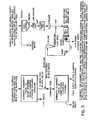
- Figure 1 is a schematic flow sheet showing the main steps of the present invention
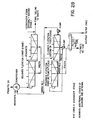
- Figures 2a and 2b are schematic flow sheets of an example of a coarse froth flotation plant for the treatment of contaminated elemental sulphur for the recovery of elemental sulphur
- Figure 3 shows an example of a combined "coarse” and "fine” flotation process for the treatment of feedstock where the major component is contaminated-elemental sulphur and the balance is complex sulphur agglomerate ("sulphur crete melt residue").
- a schematic flow sheet for the Recovery of Elemental Sulphur from Products Containing Contaminated Elemental Sulphur by Froth Flotation was developed and is shown in Figure 1.
- a froth flotation plant schematic is presented for a "coarse" type flotation process with particles finer than 10 mesh with a substantial amount of larger than 48 mesh in the slurry, in Figures 2a and 2b.
- This incorporates a rotary scrubber breaker for initial plant input material preparation, followed by classification in a spiral classifier (or other type of mechanical classification means and/or vibrating screen). By this classification the slime and fine particles are removed in the spiral classifier overflow.
- the densified underflow product is directed to the size reduction apparatus.
- the size reduction is conducted in an attrition scrubber (or other type of size reduction apparatus) to reduce particle size from minus 1/2 inch to finer than 10 mesh for a "coarse” flotation.
- the froth flotation plant shown schematically in Figures 2a and 2b can have feed capacities varying generally from 100 to 500 metric tonnes/24 - hours and could be built as a mobile system.
- the initial plant capacity could be increased up to the desired capacity by the addition of modular units.
- the estimated flotation reagent cost per metric tonne of contaminated elemental sulphur is in the order of 65 to 90 cents, when floating a more granular product.
- the contaminated elemental sulphur plant input material is obtained from the existing elemental sulphur block base pads, stockpiles or other sources by mechanical back-hoe, front-end loader or other means and transported to the processing plant storage hopper and feeder.
- a rail grizzly is normally placed over the hopper to remove tramp oversize, roots and foreign debris which may contaminate the base pads, stockpiles or other existing sources.
- Storage capacity in the hopper is provided to maintain a uniform feed rate to the plant by means of a belt, pan, or apron feeder. Feed is conveyed by a belt to a rotary scrubber having lifters to assist in breaking down any coarse lumps of elemental sulphur.
- Water and sprays are added to this unit to assist in pulping the solids and in screening out-plus 1/2 inch tramp oversize.
- a rotary screen is attached to the end of the rotary scrubber to accomplish this sizing operation. Since this operation is carried out wet, dusting is minimal.
- the minus 1/2 inch slurry discharging from the rotary scrubber breaker flows to a spiral or screw classifier, primarily for densifying the classifier underflow before it is introduced to the feed end of the attrition scrubber.
- the input material must be 70% solids or slightly higher. Retention time in the attrition scrubber is in the order of 5 to 10 minutes. Sufficient lime to minimize equipment corrosion should be added here, as well as to the rotary scrubber breaker described in point 1, above.
- Size reduction utilizing an attrition scrubber produces granular and clean elemental sulphur particles having an enhanced lustre, thus making these particles, as coarse as 10 mesh (2 mm), respond to reagents and flotation.
- Discharge slurry from the attrition scrubber is transported by pump to a vibrating screen fitted with a stainless steel or rubber covered screen cloth.
- the screen oversize is returned to the classifier. It can be crushed, if necessary, for further treatment.
- the screen undersize is sent to flotation through the conditioner.
- the spiral classifier overflow is passed over a stationary trash screen to remove oversize wood chips and tramp oversize.
- the classifier overflow after passing through the trash screen, joins the output material from the attrition scrubber and is pumped to the vibrating screen.
- the finer than 10 mesh screen undersize is the feed to the conditioner and then to the flotation process.
- This feed is conditioned with reagents (such as: MIBC and kerosene or fuel oil) for about 3 minutes in the conditioner. This ensures effective use of reagents in filming the granular and fine sulphur particles prior to flotation.
- the conditioned slurry could flow by gravity or be pumped to the Rougher flotation machine.
- This machine which produces the Rougher flotation elemental sulphur concentrate should be sized to provide at least ten minutes retention time for the quantity of material designed to be treated per hour.
- This flotation machine could be arranged, for example, in two sections with three or four cells in each series. Stage adding of some additional reagents (such as: kerosene or fuel oil and MIBC) is necessary to float any remaining sulphur after the initial froth removal in the first three or four cells.
- Rougher flotation time includes recycling of Cleaner tailings or Midds No. 1. When the Rougher froth has less than 50% elemental sulphur purity, the Rougher flotation circuit should include a Scavenger stage.
- the Rougher flotation froth concentrate is cleaned (Cleaner stage) and recleaned (Re-Cleaner stage) in a second bank of flotation cells, each stage being similar to the Rougher stage in flow arrangement but generally with half of the number of cells.
- Each cleaner section provides approximately 5 minutes flotation retention time, including recycling of the corresponding Middlings.
- the froth could be directed to the filters, by-passing the remaining cleaning stages.
- Filtration of cleaned flotation concentrate should be done on a horizontal vacuum belt filter, since the elemental sulphur product is coarse and granular (generally, minus 10 mesh with a small percentage of minus 200 mesh particles). Filter tests showed moisture content of the filter cake being near 10%. Further moisture reduction can be obtained by using hot water sprays on the belt filter cake. This granular product ground in an attrition scrubber will be easier to transport by belt conveyor and probably easier to melt than the fine elemental sulphur flotation product resulting from ball milling for size reduction. Elemental sulphur purity of the dried filter cake could be 98X or higher with a recovery over 95b as shown in the Tests No. 16, 20 and 21.
- the purity of the recovered product may be increased, by applying the combined process of "coarse” and “fine” flotation, to up to 98.2% as shown in tests No. 28, 29 and 30.
Landscapes
- Chemical & Material Sciences (AREA)
- Inorganic Chemistry (AREA)
- Organic Chemistry (AREA)
- Life Sciences & Earth Sciences (AREA)
- General Life Sciences & Earth Sciences (AREA)
- Geology (AREA)
- Manufacture And Refinement Of Metals (AREA)
Applications Claiming Priority (4)
| Application Number | Priority Date | Filing Date | Title |
|---|---|---|---|
| CA502290 | 1986-02-20 | ||
| CA000502290A CA1223373A (en) | 1986-02-20 | 1986-02-20 | Recovery of elemental sulphur from products containing contaminated elemental sulphur by froth flotation |
| US07/014,975 US4871447A (en) | 1986-02-20 | 1987-02-17 | Recovery of elemental sulphur from products containing contaminated elemental sulphur by froth flotation |
| US14975 | 1987-02-17 |
Publications (3)
| Publication Number | Publication Date |
|---|---|
| EP0240380A2 true EP0240380A2 (de) | 1987-10-07 |
| EP0240380A3 EP0240380A3 (en) | 1988-08-24 |
| EP0240380B1 EP0240380B1 (de) | 1995-09-20 |
Family
ID=25670914
Family Applications (1)
| Application Number | Title | Priority Date | Filing Date |
|---|---|---|---|
| EP19870400368 Expired - Lifetime EP0240380B1 (de) | 1986-02-20 | 1987-02-19 | Rückgewinnung von elementarem Schwefel durch Schaumflotation aus Produkten, welche verunreinigten Schwefel enthalten |
Country Status (2)
| Country | Link |
|---|---|
| EP (1) | EP0240380B1 (de) |
| DE (1) | DE3751521D1 (de) |
Cited By (1)
| Publication number | Priority date | Publication date | Assignee | Title |
|---|---|---|---|---|
| CN113976600A (zh) * | 2021-10-28 | 2022-01-28 | 江苏北矿金属循环利用科技有限公司 | 一种锌冶炼高硫渣毒害组分无害化处置工艺 |
Family Cites Families (2)
| Publication number | Priority date | Publication date | Assignee | Title |
|---|---|---|---|---|
| US2537842A (en) * | 1948-12-18 | 1951-01-09 | Chemical Construction Corp | Recovery of sulfur from native sulfur-bearing ores |
| US3634046A (en) * | 1968-11-07 | 1972-01-11 | American Cyanamid Co | Recovery of sulfur from naturally occurring ores |
-
1987
- 1987-02-19 DE DE3751521T patent/DE3751521D1/de not_active Expired - Lifetime
- 1987-02-19 EP EP19870400368 patent/EP0240380B1/de not_active Expired - Lifetime
Cited By (1)
| Publication number | Priority date | Publication date | Assignee | Title |
|---|---|---|---|---|
| CN113976600A (zh) * | 2021-10-28 | 2022-01-28 | 江苏北矿金属循环利用科技有限公司 | 一种锌冶炼高硫渣毒害组分无害化处置工艺 |
Also Published As
| Publication number | Publication date |
|---|---|
| EP0240380B1 (de) | 1995-09-20 |
| DE3751521D1 (de) | 1995-10-26 |
| EP0240380A3 (en) | 1988-08-24 |
Similar Documents
| Publication | Publication Date | Title |
|---|---|---|
| US4964981A (en) | Recovery of elemental sulphur from products containing contaminated elemental sulphur by froth flotation | |
| US4915706A (en) | Coal-water fuel production | |
| AU596114B2 (en) | Method and apparatus for column flotation of mineral matter | |
| WO2012054953A1 (en) | Method of beneficiation of phosphate | |
| US4690752A (en) | Selective flocculation process for the recovery of phosphate | |
| US5560892A (en) | Apparatus system for beneficiation of kish graphite | |
| US3782539A (en) | Beneficiation of phosphate ores | |
| US2428228A (en) | Process of separating valuable materials from grinding dusts and sludges | |
| US4737273A (en) | Flotation process for recovery of phosphate values from ore | |
| KR930011073B1 (ko) | 석탄-물 혼합연료의 제조방법과 그 장치 | |
| GB2164271A (en) | Process for froth flotation of fossilized organic mineral values | |
| CN113492055A (zh) | 处理含铜黄铁矿的选矿工艺 | |
| US3331505A (en) | Flotation process for reagent removal | |
| KR102241009B1 (ko) | 불소 오염토양 부유선별 방법 및 시스템 | |
| Lin et al. | An effective approach for improving flotation recovery of molybdenite fines from a finely-disseminated molybdenum ore | |
| US5051165A (en) | Quality of heavy mineral concentrates | |
| EP0240380B1 (de) | Rückgewinnung von elementarem Schwefel durch Schaumflotation aus Produkten, welche verunreinigten Schwefel enthalten | |
| Lloyd | The flotation of gold, uranium, and pyrite from Witwatersrand ores | |
| US2113727A (en) | Phosphate rock recovery | |
| US3456792A (en) | Method for recovering chalcopyrite and pyrite from complex magnetite ores | |
| Colombo et al. | Beneficiation of nonmagnetic taconites by selective flocculation-cationic flotation | |
| Miller et al. | Selective flotation of fossil resin from Wasatch Plateau high-volatile bituminous coal | |
| CN112827658A (zh) | 一种白钨矿的选矿方法 | |
| US4904373A (en) | Fossil resin flotation from coal by selective coagulation and depression of coal | |
| Didolkar et al. | Beneficiation of low grade graphite ore from Multai area, Betul district, MP |
Legal Events
| Date | Code | Title | Description |
|---|---|---|---|
| PUAI | Public reference made under article 153(3) epc to a published international application that has entered the european phase |
Free format text: ORIGINAL CODE: 0009012 |
|
| AK | Designated contracting states |
Kind code of ref document: A2 Designated state(s): DE FR GB IT NL |
|
| PUAL | Search report despatched |
Free format text: ORIGINAL CODE: 0009013 |
|
| AK | Designated contracting states |
Kind code of ref document: A3 Designated state(s): DE FR GB IT NL |
|
| 17P | Request for examination filed |
Effective date: 19881123 |
|
| 17Q | First examination report despatched |
Effective date: 19900921 |
|
| GRAA | (expected) grant |
Free format text: ORIGINAL CODE: 0009210 |
|
| AK | Designated contracting states |
Kind code of ref document: B1 Designated state(s): DE FR GB IT NL |
|
| PG25 | Lapsed in a contracting state [announced via postgrant information from national office to epo] |
Ref country code: IT Free format text: LAPSE BECAUSE OF FAILURE TO SUBMIT A TRANSLATION OF THE DESCRIPTION OR TO PAY THE FEE WITHIN THE PRE;WARNING: LAPSES OF ITALIAN PATENTS WITH EFFECTIVE DATE BEFORE 2007 MAY HAVE OCCURRED AT ANY TIME BEFORE 2007. THE CORRECT EFFECTIVE DATE MAY BE DIFFERENT FROM THE ONE RECORDED.SCRIBED TIME-LIMIT Effective date: 19950920 Ref country code: NL Free format text: LAPSE BECAUSE OF FAILURE TO SUBMIT A TRANSLATION OF THE DESCRIPTION OR TO PAY THE FEE WITHIN THE PRESCRIBED TIME-LIMIT Effective date: 19950920 |
|
| REF | Corresponds to: |
Ref document number: 3751521 Country of ref document: DE Date of ref document: 19951026 |
|
| PG25 | Lapsed in a contracting state [announced via postgrant information from national office to epo] |
Ref country code: DE Effective date: 19951221 |
|
| ET | Fr: translation filed | ||
| PG25 | Lapsed in a contracting state [announced via postgrant information from national office to epo] |
Ref country code: GB Effective date: 19960219 |
|
| NLV1 | Nl: lapsed or annulled due to failure to fulfill the requirements of art. 29p and 29m of the patents act | ||
| PLBE | No opposition filed within time limit |
Free format text: ORIGINAL CODE: 0009261 |
|
| STAA | Information on the status of an ep patent application or granted ep patent |
Free format text: STATUS: NO OPPOSITION FILED WITHIN TIME LIMIT |
|
| PGFP | Annual fee paid to national office [announced via postgrant information from national office to epo] |
Ref country code: FR Payment date: 19960808 Year of fee payment: 10 |
|
| 26N | No opposition filed | ||
| GBPC | Gb: european patent ceased through non-payment of renewal fee |
Effective date: 19960219 |
|
| PG25 | Lapsed in a contracting state [announced via postgrant information from national office to epo] |
Ref country code: FR Effective date: 19971030 |
|
| REG | Reference to a national code |
Ref country code: FR Ref legal event code: ST |