EP0240276A2 - Photocrosslinkable polymers - Google Patents
Photocrosslinkable polymers Download PDFInfo
- Publication number
- EP0240276A2 EP0240276A2 EP87302715A EP87302715A EP0240276A2 EP 0240276 A2 EP0240276 A2 EP 0240276A2 EP 87302715 A EP87302715 A EP 87302715A EP 87302715 A EP87302715 A EP 87302715A EP 0240276 A2 EP0240276 A2 EP 0240276A2
- Authority
- EP
- European Patent Office
- Prior art keywords
- polymer
- polymers
- cinnamate
- component
- backbone
- Prior art date
- Legal status (The legal status is an assumption and is not a legal conclusion. Google has not performed a legal analysis and makes no representation as to the accuracy of the status listed.)
- Granted
Links
- 229920000642 polymer Polymers 0.000 title claims description 54
- WBYWAXJHAXSJNI-VOTSOKGWSA-M trans-cinnamate Chemical compound [O-]C(=O)\C=C\C1=CC=CC=C1 WBYWAXJHAXSJNI-VOTSOKGWSA-M 0.000 claims abstract description 23
- 229940114081 cinnamate Drugs 0.000 claims abstract description 21
- 229920000106 Liquid crystal polymer Polymers 0.000 claims abstract description 14
- 125000006850 spacer group Chemical group 0.000 claims abstract description 13
- 125000000391 vinyl group Chemical group [H]C([*])=C([H])[H] 0.000 claims abstract description 9
- 125000003545 alkoxy group Chemical group 0.000 claims abstract description 7
- 125000000217 alkyl group Chemical group 0.000 claims abstract description 7
- -1 phenylene- oxycarbonylphenylene Chemical group 0.000 claims description 19
- 125000002496 methyl group Chemical group [H]C([H])([H])* 0.000 claims description 4
- 229910052739 hydrogen Inorganic materials 0.000 claims description 3
- 238000003384 imaging method Methods 0.000 claims description 3
- 125000000843 phenylene group Chemical group C1(=C(C=CC=C1)*)* 0.000 claims description 3
- UFHFLCQGNIYNRP-UHFFFAOYSA-N Hydrogen Chemical compound [H][H] UFHFLCQGNIYNRP-UHFFFAOYSA-N 0.000 claims description 2
- 239000001257 hydrogen Substances 0.000 claims description 2
- 125000004957 naphthylene group Chemical group 0.000 claims description 2
- 125000002529 biphenylenyl group Chemical group C1(=CC=CC=2C3=CC=CC=C3C12)* 0.000 claims 1
- 125000006836 terphenylene group Chemical group 0.000 claims 1
- 239000000306 component Substances 0.000 description 17
- OKKJLVBELUTLKV-UHFFFAOYSA-N Methanol Chemical compound OC OKKJLVBELUTLKV-UHFFFAOYSA-N 0.000 description 12
- ZMXDDKWLCZADIW-UHFFFAOYSA-N N,N-Dimethylformamide Chemical compound CN(C)C=O ZMXDDKWLCZADIW-UHFFFAOYSA-N 0.000 description 11
- 150000001875 compounds Chemical class 0.000 description 9
- CTSLXHKWHWQRSH-UHFFFAOYSA-N oxalyl chloride Chemical compound ClC(=O)C(Cl)=O CTSLXHKWHWQRSH-UHFFFAOYSA-N 0.000 description 8
- 238000002360 preparation method Methods 0.000 description 7
- RTZKZFJDLAIYFH-UHFFFAOYSA-N Diethyl ether Chemical compound CCOCC RTZKZFJDLAIYFH-UHFFFAOYSA-N 0.000 description 6
- XEKOWRVHYACXOJ-UHFFFAOYSA-N Ethyl acetate Chemical compound CCOC(C)=O XEKOWRVHYACXOJ-UHFFFAOYSA-N 0.000 description 6
- JUJWROOIHBZHMG-UHFFFAOYSA-N Pyridine Chemical compound C1=CC=NC=C1 JUJWROOIHBZHMG-UHFFFAOYSA-N 0.000 description 6
- 229920002451 polyvinyl alcohol Polymers 0.000 description 6
- 229920002554 vinyl polymer Polymers 0.000 description 6
- SCYULBFZEHDVBN-UHFFFAOYSA-N 1,1-Dichloroethane Chemical compound CC(Cl)Cl SCYULBFZEHDVBN-UHFFFAOYSA-N 0.000 description 5
- NIXOWILDQLNWCW-UHFFFAOYSA-M Acrylate Chemical compound [O-]C(=O)C=C NIXOWILDQLNWCW-UHFFFAOYSA-M 0.000 description 5
- 239000007788 liquid Substances 0.000 description 5
- 239000000178 monomer Substances 0.000 description 5
- 238000006116 polymerization reaction Methods 0.000 description 5
- 239000007787 solid Substances 0.000 description 5
- FJKROLUGYXJWQN-UHFFFAOYSA-N 4-hydroxybenzoic acid Chemical compound OC(=O)C1=CC=C(O)C=C1 FJKROLUGYXJWQN-UHFFFAOYSA-N 0.000 description 4
- YMWUJEATGCHHMB-UHFFFAOYSA-N Dichloromethane Chemical compound ClCCl YMWUJEATGCHHMB-UHFFFAOYSA-N 0.000 description 4
- CSNNHWWHGAXBCP-UHFFFAOYSA-L Magnesium sulfate Chemical compound [Mg+2].[O-][S+2]([O-])([O-])[O-] CSNNHWWHGAXBCP-UHFFFAOYSA-L 0.000 description 4
- ZYGHJZDHTFUPRJ-UHFFFAOYSA-N coumarin Chemical compound C1=CC=C2OC(=O)C=CC2=C1 ZYGHJZDHTFUPRJ-UHFFFAOYSA-N 0.000 description 4
- JHIVVAPYMSGYDF-UHFFFAOYSA-N cyclohexanone Chemical compound O=C1CCCCC1 JHIVVAPYMSGYDF-UHFFFAOYSA-N 0.000 description 4
- 238000000921 elemental analysis Methods 0.000 description 4
- 238000000034 method Methods 0.000 description 4
- 239000000203 mixture Substances 0.000 description 4
- 239000002904 solvent Substances 0.000 description 4
- AFDXODALSZRGIH-QPJJXVBHSA-N (E)-3-(4-methoxyphenyl)prop-2-enoic acid Chemical compound COC1=CC=C(\C=C\C(O)=O)C=C1 AFDXODALSZRGIH-QPJJXVBHSA-N 0.000 description 3
- OZAIFHULBGXAKX-UHFFFAOYSA-N 2-(2-cyanopropan-2-yldiazenyl)-2-methylpropanenitrile Chemical compound N#CC(C)(C)N=NC(C)(C)C#N OZAIFHULBGXAKX-UHFFFAOYSA-N 0.000 description 3
- QTBSBXVTEAMEQO-UHFFFAOYSA-N Acetic acid Chemical compound CC(O)=O QTBSBXVTEAMEQO-UHFFFAOYSA-N 0.000 description 3
- HEDRZPFGACZZDS-MICDWDOJSA-N Trichloro(2H)methane Chemical compound [2H]C(Cl)(Cl)Cl HEDRZPFGACZZDS-MICDWDOJSA-N 0.000 description 3
- 229920006125 amorphous polymer Polymers 0.000 description 3
- 125000004429 atom Chemical group 0.000 description 3
- 238000004132 cross linking Methods 0.000 description 3
- 238000006471 dimerization reaction Methods 0.000 description 3
- 230000000694 effects Effects 0.000 description 3
- LNCPIMCVTKXXOY-UHFFFAOYSA-N hexyl 2-methylprop-2-enoate Chemical compound CCCCCCOC(=O)C(C)=C LNCPIMCVTKXXOY-UHFFFAOYSA-N 0.000 description 3
- 229920002120 photoresistant polymer Polymers 0.000 description 3
- UMJSCPRVCHMLSP-UHFFFAOYSA-N pyridine Natural products COC1=CC=CN=C1 UMJSCPRVCHMLSP-UHFFFAOYSA-N 0.000 description 3
- 238000006862 quantum yield reaction Methods 0.000 description 3
- 238000003756 stirring Methods 0.000 description 3
- 238000012546 transfer Methods 0.000 description 3
- 238000005160 1H NMR spectroscopy Methods 0.000 description 2
- NGNBDVOYPDDBFK-UHFFFAOYSA-N 2-[2,4-di(pentan-2-yl)phenoxy]acetyl chloride Chemical compound CCCC(C)C1=CC=C(OCC(Cl)=O)C(C(C)CCC)=C1 NGNBDVOYPDDBFK-UHFFFAOYSA-N 0.000 description 2
- VHYFNPMBLIVWCW-UHFFFAOYSA-N 4-Dimethylaminopyridine Chemical compound CN(C)C1=CC=NC=C1 VHYFNPMBLIVWCW-UHFFFAOYSA-N 0.000 description 2
- 229940090248 4-hydroxybenzoic acid Drugs 0.000 description 2
- RGUKYNXWOWSRET-UHFFFAOYSA-N 4-pyrrolidin-1-ylpyridine Chemical compound C1CCCN1C1=CC=NC=C1 RGUKYNXWOWSRET-UHFFFAOYSA-N 0.000 description 2
- CDSULTPOCMWJCM-UHFFFAOYSA-N 4h-chromene-2,3-dione Chemical class C1=CC=C2OC(=O)C(=O)CC2=C1 CDSULTPOCMWJCM-UHFFFAOYSA-N 0.000 description 2
- CSCPPACGZOOCGX-UHFFFAOYSA-N Acetone Chemical compound CC(C)=O CSCPPACGZOOCGX-UHFFFAOYSA-N 0.000 description 2
- QOSSAOTZNIDXMA-UHFFFAOYSA-N Dicylcohexylcarbodiimide Chemical compound C1CCCCC1N=C=NC1CCCCC1 QOSSAOTZNIDXMA-UHFFFAOYSA-N 0.000 description 2
- JGFZNNIVVJXRND-UHFFFAOYSA-N N,N-Diisopropylethylamine (DIPEA) Chemical compound CCN(C(C)C)C(C)C JGFZNNIVVJXRND-UHFFFAOYSA-N 0.000 description 2
- 206010070834 Sensitisation Diseases 0.000 description 2
- CDBYLPFSWZWCQE-UHFFFAOYSA-L Sodium Carbonate Chemical compound [Na+].[Na+].[O-]C([O-])=O CDBYLPFSWZWCQE-UHFFFAOYSA-L 0.000 description 2
- 125000002947 alkylene group Chemical group 0.000 description 2
- 229910052782 aluminium Inorganic materials 0.000 description 2
- XAGFODPZIPBFFR-UHFFFAOYSA-N aluminium Chemical compound [Al] XAGFODPZIPBFFR-UHFFFAOYSA-N 0.000 description 2
- 150000001408 amides Chemical class 0.000 description 2
- 238000000149 argon plasma sintering Methods 0.000 description 2
- 125000001231 benzoyloxy group Chemical group C(C1=CC=CC=C1)(=O)O* 0.000 description 2
- 230000015572 biosynthetic process Effects 0.000 description 2
- 238000009835 boiling Methods 0.000 description 2
- 150000004649 carbonic acid derivatives Chemical class 0.000 description 2
- 238000006243 chemical reaction Methods 0.000 description 2
- 239000011248 coating agent Substances 0.000 description 2
- 239000008199 coating composition Substances 0.000 description 2
- 238000000576 coating method Methods 0.000 description 2
- 238000001816 cooling Methods 0.000 description 2
- 235000001671 coumarin Nutrition 0.000 description 2
- 229960000956 coumarin Drugs 0.000 description 2
- 150000002170 ethers Chemical class 0.000 description 2
- 125000001495 ethyl group Chemical group [H]C([H])([H])C([H])([H])* 0.000 description 2
- 238000011156 evaluation Methods 0.000 description 2
- 238000001704 evaporation Methods 0.000 description 2
- 230000008020 evaporation Effects 0.000 description 2
- 229910052943 magnesium sulfate Inorganic materials 0.000 description 2
- 230000003287 optical effect Effects 0.000 description 2
- AFDXODALSZRGIH-UHFFFAOYSA-N p-coumaric acid methyl ether Natural products COC1=CC=C(C=CC(O)=O)C=C1 AFDXODALSZRGIH-UHFFFAOYSA-N 0.000 description 2
- 230000008313 sensitization Effects 0.000 description 2
- 230000007928 solubilization Effects 0.000 description 2
- 238000005063 solubilization Methods 0.000 description 2
- VDZOOKBUILJEDG-UHFFFAOYSA-M tetrabutylammonium hydroxide Chemical compound [OH-].CCCC[N+](CCCC)(CCCC)CCCC VDZOOKBUILJEDG-UHFFFAOYSA-M 0.000 description 2
- 238000003828 vacuum filtration Methods 0.000 description 2
- CGOJOQBYEAVATL-QPJJXVBHSA-N (e)-3-(4-methoxyphenyl)prop-2-enoyl chloride Chemical compound COC1=CC=C(\C=C\C(Cl)=O)C=C1 CGOJOQBYEAVATL-QPJJXVBHSA-N 0.000 description 1
- CGOJOQBYEAVATL-UHFFFAOYSA-N 3-(4-methoxyphenyl)prop-2-enoyl chloride Chemical compound COC1=CC=C(C=CC(Cl)=O)C=C1 CGOJOQBYEAVATL-UHFFFAOYSA-N 0.000 description 1
- OCQXHCJFSAZJGC-UHFFFAOYSA-N 4-[2-(4-hydroxyphenyl)ethenyl]benzoic acid Chemical compound C1=CC(C(=O)O)=CC=C1C=CC1=CC=C(O)C=C1 OCQXHCJFSAZJGC-UHFFFAOYSA-N 0.000 description 1
- HKCYXOZBOPOHAX-UHFFFAOYSA-N 4-[3-(4-methoxyphenyl)prop-2-enoyloxy]benzoic acid Chemical compound C1=CC(OC)=CC=C1C=CC(=O)OC1=CC=C(C(O)=O)C=C1 HKCYXOZBOPOHAX-UHFFFAOYSA-N 0.000 description 1
- JNTPTNNCGDAGEJ-UHFFFAOYSA-N 6-chlorohexan-1-ol Chemical compound OCCCCCCCl JNTPTNNCGDAGEJ-UHFFFAOYSA-N 0.000 description 1
- XFOFBPRPOAWWPA-UHFFFAOYSA-N 6-hydroxyhexyl 2-methylprop-2-enoate Chemical compound CC(=C)C(=O)OCCCCCCO XFOFBPRPOAWWPA-UHFFFAOYSA-N 0.000 description 1
- JCJUKCIXTRWAQY-UHFFFAOYSA-N 6-hydroxynaphthalene-1-carboxylic acid Chemical compound OC1=CC=C2C(C(=O)O)=CC=CC2=C1 JCJUKCIXTRWAQY-UHFFFAOYSA-N 0.000 description 1
- OZAIFHULBGXAKX-VAWYXSNFSA-N AIBN Substances N#CC(C)(C)\N=N\C(C)(C)C#N OZAIFHULBGXAKX-VAWYXSNFSA-N 0.000 description 1
- WBYWAXJHAXSJNI-SREVYHEPSA-N Cinnamic acid Chemical compound OC(=O)\C=C/C1=CC=CC=C1 WBYWAXJHAXSJNI-SREVYHEPSA-N 0.000 description 1
- CERQOIWHTDAKMF-UHFFFAOYSA-M Methacrylate Chemical compound CC(=C)C([O-])=O CERQOIWHTDAKMF-UHFFFAOYSA-M 0.000 description 1
- CERQOIWHTDAKMF-UHFFFAOYSA-N Methacrylic acid Chemical compound CC(=C)C(O)=O CERQOIWHTDAKMF-UHFFFAOYSA-N 0.000 description 1
- 238000005481 NMR spectroscopy Methods 0.000 description 1
- YBGZDTIWKVFICR-JLHYYAGUSA-N Octyl 4-methoxycinnamic acid Chemical group CCCCC(CC)COC(=O)\C=C\C1=CC=C(OC)C=C1 YBGZDTIWKVFICR-JLHYYAGUSA-N 0.000 description 1
- 206010034972 Photosensitivity reaction Diseases 0.000 description 1
- 239000004372 Polyvinyl alcohol Substances 0.000 description 1
- 239000004990 Smectic liquid crystal Substances 0.000 description 1
- 125000003118 aryl group Chemical group 0.000 description 1
- PASDCCFISLVPSO-UHFFFAOYSA-N benzoyl chloride Chemical compound ClC(=O)C1=CC=CC=C1 PASDCCFISLVPSO-UHFFFAOYSA-N 0.000 description 1
- 125000003236 benzoyl group Chemical group [H]C1=C([H])C([H])=C(C([H])=C1[H])C(*)=O 0.000 description 1
- 125000000484 butyl group Chemical group [H]C([*])([H])C([H])([H])C([H])([H])C([H])([H])[H] 0.000 description 1
- 125000004432 carbon atom Chemical group C* 0.000 description 1
- 230000003098 cholesteric effect Effects 0.000 description 1
- 229930016911 cinnamic acid Natural products 0.000 description 1
- 235000013985 cinnamic acid Nutrition 0.000 description 1
- 229920001577 copolymer Polymers 0.000 description 1
- 239000013078 crystal Substances 0.000 description 1
- 238000013461 design Methods 0.000 description 1
- 150000002148 esters Chemical class 0.000 description 1
- 239000004210 ether based solvent Substances 0.000 description 1
- 230000005281 excited state Effects 0.000 description 1
- 238000002474 experimental method Methods 0.000 description 1
- 239000000706 filtrate Substances 0.000 description 1
- 239000007789 gas Substances 0.000 description 1
- 238000005227 gel permeation chromatography Methods 0.000 description 1
- 230000005283 ground state Effects 0.000 description 1
- 230000000977 initiatory effect Effects 0.000 description 1
- 239000000155 melt Substances 0.000 description 1
- QSHDDOUJBYECFT-UHFFFAOYSA-N mercury Chemical compound [Hg] QSHDDOUJBYECFT-UHFFFAOYSA-N 0.000 description 1
- 229910052753 mercury Inorganic materials 0.000 description 1
- 229910052751 metal Inorganic materials 0.000 description 1
- 239000002184 metal Substances 0.000 description 1
- WBYWAXJHAXSJNI-UHFFFAOYSA-N methyl p-hydroxycinnamate Natural products OC(=O)C=CC1=CC=CC=C1 WBYWAXJHAXSJNI-UHFFFAOYSA-N 0.000 description 1
- 125000002347 octyl group Chemical group [H]C([*])([H])C([H])([H])C([H])([H])C([H])([H])C([H])([H])C([H])([H])C([H])([H])C([H])([H])[H] 0.000 description 1
- 125000005447 octyloxy group Chemical group [H]C([H])([H])C([H])([H])C([H])([H])C([H])([H])C([H])([H])C([H])([H])C([H])([H])C([H])([H])O* 0.000 description 1
- 230000000379 polymerizing effect Effects 0.000 description 1
- 239000002244 precipitate Substances 0.000 description 1
- 230000002028 premature Effects 0.000 description 1
- 230000001737 promoting effect Effects 0.000 description 1
- 125000001436 propyl group Chemical group [H]C([*])([H])C([H])([H])C([H])([H])[H] 0.000 description 1
- 230000005855 radiation Effects 0.000 description 1
- 238000010992 reflux Methods 0.000 description 1
- 239000002002 slurry Substances 0.000 description 1
- 229910000029 sodium carbonate Inorganic materials 0.000 description 1
- 238000010561 standard procedure Methods 0.000 description 1
- 239000007858 starting material Substances 0.000 description 1
- 239000000126 substance Substances 0.000 description 1
- 238000000967 suction filtration Methods 0.000 description 1
- 238000000870 ultraviolet spectroscopy Methods 0.000 description 1
Classifications
-
- C—CHEMISTRY; METALLURGY
- C09—DYES; PAINTS; POLISHES; NATURAL RESINS; ADHESIVES; COMPOSITIONS NOT OTHERWISE PROVIDED FOR; APPLICATIONS OF MATERIALS NOT OTHERWISE PROVIDED FOR
- C09K—MATERIALS FOR MISCELLANEOUS APPLICATIONS, NOT PROVIDED FOR ELSEWHERE
- C09K19/00—Liquid crystal materials
- C09K19/04—Liquid crystal materials characterised by the chemical structure of the liquid crystal components, e.g. by a specific unit
- C09K19/38—Polymers
- C09K19/3833—Polymers with mesogenic groups in the side chain
- C09K19/3842—Polyvinyl derivatives
- C09K19/3852—Poly(meth)acrylate derivatives
-
- G—PHYSICS
- G03—PHOTOGRAPHY; CINEMATOGRAPHY; ANALOGOUS TECHNIQUES USING WAVES OTHER THAN OPTICAL WAVES; ELECTROGRAPHY; HOLOGRAPHY
- G03F—PHOTOMECHANICAL PRODUCTION OF TEXTURED OR PATTERNED SURFACES, e.g. FOR PRINTING, FOR PROCESSING OF SEMICONDUCTOR DEVICES; MATERIALS THEREFOR; ORIGINALS THEREFOR; APPARATUS SPECIALLY ADAPTED THEREFOR
- G03F7/00—Photomechanical, e.g. photolithographic, production of textured or patterned surfaces, e.g. printing surfaces; Materials therefor, e.g. comprising photoresists; Apparatus specially adapted therefor
- G03F7/004—Photosensitive materials
- G03F7/038—Macromolecular compounds which are rendered insoluble or differentially wettable
-
- G—PHYSICS
- G03—PHOTOGRAPHY; CINEMATOGRAPHY; ANALOGOUS TECHNIQUES USING WAVES OTHER THAN OPTICAL WAVES; ELECTROGRAPHY; HOLOGRAPHY
- G03F—PHOTOMECHANICAL PRODUCTION OF TEXTURED OR PATTERNED SURFACES, e.g. FOR PRINTING, FOR PROCESSING OF SEMICONDUCTOR DEVICES; MATERIALS THEREFOR; ORIGINALS THEREFOR; APPARATUS SPECIALLY ADAPTED THEREFOR
- G03F7/00—Photomechanical, e.g. photolithographic, production of textured or patterned surfaces, e.g. printing surfaces; Materials therefor, e.g. comprising photoresists; Apparatus specially adapted therefor
- G03F7/004—Photosensitive materials
- G03F7/038—Macromolecular compounds which are rendered insoluble or differentially wettable
- G03F7/0388—Macromolecular compounds which are rendered insoluble or differentially wettable with ethylenic or acetylenic bands in the side chains of the photopolymer
Definitions
- the present invention relates to photocrosslinkable polymers and their preparation and use in imaging elements.
- Photocrosslinkable polymers are known. They have found many applications in industry. For example, photocrosslinkable polymers find many applications in the making of lithographic plates and in photoresist applications. Many of the more useful photocrosslinkable polymers comprise, as a light-sensitive component, recurring cinnamate components. For example, polyvinyl cinnamate is formed by reacting polyvinyl alcohol with cinnamic acid. Such polymers are disclosed in U.S. Patent 3,817,876, U.S. Patent 4,230,817 and U.S. Patent 3,933,746..
- photocrosslinkable polymeric compositions are coated upon a suitable supporting surface such as a metal plate to form an imaging element. Thereafter, the element is exposed to actinic light. Exposure results in insolubilization of the polymer in the exposed areas and solubilization of the polymer in the unexposed areas. The unexposed areas of the polymer coating can be removed by means of suitable solvents to leave a relief image.
- the photosensitized crosslinking of amorphous polymers such as those described in the above- mentioned U.S. Patents generally show quantum yields of dimerization of about 4 percent.
- Sensitization of such polymers by ketocoumarins proceeds generally by triplet-triplet energy transfer.
- triplet energy migrates step-wise from one cinnamate component to the next until it decays, or reaches an appropriate site for promoting crosslinking.
- An appropriate site in this regard is a double bond of the cinnamate com- ponents aligned parallel to each other, and approxi- mately 40nm apart.
- the triplet energy visits an average of 100 to 200 sites before an appropriate site is found. The problem is that since the life- time of the triplet excited state is only 10 nano- seconds, the decay to the ground state dominates over excimer formation which results in crosslinking.
- the objective is to design polymers which make better use of triplet-triplet energy transfer which occurs with ketocoumarin sensitization.
- novel photocrosslinkable liquid crystalline polymer comprising a vinyl backbone having from 60 to 100 mole percent of recurring pendant groups comprising an alkyl or alkoxy substituted light-sensitive cinnamate component characterized in that the cinnamate component is connected to the vinyl backbone through:
- the spacer group is preferably an alkylene group that includes up to four groups selected from ethers (-O-), esters carbonates and amides Examples of such groups include ( CH 2 CH 2 O ) x C 2 CH 2 wherein x is 1 to 4, - etc.
- the photocrosslinkable liquid crystalline polymers of the present invention achieve a 40 percent quantum yield of dimerization resulting in as much as an 9x increase in photographic speed of the polymers of the present invention compared to the poly(vinyl alcohol-co-vinylcinnamate) polymers of the prior art of similar molecular weight.
- higher molecular weight liquid crystalline polymers of the present invention achieve an 83x increase in photographic speed compared to a poly(vinyl alcohol-co-vinyl-cinnamate) control.
- Liquid crystalline polymers of the invention generally have an absolute molecular weight of 50,000 to 3,000,000.
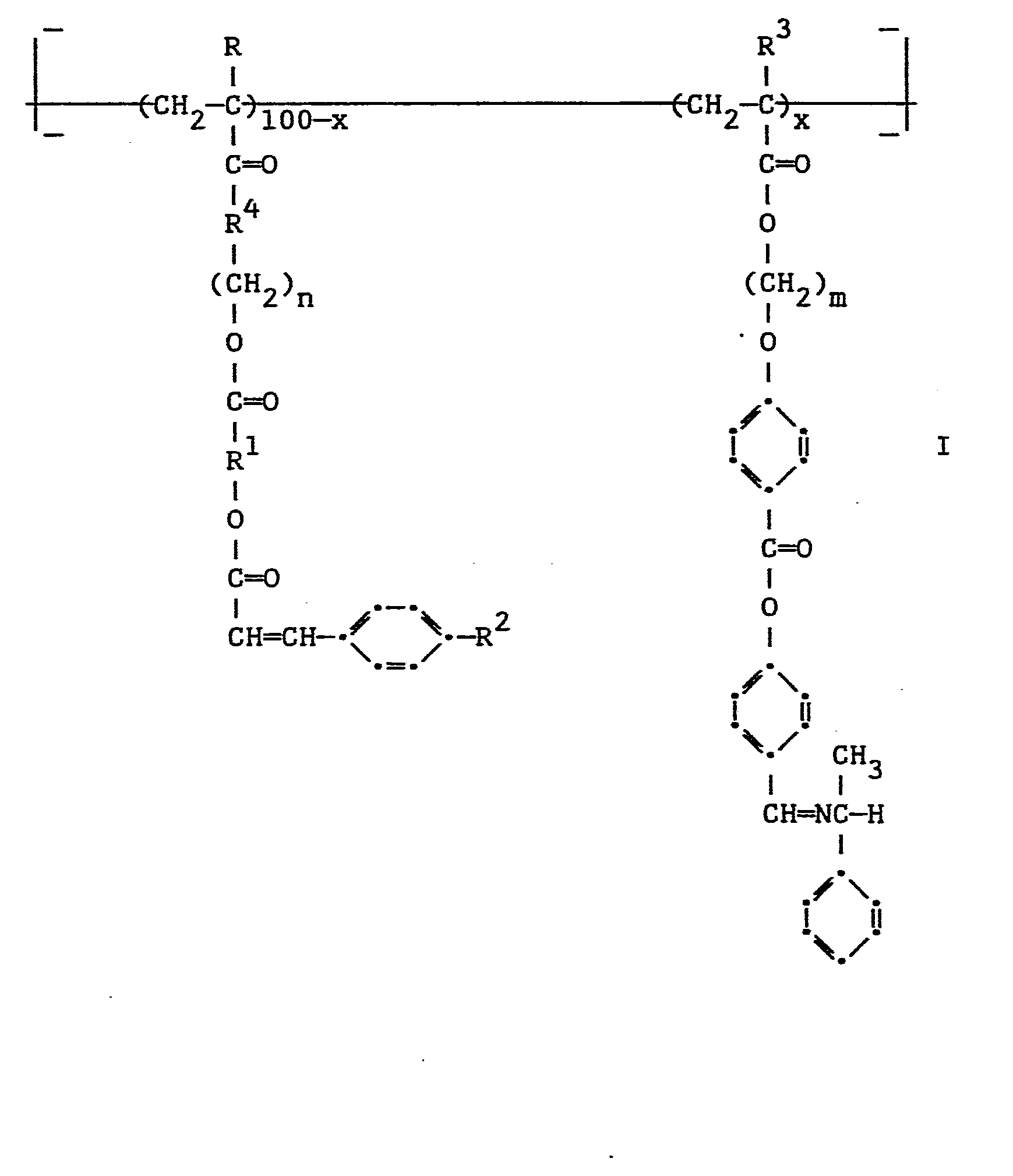
- the photocrosslinkable liquid crystalline polymers of this invention have the structure wherein
- the groups included in R are among groups known in the chemical literature to be stiff and rod-like.
- the spacer group is The group providing stiffness and rod-like character to the cinnamate group is
- the spacer group is necessary to decouple the motion of the polymer backbone from the motion of the cinnamate-containing side chains.
- Our experimental work has shown that the spacer group should comprise a backbone of from 7 to 14 atoms.
- the concept of this invention applies to polymers comprising any kind of light-sensitive groups including photoconductive groups, photocrosslinking groups, photopolymerizable groups, acid-photogenerating groups, etc.
- the present invention also provides a method for making a photocrosslinkable liquid crystalline polymer comprising the steps of:
- Polymers of this invention can be made from their corresponding methacrylate or acrylate monomers by solubilization in dichloroethane to a particular total solids concentration of 10-20%. Polymerization is then initiated with 1% 2,2'-azobis(2-methylpropionitrile) (AIBN) by weight, unless otherwise indicated.
- AIBN 2,2'-azobis(2-methylpropionitrile)
- the solutions were placed in polymerization vials, sealed with inert caps and purged with N 2 for 20 minutes via syringe needles while cooling to eliminate evaporation.
- the flasks were then immersed in constant temperature baths at temperatures of about 50 to 90°C for 15 hours. The resulting viscous solutions were diluted with dichloroethane and precipitated by adding the diluted solutions dropwise into ethyl ether with vigorous stirring. Solids were collected by vacuum filtration and dried at room temperature under oil pump vacuum.
- the following preparative example illustrates the method in making polymer 1 of Table I, infra.
- the examples also illustrate standard techniques for preparing the monomers from which the polymers are ultimately made.
- the group which provides stiffening and rod-like characteristics are added to the cinnamoyl component by reacting a compound, such as p-hydroxy benzoic acid, 4'-hydoxy-1-biphenylcarboxylic acid, 6-hydroxynaphthoic acid and 4-hydroxy-4'-stilbene- carboxylic acid with the cinnamoyl-containing starting materials in the presence of base.
- a compound such as p-hydroxy benzoic acid, 4'-hydoxy-1-biphenylcarboxylic acid, 6-hydroxynaphthoic acid and 4-hydroxy-4'-stilbene- carboxylic acid
- the spacer group is added to the group providing the stiffening and rod-like characteristics by reacting, as the spacer group, an acrylate or methacrylate compound, containing from 7 to 14 atoms.
- the acrylate or methacrylate compound includes the alkylene group that includes the ethers, carbonates, amides, etc., as defined hereinbefore, with the cinnamoyl having attached thereto the group providing stiffening and rod-like character. This latter step is carried out by contacting the cinnamoyl containing compound with the acrylate or methacrylate compound in the presence of dicyclohexylcarbodiimide and 4-pyrrolidinopyridine.
- DMF N,N-dimethylformamide
- This step illustrates the addition of an aryl group to the compound of Step 2 to increase the stiffness and rod-like characteristics of the alkyl or alkoxy substituted cinnamoyl group.
- This step involved adding a polymerizable group and the remainder of the spacer group to the compound of Step 3.
- This polymer was prepared from the monomer of Step 4 by dissolving in ethyl ether and initiating polymerization with 0.5 to 1.0% by weight of 2,2'-azobis(2-methylpropionitrile).
- the solutions were placed in polymerization vials, septa sealed and purged with N 2 for 20 minutes via syringe needles while cooling to eliminate evaporation.
- the flasks were then immersed in constant temperature baths at the prescribed temperatures for 15 hours.
- the viscous solutions were diluted with their respective solvents and precipitated by adding dropwise into the ethyl ether solvents with vigorous stirring. Solids were collected by vacuum filtration and dried at room temperature under oil pump vacuum.
- Liquid crystallinity of the polymers was confirmed by examination of polymer melts under a hot stage polarizing microscope. Under X polarizers typical nematic, cholesteric or smectic liquid crystalline textures were observed.
- the polymer of the Example 1, Step 5 was made to several different molecular weights for photographic speed evaluation. These polymers are indicated in Table I as polymers 1A to lE.
- a poly(vinyl alcohol-co-vinyl benzoate-co-vinyl 4-methoxycinnamate) copolymer (mole ratio 10/55/35) was prepared as a first control (Control 1) (PVA control).
- This polymer is frequently used in photoresist applications. It has no spacer groups or groups to stiffen the cinnamoyl group. It has the structure:
- the above control polymer was prepared by the following procedure:
- the molecular weight of this control polymer could not be determined by Gel Permeation Chromatography or light scattering. However, it is known that the degree of polymerization of the backbone is 1700 which makes the absolute molecular weight approximately 268,000.
- Coating formulations of the polymers to be evaluated and a coumarin sensitizer were prepared with the following composition and cast as films on aluminum supports.
- the thus formed coating formulations were coated on aluminum supports. Each coating was the same optical density. Each film was then exposed on an optical bench with a PEK 200 watt super high pressure mercury light source. The appropriate filters were used (k > 405 nm) to insure that only the sensitizer absorbed the incident radiation. The films were irradiated through a photographic step tablet in which the density varies in increments of 0.15 per step. After irradiation, the films were developed by soaking in cyclohexanone for 1 minute or until no further change was noted.
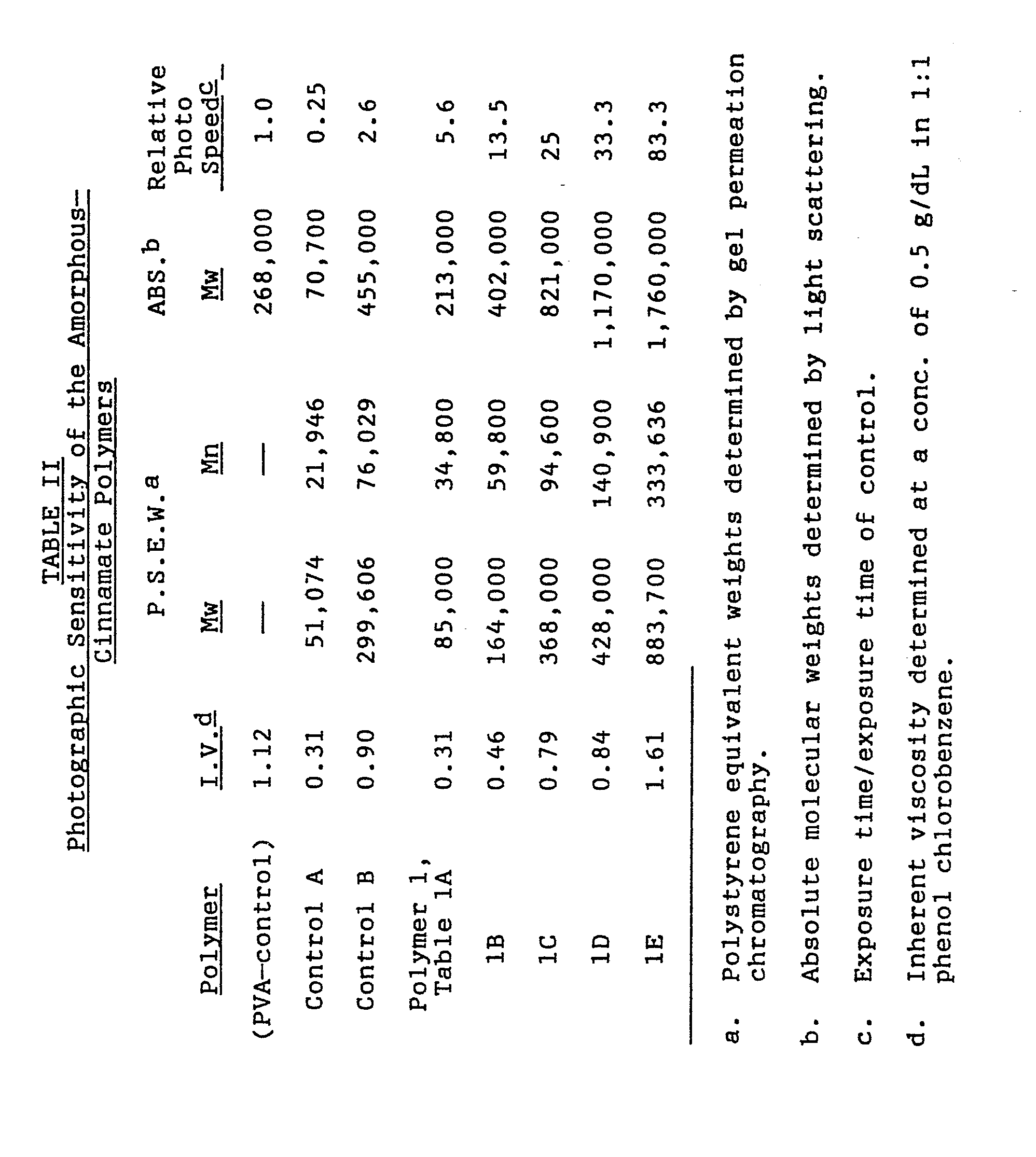
- Table II shows the molecular weights and the relative photographic speed results of the amorphous controls and various molecular weight versions of Polymer 1, Table I of the invention.
- the difference in the photographic speed between the PVA control and Control B could be attributed to the difference in the backbone configurations and the effect the backbone has on the orientation of the cinnamate component.
- the -C2H4 spacer removes some of the orientational influence the polymeric backbone might exert on the cinnamate component. The latter effect most certainly would increase the photographic speed of the polymer.
- the effect that the molecular weight played on the photographic speed of light-sensitive polymers is best illustrated by comparing control polymers (A) and (B) in Table II.
- Polymer lE has a molecular weight 6X that of the PVA cinnamate control, but was 83X faster. The molecular weight difference certainly accounted for some of this increased speed but obviously could not account for all of it. This data shows that the liquid crystalline polymers of this invention present the necessary ordered state to dramatically increase the photographic speed of photocrosslinkable polymers.
Landscapes
- Physics & Mathematics (AREA)
- Chemical & Material Sciences (AREA)
- Spectroscopy & Molecular Physics (AREA)
- General Physics & Mathematics (AREA)
- Crystallography & Structural Chemistry (AREA)
- Engineering & Computer Science (AREA)
- Materials Engineering (AREA)
- Organic Chemistry (AREA)
- Addition Polymer Or Copolymer, Post-Treatments, Or Chemical Modifications (AREA)
- Liquid Crystal Substances (AREA)
- Polymerisation Methods In General (AREA)
Abstract
Description
- The present invention relates to photocrosslinkable polymers and their preparation and use in imaging elements.
- Photocrosslinkable polymers are known. They have found many applications in industry. For example, photocrosslinkable polymers find many applications in the making of lithographic plates and in photoresist applications. Many of the more useful photocrosslinkable polymers comprise, as a light-sensitive component, recurring cinnamate components. For example, polyvinyl cinnamate is formed by reacting polyvinyl alcohol with cinnamic acid. Such polymers are disclosed in U.S. Patent 3,817,876, U.S. Patent 4,230,817 and U.S. Patent 3,933,746..
- In photolithographic and in photoresist applications, photocrosslinkable polymeric compositions are coated upon a suitable supporting surface such as a metal plate to form an imaging element. Thereafter, the element is exposed to actinic light. Exposure results in insolubilization of the polymer in the exposed areas and solubilization of the polymer in the unexposed areas. The unexposed areas of the polymer coating can be removed by means of suitable solvents to leave a relief image.
- The photosensitized crosslinking of amorphous polymers such as those described in the above- mentioned U.S. Patents generally show quantum yields of dimerization of about 4 percent. Sensitization of such polymers by ketocoumarins proceeds generally by triplet-triplet energy transfer. There are known to be several energy wastage steps competing with triplet-triplet energy transfer. In the case of known (amorphous) cinnamate polymers, the triplet energy migrates step-wise from one cinnamate component to the next until it decays, or reaches an appropriate site for promoting crosslinking. An appropriate site in this regard is a double bond of the cinnamate com- ponents aligned parallel to each other, and approxi- mately 40nm apart. The triplet energy visits an average of 100 to 200 sites before an appropriate site is found. The problem is that since the life- time of the triplet excited state is only 10 nano- seconds, the decay to the ground state dominates over excimer formation which results in crosslinking.
- The objective, therefore, is to design polymers which make better use of triplet-triplet energy transfer which occurs with ketocoumarin sensitization.
- This objective is achieved with the present invention which provides novel photocrosslinkable liquid crystalline polymer comprising a vinyl backbone having from 60 to 100 mole percent of recurring pendant groups comprising an alkyl or alkoxy substituted light-sensitive cinnamate component characterized in that the cinnamate component is connected to the vinyl backbone through:
- a) a component which provides stiffness and rod-like character to the cinnamate component; and
- b) a spacer group having a backbone of from 7 to 14 atoms.
- The spacer group is preferably an alkylene group that includes up to four groups selected from ethers (-O-), esters

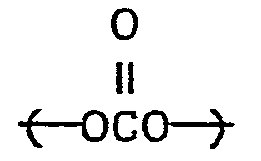



- The photocrosslinkable liquid crystalline polymers of the present invention achieve a 40 percent quantum yield of dimerization resulting in as much as an 9x increase in photographic speed of the polymers of the present invention compared to the poly(vinyl alcohol-co-vinylcinnamate) polymers of the prior art of similar molecular weight. In addition, higher molecular weight liquid crystalline polymers of the present invention achieve an 83x increase in photographic speed compared to a poly(vinyl alcohol-co-vinyl-cinnamate) control. Liquid crystalline polymers of the invention generally have an absolute molecular weight of 50,000 to 3,000,000.
- Applicants have theorized that this dramatic increase in quantum yield of dimerization and resulting increase in photographic speed results from the more ordered character of liquid crystalline polymers compared to that of amorphous polymers. In the more ordered state of liquid crystalline polymers, the probability of the double bonds of the cinnamate components of the polymers being parallel to each other is significantly increased over the likelihood of such double bonds being parallel in an amorphous polymer.
- In an especially useful embodiment of the invention, the photocrosslinkable liquid crystalline polymers of this invention have the structure

- n represents an integer of from 3 to 10;
- m represents an integer of from 2 to 6;
- x has a value of 0 to 35 mole percent;
- 3 R and R , each independently represents hydrogen or methyl;
- R 1 represents phenylene, biphenylylene, terphenylylene, 1,1'-binaphthyl-4,4'-ylene, phen- yleneoxycarbonylphenylene, azodiphenylene, azodiphenylene-N-oxide, naphthylene, stilbene-4,4'-diyl or α-azastilbene-4,4'-diyl;
- R2 represents alkyl such as methyl, ethyl, propyl, butyl, 2-ethylhexyl and octyl, or alkoxy such as methoxy, ethoxy, propoxy, butoxy and octyloxy; and
- R 4 represents -0- or -NH-.
- The groups included in R , are among groups known in the chemical literature to be stiff and rod-like.
- In the above structure the spacer group is


- It is essential to the formation of liquid crystalline polymers of the invention that the spacer group and the group which provides stiffness and rod-like character to the cinnamate component be present.
- The spacer group is necessary to decouple the motion of the polymer backbone from the motion of the cinnamate-containing side chains. Our experimental work has shown that the spacer group should comprise a backbone of from 7 to 14 atoms.
- It is also important to achieve the liquid crystalline character of the polymers to provide a component attached to the cinnamate component which provides the cinnamate component with stiffness and rod-like character. Our experiments show that groups such as those mentioned as representative of R1 in structure I satisfy this need. However, it would be clear to those skilled in the art that any group which provides the sufficient stiffness and rod-like character will work in achieving the liquid crystalline nature of the present polymers.
- The concept of this invention applies to polymers comprising any kind of light-sensitive groups including photoconductive groups, photocrosslinking groups, photopolymerizable groups, acid-photogenerating groups, etc.
- The present invention also provides a method for making a photocrosslinkable liquid crystalline polymer comprising the steps of:
- preparing an acrylate compound having the structure

- preparing a light-sensitive compound having the structure
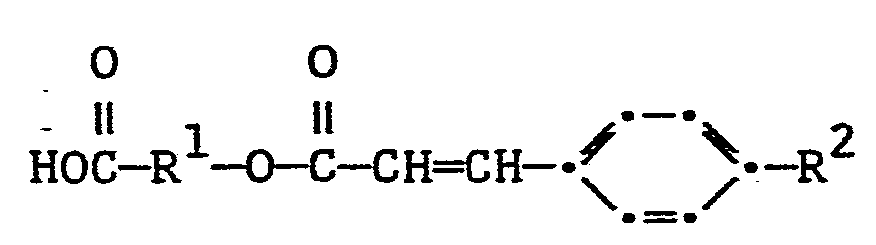
- reacting the acrylate compound and the light-sensitive compound together to form a monomer having the structure

- polymerizing the monomer to form the light-sensitive acrylate liquid crystalline polymer; wherein
- 12 4 R, R1, R 2 and R are as previously defined herein.
- Polymers of this invention can be made from their corresponding methacrylate or acrylate monomers by solubilization in dichloroethane to a particular total solids concentration of 10-20%. Polymerization is then initiated with 1% 2,2'-azobis(2-methylpropionitrile) (AIBN) by weight, unless otherwise indicated. The solutions were placed in polymerization vials, sealed with inert caps and purged with N2 for 20 minutes via syringe needles while cooling to eliminate evaporation. The flasks were then immersed in constant temperature baths at temperatures of about 50 to 90°C for 15 hours. The resulting viscous solutions were diluted with dichloroethane and precipitated by adding the diluted solutions dropwise into ethyl ether with vigorous stirring. Solids were collected by vacuum filtration and dried at room temperature under oil pump vacuum.
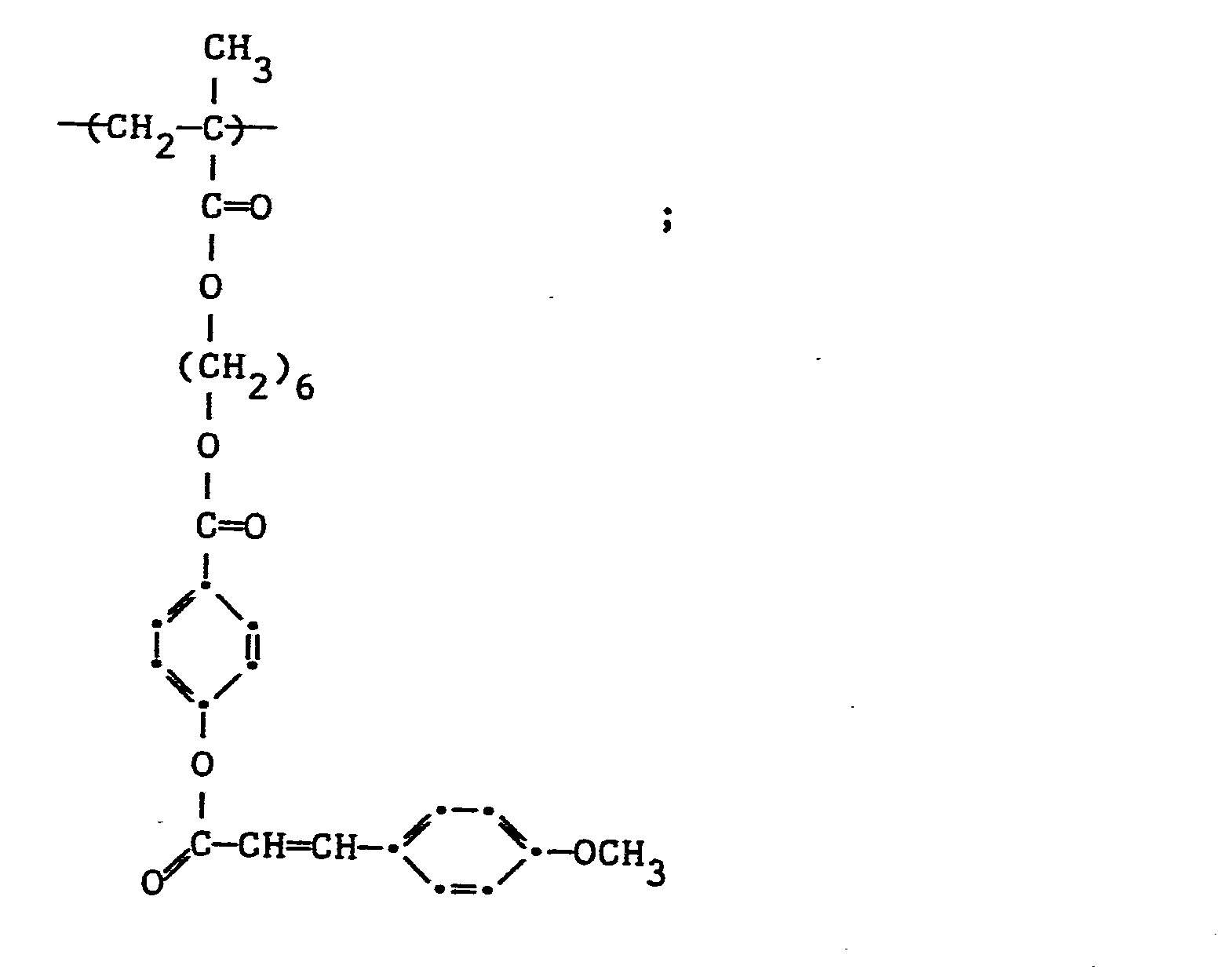
- The following preparative example illustrates the method in making polymer 1 of Table I, infra. The examples also illustrate standard techniques for preparing the monomers from which the polymers are ultimately made.
- The group which provides stiffening and rod-like characteristics are added to the cinnamoyl component by reacting a compound, such as p-hydroxy benzoic acid, 4'-hydoxy-1-biphenylcarboxylic acid, 6-hydroxynaphthoic acid and 4-hydroxy-4'-stilbene- carboxylic acid with the cinnamoyl-containing starting materials in the presence of base.
- The spacer group is added to the group providing the stiffening and rod-like characteristics by reacting, as the spacer group, an acrylate or methacrylate compound, containing from 7 to 14 atoms. The acrylate or methacrylate compound includes the alkylene group that includes the ethers, carbonates, amides, etc., as defined hereinbefore, with the cinnamoyl having attached thereto the group providing stiffening and rod-like character. This latter step is carried out by contacting the cinnamoyl containing compound with the acrylate or methacrylate compound in the presence of dicyclohexylcarbodiimide and 4-pyrrolidinopyridine.
- Methacrylic acid (43.0 g = 0.5 mole) was dissolved in 50 mL methanol. Tetrabutylammonium hydroxide (25% in methanol, 519 gm = 0.5 mole) was added to the latter solution. The solution was stirred for 30 minutes, and then freed of solvent on a rotary evaporator. The residue was dissolved in 100 mL of N,N-dimethylformamide (DMF) and a solution of 6-chloro-l-hexanol (68.3 gm + 0.5 mole) in 200 mL DMF was added. This was stirred at 50°C for 4 hours, the heat was discontinued, and the solution was stirred at room temperature overnight. An equal volume of H20 was combined and the solution was extracted with three portions of ethyl acetate. The combined ethyl acetate layers were back-extracted with three portions of H20, dried over MgSO4, and the mixture evaporated to an amber oil. 1H NMR (CDC13): δ (ppm) 4.1 (2H, t). Elemental Analysis: C10H18O3, mol. wt. 186. Calcd.: C, 61.5; H, 9.7; O, 25.8. Found: C, 61.7; H, 9.7.
- p-Methoxycinnamic acid (52.7 g = 0.45 mole) was slurried under N2 in 500 mL of sieve-dried dichloroethane. Oxalyl chloride (146.0 gm = 1.15 moles) was added in one portion followed by three drops of DMF. Complete solution was achieved in 30 minutes. The solution was stirred an additional 2 hours, and then the dichloroethane containing excess oxalyl chloride was removed on a 50°C rotary evaporator. Fresh dichloroethane was twice added to the residue and removed on the rotary evaporator. The amber oil was used without purificaton. Yield 90.4 gm.
- This step illustrates the addition of an aryl group to the compound of Step 2 to increase the stiffness and rod-like characteristics of the alkyl or alkoxy substituted cinnamoyl group. The compound of Step 2 (1.0 gm = 5.1 mmole) was slurried under N2 in 10 mL dry pyridine. N,N-diisopropylethylamine (0.7 gm = 5.6 mmole) was added, followed by a spatula tip of 4-dimethylaminopyridine. A solution of p-hydroxybenzoic acid (0.7 gm, 5.1 mmole) in 7 mL pyridine was added dropwise to the above slurry. An amber-orange solution soon developed. The solution was stirred for 60 minutes after addition was complete, and it was dropped slowly into 200 mL ice/H20 containing 25 mL concentrated HC1. The resulting precipitate was collected by suction filtration, slurried twice with H20 on the funnel, and dried in a 40°C vacuum oven. The white solid was recrystallized from boiling acetone. White needles, K280° l.c. Yield 0.6 gm. Elemental Analy- sis: C17H14O5, mol. wt. 298.3. Calcd: C, 68.5, H, 4.7, 0, 26.8. Found: C, 68.5, H, 4.7. A NMR (DMSO-d δ: 5 (ppm) 6.7 (1 H, d), 8.0 (lH, d).
- This step involved adding a polymerizable group and the remainder of the spacer group to the compound of Step 3. The compound of Step 3 (25.5 g = 85 mmole) was slurried in 800 mL dichloromethane. The compound of Step 1 (15.8 g = 85 mmole) was added in one portion, followed by dicyclohexylcarbodiimide (17.5 g = 85 mmole) and 4-pyrrolidinopyridine (1.3 g = 8.5 mmole). The mixture was stirred at room temperature for 4 hours, and then vacuum filtered. The filtrate was washed with 5% aqueous acetic acid, H20, 3 portions 5% aqueous Na2CO3, H20, and then dried over MgSO4 and freed of solvent on a rotary evaporator. The resulting solid was crystallized from low-boiling ligroin via a Soxhlet extractor. Fluffy white crystals, m.p. 65-67°C. Yield 31.8 g. Elemental Analysis: C27H30O7, mol. wt. 466.5. Anal. Calcd: C, 69.5; H, 6.5, 0, 24.0. Found: C, 69.5; H, 6.5; 1H NMR(CDCl3): 5 (ppm) 4.4 (4 H, m).
- This polymer was prepared from the monomer of Step 4 by dissolving in ethyl ether and initiating polymerization with 0.5 to 1.0% by weight of 2,2'-azobis(2-methylpropionitrile). The solutions were placed in polymerization vials, septa sealed and purged with N2 for 20 minutes via syringe needles while cooling to eliminate evaporation. The flasks were then immersed in constant temperature baths at the prescribed temperatures for 15 hours. The viscous solutions were diluted with their respective solvents and precipitated by adding dropwise into the ethyl ether solvents with vigorous stirring. Solids were collected by vacuum filtration and dried at room temperature under oil pump vacuum.
- Representative polymers of this invention are presented in Table I. The structure of all polymers were confirmed by elemental analysis and UV spectroscopy. Absolute molecular weights were determined by known light scattering techniques.
- Liquid crystallinity of the polymers was confirmed by examination of polymer melts under a hot stage polarizing microscope. Under X polarizers typical nematic, cholesteric or smectic liquid crystalline textures were observed.


- The polymer of the Example 1, Step 5 was made to several different molecular weights for photographic speed evaluation. These polymers are indicated in Table I as polymers 1A to lE.
- A poly(vinyl alcohol-co-vinyl benzoate-co-vinyl 4-methoxycinnamate) copolymer (mole ratio 10/55/35) was prepared as a first control (Control 1) (PVA control). This polymer is frequently used in photoresist applications. It has no spacer groups or groups to stiffen the cinnamoyl group. It has the structure:

- The above control polymer was prepared by the following procedure:
- p-Methoxycinnamic acid (14.2 gm, 7.95 x 10 -2m) was treated with a 20 fold excess of oxalyl chloride. A drop of DMF was added. After the evolution of HC1 gas had subsided, the solution was heated to reflux for 1 hour. The oxalyl chloride was evaporated off and an oil was isolated. This acid chloride of p-methoxycinnamic acid weighed 15.63 gm (2.27 x 10⁻¹M).
- Poly(vinyl alcohol) (PVA) (10 gm, 2.27 x 10⁻¹M) (100% hydrolyzed - abs. mw = 75,000) was put in 100 ml of dry pyridine and stirred at 70°C overnight. 19.33 g of benzoyl chloride (0.137 m 10% excess) was added and the reaction was allowed to stir for 4 hrs. Next, the p-methoxycinnamoyl chloride was added and the reaction was stirred overnight. The cooled solution was then precipitated into methanol. The isolated polymer was put in 1,2-dichloromethane and reprecipitated into methanol. This was repeated twice. Yield 24.4 g I.V.=1.15 dl/g.
- The molecular weight of this control polymer could not be determined by Gel Permeation Chromatography or light scattering. However, it is known that the degree of polymerization of the backbone is 1700 which makes the absolute molecular weight approximately 268,000.
- Coating formulations of the polymers to be evaluated and a coumarin sensitizer were prepared with the following composition and cast as films on aluminum supports.
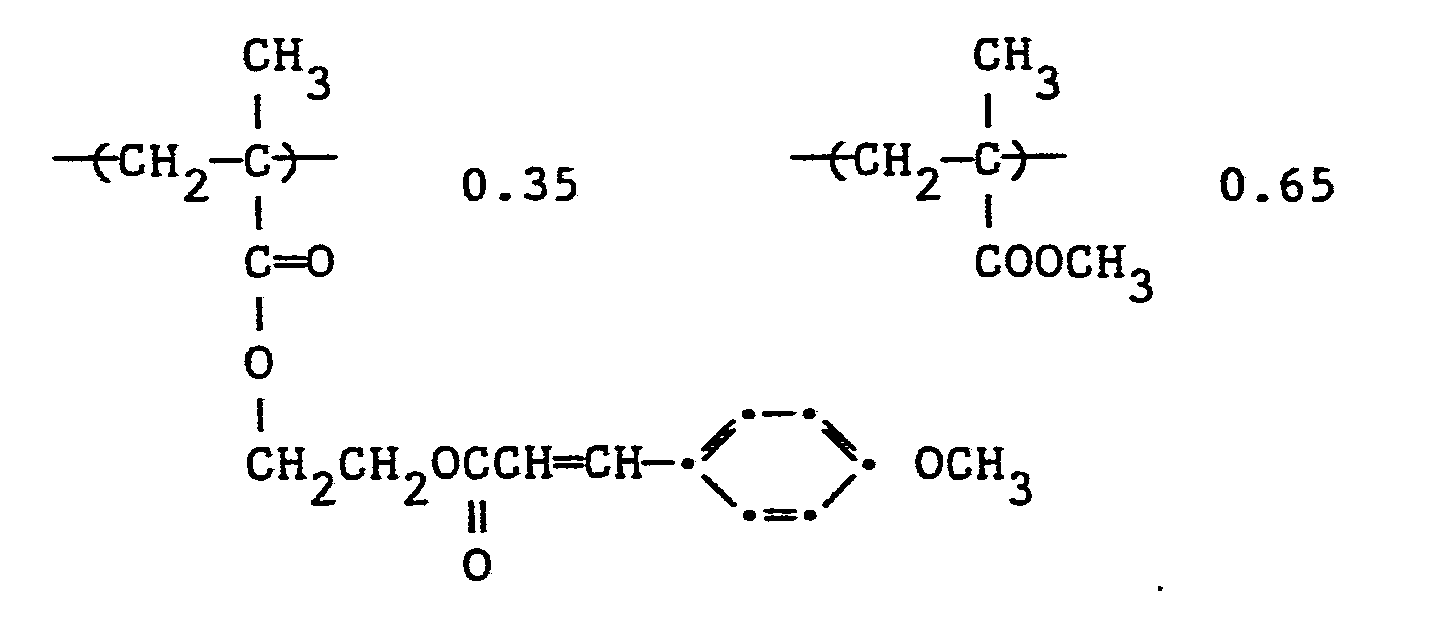
- Two different molecular weight versions of poly[2-(4-methoxycinnamoyloxy)ethyl methacrylate- co-methyl methacrylate] (mole ratio 35/65) were prepared as Controls A and B to show that a short spacer group having less than four carbon atoms between the polymer backbone and the methoxy cinnamate group was not sufficient to significantly improve photographic speed or result in liquid crystallinity of these polymers. This polymer has the structure:
- All polymers evaluated were dissolved in cyclohexanone at 3 percent by weight. The light-sensitive cinnamoyl components of each polymer were adjusted to 2.1 molar. The coumarin sensitizer was KC-74*. Its concentration was adjusted to 3 x 10⁻³ molar in the solution.

- The thus formed coating formulations were coated on aluminum supports. Each coating was the same optical density. Each film was then exposed on an optical bench with a PEK 200 watt super high pressure mercury light source. The appropriate filters were used (k > 405 nm) to insure that only the sensitizer absorbed the incident radiation. The films were irradiated through a photographic step tablet in which the density varies in increments of 0.15 per step. After irradiation, the films were developed by soaking in cyclohexanone for 1 minute or until no further change was noted.
- Table II shows the molecular weights and the relative photographic speed results of the amorphous controls and various molecular weight versions of Polymer 1, Table I of the invention. The difference in the photographic speed between the PVA control and Control B could be attributed to the difference in the backbone configurations and the effect the backbone has on the orientation of the cinnamate component. Also, the -C2H4 spacer removes some of the orientational influence the polymeric backbone might exert on the cinnamate component. The latter effect most certainly would increase the photographic speed of the polymer. The effect that the molecular weight played on the photographic speed of light-sensitive polymers is best illustrated by comparing control polymers (A) and (B) in Table II.
- It was necessary to handle films of Polymers 1C, 1E and 1D under safe-light conditions to avoid premature fogging. Polymer lE has a molecular weight 6X that of the PVA cinnamate control, but was 83X faster. The molecular weight difference certainly accounted for some of this increased speed but obviously could not account for all of it. This data shows that the liquid crystalline polymers of this invention present the necessary ordered state to dramatically increase the photographic speed of photocrosslinkable polymers.
Claims (6)


Applications Claiming Priority (2)
| Application Number | Priority Date | Filing Date | Title |
|---|---|---|---|
| US06/846,416 US4696990A (en) | 1986-03-31 | 1986-03-31 | Novel photocrosslinkable liquid crystalline polymers |
| US846416 | 1986-03-31 |
Publications (3)
| Publication Number | Publication Date |
|---|---|
| EP0240276A2 true EP0240276A2 (en) | 1987-10-07 |
| EP0240276A3 EP0240276A3 (en) | 1987-12-09 |
| EP0240276B1 EP0240276B1 (en) | 1990-09-26 |
Family
ID=25297869
Family Applications (1)
| Application Number | Title | Priority Date | Filing Date |
|---|---|---|---|
| EP87302715A Expired EP0240276B1 (en) | 1986-03-31 | 1987-03-30 | Photocrosslinkable polymers |
Country Status (5)
| Country | Link |
|---|---|
| US (1) | US4696990A (en) |
| EP (1) | EP0240276B1 (en) |
| JP (1) | JPS62284350A (en) |
| CA (1) | CA1328330C (en) |
| DE (1) | DE3765153D1 (en) |
Cited By (3)
| Publication number | Priority date | Publication date | Assignee | Title |
|---|---|---|---|---|
| EP0410205A3 (en) * | 1989-07-25 | 1992-01-08 | Roehm Gmbh | Anisotropic liquid crystal polymeric films |
| EP0469941A1 (en) * | 1990-07-31 | 1992-02-05 | Thomson-Csf | Amorphous copolymers for photorefractive compounds used in optical signal treatment |
| EP0611786A1 (en) * | 1993-02-17 | 1994-08-24 | F. Hoffmann-La Roche Ag | Orientation layer for liquid crystals |
Families Citing this family (18)
| Publication number | Priority date | Publication date | Assignee | Title |
|---|---|---|---|---|
| US4844835A (en) * | 1985-12-26 | 1989-07-04 | Idenitsu Kosan Co., Ltd. | Ferroelectric liquid crystal polymer |
| US5244699A (en) * | 1987-03-27 | 1993-09-14 | North Dakota State University | Polymeric vehicle for coatings |
| US5218045A (en) * | 1987-03-27 | 1993-06-08 | North Dakota State University | Coating binders comprising liquid crystalline enhanced polymers |
| JP2635613B2 (en) * | 1987-09-16 | 1997-07-30 | 株式会社東芝 | Method of forming resist pattern |
| US4925589A (en) * | 1987-12-29 | 1990-05-15 | Hoffmann-La Roche Inc. | Amide side-chain polymers |
| US5352312A (en) * | 1989-05-10 | 1994-10-04 | Thiokol Corporation | Method of insulating a rocket motor |
| US5078910A (en) * | 1989-06-20 | 1992-01-07 | Edison Polymer Innovation Corp. | Polimerization of liquid crystalline monomers |
| FR2668158B1 (en) * | 1990-10-22 | 1994-05-06 | Thomson Csf | CROSSLINKABLE POLYMER FOR NONLINEAR OPTICAL APPLICATIONS. |
| EP0492216B1 (en) * | 1990-12-21 | 1995-10-11 | F. Hoffmann-La Roche Ag | Non-linear optical polymeric layers |
| US5229474A (en) * | 1991-03-20 | 1993-07-20 | The Board Of Trustees Of The University Of Illinois | Synthesis of two-dimensional polymers by molecular recognition and chemical reaction among high molar mass monomers |
| US6160597A (en) * | 1993-02-17 | 2000-12-12 | Rolic Ag | Optical component and method of manufacture |
| JP3384888B2 (en) * | 1994-09-14 | 2003-03-10 | 新日本石油株式会社 | Compensator for liquid crystal display element |
| KR19980048361A (en) * | 1996-12-17 | 1998-09-15 | 손욱 | Photo-alignment composition, alignment film formed from this, and liquid crystal display element provided with this alignment film |
| WO1998052905A1 (en) | 1997-05-22 | 1998-11-26 | Rolic Ag | New polymerisable liquid crystalline compounds |
| GB9812636D0 (en) * | 1998-06-11 | 1998-08-12 | Rolic Ag | Optical component orientation layer and layerable polymerisable mixture |
| US20070037960A1 (en) * | 2005-08-15 | 2007-02-15 | General Electric Company | Copolyester stilbene embossed film and methods of making the same |
| US7105627B1 (en) * | 2005-08-15 | 2006-09-12 | General Electric Company | Polyester stilbene composition |
| US11084023B2 (en) * | 2019-03-22 | 2021-08-10 | Purdue Research Foundation | Phosphate-promoted nickel catalyst for high temperature oligomerization |
Family Cites Families (11)
| Publication number | Priority date | Publication date | Assignee | Title |
|---|---|---|---|---|
| BE755548A (en) * | 1969-08-29 | 1971-02-01 | Eastman Kodak Co | NEW PHOTOSENSITIVE POLYMER AND ITS APPLICATIONS IN PHOTOGRAPHY |
| JPS4929683B1 (en) * | 1970-09-16 | 1974-08-06 | ||
| JPS4928122B1 (en) * | 1970-12-26 | 1974-07-24 | ||
| JPS4938987A (en) * | 1972-08-18 | 1974-04-11 | ||
| JPS5637244B2 (en) * | 1973-02-13 | 1981-08-29 | ||
| US3933746A (en) * | 1973-06-14 | 1976-01-20 | Ball Corporation | Photopolymerizable polymers having anhydride-containing groups |
| DE2831909A1 (en) * | 1978-07-20 | 1980-02-07 | Basf Ag | LIQUID CRYSTALLINE POLYMER PHASE WITH CHOLESTERIC STRUCTURE, METHOD FOR THE PRODUCTION THEREOF AND THEIR USE |
| US4289842A (en) * | 1980-06-27 | 1981-09-15 | Eastman Kodak Company | Negative-working polymers useful as electron beam resists |
| DE3211400A1 (en) * | 1982-03-27 | 1983-09-29 | Basf Ag, 6700 Ludwigshafen | POLYMERS WITH MESOGENIC GROUPS AND DYE REMAINS IN THE SIDE CHAINS |
| US4434262A (en) * | 1982-09-01 | 1984-02-28 | Celanese Corporation | Melt processable blend of a low molecular weight liquid crystalline compound and a polyolefin or polyester |
| DE3500838A1 (en) * | 1985-01-12 | 1986-07-17 | Röhm GmbH, 6100 Darmstadt | POLYMERS WITH LIQUID CRYSTAL PROPERTIES AS INFORMATION CARRIERS |
-
1986
- 1986-03-31 US US06/846,416 patent/US4696990A/en not_active Expired - Fee Related
- 1986-09-22 CA CA000518726A patent/CA1328330C/en not_active Expired - Fee Related
-
1987
- 1987-03-27 JP JP62071919A patent/JPS62284350A/en active Pending
- 1987-03-30 DE DE8787302715T patent/DE3765153D1/en not_active Expired - Fee Related
- 1987-03-30 EP EP87302715A patent/EP0240276B1/en not_active Expired
Cited By (9)
| Publication number | Priority date | Publication date | Assignee | Title |
|---|---|---|---|---|
| EP0410205A3 (en) * | 1989-07-25 | 1992-01-08 | Roehm Gmbh | Anisotropic liquid crystal polymeric films |
| EP0469941A1 (en) * | 1990-07-31 | 1992-02-05 | Thomson-Csf | Amorphous copolymers for photorefractive compounds used in optical signal treatment |
| FR2665452A1 (en) * | 1990-07-31 | 1992-02-07 | Thomson Csf | AMORPHOUS COPOLYMERS FOR PHOTOREFRACTIVE COMPOUNDS USEFUL IN THE PROCESSING OF THE OPTICAL SIGNAL. |
| US5198514A (en) * | 1990-07-31 | 1993-03-30 | Thomson-Csf | Amorphous copolymers for photorefractive compounds used in optical signal processing |
| US5314939A (en) * | 1990-07-31 | 1994-05-24 | Thomson-Csf | Amorphous copolymers for photorefractive compounds used in optical signal processing |
| EP0611786A1 (en) * | 1993-02-17 | 1994-08-24 | F. Hoffmann-La Roche Ag | Orientation layer for liquid crystals |
| US5539074A (en) * | 1993-02-17 | 1996-07-23 | Hoffmann-La Roche Inc. | Linear and cyclic polymers or oligomers having a photoreactive ethene group |
| CN1049224C (en) * | 1993-02-17 | 2000-02-09 | 罗列克股份公司 | Polymers as alignment layer |
| USRE36625E (en) * | 1993-02-17 | 2000-03-21 | Rolic Ag | Linear and cyclic polymers or oligomers having a photoreactive ethene group |
Also Published As
| Publication number | Publication date |
|---|---|
| JPS62284350A (en) | 1987-12-10 |
| US4696990A (en) | 1987-09-29 |
| CA1328330C (en) | 1994-04-05 |
| EP0240276B1 (en) | 1990-09-26 |
| DE3765153D1 (en) | 1990-10-31 |
| EP0240276A3 (en) | 1987-12-09 |
Similar Documents
| Publication | Publication Date | Title |
|---|---|---|
| EP0240276B1 (en) | Photocrosslinkable polymers | |
| JP4721721B2 (en) | Polymerizable compound and polymerizable liquid crystal composition containing the compound | |
| JP3651980B2 (en) | Novel side group polymers and their use for optical components | |
| JP2691083B2 (en) | Polymerizable nematic monomer composition | |
| JP4854516B2 (en) | Polymerizable compound and composition containing the polymerizable compound | |
| JP4369748B2 (en) | Photoactive substance | |
| JPH06157511A (en) | Heterocyclic-aromatic compound functionalized for application to nonlinear optics | |
| US5132430A (en) | High refractive index polymers | |
| JP2001226430A (en) | Re-dissolvable acid crosslinkable polymer and photosensitive resin composition in which the polymer and a photoacid generator are combined | |
| US12012382B2 (en) | Polymerizable liquid crystal having a carbazole core | |
| JPH10182556A (en) | Compound and method for producing liquid crystal polymer therefrom and use thereof | |
| ZHou et al. | Synthesis of a new class of side chain liquid crystal polymers—polymers with mesogens laterally attached via short linkages to polymer backbones | |
| EP0574519B1 (en) | Polymeric nitrones having an acrylic backbone chain | |
| US12006463B2 (en) | Polymerizable liquid crystal having a quinoxaline-hydrazone core | |
| JPH11116534A (en) | Di (meth) acrylate compound | |
| JP2000154380A (en) | Spirooxazine derivative containing optically active group and optical functional medium containing the same | |
| US5112973A (en) | Fluorine-containing acrylic acid derivative and polymer thereof | |
| JP2003321430A (en) | Polymerizable compound, liquid crystalline composition containing the same and its polymer | |
| Stumpe et al. | Photochemical behaviour of cinnamoyl‐containing crystalline polymers with comb‐like structure | |
| CN1244612C (en) | Copolymerized thioxanthone polymer photoinitiator and preparation method thereof | |
| CN1290872C (en) | Photoinitiator of benzophenone in macromolecule type and preparation method | |
| JP2819157B2 (en) | Radiation polymerizable liquid crystalline monomer and its polymer | |
| JP2641274B2 (en) | Liquid crystal-forming polymer and method for producing the same | |
| JP3200467B2 (en) | Carbazole ring-containing monomer, carbazole ring-containing polymer and methods for producing them | |
| JP2772960B2 (en) | Polymer liquid crystal material |
Legal Events
| Date | Code | Title | Description |
|---|---|---|---|
| PUAI | Public reference made under article 153(3) epc to a published international application that has entered the european phase |
Free format text: ORIGINAL CODE: 0009012 |
|
| AK | Designated contracting states |
Kind code of ref document: A2 Designated state(s): DE FR GB |
|
| PUAL | Search report despatched |
Free format text: ORIGINAL CODE: 0009013 |
|
| AK | Designated contracting states |
Kind code of ref document: A3 Designated state(s): DE FR GB |
|
| 17P | Request for examination filed |
Effective date: 19880526 |
|
| 17Q | First examination report despatched |
Effective date: 19880905 |
|
| GRAA | (expected) grant |
Free format text: ORIGINAL CODE: 0009210 |
|
| AK | Designated contracting states |
Kind code of ref document: B1 Designated state(s): DE FR GB |
|
| REF | Corresponds to: |
Ref document number: 3765153 Country of ref document: DE Date of ref document: 19901031 |
|
| ET | Fr: translation filed | ||
| PGFP | Annual fee paid to national office [announced via postgrant information from national office to epo] |
Ref country code: GB Payment date: 19910220 Year of fee payment: 5 |
|
| PGFP | Annual fee paid to national office [announced via postgrant information from national office to epo] |
Ref country code: DE Payment date: 19910308 Year of fee payment: 5 |
|
| PGFP | Annual fee paid to national office [announced via postgrant information from national office to epo] |
Ref country code: FR Payment date: 19910313 Year of fee payment: 5 |
|
| PLBE | No opposition filed within time limit |
Free format text: ORIGINAL CODE: 0009261 |
|
| STAA | Information on the status of an ep patent application or granted ep patent |
Free format text: STATUS: NO OPPOSITION FILED WITHIN TIME LIMIT |
|
| 26N | No opposition filed | ||
| PG25 | Lapsed in a contracting state [announced via postgrant information from national office to epo] |
Ref country code: GB Effective date: 19920330 |
|
| GBPC | Gb: european patent ceased through non-payment of renewal fee | ||
| PG25 | Lapsed in a contracting state [announced via postgrant information from national office to epo] |
Ref country code: FR Effective date: 19921130 |
|
| PG25 | Lapsed in a contracting state [announced via postgrant information from national office to epo] |
Ref country code: DE Effective date: 19921201 |
|
| REG | Reference to a national code |
Ref country code: FR Ref legal event code: ST |