EP0237463B1 - Hot melt, synthetic, magnetic sealant - Google Patents
Hot melt, synthetic, magnetic sealant Download PDFInfo
- Publication number
- EP0237463B1 EP0237463B1 EP87630033A EP87630033A EP0237463B1 EP 0237463 B1 EP0237463 B1 EP 0237463B1 EP 87630033 A EP87630033 A EP 87630033A EP 87630033 A EP87630033 A EP 87630033A EP 0237463 B1 EP0237463 B1 EP 0237463B1
- Authority
- EP
- European Patent Office
- Prior art keywords
- adhesive
- sealant
- magnetic
- particles
- magnetized
- Prior art date
- Legal status (The legal status is an assumption and is not a legal conclusion. Google has not performed a legal analysis and makes no representation as to the accuracy of the status listed.)
- Expired - Lifetime
Links
Images

Classifications
-
- B—PERFORMING OPERATIONS; TRANSPORTING
- B29—WORKING OF PLASTICS; WORKING OF SUBSTANCES IN A PLASTIC STATE IN GENERAL
- B29C—SHAPING OR JOINING OF PLASTICS; SHAPING OF MATERIAL IN A PLASTIC STATE, NOT OTHERWISE PROVIDED FOR; AFTER-TREATMENT OF THE SHAPED PRODUCTS, e.g. REPAIRING
- B29C66/00—General aspects of processes or apparatus for joining preformed parts
- B29C66/70—General aspects of processes or apparatus for joining preformed parts characterised by the composition, physical properties or the structure of the material of the parts to be joined; Joining with non-plastics material
- B29C66/74—Joining plastics material to non-plastics material
- B29C66/742—Joining plastics material to non-plastics material to metals or their alloys
-
- B—PERFORMING OPERATIONS; TRANSPORTING
- B29—WORKING OF PLASTICS; WORKING OF SUBSTANCES IN A PLASTIC STATE IN GENERAL
- B29C—SHAPING OR JOINING OF PLASTICS; SHAPING OF MATERIAL IN A PLASTIC STATE, NOT OTHERWISE PROVIDED FOR; AFTER-TREATMENT OF THE SHAPED PRODUCTS, e.g. REPAIRING
- B29C65/00—Joining or sealing of preformed parts, e.g. welding of plastics materials; Apparatus therefor
- B29C65/02—Joining or sealing of preformed parts, e.g. welding of plastics materials; Apparatus therefor by heating, with or without pressure
- B29C65/34—Joining or sealing of preformed parts, e.g. welding of plastics materials; Apparatus therefor by heating, with or without pressure using heated elements which remain in the joint, e.g. "verlorenes Schweisselement"
- B29C65/36—Joining or sealing of preformed parts, e.g. welding of plastics materials; Apparatus therefor by heating, with or without pressure using heated elements which remain in the joint, e.g. "verlorenes Schweisselement" heated by induction
- B29C65/3604—Joining or sealing of preformed parts, e.g. welding of plastics materials; Apparatus therefor by heating, with or without pressure using heated elements which remain in the joint, e.g. "verlorenes Schweisselement" heated by induction characterised by the type of elements heated by induction which remain in the joint
- B29C65/3608—Joining or sealing of preformed parts, e.g. welding of plastics materials; Apparatus therefor by heating, with or without pressure using heated elements which remain in the joint, e.g. "verlorenes Schweisselement" heated by induction characterised by the type of elements heated by induction which remain in the joint comprising single particles, e.g. fillers or discontinuous fibre-reinforcements
- B29C65/3612—Joining or sealing of preformed parts, e.g. welding of plastics materials; Apparatus therefor by heating, with or without pressure using heated elements which remain in the joint, e.g. "verlorenes Schweisselement" heated by induction characterised by the type of elements heated by induction which remain in the joint comprising single particles, e.g. fillers or discontinuous fibre-reinforcements comprising fillers
-
- C—CHEMISTRY; METALLURGY
- C09—DYES; PAINTS; POLISHES; NATURAL RESINS; ADHESIVES; COMPOSITIONS NOT OTHERWISE PROVIDED FOR; APPLICATIONS OF MATERIALS NOT OTHERWISE PROVIDED FOR
- C09J—ADHESIVES; NON-MECHANICAL ASPECTS OF ADHESIVE PROCESSES IN GENERAL; ADHESIVE PROCESSES NOT PROVIDED FOR ELSEWHERE; USE OF MATERIALS AS ADHESIVES
- C09J201/00—Adhesives based on unspecified macromolecular compounds
-
- C—CHEMISTRY; METALLURGY
- C09—DYES; PAINTS; POLISHES; NATURAL RESINS; ADHESIVES; COMPOSITIONS NOT OTHERWISE PROVIDED FOR; APPLICATIONS OF MATERIALS NOT OTHERWISE PROVIDED FOR
- C09J—ADHESIVES; NON-MECHANICAL ASPECTS OF ADHESIVE PROCESSES IN GENERAL; ADHESIVE PROCESSES NOT PROVIDED FOR ELSEWHERE; USE OF MATERIALS AS ADHESIVES
- C09J5/00—Adhesive processes in general; Adhesive processes not provided for elsewhere, e.g. relating to primers
- C09J5/06—Adhesive processes in general; Adhesive processes not provided for elsewhere, e.g. relating to primers involving heating of the applied adhesive
-
- C—CHEMISTRY; METALLURGY
- C08—ORGANIC MACROMOLECULAR COMPOUNDS; THEIR PREPARATION OR CHEMICAL WORKING-UP; COMPOSITIONS BASED THEREON
- C08L—COMPOSITIONS OF MACROMOLECULAR COMPOUNDS
- C08L2666/00—Composition of polymers characterized by a further compound in the blend, being organic macromolecular compounds, natural resins, waxes or and bituminous materials, non-macromolecular organic substances, inorganic substances or characterized by their function in the composition
- C08L2666/54—Inorganic substances
-
- Y—GENERAL TAGGING OF NEW TECHNOLOGICAL DEVELOPMENTS; GENERAL TAGGING OF CROSS-SECTIONAL TECHNOLOGIES SPANNING OVER SEVERAL SECTIONS OF THE IPC; TECHNICAL SUBJECTS COVERED BY FORMER USPC CROSS-REFERENCE ART COLLECTIONS [XRACs] AND DIGESTS
- Y10—TECHNICAL SUBJECTS COVERED BY FORMER USPC
- Y10S—TECHNICAL SUBJECTS COVERED BY FORMER USPC CROSS-REFERENCE ART COLLECTIONS [XRACs] AND DIGESTS
- Y10S428/00—Stock material or miscellaneous articles
- Y10S428/90—Magnetic feature
Definitions
- the present invention concerns a hot melt, magnetized sealant according to the precharacterizing portion of claim 1.
- the invention further comprises a method of manufacturing that sealant and a method for sealing an irregular surface in using said sealant.
- the present invention relates to the field of art which pertains to sealants and adhesives, in particular those which possess magnetic properties.
- Synthetic adhesives having magnetic properties have been known for some time.
- the magnetic property of these adhesives is created by introducing magnetic particles of small particle sizes, typically below 150 microns, into the base adhesive composition.
- the introduction of increasing amounts of these magnetic particles, while increasing the magnetic properties of the adhesive also significantly reduces the sealant's flow properties. This creates a problem when the adhesive is placed over an irregular surface wherein a portion of the adhesive is not in contact with the substrate. In such a situation, the magnetic attraction of the adhesive may be sufficient to maintain the sealant in place on the substrate, however it may not be sufficient to overcome the high viscosity of the resin and draw it into all of the irregularities on the substrate, thereby failing to create a void-free seal.
- the GB-A-2 143 533 discloses a weldable sealant composition having a high viscosity and containing ferrous metal particles in an amount of 1-40% by weight and having a particle size of 44 to 150 micrometers.
- the FR-A-2 418 266 discloses magnetized adhesives comprising magnetized particles having a mean particle size of about 1.8 micrometers.
- the sealant of the present invention is defined by the features disclosed in the characterizing portion of claim 1.
- the method of manufacturing the sealant is defined by the steps of the characterizing portion of claim 7 and the sealant is defined by the steps of the characterizing portion of claim 8.
- the present invention is for an improved hot melt, synthetic adhesive comprising a synthetic adhesive resin impregnated with 60 % to 80 % by weight of magnetic particles having a particle size greater than 150 micrometers.
- the adhesive has improved flowability at the higher concentrations of magnetic particles due to the removal of the lower end particle sizes below about 150 micrometers. It has been determined that by removing these smaller particle sizes, a higher concentration of particles may be introduced into the adhesive without substantially reducing its flowability during curing. This results in an adhesive which, when the adhesive is overlapped, or applied to an irregular surface, will result in a substantially void-free seal.
- the application is directed to a method of making an improved hot melt, synthetic, magnetic adhesive having the above disclosed composition.
- this invention discloses a method of sealing an irregular surface, using the improved adhesive disclosed, to form a seal which is substantially void free.
- the basic resin adhesive may be thermoplastic or thermosetting. These hydrocarbon resins may be both aromatic or aliphatic with the aromatic resins being preferred.
- Typical thermoplastic materials are hydrocarbon resins, which are typically used in the adhesive and sealant industry such as styrene and acrylic monomers, while typical thermosetting resins may be ethylene propylene diene terpolymer (EPDM), polyisoprene, and styrene butadiene.
- EPDM ethylene propylene diene terpolymer
- polyisoprene polyisoprene
- styrene butadiene ethylene propylene diene terpolymer
- the preferred material being styrene butadiene rubber resins.
- Some preferred styrene butadiene materials may be Ameripol 1009 available from B. F. Goodrich Company, and Kraton 1101 available from Shell Chemical Company.
- the adhesive will typically be composed of 20 percent to 40 percent of the base synthetic resin material, with 25 percent to 33 percent by weight being preferred, exclusive of the magnetic particles, the rest of the adhesive will be composed of additives.
- Adhesive curing agents may be methacrylates, epoxies, polyamides, while typical fillers may be calcium carbonate, clay, barrites or silica and plasticizers such as adipates, phthlates, and process oils such as naphthenic or paraffinic.
- adhesive agents are normally present in concentrations from 0 percent to 7 percent by weight.
- the fillers are present from 0 percent to 25 percent by weight and the plasticizers are present from 5 percent to 30 percent by weight, each of these being in percent by weight of she adhesive prior to the introduction of the magnetic particles.
- the key feature of the invention is the ability to increase the magnetic properties of the adhesive without substantially reducing the adhesives ability to flow during cure. This objective is accomplished by limiting the particle size of the magnetic particle to those which are greater than 150 ⁇ ms and preferably between 150 ⁇ ms to 650 ⁇ m.
- One simple way of selecting the particles in a particular range is to pass the particles through a series of standard screens or sieves and utilize that portion of the particles which remain on the 150 ⁇ m (100 mesh ASTM (American Society for Testing and Materials)) or higher screen while discarding that which passes through.
- These larger particle sizes of the magnetic material are mixed with the adhesive resin in concentration of 60 percent to 80 percent by weight with 65 percent to 75 percent being preferred.
- These particles may be comprised of any conventional magnetizable material such as barium ferrite or strontium ferrite, other materials may be iron oxides, i.e. Fe3O4, Fe2O3, or powdered Alnico alloys with the preferred being strontium ferrite.
- the preparation of these adhesive materials requires mixing the adhesive resin and other components into a homogenous mixture. It may be that to ensure ease of mixing, the adhesive should be heated or warmed to a temperature which will allow for ease of mixing but will not cure the resin. Typically, this temperature will be 50°C to 70°C.
- the magnetizable particles are mixed in with the resin and typically are dispersed uniformly throughout the adhesive. All of this may be performed using conventional mixing or stirring devices.
- the adhesive is then extruded through conventional extrusion equipment into a tape or other desired form.
- the extrusion head should be selected to have an opening to accommodate them. Should one be using a selectively small extruder head opening, the particle size range of the metallic particles may be limited accordingly.
- the extruded material is then passed through an electrical field which magnetizes the particles and aligns them in strips or lines along the tape.
- These electrical fields are conventional and may be generated by A.C. rectified current, direct current or capacitor discharge.
- the magnetized adhesives will typically have gauss readings of 150 to 300. These gauss readings will be an average over a number of positions along the tape and it is desired and preferred that the gauss readings be in excess of 200.
- the tape Once the tape has been magnetized, it may be cut into the desired lengths or shapes and is ready to apply it to a substrate.
- this material may be applied to any ferrometallic surface to seal or bond it, it is particularly designed to be used when, for one reason or another the adhesive cannot be in total contact with the substrate and the substrate is in a near vertical position.
- Such situations require an adhesive which has excellent flow properties when heated but with sufficient magnetic strength to maintain its position during curing. As discussed in the introduction of the specification this often occurs when one piece of tape overlaps another as shown in Fig. 1.
- This figure shows a metal substrate 2 for an automobile wherein the adhesive strips 4 and 6 have been overlapped leaving a sizable gap 8 between the adhesive and the substrate. When the adhesive is cured through the application of heat, its viscosity is reduced and the magnetic particles draw the adhesive into the gap, thereby filling it as demonstrated in Fig. 3.
- a void 10 (exaggerated to more clearly show the voids) remains due to the fact that sealant was not capable of free enough flow to fill the gap which existed when the sealant strips were overlapped or in the alternative, the adhesive strip would flow properly but the magnetic strength would have been reduced so low that the adhesive would slide off of its position on the substrate.
- the magnetic sealant of the present invention has superior qualities over similar adhesives of the prior art in that it allows for the introduction of increased quantities of magnetic particles into the resin thereby increasing it's ability to adhere to the ferrometallic substrate, even when that substrate is at a difficult angle, yet will flow properly when heated and cured to produce a seal which is substantially void free even on irregular substrate surfaces.
- the magnetic tape was prepared having 60 percent, 70 percent and 76 percent by weight of each type of particles.
- the strips were 1.77 mm (0.07 inch) thick, 5.0 cm (2 inches) wide, and were laid up in lap joint arrangement on a sheet of steel and cured at 163°C for one-half hour.
- the resulting lap joints were then tested to see if any water could be forced through the joints. If water passed through the joint, then the joint was not sealed and it was considered unacceptable. The failure of the joint to properly seal is an indication of its inability to flow properly. As may be seen in Fig.
Landscapes
- Engineering & Computer Science (AREA)
- Mechanical Engineering (AREA)
- Chemical & Material Sciences (AREA)
- Organic Chemistry (AREA)
- Adhesives Or Adhesive Processes (AREA)
- Sealing Material Composition (AREA)
Description
- The present invention concerns a hot melt, magnetized sealant according to the precharacterizing portion of claim 1. The invention further comprises a method of manufacturing that sealant and a method for sealing an irregular surface in using said sealant.
- The present invention relates to the field of art which pertains to sealants and adhesives, in particular those which possess magnetic properties.
- Synthetic adhesives having magnetic properties have been known for some time. The magnetic property of these adhesives is created by introducing magnetic particles of small particle sizes, typically below 150 microns, into the base adhesive composition. However, it is known that the introduction of increasing amounts of these magnetic particles, while increasing the magnetic properties of the adhesive, also significantly reduces the sealant's flow properties. This creates a problem when the adhesive is placed over an irregular surface wherein a portion of the adhesive is not in contact with the substrate. In such a situation, the magnetic attraction of the adhesive may be sufficient to maintain the sealant in place on the substrate, however it may not be sufficient to overcome the high viscosity of the resin and draw it into all of the irregularities on the substrate, thereby failing to create a void-free seal.
- To overcome this high viscosity, one may try to increase the magnetic strength of the adhesive by introducing once of the magnetized particles thereby increasing the magnet strength of the tape. However, it has been found that by increasing the concentration of the magnetic particles disclosed in the prior art, the viscosity of the adhesive is increased, thereby making it more difficult to flow and offsetting the increase in magnetic strength. An alternative approach is to lower the concentration of magnetic particles in the adhesive thereby reducing their effect on the viscosity of the resin. However, this in turn reduces the magnetic attraction of the adhesive to the substrate such that the adhesive will not remain in position on the substrate during processing.
- This problem is particularly acute in the automobile industry's attempt to seal ferrometallic components which are situated at near vertical positions in the automobile and which have irregular surfaces or where the adhesive must be overlapped when applied. It has been found that prior art adhesives having sufficient magnetic properties to maintain their position on the substrate during processing and curing do not possess sufficient flowability to seal the components without leaving voids in the seal, through which water or exhaust vapors may be forced into the passenger compartment. One particularly troublesome spot is the "toe plate" on the car which is the vertical plate behind the pedals and under the glove compartment on the passenger's side.
- Therefore, what is required in this art area is an improved magnetic, hot melt adhesive which will have sufficient magnetism to maintain its position on a substrate which is near vertical during the curing process yet will have improved flowability resulting in a seal which is void free.
- The GB-A-2 143 533 discloses a weldable sealant composition having a high viscosity and containing ferrous metal particles in an amount of 1-40% by weight and having a particle size of 44 to 150 micrometers.
- The FR-A-2 418 266 discloses magnetized adhesives comprising magnetized particles having a mean particle size of about 1.8 micrometers.
- The sealant of the present invention is defined by the features disclosed in the characterizing portion of claim 1. The method of manufacturing the sealant is defined by the steps of the characterizing portion of claim 7 and the sealant is defined by the steps of the characterizing portion of
claim 8. - The present invention is for an improved hot melt, synthetic adhesive comprising a synthetic adhesive resin impregnated with 60 % to 80 % by weight of magnetic particles having a particle size greater than 150 micrometers. The adhesive has improved flowability at the higher concentrations of magnetic particles due to the removal of the lower end particle sizes below about 150 micrometers. It has been determined that by removing these smaller particle sizes, a higher concentration of particles may be introduced into the adhesive without substantially reducing its flowability during curing. This results in an adhesive which, when the adhesive is overlapped, or applied to an irregular surface, will result in a substantially void-free seal.
- Additionally, the application is directed to a method of making an improved hot melt, synthetic, magnetic adhesive having the above disclosed composition.
- Further, this invention discloses a method of sealing an irregular surface, using the improved adhesive disclosed, to form a seal which is substantially void free.
- Other features and advantages will be apparent from the specification and claims and from the accompanying drawings which illustrate an embodiment of the invention.
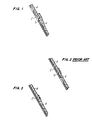
- Fig. 1 is a cross-sectional view of a typical lap joint of magnetic adhesive prior to curing.
- Fig. 2 is a cross-sectional view of a typical lap joint of cured prior art adhesive.
- Fig. 3 is a cross-sectional view of a typical lap joint of cured adhesive of the present invention.
- Fig. 4 is comparative test results indicating percentage of acceptable seals in a lap joint test of identical resins between the prior art adhesive and the present invention.
- Fig. 5 shows comparative test results indicating gauss strength of the prior art adhesive and the present invention.
- Conventional synthetic sealants may be used to practice this invention. The basic resin adhesive may be thermoplastic or thermosetting. These hydrocarbon resins may be both aromatic or aliphatic with the aromatic resins being preferred. Typical thermoplastic materials are hydrocarbon resins, which are typically used in the adhesive and sealant industry such as styrene and acrylic monomers, while typical thermosetting resins may be ethylene propylene diene terpolymer (EPDM), polyisoprene, and styrene butadiene. The preferred material being styrene butadiene rubber resins. Some preferred styrene butadiene materials may be Ameripol 1009 available from B. F. Goodrich Company, and Kraton 1101 available from Shell Chemical Company. Other conventional resin systems such as Wingtac 95, Wingtac 10, Escorez 2001, Nevchem 100, Amoco 210 and Hercules A75 may also be used. The adhesive will typically be composed of 20 percent to 40 percent of the base synthetic resin material, with 25 percent to 33 percent by weight being preferred, exclusive of the magnetic particles, the rest of the adhesive will be composed of additives.
- Conventional additives may be added to the base adhesive resin to gain the requisite physical properties of a particular sealant material. These will typically be, but need not be limited to, adhesive agents, fillers, or plasticizers which are typically used to prepare sealants or adhesives. Adhesive curing agents may be methacrylates, epoxies, polyamides, while typical fillers may be calcium carbonate, clay, barrites or silica and plasticizers such as adipates, phthlates, and process oils such as naphthenic or paraffinic. Such adhesive agents are normally present in concentrations from 0 percent to 7 percent by weight. The fillers are present from 0 percent to 25 percent by weight and the plasticizers are present from 5 percent to 30 percent by weight, each of these being in percent by weight of she adhesive prior to the introduction of the magnetic particles.
- The key feature of the invention is the ability to increase the magnetic properties of the adhesive without substantially reducing the adhesives ability to flow during cure. This objective is accomplished by limiting the particle size of the magnetic particle to those which are greater than 150 µms and preferably between 150 µms to 650 µm. One simple way of selecting the particles in a particular range is to pass the particles through a series of standard screens or sieves and utilize that portion of the particles which remain on the 150 µm (100 mesh ASTM (American Society for Testing and Materials)) or higher screen while discarding that which passes through.
- It is the omission of the lower particle sizes, from these sealants which allows for an introduction of increased weight percent of magnetic particles but without substantially decreasing the flowability of the adhesive during curing which is contrary to prior art teachings.
- These larger particle sizes of the magnetic material are mixed with the adhesive resin in concentration of 60 percent to 80 percent by weight with 65 percent to 75 percent being preferred.
- These particles may be comprised of any conventional magnetizable material such as barium ferrite or strontium ferrite, other materials may be iron oxides, i.e. Fe₃O₄, Fe₂O₃, or powdered Alnico alloys with the preferred being strontium ferrite.
- The preparation of these adhesive materials requires mixing the adhesive resin and other components into a homogenous mixture. It may be that to ensure ease of mixing, the adhesive should be heated or warmed to a temperature which will allow for ease of mixing but will not cure the resin. Typically, this temperature will be 50°C to 70°C.
- Once the adhesive has been mixed, the magnetizable particles are mixed in with the resin and typically are dispersed uniformly throughout the adhesive. All of this may be performed using conventional mixing or stirring devices.
- The adhesive is then extruded through conventional extrusion equipment into a tape or other desired form. It should be noted that since the particle sizes used in the sealant may be larger than normally used in extrusion processess, the extrusion head should be selected to have an opening to accommodate them. Should one be using a selectively small extruder head opening, the particle size range of the metallic particles may be limited accordingly.
- The extruded material is then passed through an electrical field which magnetizes the particles and aligns them in strips or lines along the tape. These electrical fields are conventional and may be generated by A.C. rectified current, direct current or capacitor discharge. The magnetized adhesives will typically have gauss readings of 150 to 300. These gauss readings will be an average over a number of positions along the tape and it is desired and preferred that the gauss readings be in excess of 200.
- Once the tape has been magnetized, it may be cut into the desired lengths or shapes and is ready to apply it to a substrate.
- Although this material may be applied to any ferrometallic surface to seal or bond it, it is particularly designed to be used when, for one reason or another the adhesive cannot be in total contact with the substrate and the substrate is in a near vertical position. Such situations require an adhesive which has excellent flow properties when heated but with sufficient magnetic strength to maintain its position during curing. As discussed in the introduction of the specification this often occurs when one piece of tape overlaps another as shown in Fig. 1. This figure shows a metal substrate 2 for an automobile wherein the
adhesive strips 4 and 6 have been overlapped leaving asizable gap 8 between the adhesive and the substrate. When the adhesive is cured through the application of heat, its viscosity is reduced and the magnetic particles draw the adhesive into the gap, thereby filling it as demonstrated in Fig. 3. - The prior art sealant, when overlapped and cured, would leave a void through which water or exhaust fumes could pass and enter the passenger compartment. This is depicted in Fig. 2 in which the substrate 2 on which two
adhesive strips 4 and 6 are placed, one overlapping the other. When the sealant is cured, a void 10 (exaggerated to more clearly show the voids) remains due to the fact that sealant was not capable of free enough flow to fill the gap which existed when the sealant strips were overlapped or in the alternative, the adhesive strip would flow properly but the magnetic strength would have been reduced so low that the adhesive would slide off of its position on the substrate. - The magnetic sealant of the present invention has superior qualities over similar adhesives of the prior art in that it allows for the introduction of increased quantities of magnetic particles into the resin thereby increasing it's ability to adhere to the ferrometallic substrate, even when that substrate is at a difficult angle, yet will flow properly when heated and cured to produce a seal which is substantially void free even on irregular substrate surfaces.
- Although there is no accepted way of measuring the flowability of these sealants, one test which is accepted in the automobile industry is to lap joint the adhesive, then cure it and then squirt water under the lap-jointed region and note any water which emerges. If water passes through, then the joint fails.
- The ability of the present sealants to flow better and fill the voids in irregular surfaces is evident from the results of comparative tests performed using the resin system of the example above and varying the quantity of magnetic particles and their sizes. Two studies were made, one where the particle sizes used were below 150 µm and the other where the same resin system was used and introducing magnetic particles greater than 150 µm as taught in the present disclosure.
- The magnetic tape was prepared having 60 percent, 70 percent and 76 percent by weight of each type of particles. The strips were 1.77 mm (0.07 inch) thick, 5.0 cm (2 inches) wide, and were laid up in lap joint arrangement on a sheet of steel and cured at 163°C for one-half hour. The resulting lap joints were then tested to see if any water could be forced through the joints. If water passed through the joint, then the joint was not sealed and it was considered unacceptable. The failure of the joint to properly seal is an indication of its inability to flow properly. As may be seen in Fig. 4, as the concentration of the smaller particles are increased, the flow is reduced and the number of acceptable seals (indicated by B) achieved is much lower than those achieved when the same quantity of particles which are in excess of 150 µm in size (indicated by A) are added to the resin.
- Additionally, it is shown in Fig. 5 that the use of the coarser particles does not reduce the magnetic strength of the sealant when the same weight percent is used. This results in a sealant which will stay in place during curing, yet will flow sufficiently to seal an irregular surface.
Claims (8)
- A hot melt, magnetized sealant particularly adapted for use on ferrometallic material comprising a synthetic resin sealant containing magnetic particles characterized in that said magnetic particles are present in an amount of 60 % to 80 % by weight and the particle size is greater than 150 µm.
- The sealant of claim 1 characterized in that the particle sizes of the magnetic particles is 150 µm to 650 µm.
- The sealant of claim 1 characterized in that the magnetic particles are selected from the group consisting of barium ferrite, strontium ferrite and mixtures thereof.
- The sealant of claim 1 characterized in that the resin is a styrene butadiene rubber.
- The sealant of claim 1 characterized in that the synthetic adhesive is a thermoplastic material.
- The sealant of claim 1 characterized in that the synthetic adhesive is a thermosetting material.
- A method of manufacturing an improved hot melt, magnetized adhesive particularly adapted for use on ferrometallic material characterized in comprising homogeneously mixing a synthetic resin adhesive with 60 % to 80 % by weight of magnetizable particles having particle sizes greater than 150 µm; extruding said mixtures to form a thin tape of adhesive material, passing said tape through an electromagnetic field thereby magnetizing the particles, said adhesive having improved magnetic properties and flow characteristics.
- A method for sealing an irregular surface using a hot melt, magnetized adhesive characterized in comprising applying a strip of a hot melt, magnetized adhesive of a synthetic resin containing 60 % to 80 % by weight of magnetized particles having particle sizes greater than 150 µm, heating the magnetic adhesive to cause the adhesive to become compliant and drawn onto the substrate by the magnetic field.
Applications Claiming Priority (2)
| Application Number | Priority Date | Filing Date | Title |
|---|---|---|---|
| US836917 | 1986-03-06 | ||
| US06/836,917 US4693775A (en) | 1986-03-06 | 1986-03-06 | Hot melt, synthetic, magnetic sealant |
Publications (3)
| Publication Number | Publication Date |
|---|---|
| EP0237463A2 EP0237463A2 (en) | 1987-09-16 |
| EP0237463A3 EP0237463A3 (en) | 1988-08-24 |
| EP0237463B1 true EP0237463B1 (en) | 1992-05-20 |
Family
ID=25273049
Family Applications (1)
| Application Number | Title | Priority Date | Filing Date |
|---|---|---|---|
| EP87630033A Expired - Lifetime EP0237463B1 (en) | 1986-03-06 | 1987-03-05 | Hot melt, synthetic, magnetic sealant |
Country Status (7)
| Country | Link |
|---|---|
| US (1) | US4693775A (en) |
| EP (1) | EP0237463B1 (en) |
| JP (1) | JPS62225579A (en) |
| BR (1) | BR8701017A (en) |
| CA (1) | CA1278674C (en) |
| DE (1) | DE3779152D1 (en) |
| MX (1) | MX165806B (en) |
Cited By (1)
| Publication number | Priority date | Publication date | Assignee | Title |
|---|---|---|---|---|
| DE102018102238A1 (en) | 2018-02-01 | 2019-08-01 | Dr. Ing. H.C. F. Porsche Aktiengesellschaft | Bonding and sealing seams and joints |
Families Citing this family (58)
| Publication number | Priority date | Publication date | Assignee | Title |
|---|---|---|---|---|
| US4918754A (en) * | 1988-05-04 | 1990-04-24 | William C. Heller, Jr. | Flocked glove and plastic sleeve member bonded thereto |
| US5332460A (en) * | 1988-08-09 | 1994-07-26 | Nippon Seiko Kabushiki Kaisha | Method of manufacturing a seal ring for magnetic fluid seal device |
| US5123989A (en) * | 1989-06-14 | 1992-06-23 | Toda Kogyo Corporation | Resin-bonding method |
| US6485589B1 (en) * | 1993-04-15 | 2002-11-26 | 3M Innovative Properties Company | Melt-flowable materials and method of sealing surfaces |
| US7575653B2 (en) * | 1993-04-15 | 2009-08-18 | 3M Innovative Properties Company | Melt-flowable materials and method of sealing surfaces |
| DE4424657C1 (en) * | 1994-07-14 | 1996-02-08 | Koenig & Bauer Albert Ag | Material for attaching a start of a stock paper roll |
| DE69618848T2 (en) * | 1995-05-24 | 2002-08-29 | Eastman Kodak Co., Rochester | Product container with a magnetic identifier |
| FR2743568B1 (en) * | 1996-01-12 | 1999-02-19 | Rapid Sa | IMPROVED HEAT-MELT AND / OR EXPANDABLE ADHESIVE JOINT |
| US5985435A (en) * | 1996-01-23 | 1999-11-16 | L & L Products, Inc. | Magnetized hot melt adhesive articles |
| US20030079821A1 (en) * | 1997-04-02 | 2003-05-01 | Kitoshi Meguro | Sealing tape and method and apparatus for its production, and method of repairs with it |
| US20090127253A1 (en) * | 1997-06-06 | 2009-05-21 | Philip Stark | Temperature-controlled induction heating of polymeric materials |
| US6939477B2 (en) * | 1997-06-06 | 2005-09-06 | Ashland, Inc. | Temperature-controlled induction heating of polymeric materials |
| US6077601A (en) | 1998-05-01 | 2000-06-20 | 3M Innovative Properties Company | Coated abrasive article |
| US6274643B1 (en) | 1998-05-01 | 2001-08-14 | 3M Innovative Properties Company | Epoxy/thermoplastic photocurable adhesive composition |
| US6057382A (en) * | 1998-05-01 | 2000-05-02 | 3M Innovative Properties Company | Epoxy/thermoplastic photocurable adhesive composition |
| US6228133B1 (en) | 1998-05-01 | 2001-05-08 | 3M Innovative Properties Company | Abrasive articles having abrasive layer bond system derived from solid, dry-coated binder precursor particles having a fusible, radiation curable component |
| US6136398A (en) * | 1998-05-01 | 2000-10-24 | 3M Innovative Properties Company | Energy cured sealant composition |
| AU2001259340A1 (en) * | 2000-05-02 | 2001-11-20 | Tribond, Inc. | Temperature-controlled induction heating of polymeric materials |
| US6620501B1 (en) | 2000-08-07 | 2003-09-16 | L&L Products, Inc. | Paintable seal system |
| GB2376689A (en) * | 2001-02-15 | 2002-12-24 | Portola Packaging Ltd | Sealing composition |
| US6787579B2 (en) | 2001-05-02 | 2004-09-07 | L&L Products, Inc. | Two-component (epoxy/amine) structural foam-in-place material |
| US7473715B2 (en) * | 2001-05-02 | 2009-01-06 | Zephyros, Inc. | Two component (epoxy/amine) structural foam-in-place material |
| US6682818B2 (en) | 2001-08-24 | 2004-01-27 | L&L Products, Inc. | Paintable material |
| US20030050352A1 (en) * | 2001-09-04 | 2003-03-13 | Symyx Technologies, Inc. | Foamed Polymer System employing blowing agent performance enhancer |
| US6887914B2 (en) * | 2001-09-07 | 2005-05-03 | L&L Products, Inc. | Structural hot melt material and methods |
| US6730713B2 (en) * | 2001-09-24 | 2004-05-04 | L&L Products, Inc. | Creation of epoxy-based foam-in-place material using encapsulated metal carbonate |
| US6890964B2 (en) * | 2001-09-24 | 2005-05-10 | L&L Products, Inc. | Homopolymerized epoxy-based form-in-place material |
| US6774171B2 (en) | 2002-01-25 | 2004-08-10 | L&L Products, Inc. | Magnetic composition |
| US6591434B1 (en) | 2002-02-04 | 2003-07-15 | Kohler Co. | Sound dampened sink |
| US6846559B2 (en) * | 2002-04-01 | 2005-01-25 | L&L Products, Inc. | Activatable material |
| US20040076831A1 (en) * | 2002-10-02 | 2004-04-22 | L&L Products, Inc. | Synthetic material and methods of forming and applying same |
| US6811864B2 (en) * | 2002-08-13 | 2004-11-02 | L&L Products, Inc. | Tacky base material with powder thereon |
| US20040204551A1 (en) * | 2003-03-04 | 2004-10-14 | L&L Products, Inc. | Epoxy/elastomer adduct, method of forming same and materials and articles formed therewith |
| US7125461B2 (en) * | 2003-05-07 | 2006-10-24 | L & L Products, Inc. | Activatable material for sealing, baffling or reinforcing and method of forming same |
| US7199165B2 (en) * | 2003-06-26 | 2007-04-03 | L & L Products, Inc. | Expandable material |
| US7323666B2 (en) * | 2003-12-08 | 2008-01-29 | Saint-Gobain Performance Plastics Corporation | Inductively heatable components |
| US20050159531A1 (en) * | 2004-01-20 | 2005-07-21 | L&L Products, Inc. | Adhesive material and use therefor |
| US20050221046A1 (en) * | 2004-04-01 | 2005-10-06 | L&L Products, Inc. | Sealant material |
| US20050230027A1 (en) * | 2004-04-15 | 2005-10-20 | L&L Products, Inc. | Activatable material and method of forming and using same |
| US8070994B2 (en) | 2004-06-18 | 2011-12-06 | Zephyros, Inc. | Panel structure |
| US7838589B2 (en) * | 2004-07-21 | 2010-11-23 | Zephyros, Inc. | Sealant material |
| US7521093B2 (en) * | 2004-07-21 | 2009-04-21 | Zephyros, Inc. | Method of sealing an interface |
| US7438782B2 (en) * | 2006-06-07 | 2008-10-21 | Zephyros, Inc. | Activatable material for sealing, baffling or reinforcing and method of forming same |
| US20110014463A1 (en) * | 2008-03-27 | 2011-01-20 | Lintec Corporation | Removable adhesive sheet |
| CN101981152A (en) * | 2008-03-27 | 2011-02-23 | 琳得科株式会社 | Adhesive composition, adhesive sheet, and adhesive molded product |
| GB0806434D0 (en) | 2008-04-09 | 2008-05-14 | Zephyros Inc | Improvements in or relating to structural adhesives |
| JP5606029B2 (en) * | 2009-09-14 | 2014-10-15 | リンテック株式会社 | Adhesive composition for slide rail, adhesive sheet, and slide rail fixing method |
| GB0916205D0 (en) | 2009-09-15 | 2009-10-28 | Zephyros Inc | Improvements in or relating to cavity filling |
| BR112012022319B1 (en) | 2010-03-04 | 2020-01-28 | Zephyros Inc | composite structural laminate |
| WO2012057961A2 (en) | 2010-10-27 | 2012-05-03 | Kraft Foods Global Brands Llc | Magnetically closable product accommodating package |
| JP5911177B2 (en) * | 2012-12-28 | 2016-04-27 | ニチレイマグネット株式会社 | Repair method of deteriorated book |
| EP3024871B1 (en) | 2013-07-26 | 2022-12-07 | Zephyros Inc. | Thermosetting adhesive films including a fibrous carrier |
| ES2594854T3 (en) | 2013-10-22 | 2016-12-23 | Reemtsma Cigarettenfabriken Gmbh | Package for tobacco products or related raw materials of tobacco or smoking devices and their use |
| JP6019365B2 (en) | 2013-10-29 | 2016-11-02 | 兵神装備株式会社 | Manufacturing method of discharge system |
| GB201417985D0 (en) | 2014-10-10 | 2014-11-26 | Zephyros Inc | Improvements in or relating to structural adhesives |
| CN108983505B (en) * | 2018-07-13 | 2023-10-20 | 京东方科技集团股份有限公司 | Display device and manufacturing method thereof, frame sealing adhesive |
| CN113403011A (en) * | 2021-05-28 | 2021-09-17 | 长江航道工程局有限责任公司 | Dredge pump repairing agent for dredger and preparation method and application thereof |
| WO2023222200A1 (en) | 2022-05-17 | 2023-11-23 | Lohmann Gmbh & Co.Kg | Adhesive tape |
Family Cites Families (9)
| Publication number | Priority date | Publication date | Assignee | Title |
|---|---|---|---|---|
| GB616249A (en) * | 1943-11-12 | 1949-01-19 | Comm Engineering Pty Ltd | Improved plastic and adhesive metal composition having electro-magnetic properties |
| US2959832A (en) * | 1957-10-31 | 1960-11-15 | Baermann Max | Flexible or resilient permanent magnets |
| DE1479212A1 (en) * | 1964-12-11 | 1970-03-12 | E M A Corp | Method of joining thermoplastic material |
| GB1267198A (en) * | 1968-05-29 | 1972-03-15 | ||
| US3668176A (en) * | 1970-01-15 | 1972-06-06 | Clyde O Childress | Method of molding utilizing thermosetting resins and magnetized filler material |
| ES478100A1 (en) * | 1978-02-27 | 1979-12-16 | R & D Chemical Co | Magnetized Adhesive and Method of Preparing Same |
| US4427481A (en) * | 1978-02-27 | 1984-01-24 | R & D Chemical Company | Magnetized hot melt adhesive and method of preparing same |
| US4405674A (en) * | 1981-05-01 | 1983-09-20 | Carpets International-Georgia (Sales), Inc. | Process for making a magnetic material containing carpet tile and carpet tile |
| US4559373A (en) * | 1983-07-18 | 1985-12-17 | W. R. Grace & Co. | Weldable sealants for metal and method of use |
-
1986
- 1986-03-06 US US06/836,917 patent/US4693775A/en not_active Expired - Lifetime
-
1987
- 1987-02-25 CA CA000530589A patent/CA1278674C/en not_active Expired - Lifetime
- 1987-03-05 EP EP87630033A patent/EP0237463B1/en not_active Expired - Lifetime
- 1987-03-05 DE DE8787630033T patent/DE3779152D1/en not_active Expired - Lifetime
- 1987-03-05 BR BR8701017A patent/BR8701017A/en not_active IP Right Cessation
- 1987-03-06 JP JP62051874A patent/JPS62225579A/en active Pending
- 1987-03-06 MX MX005493A patent/MX165806B/en unknown
Cited By (2)
| Publication number | Priority date | Publication date | Assignee | Title |
|---|---|---|---|---|
| DE102018102238A1 (en) | 2018-02-01 | 2019-08-01 | Dr. Ing. H.C. F. Porsche Aktiengesellschaft | Bonding and sealing seams and joints |
| DE102018102238B4 (en) | 2018-02-01 | 2022-06-23 | Dr. Ing. H.C. F. Porsche Aktiengesellschaft | Process for gluing and sealing seams and joints and application of a process |
Also Published As
| Publication number | Publication date |
|---|---|
| CA1278674C (en) | 1991-01-08 |
| BR8701017A (en) | 1988-01-05 |
| DE3779152D1 (en) | 1992-06-25 |
| MX165806B (en) | 1992-12-07 |
| EP0237463A3 (en) | 1988-08-24 |
| EP0237463A2 (en) | 1987-09-16 |
| US4693775A (en) | 1987-09-15 |
| JPS62225579A (en) | 1987-10-03 |
Similar Documents
| Publication | Publication Date | Title |
|---|---|---|
| US4693775A (en) | Hot melt, synthetic, magnetic sealant | |
| US4769166A (en) | Expandable magnetic sealant | |
| US4427481A (en) | Magnetized hot melt adhesive and method of preparing same | |
| US5100494A (en) | Structural bonding and debonding system | |
| CA1299082C (en) | Magnetically adhesive damping foil | |
| JPH0665434A (en) | Polymer blend material for thermally joinable roof sheet material and method for covering roof | |
| DE10037883A1 (en) | Ferromagnetic resonance excitation and its use for heating particle-filled substrates | |
| US3649438A (en) | Non-curing thermosensitive sealant tape | |
| DE19961940A1 (en) | Detachable adhesive connections | |
| EP0157194A1 (en) | Impregnated flat gasket, in particular a cylinder head gasket, and method of manufacturing it | |
| CA1249389A (en) | Weldable polymer sealants for metals | |
| US4702939A (en) | Self-locking agent and self-locking screw material | |
| EP0399140B1 (en) | Radio-opaque adhesive/sealant for void detection | |
| DE60122078T2 (en) | Adhesive resin compositions and methods of separating articles bonded by these compositions | |
| CA1125155A (en) | Method of fusion bonding non-elastomeric thermoplastic elements with a block structure elastomeric bonding element interposed at the bonding interface | |
| JPH0376775A (en) | Adhesive sealant for welding and junctioning of metal members | |
| US5087314A (en) | Electroconductive adhesive | |
| DE3815069C2 (en) | Process for producing a corrosion-resistant connection of metallic components, in particular of aluminum, for the cell of aircraft or space vehicles by spot welding | |
| JP2847829B2 (en) | Expanded graphite dispersed composite resin molding | |
| US4507421A (en) | Adhesive containing zinc powder | |
| JPH03208221A (en) | Film-coated molding for electronic component sealing | |
| JPS6161829A (en) | Method for joining polymeric and/or metallic materials | |
| CN1198896C (en) | Covered discontinuity and method of sealing the discontinuity | |
| US4661675A (en) | Welding sealants for metals and method of use | |
| EP0038679A1 (en) | Electrically conductive plastics compositions |
Legal Events
| Date | Code | Title | Description |
|---|---|---|---|
| PUAI | Public reference made under article 153(3) epc to a published international application that has entered the european phase |
Free format text: ORIGINAL CODE: 0009012 |
|
| AK | Designated contracting states |
Kind code of ref document: A2 Designated state(s): DE GB |
|
| PUAL | Search report despatched |
Free format text: ORIGINAL CODE: 0009013 |
|
| AK | Designated contracting states |
Kind code of ref document: A3 Designated state(s): DE GB |
|
| 17P | Request for examination filed |
Effective date: 19880930 |
|
| 17Q | First examination report despatched |
Effective date: 19891215 |
|
| GRAA | (expected) grant |
Free format text: ORIGINAL CODE: 0009210 |
|
| AK | Designated contracting states |
Kind code of ref document: B1 Designated state(s): DE GB |
|
| REF | Corresponds to: |
Ref document number: 3779152 Country of ref document: DE Date of ref document: 19920625 |
|
| PLBE | No opposition filed within time limit |
Free format text: ORIGINAL CODE: 0009261 |
|
| STAA | Information on the status of an ep patent application or granted ep patent |
Free format text: STATUS: NO OPPOSITION FILED WITHIN TIME LIMIT |
|
| 26N | No opposition filed | ||
| PGFP | Annual fee paid to national office [announced via postgrant information from national office to epo] |
Ref country code: GB Payment date: 19970220 Year of fee payment: 11 |
|
| PGFP | Annual fee paid to national office [announced via postgrant information from national office to epo] |
Ref country code: DE Payment date: 19970224 Year of fee payment: 11 |
|
| PG25 | Lapsed in a contracting state [announced via postgrant information from national office to epo] |
Ref country code: GB Free format text: LAPSE BECAUSE OF NON-PAYMENT OF DUE FEES Effective date: 19980305 |
|
| GBPC | Gb: european patent ceased through non-payment of renewal fee |
Effective date: 19980305 |
|
| PG25 | Lapsed in a contracting state [announced via postgrant information from national office to epo] |
Ref country code: DE Free format text: LAPSE BECAUSE OF NON-PAYMENT OF DUE FEES Effective date: 19981201 |