EP0236542B1 - Novel organic phosphinic acid compounds - Google Patents
Novel organic phosphinic acid compounds Download PDFInfo
- Publication number
- EP0236542B1 EP0236542B1 EP86110998A EP86110998A EP0236542B1 EP 0236542 B1 EP0236542 B1 EP 0236542B1 EP 86110998 A EP86110998 A EP 86110998A EP 86110998 A EP86110998 A EP 86110998A EP 0236542 B1 EP0236542 B1 EP 0236542B1
- Authority
- EP
- European Patent Office
- Prior art keywords
- trimethylpentylphosphine
- trimethylpentyl
- acid
- phosphinic acid
- cobalt
- Prior art date
- Legal status (The legal status is an assumption and is not a legal conclusion. Google has not performed a legal analysis and makes no representation as to the accuracy of the status listed.)
- Expired - Lifetime
Links
- ACVYVLVWPXVTIT-UHFFFAOYSA-N phosphinic acid Chemical class O[PH2]=O ACVYVLVWPXVTIT-UHFFFAOYSA-N 0.000 title claims abstract description 9
- -1 2,4,4-trimethylpentyl Chemical group 0.000 claims abstract description 17
- 125000000113 cyclohexyl group Chemical group [H]C1([H])C([H])([H])C([H])([H])C([H])(*)C([H])([H])C1([H])[H] 0.000 claims abstract description 4
- 150000003839 salts Chemical group 0.000 claims description 4
- 238000000605 extraction Methods 0.000 abstract 1
- 229910052751 metal Inorganic materials 0.000 abstract 1
- 239000002184 metal Substances 0.000 abstract 1
- 150000002739 metals Chemical class 0.000 abstract 1
- XYFCBTPGUUZFHI-UHFFFAOYSA-N Phosphine Chemical compound P XYFCBTPGUUZFHI-UHFFFAOYSA-N 0.000 description 16
- XLJKHNWPARRRJB-UHFFFAOYSA-N cobalt(2+) Chemical compound [Co+2] XLJKHNWPARRRJB-UHFFFAOYSA-N 0.000 description 15
- WKUJXKQEUURINH-UHFFFAOYSA-N 2,4,4-trimethylpentylphosphane Chemical compound PCC(C)CC(C)(C)C WKUJXKQEUURINH-UHFFFAOYSA-N 0.000 description 11
- 230000003647 oxidation Effects 0.000 description 11
- 238000007254 oxidation reaction Methods 0.000 description 11
- HGCIXCUEYOPUTN-UHFFFAOYSA-N cyclohexene Chemical compound C1CCC=CC1 HGCIXCUEYOPUTN-UHFFFAOYSA-N 0.000 description 10
- 239000000047 product Substances 0.000 description 9
- FXNDIJDIPNCZQJ-UHFFFAOYSA-N 2,4,4-trimethylpent-1-ene Chemical compound CC(=C)CC(C)(C)C FXNDIJDIPNCZQJ-UHFFFAOYSA-N 0.000 description 8
- VEQPNABPJHWNSG-UHFFFAOYSA-N Nickel(2+) Chemical compound [Ni+2] VEQPNABPJHWNSG-UHFFFAOYSA-N 0.000 description 8
- 229910000073 phosphorus hydride Inorganic materials 0.000 description 8
- MHAJPDPJQMAIIY-UHFFFAOYSA-N Hydrogen peroxide Chemical compound OO MHAJPDPJQMAIIY-UHFFFAOYSA-N 0.000 description 7
- 239000002253 acid Substances 0.000 description 7
- 239000000203 mixture Substances 0.000 description 7
- KFZMGEQAYNKOFK-UHFFFAOYSA-N Isopropanol Chemical compound CC(C)O KFZMGEQAYNKOFK-UHFFFAOYSA-N 0.000 description 6
- 239000012074 organic phase Substances 0.000 description 6
- 239000003999 initiator Substances 0.000 description 5
- 238000000034 method Methods 0.000 description 5
- 239000008346 aqueous phase Substances 0.000 description 4
- 238000006243 chemical reaction Methods 0.000 description 4
- ILYLJTAIQODOTI-UHFFFAOYSA-N cyclohexylphosphinic acid Chemical compound OP(=O)C1CCCCC1 ILYLJTAIQODOTI-UHFFFAOYSA-N 0.000 description 4
- FIHFWXNMOWDPBM-UHFFFAOYSA-N 2,4,4-trimethylpentylphosphonic acid Chemical compound CC(C)(C)CC(C)CP(O)(O)=O FIHFWXNMOWDPBM-UHFFFAOYSA-N 0.000 description 3
- HEMHJVSKTPXQMS-UHFFFAOYSA-M Sodium hydroxide Chemical compound [OH-].[Na+] HEMHJVSKTPXQMS-UHFFFAOYSA-M 0.000 description 3
- YXFVVABEGXRONW-UHFFFAOYSA-N Toluene Chemical compound CC1=CC=CC=C1 YXFVVABEGXRONW-UHFFFAOYSA-N 0.000 description 3
- 150000001336 alkenes Chemical class 0.000 description 3
- 239000007864 aqueous solution Substances 0.000 description 3
- 239000007795 chemical reaction product Substances 0.000 description 3
- ZBCKWHYWPLHBOK-UHFFFAOYSA-N cyclohexylphosphane Chemical compound PC1CCCCC1 ZBCKWHYWPLHBOK-UHFFFAOYSA-N 0.000 description 3
- JRZJOMJEPLMPRA-UHFFFAOYSA-N olefin Natural products CCCCCCCC=C JRZJOMJEPLMPRA-UHFFFAOYSA-N 0.000 description 3
- LAAVYEUJEMRIGF-UHFFFAOYSA-N 2,4,4-trimethylpent-2-ene Chemical compound CC(C)=CC(C)(C)C LAAVYEUJEMRIGF-UHFFFAOYSA-N 0.000 description 2
- OZAIFHULBGXAKX-UHFFFAOYSA-N 2-(2-cyanopropan-2-yldiazenyl)-2-methylpropanenitrile Chemical compound N#CC(C)(C)N=NC(C)(C)C#N OZAIFHULBGXAKX-UHFFFAOYSA-N 0.000 description 2
- VHUUQVKOLVNVRT-UHFFFAOYSA-N Ammonium hydroxide Chemical compound [NH4+].[OH-] VHUUQVKOLVNVRT-UHFFFAOYSA-N 0.000 description 2
- NBIIXXVUZAFLBC-UHFFFAOYSA-N Phosphoric acid Chemical compound OP(O)(O)=O NBIIXXVUZAFLBC-UHFFFAOYSA-N 0.000 description 2
- ABLZXFCXXLZCGV-UHFFFAOYSA-N Phosphorous acid Chemical class OP(O)=O ABLZXFCXXLZCGV-UHFFFAOYSA-N 0.000 description 2
- 125000001931 aliphatic group Chemical group 0.000 description 2
- 125000000217 alkyl group Chemical group 0.000 description 2
- 239000000908 ammonium hydroxide Substances 0.000 description 2
- 229910017052 cobalt Inorganic materials 0.000 description 2
- 239000010941 cobalt Substances 0.000 description 2
- GUTLYIVDDKVIGB-UHFFFAOYSA-N cobalt atom Chemical compound [Co] GUTLYIVDDKVIGB-UHFFFAOYSA-N 0.000 description 2
- 150000001875 compounds Chemical class 0.000 description 2
- HDULBKVLSJEMGN-UHFFFAOYSA-N dicyclohexylphosphane Chemical compound C1CCCCC1PC1CCCCC1 HDULBKVLSJEMGN-UHFFFAOYSA-N 0.000 description 2
- 239000003085 diluting agent Substances 0.000 description 2
- 238000004519 manufacturing process Methods 0.000 description 2
- 150000002978 peroxides Chemical class 0.000 description 2
- 239000003208 petroleum Substances 0.000 description 2
- 235000011007 phosphoric acid Nutrition 0.000 description 2
- 238000002360 preparation method Methods 0.000 description 2
- 238000007342 radical addition reaction Methods 0.000 description 2
- 150000003254 radicals Chemical class 0.000 description 2
- 230000035484 reaction time Effects 0.000 description 2
- 239000011347 resin Substances 0.000 description 2
- 229920005989 resin Polymers 0.000 description 2
- 239000000243 solution Substances 0.000 description 2
- 238000003756 stirring Methods 0.000 description 2
- 239000000126 substance Substances 0.000 description 2
- 150000003467 sulfuric acid derivatives Chemical class 0.000 description 2
- 238000004679 31P NMR spectroscopy Methods 0.000 description 1
- PLLBRTOLHQQAQQ-UHFFFAOYSA-N 8-methylnonan-1-ol Chemical compound CC(C)CCCCCCCO PLLBRTOLHQQAQQ-UHFFFAOYSA-N 0.000 description 1
- YGQXAQPPNDWJMG-UHFFFAOYSA-N CC1(C(CCCC1)(P(C1CCCCC1)CCCCC)C)C Chemical compound CC1(C(CCCC1)(P(C1CCCCC1)CCCCC)C)C YGQXAQPPNDWJMG-UHFFFAOYSA-N 0.000 description 1
- 238000005481 NMR spectroscopy Methods 0.000 description 1
- HZEFDBCGAGWRPF-UHFFFAOYSA-N OP(=O)CC(C)CC(C)(C)C Chemical compound OP(=O)CC(C)CC(C)(C)C HZEFDBCGAGWRPF-UHFFFAOYSA-N 0.000 description 1
- XLOMVQKBTHCTTD-UHFFFAOYSA-N Zinc monoxide Chemical compound [Zn]=O XLOMVQKBTHCTTD-UHFFFAOYSA-N 0.000 description 1
- 230000015572 biosynthetic process Effects 0.000 description 1
- 239000003153 chemical reaction reagent Substances 0.000 description 1
- VKJNVSMNQNQJEW-UHFFFAOYSA-N cyclohexyl(2,4,4-trimethylpentyl)phosphane Chemical compound CC(C)(C)CC(C)CPC1CCCCC1 VKJNVSMNQNQJEW-UHFFFAOYSA-N 0.000 description 1
- 239000012467 final product Substances 0.000 description 1
- 150000003009 phosphonic acids Chemical class 0.000 description 1
- 238000001394 phosphorus-31 nuclear magnetic resonance spectrum Methods 0.000 description 1
- 238000005201 scrubbing Methods 0.000 description 1
- 238000000638 solvent extraction Methods 0.000 description 1
- XLYOFNOQVPJJNP-UHFFFAOYSA-N water Substances O XLYOFNOQVPJJNP-UHFFFAOYSA-N 0.000 description 1
Classifications
-
- C—CHEMISTRY; METALLURGY
- C01—INORGANIC CHEMISTRY
- C01G—COMPOUNDS CONTAINING METALS NOT COVERED BY SUBCLASSES C01D OR C01F
- C01G51/00—Compounds of cobalt
- C01G51/01—Preparation or separation involving a liquid-liquid extraction, an adsorption or an ion-exchange
-
- C—CHEMISTRY; METALLURGY
- C07—ORGANIC CHEMISTRY
- C07F—ACYCLIC, CARBOCYCLIC OR HETEROCYCLIC COMPOUNDS CONTAINING ELEMENTS OTHER THAN CARBON, HYDROGEN, HALOGEN, OXYGEN, NITROGEN, SULFUR, SELENIUM OR TELLURIUM
- C07F9/00—Compounds containing elements of Groups 5 or 15 of the Periodic Table
- C07F9/02—Phosphorus compounds
- C07F9/28—Phosphorus compounds with one or more P—C bonds
- C07F9/30—Phosphinic acids [R2P(=O)(OH)]; Thiophosphinic acids ; [R2P(=X1)(X2H) (X1, X2 are each independently O, S or Se)]
- C07F9/301—Acyclic saturated acids which can have further substituents on alkyl
-
- C—CHEMISTRY; METALLURGY
- C07—ORGANIC CHEMISTRY
- C07F—ACYCLIC, CARBOCYCLIC OR HETEROCYCLIC COMPOUNDS CONTAINING ELEMENTS OTHER THAN CARBON, HYDROGEN, HALOGEN, OXYGEN, NITROGEN, SULFUR, SELENIUM OR TELLURIUM
- C07F9/00—Compounds containing elements of Groups 5 or 15 of the Periodic Table
- C07F9/02—Phosphorus compounds
- C07F9/28—Phosphorus compounds with one or more P—C bonds
- C07F9/30—Phosphinic acids [R2P(=O)(OH)]; Thiophosphinic acids ; [R2P(=X1)(X2H) (X1, X2 are each independently O, S or Se)]
- C07F9/303—Cycloaliphatic acids
-
- C—CHEMISTRY; METALLURGY
- C22—METALLURGY; FERROUS OR NON-FERROUS ALLOYS; TREATMENT OF ALLOYS OR NON-FERROUS METALS
- C22B—PRODUCTION AND REFINING OF METALS; PRETREATMENT OF RAW MATERIALS
- C22B3/00—Extraction of metal compounds from ores or concentrates by wet processes
- C22B3/20—Treatment or purification of solutions, e.g. obtained by leaching
- C22B3/26—Treatment or purification of solutions, e.g. obtained by leaching by liquid-liquid extraction using organic compounds
- C22B3/38—Treatment or purification of solutions, e.g. obtained by leaching by liquid-liquid extraction using organic compounds containing phosphorus
- C22B3/384—Pentavalent phosphorus oxyacids, esters thereof
- C22B3/3842—Phosphinic acid, e.g. H2P(O)(OH)
-
- C—CHEMISTRY; METALLURGY
- C22—METALLURGY; FERROUS OR NON-FERROUS ALLOYS; TREATMENT OF ALLOYS OR NON-FERROUS METALS
- C22B—PRODUCTION AND REFINING OF METALS; PRETREATMENT OF RAW MATERIALS
- C22B3/00—Extraction of metal compounds from ores or concentrates by wet processes
- C22B3/20—Treatment or purification of solutions, e.g. obtained by leaching
- C22B3/26—Treatment or purification of solutions, e.g. obtained by leaching by liquid-liquid extraction using organic compounds
- C22B3/38—Treatment or purification of solutions, e.g. obtained by leaching by liquid-liquid extraction using organic compounds containing phosphorus
- C22B3/387—Cyclic or polycyclic compounds
-
- Y—GENERAL TAGGING OF NEW TECHNOLOGICAL DEVELOPMENTS; GENERAL TAGGING OF CROSS-SECTIONAL TECHNOLOGIES SPANNING OVER SEVERAL SECTIONS OF THE IPC; TECHNICAL SUBJECTS COVERED BY FORMER USPC CROSS-REFERENCE ART COLLECTIONS [XRACs] AND DIGESTS
- Y02—TECHNOLOGIES OR APPLICATIONS FOR MITIGATION OR ADAPTATION AGAINST CLIMATE CHANGE
- Y02P—CLIMATE CHANGE MITIGATION TECHNOLOGIES IN THE PRODUCTION OR PROCESSING OF GOODS
- Y02P10/00—Technologies related to metal processing
- Y02P10/20—Recycling
Definitions
- the present invention relates to novel organic phosphinic acid compounds.
- novel organic phosphinic acid compounds are defined in the patent claim.
- the present invention relates to methods for producing the novel phosphinic acid compounds.
- the compounds of the present invention are very useful extractants for the selective removal of cobalt(II) from aqueous solutions, as described in EP-B1-0 046 933, from which the present application is a division.
- the invention relates to di-2,4,4-trimethylpentylphosphine acid, i.e. and a method for the production thereof which comprises free radical addition of two moles of 2,4,4-trimethylpentene-1 to 2,4,4 -trimethylpentylphosphine followed by its oxidation with two moles of hydrogen peroxide.
- the end product either as an acid or in its salt form, finds utility as a cobalt extractant and, more specifically, as a selective extractant for cobalt (II) in aqueous cobalt (II)-bearing solutions containing nickel (II).
- free radical initiators of the azobis type are preferred although others, such as the peroxides, may be used.
- Azobisobutrylnitrile is the most preferred.
- Pure 2,4,4 -trimethylpentene-1 is commercially available or may be prepared with diisobutylene.
- the temperature range of the reaction is directly related to the half life of the initiator employed.
- the temperature range should be from about 40-110°C., preferably 60° to 90°C
- the phosphine addition will take place at any temperature, however to reduce unwanted tri-2,4,4 - trimethylpentylphosphine, high phosphine pressures, i.e., high phoshine to olefin mole ratios, are required.
- the preferred range is 300-700 psig although pressure ranging from 0 to 1000 psig can be employed. Under high phosphine conditions the mono 2,4,4-trimethylpentylphosphine formed can be recycled and converted into the di- form.
- Tri-2,4,4 -trimethylpentylphosphine formed under low phosphinic pressures is a yield loss.
- the oxidation of the dialkylphosphine to the dialkylphosphine ozide is exothermic and takes place readily at 30°C.-100°C., preferably for this first oxidation step at 50°C.-70°C.
- the temperature should be increased to within 50°c. to 120°C., preferably 80°C. to 100°C. Higher temperatures tend to remove one alkyl group forming some monoalkylphosphonic acid. At lower temperatures the oxidation is rather slow and excessive reaction times may be required.
- diisobutylene a commercial source of 2,4,4 trimethylpentene-1 consisting of 70% 2,4,4 - trimethylpentene-1 and 30% 2,4,4 -trimethylpentene-2
- Vazo 64® azobis isobuturylnitrile
- the autoclave is pressurized to 550 psig with phosphine and is quickly heated to 60°C. At this point the pressure begins to drop as the phosphine addition to 2,4,4 - trimethylpentene-1 begins.
- the pressure is maintained at 550 psig by the addition of more phosphine.
- the temperature is slowly raised from 60°C. to 90°C. over a 4 1/2 hour period. A further 1/2 hour at 90 - 100°C. destroys any remaining initiator and the reaction stops. The excess phosphine is vented off and the reaction product is cooled and discharged. A total of 546 parts of phosphine are used in the reaction.
- the product mixture is distilled to recover the di-2,4,4-trimethylpentylphosphine.
- the vapor temperature of the various components are as follows: olefin mixture 90°C. (510 mm Hg) mono 2,4,4 -trimethylpentylphosphine 110°C. (124 mm Hg) di-2,4,4 -trimethylpentylphosphine 140°C. (64.5 mm Hg) 477.1 parts of di-2,4,4 -trimethylpentylphosphine containing 0.27 mono and 2.44% tri-2,4,4 -trimethylpentylphosphine are charged to a heated stirred resin flask under an inert atmosphere. The dialkylphosphine is heated to 60°C.
- the product is decanted from the aqueous phase and is vacuumed dried overnight at 60°C. A total of 520 parts are recovered. It assayed 88% di-2,4,4 -trimethylpentyl- phosphinic acid and had a pKa of 6.03 ⁇ 0.05 in 75% isopropanol.
- the 31P NMR chemical shift of the 2,4,4 -trimethylpentylphosphinic acid in isopropanol is -53.68 ppm with respect to 85% H3PO4.
- the 31P NMR spectrum also indicated the presence of 2.0% di-2,4,4 -trimethylpentylphosphine oxide, 4.0% tri- 2,4,4 -trimethylpentylphosphine oxide and 7 - 8% total of 4 different phosphonic acids or phosphonate esters.
- the di-2,4,4 -trimethylpentylphosphinic acid is dissolved in an aliphatic petroleum diluent (Solvesso® 100) modified with 5% v/v isodecanol to obtain a concentration of 15% by, volume, then a predetermined amount of 28% ammonium hydroxide is added to adjust the pH.
- An aliquot 50 mls. is shaken at 50°C. for 10 minutes at 50°C. with an equal volume of an aqueous solution containing 1.97 gpl of cobalt (II) and 93.6 gpl of nickel (II); respectively, as sulfate salts, to extract the cobalt (II) into the organic phase.
- the aqueous phase is then separated from the organic phase and analyzed for cobalt (II) content. Based on the results obtained, the percent cobalt (II) extracted is calculated by mass balance. The percent nickel (II) extracted is determined by analyzing the organic phase. The results obtained are shown in Table I
- the invention also relates to 2,4,4 -trimethylpentyl, cyclohexylphosphinic acid, i.e., and a method for the production thereof which comprises free radical addition of mono 2,4,4 -trimethylpentylphosphine to cyclohexene followed by the oxidation of the 2,4,4 -trimethylpentyl, cyclohexylphosphine with two moles of hydrogen peroxide.
- the end product either as an acid or in its salt form, finds utility as a cobalt extractant and, more specifically, as a selective extractant for cobalt (II) in aqueous cobalt (II) - bearing solutions containing nickel (II).
- free radical initiators of the azobis type are preferred although others, such as the peroxides, may be used.
- Azobisobutrylnitrile is the most preferred.
- the temperature range of the reaction is directly related to the half life of the initiator employed.
- the temperature range should be about 40°-110°C, preferably 60° to 90°C.
- the mole ratio of olefin to mono alkylphosphine can vary from 0.1 to 10 depending on the relative rates of formation of the di-and tri-alkylphosphines. Preferably the range is between 0.5 to 3.
- the oxidation of the dialkylphosphine to the dialkylphosphine oxide is exothermic and takes place readily at 30°-100°, preferably for this first oxidation step at 50°-70°C.
- the temperature should be increased to within 50° to 120°C, preferably 80° to 100°C. Higher temperatures tend to remove one alkyl group forming some monoalkylphosphonic acid. At lower temperatures the oxidation is rather slow and excessive reaction times may be required.
- the product contained 39.36% cyclohexene, 22.70% mono 2,4,4 trimethylpentylphosphine, 35.26% 2,4,4 trimethylpentyl, cyclohexylphosphine, and 0.35% 2,4,4 trimethylpentyl, dicyclohexylphosphine.
- a further 20 parts of azobisobutrylnitrile is added to the mixture. It is heated quickly to 60°C and then slowly from 60°C to 89° over a 6 1/2 hour period.
- the product contained 34.39% cyclohexene 11.14% mono 2,4,4 trimethylpentylphosphine, 48.3% 2,4,4 trimethylpentyl, cyclohexylphosphine, and 2.18% 2,4,4, trimethylpentyl dicyclohexylphosphine.
- the product mixture is then distilled to remove the cyclohexene and mono 2,4,4 trimethylpentylphosphine. 516.9% of the residue containing 0.45% mono 2,4,4 trimethylpentylphosphine, 90.0% 2,4,4 trimethylpentyl cyclohexylphosphine and 3.48% 2,4,4 trimethylpentyl, dicyclohexylphosphine is placed in a stirred, heated resin flask under an inertr atmosphere. The mixture is heated to 50°C and 575 mL of 24% H2O2 is added slowly with stirring over 1 1/2 hours. During that time the temperature rose from 50°C to 98°C. To completely oxidize all the dialkylphosphine to the phosphinic acid, an additional 500 g of 24% H2O2 is added and the mixture heated for a further 5 hours at 100°C.
- the product is then decanted as a visious oil. It assayed 85.97% phosphinic acid but also contained 9.58% mono 2,4,4 trimethylpentylphosphonic acid. During the severe oxidation conditions, a portion of the cyclohexyl groups were removed and the resulting 2,4,4 trimethylpentylphosphine is oxidized to 2,4,4 trimethylpentylphosphonic acid.
- the product is a viscious oil and had a pKa of 6.04 in 75% isopropanol.
- the 31 P NMR chemical shift in toluene is -53.13 ppm with respect to 85% H3PO4.
- the 2,4,4 -trimethylpentyl, cyclohexylphosphinic acid is dissolved in an aliphatic petroleum diluent (Solvesso® 100) modified with 5% v/v isoderanol to obtain a concentration of 15% by volume, then a predetermined amount of 28% ammonium hydroxide is added to adjust the pH.
- An aliquot (50 mls) is shaken at 50°C. for 5 minutes at 50°C with an equal volume of an aqueous solution containing 2.05 gpl of cobalt (II) and 102.4 gpl of nickel (II), respectively, as sulfate salts, to extract the cobalt (II) into the organic phase.
- the aqueous phase is then separated from the organic phase and analyzed for cobalt (II) content. Based on the results obtained, the percent cobalt (II) extracted is calculated by mass balance. The percent nickel (II) extracted is determined by analyzing the organic phase. The results obtained are shown in Table II.
Landscapes
- Chemical & Material Sciences (AREA)
- Organic Chemistry (AREA)
- Life Sciences & Earth Sciences (AREA)
- Engineering & Computer Science (AREA)
- General Health & Medical Sciences (AREA)
- Molecular Biology (AREA)
- Metallurgy (AREA)
- Health & Medical Sciences (AREA)
- Environmental & Geological Engineering (AREA)
- General Life Sciences & Earth Sciences (AREA)
- Geochemistry & Mineralogy (AREA)
- Geology (AREA)
- Biochemistry (AREA)
- Manufacturing & Machinery (AREA)
- Materials Engineering (AREA)
- Mechanical Engineering (AREA)
- Inorganic Chemistry (AREA)
- Manufacture And Refinement Of Metals (AREA)
- Extraction Or Liquid Replacement (AREA)
- Inorganic Compounds Of Heavy Metals (AREA)
- Solid-Sorbent Or Filter-Aiding Compositions (AREA)
- Removal Of Specific Substances (AREA)
- Pharmaceuticals Containing Other Organic And Inorganic Compounds (AREA)
- Heterocyclic Carbon Compounds Containing A Hetero Ring Having Nitrogen And Oxygen As The Only Ring Hetero Atoms (AREA)
- Separation Using Semi-Permeable Membranes (AREA)
- Separation By Low-Temperature Treatments (AREA)
- Organic Low-Molecular-Weight Compounds And Preparation Thereof (AREA)
- Supplying Secondary Fuel Or The Like To Fuel, Air Or Fuel-Air Mixtures (AREA)
Abstract
Description
- The present invention relates to novel organic phosphinic acid compounds. The novel organic phosphinic acid compounds are defined in the patent claim.
- Also, the present invention relates to methods for producing the novel phosphinic acid compounds.
- The compounds of the present invention are very useful extractants for the selective removal of cobalt(II) from aqueous solutions, as described in EP-B1-0 046 933, from which the present application is a division.
- It is the object of the present invention to provide novel compounds with well-balanced properties for use as a solvent extraction reagent. This object is solved, in accordance with the present invention, by novel organic phosphinic acid compounds of the formula

wherein R₁ is 2,4,4-trimethylpentyl and R₂ is 2,4,4-trimethylpentyl or cyclohexyl , or salts thereof. - The invention relates to di-2,4,4-trimethylpentylphosphine acid, i.e.

and a method for the production thereof which comprises free radical addition of two moles of 2,4,4-trimethylpentene-1 to 2,4,4 -trimethylpentylphosphine followed by its oxidation with two moles of hydrogen peroxide. The end product, either as an acid or in its salt form, finds utility as a cobalt extractant and, more specifically, as a selective extractant for cobalt (II) in aqueous cobalt (II)-bearing solutions containing nickel (II). - In the preparation of this compound free radical initiators of the azobis type are preferred although others, such as the peroxides, may be used. Azobisobutrylnitrile is the most preferred. Pure 2,4,4 -trimethylpentene-1 is commercially available or may be prepared with diisobutylene. The temperature range of the reaction is directly related to the half life of the initiator employed. For azobisobutrylnitrile the temperature range should be from about 40-110°C., preferably 60° to 90°C The phosphine addition will take place at any temperature, however to reduce unwanted tri-2,4,4 - trimethylpentylphosphine, high phosphine pressures, i.e., high phoshine to olefin mole ratios, are required. The preferred range is 300-700 psig although pressure ranging from 0 to 1000 psig can be employed. Under high phosphine conditions the mono 2,4,4-trimethylpentylphosphine formed can be recycled and converted into the di- form. Tri-2,4,4 -trimethylpentylphosphine formed under low phosphinic pressures is a yield loss.
- In the oxidation stage, the oxidation of the dialkylphosphine to the dialkylphosphine ozide is exothermic and takes place readily at 30°C.-100°C., preferably for this first oxidation step at 50°C.-70°C. To convert the dialkylphosphine oxide to the dialkylphosphinic acid, the temperature should be increased to within 50°c. to 120°C., preferably 80°C. to 100°C. Higher temperatures tend to remove one alkyl group forming some monoalkylphosphonic acid. At lower temperatures the oxidation is rather slow and excessive reaction times may be required.
- Whereas the exact scope of the instant invention is set forth in the appended claims, the following specific examples illustrate certain aspects of the present invention, and, more particularly, point out methods of evaluating the same. However, the examples are set forth for illustration only and are not to be construed as limitations on the present invention except as set forth in the appended claims. All parts and percentages are by weight unless otherwise specified.
- 1500 parts of diisobutylene (a commercial source of 2,4,4 trimethylpentene-1 consisting of 70% 2,4,4 - trimethylpentene-1 and 30% 2,4,4 -trimethylpentene-2) is charged to the autoclave along with 25 parts azobis isobuturylnitrile (Vazo 64®).
- The autoclave is pressurized to 550 psig with phosphine and is quickly heated to 60°C. At this point the pressure begins to drop as the phosphine addition to 2,4,4 - trimethylpentene-1 begins. The pressure is maintained at 550 psig by the addition of more phosphine. The temperature is slowly raised from 60°C. to 90°C. over a 4 1/2 hour period. A further 1/2 hour at 90 - 100°C. destroys any remaining initiator and the reaction stops. The excess phosphine is vented off and the reaction product is cooled and discharged. A total of 546 parts of phosphine are used in the reaction. 1593 parts of product containing 15.62% 2,4,4 -trimethylpentene-1, 19.34% 2,4,4 -trimethylpentene-2, 34.63% mono 2,4,4 -trimethylpentylphosphine, 22.39% di-2,4,4-trimethylpentylphosphine and 2.0% tri-2,4,4 - trimethylpentylphosphine are recovered.
- The product mixture is distilled to recover the di-2,4,4-trimethylpentylphosphine. The vapor temperature of the various components are as follows:
olefin mixture 90°C. (510 mm Hg) mono 2,4,4 -trimethylpentylphosphine 110°C. (124 mm Hg) di-2,4,4 -trimethylpentylphosphine 140°C. (64.5 mm Hg)
477.1 parts of di-2,4,4 -trimethylpentylphosphine containing 0.27 mono and 2.44% tri-2,4,4 -trimethylpentylphosphine are charged to a heated stirred resin flask under an inert atmosphere. The dialkylphosphine is heated to 60°C. 290 parts of 22.49% H₂O₂ is added with stirring over a 3/4 hour period at 60-70°C. The remaining 290 parts are added over 1 hour period at 95-98°C. The product separated as a clear oily layer on top of the aqueous phase. - The product is decanted from the aqueous phase and is vacuumed dried overnight at 60°C. A total of 520 parts are recovered. It assayed 88% di-2,4,4 -trimethylpentyl- phosphinic acid and had a pKa of 6.03 ± 0.05 in 75% isopropanol.
- The ³¹P NMR chemical shift of the 2,4,4 -trimethylpentylphosphinic acid in isopropanol is -53.68 ppm with respect to 85% H₃PO₄. The ³¹P NMR spectrum also indicated the presence of 2.0% di-2,4,4 -trimethylpentylphosphine oxide, 4.0% tri- 2,4,4 -trimethylpentylphosphine oxide and 7 - 8% total of 4 different phosphonic acids or phosphonate esters.
- The following example illustrates the ability of di-2,4,4 -trimethylpentylphosphinic acid to separate cobalt (II) from nickel (II).
- The di-2,4,4 -trimethylpentylphosphinic acid is dissolved in an aliphatic petroleum diluent (Solvesso® 100) modified with 5% v/v isodecanol to obtain a concentration of 15% by, volume, then a predetermined amount of 28% ammonium hydroxide is added to adjust the pH. An aliquot (50 mls.) is shaken at 50°C. for 10 minutes at 50°C. with an equal volume of an aqueous solution containing 1.97 gpl of cobalt (II) and 93.6 gpl of nickel (II); respectively, as sulfate salts, to extract the cobalt (II) into the organic phase. The aqueous phase is then separated from the organic phase and analyzed for cobalt (II) content. Based on the results obtained, the percent cobalt (II) extracted is calculated by mass balance. The percent nickel (II) extracted is determined by analyzing the organic phase. The results obtained are shown in Table I

- The invention also relates to 2,4,4 -trimethylpentyl, cyclohexylphosphinic acid, i.e.,
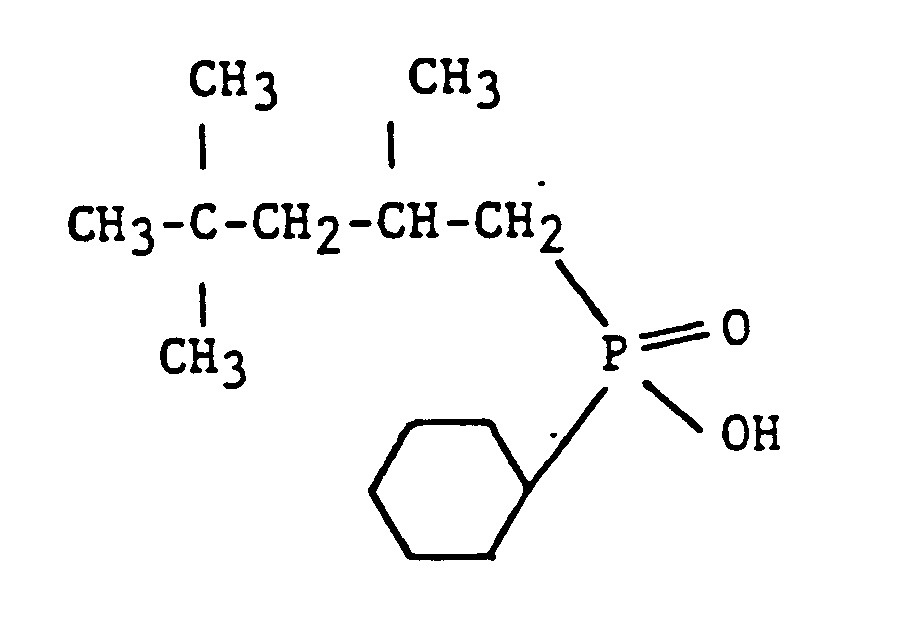
and a method for the production thereof which comprises free radical addition of mono 2,4,4 -trimethylpentylphosphine to cyclohexene followed by the oxidation of the 2,4,4 -trimethylpentyl, cyclohexylphosphine with two moles of hydrogen peroxide. The end product, either as an acid or in its salt form, finds utility as a cobalt extractant and, more specifically, as a selective extractant for cobalt (II) in aqueous cobalt (II) - bearing solutions containing nickel (II). - In the preparation of this compound free radical initiators of the azobis type are preferred although others, such as the peroxides, may be used. Azobisobutrylnitrile is the most preferred. The temperature range of the reaction is directly related to the half life of the initiator employed. For azobisbutrylnitrile the temperature range should be about 40°-110°C, preferably 60° to 90°C. The mole ratio of olefin to mono alkylphosphine can vary from 0.1 to 10 depending on the relative rates of formation of the di-and tri-alkylphosphines. Preferably the range is between 0.5 to 3.
- In the oxidation stage, the oxidation of the dialkylphosphine to the dialkylphosphine oxide is exothermic and takes place readily at 30°-100°, preferably for this first oxidation step at 50°-70°C. To convert the dialkylphosphine oxide to the dialkylphosphine acid, the temperature should be increased to within 50° to 120°C, preferably 80° to 100°C. Higher temperatures tend to remove one alkyl group forming some monoalkylphosphonic acid. At lower temperatures the oxidation is rather slow and excessive reaction times may be required.
- Whereas the exact scope of the instant invention is set forth in the appended claims, the following specific examples illustrate certain aspects of the present invention, and, more particularly, point out methods of evaluating the same. However, the examples are set forth for illustration only and are not to be construed as limitations on the present invention except as set forth in the appended claims. All parts and percentages are by weight unless otherwise specified.
- 500 parts of 09.5% mono 2,4,4 trimethylpentylphosphine is charged along with 482 parts of cyclohexene to a 1 gallon autoclave. 15 parts of azobisobutrylnitrile (VAZO 64®) is added and the mixture quickly heated to 60°C. The temperature is then slowly raised from 60°C to 87°C over a 5 1/2 hour period.
- The product contained 39.36% cyclohexene, 22.70% mono 2,4,4 trimethylpentylphosphine, 35.26% 2,4,4 trimethylpentyl, cyclohexylphosphine, and 0.35% 2,4,4 trimethylpentyl, dicyclohexylphosphine.
- A further 20 parts of azobisobutrylnitrile is added to the mixture. It is heated quickly to 60°C and then slowly from 60°C to 89° over a 6 1/2 hour period.
- The product contained 34.39% cyclohexene 11.14% mono 2,4,4 trimethylpentylphosphine, 48.3% 2,4,4 trimethylpentyl, cyclohexylphosphine, and 2.18% 2,4,4, trimethylpentyl dicyclohexylphosphine.
- The product mixture is then distilled to remove the cyclohexene and mono 2,4,4 trimethylpentylphosphine. 516.9% of the residue containing 0.45% mono 2,4,4 trimethylpentylphosphine, 90.0% 2,4,4 trimethylpentyl cyclohexylphosphine and 3.48% 2,4,4 trimethylpentyl, dicyclohexylphosphine is placed in a stirred, heated resin flask under an inertr atmosphere. The mixture is heated to 50°C and 575 mL of 24% H₂O₂ is added slowly with stirring over 1 1/2 hours. During that time the temperature rose from 50°C to 98°C. To completely oxidize all the dialkylphosphine to the phosphinic acid, an additional 500 g of 24% H₂O₂ is added and the mixture heated for a further 5 hours at 100°C.
- The product is then decanted as a visious oil. It assayed 85.97% phosphinic acid but also contained 9.58% mono 2,4,4 trimethylpentylphosphonic acid. During the severe oxidation conditions, a portion of the cyclohexyl groups were removed and the resulting 2,4,4 trimethylpentylphosphine is oxidized to 2,4,4 trimethylpentylphosphonic acid.
- Most of the phosphonic acid is removed by scrubbing with 0.1N NaOH and water. The final product assayed 85.37% 2,4,4 trimethylpentyl, cyclohexylphosphinic acid and 4.86% 2,4,4 trimethylpentylphosphonic acid.
- The product is a viscious oil and had a pKa of 6.04 in 75% isopropanol. The ³¹ P NMR chemical shift in toluene is -53.13 ppm with respect to 85% H₃PO₄.
- The following example illustrates the ability of 2,4,4 -trimethylpentyl, cyclohexyl phosphinic acid to separate cobalt (II) from nickel (II).
- The 2,4,4 -trimethylpentyl, cyclohexylphosphinic acid is dissolved in an aliphatic petroleum diluent (Solvesso® 100) modified with 5% v/v isoderanol to obtain a concentration of 15% by volume, then a predetermined amount of 28% ammonium hydroxide is added to adjust the pH. An aliquot (50 mls) is shaken at 50°C. for 5 minutes at 50°C with an equal volume of an aqueous solution containing 2.05 gpl of cobalt (II) and 102.4 gpl of nickel (II), respectively, as sulfate salts, to extract the cobalt (II) into the organic phase. The aqueous phase is then separated from the organic phase and analyzed for cobalt (II) content. Based on the results obtained, the percent cobalt (II) extracted is calculated by mass balance. The percent nickel (II) extracted is determined by analyzing the organic phase. The results obtained are shown in Table II.

Claims (2)
- Organic phosphinic acid compounds of the formula

Priority Applications (1)
| Application Number | Priority Date | Filing Date | Title |
|---|---|---|---|
| AT86110998T ATE77626T1 (en) | 1980-08-28 | 1981-08-20 | ORGANIC PHOSPHINE COMPOUNDS. |
Applications Claiming Priority (2)
| Application Number | Priority Date | Filing Date | Title |
|---|---|---|---|
| US18229680A | 1980-08-28 | 1980-08-28 | |
| US182296 | 1980-08-28 |
Related Parent Applications (1)
| Application Number | Title | Priority Date | Filing Date |
|---|---|---|---|
| EP81106471.6 Division | 1981-08-20 |
Publications (3)
| Publication Number | Publication Date |
|---|---|
| EP0236542A2 EP0236542A2 (en) | 1987-09-16 |
| EP0236542A3 EP0236542A3 (en) | 1987-11-25 |
| EP0236542B1 true EP0236542B1 (en) | 1992-06-24 |
Family
ID=22667861
Family Applications (3)
| Application Number | Title | Priority Date | Filing Date |
|---|---|---|---|
| EP81106471A Expired EP0046933B1 (en) | 1980-08-28 | 1981-08-20 | Extraction process for the selective removal of cobalt (ii) from aqueous solutions |
| EP86110998A Expired - Lifetime EP0236542B1 (en) | 1980-08-28 | 1981-08-20 | Novel organic phosphinic acid compounds |
| EP81106500A Withdrawn EP0046940A3 (en) | 1980-08-28 | 1981-08-21 | Extraction process for the selective removal of cobalt (ii) from aqueous solutions |
Family Applications Before (1)
| Application Number | Title | Priority Date | Filing Date |
|---|---|---|---|
| EP81106471A Expired EP0046933B1 (en) | 1980-08-28 | 1981-08-20 | Extraction process for the selective removal of cobalt (ii) from aqueous solutions |
Family Applications After (1)
| Application Number | Title | Priority Date | Filing Date |
|---|---|---|---|
| EP81106500A Withdrawn EP0046940A3 (en) | 1980-08-28 | 1981-08-21 | Extraction process for the selective removal of cobalt (ii) from aqueous solutions |
Country Status (10)
| Country | Link |
|---|---|
| EP (3) | EP0046933B1 (en) |
| JP (2) | JPS5773143A (en) |
| AT (2) | ATE35292T1 (en) |
| AU (2) | AU547393B2 (en) |
| BR (1) | BR8105488A (en) |
| CA (2) | CA1177256A (en) |
| DE (2) | DE3177284T2 (en) |
| FI (2) | FI71347C (en) |
| MA (2) | MA19257A1 (en) |
| ZA (2) | ZA815924B (en) |
Cited By (1)
| Publication number | Priority date | Publication date | Assignee | Title |
|---|---|---|---|---|
| AU2007260536B2 (en) * | 2006-06-14 | 2014-04-03 | Cytec Canada Inc. | Novel phosphinic acids and their sulfur derivatives and methods for their preparation |
Families Citing this family (12)
| Publication number | Priority date | Publication date | Assignee | Title |
|---|---|---|---|---|
| ZA851295B (en) * | 1984-02-22 | 1985-10-30 | Canada Iron Ore Co | Process for recovery of zirconium by solvent extraction |
| US4721605A (en) * | 1985-07-24 | 1988-01-26 | American Cyanamid Company | Selective removal of metals from aqueous solutions with dithiophosphinic acids |
| US4619816A (en) * | 1985-11-21 | 1986-10-28 | American Cyanamid Company | Recovery of cobalt from ammoniacal solutions containing cobalt and nickel |
| DE4421932A1 (en) * | 1994-06-23 | 1996-01-04 | Basf Ag | Process of hydrocarbon-soluble aminomethylenephosphonic acid derivatives for the solvent-extraction of iron ions from aqueous solutions |
| JP3830986B2 (en) * | 1995-03-07 | 2006-10-11 | 日本化学工業株式会社 | Di (1,1,3,3-tetramethylbutyl) phosphine and method for producing the same |
| AUPQ489399A0 (en) * | 1999-12-24 | 2000-02-03 | Wmc Resources Limited | Solvent extraction of impurity metals from a valuable metal sulphate solution |
| DE10356822A1 (en) * | 2003-12-05 | 2005-07-07 | Bayer Technology Services Gmbh | Process for the separation of Pb and Ni from Co-containing mixtures |
| JP2005256170A (en) * | 2004-02-12 | 2005-09-22 | National Institute Of Advanced Industrial & Technology | Electroless nickel plating method and plated product |
| JP5881952B2 (en) * | 2011-01-24 | 2016-03-09 | 住友金属鉱山株式会社 | Method for producing cobalt sulfate |
| WO2016197386A1 (en) * | 2015-06-12 | 2016-12-15 | 中国科学院宁波材料技术与工程研究所 | Preparation method and use of dialkyl phosphinic acid compounds |
| JP2015212424A (en) * | 2015-07-24 | 2015-11-26 | 住友金属鉱山株式会社 | Method for producing cobalt sulfate |
| KR102033247B1 (en) | 2018-04-17 | 2019-10-16 | (주)이엠티 | A Chelating Agent With Excellent Performance in Selective Complex Formation With Specific Metal Ions and A Method For Fabricating The Same |
Citations (1)
| Publication number | Priority date | Publication date | Assignee | Title |
|---|---|---|---|---|
| US3966569A (en) * | 1974-01-28 | 1976-06-29 | Mx Processor Reinhardt & Co. Ab | Method of recovering metal from metalliferous waste |
Family Cites Families (13)
| Publication number | Priority date | Publication date | Assignee | Title |
|---|---|---|---|---|
| BE593597A (en) * | 1959-08-03 | 1900-01-01 | ||
| GB1023704A (en) * | 1962-02-19 | 1966-03-23 | Stauffer Chemical Co | Oxymethylphosphinic acids and salts thereof |
| US3728366A (en) * | 1971-04-05 | 1973-04-17 | Shell Oil Co | Liquid/liquid extraction of cobalt values |
| FI49185C (en) * | 1972-06-02 | 1975-04-10 | Outokumpu Oy | A way to separate metals by liquid-liquid extraction |
| FR2263979A1 (en) * | 1974-03-12 | 1975-10-10 | Nickel Le | Purifying aq. nickel chloride solns. - by adding calcium chloride followed by liq.-liq. extn. using tri-n-butyl phosphate |
| DE2417510A1 (en) * | 1974-04-10 | 1975-10-30 | Bayer Ag | PROCESS FOR EXTRACTION OF METALS FROM Aqueous SOLUTIONS WITH ACID PHOSPHORUS COMPOUNDS |
| JPS5924168B2 (en) * | 1977-05-14 | 1984-06-07 | 株式会社大八化学工業所 | Separation method of cobalt and nickel by solvent extraction method |
| JPS5565335A (en) * | 1978-11-09 | 1980-05-16 | Nippon Mining Co Ltd | Separating method for cobalt and nickel from cobalt- and nickel-containing solution |
| JPS5518546A (en) * | 1978-07-24 | 1980-02-08 | Nippon Mining Co Ltd | Separating method for cobalt and nickel from liquid containing cobalt and nickel |
| JPS605651B2 (en) * | 1978-09-08 | 1985-02-13 | 日本鉱業株式会社 | How to remove iron from organic solvents |
| JPS5943984B2 (en) * | 1978-09-18 | 1984-10-25 | 日本鉱業株式会社 | Treatment method for nickel and cobalt-containing liquids containing zinc |
| BE871963A (en) * | 1978-11-13 | 1979-03-01 | Daihachi Chem Ind | SEPARATION OF COBALT AND NICKEL BY SOLVENT EXTRACTION |
| US4321213A (en) * | 1981-05-14 | 1982-03-23 | Cyanamid Canada, Inc. | 2,4,4'-Trimethylpentyl, cyclohexylphosphinic acid and its preparation |
-
1981
- 1981-08-18 MA MA19457A patent/MA19257A1/en unknown
- 1981-08-18 MA MA19458A patent/MA19258A1/en unknown
- 1981-08-20 AT AT81106471T patent/ATE35292T1/en active
- 1981-08-20 DE DE8686110998T patent/DE3177284T2/en not_active Expired - Lifetime
- 1981-08-20 EP EP81106471A patent/EP0046933B1/en not_active Expired
- 1981-08-20 AT AT86110998T patent/ATE77626T1/en not_active IP Right Cessation
- 1981-08-20 EP EP86110998A patent/EP0236542B1/en not_active Expired - Lifetime
- 1981-08-20 DE DE8181106471T patent/DE3176791D1/en not_active Expired
- 1981-08-21 EP EP81106500A patent/EP0046940A3/en not_active Withdrawn
- 1981-08-26 ZA ZA815924A patent/ZA815924B/en unknown
- 1981-08-26 JP JP56132661A patent/JPS5773143A/en active Granted
- 1981-08-26 JP JP56132660A patent/JPH0742526B2/en not_active Expired - Lifetime
- 1981-08-27 FI FI812649A patent/FI71347C/en not_active IP Right Cessation
- 1981-08-27 CA CA000384721A patent/CA1177256A/en not_active Expired
- 1981-08-27 CA CA000384689A patent/CA1177255A/en not_active Expired
- 1981-08-27 ZA ZA815960A patent/ZA815960B/en unknown
- 1981-08-27 AU AU74685/81A patent/AU547393B2/en not_active Expired
- 1981-08-27 BR BR8105488A patent/BR8105488A/en unknown
- 1981-08-27 AU AU74684/81A patent/AU551849B2/en not_active Expired
- 1981-08-27 FI FI812650A patent/FI71772C/en not_active IP Right Cessation
Patent Citations (1)
| Publication number | Priority date | Publication date | Assignee | Title |
|---|---|---|---|---|
| US3966569A (en) * | 1974-01-28 | 1976-06-29 | Mx Processor Reinhardt & Co. Ab | Method of recovering metal from metalliferous waste |
Cited By (3)
| Publication number | Priority date | Publication date | Assignee | Title |
|---|---|---|---|---|
| AU2007260536B2 (en) * | 2006-06-14 | 2014-04-03 | Cytec Canada Inc. | Novel phosphinic acids and their sulfur derivatives and methods for their preparation |
| US8764880B2 (en) | 2006-06-14 | 2014-07-01 | Cytec Canada Inc. | Phosphinic acids and their sulfur derivatives and methods for their preparation |
| US9102695B2 (en) | 2006-06-14 | 2015-08-11 | Cytec Technology Corp. | Phosphinic acids and their sulfur derivatives and methods for their preparation |
Also Published As
| Publication number | Publication date |
|---|---|
| AU547393B2 (en) | 1985-10-17 |
| FI812650L (en) | 1982-03-01 |
| CA1177255A (en) | 1984-11-06 |
| DE3177284T2 (en) | 1993-02-11 |
| DE3177284D1 (en) | 1992-07-30 |
| AU7468581A (en) | 1982-03-04 |
| EP0046940A3 (en) | 1982-03-24 |
| ATE77626T1 (en) | 1992-07-15 |
| FI71772B (en) | 1986-10-31 |
| EP0046933A2 (en) | 1982-03-10 |
| ATE35292T1 (en) | 1988-07-15 |
| AU551849B2 (en) | 1986-05-15 |
| FI71347C (en) | 1986-12-19 |
| JPS5773142A (en) | 1982-05-07 |
| MA19258A1 (en) | 1982-04-01 |
| ZA815924B (en) | 1982-08-25 |
| EP0236542A3 (en) | 1987-11-25 |
| FI71347B (en) | 1986-09-09 |
| EP0046933A3 (en) | 1982-03-24 |
| EP0046933B1 (en) | 1988-06-22 |
| ZA815960B (en) | 1982-09-29 |
| JPS5773143A (en) | 1982-05-07 |
| DE3176791D1 (en) | 1988-07-28 |
| CA1177256A (en) | 1984-11-06 |
| FI71772C (en) | 1987-02-09 |
| EP0236542A2 (en) | 1987-09-16 |
| BR8105488A (en) | 1982-05-11 |
| JPH0742526B2 (en) | 1995-05-10 |
| JPH0247530B2 (en) | 1990-10-22 |
| MA19257A1 (en) | 1982-04-01 |
| FI812649L (en) | 1982-03-01 |
| AU7468481A (en) | 1982-03-04 |
| EP0046940A2 (en) | 1982-03-10 |
Similar Documents
| Publication | Publication Date | Title |
|---|---|---|
| EP0236542B1 (en) | Novel organic phosphinic acid compounds | |
| US4374780A (en) | Di-2,4,4'-trimethylpentylphosphinic acid and its preparation | |
| Peterson | Phosphinomethyllithium compounds IV. An improved method of preparation and some synthetic applications | |
| EP0400311B1 (en) | Metal recovery with monothiophosphinic acids | |
| US4483801A (en) | Preparation of sulfonated triarylphosphines | |
| US5344567A (en) | Recovery of indium by solvent extraction using trialkylphosphine oxides | |
| US4316877A (en) | Extraction of uranium values from phosphoric acid | |
| US5728853A (en) | Chemical process | |
| US5872279A (en) | Bis(1,1,3,3-tetramethylbutyl) phosphinic acid compound, a production method thereof and an extracting agent | |
| Coover Jr et al. | Reaction of triethyl phosphite with 2-haloacrylates | |
| Kapoor et al. | Transition metal complexes with bidentate ligands spanning trans‐positions. VI. The preparation of some diaryl‐and dialkyl derivatives of 2, 11‐bis (phosphinomethyl) benzo [c] phenanthrene | |
| US5502250A (en) | Bis(dialkylthiophosphoryl)amines as metal extractants | |
| US3102900A (en) | Alkyl phosphonate esters and process for preparing same | |
| US4321213A (en) | 2,4,4'-Trimethylpentyl, cyclohexylphosphinic acid and its preparation | |
| US3070619A (en) | Production of 2-mercapto-2-thiono-derivatives of heterocyclic phosphoruscontaining compounds | |
| CA1253519A (en) | Process for synthesizing diorganomonothiophosphinates | |
| CA1167468A (en) | 2,4,4'-trimethylpentyl, cyclohexylphosphinic acid and its preparation | |
| JPS5918400B2 (en) | Phosphonate ester | |
| KR20250051271A (en) | Organic extractants for recovering metals from waste lithium-ion batteries, their manufacturing methods extraction methods using them | |
| US4836956A (en) | Extraction of polyvalent metals with organodiphosphonic acids | |
| CA1176272A (en) | 2,4,4'-trimethylpentylphosphinic acid and its preparation | |
| US5250736A (en) | Method of preparing a phosphine compound | |
| CA2076125A1 (en) | Organophosphorus compounds | |
| CA1179151A (en) | Extraction process for the selective romoval of cobalt (ii) from aqueous solutions | |
| US4818774A (en) | Organophosphorus compounds |
Legal Events
| Date | Code | Title | Description |
|---|---|---|---|
| PUAI | Public reference made under article 153(3) epc to a published international application that has entered the european phase |
Free format text: ORIGINAL CODE: 0009012 |
|
| 17P | Request for examination filed |
Effective date: 19860908 |
|
| AC | Divisional application: reference to earlier application |
Ref document number: 46933 Country of ref document: EP |
|
| AK | Designated contracting states |
Kind code of ref document: A2 Designated state(s): AT BE DE FR GB NL SE |
|
| PUAL | Search report despatched |
Free format text: ORIGINAL CODE: 0009013 |
|
| AK | Designated contracting states |
Kind code of ref document: A3 Designated state(s): AT BE DE FR GB NL SE |
|
| 17Q | First examination report despatched |
Effective date: 19881223 |
|
| GRAA | (expected) grant |
Free format text: ORIGINAL CODE: 0009210 |
|
| AC | Divisional application: reference to earlier application |
Ref document number: 46933 Country of ref document: EP |
|
| AK | Designated contracting states |
Kind code of ref document: B1 Designated state(s): AT BE DE FR GB NL SE |
|
| REF | Corresponds to: |
Ref document number: 77626 Country of ref document: AT Date of ref document: 19920715 Kind code of ref document: T |
|
| REF | Corresponds to: |
Ref document number: 3177284 Country of ref document: DE Date of ref document: 19920730 |
|
| ET | Fr: translation filed | ||
| PLBE | No opposition filed within time limit |
Free format text: ORIGINAL CODE: 0009261 |
|
| STAA | Information on the status of an ep patent application or granted ep patent |
Free format text: STATUS: NO OPPOSITION FILED WITHIN TIME LIMIT |
|
| 26N | No opposition filed | ||
| EAL | Se: european patent in force in sweden |
Ref document number: 86110998.1 |
|
| PGFP | Annual fee paid to national office [announced via postgrant information from national office to epo] |
Ref country code: NL Payment date: 20000620 Year of fee payment: 20 |
|
| PGFP | Annual fee paid to national office [announced via postgrant information from national office to epo] |
Ref country code: GB Payment date: 20000703 Year of fee payment: 20 Ref country code: AT Payment date: 20000703 Year of fee payment: 20 |
|
| PGFP | Annual fee paid to national office [announced via postgrant information from national office to epo] |
Ref country code: SE Payment date: 20000802 Year of fee payment: 20 |
|
| PGFP | Annual fee paid to national office [announced via postgrant information from national office to epo] |
Ref country code: FR Payment date: 20000803 Year of fee payment: 20 |
|
| PGFP | Annual fee paid to national office [announced via postgrant information from national office to epo] |
Ref country code: DE Payment date: 20000830 Year of fee payment: 20 |
|
| PGFP | Annual fee paid to national office [announced via postgrant information from national office to epo] |
Ref country code: BE Payment date: 20000915 Year of fee payment: 20 |
|
| BE20 | Be: patent expired |
Free format text: 20010820 *CYANAMID CANADA INC. |
|
| PG25 | Lapsed in a contracting state [announced via postgrant information from national office to epo] |
Ref country code: GB Free format text: LAPSE BECAUSE OF EXPIRATION OF PROTECTION Effective date: 20010819 |
|
| PG25 | Lapsed in a contracting state [announced via postgrant information from national office to epo] |
Ref country code: NL Free format text: LAPSE BECAUSE OF EXPIRATION OF PROTECTION Effective date: 20010820 Ref country code: AT Free format text: LAPSE BECAUSE OF EXPIRATION OF PROTECTION Effective date: 20010820 |
|
| PG25 | Lapsed in a contracting state [announced via postgrant information from national office to epo] |
Ref country code: SE Free format text: THE PATENT HAS BEEN ANNULLED BY A DECISION OF A NATIONAL AUTHORITY Effective date: 20010821 |
|
| REG | Reference to a national code |
Ref country code: GB Ref legal event code: PE20 Effective date: 20010819 |
|
| NLV7 | Nl: ceased due to reaching the maximum lifetime of a patent |
Effective date: 20010820 |
|
| EUG | Se: european patent has lapsed |
Ref document number: 86110998.1 |