EP0235099B1 - A process for fabricating lithium aluminate in gamma phase - Google Patents
A process for fabricating lithium aluminate in gamma phase Download PDFInfo
- Publication number
- EP0235099B1 EP0235099B1 EP87830066A EP87830066A EP0235099B1 EP 0235099 B1 EP0235099 B1 EP 0235099B1 EP 87830066 A EP87830066 A EP 87830066A EP 87830066 A EP87830066 A EP 87830066A EP 0235099 B1 EP0235099 B1 EP 0235099B1
- Authority
- EP
- European Patent Office
- Prior art keywords
- alumina
- gamma
- mixture
- lithium aluminate
- occurs
- Prior art date
- Legal status (The legal status is an assumption and is not a legal conclusion. Google has not performed a legal analysis and makes no representation as to the accuracy of the status listed.)
- Expired
Links
- 238000000034 method Methods 0.000 title claims description 35
- YQNQTEBHHUSESQ-UHFFFAOYSA-N lithium aluminate Chemical compound [Li+].[O-][Al]=O YQNQTEBHHUSESQ-UHFFFAOYSA-N 0.000 title claims description 10
- PNEYBMLMFCGWSK-UHFFFAOYSA-N Alumina Chemical compound [O-2].[O-2].[O-2].[Al+3].[Al+3] PNEYBMLMFCGWSK-UHFFFAOYSA-N 0.000 claims description 21
- 239000012071 phase Substances 0.000 claims description 17
- 229910001323 Li2O2 Inorganic materials 0.000 claims description 12
- 239000000843 powder Substances 0.000 claims description 11
- 238000001354 calcination Methods 0.000 claims description 10
- 239000000203 mixture Substances 0.000 claims description 10
- HPGPEWYJWRWDTP-UHFFFAOYSA-N lithium peroxide Chemical compound [Li+].[Li+].[O-][O-] HPGPEWYJWRWDTP-UHFFFAOYSA-N 0.000 claims description 8
- 238000005245 sintering Methods 0.000 claims description 7
- 238000003825 pressing Methods 0.000 claims description 6
- LFQSCWFLJHTTHZ-UHFFFAOYSA-N Ethanol Chemical compound CCO LFQSCWFLJHTTHZ-UHFFFAOYSA-N 0.000 claims description 5
- 235000021355 Stearic acid Nutrition 0.000 claims description 5
- 230000015572 biosynthetic process Effects 0.000 claims description 5
- 238000010438 heat treatment Methods 0.000 claims description 5
- 238000002156 mixing Methods 0.000 claims description 5
- QIQXTHQIDYTFRH-UHFFFAOYSA-N octadecanoic acid Chemical compound CCCCCCCCCCCCCCCCCC(O)=O QIQXTHQIDYTFRH-UHFFFAOYSA-N 0.000 claims description 5
- OQCDKBAXFALNLD-UHFFFAOYSA-N octadecanoic acid Natural products CCCCCCCC(C)CCCCCCCCC(O)=O OQCDKBAXFALNLD-UHFFFAOYSA-N 0.000 claims description 5
- 239000008117 stearic acid Substances 0.000 claims description 5
- 238000002441 X-ray diffraction Methods 0.000 claims description 4
- 229910052593 corundum Inorganic materials 0.000 claims description 4
- 229910001845 yogo sapphire Inorganic materials 0.000 claims description 4
- 239000007791 liquid phase Substances 0.000 claims description 2
- 239000008188 pellet Substances 0.000 claims description 2
- 150000001875 compounds Chemical class 0.000 claims 1
- 238000006243 chemical reaction Methods 0.000 description 5
- 239000000463 material Substances 0.000 description 5
- 239000002243 precursor Substances 0.000 description 5
- 238000004458 analytical method Methods 0.000 description 4
- 238000005516 engineering process Methods 0.000 description 3
- QSHDDOUJBYECFT-UHFFFAOYSA-N mercury Chemical compound [Hg] QSHDDOUJBYECFT-UHFFFAOYSA-N 0.000 description 3
- 229910052753 mercury Inorganic materials 0.000 description 3
- 229910010092 LiAlO2 Inorganic materials 0.000 description 2
- YZCKVEUIGOORGS-NJFSPNSNSA-N Tritium Chemical compound [3H] YZCKVEUIGOORGS-NJFSPNSNSA-N 0.000 description 2
- 229910010293 ceramic material Inorganic materials 0.000 description 2
- 229910052808 lithium carbonate Inorganic materials 0.000 description 2
- 238000003801 milling Methods 0.000 description 2
- 238000009740 moulding (composite fabrication) Methods 0.000 description 2
- 238000005025 nuclear technology Methods 0.000 description 2
- 239000002245 particle Substances 0.000 description 2
- 239000011148 porous material Substances 0.000 description 2
- 238000003786 synthesis reaction Methods 0.000 description 2
- 238000007669 thermal treatment Methods 0.000 description 2
- 229910052722 tritium Inorganic materials 0.000 description 2
- IJJWOSAXNHWBPR-HUBLWGQQSA-N 5-[(3as,4s,6ar)-2-oxo-1,3,3a,4,6,6a-hexahydrothieno[3,4-d]imidazol-4-yl]-n-(6-hydrazinyl-6-oxohexyl)pentanamide Chemical compound N1C(=O)N[C@@H]2[C@H](CCCCC(=O)NCCCCCC(=O)NN)SC[C@@H]21 IJJWOSAXNHWBPR-HUBLWGQQSA-N 0.000 description 1
- OKTJSMMVPCPJKN-UHFFFAOYSA-N Carbon Chemical compound [C] OKTJSMMVPCPJKN-UHFFFAOYSA-N 0.000 description 1
- WHXSMMKQMYFTQS-UHFFFAOYSA-N Lithium Chemical compound [Li] WHXSMMKQMYFTQS-UHFFFAOYSA-N 0.000 description 1
- 239000000919 ceramic Substances 0.000 description 1
- 239000003153 chemical reaction reagent Substances 0.000 description 1
- 238000007796 conventional method Methods 0.000 description 1
- 238000002050 diffraction method Methods 0.000 description 1
- 238000001035 drying Methods 0.000 description 1
- 238000000635 electron micrograph Methods 0.000 description 1
- 235000019441 ethanol Nutrition 0.000 description 1
- 230000004927 fusion Effects 0.000 description 1
- 238000001879 gelation Methods 0.000 description 1
- 239000011872 intimate mixture Substances 0.000 description 1
- 229910052744 lithium Inorganic materials 0.000 description 1
- XGZVUEUWXADBQD-UHFFFAOYSA-L lithium carbonate Chemical compound [Li+].[Li+].[O-]C([O-])=O XGZVUEUWXADBQD-UHFFFAOYSA-L 0.000 description 1
- 208000020442 loss of weight Diseases 0.000 description 1
- 238000001000 micrograph Methods 0.000 description 1
- 239000004005 microsphere Substances 0.000 description 1
- 239000011812 mixed powder Substances 0.000 description 1
- 238000002360 preparation method Methods 0.000 description 1
- 239000012713 reactive precursor Substances 0.000 description 1
- 150000003839 salts Chemical class 0.000 description 1
- 239000007787 solid Substances 0.000 description 1
- 239000012798 spherical particle Substances 0.000 description 1
- 230000000087 stabilizing effect Effects 0.000 description 1
- 239000000126 substance Substances 0.000 description 1
- 238000002076 thermal analysis method Methods 0.000 description 1
- 238000011282 treatment Methods 0.000 description 1
- 208000016261 weight loss Diseases 0.000 description 1
- 230000004580 weight loss Effects 0.000 description 1
- 229910003158 γ-Al2O3 Inorganic materials 0.000 description 1
Images


Classifications
-
- C—CHEMISTRY; METALLURGY
- C01—INORGANIC CHEMISTRY
- C01F—COMPOUNDS OF THE METALS BERYLLIUM, MAGNESIUM, ALUMINIUM, CALCIUM, STRONTIUM, BARIUM, RADIUM, THORIUM, OR OF THE RARE-EARTH METALS
- C01F7/00—Compounds of aluminium
- C01F7/02—Aluminium oxide; Aluminium hydroxide; Aluminates
- C01F7/04—Preparation of alkali metal aluminates; Aluminium oxide or hydroxide therefrom
- C01F7/043—Lithium aluminates
-
- C—CHEMISTRY; METALLURGY
- C04—CEMENTS; CONCRETE; ARTIFICIAL STONE; CERAMICS; REFRACTORIES
- C04B—LIME, MAGNESIA; SLAG; CEMENTS; COMPOSITIONS THEREOF, e.g. MORTARS, CONCRETE OR LIKE BUILDING MATERIALS; ARTIFICIAL STONE; CERAMICS; REFRACTORIES; TREATMENT OF NATURAL STONE
- C04B35/00—Shaped ceramic products characterised by their composition; Ceramics compositions; Processing powders of inorganic compounds preparatory to the manufacturing of ceramic products
- C04B35/01—Shaped ceramic products characterised by their composition; Ceramics compositions; Processing powders of inorganic compounds preparatory to the manufacturing of ceramic products based on oxide ceramics
- C04B35/44—Shaped ceramic products characterised by their composition; Ceramics compositions; Processing powders of inorganic compounds preparatory to the manufacturing of ceramic products based on oxide ceramics based on aluminates
-
- C—CHEMISTRY; METALLURGY
- C01—INORGANIC CHEMISTRY
- C01P—INDEXING SCHEME RELATING TO STRUCTURAL AND PHYSICAL ASPECTS OF SOLID INORGANIC COMPOUNDS
- C01P2002/00—Crystal-structural characteristics
- C01P2002/70—Crystal-structural characteristics defined by measured X-ray, neutron or electron diffraction data
- C01P2002/72—Crystal-structural characteristics defined by measured X-ray, neutron or electron diffraction data by d-values or two theta-values, e.g. as X-ray diagram
-
- C—CHEMISTRY; METALLURGY
- C01—INORGANIC CHEMISTRY
- C01P—INDEXING SCHEME RELATING TO STRUCTURAL AND PHYSICAL ASPECTS OF SOLID INORGANIC COMPOUNDS
- C01P2002/00—Crystal-structural characteristics
- C01P2002/80—Crystal-structural characteristics defined by measured data other than those specified in group C01P2002/70
- C01P2002/88—Crystal-structural characteristics defined by measured data other than those specified in group C01P2002/70 by thermal analysis data, e.g. TGA, DTA, DSC
-
- C—CHEMISTRY; METALLURGY
- C01—INORGANIC CHEMISTRY
- C01P—INDEXING SCHEME RELATING TO STRUCTURAL AND PHYSICAL ASPECTS OF SOLID INORGANIC COMPOUNDS
- C01P2004/00—Particle morphology
- C01P2004/01—Particle morphology depicted by an image
- C01P2004/03—Particle morphology depicted by an image obtained by SEM
-
- C—CHEMISTRY; METALLURGY
- C01—INORGANIC CHEMISTRY
- C01P—INDEXING SCHEME RELATING TO STRUCTURAL AND PHYSICAL ASPECTS OF SOLID INORGANIC COMPOUNDS
- C01P2004/00—Particle morphology
- C01P2004/30—Particle morphology extending in three dimensions
-
- C—CHEMISTRY; METALLURGY
- C01—INORGANIC CHEMISTRY
- C01P—INDEXING SCHEME RELATING TO STRUCTURAL AND PHYSICAL ASPECTS OF SOLID INORGANIC COMPOUNDS
- C01P2004/00—Particle morphology
- C01P2004/60—Particles characterised by their size
- C01P2004/61—Micrometer sized, i.e. from 1-100 micrometer
-
- C—CHEMISTRY; METALLURGY
- C01—INORGANIC CHEMISTRY
- C01P—INDEXING SCHEME RELATING TO STRUCTURAL AND PHYSICAL ASPECTS OF SOLID INORGANIC COMPOUNDS
- C01P2006/00—Physical properties of inorganic compounds
- C01P2006/10—Solid density
-
- C—CHEMISTRY; METALLURGY
- C01—INORGANIC CHEMISTRY
- C01P—INDEXING SCHEME RELATING TO STRUCTURAL AND PHYSICAL ASPECTS OF SOLID INORGANIC COMPOUNDS
- C01P2006/00—Physical properties of inorganic compounds
- C01P2006/12—Surface area
-
- C—CHEMISTRY; METALLURGY
- C01—INORGANIC CHEMISTRY
- C01P—INDEXING SCHEME RELATING TO STRUCTURAL AND PHYSICAL ASPECTS OF SOLID INORGANIC COMPOUNDS
- C01P2006/00—Physical properties of inorganic compounds
- C01P2006/16—Pore diameter
-
- C—CHEMISTRY; METALLURGY
- C01—INORGANIC CHEMISTRY
- C01P—INDEXING SCHEME RELATING TO STRUCTURAL AND PHYSICAL ASPECTS OF SOLID INORGANIC COMPOUNDS
- C01P2006/00—Physical properties of inorganic compounds
- C01P2006/80—Compositional purity
Definitions
- This invention concerns a process for obtaining gamma-LiAI0 2 article when starting from lithium peroxide and alumina powders, which process has novel characteristics with respect to the conventional techniques.
- Gamma-LiAI0 2 powder is produced and distributed by Cerac Inc. (Cerac 1139 L-100 mesh-99,9%, nuclear grade). As such, however, the above powder has very bad sintering characteristics, grain size of some tenths of a micrometre and a specific surface lower than one m 2 /g. Many preparatory methods have been however developed and published in the literature, specifically we list below the USA Agencies that dealt with this development and the related references or patents:
- the process of this invention utilizes a specifically reactive precursor, lithium peroxide (Li 2 0 2 ), which is mixed with microspheres of alumina (gamma phase) in anhydrous ethyl alcohol.
- the two reagents are dried in a rotating evaporator (with a temperature lower than 100°C) whereby an intimate mixture of the two components is obtained.
- the powder after calcination at 700°C for two hours produces LiAI0 2 in the gamma phase with a high specific surface (30 m 2 /g with respect to one m 2 /g of the trade products).
- a subsequent cold pressing (2 tons/cm 2 ) and a rapid sintering (1300°Cfortwo hours) produce a lithium aluminate in gamma phase which has a very high purity (99,9% gamma phase), a high specific surface or density (90% theoretical); high intercommunicating porosity (10%) large particle dimensions (0,5 ⁇ 5 micrometers).
- the present process requires extremely limited calcination times at the same temperature and also lower times at lower temperatures (tenths of hours at 650°C and two-three hours at 900°C). Contrary to sol-gel techniques this process is particularly simple. Furthermore, while the spherical particles produced through conventional gelation methods require long millings, the material produced by the present process is a lamellar material of which the milling and pressing steps are simple.
- the process of the present invention involves in general ceramic material technologies in the field of energy (fusion, batteries etc.).
- Fig. 4 the diffractometric analyses are illustrated of the mixture A1 2 0 3 +Li 2 O 2 at various thermal treatments from which it results that starting from 600°C the gamma phase is already attained after a one hour calcination.
- Li 2 0 2 and Al 2 O 3 as very pure alumina spheres are mixed in a quantity close to stoichiometric (a slight excess of the former) in liquid phase with anhydrous ethanol in a rotating evaporator, while heating and subjecting to vacuum.
- An anhydrous mixed powder is thus obtained which contains the two precursors closely mixed.
- the mixture obtained at the preceding point is calcined inside a pure (99.9%) alumina containers at 700°C for two hours.
- a very fine gamma phase lithium aluminate is obtained from the above synthesis as is shown from the diffraction analysis by X-rays. Particularly the specific surface of this powder is 30 ⁇ 5 m 2 /g.
- the obtained material is a solid ceramic material having a density of 90% with respect to the theoretical; its hollow fraction (10%) is essentially comprised of an open porosity in the range ⁇ 2%; the grain size, of the lamellar type is of the order of the micrometre; it is comprised of pure gamma phase LiAI0 2 (by X-ray diffraction).
- the geometry form of the artifact generically is a pellet which can be utilized as a tritium generator in nuclear technology.
- a low temperature calcination to form and stabilise the gamma phase is obtainable by treating the mixture Li 2 O 2 +Al 2 O 3 for one hour at 700°C (see Fig. 4 the X-ray diffraction analysis from various thermal treatments of the above mixture whereby this point is favoured).
- the process of forming, pressing and sintering comprises the cold pressing (2 tons/cm 2 ) which is followed by sintering (2 hours at 1300°C in rapid heating furnace).
- the texture of morphology of the sintered material is characterized by lamellar particles of the size of about a micrometre which are bound together while keeping an open and intercommunicating porosity, as shown in Fig. 2 from the porosimetric analysis obtained by a mercury porosimeter; the vacuum fraction of such porosity corresponds to 10 ⁇ 2% the volume occupied by the artifact.
- the apparent density (that is not corrected by the vacuum fraction caused by porosity) is equal to 90 ⁇ 2% of the theoretical density of gamma phase lithium aluminate.
Landscapes
- Chemical & Material Sciences (AREA)
- Engineering & Computer Science (AREA)
- Organic Chemistry (AREA)
- Materials Engineering (AREA)
- Ceramic Engineering (AREA)
- Life Sciences & Earth Sciences (AREA)
- Geology (AREA)
- Inorganic Chemistry (AREA)
- Manufacturing & Machinery (AREA)
- Structural Engineering (AREA)
- Compounds Of Alkaline-Earth Elements, Aluminum Or Rare-Earth Metals (AREA)
- Compositions Of Oxide Ceramics (AREA)
Description
- This invention concerns a process for obtaining gamma-LiAI02 article when starting from lithium peroxide and alumina powders, which process has novel characteristics with respect to the conventional techniques.
- Gamma-LiAI02 powder is produced and distributed by Cerac Inc. (Cerac 1139 L-100 mesh-99,9%, nuclear grade). As such, however, the above powder has very bad sintering characteristics, grain size of some tenths of a micrometre and a specific surface lower than one m2/g. Many preparatory methods have been however developed and published in the literature, specifically we list below the USA Agencies that dealt with this development and the related references or patents:
- Argonne National Laboratory (J. Nucl. Mat., 103, 104 (1981) 579;
- GA Technologies Inc. (U.S. Pat. No. 339697 15/ 01/82 McDonnell Douglas Astronautic Company (J. Nucl. Mat. 103-104 (1981) 579);
- Westinghouse El. Corp. (HELD-SA-2594-FP).
- All the methods above are characterized by the use of salts or oxide (either hydrated or not as lithium-containing precursors and by a high (higher than 900°C) calcining temperature for stabilizing LiAl02 in the gamma phase.
- The process of this invention utilizes a specifically reactive precursor, lithium peroxide (Li202), which is mixed with microspheres of alumina (gamma phase) in anhydrous ethyl alcohol. The two reagents are dried in a rotating evaporator (with a temperature lower than 100°C) whereby an intimate mixture of the two components is obtained. The powder after calcination at 700°C for two hours produces LiAI02 in the gamma phase with a high specific surface (30 m2/g with respect to one m2/g of the trade products). A subsequent cold pressing (2 tons/cm2) and a rapid sintering (1300°Cfortwo hours) produce a lithium aluminate in gamma phase which has a very high purity (99,9% gamma phase), a high specific surface or density (90% theoretical); high intercommunicating porosity (10%) large particle dimensions (0,5―5 micrometers).
- The solution of preparing the LiAI02 precursor mixture by the mixing of Li202 and gamma-Al2O3 according to the process of this invention is now known in the prior art.
- For example, C. H. Chang et al. in the Journal of the American Chemical Society, vol. 90, no. 8, 10th April 1968, pages 2020-2022, describes the formation of gamma-LiAI02 by the direct reaction of lithium peroxide Li202 with alumina without indication of the type of alumina to be employed nor of the manner in which the lithium peroxide and alumina are mixed.
- From the American Ceramic Society Bulletin, vol. 60, No. 6, June 1981, pages 629-635, Columbus, Ohio, US; R. N. Singh et al., it is also known the preparation of sintered bodies of gamma-LiAlO2 in two steps: firstly alpha-LiAI02 powder is prepared by the reaction of Li2C03 with gamma-AI203 at 873 K. This is followed by a conversion to the gamma-form by treatment at 1173 K to yield a powder which has a maximum surface area of 10 m2/g. The powders were pressed and thereafter sintered.
- With the process according to Singh, it is possible, however, to obtain gamma-LiAI02 sintered articles having a maximum density of 1,46 while with the process according to the present invention a maximum density of 2,36 is achieved.
- With respect to conventional processes wherein lithium carbonate is utilized as a precursor, the present process requires extremely limited calcination times at the same temperature and also lower times at lower temperatures (tenths of hours at 650°C and two-three hours at 900°C). Contrary to sol-gel techniques this process is particularly simple. Furthermore, while the spherical particles produced through conventional gelation methods require long millings, the material produced by the present process is a lamellar material of which the milling and pressing steps are simple.
- The process of the present invention involves in general ceramic material technologies in the field of energy (fusion, batteries etc.).
- In particular those technologies which are connected to the tritium cycle in the nuclear technologies are interested by the present process.
- This invention will be clearer from the following description and from the annexed figures which relate to a preferred embodiment of the invention. In the drawings:
- Figure 1 illustrates an electron micrograph of the lamellar morphology in the case of a pure gamma phase LiAI02 artifact obtained by the method of the present invention. It is a micrograph (100x) of a sintered material at 90% of the theoretical density.
- Figure 2 shows the distribution of the pore diameters obtained by a mercury porosity of a pure gamma phase LiAl02 artifact obtained by the method of this invention. Along the ordinate the percentage of the total porosity is shown while along the abscissa the diameter in micrometres is shown.
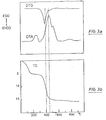
- Figs. 3a, 3b illustrate the reaction temperature between Li202 and A1203 together with the percentage weight loss of the complex Al2O3+LiO2. In figure 3a the temperature in celsius degrees is reported along the abscissa while along ordinate arbitrary units are reported for the signals related to thermodifferential analysis (DTA) and to thermogravimetric differential analysis (DTG).
- In Fig. 3b along the abscissa the temperature is marked while along the ordinate the percentage loss of weight is marked.
- In Fig. 4 the diffractometric analyses are illustrated of the mixture A1203+Li2O2 at various thermal treatments from which it results that starting from 600°C the gamma phase is already attained after a one hour calcination.
-
- a) Alumina (AI203 (gamma phase)) as a powder of high specific surface (greater than 100 m2/g) and of high purity (99.9%), the same as the trade product Degussa Type C.
- b) Lithium peroxide (Li202) prepared according to Bach and Baardmann Jr. (USA Patent No. 3185546 (1965) or a trade product by Cerac Inc.
- Li202 and Al2O3 as very pure alumina spheres (99.9%) are mixed in a quantity close to stoichiometric (a slight excess of the former) in liquid phase with anhydrous ethanol in a rotating evaporator, while heating and subjecting to vacuum. An anhydrous mixed powder is thus obtained which contains the two precursors closely mixed.
- The mixture obtained at the preceding point is calcined inside a pure (99.9%) alumina containers at 700°C for two hours.
- A very fine gamma phase lithium aluminate is obtained from the above synthesis as is shown from the diffraction analysis by X-rays. Particularly the specific surface of this powder is 30±5 m2/g.
- The powder as obtained at the preceding point when mixed stearic acid (2%) is cold pressed at 2 tons/cm2 and then sintered in a rapid heating furnace at 1300°C for two hours. An artifact is thus obtained of pure gamma phase LiAl02 (by X-ray diffraction) of which the morphology or form is shown in Fig. 1 and the open porosity is as much as 10±2% and is characterized by a distribution of the pores as shown in Fig. 2 obtained by a mercury porosimeter. The density of this artifact is 2.36±0.02 g/cm3 equal to 90% with respect to the theoretical density of the lithium aluminate in gamma phase (2.615 g/cm3).
- The obtained material is a solid ceramic material having a density of 90% with respect to the theoretical; its hollow fraction (10%) is essentially comprised of an open porosity in the range ±2%; the grain size, of the lamellar type is of the order of the micrometre; it is comprised of pure gamma phase LiAI02 (by X-ray diffraction).
- The geometry form of the artifact generically is a pellet which can be utilized as a tritium generator in nuclear technology.
- The low temperature of the reaction between Li202 and A1203 which furthermore occurs by means of an exothermic process (see the annexed thermal analysis which is shown in Fig. 3) which occurs at.400-450°C with the formation of LiAlO2 in the beta phase.
- A low temperature calcination to form and stabilise the gamma phase is obtainable by treating the mixture Li2O2+Al2O3 for one hour at 700°C (see Fig. 4 the X-ray diffraction analysis from various thermal treatments of the above mixture whereby this point is favoured).
- The process of forming, pressing and sintering comprises the cold pressing (2 tons/cm2) which is followed by sintering (2 hours at 1300°C in rapid heating furnace).
- The texture of morphology of the sintered material (as reported at Fig. 1 wherein the image is obtained by means of an electron microscope) is characterized by lamellar particles of the size of about a micrometre which are bound together while keeping an open and intercommunicating porosity, as shown in Fig. 2 from the porosimetric analysis obtained by a mercury porosimeter; the vacuum fraction of such porosity corresponds to 10±2% the volume occupied by the artifact.
- The apparent density (that is not corrected by the vacuum fraction caused by porosity) is equal to 90±2% of the theoretical density of gamma phase lithium aluminate.
Claims (13)
calcining said mixture;
Applications Claiming Priority (2)
| Application Number | Priority Date | Filing Date | Title |
|---|---|---|---|
| IT47694/86A IT1190203B (en) | 1986-02-26 | 1986-02-26 | MANUFACTURING PROCESS OF LITHIUM ALUMINATE TABLETS IN THE RANGE PHASE |
| IT4769486 | 1986-02-26 |
Publications (2)
| Publication Number | Publication Date |
|---|---|
| EP0235099A1 EP0235099A1 (en) | 1987-09-02 |
| EP0235099B1 true EP0235099B1 (en) | 1990-06-06 |
Family
ID=11261939
Family Applications (1)
| Application Number | Title | Priority Date | Filing Date |
|---|---|---|---|
| EP87830066A Expired EP0235099B1 (en) | 1986-02-26 | 1987-02-25 | A process for fabricating lithium aluminate in gamma phase |
Country Status (3)
| Country | Link |
|---|---|
| EP (1) | EP0235099B1 (en) |
| DE (1) | DE3763064D1 (en) |
| IT (1) | IT1190203B (en) |
Families Citing this family (2)
| Publication number | Priority date | Publication date | Assignee | Title |
|---|---|---|---|---|
| US5217702A (en) * | 1991-11-19 | 1993-06-08 | Fmc Corporation | Preparation of a high surface area gamma lithium aluminate |
| RU2251526C1 (en) * | 2004-04-12 | 2005-05-10 | Институт химии твердого тела и механохимии СО РАН (ИХТТМ СО РАН) | Method of production of lithium gamma-aluminate |
-
1986
- 1986-02-26 IT IT47694/86A patent/IT1190203B/en active
-
1987
- 1987-02-25 EP EP87830066A patent/EP0235099B1/en not_active Expired
- 1987-02-25 DE DE8787830066T patent/DE3763064D1/en not_active Expired - Lifetime
Also Published As
| Publication number | Publication date |
|---|---|
| DE3763064D1 (en) | 1990-07-12 |
| EP0235099A1 (en) | 1987-09-02 |
| IT8647694A0 (en) | 1986-02-26 |
| IT1190203B (en) | 1988-02-16 |
Similar Documents
| Publication | Publication Date | Title |
|---|---|---|
| US4115632A (en) | Method of preparing electrolyte for use in fuel cells | |
| CA1267769A (en) | METHOD OF MAKING ".beta."-ALUMINA | |
| US4475948A (en) | Lithium aluminate/zirconium material useful in the production of tritium | |
| HIRANO et al. | Synthesis of LiAlO2 powder by hydrolysis of metal alkoxides | |
| US3895963A (en) | Process for the formation of beta alumina-type ceramics | |
| US4052538A (en) | Method of making sodium beta-alumina powder and sintered articles | |
| US5983488A (en) | Sol-casting of molten carbonate fuel cell matrices | |
| US4534956A (en) | Molten salt synthesis of barium and/or strontium titanate powder | |
| NO153267B (en) | CONTROL DEVICE FOR A RAILWAY GRINDING DEVICE | |
| US4487755A (en) | Preparation of large crystal sized barium and/or strontium titanate powder | |
| US3141782A (en) | Processes for the production of ceramic bodies | |
| US4339511A (en) | Preparation of powders suitable for conversion to useful β-aluminas | |
| Ganguly et al. | Sol-Gel microsphere pelletization process for fabrication of high-density ThO2—2% UO2 fuel for advanced pressurized heavy water reactors | |
| US3904736A (en) | Preparing microspheres of actinide nitrides from carbon containing oxide sols | |
| CA2026521A1 (en) | Zirconium dioxide powder, processes for its preparation, its use and sintered articles produced therefrom | |
| Alvani et al. | Fabrication of porous LiAlO2 ceramic breeder material | |
| EP0235099A1 (en) | A process for fabricating lithium aluminate in gamma phase | |
| US3860691A (en) | Actinide mononitride microspheres and process | |
| US3303033A (en) | Refractory products | |
| US4322485A (en) | Preparation of materials | |
| US5217702A (en) | Preparation of a high surface area gamma lithium aluminate | |
| US4374117A (en) | Preparation of ultrafine BaZrO3 | |
| Mazdiyasni et al. | Influence of Dynamic Calcination on Crystallite Growth of Submicron Rare‐Earth Oxides | |
| GB2159805A (en) | Method of producing a sinterable gamma -LiAlO2 powder | |
| CA1241523A (en) | Process for the preparation of lithium silicate |
Legal Events
| Date | Code | Title | Description |
|---|---|---|---|
| PUAI | Public reference made under article 153(3) epc to a published international application that has entered the european phase |
Free format text: ORIGINAL CODE: 0009012 |
|
| AK | Designated contracting states |
Kind code of ref document: A1 Designated state(s): BE DE FR GB NL |
|
| 17P | Request for examination filed |
Effective date: 19880222 |
|
| 17Q | First examination report despatched |
Effective date: 19890112 |
|
| GRAA | (expected) grant |
Free format text: ORIGINAL CODE: 0009210 |
|
| AK | Designated contracting states |
Kind code of ref document: B1 Designated state(s): BE DE FR GB NL |
|
| REF | Corresponds to: |
Ref document number: 3763064 Country of ref document: DE Date of ref document: 19900712 |
|
| ET | Fr: translation filed | ||
| PLBE | No opposition filed within time limit |
Free format text: ORIGINAL CODE: 0009261 |
|
| STAA | Information on the status of an ep patent application or granted ep patent |
Free format text: STATUS: NO OPPOSITION FILED WITHIN TIME LIMIT |
|
| 26N | No opposition filed | ||
| PGFP | Annual fee paid to national office [announced via postgrant information from national office to epo] |
Ref country code: NL Payment date: 19940228 Year of fee payment: 8 |
|
| PGFP | Annual fee paid to national office [announced via postgrant information from national office to epo] |
Ref country code: GB Payment date: 19940425 Year of fee payment: 8 |
|
| PGFP | Annual fee paid to national office [announced via postgrant information from national office to epo] |
Ref country code: FR Payment date: 19940428 Year of fee payment: 8 |
|
| PGFP | Annual fee paid to national office [announced via postgrant information from national office to epo] |
Ref country code: DE Payment date: 19940429 Year of fee payment: 8 Ref country code: BE Payment date: 19940429 Year of fee payment: 8 |
|
| PG25 | Lapsed in a contracting state [announced via postgrant information from national office to epo] |
Ref country code: GB Effective date: 19950225 |
|
| PG25 | Lapsed in a contracting state [announced via postgrant information from national office to epo] |
Ref country code: BE Effective date: 19950228 |
|
| BERE | Be: lapsed |
Owner name: ENEA COMITATO NAZIONALE PER LA RICERCA E PER LO S Effective date: 19950228 |
|
| PG25 | Lapsed in a contracting state [announced via postgrant information from national office to epo] |
Ref country code: NL Effective date: 19950901 |
|
| GBPC | Gb: european patent ceased through non-payment of renewal fee |
Effective date: 19950225 |
|
| PG25 | Lapsed in a contracting state [announced via postgrant information from national office to epo] |
Ref country code: FR Effective date: 19951031 |
|
| NLV4 | Nl: lapsed or anulled due to non-payment of the annual fee |
Effective date: 19950901 |
|
| PG25 | Lapsed in a contracting state [announced via postgrant information from national office to epo] |
Ref country code: DE Effective date: 19951101 |
|
| REG | Reference to a national code |
Ref country code: FR Ref legal event code: ST |