EP0234422B1 - Procédé d'amélioration de l'albédo d'éléments vivants pour leur analyse optique tridimensionelle - Google Patents
Procédé d'amélioration de l'albédo d'éléments vivants pour leur analyse optique tridimensionelle Download PDFInfo
- Publication number
- EP0234422B1 EP0234422B1 EP87101950A EP87101950A EP0234422B1 EP 0234422 B1 EP0234422 B1 EP 0234422B1 EP 87101950 A EP87101950 A EP 87101950A EP 87101950 A EP87101950 A EP 87101950A EP 0234422 B1 EP0234422 B1 EP 0234422B1
- Authority
- EP
- European Patent Office
- Prior art keywords
- suspension
- pigment
- improving
- portions
- film forming
- Prior art date
- Legal status (The legal status is an assumption and is not a legal conclusion. Google has not performed a legal analysis and makes no representation as to the accuracy of the status listed.)
- Expired - Lifetime
Links
Classifications
-
- A—HUMAN NECESSITIES
- A61—MEDICAL OR VETERINARY SCIENCE; HYGIENE
- A61C—DENTISTRY; APPARATUS OR METHODS FOR ORAL OR DENTAL HYGIENE
- A61C19/00—Dental auxiliary appliances
- A61C19/04—Measuring instruments specially adapted for dentistry
-
- A—HUMAN NECESSITIES
- A61—MEDICAL OR VETERINARY SCIENCE; HYGIENE
- A61C—DENTISTRY; APPARATUS OR METHODS FOR ORAL OR DENTAL HYGIENE
- A61C13/00—Dental prostheses; Making same
- A61C13/0003—Making bridge-work, inlays, implants or the like
- A61C13/0004—Computer-assisted sizing or machining of dental prostheses
-
- A—HUMAN NECESSITIES
- A61—MEDICAL OR VETERINARY SCIENCE; HYGIENE
- A61C—DENTISTRY; APPARATUS OR METHODS FOR ORAL OR DENTAL HYGIENE
- A61C9/00—Impression cups, i.e. impression trays; Impression methods
-
- A—HUMAN NECESSITIES
- A61—MEDICAL OR VETERINARY SCIENCE; HYGIENE
- A61K—PREPARATIONS FOR MEDICAL, DENTAL OR TOILETRY PURPOSES
- A61K6/00—Preparations for dentistry
- A61K6/70—Preparations for dentistry comprising inorganic additives
- A61K6/71—Fillers
-
- A—HUMAN NECESSITIES
- A61—MEDICAL OR VETERINARY SCIENCE; HYGIENE
- A61C—DENTISTRY; APPARATUS OR METHODS FOR ORAL OR DENTAL HYGIENE
- A61C9/00—Impression cups, i.e. impression trays; Impression methods
- A61C9/004—Means or methods for taking digitized impressions
- A61C9/0046—Data acquisition means or methods
- A61C9/0053—Optical means or methods, e.g. scanning the teeth by a laser or light beam
-
- A—HUMAN NECESSITIES
- A61—MEDICAL OR VETERINARY SCIENCE; HYGIENE
- A61F—FILTERS IMPLANTABLE INTO BLOOD VESSELS; PROSTHESES; DEVICES PROVIDING PATENCY TO, OR PREVENTING COLLAPSING OF, TUBULAR STRUCTURES OF THE BODY, e.g. STENTS; ORTHOPAEDIC, NURSING OR CONTRACEPTIVE DEVICES; FOMENTATION; TREATMENT OR PROTECTION OF EYES OR EARS; BANDAGES, DRESSINGS OR ABSORBENT PADS; FIRST-AID KITS
- A61F2/00—Filters implantable into blood vessels; Prostheses, i.e. artificial substitutes or replacements for parts of the body; Appliances for connecting them with the body; Devices providing patency to, or preventing collapsing of, tubular structures of the body, e.g. stents
- A61F2/02—Prostheses implantable into the body
- A61F2/30—Joints
- A61F2/3094—Designing or manufacturing processes
- A61F2/30942—Designing or manufacturing processes for designing or making customized prostheses, e.g. using templates, CT or NMR scans, finite-element analysis or CAD-CAM techniques
- A61F2002/30952—Designing or manufacturing processes for designing or making customized prostheses, e.g. using templates, CT or NMR scans, finite-element analysis or CAD-CAM techniques using CAD-CAM techniques or NC-techniques
Definitions
- the invention relates to the three-dimensional optical analysis of living elements for collecting the information necessary for the computer-aided design and manufacturing technique, in the case, for example, of medical prostheses.
- This technique abandons the classic impression taking using alginate or silicone elastomer: it is based on the three-dimensional optical analysis in coherent light of a tooth to be reconstituted, as well as possibly of the part adjacent to the gum on the one hand, and the occlusal side of the tooth facing it, on the other.
- the information collected is processed by a computer which will control a milling machine cutting, precisely, in a suitable material, the necessary prosthesis.
- the problem consists in finding a means of improving the luminance factor of the surface considered.
- US Patent 4,512,743 (SANTUCCI) describes a method for applying a coating to the surface of a tooth to mask discoloration or other similar imperfections. Obtained by in situ polymerization of an acrylic monomer, it comprises a filler and pigments giving it a natural coloring. After hardening, its surface is smooth and practically does not require polishing. Its adhesion to the tooth is excellent and its lifespan exceeds 2 years.
- the object of the present invention is to increase the ratio between the light energy reflected by the object analyzed and that which it receives, this object possibly being a part of a living being. It also allows a better spatial distribution of this light energy, tending to transform this object into a Lambertian body, and avoids parasitic light phenomena due to refractions and reflections in the mass of the object.
- This process is characterized by the fact that these parts are covered with a fluid suspension of a white, finely dispersed mineral pigment.
- This suspension is devoid of toxicity, it can be used in the biomedical field and makes it possible to obtain a high definition image because it spreads out in a thin and regular coating.
- the invention is set out below in detail with an example, without limitation, of a preparation containing an inorganic pigment in fluid suspension.
- a white pigment of fine particle size is suspended in fluid in a hydro-alcoholic solution of a film-forming agent.
- the proportion of opacifying agent is of the order of 8 to 16%.
- the film-forming agent is an acrylic resin. The use of most other solvents is excluded in a biological environment.
- the "Carboset 525" (registered trademark) from the firm B.F. GOODRICH in CLEVELAND (OHIO) is used.
- This film-forming resin ensures the adhesion of the preparation to the surface to be studied, and, thanks to its flexibility, deposits a uniform film there, despite the irregularities in shape.
- a solvent is used for this acrylic resin, which has the advantage of being soluble both in ethanolic medium and in alkaline aqueous solution, a mixture of ethyl alcohol and ammonia water. Thanks to the high volatility of the alcohol, the preparation dries fairly quickly and the optical analysis can be carried out shortly after application of the fluid suspension thus composed.
- the alcoholic strength of the solvent is limited in order to avoid the irritating action on living tissues of a solution that is too concentrated in ethanol.
- the acrylic resin is neutralized with a volatile base such as ammonia in order to obtain a water-resistant film.
- the proportion of film-forming agent that is used is of the order of 8 to 16%.
- a wetting agent is added to facilitate the suspension of the pigment and spreading of the preparation thus formed into a thin and regular layer.
- polysorbate 20 is used as the wetting agent.
- the procedure is as follows to mix the constituents of this preparation: - The ammonia solution and the polysorbate are mixed in the purified water, - The flavor is dissolved separately in alcohol, - The two solutions thus obtained are combined and the resin is dissolved with rapid stirring, - The titanium oxide is dispersed throughout.
- the method according to the invention receives various applications among which the following may be mentioned without this list being exhaustive: - a three-dimensional optical intraoral reading using coherent light for the production of dental prostheses according to the technique known as "Computer Aided Design Manufacturing” (CAD / CAM); - a three-dimensional optical study of the deformation of certain biological structures, for example at the level of the palate for mobile prostheses; - a three-dimensional optical study of parts of the body on which a prosthesis or a device must be adjusted with precision, in bone surgery in particular.
- CAD / CAM Computer Aided Design Manufacturing
Landscapes
- Health & Medical Sciences (AREA)
- Life Sciences & Earth Sciences (AREA)
- Public Health (AREA)
- Veterinary Medicine (AREA)
- Epidemiology (AREA)
- Oral & Maxillofacial Surgery (AREA)
- Animal Behavior & Ethology (AREA)
- General Health & Medical Sciences (AREA)
- Dentistry (AREA)
- Chemical & Material Sciences (AREA)
- Inorganic Chemistry (AREA)
- Engineering & Computer Science (AREA)
- Biomedical Technology (AREA)
- Biophysics (AREA)
- Investigating Or Analysing Materials By Optical Means (AREA)
- Dental Preparations (AREA)
- Measurement Of The Respiration, Hearing Ability, Form, And Blood Characteristics Of Living Organisms (AREA)
- Dental Tools And Instruments Or Auxiliary Dental Instruments (AREA)
Description
- L'invention concerne l'analyse optique tridimensionnel le d'éléments vivants permettant de recueillir les informations nécessaires à la technique de conception et de fabrication assistée par ordinateur, dans le cas, par exemple, de prothèses médicales.
- Le document TD 73 publié le 15 novembre 1985, décrit une nouvelle technique pour la réalisation de prothèses fixes -telles que couronnes, bridges ... pour l'art dentaire- qui est susceptible d'être étendue ultérieurement aux prothèses mobiles. Une technique analogue est décrite dans la demande de brevet E-PA-54 785 (HÖRMANN).
- Cette technique abandonne la classique prise d'empreinte à l'aide d'alginate ou d'élastomère de silicone : elle est basée sur l'analyse optique tridimensionnelle en lumière cohérente d'une dent devant être reconstituée, ainsi qu'éventuellement de la partie adjacente de la gencive d'une part, de la face occlusale de la dent lui faisant face, d'autre part.
- Les informations recueillies sont traitées par un ordinateur qui pilotera une fraiseuse taillant, avec précision, dans un matériau adapté, la prothèse nécessaire.
- La reflexibilité du corps humain étant mauvaise, notamment au niveau des structures translucides comme les dents, le problème consiste à trouver un moyen d'améliorer le facteur de luminance lumineuse de la surface considérée.
- Le brevet US 4 512 743 (SANTUCCI) décrit un procédé pour appliquer un revêtement sur la surface d'une dent pour masquer les décolorations ou d'autres imperfections similaires. Obtenu par polymérisation in situ d'un monomère acrylique, il comprend une charge et des pigments lui donnant une coloration naturelle. Après durcissement, sa surface est lisse et ne nécessite pratiquement pas de polissage. Son adhésion à la dent est excellente et sa durée de vie dépasse 2 ans.
- La présente invention a pour but d'augmenter le rapport entre l'énergie lumineuse réfléchie par l'objet analysé et celle qu'il reçoit, cet objet pouvant être une partie d'un être vivant. Elle permet également une meilleure répartition spatiale de cette énergie lumineuse, tendant à transformer cet objet en un corps lambertien, et évite les phénomènes lumineux parasites dus à des réfractions et réflexions dans la masse de l'objet.
- Ce procédé est caractérisé par le fait que l'on recouvre ces parties d'une suspension fluide d'un pigment blanc, minéral, finement dispersé.
- Cette suspension est dénuée de toxicité, elle est utilisable dans le domaine biomédical et permet d'obtenir une image de haute définition car elle s'étale en un revêtement fin et régulier.
- Elle rend possible l'analyse optique tridimensionnelle de surfaces présentant un mauvais albédo, en s'affranchissant de lasers de puissance élevée, fort onéreux et de maniement très délicat, voire impossible sur des êtres vivants.
- Elle facilite également le traitement informatique d'images tridimensionnelles complexes, en s'affranchissant des variations de teinte et de luminosité des surfaces et en atténuant les effets d'ombres. Au niveau des dents, elle évite notamment les réflexions parasites de lumière qui se produisent dans la profondeur de l'émail.
- L'invention est exposée ci-après de façon détaillée avec un exemple, non limitatif, d'une préparation contenant un pigment minéral en suspension fluide.
- On met en suspension fluide un pigment blanc de fine granulométrie dans une solution hydro-alcoolique d'un agent filmogène.
- Il s'agit d'un pigment atoxique de nature minérale, par exemple :

- Les qualités d'oxyde de titane de très fine granulométrie, destinées à la réalisation de produits de maquillage, fournissent des résultats très satisfaisants. La proportion d'agent opacifiant est de l'ordre de 8 à 16 %.
- On utilise pour mettre en suspension le pigment blanc, un polymère filmogène soluble en milieu hydroalcoolique. L'agent filmogène est une résine acrylique. L'utilisation de la plupart des autres solvants est exclue en milieu biologique.
- De préférence, on utilise le "Carboset 525" (marque déposée) de la firme B.F. GOODRICH à CLEVELAND (OHIO).
- Cette résine filmogène assure l'adhérence de la préparation sur la surface à étudier, et, grâce à sa souplesse, y dépose un film uniforme, malgré les irrégularités de forme.
- On utilise comme solvant pour cette résine acrylique, qui présente l'avantage d'être soluble à la fois en milieu éthanolique et en solution aqueuse alcaline, un mélange d'alcool éthylique et d'eau ammoniaquée. Grâce à la volatilité élevée de l'alcool, la préparation sèche assez rapidement et l'analyse optique peut être réalisée peu de temps après l'application de la suspension fluide ainsi composée.
- Toutefois, on limite le titre alcoolique du solvant afin d'éviter l'action irritante sur les tissus vivants d'une solution trop concentrée en éthanol.
- On neutralise la résine acrylique par une base volatile comme l'ammoniaque afin d'obtenir un film hydrorésistant.
- La proportion d'agent filmogène qu'on utilise est de l'ordre de 8 à 16 %.
- On ajoute un mouillant pour faciliter la suspension du pigment et l'étalement de la préparation ainsi constituée en une couche mince et régulière. On utilise de préférence le polysorbate 20 comme agent mouillant.
- On atténue la saveur peu agréable de cette préparation en effectuant une aromatisation appropriée : des notes telles que "cerise, banane, tous fruits" sont bien adaptées.
- A titre d'exemple, non limitatif, on peut citer une composition centésimale ainsi constituée.
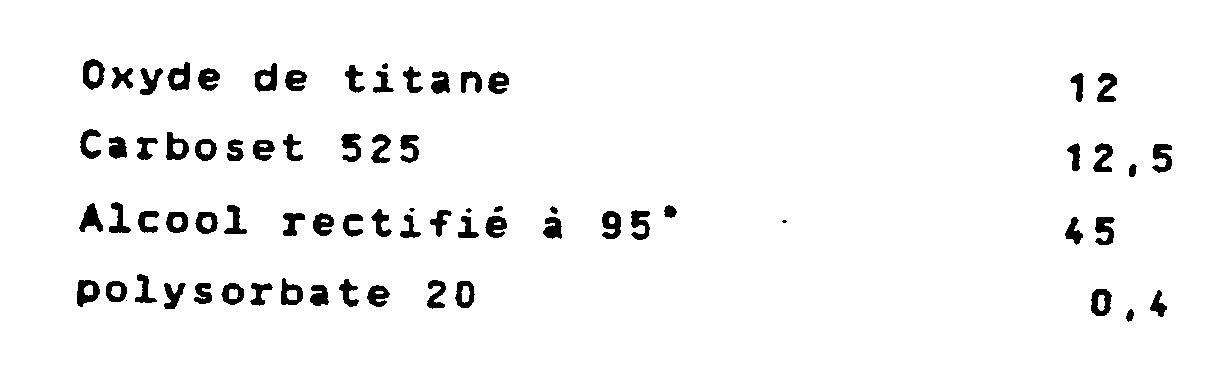

- On opère comme suit pour mélanger les constituants de cette préparation :
- On mélange la solution d'ammoniaque et le polysorbate dans l'eau purifiée,
- On dissout séparément l'arome dans l'alcool,
- On réunit les deux solutions ainsi obtenues et on dissout la résine sous agitation rapide,
- on disperse l'oxyde de titane dans l'ensemble. - Le procédé selon l'invention reçoit différentes applications parmi lesquelles on peut citer sans que cette énumération soit exhaustive :
- une lecture optique tridimensionnelle endobuccale à l'aide de lumière cohérente pour la réalisation de prothèses dentaires selon la technique dite "Conception Fabrication Assistée par Ordinateur" (C.F.A.O);
- une étude optique tridimensionnelle de la déformation de certaines structures biologiques, par exemple au niveau du palais pour les prothèses mobiles;
- une étude optique tridimensionnelle de parties du corps sur lesquelles une prothèse ou un dispositif doit être ajusté avec précision, en chirurgie osseuse notamment.
Claims (10)
Priority Applications (1)
| Application Number | Priority Date | Filing Date | Title |
|---|---|---|---|
| AT87101950T ATE59767T1 (de) | 1986-02-20 | 1987-02-12 | Verfahren zur verbesserung des reflexionsvermoegens von lebenden elementen fuer dreidimensionale optische auswertung. |
Applications Claiming Priority (2)
| Application Number | Priority Date | Filing Date | Title |
|---|---|---|---|
| FR8603040 | 1986-02-20 | ||
| FR8603040A FR2594320B1 (fr) | 1986-02-20 | 1986-02-20 | Procede d'amelioration de l'albedo d'elements vivants pour leur analyse optique tridimensionnelle |
Publications (2)
| Publication Number | Publication Date |
|---|---|
| EP0234422A1 EP0234422A1 (fr) | 1987-09-02 |
| EP0234422B1 true EP0234422B1 (fr) | 1991-01-09 |
Family
ID=9332749
Family Applications (1)
| Application Number | Title | Priority Date | Filing Date |
|---|---|---|---|
| EP87101950A Expired - Lifetime EP0234422B1 (fr) | 1986-02-20 | 1987-02-12 | Procédé d'amélioration de l'albédo d'éléments vivants pour leur analyse optique tridimensionelle |
Country Status (8)
| Country | Link |
|---|---|
| EP (1) | EP0234422B1 (fr) |
| JP (1) | JPS62253035A (fr) |
| AT (1) | ATE59767T1 (fr) |
| CA (1) | CA1293925C (fr) |
| DE (1) | DE3767177D1 (fr) |
| ES (1) | ES2020952B3 (fr) |
| FR (1) | FR2594320B1 (fr) |
| GR (1) | GR3001744T3 (fr) |
Families Citing this family (3)
| Publication number | Priority date | Publication date | Assignee | Title |
|---|---|---|---|---|
| NL9200642A (nl) * | 1992-04-06 | 1993-11-01 | Elephant Holding Bv | Werkwijze voor het vervaardigen van een tandheelkundige prothese. |
| DE4214876C2 (de) * | 1992-05-05 | 2000-07-06 | Kaltenbach & Voigt | Optische Vermessungen von Zähnen ohne mattierende Oberflächenbehandlung |
| US6854973B2 (en) * | 2002-03-14 | 2005-02-15 | Orametrix, Inc. | Method of wet-field scanning |
Family Cites Families (4)
| Publication number | Priority date | Publication date | Assignee | Title |
|---|---|---|---|---|
| US2115034A (en) * | 1933-12-14 | 1938-04-26 | Du Pont | Process of preparing an organic plastic composition |
| GB2051396B (en) * | 1979-06-01 | 1982-07-14 | Scott P J | Plotter having a part-reflecting mirror device |
| ATE14073T1 (de) * | 1980-12-24 | 1985-07-15 | Werner H Dr Med Dent Moermann | Verfahren zur herstellung medizinischer und zahntechnischer alloplastischer, endo- und exoprothetischer passkoerper. |
| US4512743A (en) * | 1982-02-05 | 1985-04-23 | Johnson & Johnson Dental Products Company | Method for masking discoloration on teeth |
-
1986
- 1986-02-20 FR FR8603040A patent/FR2594320B1/fr not_active Expired - Fee Related
-
1987
- 1987-02-12 AT AT87101950T patent/ATE59767T1/de not_active IP Right Cessation
- 1987-02-12 EP EP87101950A patent/EP0234422B1/fr not_active Expired - Lifetime
- 1987-02-12 DE DE8787101950T patent/DE3767177D1/de not_active Expired - Fee Related
- 1987-02-12 ES ES87101950T patent/ES2020952B3/es not_active Expired - Lifetime
- 1987-02-19 CA CA000530085A patent/CA1293925C/fr not_active Expired - Lifetime
- 1987-02-20 JP JP62035934A patent/JPS62253035A/ja active Pending
-
1991
- 1991-04-09 GR GR91400460T patent/GR3001744T3/el unknown
Also Published As
| Publication number | Publication date |
|---|---|
| DE3767177D1 (de) | 1991-02-14 |
| FR2594320B1 (fr) | 1990-01-19 |
| CA1293925C (fr) | 1992-01-07 |
| ES2020952B3 (es) | 1991-10-16 |
| EP0234422A1 (fr) | 1987-09-02 |
| JPS62253035A (ja) | 1987-11-04 |
| FR2594320A1 (fr) | 1987-08-21 |
| ATE59767T1 (de) | 1991-01-15 |
| GR3001744T3 (en) | 1992-11-23 |
Similar Documents
| Publication | Publication Date | Title |
|---|---|---|
| Geiger et al. | Improving fissure sealant quality: mechanical preparation and filling level | |
| Li et al. | Nanoleakage patterns of four dentin bonding systems | |
| Kenshima et al. | Conditioning effect on dentin, resin tags and hybrid layer of different acidity self-etch adhesives applied to thick and thin smear layer | |
| US5925337A (en) | Waterproof composition for covering the eyelashes, and process for the preparation thereof | |
| Terry et al. | Anatomical form defines color: function, form, and aesthetics | |
| OäNAL et al. | The two-year clinical performance of esthetic restorative materials in noncarious cervical lesions | |
| KR102326151B1 (ko) | 화장료 조성물, 화장품 및 화장료 조성물의 제조 방법 | |
| Alshali et al. | Repair of temporary fixed dental prostheses using a flowable resin composite: Effect of material, bonding, and aging | |
| Ferrari | Cement thickness and microleakage under Dicor crowns: an in vivo investigation. | |
| EP0234422A1 (fr) | Procédé d'amélioration de l'albédo d'éléments vivants pour leur analyse optique tridimensionelle | |
| Hendy et al. | The ground in pictures | |
| Wesenberg et al. | The structure of experimental in vitro lesions around glass ionomer cement restorations in human teeth | |
| Tay et al. | Effects of some finishing techniques on cervical margins of porcelain laminates. | |
| Pedersen et al. | Replica studies of the surfaces of teeth from Alaskan Eskimo, West Greenland natives, and American whites | |
| Lefkowitz et al. | Concerning the Vitality of the Calcified Dental Tissues. II: The Permeability of Enamel | |
| JPH1087433A (ja) | メークアップ化粧料 | |
| Ferrari | The micromorphologic relationship between resin and dentin in Class V restorations: an in vivo and in vitro investigation. | |
| Nasseri et al. | Comparative study of different cytotoxicity of bonding systems with different dentin thickness on L929 cell line: An experimental study | |
| Chappell et al. | The effects of current dentinal adhesives on the dentinal surface. | |
| Lambrechts et al. | A new in vivo replica technique for scanning electron microscope study of dental plaque morphology | |
| JP2022144506A (ja) | 固形粉末化粧料 | |
| EP0615757A1 (fr) | Composition thérapeutique nouvelle ayant un effet immunostimulant | |
| JP3563980B2 (ja) | シワ改善用の皮膚化粧料 | |
| TWI817111B (zh) | 口腔清潔用組成物 | |
| JP4272719B2 (ja) | 加法混色剤 |
Legal Events
| Date | Code | Title | Description |
|---|---|---|---|
| PUAI | Public reference made under article 153(3) epc to a published international application that has entered the european phase |
Free format text: ORIGINAL CODE: 0009012 |
|
| AK | Designated contracting states |
Kind code of ref document: A1 Designated state(s): AT BE CH DE ES GB GR IT LI LU NL SE |
|
| 17P | Request for examination filed |
Effective date: 19871130 |
|
| 17Q | First examination report despatched |
Effective date: 19890629 |
|
| GRAA | (expected) grant |
Free format text: ORIGINAL CODE: 0009210 |
|
| AK | Designated contracting states |
Kind code of ref document: B1 Designated state(s): AT BE CH DE ES GB GR IT LI LU NL SE |
|
| REF | Corresponds to: |
Ref document number: 59767 Country of ref document: AT Date of ref document: 19910115 Kind code of ref document: T |
|
| PGFP | Annual fee paid to national office [announced via postgrant information from national office to epo] |
Ref country code: CH Payment date: 19910129 Year of fee payment: 5 |
|
| PGFP | Annual fee paid to national office [announced via postgrant information from national office to epo] |
Ref country code: GB Payment date: 19910204 Year of fee payment: 5 |
|
| PGFP | Annual fee paid to national office [announced via postgrant information from national office to epo] |
Ref country code: SE Payment date: 19910208 Year of fee payment: 5 |
|
| PGFP | Annual fee paid to national office [announced via postgrant information from national office to epo] |
Ref country code: AT Payment date: 19910214 Year of fee payment: 5 |
|
| REF | Corresponds to: |
Ref document number: 3767177 Country of ref document: DE Date of ref document: 19910214 |
|
| PGFP | Annual fee paid to national office [announced via postgrant information from national office to epo] |
Ref country code: ES Payment date: 19910215 Year of fee payment: 5 |
|
| PGFP | Annual fee paid to national office [announced via postgrant information from national office to epo] |
Ref country code: GR Payment date: 19910221 Year of fee payment: 5 |
|
| PGFP | Annual fee paid to national office [announced via postgrant information from national office to epo] |
Ref country code: LU Payment date: 19910225 Year of fee payment: 5 Ref country code: DE Payment date: 19910225 Year of fee payment: 5 |
|
| PGFP | Annual fee paid to national office [announced via postgrant information from national office to epo] |
Ref country code: NL Payment date: 19910228 Year of fee payment: 5 |
|
| ITF | It: translation for a ep patent filed | ||
| PGFP | Annual fee paid to national office [announced via postgrant information from national office to epo] |
Ref country code: BE Payment date: 19910403 Year of fee payment: 5 |
|
| GBT | Gb: translation of ep patent filed (gb section 77(6)(a)/1977) | ||
| EPTA | Lu: last paid annual fee | ||
| PLBE | No opposition filed within time limit |
Free format text: ORIGINAL CODE: 0009261 |
|
| STAA | Information on the status of an ep patent application or granted ep patent |
Free format text: STATUS: NO OPPOSITION FILED WITHIN TIME LIMIT |
|
| 26N | No opposition filed | ||
| PG25 | Lapsed in a contracting state [announced via postgrant information from national office to epo] |
Ref country code: LU Free format text: LAPSE BECAUSE OF NON-PAYMENT OF DUE FEES Effective date: 19920212 Ref country code: GB Effective date: 19920212 Ref country code: AT Effective date: 19920212 |
|
| PG25 | Lapsed in a contracting state [announced via postgrant information from national office to epo] |
Ref country code: SE Effective date: 19920213 Ref country code: ES Free format text: LAPSE BECAUSE OF NON-PAYMENT OF DUE FEES Effective date: 19920213 |
|
| PG25 | Lapsed in a contracting state [announced via postgrant information from national office to epo] |
Ref country code: BE Effective date: 19920228 |
|
| PG25 | Lapsed in a contracting state [announced via postgrant information from national office to epo] |
Ref country code: LI Effective date: 19920229 Ref country code: CH Effective date: 19920229 |
|
| REG | Reference to a national code |
Ref country code: GR Ref legal event code: FG4A Free format text: 3001744 |
|
| BERE | Be: lapsed |
Owner name: LABORATOIRE S.P.A.D. Effective date: 19920228 |
|
| PG25 | Lapsed in a contracting state [announced via postgrant information from national office to epo] |
Ref country code: GR Free format text: THE PATENT HAS BEEN ANNULLED BY A DECISION OF A NATIONAL AUTHORITY Effective date: 19920831 |
|
| PG25 | Lapsed in a contracting state [announced via postgrant information from national office to epo] |
Ref country code: NL Effective date: 19920901 |
|
| GBPC | Gb: european patent ceased through non-payment of renewal fee | ||
| NLV4 | Nl: lapsed or anulled due to non-payment of the annual fee | ||
| REG | Reference to a national code |
Ref country code: CH Ref legal event code: PL |
|
| PG25 | Lapsed in a contracting state [announced via postgrant information from national office to epo] |
Ref country code: DE Effective date: 19921103 |
|
| REG | Reference to a national code |
Ref country code: GR Ref legal event code: MM2A Free format text: 3001744 |
|
| EUG | Se: european patent has lapsed |
Ref document number: 87101950.1 Effective date: 19920904 |
|
| REG | Reference to a national code |
Ref country code: ES Ref legal event code: FD2A Effective date: 19990201 |
|
| PG25 | Lapsed in a contracting state [announced via postgrant information from national office to epo] |
Ref country code: IT Free format text: LAPSE BECAUSE OF NON-PAYMENT OF DUE FEES;WARNING: LAPSES OF ITALIAN PATENTS WITH EFFECTIVE DATE BEFORE 2007 MAY HAVE OCCURRED AT ANY TIME BEFORE 2007. THE CORRECT EFFECTIVE DATE MAY BE DIFFERENT FROM THE ONE RECORDED. Effective date: 20050212 |