EP0234129B1 - Bonded phase of silica for solid phase extraction - Google Patents
Bonded phase of silica for solid phase extraction Download PDFInfo
- Publication number
- EP0234129B1 EP0234129B1 EP86310215A EP86310215A EP0234129B1 EP 0234129 B1 EP0234129 B1 EP 0234129B1 EP 86310215 A EP86310215 A EP 86310215A EP 86310215 A EP86310215 A EP 86310215A EP 0234129 B1 EP0234129 B1 EP 0234129B1
- Authority
- EP
- European Patent Office
- Prior art keywords
- solid
- phase
- product according
- silica
- formula
- Prior art date
- Legal status (The legal status is an assumption and is not a legal conclusion. Google has not performed a legal analysis and makes no representation as to the accuracy of the status listed.)
- Expired - Lifetime
Links
- 0 C*(*N(C)C)N Chemical compound C*(*N(C)C)N 0.000 description 1
Classifications
-
- G—PHYSICS
- G01—MEASURING; TESTING
- G01N—INVESTIGATING OR ANALYSING MATERIALS BY DETERMINING THEIR CHEMICAL OR PHYSICAL PROPERTIES
- G01N33/00—Investigating or analysing materials by specific methods not covered by groups G01N1/00 - G01N31/00
- G01N33/48—Biological material, e.g. blood, urine; Haemocytometers
- G01N33/50—Chemical analysis of biological material, e.g. blood, urine; Testing involving biospecific ligand binding methods; Immunological testing
- G01N33/94—Chemical analysis of biological material, e.g. blood, urine; Testing involving biospecific ligand binding methods; Immunological testing involving narcotics or drugs or pharmaceuticals, neurotransmitters or associated receptors
- G01N33/948—Sedatives, e.g. cannabinoids, barbiturates
-
- C—CHEMISTRY; METALLURGY
- C07—ORGANIC CHEMISTRY
- C07F—ACYCLIC, CARBOCYCLIC OR HETEROCYCLIC COMPOUNDS CONTAINING ELEMENTS OTHER THAN CARBON, HYDROGEN, HALOGEN, OXYGEN, NITROGEN, SULFUR, SELENIUM OR TELLURIUM
- C07F7/00—Compounds containing elements of Groups 4 or 14 of the Periodic Table
-
- B—PERFORMING OPERATIONS; TRANSPORTING
- B01—PHYSICAL OR CHEMICAL PROCESSES OR APPARATUS IN GENERAL
- B01J—CHEMICAL OR PHYSICAL PROCESSES, e.g. CATALYSIS OR COLLOID CHEMISTRY; THEIR RELEVANT APPARATUS
- B01J20/00—Solid sorbent compositions or filter aid compositions; Sorbents for chromatography; Processes for preparing, regenerating or reactivating thereof
- B01J20/02—Solid sorbent compositions or filter aid compositions; Sorbents for chromatography; Processes for preparing, regenerating or reactivating thereof comprising inorganic material
- B01J20/10—Solid sorbent compositions or filter aid compositions; Sorbents for chromatography; Processes for preparing, regenerating or reactivating thereof comprising inorganic material comprising silica or silicate
- B01J20/103—Solid sorbent compositions or filter aid compositions; Sorbents for chromatography; Processes for preparing, regenerating or reactivating thereof comprising inorganic material comprising silica or silicate comprising silica
-
- B—PERFORMING OPERATIONS; TRANSPORTING
- B01—PHYSICAL OR CHEMICAL PROCESSES OR APPARATUS IN GENERAL
- B01J—CHEMICAL OR PHYSICAL PROCESSES, e.g. CATALYSIS OR COLLOID CHEMISTRY; THEIR RELEVANT APPARATUS
- B01J20/00—Solid sorbent compositions or filter aid compositions; Sorbents for chromatography; Processes for preparing, regenerating or reactivating thereof
- B01J20/28—Solid sorbent compositions or filter aid compositions; Sorbents for chromatography; Processes for preparing, regenerating or reactivating thereof characterised by their form or physical properties
- B01J20/28002—Solid sorbent compositions or filter aid compositions; Sorbents for chromatography; Processes for preparing, regenerating or reactivating thereof characterised by their form or physical properties characterised by their physical properties
- B01J20/28004—Sorbent size or size distribution, e.g. particle size
-
- B—PERFORMING OPERATIONS; TRANSPORTING
- B01—PHYSICAL OR CHEMICAL PROCESSES OR APPARATUS IN GENERAL
- B01J—CHEMICAL OR PHYSICAL PROCESSES, e.g. CATALYSIS OR COLLOID CHEMISTRY; THEIR RELEVANT APPARATUS
- B01J20/00—Solid sorbent compositions or filter aid compositions; Sorbents for chromatography; Processes for preparing, regenerating or reactivating thereof
- B01J20/28—Solid sorbent compositions or filter aid compositions; Sorbents for chromatography; Processes for preparing, regenerating or reactivating thereof characterised by their form or physical properties
- B01J20/28054—Solid sorbent compositions or filter aid compositions; Sorbents for chromatography; Processes for preparing, regenerating or reactivating thereof characterised by their form or physical properties characterised by their surface properties or porosity
- B01J20/28078—Pore diameter
-
- B—PERFORMING OPERATIONS; TRANSPORTING
- B01—PHYSICAL OR CHEMICAL PROCESSES OR APPARATUS IN GENERAL
- B01J—CHEMICAL OR PHYSICAL PROCESSES, e.g. CATALYSIS OR COLLOID CHEMISTRY; THEIR RELEVANT APPARATUS
- B01J20/00—Solid sorbent compositions or filter aid compositions; Sorbents for chromatography; Processes for preparing, regenerating or reactivating thereof
- B01J20/281—Sorbents specially adapted for preparative, analytical or investigative chromatography
- B01J20/286—Phases chemically bonded to a substrate, e.g. to silica or to polymers
-
- B—PERFORMING OPERATIONS; TRANSPORTING
- B01—PHYSICAL OR CHEMICAL PROCESSES OR APPARATUS IN GENERAL
- B01J—CHEMICAL OR PHYSICAL PROCESSES, e.g. CATALYSIS OR COLLOID CHEMISTRY; THEIR RELEVANT APPARATUS
- B01J20/00—Solid sorbent compositions or filter aid compositions; Sorbents for chromatography; Processes for preparing, regenerating or reactivating thereof
- B01J20/30—Processes for preparing, regenerating, or reactivating
- B01J20/3092—Packing of a container, e.g. packing a cartridge or column
-
- B—PERFORMING OPERATIONS; TRANSPORTING
- B01—PHYSICAL OR CHEMICAL PROCESSES OR APPARATUS IN GENERAL
- B01J—CHEMICAL OR PHYSICAL PROCESSES, e.g. CATALYSIS OR COLLOID CHEMISTRY; THEIR RELEVANT APPARATUS
- B01J20/00—Solid sorbent compositions or filter aid compositions; Sorbents for chromatography; Processes for preparing, regenerating or reactivating thereof
- B01J20/30—Processes for preparing, regenerating, or reactivating
- B01J20/32—Impregnating or coating ; Solid sorbent compositions obtained from processes involving impregnating or coating
- B01J20/3202—Impregnating or coating ; Solid sorbent compositions obtained from processes involving impregnating or coating characterised by the carrier, support or substrate used for impregnation or coating
- B01J20/3204—Inorganic carriers, supports or substrates
-
- B—PERFORMING OPERATIONS; TRANSPORTING
- B01—PHYSICAL OR CHEMICAL PROCESSES OR APPARATUS IN GENERAL
- B01J—CHEMICAL OR PHYSICAL PROCESSES, e.g. CATALYSIS OR COLLOID CHEMISTRY; THEIR RELEVANT APPARATUS
- B01J20/00—Solid sorbent compositions or filter aid compositions; Sorbents for chromatography; Processes for preparing, regenerating or reactivating thereof
- B01J20/30—Processes for preparing, regenerating, or reactivating
- B01J20/32—Impregnating or coating ; Solid sorbent compositions obtained from processes involving impregnating or coating
- B01J20/3231—Impregnating or coating ; Solid sorbent compositions obtained from processes involving impregnating or coating characterised by the coating or impregnating layer
- B01J20/3242—Layers with a functional group, e.g. an affinity material, a ligand, a reactant or a complexing group
- B01J20/3244—Non-macromolecular compounds
- B01J20/3246—Non-macromolecular compounds having a well defined chemical structure
-
- B—PERFORMING OPERATIONS; TRANSPORTING
- B01—PHYSICAL OR CHEMICAL PROCESSES OR APPARATUS IN GENERAL
- B01J—CHEMICAL OR PHYSICAL PROCESSES, e.g. CATALYSIS OR COLLOID CHEMISTRY; THEIR RELEVANT APPARATUS
- B01J20/00—Solid sorbent compositions or filter aid compositions; Sorbents for chromatography; Processes for preparing, regenerating or reactivating thereof
- B01J20/30—Processes for preparing, regenerating, or reactivating
- B01J20/32—Impregnating or coating ; Solid sorbent compositions obtained from processes involving impregnating or coating
- B01J20/3231—Impregnating or coating ; Solid sorbent compositions obtained from processes involving impregnating or coating characterised by the coating or impregnating layer
- B01J20/3242—Layers with a functional group, e.g. an affinity material, a ligand, a reactant or a complexing group
- B01J20/3244—Non-macromolecular compounds
- B01J20/3246—Non-macromolecular compounds having a well defined chemical structure
- B01J20/3257—Non-macromolecular compounds having a well defined chemical structure the functional group or the linking, spacer or anchoring group as a whole comprising at least one of the heteroatoms nitrogen, oxygen or sulfur together with at least one silicon atom, these atoms not being part of the carrier as such
-
- B—PERFORMING OPERATIONS; TRANSPORTING
- B01—PHYSICAL OR CHEMICAL PROCESSES OR APPARATUS IN GENERAL
- B01J—CHEMICAL OR PHYSICAL PROCESSES, e.g. CATALYSIS OR COLLOID CHEMISTRY; THEIR RELEVANT APPARATUS
- B01J20/00—Solid sorbent compositions or filter aid compositions; Sorbents for chromatography; Processes for preparing, regenerating or reactivating thereof
- B01J20/30—Processes for preparing, regenerating, or reactivating
- B01J20/32—Impregnating or coating ; Solid sorbent compositions obtained from processes involving impregnating or coating
- B01J20/3231—Impregnating or coating ; Solid sorbent compositions obtained from processes involving impregnating or coating characterised by the coating or impregnating layer
- B01J20/3242—Layers with a functional group, e.g. an affinity material, a ligand, a reactant or a complexing group
- B01J20/3244—Non-macromolecular compounds
- B01J20/3246—Non-macromolecular compounds having a well defined chemical structure
- B01J20/3257—Non-macromolecular compounds having a well defined chemical structure the functional group or the linking, spacer or anchoring group as a whole comprising at least one of the heteroatoms nitrogen, oxygen or sulfur together with at least one silicon atom, these atoms not being part of the carrier as such
- B01J20/3259—Non-macromolecular compounds having a well defined chemical structure the functional group or the linking, spacer or anchoring group as a whole comprising at least one of the heteroatoms nitrogen, oxygen or sulfur together with at least one silicon atom, these atoms not being part of the carrier as such comprising at least two different types of heteroatoms selected from nitrogen, oxygen or sulfur with at least one silicon atom
-
- B—PERFORMING OPERATIONS; TRANSPORTING
- B01—PHYSICAL OR CHEMICAL PROCESSES OR APPARATUS IN GENERAL
- B01J—CHEMICAL OR PHYSICAL PROCESSES, e.g. CATALYSIS OR COLLOID CHEMISTRY; THEIR RELEVANT APPARATUS
- B01J20/00—Solid sorbent compositions or filter aid compositions; Sorbents for chromatography; Processes for preparing, regenerating or reactivating thereof
- B01J20/30—Processes for preparing, regenerating, or reactivating
- B01J20/32—Impregnating or coating ; Solid sorbent compositions obtained from processes involving impregnating or coating
- B01J20/3231—Impregnating or coating ; Solid sorbent compositions obtained from processes involving impregnating or coating characterised by the coating or impregnating layer
- B01J20/3242—Layers with a functional group, e.g. an affinity material, a ligand, a reactant or a complexing group
- B01J20/3244—Non-macromolecular compounds
- B01J20/3246—Non-macromolecular compounds having a well defined chemical structure
- B01J20/3257—Non-macromolecular compounds having a well defined chemical structure the functional group or the linking, spacer or anchoring group as a whole comprising at least one of the heteroatoms nitrogen, oxygen or sulfur together with at least one silicon atom, these atoms not being part of the carrier as such
- B01J20/3263—Non-macromolecular compounds having a well defined chemical structure the functional group or the linking, spacer or anchoring group as a whole comprising at least one of the heteroatoms nitrogen, oxygen or sulfur together with at least one silicon atom, these atoms not being part of the carrier as such comprising a cyclic structure containing at least one of the heteroatoms nitrogen, oxygen or sulfur, e.g. an heterocyclic or heteroaromatic structure
-
- G—PHYSICS
- G01—MEASURING; TESTING
- G01N—INVESTIGATING OR ANALYSING MATERIALS BY DETERMINING THEIR CHEMICAL OR PHYSICAL PROPERTIES
- G01N33/00—Investigating or analysing materials by specific methods not covered by groups G01N1/00 - G01N31/00
- G01N33/48—Biological material, e.g. blood, urine; Haemocytometers
- G01N33/50—Chemical analysis of biological material, e.g. blood, urine; Testing involving biospecific ligand binding methods; Immunological testing
- G01N33/94—Chemical analysis of biological material, e.g. blood, urine; Testing involving biospecific ligand binding methods; Immunological testing involving narcotics or drugs or pharmaceuticals, neurotransmitters or associated receptors
-
- B—PERFORMING OPERATIONS; TRANSPORTING
- B01—PHYSICAL OR CHEMICAL PROCESSES OR APPARATUS IN GENERAL
- B01J—CHEMICAL OR PHYSICAL PROCESSES, e.g. CATALYSIS OR COLLOID CHEMISTRY; THEIR RELEVANT APPARATUS
- B01J2220/00—Aspects relating to sorbent materials
- B01J2220/50—Aspects relating to the use of sorbent or filter aid materials
- B01J2220/54—Sorbents specially adapted for analytical or investigative chromatography
-
- B—PERFORMING OPERATIONS; TRANSPORTING
- B01—PHYSICAL OR CHEMICAL PROCESSES OR APPARATUS IN GENERAL
- B01J—CHEMICAL OR PHYSICAL PROCESSES, e.g. CATALYSIS OR COLLOID CHEMISTRY; THEIR RELEVANT APPARATUS
- B01J2220/00—Aspects relating to sorbent materials
- B01J2220/50—Aspects relating to the use of sorbent or filter aid materials
- B01J2220/58—Use in a single column
Definitions
- This invention relates to solid phase extraction material, especially such material useful for the cleanup of urine samples for analysis of cannabinoids in urine.
- THC-COOH 11-nor- ⁇ -9-tetrahydrocannabinol-9-carboxylic acid
- Various non-automated processes exist for detection of THC-COOH in urine such as thin layer chromatography, gas chromatography, gas chromatography/mass spectrometry, radioimmunoassay, enzyme multiplied immunoassay and more recently high performance liquid chromatography (HPLC).
- HPLC high performance liquid chromatography
- THC-COOH is one organic acid among a large number and variety of organic acids present in urine.
- a number of these organic acids have chromatographic properties which are similar to THC-COOH and will interfere with its measurement. Therefore, in order to be able to obtain a meaningful and relatively quick measurement of THC-COOH in urine one must be able to selectively extract it from the urine sample.
- a bonded phase that is specific enough for THC-COOH yet permits selective elution of THC-COOH from the column without removing the impurities from the column or selective elution of the impurities from the column without removing the THC-COOH would be most desirable.
- a bonded phase that provides a purified urine extract clean enough to permit a more sensitive analysis of THC-COOH by confirmational methods, such as by HPLC, is greatly needed. Impure extracts also result in high and noisy baselines that decrease the capability for detecting low levels of THC-COOH. Cleanup of urine samples sufficient to detect low levels of THC-COOH would be most desirable.
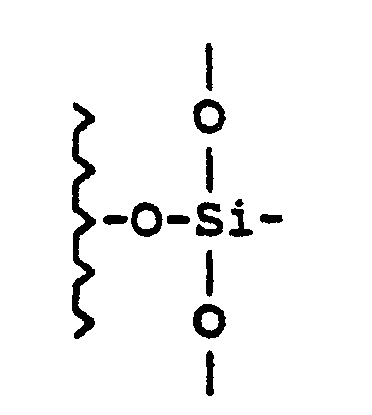
- a bonded phase permitting the extraction of a more highly purified or concentrated form of THC-COOH from human urine is provided by a bonded phase silica product of the formula: in which is the backbone of a silica gel or controlled pore glass, X is selected from -0-,-S-, each R and R 1 are each independently selected from hydrogen, an alkyl group of from 1 to 3 carbon atoms and CH 2 m COOR 3 , R 2 and R 3 are each independently alkyl of from 1 to 4 carbon atoms, n is an integer of from 2 to 5, p is zero or one and m is an integer of from 1 to 4.
- bonded phase silica products of Formula I of this invention are prepared by reacting in a suitable inert organic solvent, and where required, in the presence of a free radical initiator as a catalyst:
- the bonded phase silica reactants of Formula II are preferably those based on silica gel or controlled pore glass (CPG).
- the silica gel is silica gel having an average particle diameter of from 3 to 70 micrometers and an average pore size of from 50 to 1000(5-100nm), preferably about 50 to about 500 Angstrom units(5-50nm).
- the particulate controlled pore glass which is a silicate support material similar to silica for use in liquid chromatography is commercially available, for example from the Pierce Chemical Co., of Rockford, Illinois, is CPG having an average particle diameter of from 37 to 177 micrometers and an average pore size of from 40 to 1000 Angstrom units(4-100nm), preferably of 40 to about 500 Angstroms(4-50nm).
- silica bonded phase products of Formula I of this invention are generally prepared in accordance with the following steps:
- inert organic solvents suitable for preparing the bonded phase silica products of Formula I are aliphatic hydrocarbons such as, for example, heptane, octane, nonane and the like; aromatic hydrocarbons such as, for example, benzene, toluene, xylene and the like; and such other inert solvents as glyme, diglyme and the like.
- aliphatic hydrocarbons such as, for example, heptane, octane, nonane and the like
- aromatic hydrocarbons such as, for example, benzene, toluene, xylene and the like
- other inert solvents as glyme, diglyme and the like.
- a 1:5 ratio of bonded phase silica reactant of Formula II in grams to organic solvent in milliliters affords a suitable reaction mixture.
- the bonded phase silica reactant of Formula II is a reactant in which Z is the group a free radical initiating catalytic amount of a free radical initiator is employed as a catalyst.
- free radical initiators are known in the art, such as for example, organic peroxides, such as benzoyl peroxide, or azobisisobutyronitrile and the like.
- bonded phase silica reactants of Formula II employed in the reaction of this invention there may be mentioned, for example, glycidoxypropyl bonded phase silica of the formula and allyl bonded phase silica of the formula and the like.
- reactants of Formula III employed as reactants in the reaction of this invention there may be mentioned, for example, dimethyl tartrate, dimethyl maleate, methyl lactate, methyl 2-hydrox- yisobutyrate, ethyl mercaptoacetate, methyl 3-mercaptopropionate, dimethyl mercaptosuccinate, trimethyl citrate, 2-mercaptodimethylsuccinate, 2-mercaptomethyl dimethylsuccinate, 2-mercaptoethyl butyrate, 2-mercaptoethylpropionate, 2-mercaptobutylpropionate, trimethyl citrate and the like.
- the reactants of Formulas II and III are reacted in stoichiometric equivalent amounts or with a slight excess of the reactant of Formula III.
- the reaction may be conducted at ambient temperature although elevated temperatures of about 80 C or more may be utilized to enhance the rate of reaction.
- the reaction proceeds readily to substantial completion (Step 1) within about 2-10 hours. Stirring during admixture of the reactants is advantageously employed although the reaction thereafter may continue without further stirring.
- the resultant solid fraction is recovered from the reaction mixture by conventional physical means, for example, filtration, centrifugation and the like.
- a filtering means sufficient to retain a particle size of 5 micrometers is suitable whereas centrifuging is suitable for a particle size of 3 micrometers.
- the recovered solid fraction is then heat cured at a temperature and for a time sufficient to dry. In general, from 1-4 hours at 40-120° C has been found sufficient.
- the bonded phase reaction products of Formula I constitute new and useful bonded phases for the purification, concentration and separation of THC-COOH, especially from human urine, and are particularly suitable for use with solid phase extraction instrumentation especially in high performance liquid chromatography (HPLC) applications.
- the novel bonded phase product may be employed as column packing and be of various mesh sizes, for example, from about 50 to about 600 mesh.
- An example of the methodology suitable for purification and concentration or separation of THC-COOH is similar to that reported in the literature using other but much less effective and less efficient bonded phases, for example, the methodology disclosed by M. Elsohly, J. Analytical Toxicology , Vol. 7, pp. 262-264, November/December 1983.
- bonded phase silica of Formula II employed as reactants namely glycidoxypropyl bonded phase silica, allyl bonded phase silica and mercaptopropyl bonded phase silica were prepared in the following exemplary manner.
- Example 2 In the method of Example 1, 4 ml butyl acrylate is employed in place of dimethyl maleate, the water bath is maintained at 75 C and 0.05g azobisisobutyronitrite employed in place of benzoyl peroxide. Yield: 11.1 g; Analysis 10.86% C, 2.29% H, 3.21 % S.
- Example 2 As exemplary of the use of the bonded phase products of this invention in the cleanup of urine samples for analysis of cannabinoids reference may be had to the following Example.
- the urine sample is first hydrolized to hydrolyze the conjugated form of THC-COOH to free form for chromatographic processing according to this invention.
- Typically such hydrolysis of a urine sample is conducted in the following manner. Three ml of urine, 3 ml of distilled water and 300 microliters of 10N KOH solution are added to a 15 ml screw top tube. The tube is capped and the solution mixed thoroughly and the tube placed in a 60 C water bath for about 20 minutes. Following this hydrolysis step the ph of the hydrolysate is adjusted to a ph of 6 with the addition of the appropriate amount of concentrated HCL.
- a standard 3 ml polypropylene solid phase extraction column cartridge (serological grade) is dry packed with 500 mg of the bonded phase from Example 1. The bottom of this cartridge is then friction fitted via Leur type fitting onto a suitable vacuum manifold. The vacuum is then increased to 14 inches of mercury(47,4KPa) which results in a flow rate of 5 ml/minute. The column is then conditioned to wet the bonded phase and to rinse out solubles by adding two 2 ml aliquots of methanol followed by two 2 ml aliquots of distilled water (care being taken not to let the column run dry during or following conditioning). The vacuum is then turned off. Enough distilled water to fill the cartridge 2/3 of the way is then introduced.
- a 15 milliliter standard polypropylene (serological grade) reservoir is then friction fitted to the top of the extract column via an adaptor.
- Five ml of distilled water is then introduced into the column along with the hydrolized urine sample. This entire solution is then aspirated through the column at a flow rate of 5 ml/minute (14 inches of mercury(47,4KPa)).
- the reservoir is rinsed with a small portion of distilled water after it has run dry.
- the extraction column is allowed to run dry and then the reservoir and the adaptor are removed. At this point one observes a colored zone of about 2 millimeters at the top of the cartridge. This zone consists of the extracted THC-COOH as well as a large amount of co-extracted impurities.
- the vacuum is again adjusted so that a flow rate of 5 ml/minute is obtained (14 inches mercury(47,4KPa)) and three 0.5 ml aliquots of 100% acetonitrile is introduced to the column. Once the column has dried the vacuum is turned off and the sample collection tube containing the concentrated THC-COOH sample eluant is removed from the rack in the vacuum manifold.
- the bonded phases of this invention provide a much faster, easier and more efficient sample preparation technique, that is concentration of THC-COOH in the sample, than is possible with heretofore available bonded phases.
Landscapes
- Chemical & Material Sciences (AREA)
- Analytical Chemistry (AREA)
- Organic Chemistry (AREA)
- Chemical Kinetics & Catalysis (AREA)
- Health & Medical Sciences (AREA)
- Engineering & Computer Science (AREA)
- Life Sciences & Earth Sciences (AREA)
- Molecular Biology (AREA)
- Hematology (AREA)
- Urology & Nephrology (AREA)
- Biomedical Technology (AREA)
- Immunology (AREA)
- Inorganic Chemistry (AREA)
- Bioinformatics & Cheminformatics (AREA)
- General Health & Medical Sciences (AREA)
- Biotechnology (AREA)
- Microbiology (AREA)
- Pharmacology & Pharmacy (AREA)
- Food Science & Technology (AREA)
- Medicinal Chemistry (AREA)
- Physics & Mathematics (AREA)
- Biochemistry (AREA)
- Cell Biology (AREA)
- General Physics & Mathematics (AREA)
- Pathology (AREA)
- Anesthesiology (AREA)
- Silicon Compounds (AREA)
- Solid-Sorbent Or Filter-Aiding Compositions (AREA)
- Investigating Or Analysing Biological Materials (AREA)
- Glass Compositions (AREA)
Abstract
Description
- This invention relates to solid phase extraction material, especially such material useful for the cleanup of urine samples for analysis of cannabinoids in urine.
- Detection of marihuana use through analysis of biological samples, such as urine or blood, is coming into more widespread use. Because use of urine samples involves a non-invasive and more convenient process, detection of metabolites of A-9-tetrahydrocannabinoi in urine has begun to find greater popularity. Additionally, the use of such assay procedure has begun to develop greater importance and more widespread use not only because of its use to initially detect marihuana users but as an adjunct of drug counseling programs as a screening procedure to monitor compliance with withdrawal procedures and continued abstinence from marihuana use.
- Of the several metabolites of A-9-tetrahydrocannabinoi found in urine the major is 11-nor-Δ-9-tetrahydrocannabinol-9-carboxylic acid, hereinafter referred to as THC-COOH, in either its free or conjugated (glucuronide) form. Various non-automated processes exist for detection of THC-COOH in urine, such as thin layer chromatography, gas chromatography, gas chromatography/mass spectrometry, radioimmunoassay, enzyme multiplied immunoassay and more recently high performance liquid chromatography (HPLC). However, such processes are quite labor intensive and due to the numerous and varied interferents in the urine sample are quite cumbersome to carry out. Additionally, it is difficult to measure THC-COOH in urine because of the complex nature of this matrix. The extraction of THC-COOH from urine is rendered more difficult because THC-COOH is one organic acid among a large number and variety of organic acids present in urine. A number of these organic acids have chromatographic properties which are similar to THC-COOH and will interfere with its measurement. Therefore, in order to be able to obtain a meaningful and relatively quick measurement of THC-COOH in urine one must be able to selectively extract it from the urine sample.
- Current techniques for screening total urine samples for the presence of THC-COOH are generally either by thin layer chromatography or the Enzyme Multiplied Immunoassay Technique (EMIT) of Syva Company. Once a positive sample is detected a confirmational analysis is performed, usually by gas chromatography/mass spectrometry. However, with adequate cleanup of the urine sample, that is concentration of THC-COOH in the urine sample, and the use of an internal standard, confirmation by HPLC is possible. Thus, a great need exists for a much more satisfactory method of cleanup of urine samples to concentrate THC-COOH present in said samples. A bonded phase chromatographic packing that uniquely and specifically extracts THC-COOH from human urine would be highly desirable. Moreover, a bonded phase that is specific enough for THC-COOH yet permits selective elution of THC-COOH from the column without removing the impurities from the column or selective elution of the impurities from the column without removing the THC-COOH would be most desirable. A bonded phase that provides a purified urine extract clean enough to permit a more sensitive analysis of THC-COOH by confirmational methods, such as by HPLC, is greatly needed. Impure extracts also result in high and noisy baselines that decrease the capability for detecting low levels of THC-COOH. Cleanup of urine samples sufficient to detect low levels of THC-COOH would be most desirable.
- In accordance with the invention, a bonded phase permitting the extraction of a more highly purified or concentrated form of THC-COOH from human urine is provided by a bonded phase silica product of the formula:


- The bonded phase silica products of Formula I of this invention are prepared by reacting in a suitable inert organic solvent, and where required, in the presence of a free radical initiator as a catalyst:
- (a) a bonded phase silica reactant of the formula:


- (b) a compound of the formula:

- The bonded phase silica reactants of Formula II are preferably those based on silica gel or controlled pore glass (CPG). The silica gel is silica gel having an average particle diameter of from 3 to 70 micrometers and an average pore size of from 50 to 1000(5-100nm), preferably about 50 to about 500 Angstrom units(5-50nm). The particulate controlled pore glass, which is a silicate support material similar to silica for use in liquid chromatography is commercially available, for example from the Pierce Chemical Co., of Rockford, Illinois, is CPG having an average particle diameter of from 37 to 177 micrometers and an average pore size of from 40 to 1000 Angstrom units(4-100nm), preferably of 40 to about 500 Angstroms(4-50nm).
- The silica bonded phase products of Formula I of this invention are generally prepared in accordance with the following steps:
- A. reacting a silica bonded phase of Formula 11, as set forth hereinbefore, wherein the silica backbone is either particulate silica gel having an average particle diameter of from 3 to 70 micrometers and an average pore size of from 50 to 1000 Angstrom units(5-100nm), or particulate controlled pore glass having an average particle diameter of from 37 to 177 micrometers and an average pore size of from 40 to 1000 Angstroms(4-100nm), in an inert organic solvent having a boiling point of at least 80 C and inert to free radicals, a free radical initiator where required, with a compound of Formula III, as set forth hereinbefore, said reaction being conducted at ambient to 80 C or more for 2 to about 10 hours;
- B. recovering the resultant solid fraction from the reaction mixture; and
- C. heating said solid fraction at a temperature and for a time sufficient to dry the product.
- Among the inert organic solvents suitable for preparing the bonded phase silica products of Formula I are aliphatic hydrocarbons such as, for example, heptane, octane, nonane and the like; aromatic hydrocarbons such as, for example, benzene, toluene, xylene and the like; and such other inert solvents as glyme, diglyme and the like. In general a 1:5 ratio of bonded phase silica reactant of Formula II in grams to organic solvent in milliliters affords a suitable reaction mixture.
- When the bonded phase silica reactant of Formula II is a reactant in which Z is the group

- As examples of the bonded phase silica reactants of Formula II employed in the reaction of this invention there may be mentioned, for example, glycidoxypropyl bonded phase silica of the formula


- As examples of the reactants of Formula III employed as reactants in the reaction of this invention there may be mentioned, for example, dimethyl tartrate, dimethyl maleate, methyl lactate, methyl 2-hydrox- yisobutyrate, ethyl mercaptoacetate, methyl 3-mercaptopropionate, dimethyl mercaptosuccinate, trimethyl citrate, 2-mercaptodimethylsuccinate, 2-mercaptomethyl dimethylsuccinate, 2-mercaptoethyl butyrate, 2-mercaptoethylpropionate, 2-mercaptobutylpropionate, trimethyl citrate and the like.
- In general, the reactants of Formulas II and III are reacted in stoichiometric equivalent amounts or with a slight excess of the reactant of Formula III. The reaction may be conducted at ambient temperature although elevated temperatures of about 80 C or more may be utilized to enhance the rate of reaction. The reaction proceeds readily to substantial completion (Step 1) within about 2-10 hours. Stirring during admixture of the reactants is advantageously employed although the reaction thereafter may continue without further stirring.
- The resultant solid fraction is recovered from the reaction mixture by conventional physical means, for example, filtration, centrifugation and the like. In general, a filtering means sufficient to retain a particle size of 5 micrometers is suitable whereas centrifuging is suitable for a particle size of 3 micrometers.
- The recovered solid fraction is then heat cured at a temperature and for a time sufficient to dry. In general, from 1-4 hours at 40-120° C has been found sufficient.
- It is also possible to prepare the bonded phase silica products of Formula I of this invention where X is -S-by reacting, in the presence of a free radical initiator and a suitable organic solvent, as previously discussed, a mercaptoalkyl bonded phase silica of the formula


- The bonded phase reaction products of Formula I constitute new and useful bonded phases for the purification, concentration and separation of THC-COOH, especially from human urine, and are particularly suitable for use with solid phase extraction instrumentation especially in high performance liquid chromatography (HPLC) applications. The novel bonded phase product may be employed as column packing and be of various mesh sizes, for example, from about 50 to about 600 mesh. An example of the methodology suitable for purification and concentration or separation of THC-COOH is similar to that reported in the literature using other but much less effective and less efficient bonded phases, for example, the methodology disclosed by M. Elsohly, J. Analytical Toxicology , Vol. 7, pp. 262-264, November/December 1983.
- In the following examples the bonded phase silica of Formula II employed as reactants, namely glycidoxypropyl bonded phase silica, allyl bonded phase silica and mercaptopropyl bonded phase silica were prepared in the following exemplary manner.
- To 100g silica gel, 40µm, 60A(6nm), is added 40 ml glycidoxypropyltrimethoxy silane in 500 ml toluene and 8 ml water with stirring. The reaction mixture is permitted to stand at ambient temperature overnight and the solid reaction product is filtered, washed twice with toluene and twice with methanol. The reaction product is placed in an 80 C oven for about 3 hours to cure and dry the product. Yield: 115.1g; Analysis 6.10% C, 1.57% H.
- To 100g silica gel, 40um, 60A(6nm), is added 112.5g mercaptopropyltrimethoxysilane in 1250 ml toluene and 20 ml water with stirring. After standing overnight at ambient temperature the solid reaction product is filtered and washed twice with toluene and twice with methanol. The reaction product is placed in an 80° C oven for 3½ hours to cure and dry the product. Yield: 304.2g; Analysis 3.73% C, 1.17% H, 3.14% S.
- To 100g silica gel, 40µm, 60Å(6nm), is added 40 ml allyltrimethoxysilane in 500 ml toluene and 1 ml water with stirring. After standing overnight at ambient temperature the reaction product is filtered, washed twice with toluene and twice with methanol. The reaction product is placed in an 80 C oven for 5½ hours to cure and dry the product. Yield: 110.2g; Analysis 3.88% C, 1.24% H.
- Exemplary of the preparation of the new bonded phases products according to the invention are the following representative examples.
- To 50 ml toluene is added 10g mercaptopropyl bonded phase silica, 4 ml dimethyl maleate and 0.25g benzoyl peroxide with stirring. The reaction mixture is placed in a water bath maintained at 80 C for 4½ to 5 hours. The reaction mixture is filtered and the filter cake washed twice with toluene and twice with methanol and dried in an oven at 80 C for a period of 1 to 1 hour. Yield: 10.24g; Analysis 6.59% C, 1.55% H, 3.20% S.
- In the method of Example 1, 4 ml dimethyl itaconate is employed in place of dimethyl maleate. Yield: 10.56g; Analysis 7.94% C, 1.78% H, 2.27% S.
- In the method of Example 1, 4 ml ethyl crotonate is employed in place of dimethyl maleate. Yield: 10.08g; Analysis 5.70% C, 1.62% H, 3.12% S.
- In the method of Example 1, 4 ml butyl acrylate is employed in place of dimethyl maleate, the water bath is maintained at 75 C and 0.05g azobisisobutyronitrite employed in place of benzoyl peroxide. Yield: 11.1 g; Analysis 10.86% C, 2.29% H, 3.21 % S.
- To 50 ml toluene is added 10g allyl bonded phase silica, 4 ml ethyl mercaptoacetate and 0.05g azobisisobutyronitrite with stirring. The reaction mixture is placed in a water bath maintained at 75. C for 5 hours. The reaction mixture is filtered and the filter cake washed twice with toluene and twice with methanol and dried in an oven at 80 C for 105 minutes. Yield: 11.15g; Analysis 7.03% C, 1.55% H, 2.55% S.
- In the method of Example 5, 4 ml methyl mercaptopropionate is employed in place of ethyl mercaptoacetate. Yield: 11.23g; Analysis 6.95% C, 1.58% H, 2.70% S.
- In the method of Example 5, 4 ml dimethyl mercaptosuccinate is employed in place of ethyl mercaptoacetate. Yield: 11.50g; Analysis 7.48% C, 1.52% H, 2.68% S.
- To 50 ml toluene is added 10g glycidoxypropyl bonded phase silica, 4 ml methyl mercaptoacetate and 0.5 ml water with stirring. The reaction mixture is placed in a water bath maintained at 80°C for 4 hours. The reaction mixture is filtered, washed twice with toluene and twice with methanol and dried in an oven at 80 C for 1 hour. Yield: 10.5g; Analysis 7.14% C, 1.54% H, 1.55% S.
- In the method of Example 8, 4 ml methyl mercaptopropionate is employed in place of methyl mercaptoacetate. Yield: 10.4g; Analysis 6.73% C, 1.41% H, 1.14% S.
- To 50 ml toluene is added 10g glycidoxypropyl bonded phase silica, 4g trimethyl citrate and 250 ul 1 N HC1 with stirring. The reaction mixture is placed in a water bath maintained at 80°C for 5 hours. The reaction product is filtered and the filter cake washed twice with toluene and twice with methanol and dried in an oven at 80° C for 1 hour. Yield: 10.05g; Analysis 7.57% C, 1.63% H.
- In the method of Example 10, 4 ml dimethyl malate is employed in place of trimethyl citrate. Yield: 10.53g; Analysis 7.64% C, 1.49% H.
- In the method of Example 11, 4 ml dimethyl mercaptosuccinate is employed in place of trimethyl citrate and 250 fit water in place of IN HCI. Yield: 10.57g; Analysis 6.77% C, 1.53% H, 1.03% S.
- In the method of Example 11, 4 ml dimethyl tartrate is employed in place of trimethyl citrate. Yield: 10.42g; Analysis 6.14% C, 1.25% H.
- In the method of Example 11, 4 ml methyl lactate is employed in place of trimethyl citrate. Yield: 10.32g.
- As exemplary of the use of the bonded phase products of this invention in the cleanup of urine samples for analysis of cannabinoids reference may be had to the following Example. In the following Example the urine sample is first hydrolized to hydrolyze the conjugated form of THC-COOH to free form for chromatographic processing according to this invention. Typically such hydrolysis of a urine sample is conducted in the following manner. Three ml of urine, 3 ml of distilled water and 300 microliters of 10N KOH solution are added to a 15 ml screw top tube. The tube is capped and the solution mixed thoroughly and the tube placed in a 60 C water bath for about 20 minutes. Following this hydrolysis step the ph of the hydrolysate is adjusted to a ph of 6 with the addition of the appropriate amount of concentrated HCL.
- A standard 3 ml polypropylene solid phase extraction column cartridge (serological grade) is dry packed with 500 mg of the bonded phase from Example 1. The bottom of this cartridge is then friction fitted via Leur type fitting onto a suitable vacuum manifold. The vacuum is then increased to 14 inches of mercury(47,4KPa) which results in a flow rate of 5 ml/minute. The column is then conditioned to wet the bonded phase and to rinse out solubles by adding two 2 ml aliquots of methanol followed by two 2 ml aliquots of distilled water (care being taken not to let the column run dry during or following conditioning). The vacuum is then turned off. Enough distilled water to fill the cartridge 2/3 of the way is then introduced. A 15 milliliter standard polypropylene (serological grade) reservoir is then friction fitted to the top of the extract column via an adaptor. Five ml of distilled water is then introduced into the column along with the hydrolized urine sample. This entire solution is then aspirated through the column at a flow rate of 5 ml/minute (14 inches of mercury(47,4KPa)). The reservoir is rinsed with a small portion of distilled water after it has run dry. The extraction column is allowed to run dry and then the reservoir and the adaptor are removed. At this point one observes a colored zone of about 2 millimeters at the top of the cartridge. This zone consists of the extracted THC-COOH as well as a large amount of co-extracted impurities. These impurities are washed from the bonded phase by aspirating through the column at a flow rate of 5 ml/minute two one ml aliquots of 45% acetonitrile/55% 0.1 N HCL in water solution. The colored zone at the top of the column is displaced from the column by the first aliquot of the wash solution. The column is allowed to air dry for one minute before the vacuum is turned off. Next, a rack containing a 3 ml glass sample collection tube is placed in the vacuum manifold in such a way that the eluant from the solid phase extraction column is collected. The vacuum is again adjusted so that a flow rate of 5 ml/minute is obtained (14 inches mercury(47,4KPa)) and three 0.5 ml aliquots of 100% acetonitrile is introduced to the column. Once the column has dried the vacuum is turned off and the sample collection tube containing the concentrated THC-COOH sample eluant is removed from the rack in the vacuum manifold.
- The bonded phases of this invention provide a much faster, easier and more efficient sample preparation technique, that is concentration of THC-COOH in the sample, than is possible with heretofore available bonded phases.
Claims (12)



Priority Applications (1)
| Application Number | Priority Date | Filing Date | Title |
|---|---|---|---|
| AT86310215T ATE60913T1 (en) | 1986-02-20 | 1986-12-30 | BONDED PHASE OF SILICA FOR SOLID PHASE EXTRACTION. |
Applications Claiming Priority (2)
| Application Number | Priority Date | Filing Date | Title |
|---|---|---|---|
| US06/831,333 US4650784A (en) | 1986-02-20 | 1986-02-20 | Bonded phase of silica for solid phase extraction |
| US831333 | 1986-02-20 |
Publications (3)
| Publication Number | Publication Date |
|---|---|
| EP0234129A2 EP0234129A2 (en) | 1987-09-02 |
| EP0234129A3 EP0234129A3 (en) | 1988-08-31 |
| EP0234129B1 true EP0234129B1 (en) | 1991-02-20 |
Family
ID=25258814
Family Applications (1)
| Application Number | Title | Priority Date | Filing Date |
|---|---|---|---|
| EP86310215A Expired - Lifetime EP0234129B1 (en) | 1986-02-20 | 1986-12-30 | Bonded phase of silica for solid phase extraction |
Country Status (11)
| Country | Link |
|---|---|
| US (1) | US4650784A (en) |
| EP (1) | EP0234129B1 (en) |
| JP (1) | JPH0647453B2 (en) |
| KR (1) | KR890004080B1 (en) |
| AT (1) | ATE60913T1 (en) |
| AU (1) | AU587302B2 (en) |
| CA (1) | CA1283090C (en) |
| DE (1) | DE3677587D1 (en) |
| DK (1) | DK164803C (en) |
| IE (1) | IE59565B1 (en) |
| IL (1) | IL81270A (en) |
Cited By (1)
| Publication number | Priority date | Publication date | Assignee | Title |
|---|---|---|---|---|
| US7304017B2 (en) | 2004-12-28 | 2007-12-04 | Polymerics Gmbh | Sorbent for use in process of solid phase extraction |
Families Citing this family (36)
| Publication number | Priority date | Publication date | Assignee | Title |
|---|---|---|---|---|
| US5066395A (en) * | 1986-03-06 | 1991-11-19 | J. T. Baker Inc. | N-acylated derivatives of polyethyleneimine bonded phase silica products |
| US4904632A (en) * | 1987-06-19 | 1990-02-27 | Pesek Joseph J | Surface-modified chromatographic separation material |
| US5039419A (en) * | 1988-07-13 | 1991-08-13 | Brigham Young University | Sulfur-containing hydrocarbon compounds and process of using same in recovering and concentrating desired ions from solutions thereof |
| US5071819A (en) * | 1988-08-26 | 1991-12-10 | Ibc Advanced Technologies | Sulfur and nitrogen-containing hydrocarbons and process of using same in recovering and concentrating desired ions from solutions thereof |
| US5137626A (en) * | 1989-02-21 | 1992-08-11 | Rohm And Haas Company | Solid-phase extraction tubes containing sulfonazide bonded-phase extractants |
| US5087359A (en) * | 1989-08-07 | 1992-02-11 | J. T. Baker Inc. | Quaternized PEI silica solid supports for chromatography |
| DE4018778A1 (en) * | 1990-06-12 | 1991-12-19 | Braun Melsungen Ag | ADSORPTION MATERIAL FOR THE SELECTIVE REMOVAL OF LDL AND / AND VLDL |
| US5173470A (en) * | 1991-08-09 | 1992-12-22 | Brigham Young University | Compositions and processes for removing, separating and concentrating desired ions from solutions using sulfur and aralkyl nitrogen containing ligands bonded to inorganic supports |
| US5273660A (en) * | 1991-10-10 | 1993-12-28 | Brigham Young University | Aminoalkylphosphonic acid containing ligands attached to solid supports for removal of metal ions |
| US5182251A (en) * | 1991-10-10 | 1993-01-26 | Brigham Young University | Aminoalkylphosphonic acid containing ligands attached to solid supports for removal of metal ions |
| US5190661A (en) * | 1992-06-08 | 1993-03-02 | Brigham Young University | Process of removing ions from solutions using a complex with sulfur-containing hydrocarbons |
| CN1041694C (en) * | 1992-12-19 | 1999-01-20 | 布莱阿姆青年大学 | Method for concentrating and separating desired ions from multi-ion source solution and ligand-solid complex used |
| DE9300912U1 (en) * | 1993-01-23 | 1993-04-29 | Macherey, Nagel GmbH & Co. Handelsgesellschaft, 52355 Düren | Separation material for chromatography |
| JPH0679941U (en) * | 1993-04-28 | 1994-11-08 | 株式会社サンレール | Weir wall Kasagi joining device |
| US5595653A (en) * | 1994-07-15 | 1997-01-21 | Cera, Inc. | Microcolumn for extraction of analytes from liquids |
| US5888290A (en) * | 1996-05-24 | 1999-03-30 | Minnesota Mining And Manufacturing Company | Composition and process for imparting durable repellency to substrates |
| US5637135A (en) * | 1995-06-26 | 1997-06-10 | Capillary Technology Corporation | Chromatographic stationary phases and adsorbents from hybrid organic-inorganic sol-gels |
| US6077421A (en) * | 1996-07-18 | 2000-06-20 | The United States Of America As Represented By The Secretary Of The Navy | Metal complexing |
| WO1999039816A1 (en) * | 1998-02-09 | 1999-08-12 | Industrial Science & Technology Network, Inc. | Ion separation using a surface-treated xerogel |
| ES2325304T3 (en) * | 1999-04-28 | 2009-09-01 | Toray Industries, Inc. | MATERIALS TO ELIMINATE CANABINOIDS AND COLUMNS FOR THE ELIMINATION OF CANABINOIDS WITH THE SAME USE. |
| US6905031B1 (en) | 1999-09-13 | 2005-06-14 | The Regents Of The University Of California | Solid phase microextraction device using aerogel |
| DE60131710T2 (en) | 2000-08-24 | 2008-11-13 | Kaneka Corp. | Methods of adsorption and removal, and use of an adsorbent for endogenous cannabinoids |
| EP1346765B1 (en) * | 2000-12-07 | 2008-02-13 | Sun Plastics Co., Ltd | Material for capturing chemical substance and method for producing the same, and chemical substance-capturing tube |
| US6723236B2 (en) * | 2002-03-19 | 2004-04-20 | Waters Investments Limited | Device for solid phase extraction and method for purifying samples prior to analysis |
| US7402243B2 (en) * | 2004-09-10 | 2008-07-22 | Dionex Corporation | Organosilanes and substrate bonded with same |
| US7468130B2 (en) * | 2005-02-15 | 2008-12-23 | Dionex Corporation | Organosilanes and substrates covalently bonded with same and methods for synthesis and use same |
| DE102005042647A1 (en) * | 2005-09-08 | 2007-03-15 | Noske-Kaeser Gmbh | Filter material against chemical warfare agents |
| US20070102358A1 (en) * | 2005-11-09 | 2007-05-10 | Cera Inc. | Solid phase extraction column |
| US7557232B2 (en) * | 2007-05-25 | 2009-07-07 | Dionex Corporation | Compositions useful as chromatography stationary phases |
| DE112013002108T5 (en) | 2012-04-19 | 2014-12-31 | New Objective, Inc. | Method and apparatus for combined sample preparation and nanoelectrospray ionization mass spectrometry |
| MY195756A (en) * | 2012-09-17 | 2023-02-09 | Grace W R & Co | Functionalized Particulate Support Material and Methods of Making and Using the Same |
| IN2015DN02055A (en) | 2012-09-17 | 2015-08-14 | Grace W R & Co | |
| EP3137209B1 (en) | 2014-05-02 | 2022-10-05 | W.R. Grace & CO. - CONN. | Functionalized support material and methods of making and using functionalized support material |
| SG10201911134QA (en) | 2015-06-05 | 2020-01-30 | Grace W R & Co | Adsorbent bioprocessing clarification agents and methods of making and using the same |
| WO2021080968A1 (en) * | 2019-10-22 | 2021-04-29 | Albert Einstein College Of Medicine | Delivery systems and method using cannabinoids for treatment of inflammatory disorders |
| PL435782A1 (en) * | 2020-10-27 | 2022-05-02 | Politechnika Wrocławska | Silica gels functionalized with N-perfosphonomethylated polyethylene-polyaminopropylsiloxane resins and the method of their production |
Family Cites Families (11)
| Publication number | Priority date | Publication date | Assignee | Title |
|---|---|---|---|---|
| US3960521A (en) * | 1974-03-01 | 1976-06-01 | Applied Science Laboratories, Inc. | High temperature polar stationary phase for gas chromatograhy |
| US3987058A (en) * | 1975-02-27 | 1976-10-19 | The United States Of America As Represented By The Secretary Of Agriculture | Preparation and uses of stable, bound stationary phases |
| US4242227A (en) * | 1979-07-31 | 1980-12-30 | The Dow Chemical Company | Chromatographic column packing having a bonded organosiloxane coating |
| CA1141358A (en) * | 1980-02-29 | 1983-02-15 | Jan Chmielowiec | Mercuro-organic bonded phase sorbents |
| US4324681A (en) * | 1980-06-12 | 1982-04-13 | Uop Inc. | Chiral supports for resolution of racemates |
| CA1204720A (en) * | 1982-09-30 | 1986-05-20 | Hajimu Kitahara | Packing materials for chromatographic use and a method for analysis of an enantiomer mixture using the same |
| US4540486A (en) * | 1983-11-25 | 1985-09-10 | J. T. Baker Chemical Company | Polyethylenimine bound chromatographic packing |
| US4523997A (en) * | 1984-03-02 | 1985-06-18 | J. T. Baker Chemical Company | Affinity chromatography matrix with built-in reaction indicator |
| US4522724A (en) * | 1984-03-02 | 1985-06-11 | J. T. Baker Chemical Company | Diazonium affinity matrixes |
| US4551245A (en) * | 1985-04-22 | 1985-11-05 | J. T. Baker Chemical Co. | Acylated polyethylenimine bound chromatographic packing |
| US4640909A (en) * | 1985-05-07 | 1987-02-03 | J. T. Baker Chemical Company | Bonded phase of silica and carboalkoxyalkyl silanes for solid phase extraction |
-
1986
- 1986-02-20 US US06/831,333 patent/US4650784A/en not_active Expired - Lifetime
- 1986-12-23 CA CA000526201A patent/CA1283090C/en not_active Expired - Lifetime
- 1986-12-30 EP EP86310215A patent/EP0234129B1/en not_active Expired - Lifetime
- 1986-12-30 AT AT86310215T patent/ATE60913T1/en not_active IP Right Cessation
- 1986-12-30 DE DE8686310215T patent/DE3677587D1/en not_active Expired - Lifetime
- 1986-12-30 IE IE340986A patent/IE59565B1/en not_active IP Right Cessation
- 1986-12-31 AU AU67071/86A patent/AU587302B2/en not_active Expired
-
1987
- 1987-01-15 IL IL81270A patent/IL81270A/en not_active IP Right Cessation
- 1987-01-16 KR KR1019870000313A patent/KR890004080B1/en not_active Expired
- 1987-02-19 DK DK084887A patent/DK164803C/en not_active IP Right Cessation
- 1987-02-20 JP JP62036018A patent/JPH0647453B2/en not_active Expired - Lifetime
Cited By (1)
| Publication number | Priority date | Publication date | Assignee | Title |
|---|---|---|---|---|
| US7304017B2 (en) | 2004-12-28 | 2007-12-04 | Polymerics Gmbh | Sorbent for use in process of solid phase extraction |
Also Published As
| Publication number | Publication date |
|---|---|
| IL81270A0 (en) | 1987-08-31 |
| DK84887A (en) | 1987-08-21 |
| KR870007940A (en) | 1987-09-23 |
| JPS62212218A (en) | 1987-09-18 |
| IE59565B1 (en) | 1994-03-09 |
| DK84887D0 (en) | 1987-02-19 |
| KR890004080B1 (en) | 1989-10-18 |
| IE863409L (en) | 1987-08-20 |
| AU587302B2 (en) | 1989-08-10 |
| US4650784A (en) | 1987-03-17 |
| CA1283090C (en) | 1991-04-16 |
| ATE60913T1 (en) | 1991-03-15 |
| AU6707186A (en) | 1987-08-27 |
| IL81270A (en) | 1989-12-15 |
| DE3677587D1 (en) | 1991-03-28 |
| DK164803B (en) | 1992-08-24 |
| EP0234129A3 (en) | 1988-08-31 |
| EP0234129A2 (en) | 1987-09-02 |
| JPH0647453B2 (en) | 1994-06-22 |
| DK164803C (en) | 1993-01-11 |
Similar Documents
| Publication | Publication Date | Title |
|---|---|---|
| US4650784A (en) | Bonded phase of silica for solid phase extraction | |
| EP0201286B1 (en) | Bonded phase of silica and carboalkoxyalkyl silanes for solid phase extraction | |
| US4680120A (en) | Bonded phase of silica and carboalkoxyalkyl silanes for solid phase extraction | |
| EP0196533B1 (en) | Coagulant for separating serum or plasma from whole blood for use in blood examination procedures | |
| US4680121A (en) | Bonded phase of silica for solid phase extraction | |
| US5137626A (en) | Solid-phase extraction tubes containing sulfonazide bonded-phase extractants | |
| CN108047071B (en) | Carcinone artificial hapten, artificial antigen, preparation method and application thereof | |
| Horner et al. | Esterification of (2, 4-dichlorophenoxy) acetic acid. Quantitative comparison of esterification techniques | |
| Woollard | Selective silylation using tert‐butyldimethylsilyl reagents: Their use in the quantification of fatty acids | |
| Araki et al. | Chemical ionization mass spectrometry of polyunsaturated fatty acids of human serum | |
| JPH10510633A (en) | Method for modifying a silanol-containing or silanol-containing stationary carrier phase with calixarene for chromatography | |
| Gelijkens et al. | Capillary gas chromatography of pyrimidines and purines: N, O-peralkyl and trifluoroacetyl-N, O-alkyl derivatives | |
| Kristinsson | A gas chromatographic method for the determination of antidepressant drugs in human serum | |
| CN1057607C (en) | Double functional chromatographic material and preparing method and use | |
| Burke et al. | Quaternary ammonium salts for butylation and mass spectral identification of volatile organic acids | |
| Shulgin et al. | Synthesis and Chromatographic Separation of Isotopically Labeled DL-Threonine and DL-Allothreonine1 | |
| KOTAKI et al. | Determination of chinoform and its metabolites in plasma by gas chromatography-mass spectrometry | |
| US4467037A (en) | Silylation of amino acids | |
| Fischer et al. | A stable isotope method for the quantification of N‐acetyl‐5‐aminosalicylic acid in plasma and urine | |
| Steffenrud et al. | A comparative study of methyl ester trimethylsilyl, allyldimethylsilyl and tert‐butyldimethylsilyl ethers for electron impact mass spectrometry of leukotrienes | |
| JP2902122B2 (en) | Column packing and method for producing the same | |
| Matyska et al. | Change‐transfer‐like stationary phase for HPLC prepared via hydrosilation on silica hydride | |
| US5128120A (en) | Use of 9-anthrylalkyl compounds as derivatization reagents for separation and detection purposes | |
| SU1527579A1 (en) | Method of analysis of platinum metals | |
| CN121517748A (en) | A method for extracting and purifying rubber oil components from thermoplastic elastomers |
Legal Events
| Date | Code | Title | Description |
|---|---|---|---|
| PUAI | Public reference made under article 153(3) epc to a published international application that has entered the european phase |
Free format text: ORIGINAL CODE: 0009012 |
|
| AK | Designated contracting states |
Kind code of ref document: A2 Designated state(s): AT BE CH DE FR GB IT LI LU NL SE |
|
| RAP1 | Party data changed (applicant data changed or rights of an application transferred) |
Owner name: J.T. BAKER INC. |
|
| PUAL | Search report despatched |
Free format text: ORIGINAL CODE: 0009013 |
|
| AK | Designated contracting states |
Kind code of ref document: A3 Designated state(s): AT BE CH DE FR GB IT LI LU NL SE |
|
| RHK1 | Main classification (correction) |
Ipc: B01J 20/32 |
|
| 17P | Request for examination filed |
Effective date: 19890223 |
|
| 17Q | First examination report despatched |
Effective date: 19900410 |
|
| GRAA | (expected) grant |
Free format text: ORIGINAL CODE: 0009210 |
|
| AK | Designated contracting states |
Kind code of ref document: B1 Designated state(s): AT BE CH DE FR GB IT LI LU NL SE |
|
| REF | Corresponds to: |
Ref document number: 60913 Country of ref document: AT Date of ref document: 19910315 Kind code of ref document: T |
|
| ET | Fr: translation filed | ||
| REF | Corresponds to: |
Ref document number: 3677587 Country of ref document: DE Date of ref document: 19910328 |
|
| ITF | It: translation for a ep patent filed | ||
| K2C3 | Correction of patent specification (complete document) published |
Effective date: 19910220 |
|
| PLBE | No opposition filed within time limit |
Free format text: ORIGINAL CODE: 0009261 |
|
| STAA | Information on the status of an ep patent application or granted ep patent |
Free format text: STATUS: NO OPPOSITION FILED WITHIN TIME LIMIT |
|
| 26N | No opposition filed | ||
| EPTA | Lu: last paid annual fee | ||
| EAL | Se: european patent in force in sweden |
Ref document number: 86310215.8 |
|
| REG | Reference to a national code |
Ref country code: CH Ref legal event code: PFA Free format text: J. T. BAKER INC. TRANSFER- MALLINCKRODT BAKER, INC. |
|
| REG | Reference to a national code |
Ref country code: FR Ref legal event code: CD |
|
| NLT1 | Nl: modifications of names registered in virtue of documents presented to the patent office pursuant to art. 16 a, paragraph 1 |
Owner name: MALLINCKRODT BAKER, INC. |
|
| REG | Reference to a national code |
Ref country code: GB Ref legal event code: IF02 |
|
| PGFP | Annual fee paid to national office [announced via postgrant information from national office to epo] |
Ref country code: NL Payment date: 20051129 Year of fee payment: 20 |
|
| PGFP | Annual fee paid to national office [announced via postgrant information from national office to epo] |
Ref country code: AT Payment date: 20051202 Year of fee payment: 20 |
|
| PGFP | Annual fee paid to national office [announced via postgrant information from national office to epo] |
Ref country code: FR Payment date: 20051216 Year of fee payment: 20 |
|
| PGFP | Annual fee paid to national office [announced via postgrant information from national office to epo] |
Ref country code: GB Payment date: 20051221 Year of fee payment: 20 |
|
| PGFP | Annual fee paid to national office [announced via postgrant information from national office to epo] |
Ref country code: CH Payment date: 20051227 Year of fee payment: 20 Ref country code: SE Payment date: 20051227 Year of fee payment: 20 |
|
| PGFP | Annual fee paid to national office [announced via postgrant information from national office to epo] |
Ref country code: IT Payment date: 20051229 Year of fee payment: 20 |
|
| PGFP | Annual fee paid to national office [announced via postgrant information from national office to epo] |
Ref country code: LU Payment date: 20051230 Year of fee payment: 20 |
|
| PGFP | Annual fee paid to national office [announced via postgrant information from national office to epo] |
Ref country code: DE Payment date: 20060131 Year of fee payment: 20 |
|
| PGFP | Annual fee paid to national office [announced via postgrant information from national office to epo] |
Ref country code: BE Payment date: 20060202 Year of fee payment: 20 |
|
| PG25 | Lapsed in a contracting state [announced via postgrant information from national office to epo] |
Ref country code: GB Free format text: LAPSE BECAUSE OF EXPIRATION OF PROTECTION Effective date: 20061229 |
|
| PG25 | Lapsed in a contracting state [announced via postgrant information from national office to epo] |
Ref country code: NL Free format text: LAPSE BECAUSE OF EXPIRATION OF PROTECTION Effective date: 20061230 |
|
| REG | Reference to a national code |
Ref country code: GB Ref legal event code: PE20 |
|
| EUG | Se: european patent has lapsed | ||
| NLV7 | Nl: ceased due to reaching the maximum lifetime of a patent |
Effective date: 20061230 |
|
| BE20 | Be: patent expired |
Owner name: *MALLINCKRODT BAKER INC. Effective date: 20061230 |