EP0233969B1 - A fluorine-containing crosslinking copolymer - Google Patents
A fluorine-containing crosslinking copolymer Download PDFInfo
- Publication number
- EP0233969B1 EP0233969B1 EP86102322A EP86102322A EP0233969B1 EP 0233969 B1 EP0233969 B1 EP 0233969B1 EP 86102322 A EP86102322 A EP 86102322A EP 86102322 A EP86102322 A EP 86102322A EP 0233969 B1 EP0233969 B1 EP 0233969B1
- Authority
- EP
- European Patent Office
- Prior art keywords
- mole
- fluorine
- copolymer
- tetrafluoroethylene
- sulfonyl chloride
- Prior art date
- Legal status (The legal status is an assumption and is not a legal conclusion. Google has not performed a legal analysis and makes no representation as to the accuracy of the status listed.)
- Expired
Links
- 229920001577 copolymer Polymers 0.000 title claims description 128
- 229910052731 fluorine Inorganic materials 0.000 title claims description 63
- YCKRFDGAMUMZLT-UHFFFAOYSA-N Fluorine atom Chemical compound [F] YCKRFDGAMUMZLT-UHFFFAOYSA-N 0.000 title claims description 57
- 239000011737 fluorine Substances 0.000 title claims description 57
- 238000004132 cross linking Methods 0.000 title description 15
- YBBRCQOCSYXUOC-UHFFFAOYSA-N sulfuryl dichloride Chemical group ClS(Cl)(=O)=O YBBRCQOCSYXUOC-UHFFFAOYSA-N 0.000 claims description 49
- 239000000178 monomer Substances 0.000 claims description 40
- 150000001875 compounds Chemical class 0.000 claims description 36
- RTZKZFJDLAIYFH-UHFFFAOYSA-N Diethyl ether Chemical compound CCOCC RTZKZFJDLAIYFH-UHFFFAOYSA-N 0.000 claims description 30
- BFKJFAAPBSQJPD-UHFFFAOYSA-N tetrafluoroethene Chemical group FC(F)=C(F)F BFKJFAAPBSQJPD-UHFFFAOYSA-N 0.000 claims description 18
- BQCIDUSAKPWEOX-UHFFFAOYSA-N 1,1-Difluoroethene Chemical compound FC(F)=C BQCIDUSAKPWEOX-UHFFFAOYSA-N 0.000 claims description 14
- HCDGVLDPFQMKDK-UHFFFAOYSA-N hexafluoropropylene Chemical group FC(F)=C(F)C(F)(F)F HCDGVLDPFQMKDK-UHFFFAOYSA-N 0.000 claims description 14
- 229910052801 chlorine Inorganic materials 0.000 claims description 6
- 125000001309 chloro group Chemical group Cl* 0.000 claims description 6
- 125000001153 fluoro group Chemical group F* 0.000 claims description 6
- 125000004435 hydrogen atom Chemical group [H]* 0.000 claims description 6
- -1 ethylene, propylene, pentafluoropropylene Chemical group 0.000 claims description 4
- 125000002023 trifluoromethyl group Chemical group FC(F)(F)* 0.000 claims description 4
- 125000002496 methyl group Chemical group [H]C([H])([H])* 0.000 claims description 3
- UUAGAQFQZIEFAH-UHFFFAOYSA-N chlorotrifluoroethylene Chemical group FC(F)=C(F)Cl UUAGAQFQZIEFAH-UHFFFAOYSA-N 0.000 claims description 2
- 238000006116 polymerization reaction Methods 0.000 description 27
- 229920001971 elastomer Polymers 0.000 description 13
- 238000000034 method Methods 0.000 description 13
- 239000000806 elastomer Substances 0.000 description 12
- 239000000203 mixture Substances 0.000 description 12
- 239000007787 solid Substances 0.000 description 11
- AJDIZQLSFPQPEY-UHFFFAOYSA-N 1,1,2-Trichlorotrifluoroethane Chemical compound FC(F)(Cl)C(F)(Cl)Cl AJDIZQLSFPQPEY-UHFFFAOYSA-N 0.000 description 10
- 239000000470 constituent Substances 0.000 description 9
- 238000010521 absorption reaction Methods 0.000 description 8
- 238000006243 chemical reaction Methods 0.000 description 8
- 239000003999 initiator Substances 0.000 description 8
- 150000001451 organic peroxides Chemical class 0.000 description 8
- 229920000642 polymer Polymers 0.000 description 8
- 238000004458 analytical method Methods 0.000 description 7
- 238000003756 stirring Methods 0.000 description 7
- 239000000126 substance Substances 0.000 description 7
- 238000007334 copolymerization reaction Methods 0.000 description 6
- 239000007789 gas Substances 0.000 description 6
- 150000003254 radicals Chemical class 0.000 description 6
- 230000000052 comparative effect Effects 0.000 description 5
- 239000003431 cross linking reagent Substances 0.000 description 5
- 239000002904 solvent Substances 0.000 description 5
- IJGRMHOSHXDMSA-UHFFFAOYSA-N Atomic nitrogen Chemical compound N#N IJGRMHOSHXDMSA-UHFFFAOYSA-N 0.000 description 4
- 230000006835 compression Effects 0.000 description 4
- 238000007906 compression Methods 0.000 description 4
- 229910001873 dinitrogen Inorganic materials 0.000 description 4
- 239000003014 ion exchange membrane Substances 0.000 description 4
- 229920003023 plastic Polymers 0.000 description 4
- 239000004033 plastic Substances 0.000 description 4
- JUTIIYKOQPDNEV-UHFFFAOYSA-N 2,2,3,3,4,4,4-heptafluorobutanoyl 2,2,3,3,4,4,4-heptafluorobutaneperoxoate Chemical compound FC(F)(F)C(F)(F)C(F)(F)C(=O)OOC(=O)C(F)(F)C(F)(F)C(F)(F)F JUTIIYKOQPDNEV-UHFFFAOYSA-N 0.000 description 3
- ZWEHNKRNPOVVGH-UHFFFAOYSA-N 2-Butanone Chemical compound CCC(C)=O ZWEHNKRNPOVVGH-UHFFFAOYSA-N 0.000 description 3
- UHOVQNZJYSORNB-UHFFFAOYSA-N Benzene Chemical compound C1=CC=CC=C1 UHOVQNZJYSORNB-UHFFFAOYSA-N 0.000 description 3
- HEMHJVSKTPXQMS-UHFFFAOYSA-M Sodium hydroxide Chemical compound [OH-].[Na+] HEMHJVSKTPXQMS-UHFFFAOYSA-M 0.000 description 3
- 239000003708 ampul Substances 0.000 description 3
- 238000007385 chemical modification Methods 0.000 description 3
- 230000003247 decreasing effect Effects 0.000 description 3
- 238000000921 elemental analysis Methods 0.000 description 3
- 238000010556 emulsion polymerization method Methods 0.000 description 3
- 238000010528 free radical solution polymerization reaction Methods 0.000 description 3
- 239000011521 glass Substances 0.000 description 3
- 238000004519 manufacturing process Methods 0.000 description 3
- 239000003960 organic solvent Substances 0.000 description 3
- XHXFXVLFKHQFAL-UHFFFAOYSA-N phosphoryl trichloride Chemical compound ClP(Cl)(Cl)=O XHXFXVLFKHQFAL-UHFFFAOYSA-N 0.000 description 3
- 239000000843 powder Substances 0.000 description 3
- 229910001220 stainless steel Inorganic materials 0.000 description 3
- 239000010935 stainless steel Substances 0.000 description 3
- 238000010558 suspension polymerization method Methods 0.000 description 3
- XLYOFNOQVPJJNP-UHFFFAOYSA-N water Substances O XLYOFNOQVPJJNP-UHFFFAOYSA-N 0.000 description 3
- KOMNUTZXSVSERR-UHFFFAOYSA-N 1,3,5-tris(prop-2-enyl)-1,3,5-triazinane-2,4,6-trione Chemical compound C=CCN1C(=O)N(CC=C)C(=O)N(CC=C)C1=O KOMNUTZXSVSERR-UHFFFAOYSA-N 0.000 description 2
- 238000004293 19F NMR spectroscopy Methods 0.000 description 2
- OZAIFHULBGXAKX-UHFFFAOYSA-N 2-(2-cyanopropan-2-yldiazenyl)-2-methylpropanenitrile Chemical compound N#CC(C)(C)N=NC(C)(C)C#N OZAIFHULBGXAKX-UHFFFAOYSA-N 0.000 description 2
- 238000000862 absorption spectrum Methods 0.000 description 2
- 239000000654 additive Substances 0.000 description 2
- 238000005260 corrosion Methods 0.000 description 2
- 230000007797 corrosion Effects 0.000 description 2
- 238000003912 environmental pollution Methods 0.000 description 2
- 238000002329 infrared spectrum Methods 0.000 description 2
- 150000002978 peroxides Chemical class 0.000 description 2
- UHZYTMXLRWXGPK-UHFFFAOYSA-N phosphorus pentachloride Chemical compound ClP(Cl)(Cl)(Cl)Cl UHZYTMXLRWXGPK-UHFFFAOYSA-N 0.000 description 2
- 230000002265 prevention Effects 0.000 description 2
- 239000011541 reaction mixture Substances 0.000 description 2
- 230000009257 reactivity Effects 0.000 description 2
- KHXKESCWFMPTFT-UHFFFAOYSA-N 1,1,1,2,2,3,3-heptafluoro-3-(1,2,2-trifluoroethenoxy)propane Chemical compound FC(F)=C(F)OC(F)(F)C(F)(F)C(F)(F)F KHXKESCWFMPTFT-UHFFFAOYSA-N 0.000 description 1
- WFBNEICBYWLBDB-UHFFFAOYSA-N 1,1,2,2-tetrafluoro-2-[1,1,1,2,3,3,4,5-octafluoro-5-[1,2,3,3,4,5,5,5-octafluoro-4-(1,1,2,2-tetrafluoro-2-fluorosulfonylethoxy)pent-1-enoxy]pent-4-en-2-yl]oxyethanesulfonyl fluoride Chemical compound FC(OC(F)=C(F)C(F)(F)C(F)(OC(F)(F)C(F)(F)S(F)(=O)=O)C(F)(F)F)=C(F)C(F)(F)C(F)(OC(F)(F)C(F)(F)S(F)(=O)=O)C(F)(F)F WFBNEICBYWLBDB-UHFFFAOYSA-N 0.000 description 1
- DOWJGHMZJRTBBD-UHFFFAOYSA-N 1,1,2,2-tetrafluoroethene;1,1,2-trifluoro-2-(trifluoromethoxy)ethene Chemical compound FC(F)=C(F)F.FC(F)=C(F)OC(F)(F)F DOWJGHMZJRTBBD-UHFFFAOYSA-N 0.000 description 1
- BLTXWCKMNMYXEA-UHFFFAOYSA-N 1,1,2-trifluoro-2-(trifluoromethoxy)ethene Chemical compound FC(F)=C(F)OC(F)(F)F BLTXWCKMNMYXEA-UHFFFAOYSA-N 0.000 description 1
- NALFRYPTRXKZPN-UHFFFAOYSA-N 1,1-bis(tert-butylperoxy)-3,3,5-trimethylcyclohexane Chemical compound CC1CC(C)(C)CC(OOC(C)(C)C)(OOC(C)(C)C)C1 NALFRYPTRXKZPN-UHFFFAOYSA-N 0.000 description 1
- DDMOUSALMHHKOS-UHFFFAOYSA-N 1,2-dichloro-1,1,2,2-tetrafluoroethane Chemical compound FC(F)(Cl)C(F)(F)Cl DDMOUSALMHHKOS-UHFFFAOYSA-N 0.000 description 1
- OVGRCEFMXPHEBL-UHFFFAOYSA-N 1-ethenoxypropane Chemical compound CCCOC=C OVGRCEFMXPHEBL-UHFFFAOYSA-N 0.000 description 1
- LXANZHXWGZWFAC-UHFFFAOYSA-N 2,3-dichloro-1,1,1,2,3,4,4,4-octafluorobutane Chemical compound FC(F)(F)C(F)(Cl)C(F)(Cl)C(F)(F)F LXANZHXWGZWFAC-UHFFFAOYSA-N 0.000 description 1
- BJELTSYBAHKXRW-UHFFFAOYSA-N 2,4,6-triallyloxy-1,3,5-triazine Chemical compound C=CCOC1=NC(OCC=C)=NC(OCC=C)=N1 BJELTSYBAHKXRW-UHFFFAOYSA-N 0.000 description 1
- MZHGJEUSZDPQPS-UHFFFAOYSA-N 2,5-bis(tert-butylperoxy)-2,3,4,5-tetramethylhexane Chemical compound CC(C(C)(OOC(C)(C)C)C)C(C(C)(OOC(C)(C)C)C)C MZHGJEUSZDPQPS-UHFFFAOYSA-N 0.000 description 1
- ODBCKCWTWALFKM-UHFFFAOYSA-N 2,5-bis(tert-butylperoxy)-2,5-dimethylhex-3-yne Chemical compound CC(C)(C)OOC(C)(C)C#CC(C)(C)OOC(C)(C)C ODBCKCWTWALFKM-UHFFFAOYSA-N 0.000 description 1
- 239000004342 Benzoyl peroxide Substances 0.000 description 1
- OMPJBNCRMGITSC-UHFFFAOYSA-N Benzoylperoxide Chemical compound C=1C=CC=CC=1C(=O)OOC(=O)C1=CC=CC=C1 OMPJBNCRMGITSC-UHFFFAOYSA-N 0.000 description 1
- LSNNMFCWUKXFEE-UHFFFAOYSA-M Bisulfite Chemical compound OS([O-])=O LSNNMFCWUKXFEE-UHFFFAOYSA-M 0.000 description 1
- 239000004338 Dichlorodifluoromethane Substances 0.000 description 1
- NCHFSZWJHFHNCJ-UHFFFAOYSA-N FC(=C(C(C(C(F)(F)F)(OC(C(C(S(=O)(=O)Cl)(F)F)(F)F)(F)F)F)(F)F)F)OC(=C(F)C(C(C(F)(F)F)(F)OC(C(C(F)(F)S(=O)(=O)Cl)(F)F)(F)F)(F)F)F Chemical compound FC(=C(C(C(C(F)(F)F)(OC(C(C(S(=O)(=O)Cl)(F)F)(F)F)(F)F)F)(F)F)F)OC(=C(F)C(C(C(F)(F)F)(F)OC(C(C(F)(F)S(=O)(=O)Cl)(F)F)(F)F)(F)F)F NCHFSZWJHFHNCJ-UHFFFAOYSA-N 0.000 description 1
- ROXNYUVMOLIKHE-UHFFFAOYSA-N FC(=C(C(C(C(F)(F)F)(OC(C(S(=O)(=O)Cl)(F)F)(F)F)F)(F)F)F)OC(=C(F)C(C(C(F)(F)F)(F)OC(C(F)(F)S(=O)(=O)Cl)(F)F)(F)F)F Chemical compound FC(=C(C(C(C(F)(F)F)(OC(C(S(=O)(=O)Cl)(F)F)(F)F)F)(F)F)F)OC(=C(F)C(C(C(F)(F)F)(F)OC(C(F)(F)S(=O)(=O)Cl)(F)F)(F)F)F ROXNYUVMOLIKHE-UHFFFAOYSA-N 0.000 description 1
- KRHYYFGTRYWZRS-UHFFFAOYSA-M Fluoride anion Chemical compound [F-] KRHYYFGTRYWZRS-UHFFFAOYSA-M 0.000 description 1
- VEXZGXHMUGYJMC-UHFFFAOYSA-N Hydrochloric acid Chemical group Cl VEXZGXHMUGYJMC-UHFFFAOYSA-N 0.000 description 1
- KWYHDKDOAIKMQN-UHFFFAOYSA-N N,N,N',N'-tetramethylethylenediamine Chemical compound CN(C)CCN(C)C KWYHDKDOAIKMQN-UHFFFAOYSA-N 0.000 description 1
- QYKIQEUNHZKYBP-UHFFFAOYSA-N Vinyl ether Chemical group C=COC=C QYKIQEUNHZKYBP-UHFFFAOYSA-N 0.000 description 1
- 150000001408 amides Chemical class 0.000 description 1
- 239000003125 aqueous solvent Substances 0.000 description 1
- 235000019400 benzoyl peroxide Nutrition 0.000 description 1
- 238000009835 boiling Methods 0.000 description 1
- 238000012662 bulk polymerization Methods 0.000 description 1
- 239000006229 carbon black Substances 0.000 description 1
- 150000001732 carboxylic acid derivatives Chemical class 0.000 description 1
- 239000012159 carrier gas Substances 0.000 description 1
- 239000012986 chain transfer agent Substances 0.000 description 1
- 239000003795 chemical substances by application Substances 0.000 description 1
- 238000005336 cracking Methods 0.000 description 1
- 238000000354 decomposition reaction Methods 0.000 description 1
- PXBRQCKWGAHEHS-UHFFFAOYSA-N dichlorodifluoromethane Chemical compound FC(F)(Cl)Cl PXBRQCKWGAHEHS-UHFFFAOYSA-N 0.000 description 1
- 235000019404 dichlorodifluoromethane Nutrition 0.000 description 1
- 238000009792 diffusion process Methods 0.000 description 1
- 230000000694 effects Effects 0.000 description 1
- 238000004817 gas chromatography Methods 0.000 description 1
- 150000008282 halocarbons Chemical class 0.000 description 1
- 238000004898 kneading Methods 0.000 description 1
- 239000007788 liquid Substances 0.000 description 1
- 238000005259 measurement Methods 0.000 description 1
- 229910000000 metal hydroxide Inorganic materials 0.000 description 1
- 150000004692 metal hydroxides Chemical class 0.000 description 1
- 229910044991 metal oxide Inorganic materials 0.000 description 1
- 150000004706 metal oxides Chemical class 0.000 description 1
- 238000002156 mixing Methods 0.000 description 1
- BCCOBQSFUDVTJQ-UHFFFAOYSA-N octafluorocyclobutane Chemical compound FC1(F)C(F)(F)C(F)(F)C1(F)F BCCOBQSFUDVTJQ-UHFFFAOYSA-N 0.000 description 1
- 235000019407 octafluorocyclobutane Nutrition 0.000 description 1
- 230000009965 odorless effect Effects 0.000 description 1
- 239000003505 polymerization initiator Substances 0.000 description 1
- 238000011417 postcuring Methods 0.000 description 1
- 239000002243 precursor Substances 0.000 description 1
- 230000002285 radioactive effect Effects 0.000 description 1
- 238000000926 separation method Methods 0.000 description 1
- OBTWBSRJZRCYQV-UHFFFAOYSA-N sulfuryl difluoride Chemical group FS(F)(=O)=O OBTWBSRJZRCYQV-UHFFFAOYSA-N 0.000 description 1
- CYRMSUTZVYGINF-UHFFFAOYSA-N trichlorofluoromethane Chemical compound FC(Cl)(Cl)Cl CYRMSUTZVYGINF-UHFFFAOYSA-N 0.000 description 1
- 229940029284 trichlorofluoromethane Drugs 0.000 description 1
- KJWHEZXBZQXVSA-UHFFFAOYSA-N tris(prop-2-enyl) phosphite Chemical compound C=CCOP(OCC=C)OCC=C KJWHEZXBZQXVSA-UHFFFAOYSA-N 0.000 description 1
Classifications
-
- C—CHEMISTRY; METALLURGY
- C08—ORGANIC MACROMOLECULAR COMPOUNDS; THEIR PREPARATION OR CHEMICAL WORKING-UP; COMPOSITIONS BASED THEREON
- C08F—MACROMOLECULAR COMPOUNDS OBTAINED BY REACTIONS ONLY INVOLVING CARBON-TO-CARBON UNSATURATED BONDS
- C08F216/00—Copolymers of compounds having one or more unsaturated aliphatic radicals, each having only one carbon-to-carbon double bond, and at least one being terminated by an alcohol, ether, aldehydo, ketonic, acetal or ketal radical
- C08F216/12—Copolymers of compounds having one or more unsaturated aliphatic radicals, each having only one carbon-to-carbon double bond, and at least one being terminated by an alcohol, ether, aldehydo, ketonic, acetal or ketal radical by an ether radical
- C08F216/14—Monomers containing only one unsaturated aliphatic radical
- C08F216/1466—Monomers containing sulfur
-
- C—CHEMISTRY; METALLURGY
- C08—ORGANIC MACROMOLECULAR COMPOUNDS; THEIR PREPARATION OR CHEMICAL WORKING-UP; COMPOSITIONS BASED THEREON
- C08F—MACROMOLECULAR COMPOUNDS OBTAINED BY REACTIONS ONLY INVOLVING CARBON-TO-CARBON UNSATURATED BONDS
- C08F216/00—Copolymers of compounds having one or more unsaturated aliphatic radicals, each having only one carbon-to-carbon double bond, and at least one being terminated by an alcohol, ether, aldehydo, ketonic, acetal or ketal radical
- C08F216/12—Copolymers of compounds having one or more unsaturated aliphatic radicals, each having only one carbon-to-carbon double bond, and at least one being terminated by an alcohol, ether, aldehydo, ketonic, acetal or ketal radical by an ether radical
- C08F216/14—Monomers containing only one unsaturated aliphatic radical
- C08F216/1466—Monomers containing sulfur
- C08F216/1475—Monomers containing sulfur and oxygen
Definitions
- This invention relates to a novel fluorine-containing crosslinkable copolymer. More particularly, the present invention is concerned with a fluorine-containing crosslinkable copolymer comprising fluorine-containing monomer units each having a sulfonyl chloride group and monomer units of at least one ethylenically unsaturated compound, which can be easily crosslinked to give a crosslinked elastomeric product which is excellent in heat resistance and chemicals resistance.
- the fluorine-containing plastic products and elastomeric products are produced from a fluorine-containing polymer. Therefore, various studies have been made with a view to developing a fluorine-containing polymer which is useful to give a plastic product or an elastomeric product having excellent properties, such as heat resistance, solvent resistance and corrosion resistance.
- the present inventors also have made extensive and intensive studies to develop an excellent fluorine-containing polymer.
- a fluorine-containing crosslinkable copolymer which comprises fluorine-containing monomer units each having a sulfonyl chloride group as an active group for crosslinking and monomer units of at least one ethylenically unsaturated compound and of which the sulfonyl chloride group content is in a specific range is capable of being easily crosslinked to give an elastomer which exhibits excellent heat resistance and chemicals resistance.
- the present invention has been completed based on this novel finding.
- an object of the present invention to provide a novel fluorine-containing crosslinkable copolymer which is capable of being easily crosslinked to give an elastomer which is excellent in heat resistance and chemicals resistance.
- a fluorine-containing crosslinkable copolymer comprising:
- the fluorine-containing crosslinkable copolymer of the present invention contains sulfonyl chloride groups.
- the sulfonyl chloride groups serve as active groups for crosslinking.
- the fluorine-containing copolymer in order that the fluorine-containing copolymer may be easily crosslinked to give an excellent elastomer, it is requisite that the sulfonyl chloride group content of the copolymer be 0.1 to 3.0% by weight based on the total weight of copolymer constituents (A) and (B) which will be mentioned later.
- the sulfonyl chloride group content is less than 0.1 % by weight, the amount of active groups for crosslinking is too small for the fluorine-containing copolymer to crosslink sufficiently and, therefore, an elastomer which is excellent in heat resistance and chemicals resistance cannot be obtained.
- the sulfonyl chloride group content of the fluorine-containing copolymer may be determined by a customary infrared analysis method in which an infrared absorption at 1410 cm-' is measured.
- fluorine-containing copolymers having sulfonyl chloride groups but having a sulfonyl chloride group content of more than 3.0% by weight there are conventionally known precursors for the production of ion exchange membranes.
- sulfonic acid type ion exchange membranes and carboxylic acid type ion exchange membranes are produced utilizing the active sulfonyl chloride groups of fluorine-containing polymers having a sulfonyl chloride group content of 5.0% by weight or more (U.S. Patent Nos. 4,166,014 and 4,151,053).
- Such fluorine-containing polymers having sulfonyl chloride group are prepared by subjecting fluorine-containing polymers having sulfonic group to chemical modification so that the sulfonic groups are converted to sulfonyl chloride groups. It should be noted, however, that in the production of the above-mentioned ion exchange membranes, the sulfonyl chloride groups of such fluorine-containing polymers are not utilized as active groups for crosslinking.
- the present fluorine-containing crosslinkable copolymer having sulfonyl chloride groups is prepared by copolymerizing a fluorine-containing monomer having a sulfonyl chloride group with a monomer of at least one ethylenically unsaturated compound and, therfore, the sulfonyl chloride group content of the resulting copolymer can be easily controlled by changing the amount ratio of the fluorine-containing monomer having a sulfonyl chloride group to the monomer of at least one ethylenically unsaturated compound.
- a fluorine-containing copolymer of which the sulfonyl chloride group content is as small as 0.1 to 3% by weight and in which sulfonyl chloride groups are uniformly distributed can be easily obtained. From the fluorine-containing copolymer having a sulfonyl chloride group content of 0.1 to 3% by weight, there can be obtained a crosslinked elastomeric product having excellent heat resistance and chemicals resistance.
- the copolymer constituent (A) of the fluorine-containing crosslinkable copolymer of the present invention is monomer units of a compound represented by the following general formula (I): (wherein I is 0 or 1, m is 0, 1 or 2, and n is an integer of from 1 to 4).
- Such a compound can be prepared from a known compound by a customary method. Such a compound can be readily synthesized from the corresponding fluorine-containing monomer compound having a sulfonyl fluoride group or a sulfonic group.
- the copolymer constituent (B) of the fluorine-containing crosslinkable copolymer of the present invention has monomer units of at least one ethylenically unsaturated compound represented by the following general formula (II): wherein X, and X 2 each independently stand for a fluorine atom, a hydrogen atom or a chlorine atom, and X 3 and X 4 each independently stand for a fluorine atom, a hydrogen atom, a chlorine atom, a methyl group, a trifluoromethyl group, or a group represented by the following formula (III): (wherein p is 0, 1 or 2 and q is an integer of from 1 to 3).
- the ethylenically unsaturated compound there may be mentioned tetrafluoroethylene, hexafluoropropylene, a perfluoroalkylperfluorovinyl ether, vinylidene fluoride, ethylene, propylene, pentafluoropropylene and chlorotrifluoroethylene. They may be employed alone or in mixture. In order to attain the effect of the present invention, it is preferable that two or more kinds of the above-mentioned ethylenically unsaturated compounds, in combination, be employed as the copolymer constituent (B).
- ethylenically unsaturated compounds there may be mentioned (1) a combination of tetrafluoroethylene and a perfluoroalkylperfluorovinyl ether, (2) a combination of vinylidene fluoride, hexafluoropropylene, tetrafluoroethylene and a perfluoroalkylperfluorovinyl ether, (3) a combination of vinylidene fluoride and hexafluoropropylene, and (4) a combination of tetrafluoroethylene, vinylidene fluoride and hexafluoropropylene.
- a combination of tetrafluoroethylene and a perfluoroalkylperfluorovinyl ether represented by the general formula CF 2 CFO(CF 2 ) " CF 3 (wherein n is 0, 1 or 2) is most preferable as the copolymer constituent (B).
- the preferable ethylenically unsaturated compound is a fluorine-containing ethylenically unsaturated compound having no C-H bond or having few C-H bonds.
- Such ethylenically unsaturated compounds have, on one hand, an advantage that when the ethylenically unsaturated compound is used as a constituent of a copolymer, the copolymer is capable of giving an elastomer having the desired properties.
- the copolymer is prepared by copolymerizing the ethylenically unsaturated compound with the fluorine-containing monomer having a sulfonyl chloride group, that is, the copolymer of the present invention has sulfonlyl chloride groups as active groups for crosslinking. Therefore, the copolymer of the present invention can be easily crosslinked to give an elastomer having the desired properties.
- the fluorine-containing crosslinkable copolymer of the present invention is prepared by copolymerizing the fluorine-containing monomer having a sulfonyl chloride group and the monomer of at least one ethylenically unsaturated compound.
- the copolymerization may be performed in the presence of a free radical initiator according to known polymerization methods such as a bulk polymerization method, a suspension polymerization method, a emulsion polymerization method and a solution polymerization method.
- organic free radical initiator which can be used for preparing the copolymer of the present invention
- organic free radical initiator which can be used for preparing the copolymer of the present invention
- azobisisobutyronitrile benzoyl peroxide
- fluorine type free radical initiators such as perfluorobutanoyl peroxide.
- perfluorobutanoyl peroxide may be most preferable.
- the amount of the organic free radical initiator may be varied depending on the kind of the free radical initiator, the temperature and the polymerizability of the monomers. But, in general, the amount of the initiator may be in the range of 0.005 to 0.5% by weight based on the total weight of the reaction system.
- organic solvent which can be used in the copolymerization
- organic solvent there may be mentioned halogenated hydrocarbons such as 1,1,2-trichloro-1,2,2-trifluoroethane, 1,2-dichloro-1,1,2,2-tetrafluoroethane, trichlorofluoromethane, dichlorodifluoromethane, and perfluorocyclobutane.
- the reaction conditions such as polymerization pressure and polymerization temperature may be widely varied depending on the composition of the intended copolymer, the kind of free-radical initiator and the kind of polymerization method. But, the copolymerization reaction may generally be effected at a temperature of 20 to 90°C under a pressure of 98066.5 Pa to 4903 KPa (1.0 to 50 kg/cm 2 )-Gauge.
- the thus prepared fluorine-containing crosslinkable copolymer of the present invention essentially comprises the monomer units (A) and (B).
- the copolymer of the present invention may contain a small amount of the other compounds, such as an organic free radical initiator.
- the determination of sulfonyl chloride group content and the amount of each monomer unit constituting the copolymer can be made by a customary infrared absorption analysis, an elemental analysis and a 19 F-NMR analysis.
- the fluorine-containing crosslinkable copolymer of the present invention has an intrinsic viscosity of at least 0.01 dl/g, preferably 0.1 to 3.0 dl/g as measured at 30°C.
- the intrinsic viscosity can be obtained from the values of the solution viscosities.
- the solution viscosities are obtained by measuring the viscositites of the solutions of the copolymer by means of an Ostwald's viscometer.
- the solutions of the copolymer are prepared by dissolving 0.1 g of the copolymer in 100 g of 2,3-dichlorooctafluorobutane.
- the fluorine-containing copolymer of the present invention can be crosslinked with the aid of an organic peroxide, heat, light, radioactive rays or the like utilizing the chemical reactivity of sulfonyl chloride groups. It is most preferred that the cross-linking reaction be effected using an organic peroxide.
- organic peroxide there may be mentioned such dialkyl peroxides as served as a crosslinking agent at an elevated temperature but will not cause any crosslinking during the preliminary procedure such as blending of the copolymer with the peroxide and the subsequent kneading.
- organic peroxide there may be mentioned, 2,5-dimethyl-dimethyl-2,5-di(t-butylperoxy)hexane, 2,5-dimethyl-2,5-di(t-butylperoxy)hexyne, 1,3-di(t)butylperoxyisopropyl)benzene, 1,1-di(t-butylperoxy)-3,3,5-trimethylcyclohexane and the like.
- These organic peroxides may usually be employed in an amount of 0.5 to 5% by weight based on the weight of the copolymer of the present invention.
- an auxiliary crosslinking agent be used in combination with the organic peroxide.
- the auxiliary crosslinking agent it is preferred to employ multi-functional compounds which coact with the organic peroxide.
- multifunctional compounds there may be mentioned, for example, triallyl isocyanurate, triallyl cyanurate, triallyl phosphite and N,N,N',N'-tetraallylterephthal amide. Of them, triallyl isocyanurate is most preferable.
- the auxiliary crosslinking agent may be employed in an amount of 0.5 to 7% by weight based on the weight of the copolymer.
- the crosslinking of the fluorine-containing copolymer of the present invention may be effected as follows. First, to the copolymer of the present invention are added the above-mentioned organic peroxide and auxiliary crosslinking agent, and, according to need, known additives such as a metal oxide, a metal hydroxide and carbon black, and the resulting mixture is sufficiently kneaded using a roll or a Banbury type mixer to form a homogeneous composition. Second, the thus-obtained composition is heated at a temperature of 120 to 200°C for 1 to 60 minutes by means of a press, mold or extruder, thereby to perform primary crosslinking of the copolymer.
- known additives such as a metal oxide, a metal hydroxide and carbon black
- the copolymer thus primarily crosslinked may preferably be further heated at a temperature of 160 to 300°C for 1 to 48 hours, thereby to perform secondary crosslinking of the copolymer so that the thermal stability and dimensional stability of the crosslinked product can be improved.
- a fluorine-containing elastomer having excellent properties, such as heat resistance and chemicals resistance.
- the novel fluorine-containing copolymer of the present invention has sulfonyl chloride groups as active groups for crosslinking. Due to the presence of the sulfonyl chloride groups, the fluorine-containing copolymer of the present invention can be easily crosslinked to give an elastomer.
- the thus obtained elastomer has excellent properties, such as creep resistance, heat resistance and solvent resistance. Therefore, it is expected that by the use of the copolymer of the present invention, there can be advantageously obtained fluorine-containing elastomers useful in the fields of auto industry, shipping industry, aircraft industry, hydraulic equipment industry and the other machine industries, and in the fields associated with prevention of environmental pollution.
- the white powder sample is subjected to infrared absorption analysis to obtain the infrared absorption spectrum.
- a sample is applied to a KBr plate, and another KBr plate is covered over the sample-applied plate to sandwich the sample therebetween.
- IR-440 trade name of an infrared spectrometer manufactured by Shimadzu Corporation, Japan
- IR spectrum is taken at room temperature between the wavelengths of 5040 cm- 1 and 400 cm-'.
- the examination of the IR spectrum shows that the sample exhibits a strong absorption at 1050 cm- 1 attributed to -S0 3 Na.
- reaction mixture After completion of the reaction, the reaction mixture is cooled and poured into water little by little to hydrolyze the phosphorous oxychloride and the excess of phosphorous pentachloride. The mixture is allowed to stand to separate into two layers. After the separation into two layers, the lower layer is collected and distilled under reduced pressure to obtain 175 g of a distillate having a boiling point of 72°C (80 mmHg).
- the obtained distillate is a transparent, colorless and odorless liquid. Infrared absorption spectrum with respect to the distillate is obtained in substantially the same manner as described above. As a result, it is found that the distillate shows an absorption at 1840 cm- 1 attributed to the vinyl ether group and an absorption at 1410 cm- 1 attributed to the sulfonyl chloride group.
- the purity of the product is determined using GC-3BT (trade name of an apparatus for gas chromatography manufactured by Shimadzu Corporation, Japan) under the following conditions:
- Solid support KRYTOX/Chromosorb (trade name of a solid support manufactured and sold by E. I. Du Pont de Nemours and Company, U.S.A.) (column length: 3m)
- PPVE perfluoro- propylper f luorovinyl ether
- 3-CSVE perfluoro[3-(chlorosulfonyl)-propylvinyl ether]
- PBP perfluorobutanoyl peroxide
- TFE tetrafluoroethylene
- the pressure is gradually decreased with the progress of the polymerization reaction, the pressure is maintained at 4.8 kg/cm 2 by adding TFE gas.
- the polymerization reaction is stopped 7 hours after the start of the polymerization reaction.
- the total amount of TFE gas introduced into the autoclave is 65 g.
- TFE, PPVE and 3-CSVE which remain unreacted are removed from the autoclave to obtain a solid residue.
- the solid residue is washed with Freon 113 (manufactured and sold by E. I. du Pont de Nemours and Company, U.S.A.), and dried under vacuum at 90°C to obtain 150 g of a white elastic copolymer of TFE-PPVE-3-CSVE.
- the obtained copolymer is subjected to elemental analysis and infrared absorption analysis to determine the composition of the copolymer and the sulfonyl chloride group content of the copolymer.
- the obtained copolymer comprises 65.5% by mole of TFE monomer unit, 33.5% by mole of PPVE monomer unit and 1.0% by mole of 3-CSVE.
- the sulfonyl chloride group content of the copolymer is found to be 0.63% by weight based on the copolymer.
- the intrinsic viscosity of the copolymer is 0.65 dl/g at 30°C.
- Example 2 Substantially the same procedures as in Example 1 are repeated except that instead of 18 g of 3-CSVE, 100 g of 3-CSVE is charged, to obtain 155 g of white elastic copolymer of TFE-PPVE-3-CSVE.
- the obtained copolymer comprises 62.0% by mole of TFE monomer unit, 32.0% by mole of PPVE monomer unit and 6.0% by mole of 3-CSVE.
- the intrinsic viscosity and sulfonyl chloride group content of the obtained copolymer are found to be 0.55 dl/g at 30°C and 3.53% by weight based on the total weight of the copolymer, respectively.
- the pressure is maintained at 176.52 KPa (1.8 kg/cm2) by adding TFE.
- the polymerization reaction is completed 20 hours after the start of polymerization reaction.
- TFE, PPVE and 3-CSVE which remain unreacted are removed from the autoclave to obtain a solid residue.
- the solid residue is washed with Freon 113 (manufactured and sold by E. I. Du Pont de Nemours and Company, U.S.A.), and dried under vacuum at 90°C to obtain 250 g of a white elastic copolymer of TFE-PPVE-3-CSVE.
- the obtained copolymer comprises 65% by mole of TFE monomer unit, 33.5% by mole of PPVE monomer unit and 1.5% by mole of 3-CSVE monomer unit.
- the intrinsic viscosity and sulfonyl chloride group content of the obtained copolymer are found to be 0.55 dl/g at 30°C and 0.94% by weight based on the total weight of the copolymer, respectively.
- VdF vinyldene fluoride
- HFP hexafluoropropylene
- VdF, HFP and 3-CSVE which remain unreacted are removed from the autoclave to obtain a solid residue.
- the solid residue is washed with Freon 113 (manufactured and sold by E. I. Du Pont de Nemours and Company, U.S.A.), and dried under vacuum at 90°C to obtain 80 g of a white elastic copolymer of VdF-HFP-3-CSVE.
- the obtained copolymer is subjected to 19F-NMR analysis. As a result, it is found that the copolymer comprises 72% by mole of VdF monomer unit, 27.3% by mole of HFP monomer unit and 0.7% by mole of 3-CSVE monomer unit.
- the intrinsic viscosity of the copolymer is determined in methyl ethyl ketone at 35°C and found to be 0.6 dl/g.
- the sulfonyl chloride group content of the copolymer is found to be 0.77% by weight based on the total weight of the copolymer.
- TFE PMVE and 3-CSVE which remain unreacted are removed from the autoclave to obtain a solid residue.
- the solid residue is washed with Freon 113 (manufactured and sold by E. I. Du Pont de Nemours and Company, U.S.A.), and dried under vacuum at 90°C to obtain 48 g of a white elastic copolymer of TFE-PMVE-3-CSVE.
- the obtained copolymer is subjected to infrared absorption analysis and it is found that the copolymer comprises 66.5% by mole of TFE monomer unit, 33% by mole of PMVE monomer unit and 0.5% by mole of 3-CSVE monomer unit.
- the sulfonyl chloride group content of the copolymer is found to be 0.42 % by weight based on the total weight of the copolymer.
- perfluoro[2-(2-chlorosulfonylethoxy)]-propylvinyl ether (hereinafter referred to as "2-CSEVE”) is synthesized from perfluoro[2-(2-fluorosulfonyl- ethoxy)]propylvinyl ether.
- the copolymer comprises 65.5% by mole of TFE monomer unit, 33.3% by mole of PPVE monomer unit and 1.2% by mole of 2-CSEVE.
- the sulfonyl chloride group content of the copolymer is found to be 0.8% by weight based on the total weight of the copolymer.
- Example 5 Substantially the same procedures as in Example 5 are repeated except that perfluoro[2-(3-chloro- sulfonylpropoxy)]propylvinyl ether (hereinafter referred to as "3-CSPVE”) is used instead of 2-CSEVE.
- 3-CSPVE perfluoro[2-(3-chloro- sulfonylpropoxy)]propylvinyl ether
- each of the copolymers obtained in Examples 1 to 6 and Comparative Example 1 is separately mixed with various additives by means of a rubber roll as indicated in Table below. Then, the obtained compositions are subjected to press curing and, then, to post-curing under the conditions indicated in the same table. With respect to the obtained cured products, the curing characteristics of the products are examined using an oscillating disc rheometer (ODR) and the mechanical properties of the products are examined according to the Japanese Industrial Standards K-6301.
- ODR oscillating disc rheometer
- the composition is shaped into an 0-ring having an outer diameter of 25.4 mm and a thickness of 2.54 mm.
- the compressive stress is applied to the O-ring-shaped specimen in the direction in parallel with the axis of the O-ring product until the thickness of the O-ring specimen becomes 0.54 mm.
- the compression is effected at 200°C for 70 hours.
- the compressive stress is removed and the thickness of the product is measured.
- the Compresion set (%) is calculated by the following equation:
- the cured copolymer obtained by curing the copolymer of Comparative Example 1 which has a sulfonyl chloride group content of 3.53% by weight based on the total weight of the copolymer shows an elongation as small as 85%, and cracking of a sample of the cured copolymer occurs during determination of compression set so that compression set of the cured copolymer cannot be determined.
- the cured copolymers obtained by curing the copolymers of Examples 1 to 6 have good mechanical properties.
- the obtained copolymer can be readily crosslinked as in the cases of Examples 1 to 6, and the resulting cured copolymer shows mechanical properties and curing characteristic similar to those of the cured copolymers obtained by curing the copolymers of Examples 1 to 6.
- the obtained copolymer can be readily crosslinked as in the cases of Examples 1 to 6 and the resulting cured copolymer shows mechanical properties and curing characteristic similar to those of the cured copolymers obtained by curing the copolymers of Examples 1 to 6.
Landscapes
- Chemical & Material Sciences (AREA)
- Health & Medical Sciences (AREA)
- Chemical Kinetics & Catalysis (AREA)
- Medicinal Chemistry (AREA)
- Polymers & Plastics (AREA)
- Organic Chemistry (AREA)
- Addition Polymer Or Copolymer, Post-Treatments, Or Chemical Modifications (AREA)
Description
- This invention relates to a novel fluorine-containing crosslinkable copolymer. More particularly, the present invention is concerned with a fluorine-containing crosslinkable copolymer comprising fluorine-containing monomer units each having a sulfonyl chloride group and monomer units of at least one ethylenically unsaturated compound, which can be easily crosslinked to give a crosslinked elastomeric product which is excellent in heat resistance and chemicals resistance.
- In recent years, various fluorine-containing plastic products and elastomeric products have been used in a variety of industrial fields such as auto industry, shipping industry, aircraft industry, hydraulic equipment industry and the other machine industries and in the fields associated with prevention of environmental pollution, because of their excellent heat resistance, solvent resistance and corrosion resistance. The range of their use has been expanded and, therefore, the demand for fluorine-containing plastic products and elastomeric products has been increased.
- The fluorine-containing plastic products and elastomeric products are produced from a fluorine-containing polymer. Therefore, various studies have been made with a view to developing a fluorine-containing polymer which is useful to give a plastic product or an elastomeric product having excellent properties, such as heat resistance, solvent resistance and corrosion resistance.
- The present inventors also have made extensive and intensive studies to develop an excellent fluorine-containing polymer. As a result, it has been found that a fluorine-containing crosslinkable copolymer which comprises fluorine-containing monomer units each having a sulfonyl chloride group as an active group for crosslinking and monomer units of at least one ethylenically unsaturated compound and of which the sulfonyl chloride group content is in a specific range is capable of being easily crosslinked to give an elastomer which exhibits excellent heat resistance and chemicals resistance. The present invention has been completed based on this novel finding.
- It is, therefore, an object of the present invention to provide a novel fluorine-containing crosslinkable copolymer which is capable of being easily crosslinked to give an elastomer which is excellent in heat resistance and chemicals resistance.
- The foregoing and other objects, features and advantages of the present invention will be apparent to those skilled in the art from the following detailed description.
- According to the present invention, there is provided a fluorine-containing crosslinkable copolymer comprising:
- (A) fluorine-containing monomer units each having a sulfonyl chloride group and represented by the following general formula (I):

- (B) monomer units of at least one ethylenically unsaturated compound represented by the following general formula (II):


- The fluorine-containing crosslinkable copolymer of the present invention contains sulfonyl chloride groups. The sulfonyl chloride groups serve as active groups for crosslinking. In the present invention, in order that the fluorine-containing copolymer may be easily crosslinked to give an excellent elastomer, it is requisite that the sulfonyl chloride group content of the copolymer be 0.1 to 3.0% by weight based on the total weight of copolymer constituents (A) and (B) which will be mentioned later. When the sulfonyl chloride group content is less than 0.1 % by weight, the amount of active groups for crosslinking is too small for the fluorine-containing copolymer to crosslink sufficiently and, therefore, an elastomer which is excellent in heat resistance and chemicals resistance cannot be obtained. On the other hand, when the sulfonyl chloride group content exceeds 3.0% by weight, the crosslink density of the crosslinked copolymer becomes high so that, as shown in the later-given Comparative Example 1 and Application Example, the elastomeric characteristics of the crosslinked copolymer become extremely poor, that is, the elongation of the crosslinked copolymer becomes considerably small and when the compressive stress is applied to the crosslinked copolymer, the crosslinked copolymer tends to be easily cracked. The sulfonyl chloride group content of the fluorine-containing copolymer may be determined by a customary infrared analysis method in which an infrared absorption at 1410 cm-' is measured.
- With respect to fluorine-containing copolymers having sulfonyl chloride groups but having a sulfonyl chloride group content of more than 3.0% by weight, there are conventionally known precursors for the production of ion exchange membranes. For example, sulfonic acid type ion exchange membranes and carboxylic acid type ion exchange membranes are produced utilizing the active sulfonyl chloride groups of fluorine-containing polymers having a sulfonyl chloride group content of 5.0% by weight or more (U.S. Patent Nos. 4,166,014 and 4,151,053). Such fluorine-containing polymers having sulfonyl chloride group are prepared by subjecting fluorine-containing polymers having sulfonic group to chemical modification so that the sulfonic groups are converted to sulfonyl chloride groups. It should be noted, however, that in the production of the above-mentioned ion exchange membranes, the sulfonyl chloride groups of such fluorine-containing polymers are not utilized as active groups for crosslinking. Further, it should be noted that in the above-mentioned chemical modification of the sulfonic groups to sulfonyl chloride groups, due to the high reactivity and high diffusion of the modifying agent used in such a chemical modification, it is impossible to obtain .a fluorine-containing polymer of which the sulfonyl chloride group content is controlled to an extent as small as 0.1 to 3.0% by weight and in which sulfonyl chloride group are uniformly distributed.
- On the other hand, the present fluorine-containing crosslinkable copolymer having sulfonyl chloride groups is prepared by copolymerizing a fluorine-containing monomer having a sulfonyl chloride group with a monomer of at least one ethylenically unsaturated compound and, therfore, the sulfonyl chloride group content of the resulting copolymer can be easily controlled by changing the amount ratio of the fluorine-containing monomer having a sulfonyl chloride group to the monomer of at least one ethylenically unsaturated compound. Therefore, a fluorine-containing copolymer of which the sulfonyl chloride group content is as small as 0.1 to 3% by weight and in which sulfonyl chloride groups are uniformly distributed can be easily obtained. From the fluorine-containing copolymer having a sulfonyl chloride group content of 0.1 to 3% by weight, there can be obtained a crosslinked elastomeric product having excellent heat resistance and chemicals resistance.
- The copolymer constituent (A) of the fluorine-containing crosslinkable copolymer of the present invention is monomer units of a compound represented by the following general formula (I):

- Such a compound can be prepared from a known compound by a customary method. Such a compound can be readily synthesized from the corresponding fluorine-containing monomer compound having a sulfonyl fluoride group or a sulfonic group. For example, a compound represented by the above formula (I) in which 1=0, m=0 and n=3 can be prepared as follows:

- The copolymer constituent (B) of the fluorine-containing crosslinkable copolymer of the present invention has monomer units of at least one ethylenically unsaturated compound represented by the following general formula (II):

wherein X, and X2 each independently stand for a fluorine atom, a hydrogen atom or a chlorine atom, and X3 and X4 each independently stand for a fluorine atom, a hydrogen atom, a chlorine atom, a methyl group, a trifluoromethyl group, or a group represented by the following formula (III):
- As preferable examples of the ethylenically unsaturated compound, there may be mentioned tetrafluoroethylene, hexafluoropropylene, a perfluoroalkylperfluorovinyl ether, vinylidene fluoride, ethylene, propylene, pentafluoropropylene and chlorotrifluoroethylene. They may be employed alone or in mixture. In order to attain the effect of the present invention, it is preferable that two or more kinds of the above-mentioned ethylenically unsaturated compounds, in combination, be employed as the copolymer constituent (B). In this connection, it is noted that when a monomer compound which has relatively poor polymerizability such as hexafluoropropylene is chosen as the constituent (B), another monomer compound which has good polymerizability such as tetrafluoroethylene should preferably be used in combination therewith.
- As preferable combinations of the ethylenically unsaturated compounds, there may be mentioned (1) a combination of tetrafluoroethylene and a perfluoroalkylperfluorovinyl ether, (2) a combination of vinylidene fluoride, hexafluoropropylene, tetrafluoroethylene and a perfluoroalkylperfluorovinyl ether, (3) a combination of vinylidene fluoride and hexafluoropropylene, and (4) a combination of tetrafluoroethylene, vinylidene fluoride and hexafluoropropylene. Of them, a combination of tetrafluoroethylene and a perfluoroalkylperfluorovinyl ether represented by the general formula CF2=CFO(CF2)"CF3 (wherein n is 0, 1 or 2) is most preferable as the copolymer constituent (B).
- In order to provide a fluorine-containing cross-linkable copolymer which, upon being crosslinked, is capable of giving an elastomer having the desired properties, it is preferred that the following combination of ethylenically unsaturated compounds be used as the constituent (B):
- (1) 50 to 85% by mole of tetrafluoroethylene and 15 to 50% by mole of a perfluoroalkylperfluorovinyl ether, based on the total mole of (B),
- (2) 40 to 75% by mole of vinylidene fluoride, 0 to 30% by mole of hexafluoropropylene, 0 to 25% by mole of tetrafluoroethylene and 0 to 20% by mole of a perfluoroalkylperfluorovinyl ether, based on the total mole of (B),
- (3) 70 to 80% by mole of vinylidene fluoride and 20 to 30% by mole of hexafluoropropylene, based on the total mole of (B), or
- (4) 15 to 20% by mole of tetrafluoroethylene, 60 to 65% by mole of vinylidene fluoride, and 15 to 25% by mole of hexafluoropropylene, based on the total mole of (B).
- It is most preferable to employ, as the constituent (B), a combination of 50 to 85% by mole of tetrafluoroethylene and 15 to 50% by mole of a perfluoroalkylperfluorovinyl ether, based on the total mole of (B).
- As is apparent from the above, the preferable ethylenically unsaturated compound is a fluorine-containing ethylenically unsaturated compound having no C-H bond or having few C-H bonds. Such ethylenically unsaturated compounds have, on one hand, an advantage that when the ethylenically unsaturated compound is used as a constituent of a copolymer, the copolymer is capable of giving an elastomer having the desired properties. On the other hand, such ethylenically unsaturated compounds have the disadvantage that the ethylenically unsaturated compound has no active groups or few active groups for crosslinking and, therefore, it is difficult to crosslink a copolymer comprising the ethylenically unsaturated compound. According to the present invention, however, the copolymer is prepared by copolymerizing the ethylenically unsaturated compound with the fluorine-containing monomer having a sulfonyl chloride group, that is, the copolymer of the present invention has sulfonlyl chloride groups as active groups for crosslinking. Therefore, the copolymer of the present invention can be easily crosslinked to give an elastomer having the desired properties.
- As mentioned above, the fluorine-containing crosslinkable copolymer of the present invention is prepared by copolymerizing the fluorine-containing monomer having a sulfonyl chloride group and the monomer of at least one ethylenically unsaturated compound. The copolymerization may be performed in the presence of a free radical initiator according to known polymerization methods such as a bulk polymerization method, a suspension polymerization method, a emulsion polymerization method and a solution polymerization method. In this connection, however, if the copolymerization is performed using an aqueous solvent according to an emulsion polymerization method, a suspension polymerization method or a solution polymerization method, the decomposition of sulfonyl chloride groups may occur to some extent. Therefore, when the copolymerization is carried out according to the suspension polymerization method, emulsion polymerization method or solution polymerization method, it is preferred to carry out the copolymerization in an organic solvent.
- As examples of the organic free radical initiator which can be used for preparing the copolymer of the present invention, there may be mentioned, for example, azobisisobutyronitrile, benzoyl peroxide and fluorine type free radical initiators such as perfluorobutanoyl peroxide. Of them, perfluorobutanoyl peroxide may be most preferable. The amount of the organic free radical initiator may be varied depending on the kind of the free radical initiator, the temperature and the polymerizability of the monomers. But, in general, the amount of the initiator may be in the range of 0.005 to 0.5% by weight based on the total weight of the reaction system.
- As the organic solvent which can be used in the copolymerization, it is preferred to employ such a solvent as will not act as a chain transfer agent and is capable of dissolving the monomers used and the copolymers formed. As examples of such an organic solvent, there may be mentioned halogenated hydrocarbons such as 1,1,2-trichloro-1,2,2-trifluoroethane, 1,2-dichloro-1,1,2,2-tetrafluoroethane, trichlorofluoromethane, dichlorodifluoromethane, and perfluorocyclobutane.
- The reaction conditions such as polymerization pressure and polymerization temperature may be widely varied depending on the composition of the intended copolymer, the kind of free-radical initiator and the kind of polymerization method. But, the copolymerization reaction may generally be effected at a temperature of 20 to 90°C under a pressure of 98066.5 Pa to 4903 KPa (1.0 to 50 kg/cm2)-Gauge.
- The thus prepared fluorine-containing crosslinkable copolymer of the present invention essentially comprises the monomer units (A) and (B). However, the copolymer of the present invention may contain a small amount of the other compounds, such as an organic free radical initiator.
- With respect to the thus obtained fluorine-containing crosslinkable copolymer of the present invention, the determination of sulfonyl chloride group content and the amount of each monomer unit constituting the copolymer can be made by a customary infrared absorption analysis, an elemental analysis and a 19F-NMR analysis.
- The fluorine-containing crosslinkable copolymer of the present invention has an intrinsic viscosity of at least 0.01 dl/g, preferably 0.1 to 3.0 dl/g as measured at 30°C. The intrinsic viscosity can be obtained from the values of the solution viscosities. The solution viscosities are obtained by measuring the viscositites of the solutions of the copolymer by means of an Ostwald's viscometer. The solutions of the copolymer are prepared by dissolving 0.1 g of the copolymer in 100 g of 2,3-dichlorooctafluorobutane.
- The fluorine-containing copolymer of the present invention can be crosslinked with the aid of an organic peroxide, heat, light, radioactive rays or the like utilizing the chemical reactivity of sulfonyl chloride groups. It is most preferred that the cross-linking reaction be effected using an organic peroxide.
- As the organic peroxide, there may be mentioned such dialkyl peroxides as served as a crosslinking agent at an elevated temperature but will not cause any crosslinking during the preliminary procedure such as blending of the copolymer with the peroxide and the subsequent kneading. As suitable examples of such organic peroxide, there may be mentioned, 2,5-dimethyl-dimethyl-2,5-di(t-butylperoxy)hexane, 2,5-dimethyl-2,5-di(t-butylperoxy)hexyne, 1,3-di(t)butylperoxyisopropyl)benzene, 1,1-di(t-butylperoxy)-3,3,5-trimethylcyclohexane and the like. These organic peroxides may usually be employed in an amount of 0.5 to 5% by weight based on the weight of the copolymer of the present invention.
- For performing sufficient crosslinking of the copolymer, it is preferred that an auxiliary crosslinking agent be used in combination with the organic peroxide. As the auxiliary crosslinking agent, it is preferred to employ multi-functional compounds which coact with the organic peroxide. As such multifunctional compounds, there may be mentioned, for example, triallyl isocyanurate, triallyl cyanurate, triallyl phosphite and N,N,N',N'-tetraallylterephthal amide. Of them, triallyl isocyanurate is most preferable. The auxiliary crosslinking agent may be employed in an amount of 0.5 to 7% by weight based on the weight of the copolymer.
- The crosslinking of the fluorine-containing copolymer of the present invention may be effected as follows. First, to the copolymer of the present invention are added the above-mentioned organic peroxide and auxiliary crosslinking agent, and, according to need, known additives such as a metal oxide, a metal hydroxide and carbon black, and the resulting mixture is sufficiently kneaded using a roll or a Banbury type mixer to form a homogeneous composition. Second, the thus-obtained composition is heated at a temperature of 120 to 200°C for 1 to 60 minutes by means of a press, mold or extruder, thereby to perform primary crosslinking of the copolymer. Thereafter, if desired, the copolymer thus primarily crosslinked may preferably be further heated at a temperature of 160 to 300°C for 1 to 48 hours, thereby to perform secondary crosslinking of the copolymer so that the thermal stability and dimensional stability of the crosslinked product can be improved. Thus, there is obtained a fluorine-containing elastomer having excellent properties, such as heat resistance and chemicals resistance.
- The novel fluorine-containing copolymer of the present invention has sulfonyl chloride groups as active groups for crosslinking. Due to the presence of the sulfonyl chloride groups, the fluorine-containing copolymer of the present invention can be easily crosslinked to give an elastomer. The thus obtained elastomer has excellent properties, such as creep resistance, heat resistance and solvent resistance. Therefore, it is expected that by the use of the copolymer of the present invention, there can be advantageously obtained fluorine-containing elastomers useful in the fields of auto industry, shipping industry, aircraft industry, hydraulic equipment industry and the other machine industries, and in the fields associated with prevention of environmental pollution.
- The present invention will now be described in detail with reference to the following Referential Example, Examples and Comparative Example, which should not be construed to be limiting the scope of the present invention.
- Into a three-necked flask equipped with a stirrer and having a capacity of 1 liter is charged 400 g of a 15% by weight aqueous NaOH solution and the inner temperature of the flask is kept at 50°C by means of a water bath. 245 g of CFZ=CFO(CFZ)3SOZF is gently dropwise added to the flask while stirring. The reaction proceeds smoothly and after 3 hours, the reaction is completed. After the water in the obtained reaction mixture is removed by means of an evaporator, the solid residue is dried under reduced pressure at 80°C for 40 hours. Thus, there is obtained 290 g of a white powder. The white powder sample is subjected to infrared absorption analysis to obtain the infrared absorption spectrum. Illustratively stated, a sample is applied to a KBr plate, and another KBr plate is covered over the sample-applied plate to sandwich the sample therebetween. Then, using IR-440 (trade name of an infrared spectrometer manufactured by Shimadzu Corporation, Japan), IR spectrum is taken at room temperature between the wavelengths of 5040 cm-1 and 400 cm-'. The examination of the IR spectrum shows that the sample exhibits a strong absorption at 1050 cm-1 attributed to -S03Na.
- Into a three-necked flask equipped with a stirrer and having a capacity of 1 liter are added 290 g of the above-obtained white powder and, then, 313 g of phosphorus pentachloride and 100 g of phosphorus oxychloride. The flask is heated by means of an oil bath to raise the inner temperature of the flask gradually, while gently stirring, to 120°C over 2 hours, and the reaction is allowed to proceed at this temperature for 16 hours.
- After completion of the reaction, the reaction mixture is cooled and poured into water little by little to hydrolyze the phosphorous oxychloride and the excess of phosphorous pentachloride. The mixture is allowed to stand to separate into two layers. After the separation into two layers, the lower layer is collected and distilled under reduced pressure to obtain 175 g of a distillate having a boiling point of 72°C (80 mmHg).
- The obtained distillate is a transparent, colorless and odorless liquid. Infrared absorption spectrum with respect to the distillate is obtained in substantially the same manner as described above. As a result, it is found that the distillate shows an absorption at 1840 cm-1 attributed to the vinyl ether group and an absorption at 1410 cm-1 attributed to the sulfonyl chloride group. The purity of the product is determined using GC-3BT (trade name of an apparatus for gas chromatography manufactured by Shimadzu Corporation, Japan) under the following conditions:
- Detector: Thermal conductivity detector (TCD)
- Carrier gas: He gas
- Solid support: KRYTOX/Chromosorb (trade name of a solid support manufactured and sold by E. I. Du Pont de Nemours and Company, U.S.A.) (column length: 3m)
- Column temperature: 120°C
- As a result, it is found that the purity of the product is 99%. The results of the elemental analysis of the product are well in agreement with the calculated values as follows:

- After the air in an autoclave having a capacity of 3 liters and made of a stainless steel is completely replaced by nitrogen gas, the autoclave is evacuated to remove the nitrogen gas. Then, 1500 g of perfluoro- propylperfluorovinyl ether (hereinafter referred to as "PPVE") and 18 g of perfluoro[3-(chlorosulfonyl)-propylvinyl ether] (hereinafter referred to as "3-CSVE") are charged into the autoclave and are gently stirred at 25°C. Then, 1.5 g of perfluorobutanoyl peroxide (hereinafter referred to as "PBP") is poured into the autoclave by means of a glass ampule and, thereafter, tetrafluoroethylene (hereinafter referred to as "TFE") is introduced into the autoclave until the inner pressure of the autoclave becomes 402 KPa (4.8 kg/ cm2) so that the polymerization reaction is caused to start. The polymerization reaction is effected while stirring at 300 rpm.
- Since the pressure is gradually decreased with the progress of the polymerization reaction, the pressure is maintained at 4.8 kg/cm2 by adding TFE gas. The polymerization reaction is stopped 7 hours after the start of the polymerization reaction. The total amount of TFE gas introduced into the autoclave is 65 g.
- Then, TFE, PPVE and 3-CSVE which remain unreacted are removed from the autoclave to obtain a solid residue. The solid residue is washed with Freon 113 (manufactured and sold by E. I. du Pont de Nemours and Company, U.S.A.), and dried under vacuum at 90°C to obtain 150 g of a white elastic copolymer of TFE-PPVE-3-CSVE.
- The obtained copolymer is subjected to elemental analysis and infrared absorption analysis to determine the composition of the copolymer and the sulfonyl chloride group content of the copolymer. As a result, it is found that the obtained copolymer comprises 65.5% by mole of TFE monomer unit, 33.5% by mole of PPVE monomer unit and 1.0% by mole of 3-CSVE. The sulfonyl chloride group content of the copolymer is found to be 0.63% by weight based on the copolymer. The intrinsic viscosity of the copolymer is 0.65 dl/g at 30°C.
- Substantially the same procedures as in Example 1 are repeated except that instead of 18 g of 3-CSVE, 100 g of 3-CSVE is charged, to obtain 155 g of white elastic copolymer of TFE-PPVE-3-CSVE.
- It is found that the obtained copolymer comprises 62.0% by mole of TFE monomer unit, 32.0% by mole of PPVE monomer unit and 6.0% by mole of 3-CSVE. The intrinsic viscosity and sulfonyl chloride group content of the obtained copolymer are found to be 0.55 dl/g at 30°C and 3.53% by weight based on the total weight of the copolymer, respectively.
- The air in an autoclave having a capacity of 3 liters and made of a stainless steel is completely removed. Then, 2000 g of 1,1,2-trichloro-1,2,2-trifluoroethane (hereinafter referred to as "R-113"), 1000 g of PPVE and 40 g of 3-CSVE are charged into the autoclave and gently stirred at 25°C. Then, 2.15 g of PBP is poured into the autoclave by means of a glass ampule and, thereafter, TFE is introduced into the autoclave until the inner pressure of the autoclave becomes 176.52 KPa (1.8 kg/cm2) so that the polymerization reaction is caused to start. The polymerization reaction is effected while stirring at 300 rpm.
- Since the TFE pressure is gradually decreased with the progress of polymerization reaction, the pressure is maintained at 176.52 KPa (1.8 kg/cm2) by adding TFE. The polymerization reaction is completed 20 hours after the start of polymerization reaction.
- Then, TFE, PPVE and 3-CSVE which remain unreacted are removed from the autoclave to obtain a solid residue. The solid residue is washed with Freon 113 (manufactured and sold by E. I. Du Pont de Nemours and Company, U.S.A.), and dried under vacuum at 90°C to obtain 250 g of a white elastic copolymer of TFE-PPVE-3-CSVE.
- It is found that the obtained copolymer comprises 65% by mole of TFE monomer unit, 33.5% by mole of PPVE monomer unit and 1.5% by mole of 3-CSVE monomer unit. The intrinsic viscosity and sulfonyl chloride group content of the obtained copolymer are found to be 0.55 dl/g at 30°C and 0.94% by weight based on the total weight of the copolymer, respectively.
- The air in an autoclave having a capacity of 3 liters is completely removed. Then, 2500 g of R-113 and 12 g of 3-CSVE are charged into the autoclave and gently stirred at 25°C. Separately, 0.5 g of PBP is dissolved in 10 g of R-113 to obtain a solution. The thus-obtained solution is poured into the autoclave by means of a glass ampule. Then, a gas mixture consisting of 43.4% by mole of vinyldene fluoride (hereinafter referred to as "VdF") and 56.6% by mole of hexafluoropropylene (hereinafter referred to as "HFP") is introduced into the autoclave until the inner pressure of the autoclave becomes 980 KPa (10 kg/ cm2) so that the polymerization reaction is caused to start. The polymerization reaction is effected while stirring at 300 rpm. Since the pressure is decreased with the progress of polymerization reaction, the pressure is maintained at 980 KPa (10 kg/cm2) by adding a gas mixture consisting of 76.8% by mole of VdF and 23.2% by mole of HFP. The polymerization reaction is completed 7 hours after the start of polymerization reaction.
- Then, VdF, HFP and 3-CSVE which remain unreacted are removed from the autoclave to obtain a solid residue. The solid residue is washed with Freon 113 (manufactured and sold by E. I. Du Pont de Nemours and Company, U.S.A.), and dried under vacuum at 90°C to obtain 80 g of a white elastic copolymer of VdF-HFP-3-CSVE.
- The obtained copolymer is subjected to 19F-NMR analysis. As a result, it is found that the copolymer comprises 72% by mole of VdF monomer unit, 27.3% by mole of HFP monomer unit and 0.7% by mole of 3-CSVE monomer unit. The intrinsic viscosity of the copolymer is determined in methyl ethyl ketone at 35°C and found to be 0.6 dl/g. The sulfonyl chloride group content of the copolymer is found to be 0.77% by weight based on the total weight of the copolymer.
- The air in an autoclave having a capacity of 3 liters is completely removed. Then, 2500 g of R-113, 12 g of 3-CSVE and 0.5 g of PBP are charged into an autoclave. While gently stirring at 25°C, a gas mixture consisting of 55% by mole of TFE and 45% by mole of perfluoromethylperfluorovinyl ether (hereinafter referred to as "PMVE") is introduced into the autoclave until the inner pressure of the autoclave becomes 784.5 KPa (8 kg/cm2) so that the polymerization reaction is caused to start. The polymerization reaction is carried out while stirring at 300 rpm. The polymerization reaction is completed 5 hours after the start of polymerization reaction. Then, TFE PMVE and 3-CSVE which remain unreacted are removed from the autoclave to obtain a solid residue. The solid residue is washed with Freon 113 (manufactured and sold by E. I. Du Pont de Nemours and Company, U.S.A.), and dried under vacuum at 90°C to obtain 48 g of a white elastic copolymer of TFE-PMVE-3-CSVE.
- The obtained copolymer is subjected to infrared absorption analysis and it is found that the copolymer comprises 66.5% by mole of TFE monomer unit, 33% by mole of PMVE monomer unit and 0.5% by mole of 3-CSVE monomer unit. The sulfonyl chloride group content of the copolymer is found to be 0.42 % by weight based on the total weight of the copolymer.
- In substantially the same manner as in Referential Example, perfluoro[2-(2-chlorosulfonylethoxy)]-propylvinyl ether (hereinafter referred to as "2-CSEVE") is synthesized from perfluoro[2-(2-fluorosulfonyl- ethoxy)]propylvinyl ether.
- After the air in an autoclave having a capacity of 3 liters and made of a stainless steel is completely replaced by nitrogen gas, the autoclave is evacuated to remove the nitrogen gas. Then, 1500 g of PPVE and 2 g of the above-obtained 2-CSEVE are charged into the autoclave and are gently stirred at 25°C. Then, TFE is introduced into the autoclave until the inner pressure of the autoclave becomes 402 KPa (4.8 kg/cm2). Subsequently, 1.5 g of PBP as a polymerization initiator is added so that the polymerization reaction is caused to start. The polymerization reaction is caused to start. The polymerization reaction is terminated 7 hours after the start of polymerization reaction. The monomers remaining unreacted are recovered and 150 g of a white elastic copolymer of TFE-PPVE-2-CSEVE is obtained.
- It is found that the copolymer comprises 65.5% by mole of TFE monomer unit, 33.3% by mole of PPVE monomer unit and 1.2% by mole of 2-CSEVE. The sulfonyl chloride group content of the copolymer is found to be 0.8% by weight based on the total weight of the copolymer.
- Substantially the same procedures as in Example 5 are repeated except that perfluoro[2-(3-chloro- sulfonylpropoxy)]propylvinyl ether (hereinafter referred to as "3-CSPVE") is used instead of 2-CSEVE. Thus, there is obtained a white elastic copolymer of TFE-PPVE-3-CSPVE.
- It is found that the copolymer'comprises 65.5% by mole of TFE, 33.3% by mole of PPVE ad 1.2% by mole of 3-CSPVE and that the sulfonyl chloride group content of the copolymer is 0.75% by weight based on the total weight of the copolymer..
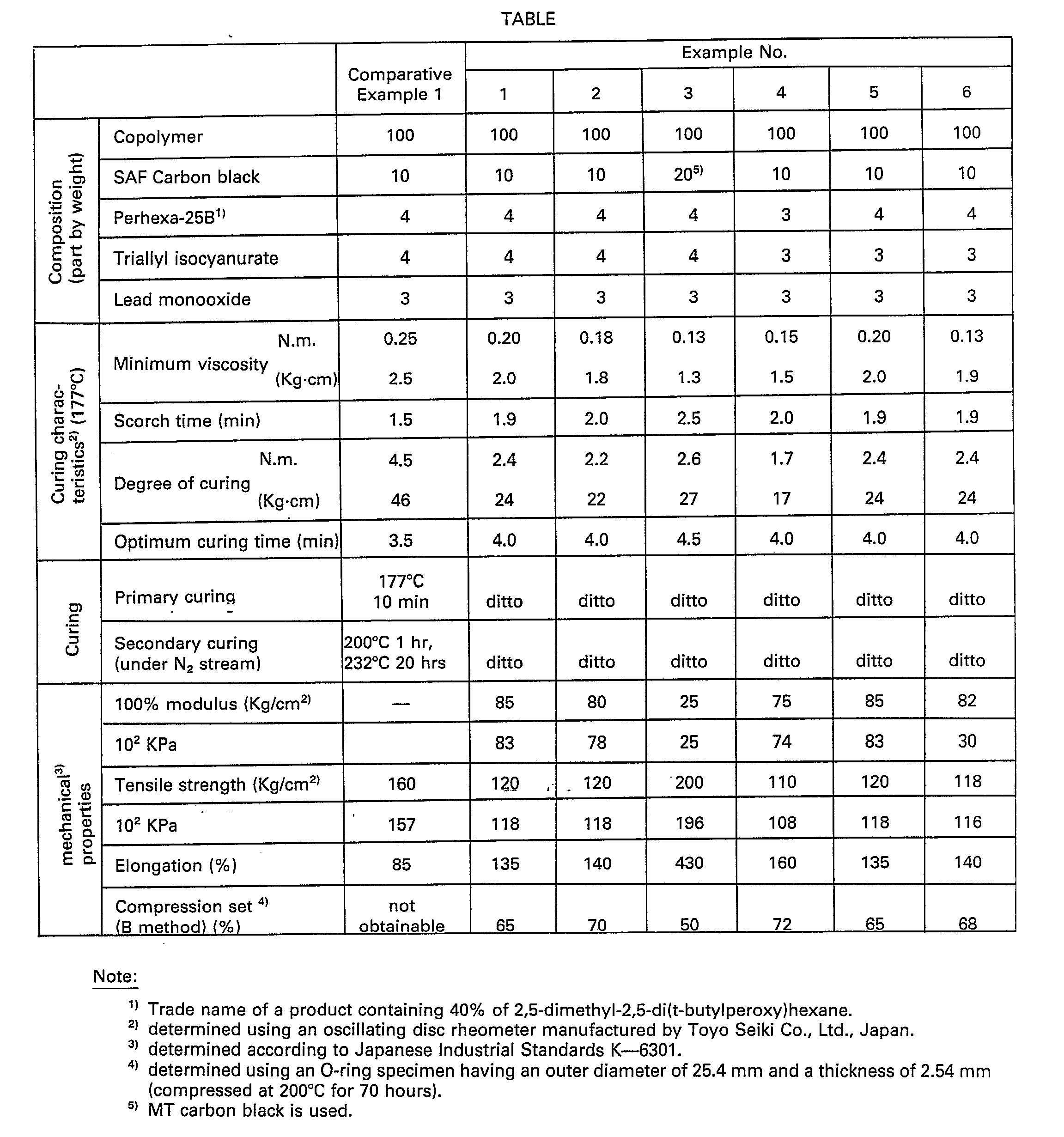
- Each of the copolymers obtained in Examples 1 to 6 and Comparative Example 1 is separately mixed with various additives by means of a rubber roll as indicated in Table below. Then, the obtained compositions are subjected to press curing and, then, to post-curing under the conditions indicated in the same table. With respect to the obtained cured products, the curing characteristics of the products are examined using an oscillating disc rheometer (ODR) and the mechanical properties of the products are examined according to the Japanese Industrial Standards K-6301.
- With respect to the measurement of the compression set, the following method is employed. The composition is shaped into an 0-ring having an outer diameter of 25.4 mm and a thickness of 2.54 mm. The compressive stress is applied to the O-ring-shaped specimen in the direction in parallel with the axis of the O-ring product until the thickness of the O-ring specimen becomes 0.54 mm. The compression is effected at 200°C for 70 hours. Then, the compressive stress is removed and the thickness of the product is measured. The Compresion set (%) is calculated by the following equation:

- (11) is the thickness of the product after the compressive stress is removed).
- The results are shown in Table below.
- The thus obtained elastomers no longer dissolve in a solvent such as 2,3-dichlorooctabutane in which the copolymers before curing can dissolve.
- As is apparent from the curing characteristic determined by the rheometer, an extremely rapid and large increase in torque is observed with respect to the fluorine-containing copolymers of the present invention, suggesting that a crosslinking reaction proceeds readily and sufficiently with respect to the fluorine-containing copolymers of the present invention.
- Further, with respect to the mechanical properties, the cured copolymer obtained by curing the copolymer of Comparative Example 1 which has a sulfonyl chloride group content of 3.53% by weight based on the total weight of the copolymer shows an elongation as small as 85%, and cracking of a sample of the cured copolymer occurs during determination of compression set so that compression set of the cured copolymer cannot be determined. On the other hand, the cured copolymers obtained by curing the copolymers of Examples 1 to 6 have good mechanical properties.
- Substantially the same procedures as in Example 5 are repeated except that perfluoro(2-chlorosulfonylethylallyl ether) (hereinafter referred to as "2-CSAE") is used instead of 2-CSEVE. Thus, there is obtained a white elastic copolymer of TFE-PPVE-2-CSAE. The sulfonyl chloride group content of the obtained copolymer is 0.8% by weight based on the total weight of the copolymer.
- The obtained copolymer can be readily crosslinked as in the cases of Examples 1 to 6, and the resulting cured copolymer shows mechanical properties and curing characteristic similar to those of the cured copolymers obtained by curing the copolymers of Examples 1 to 6.
- Substantially the same procedures as in Example 1 are repeated except that 65 g of 3-CSVE is used instead of 18 g of 3-CSVE. Thus, there is obtained a copolymer ofTFE-PPVE-3-CSVE having a sulfonyl chloride group content of 2.3% by weight based on the total weight of the copolymer.
- The obtained copolymer can be readily crosslinked as in the cases of Examples 1 to 6 and the resulting cured copolymer shows mechanical properties and curing characteristic similar to those of the cured copolymers obtained by curing the copolymers of Examples 1 to 6.
Claims (6)


Priority Applications (1)
| Application Number | Priority Date | Filing Date | Title |
|---|---|---|---|
| DE8686102322T DE3661018D1 (en) | 1986-02-22 | 1986-02-22 | A fluorine-containing crosslinking copolymer |
Applications Claiming Priority (1)
| Application Number | Priority Date | Filing Date | Title |
|---|---|---|---|
| JP59181678A JPH0641494B2 (en) | 1984-08-31 | 1984-08-31 | Crosslinkable fluorine-containing copolymer |
Publications (2)
| Publication Number | Publication Date |
|---|---|
| EP0233969A1 EP0233969A1 (en) | 1987-09-02 |
| EP0233969B1 true EP0233969B1 (en) | 1988-10-26 |
Family
ID=16104955
Family Applications (1)
| Application Number | Title | Priority Date | Filing Date |
|---|---|---|---|
| EP86102322A Expired EP0233969B1 (en) | 1984-08-31 | 1986-02-22 | A fluorine-containing crosslinking copolymer |
Country Status (3)
| Country | Link |
|---|---|
| US (1) | US4734474A (en) |
| EP (1) | EP0233969B1 (en) |
| JP (1) | JPH0641494B2 (en) |
Families Citing this family (13)
| Publication number | Priority date | Publication date | Assignee | Title |
|---|---|---|---|---|
| US5069974A (en) * | 1989-02-06 | 1991-12-03 | Monsanto Company | Metals coated with protective coatings of annealed perfluorinated cation-exchange polymers and method for making same |
| US5463005A (en) * | 1992-01-03 | 1995-10-31 | Gas Research Institute | Copolymers of tetrafluoroethylene and perfluorinated sulfonyl monomers and membranes made therefrom |
| TW505665B (en) * | 1996-08-09 | 2002-10-11 | Du Pont | Process for polymerization of olefinic monomers |
| US7071271B2 (en) * | 2003-10-30 | 2006-07-04 | 3M Innovative Properties Company | Aqueous emulsion polymerization of functionalized fluoromonomers |
| US7259208B2 (en) * | 2003-11-13 | 2007-08-21 | 3M Innovative Properties Company | Reinforced polymer electrolyte membrane |
| US7265162B2 (en) * | 2003-11-13 | 2007-09-04 | 3M Innovative Properties Company | Bromine, chlorine or iodine functional polymer electrolytes crosslinked by e-beam |
| US7074841B2 (en) * | 2003-11-13 | 2006-07-11 | Yandrasits Michael A | Polymer electrolyte membranes crosslinked by nitrile trimerization |
| US7179847B2 (en) * | 2003-11-13 | 2007-02-20 | 3M Innovative Properties Company | Polymer electrolytes crosslinked by e-beam |
| US7060756B2 (en) * | 2003-11-24 | 2006-06-13 | 3M Innovative Properties Company | Polymer electrolyte with aromatic sulfone crosslinking |
| US7112614B2 (en) * | 2003-12-08 | 2006-09-26 | 3M Innovative Properties Company | Crosslinked polymer |
| US7060738B2 (en) * | 2003-12-11 | 2006-06-13 | 3M Innovative Properties Company | Polymer electrolytes crosslinked by ultraviolet radiation |
| US7173067B2 (en) * | 2003-12-17 | 2007-02-06 | 3M Innovative Properties Company | Polymer electrolyte membranes crosslinked by direct fluorination |
| WO2015002008A1 (en) * | 2013-07-03 | 2015-01-08 | 旭硝子株式会社 | Method for producing fluorine-containing polymer |
Family Cites Families (4)
| Publication number | Priority date | Publication date | Assignee | Title |
|---|---|---|---|---|
| US4166014A (en) * | 1973-12-27 | 1979-08-28 | Tokuyama Soda Kabushiki Kaisha | Electrolytic diaphragms, and method of electrolysis using the same |
| US4151053A (en) * | 1975-07-09 | 1979-04-24 | Asahi Kasei Kogyo Kabushiki Kaisha | Cation exchange membrane preparation and use thereof |
| AU541096B2 (en) * | 1980-06-11 | 1984-12-13 | Dow Chemical Company, The | Fluorocarbon vinyl ethers and their polymers |
| US4576752A (en) * | 1982-07-19 | 1986-03-18 | E. I. Du Pont De Nemours And Company | β-Substituted polyfluoroethyl compounds |
-
1984
- 1984-08-31 JP JP59181678A patent/JPH0641494B2/en not_active Expired - Lifetime
-
1986
- 1986-02-21 US US06/831,509 patent/US4734474A/en not_active Expired - Lifetime
- 1986-02-22 EP EP86102322A patent/EP0233969B1/en not_active Expired
Also Published As
| Publication number | Publication date |
|---|---|
| JPS6160712A (en) | 1986-03-28 |
| US4734474A (en) | 1988-03-29 |
| JPH0641494B2 (en) | 1994-06-01 |
| EP0233969A1 (en) | 1987-09-02 |
Similar Documents
| Publication | Publication Date | Title |
|---|---|---|
| EP0407937B1 (en) | Fluoroelastomers with improved processability and process for preparing them | |
| US4564662A (en) | Fluorocarbon elastomer | |
| EP0199138B1 (en) | Novel fluorovinyl ether and copolymer comprising the same | |
| RU2136702C1 (en) | Fluoroelastomer | |
| DE69405859T2 (en) | FLUORINE POLYMERS, THEIR PRODUCTION AND THEIR USE | |
| JP3369215B2 (en) | Vinylidene fluoride based fluoroelastomer with excellent resistance to organic bases | |
| US4734474A (en) | Fluorine-containing sulfonyl polymer | |
| US4946936A (en) | Fluorinated polymers and copolymers containing perfluoropolyethers blocks | |
| EP0092675B1 (en) | Optical materials | |
| JPS6212734A (en) | Novel fluorovinyl ether and copolymer containing same | |
| JPS5871906A (en) | Manufacture of fluorine-containing elastic copolymer | |
| JPH01221443A (en) | Co-support additive for releasing rubber vulcanizable by peroxide from mold | |
| KR100406925B1 (en) | Ethylene copolymers with tetrafluoroethylene and / or chlorotrifluoroethylene having improved mechanical properties at high temperatures | |
| KR101022727B1 (en) | Fluoroelastomer with improved permeability and a method for producing the same | |
| RU97118092A (en) | RING GASKET FROM CURING ON IONIC MECHANISM OF FLUORELASTOMERS | |
| JPH0611773B2 (en) | Method for producing fluorinated elastomer-cured product | |
| JPH04217936A (en) | New fluorovinyl ether | |
| EP0186180B1 (en) | High molecular weight fluoroelastomer | |
| DE69507338T2 (en) | FLUORINE-CONTAINING POLYMERS AND THEIR PRODUCTION | |
| EP0525685B1 (en) | Vinylidene fluoride based fluoroelastomeric copolymers modified with perfluoroalkylvinylether | |
| JP2701080B2 (en) | Method for producing peroxide-curable fluoroelastomer | |
| JPH075810B2 (en) | Composition for cross-linking fluorine-containing elastic copolymer excellent in low temperature property and processability | |
| EP0570762A1 (en) | Fluoroelastomeric and fluoroplastomeric copolymers having a high resistance to bases | |
| KR20070058592A (en) | Fluoropolymer to Prepare Fluoroelastomer | |
| KR900001558B1 (en) | Fluorine - containing sulfonyl polymer |
Legal Events
| Date | Code | Title | Description |
|---|---|---|---|
| PUAI | Public reference made under article 153(3) epc to a published international application that has entered the european phase |
Free format text: ORIGINAL CODE: 0009012 |
|
| 17P | Request for examination filed |
Effective date: 19860222 |
|
| AK | Designated contracting states |
Kind code of ref document: A1 Designated state(s): DE FR GB IT NL |
|
| 17Q | First examination report despatched |
Effective date: 19880323 |
|
| GRAA | (expected) grant |
Free format text: ORIGINAL CODE: 0009210 |
|
| AK | Designated contracting states |
Kind code of ref document: B1 Designated state(s): DE FR GB IT NL |
|
| REF | Corresponds to: |
Ref document number: 3661018 Country of ref document: DE Date of ref document: 19881201 |
|
| ET | Fr: translation filed | ||
| ITF | It: translation for a ep patent filed | ||
| PLBE | No opposition filed within time limit |
Free format text: ORIGINAL CODE: 0009261 |
|
| STAA | Information on the status of an ep patent application or granted ep patent |
Free format text: STATUS: NO OPPOSITION FILED WITHIN TIME LIMIT |
|
| 26N | No opposition filed | ||
| ITTA | It: last paid annual fee | ||
| REG | Reference to a national code |
Ref country code: GB Ref legal event code: 732E |
|
| REG | Reference to a national code |
Ref country code: FR Ref legal event code: TP |
|
| NLS | Nl: assignments of ep-patents |
Owner name: E.I. DUPONT DE NEMOURS & COMPANY |
|
| PGFP | Annual fee paid to national office [announced via postgrant information from national office to epo] |
Ref country code: NL Payment date: 19961213 Year of fee payment: 12 |
|
| PG25 | Lapsed in a contracting state [announced via postgrant information from national office to epo] |
Ref country code: NL Free format text: LAPSE BECAUSE OF NON-PAYMENT OF DUE FEES Effective date: 19980901 |
|
| NLV4 | Nl: lapsed or anulled due to non-payment of the annual fee |
Effective date: 19980901 |
|
| PGFP | Annual fee paid to national office [announced via postgrant information from national office to epo] |
Ref country code: DE Payment date: 20010212 Year of fee payment: 16 |
|
| PGFP | Annual fee paid to national office [announced via postgrant information from national office to epo] |
Ref country code: FR Payment date: 20010213 Year of fee payment: 16 |
|
| PGFP | Annual fee paid to national office [announced via postgrant information from national office to epo] |
Ref country code: GB Payment date: 20010221 Year of fee payment: 16 |
|
| REG | Reference to a national code |
Ref country code: GB Ref legal event code: IF02 |
|
| PG25 | Lapsed in a contracting state [announced via postgrant information from national office to epo] |
Ref country code: GB Free format text: LAPSE BECAUSE OF NON-PAYMENT OF DUE FEES Effective date: 20020222 |
|
| PG25 | Lapsed in a contracting state [announced via postgrant information from national office to epo] |
Ref country code: DE Free format text: LAPSE BECAUSE OF NON-PAYMENT OF DUE FEES Effective date: 20020903 |
|
| GBPC | Gb: european patent ceased through non-payment of renewal fee |
Effective date: 20020222 |
|
| PG25 | Lapsed in a contracting state [announced via postgrant information from national office to epo] |
Ref country code: FR Free format text: LAPSE BECAUSE OF NON-PAYMENT OF DUE FEES Effective date: 20021031 |
|
| REG | Reference to a national code |
Ref country code: FR Ref legal event code: ST |
|
| PG25 | Lapsed in a contracting state [announced via postgrant information from national office to epo] |
Ref country code: IT Free format text: LAPSE BECAUSE OF NON-PAYMENT OF DUE FEES;WARNING: LAPSES OF ITALIAN PATENTS WITH EFFECTIVE DATE BEFORE 2007 MAY HAVE OCCURRED AT ANY TIME BEFORE 2007. THE CORRECT EFFECTIVE DATE MAY BE DIFFERENT FROM THE ONE RECORDED. Effective date: 20050222 |