EP0232152A2 - Elektromagnetischer Schwingungserzeuger - Google Patents
Elektromagnetischer Schwingungserzeuger Download PDFInfo
- Publication number
- EP0232152A2 EP0232152A2 EP87300872A EP87300872A EP0232152A2 EP 0232152 A2 EP0232152 A2 EP 0232152A2 EP 87300872 A EP87300872 A EP 87300872A EP 87300872 A EP87300872 A EP 87300872A EP 0232152 A2 EP0232152 A2 EP 0232152A2
- Authority
- EP
- European Patent Office
- Prior art keywords
- vibrator
- stator
- vibratory
- coils
- air gap
- Prior art date
- Legal status (The legal status is an assumption and is not a legal conclusion. Google has not performed a legal analysis and makes no representation as to the accuracy of the status listed.)
- Withdrawn
Links
Images

Classifications
-
- H—ELECTRICITY
- H02—GENERATION; CONVERSION OR DISTRIBUTION OF ELECTRIC POWER
- H02K—DYNAMO-ELECTRIC MACHINES
- H02K33/00—Motors with reciprocating, oscillating or vibrating magnet, armature or coil system
- H02K33/18—Motors with reciprocating, oscillating or vibrating magnet, armature or coil system with coil systems moving upon intermittent or reversed energisation thereof by interaction with a fixed field system, e.g. permanent magnets
Definitions
- This invention relates to electromagnetic vibrators and one object is to provide a simple and compact construction which can give good performance and reproduce accurately vibration command waveforms.
- GB-B-1202526 discloses a vibrator in which a stator defines an air gap with a radial magnetic field extending across it and a vibratory element is mounted in the air gap to be free to vibrate parallel with the axis of the air gap.
- the vibratory element is in the form of an A.C. excited coil with turns extending around the air gap.
- the vibratory element is in the form of a ring or sleeve of electrically-conducting material, and A.C. coils are mounted on the stator at the air gap for generating circumferential alternating currents in the vibratory element.
- the arrangement has the advantage that exciting current does not have to be applied to the vibratory element and electrical connetions only have to be made to static components.
- annular air gap While there may be a single annular air gap at one end it is preferred that there are two annular air gaps spaced apart along the axis of vibration, each with its electrically conducting vibratory ring. Then the rings will be interconnected or may, indeed, be separate parts of a continuous cylindrical or like ring.
- the A.C. coils when energised with alternating current, can induce circumferential alternating current in the vibratory ring which then cooperates with the radial D.C. field to impart vibratory movement to the ring at the alternating frequency.
- the stator is generally annular with a cross section in the form of a C having upper and lower limbs defining two air gaps and an intermediate portion having either a channel for a D.C. magnetising coil or an annular permanent magnet for magnetising the stator.
- the A.C. coils which are mounted on the stator can be on the annular part of the stator defining the outside of the or each air gap or can be on the external surface of the core defining the inner surface of the air gap, but preferably there is an A.C. coil on each surface, and thus on each side of the annular gap in which the ring is to vibrate.
- Each A.C. coil is conveniently mounted on a sleeve or the like of a material, that is both non-conducting and non-magnetic, or a ferrite, or possibly an inert material insulator, or a composite multilayer construction with interruptions which provide a path for A.C. flux which does not pass through the stator iron.
- bearings - preferably axial hydrostatic bearings - for the vibratory ring are fixed components holding an annular part of the stator in relation to a centre core of the stator and those components can then have bearings - preferably axial hydrostatic bearings - for the vibratory ring.
- Such bearings give substantial freedom to move in the direction of the vibratory axis, but are very stiff in directions perpendicular to that axis.
- a vibratory table can be mounted from the bearings on the other side of the mounting element from the magnetic stator and ring.
- the vibrator comprises a vibrating table 11 arranged to vibrate in the vertical direction in the figure in a stator 12.
- the stator comprises a core 13 of carbon steel or other magnetic material positioned within an annular housing 14 also of carbon steel or similar material with a cross section as shown in the figure which is generally in the form of a C.
- the housing 14 defines with the upper and lower ends of the core 13 in the Figure a pair of annular air gaps 15 and 16 respectively opposite the inner ends of the horizontal limbs of the C-section; the gaps are axially aligned so that they are effectively axially separated parts of a thin cylindrical space extending arounmd the axis of the vibrator between the core and the housing 14.
- the housing may be formed in various ways.
- One possiblity is to machine out a slot or channel midway along the length of the internal cylindrical surface of a steel tube to form the C-section.
- Another possibility is to provide three separate annular rings with the same outside diameter, one of which is radially thinner than the others by the depth of the channel. They can be assembled together by welding or bolting to form the C-section.
- Another possibility is to cast the housing 14. In that case it will probably be cast in two identical halves which can then be united by bolting along the plane perpendicular to the axis of the vibrator core 13 and midway along its height.
- D.C. exciting coils 17 are positioned in the D.C. slot or channel 20 and they may be divided into a number of separately wound coils either annularly one within another or axially side by side, or both. They are energised in parallel in series from a D.C. source to magnetise the stator so that flux flows one way along the core 13, radially outwards across one of the gaps, through the C-section annular housing 14, and radially inwards through the other gap to the other end of the core 13.
- A.C. coils are provided on the stator top and bottom on the inside and the outside of each of the air gaps.
- A.C. coils there are four A.C. coils, namely an upper inner coil 18, an upper outer coil 19, a lower inner coil 21, and a lower outer coil 22.
- the outer coils are mounted on the faces of the stator ring 14 facing the gaps 15 and 16 and the inner coils may be mounted in rebates in the top and bottom of the core 13.
- Each of the coils may be covered by a non-ferrous protective covering 23 which may be of a non-ferrous metal or of an insulating material.
- the A.C. coils are energised in series/parallel or series from an A.C. supply, and the effect is to produce two local axially-spaced toroidal alternating magnetic fields, one around each of the upper and lower air gaps 15 and 16.
- a cylindrical sleeve 24 of, for example, aluminium alloy or similar material is positioned in each air gap and mounted in a manner to be described below to be capable of vibrating vertically with substantially no restraint, but not to be capable of free movement transversely of the vibration axis, that is in the horizontal direction of the figure.
- the sleeves are interconnected as shown at 30 to vibrate as one.
- the local A.C. fields around the gaps induce eddy currents locally in the sleeves which extend circumferentially and so are at right angles to the D.C. field extending radially across the gap.
- the interaction of the eddy currents with the D.C. flux produces the vibratory movement vertically in the figure at the same frequency as that of the A.C. supply and with a force proportional to the product of the D.C. field and the eddy current intensity.
- each of the mounting plates 25 has a circumferential ring of e.g. four axial bores 26, each arranged to act as the outer ring of a hydrostatic bearing by being provided at the central nozzle - one of which is indicated diagrammatically at 27 - with high pressure hydraulic fluid.
- the vibratory sleeves 24 are secured at their outer annular edges to four cylindrical posts 28 circumferentially spaced to correspond with the bores 26, and each constituting the inner member of one of the hydrostatic bearings.
- the vibratory table 11 is mounted at the upper end of four upper posts 28.
- the lower ends of the lower posts 28 could be interconnected by an annular ring to give stability, but in some applications that will not be necessary.
- the lower end of the lower mounting plate 25 is closed by a closure 29.
- An air filled bellows 31 positioned between the upper mounting plate 25 and the table 11 can define a reference position for the table midway between the extreme positions in the absence of any A.C. energisation of the A.C. coils. Thus, when those coils are energised vibration will start from that central reference position.
- the size of the vibrator can be reduced by providing forced hydraulic cooling of either the D.C. coils, or the A.C. coils, or both, and in any design it is a question of deciding whether the reduction of the size merits the increased cost of the cooling system.
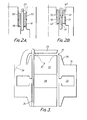
- FIG 2 shows one way of mounting the A.C. coils 18 and 19. It is believed to be undesirable, particularly when operation is at high frequencies up to about 5 kHz, for the A.C. flux to flow through solid magnetic iron, and accordingly, each of the coils 18 and 19 is mounted on a component 32 providing a path for the higher frequency A.C. flux as indicated generally by the line 33 in Figure 2A. At low frequencies, the flux would penetrate the iron so that the A.C. flux path would be as shown in Figure 1 at 33 even where the components 32 are provided for higher frequency operation.
- Figure 2B shows how some A.C. flux also occurs as shown at 40.
- the component 32 may be just a cylindrical layer of inert material on the inner annular face of the stator pole and in the case of the inner winding 18 the element may be of angled section sitting in a rebate cut in the end of the core 13.
- the material of the components 32 could be an insulator or a ferrite material or a non-magnetic conductor or an interrupted multilayer composite, for example. Different arrangements are possible, but in general it is believed that the advantage of providing a flux path for the A.C. flux in this manner more than offsets the disadvantage of having to increase the width of the air gap. It will be noted from Figure 2 that it is generally preferred that the components 32 extend axially a little beyond each end of the coils mounted on them.
- Figure 3 is a very simplified diagrammatic view intended mainly to show just the magnetic circuit.
- annular housing 14 is smaller than shown in Figure 1, but is formed with extended pole pieces 34 defining the air gaps 15 with the ends of the core 13.
- the stator housing will preferably be a casting and probably a casting made in two identical halves secured together to leave the D.C. channel 20 for the D.C. coil 17.
- Figure 3 which is diagrammatic, shows the shape of the components as having angles, but in practice the angles are likely to be rounded off as shown at 36 to save metal and weight at places where the flux density will be low.
- the flux density will be low at the centres of the ends of the core 13 and accordingly they may be indented or otherwise shaped generally as indicated at 37 to save unnecessary steel.
- the arrangement shown means that the flux density in the core 13 will be at a maximum in the middle section 38 of the core and accordingly that may be made of a material having a very high saturation flux density so that it will not go into saturation at the intensities experienced in practice. Such materials tend to be expensive and so are unlikely to be used throughout the length of the core where the flux density will be less.
- the building up of the core in different layers with materials of different saturation flux densities may be considered to be a feature of the invention, as can the shaping of the ends of the core to suit the flux pattern.
- the extended poles are very closely spaced axially and by an amount comparable with the vibration stroke. Accordingly, the sleeve 24 will probably be a continuous length of, for example, aluminium alloy or similar tube of constant or varying cross-section instead of consisting of two axially separated sleeves with an appropriate interconnection 30 as in the embodiment of Figure 1.
- end plates 25 for locating the core 13 centrally within the stator housing 14 and for providing bearings for the sleeve 24, but that is only shown diagrammatically in Figure 3.
- One embodiment of the vibrator shown in Figure 3 has a core diameter of about 20 cm.
Landscapes
- Engineering & Computer Science (AREA)
- Power Engineering (AREA)
- Apparatuses For Generation Of Mechanical Vibrations (AREA)
- Reciprocating, Oscillating Or Vibrating Motors (AREA)
- Magnetic Bearings And Hydrostatic Bearings (AREA)
Applications Claiming Priority (2)
| Application Number | Priority Date | Filing Date | Title |
|---|---|---|---|
| GB08602408A GB2186121A (en) | 1986-01-31 | 1986-01-31 | Electromagnetic vibrator |
| GB8602408 | 1986-01-31 |
Publications (2)
| Publication Number | Publication Date |
|---|---|
| EP0232152A2 true EP0232152A2 (de) | 1987-08-12 |
| EP0232152A3 EP0232152A3 (de) | 1988-07-06 |
Family
ID=10592300
Family Applications (1)
| Application Number | Title | Priority Date | Filing Date |
|---|---|---|---|
| EP87300872A Withdrawn EP0232152A3 (de) | 1986-01-31 | 1987-01-30 | Elektromagnetischer Schwingungserzeuger |
Country Status (2)
| Country | Link |
|---|---|
| EP (1) | EP0232152A3 (de) |
| GB (1) | GB2186121A (de) |
Cited By (2)
| Publication number | Priority date | Publication date | Assignee | Title |
|---|---|---|---|---|
| EP0234953A3 (de) * | 1986-02-28 | 1988-07-13 | Derritron Group Limited | Elektromagnetischer Schwinger |
| GB2385470A (en) * | 2002-02-11 | 2003-08-20 | Ling Dynamic Systems | Vibrator - bearing and coil layout |
Family Cites Families (3)
| Publication number | Priority date | Publication date | Assignee | Title |
|---|---|---|---|---|
| US2026994A (en) * | 1929-05-15 | 1936-01-07 | Messick Charles | Armature for magnetic movements |
| US2820161A (en) * | 1954-06-01 | 1958-01-14 | Calidyne Company | Electromagnetic vibration generator |
| GB1202526A (en) * | 1966-09-29 | 1970-08-19 | Derritron Electronic Vibrators | Improvements relating to electro magnetic vibrators |
-
1986
- 1986-01-31 GB GB08602408A patent/GB2186121A/en not_active Withdrawn
-
1987
- 1987-01-30 EP EP87300872A patent/EP0232152A3/de not_active Withdrawn
Cited By (2)
| Publication number | Priority date | Publication date | Assignee | Title |
|---|---|---|---|---|
| EP0234953A3 (de) * | 1986-02-28 | 1988-07-13 | Derritron Group Limited | Elektromagnetischer Schwinger |
| GB2385470A (en) * | 2002-02-11 | 2003-08-20 | Ling Dynamic Systems | Vibrator - bearing and coil layout |
Also Published As
| Publication number | Publication date |
|---|---|
| GB2186121A (en) | 1987-08-05 |
| GB8602408D0 (en) | 1986-03-05 |
| EP0232152A3 (de) | 1988-07-06 |
Similar Documents
| Publication | Publication Date | Title |
|---|---|---|
| US5719451A (en) | Linear magnetic actuator | |
| CA2151048C (en) | Linear electrodynamic machine and method of making and using same | |
| US4937481A (en) | Permanent magnet linear electromagnetic machine | |
| US3891874A (en) | Compensated reciprocating electrodynamic machine | |
| US20070108850A1 (en) | Linear electrical machine for electric power generation or motive drive | |
| WO1994015392A9 (en) | Linear electrodynamic machine and method of using same | |
| US6013959A (en) | Lamination structure for an electromagnetic device | |
| WO2002095905A2 (en) | Auto-centering linear motor | |
| US2026994A (en) | Armature for magnetic movements | |
| WO1999016161A9 (en) | Synchronous reciprocating electric machines | |
| GB2186121A (en) | Electromagnetic vibrator | |
| EP0667990B1 (de) | Magnetanordnung,und dieselbe aufweisende Antriebsvorrichtung und Kühlungseinrichtung | |
| JP2016025818A (ja) | 発電機 | |
| GB2358967A (en) | Tapered pole pieces for a linear electromagnetic machine | |
| US4121124A (en) | Electrodynamic force generator | |
| EP0200313B1 (de) | Kraftloser berührungsfreier Leistungstransformator | |
| US6255754B1 (en) | Flux damper for permanent magnet electric motors | |
| EP0234953A2 (de) | Elektromagnetischer Schwinger | |
| US3444405A (en) | Permanent magnet generator | |
| RU96116744A (ru) | Электрическая машина переменного тока | |
| GB1151192A (en) | Electrodynamic Exciter | |
| KR100360255B1 (ko) | 리니어 모터의 손실 저감구조 | |
| JPH0312365Y2 (de) | ||
| SU803999A1 (ru) | Электродинамический возбудительКОлЕбАНий | |
| SU1599076A1 (ru) | Вибросмеситель |
Legal Events
| Date | Code | Title | Description |
|---|---|---|---|
| PUAI | Public reference made under article 153(3) epc to a published international application that has entered the european phase |
Free format text: ORIGINAL CODE: 0009012 |
|
| AK | Designated contracting states |
Kind code of ref document: A2 Designated state(s): AT DE ES FR GB IT NL SE |
|
| PUAL | Search report despatched |
Free format text: ORIGINAL CODE: 0009013 |
|
| AK | Designated contracting states |
Kind code of ref document: A3 Designated state(s): AT DE ES FR GB IT NL SE |
|
| STAA | Information on the status of an ep patent application or granted ep patent |
Free format text: STATUS: THE APPLICATION IS DEEMED TO BE WITHDRAWN |
|
| 18D | Application deemed to be withdrawn |
Effective date: 19890107 |
|
| RIN1 | Information on inventor provided before grant (corrected) |
Inventor name: BOLTON, HUGH ROBERT Inventor name: D'SILVA, JOHN ROBERT |