EP0231505B1 - Antimicrobial agent - Google Patents
Antimicrobial agent Download PDFInfo
- Publication number
- EP0231505B1 EP0231505B1 EP86117848A EP86117848A EP0231505B1 EP 0231505 B1 EP0231505 B1 EP 0231505B1 EP 86117848 A EP86117848 A EP 86117848A EP 86117848 A EP86117848 A EP 86117848A EP 0231505 B1 EP0231505 B1 EP 0231505B1
- Authority
- EP
- European Patent Office
- Prior art keywords
- isothiazolone
- antimicrobial composition
- methyl
- compound complex
- chloro
- Prior art date
- Legal status (The legal status is an assumption and is not a legal conclusion. Google has not performed a legal analysis and makes no representation as to the accuracy of the status listed.)
- Expired
Links
Classifications
-
- D—TEXTILES; PAPER
- D21—PAPER-MAKING; PRODUCTION OF CELLULOSE
- D21H—PULP COMPOSITIONS; PREPARATION THEREOF NOT COVERED BY SUBCLASSES D21C OR D21D; IMPREGNATING OR COATING OF PAPER; TREATMENT OF FINISHED PAPER NOT COVERED BY CLASS B31 OR SUBCLASS D21G; PAPER NOT OTHERWISE PROVIDED FOR
- D21H21/00—Non-fibrous material added to the pulp, characterised by its function, form or properties; Paper-impregnating or coating material, characterised by its function, form or properties
- D21H21/14—Non-fibrous material added to the pulp, characterised by its function, form or properties; Paper-impregnating or coating material, characterised by its function, form or properties characterised by function or properties in or on the paper
- D21H21/36—Biocidal agents, e.g. fungicidal, bactericidal, insecticidal agents
-
- A—HUMAN NECESSITIES
- A01—AGRICULTURE; FORESTRY; ANIMAL HUSBANDRY; HUNTING; TRAPPING; FISHING
- A01N—PRESERVATION OF BODIES OF HUMANS OR ANIMALS OR PLANTS OR PARTS THEREOF; BIOCIDES, e.g. AS DISINFECTANTS, AS PESTICIDES OR AS HERBICIDES; PEST REPELLANTS OR ATTRACTANTS; PLANT GROWTH REGULATORS
- A01N43/00—Biocides, pest repellants or attractants, or plant growth regulators containing heterocyclic compounds
- A01N43/72—Biocides, pest repellants or attractants, or plant growth regulators containing heterocyclic compounds having rings with nitrogen atoms and oxygen or sulfur atoms as ring hetero atoms
- A01N43/80—Biocides, pest repellants or attractants, or plant growth regulators containing heterocyclic compounds having rings with nitrogen atoms and oxygen or sulfur atoms as ring hetero atoms five-membered rings with one nitrogen atom and either one oxygen atom or one sulfur atom in positions 1,2
-
- C—CHEMISTRY; METALLURGY
- C02—TREATMENT OF WATER, WASTE WATER, SEWAGE, OR SLUDGE
- C02F—TREATMENT OF WATER, WASTE WATER, SEWAGE, OR SLUDGE
- C02F1/00—Treatment of water, waste water, or sewage
- C02F1/50—Treatment of water, waste water, or sewage by addition or application of a germicide or by oligodynamic treatment
-
- D—TEXTILES; PAPER
- D21—PAPER-MAKING; PRODUCTION OF CELLULOSE
- D21C—PRODUCTION OF CELLULOSE BY REMOVING NON-CELLULOSE SUBSTANCES FROM CELLULOSE-CONTAINING MATERIALS; REGENERATION OF PULPING LIQUORS; APPARATUS THEREFOR
- D21C9/00—After-treatment of cellulose pulp, e.g. of wood pulp, or cotton linters ; Treatment of dilute or dewatered pulp or process improvement taking place after obtaining the raw cellulosic material and not provided for elsewhere
- D21C9/008—Prevention of corrosion or formation of deposits on pulp-treating equipment
-
- D—TEXTILES; PAPER
- D21—PAPER-MAKING; PRODUCTION OF CELLULOSE
- D21H—PULP COMPOSITIONS; PREPARATION THEREOF NOT COVERED BY SUBCLASSES D21C OR D21D; IMPREGNATING OR COATING OF PAPER; TREATMENT OF FINISHED PAPER NOT COVERED BY CLASS B31 OR SUBCLASS D21G; PAPER NOT OTHERWISE PROVIDED FOR
- D21H17/00—Non-fibrous material added to the pulp, characterised by its constitution; Paper-impregnating material characterised by its constitution
- D21H17/20—Macromolecular organic compounds
- D21H17/21—Macromolecular organic compounds of natural origin; Derivatives thereof
- D21H17/24—Polysaccharides
- D21H17/28—Starch
Definitions
- This invention relates to a novel antimicrobial composition which contains an isothiazolone complex or isothiazolone derivative complex of general formula (I) and 3,3,4,4-tetrachlorotetrahydrothiophene I,I-dioxide (hereinafter sometimes referred to as "compound (II)”) and in which synergism between both the active ingredients is made the best of.
- This antimicrobial composition is suited particularly for use in industrial water systems in pulp and paper manufacture.
- microorganisms can grow and proliferate to thereby affect the cooling power and/or emulsifiability of the cutting oils adversely or cause phenomena unfavorable from the public health viewpoint through bad odor emission and/or impairment of the working environment. Troubles caused by the growth of harmful microorganisms are also encountered in industrial products such as water-based paints, sizing liquids for paper, polymer latices, pulp for papermaking, pastes, leathers, and metal cutting oils.
- Those agents which have been so far in use for the inhibition or prevention of growth of harmful microorganisms in the above-mentioned water systems or in the above-mentioned industrial products include, among others, organometallic compounds, organochlorine compounds, organosulfur compounds and quaternary ammonium compounds. These compounds, however, are toxic to humans, have unpleasant or offensive odor and, furthermore, may cause unfavorable phenomena such as foaming. In addition, water systems containing these agents, when discharged into ordinary rivers or watercourses or into the sea, may adversely affect aquatic animals and thus pose problems from the environmental protection viewpoint.
- this invention provides an antimicrobial composition specified below:
- An antimicrobial composition which contains, as combined active ingredients, an isothiazolone complex and or isothiazolone derivative complex of the general formula wherein R i is a hydrogen atom or a substituted or unsubstituted monovalent hydrocarbyl group, R 2 and R 3 are each independently a hydrogen atom or a halogen atom, M is a metal or ammonium cation, X is a complex-forming anion, a is I or 2 and b is an integer which is such that the anion X satisfies the valence of the cation M, and 3,3,4,4-tetrachlorotetrahydrothiophene I,I-dioxide.
- complexes of general formula (I) are the complexes described in United States Patent No. 4150026 whereas the compound (II) is also a bactericide described in United States Patent No. 2,957,887.
- the complexes of general formula (I) and the compound (II) can be produced in a manner analogous to the known method.
- bactericides separately are still unsatisfactory as antimicrobial agents, for example in that they are effective against only limited kinds of microorganism, hence they produce insufficient bactericidal effect, and that they fail to retain their effect for a prolonged period of time.
- the antimicrobial composition according to the invention can produce a very high antimicrobial effect which could have never been expected from the experience with each individual constituent active ingredient. Furthermore, it has a broad range of applications against harmful microorganisms, namely filamentous bacteria, other bacteria, yeasts, fungi, and so forth, irrespective of species thereof.
- metal cations represented by M and complex-forming anions represented by X include respectively the corresponding metal cations and anions described in the above-mentioned U.S.P. No. 4150026, namely metal cations such as barium, cadmium, calcium, chromium, cobalt, copper, iron, lead, lithium, manganese, merculy, nickel, sodium, silver stronium, tin, zinc or the like and anions such as chloride, bromide, iodide, sulfate, nitrate, acetate, perchlorate, bisulfate, bicarbonate, oxalate, maleate, p-toluene-sulfonate, carbonate, phosphate, and the like.
- M there are mentioned catio s of metals of valence of 2.
- Ri is a Ci- io alkyl group
- R2 and R3 are each independently a hydrogen atom or a halogen atom and M is zinc, calcium, copper or magnesium
- X is a mineral acid anion such as chloride, bromide, nitrate or sulfate.
- Such compounds of general formula (I) may be used either singly or in admixture of two or more of them.
- the compound of general formula (1) and the compound (II) are used generally in a weight ratio of via to 10/I, preferably I/5 to 5/I.
- the antimicrobial composition according to the invention is prepared by admixing the above-mentioned two ingredients to a homogeneous composition.
- the composition is submitted to use in the form of a solution in solvents or an emulsion or dispersion, for instance.
- alcohol type solvents e.g. methyl alcohol, ethyl alcohol, ethylene glycol, diethylene glycol
- ketone type solvents e.g. acetone, methylethyl ketone
- ether type solvents e.g. dioxane, tetrahydrofuran
- hydrocarbon type solvents e.g. benzene, toluene
- the antimicrobial composition according to the present invention may also be used in a carrier-borne form.
- the liquid carriers include, for example, the above-mentioned alcohols, ketones and hydrocarbons.
- the solid carrier for example, there may be mentioned clays (e.g. Kaolin, bentnite), talcs and silicas (e.g. diatomaceous soil).
- the solvents and carriers may be conventional.
- the dose of the antimicrobial composition may vary depending on the concentration of the microorganisms, the composition is used generally in a dose of 0.01 to 100 ppm based on the amount of the composition in the case of water systems in the field of paper and pulp industry and the like, and I to 500 ppm based on the amount of the composition in the fields of water-based paints, pastes, leathers and the like.
- the antimicrobial composition according to the invention may justifiably contain conventional additives or auxiliaries, such as stabilizers (e.g. magnesium nitrate, magnesium chloride, calcium chloride, sodium alginate) and surfactants (e.g. alkyl sulfates, polyethyleneglycol alkyl ethers,), so long as they do not lead to failure to achieve the objects of the invention. While the amount of such additives and auxiliaries to be incorporated may vary depending on the amount of active ingredients (I) and (II) to be used, the additives and auxiliaries are preferably incorporated in a 0.5 to 10 weight percent based on the composition.
- stabilizers e.g. magnesium nitrate, magnesium chloride, calcium chloride, sodium alginate
- surfactants e.g. alkyl sulfates, polyethyleneglycol alkyl ethers,
- Antimicrobial compositions were prepared according to the following formulations.
- “part(s)” invariably means “part(s)” by weight”.
- An antimicrobial composition was prepared from the ingredients given below in the same manner as in Example I.
- An antimicrobial composition was prepared from the ingredients given below in the same manner as in Example I.
- An antimicrobial composition was prepared from the ingredients given below in the same manner as in Example I. 3:1 (by weight) Mixture of 5-chloro-2-methyl-3-isothiazolone-magnesium (II) nitrate and 2-methyl-3-isothiazolone-magnesium (II) nitrate 20 parts Diethylene glycol 80 parts
- An antimicrobial composition was prepared from the ingredients given below in the same manner as in Example I.
- the antimicrobial compositions prepared in the above Examples I to 2 and comparative Examples I to 3 were separately added to a white water pit three times a day, each time for 2 hours, to a concentration in water of 20 ppm based on the amount of the composition. After 7 days of such addition, the number of the microorganisms in white water was counted.
- a white water sample taken was diluted with sterile water, a known amount of the dilution was placed in a dish, a Waksman agar medium solution was poured into the dish, and the mixture was homogenized and then allowed to solidify in a plate form. After 2 days of cultivation in an incubator (32 ° C), the microbial colonies formed were counted using a colony counter. The frequency of paper breakage during papermaking process was also recorded for further confirmation of the bactericidal effect. The results of these tests are shown below in Table I.
Landscapes
- Life Sciences & Earth Sciences (AREA)
- Engineering & Computer Science (AREA)
- Pest Control & Pesticides (AREA)
- Wood Science & Technology (AREA)
- Health & Medical Sciences (AREA)
- Plant Pathology (AREA)
- Dentistry (AREA)
- General Health & Medical Sciences (AREA)
- Agronomy & Crop Science (AREA)
- Zoology (AREA)
- Environmental Sciences (AREA)
- Hydrology & Water Resources (AREA)
- Environmental & Geological Engineering (AREA)
- Water Supply & Treatment (AREA)
- Chemical & Material Sciences (AREA)
- Organic Chemistry (AREA)
- Agricultural Chemicals And Associated Chemicals (AREA)
Description
- This invention relates to a novel antimicrobial composition which contains an isothiazolone complex or isothiazolone derivative complex of general formula (I) and 3,3,4,4-tetrachlorotetrahydrothiophene I,I-dioxide (hereinafter sometimes referred to as "compound (II)") and in which synergism between both the active ingredients is made the best of. This antimicrobial composition is suited particularly for use in industrial water systems in pulp and paper manufacture.
- In wastewater from the papermaking process in the field of paper and pulp industry and in various water systems in various fields of industry, such as in circulating cooling water, and further in water-based paints, sizing liquids for paper, latices, printing pastes, leathers and like products manufactured by using industrial water, harmful microorganisms can grow with ease to cause decrease in productivity and/or quality of products. In water systems in the paper and pulp industry, in particular, the growth and proliferation of bacteria, filamentous microorganisms and yeasts lead to the formation of slime. In watercourses in which the pulp slurry flows, in particular at places having a rough wall surface which comes into contact with the slurry and at places where the pulp slurry decreases in flow rate and becomes stagnant, for example in the chest, flow box and transportation pipe, slime formation and adherence take place. This slime often detaches and causes paper breakage and/or contamination of paper and pulp products. The growth of microorganisms in slime also causes various other troubles.
- Where the papermaking machines are high-speed ones, these troubles present very serious problems, provoking marked decrease in productivity and significant economic losses.
- Also in circulating cooling water systems for metal cutting oils, microorganisms can grow and proliferate to thereby affect the cooling power and/or emulsifiability of the cutting oils adversely or cause phenomena unfavorable from the public health viewpoint through bad odor emission and/or impairment of the working environment. Troubles caused by the growth of harmful microorganisms are also encountered in industrial products such as water-based paints, sizing liquids for paper, polymer latices, pulp for papermaking, pastes, leathers, and metal cutting oils.
- Those agents which have been so far in use for the inhibition or prevention of growth of harmful microorganisms in the above-mentioned water systems or in the above-mentioned industrial products include, among others, organometallic compounds, organochlorine compounds, organosulfur compounds and quaternary ammonium compounds. These compounds, however, are toxic to humans, have unpleasant or offensive odor and, furthermore, may cause unfavorable phenomena such as foaming. In addition, water systems containing these agents, when discharged into ordinary rivers or watercourses or into the sea, may adversely affect aquatic animals and thus pose problems from the environmental protection viewpoint.
- The present inventors conducted intensive investigations in an attempt to eliminate the above-mentioned drawbacks and, as a result, have now completed the present invention.
- Thus, this invention provides an antimicrobial composition specified below:
- An antimicrobial composition which contains, as combined active ingredients, an isothiazolone complex and or isothiazolone derivative complex of the general formula
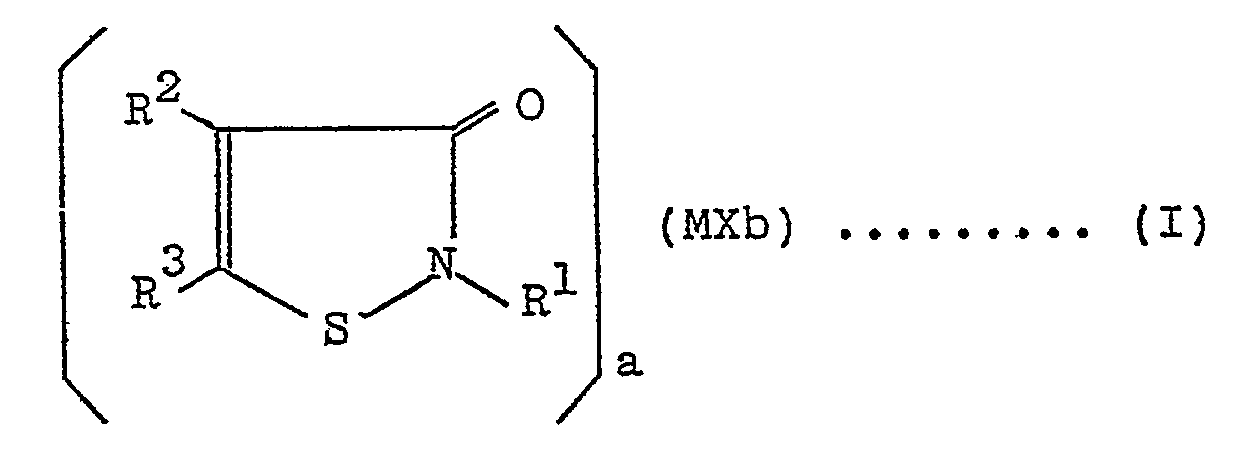
- Some of the complexes of general formula (I) are the complexes described in United States Patent No. 4150026 whereas the compound (II) is also a bactericide described in United States Patent No. 2,957,887. The complexes of general formula (I) and the compound (II) can be produced in a manner analogous to the known method.
- These bactericides separately are still unsatisfactory as antimicrobial agents, for example in that they are effective against only limited kinds of microorganism, hence they produce insufficient bactericidal effect, and that they fail to retain their effect for a prolonged period of time.
- The antimicrobial composition according to the invention can produce a very high antimicrobial effect which could have never been expected from the experience with each individual constituent active ingredient. Furthermore, it has a broad range of applications against harmful microorganisms, namely filamentous bacteria, other bacteria, yeasts, fungi, and so forth, irrespective of species thereof.
- As for the complexes of the general formula (I), metal cations represented by M and complex-forming anions represented by X include respectively the corresponding metal cations and anions described in the above-mentioned U.S.P. No. 4150026, namely metal cations such as barium, cadmium, calcium, chromium, cobalt, copper, iron, lead, lithium, manganese, merculy, nickel, sodium, silver stronium, tin, zinc or the like and anions such as chloride, bromide, iodide, sulfate, nitrate, acetate, perchlorate, bisulfate, bicarbonate, oxalate, maleate, p-toluene-sulfonate, carbonate, phosphate, and the like. As more preferred examples of M, there are mentioned catio s of metals of valence of 2.
- As the complex of general formula (I) which is to be used in accordance with the invention, there may be included, for example, compounds wherein Ri is a Ci-io alkyl group, R2 and R3 are each independently a hydrogen atom or a halogen atom and M is zinc, calcium, copper or magnesium, and X is a mineral acid anion such as chloride, bromide, nitrate or sulfate. Preferably, there may be mentioned, for example, 5-chloro-2-methyl-3-isothiazolone-magnesium nitrate, 2-methyl-3-isothiazolone-magnesium nitrate, and 2-octyl-5-chloro-3-isothiazolone-calcium chloride and 2-octyl-4-chloro-3-isothiazolone-calcium chloride.
- Such compounds of general formula (I) may be used either singly or in admixture of two or more of them. The compound of general formula (1) and the compound (II) are used generally in a weight ratio of via to 10/I, preferably I/5 to 5/I.
- A satisfactory effect as seen from the practical viewpoint can be achieved in the above ratio.
- Basically, the antimicrobial composition according to the invention is prepared by admixing the above-mentioned two ingredients to a homogeneous composition. Generally, however, the composition is submitted to use in the form of a solution in solvents or an emulsion or dispersion, for instance.
- As the solvent usable in that occasion, there may be mentioned alcohol type solvents (e.g. methyl alcohol, ethyl alcohol, ethylene glycol, diethylene glycol), ketone type solvents,(e.g. acetone, methylethyl ketone), ether type solvents (e.g. dioxane, tetrahydrofuran) and hydrocarbon type solvents (e.g. benzene, toluene), among others. The antimicrobial composition according to the present invention may also be used in a carrier-borne form. The liquid carriers include, for example, the above-mentioned alcohols, ketones and hydrocarbons. As the solid carrier, for example, there may be mentioned clays (e.g. Kaolin, bentnite), talcs and silicas (e.g. diatomaceous soil). Thus the mode of application is not critical but various modes of application can be employed. The solvents and carriers may be conventional.
- While the dose of the antimicrobial composition may vary depending on the concentration of the microorganisms, the composition is used generally in a dose of 0.01 to 100 ppm based on the amount of the composition in the case of water systems in the field of paper and pulp industry and the like, and I to 500 ppm based on the amount of the composition in the fields of water-based paints, pastes, leathers and the like.
- The antimicrobial composition according to the invention may justifiably contain conventional additives or auxiliaries, such as stabilizers (e.g. magnesium nitrate, magnesium chloride, calcium chloride, sodium alginate) and surfactants (e.g. alkyl sulfates, polyethyleneglycol alkyl ethers,), so long as they do not lead to failure to achieve the objects of the invention. While the amount of such additives and auxiliaries to be incorporated may vary depending on the amount of active ingredients (I) and (II) to be used, the additives and auxiliaries are preferably incorporated in a 0.5 to 10 weight percent based on the composition.
- There will be mentioned Examples and Comparative Examples below. The examples are intended to illustrate this invention in further detail and should by no means be construed as limiting the scope of the present invention.
- Antimicrobial compositions were prepared according to the following formulations. In the examples, "part(s)" invariably means "part(s)" by weight".
- 3:1 (by weight) Mixture of 5-chloro-2-methyl-3-isothiazolone-magnesium nitrate and 2-methyl-3-isothiazolone-magnesium nitrate 10 parts
- Diethylene glycol 78 parts
- Sorpol 900A (Toho Chemical) 2 parts
- The above-mentioned ingredients were admixed in the specified amount homogeneously to give a composition.
- An antimicrobial composition was prepared from the ingredients given below in the same manner as in Example I.
- Compound (II) 10 parts
- 5-Chloro-2-octyl-3-isothiazolone-calcium (II) chloride 10 parts
- Diethylene glycol 78 parts
- Sorpol 900A 2 parts,
- An antimicrobial composition was prepared from the ingredients given below in the same manner as in Example I.
- Compound (11) 20 parts
- Diethylene glycol 78 parts
- Sorpol 900A 2 parts,
- An antimicrobial composition was prepared from the ingredients given below in the same manner as in Example I.
3:1 (by weight) Mixture of 5-chloro-2-methyl-3-isothiazolone-magnesium (II) nitrate and 2-methyl-3-isothiazolone-magnesium (II) nitrate 20 parts Diethylene glycol 80 parts - An antimicrobial composition was prepared from the ingredients given below in the same manner as in Example I.
- 5-Chloro-2-octyl-3-isothiazolone-calcium (II) chloride 20 parts
- Diethylene glycol 78 parts
- Sorpol 900A 2 parts
- The antimicrobial compositions prepared in the above Examples I to 2 and Comparative Examples I to 3 were tested for their effects in slime control and preservation.
- In the papermaking process in a certain paper mill, the antimicrobial compositions prepared in the above Examples I to 2 and comparative Examples I to 3 were separately added to a white water pit three times a day, each time for 2 hours, to a concentration in water of 20 ppm based on the amount of the composition. After 7 days of such addition, the number of the microorganisms in white water was counted.
- For the counting, a white water sample taken was diluted with sterile water, a known amount of the dilution was placed in a dish, a Waksman agar medium solution was poured into the dish, and the mixture was homogenized and then allowed to solidify in a plate form. After 2 days of cultivation in an incubator (32°C), the microbial colonies formed were counted using a colony counter. The frequency of paper breakage during papermaking process was also recorded for further confirmation of the bactericidal effect. The results of these tests are shown below in Table I.

- The data given in Table I indicate that the antimicrobial compositions according to the invention (Examples I to 2) have an excellent microbial growth inhibiting activity.
- To a starch-based sizing liquid having a pH of 10.0, there were added a bouillon liquid medium and a preliminarily rotten sizing liquid. The mixture was stirred and each of the antimicrobial compositions prepared in the above Examples and Comparative Examples was added respectively to a concentration of 300 ppm based on the amount of the composition.
- After 5 days' maintenance of the mixture in an incubator at 32°C, the viable count in each sizing liquid was conducted. The results thus obtained are shown below in Table 2.

Claims (8)
- I. An antimicrobial composition characterized by containing, as combined active ingredients, an isothiazolone compound complex of the general formula

- 2. An antimicrobial composition as claimed in Claim I, wherein Ri is a hydrogen atom or a C1-10 alkyl, R2 and R3 are each independently a hydrogen atom or a halogen atom, M is a metal of valence of 2 and X is chloride, bromide, nitrate or sulfate.
- 3. An antimicrobial composition as claimed in Claim 2, wherein the metal of valence of 2 represented by M is zinc, magnesium, calcium or copper.
- 4. An antimicrobial composition as claimed in Claim I, wherein the isothiazolone compound complex is 5-chloro-2-methyl-3-isothiazolone-magnesium nitrate.
- 5. An antimicrobial composition as claimed in Claim I, wherein the isothiazolone compound complex is 2-methyl-3-isothiazolone-magnesium nitrate.
- 6. An antimicrobial composition as claimed in Claim I, wherein as the isothiazolone compound complex, an admixture of 5-chloro-2-methyl-3-isothiazolone-magnesium nitrate and 2-methyl-3-isothiazolone- magnesium nitrate in a weight ratio of 3 to I is used.
- 7. An antimicrobial composition as claimed in Claim I wherein the isothiazolone compound complex is 2-octyl-5-chloro-3-isothiazolone-calcium chloride.
- 8. An antimicrobial composition as claimed in Claim I, wherein the isothiazolone compound complex and 3,3,4,4-tetrachlorotetrahydrothiophene I,I-dioxide are contained in a weight ratio of 1/10 to 10/1.
Applications Claiming Priority (2)
| Application Number | Priority Date | Filing Date | Title |
|---|---|---|---|
| JP60287930A JPH0660082B2 (en) | 1985-12-23 | 1985-12-23 | Industrial antibacterial agent |
| JP287930/85 | 1985-12-23 |
Publications (2)
| Publication Number | Publication Date |
|---|---|
| EP0231505A1 EP0231505A1 (en) | 1987-08-12 |
| EP0231505B1 true EP0231505B1 (en) | 1989-09-27 |
Family
ID=17723568
Family Applications (1)
| Application Number | Title | Priority Date | Filing Date |
|---|---|---|---|
| EP86117848A Expired EP0231505B1 (en) | 1985-12-23 | 1986-12-20 | Antimicrobial agent |
Country Status (7)
| Country | Link |
|---|---|
| US (1) | US4861766A (en) |
| EP (1) | EP0231505B1 (en) |
| JP (1) | JPH0660082B2 (en) |
| CA (1) | CA1287572C (en) |
| DE (1) | DE3665805D1 (en) |
| HK (1) | HK23392A (en) |
| SG (1) | SG105091G (en) |
Families Citing this family (5)
| Publication number | Priority date | Publication date | Assignee | Title |
|---|---|---|---|---|
| JPH02784A (en) * | 1988-10-08 | 1990-01-05 | Katayama Chem Works Co Ltd | Isothiazolone composition and use thereof |
| FI117875B (en) * | 2000-05-26 | 2007-03-30 | Kemira Oyj | Gluing composition of paper or cardboard and method of using sizing composition |
| JP2003055110A (en) * | 2001-08-10 | 2003-02-26 | Takeda Chem Ind Ltd | Industrial germicidal composition |
| US20070020140A1 (en) * | 2005-07-25 | 2007-01-25 | Buhr Tony L | Decontamination of biological microbes using metal cations suspended in ethanol |
| CN111109262A (en) * | 2020-01-14 | 2020-05-08 | 中国电建集团江西省电力建设有限公司 | Low-toxicity environment-friendly compound bactericide applied to circulating cooling water and use method |
Family Cites Families (7)
| Publication number | Priority date | Publication date | Assignee | Title |
|---|---|---|---|---|
| BE565617A (en) * | 1957-03-13 | |||
| US4396413A (en) * | 1971-05-12 | 1983-08-02 | Rohm And Haas Company | Metal salt complexes of 3-isothiazolones as effective biocidal agents |
| US4150026A (en) * | 1971-05-12 | 1979-04-17 | Rohm And Haas Company | Metal salt complexes of 3-isothiazolones |
| US3862323A (en) * | 1971-09-20 | 1975-01-21 | Betz Laboratories | Dioxide slime control composition and its use |
| US3879536A (en) * | 1972-12-04 | 1975-04-22 | Diamond Shamrock Corp | Control of bacteria and fungi in aqueous systems |
| US3929561A (en) * | 1975-03-03 | 1975-12-30 | Betz Laboratories | Synergistic compositions containing bis (trichloromethyl) sulfone and their use |
| US3928198A (en) * | 1975-03-06 | 1975-12-23 | Betz Laboratories | Synergistic compositions containing 2,2-dibromo-3-nitrilopropionamide and 3,3,4,4-tetrachlorotetrahydrothiopene-1,1-dioxide and their use |
-
1985
- 1985-12-23 JP JP60287930A patent/JPH0660082B2/en not_active Expired - Lifetime
-
1986
- 1986-12-19 US US06/946,506 patent/US4861766A/en not_active Expired - Fee Related
- 1986-12-20 EP EP86117848A patent/EP0231505B1/en not_active Expired
- 1986-12-20 DE DE8686117848T patent/DE3665805D1/en not_active Expired
- 1986-12-22 CA CA000525964A patent/CA1287572C/en not_active Expired - Lifetime
-
1991
- 1991-12-12 SG SG1050/91A patent/SG105091G/en unknown
-
1992
- 1992-04-02 HK HK233/92A patent/HK23392A/en unknown
Also Published As
| Publication number | Publication date |
|---|---|
| EP0231505A1 (en) | 1987-08-12 |
| HK23392A (en) | 1992-04-10 |
| SG105091G (en) | 1992-02-14 |
| CA1287572C (en) | 1991-08-13 |
| JPH0660082B2 (en) | 1994-08-10 |
| US4861766A (en) | 1989-08-29 |
| DE3665805D1 (en) | 1989-11-02 |
| JPS62148409A (en) | 1987-07-02 |
Similar Documents
| Publication | Publication Date | Title |
|---|---|---|
| US2692231A (en) | Microbiocidal water treatment | |
| US4861766A (en) | Antimicrobial composition | |
| JPS5812243B2 (en) | Stable antibacterial and antialgal liquid agent | |
| JP3585263B2 (en) | Industrial antibacterial agent | |
| JPH0737362B2 (en) | Industrial sterilization composition | |
| JPS63316702A (en) | Antimicrobial agent | |
| EP0115922B1 (en) | Control of legionella pneumophila in water systems | |
| JPS584682B2 (en) | Antibacterial and algal agent | |
| JPH0967212A (en) | Composition for eradicating harmful microorganisms | |
| US5017592A (en) | Stable biocide composition for industrial use | |
| JPH06345790A (en) | Microbicidal and algaecidal agent | |
| JPH0840811A (en) | Sterilizing algicides | |
| JP2891635B2 (en) | Industrial fungicides | |
| JPH01272506A (en) | Antimicrobial agent | |
| JPS6388103A (en) | Novel antimicrobial agent | |
| JP2815327B2 (en) | Industrial fungicide composition | |
| JPH0694403B2 (en) | Non-medical antibacterial algae | |
| JPH01102004A (en) | Industrial germicide | |
| JP2534726B2 (en) | Industrial fungicide | |
| EP0390371B1 (en) | Germicidal composition | |
| JP2940795B2 (en) | Industrial fungicides | |
| JPH0753641B2 (en) | Industrial fungicide | |
| US3862323A (en) | Dioxide slime control composition and its use | |
| JPS61236706A (en) | Antimicrobial agent | |
| JPH01151502A (en) | Industrial germicide |
Legal Events
| Date | Code | Title | Description |
|---|---|---|---|
| PUAI | Public reference made under article 153(3) epc to a published international application that has entered the european phase |
Free format text: ORIGINAL CODE: 0009012 |
|
| AK | Designated contracting states |
Kind code of ref document: A1 Designated state(s): DE FR GB |
|
| 17P | Request for examination filed |
Effective date: 19871029 |
|
| 17Q | First examination report despatched |
Effective date: 19890117 |
|
| GRAA | (expected) grant |
Free format text: ORIGINAL CODE: 0009210 |
|
| AK | Designated contracting states |
Kind code of ref document: B1 Designated state(s): DE FR GB |
|
| REF | Corresponds to: |
Ref document number: 3665805 Country of ref document: DE Date of ref document: 19891102 |
|
| ET | Fr: translation filed | ||
| PLBE | No opposition filed within time limit |
Free format text: ORIGINAL CODE: 0009261 |
|
| STAA | Information on the status of an ep patent application or granted ep patent |
Free format text: STATUS: NO OPPOSITION FILED WITHIN TIME LIMIT |
|
| 26N | No opposition filed | ||
| PGFP | Annual fee paid to national office [announced via postgrant information from national office to epo] |
Ref country code: FR Payment date: 19951019 Year of fee payment: 10 |
|
| PGFP | Annual fee paid to national office [announced via postgrant information from national office to epo] |
Ref country code: GB Payment date: 19951211 Year of fee payment: 10 |
|
| PGFP | Annual fee paid to national office [announced via postgrant information from national office to epo] |
Ref country code: DE Payment date: 19951222 Year of fee payment: 10 |
|
| PG25 | Lapsed in a contracting state [announced via postgrant information from national office to epo] |
Ref country code: GB Effective date: 19961220 |
|
| GBPC | Gb: european patent ceased through non-payment of renewal fee |
Effective date: 19961220 |
|
| PG25 | Lapsed in a contracting state [announced via postgrant information from national office to epo] |
Ref country code: FR Effective date: 19970829 |
|
| PG25 | Lapsed in a contracting state [announced via postgrant information from national office to epo] |
Ref country code: DE Effective date: 19970902 |
|
| REG | Reference to a national code |
Ref country code: FR Ref legal event code: ST |