EP0230402A2 - Pharmacologically active alkylol derivatives - Google Patents
Pharmacologically active alkylol derivatives Download PDFInfo
- Publication number
- EP0230402A2 EP0230402A2 EP87830012A EP87830012A EP0230402A2 EP 0230402 A2 EP0230402 A2 EP 0230402A2 EP 87830012 A EP87830012 A EP 87830012A EP 87830012 A EP87830012 A EP 87830012A EP 0230402 A2 EP0230402 A2 EP 0230402A2
- Authority
- EP
- European Patent Office
- Prior art keywords
- piperazin
- hydrogen atom
- dihydroxypropyl
- hydroxy group
- substituted
- Prior art date
- Legal status (The legal status is an assumption and is not a legal conclusion. Google has not performed a legal analysis and makes no representation as to the accuracy of the status listed.)
- Granted
Links
Classifications
-
- C—CHEMISTRY; METALLURGY
- C07—ORGANIC CHEMISTRY
- C07D—HETEROCYCLIC COMPOUNDS
- C07D213/00—Heterocyclic compounds containing six-membered rings, not condensed with other rings, with one nitrogen atom as the only ring hetero atom and three or more double bonds between ring members or between ring members and non-ring members
- C07D213/02—Heterocyclic compounds containing six-membered rings, not condensed with other rings, with one nitrogen atom as the only ring hetero atom and three or more double bonds between ring members or between ring members and non-ring members having three double bonds between ring members or between ring members and non-ring members
- C07D213/04—Heterocyclic compounds containing six-membered rings, not condensed with other rings, with one nitrogen atom as the only ring hetero atom and three or more double bonds between ring members or between ring members and non-ring members having three double bonds between ring members or between ring members and non-ring members having no bond between the ring nitrogen atom and a non-ring member or having only hydrogen or carbon atoms directly attached to the ring nitrogen atom
- C07D213/60—Heterocyclic compounds containing six-membered rings, not condensed with other rings, with one nitrogen atom as the only ring hetero atom and three or more double bonds between ring members or between ring members and non-ring members having three double bonds between ring members or between ring members and non-ring members having no bond between the ring nitrogen atom and a non-ring member or having only hydrogen or carbon atoms directly attached to the ring nitrogen atom with hetero atoms or with carbon atoms having three bonds to hetero atoms with at the most one bond to halogen, e.g. ester or nitrile radicals, directly attached to ring carbon atoms
- C07D213/78—Carbon atoms having three bonds to hetero atoms, with at the most one bond to halogen, e.g. ester or nitrile radicals
- C07D213/79—Acids; Esters
- C07D213/80—Acids; Esters in position 3
-
- A—HUMAN NECESSITIES
- A61—MEDICAL OR VETERINARY SCIENCE; HYGIENE
- A61P—SPECIFIC THERAPEUTIC ACTIVITY OF CHEMICAL COMPOUNDS OR MEDICINAL PREPARATIONS
- A61P11/00—Drugs for disorders of the respiratory system
- A61P11/14—Antitussive agents
-
- C—CHEMISTRY; METALLURGY
- C07—ORGANIC CHEMISTRY
- C07D—HETEROCYCLIC COMPOUNDS
- C07D213/00—Heterocyclic compounds containing six-membered rings, not condensed with other rings, with one nitrogen atom as the only ring hetero atom and three or more double bonds between ring members or between ring members and non-ring members
- C07D213/02—Heterocyclic compounds containing six-membered rings, not condensed with other rings, with one nitrogen atom as the only ring hetero atom and three or more double bonds between ring members or between ring members and non-ring members having three double bonds between ring members or between ring members and non-ring members
- C07D213/04—Heterocyclic compounds containing six-membered rings, not condensed with other rings, with one nitrogen atom as the only ring hetero atom and three or more double bonds between ring members or between ring members and non-ring members having three double bonds between ring members or between ring members and non-ring members having no bond between the ring nitrogen atom and a non-ring member or having only hydrogen or carbon atoms directly attached to the ring nitrogen atom
- C07D213/60—Heterocyclic compounds containing six-membered rings, not condensed with other rings, with one nitrogen atom as the only ring hetero atom and three or more double bonds between ring members or between ring members and non-ring members having three double bonds between ring members or between ring members and non-ring members having no bond between the ring nitrogen atom and a non-ring member or having only hydrogen or carbon atoms directly attached to the ring nitrogen atom with hetero atoms or with carbon atoms having three bonds to hetero atoms with at the most one bond to halogen, e.g. ester or nitrile radicals, directly attached to ring carbon atoms
- C07D213/72—Nitrogen atoms
- C07D213/74—Amino or imino radicals substituted by hydrocarbon or substituted hydrocarbon radicals
-
- C—CHEMISTRY; METALLURGY
- C07—ORGANIC CHEMISTRY
- C07D—HETEROCYCLIC COMPOUNDS
- C07D213/00—Heterocyclic compounds containing six-membered rings, not condensed with other rings, with one nitrogen atom as the only ring hetero atom and three or more double bonds between ring members or between ring members and non-ring members
- C07D213/02—Heterocyclic compounds containing six-membered rings, not condensed with other rings, with one nitrogen atom as the only ring hetero atom and three or more double bonds between ring members or between ring members and non-ring members having three double bonds between ring members or between ring members and non-ring members
- C07D213/04—Heterocyclic compounds containing six-membered rings, not condensed with other rings, with one nitrogen atom as the only ring hetero atom and three or more double bonds between ring members or between ring members and non-ring members having three double bonds between ring members or between ring members and non-ring members having no bond between the ring nitrogen atom and a non-ring member or having only hydrogen or carbon atoms directly attached to the ring nitrogen atom
- C07D213/60—Heterocyclic compounds containing six-membered rings, not condensed with other rings, with one nitrogen atom as the only ring hetero atom and three or more double bonds between ring members or between ring members and non-ring members having three double bonds between ring members or between ring members and non-ring members having no bond between the ring nitrogen atom and a non-ring member or having only hydrogen or carbon atoms directly attached to the ring nitrogen atom with hetero atoms or with carbon atoms having three bonds to hetero atoms with at the most one bond to halogen, e.g. ester or nitrile radicals, directly attached to ring carbon atoms
- C07D213/78—Carbon atoms having three bonds to hetero atoms, with at the most one bond to halogen, e.g. ester or nitrile radicals
- C07D213/81—Amides; Imides
- C07D213/82—Amides; Imides in position 3
-
- C—CHEMISTRY; METALLURGY
- C07—ORGANIC CHEMISTRY
- C07D—HETEROCYCLIC COMPOUNDS
- C07D237/00—Heterocyclic compounds containing 1,2-diazine or hydrogenated 1,2-diazine rings
- C07D237/02—Heterocyclic compounds containing 1,2-diazine or hydrogenated 1,2-diazine rings not condensed with other rings
- C07D237/06—Heterocyclic compounds containing 1,2-diazine or hydrogenated 1,2-diazine rings not condensed with other rings having three double bonds between ring members or between ring members and non-ring members
- C07D237/10—Heterocyclic compounds containing 1,2-diazine or hydrogenated 1,2-diazine rings not condensed with other rings having three double bonds between ring members or between ring members and non-ring members with hetero atoms or with carbon atoms having three bonds to hetero atoms with at the most one bond to halogen, e.g. ester or nitrile radicals, directly attached to ring carbon atoms
- C07D237/20—Nitrogen atoms
-
- C—CHEMISTRY; METALLURGY
- C07—ORGANIC CHEMISTRY
- C07D—HETEROCYCLIC COMPOUNDS
- C07D237/00—Heterocyclic compounds containing 1,2-diazine or hydrogenated 1,2-diazine rings
- C07D237/02—Heterocyclic compounds containing 1,2-diazine or hydrogenated 1,2-diazine rings not condensed with other rings
- C07D237/06—Heterocyclic compounds containing 1,2-diazine or hydrogenated 1,2-diazine rings not condensed with other rings having three double bonds between ring members or between ring members and non-ring members
- C07D237/10—Heterocyclic compounds containing 1,2-diazine or hydrogenated 1,2-diazine rings not condensed with other rings having three double bonds between ring members or between ring members and non-ring members with hetero atoms or with carbon atoms having three bonds to hetero atoms with at the most one bond to halogen, e.g. ester or nitrile radicals, directly attached to ring carbon atoms
- C07D237/24—Carbon atoms having three bonds to hetero atoms with at the most one bond to halogen
-
- C—CHEMISTRY; METALLURGY
- C07—ORGANIC CHEMISTRY
- C07D—HETEROCYCLIC COMPOUNDS
- C07D239/00—Heterocyclic compounds containing 1,3-diazine or hydrogenated 1,3-diazine rings
- C07D239/02—Heterocyclic compounds containing 1,3-diazine or hydrogenated 1,3-diazine rings not condensed with other rings
- C07D239/24—Heterocyclic compounds containing 1,3-diazine or hydrogenated 1,3-diazine rings not condensed with other rings having three or more double bonds between ring members or between ring members and non-ring members
- C07D239/28—Heterocyclic compounds containing 1,3-diazine or hydrogenated 1,3-diazine rings not condensed with other rings having three or more double bonds between ring members or between ring members and non-ring members with hetero atoms or with carbon atoms having three bonds to hetero atoms with at the most one bond to halogen, directly attached to ring carbon atoms
- C07D239/32—One oxygen, sulfur or nitrogen atom
- C07D239/42—One nitrogen atom
-
- C—CHEMISTRY; METALLURGY
- C07—ORGANIC CHEMISTRY
- C07D—HETEROCYCLIC COMPOUNDS
- C07D239/00—Heterocyclic compounds containing 1,3-diazine or hydrogenated 1,3-diazine rings
- C07D239/02—Heterocyclic compounds containing 1,3-diazine or hydrogenated 1,3-diazine rings not condensed with other rings
- C07D239/24—Heterocyclic compounds containing 1,3-diazine or hydrogenated 1,3-diazine rings not condensed with other rings having three or more double bonds between ring members or between ring members and non-ring members
- C07D239/28—Heterocyclic compounds containing 1,3-diazine or hydrogenated 1,3-diazine rings not condensed with other rings having three or more double bonds between ring members or between ring members and non-ring members with hetero atoms or with carbon atoms having three bonds to hetero atoms with at the most one bond to halogen, directly attached to ring carbon atoms
- C07D239/46—Two or more oxygen, sulphur or nitrogen atoms
- C07D239/47—One nitrogen atom and one oxygen or sulfur atom, e.g. cytosine
-
- C—CHEMISTRY; METALLURGY
- C07—ORGANIC CHEMISTRY
- C07D—HETEROCYCLIC COMPOUNDS
- C07D241/00—Heterocyclic compounds containing 1,4-diazine or hydrogenated 1,4-diazine rings
- C07D241/02—Heterocyclic compounds containing 1,4-diazine or hydrogenated 1,4-diazine rings not condensed with other rings
- C07D241/10—Heterocyclic compounds containing 1,4-diazine or hydrogenated 1,4-diazine rings not condensed with other rings having three double bonds between ring members or between ring members and non-ring members
- C07D241/14—Heterocyclic compounds containing 1,4-diazine or hydrogenated 1,4-diazine rings not condensed with other rings having three double bonds between ring members or between ring members and non-ring members with hetero atoms or with carbon atoms having three bonds to hetero atoms with at the most one bond to halogen, e.g. ester or nitrile radicals, directly attached to ring carbon atoms
- C07D241/24—Carbon atoms having three bonds to hetero atoms with at the most one bond to halogen, e.g. ester or nitrile radicals
- C07D241/26—Carbon atoms having three bonds to hetero atoms with at the most one bond to halogen, e.g. ester or nitrile radicals with nitrogen atoms directly attached to ring carbon atoms
-
- C—CHEMISTRY; METALLURGY
- C07—ORGANIC CHEMISTRY
- C07D—HETEROCYCLIC COMPOUNDS
- C07D277/00—Heterocyclic compounds containing 1,3-thiazole or hydrogenated 1,3-thiazole rings
- C07D277/02—Heterocyclic compounds containing 1,3-thiazole or hydrogenated 1,3-thiazole rings not condensed with other rings
- C07D277/20—Heterocyclic compounds containing 1,3-thiazole or hydrogenated 1,3-thiazole rings not condensed with other rings having two or three double bonds between ring members or between ring members and non-ring members
- C07D277/32—Heterocyclic compounds containing 1,3-thiazole or hydrogenated 1,3-thiazole rings not condensed with other rings having two or three double bonds between ring members or between ring members and non-ring members with hetero atoms or with carbon atoms having three bonds to hetero atoms with at the most one bond to halogen, e.g. ester or nitrile radicals, directly attached to ring carbon atoms
- C07D277/38—Nitrogen atoms
- C07D277/42—Amino or imino radicals substituted by hydrocarbon or substituted hydrocarbon radicals
Definitions
- the subject of the present invention relates to a new class of alkylol derivatives which show an interesting activity as antitussive agents.
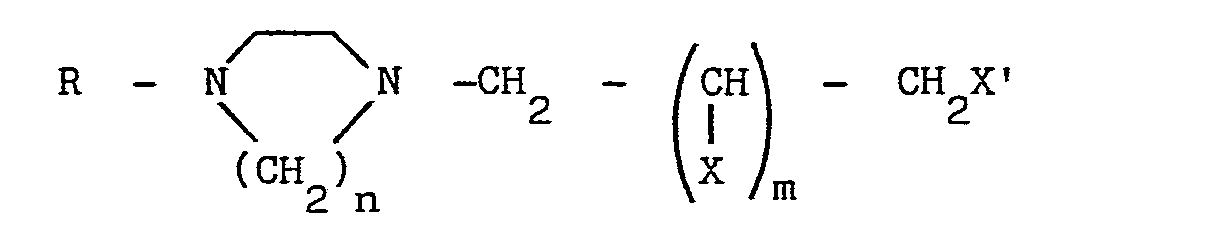
- alkylolpiperazine and alkylolhomopiperazine derivatives belonging to the general formula where R represents a 5 or 6 membered heterocyclic ring selected among pyridine, pyrimidine, pyrazine, pyridazine, thiophene, furan and thiazole which may be substituted with one or more groups selected among alkyl, trifluoromethyl, methylthio, alkoxy, halogen, amide, hydroxy, cyano, carboxy and the alkyl esters thereof n is an integer such as 2 or 3
- the compounds of formula I display a marked antitussive activity and, at their active dose, practically they are free of the undesired side effects which generally are shown by the compounds on the market having analogous activity.
- the process for preparing the compounds of formula I is essentially based on reacting a heterocyclic derivative R-Hal (II), where R has the above-cited meaning and Hal represents a halogen atom, preferably a chlorine atom, with a piperazine or homopipe- razine alkylol derivative (III), in a suitable organic solvent at a temperature generally comprised between 60 and 130°C.
- R-Hal a heterocyclic derivative
- Hal represents a halogen atom, preferably a chlorine atom
- a piperazine or homopipe- razine alkylol derivative (III) in a suitable organic solvent at a temperature generally comprised between 60 and 130°C.
- the reaction can be schematically represented as following where the symbols R, Hal, n, m, X and X' have the above mentioned meaning.
- the compounds I are isolated according to the known technique, in good yield and purity state.
- alkyl or alkoxy is used through the description to mean an alkyl or alkoxy radical having from 1 to 3 carbon atoms respectively.
- substituted hydroxy means a hydroxy group substituted with an alkyl or with a hydroxyalkyl.
- the compounds I when: the carboxy group is present and when desired, may be converted in a manner known per se into the corresponding alkali metal salts and they may be isolated as non-toxic addition salts with suitable acids.
- the compounds according to the present invention are used in the form of pharmaceutical preparation which contain said compounds in admixture with pharmaceutically acceptable carriers such as an organic or inorganic solid or liquid excipient suitable for oral or parenteral administration.
- pharmaceutically acceptable carriers such as an organic or inorganic solid or liquid excipient suitable for oral or parenteral administration.
- the compounds of the invention may be contained in these pharmaceu tical preparatiors in the form of free base or in the form of their non-toxic acid addition salts.
- the inorganic acids which may be employed to prepare these acid addition salts may be, for example, hydrochloric, hydrobromic, or sulphuric acid.
- the organic acids which may be employed are, for example, maleic, citric, fumaric and succinic acid.
- the pharmaceutical preparations may be in solid form as capsules, tablets, dragees or suppositories, or in liquid form such as solutions, suspensions or emulsions. If desired, there may be included in the above preparations auxiliary substances such as stabilizing agents and other commonly used additives, or there may be contained other therapeutically active agents suitable to be administered together with the componds of the invention. While the dosage of the compounds will vary from the administration route and will also depend upon the age and condition of the patient, a dosage unit from about 1 to about 20 mg per kilogram of body weight per day, can be orally administered.
- the antitussive activity of the compounds of the invention has been evaluated using as comparison compounds both dropropizine, which represents the antitussive compound having the closest chemical structure analogy with the compounds of the invention, and codeine.
- the compounds of the invention compared to the standard at the same dose, showed to be endowed with a higher or comparable activity and to be practically devoided of undesired side effects.
- tests for determining the effect on the sleeping time interval induced by barbiturate administration were carried out. Tests were performed on the compounds of formula I according to the methods herebelow reported and gave the results listed in Tables 1 and 2.
- the animals were selected the day before and allowed to the test only if they showed a number of short coughs equal or higher than 10.
- the sleep was induced by intraperitoneal administration of 40 mg/Kg pentobarbital sodium.
- the narcosis start was considered from the moment when the animal, lying on its back, lost its straightening reflex.
- the narcosis end was considered from the moment when the animal recovered such reflex. (Turner R. in "Screening Methods in Pharmacology", Academic Press, 6,70,1985).
- the compounds under examination were orally administered 1 hour before the barbiturate administration; to the control animals 10 ml/Kg tap water were administered.
Landscapes
- Chemical & Material Sciences (AREA)
- Organic Chemistry (AREA)
- Health & Medical Sciences (AREA)
- Animal Behavior & Ethology (AREA)
- Public Health (AREA)
- Chemical Kinetics & Catalysis (AREA)
- General Chemical & Material Sciences (AREA)
- Medicinal Chemistry (AREA)
- Nuclear Medicine, Radiotherapy & Molecular Imaging (AREA)
- Bioinformatics & Cheminformatics (AREA)
- Pharmacology & Pharmacy (AREA)
- Life Sciences & Earth Sciences (AREA)
- Engineering & Computer Science (AREA)
- General Health & Medical Sciences (AREA)
- Pulmonology (AREA)
- Veterinary Medicine (AREA)
- Pharmaceuticals Containing Other Organic And Inorganic Compounds (AREA)
- Acyclic And Carbocyclic Compounds In Medicinal Compositions (AREA)
- Organic Low-Molecular-Weight Compounds And Preparation Thereof (AREA)
- Pyridine Compounds (AREA)
- Heterocyclic Compounds Containing Sulfur Atoms (AREA)
- Thiazole And Isothizaole Compounds (AREA)
- Compounds Of Unknown Constitution (AREA)
- Medicines Containing Material From Animals Or Micro-Organisms (AREA)
- Plural Heterocyclic Compounds (AREA)
Abstract

- R represents a 5 or 6 membered heterocyclic ring selected among pyridine, pyrimidine, pyrazine, pyridazine, thiophene, furan, thiazole which optionally may be substituted with one or more groups selected among alkyl, alkoxy, halogen, amide, hydroxy, methylthio, trifluoromethyl, cyano, carboxy and the corresponding alkyl esters and salts with alkali metals;
- n is an integer such as 2 or 3;
- X and X' represent each a hydrogen atom or hydroxy group with the exception of both being hydrogen atom, and X' may be also a substituted hydroxy group;
- m is 0 or 1,
Description
- The subject of the present invention relates to a new class of alkylol derivatives which show an interesting activity as antitussive agents.
- More specifically the compounds of the invention are represented by alkylolpiperazine and alkylolhomopiperazine derivatives belonging to the general formula

- X and X' represent each a hydrogen atom or hydroxy group with the exception of. both being hydrogen atom, and X' may be also a substituted hydroxy group
- m is 0 or 1 .
- The compounds of formula I display a marked antitussive activity and, at their active dose, practically they are free of the undesired side effects which generally are shown by the compounds on the market having analogous activity.
- The process for preparing the compounds of formula I is essentially based on reacting a heterocyclic derivative R-Hal (II), where R has the above-cited meaning and Hal represents a halogen atom, preferably a chlorine atom, with a piperazine or homopipe- razine alkylol derivative (III), in a suitable organic solvent at a temperature generally comprised between 60 and 130°C. The reaction can be schematically represented as following

- The compounds I are isolated according to the known technique, in good yield and purity state.
- The term alkyl or alkoxy is used through the description to mean an alkyl or alkoxy radical having from 1 to 3 carbon atoms respectively.
- The term substituted hydroxy means a hydroxy group substituted with an alkyl or with a hydroxyalkyl.
- The compounds I,when: the carboxy group is present and when desired, may be converted in a manner known per se into the corresponding alkali metal salts and they may be isolated as non-toxic addition salts with suitable acids.
- For therapeutic administration, the compounds according to the present invention are used in the form of pharmaceutical preparation which contain said compounds in admixture with pharmaceutically acceptable carriers such as an organic or inorganic solid or liquid excipient suitable for oral or parenteral administration. The compounds of the invention may be contained in these pharmaceu tical preparatiors in the form of free base or in the form of their non-toxic acid addition salts. The inorganic acids which may be employed to prepare these acid addition salts may be, for example, hydrochloric, hydrobromic, or sulphuric acid. The organic acids which may be employed are, for example, maleic, citric, fumaric and succinic acid. The pharmaceutical preparations may be in solid form as capsules, tablets, dragees or suppositories, or in liquid form such as solutions, suspensions or emulsions. If desired, there may be included in the above preparations auxiliary substances such as stabilizing agents and other commonly used additives, or there may be contained other therapeutically active agents suitable to be administered together with the componds of the invention. While the dosage of the compounds will vary from the administration route and will also depend upon the age and condition of the patient, a dosage unit from about 1 to about 20 mg per kilogram of body weight per day, can be orally administered.
- Grams 3.2 of 1-(2,3-dihydroxypropyl)piperazine and 1.14 g of 2-chloropyrimidine in 50 ml dioxane were refluxed for two and a half hour. The reaction mixture was then settled and the solution evaporated to dryness. The residue obtained was extracted with hot acetone and filtered to remove all impurities. After resting 1.1 g of 3-[4-(pyrimidin-2-yl)piperazin-1-yl]propane-1,2- diol were separated, which melted at l18-120°C.
- Elementary analysis for C11H18N4O2

- Grams 32 of 1-(2,3-dihydroxypropyl)piperazine and 15 g of 3,6-di- chloropyridazine in 700 ml isopropanol were refluxed for 24 hours. The reaction mixture was settled, the solid undissolvable removed and the solution evaporated to dryness. The so obtained residue was purified on column eluting with chloroform: methanol (9:1). Grams 2.1 of 3-[4-(6-chloropyridazin-3-yl)piperazin-1-yl]propane-1,2-diol, which, recrystallized from acetone, melted at 126-128°C Elementary analysis for C11H17Cl N 4 0 2
-

- Operation was carried out in a manner similar to the one described in Example 2, using 1.6 g of 2-chloronicotinamide, 3.2 g of 1-(2,3-dihydroxypropyl)piperazine and 30 ml ethanol and refluxing overnight. Column purification of the residue gave 1 g of 2-f4-(2,3-dihydroxypropyl)piperazin-1-yl]nicotinamide, which, recrystallized from acetone, melted at 140-142°C.
- Elementary analysis for C13H20N4O3

- Operation was carried out in a manner similar to the one previously described, using 2-chloropyridine and 1-(2,3-dihydroxypropyl) piperazine. The residue obtained after evaporation to dryness was dissolved in a small amount of concentrated hydrochloric acid and diluted with isopropanol. After resting, 3-f4-(pyridin-2-yl) piperazin-1-yl]propane-1,2-diol dihydrochloride melting at 238-242°C, was obtained with the 53.6% yield.
- Elementary analysis for C 12 H 19 N 3 0 2 .2HCl

- Grams 32 of 1-(2,3-dihydroxypropyl) piperazine and 15.7 g of 2-chloronicotinic acid in 500 ml dioxane were refluxed for 8 hours. The reaction mixture was cooled, settled, the solvent separated and removed. The residue was triturated under heating with absolute ethanol and gave 16.2 g of 2-[4-(2,3-dihydroxypropyl)pipera- zin-1-yl7nicotinic acid melting at 210-212°C (with decomposition) Elementary analysis for C13H19N3O4

- Operation was carried out in a manner similar to the one previous ly described in Example 5, using 1.6 g of 6-chloronicotinic acid and 3.2 g of 1-(2,3-dihydroxypropyl)piperazine in 50 ml dioxane. Grams 1.95 of 6-[4-(2,3-dihydroxypropyl)piperazin-1-yl]nicotinic acid were obtained, which, recrystallized from hot water, melted at 244-246°C ( with decomposition).
- Elementary analysis for C13H19N3O4

- Operation was carried out in a manner similar to the one previous ly described in Example 5, using 10.4 g of 1-(2-hydroxyethyl)piperazine and 6.3 g of 2-chloronicotinic acid in 100 ml dioxane under reflux for 18 hours. Grams 3.9 of 2-[4-(2-hydroxyethyl)pi- perazin-1-yl]nicotinic acid, melting at 148-171°C (with decomposition), were obtained.
- Elementary analysis for C12H17N3O3

- Grams 5 of 1-(2,3-dihydroxypropyl)homopiperazine and 2.25 g of 2-chloronicotinic acid in 50 ml dioxane were refluxed for 24 hours. The reaction mixture was evaporated to dryness and the residue was purified on column eluting with ethanol:ammonium hydroxyde (95:5). The fractions containing the product were dried and the residue, triturated with acetonitrile, gave 1.3 g of 2-[ 4-(2,3-dihydroxypropyl)homopiperazin-1-yl]nicotinic acid,melting at 70-77°C (with decomposition).
- Elementary analysis for C14H21N3O4

- Grams 8.65 of 1-(3-hydroxypropyl)piperazine and 4.7 g of 2-chloronicotinic acid in 100 ml dioxane were refluxed for 6 hours. The reaction mixture was cooled and settled.The residual oil, crystallized from 95° ethanol, gave 2.3 g of 2-14-(3-hydroxypropyl)piperazin-1-yl]nicotinic acid, melting at 222-225°C (with decomposition).
- Elementary analysis for C 13 H 19 N 3 0 3

- Grams 6.9 of 1-(2,3-dihydroxypropyl)piperazine and 3.0 g of 4-cyano-3-chloropyridazine in 60 ml dioxane were refluxed for 2 hours. The reaction mixture was settled, the supernatant liquor evaporated to dryness and the residue, which formed, was dissolved in 10 ml concentrated hydrochloric acid and diluted with 10 volumes of isopropanol. A precipitate was obtained formed by a gummy oil, which solidified afterwards giving 5.9 g of 3-[4-(4-cyanopyridazin-3-yl)piperazin-1-yl]propane-1,2-diol dihydrochloride which melted at 128-130°C.
- Elementary analysis for C 12H17N5O2· 2HCl

- Grams 7.4 of 1-(2,3-dihydroxypropyl)piperazine and 4.3 g of 4-chloropyrimidine5-carboxylic acid ethyl ester were warmed to 90°C for 45 minutes in 100 ml dioxane. The reaction mixture was then settled, the supernatant liquor evaporated to dryness and the residue dissolved in hydrochloric ethanol and diluted with isopropanol until complete precipitation. By addition of 95°ethanol, the so formed gum crystallized and 4 g of 4-[4-(2,3-dihydroxypropyl)piperazin-1-yl]pyrimidine-5-carboxylic acid ethyl ester dihydrochloride, melting at 190-193°C (with decomposition), were obtained.
- Elementary analysis for C 14 H 22 N 4 0 4 .2HCl

- Grams 2 of 4-[4-(2,3-dihydroxypropyl)piperazin-1-yl]pyrimidine-5 carboxylic acid ethyl ester dihydrochloride, obtained in Example 11, were treated with 0.62 g sodium hydroxide in 20 ml water at 70°C for 15 minutes. Then it was cooled and evaporated to dryness, the residue taken up with absolute ethanol, filtered and the undissolvable removed. The clear filtrate was concentrated to a 10 ml volume and allowed to rest. Grams 0.5 of 4-L4-(2,3-dihydroxypropyl)piperazin-1-yl]pyrimidine-5-carboxylic acid sodium salt melting at 268-273°C (with decomposition) were obtained. Elementary analysis for C12H17H4NaO4


- Grams 10.2 of 1-(2,3-dihydroxypropyl)piperazine and 5.9 g of 3-chloropyridazine-4-carboxylic acid ethyl ester in 100 ml dioxane were refluxed for one hour. Then it was settled, the solvent evaporated till dryness, and the residue dissolved in chloroform and washed with a small amount of water. The organic phase was made anhydrous, evaporated to dryness and the residue, purified on a column eluting with chloroform:methanol (9:1), gave 2.4 g of 3-f4-(2,3-dihydroxypropyl)piperazin-1-yl7pyridazine-4-carboxylic acid ethyl ester as an oil.
- Elementary analysis for C14H22N4O4

- Grams 3 of 1-(2-hydroxypropyl)piperazine and 1.6 g of 2-chloronicotinic acid in 50 ml dioxane were refluxed for 2 days. The react ion mixture was cooled, then allowed to rest for 2 days, the solvent was removed and the residue was crystallized from absolute ethanol to give 1.2 g of 2-[4-(2-hydroxypropyl)piperazin-1-yl]nicotinic acid, melting at 222-223°C (with decomposition). Elementary analysis for C13H19N3O3

- Grams 5.9 of 1-(2-hydroxyethoxyethyl)piperazine and 2.7 g of 2-chloronicotinic acid in 50 ml dioxane were refluxed for 3 days. The reaction mixture was then cooled and allowed to rest for 2 days, afterwards the solvent was removed and the residue crystallized from absolute ethanol, gave 1.1 g of 2-{4-[2-(2-hydroxy ethoxy)ethyl]piperazin-1-yl} nicotinic acid melting at 172-174°C. Elementary analysis for C14H21N3O4

- Grams 6.4 of 1-(2,3-dihydroxypropyl)piperazine and 3.5 g of 2-bromo-3-hydroxypyridine in 70 ml cyclohexanol were refluxed for 24 hours, then the solvent was distilled off and the obtained residue was purified on column eluting with chloroform:methanol (9:1). The obtained product was dissolved in concentrated hydrochloric acid and diluted with isopropanol until incipient precipitation. After resting, were obtained 1.5 g of 3-[4-(3-hydroxypy- ridin-2-yl)piperazin-1-yl]propane-1,2-diol dihydrochloride melting at 243-247°C (with decomposition).
- Elementary analysis for C 12H19N3O3· 2HCl

- Grams 4.6 of 2-methylthio-4-chloropyrimidine-5-carboxylic acid ethyl ester and 6.4 g of 1-(2,3-dihydroxypropyl)piperazine in 50 ml dioxane were refluxed for 30 minutes. The mixture was cooled and settled, then the solvent was evaporated and the dried residue purified on column eluting with chloroform:methanol (9:1). Grams 4.8 of 2-methylthio-4-[4-(2,3-dihydroxypropyl)piperazin-1-yl]pyrimidine-5-carboxylic acid ethyl ester as an oil, were obtained. Elementary analysis for C15H24N4O4S

- Grams 20.5 of 1-(2,3-dihydroxypropyl)piperazine and 11 g of 3-chloropyrazine-2-carboxylic acid methyl ester in 100 ml dioxane were refluxed for one hour. The reaction mixture was cooled and settled, the solvent evaporated and the obtained residue dissolved in concentrated hydrochloric acid and the solution diluted with isopropanol until incipient precipitation. After resting, 12.7 g of 3-[4-(2,3-dihydroxypropyl)piperazin-1-yl]pyrazine-2-carboxylic acid methyl ester dihydrochloride melting at 195-197°C (with decomposition), were obtained.
- Elementary analysis for C 13 H 20 N 4 0 4' 2HCl

- Grams 5 of 3-[4-(2,3-dihydroxypropyl)piperazin-1-yl]pyrazine-2-carboxylic acid methyl ester, obtained as in Example 18, were dissolved in a sodium bicarbonate aqueous saturated solution. The solution was extracted three times with 100 ml chloroform and the organic phases collected together were evaporated to dryness to give 4 g of 3-[4-(2,3-dihydroxypropyl)piperazin-1-yl]pyrazine-2-carboxylic acid, which were dissolved in 40 ml water and 0.5 g sodium hydroxyde and refluxed for 8 hours. The reaction mixture was evaporated to dryness and the residue taken up several times with absolute ethanol, each time distilling to dryness. The residue obtained from distillation was triturated with diethyl ether and gave 2.7 g of 3-[4-(2,3-dihydroxypropyl)piperazin-1-yl]pyrazine-2-carboxylic acid sodium salt, melting at 175-184°C. Elementary analysis for C12H17Na N4O4

- Grams 6.4 of 1-(2,3-dihydroxypropyl)piperazine and 3.3 g of 2-bromo-l,3-thiazole in 50 ml dioxane were refluxed for 24 hours. The reaction mixture was evaporated to dryness and the so obtained residue was purified on column eluting with chloroform:methanol (9:1). Grams 1.5 of 3-f4-( 1,3- thiazol-2-yl)piperazin-1-yl] propane-1,2-diol which, by recrystallization from acetone, melted at 138-139°C, were obtained.
- Elementary anlysis for C10H17N3O2S

- The following listed compounds have been prepared from the corresponding suitable reactants, according to the previously described method:
- . 2-[4-(2,3-Dihydroxypropyl)piperazin-1-yl]thiophene-3-carboxylic acid methyl ester.
- . 3-[4-(Pyrazin-2 yl)piperazin-1-yl]propane-1,2-diol.
- . 3-[4-(6-Methoxypyridazin-3-yl)piperazin-1-yl]propane-1,2-diol.
- . 3-[4-(Thiophen-2-yl)piperazin-1-yl]propane-1,2-diol.
- . 2-f4-(2,3-Dihydroxypropyl)piperazin-1-yl7furan-5-carboxylic acid.
- The antitussive activity of the compounds of the invention has been evaluated using as comparison compounds both dropropizine, which represents the antitussive compound having the closest chemical structure analogy with the compounds of the invention, and codeine.The compounds of the invention, compared to the standard at the same dose, showed to be endowed with a higher or comparable activity and to be practically devoided of undesired side effects. Thus, besides the tests able to evaluate the antitussive activity, also tests for determining the effect on the sleeping time interval induced by barbiturate administration were carried out. Tests were performed on the compounds of formula I according to the methods herebelow reported and gave the results listed in Tables 1 and 2.
- The method described by R.W.Pickering and G.W.L.James (Arzneim. Forsch./Drug Res.,29 (I),nO2,1979) slightly modified, was followed. The animals were placed in a perspex box having the size 20x14x12 cm, and were exposed to an aerosol of 5% p/v citric acid in distilled water. The aerosol was prepared by bubbling 0.5 atm compressed air through a nebulizer containing 4-5 ml of the citric acid solution; the animals were exposed for 5 minutes counting the number of short coughs during this period. The compounds under examination were orally administered one hour before the tussive stimulus.
- The animals were selected the day before and allowed to the test only if they showed a number of short coughs equal or higher than 10.
- The results are given in the following Table 1.

- The sleep was induced by intraperitoneal administration of 40 mg/Kg pentobarbital sodium. The narcosis start was considered from the moment when the animal, lying on its back, lost its straightening reflex. The narcosis end was considered from the moment when the animal recovered such reflex. (Turner R. in "Screening Methods in Pharmacology", Academic Press, 6,70,1985). The compounds under examination were orally administered 1 hour before the barbiturate administration; to the control animals 10 ml/Kg tap water were administered.
- The results are listed in the following Table 2.

Claims (11)




Priority Applications (1)
| Application Number | Priority Date | Filing Date | Title |
|---|---|---|---|
| AT87830012T ATE88467T1 (en) | 1986-01-20 | 1987-01-16 | PHARMACOLOGICALLY ACTIVE ALKYLENE DERIVATIVES. |
Applications Claiming Priority (2)
| Application Number | Priority Date | Filing Date | Title |
|---|---|---|---|
| IT1912186 | 1986-01-20 | ||
| IT19121/86A IT1191845B (en) | 1986-01-20 | 1986-01-20 | PHARMACOLOGICALLY ACTIVE ALCHYLOLS |
Publications (3)
| Publication Number | Publication Date |
|---|---|
| EP0230402A2 true EP0230402A2 (en) | 1987-07-29 |
| EP0230402A3 EP0230402A3 (en) | 1989-02-22 |
| EP0230402B1 EP0230402B1 (en) | 1993-04-21 |
Family
ID=11154912
Family Applications (1)
| Application Number | Title | Priority Date | Filing Date |
|---|---|---|---|
| EP87830012A Expired - Lifetime EP0230402B1 (en) | 1986-01-20 | 1987-01-16 | Pharmacologically active alkylol derivatives |
Country Status (7)
| Country | Link |
|---|---|
| US (1) | US4849422A (en) |
| EP (1) | EP0230402B1 (en) |
| JP (1) | JPS62169768A (en) |
| AT (1) | ATE88467T1 (en) |
| DE (1) | DE3785463T2 (en) |
| ES (1) | ES2056836T3 (en) |
| IT (1) | IT1191845B (en) |
Cited By (6)
| Publication number | Priority date | Publication date | Assignee | Title |
|---|---|---|---|---|
| EP0385351A1 (en) * | 1989-03-01 | 1990-09-05 | Nisshin Flour Milling Co., Ltd. | Nicotinic acid derivatives and pharmaceutical compositions comprising same |
| EP0511072A1 (en) * | 1991-04-24 | 1992-10-28 | Synthelabo | 2-Aminopyrimidin-4-carboxamid derivatives, their preparation and their therapeutical use |
| WO2009005645A1 (en) * | 2007-06-28 | 2009-01-08 | Schering Corporation | Substituted piperazines as cb1 antagonists |
| WO2009005646A3 (en) * | 2007-06-28 | 2009-03-19 | Schering Corp | Substituted piperazines as cb1 antagonists |
| US7897601B2 (en) | 2006-01-18 | 2011-03-01 | Intervet, Inc. | Cannabinoid receptor modulators |
| US8236805B2 (en) | 2004-12-03 | 2012-08-07 | Intervet Inc. | Substituted piperazines as CB1 antagonists |
Families Citing this family (3)
| Publication number | Priority date | Publication date | Assignee | Title |
|---|---|---|---|---|
| AU2004221812B2 (en) * | 2003-03-19 | 2010-02-18 | Exelixis Inc. | Tie-2 modulators and methods of use |
| WO2005118543A1 (en) * | 2004-06-03 | 2005-12-15 | Ono Pharmaceutical Co., Ltd. | Kinase inhibitor and use thereof |
| JP6047830B2 (en) * | 2013-03-12 | 2016-12-21 | 花王株式会社 | Bleach composition comprising a homopiperazine derivative |
Family Cites Families (4)
| Publication number | Priority date | Publication date | Assignee | Title |
|---|---|---|---|---|
| FR2257294B1 (en) * | 1973-07-06 | 1977-07-01 | Ugine Kuhlmann | |
| CH583232A5 (en) * | 1973-02-02 | 1976-12-31 | Wander Ag Dr A | |
| HU173380B (en) * | 1977-02-25 | 1979-04-28 | Richter Gedeon Vegyeszet | Process for producing new pyridyl-piperazine derivatives and acid additional salts thereof |
| ATE50987T1 (en) * | 1982-05-10 | 1990-03-15 | Takeda Chemical Industries Ltd | DIHYDROPYRIDE DERIVATIVES, THEIR PREPARATION AND USE. |
-
1986
- 1986-01-20 IT IT19121/86A patent/IT1191845B/en active
-
1987
- 1987-01-16 DE DE87830012T patent/DE3785463T2/en not_active Expired - Fee Related
- 1987-01-16 EP EP87830012A patent/EP0230402B1/en not_active Expired - Lifetime
- 1987-01-16 AT AT87830012T patent/ATE88467T1/en not_active IP Right Cessation
- 1987-01-16 ES ES87830012T patent/ES2056836T3/en not_active Expired - Lifetime
- 1987-01-16 US US07/004,028 patent/US4849422A/en not_active Expired - Fee Related
- 1987-01-19 JP JP62008371A patent/JPS62169768A/en active Pending
Cited By (10)
| Publication number | Priority date | Publication date | Assignee | Title |
|---|---|---|---|---|
| EP0385351A1 (en) * | 1989-03-01 | 1990-09-05 | Nisshin Flour Milling Co., Ltd. | Nicotinic acid derivatives and pharmaceutical compositions comprising same |
| US5025012A (en) * | 1989-03-01 | 1991-06-18 | Nisshin Flour Milling Co., Ltd. | Nicotinic acid derivatives and pharmaceutical compositions comprising same |
| EP0511072A1 (en) * | 1991-04-24 | 1992-10-28 | Synthelabo | 2-Aminopyrimidin-4-carboxamid derivatives, their preparation and their therapeutical use |
| FR2675799A1 (en) * | 1991-04-24 | 1992-10-30 | Synthelabo | 2-AMINOPYRIMIDINE-4-CARBOXAMIDE DERIVATIVES, THEIR PREPARATION AND THERAPEUTIC USE THEREOF |
| US8236805B2 (en) | 2004-12-03 | 2012-08-07 | Intervet Inc. | Substituted piperazines as CB1 antagonists |
| US7897601B2 (en) | 2006-01-18 | 2011-03-01 | Intervet, Inc. | Cannabinoid receptor modulators |
| WO2009005645A1 (en) * | 2007-06-28 | 2009-01-08 | Schering Corporation | Substituted piperazines as cb1 antagonists |
| WO2009005646A3 (en) * | 2007-06-28 | 2009-03-19 | Schering Corp | Substituted piperazines as cb1 antagonists |
| EP2548874A3 (en) * | 2007-06-28 | 2013-05-15 | Intervet International B.V. | Substituted piperazines as CB1 antagonists |
| US8623873B2 (en) | 2007-06-28 | 2014-01-07 | Intervet Inc. | Substituted piperazines as CB1 antagonists |
Also Published As
| Publication number | Publication date |
|---|---|
| DE3785463T2 (en) | 1993-11-18 |
| US4849422A (en) | 1989-07-18 |
| DE3785463D1 (en) | 1993-05-27 |
| ATE88467T1 (en) | 1993-05-15 |
| IT1191845B (en) | 1988-03-23 |
| EP0230402A3 (en) | 1989-02-22 |
| IT8619121A0 (en) | 1986-01-20 |
| EP0230402B1 (en) | 1993-04-21 |
| ES2056836T3 (en) | 1994-10-16 |
| JPS62169768A (en) | 1987-07-25 |
Similar Documents
| Publication | Publication Date | Title |
|---|---|---|
| DE60311980T2 (en) | Histone deacetylase INHIBITORS | |
| EP0385351B1 (en) | Nicotinic acid derivatives and pharmaceutical compositions comprising same | |
| EP0040696A2 (en) | Aminothiadiazoles as gastric secretion inhibitors | |
| EP1656351B1 (en) | Process for preparation of 4-aryl-nicotinamide derivatives | |
| CA2107115A1 (en) | Heterocyclic amines useful in the therapy of asthma and inflammation of the respiratory tract | |
| DK154078B (en) | METHOD OF ANALOGY FOR THE PREPARATION OF 2- (2- (4- (DIPHENYL-METHYL) -1-PIPERAZINYL) ETHOXY) -ACETAMIDES OR ACID ADDITION SALTS. | |
| NO841168L (en) | PROCEDURE FOR PREPARING PYRIMIDINE DERIVATIVES | |
| US3944551A (en) | N-Coumaranyl and chromanyl -methyl-or sulfur analogs thereof-N'- thiazolyl piperazines | |
| CA2098562A1 (en) | Piperazine and homopiperazine derivatives, pharmaceutical compositions containing them and process for preparing the same | |
| US4849422A (en) | Pharmacologically active alkylol derivatives | |
| EP0314363B1 (en) | Anti-anxiety agents | |
| NO172392B (en) | ANALOGUE PROCEDURE FOR PREPARATION OF 1H, 3H- (1,2-C) -PYRROLO-7-TIAZOLAR CARBOXAMIDES | |
| HK64196A (en) | New aminopiperazine derivatives | |
| US4629728A (en) | Antihypoxemic 5-(4-substituted piperazinyl)alkyl-8-substituted quinolines | |
| FI65998B (en) | PHARMACEUTICAL FORM OF PHARMACOLOGICAL ACTIVE PYRROLYL PYRIDAZINE AMINDER | |
| GB2083474A (en) | N-(4-3-substituted pyridyl piperazino) alkyl azaspirodecanediones | |
| EP0144730B1 (en) | 2-anilino-1,6-dihydro-6-oxo-5-pyrimidinecarboxylic acid derivatives, processes for the preparation thereof, and antiallergic agent containing the same | |
| DK156722B (en) | ANALOGY PROCEDURE FOR PREPARING 2-PIPERAZINOPYRIMIDINE DERIVATIVES | |
| NZ202974A (en) | Benzodioxine derivatives and pharmaceutical compositions | |
| CS226034B2 (en) | Method of preparing pyridine derivatives | |
| EP0086647B1 (en) | Pyrimidone compounds, their preparation, and pharmaceutical compositions containing them | |
| CA1166253A (en) | 4-amino-6-(pyridinyl)-3(2h)-pyridazinones, preparation and cardiotonic use | |
| JPS58118585A (en) | Antiulcer | |
| RU2036924C1 (en) | Method of synthesis of imidazo-(1,2-b)-pyridazine or their salts and imidazo-(1,2-b)-pyridazine derivatives or their salts | |
| EP0451772A1 (en) | Piperidine compounds, method for preparation thereof, and a pharamceutical composition comprising the same |
Legal Events
| Date | Code | Title | Description |
|---|---|---|---|
| PUAI | Public reference made under article 153(3) epc to a published international application that has entered the european phase |
Free format text: ORIGINAL CODE: 0009012 |
|
| AK | Designated contracting states |
Kind code of ref document: A2 Designated state(s): AT BE CH DE ES FR GB GR IT LI LU NL SE |
|
| PUAL | Search report despatched |
Free format text: ORIGINAL CODE: 0009013 |
|
| AK | Designated contracting states |
Kind code of ref document: A3 Designated state(s): AT BE CH DE ES FR GB GR IT LI LU NL SE |
|
| 17P | Request for examination filed |
Effective date: 19890718 |
|
| 17Q | First examination report despatched |
Effective date: 19910920 |
|
| GRAA | (expected) grant |
Free format text: ORIGINAL CODE: 0009210 |
|
| AK | Designated contracting states |
Kind code of ref document: B1 Designated state(s): AT BE CH DE ES FR GB GR IT LI LU NL SE |
|
| PG25 | Lapsed in a contracting state [announced via postgrant information from national office to epo] |
Ref country code: SE Effective date: 19930421 Ref country code: NL Effective date: 19930421 Ref country code: GR Free format text: LAPSE BECAUSE OF FAILURE TO SUBMIT A TRANSLATION OF THE DESCRIPTION OR TO PAY THE FEE WITHIN THE PRESCRIBED TIME-LIMIT Effective date: 19930421 Ref country code: BE Effective date: 19930421 Ref country code: AT Effective date: 19930421 |
|
| REF | Corresponds to: |
Ref document number: 88467 Country of ref document: AT Date of ref document: 19930515 Kind code of ref document: T |
|
| ITF | It: translation for a ep patent filed | ||
| REF | Corresponds to: |
Ref document number: 3785463 Country of ref document: DE Date of ref document: 19930527 |
|
| ET | Fr: translation filed | ||
| NLV1 | Nl: lapsed or annulled due to failure to fulfill the requirements of art. 29p and 29m of the patents act | ||
| PG25 | Lapsed in a contracting state [announced via postgrant information from national office to epo] |
Ref country code: GB Effective date: 19940116 |
|
| PG25 | Lapsed in a contracting state [announced via postgrant information from national office to epo] |
Ref country code: ES Free format text: LAPSE BECAUSE OF NON-PAYMENT OF DUE FEES Effective date: 19940117 |
|
| PG25 | Lapsed in a contracting state [announced via postgrant information from national office to epo] |
Ref country code: LU Free format text: LAPSE BECAUSE OF NON-PAYMENT OF DUE FEES Effective date: 19940131 Ref country code: LI Effective date: 19940131 Ref country code: CH Effective date: 19940131 |
|
| PLBE | No opposition filed within time limit |
Free format text: ORIGINAL CODE: 0009261 |
|
| STAA | Information on the status of an ep patent application or granted ep patent |
Free format text: STATUS: NO OPPOSITION FILED WITHIN TIME LIMIT |
|
| 26N | No opposition filed | ||
| GBPC | Gb: european patent ceased through non-payment of renewal fee |
Effective date: 19940116 |
|
| PG25 | Lapsed in a contracting state [announced via postgrant information from national office to epo] |
Ref country code: FR Effective date: 19940930 |
|
| REG | Reference to a national code |
Ref country code: CH Ref legal event code: PL |
|
| PG25 | Lapsed in a contracting state [announced via postgrant information from national office to epo] |
Ref country code: DE Effective date: 19941001 |
|
| REG | Reference to a national code |
Ref country code: ES Ref legal event code: FG2A Ref document number: 2056836 Country of ref document: ES Kind code of ref document: T3 |
|
| REG | Reference to a national code |
Ref country code: FR Ref legal event code: ST |
|
| REG | Reference to a national code |
Ref country code: ES Ref legal event code: FD2A Effective date: 19990405 |
|
| PG25 | Lapsed in a contracting state [announced via postgrant information from national office to epo] |
Ref country code: IT Free format text: LAPSE BECAUSE OF NON-PAYMENT OF DUE FEES;WARNING: LAPSES OF ITALIAN PATENTS WITH EFFECTIVE DATE BEFORE 2007 MAY HAVE OCCURRED AT ANY TIME BEFORE 2007. THE CORRECT EFFECTIVE DATE MAY BE DIFFERENT FROM THE ONE RECORDED. Effective date: 20050116 |