EP0225050B1 - Automated biopolymer crystal preparation apparatus and process - Google Patents
Automated biopolymer crystal preparation apparatus and process Download PDFInfo
- Publication number
- EP0225050B1 EP0225050B1 EP86308404A EP86308404A EP0225050B1 EP 0225050 B1 EP0225050 B1 EP 0225050B1 EP 86308404 A EP86308404 A EP 86308404A EP 86308404 A EP86308404 A EP 86308404A EP 0225050 B1 EP0225050 B1 EP 0225050B1
- Authority
- EP
- European Patent Office
- Prior art keywords
- reactor
- reaction solutions
- pipes
- procedure
- reaction
- Prior art date
- Legal status (The legal status is an assumption and is not a legal conclusion. Google has not performed a legal analysis and makes no representation as to the accuracy of the status listed.)
- Expired - Lifetime
Links
Images




Classifications
-
- C—CHEMISTRY; METALLURGY
- C30—CRYSTAL GROWTH
- C30B—SINGLE-CRYSTAL GROWTH; UNIDIRECTIONAL SOLIDIFICATION OF EUTECTIC MATERIAL OR UNIDIRECTIONAL DEMIXING OF EUTECTOID MATERIAL; REFINING BY ZONE-MELTING OF MATERIAL; PRODUCTION OF A HOMOGENEOUS POLYCRYSTALLINE MATERIAL WITH DEFINED STRUCTURE; SINGLE CRYSTALS OR HOMOGENEOUS POLYCRYSTALLINE MATERIAL WITH DEFINED STRUCTURE; AFTER-TREATMENT OF SINGLE CRYSTALS OR A HOMOGENEOUS POLYCRYSTALLINE MATERIAL WITH DEFINED STRUCTURE; APPARATUS THEREFOR
- C30B7/00—Single-crystal growth from solutions using solvents which are liquid at normal temperature, e.g. aqueous solutions
-
- B—PERFORMING OPERATIONS; TRANSPORTING
- B01—PHYSICAL OR CHEMICAL PROCESSES OR APPARATUS IN GENERAL
- B01J—CHEMICAL OR PHYSICAL PROCESSES, e.g. CATALYSIS OR COLLOID CHEMISTRY; THEIR RELEVANT APPARATUS
- B01J19/00—Chemical, physical or physico-chemical processes in general; Their relevant apparatus
- B01J19/0046—Sequential or parallel reactions, e.g. for the synthesis of polypeptides or polynucleotides; Apparatus and devices for combinatorial chemistry or for making molecular arrays
-
- C—CHEMISTRY; METALLURGY
- C30—CRYSTAL GROWTH
- C30B—SINGLE-CRYSTAL GROWTH; UNIDIRECTIONAL SOLIDIFICATION OF EUTECTIC MATERIAL OR UNIDIRECTIONAL DEMIXING OF EUTECTOID MATERIAL; REFINING BY ZONE-MELTING OF MATERIAL; PRODUCTION OF A HOMOGENEOUS POLYCRYSTALLINE MATERIAL WITH DEFINED STRUCTURE; SINGLE CRYSTALS OR HOMOGENEOUS POLYCRYSTALLINE MATERIAL WITH DEFINED STRUCTURE; AFTER-TREATMENT OF SINGLE CRYSTALS OR A HOMOGENEOUS POLYCRYSTALLINE MATERIAL WITH DEFINED STRUCTURE; APPARATUS THEREFOR
- C30B29/00—Single crystals or homogeneous polycrystalline material with defined structure characterised by the material or by their shape
- C30B29/54—Organic compounds
- C30B29/58—Macromolecular compounds
-
- B—PERFORMING OPERATIONS; TRANSPORTING
- B01—PHYSICAL OR CHEMICAL PROCESSES OR APPARATUS IN GENERAL
- B01J—CHEMICAL OR PHYSICAL PROCESSES, e.g. CATALYSIS OR COLLOID CHEMISTRY; THEIR RELEVANT APPARATUS
- B01J2219/00—Chemical, physical or physico-chemical processes in general; Their relevant apparatus
- B01J2219/00274—Sequential or parallel reactions; Apparatus and devices for combinatorial chemistry or for making arrays; Chemical library technology
- B01J2219/00277—Apparatus
- B01J2219/00351—Means for dispensing and evacuation of reagents
- B01J2219/00389—Feeding through valves
-
- B—PERFORMING OPERATIONS; TRANSPORTING
- B01—PHYSICAL OR CHEMICAL PROCESSES OR APPARATUS IN GENERAL
- B01J—CHEMICAL OR PHYSICAL PROCESSES, e.g. CATALYSIS OR COLLOID CHEMISTRY; THEIR RELEVANT APPARATUS
- B01J2219/00—Chemical, physical or physico-chemical processes in general; Their relevant apparatus
- B01J2219/00274—Sequential or parallel reactions; Apparatus and devices for combinatorial chemistry or for making arrays; Chemical library technology
- B01J2219/00277—Apparatus
- B01J2219/00351—Means for dispensing and evacuation of reagents
- B01J2219/00389—Feeding through valves
- B01J2219/00391—Rotary valves
- B01J2219/00394—Rotary valves in multiple arrangements
-
- B—PERFORMING OPERATIONS; TRANSPORTING
- B01—PHYSICAL OR CHEMICAL PROCESSES OR APPARATUS IN GENERAL
- B01J—CHEMICAL OR PHYSICAL PROCESSES, e.g. CATALYSIS OR COLLOID CHEMISTRY; THEIR RELEVANT APPARATUS
- B01J2219/00—Chemical, physical or physico-chemical processes in general; Their relevant apparatus
- B01J2219/00274—Sequential or parallel reactions; Apparatus and devices for combinatorial chemistry or for making arrays; Chemical library technology
- B01J2219/00277—Apparatus
- B01J2219/00495—Means for heating or cooling the reaction vessels
-
- C—CHEMISTRY; METALLURGY
- C40—COMBINATORIAL TECHNOLOGY
- C40B—COMBINATORIAL CHEMISTRY; LIBRARIES, e.g. CHEMICAL LIBRARIES
- C40B60/00—Apparatus specially adapted for use in combinatorial chemistry or with libraries
- C40B60/14—Apparatus specially adapted for use in combinatorial chemistry or with libraries for creating libraries
-
- Y—GENERAL TAGGING OF NEW TECHNOLOGICAL DEVELOPMENTS; GENERAL TAGGING OF CROSS-SECTIONAL TECHNOLOGIES SPANNING OVER SEVERAL SECTIONS OF THE IPC; TECHNICAL SUBJECTS COVERED BY FORMER USPC CROSS-REFERENCE ART COLLECTIONS [XRACs] AND DIGESTS
- Y10—TECHNICAL SUBJECTS COVERED BY FORMER USPC
- Y10S—TECHNICAL SUBJECTS COVERED BY FORMER USPC CROSS-REFERENCE ART COLLECTIONS [XRACs] AND DIGESTS
- Y10S117/00—Single-crystal, oriented-crystal, and epitaxy growth processes; non-coating apparatus therefor
- Y10S117/901—Levitation, reduced gravity, microgravity, space
-
- Y—GENERAL TAGGING OF NEW TECHNOLOGICAL DEVELOPMENTS; GENERAL TAGGING OF CROSS-SECTIONAL TECHNOLOGIES SPANNING OVER SEVERAL SECTIONS OF THE IPC; TECHNICAL SUBJECTS COVERED BY FORMER USPC CROSS-REFERENCE ART COLLECTIONS [XRACs] AND DIGESTS
- Y10—TECHNICAL SUBJECTS COVERED BY FORMER USPC
- Y10T—TECHNICAL SUBJECTS COVERED BY FORMER US CLASSIFICATION
- Y10T117/00—Single-crystal, oriented-crystal, and epitaxy growth processes; non-coating apparatus therefor
- Y10T117/10—Apparatus
- Y10T117/1004—Apparatus with means for measuring, testing, or sensing
- Y10T117/1008—Apparatus with means for measuring, testing, or sensing with responsive control means
-
- Y—GENERAL TAGGING OF NEW TECHNOLOGICAL DEVELOPMENTS; GENERAL TAGGING OF CROSS-SECTIONAL TECHNOLOGIES SPANNING OVER SEVERAL SECTIONS OF THE IPC; TECHNICAL SUBJECTS COVERED BY FORMER USPC CROSS-REFERENCE ART COLLECTIONS [XRACs] AND DIGESTS
- Y10—TECHNICAL SUBJECTS COVERED BY FORMER USPC
- Y10T—TECHNICAL SUBJECTS COVERED BY FORMER US CLASSIFICATION
- Y10T117/00—Single-crystal, oriented-crystal, and epitaxy growth processes; non-coating apparatus therefor
- Y10T117/10—Apparatus
- Y10T117/1024—Apparatus for crystallization from liquid or supercritical state
Definitions
- the present invention relates to an apparatus and a process for preparing crystals of a biopolymer such as proteins and nucleic acids.
- the atomic level structure determination of proteins by X-ray analysis has been made in molecular biology, protein engineering, etc., and solving the crystal structure of a protein helps in understanding the relationship between the three-dimensional molecular structure or atomic arrangement of the main chain of the amino acid and the enzyme action thereof.
- US-A-4 332 590 discloses a method and apparatus for control of a reaction system in which a plurality of feedstock-containing streams are combined to form a total reactor feed stream, the relative concentrations and total flow of feed material to a reaction zone being controllable.
- the reaction system can be used, for example, to produce methyl t-butyl ether.
- a paper in “Z. Flugwiss. Weltraumforsch”. 6(1982) Heft 5, pages 325-333 entitled “Protein-Einkristallzüchtung im Mikrogravitationsfeld” describes a process for preparing biopolymer crystals comprising supplying reaction solutions to a reactor system in which biopolymer crystals can be grown, controlling the supply of the reaction solutions and controlling the temperature in the reactor to provide temperature conditions in the reactor system allowing formation and/or growth of biopolymer crystals.
- the process is essentially a free interface diffusion process.
- an automated device for preparing biopolymer crystals comprising a reactor system having at least one reactor in which biopolymer crystals are to be grown, a supply system for supplying reaction solutions to the reactor system, and means for controlling a temperature in the reactor system; characterised in that said reactor defines two vessels separated but in communication with each other through a communicating part so that vapour of a component of a reaction solution in one of the vessels can reach another reaction solution in the other vessel through the communicating part; said supply system comprises a plurality of reservoirs for storing respective reaction solutions, conduit means including pipes and a pump, operable to supply the reaction solutions to the vessels and switch valves associated with the conduit means and operable selectively to mix the reaction solutions and to direct mixed or unmixed solutions to selected ones of the vessels; and in that means are provided for controlling said supply system and said temperature controlling means in a predetermined procedure for conducting preparation of biopolymer crystals in the reactor system by a batch-wise, vapour diffusion or free interface diffusion procedure,
- an automated device for preparing biopolymer crystals under conditions of zero gravity comprising a reactor system having at least one reactor in which biopolymer crystals are to be grown, a supply system for supplying reaction solutions to the reactor system, and means for controlling a temperature in the reactor system; characterised in that: said at least one reactor comprises a box penetrated by at least three pipes for the supply of reaction solutions; said supply system comprises a plurality of reservoirs for storing respective reaction solutions, conduit means including pipes and a pump, operable to supply the reaction solutions to the at least three pipes of the reactor, and switch valves associated with the conduit means and operable selectively to mix the reaction solutions and to direct mixed or unmixed solutions to selected ones of the at least three pipes of the reactor; said at least three pipes are arranged so that under zero gravity conditions reaction solution supplied to any one of said pipes forms a sphere suspended from the pipe and so that spheres suspended from two of said pipes are separate or in contact; and in that means are provided for controlling said
- a process for preparing biopolymer crystals comprising:
- a process for preparing biopolymer crystals comprising:
- An example of the present invention may provide an automated apparatus and process for preparing biopolymer crystals, in which the optimum conditions for crystal preparation are automatically determined and reproducibility of the biopolymer crystals is improved.
- various processes and conditions for preparing various crystals can be established or selected as desired through the supply systems including the switch valves; a biopolymer solution and biopolymer insolubilizing agent solution can be supplied to the reactor system in desired concentration and flow-rate; and a plurality of crystal preparations can be conducted concurrently by supplying necessary solutions to each reactor of the plurality of reactors forming the reactor system.
- Figure 1 is a block diagram of the apparatus.
- reaction solutions are sent from a supply system 2 to a reactor system 5, the temperature of which is controlled by a temperature control system 4, and a process of crystallization in the reactor system 5 is recorded by an image recording system 7.
- FIG. 2 is a more detailed construction of the apparatus shown in Fig. 1.
- the supply system 2 comprises four solution reservoirs 21 to 24 for a biopolymer solution, a biopolymer insolubilizing solution, a buffer, and a wash solution, reaction solution-selecting switch valves 25 and 26, stirrers 27 and 28, a first pump 29, a second pump 30, a liquid passage-selecting switch valve 31, three cooperating twelve-way rotary valves 32 to 34, a waste reservoir 35, and a supply system control device 20 which controls the reaction solution-selecting switch valves 25 and 26, the stirrers 27 and 28, the pumps 29 and 30, the passage-selecting switch valve 31, and the twelve-way rotary valves 32, 33 and 34.
- the four solution reservoirs 21 to 24 may have a cap or they may be a closed system, if desired.
- FIGs 3A and 3B are perspective and sectional views of the reactor system 5, respectively.
- the reactor system 5 comprises eleven reactors 51 to 61 and pipes 51a to 61a, 51b to 61b and 51c to 61c connecting between each of the reactors 51 to 61 and each of the three twelve-way rotary valves 32 to 34.
- Fig. 2 only one set of the pipes 51a, 51b, and 51c is shown for simplicity.
- Each reactor comprises an inner peripheral vessel A, an outer peripheral vessel B, and a connecting part (passage) C connecting the inner and outer peripheral vessels A and B.
- the connecting part C has a structure by which the liquids in the inner and outer peripheral vessels A and B can be kept separate but vapor diffusion allowed therebetween.
- the reactors are made of a transparent material such as glass or plastic to allow the state of the crystal growth to be recorded by the image recording system 7.
- the pipes 51a to 61a are connected to the twelve-way rotary valve 32, the pipes 51b to 61b are connected to the twelve-way rotary valve 33, and the pipes 51c to 61c are connected to the twelve-way rotary valve 34, respectively.
- Figure 3A illustrates the reactor system 5 which is composed of eleven reactors 51 to 61 and is in the shape of a doughnut.
- Figure 3B illustrates the connections between the respective reactors and twelve-way rotary valves.
- the temperature control system 4 comprises a heat accumulating chamber 41, a stirrer 42, a heater 43, a heat sensor 44, and a control device 40 in the temperature control system 4, which device controls the heater 43 and the stirrer 42 by signals from the heat sensor 44.
- the reactors 51 to 61 are surrounded by or included in the heat accumulating chamber 41.
- at least a part of the heat accumulating chamber 41 used in an image recording optical system is transparent.
- the image recording system 7 comprises an illuminating light source 71, a light-passage switching mirror and a driving unit 72 thereof, a TV camera 73, a video tape recorder 74, and a control device 70 in the image recording system which device controls the light source 71, a unit of the mirrors and the drive 72 thereof, the TV camera 73, and the video tape recorder 74.
- Figures 4A and 4B illustrate a more detailed construction of the unit of the light passage switching mirror and the drive 72 thereof.
- Figure 4A is a plane view and Fig. 4B is a sectional view, in which light from the light source 71 passes through a heat absorbing filter 75 and a scattered light filter 76, then passes through a desired reactor, is reflected by an optical pass switching mirror 72a, and reaches the TV camera to project images of the biopolymer crystals therein.
- the optical pass switching mirror 72a enables the observation and image recording of the state of crystal growth in the desired reactor, by rotation or vertical movement made by a driving unit 72b.
- reactors may be provided at multiple levels, as shown by reactors 5 and 5'.
- the optical pass switching mirror 72a is moved downward when recording at the lower reactor 5' is to be done.
- the TV camera 73 is preferably movable.
- the supply-system control device 20, the temperature control-system control device 40 and the image recording-system control device 70 are controlled by a central control device 1.
- Fig. 5 The operation of the pumps 29 and 30 and valve 31 and the state of a reaction solution in a reactor in the above three kinds of methods for preparing biopolymer crystals are shown in Fig. 5.
- a mixture of biopolymer and insolubilizing solutions is charged in a vessel of a reactor and allowed to stand.
- a biopolymer solution and an insolubilizing agent solution are charged in two vessels separately and then diffused from one solution to the other solution.
- the free interface diffusion method a biopolymer solution and an insolubilizing agent solution are charged in a vessel of a reactor as separate layers forming the interface therebetween and ingredients of the solutions then diffused into each of the solutions.
- the batch-wise method is carried out by keeping an oversaturated biopolymer solution stationary to nucleate, crystallize, and grow biopolymer crystals from the solution.
- the oversaturated biopolymer solution containing a high salt concentration is prepared by the process of dissolving a biopolymer in water or an aqueous buffer solution, followed by adding a salt solution to the biopolymer solution.
- the vapor diffusion method is carried out by diffusing H2O vapor (or an organic solvent vapor) in a biopolymer solution passing through the vapor phase equilibrated between the biopolymer solution and an aqueous salt solution (or an organic solvent solution) separated from each other in a closed system.
- H2O vapor or an organic solvent vapor
- a biopolymer solution is concentrated by diffusing water vapor from the solution to the aqueous salt solution because of a diluted concentration of the aqueous salt solution.
- organic solvent vapor is dissolved into a biopolymer solution. In either case, the biopolymer solution becomes oversaturated by vapor diffusion.
- the free interface diffusion method is carried out by forming separate layers of a biopolymer solution and an aqueous salt solution or an organic solvent solution, one on top of the other. Crystallization and growth of the biopolymer crystals occur near the free interface of the solutions where oversaturation is attained, by diffusion with each other.
- acetic acid phosphoric acid, trisulfuric acid buffers
- neutral (neutric) salt ammonium sulfate, phosphate, sodium chloride, magnesium sulfate, cerium chloride, etc.
- a 2% aqueous solution of sperm whale myoglobin (produced by Sigma Chemical Co., USA) was used as the biopolymer solution 24 and a saturated aqueous solution of ammonium sulfate as an insolubilizing solution 21.
- the pipes used in this operation are shown by thickened lines in Fig. 6A.
- the pump 30 was operated at a speed of 1 ml/min, and the valve 26 appropriately switched such that the sampling times, by the valve 26, of the ammonium sulfate solution 21, the buffer 23 and the myoglobin solution 24 are in the ratio of 70:5:25 and the resultant mixture is stirred by the stirrer 28 to obtain a 0.5% myoglobin solution.
- valve 34 After connecting the valve 34 to the waste reservoir 35 to wash the pipe, the valve 34 was connected to the reactor 51 and 1 ml of the above solution supplied therein. At the same time, by operating the pump 29 at a speed of 1 ml/min, the saturated solution of ammonium sulfate 21 was sent through the valve 31 to the valve 32. 1 ml of the solution 21 was supplied to the reactor 51 after washing the pipe. As a result, the two solutions were charged in the two vessels A and B of the reactor 51, as shown in Figs. 5 and 6A. During the above operation, excess gas in the reactor 51 was discharged through the valves 33 and 31, as a result of the introduction of the solutions into the reactor 51.
- reaction solutions could be supplied to the other reactors 52 to 61 respectively by switching the valve 32 to 34 in a similar manner to that described above.
- different crystallization methods or conditions may be selected for any of the other reactors 52 to 61 by changing the operation of the pumps and the valves.
- different crystallization methods and/or conditions can be established in the same apparatus.
- the temperature in the reactors 51 to 61 was then controlled by the temperature control system 4 for a time period required for crystal growth.
- the growth of crystals in the reactors 51 to 61 was observed and recorded by the image recording system 7. The growth of crystals can be visually inspected, if necessary.
- the concentration of the myoglobin solution means that concentration in the reactor, and the 80% saturation or the ammonium sulfate solution means a mixture of the 100% saturated ammonium sulfate solution and the buffer in a ratio of 4:1.
- Table 1 Method Concentration of myoglobin solution Concentration of ammonium sulfate solution Batch-wise method 0.5 wt % 80% saturation Vapor diffusion method 0.5 wt % 80% saturation Free interface diffusion method 0.5 wt % 100% saturation
- a myoglobin single crystal obtained as a result of the above operation is shown as a photograph in Fig. 7.
- the size of this crystal is about 100 ⁇ m.
- the operation of preparing biopolymer crystals is conducted automatically in accordance with a procedure preliminarily set in a central control system.
- a procedure preliminarily set in a central control system As a result, the operator can be completely or almost freed from operation work.
- the crystal growth obtained by a process of the present invention is reproducible and further, different methods and/or conditions of preparing crystals can be conducted at the same time in the reactor system.
- FIG. 8A, 8B, and 9 Another apparatus, for use under zero gravity, is described with reference to Figs. 8A, 8B, and 9.
- the apparatus is similar to the apparatus in Fig. 2 except for the reactor.
- Figures 8A and 8B are plane and sectional views of a reactor system and an image recording system of this embodiment.
- liquid supply pipes 80 penetrate the reactors 50 (51 to 61), each of which is a simple closed box and does not have two vessels as does a reactor in Fig. 3. Under zero gravity, if certain amount of liquid is introduced into a reactor 50 through a pipe 80, the liquid forms a sphere outside the end of the pipe and the sphere is suspended from the pipe.
- Figure 9 shows a perspective view of an apparatus for preparing biopolymer crystals, intended to be used in a free flyer which is placed in space by a space shuttle, rocket or the like and recovered after experiments have been carried out.
- 101 denotes a supply unit, 102 a reactor unit, 103 an electric source and temperature control unit, 104 a recording and controlling unit, and 105 a data processing unit.
- the data processing unit 105 is connected to a communicating (communications) system of the free flyer.
- the apparatus for preparing crystals can be controlled on the Earth in a desired procedure and can transmit images of crystal growth in the reactor to the Earth, by communication between the free flyer and the Earth.
Landscapes
- Chemical & Material Sciences (AREA)
- Organic Chemistry (AREA)
- Engineering & Computer Science (AREA)
- Crystallography & Structural Chemistry (AREA)
- Materials Engineering (AREA)
- Metallurgy (AREA)
- Chemical Kinetics & Catalysis (AREA)
- Crystals, And After-Treatments Of Crystals (AREA)
- Peptides Or Proteins (AREA)
- Saccharide Compounds (AREA)
Description
- The present invention relates to an apparatus and a process for preparing crystals of a biopolymer such as proteins and nucleic acids.
- The atomic level structure determination of proteins by X-ray analysis has been made in molecular biology, protein engineering, etc., and solving the crystal structure of a protein helps in understanding the relationship between the three-dimensional molecular structure or atomic arrangement of the main chain of the amino acid and the enzyme action thereof.
- In a crystal structure analysis of a protein, (1) it is necessary to determine the optimum conditions for preparing crystals of the protein with a very small amount of protein sample, and (2) a certain size (about several hundred micrometers) of a crystal is necessary for X-ray diffraction. Many factors have an influence on the crystallization of a protein, including the concentration of the protein, the kind and concentration of a neutral salt and an organic solvent, pH, temperature, and contaminants, etc. To obtain large and satisfactory crystals, the crystallization of a protein under zero gravity in space has been considered and tried.
- Heretofore, the preparation of biopolymer crystals has been done manually by skilled persons in accordance with their skill and experience. But considerable time and work are necessary to determine the optimum conditions for crystal preparation, since there are many factors such as the concentration of a biopolymer, the kind and concentration of a biopolymer insolubilizing agent, the ionic strength, pH, and temperature of a reaction solution, etc. Further, in manual operation, the results may be varied by slight differences in procedure, resulting in an undesirable low reproducibility.
- K. Nakamura and Y. Mitsui in "Crystallization of Protein by Hanging-drop Method" Rigaku Denki Journal 16, 1985, pp 12 - 14 describe a hanging-drop method in which a vessel for tissue culture having a plurality of reservoirs is used so that the crystallization conditions of a protein are examined systematically.
- In this operation, a sample solution and ammonium sulfate solution are dropped on a coverglass by means of a digital micropipette and combined by means of a fine glass rod. The coverglass is then placed upside down on a reservoir, and this operation is repeated for all reservoirs. This operation is disadvantageous in that, if the operation is not done quickly, water evaporation changes the concentration of the solution.
- Other apparatuses for preparing biopolymer crystals include that disclosed by, for example, Walter Littke and Christina John in "Protein Single Crystal Growth Under Microgravity", SCIENCE, Vol. 225, pp 203 - 204; and Yuhei Moriguchi in "Crystal Growth of Proteins under Microgravity", "Nihon Kessho Gakkai Shi (Japanese Journal of Crystallography)" 28, 47 (1986) pp 47 - 49. All of these apparatuses were developed for use in space, but were not intended to provide an automated apparatus. Further, an apparatus for preparing biopolymer crystals in a land-based laboratory has not been proposed.
- US-A-4 332 590 discloses a method and apparatus for control of a reaction system in which a plurality of feedstock-containing streams are combined to form a total reactor feed stream, the relative concentrations and total flow of feed material to a reaction zone being controllable. The reaction system can be used, for example, to produce methyl t-butyl ether.
- An article in "Solid State Technology", Vol. 25 (1982) pp 123-4, entitled "Microprocessor Promotes Control of Thick Film Intermediates", discloses a system for precipitation of precious metal powders from metal chloride solutions, in which a set of feed tanks feed into a precipitation vessel, and process control is performed by a microcomputer.
- A paper in "Z. Flugwiss. Weltraumforsch". 6(1982)
Heft 5, pages 325-333 entitled "Protein-Einkristallzüchtung im Mikrogravitationsfeld" describes a process for preparing biopolymer crystals comprising supplying reaction solutions to a reactor system in which biopolymer crystals can be grown, controlling the supply of the reaction solutions and controlling the temperature in the reactor to provide temperature conditions in the reactor system allowing formation and/or growth of biopolymer crystals. The process is essentially a free interface diffusion process. - According to a first aspect of the present invention, there is provided an automated device for preparing biopolymer crystals, comprising a reactor system having at least one reactor in which biopolymer crystals are to be grown, a supply system for supplying reaction solutions to the reactor system, and means for controlling a temperature in the reactor system; characterised in that
said reactor defines two vessels separated but in communication with each other through a communicating part so that vapour of a component of a reaction solution in one of the vessels can reach another reaction solution in the other vessel through the communicating part;
said supply system comprises a plurality of reservoirs for storing respective reaction solutions, conduit means including pipes and a pump, operable to supply the reaction solutions to the vessels and switch valves associated with the conduit means and operable selectively to mix the reaction solutions and to direct mixed or unmixed solutions to selected ones of the vessels; and in that
means are provided for controlling said supply system and said temperature controlling means in a predetermined procedure for conducting preparation of biopolymer crystals in the reactor system by a batch-wise, vapour diffusion or free interface diffusion procedure, wherein, in the batch-wise procedure, the mixed reaction solution is supplied in one vessel; in the vapour diffusion procedure, the reaction solutions to be mixed are separately supplied to the two vessels, respectively; and in the free interface diffusion procedure, the reaction solutions to be mixed are supplied to one vessel in such a manner that one of the reaction solutions is first charged in the vessel and the other reaction solution is charged on top of said one first charged reaction solution, whereby a free interface is formed between the reaction solutions. - According to a second aspect of the present invention, there is provided an automated device for preparing biopolymer crystals under conditions of zero gravity, comprising a reactor system having at least one reactor in which biopolymer crystals are to be grown, a supply system for supplying reaction solutions to the reactor system, and means for controlling a temperature in the reactor system; characterised in that:
said at least one reactor comprises a box penetrated by at least three pipes for the supply of reaction solutions;
said supply system comprises a plurality of reservoirs for storing respective reaction solutions, conduit means including pipes and a pump, operable to supply the reaction solutions to the at least three pipes of the reactor, and switch valves associated with the conduit means and operable selectively to mix the reaction solutions and to direct mixed or unmixed solutions to selected ones of the at least three pipes of the reactor;
said at least three pipes are arranged so that under zero gravity conditions reaction solution supplied to any one of said pipes forms a sphere suspended from the pipe and so that spheres suspended from two of said pipes are separate or in contact; and in that
means are provided for controlling said supply system and said temperature controlling means in a predetermined procedure for conducting preparation of biopolymer crystals in the reactor system under zero gravity conditions by a batchwise, vapour diffusion or free interface diffusion procedure, wherein, in the batchwise procedure, a mixed reaction solution is supplied to one of the at least three pipes of the reactor to form a sphere of the mixed reaction solution suspended from the pipe; in the vapour diffusion procedure, reaction solutions to be mixed are supplied to two of the at least three pipes of the reactor to form spheres of the reaction solutions suspended from the pipes and separated from each other; and in the free interface diffusion procedure, reaction solutions to be mixed are supplied to two of the at least three pipes of the reactor to form spheres of the reaction solutions suspended from the pipes and in contact with each other, whereby a free interface is formed between the two spheres. - According to a third aspect of the present invention, there is provided a process for preparing biopolymer crystals, comprising:
- a) supplying reaction solutions under automatic control, to a reactor system in which biopolymer crystals are to be grown, the reactor system having at least one reactor;
- b) controlling a temperature in the reactor system; and
- c) performing said supplying and temperature controlling steps automatically in accordance with a predetermined procedure for the preparation of biopolymer crystals;
- According to a fourth aspect of the present invention, there is provided a process for preparing biopolymer crystals, comprising:
- a) supplying reaction solutions under automatic control to a reactor system in which biopolymer crystals are to be grown, the reactor system having at least one reactor;
- b) controlling a temperature in the reactor system; and
- c) performing said supplying and temperature controlling steps automatically in accordance with a predetermined procedure for the preparation of biopolymer crystals;
- An example of the present invention may provide an automated apparatus and process for preparing biopolymer crystals, in which the optimum conditions for crystal preparation are automatically determined and reproducibility of the biopolymer crystals is improved.
- In examples of the present invention, various processes and conditions for preparing various crystals can be established or selected as desired through the supply systems including the switch valves; a biopolymer solution and biopolymer insolubilizing agent solution can be supplied to the reactor system in desired concentration and flow-rate; and a plurality of crystal preparations can be conducted concurrently by supplying necessary solutions to each reactor of the plurality of reactors forming the reactor system.
- Reference is made, by way of example, to the accompanying drawings in which:
- Figure 1 is a block diagram of an automated apparatus for preparing biopolymer crystals embodying the present invention;
- Figure 2 is a schematic diagram of a more detailed construction of an apparatus according to the present invention;
- Figures 3A and 3B are perspective and sectional views of reactors and pipes connected thereto;
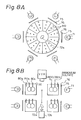
- Figures 4A and 4B are plane and sectional views of a reactor and an optical system for image recording;
- Figure 5 shows the operation and conditions of various methods for preparing biopolymer crystals in an apparatus shown in Fig. 2;
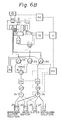
- Figs. 6A, 6B, and 6C are schematical diagrams of an apparatus shown in Fig. 2, showing the operation for different methods;
- Fig. 7 is a photograph of a single crystal of myoglobin obtained in an experiment according to the present invention;
- Figs. 8A and 8B are plane and sectional views of a reactor and an optical system for recording of another apparatus according to the present invention; and
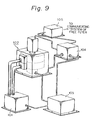
- Fig. 9 is a perspective view of an apparatus to be used in a free flyer.
- An example of an automated apparatus for preparing biopolymer crystals according to the present invention is described with reference to Figs. 1 to 9.
- Figure 1 is a block diagram of the apparatus. In the apparatus, under the control of a
central control system 1, reaction solutions are sent from asupply system 2 to areactor system 5, the temperature of which is controlled by atemperature control system 4, and a process of crystallization in thereactor system 5 is recorded by animage recording system 7. - Figure 2 is a more detailed construction of the apparatus shown in Fig. 1. The
supply system 2, in this case, comprises foursolution reservoirs 21 to 24 for a biopolymer solution, a biopolymer insolubilizing solution, a buffer, and a wash solution, reaction solution-selectingswitch valves stirrers first pump 29, asecond pump 30, a liquid passage-selectingswitch valve 31, three cooperating twelve-wayrotary valves 32 to 34, awaste reservoir 35, and a supplysystem control device 20 which controls the reaction solution-selectingswitch valves stirrers pumps switch valve 31, and the twelve-wayrotary valves solution reservoirs 21 to 24 may have a cap or they may be a closed system, if desired. - Figures 3A and 3B are perspective and sectional views of the
reactor system 5, respectively. Thereactor system 5 comprises elevenreactors 51 to 61 andpipes 51a to 61a, 51b to 61b and 51c to 61c connecting between each of thereactors 51 to 61 and each of the three twelve-wayrotary valves 32 to 34. In Fig. 2, only one set of thepipes - Each reactor comprises an inner peripheral vessel A, an outer peripheral vessel B, and a connecting part (passage) C connecting the inner and outer peripheral vessels A and B. The connecting part C has a structure by which the liquids in the inner and outer peripheral vessels A and B can be kept separate but vapor diffusion allowed therebetween. Preferably, the reactors are made of a transparent material such as glass or plastic to allow the state of the crystal growth to be recorded by the
image recording system 7. - The
pipes 51a to 61a are connected to the twelve-wayrotary valve 32, thepipes 51b to 61b are connected to the twelve-wayrotary valve 33, and thepipes 51c to 61c are connected to the twelve-wayrotary valve 34, respectively. - Figure 3A illustrates the
reactor system 5 which is composed of elevenreactors 51 to 61 and is in the shape of a doughnut. - Figure 3B illustrates the connections between the respective reactors and twelve-way rotary valves.
- In Fig. 2, the
temperature control system 4 comprises aheat accumulating chamber 41, astirrer 42, aheater 43, a heat sensor 44, and acontrol device 40 in thetemperature control system 4, which device controls theheater 43 and thestirrer 42 by signals from the heat sensor 44. In this example, thereactors 51 to 61 are surrounded by or included in theheat accumulating chamber 41. In order to carry out image recording, preferably at least a part of theheat accumulating chamber 41 used in an image recording optical system is transparent. - The
image recording system 7 comprises an illuminatinglight source 71, a light-passage switching mirror and a drivingunit 72 thereof, aTV camera 73, avideo tape recorder 74, and acontrol device 70 in the image recording system which device controls thelight source 71, a unit of the mirrors and thedrive 72 thereof, theTV camera 73, and thevideo tape recorder 74. - Figures 4A and 4B illustrate a more detailed construction of the unit of the light passage switching mirror and the
drive 72 thereof. Figure 4A is a plane view and Fig. 4B is a sectional view, in which light from thelight source 71 passes through aheat absorbing filter 75 and a scatteredlight filter 76, then passes through a desired reactor, is reflected by an opticalpass switching mirror 72a, and reaches the TV camera to project images of the biopolymer crystals therein. The opticalpass switching mirror 72a enables the observation and image recording of the state of crystal growth in the desired reactor, by rotation or vertical movement made by adriving unit 72b. - As seen in Fig. 4B, reactors may be provided at multiple levels, as shown by
reactors 5 and 5'. In such a case, the opticalpass switching mirror 72a is moved downward when recording at the lower reactor 5' is to be done. TheTV camera 73 is preferably movable. - In Fig. 2, the supply-
system control device 20, the temperature control-system control device 40 and the image recording-system control device 70 are controlled by acentral control device 1. - Examples for preparing biopolymer single crystals by (1) a batch-wise method; (2) a vapor diffusion method; and, (3) a free interface diffusion method, using the automated apparatus for preparing biopolymer crystals shown in Fig. 2, are described below.
- The operation of the
pumps valve 31 and the state of a reaction solution in a reactor in the above three kinds of methods for preparing biopolymer crystals are shown in Fig. 5. As seen in Fig. 5, in the batch-wise method, a mixture of biopolymer and insolubilizing solutions is charged in a vessel of a reactor and allowed to stand. In the vapor diffusion method, a biopolymer solution and an insolubilizing agent solution are charged in two vessels separately and then diffused from one solution to the other solution. In the free interface diffusion method, a biopolymer solution and an insolubilizing agent solution are charged in a vessel of a reactor as separate layers forming the interface therebetween and ingredients of the solutions then diffused into each of the solutions. - The batch-wise method is carried out by keeping an oversaturated biopolymer solution stationary to nucleate, crystallize, and grow biopolymer crystals from the solution. The oversaturated biopolymer solution containing a high salt concentration is prepared by the process of dissolving a biopolymer in water or an aqueous buffer solution, followed by adding a salt solution to the biopolymer solution.
- The vapor diffusion method is carried out by diffusing H₂O vapor (or an organic solvent vapor) in a biopolymer solution passing through the vapor phase equilibrated between the biopolymer solution and an aqueous salt solution (or an organic solvent solution) separated from each other in a closed system. When using an aqueous salt solution, the biopolymer solution is concentrated by diffusing water vapor from the solution to the aqueous salt solution because of a diluted concentration of the aqueous salt solution. When using an organic solvent solution, organic solvent vapor is dissolved into a biopolymer solution. In either case, the biopolymer solution becomes oversaturated by vapor diffusion.
- The free interface diffusion method is carried out by forming separate layers of a biopolymer solution and an aqueous salt solution or an organic solvent solution, one on top of the other. Crystallization and growth of the biopolymer crystals occur near the free interface of the solutions where oversaturation is attained, by diffusion with each other.
- As the buffer, acetic acid, phosphoric acid, trisulfuric acid buffers may be exemplified. As the neutral (neutric) salt, ammonium sulfate, phosphate, sodium chloride, magnesium sulfate, cerium chloride, etc., may be exemplified.
- First, an example of the vapor diffusion method is described with reference to Fig. 6A.
- A 2% aqueous solution of sperm whale myoglobin (produced by Sigma Chemical Co., USA) was used as the
biopolymer solution 24 and a saturated aqueous solution of ammonium sulfate as aninsolubilizing solution 21. - The pipes used in this operation are shown by thickened lines in Fig. 6A. The
pump 30 was operated at a speed of 1 ml/min, and thevalve 26 appropriately switched such that the sampling times, by thevalve 26, of theammonium sulfate solution 21, thebuffer 23 and themyoglobin solution 24 are in the ratio of 70:5:25 and the resultant mixture is stirred by thestirrer 28 to obtain a 0.5% myoglobin solution. - After connecting the
valve 34 to thewaste reservoir 35 to wash the pipe, thevalve 34 was connected to thereactor pump 29 at a speed of 1 ml/min, the saturated solution ofammonium sulfate 21 was sent through thevalve 31 to thevalve 32. 1 ml of thesolution 21 was supplied to thereactor 51 after washing the pipe. As a result, the two solutions were charged in the two vessels A and B of thereactor 51, as shown in Figs. 5 and 6A. During the above operation, excess gas in thereactor 51 was discharged through thevalves reactor 51. - Subsequently, reaction solutions could be supplied to the
other reactors 52 to 61 respectively by switching thevalve 32 to 34 in a similar manner to that described above. Here, if desired, different crystallization methods or conditions may be selected for any of theother reactors 52 to 61 by changing the operation of the pumps and the valves. Thus, different crystallization methods and/or conditions can be established in the same apparatus. - The operations for the batch-wise method and the free interface diffusion method are shown in Figs. 6B and 6C, respectively.
- Finally, the pipes were washed with the
wash solution 22 and the waste removed and sent to thewaste reservoir 35. - The temperature in the
reactors 51 to 61 was then controlled by thetemperature control system 4 for a time period required for crystal growth. The growth of crystals in thereactors 51 to 61 was observed and recorded by theimage recording system 7. The growth of crystals can be visually inspected, if necessary. - The conditions for crystal growth in the three methods in the above experiments are shown in Table 1. In Table 1, the concentration of the myoglobin solution means that concentration in the reactor, and the 80% saturation or the ammonium sulfate solution means a mixture of the 100% saturated ammonium sulfate solution and the buffer in a ratio of 4:1.
Table 1 Method Concentration of myoglobin solution Concentration of ammonium sulfate solution Batch-wise method 0.5 wt % 80% saturation Vapor diffusion method 0.5 wt % 80% saturation Free interface diffusion method 0.5 wt % 100% saturation - A myoglobin single crystal obtained as a result of the above operation is shown as a photograph in Fig. 7. The size of this crystal is about 100 µm.
- In examples of the invention, the operation of preparing biopolymer crystals is conducted automatically in accordance with a procedure preliminarily set in a central control system. As a result, the operator can be completely or almost freed from operation work. The crystal growth obtained by a process of the present invention is reproducible and further, different methods and/or conditions of preparing crystals can be conducted at the same time in the reactor system.
- By changing the temperature control, crystal growth at a gradually increased or decreased temperature can be carried out in the above apparatus, with a similar procedure.
- Another apparatus, for use under zero gravity, is described with reference to Figs. 8A, 8B, and 9. The apparatus is similar to the apparatus in Fig. 2 except for the reactor. Figures 8A and 8B are plane and sectional views of a reactor system and an image recording system of this embodiment.
- In Figs. 8A and 8B, parts or components having similar functions to those of Figs. 4A and 4B are denoted by the same reference numerals. In this apparatus, liquid supply pipes 80 (80a, 80b and 80c) penetrate the reactors 50 (51 to 61), each of which is a simple closed box and does not have two vessels as does a reactor in Fig. 3. Under zero gravity, if certain amount of liquid is introduced into a reactor 50 through a pipe 80, the liquid forms a sphere outside the end of the pipe and the sphere is suspended from the pipe. Therefore, by introducing biopolymer and insolubilizing agent solutions through two neighboring pipes, e.g., 80b and 80c respectively, two spheres of the biopolymer and insolubilizing agent solutions are formed and these two spheres come into contact with each other, thus forming a free interface between the two solutions. Figure 8B shows this method. If a mixture of biopolymer and insolubilizing agent solutions is introduced through a pipe, the stationary standing batch method of preparation of crystals can be conducted. If biopolymer and insolubilizing agent solutions are introduced through two
pipes - Figure 9 shows a perspective view of an apparatus for preparing biopolymer crystals, intended to be used in a free flyer which is placed in space by a space shuttle, rocket or the like and recovered after experiments have been carried out. In Fig. 9, 101 denotes a supply unit, 102 a reactor unit, 103 an electric source and temperature control unit, 104 a recording and controlling unit, and 105 a data processing unit. The
data processing unit 105 is connected to a communicating (communications) system of the free flyer. By providing thedata processing unit 105, the apparatus for preparing crystals can be controlled on the Earth in a desired procedure and can transmit images of crystal growth in the reactor to the Earth, by communication between the free flyer and the Earth.
said reactor defines two vessels separated but in communication with each other through a communicating part so that vapour of a component of a reaction solution in one of the vessels can reach another reaction solution in the other vessel through the communicating part, said supplying step including: storing respective reaction solutions in a plurality of reservoirs supplying the reaction solutions to the vessels using conduit means including pipes and a pump and selectively operating switch valves associated with the conduit means to mix the reaction solutions and to direct mixed or unmixed solutions to selected ones of the vessels; and
said predetermined procedure is a procedure for conducting preparation of biopolymer crystals in the reactor system by a batch-wise, vapour diffusion or free interface diffusion procedure, wherein, in the batch-wise procedure, the mixed reaction solution is supplied in one vessel; in the vapour diffusion procedure, the reaction solutions to be mixed are separately supplied to the two vessels, respectively; and in the free interface diffusion procedure, the reaction solutions to be mixed are supplied to one vessel in such a manner that one of the reaction solutions is first charged in the vessel and the other reaction solution is charged on a top of said one first charged reaction solution, whereby a free interface is formed between the reaction solutions.
said reactor comprises a box and at least three pipes penetrating said box for the supply of reaction solutions, said supplying step including: storing respective reaction solutions in a plurality of reservoirs, supplying the reaction solutions to the at least three pipes of the reactor using conduit means including pipes and a pump, and selectively operating switch valves associated with the conduit means to mix the reaction solutions and to direct mixed or unmixed solutions to selected ones of the at least three pipes of the reactor; and
said predetermined procedure is a procedure for conducting preparation of biopolymer crystals in the reactor system under zero gravity conditions by a batch-wise, vapour diffusion or free interface diffusion procedure, wherein, in the batch wise procedure, a mixed reaction solution is supplied to one of the at least three pipes of the reactor to form a sphere of the mixed reactor solution suspended from the pipe; in the vapour diffusion procedure, reaction solutions to be mixed are supplied to two of the at least three pipes of the reactor to form spheres of the reaction solutions suspended from the pipes and separated from each other; and in the free interface diffusion procedure, reaction solutions to be mixed are supplied to two of the at least three pipes of the reactor to form spheres of the reaction solutions suspended from the pipes and in contact with each other, whereby a free interface is formed between the two spheres.
Claims (13)
- An automated device for preparing biopolymer crystals, comprising a reactor system (5) having at least one reactor (51) in which biopolymer crystals are to be grown, a supply system (2) for supplying reaction solutions to the reactor system, and means (4) for controlling a temperature in the reactor system; characterised in that:
said reactor (51) defines two vessels (A,B) separated but in communication with each other through a communicating part (C) so that vapour of a component of a reaction solution in one of the vessels can reach another reaction solution in the other vessel through the communicating part;
said supply system (2) comprises a plurality of reservoirs (21...24) for storing respective reaction solutions, conduit means including pipes and a pump (29,30), operable to supply the reaction solutions to the vessels (A,B), and switch valves (25,26,31) associated with the conduit means and operable selectively to mix the reaction solutions and to direct mixed or unmixed solutions to selected ones of the vessels; and in that
means (1) are provided for controlling said supply system and said temperature controlling means in a predetermined procedure for conducting preparation of biopolymer crystals in the reactor system by a batch-wise, vapour diffusion or free interface diffusion procedure, wherein, in the batch-wise procedure, the mixed reaction solution is supplied in one vessel; in the vapour diffusion procedure, the reaction solutions to be mixed are separately supplied to the two vessels, respectively; and in the free interface diffusion procedure, the reaction solutions to be mixed are supplied to one vessel in such a manner that one of the reaction solutions is first charged in the vessel and the other reaction solution is charged on top of said one first charged reaction solution, whereby a free interface is formed between the reaction solutions. - A device according to claim 1, further comprising means (7) for recording a process of growth of the biopolymer crystals in the reactor system (5).
- A device according to claim 1 or 2, wherein said reactor system (5) comprises a plurality of reactors (51,52,...) and said supply system can deliver desired reaction solutions to a desired reactor in said reactor system.
- An automated device for preparing biopolymer crystals under conditions of zero gravity, comprising a reactor system (5) having at least one reactor (50) in which biopolymer crystals are to be grown, a supply system (2) for supplying reaction solutions to the reactor system, and means (4) for controlling a temperature in the reactor system;
characterised in that:-
said at least one reactor comprises a box penetrated by at least three pipes (80a, 80b, 80c) for the supply of reaction solutions;
said supply system (2) comprises a plurality of reservoirs (21 ... 24) for storing respective reaction solutions, conduit means including pipes and a pump (29, 30), operable to supply the reaction solutions to the at least three pipes (80a, 80b, 80c) of the reactor, and switch valves (25, 26, 31) associated with the conduit means and operable selectively to mix the reaction solutions and to direct mixed or unmixed solutions to selected ones of the at least three pipes of the reactor;
said at least three pipes (80a, 80b, 80c) are arranged so that under zero gravity conditions reaction solution supplied to any one of said pipes forms a sphere suspended from the pipe and so that spheres suspended from two of said pipes are separate or in contact; and in that
means (1) are provided for controlling said supply system and said temperature controlling means in a predetermined procedure for conducting preparation of biopolymer crystals in the reactor system under zero gravity conditions by a batch-wise vapour diffusion or free interface diffusion procedure, wherein, in the batchwise procedure, a mixed reaction solution is supplied to one of the at least three pipes (80a, 80b, 80c) of the reactor to form a sphere of the mixed reaction solution suspended from the pipe; in the vapour diffusion procedure, reaction solutions to be mixed are supplied to two (80a,80c) of the at least three pipes of the reactor to form spheres of the reaction solutions suspended from the pipes and separated from each other; and in the free interface diffusion procedure, reaction solutions to be mixed are supplied to two (e.g. 80b,80c) of the at least three pipes of the reactor to form spheres of the reaction solutions suspended from the pipes and in contact with each other, whereby a free interface is formed between the two spheres. - A device according to any preceding claim, wherein said reactor system is provided with a doughnut-shaped box separated into several closed sections (51...61) and each of the closed sections serves as a reactor, respectively.
- A device according to claim 5, wherein a rotatable mirror (72a) is disposed on the axis of the doughnut shaped box so that the crystal growth in each of the sections of the doughnut-shaped box can be observed or recorded at a place on the axis of the doughnut shape by rotating the mirror.
- A device according to any preceding claim, wherein said device comprises at least four reservoirs (21...24) for a biopolymer solution, an insolubilizing agent solution, a buffer and a wash, respectively.
- A process for preparing biopolymer crystals, comprising:a) supplying reaction solutions under automatic control to a reactor system (5) in which biopolymer crystals are to be grown, the reactor system having at least one reactor (51);b) controlling a temperature in the reactor system (5); andc) performing said supplying and temperature controlling steps automatically in accordance with a predetermined procedure for the preparation of biopolymer crystals;wherein
said reactor (51) defines two vessels (A,B) separated but in communication with each other through a communicating part (C) so that vapour of a component of a reaction solution in one of the vessels can reach another reaction solution in the other vessel through the communicating part, said supplying step including: storing respective reaction solutions in a plurality of reservoirs (21...24); supplying the reaction solutions to the vessels (A,B) using conduit means including pipes and a pump (29,30) and selectively operating switch valves (25,26,31) associated with the conduit means to mix the reaction solutions and to direct mixed or unmixed solutions to selected ones of the vessels; and
said predetermined procedure is a procedure for conducting preparation of biopolymer crystals in the reactor system by a batch-wise, vapour diffusion or free interface diffusion procedure, wherein, in the batch-wise procedure, the mixed reaction solution is supplied in one vessel; in the vapour diffusion procedure, the reaction solutions to be mixed are separately supplied to the two vessels, respectively; and in the free interface diffusion procedure, the reaction solutions to be mixed are supplied to one vessel in such a manner that one of the reaction solutions is first charged in the vessel and the other reaction solution is charged on top of said one first charged reaction solution, whereby a free interface is formed between the reaction solutions. - A process according to claim 8, further comprising a step of recording a process of growth of the biopolymer crystals in the reactor system (5).
- A process according to claim 8 or 9, wherein said reactor system (5) comprises a plurality of reactors (51,52,...) and said supplying step involves delivering desired reaction solutions to a desired reactor in said reactor system.
- A process for preparing biopolymer crystals, comprising:a) supplying reaction solutions under automatic control to a reactor system (5) in which biopolymer crystals are to be grown, the reactor system having at least one reactor (50);b) controlling a temperature in the reactor system (5); andc) performing said supplying and temperature controlling steps automatically in accordance with a predetermined procedure for the preparation of biopolymer crystals;wherein
said reactor (50) comprises a box and at least three pipes (80a,80b,80c) penetrating said box for the supply of reaction solutions, said supplying step including: storing respective reaction solutions in a plurality of reservoirs (21...24), supplying the reaction solutions to the at least three pipes of the reactor using conduit means including pipes and a pump (29,30), and selectively operating switch valves (25,26,31) associated with the conduit means to mix the reaction solutions and to direct mixed or unmixed solutions to selected ones of the at least three pipes (80a,80b,80c) of the reactor; and
said predetermined procedure is a procedure for conducting preparation of biopolymer crystals in the reactor system under zero gravity conditions by a batch-wise, vapour diffusion or free interface diffusion procedure, wherein, in the batch wise procedure, a mixed reaction solution is supplied to one of the at least three pipes (80a,80b,80c) of the reactor to form a sphere of the mixed reactor solution suspended from the pipe; in the vapour diffusion procedure, reaction solutions to be mixed are supplied to two (80a,80c) of the at least three pipes of the reactor to form spheres of the reaction solutions suspended from the pipes and separated from each other; and in the free interface diffusion procedure, reaction solutions to be mixed are supplied to two (e.g. 80b,80c) of the at least three pipes of the reactor to form spheres of the reaction solutions suspended from the pipes and in contact with each other, whereby a free interface is formed between the two spheres. - A process according to any of claims 8 to 11, wherein said reactor system is provided with a doughnut-shaped box separated into several closed sections (51...61) each serving as a reactor, respectively, the process further comprising rotating a rotatable mirror (72a) disposed on the axis of the doughnut shaped box to observe or record the crystal growth in each of the sections of the doughnut-shaped box.
- A process according to any of claims 8 to 12, wherein said supplying step involves storing a biopolymer solution, an insolubilizing agent solution, a buffer and a wash in respective ones of said reservoirs (21...24).
Applications Claiming Priority (2)
| Application Number | Priority Date | Filing Date | Title |
|---|---|---|---|
| JP243149/85 | 1985-10-30 | ||
| JP60243149A JPS62106000A (en) | 1985-10-30 | 1985-10-30 | Apparatus for automatic production of biopolymer crystal |
Publications (3)
| Publication Number | Publication Date |
|---|---|
| EP0225050A2 EP0225050A2 (en) | 1987-06-10 |
| EP0225050A3 EP0225050A3 (en) | 1988-04-27 |
| EP0225050B1 true EP0225050B1 (en) | 1992-04-08 |
Family
ID=17099520
Family Applications (1)
| Application Number | Title | Priority Date | Filing Date |
|---|---|---|---|
| EP86308404A Expired - Lifetime EP0225050B1 (en) | 1985-10-30 | 1986-10-29 | Automated biopolymer crystal preparation apparatus and process |
Country Status (4)
| Country | Link |
|---|---|
| US (1) | US4755363A (en) |
| EP (1) | EP0225050B1 (en) |
| JP (1) | JPS62106000A (en) |
| DE (1) | DE3684762D1 (en) |
Families Citing this family (49)
| Publication number | Priority date | Publication date | Assignee | Title |
|---|---|---|---|---|
| FR2604917B1 (en) * | 1986-10-09 | 1989-01-27 | Aerospatiale | CRYSTALLOGENESIS METHOD, CELL AND DEVICE, ESPECIALLY BY SPACE VESSEL |
| DE3738840A1 (en) * | 1987-08-12 | 1989-02-23 | Intospace Gmbh | CRYSTALIZATION DEVICE |
| EP0314469B1 (en) * | 1987-10-27 | 1993-06-23 | Fujitsu Limited | Process and apparatus for preparation of single crystal of biopolymer |
| US4919899A (en) * | 1988-02-29 | 1990-04-24 | Herrmann Frederick T | Crystal growth apparatus |
| US4886646A (en) * | 1988-03-23 | 1989-12-12 | The United States Of America As Represented By The Administrator Of The National Aeronautics And Space Administration | Hanging drop crystal growth apparatus and method |
| JP2740375B2 (en) * | 1990-10-25 | 1998-04-15 | 富士通株式会社 | Biopolymer crystallization equipment |
| JP2914758B2 (en) * | 1990-12-18 | 1999-07-05 | 富士通株式会社 | Method and apparatus for two-dimensional measurement of protein solution concentration |
| US6027565A (en) * | 1991-02-25 | 2000-02-22 | Bugg; Charles E. | Method and apparatus for crystalizing macromolecules in microgravity |
| US5866114A (en) * | 1992-06-09 | 1999-02-02 | Chiron Corporation | Crystallization of M-CSFα |
| US5985356A (en) | 1994-10-18 | 1999-11-16 | The Regents Of The University Of California | Combinatorial synthesis of novel materials |
| US6406903B2 (en) * | 1995-09-25 | 2002-06-18 | University Of Alabama At Birmingham | Dynamically controlled crystal growth system |
| FR2770231A1 (en) * | 1997-10-24 | 1999-04-30 | Commissariat Energie Atomique | Apparatus for growing crystals |
| WO1999031137A1 (en) | 1997-12-18 | 1999-06-24 | Eli Lilly And Company | Crystalline teriparatide |
| EP1059976A4 (en) * | 1998-02-18 | 2001-02-28 | Biospace Internat Inc | Dynamically controlled crystallization method and apparatus and crystals obtained thereby |
| US5961934A (en) * | 1998-02-18 | 1999-10-05 | Biospace International Inc. | Dynamically controlled crystallization method and apparatus and crystals obtained thereby |
| US20040064105A1 (en) * | 2002-09-27 | 2004-04-01 | Capes David Francis | Single-use syringe |
| US7798993B2 (en) * | 1998-07-29 | 2010-09-21 | Becton, Dickinson And Company | Single use syringe |
| US7244396B2 (en) * | 1999-04-06 | 2007-07-17 | Uab Research Foundation | Method for preparation of microarrays for screening of crystal growth conditions |
| US7214540B2 (en) * | 1999-04-06 | 2007-05-08 | Uab Research Foundation | Method for screening crystallization conditions in solution crystal growth |
| US7250305B2 (en) * | 2001-07-30 | 2007-07-31 | Uab Research Foundation | Use of dye to distinguish salt and protein crystals under microcrystallization conditions |
| US20030022383A1 (en) * | 1999-04-06 | 2003-01-30 | Uab Research Foundation | Method for screening crystallization conditions in solution crystal growth |
| DE60034033T2 (en) * | 1999-04-06 | 2007-12-06 | University of Alabama, Birmingham Research Foundation, Birmingham | DEVICE FOR SCREENING CRYSTALLIZATION CONDITIONS IN SOLUTIONS FOR CRYSTAL BREEDING |
| US7247490B2 (en) * | 1999-04-06 | 2007-07-24 | Uab Research Foundation | Method for screening crystallization conditions in solution crystal growth |
| US6296673B1 (en) | 1999-06-18 | 2001-10-02 | The Regents Of The University Of California | Methods and apparatus for performing array microcrystallizations |
| US6630006B2 (en) | 1999-06-18 | 2003-10-07 | The Regents Of The University Of California | Method for screening microcrystallizations for crystal formation |
| US20020169512A1 (en) * | 1999-08-02 | 2002-11-14 | Decode Genetics Ehf. | Plate mover for crystallization data collection |
| US6818060B2 (en) * | 1999-08-02 | 2004-11-16 | Emerald Biostructures, Inc. | Robot for mixing crystallization trial matrices |
| GB2384729A (en) * | 2000-09-28 | 2003-08-06 | Bsi Proteomics Corp | Automated robotic device for dynamically controlled crystallization of proteins |
| US6402837B1 (en) * | 2000-10-30 | 2002-06-11 | Abraham Shtrahman | Apparatus and method of preparation for automated high output biopolymer crystallization via vapor diffusion sitting drop and micro-batch techniques |
| US7670429B2 (en) * | 2001-04-05 | 2010-03-02 | The California Institute Of Technology | High throughput screening of crystallization of materials |
| EP1425577A4 (en) * | 2001-08-10 | 2004-12-29 | Symyx Technologies Inc | Apparatuses and methods for creating and testing pre-formulations and systems for same |
| JP3759891B2 (en) * | 2001-09-27 | 2006-03-29 | 独立行政法人理化学研究所 | Protein crystallization method and apparatus |
| US20040033166A1 (en) * | 2001-09-28 | 2004-02-19 | Leonard Arnowitz | Automated robotic device for dynamically controlled crystallization of proteins |
| US20070026528A1 (en) * | 2002-05-30 | 2007-02-01 | Delucas Lawrence J | Method for screening crystallization conditions in solution crystal growth |
| US20040007672A1 (en) * | 2002-07-10 | 2004-01-15 | Delucas Lawrence J. | Method for distinguishing between biomolecule and non-biomolecule crystals |
| US7118626B2 (en) * | 2003-08-29 | 2006-10-10 | University Of Alabama In Huntsville | Crystallization cassette for the growth and analysis of macromolecular crystals and an associated method |
| US7182810B2 (en) * | 2004-04-16 | 2007-02-27 | Canadian Space Agency | Protein temperature evaporation-controlled crystallization device and method thereof |
| US7507552B1 (en) | 2004-04-16 | 2009-03-24 | Takeda San Diego, Inc. | Crystallization of histone deacetylase 2 |
| JP4875591B2 (en) * | 2007-11-06 | 2012-02-15 | 古河機械金属株式会社 | Crystal observation device |
| CA2731723A1 (en) * | 2008-07-23 | 2010-01-28 | Ancora Pharmaceuticals Inc. | Automated oligosaccharide synthesizer |
| US10196700B2 (en) | 2009-03-24 | 2019-02-05 | University Of Chicago | Multivolume devices, kits and related methods for quantification and detection of nucleic acids and other analytes |
| CA2756463C (en) | 2009-03-24 | 2019-01-22 | University Of Chicago | Slip chip device and methods |
| US9447461B2 (en) | 2009-03-24 | 2016-09-20 | California Institute Of Technology | Analysis devices, kits, and related methods for digital quantification of nucleic acids and other analytes |
| US9464319B2 (en) | 2009-03-24 | 2016-10-11 | California Institute Of Technology | Multivolume devices, kits and related methods for quantification of nucleic acids and other analytes |
| JP5657326B2 (en) * | 2010-10-01 | 2015-01-21 | 株式会社 清原光学 | Microscopic observation apparatus in strong magnetic field |
| JP2012076963A (en) * | 2010-10-01 | 2012-04-19 | Kiyohara Optics Inc | Crystal generator in strong magnetic field |
| JP5896550B2 (en) * | 2011-09-21 | 2016-03-30 | 株式会社 清原光学 | Crystallization plate |
| JP2013067528A (en) * | 2011-09-21 | 2013-04-18 | Kiyohara Optics Inc | Observation device for crystallization plate |
| JP2013066404A (en) * | 2011-09-21 | 2013-04-18 | Kiyohara Optics Inc | Device for observing crystallization plate |
Family Cites Families (2)
| Publication number | Priority date | Publication date | Assignee | Title |
|---|---|---|---|---|
| US4263010A (en) * | 1979-10-31 | 1981-04-21 | University Patents, Inc. | Control method and apparatus for crystallizer process control |
| US4332590A (en) * | 1981-02-20 | 1982-06-01 | Phillips Petroleum Company | Reactor control |
-
1985
- 1985-10-30 JP JP60243149A patent/JPS62106000A/en active Granted
-
1986
- 1986-10-29 DE DE8686308404T patent/DE3684762D1/en not_active Expired - Lifetime
- 1986-10-29 EP EP86308404A patent/EP0225050B1/en not_active Expired - Lifetime
- 1986-10-29 US US06/924,330 patent/US4755363A/en not_active Expired - Lifetime
Also Published As
| Publication number | Publication date |
|---|---|
| EP0225050A3 (en) | 1988-04-27 |
| US4755363A (en) | 1988-07-05 |
| DE3684762D1 (en) | 1992-05-14 |
| JPS62106000A (en) | 1987-05-16 |
| JPH033640B2 (en) | 1991-01-21 |
| EP0225050A2 (en) | 1987-06-10 |
Similar Documents
| Publication | Publication Date | Title |
|---|---|---|
| US4755363A (en) | Automated biopolymer crystal preparation apparatus | |
| DE60211760T2 (en) | Apparatus and method for processing a plurality of reaction mixtures in parallel | |
| DE69033032T2 (en) | INTEGRATED CELL CULTURE PROTEIN CLEANING SYSTEM FOR THE AUTOMATED MANUFACTURE AND CLEANING OF CELL CULTURE PRODUCTS | |
| US6596081B1 (en) | Dynamically controlled crystallization method and apparatus and crystals obtained thereby | |
| Chayen et al. | Microbatch crystallization under oil—a new technique allowing many small-volume crystallization trials | |
| EP0763739B1 (en) | Method and apparatus for liquid treatment utilizing dispenser | |
| US4358470A (en) | Process and apparatus for the treatment of samples with a succession of liquids | |
| Bergfors | Protein crystallization | |
| DE3586892T2 (en) | DEVICE FOR SEPARATING CELLS. | |
| EP0553539A1 (en) | Crystal forming device and automated crystallization system | |
| US5362325A (en) | Apparatus for growing crystals in an environment in which opportunity for accessing is limited | |
| DE3601705A1 (en) | GAS BUBBLE GENERATOR AND DEVICE AND METHOD FOR BREEDING CELLS | |
| US8554344B2 (en) | Method and apparatus for microscopy | |
| Adawy et al. | High resolution protein crystals using an efficient convection-free geometry | |
| US5120650A (en) | Method for producing crystalline glucose isomerase | |
| JPH04232868A (en) | Liquid treating apparatus | |
| EP0432162B1 (en) | Apparatus and method for automated separation of extra-chromosomal dna from a cell suspension | |
| Yamamoto et al. | A simple microinjection technique not employing a micromanipulator | |
| Giegé et al. | Crystallogenesis of proteins | |
| Tang et al. | Study on the influence of lysozyme crystallization conditions on crystal properties in crystallizers of varied sizes when temperature is the manipulated variable | |
| Adachi et al. | New practical technique for protein crystallization with floating and stirring methods | |
| JP2002503538A (en) | Kinetic controlled crystallization method and apparatus and crystals obtained by them | |
| US5366552A (en) | Apparatus for liquid-phase epitaxial growth | |
| DeLucas et al. | Microgravity protein crystal growth; results and hardware development | |
| Villaseñor et al. | Fast drops: a high-throughput approach for setting up protein crystal screens |
Legal Events
| Date | Code | Title | Description |
|---|---|---|---|
| PUAI | Public reference made under article 153(3) epc to a published international application that has entered the european phase |
Free format text: ORIGINAL CODE: 0009012 |
|
| AK | Designated contracting states |
Kind code of ref document: A2 Designated state(s): DE FR GB |
|
| PUAL | Search report despatched |
Free format text: ORIGINAL CODE: 0009013 |
|
| AK | Designated contracting states |
Kind code of ref document: A3 Designated state(s): DE FR GB |
|
| 17P | Request for examination filed |
Effective date: 19880902 |
|
| 17Q | First examination report despatched |
Effective date: 19900205 |
|
| GRAA | (expected) grant |
Free format text: ORIGINAL CODE: 0009210 |
|
| AK | Designated contracting states |
Kind code of ref document: B1 Designated state(s): DE FR GB |
|
| REF | Corresponds to: |
Ref document number: 3684762 Country of ref document: DE Date of ref document: 19920514 |
|
| ET | Fr: translation filed | ||
| PLBE | No opposition filed within time limit |
Free format text: ORIGINAL CODE: 0009261 |
|
| STAA | Information on the status of an ep patent application or granted ep patent |
Free format text: STATUS: NO OPPOSITION FILED WITHIN TIME LIMIT |
|
| 26N | No opposition filed | ||
| PGFP | Annual fee paid to national office [announced via postgrant information from national office to epo] |
Ref country code: FR Payment date: 19931028 Year of fee payment: 8 |
|
| PG25 | Lapsed in a contracting state [announced via postgrant information from national office to epo] |
Ref country code: FR Effective date: 19950630 |
|
| REG | Reference to a national code |
Ref country code: FR Ref legal event code: ST |
|
| PGFP | Annual fee paid to national office [announced via postgrant information from national office to epo] |
Ref country code: GB Payment date: 19981030 Year of fee payment: 13 |
|
| PGFP | Annual fee paid to national office [announced via postgrant information from national office to epo] |
Ref country code: DE Payment date: 19981106 Year of fee payment: 13 |
|
| PG25 | Lapsed in a contracting state [announced via postgrant information from national office to epo] |
Ref country code: GB Free format text: LAPSE BECAUSE OF NON-PAYMENT OF DUE FEES Effective date: 19991029 |
|
| GBPC | Gb: european patent ceased through non-payment of renewal fee |
Effective date: 19991029 |
|
| PG25 | Lapsed in a contracting state [announced via postgrant information from national office to epo] |
Ref country code: DE Free format text: LAPSE BECAUSE OF NON-PAYMENT OF DUE FEES Effective date: 20000801 |