EP0225036A1 - Process for producing reinforced bodies, especially precast building units - Google Patents
Process for producing reinforced bodies, especially precast building units Download PDFInfo
- Publication number
- EP0225036A1 EP0225036A1 EP86308249A EP86308249A EP0225036A1 EP 0225036 A1 EP0225036 A1 EP 0225036A1 EP 86308249 A EP86308249 A EP 86308249A EP 86308249 A EP86308249 A EP 86308249A EP 0225036 A1 EP0225036 A1 EP 0225036A1
- Authority
- EP
- European Patent Office
- Prior art keywords
- fibres
- mixture
- mass
- prepared
- antistatic
- Prior art date
- Legal status (The legal status is an assumption and is not a legal conclusion. Google has not performed a legal analysis and makes no representation as to the accuracy of the status listed.)
- Withdrawn
Links
- 238000000034 method Methods 0.000 title claims abstract description 24
- 239000000203 mixture Substances 0.000 claims abstract description 46
- -1 polypropylene Polymers 0.000 claims abstract description 33
- 239000004743 Polypropylene Substances 0.000 claims abstract description 29
- 229920001155 polypropylene Polymers 0.000 claims abstract description 29
- 239000011159 matrix material Substances 0.000 claims abstract description 21
- 230000003014 reinforcing effect Effects 0.000 claims abstract description 11
- 230000000694 effects Effects 0.000 claims abstract description 9
- 239000002216 antistatic agent Substances 0.000 claims description 15
- 239000011248 coating agent Substances 0.000 claims description 12
- 238000005520 cutting process Methods 0.000 claims description 12
- 229920000642 polymer Polymers 0.000 claims description 12
- 238000000576 coating method Methods 0.000 claims description 10
- PEDCQBHIVMGVHV-UHFFFAOYSA-N Glycerine Chemical compound OCC(O)CO PEDCQBHIVMGVHV-UHFFFAOYSA-N 0.000 claims description 8
- XLYOFNOQVPJJNP-UHFFFAOYSA-N water Substances O XLYOFNOQVPJJNP-UHFFFAOYSA-N 0.000 claims description 8
- VBICKXHEKHSIBG-UHFFFAOYSA-N 1-monostearoylglycerol Chemical compound CCCCCCCCCCCCCCCCCC(=O)OCC(O)CO VBICKXHEKHSIBG-UHFFFAOYSA-N 0.000 claims description 6
- 239000000654 additive Substances 0.000 claims description 5
- 239000000463 material Substances 0.000 claims description 5
- 238000005507 spraying Methods 0.000 claims description 5
- 230000000996 additive effect Effects 0.000 claims description 4
- 239000011230 binding agent Substances 0.000 claims description 4
- 229920001577 copolymer Polymers 0.000 claims description 4
- 239000000839 emulsion Substances 0.000 claims description 4
- 235000011187 glycerol Nutrition 0.000 claims description 4
- 229920005862 polyol Polymers 0.000 claims description 4
- 150000003077 polyols Chemical class 0.000 claims description 4
- 229920001451 polypropylene glycol Polymers 0.000 claims description 4
- 229920002554 vinyl polymer Polymers 0.000 claims description 4
- 239000004372 Polyvinyl alcohol Substances 0.000 claims description 3
- 238000007664 blowing Methods 0.000 claims description 3
- 239000004014 plasticizer Substances 0.000 claims description 3
- 229920002451 polyvinyl alcohol Polymers 0.000 claims description 3
- 229920002134 Carboxymethyl cellulose Polymers 0.000 claims description 2
- 229920000663 Hydroxyethyl cellulose Polymers 0.000 claims description 2
- 239000004354 Hydroxyethyl cellulose Substances 0.000 claims description 2
- 229920003171 Poly (ethylene oxide) Polymers 0.000 claims description 2
- 239000002202 Polyethylene glycol Substances 0.000 claims description 2
- FXBZWPXBAZFWIY-UHFFFAOYSA-N butyl prop-2-enoate;ethenyl acetate Chemical compound CC(=O)OC=C.CCCCOC(=O)C=C FXBZWPXBAZFWIY-UHFFFAOYSA-N 0.000 claims description 2
- 239000001768 carboxy methyl cellulose Substances 0.000 claims description 2
- 235000010948 carboxy methyl cellulose Nutrition 0.000 claims description 2
- 239000008112 carboxymethyl-cellulose Substances 0.000 claims description 2
- 229940105329 carboxymethylcellulose Drugs 0.000 claims description 2
- HGAZMNJKRQFZKS-UHFFFAOYSA-N chloroethene;ethenyl acetate Chemical compound ClC=C.CC(=O)OC=C HGAZMNJKRQFZKS-UHFFFAOYSA-N 0.000 claims description 2
- 150000001875 compounds Chemical class 0.000 claims description 2
- 235000014113 dietary fatty acids Nutrition 0.000 claims description 2
- ZBCBWPMODOFKDW-UHFFFAOYSA-N diethanolamine Chemical compound OCCNCCO ZBCBWPMODOFKDW-UHFFFAOYSA-N 0.000 claims description 2
- 239000000428 dust Substances 0.000 claims description 2
- HDERJYVLTPVNRI-UHFFFAOYSA-N ethene;ethenyl acetate Chemical group C=C.CC(=O)OC=C HDERJYVLTPVNRI-UHFFFAOYSA-N 0.000 claims description 2
- 239000000194 fatty acid Substances 0.000 claims description 2
- 229930195729 fatty acid Natural products 0.000 claims description 2
- 150000004665 fatty acids Chemical class 0.000 claims description 2
- YQEMORVAKMFKLG-UHFFFAOYSA-N glycerine monostearate Natural products CCCCCCCCCCCCCCCCCC(=O)OC(CO)CO YQEMORVAKMFKLG-UHFFFAOYSA-N 0.000 claims description 2
- SVUQHVRAGMNPLW-UHFFFAOYSA-N glycerol monostearate Natural products CCCCCCCCCCCCCCCCC(=O)OCC(O)CO SVUQHVRAGMNPLW-UHFFFAOYSA-N 0.000 claims description 2
- 235000019447 hydroxyethyl cellulose Nutrition 0.000 claims description 2
- 229940071826 hydroxyethyl cellulose Drugs 0.000 claims description 2
- WXZMFSXDPGVJKK-UHFFFAOYSA-N pentaerythritol Chemical compound OCC(CO)(CO)CO WXZMFSXDPGVJKK-UHFFFAOYSA-N 0.000 claims description 2
- 229920001223 polyethylene glycol Polymers 0.000 claims description 2
- 229920002635 polyurethane Polymers 0.000 claims description 2
- 239000004814 polyurethane Substances 0.000 claims description 2
- 229940068984 polyvinyl alcohol Drugs 0.000 claims description 2
- 235000019422 polyvinyl alcohol Nutrition 0.000 claims description 2
- 150000005846 sugar alcohols Polymers 0.000 claims description 2
- 125000000383 tetramethylene group Chemical group [H]C([H])([*:1])C([H])([H])C([H])([H])C([H])([H])[*:2] 0.000 claims description 2
- 125000000391 vinyl group Chemical group [H]C([*])=C([H])[H] 0.000 claims description 2
- 229920003169 water-soluble polymer Polymers 0.000 claims description 2
- 238000002788 crimping Methods 0.000 abstract description 4
- 238000007788 roughening Methods 0.000 abstract description 4
- 238000007493 shaping process Methods 0.000 abstract description 4
- 238000009827 uniform distribution Methods 0.000 abstract description 3
- 230000001976 improved effect Effects 0.000 abstract description 2
- 239000000835 fiber Substances 0.000 description 35
- 239000004567 concrete Substances 0.000 description 16
- 238000004519 manufacturing process Methods 0.000 description 9
- 238000002156 mixing Methods 0.000 description 8
- 239000004568 cement Substances 0.000 description 7
- 244000144992 flock Species 0.000 description 5
- 239000008187 granular material Substances 0.000 description 5
- 239000007795 chemical reaction product Substances 0.000 description 4
- 230000003068 static effect Effects 0.000 description 4
- 238000010276 construction Methods 0.000 description 3
- 230000003247 decreasing effect Effects 0.000 description 3
- 238000009826 distribution Methods 0.000 description 3
- 238000009998 heat setting Methods 0.000 description 3
- 239000000843 powder Substances 0.000 description 3
- 239000007858 starting material Substances 0.000 description 3
- 230000008093 supporting effect Effects 0.000 description 3
- 238000001035 drying Methods 0.000 description 2
- 230000002209 hydrophobic effect Effects 0.000 description 2
- 239000002245 particle Substances 0.000 description 2
- 230000000737 periodic effect Effects 0.000 description 2
- 239000000047 product Substances 0.000 description 2
- 230000001737 promoting effect Effects 0.000 description 2
- 239000000126 substance Substances 0.000 description 2
- 238000004804 winding Methods 0.000 description 2
- 229920003345 Elvax® Polymers 0.000 description 1
- 239000004594 Masterbatch (MB) Substances 0.000 description 1
- 229910000831 Steel Inorganic materials 0.000 description 1
- XTXRWKRVRITETP-UHFFFAOYSA-N Vinyl acetate Chemical compound CC(=O)OC=C XTXRWKRVRITETP-UHFFFAOYSA-N 0.000 description 1
- 239000004480 active ingredient Substances 0.000 description 1
- 230000015572 biosynthetic process Effects 0.000 description 1
- 239000002131 composite material Substances 0.000 description 1
- 238000002425 crystallisation Methods 0.000 description 1
- 230000008025 crystallization Effects 0.000 description 1
- 238000004043 dyeing Methods 0.000 description 1
- 230000008030 elimination Effects 0.000 description 1
- 238000003379 elimination reaction Methods 0.000 description 1
- 239000005038 ethylene vinyl acetate Substances 0.000 description 1
- 238000002474 experimental method Methods 0.000 description 1
- 230000002349 favourable effect Effects 0.000 description 1
- 239000011210 fiber-reinforced concrete Substances 0.000 description 1
- 239000011152 fibreglass Substances 0.000 description 1
- 238000011049 filling Methods 0.000 description 1
- 239000011521 glass Substances 0.000 description 1
- 239000000155 melt Substances 0.000 description 1
- 239000002184 metal Substances 0.000 description 1
- 229920001200 poly(ethylene-vinyl acetate) Polymers 0.000 description 1
- 229920006254 polymer film Polymers 0.000 description 1
- 230000002940 repellent Effects 0.000 description 1
- 239000005871 repellent Substances 0.000 description 1
- 238000000926 separation method Methods 0.000 description 1
- 239000002904 solvent Substances 0.000 description 1
- 238000009987 spinning Methods 0.000 description 1
- 239000010959 steel Substances 0.000 description 1
- 229920002994 synthetic fiber Polymers 0.000 description 1
Classifications
-
- C—CHEMISTRY; METALLURGY
- C04—CEMENTS; CONCRETE; ARTIFICIAL STONE; CERAMICS; REFRACTORIES
- C04B—LIME, MAGNESIA; SLAG; CEMENTS; COMPOSITIONS THEREOF, e.g. MORTARS, CONCRETE OR LIKE BUILDING MATERIALS; ARTIFICIAL STONE; CERAMICS; REFRACTORIES; TREATMENT OF NATURAL STONE
- C04B16/00—Use of organic materials as fillers, e.g. pigments, for mortars, concrete or artificial stone; Treatment of organic materials specially adapted to enhance their filling properties in mortars, concrete or artificial stone
- C04B16/04—Macromolecular compounds
- C04B16/06—Macromolecular compounds fibrous
-
- C—CHEMISTRY; METALLURGY
- C04—CEMENTS; CONCRETE; ARTIFICIAL STONE; CERAMICS; REFRACTORIES
- C04B—LIME, MAGNESIA; SLAG; CEMENTS; COMPOSITIONS THEREOF, e.g. MORTARS, CONCRETE OR LIKE BUILDING MATERIALS; ARTIFICIAL STONE; CERAMICS; REFRACTORIES; TREATMENT OF NATURAL STONE
- C04B16/00—Use of organic materials as fillers, e.g. pigments, for mortars, concrete or artificial stone; Treatment of organic materials specially adapted to enhance their filling properties in mortars, concrete or artificial stone
- C04B16/04—Macromolecular compounds
- C04B16/06—Macromolecular compounds fibrous
- C04B16/0616—Macromolecular compounds fibrous from polymers obtained by reactions only involving carbon-to-carbon unsaturated bonds
- C04B16/0625—Polyalkenes, e.g. polyethylene
- C04B16/0633—Polypropylene
-
- C—CHEMISTRY; METALLURGY
- C04—CEMENTS; CONCRETE; ARTIFICIAL STONE; CERAMICS; REFRACTORIES
- C04B—LIME, MAGNESIA; SLAG; CEMENTS; COMPOSITIONS THEREOF, e.g. MORTARS, CONCRETE OR LIKE BUILDING MATERIALS; ARTIFICIAL STONE; CERAMICS; REFRACTORIES; TREATMENT OF NATURAL STONE
- C04B20/00—Use of materials as fillers for mortars, concrete or artificial stone according to more than one of groups C04B14/00 - C04B18/00 and characterised by shape or grain distribution; Treatment of materials according to more than one of the groups C04B14/00 - C04B18/00 specially adapted to enhance their filling properties in mortars, concrete or artificial stone; Expanding or defibrillating materials
- C04B20/10—Coating or impregnating
- C04B20/1018—Coating or impregnating with organic materials
- C04B20/1029—Macromolecular compounds
-
- E—FIXED CONSTRUCTIONS
- E04—BUILDING
- E04C—STRUCTURAL ELEMENTS; BUILDING MATERIALS
- E04C5/00—Reinforcing elements, e.g. for concrete; Auxiliary elements therefor
- E04C5/07—Reinforcing elements of material other than metal, e.g. of glass, of plastics, or not exclusively made of metal
Definitions
- the present invention relates to a process for producing bodies, especially precast building units from an after-setting mixture and reinforcing fibres added thereto.
- fibre reinforced concrete units e.g. covering units and supporting structures, as well.
- Fibres of various sorts are tested, steel wires, fiberglass, metal -glass filaments and synthetic fibres are equally used.
- staple fibres are added to the raw concrete as reinforcing inserts, made by splitting polypropylene film and by fibrillating the split strips.
- the quantity of the staple fibres the so-called "critical fibre content” is decreased by gripping one end or both ends of the fibre bundle introduced into the matrix thereby increasing the fixation degree of the fibres.
- This solution prevents the fibre bundles from being completely loosened' during mixing or only an optimum fibre loosening is allowed to promote proper bonding and, simultaneously, an advantageous consistency may be achieved for good placeability and compacting.
- a further advantage of gripping the fibre bundles resides in that an optimum charge of fibres may be applied promoting the most favourable mechanical properties, water-tightness, etc.
- This method can be considered advantageous for preparing thin /7 to 15 mm/ plates or platelike structures as with such thin structures there are practically no placeability problems.
- the particle size of the additives - loosening the fibre bundles to an optimum degree by using the conventional mixing methods will be more and more difficult to cope with.
- the appropriate means e.g. forced mixer are not available, it may happen that pouring the mixture into the mould begins before an optimum fibre distribution is achieved through mixing. In such circumstances the so-called "subjective factors" become more and more dominant, and may make doubtful the uniform quality of the end product.
- the object of the present invention is to provide a process for producing bodies, especially precast building units from a settable material reinforced with polypropylene fibres which results in a good embedding of the fibres and their most advantageous possible distribution in the matrix and, thereby, in achieving an end product of high and uniform quality.
- the fibres are introduced into the mixture as a separate step for establishing the three-dimensional fibre structure in the mixture, and for loosening the fibre bundles of fibrillated structure, instead of using the concrete mixing process.
- the human factors can be eliminated.
- binder, additive, water and reinforcing fibres are mixed together, the mixture is moulded and hardened or/and allowed to harden, and which process consists in preparing the mixture by adding polypropylene fibres previously treated for making them antistatic.
- the fibres may contain within their material or/and on their surface an antistatic agent, however, they can be made antistatic during cutting.
- the mixture is prepared by adding polypropylene fibres containing - considering the electrically nonpolar, highly water repellent character of the fibres - a polarized polymer showing in given case hydrophilic properties, e.g. glycerine, pentaerythritol, glycerol monostearate or one or more monoesters of glycerine with other fatty acids, polyethylene glycol/s/ of low or medium molecular weight; polypropylene glycol/s/, polyol component/s/ as used for preparing polyurethane, aliphatic amine/s/, or a mixture of two or more of them as an antistatic agent.
- the antistatic agents are introduced into the material of the polypropylene fibres either by applying them onto the surface of the polypropylene granules during manufacture of the fibres preceding feeding the granules into the extruder, or by preparing a master batch of polypropylene containing antistatic agent in high concentration and then extruding the fibres from this batch.
- the mixture is prepared by adding polypropylene fibres containing 0.1 to 5.0 mass % , expediently 0.3 to 1.0 mass% of an antistatic agent, in relation to the mass of the fibres.
- the settable mixture is prepared by adding polypropylene fibres having a surface coating containing as an antistatic agent a mixture of water soluble polymer/s/ e.g. polyvinyl alcohol, carboxy methyl cellulose, hydroxy ethyl cellulose, polyethylene oxide and, as plasticizer thereof polyol /polyalcohol / type compound/s/ e.g. polyoxy propylene or polyoxy tetramethylene.
- water soluble polymer/s/ e.g. polyvinyl alcohol, carboxy methyl cellulose, hydroxy ethyl cellulose, polyethylene oxide and, as plasticizer thereof polyol /polyalcohol / type compound/s/ e.g. polyoxy propylene or polyoxy tetramethylene.
- water soluble polymer/s/ e.g. polyvinyl alcohol, carboxy methyl cellulose, hydroxy ethyl cellulose, polyethylene oxide and, as plasticizer thereof polyol /polyalcohol
- the fibres to be added to the mixture can be made antistatic, as already referred to earlier, also during cutting so that the components of the matrix i.e. cement powder, mixing water, plasticizer etc. are applied e.g. by spraying or powder blowing to the surface of the cut fibres falling down and being well separated from each other.
- the matrix components applied to the fibres are basically the active ingredients of the cement bond, they have an advantageous influence to embedding of the fibres.
- the antistatic effect of the matrix components has, however, a limited time of effectivity thus, it assures only a limited possibility to make both operations, namely the cutting of fibres and concrete mixing, independent in time.
- a further embodiment of the invention resides in that the settable mixture is prepared by adding fibres having a surface coating containing, as an antistatic agent, a polymer being compatible to the material of the polypropylene fibre as well as to the components of the matrix and further containing matrix components applied to the fibres by dust blowing or/and by spraying them onto the surface of the fibres and thereby making them antistatic when falling down after cutting; preferably the settable mixture is prepared by adding fibres having a surface coating containing as a polymer, a copolymer emulsion of vinyl acetate--ethylene, vinyl acetate-vinyl chloride, vinyl acetate-vinyl versatate, vinyl acetate-butyl acrylate or a mixture of such copolymer emulsions.
- the settable mixture is prepared by adding fibres having a surface coating containing 0.01 to 10.0 mass%, expediently 0.1 to 1.0 mass% of a polymer, in relation to the mass of the fibres.
- a direct antistatic effect of such polymer/s/ is not required, they only have to promote adhering of the matrix components onto the surface of the polypropylene fibres.
- the polymers used for this purpose there obviously may be those having antistatic properties in themselves.
- Another object of the present invention is a process for preparing fibre reinforced parts, specially precast building units wherein binder, additive, water and reinforcing fibres are mixed together, the mixture is moulded and allowed to harden, this process being characterized in that the mixture is prepared by adding polypropylene fibres having profiled shape with altering cross section or/and being crimped. It is expedient when the mixture is prepared by adding polypropylene fibres containing equally or substantially equally distanced, flattened configurations formed by cold deformation.
- the fibres having profiled shape may also be made antistatic in which case more than one effect promotes the optimum embedding and fibre distribution.
- the profiled shaping of the fibres may be considered as roughening. Both the roughening and crimping result in an increase of the specific surface and thus, a better embedding of the fibres.
- the profiled shaping and crimping are linked with the fibre manufacturing process and technically can be carried out before making the rovings.
- the fibre being yet warm is slightly streched during winding and thereafter and, due to this, a waviness is produced which is hard to observe as long as the fibres are wound up, however becomes apparent when after cutting the fibres are unstressed.
- the profiled shaping resulting in a periodically repeated pattern on the fibre can e.g. be produced so that during fibre manufacture the warm fibre bundle coming from the heat setting apparatus and having a temperature of e.g. 60 to 80 °C, is passed between rolls with ribbed surfaces, the fibres being arranged adjacent to each other i.e. they are laid in the same plane.
- the ribs press - through cold deformation - uniform impresses into the fibres, which are periodically repeated.
- the fibre thickness may be as low as 70 % of the original thickness i.e. the fibre is flattened so that the cross sectional area.remains unchanged but at right angles to the plane of impressing the width of the fibre will be increased.
- the impresses may be distanced at e.g. 0.5 mm.
- the after-setting mixture is prepared by adding polypropylene monofilaments in a quantity of 0.05 to 20 mass%, expediently 0.1 to 1.0 mass% in relation to the mass of the matrix, the fibres having a length of 10 to 100 mm, advantageously 20'to 60 mm and a diameter /thickness/ of 0.04 to 0.8 mm, advantageously 0.1 to 0.4 mm.
- Precast supporting structure units were produced by the process according to the invention. As reinforcing fibres were added to the matrix manufactured by an extruder preparing monofilament bundles.
- the starting material was polypropylene /Tippeln H 263 FU/.
- the melt emerging from the spinning head was pressed into a hot water bath where crystallization of the polypropylene took place. Then the thick unoriented filaments were exposed to strong streching /at a relation 1:9/ in two steps. Thereafter heat setting /relaxation/ followed.
- the fibre bundle was passed through a bath containing surface coating agent based on polyvinyl alcohol, such as the product of the firm Henkel KGA /GFR/ under the trade name "Avirol 2003". From this surface coating agent an amount of 0.8 to 1.0 % in relation to the mass of the fibres, remained on the fibres after being dried.
- surface coating agent based on polyvinyl alcohol, such as the product of the firm Henkel KGA /GFR/ under the trade name "Avirol 2003.
- the fibre bundles consisting of monofilaments made antistatic on their surface and thereby made hydrophilic .in the above way, were cut to length of 40 mm in an automatic cutting device, and the cut fibres were filled into sacks and compacted, and delivered to the factory for manufacturing concrete units.
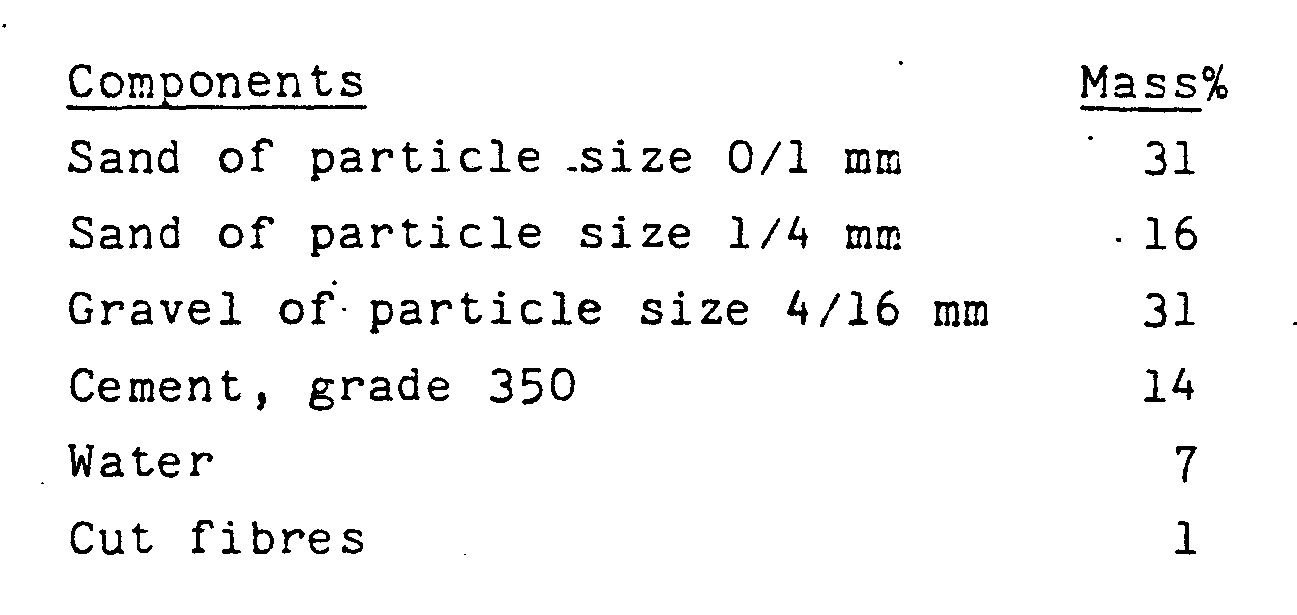
- the matrix was composed following the formula as set forth below: These components were homogenized in a conventional forced mixer, then the mixture was poured into moulds using a vibrator.
- the 7 days compressive strength of a unit prepared as described above exceeds by 15 to 20 % that of a concrete improved with fine crushing up to 60 % containing the same amount of cement but prepared without adding fibres, and it has a multiple impact strength and the same abrasive strength as compared to the latter. It is a prominent feature of the concretes prepared according to our invention that the standard deviation of the strength values is negligible, this fact proving that the structure contains the polypropylene fibres uniformly distributed.
- Supporting structure units were made according to Example 1 except that polypropylene granules Tipplen H 331 F were used as starting material for the fibre manufacture.
- 0.6 % glycerol stearate /in relation to the mass of the fibres/ was distributed in a dyeing drum. Then, the granules were fed into an extruder. No antistatic agent was applied to the surface of the fibres.
- the fibre bundle was directly wound up and cut into a length of 40 mm. During cutting and thereafter, when filled into sacks, the filaments did not gather to flocks, consequently, the concrete mixture contained the polypropylene fibres homogenously distributed, thus, the end product had the excellent properties as described in Example 1.
- the process was carried out according to Example 2 except that a concrete shell construction was prepared and fibres were added to the matrix, said fibres having been gathered to a bundle after emerging from the heat setting device, having still a temperature of about 60 to 80°C and were passed between rolls with ribbed surfaces the fibres being arranged adjacent to each other in the same plane, the ribs causing thereby periodic /equally distanced/ impresses pressed into the fibres under the effect of cold deformation.
- the impressed area the fibre thickness was decreased as low as about 70 % of the original thickness while the cross sectional area remained unchanged.
- the width of the fibre was increased perpendicularly to the impresses and a periodic pattern was produced with a sidewise dimension of the impresses amounting to 0.5 mm.
- the quality of the end product was further increased as compared to that according to Example 1 as the compressive strength of the concrete shell construction proved to be higher by 20% than that measured previously.
- a concrete shell construction was prepared by using the process according to the invention.
- the composition of the matrix was the same as in Example 1.
- the starting material of the fibres to be added was also the same as in Example 1, however, eliminating of the static charge was carried out as follows:
- the fibre bundle After having wound up the fibre bundle, just before cutting it to length, the fibre bundle was passed through a spraying chamber and a drying chamber following thereto.
- the surface of the fibre bundle was sprayed in the spraying chamber with an aqueous emulsion of an ethylene-vinyl acetate copolymer containing 40% of a low molar weight vinyl acetate.
- This type substance is known among others under the trade name "ELVAX 40".
- ELVAX 40 ethylene-vinyl acetate copolymer containing 40% of a low molar weight vinyl acetate.
- ELVAX 40 ethylene-vinyl acetate copolymer containing 40% of a low molar weight vinyl acetate.
- ELVAX 40 ethylene-vinyl acetate copolymer containing 40% of a low molar weight vinyl acetate.
- ELVAX 40 ethylene-vinyl acetate copolymer containing 40% of a low molar weight
- the fibres were introduced into an area containing cement powder, the cement particles adhered sufficiently to the surface cf the cut fibres falling down in this area.
- the fibres with a cement layer on their surface were practically free from static charge thus preventing an eventual adhesion between the individual filaments due to the effect of electric force.
- the cut fibres having such surface coating did not gather into flocks when being filled into sacks, they could be uniformly distributed within the matrix and the pieces of fibres can appropriately be embedded due to the composite layer of polymer and cement on their surfaces.
- the invention has the advantage of ensuring an optimum and uniform distribution of the fibres and their excellent embedding in the matrix thereby enabling to prepare a concrete product of perfect and uniform quality.
Landscapes
- Chemical & Material Sciences (AREA)
- Engineering & Computer Science (AREA)
- Ceramic Engineering (AREA)
- Structural Engineering (AREA)
- Materials Engineering (AREA)
- Organic Chemistry (AREA)
- Architecture (AREA)
- Chemical Kinetics & Catalysis (AREA)
- Civil Engineering (AREA)
- Treatments For Attaching Organic Compounds To Fibrous Goods (AREA)
- Compositions Of Macromolecular Compounds (AREA)
Abstract
Description
- The present invention relates to a process for producing bodies, especially precast building units from an after-setting mixture and reinforcing fibres added thereto.
- Nowdays there are worldwide efforts to develop fibre reinforced concrete units e.g. covering units and supporting structures, as well. Fibres of various sorts are tested, steel wires, fiberglass, metal -glass filaments and synthetic fibres are equally used.
- According to the Hungarian patent application 1766/83 staple fibres are added to the raw concrete as reinforcing inserts, made by splitting polypropylene film and by fibrillating the split strips. In order to facilitate placeability and compacting of the mixture, the quantity of the staple fibres, the so-called "critical fibre content" is decreased by gripping one end or both ends of the fibre bundle introduced into the matrix thereby increasing the fixation degree of the fibres. This solution prevents the fibre bundles from being completely loosened' during mixing or only an optimum fibre loosening is allowed to promote proper bonding and, simultaneously, an advantageous consistency may be achieved for good placeability and compacting. A further advantage of gripping the fibre bundles resides in that an optimum charge of fibres may be applied promoting the most favourable mechanical properties, water-tightness, etc.
- This method can be considered advantageous for preparing thin /7 to 15 mm/ plates or platelike structures as with such thin structures there are practically no placeability problems. However, when increasing the thickness - and at the same time the particle size of the additives - loosening the fibre bundles to an optimum degree by using the conventional mixing methods will be more and more difficult to cope with. As a result, especially when at the building or manufacturing site the appropriate means e.g. forced mixer are not available, it may happen that pouring the mixture into the mould begins before an optimum fibre distribution is achieved through mixing. In such circumstances the so-called "subjective factors" become more and more dominant, and may make doubtful the uniform quality of the end product.
- The object of the present invention is to provide a process for producing bodies, especially precast building units from a settable material reinforced with polypropylene fibres which results in a good embedding of the fibres and their most advantageous possible distribution in the matrix and, thereby, in achieving an end product of high and uniform quality.
- According to the invention, the fibres are introduced into the mixture as a separate step for establishing the three-dimensional fibre structure in the mixture, and for loosening the fibre bundles of fibrillated structure, instead of using the concrete mixing process. Thus, the human factors can be eliminated. For this purpose, however, we have to remove the difficulties impeding at present the effective application of the polypropylene fibres manufactured with smooth surface as monofilaments. There are two such basic difficulties, namely
- - poor embedding of the fibres in the matrix, resulting first of all from the hydrophobic character of the fibres,
- - electric charge of the staple fibres induced during cutting and resulting in formation of fibre flocks /tangled parts/ which
- cannot be loosened to separate the individual fibres and does not allow a uniform distribution of the fibres in the concrete mixture.
- It is an important recognition that eliminating static charge of the fibres /i.e. to make them antistatic/ also contributes to decreasing their hydrophobic character /i.e. makes the fibres hydrophilic/, and produces a further effect promoting a better bond between the concrete and the surfaces of the fibres. Yet another recognition resides in that when embedding the staple fibres in the matrix, surface bonding and thereby the degree of the fibre fixation may also significantly increased by roughening and/or crimping the fibres advantageously during their manufacture.
- In this way, binder, additive, water and reinforcing fibres are mixed together, the mixture is moulded and hardened or/and allowed to harden, and which process consists in preparing the mixture by adding polypropylene fibres previously treated for making them antistatic. The fibres may contain within their material or/and on their surface an antistatic agent, however, they can be made antistatic during cutting.
- According to an embodiment of the invention, the mixture is prepared by adding polypropylene fibres containing - considering the electrically nonpolar, highly water repellent character of the fibres - a polarized polymer showing in given case hydrophilic properties, e.g. glycerine, pentaerythritol, glycerol monostearate or one or more monoesters of glycerine with other fatty acids, polyethylene glycol/s/ of low or medium molecular weight; polypropylene glycol/s/, polyol component/s/ as used for preparing polyurethane, aliphatic amine/s/, or a mixture of two or more of them as an antistatic agent.
- The antistatic agents are introduced into the material of the polypropylene fibres either by applying them onto the surface of the polypropylene granules during manufacture of the fibres preceding feeding the granules into the extruder, or by preparing a master batch of polypropylene containing antistatic agent in high concentration and then extruding the fibres from this batch.
- According to a further feature of the invention, the mixture is prepared by adding polypropylene fibres containing 0.1 to 5.0 mass % , expediently 0.3 to 1.0 mass% of an antistatic agent, in relation to the mass of the fibres.
- According to another embodiment of the invention, the settable mixture is prepared by adding polypropylene fibres having a surface coating containing as an antistatic agent a mixture of water soluble polymer/s/ e.g. polyvinyl alcohol, carboxy methyl cellulose, hydroxy ethyl cellulose, polyethylene oxide and, as plasticizer thereof polyol /polyalcohol / type compound/s/ e.g. polyoxy propylene or polyoxy tetramethylene. In this case, the elimination of static charge takes place mainly in the last phase of the fibre manufacture or immediately thereafter. After the water as solvent has evaporated, there remains a thin polymer film on the surface of the fibres, having hydrophilic character. The quantity of the antistatic agents used as surface coating amounts to 0.1 to 1.0 mass%.
- The fibres to be added to the mixture can be made antistatic, as already referred to earlier, also during cutting so that the components of the matrix i.e. cement powder, mixing water, plasticizer etc. are applied e.g. by spraying or powder blowing to the surface of the cut fibres falling down and being well separated from each other. As the matrix components applied to the fibres are basically the active ingredients of the cement bond, they have an advantageous influence to embedding of the fibres. The antistatic effect of the matrix components has, however, a limited time of effectivity thus, it assures only a limited possibility to make both operations, namely the cutting of fibres and concrete mixing, independent in time. In order that the antistatic effect produced during cutting of the fibres remain effective also within the concrete mixture, thereby resulting in separation of the fibres, thus ensuring independence in time from the concrete mixing, a further embodiment of the invention resides in that the settable mixture is prepared by adding fibres having a surface coating containing, as an antistatic agent, a polymer being compatible to the material of the polypropylene fibre as well as to the components of the matrix and further containing matrix components applied to the fibres by dust blowing or/and by spraying them onto the surface of the fibres and thereby making them antistatic when falling down after cutting; preferably the settable mixture is prepared by adding fibres having a surface coating containing as a polymer, a copolymer emulsion of vinyl acetate--ethylene, vinyl acetate-vinyl chloride, vinyl acetate-vinyl versatate, vinyl acetate-butyl acrylate or a mixture of such copolymer emulsions. According to a further advantageous feature of the invention the settable mixture is prepared by adding fibres having a surface coating containing 0.01 to 10.0 mass%, expediently 0.1 to 1.0 mass% of a polymer, in relation to the mass of the fibres. It should be noted that a direct antistatic effect of such polymer/s/ is not required, they only have to promote adhering of the matrix components onto the surface of the polypropylene fibres. Among the polymers used for this purpose there obviously may be those having antistatic properties in themselves.
- Another object of the present invention is a process for preparing fibre reinforced parts, specially precast building units wherein binder, additive, water and reinforcing fibres are mixed together, the mixture is moulded and allowed to harden, this process being characterized in that the mixture is prepared by adding polypropylene fibres having profiled shape with altering cross section or/and being crimped. It is expedient when the mixture is prepared by adding polypropylene fibres containing equally or substantially equally distanced, flattened configurations formed by cold deformation. The fibres having profiled shape may also be made antistatic in which case more than one effect promotes the optimum embedding and fibre distribution.
- The profiled shaping of the fibres, as a result of which an individual fibre will show preferably a periodically repeated pattern, may be considered as roughening. Both the roughening and crimping result in an increase of the specific surface and thus, a better embedding of the fibres. Incidentally, the profiled shaping and crimping are linked with the fibre manufacturing process and technically can be carried out before making the rovings. The fibre being yet warm is slightly streched during winding and thereafter and, due to this, a waviness is produced which is hard to observe as long as the fibres are wound up, however becomes apparent when after cutting the fibres are unstressed.
- The profiled shaping resulting in a periodically repeated pattern on the fibre can e.g. be produced so that during fibre manufacture the warm fibre bundle coming from the heat setting apparatus and having a temperature of e.g. 60 to 80 °C, is passed between rolls with ribbed surfaces, the fibres being arranged adjacent to each other i.e. they are laid in the same plane. Thus, the ribs press - through cold deformation - uniform impresses into the fibres, which are periodically repeated. At the impressed places the fibre thickness may be as low as 70 % of the original thickness i.e. the fibre is flattened so that the cross sectional area.remains unchanged but at right angles to the plane of impressing the width of the fibre will be increased. The impresses may be distanced at e.g. 0.5 mm.
- According to any of the above described embodiments of the present invention, it is desirable that the after-setting mixture is prepared by adding polypropylene monofilaments in a quantity of 0.05 to 20 mass%, expediently 0.1 to 1.0 mass% in relation to the mass of the matrix, the fibres having a length of 10 to 100 mm, advantageously 20'to 60 mm and a diameter /thickness/ of 0.04 to 0.8 mm, advantageously 0.1 to 0.4 mm.
- The invention will be explained in details by the following examples.
- Precast supporting structure units were produced by the process according to the invention. As reinforcing fibres were added to the matrix manufactured by an extruder preparing monofilament bundles. The starting material was polypropylene /Tippeln H 263 FU/. The melt emerging from the spinning head was pressed into a hot water bath where crystallization of the polypropylene took place. Then the thick unoriented filaments were exposed to strong streching /at a relation 1:9/ in two steps. Thereafter heat setting /relaxation/ followed. Finally, before winding up, the fibre bundle was passed through a bath containing surface coating agent based on polyvinyl alcohol, such as the product of the firm Henkel KGA /GFR/ under the trade name "Avirol 2003". From this surface coating agent an amount of 0.8 to 1.0 % in relation to the mass of the fibres, remained on the fibres after being dried.
- The fibre bundles consisting of monofilaments made antistatic on their surface and thereby made hydrophilic .in the above way, were cut to length of 40 mm in an automatic cutting device, and the cut fibres were filled into sacks and compacted, and delivered to the factory for manufacturing concrete units. Here, the matrix was composed following the formula as set forth below:
- A reference experiment was also carried out by adding staple fibres which were not made antistatic. Apparently, the fibres were gathering in large flocks already when filling them into the sacks. These flocks could not be loosened even in the forced mixing machine, thus, the concrete mixture contained the fibres with a major inhomogenity, consequently, they were not able to exert an appropriate reinforcing effect.
- Supporting structure units were made according to Example 1 except that polypropylene granules Tipplen H 331 F were used as starting material for the fibre manufacture. On the surface of the granules 0.6 % glycerol stearate /in relation to the mass of the fibres/ was distributed in a dyeing drum. Then, the granules were fed into an extruder. No antistatic agent was applied to the surface of the fibres. The fibre bundle was directly wound up and cut into a length of 40 mm. During cutting and thereafter, when filled into sacks, the filaments did not gather to flocks, consequently, the concrete mixture contained the polypropylene fibres homogenously distributed, thus, the end product had the excellent properties as described in Example 1.
- The process was carried out according to Example 2 except that a concrete shell construction was prepared and fibres were added to the matrix, said fibres having been gathered to a bundle after emerging from the heat setting device, having still a temperature of about 60 to 80°C and were passed between rolls with ribbed surfaces the fibres being arranged adjacent to each other in the same plane, the ribs causing thereby periodic /equally distanced/ impresses pressed into the fibres under the effect of cold deformation. In the impressed area the fibre thickness was decreased as low as about 70 % of the original thickness while the cross sectional area remained unchanged. Thus, the width of the fibre was increased perpendicularly to the impresses and a periodic pattern was produced with a sidewise dimension of the impresses amounting to 0.5 mm. The quality of the end product was further increased as compared to that according to Example 1 as the compressive strength of the concrete shell construction proved to be higher by 20% than that measured previously.
- A concrete shell construction was prepared by using the process according to the invention. The composition of the matrix was the same as in Example 1. The starting material of the fibres to be added was also the same as in Example 1, however, eliminating of the static charge was carried out as follows:
- After having wound up the fibre bundle, just before cutting it to length, the fibre bundle was passed through a spraying chamber and a drying chamber following thereto. The surface of the fibre bundle was sprayed in the spraying chamber with an aqueous emulsion of an ethylene-vinyl acetate copolymer containing 40% of a low molar weight vinyl acetate. This type substance is known among others under the trade name "ELVAX 40". In the second chamber an air stream was passed through at a temperature of 40°C whereby the substance applied to the surface of the fibres was dried. The dried fibre bundle emerging from the drying chamber had a thin polymer layer on its surface. The fibre bundle with surface coating was then cut to a length of 40 mm. When, after such pretreatment, the fibres were introduced into an area containing cement powder, the cement particles adhered sufficiently to the surface cf the cut fibres falling down in this area. Thus, the fibres with a cement layer on their surface were practically free from static charge thus preventing an eventual adhesion between the individual filaments due to the effect of electric force. The cut fibres having such surface coating did not gather into flocks when being filled into sacks, they could be uniformly distributed within the matrix and the pieces of fibres can appropriately be embedded due to the composite layer of polymer and cement on their surfaces.
- The invention has the advantage of ensuring an optimum and uniform distribution of the fibres and their excellent embedding in the matrix thereby enabling to prepare a concrete product of perfect and uniform quality.
- It is understood that the disclosed process is by no way limited to the examples given above but it might be realized in various ways within the scope of the invention.
Claims (10)
Applications Claiming Priority (2)
| Application Number | Priority Date | Filing Date | Title |
|---|---|---|---|
| HU408485 | 1985-10-23 | ||
| HU408485A HUT48185A (en) | 1985-10-23 | 1985-10-23 | Process for producing building units, particularly prefabricated building units from after-hardening material mixture containing reinforcing fibres |
Publications (1)
| Publication Number | Publication Date |
|---|---|
| EP0225036A1 true EP0225036A1 (en) | 1987-06-10 |
Family
ID=10966826
Family Applications (1)
| Application Number | Title | Priority Date | Filing Date |
|---|---|---|---|
| EP86308249A Withdrawn EP0225036A1 (en) | 1985-10-23 | 1986-10-23 | Process for producing reinforced bodies, especially precast building units |
Country Status (2)
| Country | Link |
|---|---|
| EP (1) | EP0225036A1 (en) |
| HU (1) | HUT48185A (en) |
Cited By (17)
| Publication number | Priority date | Publication date | Assignee | Title |
|---|---|---|---|---|
| EP0318137A3 (en) * | 1987-11-24 | 1990-05-16 | Magyar Tudomanyos Akademia Termeszettudomanyi Kutatolaboratoriumai | Process for the production of bodies, in particular building elements, from hydraulic hardening mixtures containing reinforcing fibres, and process for obtaining plastic fibres with a roughened surface |
| WO1990006902A1 (en) * | 1988-12-14 | 1990-06-28 | Danaklon A/S | Fibres and material comprising same |
| EP0343148A3 (en) * | 1988-05-17 | 1990-08-22 | Walter Basta | Specially treated plastic fibre for improved building materials |
| AT394547B (en) * | 1988-03-21 | 1992-04-27 | Basta Walter | Hydraulically settable or bound building material, for example concrete, mortar, cement/sand mixtures, etc., containing polypropylene fibres as aggregate |
| AT395241B (en) * | 1988-11-11 | 1992-10-27 | Basta Walter | Process for recycling plastic scrap, mixing-in machine used for this purpose, fibres, building materials and fibre-reinforced concrete |
| EP0535373A1 (en) * | 1991-10-01 | 1993-04-07 | Daiwaboseki Co., Ltd. | Polypropylene fibre for reinforcing cement |
| US5277712A (en) * | 1992-08-20 | 1994-01-11 | Louisiana-Pacific Corporation | Dry mix-type joint compounds, compositions therefrom and methods for filling drywall joints with same |
| WO1999019268A1 (en) * | 1997-10-15 | 1999-04-22 | Redco S.A. | Shaped fibre cement products and reinforcing fibres for same |
| EP1044939A1 (en) * | 1999-04-13 | 2000-10-18 | Redco S.A. | Shaped fibrous cement products and reinforcement fibers for such products and method for treating such fibers |
| US6753081B1 (en) | 2001-02-21 | 2004-06-22 | Forta Corporation | Fiber reinforcement material, products made therefrom, and method for making the same |
| FR2849064A1 (en) * | 2002-12-20 | 2004-06-25 | Saint Gobain Mat Constr Sas | Polyolefin fiber for reinforcement of hydraulic setting products such as mortars or cement based articles which is treated with a size to promote wettability by, and adhesion to, the hydraulic binder |
| US7168232B2 (en) | 2001-02-21 | 2007-01-30 | Forta Corporation | Fiber reinforcement material, products made thereform, and method for making the same |
| EP1315857A4 (en) * | 2000-03-30 | 2009-07-15 | Grace W R & Co | Fibers for reinforcing matrix materials |
| EP2842921A1 (en) | 2013-08-27 | 2015-03-04 | Construction Research & Technology GmbH | Novel fibers, methods for their preparation and use in the manufacture of reinforced elements |
| EP3006609A1 (en) | 2014-10-09 | 2016-04-13 | Construction Research & Technology GmbH | Stretched polyolefin fibers |
| WO2016135182A1 (en) | 2015-02-27 | 2016-09-01 | Basf Se | Use of csh-seed modified fibers in oil field applications |
| US10829415B2 (en) | 2014-11-27 | 2020-11-10 | Construction Research & Technology, Gmbh | Surface-modified polyolefin fibers |
Citations (3)
| Publication number | Priority date | Publication date | Assignee | Title |
|---|---|---|---|---|
| US4039492A (en) * | 1975-11-26 | 1977-08-02 | Hamilton Materials | Synthetic fiber water base surface coating composition |
| DE2816457A1 (en) * | 1977-04-20 | 1978-11-02 | Chemiefaser Lenzing Ag | MIXTURE, PARTICULARLY BUILDING MATERIAL MIXTURE, AND METHOD FOR PRODUCING MOLDED BODIES FROM THIS MIXTURE |
| GB2035990A (en) * | 1978-11-28 | 1980-06-25 | Hawkins & Tipson Ltd | Fibre Containing Water- Hardenable Masses |
-
1985
- 1985-10-23 HU HU408485A patent/HUT48185A/en unknown
-
1986
- 1986-10-23 EP EP86308249A patent/EP0225036A1/en not_active Withdrawn
Patent Citations (3)
| Publication number | Priority date | Publication date | Assignee | Title |
|---|---|---|---|---|
| US4039492A (en) * | 1975-11-26 | 1977-08-02 | Hamilton Materials | Synthetic fiber water base surface coating composition |
| DE2816457A1 (en) * | 1977-04-20 | 1978-11-02 | Chemiefaser Lenzing Ag | MIXTURE, PARTICULARLY BUILDING MATERIAL MIXTURE, AND METHOD FOR PRODUCING MOLDED BODIES FROM THIS MIXTURE |
| GB2035990A (en) * | 1978-11-28 | 1980-06-25 | Hawkins & Tipson Ltd | Fibre Containing Water- Hardenable Masses |
Cited By (29)
| Publication number | Priority date | Publication date | Assignee | Title |
|---|---|---|---|---|
| GR880100735A (en) * | 1987-11-24 | 1994-03-31 | Magyar Tydomanyos Akademia Ter | Method for the preparation of bodies of special structural units by mixing hydraulically connected, retractable materials & reinforcing fibers, in addition to the method of preparation of synthetic fibers that have an irregular surface. |
| BE1002500A4 (en) * | 1987-11-24 | 1991-03-05 | Mta Termeszettu Domanyi Kutato | PROCESS FOR THE MANUFACTURE OF BODIES AND IN PARTICULAR CONSTRUCTION ELEMENTS MIXTURES OF HYDRAULICALLY LINED AND CURABLE MATERIALS AND REINFORCING FIBERS THEREOF, AS WELL AS PROCESS FOR THE PRODUCTION OF PLASTIC FIBERS WITH RENDERED SURFACES. |
| EP0318137A3 (en) * | 1987-11-24 | 1990-05-16 | Magyar Tudomanyos Akademia Termeszettudomanyi Kutatolaboratoriumai | Process for the production of bodies, in particular building elements, from hydraulic hardening mixtures containing reinforcing fibres, and process for obtaining plastic fibres with a roughened surface |
| AT394547B (en) * | 1988-03-21 | 1992-04-27 | Basta Walter | Hydraulically settable or bound building material, for example concrete, mortar, cement/sand mixtures, etc., containing polypropylene fibres as aggregate |
| EP0343148A3 (en) * | 1988-05-17 | 1990-08-22 | Walter Basta | Specially treated plastic fibre for improved building materials |
| AT395241B (en) * | 1988-11-11 | 1992-10-27 | Basta Walter | Process for recycling plastic scrap, mixing-in machine used for this purpose, fibres, building materials and fibre-reinforced concrete |
| WO1990006902A1 (en) * | 1988-12-14 | 1990-06-28 | Danaklon A/S | Fibres and material comprising same |
| AU630141B2 (en) * | 1988-12-14 | 1992-10-22 | Anglo-Danish Fibre Industries Limited | Fibres and material comprising same |
| US5399195A (en) * | 1988-12-14 | 1995-03-21 | Danaklon A/S | Fibres and material comprising same |
| US6010786A (en) * | 1991-10-01 | 2000-01-04 | Daiwabo Create Co., Ltd. | Polypropylene fiber for reinforcing cement |
| US5338357A (en) * | 1991-10-01 | 1994-08-16 | Polyfibre S.A. | Fibre reinforced shaped solid articles |
| EP0537129A1 (en) * | 1991-10-01 | 1993-04-14 | Polyfibre S.A. | Moulded solid products reinforced with fibres |
| EP0535373A1 (en) * | 1991-10-01 | 1993-04-07 | Daiwaboseki Co., Ltd. | Polypropylene fibre for reinforcing cement |
| CN1050346C (en) * | 1991-10-01 | 2000-03-15 | 多纤维公司 | Fibre reinforced shaped solid articles |
| US5277712A (en) * | 1992-08-20 | 1994-01-11 | Louisiana-Pacific Corporation | Dry mix-type joint compounds, compositions therefrom and methods for filling drywall joints with same |
| WO1999019268A1 (en) * | 1997-10-15 | 1999-04-22 | Redco S.A. | Shaped fibre cement products and reinforcing fibres for same |
| EP1044939A1 (en) * | 1999-04-13 | 2000-10-18 | Redco S.A. | Shaped fibrous cement products and reinforcement fibers for such products and method for treating such fibers |
| EP1315857A4 (en) * | 2000-03-30 | 2009-07-15 | Grace W R & Co | Fibers for reinforcing matrix materials |
| US7168232B2 (en) | 2001-02-21 | 2007-01-30 | Forta Corporation | Fiber reinforcement material, products made thereform, and method for making the same |
| US6753081B1 (en) | 2001-02-21 | 2004-06-22 | Forta Corporation | Fiber reinforcement material, products made therefrom, and method for making the same |
| FR2849064A1 (en) * | 2002-12-20 | 2004-06-25 | Saint Gobain Mat Constr Sas | Polyolefin fiber for reinforcement of hydraulic setting products such as mortars or cement based articles which is treated with a size to promote wettability by, and adhesion to, the hydraulic binder |
| WO2004065714A1 (en) * | 2002-12-20 | 2004-08-05 | Saint-Gobain Materiaux De Construction S.A.S. | Polyolefin reinforcing fibre, use thereof and products comprising same |
| EP2842921A1 (en) | 2013-08-27 | 2015-03-04 | Construction Research & Technology GmbH | Novel fibers, methods for their preparation and use in the manufacture of reinforced elements |
| WO2015028380A1 (en) | 2013-08-27 | 2015-03-05 | Construction Research & Technology Gmbh | Novel fibers, methods for their preparation and use in the manufacture of reinforced elements |
| US10065887B2 (en) | 2013-08-27 | 2018-09-04 | Construction Research & Technology, Gmbh | Fibers, methods for their preparation and use in the manufacture of reinforced elements |
| EP3006609A1 (en) | 2014-10-09 | 2016-04-13 | Construction Research & Technology GmbH | Stretched polyolefin fibers |
| US10829415B2 (en) | 2014-11-27 | 2020-11-10 | Construction Research & Technology, Gmbh | Surface-modified polyolefin fibers |
| WO2016135182A1 (en) | 2015-02-27 | 2016-09-01 | Basf Se | Use of csh-seed modified fibers in oil field applications |
| US10214676B2 (en) | 2015-02-27 | 2019-02-26 | Basf Se | Use of CSH-seed modified fibers in oil field applications |
Also Published As
| Publication number | Publication date |
|---|---|
| HUT48185A (en) | 1989-05-29 |
Similar Documents
| Publication | Publication Date | Title |
|---|---|---|
| EP0225036A1 (en) | Process for producing reinforced bodies, especially precast building units | |
| US3770859A (en) | Building materials | |
| US4261754A (en) | Fiber reinforced building products and method of producing same | |
| US4414030A (en) | Fiber-reinforced cement, and process | |
| EP0003245B1 (en) | Process for the manufacture of articles of water-hardening material | |
| DE2816457A1 (en) | MIXTURE, PARTICULARLY BUILDING MATERIAL MIXTURE, AND METHOD FOR PRODUCING MOLDED BODIES FROM THIS MIXTURE | |
| GB2026379A (en) | Reinforcing fibres and method of producing same | |
| US4111710A (en) | Method of incorporating carbon fibers into cement to produce reinforced structures having improved flexural strengths | |
| EP0026581B1 (en) | Fibrous reinforcement material for water-hardenable masses and method of reinforcing such masses | |
| DE2919503A1 (en) | GLASS FIBERS PROVIDED WITH A COATING, METHOD FOR THE PRODUCTION THEREOF, METHOD FOR PRODUCING A FIBER-REINFORCED CEMENT-LIKE PRODUCT, AND FIBERGLASS-REINFORCED CEMENT-LIKE PRODUCT | |
| US3271492A (en) | Method of making a non-porous board composed of strands of wood and portland cement | |
| JP2835812B2 (en) | Focused cement reinforcing fibers | |
| US7067002B2 (en) | Unitized fibrous concrete reinforcement | |
| GB2035990A (en) | Fibre Containing Water- Hardenable Masses | |
| JPH0986984A (en) | Polypropylene fiber for cement reinforcement | |
| EP0152490A1 (en) | Improved fibre-reinforced cement and process | |
| US1744256A (en) | Bonded-fiber separator and process of making the same | |
| JPH0299657A (en) | Preformable mat | |
| JPH10236855A (en) | Polypropylene fiber for cement reinforcement | |
| US20060147694A1 (en) | Unitized filamentary concrete reinforcement having circumferential binding element | |
| EP0051498B1 (en) | Process for the preparation of manufactured products based on hydraulic binders | |
| US1606051A (en) | Material for building and other purposes | |
| JP2744944B2 (en) | Manufacturing method of hardened cement | |
| GB2198072A (en) | Apparatus for molding articles from fibrous concrete | |
| JP3266646B2 (en) | Manufacturing method of carbon fiber chops |
Legal Events
| Date | Code | Title | Description |
|---|---|---|---|
| PUAI | Public reference made under article 153(3) epc to a published international application that has entered the european phase |
Free format text: ORIGINAL CODE: 0009012 |
|
| AK | Designated contracting states |
Kind code of ref document: A1 Designated state(s): AT CH DE FR GB IT LI NL SE |
|
| STAA | Information on the status of an ep patent application or granted ep patent |
Free format text: STATUS: THE APPLICATION IS DEEMED TO BE WITHDRAWN |
|
| 18D | Application deemed to be withdrawn |
Effective date: 19871211 |
|
| RIN1 | Information on inventor provided before grant (corrected) |
Inventor name: LUDVIG, LAJOS Inventor name: NAGY, GABOR Inventor name: SZEKELY, TAMAS Inventor name: BABOS, LASZLO Inventor name: DEZSENYI, ISTVAN Inventor name: VALTINYI, DANIEL |