EP0222002B1 - Alloy toughening method - Google Patents
Alloy toughening method Download PDFInfo
- Publication number
- EP0222002B1 EP0222002B1 EP86903818A EP86903818A EP0222002B1 EP 0222002 B1 EP0222002 B1 EP 0222002B1 EP 86903818 A EP86903818 A EP 86903818A EP 86903818 A EP86903818 A EP 86903818A EP 0222002 B1 EP0222002 B1 EP 0222002B1
- Authority
- EP
- European Patent Office
- Prior art keywords
- particles
- toughness
- regions
- featureless
- alloy
- Prior art date
- Legal status (The legal status is an assumption and is not a legal conclusion. Google has not performed a legal analysis and makes no representation as to the accuracy of the status listed.)
- Expired - Lifetime
Links
Images

Classifications
-
- C—CHEMISTRY; METALLURGY
- C21—METALLURGY OF IRON
- C21D—MODIFYING THE PHYSICAL STRUCTURE OF FERROUS METALS; GENERAL DEVICES FOR HEAT TREATMENT OF FERROUS OR NON-FERROUS METALS OR ALLOYS; MAKING METAL MALLEABLE, e.g. BY DECARBURISATION OR TEMPERING
- C21D1/00—General methods or devices for heat treatment, e.g. annealing, hardening, quenching or tempering
-
- B—PERFORMING OPERATIONS; TRANSPORTING
- B22—CASTING; POWDER METALLURGY
- B22F—WORKING METALLIC POWDER; MANUFACTURE OF ARTICLES FROM METALLIC POWDER; MAKING METALLIC POWDER; APPARATUS OR DEVICES SPECIALLY ADAPTED FOR METALLIC POWDER
- B22F1/00—Metallic powder; Treatment of metallic powder, e.g. to facilitate working or to improve properties
- B22F1/14—Treatment of metallic powder
- B22F1/142—Thermal or thermo-mechanical treatment
-
- B—PERFORMING OPERATIONS; TRANSPORTING
- B22—CASTING; POWDER METALLURGY
- B22F—WORKING METALLIC POWDER; MANUFACTURE OF ARTICLES FROM METALLIC POWDER; MAKING METALLIC POWDER; APPARATUS OR DEVICES SPECIALLY ADAPTED FOR METALLIC POWDER
- B22F3/00—Manufacture of workpieces or articles from metallic powder characterised by the manner of compacting or sintering; Apparatus specially adapted therefor ; Presses and furnaces
- B22F3/24—After-treatment of workpieces or articles
-
- C—CHEMISTRY; METALLURGY
- C22—METALLURGY; FERROUS OR NON-FERROUS ALLOYS; TREATMENT OF ALLOYS OR NON-FERROUS METALS
- C22C—ALLOYS
- C22C1/00—Making non-ferrous alloys
- C22C1/04—Making non-ferrous alloys by powder metallurgy
- C22C1/0408—Light metal alloys
- C22C1/0416—Aluminium-based alloys
Definitions
- a method of treating a metallurgical object or metal particles to improve toughness of the object or object formed by bonding the particles together wherein the object or the particles contain metastable featureless regions adversely, affecting the toughness of the object or object formed from the particles, comprising heating the object or the particles for transforming the regions at least sufficiently out of their metastable state to stabilize them and make them deformable, and deforming the object or object formed from the particles to improve the toughness of the object or object formed from the particles.
- Preferred embodiments are defined in the dependent claims 2 to 9.
- Figure 1 composed of Figures 1a to 1d, are photomicrographs of a powder used in the invention.
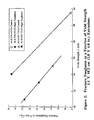
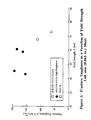
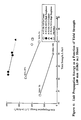
- Figures 2 to 4 are plots of data.
- the present invention concerns a treatment of metallurgical objects containing certain metastable, featureless regions.
- the treatment improves fracture toughness.
- zone A regions is synonymous to “featureless regions”, as can be observed, for instance, in the references antedating Jones, as cited in the preceding paragraph), such indicating that discussion is of crystalline material.
- EP-A-0 136 508 discloses an aluminum-based alloy having high strength at elevated temperatures which may be comminuted and processed into articles by deformation at high temperatures. It further discloses a method and apparatus for forming rapidly solidified metal having a desired microstructure. In alloys cast by employing the apparatus and method, optical microscopy reveals a uniform, featureless morphology.
- Figure 1 illustrates the phenomenon of featureless regions.
- Figure 1a taken using optical microscopy, the featureless regions appear white as compared to the other regions which have a texture that appears to be black specks on a gray background. Note that the smaller particles tend to be completely featureless, an effect of the higher cooling rate experienced by the smaller particles.
- the scanning electron microscopy photographs of Figures 1b-1d further illustrate the featureless regions, which appear uniformly gray as compared to the remaining, dendritically textured regions.
- Figures 1b and 1d show again the smaller, completely featureless regions.
- Figure 1c shows in particularly good detail that the particle has a featureless half-moon region on its lower side.
- any alloy containing featureless regions can be treated according to the invention.
- a preferred Al alloy consists essentially of 4 to 12% Fe, 2 to 14% Ce, remainder Al. Fe combines with Al to form intermetallic dispersoids and precipitates providing strength at room temperature and elevated temperature. Ce combines with Fe and Al to form intermetallic dispersoids which provide strength, thermal stability and corrosion resistance. Further information concerning this alloy is contained in U.S. Patent Nos. 4,379,719 and 4,464,199.
- This heating step of the invention for the above preferred Al alloy will generally be in the range 750-950°F for 10 seconds to 4 hours. However, at lower temperatures, longer time may be suitable. This could be of advantage in the case of large billets, in order to obtain temperature uniformity.
- the featureless particles are stabilized and they become deformable.
- Deformation after the uniformizing treatment for instance deformation in the form of compaction, extrusion or rolling, will provide a more uniform microstructure, with improved bonding between powder particles.
- Improved interparticle powder bonding further increases toughness and resistance to crack propagation.
- Table A illustrates results achieved by procedure according to the present invention (with heat treatment, i.e. 1 to 3 minutes at 900°F followed by cooling to 725°F extrusion temperature) compared to results without heat treatment (i.e. the billet was heated directly to the 725°F extrusion temperature and then extruded). Processing in going from extruded bar to sheet was the same in both instances.
- the invention improves toughness and thermal stability in metallurgical objects based on rapid solidification processes. It is expected that creep behavior will also be improved.
- Rapidly solidified aluminum alloy powder of composition 8.4% Fe, 4.0% Ce, rest essentially aluminum had featureless regions resulting from rapid cooling during formation of the powder.
- a pot of such composition was alloyed by adding high purity alloying elements to high purity aluminum. The melt was passed through a filter and atomized using high temperature flue gas to minimize the oxidation of the alloying elements. During atomization, the powder was continuously passed through a cyclone to separate the particles from the high velocity air stream. The majority of powder particles had diameters between 5 and 40 micrometers. Powder was screened to retain only less than 74 micrometers size powder and fed directly into a drum.
- the powder had the following percentages of impurities: Si 0.14, Cu 0.02, Mn 0.04, Cr 0.01, Ni 0.02, Zn 0.02, Ti 0.01.
- the powder was found to have featureless regions in about the same quantity and distribution as shown in Figure 1.
- the particle size distribution of the powder was 4.4% in the range 44 to 74 micrometers and 95.4% smaller than 44 micrometers. Average particle diameter was 15.5 microns as determined on a Fisher Subsieve Sizer.
- Billet was made from this powder by cold isostatic pressing to approximately 75% of theoretical density.
- Each 66 kg (145 lb) cold isostatic compact was encapsulated in an aluminum container with an evacuation tube on one end.
- the canned compacts were placed in a 658 K (725°F) furnace and continuously degassed for six hours, attaining a vacuum level below 40 microns. Degassed and sealed compacts were then hot pressed at 725°F to 100 percent density using an average pressure of 469.2 MPa (68 ksi).
- a cylindrical extrusion charge measuring 15 cm (6.125 in.) diameter x 30.5 cm (12 in.) length was machined from the billet and subjected to a uniformizing treatments of 1 minute at 850°F and 1 minute at 900°F. Heating was done using an induction furnace operating at 60 H z . Temperature was measured by a thermocouple placed at an axial location about 1.2 cm (0.5 in.) from the end. It took about 10 minutes to heat the extrusion charge from room temperature to 850°F or 900°F at which point temperature was controlled at 850°F and 900°F for the 1 minute holding time.
- the extrusion charge was then air-cooled to 725°F and extruded as a bar of 5 cm (2 inches) x 10 cm (4 inches) cross section.
- Al-Fe-Ce alloy having the composition Al-8.4%Fe-7.0%Ce was also uniformized at 900°F for 1 min.
- Extruded bar of Example I was rolled at 600°F to sheet of final thickness equalling 1.60 mm (0.063 inch).
- the extrusion Prior to rolling, the extrusion was sawed to approximately 25 cm (10 in.) lengths. Surface roughness, caused by pickup of aluminum on the extrusion dies, was eliminated by machining the extrusions to the thicknesses listed in Table III. Also listed are process parameters used to roll the Al-Fe-Ce 1.60 mm (0.063 in.) sheet.
- Each piece was cross rolled until the desired width, greater than 41 cm (16 inches) was obtained, followed by straight rolling to the desired thickness, 1.60 mm (0.063 inch).
- Figure 3 shows the graphic representation of the strength/fracture toughness, K c , relationships for representative samples of Table II, while Figure 4 provides a corresponding presentation from Table II in the form of toughness indicator, or unit propagation energy, against yield strength.
- the superiority of sheet treated according to the present invention compared to the ingot metallurgy representatives is apparent.
Landscapes
- Chemical & Material Sciences (AREA)
- Engineering & Computer Science (AREA)
- Mechanical Engineering (AREA)
- Physics & Mathematics (AREA)
- Thermal Sciences (AREA)
- Materials Engineering (AREA)
- Metallurgy (AREA)
- Organic Chemistry (AREA)
- Crystallography & Structural Chemistry (AREA)
- Manufacturing & Machinery (AREA)
- Powder Metallurgy (AREA)
- Manufacture Of Metal Powder And Suspensions Thereof (AREA)
Abstract
Description
- Metallurgical objects produced from rapidly cooled metal have been burdened by low toughness. The cause of this low toughness was not known.
- It is an object of the invention to provide a method for toughening metallurgical objects produced from rapidly cooled metal components.
- We have discovered that metastable, featureless regions in rapidly cooled metal adversely affect toughness.
- According to the present invention, there is provided a method of treating a metallurgical object or metal particles to improve toughness of the object or object formed by bonding the particles together wherein the object or the particles contain metastable featureless regions adversely, affecting the toughness of the object or object formed from the particles, comprising heating the object or the particles for transforming the regions at least sufficiently out of their metastable state to stabilize them and make them deformable, and deforming the object or object formed from the particles to improve the toughness of the object or object formed from the particles. Preferred embodiments are defined in the dependent claims 2 to 9.
- Figure 1 , composed of Figures 1a to 1d, are photomicrographs of a powder used in the invention.
- Figures 2 to 4 are plots of data.
- The present invention concerns a treatment of metallurgical objects containing certain metastable, featureless regions. The treatment improves fracture toughness.
- Instances in the literature where the term "featureless" is used to refer to these regions are as follows:
Location in Reference Citation of Reference Col. 4, line 21 U.S. Pat. No. 3,899,820, 8/19/85 E.g. lines 7&8, abstract RapidlyQu'dMetalsIII,1,73-84,1978 E.g., the title Met.Trans.A,V.15A,1/84,pp29-31 Intro.,2nd.para.,line2 Scrip.Met'ica,V18,1984,pp905-9 Intro.,2nd.para.,line6 Scrip.Met'ica,V18,1984,pp911-6 E.g., page 26MatResSocSympProc,V28,1984,pp21-7 Pg. 148, top left col. Mat.Sci.&Eng.,V65,1984,pp145-56 3rd.para.,line2 43rdAnMt'gElecM'scopSoc,'85,pp32-3 Pg.9, line 6 EP-A-0 136 508, 4/10/85 - These featureless regions are crystalline. This is evident alone in the title of the second-listed reference, "Rapidly Quenched Crystalline Alloys". It is also evident from what is believed to be the pioneer article on these regions, entitled "Observations on a Structural Transition in Aluminum Alloys Hardened by Rapid Solidification" by H. Jones, Mater.Sci.Eng., 5 (1969/70),pp. 1-18. Thus, in the Summary of the article by Jones, refrence is to X-ray diffraction alpha-Al line broadening, and shift, in zone A regions ("zone A regions" is synonymous to "featureless regions", as can be observed, for instance, in the references antedating Jones, as cited in the preceding paragraph), such indicating that discussion is of crystalline material.
- The ninth-listed reference, EP-A-0 136 508, discloses an aluminum-based alloy having high strength at elevated temperatures which may be comminuted and processed into articles by deformation at high temperatures. It further discloses a method and apparatus for forming rapidly solidified metal having a desired microstructure. In alloys cast by employing the apparatus and method, optical microscopy reveals a uniform, featureless morphology.
- The featureless regions result from rapid cooling. Figure 1 illustrates the phenomenon of featureless regions. In Figure 1a, taken using optical microscopy, the featureless regions appear white as compared to the other regions which have a texture that appears to be black specks on a gray background. Note that the smaller particles tend to be completely featureless, an effect of the higher cooling rate experienced by the smaller particles. The scanning electron microscopy photographs of Figures 1b-1d further illustrate the featureless regions, which appear uniformly gray as compared to the remaining, dendritically textured regions. Figures 1b and 1d show again the smaller, completely featureless regions. Figure 1c shows in particularly good detail that the particle has a featureless half-moon region on its lower side. This is an aspect which also shows in Figures 1a and 1b, namely that higher cooling rates in some parts of a particle versus slower cooling rates in other parts can lead to a situation where the particle will be featureless in the rapidly cooled parts and textured in the slower cooled parts.
- In general, any alloy containing featureless regions can be treated according to the invention.
- A preferred Al alloy consists essentially of 4 to 12% Fe, 2 to 14% Ce, remainder Al. Fe combines with Al to form intermetallic dispersoids and precipitates providing strength at room temperature and elevated temperature. Ce combines with Fe and Al to form intermetallic dispersoids which provide strength, thermal stability and corrosion resistance. Further information concerning this alloy is contained in U.S. Patent Nos. 4,379,719 and 4,464,199.
- With respect to strength, such as yield or tensile strength, our uniformizing heat treatment, within the featureless regions, represents an overaging.
- This heating step of the invention for the above preferred Al alloy will generally be in the range 750-950°F for 10 seconds to 4 hours. However, at lower temperatures, longer time may be suitable. This could be of advantage in the case of large billets, in order to obtain temperature uniformity.
- Fast heating appears to be best (via induction heating), since this will prevent coarsening, for instance dispersoid coarsening.
- In the heating to effect the uniformizing of the invention, the featureless particles are stabilized and they become deformable. Deformation after the uniformizing treatment, for instance deformation in the form of compaction, extrusion or rolling, will provide a more uniform microstructure, with improved bonding between powder particles. Improved interparticle powder bonding further increases toughness and resistance to crack propagation.
- The following Table A illustrates results achieved by procedure according to the present invention (with heat treatment, i.e. 1 to 3 minutes at 900°F followed by cooling to 725°F extrusion temperature) compared to results without heat treatment (i.e. the billet was heated directly to the 725°F extrusion temperature and then extruded). Processing in going from extruded bar to sheet was the same in both instances.

- In the case of the extrusion, there was a 56% increase in toughness for an 8% decrease in yield strength. For the sheet, toughness was increased 78% for an 5% decrease in yield strength.
- The invention improves toughness and thermal stability in metallurgical objects based on rapid solidification processes. It is expected that creep behavior will also be improved.
- Further illustrative of the invention are the following examples.
- Rapidly solidified aluminum alloy powder of composition 8.4% Fe, 4.0% Ce, rest essentially aluminum, had featureless regions resulting from rapid cooling during formation of the powder. To make the powder, a pot of such composition was alloyed by adding high purity alloying elements to high purity aluminum. The melt was passed through a filter and atomized using high temperature flue gas to minimize the oxidation of the alloying elements. During atomization, the powder was continuously passed through a cyclone to separate the particles from the high velocity air stream. The majority of powder particles had diameters between 5 and 40 micrometers. Powder was screened to retain only less than 74 micrometers size powder and fed directly into a drum. Besides Fe, Ce, and Al, the powder had the following percentages of impurities: Si 0.14, Cu 0.02, Mn 0.04, Cr 0.01, Ni 0.02, Zn 0.02, Ti 0.01. The powder was found to have featureless regions in about the same quantity and distribution as shown in Figure 1. The particle size distribution of the powder was 4.4% in the range 44 to 74 micrometers and 95.4% smaller than 44 micrometers. Average particle diameter was 15.5 microns as determined on a Fisher Subsieve Sizer.
- Billet was made from this powder by cold isostatic pressing to approximately 75% of theoretical density. Each 66 kg (145 lb) cold isostatic compact was encapsulated in an aluminum container with an evacuation tube on one end. The canned compacts were placed in a 658 K (725°F) furnace and continuously degassed for six hours, attaining a vacuum level below 40 microns. Degassed and sealed compacts were then hot pressed at 725°F to 100 percent density using an average pressure of 469.2 MPa (68 ksi).
- A cylindrical extrusion charge measuring 15 cm (6.125 in.) diameter x 30.5 cm (12 in.) length was machined from the billet and subjected to a uniformizing treatments of 1 minute at 850°F and 1 minute at 900°F. Heating was done using an induction furnace operating at 60 Hz. Temperature was measured by a thermocouple placed at an axial location about 1.2 cm (0.5 in.) from the end. It took about 10 minutes to heat the extrusion charge from room temperature to 850°F or 900°F at which point temperature was controlled at 850°F and 900°F for the 1 minute holding time.
- The extrusion charge was then air-cooled to 725°F and extruded as a bar of 5 cm (2 inches) x 10 cm (4 inches) cross section.
- Another Al-Fe-Ce alloy having the composition Al-8.4%Fe-7.0%Ce was also uniformized at 900°F for 1 min.
- Properties for both alloys are recorded in Table I. Results from Table I are shown graphically in Figure 2 . Note the strength toughness relation for the two different alloys.

- Extruded bar of Example I was rolled at 600°F to sheet of final thickness equalling 1.60 mm (0.063 inch).
- Prior to rolling, the extrusion was sawed to approximately 25 cm (10 in.) lengths. Surface roughness, caused by pickup of aluminum on the extrusion dies, was eliminated by machining the extrusions to the thicknesses listed in Table III. Also listed are process parameters used to roll the Al-Fe-Ce 1.60 mm (0.063 in.) sheet.
- Each piece was cross rolled until the desired width, greater than 41 cm (16 inches) was obtained, followed by straight rolling to the desired thickness, 1.60 mm (0.063 inch).
- 1.27 cm (0.5 in.) width x 5.08 cm (2.0 in.) gage length tensile specimens were prepared and tested to give results as shown in Table II. Sheet tensile strength was determined per ASTM E8 and E23. The Alcoa-Kahn tear test (see "Fracture Characteristics of Aluminum Alloys," J. G. Kaufman, Marshall Holt, Alcoa Research Laboratories, Technical Paper No. 18, pp. 10-18, 1965) and fracture toughness Kc per ASTM B646 and E561 were used to compare sheet toughness. These results are shown in Table II. Figure 3 shows the graphic representation of the strength/fracture toughness, Kc, relationships for representative samples of Table II, while Figure 4 provides a corresponding presentation from Table II in the form of toughness indicator, or unit propagation energy, against yield strength. The superiority of sheet treated according to the present invention compared to the ingot metallurgy representatives is apparent.
- It is to be noted that for a given alloy, the tradeoff between strength loss and toughness improvement is a function of time and temperature during the uniformizing treatment.


- Unless noted otherwise, percentages herein are on a weight basis.
Claims (9)
- A method of treating a metallurgical object or metal particles to improve toughness of the object or toughness in an object formed by bonding the particles together, wherein said object or said particles contain metastable, featureless regions adversely affecting said toughness of the object or object formed from the particles, characterized by comprising heating said object or said particles for transforming the regions at least sufficiently out of their metastable state to stabilize them and make them deformable, and deforming the object or object formed from the particles to improve said toughness of the object or object formed from the particles.
- A method as claimed in claim 1, characterized by the heating being sufficient to provide at least a 10% improvement in toughness.
- A method as claimed in claim 1 or 2, characterized by the object or particles comprising an aluminum alloy.
- A method as claimed in claim 3, characterized by the object comprising an aluminum alloy of the class referred to as non-heat treatable or dispersion hardened.
- A method as claimed in claim 3, characterized by the particle comprising an aluminum alloy of the class referred to as non-heat treatable.
- A method as claimed in claim 4 or 5, characterized by the object or particle comprising bonded powder.
- A method as claimed in claim 6, characterized by the object or particle comprising a dispersion hardened, bonded powder.
- A method as claimed in claim 7, characterized by the alloy consisting essentially of 4 to 12% iron, 1 to 8% rare earth metal, balance aluminum.
- A method as claimed in claim 8, characterized by the alloy consisting essentially of 6 to 10% iron, 2 to 6% cerium, balance aluminum.
Applications Claiming Priority (4)
| Application Number | Priority Date | Filing Date | Title |
|---|---|---|---|
| US73556785A | 1985-05-17 | 1985-05-17 | |
| US735567 | 1985-05-17 | ||
| US86054686A | 1986-05-07 | 1986-05-07 | |
| US860546 | 1992-04-03 |
Publications (3)
| Publication Number | Publication Date |
|---|---|
| EP0222002A1 EP0222002A1 (en) | 1987-05-20 |
| EP0222002A4 EP0222002A4 (en) | 1988-09-28 |
| EP0222002B1 true EP0222002B1 (en) | 1992-09-16 |
Family
ID=27112913
Family Applications (1)
| Application Number | Title | Priority Date | Filing Date |
|---|---|---|---|
| EP86903818A Expired - Lifetime EP0222002B1 (en) | 1985-05-17 | 1986-05-15 | Alloy toughening method |
Country Status (2)
| Country | Link |
|---|---|
| EP (1) | EP0222002B1 (en) |
| WO (1) | WO1986006748A1 (en) |
Cited By (1)
| Publication number | Priority date | Publication date | Assignee | Title |
|---|---|---|---|---|
| US20220380868A1 (en) * | 2021-06-01 | 2022-12-01 | Iowa State University Research Foundation, Inc. | Thermo-mechanical Processing Of High-Performance Al-RE Alloys |
Families Citing this family (2)
| Publication number | Priority date | Publication date | Assignee | Title |
|---|---|---|---|---|
| DE3741290C2 (en) * | 1987-12-05 | 1993-09-30 | Geesthacht Gkss Forschung | Application of a process for the treatment of glass-like alloys |
| JPH01240631A (en) * | 1988-03-17 | 1989-09-26 | Takeshi Masumoto | High tensile and heat-resistant aluminum-based alloy |
Family Cites Families (6)
| Publication number | Priority date | Publication date | Assignee | Title |
|---|---|---|---|---|
| SE378260B (en) * | 1973-11-29 | 1975-08-25 | Hoeganaes Ab | |
| US4365994A (en) * | 1979-03-23 | 1982-12-28 | Allied Corporation | Complex boride particle containing alloys |
| US4347076A (en) * | 1980-10-03 | 1982-08-31 | Marko Materials, Inc. | Aluminum-transition metal alloys made using rapidly solidified powers and method |
| CA1177286A (en) * | 1980-11-24 | 1984-11-06 | United Technologies Corporation | Dispersion strengthened aluminum alloys |
| US4379719A (en) * | 1981-11-20 | 1983-04-12 | Aluminum Company Of America | Aluminum powder alloy product for high temperature application |
| US4743317A (en) * | 1983-10-03 | 1988-05-10 | Allied Corporation | Aluminum-transition metal alloys having high strength at elevated temperatures |
-
1986
- 1986-05-15 EP EP86903818A patent/EP0222002B1/en not_active Expired - Lifetime
- 1986-05-15 WO PCT/US1986/001050 patent/WO1986006748A1/en not_active Ceased
Non-Patent Citations (2)
| Title |
|---|
| Scripta Metallurgical vol. 18, 1984 D.J. Skinner et al, " High Strength Al-Fe-V Alloys at Elevated Temperatures Produced by Rapid Quenching from the Melt ", pp. 905 - 909 * |
| Scripta Metallurgical vol. 18, 1984 Kokazaki et al, " Al-Fe-Zr Alloys for High Temperature Applications Produced by Rapid Quenching from the Melt ", pp. 911-916 * |
Cited By (1)
| Publication number | Priority date | Publication date | Assignee | Title |
|---|---|---|---|---|
| US20220380868A1 (en) * | 2021-06-01 | 2022-12-01 | Iowa State University Research Foundation, Inc. | Thermo-mechanical Processing Of High-Performance Al-RE Alloys |
Also Published As
| Publication number | Publication date |
|---|---|
| EP0222002A4 (en) | 1988-09-28 |
| EP0222002A1 (en) | 1987-05-20 |
| WO1986006748A1 (en) | 1986-11-20 |
Similar Documents
| Publication | Publication Date | Title |
|---|---|---|
| JP5239022B2 (en) | High strength and high toughness magnesium alloy and method for producing the same | |
| EP0079755B1 (en) | Copper base spinodal alloy strip and process for its preparation | |
| EP0187235A2 (en) | Production of increased ductility in articles consolidated from a rapidly solidified alloy | |
| US7879286B2 (en) | Method of producing high strength, high stiffness and high ductility titanium alloys | |
| US3562024A (en) | Cobalt-nickel base alloys containing chromium and molybdenum | |
| EP0475101B1 (en) | High strength aluminum-based alloys | |
| EP0445114B1 (en) | Thermomechanical processing of rapidly solidified high temperature al-base alloys | |
| US3297415A (en) | Dispersion strengthened ultra-fine wires | |
| EP0171798B1 (en) | High strength material produced by consolidation of rapidly solidified aluminum alloy particulates | |
| US4927469A (en) | Alloy toughening method | |
| EP0222002B1 (en) | Alloy toughening method | |
| JPS61213358A (en) | Production of al alloy having improved properties | |
| JP2807374B2 (en) | High-strength magnesium-based alloy and its solidified material | |
| Webster | Properties and microstructure of aluminum-copper-magnesium-lithium alloys | |
| WO1994011138A1 (en) | Silicon alloy, method for producing the alloy and method for production of consolidated products from silicon alloy | |
| EP0568705B1 (en) | Method for degassing and solidifying aluminum alloy powder | |
| NO862577L (en) | ALUMINUM ALLOY. | |
| Tsujimoto et al. | Structures and properties of an intermetallic compound TiAl based alloys containing silver | |
| Zhang et al. | Superplastic properties of two rapidly solidified powder metallurgy aluminium alloys | |
| Guoxian et al. | Hot hydrostatic extrusion and microstructures of mechanically alloyed Al 4.9 Fe 4.9 Ni alloy | |
| CA1274756A (en) | Alloy toughening method | |
| US20210310102A1 (en) | Aluminum alloy material and method for producing aluminum alloy material | |
| Shakesheff | Ageing and toughness of silicon carbide particulate reinforced Al-Cu and Al-Cu-Mg based metal-matrix composites | |
| JPS60149751A (en) | Metal composition | |
| Sivaramakrishnan et al. | Characterization of rapidly solidified structures of Al-6Fe-3MM |
Legal Events
| Date | Code | Title | Description |
|---|---|---|---|
| PUAI | Public reference made under article 153(3) epc to a published international application that has entered the european phase |
Free format text: ORIGINAL CODE: 0009012 |
|
| AK | Designated contracting states |
Kind code of ref document: A1 Designated state(s): FR GB |
|
| 17P | Request for examination filed |
Effective date: 19870716 |
|
| A4 | Supplementary search report drawn up and despatched |
Effective date: 19880928 |
|
| 17Q | First examination report despatched |
Effective date: 19900816 |
|
| GRAA | (expected) grant |
Free format text: ORIGINAL CODE: 0009210 |
|
| AK | Designated contracting states |
Kind code of ref document: B1 Designated state(s): FR GB |
|
| ET | Fr: translation filed | ||
| PLBE | No opposition filed within time limit |
Free format text: ORIGINAL CODE: 0009261 |
|
| STAA | Information on the status of an ep patent application or granted ep patent |
Free format text: STATUS: NO OPPOSITION FILED WITHIN TIME LIMIT |
|
| 26N | No opposition filed | ||
| PGFP | Annual fee paid to national office [announced via postgrant information from national office to epo] |
Ref country code: GB Payment date: 20010404 Year of fee payment: 16 |
|
| PGFP | Annual fee paid to national office [announced via postgrant information from national office to epo] |
Ref country code: FR Payment date: 20010503 Year of fee payment: 16 |
|
| REG | Reference to a national code |
Ref country code: GB Ref legal event code: IF02 |
|
| PG25 | Lapsed in a contracting state [announced via postgrant information from national office to epo] |
Ref country code: GB Free format text: LAPSE BECAUSE OF NON-PAYMENT OF DUE FEES Effective date: 20020515 |
|
| GBPC | Gb: european patent ceased through non-payment of renewal fee |
Effective date: 20020515 |
|
| PG25 | Lapsed in a contracting state [announced via postgrant information from national office to epo] |
Ref country code: FR Free format text: LAPSE BECAUSE OF NON-PAYMENT OF DUE FEES Effective date: 20030131 |
|
| REG | Reference to a national code |
Ref country code: FR Ref legal event code: ST |