EP0220887B1 - Method of optically resolving a racemate or a diastereomeric mixture of glycidyl compound - Google Patents
Method of optically resolving a racemate or a diastereomeric mixture of glycidyl compound Download PDFInfo
- Publication number
- EP0220887B1 EP0220887B1 EP86308033A EP86308033A EP0220887B1 EP 0220887 B1 EP0220887 B1 EP 0220887B1 EP 86308033 A EP86308033 A EP 86308033A EP 86308033 A EP86308033 A EP 86308033A EP 0220887 B1 EP0220887 B1 EP 0220887B1
- Authority
- EP
- European Patent Office
- Prior art keywords
- compound
- glycidyl
- racemate
- formula
- crystals
- Prior art date
- Legal status (The legal status is an assumption and is not a legal conclusion. Google has not performed a legal analysis and makes no representation as to the accuracy of the status listed.)
- Expired
Links
- -1 glycidyl compound Chemical class 0.000 title claims description 44
- 239000000203 mixture Substances 0.000 title claims description 24
- 238000000034 method Methods 0.000 title claims description 17
- 150000001875 compounds Chemical class 0.000 claims description 78
- 125000000041 C6-C10 aryl group Chemical group 0.000 claims description 7
- 125000005843 halogen group Chemical group 0.000 claims description 7
- 125000006656 (C2-C4) alkenyl group Chemical group 0.000 claims description 6
- 125000004432 carbon atom Chemical group C* 0.000 claims description 6
- 125000004169 (C1-C6) alkyl group Chemical group 0.000 claims description 5
- 125000000217 alkyl group Chemical group 0.000 claims description 5
- GYZLOYUZLJXAJU-UHFFFAOYSA-N diglycidyl ether Chemical class C1OC1COCC1CO1 GYZLOYUZLJXAJU-UHFFFAOYSA-N 0.000 claims description 3
- 239000013078 crystal Substances 0.000 description 44
- RTZKZFJDLAIYFH-UHFFFAOYSA-N ether Substances CCOCC RTZKZFJDLAIYFH-UHFFFAOYSA-N 0.000 description 32
- 239000012046 mixed solvent Substances 0.000 description 18
- 230000003287 optical effect Effects 0.000 description 14
- 238000006243 chemical reaction Methods 0.000 description 13
- 125000003055 glycidyl group Chemical group C(C1CO1)* 0.000 description 11
- 238000002844 melting Methods 0.000 description 11
- 230000008018 melting Effects 0.000 description 11
- 239000002904 solvent Substances 0.000 description 9
- 238000001914 filtration Methods 0.000 description 7
- 239000003208 petroleum Substances 0.000 description 7
- BVXPMFQVOWRQKD-UHFFFAOYSA-N 2,3-dichloropropyl acetate Chemical compound CC(=O)OCC(Cl)CCl BVXPMFQVOWRQKD-UHFFFAOYSA-N 0.000 description 5
- 230000015572 biosynthetic process Effects 0.000 description 5
- YLNSNVGRSIOCEU-UHFFFAOYSA-N oxiran-2-ylmethyl butanoate Chemical compound CCCC(=O)OCC1CO1 YLNSNVGRSIOCEU-UHFFFAOYSA-N 0.000 description 5
- CSCPPACGZOOCGX-UHFFFAOYSA-N Acetone Chemical compound CC(C)=O CSCPPACGZOOCGX-UHFFFAOYSA-N 0.000 description 4
- UHOVQNZJYSORNB-UHFFFAOYSA-N Benzene Chemical compound C1=CC=CC=C1 UHOVQNZJYSORNB-UHFFFAOYSA-N 0.000 description 4
- FQYUMYWMJTYZTK-UHFFFAOYSA-N Phenyl glycidyl ether Chemical compound C1OC1COC1=CC=CC=C1 FQYUMYWMJTYZTK-UHFFFAOYSA-N 0.000 description 4
- 238000004821 distillation Methods 0.000 description 4
- 229920000642 polymer Polymers 0.000 description 4
- 239000002243 precursor Substances 0.000 description 4
- 125000004178 (C1-C4) alkyl group Chemical group 0.000 description 3
- ZWEHNKRNPOVVGH-UHFFFAOYSA-N 2-Butanone Chemical compound CCC(C)=O ZWEHNKRNPOVVGH-UHFFFAOYSA-N 0.000 description 3
- YMWUJEATGCHHMB-UHFFFAOYSA-N Dichloromethane Chemical compound ClCCl YMWUJEATGCHHMB-UHFFFAOYSA-N 0.000 description 3
- XEKOWRVHYACXOJ-UHFFFAOYSA-N Ethyl acetate Chemical compound CCOC(C)=O XEKOWRVHYACXOJ-UHFFFAOYSA-N 0.000 description 3
- OKKJLVBELUTLKV-UHFFFAOYSA-N Methanol Chemical compound OC OKKJLVBELUTLKV-UHFFFAOYSA-N 0.000 description 3
- YXFVVABEGXRONW-UHFFFAOYSA-N Toluene Chemical compound CC1=CC=CC=C1 YXFVVABEGXRONW-UHFFFAOYSA-N 0.000 description 3
- 238000002955 isolation Methods 0.000 description 3
- VLKZOEOYAKHREP-UHFFFAOYSA-N n-Hexane Chemical compound CCCCCC VLKZOEOYAKHREP-UHFFFAOYSA-N 0.000 description 3
- 125000001624 naphthyl group Chemical group 0.000 description 3
- 125000001997 phenyl group Chemical group [H]C1=C([H])C([H])=C(*)C([H])=C1[H] 0.000 description 3
- 239000002244 precipitate Substances 0.000 description 3
- 239000011541 reaction mixture Substances 0.000 description 3
- 239000000126 substance Substances 0.000 description 3
- 238000003786 synthesis reaction Methods 0.000 description 3
- YGDYPIJRDVRXIL-UHFFFAOYSA-N (3-methyloxiran-2-yl)methyl acetate Chemical compound CC1OC1COC(C)=O YGDYPIJRDVRXIL-UHFFFAOYSA-N 0.000 description 2
- SCYULBFZEHDVBN-UHFFFAOYSA-N 1,1-Dichloroethane Chemical compound CC(Cl)Cl SCYULBFZEHDVBN-UHFFFAOYSA-N 0.000 description 2
- WRIMYWWTBQZOPW-UHFFFAOYSA-N 1-(3-methyloxiran-2-yl)ethyl acetate Chemical compound CC(=O)OC(C)C1OC1C WRIMYWWTBQZOPW-UHFFFAOYSA-N 0.000 description 2
- XMBOCVZBPDQABD-UHFFFAOYSA-N 1-(oxiran-2-yl)ethyl acetate Chemical compound CC(=O)OC(C)C1CO1 XMBOCVZBPDQABD-UHFFFAOYSA-N 0.000 description 2
- WWRVLOZDKMPDMM-UHFFFAOYSA-N 7-oxabicyclo[4.1.0]heptan-5-yl acetate Chemical compound CC(=O)OC1CCCC2OC12 WWRVLOZDKMPDMM-UHFFFAOYSA-N 0.000 description 2
- XDTMQSROBMDMFD-UHFFFAOYSA-N Cyclohexane Chemical compound C1CCCCC1 XDTMQSROBMDMFD-UHFFFAOYSA-N 0.000 description 2
- ULGZDMOVFRHVEP-RWJQBGPGSA-N Erythromycin Chemical compound O([C@@H]1[C@@H](C)C(=O)O[C@@H]([C@@]([C@H](O)[C@@H](C)C(=O)[C@H](C)C[C@@](C)(O)[C@H](O[C@H]2[C@@H]([C@H](C[C@@H](C)O2)N(C)C)O)[C@H]1C)(C)O)CC)[C@H]1C[C@@](C)(OC)[C@@H](O)[C@H](C)O1 ULGZDMOVFRHVEP-RWJQBGPGSA-N 0.000 description 2
- IMNFDUFMRHMDMM-UHFFFAOYSA-N N-Heptane Chemical compound CCCCCCC IMNFDUFMRHMDMM-UHFFFAOYSA-N 0.000 description 2
- OFBQJSOFQDEBGM-UHFFFAOYSA-N Pentane Chemical compound CCCCC OFBQJSOFQDEBGM-UHFFFAOYSA-N 0.000 description 2
- JUJWROOIHBZHMG-UHFFFAOYSA-N Pyridine Chemical compound C1=CC=NC=C1 JUJWROOIHBZHMG-UHFFFAOYSA-N 0.000 description 2
- WYURNTSHIVDZCO-UHFFFAOYSA-N Tetrahydrofuran Chemical compound C1CCOC1 WYURNTSHIVDZCO-UHFFFAOYSA-N 0.000 description 2
- 229910052794 bromium Inorganic materials 0.000 description 2
- 229910052801 chlorine Inorganic materials 0.000 description 2
- 238000004587 chromatography analysis Methods 0.000 description 2
- 150000003997 cyclic ketones Chemical class 0.000 description 2
- 239000000706 filtrate Substances 0.000 description 2
- 229910052731 fluorine Inorganic materials 0.000 description 2
- 238000011835 investigation Methods 0.000 description 2
- 229910052740 iodine Inorganic materials 0.000 description 2
- 238000004519 manufacturing process Methods 0.000 description 2
- 238000002156 mixing Methods 0.000 description 2
- 239000012452 mother liquor Substances 0.000 description 2
- 239000002798 polar solvent Substances 0.000 description 2
- 239000000376 reactant Substances 0.000 description 2
- 230000035484 reaction time Effects 0.000 description 2
- 238000001953 recrystallisation Methods 0.000 description 2
- 238000000926 separation method Methods 0.000 description 2
- 238000006467 substitution reaction Methods 0.000 description 2
- 0 *C(*C#C*(c1ccccc1)c1c(*)cccc1)(c1ccccc1)c1c(*)cccc1 Chemical compound *C(*C#C*(c1ccccc1)c1c(*)cccc1)(c1ccccc1)c1c(*)cccc1 0.000 description 1
- KNKRKFALVUDBJE-UHFFFAOYSA-N 1,2-dichloropropane Chemical compound CC(Cl)CCl KNKRKFALVUDBJE-UHFFFAOYSA-N 0.000 description 1
- RYHBNJHYFVUHQT-UHFFFAOYSA-N 1,4-Dioxane Chemical compound C1COCCO1 RYHBNJHYFVUHQT-UHFFFAOYSA-N 0.000 description 1
- UFTFRBDXSGUFDT-UHFFFAOYSA-N 1-(2,3-dichloropropoxy)butane Chemical compound CCCCOCC(Cl)CCl UFTFRBDXSGUFDT-UHFFFAOYSA-N 0.000 description 1
- XBRBHDGRUHMMCF-UHFFFAOYSA-N 2,3-dibromopropyl acetate Chemical compound CC(=O)OCC(Br)CBr XBRBHDGRUHMMCF-UHFFFAOYSA-N 0.000 description 1
- STMDPCBYJCIZOD-UHFFFAOYSA-N 2-(2,4-dinitroanilino)-4-methylpentanoic acid Chemical compound CC(C)CC(C(O)=O)NC1=CC=C([N+]([O-])=O)C=C1[N+]([O-])=O STMDPCBYJCIZOD-UHFFFAOYSA-N 0.000 description 1
- AQKDMKKMCVJJTC-UHFFFAOYSA-N 2-(2-methylpropoxymethyl)oxirane Chemical compound CC(C)COCC1CO1 AQKDMKKMCVJJTC-UHFFFAOYSA-N 0.000 description 1
- YSUQLAYJZDEMOT-UHFFFAOYSA-N 2-(butoxymethyl)oxirane Chemical compound CCCCOCC1CO1 YSUQLAYJZDEMOT-UHFFFAOYSA-N 0.000 description 1
- LKMJVFRMDSNFRT-UHFFFAOYSA-N 2-(methoxymethyl)oxirane Chemical compound COCC1CO1 LKMJVFRMDSNFRT-UHFFFAOYSA-N 0.000 description 1
- QYYCPWLLBSSFBW-UHFFFAOYSA-N 2-(naphthalen-1-yloxymethyl)oxirane Chemical compound C=1C=CC2=CC=CC=C2C=1OCC1CO1 QYYCPWLLBSSFBW-UHFFFAOYSA-N 0.000 description 1
- BKYSFVJCBRHGMA-UHFFFAOYSA-N 2-(naphthalen-2-yloxymethyl)oxirane Chemical compound C=1C=C2C=CC=CC2=CC=1OCC1CO1 BKYSFVJCBRHGMA-UHFFFAOYSA-N 0.000 description 1
- QTBSBXVTEAMEQO-UHFFFAOYSA-M Acetate Chemical compound CC([O-])=O QTBSBXVTEAMEQO-UHFFFAOYSA-M 0.000 description 1
- 229910021591 Copper(I) chloride Inorganic materials 0.000 description 1
- ZAFNJMIOTHYJRJ-UHFFFAOYSA-N Diisopropyl ether Chemical compound CC(C)OC(C)C ZAFNJMIOTHYJRJ-UHFFFAOYSA-N 0.000 description 1
- RJNPPEUAJCEUPV-UHFFFAOYSA-N acetyl beta-naphthyl ester Natural products C1=CC=CC2=CC(OC(=O)C)=CC=C21 RJNPPEUAJCEUPV-UHFFFAOYSA-N 0.000 description 1
- 239000013543 active substance Substances 0.000 description 1
- 150000001338 aliphatic hydrocarbons Chemical class 0.000 description 1
- 150000004945 aromatic hydrocarbons Chemical class 0.000 description 1
- 230000008827 biological function Effects 0.000 description 1
- 239000003054 catalyst Substances 0.000 description 1
- 238000010668 complexation reaction Methods 0.000 description 1
- 238000001816 cooling Methods 0.000 description 1
- 229920001577 copolymer Polymers 0.000 description 1
- OXBLHERUFWYNTN-UHFFFAOYSA-M copper(I) chloride Chemical compound [Cu]Cl OXBLHERUFWYNTN-UHFFFAOYSA-M 0.000 description 1
- 230000008878 coupling Effects 0.000 description 1
- 238000010168 coupling process Methods 0.000 description 1
- 238000005859 coupling reaction Methods 0.000 description 1
- 229940045803 cuprous chloride Drugs 0.000 description 1
- ZWAJLVLEBYIOTI-UHFFFAOYSA-N cyclohexene oxide Chemical class C1CCCC2OC21 ZWAJLVLEBYIOTI-UHFFFAOYSA-N 0.000 description 1
- POLCUAVZOMRGSN-UHFFFAOYSA-N dipropyl ether Chemical compound CCCOCCC POLCUAVZOMRGSN-UHFFFAOYSA-N 0.000 description 1
- 125000003700 epoxy group Chemical group 0.000 description 1
- 150000002148 esters Chemical class 0.000 description 1
- 150000002170 ethers Chemical class 0.000 description 1
- 230000006870 function Effects 0.000 description 1
- VOZRXNHHFUQHIL-UHFFFAOYSA-N glycidyl methacrylate Chemical compound CC(=C)C(=O)OCC1CO1 VOZRXNHHFUQHIL-UHFFFAOYSA-N 0.000 description 1
- 150000008282 halocarbons Chemical class 0.000 description 1
- 238000010438 heat treatment Methods 0.000 description 1
- 239000000543 intermediate Substances 0.000 description 1
- 150000002576 ketones Chemical class 0.000 description 1
- 239000007788 liquid Substances 0.000 description 1
- 239000000463 material Substances 0.000 description 1
- 238000013048 microbiological method Methods 0.000 description 1
- 239000000178 monomer Substances 0.000 description 1
- 230000001590 oxidative effect Effects 0.000 description 1
- JUVGLPRIQOJMIR-UHFFFAOYSA-N oxiran-2-ylmethyl 3-phenylprop-2-enoate Chemical compound C=1C=CC=CC=1C=CC(=O)OCC1CO1 JUVGLPRIQOJMIR-UHFFFAOYSA-N 0.000 description 1
- JKXONPYJVWEAEL-UHFFFAOYSA-N oxiran-2-ylmethyl acetate Chemical compound CC(=O)OCC1CO1 JKXONPYJVWEAEL-UHFFFAOYSA-N 0.000 description 1
- XRQKARZTFMEBBY-UHFFFAOYSA-N oxiran-2-ylmethyl benzoate Chemical compound C=1C=CC=CC=1C(=O)OCC1CO1 XRQKARZTFMEBBY-UHFFFAOYSA-N 0.000 description 1
- RPQRDASANLAFCM-UHFFFAOYSA-N oxiran-2-ylmethyl prop-2-enoate Chemical compound C=CC(=O)OCC1CO1 RPQRDASANLAFCM-UHFFFAOYSA-N 0.000 description 1
- QNAJAJLBHMMOJB-UHFFFAOYSA-N oxiran-2-ylmethyl propanoate Chemical compound CCC(=O)OCC1CO1 QNAJAJLBHMMOJB-UHFFFAOYSA-N 0.000 description 1
- 238000001556 precipitation Methods 0.000 description 1
- 238000002360 preparation method Methods 0.000 description 1
- UMJSCPRVCHMLSP-UHFFFAOYSA-N pyridine Natural products COC1=CC=CN=C1 UMJSCPRVCHMLSP-UHFFFAOYSA-N 0.000 description 1
- 230000009257 reactivity Effects 0.000 description 1
- 238000010992 reflux Methods 0.000 description 1
- 238000007142 ring opening reaction Methods 0.000 description 1
- 239000007787 solid Substances 0.000 description 1
- 239000007858 starting material Substances 0.000 description 1
- YLQBMQCUIZJEEH-UHFFFAOYSA-N tetrahydrofuran Natural products C=1C=COC=1 YLQBMQCUIZJEEH-UHFFFAOYSA-N 0.000 description 1
Classifications
-
- C—CHEMISTRY; METALLURGY
- C07—ORGANIC CHEMISTRY
- C07D—HETEROCYCLIC COMPOUNDS
- C07D303/00—Compounds containing three-membered rings having one oxygen atom as the only ring hetero atom
- C07D303/02—Compounds containing oxirane rings
- C07D303/12—Compounds containing oxirane rings with hydrocarbon radicals, substituted by singly or doubly bound oxygen atoms
- C07D303/18—Compounds containing oxirane rings with hydrocarbon radicals, substituted by singly or doubly bound oxygen atoms by etherified hydroxyl radicals
- C07D303/28—Ethers with hydroxy compounds containing oxirane rings
-
- C—CHEMISTRY; METALLURGY
- C07—ORGANIC CHEMISTRY
- C07D—HETEROCYCLIC COMPOUNDS
- C07D303/00—Compounds containing three-membered rings having one oxygen atom as the only ring hetero atom
- C07D303/02—Compounds containing oxirane rings
- C07D303/12—Compounds containing oxirane rings with hydrocarbon radicals, substituted by singly or doubly bound oxygen atoms
- C07D303/16—Compounds containing oxirane rings with hydrocarbon radicals, substituted by singly or doubly bound oxygen atoms by esterified hydroxyl radicals
Definitions
- This invention relates to a novel method of optically resolving a racemate, or a diastereomeric mixture, of a substituted or unsubstituted glycidyl ester or ether compound, or a racemate of a beta-dihalohydrin ester compound as a precursor of the glycidyl compound.
- this invention relates to a novel method of optically resolving a racemate, or a diastereomeric mixture, of a glycidyl compound, which can give optically active compounds having a higher optical purity in a higher yield than known optical resolving methods for a racemate or a diastereomeric mixture of a glycidyl compound industrially advantageously and directly without changing the highly reactive epoxy group of the glycidyl compounds.
- this invention relates to a method of optically resolving a racemate, or a diastereomeric mixture, of a substituted or unsubstituted glycidyl ester or ether compound having at least one glycidylic structure represented by the formula wherein R 1 , R 2 and R 3 , independently from each other, represent H or CH 3 , and 1 to 3 asymmetric carbon atoms in the molecule, or a racemate of a beta-dihalohydrin ester compound, which comprises contacting said racemate or diastereomeric mixture with an optionally active form of a compound having the following formula (I) wherein X represents a halogen atom, to form an inclusion complex compound having the optically active compound of formula (I) as a host, and separating the resulting complex compound.
- a substituted or unsubstituted glycidyl ester or ether compound having at least one glycidylic structure represented by the formula wherein R 1 , R 2 and
- the substituted or unsubstituted glycidyl compound may sometimes be generically referred to as a glycidyl compound.
- the optical resolution of the racemate and the optical resolution of the diastereomeric mixture may sometimes be referred to generically as the optical resolution of a racemate.
- Glycidyl compounds are very industrially valuable as intermediates for synthesis of various derivatives and as polymerizable monomers for production of useful polymers or copolymers. It has recently been well known that in a chemical substance having a biological function, one of its optical isomers has a special significance. It is very significant to obtain optically active glycidyl compounds as materials for the synthesis of biologically functioning substances. Furthermore, on the polymer chemical industry, too, it is significant to synthesize polymers having only a specific steric configuration because it results in formation of polymers having a specific function.
- optically active glycidyl compounds require the use of natural optically active substances as starting materials, or the preparation of optically active precursors by an operationally complex and disadvantageous microbiological method and the subsequent synthesis of optically active glycidyl compounds from the precursors.
- a cyclic ketone having an alkyl substituent can be optically resolved by utilizing the compound of formula (I).
- a paper entitled "Optical Resolution of 3-Methylcycloalkanones and 5-Methyl-gammabutyrolactone by Complexation with Optically Active 1,6-bis (o-Halophenyl)-1,6-diphenylhexa-2,4-diyne-1,6-diol” J. Am. Chem. Soc., 1983 5151.
- some of the co-inventors of the present invention reported that five bicyclic lactones and three bicyclic ketones can be optically resolved by utilizing the compound of formula (I) (Chemistry Letters, 1985, 885).
- the present inventors have made investigations in order to develop a method which can advantageously overcome the aforesaid technical troubles in the optical resolution of a racemate of a glycidyl ester or ether compound or a racemate of a beta-dihalohydrin ester compound which is a precursor of the glycidyl ester compound.
- an inclusion complex compound containig only one of the enantiomorphs of the racemate as a guest and the optically active compound of formula (I) as a host can be easily formed and isolated; the guest compound as one enantiomorph can be easily separated and obtained from the complex compound; and the other enantiomorph can be easily obtained from the residue left after isolation of the inclusion complex compound.
- the inclusion complex compound can be formed industrially advantageously with high selectively and in a high yield and purity without changing the glycidyl group.
- the glycidyl compound to be resolved has at least 2 asymmetric carbon atoms in the molecule, this compound is present as a diastereomeric mixture.
- the isolation of optical isomers from a diastereomeric mixture should, in almost all cases, be carried out by first separating the mixture into the individual diastereomers by some method, and optically resolving the separated diastereomers.
- contacting of the diastereomeric mixture directly with the compound of formula (I) makes possible direct isolation of at least one optical isomer.
- the compound of formula (I) forms complexes with two or more optical isomers, the rates of forming the complexes are different in many cases, and the complexes can be easily separated. Where there is no difference in the rate of forming at least two complexes under one set of conditions, such complexes may be easily separated by recrystallization using different solvents.
- a complex containing the other enantiomorph of the glycidyl compound as a guest can be precipitated and isolated.
- beta-dihalohydrin ester compound of formula (11)-3 Specific examples of the beta-dihalohydrin ester compound of formula (11)-3 are given below.
- the racemate, or the diastereomeric mixture, of the glycidyl ester or ether compound above or the racemate of the beta-dihalohydrin ester compound defined above is contacted with an optically active form of a compound having the following formula (I). wherein X represents a halogen atom.
- the compound of formula (I) is a known compound, and examples of the halogen atom X are Cl, Br, I and F.
- the optically active compound of formula (I) can be produced easily by oxidatively coupling a known optically active compound represented by the following formula wherein X is as defined with regard to formula (1), for example by oxidizing it with air in acetone as a solvent in the presence of a cuprous chloride/pyridine catalyst.
- Examples of the compound of formula (I) so obtained include 1,6-di-o-chlorophenyl-1,6-diphenyl- hexa-2,4-diyne-1,6-diol, 1,6-di-o-bromophenyl-1,6-diphenyl-hexa-2,4-diyne-1,6-diol and 1,6-di-o-fluorophenyl-1,6-diphenylhexa-2,4-diyne-1,6-diol.
- the racemate of the glycidyl ester or ether compound or the racemate of the beta-dihalohydrin ester compound is contacted with the optically active form of the compound of formula (I) to form easily and selectively an inclusion complex compound containing the optically active compound (I) as a host compound and one of the enantiomorphs of the racemate as a guest compound.
- the reaction of forming the inclusion complex compound containing the optically active compound of formula (I) as a host by the above contacting treatment can be carried out by directly mixing the optically active compound of formula (I) and the racemate of the guest compound, or mixing them as solutions.
- the solvent which may be utilized in reacting the two reactants in the presence of solvent include aliphatic hydrocarbons such as pentane, hexane, cyclohexane, heptane, petroleum ether and petroleum benzine; aromatic hydrocarbons such as benzene and toluene; ethers such as diethyl ether, dipropyl ether, diisopropyl ether, dioxane and tetrahydrofuran; halogenated hydrocarbons such as dichloromethane and dichloroethane; and suitable mixtures of these.
- the reaction conditions may be properly chosen and varied depending upon, for example, the mode of the contacting treatment, the type of the solvent and the types of the two reactants.
- the reaction temperature is from room temperature to the refluxing temperature of the solvent.
- the reaction time can be varied properly depending upon the reaction temperature and the above-mentioned factors. Since the inclusion complex compound formed as a result of the reaction usually precipitates as solid crystals, the reaction time can be easily selected and determined by using the formation of the precipitate as a measure. Precipitation of the crystals may take place immediately after the contacting of the host compound with the guest compound, or sometimes after a lapse of about 1 hour to about several tens of hours.
- the inclusion complex formed by the contacting treatment and containing the optically active compound of formula (I) as a host and one of the enantiomorphs of the racemate as a guest usually has a guest/host mole ratio of from 3/1 to 1/3. Accordingly, in performing the reaction, the proportions of the guest compound and the host compound used are preferably selected so that about 0.25 to about 4 moles of the guest compound is used per mole of the host compound depending upon the types of these compounds.
- one of the enantiomorphs of the racemate can be obtained in the form of an inclusion complex compound. Since the resulting inclusion complex compound precipitates from the reaction system, it can be easily recovered by utilizing a solid-liquid separating means such as filtration, and as required it may be purified by, for example, recrystallization.
- the optically active guest compound can be obtained from the separated inclusion complex compound containing the optically active glycidyl ester or ether compound or the optically active beta-dihalohydrin ester compound as a guest and the optically active compound as a host by a known means such as distillation under heat, substitution by a polar solvent, or chromatography.
- the inclusion complex compound is distilled by heating it under reduced pressure to obtain the optically active guest compound as a distillate.
- the optically active gust compound can be obtained by using a ketone such as acetone or methyl ethyl ketone or an ester such as ethyl acetate.
- the optically active guest compound may be obtained by using a solvent such as dichloroethane.
- the other enantiomorph of the racemate is present in the residue resulting from separation of the inclusion complex compound from the reaction system.
- the other optically active compound can be obtained by, for example, distillation, or by adding the other enantiomorph of the host compound and forming an inclusion complex containing the other enantiomorph of the racemate as a guest.
- the prismatic crystals were recrystallized once to give crystals having a melting point of 79 to 81°C and a [a] D of -92.9°. Distillation of these crystals under reduced pressure gave phenyl glycidyl ether having a [a] D of -2.7°.
- the complex was recrystallized twice from the mixed solvent, filtered, and dried to give 1.59 g of colorless needle-like crystals.
- the crystals had a melting point of 132 to 13°C and a [a] D of -99.3°.
- the resulting crystals were collected by filtration, and recrystallized once from the same mixed solvent as above to give 3.31 g of colorless prismatic crystals which were a complex having a melting point of 93 to 95°C and a [a] D of -86.8° and in which the mole ratio of the above compounds was 1:1.
- the crystals were heated to about 150°C under reduced presure (25 mmHg) to give 0.87 g of dextrorotatory 1-acetoxy-2,3-dichloropropane having a [a] D of +18.6°.
Landscapes
- Chemical & Material Sciences (AREA)
- Organic Chemistry (AREA)
- Epoxy Compounds (AREA)
- Organic Low-Molecular-Weight Compounds And Preparation Thereof (AREA)
Description
- This invention relates to a novel method of optically resolving a racemate, or a diastereomeric mixture, of a substituted or unsubstituted glycidyl ester or ether compound, or a racemate of a beta-dihalohydrin ester compound as a precursor of the glycidyl compound. More specifically, this invention relates to a novel method of optically resolving a racemate, or a diastereomeric mixture, of a glycidyl compound, which can give optically active compounds having a higher optical purity in a higher yield than known optical resolving methods for a racemate or a diastereomeric mixture of a glycidyl compound industrially advantageously and directly without changing the highly reactive epoxy group of the glycidyl compounds.
- In particular, this invention relates to a method of optically resolving a racemate, or a diastereomeric mixture, of a substituted or unsubstituted glycidyl ester or ether compound having at least one glycidylic structure represented by the formula


- In the following description, the substituted or unsubstituted glycidyl compound may sometimes be generically referred to as a glycidyl compound. The optical resolution of the racemate and the optical resolution of the diastereomeric mixture may sometimes be referred to generically as the optical resolution of a racemate.
- Glycidyl compounds are very industrially valuable as intermediates for synthesis of various derivatives and as polymerizable monomers for production of useful polymers or copolymers. It has recently been well known that in a chemical substance having a biological function, one of its optical isomers has a special significance. It is very significant to obtain optically active glycidyl compounds as materials for the synthesis of biologically functioning substances. Furthermore, on the polymer chemical industry, too, it is significant to synthesize polymers having only a specific steric configuration because it results in formation of polymers having a specific function.
- In the prior art, the production of optically active glycidyl compounds requires the use of natural optically active substances as starting materials, or the preparation of optically active precursors by an operationally complex and disadvantageous microbiological method and the subsequent synthesis of optically active glycidyl compounds from the precursors. Alternatively, it is necessary to subject a glycidyl compound to a chemical reaction with an optically active compound to convert it into another compound, and then to subject the other compound to a chemical reaction to obtain the desired optically active glycidyl compound.
- Thus, in the prior methods of obtaining optically active glycidyl compounds which are industrially disadvantageous, very inefficient operations are required, and moreover, the optical purities of the resulting optically active glycidyl compounds are low, or only one of the enantiomorphs can be obtained.
- Some of the co-inventors of the present application previously discovered that a cyclic ketone having an alkyl substituent, particularly a cyclic ketone of the following formula:

- Two of the co-inventors have also found that certain 2,3-epoxycyclohexanes can be optically resolved by the use of the compound of the formula (I) (J. Chem. Soc., chem, Commun., 24, 1513, (1983)).
- These prior references, however, neither describe nor suggest the optical resolution of a racemate of a glycidyl compound. Furthermore, the prior optical resolution of a compound having a glycidyl group requires a step of ring-opening the glycidyl ring because of the high reactivity of the glycidyl group.
- The present inventors have made investigations in order to develop a method which can advantageously overcome the aforesaid technical troubles in the optical resolution of a racemate of a glycidyl ester or ether compound or a racemate of a beta-dihalohydrin ester compound which is a precursor of the glycidyl ester compound.
- These investigations have led to the discovery that by contacting the racemate with the optically active form of the compound of formula (I), an inclusion complex compound containig only one of the enantiomorphs of the racemate as a guest and the optically active compound of formula (I) as a host can be easily formed and isolated; the guest compound as one enantiomorph can be easily separated and obtained from the complex compound; and the other enantiomorph can be easily obtained from the residue left after isolation of the inclusion complex compound.
- It has also been found that the inclusion complex compound can be formed industrially advantageously with high selectively and in a high yield and purity without changing the glycidyl group.
- It is an object of this invention to provide a much improved method of optically resolving a racemate, or a diastereomeric mixture, of a glycidyl ester or ether compound, or a racemate of a beta-dihalohydrin ester compound.
- The above and other objects of this invention along with its advantages will become more apparent from the following description.
- According to the method of this invention a racemate, or a diastereomeric mixture of a compound selected from
- a) glycidyl ester compounds represented by the formula (11)-I


- b) glycidyl ether compounds represented by the formula (II)-2


- c) beta-dihalohydrin ester compounds represented by the formula (11)-3


- If the glycidyl compound to be resolved has at least 2 asymmetric carbon atoms in the molecule, this compound is present as a diastereomeric mixture. In the prior art, the isolation of optical isomers from a diastereomeric mixture should, in almost all cases, be carried out by first separating the mixture into the individual diastereomers by some method, and optically resolving the separated diastereomers.
- According to the method of this invention using the optically active compound of formula (I) as a host, contacting of the diastereomeric mixture directly with the compound of formula (I) makes possible direct isolation of at least one optical isomer. When the compound of formula (I) forms complexes with two or more optical isomers, the rates of forming the complexes are different in many cases, and the complexes can be easily separated. Where there is no difference in the rate of forming at least two complexes under one set of conditions, such complexes may be easily separated by recrystallization using different solvents. By adding the other enantiomorph of the compound of formula (I) to the residue left after removal of the formed complexes, a complex containing the other enantiomorph of the glycidyl compound as a guest can be precipitated and isolated.
- Specific examples of the glycidyl ester compounds of formula (II)-1 are given below. In the following examples, the asterisks attached to carbon atoms show that they are asymmetric carbon atoms.
- Glycidyl acetate

- 2-Methylglycidyl acetate

- Glycidyl propionate

- Glycidyl butyrate

- Glycidyl benzoate

- Glycidyl cinnamate

- Glycidyl alpha-naphthoate

- Glycidyl beta-naphthoate

- Glycidyl alpha-naphthylacetate

- Glycidyl beta-naphthylacetate

- Glycidyl acrylate

- Glycidyl methacrylate

- 1-Methyl-2,3-epoxy-propyl acetate

- 2,3-Epoxybutyl acetate

- 1-Methyl-2,3-epoxy-butyl acetate

- 2,3-Epoxy-cyclohexyl acetate.

- Specific examples of the glycidyl ether compounds of formula (111-2 are given below.
- Methyl glycidyl ether

- Allyl glycidyl ether

- n-Butyl glycidyl ether

- iso-Butyl glycidyl ether

- Phenyl glycidyl ether

- alpha-Naphthyl glycidyl ether
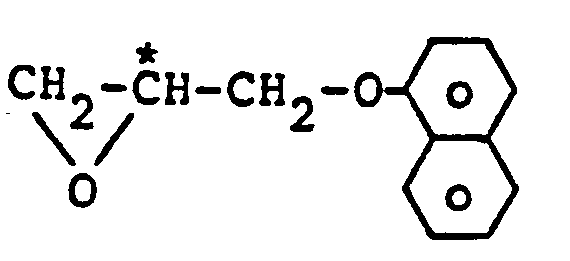
- beta-Naphthyl glycidyl ether

- 2,3-Epoxypropyl-2',3'-epoxy-2'-methylpropyl ether

- Specific examples of the beta-dihalohydrin ester compound of formula (11)-3 are given below.
- 1-Acetoxy-2,3-dichloropropane

- 1-Butanoxy-2,3-dichloropropane

- 1-Acetoxy-2,3-dibromopropane

- In the method of this invention, the racemate, or the diastereomeric mixture, of the glycidyl ester or ether compound above or the racemate of the beta-dihalohydrin ester compound defined above is contacted with an optically active form of a compound having the following formula (I).

- The compound of formula (I) is a known compound, and examples of the halogen atom X are Cl, Br, I and F. The optically active compound of formula (I) can be produced easily by oxidatively coupling a known optically active compound represented by the following formula

- According to the method of this invention, the racemate of the glycidyl ester or ether compound or the racemate of the beta-dihalohydrin ester compound is contacted with the optically active form of the compound of formula (I) to form easily and selectively an inclusion complex compound containing the optically active compound (I) as a host compound and one of the enantiomorphs of the racemate as a guest compound.
- The reaction of forming the inclusion complex compound containing the optically active compound of formula (I) as a host by the above contacting treatment can be carried out by directly mixing the optically active compound of formula (I) and the racemate of the guest compound, or mixing them as solutions. Examples of the solvent which may be utilized in reacting the two reactants in the presence of solvent include aliphatic hydrocarbons such as pentane, hexane, cyclohexane, heptane, petroleum ether and petroleum benzine; aromatic hydrocarbons such as benzene and toluene; ethers such as diethyl ether, dipropyl ether, diisopropyl ether, dioxane and tetrahydrofuran; halogenated hydrocarbons such as dichloromethane and dichloroethane; and suitable mixtures of these.
- The reaction conditions may be properly chosen and varied depending upon, for example, the mode of the contacting treatment, the type of the solvent and the types of the two reactants. For example, the reaction temperature is from room temperature to the refluxing temperature of the solvent. The reaction time can be varied properly depending upon the reaction temperature and the above-mentioned factors. Since the inclusion complex compound formed as a result of the reaction usually precipitates as solid crystals, the reaction time can be easily selected and determined by using the formation of the precipitate as a measure. Precipitation of the crystals may take place immediately after the contacting of the host compound with the guest compound, or sometimes after a lapse of about 1 hour to about several tens of hours.
- The inclusion complex formed by the contacting treatment and containing the optically active compound of formula (I) as a host and one of the enantiomorphs of the racemate as a guest usually has a guest/host mole ratio of from 3/1 to 1/3. Accordingly, in performing the reaction, the proportions of the guest compound and the host compound used are preferably selected so that about 0.25 to about 4 moles of the guest compound is used per mole of the host compound depending upon the types of these compounds.
- By separating the inclusion complex compound from the reaction mixture, one of the enantiomorphs of the racemate can be obtained in the form of an inclusion complex compound. Since the resulting inclusion complex compound precipitates from the reaction system, it can be easily recovered by utilizing a solid-liquid separating means such as filtration, and as required it may be purified by, for example, recrystallization.
- The optically active guest compound can be obtained from the separated inclusion complex compound containing the optically active glycidyl ester or ether compound or the optically active beta-dihalohydrin ester compound as a guest and the optically active compound as a host by a known means such as distillation under heat, substitution by a polar solvent, or chromatography. For example, according to the distillation method, the inclusion complex compound is distilled by heating it under reduced pressure to obtain the optically active guest compound as a distillate. In the method of substitution with a polar solvent, the optically active gust compound can be obtained by using a ketone such as acetone or methyl ethyl ketone or an ester such as ethyl acetate. In the chromatographic method, the optically active guest compound may be obtained by using a solvent such as dichloroethane.
- The other enantiomorph of the racemate is present in the residue resulting from separation of the inclusion complex compound from the reaction system. Hence, the other optically active compound can be obtained by, for example, distillation, or by adding the other enantiomorph of the host compound and forming an inclusion complex containing the other enantiomorph of the racemate as a guest.
- The following Examples illustrate the method of this invention more specifically.
- Optically pure levorotatory 1,6-di-o-chlorophenyl-1,6-diphenyl-hexa-2,4-diyne-1,6-diol ([a]D = 122°; mp. 127-129°C; 9.66 g (0.02 mole)) and 5.76 g (0.04 mole) of racemic glycidyl butyrate were dissolved in a mixed solvent composed of 10 ml of ether and 20 ml of petroleum ether, and refluxed for 12 hours. The reaction mixture was filtered to collect 11.0 g of colorless prismatic crystals (yield 88%). The crystals were a complex in which the above compounds were included in a mole ratio of 1:1. The complex had a melting point of 72 to 75°C and a specific rotation, measured with a methanol solution, [α]D (the same solvent was used in measuring the specific rotation hereinafter), of -93.5°.
- The crystals were then thermally decomposed under reduced pressure to distill levorotatory glycidyl butyrate which had a [a]D of -5.7°.
- The above prismatic crystals were recrystallized five times to give crystals having a melting point of 72 to 75°C and a [a]D of -94.1°. These crystals were thermally decomposed under reduced pressure as above to give leverotatory glycidyl butyrate having a [a]D of -11.8°.
- The filtrate from which the prismatic crystals had been separated was distilled to give 3.2 g of dextrorotatory glycidyl butyrate which had a [a]D of +4.26°.
- The same levorotatory 1,6-o-chlorophenyl-1,6-diphenyl-hexa-2,4-diyne-1,6-diol (4.83 g; 0.01 mole) and 3.0 g (0.02 mole) of racemic phenyl glycidyl ether were dissolved in a mixed solvent composed of 5 ml of ether and 20 ml of petroleum ether. The solution was refluxed for 12 hours. After cooling the reaction mixture, 4.65 g (yield 73%) a complex in which the mole ratio of the above compounds was 1:1 was obtained as colorless prismatic crystals. These crystals had a melting point of 79 to 80°C, and a [a]D of -90.6°.
- The crystals were then distilled under reduced pressure to give levorotatory phenyl glycidyl ether having a [α]D of -1.4°.
- The prismatic crystals were recrystallized once to give crystals having a melting point of 79 to 81°C and a [a]D of -92.9°. Distillation of these crystals under reduced pressure gave phenyl glycidyl ether having a [a]D of -2.7°.
-


- Optically pure levorotatory 1,6-di-o-chlorophenyl-1,6-diphenylhexa-2,4-diyne-1,6-diol ([α]D = -122°, mp. 127-129°C; 2.42 g) and 1.30 g of a diastereomeric mixture of 1-methyl-2,3-epoxypropyl acetate (threo:erythro = 64:36) were dissolved in a mixed solvent (1:1) composed of ether and petroleum ether, and the solution was left to stand at room temperature for 12 hours. It was filtered, and the resulting complex in the form of crystals were recrystallized once from the above mixed solvent, filtered, and dried to give 0.76 g of colorless prismatic crystals. These crystals were a complex in which the mole ratio of (-)-A to threo-(+)-B was 1:1. The complex had a melting point of 101 to 103°C and a [a]D of -92.2°.
- The crystals were heated to about 150°C under reduced pressure (25 mmHg) to obtain 0.16 g of threo-(+1-B([α]D = +1.0°).
-

- The same (-)-A as used in Example 3 (2,42 g) and 1.30 g of a diastereomeric mixture of 2,3-epoxybutyl acetate represented by formula (C) above were dissolved in 10 ml of the same mixed solvent as used in Example 3, and then left to stand at room temperature for 12 hours. It was filtered to give a complex as crystals. The crystals were recrystallized twice from the mixed solvent, filtered, and dried to give 0.95 g of colorless needle-like crystals. These crystals were a complex in which the mole ratio of (-)-A to (+)-C was 1:1. The complex had a melting point of 117 to 119°C and a [a]o of -82.0°C.
- When the crystals were heated as in Example 3, 0.20 g of (+)-C ([α]D = +50.6°) was obtained.
- Separately 2.42 g of the enantiomorph (+)-A of A was added to the mother liquor left after separating the above complex by filtration, and the mixture was left to stand at room temperature for 12 hours. The resulting crystals were recrystallized twice from the same mixed solvent as above to give 0.88 g of a complex having a [a]D of +82.0°.
- When the complex was heated in the same way as in Example 3, 0.155 g of (-)-C ([a]D = -50.6°) was obtained.
-

- The same (-)-A as in Example 3 (4,83 g) and 2.88 g of a diastereomeric mixture of 1-methyl-2,3-epoxybutyl acetate (threo:erythro = 9:91) were dissolved in 20 ml of the same mixed solvent as used in Example 3, and left to stand at room temperature for 12 hours. The crystals of a complex obtained by filtration were recrystallized twice from the same mixed solvent as above, filtered, and dried to give 1.72 g of colorless prismatic crystals. These crystals were a complex in which the mole ratio of (-)-A to erythro-(-)-E was 1:1. The complex had a melting point of 105 to 108°C and a [a]D of -104°C.
- When the crystals were heated in the same way as in Example 3, 0.4 g of erythro-(-)-E ([a]D = -13.0°) was obtained.
-

- The same (-)-A as in Example 3 (4.83 g) and 3.12 g of a diastereomeric mixture of 2,3-epoxycyclohexyl acetate (cis:trans = 35:65) were dissolved in 20 ml of the same mixed solvent as used in Example 3, and left to stand at room temperature for 12 hours. Crystals of a complex obtained by filtering the solution were recrystallized once from the same mixed solvent as above, filtered, and dried to give 1.15 g of prismatic crystals. These crystals were a complex in which the mole ratio of (-)-A to cis-(-)-F was 1:1. The complex had a melting point of 125 to 127°C and a ([a]D of -122°.
- When these crystals were heated in the same way as in Example 3, 0.28 g of cis-(-)-F ([α]D = -98.1°) was obtained.
- When the filtrate from which the complex was separated was left to stand at room temperature for 6 hours, a complex in which the mole ratio of (-)-A to trans-(+)-F was 1:1 precipitated.
- The complex was recrystallized twice from the mixed solvent, filtered, and dried to give 1.59 g of colorless needle-like crystals. The crystals had a melting point of 132 to 13°C and a [a]D of -99.3°.
- When the crystals were heat-treated, 0.39 g of trans-(+)-F ([α]D = +79.4°) was obtained.
-
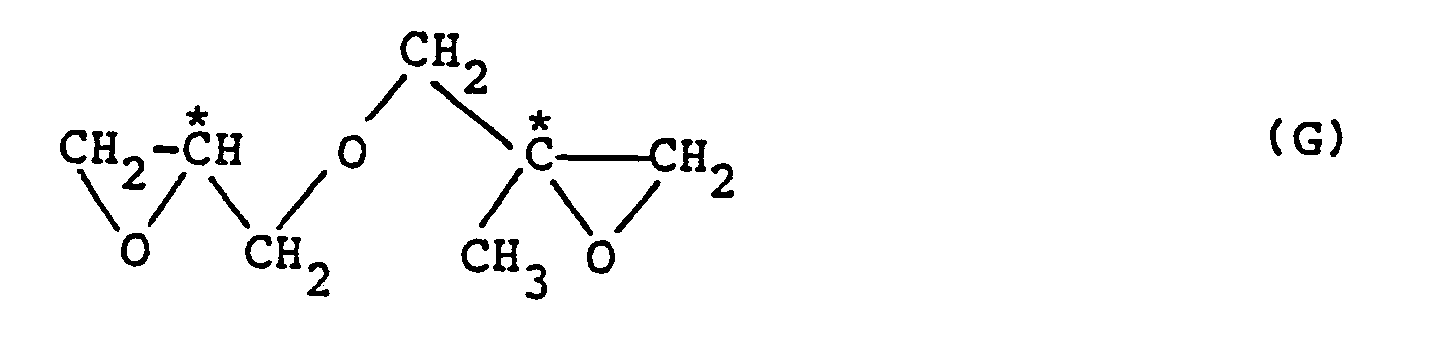
- The same (-)-A as in Example 3 (4.83 g) and 2.88 g of a diastereomeric mixture of 2,3-epoxypropyl-2',3'-epoxy-2'-methylpropyl ether were dissolved in 20 ml of the same mixed solvent as used in Example 3, and left to stand at room temperature for 12 hours. Crystals of a complex obtained by filtration were recrystallized three times from the mixed solvent, filtered, and dried to give 1.39 g of colorless prismatic crystals. The crystals were a complex in which the mole ratio of (-)-A to (-)-G was 1: 1. The complex had a melting point of 98 to 100°C and a [a]D of -97.7°.
- When the crystals were heated as in Example 3, 0.31 g of (-)-G ([a]D = -20.2°) was obtained.
- Optically pure levorotatory 1,6-di-o-chlorophenyl-1,6-diphenylhexa-2,4-diyne-1,6-diol ([a]D = -122°; mp. 127-129°C; 4.83 g = 0.01 mole) and 3.42 g (0.02 mole) of racemic 1-acetoxy-2,3-dichloropropane were dissolved in a mixed solvent composed of 10 ml of ether and 10 ml of petroleum ether, and left to stand at room temperature for 12 hours. The resulting crystals were collected by filtration, and recrystallized once from the same mixed solvent as above to give 3.31 g of colorless prismatic crystals which were a complex having a melting point of 93 to 95°C and a [a]D of -86.8° and in which the mole ratio of the above compounds was 1:1. The crystals were heated to about 150°C under reduced presure (25 mmHg) to give 0.87 g of dextrorotatory 1-acetoxy-2,3-dichloropropane having a [a]D of +18.6°.
- Separately, the solvent of the mother liquor left after separation of the crystals by filtration was evaporated, and the residue was distilled under reduced pressure to give 2.10 g of levorotatory 1-acetoxy-2,3-dichloropropane having a [a]D -2.89°C.
- The resulting levorotatory 1-acetoxy=2,3-di-chloropropane (2.10 g) and 5.93 g of dextrorotatory 1,6-di- o-chlorophenyl-1,6-diphenylhexa-2,4-diyne-1,6-diol ([a]D = +122°) were dissolved in 20 ml of a mixed solvent of ether and petroleum ether, and left to stand at room temperature for 12 hours to precipitate a complex. The complex was recrystallized once from the same mixed solvent as above and distilled under reduced pressure to give 0.64 g of levorotatory 1-acetoxy-2,3-dichloropropane [a]D = -18.6°.
Claims (1)
- A method of optically resolving a racemate or a diastereomeric mixture of a compound having 1 to 3 asymmetric carbon atoms in the molecule and selected from a glycidyl ester compounds represented by the formula


 b) glycidyl ether compounds represented by the formula
 c) beta-dihalohydrin compounds represented by the formula
 which comprises contacting said racemate or diastereomeric mixture with an optically active form of a compound having the following formula (I]
 wherein X represents a halogen atom, to form an inclusion complex compound having the optically active compound of formula (I) as a host, and separating the resulting complex compound from the mixture.
Applications Claiming Priority (6)
| Application Number | Priority Date | Filing Date | Title |
|---|---|---|---|
| JP23068685A JPH062756B2 (en) | 1985-10-16 | 1985-10-16 | Method for optical resolution of glycidyl compound |
| JP230686/85 | 1985-10-16 | ||
| JP251597/85 | 1985-11-08 | ||
| JP25159785A JPS62111943A (en) | 1985-11-08 | 1985-11-08 | Method of optical resolution of beta-dichlorohydrin ester |
| JP60281567A JPH0641459B2 (en) | 1985-12-13 | 1985-12-13 | Method for separating optical isomers of epoxides having multiple asymmetric carbons |
| JP281567/85 | 1985-12-13 |
Publications (2)
| Publication Number | Publication Date |
|---|---|
| EP0220887A1 EP0220887A1 (en) | 1987-05-06 |
| EP0220887B1 true EP0220887B1 (en) | 1990-06-27 |
Family
ID=27331680
Family Applications (1)
| Application Number | Title | Priority Date | Filing Date |
|---|---|---|---|
| EP86308033A Expired EP0220887B1 (en) | 1985-10-16 | 1986-10-16 | Method of optically resolving a racemate or a diastereomeric mixture of glycidyl compound |
Country Status (3)
| Country | Link |
|---|---|
| US (1) | US4841081A (en) |
| EP (1) | EP0220887B1 (en) |
| DE (1) | DE3672241D1 (en) |
Families Citing this family (8)
| Publication number | Priority date | Publication date | Assignee | Title |
|---|---|---|---|---|
| WO2001047907A1 (en) * | 1999-12-27 | 2001-07-05 | Asahi Kasei Kabushiki Kaisha | Ester containing alicyclic epoxy and process for producing the same |
| EP2277551B1 (en) | 2002-09-06 | 2013-05-08 | Cerulean Pharma Inc. | Cyclodextrin-based polymers for delivering the therapeutic agents covalently bound thereto |
| WO2004032862A2 (en) * | 2002-10-09 | 2004-04-22 | Insert Therapeutics, Inc. | Cyclodextrin-based materials, compositions and uses related thereto |
| US20080176958A1 (en) | 2007-01-24 | 2008-07-24 | Insert Therapeutics, Inc. | Cyclodextrin-based polymers for therapeutics delivery |
| EP2503888A4 (en) * | 2009-11-23 | 2015-07-29 | Cerulean Pharma Inc | CYCLODEXTRIN-BASED POLYMERS FOR THERAPEUTIC ADMINISTRATION |
| US20140094432A1 (en) | 2012-10-02 | 2014-04-03 | Cerulean Pharma Inc. | Methods and systems for polymer precipitation and generation of particles |
| RU2509906C1 (en) * | 2012-12-06 | 2014-03-20 | Юрий Константинович Курчаков | Ice exhaust gas circulation system |
| CN112595788B (en) * | 2020-12-13 | 2022-04-19 | 云南贝斯泰生物科技有限公司 | A kind of high-performance liquid chromatography method for separating (R), (S)-1-(α-naphthyl) glycidyl ether |
-
1986
- 1986-10-14 US US06/918,724 patent/US4841081A/en not_active Expired - Fee Related
- 1986-10-16 DE DE8686308033T patent/DE3672241D1/en not_active Expired - Fee Related
- 1986-10-16 EP EP86308033A patent/EP0220887B1/en not_active Expired
Also Published As
| Publication number | Publication date |
|---|---|
| US4841081A (en) | 1989-06-20 |
| DE3672241D1 (en) | 1990-08-02 |
| EP0220887A1 (en) | 1987-05-06 |
Similar Documents
| Publication | Publication Date | Title |
|---|---|---|
| RU2210565C2 (en) | Novel method for metoprolol production | |
| US4841081A (en) | Method of optically resolving a racemate or a diastereomeric mixture of glycidyl compound | |
| CA2099444C (en) | Process for preparing tert-butyl (3r,5s)-6-hydroxy-3,5-o- isopropylidene-3,5-dihydroxyhexanoate | |
| US5334776A (en) | Compound and separating agent | |
| US11603337B2 (en) | Method for producing optically active substance, optically active substance, method for producing chiral molecule, and chiral molecule | |
| AU638801B2 (en) | Production of homochiral chloropropanolamines | |
| US5510520A (en) | Optical resolution method | |
| US6288280B1 (en) | Racemization of atropisomeric bis(phosphine oxide) compounds | |
| US4761491A (en) | Preparation of 2-substituted-1,3-dioxacycloalkanes from diols and diunsaturated ethers | |
| WO1988000190A1 (en) | Optically active derivatives of glycidol | |
| US4946974A (en) | Optically active derivatives of glycidol | |
| US5043495A (en) | Process of separation and purification of a propargyl alcohols | |
| US5332843A (en) | Optically active derivatives of gycidol | |
| JPH01102072A (en) | Production of epoxide derivative | |
| JP2832479B2 (en) | Stereochemical inversion method of optically active styrene oxide and preparation of optically active glycol derivative | |
| WO1990007506A1 (en) | Production of glycidyl ether | |
| JPH0411544B2 (en) | ||
| KR890000290B1 (en) | Process for preparing oxirane derivative | |
| US5344947A (en) | Optically active derivatives of glycidol | |
| JPS59216841A (en) | optical resolution agent | |
| JPH06157421A (en) | Composition composed of mixture of t-butoxy carbonates of trisphenols | |
| US5395977A (en) | Process for producing optical active 4-hydroxy-2-cyclopentenone | |
| JPH0434535B2 (en) | ||
| JPH0641459B2 (en) | Method for separating optical isomers of epoxides having multiple asymmetric carbons | |
| JPS6156188A (en) | Lactic acid silyl ester |
Legal Events
| Date | Code | Title | Description |
|---|---|---|---|
| PUAI | Public reference made under article 153(3) epc to a published international application that has entered the european phase |
Free format text: ORIGINAL CODE: 0009012 |
|
| AK | Designated contracting states |
Kind code of ref document: A1 Designated state(s): DE FR GB |
|
| 17P | Request for examination filed |
Effective date: 19870923 |
|
| 17Q | First examination report despatched |
Effective date: 19881021 |
|
| RAP1 | Party data changed (applicant data changed or rights of an application transferred) |
Owner name: DAISO CO., LTD. |
|
| GRAA | (expected) grant |
Free format text: ORIGINAL CODE: 0009210 |
|
| AK | Designated contracting states |
Kind code of ref document: B1 Designated state(s): DE FR GB |
|
| REF | Corresponds to: |
Ref document number: 3672241 Country of ref document: DE Date of ref document: 19900802 |
|
| ET | Fr: translation filed | ||
| PLBE | No opposition filed within time limit |
Free format text: ORIGINAL CODE: 0009261 |
|
| STAA | Information on the status of an ep patent application or granted ep patent |
Free format text: STATUS: NO OPPOSITION FILED WITHIN TIME LIMIT |
|
| 26N | No opposition filed | ||
| PGFP | Annual fee paid to national office [announced via postgrant information from national office to epo] |
Ref country code: GB Payment date: 19931006 Year of fee payment: 8 |
|
| PGFP | Annual fee paid to national office [announced via postgrant information from national office to epo] |
Ref country code: FR Payment date: 19931011 Year of fee payment: 8 Ref country code: DE Payment date: 19931011 Year of fee payment: 8 |
|
| PG25 | Lapsed in a contracting state [announced via postgrant information from national office to epo] |
Ref country code: GB Effective date: 19941016 |
|
| GBPC | Gb: european patent ceased through non-payment of renewal fee |
Effective date: 19941016 |
|
| PG25 | Lapsed in a contracting state [announced via postgrant information from national office to epo] |
Ref country code: FR Effective date: 19950630 |
|
| PG25 | Lapsed in a contracting state [announced via postgrant information from national office to epo] |
Ref country code: DE Effective date: 19950701 |
|
| REG | Reference to a national code |
Ref country code: FR Ref legal event code: ST |