EP0219247B1 - Bioelectrochemical cell and electrode therefor - Google Patents
Bioelectrochemical cell and electrode therefor Download PDFInfo
- Publication number
- EP0219247B1 EP0219247B1 EP86307347A EP86307347A EP0219247B1 EP 0219247 B1 EP0219247 B1 EP 0219247B1 EP 86307347 A EP86307347 A EP 86307347A EP 86307347 A EP86307347 A EP 86307347A EP 0219247 B1 EP0219247 B1 EP 0219247B1
- Authority
- EP
- European Patent Office
- Prior art keywords
- electrode
- cloth
- working electrode
- cell
- felt
- Prior art date
- Legal status (The legal status is an assumption and is not a legal conclusion. Google has not performed a legal analysis and makes no representation as to the accuracy of the status listed.)
- Expired - Lifetime
Links
- OKTJSMMVPCPJKN-UHFFFAOYSA-N Carbon Chemical group [C] OKTJSMMVPCPJKN-UHFFFAOYSA-N 0.000 claims abstract description 44
- 229910052799 carbon Inorganic materials 0.000 claims abstract description 40
- 239000004744 fabric Substances 0.000 claims abstract description 35
- 230000000813 microbial effect Effects 0.000 claims abstract description 15
- 230000004044 response Effects 0.000 claims abstract description 13
- 239000012736 aqueous medium Substances 0.000 claims abstract description 9
- 239000011148 porous material Substances 0.000 claims abstract description 4
- 241000894006 Bacteria Species 0.000 claims description 13
- 238000001914 filtration Methods 0.000 claims description 9
- 238000000034 method Methods 0.000 claims description 9
- 239000007900 aqueous suspension Substances 0.000 claims description 7
- 238000005259 measurement Methods 0.000 claims description 6
- 239000010439 graphite Substances 0.000 claims description 4
- 229910002804 graphite Inorganic materials 0.000 claims description 4
- 238000001514 detection method Methods 0.000 claims description 3
- 239000000463 material Substances 0.000 claims description 3
- 239000002609 medium Substances 0.000 claims description 2
- 230000027756 respiratory electron transport chain Effects 0.000 claims description 2
- 230000001965 increasing effect Effects 0.000 abstract description 10
- 239000007772 electrode material Substances 0.000 abstract 1
- BASFCYQUMIYNBI-UHFFFAOYSA-N platinum Chemical compound [Pt] BASFCYQUMIYNBI-UHFFFAOYSA-N 0.000 description 17
- 229910021607 Silver chloride Inorganic materials 0.000 description 7
- 229910052697 platinum Inorganic materials 0.000 description 7
- HKZLPVFGJNLROG-UHFFFAOYSA-M silver monochloride Chemical compound [Cl-].[Ag+] HKZLPVFGJNLROG-UHFFFAOYSA-M 0.000 description 7
- 241000588724 Escherichia coli Species 0.000 description 6
- 238000002474 experimental method Methods 0.000 description 6
- 239000003792 electrolyte Substances 0.000 description 5
- IJGRMHOSHXDMSA-UHFFFAOYSA-N Atomic nitrogen Chemical compound N#N IJGRMHOSHXDMSA-UHFFFAOYSA-N 0.000 description 4
- WCUXLLCKKVVCTQ-UHFFFAOYSA-M Potassium chloride Chemical compound [Cl-].[K+] WCUXLLCKKVVCTQ-UHFFFAOYSA-M 0.000 description 4
- 230000001580 bacterial effect Effects 0.000 description 4
- 239000000706 filtrate Substances 0.000 description 4
- 244000005700 microbiome Species 0.000 description 3
- -1 potassium ferricyanide Chemical compound 0.000 description 3
- 239000000725 suspension Substances 0.000 description 3
- XLYOFNOQVPJJNP-UHFFFAOYSA-N water Substances O XLYOFNOQVPJJNP-UHFFFAOYSA-N 0.000 description 3
- AZQWKYJCGOJGHM-UHFFFAOYSA-N 1,4-benzoquinone Chemical compound O=C1C=CC(=O)C=C1 AZQWKYJCGOJGHM-UHFFFAOYSA-N 0.000 description 2
- WQZGKKKJIJFFOK-GASJEMHNSA-N Glucose Natural products OC[C@H]1OC(O)[C@H](O)[C@@H](O)[C@@H]1O WQZGKKKJIJFFOK-GASJEMHNSA-N 0.000 description 2
- 241000589517 Pseudomonas aeruginosa Species 0.000 description 2
- 230000002708 enhancing effect Effects 0.000 description 2
- YAGKRVSRTSUGEY-UHFFFAOYSA-N ferricyanide Chemical compound [Fe+3].N#[C-].N#[C-].N#[C-].N#[C-].N#[C-].N#[C-] YAGKRVSRTSUGEY-UHFFFAOYSA-N 0.000 description 2
- 239000008103 glucose Substances 0.000 description 2
- 230000014759 maintenance of location Effects 0.000 description 2
- 229910052757 nitrogen Inorganic materials 0.000 description 2
- 230000003287 optical effect Effects 0.000 description 2
- 239000001103 potassium chloride Substances 0.000 description 2
- 235000011164 potassium chloride Nutrition 0.000 description 2
- 239000012064 sodium phosphate buffer Substances 0.000 description 2
- 229940005561 1,4-benzoquinone Drugs 0.000 description 1
- UPMXNNIRAGDFEH-UHFFFAOYSA-N 3,5-dibromo-4-hydroxybenzonitrile Chemical compound OC1=C(Br)C=C(C#N)C=C1Br UPMXNNIRAGDFEH-UHFFFAOYSA-N 0.000 description 1
- 241000270722 Crocodylidae Species 0.000 description 1
- 230000005526 G1 to G0 transition Effects 0.000 description 1
- 239000001888 Peptone Substances 0.000 description 1
- 108010080698 Peptones Proteins 0.000 description 1
- BQCADISMDOOEFD-UHFFFAOYSA-N Silver Chemical compound [Ag] BQCADISMDOOEFD-UHFFFAOYSA-N 0.000 description 1
- 241000607447 Yersinia enterocolitica Species 0.000 description 1
- 238000009825 accumulation Methods 0.000 description 1
- 230000009471 action Effects 0.000 description 1
- 239000003463 adsorbent Substances 0.000 description 1
- 239000012491 analyte Substances 0.000 description 1
- 230000003115 biocidal effect Effects 0.000 description 1
- 239000000872 buffer Substances 0.000 description 1
- 230000008859 change Effects 0.000 description 1
- 239000012141 concentrate Substances 0.000 description 1
- 239000002173 cutting fluid Substances 0.000 description 1
- 230000003247 decreasing effect Effects 0.000 description 1
- LNNWVNGFPYWNQE-GMIGKAJZSA-N desomorphine Chemical compound C1C2=CC=C(O)C3=C2[C@]24CCN(C)[C@H]1[C@@H]2CCC[C@@H]4O3 LNNWVNGFPYWNQE-GMIGKAJZSA-N 0.000 description 1
- 230000000694 effects Effects 0.000 description 1
- 238000003933 environmental pollution control Methods 0.000 description 1
- 239000012530 fluid Substances 0.000 description 1
- 230000005484 gravity Effects 0.000 description 1
- 239000007788 liquid Substances 0.000 description 1
- 238000013508 migration Methods 0.000 description 1
- 230000005012 migration Effects 0.000 description 1
- 238000012544 monitoring process Methods 0.000 description 1
- 239000013642 negative control Substances 0.000 description 1
- 235000015097 nutrients Nutrition 0.000 description 1
- 235000019319 peptone Nutrition 0.000 description 1
- 238000004094 preconcentration Methods 0.000 description 1
- 238000012545 processing Methods 0.000 description 1
- 230000000717 retained effect Effects 0.000 description 1
- 230000035945 sensitivity Effects 0.000 description 1
- 238000000926 separation method Methods 0.000 description 1
- 238000001179 sorption measurement Methods 0.000 description 1
- 238000003911 water pollution Methods 0.000 description 1
- 238000009736 wetting Methods 0.000 description 1
- 229940098232 yersinia enterocolitica Drugs 0.000 description 1
Images
Classifications
-
- C—CHEMISTRY; METALLURGY
- C12—BIOCHEMISTRY; BEER; SPIRITS; WINE; VINEGAR; MICROBIOLOGY; ENZYMOLOGY; MUTATION OR GENETIC ENGINEERING
- C12Q—MEASURING OR TESTING PROCESSES INVOLVING ENZYMES, NUCLEIC ACIDS OR MICROORGANISMS; COMPOSITIONS OR TEST PAPERS THEREFOR; PROCESSES OF PREPARING SUCH COMPOSITIONS; CONDITION-RESPONSIVE CONTROL IN MICROBIOLOGICAL OR ENZYMOLOGICAL PROCESSES
- C12Q1/00—Measuring or testing processes involving enzymes, nucleic acids or microorganisms; Compositions therefor; Processes of preparing such compositions
- C12Q1/001—Enzyme electrodes
-
- C—CHEMISTRY; METALLURGY
- C12—BIOCHEMISTRY; BEER; SPIRITS; WINE; VINEGAR; MICROBIOLOGY; ENZYMOLOGY; MUTATION OR GENETIC ENGINEERING
- C12M—APPARATUS FOR ENZYMOLOGY OR MICROBIOLOGY; APPARATUS FOR CULTURING MICROORGANISMS FOR PRODUCING BIOMASS, FOR GROWING CELLS OR FOR OBTAINING FERMENTATION OR METABOLIC PRODUCTS, i.e. BIOREACTORS OR FERMENTERS
- C12M41/00—Means for regulation, monitoring, measurement or control, e.g. flow regulation
- C12M41/30—Means for regulation, monitoring, measurement or control, e.g. flow regulation of concentration
- C12M41/36—Means for regulation, monitoring, measurement or control, e.g. flow regulation of concentration of biomass, e.g. colony counters or by turbidity measurements
-
- Y—GENERAL TAGGING OF NEW TECHNOLOGICAL DEVELOPMENTS; GENERAL TAGGING OF CROSS-SECTIONAL TECHNOLOGIES SPANNING OVER SEVERAL SECTIONS OF THE IPC; TECHNICAL SUBJECTS COVERED BY FORMER USPC CROSS-REFERENCE ART COLLECTIONS [XRACs] AND DIGESTS
- Y10—TECHNICAL SUBJECTS COVERED BY FORMER USPC
- Y10S—TECHNICAL SUBJECTS COVERED BY FORMER USPC CROSS-REFERENCE ART COLLECTIONS [XRACs] AND DIGESTS
- Y10S435/00—Chemistry: molecular biology and microbiology
- Y10S435/817—Enzyme or microbe electrode
Definitions
- This invention relates to the measurement of microbial activity by means of a bioelectrochemical cell (BEC).
- BEC bioelectrochemical cell
- AU 498905 discloses BEC for measuring microbial activity; in particular the migration and accumulation of the micro-organism about the surface of the measuring electrode.
- WO 82/04264 discloses a method for rapid determination of biochemical data for micro-organisms.
- the micro-organisms are adsorbed on an adsorbent to concentrate the cells prior to measurement of changes, such as of pH or conductivity, caused by the concentrated cells, thus to produce a result in a short time.
- the accurate determination of microbial activity is of considerable interest in, for example the food and drink industry, water and environmental pollution control, clinical analysis, including antibiotic sensitivity under clinical applications, etc.
- the present invention is directed to improvements in BEC methods and equipment for monitoring microbial activity.
- a bioelectrochemical cell for the detection of microbes in an aqueous medium, the cell having a working electrode and a reference electrode; characterised in that said working electrode comprises a graphitized carbon felt or cloth; the felt or cloth having porosity which enables filtering of bacteria out of an aqueous suspension; and in that said cell contains a mediator for mediating electron transfer between said microbes and the working electrode.
- the present invention provides an electrically conductive carbon-bearing porous working electrode for use in a bioelectrochemical cell, said electrode comprising a graphitized carbon felt or cloth rolled into a cylindrical roll, the felt or cloth having a porosity which enables filtering of bacteria out of an aqueous suspension.
- a method of measuring microbial activity in an aqueous medium by means of a bioelectrochemical cell comprising contacting the working electrode with aqueous medium whose microbial activity is to be measured and measuring an electrical response from the bioelectrochemical cell, the response being related to the microbial activity of said sample; characterised in that said working electrode comprises electrically conduve carbon-bearing porous material, said material enabling filtering of bacteria out of anaqueous suspension.
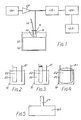
- the bioelectrochemical cell is contained in a beaker 10 with a lid 11, and placed in a water bath 12 with a magnetic stirrer 13. If desired, e.g. for the analysis of obligate anaerobes, nitrogen is bubbled into the cell from a nitrogen line 14.
- the electrodes, indicated generally at l6, comprise a platinum electrode and an Ag/AgCl reference electrode.
- the output from the electrodes is taken to suitable data processing equipment. As illustrated, this comprises: a low noise current-to-voltage converter l8, a low noise by-pass filter 20, a digital volt meter 22, a buffer 24 and a precision voltage reference 26.
- Figs 2 to 4 show different embodiments of the BEC according to the present invention which can be used with the configuration shown in Fig. l.
- Each cell contains an aqueous analyte sample 20, an Ag/AgCl reference electrode 2l and a working electrode 22.
- the working electrode in each case is made from RVG l000 grade of graphitized carbon felt, supplied by Le Carbone (Great Britain) Ltd., of Portslade, Wales, BN4 2LX.
- the felt has the following properties: Electrical resistance l.7 ohms/cm2 Weight m ⁇ 2 l50 g Thickness l.2 mm Carbon content > 99%
- the working electrode takes the form of a planar strip of the carbon felt or cloth.
- it takes the form of a cylindrical roll of the carbon felt or cloth.
- it takes the form of a large open cylinder of the carbon felt or cloth.
- the control BEC contained ferricyanide mediator (500 ⁇ l, 250 mM) with l50 ⁇ l E . coli (O.D. l.7).
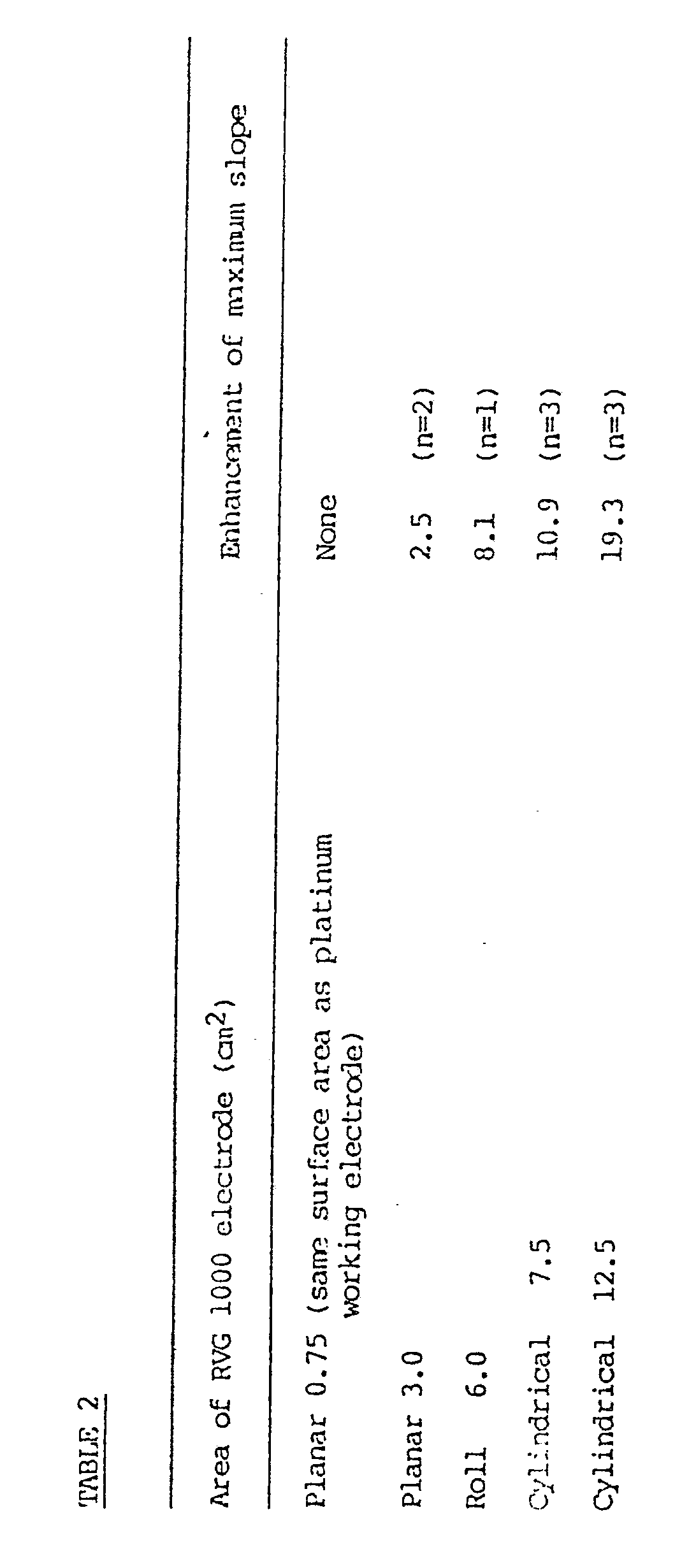
- the results which appear in Table 2 show that enhancement of the E . coli BEC response relative to that obtained with standard platinum/silver chloride paired electrodes (0.5 ⁇ l.5 cm) increased with increasing area of the working electrode.
- the largest enhancement was obtained with the l2.5 cm2 cylindrical electrode, which was the largest electrode that could be fitted into the l0 ml beaker used.
- RVG l000 cloth cylindrical electrode (area l2.5 cm2) with 0.l% peptone water (500 ⁇ l) produced no response in the BEC.
- the working electrode was made from RVG l000 carbon felt or platinum foil.
- the platinum foil working electrode was in the standard configuration, that is mounted on a plastic support on the opposite side to an Ag/AgCl reference electrode.
- the carbon cloth electrode was one of two shapes. It was either a cylinder of rolled-up cloth, of initial dimensions 4.5 cm ⁇ 3.5 cm (height ⁇ width), or an open cylinder of height 3.0 cm and outside diameter 2.3 cm.
- the reference electrode was a standard single sided Ag/AgCl reference electrode (0.5 cm ⁇ l.5 cm).
- the reference electrode was a cylinder of AgCl coated silver foil (diameter: 0.95 cm, height: 2.00 cm).
- the electrolyte consisted of sodium phosphate buffer (6.4 ml, pH 7.0, 50 mM), potassium chloride (0.8 ml, l.0 M), potassium ferricyanide (l50 ⁇ l, 250 mM), glucose (l50 ⁇ l, 25 mM) and E . coli cells (0.5 ml). All BEC experiments were carried out at 39.5°C. The E . coli was harvested in the stationary phase, after overnight growth on nutrient broth in a 250 ml shake flask (l50 rpm, 30°C).
- the lowest concentration of E . coli that was tested was l.l ⁇ l06 cells ml ⁇ 1.
- the carbon cloth electrode (6.5 cm2) gave a maximum current (2.4 ⁇ A) that was twelve times that of the platinum electrode (0.7 cm2).
- the signal to noise ratios obtained using the carbon cloth ranged from 2.8 to 2l.4. Hence it should be feasible to detect less than l06 cells ml ⁇ 1. When a larger carbon cloth electrode was used there was no significant change in the maximum current.
- Strips of RVGl000 carbon felt were rolled into spirals and inserted into the bore of a graduated l0ml pipette (i.d. 8mm).
- Known volumes of aqueous suspensions of bacteria prepared from mixed cultures obtained from real samples of used cutting fluids) were transferred to the pipette and allowed to fall, by gravity, through the spiral plug of carbon felt.
- the concentrations of bacteria in the original sample and in the filtrate were determined immediately before and after each experiment by standard plate count.
- the total number of bacterial cells in each sample was calculated from the concentration measurement and the number of bacteria retained in the felt plug was obtained by difference. This was expressed as a proportion of the total number in each sample (% retention) and as a concentration since the volume of liquid in the plug was known.
- Fig. 5 shows the configuration of a graphite cloth used to make a filter electrode.
- the graphite cloth (Le Carbone: TGM 285) had a geometric working area of 17.5cm2. It comprised a rectangular body portion 23 measuring 7.0x2.5cm, and a contact strip portion 24 measuring 2.5x0.5cm.
- the electrode was tightly rolled up with the contact strip inside the roll and pushed inside a syringe (Sabre : 2m1 : internal diameter ca. 9mm). The end of the syringe had been removed to allow the filter/ electrode to be pushed out of the syringe barrel with the plunger.
- the filtration efficiency was determined by repeatedly passing the same sample of P . aeruginosa through the filter and measuring the optical density (O.D.600) of the filtrate. The final volume of the filtrate was measured. The results are shown in Table 5. Table 5 Number of filtration passes O.D.600 0 1.02 1 0.31 2 0.19 3 0.16 4 0.16 5 0.10 6 0.14
- the sample was 2.0ml of Pseudomonas aeruginosa (5x10⁹ cells ml -1 ).
- the optical density of the filtrate decreased rapidly with the number of filtration passes and stabilised after three passes, possibly due to saturation of the filter. After six passes through the filter 93.5% of the bacteria remained on the filter.
- the filter/electrode As a filter and as a working electrode, samples of a P . aeruginosa suspension (4ml or 8ml) or of a FAM2 blank (4ml or 8ml) were passed through the filter.
- the filter/electrode was ejected from the barrel of the syringe, unrolled and placed around the internal wall of the BEC. Platinum foil was folded around the ends of the contact strip of the working electrode to prevent wetting of the crocodile clip connectors with electrolyte that had seeped up the strip.
- the cell was assembled with an Ag/AgCl reference electrode that was single sided and had a geometric area of 0.75cm2.
- the electrolyte was sodium phosphate buffer (8.35ml, pH 7.0, 50mM) in potassium chloride solution (100mM), glucose (150 ⁇ l, 25mM), 1,4-benzoquinone (250 ⁇ l, 25mM) and ferricyanide (250 ⁇ l, 250mM).
- the experiments were carried out at 22°C. The results are shown in Table 6.
- Table 6 Sample Sample vol. (ml) Max. slope ( ⁇ A min -1 ) Max. current ( ⁇ A) P. aeruginosa 4.0 159 58 FAM2 control 4.0 37 18 P. aeruginosa 8.0 ca. 700 136 FAM2 control 8.0 21 16
- the concentration of the P . aeruginosa was 2x10⁸ cells ml -1 .
- Carbon felt could be used very satisfactorily to collect bacteria from a relatively large volume of aqueous suspension and to retain them in a relatively small volume thereby increasing the concentration of bacteria in the fluid. Carbon felt or cloth can therefore be shown to have three modes of action within the BEC:
- the electrode conveniently uses graphitized carbon felt or cloth, but other materials could be used which combine porosity with active electrically conductive carbon of high surface area.
Landscapes
- Chemical & Material Sciences (AREA)
- Organic Chemistry (AREA)
- Life Sciences & Earth Sciences (AREA)
- Health & Medical Sciences (AREA)
- Wood Science & Technology (AREA)
- Zoology (AREA)
- Engineering & Computer Science (AREA)
- Bioinformatics & Cheminformatics (AREA)
- Genetics & Genomics (AREA)
- General Engineering & Computer Science (AREA)
- Microbiology (AREA)
- General Health & Medical Sciences (AREA)
- Analytical Chemistry (AREA)
- Biotechnology (AREA)
- Proteomics, Peptides & Aminoacids (AREA)
- Biochemistry (AREA)
- Physics & Mathematics (AREA)
- Immunology (AREA)
- Molecular Biology (AREA)
- Biophysics (AREA)
- Biomedical Technology (AREA)
- Sustainable Development (AREA)
- Measuring Or Testing Involving Enzymes Or Micro-Organisms (AREA)
- Inert Electrodes (AREA)
- Immobilizing And Processing Of Enzymes And Microorganisms (AREA)
- Micro-Organisms Or Cultivation Processes Thereof (AREA)
- Apparatus Associated With Microorganisms And Enzymes (AREA)
Abstract
Description
- This invention relates to the measurement of microbial activity by means of a bioelectrochemical cell (BEC).
- The use of BEC for collecting data on microbial activity has been investigated by a number of workers in recent years: see for example AU 498905; WO 82/04264; Matsunaga et al, Appl. Environ. Microbiol. 37, 117-121 (1979) and Eur. J. Appl. Microbiol. 10, 125-132 (1980); Turner et al Biotechnology and Bioengineering Symposium No. 12 (1982) 401-412; Turner et al, Biochemical Society Transactions, 11, 445-448 (1983).
- AU 498905 discloses BEC for measuring microbial activity; in particular the migration and accumulation of the micro-organism about the surface of the measuring electrode.
- WO 82/04264 discloses a method for rapid determination of biochemical data for micro-organisms. The micro-organisms are adsorbed on an adsorbent to concentrate the cells prior to measurement of changes, such as of pH or conductivity, caused by the concentrated cells, thus to produce a result in a short time.
- The accurate determination of microbial activity is of considerable interest in, for example the food and drink industry, water and environmental pollution control, clinical analysis, including antibiotic sensitivity under clinical applications, etc. The present invention is directed to improvements in BEC methods and equipment for monitoring microbial activity.
- According to one aspect of the present invention there is provided a bioelectrochemical cell for the detection of microbes in an aqueous medium, the cell having a working electrode and a reference electrode; characterised in that said working electrode comprises a graphitized carbon felt or cloth; the felt or cloth having porosity which enables filtering of bacteria out of an aqueous suspension; and in that said cell contains a mediator for mediating electron transfer between said microbes and the working electrode.
- In another aspect the present invention provides an electrically conductive carbon-bearing porous working electrode for use in a bioelectrochemical cell, said electrode comprising a graphitized carbon felt or cloth rolled into a cylindrical roll, the felt or cloth having a porosity which enables filtering of bacteria out of an aqueous suspension.
- In a third aspect of the present invention there is provided a method of measuring microbial activity in an aqueous medium by means of a bioelectrochemical cell, wherein the cell has a reference electrode and a working electrode said method comprising contacting the working electrode with aqueous medium whose microbial activity is to be measured and measuring an electrical response from the bioelectrochemical cell, the response being related to the microbial activity of said sample; characterised in that said working electrode comprises electrically conduve carbon-bearing porous material, said material enabling filtering of bacteria out of anaqueous suspension.
- Other preferred and useful features of the invention will become apparent from the following description.
- In the accompanying drawings:
- Fig. 1 shows a diagrammatic view of a BEC configuration for measuring microbial activity in an aqueous sample;
- Figs. 2 to 4 show diagrammatically various embodiments of BEC according to the present invention; and
- Fig. 5 shows a blank of a graphite cloth for forming an electrode.
- Referring to Fig. 1; the bioelectrochemical cell is contained in a
beaker 10 with alid 11, and placed in awater bath 12 with amagnetic stirrer 13. If desired, e.g. for the analysis of obligate anaerobes, nitrogen is bubbled into the cell from anitrogen line 14. The electrodes, indicated generally at l6, comprise a platinum electrode and an Ag/AgCl reference electrode. The output from the electrodes is taken to suitable data processing equipment. As illustrated, this comprises: a low noise current-to-voltage converter l8, a low noise by-pass filter 20, adigital volt meter 22, abuffer 24 and aprecision voltage reference 26. - Figs 2 to 4 show different embodiments of the BEC according to the present invention which can be used with the configuration shown in Fig. l. Each cell contains an
aqueous analyte sample 20, an Ag/AgCl reference electrode 2l and a workingelectrode 22. The working electrode in each case is made from RVG l000 grade of graphitized carbon felt, supplied by Le Carbone (Great Britain) Ltd., of Portslade, Sussex, BN4 2LX. The felt has the following properties:
Electrical resistance l.7 ohms/cm²
Weight m⁻² l50 g
Thickness l.2 mm
Carbon content > 99% - In the embodiment shown in Fig. 2, the working electrode takes the form of a planar strip of the carbon felt or cloth. In the embodiment shown in Fig. 3, it takes the form of a cylindrical roll of the carbon felt or cloth. In the embodiment shown in Fig. 4 it takes the form of a large open cylinder of the carbon felt or cloth.
- A direct comparison was carried out of the response obtained with these three configurations of BEC, and the response obtained from a normal BEC using a platinum working electrode. The results obtained are shown in Table l. l00 µl (250 mM) of potassium ferricyanide were used in each cell as a mediator.

- The results shown in Table l indicate that the slope measurement (electrical output) was enhanced significantly using a carbon cloth working electrode as compared with a platinum electrode, single sided of 7.5 cm² area. For example, for a strip of carbon cloth of equivalent dimensions to the platinum working electrode, the maximum slope values were increased 5- to 7- fold. For a rolled up carbon cloth electrode of dimensions 3.5 × 4.5 cm, the maximum slope values were increased l0- to 20-fold.
- Experiments were also carried out to investigate the effect on the electrical response of increasing the surface area of the working electrode. The control BEC contained ferricyanide mediator (500 µl, 250 mM) with l50 µl E. coli (O.D. l.7). The results which appear in Table 2 show that enhancement of the E. coli BEC response relative to that obtained with standard platinum/silver chloride paired electrodes (0.5 × l.5 cm) increased with increasing area of the working electrode. The largest enhancement was obtained with the l2.5 cm² cylindrical electrode, which was the largest electrode that could be fitted into the l0 ml beaker used.
- As a negative control, RVG l000 cloth cylindrical electrode (area l2.5 cm²) with 0.l% peptone water (500 µl) produced no response in the BEC.
- The working electrode was made from RVG l000 carbon felt or platinum foil. The platinum foil working electrode was in the standard configuration, that is mounted on a plastic support on the opposite side to an Ag/AgCl reference electrode. The carbon cloth electrode was one of two shapes. It was either a cylinder of rolled-up cloth, of initial dimensions 4.5 cm × 3.5 cm (height × width), or an open cylinder of height 3.0 cm and outside diameter 2.3 cm. In the former case the reference electrode was a standard single sided Ag/AgCl reference electrode (0.5 cm × l.5 cm). In the latter configuration the reference electrode was a cylinder of AgCl coated silver foil (diameter: 0.95 cm, height: 2.00 cm). l0 ml of the standard BEC electrolyte (l50 µl of potassium ferricyanide, 250 mM) was used with the platinum working electrode. When the large (l2.5 cm²) carbon cloth electrodes were used, the total electrolyte volume was 8.0 ml. The electrolyte consisted of sodium phosphate buffer (6.4 ml, pH 7.0, 50 mM), potassium chloride (0.8 ml, l.0 M), potassium ferricyanide (l50 µl, 250 mM), glucose (l50 µl, 25 mM) and E. coli cells (0.5 ml). All BEC experiments were carried out at 39.5°C. The E. coli was harvested in the stationary phase, after overnight growth on nutrient broth in a 250 ml shake flask (l50 rpm, 30°C).
- The results of these experiments are presented in Table 3.

- The lowest concentration of E. coli that was tested was l.l × l0⁶ cells ml⁻¹. The carbon cloth electrode (6.5 cm²) gave a maximum current (2.4 µA) that was twelve times that of the platinum electrode (0.7 cm²). The signal to noise ratios obtained using the carbon cloth ranged from 2.8 to 2l.4. Hence it should be feasible to detect less than l0⁶ cells ml⁻¹. When a larger carbon cloth electrode was used there was no significant change in the maximum current.
- Strips of RVGl000 carbon felt were rolled into spirals and inserted into the bore of a graduated l0ml pipette (i.d. 8mm). Known volumes of aqueous suspensions of bacteria (prepared from mixed cultures obtained from real samples of used cutting fluids) were transferred to the pipette and allowed to fall, by gravity, through the spiral plug of carbon felt. The concentrations of bacteria in the original sample and in the filtrate were determined immediately before and after each experiment by standard plate count. The total number of bacterial cells in each sample was calculated from the concentration measurement and the number of bacteria retained in the felt plug was obtained by difference. This was expressed as a proportion of the total number in each sample (% retention) and as a concentration since the volume of liquid in the plug was known.
- Results are given in Table 4:

- Fig. 5 shows the configuration of a graphite cloth used to make a filter electrode. The graphite cloth (Le Carbone: TGM 285) had a geometric working area of 17.5cm². It comprised a rectangular body portion 23 measuring 7.0x2.5cm, and a
contact strip portion 24 measuring 2.5x0.5cm. - To form a filter the electrode was tightly rolled up with the contact strip inside the roll and pushed inside a syringe (Sabre : 2m1 : internal diameter ca. 9mm). The end of the syringe had been removed to allow the filter/ electrode to be pushed out of the syringe barrel with the plunger.
- The filtration efficiency was determined by repeatedly passing the same sample of P. aeruginosa through the filter and measuring the optical density (O.D.₆₀₀) of the filtrate. The final volume of the filtrate was measured. The results are shown in Table 5.
Table 5 Number of filtration passes O.D.₆₀₀ 0 1.02 1 0.31 2 0.19 3 0.16 4 0.16 5 0.10 6 0.14 - The sample was 2.0ml of Pseudomonas aeruginosa (5x10⁹ cells ml-1).
- The optical density of the filtrate decreased rapidly with the number of filtration passes and stabilised after three passes, possibly due to saturation of the filter. After six passes through the filter 93.5% of the bacteria remained on the filter.
- To examine the use of the filter/electrode as a filter and as a working electrode, samples of a P. aeruginosa suspension (4ml or 8ml) or of a FAM2 blank (4ml or 8ml) were passed through the filter. The filter/electrode was ejected from the barrel of the syringe, unrolled and placed around the internal wall of the BEC. Platinum foil was folded around the ends of the contact strip of the working electrode to prevent wetting of the crocodile clip connectors with electrolyte that had seeped up the strip. The cell was assembled with an Ag/AgCl reference electrode that was single sided and had a geometric area of 0.75cm². The electrolyte was sodium phosphate buffer (8.35ml, pH 7.0, 50mM) in potassium chloride solution (100mM), glucose (150µl, 25mM), 1,4-benzoquinone (250µl, 25mM) and ferricyanide (250µl, 250mM). The experiments were carried out at 22°C. The results are shown in Table 6.
Table 6 Sample Sample vol. (ml) Max. slope (µA min-1) Max. current (µA) P. aeruginosa 4.0 159 58 FAM2 control 4.0 37 18 P. aeruginosa 8.0 ca. 700 136 FAM2 control 8.0 21 16 - The concentration of the P. aeruginosa was 2x10⁸ cells ml-1.
- These data demonstrated that both the maximum slope and the maximum current increased on doubling the volume of the bacterial suspension that was passed through the filter/ electrode. The accuracy of the measurement of the maximum current was considerably higher than that of the manually measured maximum slopes. The doubling of the sample volume resulted in an increase of the signal to noise ratio of the maximum current from 3.3 to 8.4. The maximum current therefore approximately doubled as the sample volume was doubled. This demonstrated that a filter/electrode can enhance the BEC signal from a sample of P. aeruginosa.
- The results of the experiments described above show:
- (i) that increasing the length of the carbon felt plug (given by the volume) raises the efficiency of the separation i.e. % retention values obtained with l.8 ml are consistently higher than when using l.4 ml,
- (ii) that reasonable efficiency and repeatability is obtained independent of the starting volume of sample especially at the higher path length,
- (iii) that concentration factors in excess of half the theoretical maximum can be achieved with relative ease.
- It was concluded that carbon felt could be used very satisfactorily to collect bacteria from a relatively large volume of aqueous suspension and to retain them in a relatively small volume thereby increasing the concentration of bacteria in the fluid. Carbon felt or cloth can therefore be shown to have three modes of action within the BEC:
- (a) as an electrode, enhancing the BEC response by increasing the surface area,
- (b) as an electrode, enhancing the BEC response due to adsorption of bacterial cells from the sample onto the carbon. This can be deduced from the results in Table l, in particular the increase in maximum slope measured when Yersinia enterocolitica were examined in the BEC. The enhancement is clearly more than can be explained by a simple increase in surface area of the electrode,
- (c) as a filter for preconcentrating bacteria prior to being used as an electrode as above.
- The electrode conveniently uses graphitized carbon felt or cloth, but other materials could be used which combine porosity with active electrically conductive carbon of high surface area.
Claims (10)
- A method of measuring microbial activity in an aqueous medium by means of a bioelectrochemical cell, wherein the cell has a reference electrode (21) and a working electrode (22) said method comprising contacting the working electrode (22) with aqueous medium (20) whose microbial activity is to be measured and measuring an electrical response from the bioelectrochemical cell, the response being related to the microbial activity of said sample; characterised in that a said working electrode (22) is used comprising electrically conductive carbon-bearing porous material, said material enabling filtering of bacteria out of an aqueous suspension thereof.
- A method according to claim 1 wherein the carbon of said electrode is in the form of graphite.
- A method according to claim 2 wherein said working electrode comprises a graphitized carbon felt or cloth.
- A method according to any one of claims 1 to 3 wherein the measurement using the cell is preceded by passing a known volume of the aqueous medium through the porous material of the working electrode (22) to preconcentrate microbes on the electrode.
- A bioelectrochemical cell for the detection of microbes in an aqueous medium, the cell having a working electrode (22) and a reference electrode (21); characterised in that said working electrode (22) comprises a graphitized carbon felt or cloth; the felt or cloth having porosity which enables filtering of bacteria out of an aqueous suspension thereof; and in that said cell contains a mediator for mediating electron transfer between said microbes and the working electrode (22).
- A bioelectrochemical cell according to claim 5, said cell containing an aqueous medium (20) containing microbes in contact with said working electrode; said mediator being dissolved in said medium.
- A bioelectrochemical cell according to claim 5 or 6 wherein said working electrode (22) comprises a graphitised carbon felt or cloth rolled into a cylindrical roll.
- A bioelectrochemical cell according to claim 5 or 6 wherein said working electrode (22) comprises a graphitized carbon felt or cloth, the felt or cloth having a body portion (23) rollable into a cylindrical roll and a contact strip portion (24) for connecting said electrode to an electrical connection; the electrode also being usable as a microbial filter.
- An electrically conductive carbon-bearing porous working electrode (22) for use in a bioelectrochemical cell, said electrode comprising a graphitized carbon felt or cloth rolled into a cylindrical roll, the felt or cloth having a porosity which enables filtering of bacteria out of an aqueous suspension.
- An electrically conductive carbon-bearing porous working electrode (22) for use in a bioelectrochemical cell and also for use as a microbial filter said electrode comprising a graphitized carbon felt or cloth, the felt or cloth having a body portion (23) rollable into a cylindrical roll and a contact strip portion (24) for connecting said electrode to an electrical connection.
Priority Applications (1)
| Application Number | Priority Date | Filing Date | Title |
|---|---|---|---|
| AT86307347T ATE70362T1 (en) | 1985-09-25 | 1986-09-24 | BIOELECTROCHEMICAL CELL AND ELECTRODE THEREOF. |
Applications Claiming Priority (2)
| Application Number | Priority Date | Filing Date | Title |
|---|---|---|---|
| GB858523631A GB8523631D0 (en) | 1985-09-25 | 1985-09-25 | Bioelectrochemical cell |
| GB8523631 | 1985-09-25 |
Publications (2)
| Publication Number | Publication Date |
|---|---|
| EP0219247A1 EP0219247A1 (en) | 1987-04-22 |
| EP0219247B1 true EP0219247B1 (en) | 1991-12-11 |
Family
ID=10585686
Family Applications (1)
| Application Number | Title | Priority Date | Filing Date |
|---|---|---|---|
| EP86307347A Expired - Lifetime EP0219247B1 (en) | 1985-09-25 | 1986-09-24 | Bioelectrochemical cell and electrode therefor |
Country Status (10)
| Country | Link |
|---|---|
| US (1) | US4983516A (en) |
| EP (1) | EP0219247B1 (en) |
| JP (1) | JPH07119738B2 (en) |
| AT (1) | ATE70362T1 (en) |
| AU (1) | AU603995B2 (en) |
| CA (1) | CA1255752A (en) |
| DE (1) | DE3682863D1 (en) |
| GB (2) | GB8523631D0 (en) |
| HK (1) | HK49490A (en) |
| ZA (1) | ZA867241B (en) |
Families Citing this family (9)
| Publication number | Priority date | Publication date | Assignee | Title |
|---|---|---|---|---|
| EP0238322B1 (en) * | 1986-03-19 | 1992-02-26 | Paul De La Pena Limited | Mediators for bioelectrochemical cells |
| GB8817421D0 (en) * | 1988-07-21 | 1988-08-24 | Medisense Inc | Bioelectrochemical electrodes |
| US5254461A (en) * | 1989-11-07 | 1993-10-19 | Infometrix, Incorporated | Method of and apparatus for determining microorganism populations electrochemically |
| US5158662A (en) * | 1990-11-19 | 1992-10-27 | Osborne Philip S | Device for detecting and continuously measuring the concentration of oxidizable biodegradable substrates in a medium and method |
| IT1253176B (en) * | 1991-11-20 | 1995-07-10 | METHOD FOR THE QUICK DETERMINATION OF THE CONTENT OF MICROORGANISMS IN LIQUIDS AND FLUID SOLUTIONS, AND EQUIPMENT FOR THE IMPLEMENTATION OF SUCH METHOD. | |
| JPH06104230B2 (en) * | 1992-06-01 | 1994-12-21 | 正和 黒田 | Biocatalyst-immobilized electrode and water treatment method using the electrode |
| FR2792338B1 (en) | 1999-04-15 | 2001-08-10 | France Etat | METHOD AND DEVICE FOR DETERMINING THE EXISTENCE OF A BIOLOGICAL ACTIVITY OF MICROORGANISMS |
| WO2004019432A2 (en) * | 2002-08-22 | 2004-03-04 | The Johns Hopkins University | Methods of producing electrodes and methods of using such electrodes to accumulate and detect analytes |
| US11846626B2 (en) | 2017-11-09 | 2023-12-19 | Battelle Savannah River Alliance, Llc | Electrochemical detection of microbial stress |
Family Cites Families (19)
| Publication number | Priority date | Publication date | Assignee | Title |
|---|---|---|---|---|
| US3403081A (en) * | 1967-02-06 | 1968-09-24 | Trw Inc | Bio-chemical sensor and method of using same |
| JPS5114040B1 (en) * | 1969-05-16 | 1976-05-06 | ||
| US3616416A (en) * | 1969-07-02 | 1971-10-26 | Hydronautics | Oxygen detector for analysis of oxygen in gaseous streams including an internal humidifier |
| JPS5529940A (en) * | 1978-08-23 | 1980-03-03 | Kyowa Hakko Kogyo Co Ltd | Method and apparatus for determining activity of microorganism |
| JPS55149050A (en) * | 1979-05-08 | 1980-11-20 | Matsushita Electric Ind Co Ltd | Enzyme electrode |
| JPS5636048A (en) * | 1979-08-31 | 1981-04-09 | Matsushita Electric Ind Co Ltd | Enzyme electrode |
| DE3033796A1 (en) * | 1980-09-09 | 1982-04-22 | Bayer Ag, 5090 Leverkusen | ELECTROCHEMICAL SENSOR FOR DETECTING REDUCING GASES, ESPECIALLY CARBON MONOXIDE, HYDRAZINE AND HYDROGEN IN AIR |
| DE3148366A1 (en) * | 1980-12-10 | 1982-09-23 | National Research Development Corp., London | BIOELECTROCATALYTIC METHOD AND BIOELECTROCATALYTIC ELECTRODE |
| JPS57120853A (en) * | 1981-01-19 | 1982-07-28 | Matsushita Electric Ind Co Ltd | Enzyme electrode |
| SE430900B (en) * | 1981-06-04 | 1983-12-19 | Bo Gustav Mattiasson | PROCEDURE FOR DETERMINING BIOCHEMICAL DATA FOR MICRO ORGANISMS OR SINGLE ORGANISMS |
| DE3278334D1 (en) * | 1981-10-23 | 1988-05-19 | Genetics Int Inc | Sensor for components of a liquid mixture |
| JPS5967452A (en) * | 1982-10-12 | 1984-04-17 | Matsushita Electric Ind Co Ltd | Biosensor |
| US4528270A (en) * | 1982-11-02 | 1985-07-09 | Kabushiki Kaisya Advance Kaihatsu Kenkyujo | Electrochemical method for detection and classification of microbial cell |
| US4595479A (en) * | 1982-11-09 | 1986-06-17 | Ajinomoto Co., Inc. | Modified electrode |
| CA1226036A (en) * | 1983-05-05 | 1987-08-25 | Irving J. Higgins | Analytical equipment and sensor electrodes therefor |
| CA1219040A (en) * | 1983-05-05 | 1987-03-10 | Elliot V. Plotkin | Measurement of enzyme-catalysed reactions |
| JPH0640086B2 (en) * | 1984-02-20 | 1994-05-25 | 松下電器産業株式会社 | Biosensor |
| GB8417301D0 (en) * | 1984-07-06 | 1984-08-08 | Serono Diagnostics Ltd | Assay |
| NL8500845A (en) * | 1984-07-06 | 1986-02-03 | Rohrback Tech | METHOD AND APPARATUS FOR MEASURING ENZYME CONCENTRATIONS |
-
1985
- 1985-09-25 GB GB858523631A patent/GB8523631D0/en active Pending
-
1986
- 1986-09-23 US US06/910,453 patent/US4983516A/en not_active Expired - Fee Related
- 1986-09-23 ZA ZA867241A patent/ZA867241B/en unknown
- 1986-09-24 CA CA000518928A patent/CA1255752A/en not_active Expired
- 1986-09-24 GB GB8622992A patent/GB2181558B/en not_active Expired - Lifetime
- 1986-09-24 AU AU63107/86A patent/AU603995B2/en not_active Ceased
- 1986-09-24 AT AT86307347T patent/ATE70362T1/en not_active IP Right Cessation
- 1986-09-24 DE DE8686307347T patent/DE3682863D1/en not_active Expired - Lifetime
- 1986-09-24 EP EP86307347A patent/EP0219247B1/en not_active Expired - Lifetime
- 1986-09-25 JP JP61225033A patent/JPH07119738B2/en not_active Expired - Lifetime
-
1990
- 1990-06-28 HK HK494/90A patent/HK49490A/en not_active IP Right Cessation
Also Published As
| Publication number | Publication date |
|---|---|
| US4983516A (en) | 1991-01-08 |
| CA1255752A (en) | 1989-06-13 |
| GB2181558A (en) | 1987-04-23 |
| GB8523631D0 (en) | 1985-10-30 |
| HK49490A (en) | 1990-07-08 |
| ATE70362T1 (en) | 1991-12-15 |
| JPH07119738B2 (en) | 1995-12-20 |
| AU603995B2 (en) | 1990-12-06 |
| ZA867241B (en) | 1988-04-27 |
| DE3682863D1 (en) | 1992-01-23 |
| GB8622992D0 (en) | 1986-10-29 |
| JPS6275251A (en) | 1987-04-07 |
| GB2181558B (en) | 1990-02-14 |
| EP0219247A1 (en) | 1987-04-22 |
| AU6310786A (en) | 1987-03-26 |
Similar Documents
| Publication | Publication Date | Title |
|---|---|---|
| Pereira et al. | Electrochemical sensing of lactate by using an electrode modified with molecularly imprinted polymers, reduced graphene oxide and gold nanoparticles | |
| Zhao et al. | Direct electron transfer at horseradish peroxidase—colloidal gold modified electrodes | |
| AU605111B2 (en) | Enzyme-electrode sensor | |
| Wang et al. | Adsorptive stripping voltammetry of riboflavin and other flavin analogs at the static mercury drop electrode | |
| Wang et al. | Zeolite-modified carbon paste electrode for selective monitoring of dopamine | |
| RU1801119C (en) | Enzymic electrode reacting amperometrically on the presence of substrate of corresponding enzyme in examining specimen | |
| US5468366A (en) | Colloidal-gold electrosensor measuring device | |
| EP0510725A3 (en) | Electrochemical cell | |
| US5503728A (en) | Carbon sensor electrode and process for producing the same | |
| AU622196B2 (en) | Bioelectrochemical electrodes | |
| JPH08500190A (en) | Biosensor for hematocrit determination | |
| Wierl et al. | Multiple-use polymer-modified electrodes for electroanalysis of metal ions in solution | |
| US4983516A (en) | Bioelectrochemical measurement of microbial activity using a working electrode of carbon-bearing porous material | |
| Siontorou et al. | Evaluation of a glassy carbon electrode modified by a bilayer lipid membrane with incorporated DNA | |
| US5531870A (en) | Potentiometric ion determinations using enhanced selectivity asymmetric ion-selective membranes | |
| CN114563460B (en) | Fabrication of a bismuth film and two-dimensional graphdiyne sensor and its application in one-step detection of multi-component heavy metal ions | |
| Leech et al. | Electrocatalytic detection of streptomycin and related antibiotics at ruthenium dioxide modified graphite-epoxy composite electrodes | |
| US6197172B1 (en) | Electrochemical sensor with gelled membrane and method of making | |
| Wang et al. | Dimethylglyoxime doped sol‐gel carbon composite voltammetric sensor for trace nickel | |
| US4614716A (en) | Filter cell for electrochemically measuring enzyme concentrations | |
| Bowyer et al. | Electrochemical measurements in submicroliter volumes | |
| El-Maali et al. | Cephalosporin antibiotics at carbon paste and modified carbon paste electrodes in both aqueous and biological media | |
| Zen et al. | Preconcentration and electroanalysis of copper (II) in ammoniacal medium on nontronite/cellulose acetate modified electrodes | |
| EP1225449A1 (en) | Non-enzymatic disposable electrode strip comprising a surfactant for detecting uric acid or hemoglobin; method for producing the same and its use | |
| Dias Filho et al. | Preconcentration and determination of mercury (II) at a chemically modified electrode containing 3-(2-thioimidazolyl) propyl silica gel |
Legal Events
| Date | Code | Title | Description |
|---|---|---|---|
| PUAI | Public reference made under article 153(3) epc to a published international application that has entered the european phase |
Free format text: ORIGINAL CODE: 0009012 |
|
| AK | Designated contracting states |
Kind code of ref document: A1 Designated state(s): AT BE CH DE FR GB IT LI LU NL SE |
|
| 17P | Request for examination filed |
Effective date: 19870704 |
|
| 17Q | First examination report despatched |
Effective date: 19890904 |
|
| RBV | Designated contracting states (corrected) |
Designated state(s): AT BE CH DE FR IT LI LU NL SE |
|
| GRAA | (expected) grant |
Free format text: ORIGINAL CODE: 0009210 |
|
| AK | Designated contracting states |
Kind code of ref document: B1 Designated state(s): AT BE CH DE FR IT LI LU NL SE |
|
| REF | Corresponds to: |
Ref document number: 70362 Country of ref document: AT Date of ref document: 19911215 Kind code of ref document: T |
|
| REF | Corresponds to: |
Ref document number: 3682863 Country of ref document: DE Date of ref document: 19920123 |
|
| ITF | It: translation for a ep patent filed | ||
| ET | Fr: translation filed | ||
| PLBE | No opposition filed within time limit |
Free format text: ORIGINAL CODE: 0009261 |
|
| STAA | Information on the status of an ep patent application or granted ep patent |
Free format text: STATUS: NO OPPOSITION FILED WITHIN TIME LIMIT |
|
| 26N | No opposition filed | ||
| EPTA | Lu: last paid annual fee | ||
| EAL | Se: european patent in force in sweden |
Ref document number: 86307347.4 |
|
| ITPR | It: changes in ownership of a european patent |
Owner name: CESSIONE;BIOSENSORI S.P.A. |
|
| REG | Reference to a national code |
Ref country code: CH Ref legal event code: PUE Owner name: BIOTECH LIMITED TRANSFER- BIOSENSORI S.P.A. |
|
| REG | Reference to a national code |
Ref country code: FR Ref legal event code: TP |
|
| NLS | Nl: assignments of ep-patents |
Owner name: BIOTECH LIMITED |
|
| NLS | Nl: assignments of ep-patents |
Owner name: BIOSENSORI S.P.A. |
|
| BECA | Be: change of holder's address |
Free format text: 950405 *BIOSENSORI S.P.A.:CORSO PERRONE 11, I-16152 GENOVA |
|
| BECH | Be: change of holder |
Free format text: 950405 *BIOSENSORI S.P.A. |
|
| PGFP | Annual fee paid to national office [announced via postgrant information from national office to epo] |
Ref country code: FR Payment date: 19980916 Year of fee payment: 13 |
|
| PGFP | Annual fee paid to national office [announced via postgrant information from national office to epo] |
Ref country code: SE Payment date: 19980918 Year of fee payment: 13 Ref country code: DE Payment date: 19980918 Year of fee payment: 13 |
|
| PGFP | Annual fee paid to national office [announced via postgrant information from national office to epo] |
Ref country code: NL Payment date: 19980921 Year of fee payment: 13 |
|
| PGFP | Annual fee paid to national office [announced via postgrant information from national office to epo] |
Ref country code: LU Payment date: 19980922 Year of fee payment: 13 Ref country code: CH Payment date: 19980922 Year of fee payment: 13 |
|
| PGFP | Annual fee paid to national office [announced via postgrant information from national office to epo] |
Ref country code: BE Payment date: 19980923 Year of fee payment: 13 Ref country code: AT Payment date: 19980923 Year of fee payment: 13 |
|
| PG25 | Lapsed in a contracting state [announced via postgrant information from national office to epo] |
Ref country code: LU Free format text: LAPSE BECAUSE OF NON-PAYMENT OF DUE FEES Effective date: 19990924 Ref country code: AT Free format text: LAPSE BECAUSE OF NON-PAYMENT OF DUE FEES Effective date: 19990924 |
|
| PG25 | Lapsed in a contracting state [announced via postgrant information from national office to epo] |
Ref country code: SE Free format text: THE PATENT HAS BEEN ANNULLED BY A DECISION OF A NATIONAL AUTHORITY Effective date: 19990929 |
|
| PG25 | Lapsed in a contracting state [announced via postgrant information from national office to epo] |
Ref country code: LI Free format text: LAPSE BECAUSE OF NON-PAYMENT OF DUE FEES Effective date: 19990930 Ref country code: CH Free format text: LAPSE BECAUSE OF NON-PAYMENT OF DUE FEES Effective date: 19990930 Ref country code: BE Free format text: LAPSE BECAUSE OF NON-PAYMENT OF DUE FEES Effective date: 19990930 |
|
| BERE | Be: lapsed |
Owner name: BIOSENSORI S.P.A. Effective date: 19990930 |
|
| PG25 | Lapsed in a contracting state [announced via postgrant information from national office to epo] |
Ref country code: NL Free format text: LAPSE BECAUSE OF NON-PAYMENT OF DUE FEES Effective date: 20000401 |
|
| EUG | Se: european patent has lapsed |
Ref document number: 86307347.4 |
|
| REG | Reference to a national code |
Ref country code: CH Ref legal event code: PL |
|
| PG25 | Lapsed in a contracting state [announced via postgrant information from national office to epo] |
Ref country code: FR Free format text: LAPSE BECAUSE OF NON-PAYMENT OF DUE FEES Effective date: 20000531 |
|
| NLV4 | Nl: lapsed or anulled due to non-payment of the annual fee |
Effective date: 20000401 |
|
| PG25 | Lapsed in a contracting state [announced via postgrant information from national office to epo] |
Ref country code: DE Free format text: LAPSE BECAUSE OF NON-PAYMENT OF DUE FEES Effective date: 20000701 |
|
| REG | Reference to a national code |
Ref country code: FR Ref legal event code: ST |
|
| PG25 | Lapsed in a contracting state [announced via postgrant information from national office to epo] |
Ref country code: IT Free format text: LAPSE BECAUSE OF NON-PAYMENT OF DUE FEES;WARNING: LAPSES OF ITALIAN PATENTS WITH EFFECTIVE DATE BEFORE 2007 MAY HAVE OCCURRED AT ANY TIME BEFORE 2007. THE CORRECT EFFECTIVE DATE MAY BE DIFFERENT FROM THE ONE RECORDED. Effective date: 20050924 |