EP0219130B1 - Heat and pressure sensitive recording material - Google Patents
Heat and pressure sensitive recording material Download PDFInfo
- Publication number
- EP0219130B1 EP0219130B1 EP86114351A EP86114351A EP0219130B1 EP 0219130 B1 EP0219130 B1 EP 0219130B1 EP 86114351 A EP86114351 A EP 86114351A EP 86114351 A EP86114351 A EP 86114351A EP 0219130 B1 EP0219130 B1 EP 0219130B1
- Authority
- EP
- European Patent Office
- Prior art keywords
- heat
- sheet
- composition
- pressure sensitive
- sensitive recording
- Prior art date
- Legal status (The legal status is an assumption and is not a legal conclusion. Google has not performed a legal analysis and makes no representation as to the accuracy of the status listed.)
- Expired
Links
Images

Classifications
-
- B—PERFORMING OPERATIONS; TRANSPORTING
- B41—PRINTING; LINING MACHINES; TYPEWRITERS; STAMPS
- B41M—PRINTING, DUPLICATING, MARKING, OR COPYING PROCESSES; COLOUR PRINTING
- B41M5/00—Duplicating or marking methods; Sheet materials for use therein
- B41M5/26—Thermography ; Marking by high energetic means, e.g. laser otherwise than by burning, and characterised by the material used
- B41M5/40—Thermography ; Marking by high energetic means, e.g. laser otherwise than by burning, and characterised by the material used characterised by the base backcoat, intermediate, or covering layers, e.g. for thermal transfer dye-donor or dye-receiver sheets; Heat, radiation filtering or absorbing means or layers; combined with other image registration layers or compositions; Special originals for reproduction by thermography
- B41M5/48—Thermography ; Marking by high energetic means, e.g. laser otherwise than by burning, and characterised by the material used characterised by the base backcoat, intermediate, or covering layers, e.g. for thermal transfer dye-donor or dye-receiver sheets; Heat, radiation filtering or absorbing means or layers; combined with other image registration layers or compositions; Special originals for reproduction by thermography combined with other image registration layers or compositions; Special originals for reproduction by thermography
-
- B—PERFORMING OPERATIONS; TRANSPORTING
- B41—PRINTING; LINING MACHINES; TYPEWRITERS; STAMPS
- B41M—PRINTING, DUPLICATING, MARKING, OR COPYING PROCESSES; COLOUR PRINTING
- B41M5/00—Duplicating or marking methods; Sheet materials for use therein
- B41M5/124—Duplicating or marking methods; Sheet materials for use therein using pressure to make a masked colour visible, e.g. to make a coloured support visible, to create an opaque or transparent pattern, or to form colour by uniting colour-forming components
-
- B—PERFORMING OPERATIONS; TRANSPORTING
- B41—PRINTING; LINING MACHINES; TYPEWRITERS; STAMPS
- B41M—PRINTING, DUPLICATING, MARKING, OR COPYING PROCESSES; COLOUR PRINTING
- B41M5/00—Duplicating or marking methods; Sheet materials for use therein
- B41M5/26—Thermography ; Marking by high energetic means, e.g. laser otherwise than by burning, and characterised by the material used
- B41M5/30—Thermography ; Marking by high energetic means, e.g. laser otherwise than by burning, and characterised by the material used using chemical colour formers
-
- Y—GENERAL TAGGING OF NEW TECHNOLOGICAL DEVELOPMENTS; GENERAL TAGGING OF CROSS-SECTIONAL TECHNOLOGIES SPANNING OVER SEVERAL SECTIONS OF THE IPC; TECHNICAL SUBJECTS COVERED BY FORMER USPC CROSS-REFERENCE ART COLLECTIONS [XRACs] AND DIGESTS
- Y10—TECHNICAL SUBJECTS COVERED BY FORMER USPC
- Y10S—TECHNICAL SUBJECTS COVERED BY FORMER USPC CROSS-REFERENCE ART COLLECTIONS [XRACs] AND DIGESTS
- Y10S428/00—Stock material or miscellaneous articles
- Y10S428/913—Material designed to be responsive to temperature, light, moisture
-
- Y—GENERAL TAGGING OF NEW TECHNOLOGICAL DEVELOPMENTS; GENERAL TAGGING OF CROSS-SECTIONAL TECHNOLOGIES SPANNING OVER SEVERAL SECTIONS OF THE IPC; TECHNICAL SUBJECTS COVERED BY FORMER USPC CROSS-REFERENCE ART COLLECTIONS [XRACs] AND DIGESTS
- Y10—TECHNICAL SUBJECTS COVERED BY FORMER USPC
- Y10S—TECHNICAL SUBJECTS COVERED BY FORMER USPC CROSS-REFERENCE ART COLLECTIONS [XRACs] AND DIGESTS
- Y10S428/00—Stock material or miscellaneous articles
- Y10S428/914—Transfer or decalcomania
Definitions
- the present invention relates to a heat and pressure sensitive recording material for recording and duplicating
- Heat sensitive recording materials are widely known. They are generally obtained by coating a substrate sheet with an aqueous dispersion containing a colorless electron donative organic compound (such as crystal violet lactone), an organic acidic compound and a binder, and then drying it. These heat sensitive recording materials are used as paper for recording informations in facsimile machines, cardiograph machines and computer terminals.
- a colorless electron donative organic compound such as crystal violet lactone
- Japanese Patent Publications (examined) 36865/1979 and 43900/1979 disclose heat and pressure sensitive recording materials employing a transparent or translucent substrate sheet. It however, is difficult to read the recorded informations due to transparency of the substrate sheet. It is also considered that two or more sheets of heat sensitive paper are piled up in order for a duplication. However, since paper absorbs heat in a significant amount, the temperature of an outer layer is decreased and a developed color becomes light and faint.
- heat sensitive recording materials which are currently available for a handy terminal, often make the surface of things dirty by its color, because they use carbon ink.
- the present invention is to provide a heat and pressure sensitive recording material not having the problems mentioned above.
- the heat and pressure sensitive recording material comprises an up sheet I and a down sheet II, wherein the up sheet I is coated on the surface with a composition A comprising a colorless electron donative organic compound 1 and an acidic organic compound 2 which develops the color of said compound 1 when heat is applied and is coated on the other side facing the down sheet II with a composition B comprising said compound 1, an encapsulated one 1' of said compound 1 and a hot melt material 3, and the down sheet II is coated on the side facing the up sheet I with a composition C comprising said organic compound 2.
- the present invention also provides a heat and pressure sensitive recording material having more than two sheets wherein at least one middle sheet III is inserted between the up sheet I and the down sheet II and the middle sheet III is coated on the up sheet side with a composition C comprising an acidic organic compound 2 and on the down sheet side with a composition B comprising a colorless electron donative organic compound 1, an encapsulated one 1' of said compound 1 and a hot melt material 3.
- Fig.1 is a sectional view schematically showing one embodiment of the present invention.
- Fig.2 is a sectional view schematically showing another embodiment of the present invention.
- Fig.3 is a sectional view schematically showing an application of the embodiment of Fig.1 to a thermal head.
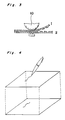
- Fig.4 shows an application of the heat and pressure sensitive recording material described in Fig.1 to a pressure sensitive recording material.
- the colorless electron donative organic compounds 1 used in the present invention are leuco compounds including triphenyl methanes, fluorans, spiropyrans, auramines and phenothiazines.
- Representative examples of the compounds are 3,3-bis(p-dimethylaminophenyl)-6-dimethylaminophthalide, 3,3-bis(p-dimethylaminophenyl)phthalide, 3-(N-p-tolyl-N-ethylamino)-6-methyl-7-(N-phenylamino)fluoran, 2-(N-(3'-trifruoromethylphenyl)amino ⁇ -6-diethylaminofluoran, 3-diethylamino-7-chlorofluoran, 6'-chloro-8'-methoxy-benzoindolino-spyropyran, Benzoyl Leuco Methyleneblue and the like.
- the compounds 1 which is encapsulated [hereinafter referred to as encapsulated compound 1'] are employed in the present invention.
- Encapsulating methods are known to those skilled in the art. Representative methods are a coacervation method using hydrophilic colloid sol, such as USP 2,800,457 and USP 2,800,458; and an interfacial polymerization method, such as U.K.Patents 867797, 950443 989264, 1091075 and the like.
- the encapsulated compound 1' is used in a dried form.
- the acidic organic compounds 2 which are used for developing the color of the compound 1 mentioned above include clays, such as montmorillonite, Attapulgite, bentonite, clay, kaoline and the like: phenol derivatives, such as 4-t-butylphenol, 4-phenylphenol, 2,2-bis(p-hydroxyphenyl)propane, 2,2-bis(p-hydroxyphenyl)butane, a condensation of 4-t-butylphenol and formaldehyde, alpha-naphthol, beta-naphthol, a metal salt of salicylic acid derivatives (for example, a zinc salt of 5-t-amylsalicylic acid, a zinc salt of 5-phenyl salicylic acid, a zinc salt of 5-(4-hydroxyphenyl)-salicylic acid, a zinc salt of 3-methyl-5-phenylsalicylic acid, and a zinc salt of a condensation of salicylic acid and formaldehyde); a mixture thereof; and the like
- the hot melt materials 3 employed in the present invention are those having a melting point of 30 to 110 °C.
- Most of the materials 3 is wax including carnauba wax, montan wax, ouricury wax, candelilla wax, coconuts wax, paraffin wax, micorcrystalline wax, Hoechst wax (OP, O and the like), Bareco wax (WB wax), NPS wax, rice wax, lower molecule polyethylene wax, stearic acid, palmitic acid, myristic acid, a fatty acid amid such as stearoamide, ketone wax such as stearone.
- wax is meant a material which is changed to a liquid having a decreased viscosity when heated and the liquid is returned to a crystalline solid when cooled below its melting point.
- the term “wax” herein intends to cover not only higher fatty acids and esters of higher alcohol, but also the other materials having the characteristics mentioned above.
- an up sheet I is coated with a composition A on the surface.
- the composition A is generally an aqueous composition containing both the electron donative organic compound 1 and the acidic organic compound 2. If necessary, it may further contain a water-soluble binder. Examples of the water-soluble binders are polyvinyl alcohol, starch, carboxymethylcellulose, acrylic emulsion, casein, polysacharide and the like.
- the amount of the electron donative compound 1 is 1 to 50, preferably 3 to 30 % by weight based on the composition. Amounts less than 1 % by weight develop a light and faint color and amounts more than 50 % by weight do not produce an expected color.
- the amount of the acidic compound 2 is 5 to 80 % by weight, preferably 10 to 60 % by weight based on the weight of the composition A. Amounts less than 5 % by weight also develop a light and faint color and amounts more than 80 % by weight do not provide an expected color-development and decline its workability.
- the compound 1 and 2 are reactive with each other and therefore color development may occur when the compounds 1 and 2 are mixed and left for a long time. Accordingly, it is preferred that the compounds 1 and 2 are respectively mixed with the binder and water to form two compositions and than the two compositions are mixed together just before coating.
- the up sheet I is coated with the composition A and then dried.
- the composition B comprises an electron donative compound 1, an encapsulated electron donative compound 1' and a hot melt material 3.
- the composition B is melted by heat and then coated on the other side of the up sheet I.
- the capsule of the encapsulated electron donative compound 1' is broken by pressure and the electron donative compound 1 in the capsule is reacted with the acidic organic compound 2 to develop an image.
- the hot melt material 3 is melted and the electron donative compound 1 which is not encapsulated is reacted with the acidic organic compound 2 to develop an image.
- the weight ratio of the encapsulated compound 1' to the compound 1 not encapsulated is 1:1 to 10:1, preferably 2:1 to 5:1. Weight ratios outside of the ratio mentioned above provide lack of either of pressure sensitivity or heat sensitivity.
- the weight ratio of the compound 1 including both the encapsulated compound 1' and the non-encapsulated compound 1 to the hot melt material 3 is not limited, but preferably 3 to 15 parts by weight, more preferably 3 to 50 parts by weight based on 100 parts by weight of the hot melt material 3.
- the sheet employed in the present invention can be paper or plastic film and the like. Preferred are paper having a weight of 15 to 40 g/m2, preferably 20 to 40 g/m2. Weights lens than 15 g/m2 result in a decreased operating efficiency during coating, and weights more than 40 g/m2 result in a decreased heat conductivity of a thermal head in a thermal printer, which makes color light and faint.
- a down sheet II is coated with a composition C comprising the acidic organic compound 2 and if desirable a resin solution such as SBR latex, polyvinyl alcohol, nitrocellulose.
- the amount of the acidic organic compound 2 is 1 to 50 % by weight, preferably 5 to 50 % by weight based on the total amount of the composition C. Amounts less than 5 % by weight develop a faint color. Amounts more than 50 % by weight result in decline of workability.
- middle sheets III are employed for duplicating as shown in Fig.2, the middle sheets III are coated on the up sheet side with the composition C and on the down sheet side with the composition B.
- the down sheet II and middle sheet III can be paper, plastic film and the like. Paper is preferred.
- a developing temperature is easily adjusted by choice of the hot melt material 3.
- decrease of a developing temperature can be achieved by only selecting a wax having a low melting point and a low melt viscosity.
- a thermal head 10 is generally located above the up sheet I.
- the wax to be coated on the other side of the thermal head 10 should be one which has a lower melting point than the acidic organic compound 2 having been coated on the thermal head side.
- the hot melt material to be coated on the other side of the up sheet I should be one having a melting point of 60 to 70 °C. If the heat and pressure sensitive recording materials of the present invention have three sheets, the melting point of the hot melt materials is made lower the further they are from the thermal head. Further, in case where the recording materials are used as pressure sensitive recording materials, an shown in Fig.4, a good image can be obtained by a pressure of a pencil or a ball point pen. Thus the recording materials of the present invention can provide a good image from either heat or pressure and do not make the surface of things dirty.
- composition B was prepared from the following ingredients.
- the ingredients were melted at a temperature of 120 to 130 °C to form a mixture.
- the mixture was then cooled to 70 to 80 °C at which the mixture was coated on a heat sensitive sheet available from Honshu Seishi Co. Ltd. as Corona Heat Sensitive Paper in an amount of 2.0 to 5.0 g/m2 to form a up sheet.
- composition B was prepared from the following ingredients.
- Example 2 The ingredients were treated as generally described in Example 1 to form a up sheet.
- composition C was prepared from the following ingredients.
- the above ingredients were dispersed and then coated on one sheet of high grade paper by Mayer Bar Coater in an amount of 2.0 to 6.0 g/m2 based on a dried solid content to form a down sheet.
- the up sheet prepared in Example 1 was combined with the down sheet and developed by using Handy terminal HT-5000P available from Canon Corporation.
- the developed image was clear and blue.
- the up sheet prepared in Example 2 was also combined with the down sheet and developed as described above.
- the developed image was clear and black.
- the heat sensitive recording materials combined as mentioned above were tested by writing with a ball point pen. The images thus developed were clear and have distinguish colors.
Landscapes
- Physics & Mathematics (AREA)
- Optics & Photonics (AREA)
- Heat Sensitive Colour Forming Recording (AREA)
- Color Printing (AREA)
Description
- The present invention relates to a heat and pressure sensitive recording material for recording and duplicating
- Heat sensitive recording materials are widely known. They are generally obtained by coating a substrate sheet with an aqueous dispersion containing a colorless electron donative organic compound (such as crystal violet lactone), an organic acidic compound and a binder, and then drying it. These heat sensitive recording materials are used as paper for recording informations in facsimile machines, cardiograph machines and computer terminals.
- It is often desired that an information to be recorded is duplicated into two or three sheets. Japanese Patent Publications (examined) 36865/1979 and 43900/1979 disclose heat and pressure sensitive recording materials employing a transparent or translucent substrate sheet. It however, is difficult to read the recorded informations due to transparency of the substrate sheet. It is also considered that two or more sheets of heat sensitive paper are piled up in order for a duplication. However, since paper absorbs heat in a significant amount, the temperature of an outer layer is decreased and a developed color becomes light and faint.
- Further, heat sensitive recording materials which are currently available for a handy terminal, often make the surface of things dirty by its color, because they use carbon ink.
- The present invention is to provide a heat and pressure sensitive recording material not having the problems mentioned above. The heat and pressure sensitive recording material comprises an up sheet I and a down sheet II, wherein the up sheet I is coated on the surface with a composition A comprising a colorless electron donative
organic compound 1 and an acidicorganic compound 2 which develops the color of saidcompound 1 when heat is applied and is coated on the other side facing the down sheet II with a composition B comprising saidcompound 1, an encapsulated one 1' ofsaid compound 1 and ahot melt material 3, and the down sheet II is coated on the side facing the up sheet I with a composition C comprising saidorganic compound 2. - The present invention also provides a heat and pressure sensitive recording material having more than two sheets wherein at least one middle sheet III is inserted between the up sheet I and the down sheet II and the middle sheet III is coated on the up sheet side with a composition C comprising an acidic
organic compound 2 and on the down sheet side with a composition B comprising a colorless electron donativeorganic compound 1, an encapsulated one 1' ofsaid compound 1 and ahot melt material 3. - Fig.1 is a sectional view schematically showing one embodiment of the present invention.
- Fig.2 is a sectional view schematically showing another embodiment of the present invention.
- Fig.3 is a sectional view schematically showing an application of the embodiment of Fig.1 to a thermal head.
- Fig.4 shows an application of the heat and pressure sensitive recording material described in Fig.1 to a pressure sensitive recording material.
- The colorless electron donative
organic compounds 1 used in the present invention are leuco compounds including triphenyl methanes, fluorans, spiropyrans, auramines and phenothiazines. Representative examples of the compounds are 3,3-bis(p-dimethylaminophenyl)-6-dimethylaminophthalide, 3,3-bis(p-dimethylaminophenyl)phthalide, 3-(N-p-tolyl-N-ethylamino)-6-methyl-7-(N-phenylamino)fluoran, 2-(N-(3'-trifruoromethylphenyl)amino}-6-diethylaminofluoran, 3-diethylamino-7-chlorofluoran, 6'-chloro-8'-methoxy-benzoindolino-spyropyran, Benzoyl Leuco Methyleneblue and the like. - In addition to the
organic compounds 1, thecompounds 1 which is encapsulated [hereinafter referred to as encapsulated compound 1'] are employed in the present invention. Encapsulating methods are known to those skilled in the art. Representative methods are a coacervation method using hydrophilic colloid sol, such as USP 2,800,457 and USP 2,800,458; and an interfacial polymerization method, such as U.K.Patents 867797, 950443 989264, 1091075 and the like. According to the present invention, the encapsulated compound 1' is used in a dried form. - The acidic
organic compounds 2 which are used for developing the color of thecompound 1 mentioned above include clays, such as montmorillonite, Attapulgite, bentonite, clay, kaoline and the like: phenol derivatives, such as 4-t-butylphenol, 4-phenylphenol, 2,2-bis(p-hydroxyphenyl)propane, 2,2-bis(p-hydroxyphenyl)butane, a condensation of 4-t-butylphenol and formaldehyde, alpha-naphthol, beta-naphthol, a metal salt of salicylic acid derivatives (for example, a zinc salt of 5-t-amylsalicylic acid, a zinc salt of 5-phenyl salicylic acid, a zinc salt of 5-(4-hydroxyphenyl)-salicylic acid, a zinc salt of 3-methyl-5-phenylsalicylic acid, and a zinc salt of a condensation of salicylic acid and formaldehyde); a mixture thereof; and the like. Preferred are a mixture of the phenol derivatives such as 2,2-bis(p-hydroxyphenyl)propane and a zinc salt of salicylic acid derivatives, such as 5-(4-hydroxyphenyl)-salicylic acid. - The
hot melt materials 3 employed in the present invention are those having a melting point of 30 to 110 °C. Most of thematerials 3 is wax including carnauba wax, montan wax, ouricury wax, candelilla wax, coconuts wax, paraffin wax, micorcrystalline wax, Hoechst wax (OP, O and the like), Bareco wax (WB wax), NPS wax, rice wax, lower molecule polyethylene wax, stearic acid, palmitic acid, myristic acid, a fatty acid amid such as stearoamide, ketone wax such as stearone. By "wax" is meant a material which is changed to a liquid having a decreased viscosity when heated and the liquid is returned to a crystalline solid when cooled below its melting point. The term "wax" herein intends to cover not only higher fatty acids and esters of higher alcohol, but also the other materials having the characteristics mentioned above. - As shown in Fig.1, an up sheet I is coated with a composition A on the surface. The composition A is generally an aqueous composition containing both the electron donative
organic compound 1 and the acidicorganic compound 2. If necessary, it may further contain a water-soluble binder. Examples of the water-soluble binders are polyvinyl alcohol, starch, carboxymethylcellulose, acrylic emulsion, casein, polysacharide and the like. The amount of theelectron donative compound 1 is 1 to 50, preferably 3 to 30 % by weight based on the composition. Amounts less than 1 % by weight develop a light and faint color and amounts more than 50 % by weight do not produce an expected color. The amount of theacidic compound 2 is 5 to 80 % by weight, preferably 10 to 60 % by weight based on the weight of the composition A. Amounts less than 5 % by weight also develop a light and faint color and amounts more than 80 % by weight do not provide an expected color-development and decline its workability. Thecompound compounds compounds - The composition B comprises an
electron donative compound 1, an encapsulated electron donative compound 1' and ahot melt material 3. The composition B is melted by heat and then coated on the other side of the up sheet I. The capsule of the encapsulated electron donative compound 1' is broken by pressure and theelectron donative compound 1 in the capsule is reacted with the acidicorganic compound 2 to develop an image. When heat in applied, thehot melt material 3 is melted and theelectron donative compound 1 which is not encapsulated is reacted with the acidicorganic compound 2 to develop an image. The weight ratio of the encapsulated compound 1' to thecompound 1 not encapsulated is 1:1 to 10:1, preferably 2:1 to 5:1. Weight ratios outside of the ratio mentioned above provide lack of either of pressure sensitivity or heat sensitivity. The weight ratio of thecompound 1 including both the encapsulated compound 1' and thenon-encapsulated compound 1 to thehot melt material 3 is not limited, but preferably 3 to 15 parts by weight, more preferably 3 to 50 parts by weight based on 100 parts by weight of thehot melt material 3. - The sheet employed in the present invention can be paper or plastic film and the like. Preferred are paper having a weight of 15 to 40 g/m², preferably 20 to 40 g/m². Weights lens than 15 g/m² result in a decreased operating efficiency during coating, and weights more than 40 g/m² result in a decreased heat conductivity of a thermal head in a thermal printer, which makes color light and faint.
- A down sheet II is coated with a composition C comprising the acidic
organic compound 2 and if desirable a resin solution such as SBR latex, polyvinyl alcohol, nitrocellulose. The amount of the acidicorganic compound 2 is 1 to 50 % by weight, preferably 5 to 50 % by weight based on the total amount of the composition C. Amounts less than 5 % by weight develop a faint color. Amounts more than 50 % by weight result in decline of workability. - If one or more middle sheets III are employed for duplicating as shown in Fig.2, the middle sheets III are coated on the up sheet side with the composition C and on the down sheet side with the composition B.
- The down sheet II and middle sheet III can be paper, plastic film and the like. Paper is preferred.
- According to the present invention, since the electron donative
organic compound 1 to be coated on a sheet is dispersed in thehot melt material 3, a developing temperature is easily adjusted by choice of thehot melt material 3. In other words, decrease of a developing temperature can be achieved by only selecting a wax having a low melting point and a low melt viscosity. As is shown in Fig. 3, athermal head 10 is generally located above the up sheet I. The wax to be coated on the other side of thethermal head 10 should be one which has a lower melting point than the acidicorganic compound 2 having been coated on the thermal head side. For example, if a developing temperature on the surface of the up sheet I is 100 °C, the hot melt material to be coated on the other side of the up sheet I should be one having a melting point of 60 to 70 °C. If the heat and pressure sensitive recording materials of the present invention have three sheets, the melting point of the hot melt materials is made lower the further they are from the thermal head. Further, in case where the recording materials are used as pressure sensitive recording materials, an shown in Fig.4, a good image can be obtained by a pressure of a pencil or a ball point pen. Thus the recording materials of the present invention can provide a good image from either heat or pressure and do not make the surface of things dirty. - The present invention is illustrated by the following examples which are not construed as limiting the scope of the invention to their details.
-
- A composition B was prepared from the following ingredients.

- The ingredients were melted at a temperature of 120 to 130 °C to form a mixture. The mixture was then cooled to 70 to 80 °C at which the mixture was coated on a heat sensitive sheet available from Honshu Seishi Co. Ltd. as Corona Heat Sensitive Paper in an amount of 2.0 to 5.0 g/m² to form a up sheet.
- A composition B was prepared from the following ingredients.


- The ingredients were treated as generally described in Example 1 to form a up sheet.
- A composition C was prepared from the following ingredients.

- The above ingredients were dispersed and then coated on one sheet of high grade paper by Mayer Bar Coater in an amount of 2.0 to 6.0 g/m² based on a dried solid content to form a down sheet.
- The up sheet prepared in Example 1 was combined with the down sheet and developed by using Handy terminal HT-5000P available from Canon Corporation. The developed image was clear and blue. The up sheet prepared in Example 2 was also combined with the down sheet and developed as described above. The developed image was clear and black. The heat sensitive recording materials combined as mentioned above were tested by writing with a ball point pen. The images thus developed were clear and have distinguish colors.
Claims (12)
- A heat and pressure sensitive recording material for recording and duplicating comprising an up sheet (I) and a down sheet (II), wherein the up sheet (I) is coated on the surface with a composition A comprising a colorless electron donative organic compound (1) and an acidic organic compound (2) which develops the color of said compound (1) when heat is applied and is coated on the other side facing the down sheet (II) with a composition B comprising said compound (1), an encapsulated one (1') of said compound (1) and a hot melt material (3), and the down sheet (II) is coated on the side facing the up sheet (I) with a composition C comprising said organic compound (2).
- The heat and pressure sensitive recording material of Claim 1 wherein the electron donative organic compound (1) is selected from the group consisting of 3,3-bis(p-dimethylaminophenyl)-6-dimethylaminophthalide, 3,3-bis(p-dimethylaminophenyl)phthalide, 3-(N-p-tolyl-N-ethylamino)-6-methyl-7-(N-phenylamino)fluoran, 2-(N-(3'-trifruoromethylphenyl)amino}-6-diethylaminofluoran, 3-diethylamino-7-chlorofluoran, 6'-chloro-8'-methoxy-benzoindolino-spyropyran, and Benzoyl Leuco Methyleneblue.
- The heat and pressure sensitive recording material of Claim 1 wherein the acidic organic compound (2) is a mixture of 2,2-bis(p-hydrophenyl)propane and 5-(4-hydrophenyl)-salichlic acid.
- The heat and pressure sensitive recording material of Claim 1 wherein the hot melt material (3) is a wax having a melting point of 30 to 110 °C.
- The heat and pressure sensitive recording material of Claim 1 wherein the composition A further comprises a water-soluble binder.
- The heat and pressure sensitive recording material of Claim 1 wherein the composition C further comprises a resin solution.
- A heat and pressure sensitive recording material for recording and duplicating comprising an up sheet (I), one or two middle sheets (III) and a down sheet (II), wherein the up sheet (I) is coated on the surface with a composition A comprising a colorless electron donative organic compound (1) and an acidic organic compound (2) which develops the color of said compound (1) when heat is applied and is coated on the down sheet side with a composition B comprising said compound (1), an encapsulated one (1') of said compound (1) and a hot melt material (3); the down sheet (II) is coated on the up sheet side with a composition C comprising said organic compound (2); and at least one middle sheet (III) is inserted between the up sheet (I) and the down sheet (II) and is coated on the up sheet side with a composition C comprising an acidic organic compound (2) and on the down sheet side with a composition B comprising a colorless electron donative organic compound (1), an encapsulated one (1') of said compound (1) and a hot melt material (3).
- The heat and pressure sensitive recording material of Claim 7 wherein the electron donative organic compound (1) is selected from the group consisting of 3,3-bis(p-dimethylaminophenyl)-6-dimethylaminophthalide, 3,3-bis(p-dimethylaminophenyl)phthalide, 3-(N-p-tolyl-N-ethylamino)-6-methyl-7-(N-phenylamino)fluoran, 2-{N-(3'-trifruoromethylphenyl)amino}-6-diethylaminofluoran, 3-diethylamino-7-chlorofluoran, 6'-chloro-8'-methoxy-benzoindolino-spyropyran, and Benzoyl Leuco Methyleneblue.
- The heat and pressure sensitive recording material of Claim 7 wherein the acidic organic compound (2) is a mixture of 2,2-bis(p-hydrophenyl)propane and 5-(4-hydrophenyl)-salichlic acid.
- The heat and pressure sensitive recording material of Claim 7 wherein the hot melt material (3) is a wax having a melting point of 30 to 110 °C.
- The heat and pressure sensitive recording material of Claim 7 wherein the composition A further comprises a water-soluble binder.
- The heat and pressure sensitive recording material of Claim 7 wherein the composition C further comprises a resin solution.
Applications Claiming Priority (2)
| Application Number | Priority Date | Filing Date | Title |
|---|---|---|---|
| JP60231497A JPH0651422B2 (en) | 1985-10-16 | 1985-10-16 | Pressure-sensitive and heat-sensitive multiple copy paper |
| JP231497/85 | 1985-10-16 |
Publications (3)
| Publication Number | Publication Date |
|---|---|
| EP0219130A2 EP0219130A2 (en) | 1987-04-22 |
| EP0219130A3 EP0219130A3 (en) | 1988-10-05 |
| EP0219130B1 true EP0219130B1 (en) | 1991-09-18 |
Family
ID=16924415
Family Applications (1)
| Application Number | Title | Priority Date | Filing Date |
|---|---|---|---|
| EP86114351A Expired EP0219130B1 (en) | 1985-10-16 | 1986-10-16 | Heat and pressure sensitive recording material |
Country Status (4)
| Country | Link |
|---|---|
| US (1) | US4814319A (en) |
| EP (1) | EP0219130B1 (en) |
| JP (1) | JPH0651422B2 (en) |
| DE (1) | DE3681547D1 (en) |
Families Citing this family (14)
| Publication number | Priority date | Publication date | Assignee | Title |
|---|---|---|---|---|
| US5135437A (en) | 1989-11-13 | 1992-08-04 | Schubert Keith E | Form for making two-sided carbonless copies of information entered on both sides of an original sheet and methods of making and using same |
| US5137494A (en) | 1989-11-13 | 1992-08-11 | Schubert Keith E | Two-sided forms and methods of laying out, printing and filling out same |
| US5127879A (en) | 1989-04-06 | 1992-07-07 | Schubert Keith E | Apparatus for recordkeeping |
| US5395288A (en) | 1989-04-06 | 1995-03-07 | Linden; Gerald E. | Two-way-write type, single sheet, self-replicating forms |
| US5248279A (en) | 1989-04-06 | 1993-09-28 | Linden Gerald E | Two-sided, self-replicating forms |
| US5154668A (en) | 1989-04-06 | 1992-10-13 | Schubert Keith E | Single paper sheet forming a two-sided copy of information entered on both sides thereof |
| US5224897A (en) | 1989-04-06 | 1993-07-06 | Linden Gerald E | Self-replicating duplex forms |
| US6280322B1 (en) | 1989-11-13 | 2001-08-28 | Gerald E. Linden | Single sheet of paper for duplicating information entered on both surfaces thereof |
| US5424266A (en) * | 1991-04-15 | 1995-06-13 | Nocopi Technologies, Inc. | Latent image printing process and substrate |
| JP2977404B2 (en) * | 1993-02-24 | 1999-11-15 | 内外カーボンインキ株式会社 | Pressure-sensitive and heat-sensitive multiplex paper |
| US5810397A (en) | 1993-05-03 | 1998-09-22 | The Standard Register Company | Thermally imagable business record and method of desensitizing a thermally imagable surface |
| US5984363A (en) * | 1993-05-03 | 1999-11-16 | The Standard Register Company | Business record having a thermally imagable surface |
| CA2243722A1 (en) * | 1997-07-25 | 1999-01-25 | Asahi Kogaku Kogyo Kabushiki Kaisha | Image-forming system |
| CA2245600A1 (en) | 1997-08-28 | 1999-02-28 | Minoru Suzuki | Image-forming substrate |
Family Cites Families (10)
| Publication number | Priority date | Publication date | Assignee | Title |
|---|---|---|---|---|
| US30041A (en) * | 1860-09-18 | Improvement in mole-plows | ||
| US3981523A (en) | 1975-03-24 | 1976-09-21 | Moore Business Forms, Inc. | Carbonless manifold business forms |
| JPS5835479B2 (en) * | 1978-12-18 | 1983-08-02 | 三島製紙株式会社 | pressure sensitive recording material |
| JPS5712693A (en) * | 1980-06-27 | 1982-01-22 | Mitsubishi Paper Mills Ltd | Thermo-sensitive recording body for simultaneous copying |
| JPS5796895A (en) * | 1980-12-09 | 1982-06-16 | Naigai Ink Seizo Kk | Heat sensitive multiple copying paper |
| US4425386A (en) * | 1982-07-07 | 1984-01-10 | Wallace Computer Services, Inc. | Multi-sheet assembly using autogenous coating |
| US4520378A (en) * | 1983-05-21 | 1985-05-28 | Mitsubishi Paper Mills, Ltd. | Heat-sensitive recording paper and a process for production thereof |
| JPS6083886A (en) * | 1983-10-17 | 1985-05-13 | Mitsubishi Paper Mills Ltd | Thermal transfer recording material |
| JPS60168690A (en) * | 1984-02-13 | 1985-09-02 | Mitsubishi Paper Mills Ltd | Pressure-sensitive colorless thermal transfer recording paper |
| JPS60214990A (en) * | 1984-03-26 | 1985-10-28 | Fuji Photo Film Co Ltd | Photosensitive thermal recording material |
-
1985
- 1985-10-16 JP JP60231497A patent/JPH0651422B2/en not_active Expired - Fee Related
-
1986
- 1986-10-16 DE DE8686114351T patent/DE3681547D1/en not_active Expired - Lifetime
- 1986-10-16 US US06/919,734 patent/US4814319A/en not_active Expired - Lifetime
- 1986-10-16 EP EP86114351A patent/EP0219130B1/en not_active Expired
Also Published As
| Publication number | Publication date |
|---|---|
| EP0219130A2 (en) | 1987-04-22 |
| EP0219130A3 (en) | 1988-10-05 |
| DE3681547D1 (en) | 1991-10-24 |
| US4814319A (en) | 1989-03-21 |
| JPS6290282A (en) | 1987-04-24 |
| JPH0651422B2 (en) | 1994-07-06 |
Similar Documents
| Publication | Publication Date | Title |
|---|---|---|
| US4311758A (en) | Heat-sensitive record material | |
| US4814319A (en) | Heat and pressure sensitive recording material | |
| JP3054662B2 (en) | Thermal recording material | |
| US4620205A (en) | Two-color thermosensitive recording material | |
| US4547788A (en) | Thermosensitive image transfer medium | |
| JPH029953B2 (en) | ||
| US4568956A (en) | Heat-sensitive and heat transfer recording sheet with pressure sensitivity | |
| US4688057A (en) | Heat-sensitive transferring recording medium | |
| EP0008205A1 (en) | Thermosensitive recording material | |
| EP0164417A1 (en) | Thermal recording material | |
| JPS5967081A (en) | Heat sensitive recordng sheet | |
| US4575734A (en) | Thermosensitive image transfer medium | |
| JPS6046292A (en) | Thermal recording material | |
| JPS59174388A (en) | Thermal recording material | |
| JP3699221B2 (en) | Thermal recording material | |
| JPH0153199B2 (en) | ||
| JPS58166098A (en) | Heat-sensitive recording material | |
| JP3101449B2 (en) | Pressure-sensitive copy paper | |
| JP3129597B2 (en) | Pressure-sensitive recording sheet | |
| JPH0679869B2 (en) | Thermal recording material | |
| JPS59167296A (en) | heat sensitive recording material | |
| JPH01180382A (en) | Thermal recording material | |
| JPS5822197A (en) | heat sensitive recording material | |
| JPS58212987A (en) | multicolor thermal paper | |
| JPH0377071B2 (en) |
Legal Events
| Date | Code | Title | Description |
|---|---|---|---|
| PUAI | Public reference made under article 153(3) epc to a published international application that has entered the european phase |
Free format text: ORIGINAL CODE: 0009012 |
|
| AK | Designated contracting states |
Kind code of ref document: A2 Designated state(s): DE FR GB |
|
| PUAL | Search report despatched |
Free format text: ORIGINAL CODE: 0009013 |
|
| AK | Designated contracting states |
Kind code of ref document: A3 Designated state(s): DE FR GB |
|
| 17P | Request for examination filed |
Effective date: 19890322 |
|
| 17Q | First examination report despatched |
Effective date: 19901012 |
|
| GRAA | (expected) grant |
Free format text: ORIGINAL CODE: 0009210 |
|
| AK | Designated contracting states |
Kind code of ref document: B1 Designated state(s): DE FR GB |
|
| REF | Corresponds to: |
Ref document number: 3681547 Country of ref document: DE Date of ref document: 19911024 |
|
| ET | Fr: translation filed | ||
| PLBE | No opposition filed within time limit |
Free format text: ORIGINAL CODE: 0009261 |
|
| STAA | Information on the status of an ep patent application or granted ep patent |
Free format text: STATUS: NO OPPOSITION FILED WITHIN TIME LIMIT |
|
| 26N | No opposition filed | ||
| REG | Reference to a national code |
Ref country code: GB Ref legal event code: IF02 |
|
| PGFP | Annual fee paid to national office [announced via postgrant information from national office to epo] |
Ref country code: GB Payment date: 20031016 Year of fee payment: 18 |
|
| PGFP | Annual fee paid to national office [announced via postgrant information from national office to epo] |
Ref country code: FR Payment date: 20031030 Year of fee payment: 18 |
|
| PGFP | Annual fee paid to national office [announced via postgrant information from national office to epo] |
Ref country code: DE Payment date: 20031219 Year of fee payment: 18 |
|
| PG25 | Lapsed in a contracting state [announced via postgrant information from national office to epo] |
Ref country code: GB Free format text: LAPSE BECAUSE OF NON-PAYMENT OF DUE FEES Effective date: 20041016 |
|
| PG25 | Lapsed in a contracting state [announced via postgrant information from national office to epo] |
Ref country code: DE Free format text: LAPSE BECAUSE OF NON-PAYMENT OF DUE FEES Effective date: 20050503 |
|
| GBPC | Gb: european patent ceased through non-payment of renewal fee |
Effective date: 20041016 |
|
| PG25 | Lapsed in a contracting state [announced via postgrant information from national office to epo] |
Ref country code: FR Free format text: LAPSE BECAUSE OF NON-PAYMENT OF DUE FEES Effective date: 20050630 |
|
| REG | Reference to a national code |
Ref country code: FR Ref legal event code: ST |