EP0219031A2 - Verfahren zur Reinigung von Kälberlab - Google Patents
Verfahren zur Reinigung von Kälberlab Download PDFInfo
- Publication number
- EP0219031A2 EP0219031A2 EP86113820A EP86113820A EP0219031A2 EP 0219031 A2 EP0219031 A2 EP 0219031A2 EP 86113820 A EP86113820 A EP 86113820A EP 86113820 A EP86113820 A EP 86113820A EP 0219031 A2 EP0219031 A2 EP 0219031A2
- Authority
- EP
- European Patent Office
- Prior art keywords
- chymosin
- rennet
- pepsin
- column
- calf
- Prior art date
- Legal status (The legal status is an assumption and is not a legal conclusion. Google has not performed a legal analysis and makes no representation as to the accuracy of the status listed.)
- Withdrawn
Links
Images

Classifications
-
- C—CHEMISTRY; METALLURGY
- C12—BIOCHEMISTRY; BEER; SPIRITS; WINE; VINEGAR; MICROBIOLOGY; ENZYMOLOGY; MUTATION OR GENETIC ENGINEERING
- C12N—MICROORGANISMS OR ENZYMES; COMPOSITIONS THEREOF; PROPAGATING, PRESERVING, OR MAINTAINING MICROORGANISMS; MUTATION OR GENETIC ENGINEERING; CULTURE MEDIA
- C12N9/00—Enzymes; Proenzymes; Compositions thereof; Processes for preparing, activating, inhibiting, separating or purifying enzymes
- C12N9/14—Hydrolases (3)
- C12N9/48—Hydrolases (3) acting on peptide bonds (3.4)
- C12N9/50—Proteinases, e.g. Endopeptidases (3.4.21-3.4.25)
- C12N9/64—Proteinases, e.g. Endopeptidases (3.4.21-3.4.25) derived from animal tissue
- C12N9/6421—Proteinases, e.g. Endopeptidases (3.4.21-3.4.25) derived from animal tissue from mammals
- C12N9/6478—Aspartic endopeptidases (3.4.23)
- C12N9/6481—Pepsins (3.4.23.1; 3.4.23.2; 3.4.23.3)
-
- Y—GENERAL TAGGING OF NEW TECHNOLOGICAL DEVELOPMENTS; GENERAL TAGGING OF CROSS-SECTIONAL TECHNOLOGIES SPANNING OVER SEVERAL SECTIONS OF THE IPC; TECHNICAL SUBJECTS COVERED BY FORMER USPC CROSS-REFERENCE ART COLLECTIONS [XRACs] AND DIGESTS
- Y10—TECHNICAL SUBJECTS COVERED BY FORMER USPC
- Y10S—TECHNICAL SUBJECTS COVERED BY FORMER USPC CROSS-REFERENCE ART COLLECTIONS [XRACs] AND DIGESTS
- Y10S435/00—Chemistry: molecular biology and microbiology
- Y10S435/814—Enzyme separation or purification
- Y10S435/815—Enzyme separation or purification by sorption
Definitions
- Chymosin (EC 3.4.23.4) is the predominant milk-clotting enzyme in the fourth stomach of unweaned calves Use of this enzyme in cheese making has been known since ancient times.
- Calf chymosin used for commercial cheese making is typically found in rennet, an impure extract leached from the calf stomach.
- rennet an impure extract leached from the calf stomach.
- 5-20% of the milk clotting activity is due to bovine pepsin with the amount of pepsin in the rennet being a function of the age, weaning and diet of the calves whose stomachs are processed during its preparation.
- higher levels of non-protein nitrogen and fat are found in the whey when rennet containing higher levels of pepsin is used.
- pepsin has greater proteolytic activity than chymosin at all pH values from 2 to 6. If the proteolytic activity is excessive, the yield of cheese and retention of fat by the curd may be diminished. Excessive proteolysis during ripening also has undesirable effects on the body and flavor of the finished cheese. For these reasons, it is desirable to use rennin having a reduced pepsin level in the manufacture of cheese.
- Bovine pepsin can be inactivated at an alkaline pH for example, by incubating at a pH of 7-7.3 for 30 minutes at 30°C but not without inactivating some chymosin too. Because of the critical conditions necessary for the selective inactivation of pepsin, methods by which pepsin and chymosin are separated are to be preferred over the selective inactivation technique.
- Garnot et al discuss the separation of chymosin from pepsin in calf rennet in J. Dairy Science, 55, 1641-1650 (1972). After exhaustive dialysis the sample is applied to a microgranular DEAE cellulose column. Both chymosin and pepsin are adsorbed on the column, however, application of a linear gradient of NaCl eluted chymosin first and pepsin at a higher salt concentration. This method was used primarily for the determination of the enzymatic composition of several commercial rennet preparations.
- Pohl et al disclose the preparation of an affinity ligand (a synthetic inhibitor of aspartate proteinases) and its attachment to Sepharose 4B, which is then used to purify bovine cathepsin D and also human, porcine and chicken pepsins. These enzymes bind to the support over the pH range of 2-5.
- a buffer at pH Z 6, low ionic strength and containing 20% dioxane served as a general desorption agent.
- the peptide inhibitor (Sepharose) is a general purpose ligand which can bind most aspartate proteinases and is thus not discriminatory.
- Bovine Cathepsin D could be purified on the affinity column because the contaminant proteinases were all of the cysteine type (rather than aspartate proteinases) which did not bind to the column.
- pepstatin-Sepharose as the affinity medium for the purification of chymosin is disclosed in Agric. Biol. Chem., 42, 2227-2231 (1978) by Kobayashi et al. This method results in poor recovery ( 1 ⁇ 60%) and pepstatin is quite expensive for use in commercial scale operations.
- the present invention is a method for the purification of calf rennet by separating pepsin therefrom.
- the method comprises contacting the rennet with an affinity ligand of the formula: where R is a solubilizing moiety or a moiety which will insolubilize the ligand without affecting its affinity characteristics at a pH of from 5.4 to 5.7 to cause separation of chymosin and pepsin contained in the rennet.
- the present technique is capable of separating pepsin from chymosin in calf rennet by selectively retaining or retarding chymosin on an affinity column under controlled conditions and letting the pepsin pass through unaffected.
- the chymosin is adsorbed on the affinity ligand in the column and later released by use of an eluting agent.
- the technique can be fine tuned such that under appropriate conditions the chymosin is not adsorbed but only retarded by the affinity ligand so that the pepsin is recovered first while an appropriate cut in the fractions separates the enzymes. This is accomplished by applying the calf rennet to the column at a pH of 5.5 (0.025 M citrate buffer) containing 0.5% (0.085 M) NaCl. In this embodiment chymosin will be retarded by the gel to a greater degree than pepsin so that pepsin will elute first followed by chymosin.
- the blue dye affinity ligand described above is available commercially as Cibacron Blue F3GA in a form in which M is Na and R is Cl. This form of the dye is soluble and can be used to purify the rennet.
- soluble forms of the dye such as when R is polyethylene glycol, dextran or polyethyleneimine can be used in the purification of calf rennet in a similar manner.
- R polyethylene glycol
- two-phase purification involves the use of Cibacron blue derivatized polyethyleneglycol (CB-PEG) and dextran in water to form two phases.
- the upper phase will be rich in CB-PEG and the lower phase rich in dextran.
- the enzyme chymosin
- the enzyme chymosin
- the enzyme chymosin
- the enzyme will complex with CB-PEG and stay in the upper phase.
- salt NaCl
- the enzyme will be released into aqueous (containing salt) phase.
- the enzyme can be dissociated from the complex with salt and rechromatographed to separate it from the blue dextran.
- the enzyme With polyethyleneimine, the enzyme may form a precipitate or a complex which can be chromatographed further to separate the enzyme.
- the affinity ligand is immobilized by attaching it to a polymeric material so that in the foregoing formula R is agarose, Sephadex (dextran cross-linked with epichlorhydrin), polyacrylamide, agarose-polyacrylamide copolymer, cellulose, or even glass among other insoluble matrices.
- R is agarose
- Sephadex distaln cross-linked with epichlorhydrin
- polyacrylamide polyacrylamide
- agarose-polyacrylamide copolymer cellulose
- even glass among other insoluble matrices a particularly preferred insoluble affinity ligand is available as Blue agarose in which M in the above formula is Na and R is cross-linked agarose. Blue agarose has good flow properties as well as good mechanical and chemical stability. It is highly porous and the gel is known to be stable for years. These bead-like particles lend themselves readily for use in a conventional affinity gel chromatography column.
- M can represent a monovalent or divalent cation such as Li , Na , K + , Rb + , Ca ++ or Mg ++ .
- a monovalent or divalent cation such as Li , Na , K + , Rb + , Ca ++ or Mg ++ .
- the cation is Na + .
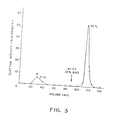
- pepsin When calf rennet containing approximately 15% pepsin is applied to a Cibacron Blue Agarose column at a pH of from 5.4 to 5.7 (preferably 5.5) in a low salt medium (0.025 M Na-citrate), pepsin passes through unadsorbed while chymosin is bound to the gel in the column. After washing the column with 0.025 M Na-citrate to remove unbound impurities, the chymosin can be eluted with 5% NaCl solution at pH 5.5 or with 50% (v/v) ethylene glycol -0.025 M citrate buffer at pH 6.0. The eluted chymosin was analyzed and found to contain greater than 97% pure chymosin.
- calf rennet extract Five ml of calf rennet extract was dialyzed in one liter of 0.025 M citrate buffer at pH 5.5 with two changes of buffer overnight. The dialyzed sample was loaded onto a (1.5 cm x 10 cm) column of Cibacron Blue Agarose (obtained from Pierce Chemical Co.) equilibrated with 0.025 M Na citrate buffer at pH 5.5 at a flow rate of 30 ml/hour. The column was then washed with the equilibrating buffer and the effluents monitored for absorbance at 280 nm and also for milk-clotting activity.
- the bound enzyme When the activity returned to basal value, the bound enzyme was eluted by application of the 0.025 M citrate buffer (pH 5.5) containing 10% NaCl.
- the bound enzyme with milk-clotting activity eluted in a sharp peak as shown in Fig. 1.
- the fractions under A and B were pooled separately.
- the clotting activity of peak A was 23% of the total applied while that of peak B was 67% of the total applied activity. It was also found (by analysis on a DEAE cellulose column) that peak A was composed of 96% pepsin and peak B was 96.3% chymosin.
- pepsin passed through the column unadsorbed while chymosin is bound and can be eluted with 10% NaCl.
- C/P clotting/proteolytic
- rennet extract Five ml of rennet extract was dialyzed overnight in 0.025 M citrate buffer at pH 5.1 and applied to the blue gel column as in Example I at a flow rate of 30 ml/hour.
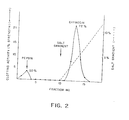
- the column was equilibrated with the same buffer. As before, the fraction which passed through the column had milk-clotting activity. After washing with equilibrating buffer, a gradient was applied with 0-18% NaCl in the buffer. The results are illustrated in Fig. 2.
- the passthrough fraction contained 20% of the clotting activity whereas the elution fraction contained 72%. Peak activity eluted at 3.17% NaCl and all clotting activity was completely eluted at 6.8% NaCl. Total recovery was 92% of which pepsin was 20% and chymosin 72%. Proteolytic activities of the two peaks were measured and the ratios of clotting to proteolytic activities were obtained. These are set out in Table I.
- Fraction 3 gave a C/P ratio of 1.7 while fraction 4 gave a ratio of 12.1 which is in line with previous identification of such fractions as pepsin and chymosin respectively.
- This embodiment provides an effective alternative for separating the two fractions without having to bind either pepsin or chymosin on the column.
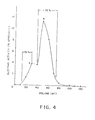
- Example III Since it was shown in Example III that 0.75 M Na 2 S0 4 is effective in separating pepsin and chymosin, the feasibility of a large scale preparation was further tested.
- Rennet was extracted from calf stomachs using 10% Na 2 SO 4 instead of the usual NaCl.
- the crude extract had a clotting activity of 14.5%.
- the extract was filtered through Whatman #1 filter paper and centrifuged for two hours at 10,000 rpm. The resulting supernatant had a clotting strength of 12.3%.
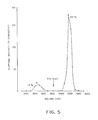
- the conductivity of the extract was 46,300 ( ⁇ S/cm). Eleven percent Na 2 S0 4 solution measured 60,800 ⁇ S/cm. So, in order to keep the Na 2 SO 4 concentration at 0.77 M ( ⁇ 11%), additional Na 2 S0 4 was added to 470 ml of the extract to bring the conductivity to 60,400 ⁇ S/cm ( ⁇ 11% Na 2 S0 4 ). This was then ultrafiltered down to a volume of 250 ml. This 250 ml was processed on a wide Cibacron Blue gel column (6 cm x 14 cm) equilibrated with 11% Na 2 SO 4 and 0.025 M Na citrate buffer at pH 5.5. The milk clotting activities of all the fractions (passthrough, wash and elution) were determined. The washing medium was the same as the equilibrium medium. Elution was effected by passing 5% NaCl through the gel.
- the clotting activities of the fractions were plotted as a function of the fractions collected. They are shown in Fig. 5.
- the initial peak (a) represents the passthrough fraction containing 14% of the total applied clotting activity.
- the peak (b) represents the elution (5% NaCl) fraction which had 82% of the applied activity.
- proteolytic activities of the rennet applied to the column, the passthrough and the elution fractions were determined to test the efficacy of separation of pepsin and chymosin. Hemoglobin was used as the substrate. Essentially the proteolytic activity thus determined would show pepsin activity (since the pH was kept at 2.0). The proteolytic and clotting activities are given in Table III.
- Sigma pepsin and chymosin have C/P values of 1.1 and 9.8, respectively.
- O ur passthrough fraction and elution fraction give C/P values of 0.99 and 16.67, respectively, indicating that they are pure pepsin and pure chymosin, respectively.
Landscapes
- Health & Medical Sciences (AREA)
- Engineering & Computer Science (AREA)
- Life Sciences & Earth Sciences (AREA)
- Chemical & Material Sciences (AREA)
- Biomedical Technology (AREA)
- Organic Chemistry (AREA)
- Zoology (AREA)
- Bioinformatics & Cheminformatics (AREA)
- Wood Science & Technology (AREA)
- Genetics & Genomics (AREA)
- Microbiology (AREA)
- Biotechnology (AREA)
- Molecular Biology (AREA)
- Biochemistry (AREA)
- General Engineering & Computer Science (AREA)
- General Health & Medical Sciences (AREA)
- Medicinal Chemistry (AREA)
- Enzymes And Modification Thereof (AREA)
- Compounds Of Unknown Constitution (AREA)
- Medicines That Contain Protein Lipid Enzymes And Other Medicines (AREA)
Applications Claiming Priority (2)
| Application Number | Priority Date | Filing Date | Title |
|---|---|---|---|
| US787998 | 1985-10-16 | ||
| US06/787,998 US4666843A (en) | 1985-10-16 | 1985-10-16 | Method for the purification of calf rennet |
Publications (2)
| Publication Number | Publication Date |
|---|---|
| EP0219031A2 true EP0219031A2 (de) | 1987-04-22 |
| EP0219031A3 EP0219031A3 (de) | 1988-11-23 |
Family
ID=25143134
Family Applications (1)
| Application Number | Title | Priority Date | Filing Date |
|---|---|---|---|
| EP86113820A Withdrawn EP0219031A3 (de) | 1985-10-16 | 1986-10-06 | Verfahren zur Reinigung von Kälberlab |
Country Status (5)
| Country | Link |
|---|---|
| US (1) | US4666843A (de) |
| EP (1) | EP0219031A3 (de) |
| AU (1) | AU574586B2 (de) |
| CA (1) | CA1284303C (de) |
| DK (1) | DK492586A (de) |
Families Citing this family (6)
| Publication number | Priority date | Publication date | Assignee | Title |
|---|---|---|---|---|
| US4743551A (en) * | 1984-11-05 | 1988-05-10 | Miles Inc. | Purification of microbial rennet from Mucor miehei |
| US5139943A (en) * | 1989-06-13 | 1992-08-18 | Genencor International, Inc. | Processes for the recovery of microbially produced chymosin |
| US5151358A (en) * | 1989-06-13 | 1992-09-29 | Genencor International, Inc. | Processes for the recovery of naturally produced chymosin |
| US5215908A (en) * | 1989-06-13 | 1993-06-01 | Genencor International, Inc. | Process for recovery and purification of chymosin |
| SE0004808D0 (sv) | 2000-12-20 | 2000-12-20 | Apbiotech Ab | Method for the purification of an enzyme |
| US20080131487A1 (en) * | 2006-11-30 | 2008-06-05 | Dag Ommundsen | Chymosin for the prevention and treatment of gastrointestinal disorders |
Family Cites Families (1)
| Publication number | Priority date | Publication date | Assignee | Title |
|---|---|---|---|---|
| US4431544A (en) * | 1981-04-27 | 1984-02-14 | The Public Health Laboratory Service Board | High pressure liquid affinity chromatography |
-
1985
- 1985-10-16 US US06/787,998 patent/US4666843A/en not_active Expired - Fee Related
-
1986
- 1986-08-25 CA CA000516774A patent/CA1284303C/en not_active Expired - Lifetime
- 1986-10-06 EP EP86113820A patent/EP0219031A3/de not_active Withdrawn
- 1986-10-15 DK DK492586A patent/DK492586A/da not_active Application Discontinuation
- 1986-10-15 AU AU63937/86A patent/AU574586B2/en not_active Ceased
Also Published As
| Publication number | Publication date |
|---|---|
| DK492586D0 (da) | 1986-10-15 |
| AU574586B2 (en) | 1988-07-07 |
| AU6393786A (en) | 1987-04-30 |
| CA1284303C (en) | 1991-05-21 |
| US4666843A (en) | 1987-05-19 |
| EP0219031A3 (de) | 1988-11-23 |
| DK492586A (da) | 1987-04-17 |
Similar Documents
| Publication | Publication Date | Title |
|---|---|---|
| Grant et al. | Purification and characterization of a human platelet cyclic nucleotide phosphodiesterase | |
| Abo et al. | Purification and characterization of a third cytosolic component of the superoxide-generating NADPH oxidase of macrophages. | |
| EP0140386B1 (de) | Verfahren zur Reinigung von LPF-HA | |
| Shapiro et al. | The relationship of α-l-iduronidase and Hurler corrective factor | |
| Heinz et al. | [52] Glyceraldehyde-3-phosphate dehydrogenase from human tissues | |
| US4666843A (en) | Method for the purification of calf rennet | |
| El-Gharbawi et al. | Fractionation and partial characterization of the proteolytic enzymes of stem bromelain | |
| Torres et al. | Fractionation of granule proteins of granulocytes by copper chelate chromatography | |
| US4743551A (en) | Purification of microbial rennet from Mucor miehei | |
| Heumann et al. | Purification and immunological characterization of the human hexokinase isoenzymes I and III (ATP-d-hexose 6-phosphotransferase EC 2.7. 1.1) | |
| US4745063A (en) | Method for separating rennet components | |
| US4065445A (en) | Pregnancy-specific β1 -glycoprotein and process for isolating it | |
| Paus et al. | α‐Mannosidase from Phaseolus vulgaris: Purification and Characterization | |
| Grace et al. | Improved procedures for purification of human and canine creatine kinase isoenzymes | |
| Rhodes et al. | Trypsin and chymotrypsin inhibitors from Ascaris suum | |
| Kobayashi et al. | Rapid isolation of microbial milk-clotting enzymes by N-acetyl (or N-isobutyryl)-pepstatin-aminohexylagarose | |
| Paech et al. | Simplified isolation and molecular composition of NADH dehydrogenase of the respiratory chain | |
| EP0253331A2 (de) | Throminbindende Substanz und Verfahren zu ihrer Herstellung | |
| Nose | Purification and characterization of alkaline phosphatase from rat kidney | |
| US4978620A (en) | Process for separating single-chain TPA and double-chain from each other | |
| Subramanian | Separation of Chymosin and Pepsin in Calf Rennet by Dye-Ligant) Affinity Chromatography | |
| EP0190350A1 (de) | Verfahren zur herstellung menschlicher hydroxylase | |
| CA1143309A (en) | Apoglucose oxidase preparation | |
| Agarwal et al. | [79] A general method for the isolation of various enzymes from human erythrocytes | |
| CA1335186C (en) | Method for purifying tissue plasminogen activator |
Legal Events
| Date | Code | Title | Description |
|---|---|---|---|
| PUAI | Public reference made under article 153(3) epc to a published international application that has entered the european phase |
Free format text: ORIGINAL CODE: 0009012 |
|
| 17P | Request for examination filed |
Effective date: 19861009 |
|
| AK | Designated contracting states |
Kind code of ref document: A2 Designated state(s): DE FR GB IT |
|
| RAP1 | Party data changed (applicant data changed or rights of an application transferred) |
Owner name: MILES LABORATORIES, INC. |
|
| RAP1 | Party data changed (applicant data changed or rights of an application transferred) |
Owner name: MILES INC. |
|
| PUAL | Search report despatched |
Free format text: ORIGINAL CODE: 0009013 |
|
| AK | Designated contracting states |
Kind code of ref document: A3 Designated state(s): DE FR GB IT |
|
| 17Q | First examination report despatched |
Effective date: 19901010 |
|
| RAP1 | Party data changed (applicant data changed or rights of an application transferred) |
Owner name: RHONE-POULENC INC. |
|
| STAA | Information on the status of an ep patent application or granted ep patent |
Free format text: STATUS: THE APPLICATION IS DEEMED TO BE WITHDRAWN |
|
| 18D | Application deemed to be withdrawn |
Effective date: 19910911 |
|
| RIN1 | Information on inventor provided before grant (corrected) |
Inventor name: SUBRAMANIAN, SETHURAMAN |