EP0218931A2 - Peroxide-containing conditioning shampoo - Google Patents
Peroxide-containing conditioning shampoo Download PDFInfo
- Publication number
- EP0218931A2 EP0218931A2 EP86112664A EP86112664A EP0218931A2 EP 0218931 A2 EP0218931 A2 EP 0218931A2 EP 86112664 A EP86112664 A EP 86112664A EP 86112664 A EP86112664 A EP 86112664A EP 0218931 A2 EP0218931 A2 EP 0218931A2
- Authority
- EP
- European Patent Office
- Prior art keywords
- hair
- percent
- hair conditioning
- component
- peroxide
- Prior art date
- Legal status (The legal status is an assumption and is not a legal conclusion. Google has not performed a legal analysis and makes no representation as to the accuracy of the status listed.)
- Granted
Links
Classifications
-
- A—HUMAN NECESSITIES
- A61—MEDICAL OR VETERINARY SCIENCE; HYGIENE
- A61K—PREPARATIONS FOR MEDICAL, DENTAL OR TOILETRY PURPOSES
- A61K8/00—Cosmetics or similar toiletry preparations
- A61K8/18—Cosmetics or similar toiletry preparations characterised by the composition
- A61K8/19—Cosmetics or similar toiletry preparations characterised by the composition containing inorganic ingredients
- A61K8/22—Peroxides; Oxygen; Ozone
-
- A—HUMAN NECESSITIES
- A61—MEDICAL OR VETERINARY SCIENCE; HYGIENE
- A61K—PREPARATIONS FOR MEDICAL, DENTAL OR TOILETRY PURPOSES
- A61K8/00—Cosmetics or similar toiletry preparations
- A61K8/18—Cosmetics or similar toiletry preparations characterised by the composition
- A61K8/30—Cosmetics or similar toiletry preparations characterised by the composition containing organic compounds
- A61K8/46—Cosmetics or similar toiletry preparations characterised by the composition containing organic compounds containing sulfur
- A61K8/463—Cosmetics or similar toiletry preparations characterised by the composition containing organic compounds containing sulfur containing sulfuric acid derivatives, e.g. sodium lauryl sulfate
-
- A—HUMAN NECESSITIES
- A61—MEDICAL OR VETERINARY SCIENCE; HYGIENE
- A61K—PREPARATIONS FOR MEDICAL, DENTAL OR TOILETRY PURPOSES
- A61K8/00—Cosmetics or similar toiletry preparations
- A61K8/18—Cosmetics or similar toiletry preparations characterised by the composition
- A61K8/72—Cosmetics or similar toiletry preparations characterised by the composition containing organic macromolecular compounds
- A61K8/73—Polysaccharides
- A61K8/731—Cellulose; Quaternized cellulose derivatives
-
- A—HUMAN NECESSITIES
- A61—MEDICAL OR VETERINARY SCIENCE; HYGIENE
- A61Q—SPECIFIC USE OF COSMETICS OR SIMILAR TOILETRY PREPARATIONS
- A61Q5/00—Preparations for care of the hair
- A61Q5/04—Preparations for permanent waving or straightening the hair
-
- A—HUMAN NECESSITIES
- A61—MEDICAL OR VETERINARY SCIENCE; HYGIENE
- A61Q—SPECIFIC USE OF COSMETICS OR SIMILAR TOILETRY PREPARATIONS
- A61Q5/00—Preparations for care of the hair
- A61Q5/12—Preparations containing hair conditioners
-
- A—HUMAN NECESSITIES
- A61—MEDICAL OR VETERINARY SCIENCE; HYGIENE
- A61K—PREPARATIONS FOR MEDICAL, DENTAL OR TOILETRY PURPOSES
- A61K2800/00—Properties of cosmetic compositions or active ingredients thereof or formulation aids used therein and process related aspects
- A61K2800/40—Chemical, physico-chemical or functional or structural properties of particular ingredients
- A61K2800/54—Polymers characterized by specific structures/properties
- A61K2800/542—Polymers characterized by specific structures/properties characterized by the charge
- A61K2800/5426—Polymers characterized by specific structures/properties characterized by the charge cationic
Definitions
- the invention relates to a hair conditioning shampoo composition especially suitable for treating permanently waved hair.
- Permanent waving is a process whereby a reducing agent is applied to the hair structure to open the disulfide linkages of the hair which are formed by the amino acid cystine.
- hair is wound onto an appropriate mandrel, e.g., roller or rod, etc., prior to and/or following reduction with a suitable-reducing agent.
- the protein chains flow under tension to assume the imparted shape.
- an oxidizing agent also termed a neutralizer
- hydrogen peroxide is then applied, generally at ambient or elevated temperatures, to re-establish or close the disulfide linkages of the hair which, in effect, hardens the protein structure to set the hair in conformity with the shape of the mandrel.
- Excess oxidizing agent is then rinsed from the hair and the hair dried.
- the hair conditioning shampoo composition of this invention provides a shampooing and conditioning treatment for permed hair without adversely affecting the permed condition of the hair.
- the subject compositions which may be advantageously used even immediately after perming, furthers the curl retention feature of the permed hair, thereby extending the life of the laid permanent wave.
- the hair conditioning shampoo composition herein provided comprises an aqueous solution of hydrogen peroxide, a specific anionic surfactant, at least one nonionic surfactant, an acidic pH-producing agent and one or more hair conditioning components. More specifically, the invention provides a stable, aqueous hair conditioning shampoo composition containing from about 2 to about 2.5 percent of active hydrogen peroxide, at least about 3 percent by weight of sodium lauryl ether sulfate (SLES) as the sole anionic surfactant, at least about 5 percent by weight of a nonionic surfactant component, a sufficient amount of an acid component to provide the composition with a pH of from about 3 to about 4, and an effective hair conditioning amount of a hair conditioning component compatible with hydrogen peroxide.
- SLES sodium lauryl ether sulfate
- Said ingredients provide a formulation suitable for use on permed hair which is very effective with regard to lathering and cleansing and which also effectively conditions as it cleans, that is, the hair becomes more manageable, whereby the combability of the hair is markedly improved, the hair appears to have more body and the hair exhibits improved luster.
- the low pH/peroxide profile of the formulation enhances the neutralization step of the perming process by helping to firmly lock those disulfide linkages which may not have been closed due to insufficient or uneven neutralization, a frequent cause of perm failure, thereby assuring long-lasting bouncy curls.
- composition of the invention comprises a stable aqueous formulation containing the five indicated essential components, ,other than water, all of which are preferably present in about the following ranges:
- Hydrogen peroxide is readily available in aqueous solution form from various commercial entities, for example, as 35%, 50%, 70% solutions from DuPont under its trademark "Albone".
- active hydrogen peroxide relates to the availability of hydrogen peroxide as determined by standard assay procedures, such as, for example, the standard “Assay of Hydrogen Peroxide Solutions” issued by the Cosmetic, Toiletry and Fragrance Association, Inc. (CTFA) on October 15, 1974 as CTFA Method E29-1; and the standard “Stability of Hydrogen Peroxide Solutions” assay issued by the CTFA on October 15, 1974 as CTFA Method E30-1.
- CTFA Cosmetic, Toiletry and Fragrance Association, Inc.
- the subject compositions have from about 2 to about 2.5 percent active hydrogen peroxide when subjected to both the aforementioned CTFA assay procedures.
- the anionic component sodium lauryl ether sulfate (SLES)
- SLES sodium lauryl ether sulfate
- CTFA adopted name as sodium laureth sulfate
- nonionic surface active agent known to be useful in the formulation of hair shampoo compositions may be likewise used in the compositions of this invention.
- various nonionic surfactants there may for instance be mentioned nonylphen- olpoly g lycol ethers, sorbitan fatty acid esters, fatty acid ethoxylates and fatty alcohol ethoxylates.
- Typical ethoxylated nonionic surfactants include ethoxylated mono and polyhydric alcohols having 10 to 18 carbon atoms and more than 5 moles of ethoxylation; ethoxylated alkylphenols having 6 to 12 carbon atoms in the alkyl group and 5 to 200 moles of ethoxylation; ethoxylated fatty acids having 10 to 18 carbon atoms and 5 to 200 moles of ethoxylation; ethoxylated lanolin derivatives; and ethoxylated sorbitans, including fatty acid esters of sorbitol having 10 to 18 carbon atoms and ethoxylated with 10 to 200 moles of ethylene oxide.
- Nonionic surfactants are readily available under many commercial brand names including the polyoxyalkylene derivatives of propylene glycol sold by BASF-Wyandotte Corp., Par- sippany, NJ, under its "Pluronic” trademark; and the polyoxyethylene derivatives of fatty acid partial esters of sorbitol anhydrides sold by ICI United States, Inc., Wilmington, DE, under its "Tween” trademark.
- One or more nonionic surfactants may be utilized as the essential nonionic surfactant component of the subject compositions.
- the acid component there may be used an inorganic acid such as, for example, phosphoric, sulfuric, nitric and the like acids, or an organic acid such as, for example, citric, sorbic and the like acids.
- an inorganic acid such as, for example, phosphoric, sulfuric, nitric and the like acids
- organic acid such as, for example, citric, sorbic and the like acids.
- the choice of acid obviously must be one that does not decompose the essential hydrogen peroxide component, that is, it must be peroxide compatible.
- One or more such acids may be utilized as the essential acid component of the subject compositions.
- the essential hair conditioning component it is known to add to shampoos small 'amounts of compounds, customarily called conditoners, which are intended to advantageously effect (i.e., condition) some cosmetic parameter of the treated hair, for example, lustre, manageability, feel, texture, combability, body and the like, by depositing such compounds on the hair during use.
- One or more such compounds may be utilized herein as the hair conditioning component provided that the particular compound employed is stable at the composition pH and peroxide compatible, that is, it does not adversely affect the stability of the hydrogen peroxide in the subject composition.
- metals, particularly heavy metals will decompose hydrogen peroxide to render it inactive. Accordingly, a hair conditioning compound containing such a metallic ion is to be avoided.
- conditioning compounds which may be utilized in the subject composition include, for example, cationic conditioners such as polyquaternium-7, polyquaternium-10, steartrimonium hydrolyzed animal protein, cocamidopropylamine oxide, cocamidopropyl betaine and the like (the latter two conditioners being cationic at the subject composition's pH 3-4), and non-cationic conditioners such as panthenyl ether ether, panthenol, phytantriol, dimethicone copolyol, polysorbate-20, PEG-75 lanolin and the like.
- cationic conditioners such as polyquaternium-7, polyquaternium-10, steartrimonium hydrolyzed animal protein, cocamidopropylamine oxide, cocamidopropyl betaine and the like (the latter two conditioners being cationic at the subject composition's pH 3-4)
- non-cationic conditioners such as panthenyl ether ether, panthenol, phytantriol, dime
- the conditioning shampoo of the invention may contain one or more optional ingredients customarily used for conventional shampoo compositions such as, for example, preservatives, dyes and other colorants, odorants and odor counteractants, U.V.-absorbers, viscosity adjusting agents, dandruff removers, protein hydrolysates and other protein derivatives, foam boosters, lanolin compounds and the like, said ingredients being compatible with peroxide.
- preservatives, dyes and other colorants, odorants and odor counteractants, U.V.-absorbers, viscosity adjusting agents, dandruff removers, protein hydrolysates and other protein derivatives, foam boosters, lanolin compounds and the like said ingredients being compatible with peroxide.
- a stable aqueous hair conditioning shampoo with pH about 3.7 is provided from:
- the first three ingredients are added one at a time with stirring to about 75% w/w of the distilled water at ambient temperature until thoroughly mixed. Enough citric acid is added to provide pH about 3.7. The hydrogen peroxide is mixed in and distilled water added to 100% w/w. Permed hair shampooed with this composition within one hour demonstrates substantially increased curl retention as compared to permed hair subsequently shampooed with "SassoonNormal Shampoo", a commercially available shampoo from Vidal Sassoon, Inc., Los Angeles, CA.
- compositions of this invention containing additional optional ingredients.
- Each ingredient is identified by its generic chemical name or by its CTFA (Cosmetic, Toiletry and Fragrance Association, Inc.) adopted name.
- CTFA Cosmetic, Toiletry and Fragrance Association, Inc.
- Virgin hair swatches approximately 2 grams in weight, are bound together at one end and trimmed to 7 inches (17,8 cm). After spraying with water to moisten, the hair swatch is wound tightly around a 1 cm diameter perming rod and then permed with one of the following two commercially available permanent waving solutions: "Pantene Professional Vitamin Exothermic Self-Timing Wave” (an alkaline wave) and "Perfect Transition Vitamin Exothermic Acid-Balanced Wave” (an acid wave), both from The Pantene Company, Division of Richardson-Vicks Inc., Wilton, CT , USA. The moistened hair swatch is permed in the respective waving solution, 15 minutes with the former and 20 minutes with the latter, and then thoroughly rinsed with water.
- Example A For each permanent waving solution, one swatch is left unneutralized (Sample A); one is neutralized with the particular neutralizer provided with the respective commercial product (Sample B); one is similarly neutralized and shampooed once with the hair conditioning shampoo of Example 2-A (Sample C); one is not neutralized but shampooed twice with said shampoo (Example D); and, finally, one is not neutralized but shampooed twice with a commercially available shampoo, "Vidal Sassoon Original Salon Formula Shampoo” from Vidal Sassoon, Inc., Los Angeles, CA (Example E).
- the swatch is removed carefully from the perming rod, treated with the particular shampoo as indicated, rinsed thoroughly with water, towel-blotted dry, and then recurled onto a 1.5 cm diameter roller. Each rolled hair swatch is then dried under a standard salon hair dryer until dry. After drying, the hair swatch is carefully unwound from the roller and hung vertically from the bound end. The swatch is then combed through once.
- the initial length of the curl is measured before exposure in the humidity chamber and this measurement serves as the control basis against which the curl efficiency measured as percent droop, i.e., percent loss in curl retention, is determined.
- the hair swatches are placed in a humidity chamber set at 90% relative humidity (RH) and 37°C. Relaxation of the swatches is measured periodically in the humidity chamber. The lesser the percent droop, the more effective is the prescribed treatment. The percent droop, or percent loss in curl retention, is determined by the formula:
- the results obtained with the hair conditioning shampoo of Example 2-A consistently provide lower percent droop values, thereby indicating better curl retention than non-peroxide containing shampoos.
- the measurements of percent droop are recorded the same day as the swatches are permed ("I") and again 24 hours later ("24").
- beneficial results in curl retention are obtainable with the hair conditioning shampoo of Example 2-B.
- Example F a further comparison with both the alkaline and acid permanent waving solutions utilized therein is provided wherein one swatch of permed hair is neutralized with the particular neutralizer provided with the respective commercial product (Sample F); another swatch is similarly neutralized and shampooed once with the hair conditioning shampoo of Example 2-A (Sample G); and, finally, an additional swatch is similarly neutralized and shampooed twice with the commercially available shampoo identified in Example 3 (Sample H).
Landscapes
- Health & Medical Sciences (AREA)
- Life Sciences & Earth Sciences (AREA)
- Public Health (AREA)
- Veterinary Medicine (AREA)
- Animal Behavior & Ethology (AREA)
- General Health & Medical Sciences (AREA)
- Epidemiology (AREA)
- Birds (AREA)
- Dermatology (AREA)
- Emergency Medicine (AREA)
- Chemical & Material Sciences (AREA)
- Inorganic Chemistry (AREA)
- Cosmetics (AREA)
- Detergent Compositions (AREA)
Abstract
Description
- The invention relates to a hair conditioning shampoo composition especially suitable for treating permanently waved hair.
- Permanent waving is a process whereby a reducing agent is applied to the hair structure to open the disulfide linkages of the hair which are formed by the amino acid cystine. In the conventional two-step perming process, hair is wound onto an appropriate mandrel, e.g., roller or rod, etc., prior to and/or following reduction with a suitable-reducing agent. The protein chains flow under tension to assume the imparted shape. After rinsing, an oxidizing agent (also termed a neutralizer) such as hydrogen peroxide is then applied, generally at ambient or elevated temperatures, to re-establish or close the disulfide linkages of the hair which, in effect, hardens the protein structure to set the hair in conformity with the shape of the mandrel. Excess oxidizing agent is then rinsed from the hair and the hair dried.
- To date it has not been accepted cosmetic practice to shampoo and/or condition hair which has been newly permed since, as a general rule, commercially available shampoo/conditioner formulations adversely affect the setting or curl retention features of the permed hair. This is believed due to the fact that deposition of shampooing and/or conditioning materials on the permed hair would inhibit the naturally occurring air oxidation (neutralization) process which is desirable to further the closing of those disulfide linkages which may have remained open after the perming process.
- In contrast, the hair conditioning shampoo composition of this invention provides a shampooing and conditioning treatment for permed hair without adversely affecting the permed condition of the hair. Indeed, the subject compositions, which may be advantageously used even immediately after perming, furthers the curl retention feature of the permed hair, thereby extending the life of the laid permanent wave.
- The hair conditioning shampoo composition herein provided comprises an aqueous solution of hydrogen peroxide, a specific anionic surfactant, at least one nonionic surfactant, an acidic pH-producing agent and one or more hair conditioning components. More specifically, the invention provides a stable, aqueous hair conditioning shampoo composition containing from about 2 to about 2.5 percent of active hydrogen peroxide, at least about 3 percent by weight of sodium lauryl ether sulfate (SLES) as the sole anionic surfactant, at least about 5 percent by weight of a nonionic surfactant component, a sufficient amount of an acid component to provide the composition with a pH of from about 3 to about 4, and an effective hair conditioning amount of a hair conditioning component compatible with hydrogen peroxide.
- Said ingredients provide a formulation suitable for use on permed hair which is very effective with regard to lathering and cleansing and which also effectively conditions as it cleans, that is, the hair becomes more manageable, whereby the combability of the hair is markedly improved, the hair appears to have more body and the hair exhibits improved luster. In addition to these benefits, the low pH/peroxide profile of the formulation enhances the neutralization step of the perming process by helping to firmly lock those disulfide linkages which may not have been closed due to insufficient or uneven neutralization, a frequent cause of perm failure, thereby assuring long-lasting bouncy curls.
- As set forth above, the composition of the invention comprises a stable aqueous formulation containing the five indicated essential components, ,other than water, all of which are preferably present in about the following ranges:

- Hydrogen peroxide is readily available in aqueous solution form from various commercial entities, for example, as 35%, 50%, 70% solutions from DuPont under its trademark "Albone". The term "active hydrogen peroxide" relates to the availability of hydrogen peroxide as determined by standard assay procedures, such as, for example, the standard "Assay of Hydrogen Peroxide Solutions" issued by the Cosmetic, Toiletry and Fragrance Association, Inc. (CTFA) on October 15, 1974 as CTFA Method E29-1; and the standard "Stability of Hydrogen Peroxide Solutions" assay issued by the CTFA on October 15, 1974 as CTFA Method E30-1. In accordance with this invention, the subject compositions have from about 2 to about 2.5 percent active hydrogen peroxide when subjected to both the aforementioned CTFA assay procedures.
- The anionic component, sodium lauryl ether sulfate (SLES), is also known by its CTFA adopted name as sodium laureth sulfate and is also readily available from diverse commercial sources.
- The nomenclature of most abbreviations used in this invention is published in the CTFA Cosmetic Ingredient Dictionary, 2nd edition, by the Cosmetic Toiletry and Fragrance Association, Inc., Washington, USA (1977).
- Any nonionic surface active agent known to be useful in the formulation of hair shampoo compositions may be likewise used in the compositions of this invention. Among the various nonionic surfactants there may for instance be mentioned nonylphen- olpolyglycol ethers, sorbitan fatty acid esters, fatty acid ethoxylates and fatty alcohol ethoxylates. Typical ethoxylated nonionic surfactants include ethoxylated mono and polyhydric alcohols having 10 to 18 carbon atoms and more than 5 moles of ethoxylation; ethoxylated alkylphenols having 6 to 12 carbon atoms in the alkyl group and 5 to 200 moles of ethoxylation; ethoxylated fatty acids having 10 to 18 carbon atoms and 5 to 200 moles of ethoxylation; ethoxylated lanolin derivatives; and ethoxylated sorbitans, including fatty acid esters of sorbitol having 10 to 18 carbon atoms and ethoxylated with 10 to 200 moles of ethylene oxide. Nonionic surfactants are readily available under many commercial brand names including the polyoxyalkylene derivatives of propylene glycol sold by BASF-Wyandotte Corp., Par- sippany, NJ, under its "Pluronic" trademark; and the polyoxyethylene derivatives of fatty acid partial esters of sorbitol anhydrides sold by ICI United States, Inc., Wilmington, DE, under its "Tween" trademark. One or more nonionic surfactants may be utilized as the essential nonionic surfactant component of the subject compositions.
- As the acid component there may be used an inorganic acid such as, for example, phosphoric, sulfuric, nitric and the like acids, or an organic acid such as, for example, citric, sorbic and the like acids. The choice of acid obviously must be one that does not decompose the essential hydrogen peroxide component, that is, it must be peroxide compatible. One or more such acids may be utilized as the essential acid component of the subject compositions.
- With regard to the essential hair conditioning component, it is known to add to shampoos small 'amounts of compounds, customarily called conditoners, which are intended to advantageously effect (i.e., condition) some cosmetic parameter of the treated hair, for example, lustre, manageability, feel, texture, combability, body and the like, by depositing such compounds on the hair during use. One or more such compounds may be utilized herein as the hair conditioning component provided that the particular compound employed is stable at the composition pH and peroxide compatible, that is, it does not adversely affect the stability of the hydrogen peroxide in the subject composition. In this regard, for example, it is well known that metals, particularly heavy metals, will decompose hydrogen peroxide to render it inactive. Accordingly, a hair conditioning compound containing such a metallic ion is to be avoided.
- Apart from various other compounds used for conditioning purposes, there are frequently used quaternary ammonium compounds and ethoxylated alkylolamides. Preferred conditioning compounds which may be utilized in the subject composition include, for example, cationic conditioners such as polyquaternium-7, polyquaternium-10, steartrimonium hydrolyzed animal protein, cocamidopropylamine oxide, cocamidopropyl betaine and the like (the latter two conditioners being cationic at the subject composition's pH 3-4), and non-cationic conditioners such as panthenyl ether ether, panthenol, phytantriol, dimethicone copolyol, polysorbate-20, PEG-75 lanolin and the like.
- The conditioning shampoo of the invention may contain one or more optional ingredients customarily used for conventional shampoo compositions such as, for example, preservatives, dyes and other colorants, odorants and odor counteractants, U.V.-absorbers, viscosity adjusting agents, dandruff removers, protein hydrolysates and other protein derivatives, foam boosters, lanolin compounds and the like, said ingredients being compatible with peroxide.
- The invention will now be firtjerillustrated by, but not intended to be limited by, the following examples.
- A stable aqueous hair conditioning shampoo with pH about 3.7 is provided from:

- The first three ingredients are added one at a time with stirring to about 75% w/w of the distilled water at ambient temperature until thoroughly mixed. Enough citric acid is added to provide pH about 3.7. The hydrogen peroxide is mixed in and distilled water added to 100% w/w. Permed hair shampooed with this composition within one hour demonstrates substantially increased curl retention as compared to permed hair subsequently shampooed with "SassoonNormal Shampoo", a commercially available shampoo from Vidal Sassoon, Inc., Los Angeles, CA.
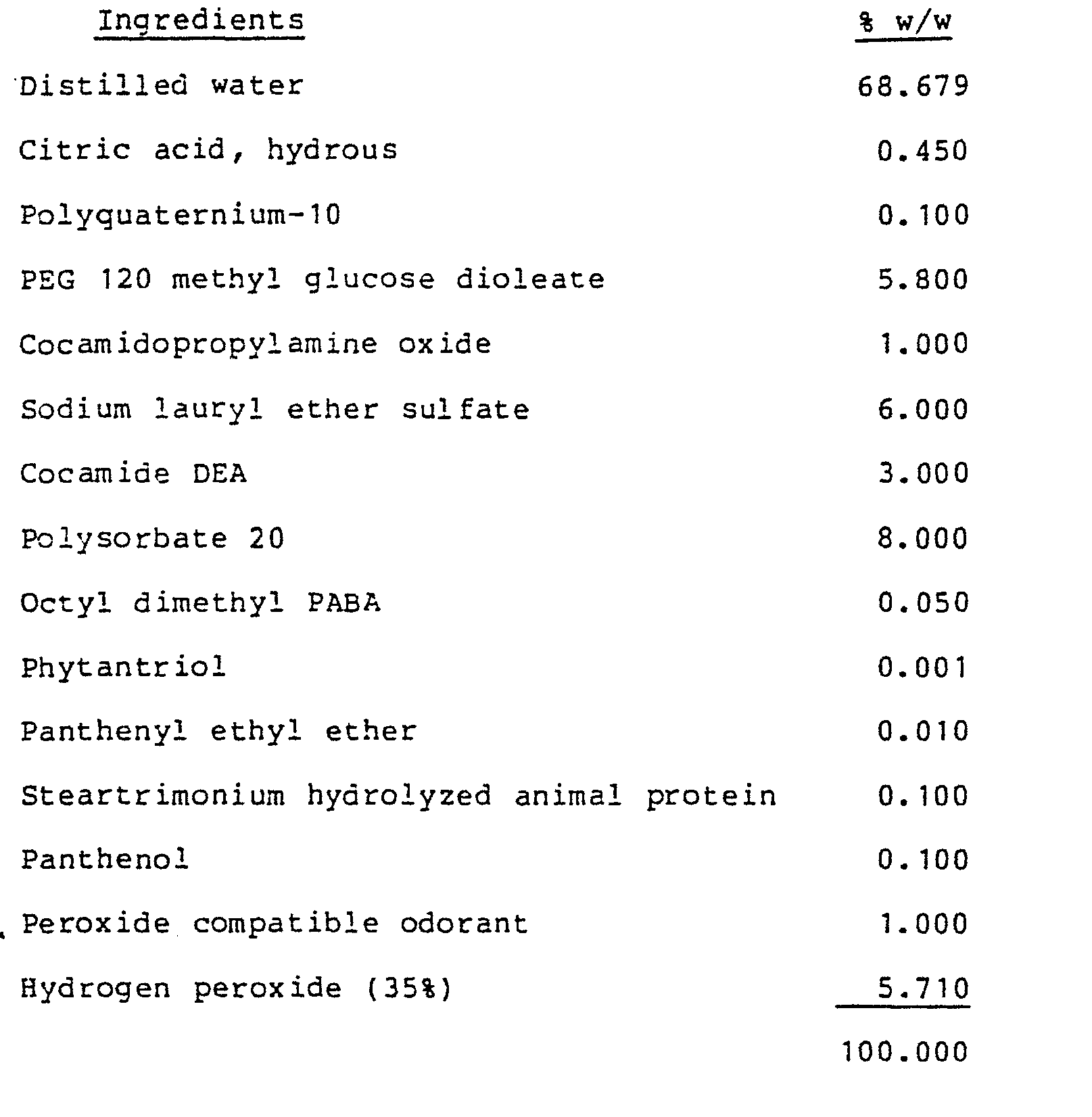
- This example illustrates best mode compositions of this invention containing additional optional ingredients. Each ingredient is identified by its generic chemical name or by its CTFA (Cosmetic, Toiletry and Fragrance Association, Inc.) adopted name.

- Heat ingredient #1 to 75°C, and then add ingredients #2 through 9, with stirring at moderate speed making sure each ingredient is completely in solution before the next addition. Premix ingredients #10 and #11, heat to 65°C and add to the batch with stirring. Cool batch to 50°C and then add ingredients #12 through #14 with stirring. Premix ingredients #15 and #16 and stir into batch at 45*C. Add ingredients #17 and #18 (for composition A) with stirring when batch temperature is at 40°C. Cool batch to 30°C and mix in ingredient #19. The pH of composition A is about 3.30 and of composition B of about 3.85.
- Virgin hair swatches, approximately 2 grams in weight, are bound together at one end and trimmed to 7 inches (17,8 cm). After spraying with water to moisten, the hair swatch is wound tightly around a 1 cm diameter perming rod and then permed with one of the following two commercially available permanent waving solutions: "Pantene Professional Vitamin Exothermic Self-Timing Wave" (an alkaline wave) and "Perfect Transition Vitamin Exothermic Acid-Balanced Wave" (an acid wave), both from The Pantene Company, Division of Richardson-Vicks Inc., Wilton, CT , USA. The moistened hair swatch is permed in the respective waving solution, 15 minutes with the former and 20 minutes with the latter, and then thoroughly rinsed with water. For each permanent waving solution, one swatch is left unneutralized (Sample A); one is neutralized with the particular neutralizer provided with the respective commercial product (Sample B); one is similarly neutralized and shampooed once with the hair conditioning shampoo of Example 2-A (Sample C); one is not neutralized but shampooed twice with said shampoo (Example D); and, finally, one is not neutralized but shampooed twice with a commercially available shampoo, "Vidal Sassoon Original Salon Formula Shampoo" from Vidal Sassoon, Inc., Los Angeles, CA (Example E). After neutralization, the swatch is removed carefully from the perming rod, treated with the particular shampoo as indicated, rinsed thoroughly with water, towel-blotted dry, and then recurled onto a 1.5 cm diameter roller. Each rolled hair swatch is then dried under a standard salon hair dryer until dry. After drying, the hair swatch is carefully unwound from the roller and hung vertically from the bound end. The swatch is then combed through once. The initial length of the curl is measured before exposure in the humidity chamber and this measurement serves as the control basis against which the curl efficiency measured as percent droop, i.e., percent loss in curl retention, is determined. The hair swatches are placed in a humidity chamber set at 90% relative humidity (RH) and 37°C. Relaxation of the swatches is measured periodically in the humidity chamber. The lesser the percent droop, the more effective is the prescribed treatment. The percent droop, or percent loss in curl retention, is determined by the formula:

- As indicated by the following tablulated data, the results obtained with the hair conditioning shampoo of Example 2-A consistently provide lower percent droop values, thereby indicating better curl retention than non-peroxide containing shampoos. The measurements of percent droop are recorded the same day as the swatches are permed ("I") and again 24 hours later ("24"). Similarly beneficial results in curl retention are obtainable with the hair conditioning shampoo of Example 2-B.


- Following the procedure of Example 3, a further comparison with both the alkaline and acid permanent waving solutions utilized therein is provided wherein one swatch of permed hair is neutralized with the particular neutralizer provided with the respective commercial product (Sample F); another swatch is similarly neutralized and shampooed once with the hair conditioning shampoo of Example 2-A (Sample G); and, finally, an additional swatch is similarly neutralized and shampooed twice with the commercially available shampoo identified in Example 3 (Sample H).


Claims (4)

Priority Applications (1)
| Application Number | Priority Date | Filing Date | Title |
|---|---|---|---|
| AT86112664T ATE82493T1 (en) | 1985-09-13 | 1986-09-12 | PEROXIDE SHAMPOO WITH CONDITIONING ACTION. |
Applications Claiming Priority (2)
| Application Number | Priority Date | Filing Date | Title |
|---|---|---|---|
| US775682 | 1985-09-13 | ||
| US06/775,682 US4656043A (en) | 1985-09-13 | 1985-09-13 | Peroxide-containing conditioning shampoo |
Publications (3)
| Publication Number | Publication Date |
|---|---|
| EP0218931A2 true EP0218931A2 (en) | 1987-04-22 |
| EP0218931A3 EP0218931A3 (en) | 1990-10-24 |
| EP0218931B1 EP0218931B1 (en) | 1992-11-19 |
Family
ID=25105169
Family Applications (1)
| Application Number | Title | Priority Date | Filing Date |
|---|---|---|---|
| EP86112664A Expired - Lifetime EP0218931B1 (en) | 1985-09-13 | 1986-09-12 | Peroxide-containing conditioning shampoo |
Country Status (10)
| Country | Link |
|---|---|
| US (1) | US4656043A (en) |
| EP (1) | EP0218931B1 (en) |
| JP (1) | JPH078772B2 (en) |
| AT (1) | ATE82493T1 (en) |
| AU (1) | AU581148B2 (en) |
| CA (1) | CA1268421C (en) |
| DE (1) | DE3687140T2 (en) |
| IE (1) | IE59238B1 (en) |
| NZ (1) | NZ217349A (en) |
| ZA (1) | ZA866257B (en) |
Cited By (6)
| Publication number | Priority date | Publication date | Assignee | Title |
|---|---|---|---|---|
| EP0437114A1 (en) * | 1990-01-10 | 1991-07-17 | Unilever Plc | Shampoo composition |
| WO1993005757A1 (en) * | 1991-09-26 | 1993-04-01 | Wella Aktiengesellschaft | Hair-setting agent and a hair-perming method using this agent |
| WO1998038975A1 (en) * | 1997-03-03 | 1998-09-11 | Quest International B.V. | Hair treatment compositions containing reducing sulphur species and zinc compound |
| WO2000010515A1 (en) * | 1998-08-21 | 2000-03-02 | Unilever Plc | A composition for lightening and highlighting hair |
| US6231846B1 (en) | 1997-03-03 | 2001-05-15 | Quest International B.V. | Hair treatment compositions containing reducing sulphur species and zinc compound |
| WO2001085113A1 (en) * | 2000-05-05 | 2001-11-15 | Unilever Plc | Hair treatment composition |
Families Citing this family (60)
| Publication number | Priority date | Publication date | Assignee | Title |
|---|---|---|---|---|
| DE3711841A1 (en) * | 1987-04-08 | 1988-10-27 | Henkel Kgaa | HAIR REGENERATING PREPARATIONS |
| US5322683A (en) * | 1989-05-01 | 1994-06-21 | Leonard Mackles | Anhydrous aerosol foam |
| US5437809A (en) * | 1990-12-18 | 1995-08-01 | The Gillette Company | Shampoo compositions with dimethicone copolyols |
| DK0578747T3 (en) * | 1991-04-05 | 1995-05-01 | Procter & Gamble | Hair Conditioner Shampoo Compositions with Silicone Conditioner |
| DE4413433C2 (en) * | 1994-04-18 | 1999-09-16 | Henkel Kgaa | Aqueous bleach |
| US6316399B1 (en) * | 1995-12-27 | 2001-11-13 | Envirox, L.L.C. | Surfactants based aqueous compositions with D-limonene and hydrogen peroxide and methods using the same |
| US6090773A (en) * | 1996-01-29 | 2000-07-18 | Johnson & Johnson Consumer Products, Inc. | Personal cleansing |
| ID18376A (en) | 1996-01-29 | 1998-04-02 | Johnson & Johnson Consumer | DETERGENT COMPOSITIONS |
| US5776443A (en) * | 1996-03-18 | 1998-07-07 | Chesebrough-Pond's Usa Co., Division Of Conopco, Inc. | Hair care compositions |
| US6187738B1 (en) | 1998-02-02 | 2001-02-13 | Playtex Products, Inc. | Stable compositions for removing stains from fabrics and carpets |
| AU1627901A (en) * | 1999-12-23 | 2001-07-09 | Avon Products Inc. | Composition for protecting hair from extremes of humidity |
| DE10053727A1 (en) * | 2000-10-30 | 2002-05-16 | Kao Chemicals Europe Sl | Compositions comprising hydrophobic silicone oils and alkyl ether carboxylates |
| US6770103B2 (en) * | 2001-03-19 | 2004-08-03 | Unilever Home & Personal Care Usa, Division Of Conopco, Inc. | Method and composition for the gradual permanent coloring of hair |
| KR100453494B1 (en) * | 2001-11-27 | 2004-10-20 | 주식회사 엘지생활건강 | Hair color sampoo composition |
| US6758867B2 (en) * | 2001-12-28 | 2004-07-06 | Unilever Home & Personal Care Usa, Division Of Conopco, Inc. | Gradual permanent coloring of hair using dye intermediates in a shampoo base |
| US6726729B2 (en) * | 2001-12-28 | 2004-04-27 | Unilever Home & Personal Care Usa, Division Of Conopco, Inc. | Gradual permanent coloring of hair using dye intermediates in a shampoo base |
| US6736860B2 (en) | 2002-03-12 | 2004-05-18 | Unilever Home & Personal Care Usa Division Of Conopco, Inc. | Gradual permanent coloring of hair using dye intermediates dissolved in alkaline water with fatty alcohol |
| US6743265B2 (en) * | 2002-03-13 | 2004-06-01 | Unilever Home & Personal Care Usa Division Of Conopco, Inc. | Gradual permanent coloring of hair using dye intermediates dissolved in alkaline water with a gelling agent |
| US20040146475A1 (en) * | 2003-01-17 | 2004-07-29 | Peffly Marjorie Mossman | Personal care composition containing a cationic cellulose polymer and an anionic surfactant system |
| US7553480B2 (en) * | 2005-02-10 | 2009-06-30 | Pure USA, LLC | Topical personal care compositions and methods of use |
| JP3947554B1 (en) * | 2006-05-17 | 2007-07-25 | 英昌化学工業株式会社 | Hydrogen peroxide-containing composition for hair dye second agent |
| FR2925307B1 (en) | 2007-12-21 | 2009-12-18 | Oreal | METHOD FOR DIRECT LIGHTENING OR OXIDATION COLORING IN THE PRESENCE OF A PARTICULAR ORGANIC AMINE AND DEVICE |
| FR2925323B1 (en) | 2007-12-21 | 2009-12-18 | Oreal | COLORING PROCESS IN THE PRESENCE OF AN OXIDIZING AGENT AND A PARTICULAR ORGANIC AMINE AND DEVICE |
| FR2925311B1 (en) | 2007-12-21 | 2009-12-18 | Oreal | PROCESS FOR LIGHTENING HUMAN KERATINOUS FIBERS USING ANHYDROUS COMPOSITION AND A PARTICULAR ORGANIC AMINE AND APPROPRIATE DEVICE |
| CN101780015A (en) | 2008-12-19 | 2010-07-21 | 莱雅公司 | Coloring or lightening human keratin fiber, using anhydrous composition comprising fatty substance and surfactants, a composition comprising mono ethanolamine and basic amino acids, and composition comprising oxidizing agents |
| FR2940077B1 (en) | 2008-12-19 | 2012-07-20 | Oreal | METHOD FOR LIGHTENING COLORING KERATINIC MATERIALS USING A COLORING ANHYDROUS COMPOSITION COMPRISING AN ALKALI AGENT AND AN OXIDIZING COMPOSITION |
| FR2940079B1 (en) | 2008-12-19 | 2011-02-18 | Oreal | COMPOSITION COMPRISING AT LEAST ONE SOLID FATTY ALCOHOL, METHOD FOR COLORING THE SAME AND DEVICES THEREOF |
| FR2940102B1 (en) | 2008-12-19 | 2016-03-11 | Oreal | KERATIN FIBER OXIDATION DYEING COMPOSITION COMPRISING A FATTY BODY, A THICKENER AND AN OXIDATION COLORING PRECURSOR |
| FR2940067B1 (en) * | 2008-12-19 | 2011-02-25 | Oreal | OXIDIZING COMPOSITION FOR THE TREATMENT OF KERATIN FIBERS COMPRISING A CATIONIC POLYMER, A FATTY AMIDE AND AN OXYGEN AGENT |
| FR2940107B1 (en) | 2008-12-19 | 2011-03-18 | Oreal | PROCESS FOR LIGHTENING KERATINIC MATERIALS USING AN EMULSION COMPRISING AN ALKALI AGENT AND AN OXIDIZING COMPOSITION |
| FR2940103B1 (en) | 2008-12-19 | 2011-06-10 | Oreal | METHOD FOR LIGHTENING COLORING KERATINIC MATERIALS USING AN EMULSION COMPRISING A COLORANT AND AN ALKALI AGENT AND AN OXIDIZING COMPOSITION |
| FR2940055B1 (en) | 2008-12-19 | 2015-03-27 | Oreal | KERATIN FIBER OXIDATION DYEING COMPOSITION COMPRISING PARA-AMINOPHENOL, DIPROPYLENE GLYCOL, AND ADDITIONAL COLOURANT PRECURSOR |
| FR2940092B1 (en) | 2008-12-19 | 2011-02-18 | Oreal | KERATIN FIBER OXIDATION DYE COMPOSITION COMPRISING AN AMIDE OR ESTER FATTY BODY |
| BRPI0907294A2 (en) | 2008-12-19 | 2013-05-07 | Oreal | keratin fiber bleaching or coloring process and multi-compartment device |
| FR2940105B1 (en) | 2008-12-19 | 2011-04-08 | Oreal | COMPOSITION COMPRISING A PARTICULAR OXYETHYLENE FIBER AND SURFACTANT, METHOD FOR COLORING THE SAME AND DEVICES THEREFOR |
| US7927381B2 (en) | 2008-12-19 | 2011-04-19 | L'oreal S.A. | Process for lightening or lightening direct dyeing or oxidation dyeing in the presence of an aqueous composition comprising at least one fatty substance, and device |
| FR2940061B1 (en) | 2008-12-19 | 2011-03-04 | Oreal | KERATIN FIBER OXIDATION DYE COMPOSITION COMPRISING A FATTY BODY AND A DIAMINOPYRAZOLONE DERIVATIVE. |
| EP2198831B1 (en) | 2008-12-19 | 2017-05-10 | L'Oréal | Method for lightening, lightening direct dyeing or oxidation dyeing carried out in the presence of an organic amine and a mineral base; suitable kit |
| FR2940104B1 (en) | 2008-12-19 | 2011-08-19 | Oreal | HAIR PROCESSING METHOD USING DIRECT EMULSION COMPRISING OXIDIZING AGENT AND COMPOSITION CONTAINING ALKALINE AGENT |
| FR2940078B1 (en) | 2008-12-19 | 2011-05-13 | Oreal | COMPOSITION COMPRISING A FATTY BODY AND A CATIONIC POLYMER, A METHOD FOR COLORING THE SAME AND DEVICES |
| CN101822619B (en) | 2008-12-19 | 2014-03-26 | 莱雅公司 | Method of coloring or lightening color in the presence of an oxidizing agent, and kit thereof |
| FR2940101B1 (en) | 2008-12-19 | 2011-02-18 | Oreal | KERATIN FIBER OXIDATION DYEING COMPOSITION COMPRISING A FATTY BODY AND A 4,5-DIAMINOPYRAZOLE DERIVATIVE |
| FR2940106B1 (en) | 2008-12-19 | 2013-04-12 | Oreal | COMPOSITION COMPRISING A FATTY BODY AND A SILICATE, COLORING PROCESS USING THE SAME AND DEVICES |
| FR2940108B1 (en) | 2008-12-19 | 2011-04-29 | Oreal | METHOD FOR LIGHTENING KERATINIC MATERIALS USING ANHYDROUS COMPOSITION COMPRISING AN ALKALI AGENT AND AN OXIDIZING COMPOSITION |
| FR2940090B1 (en) | 2008-12-19 | 2011-02-25 | Oreal | OXIDIZING COMPOSITION FOR THE TREATMENT OF KERATIN FIBERS COMPRISING OIL, FATTY ALCOHOL AND OXYALKYLENE FATTY ALCOHOL |
| FR2940100B1 (en) | 2008-12-19 | 2011-02-18 | Oreal | KERATIN FIBER OXIDATION DYE COMPOSITION COMPRISING A FATTY BODY AND N, N BIS (BETA-HYDROXYETHYL) -PARAPHENYLENE DIAMINE |
| BRPI0910081A2 (en) | 2008-12-19 | 2012-03-13 | L'oreal | HUMAN KERATIN FIBER CLARING PROCESS, HUMAN KERATIN FIBER COLORING PROCESS AND DEVICES WITH VARIOUS COMPARTMENTS |
| FR2954121B1 (en) | 2009-12-22 | 2016-03-25 | Oreal | COLORING AND / OR DECOLOURING AGENT OF TWO - PART KERATIN FIBERS, COMPRISING A PARTICULAR FOLDER AND A REDUCTONE. |
| FR2954127B1 (en) | 2009-12-22 | 2015-10-30 | Oreal | COLORING AND / OR DECOLOURING AGENT OF TWO-PART KERATINOUS FIBERS, COMPRISING A BODY AND A SEQUESTRING AGENT. |
| FR2954159B1 (en) | 2009-12-22 | 2012-02-10 | Oreal | A KERATIN FIBER COLORING AND / OR DECOLOURING AGENT COMPRISING A COMPOSITION COMPRISING AN ALKALINIZING AGENT AND AN ANHYDROUS COMPOSITION COMPRISING AN OXIDANT, EITHER OF THE COMPOSITIONS CONTAINING A FATTY BODY |
| FR2954160B1 (en) | 2009-12-22 | 2012-03-30 | Oreal | COLORING OR LIGHTENING COMPOSITION COMPRISING A FATTY BODY AND AN AMPHOTERIC POLYMER |
| MX2013001095A (en) * | 2010-07-27 | 2013-03-12 | Clariant Finance Bvi Ltd | Compositions comprising hydrogen peroxide or hydrogen peroxide donor substances. |
| PH12013501860A1 (en) * | 2011-03-07 | 2013-10-14 | Procter & Gamble | Multipurpose detergent compositions |
| GB2493207B (en) * | 2011-07-29 | 2015-04-01 | Perachem Ltd | Method |
| US10119099B2 (en) | 2017-01-10 | 2018-11-06 | Envirox, L.L.C. | Peroxide based multi-purpose cleaner, degreaser, sanitizer/virucide and associated solutions and methods for preparing the same |
| WO2018140541A1 (en) * | 2017-01-25 | 2018-08-02 | Parsons Camie | Chemical membrane complex repair solution and method of using the same |
| US11518966B2 (en) | 2019-11-07 | 2022-12-06 | Envirox, L.L.C. | Peroxide-based multi-purpose cleaning, degreasing, sanitizing, and disinfecting solutions and methods for preparing the same |
| WO2024025764A1 (en) | 2022-07-28 | 2024-02-01 | EnvirOx, LLC | Stabilization of hydrogen peroxide containing formulations with two-component synergistic stabilizers |
| WO2024058857A1 (en) | 2022-09-13 | 2024-03-21 | EnvirOx, LLC | Potential of hydrogen (ph) stabilized cleaning formulations |
| JP2024083777A (en) * | 2022-12-12 | 2024-06-24 | 第一三共ヘルスケア株式会社 | Composition |
Family Cites Families (11)
| Publication number | Priority date | Publication date | Assignee | Title |
|---|---|---|---|---|
| GB1083007A (en) * | 1964-11-26 | 1967-09-13 | Rayette Faberge | Hair bleaching composition |
| US3488287A (en) * | 1965-09-17 | 1970-01-06 | Fmc Corp | Method of producing warm lather |
| US3378444A (en) * | 1966-06-03 | 1968-04-16 | Rayette Faberge | Hair bleaching composition |
| FR1520945A (en) * | 1967-04-25 | 1968-04-12 | Curtis Helene Ind Inc | Base for emulsion containing hydrogen peroxide |
| US3639574A (en) * | 1967-10-25 | 1972-02-01 | Basf Wyandotte Corp | Stable hydrogen peroxide gels |
| GB2032974B (en) * | 1978-11-01 | 1983-03-23 | Warner & Co Ltd W | Neutraliser for use in connection with permanent waving preparation |
| FR2460133B1 (en) * | 1979-07-02 | 1986-11-07 | Bristol Myers Co | COMPOSITION FOR HAIR CARE AND METHOD OF APPLICATION |
| US4366827A (en) * | 1979-12-28 | 1983-01-04 | Societe Anonyme Dite: L'oreal | Procedure for the permanent reshaping of hair, and composition intended for carrying out said procedure |
| CA1138341A (en) * | 1980-01-23 | 1982-12-28 | Leszek J. Wolfram | Waving composition from a reducing agent and cationic polymer |
| NZ203095A (en) * | 1982-02-08 | 1986-10-08 | Bristol Myers Co | Aqueous hair waving compositions and packages containing them |
| CA1266829A (en) * | 1985-02-07 | 1990-03-20 | Du Yung Hsiung | Permanent wave neutralizer composition and method |
-
1985
- 1985-09-13 US US06/775,682 patent/US4656043A/en not_active Expired - Fee Related
-
1986
- 1986-08-14 IE IE219186A patent/IE59238B1/en not_active IP Right Cessation
- 1986-08-19 ZA ZA866257A patent/ZA866257B/en unknown
- 1986-08-21 CA CA516504A patent/CA1268421C/en not_active Expired
- 1986-08-25 NZ NZ217349A patent/NZ217349A/en unknown
- 1986-09-04 AU AU62345/86A patent/AU581148B2/en not_active Ceased
- 1986-09-09 JP JP61210848A patent/JPH078772B2/en not_active Expired - Lifetime
- 1986-09-12 DE DE8686112664T patent/DE3687140T2/en not_active Expired - Fee Related
- 1986-09-12 EP EP86112664A patent/EP0218931B1/en not_active Expired - Lifetime
- 1986-09-12 AT AT86112664T patent/ATE82493T1/en active
Cited By (7)
| Publication number | Priority date | Publication date | Assignee | Title |
|---|---|---|---|---|
| EP0437114A1 (en) * | 1990-01-10 | 1991-07-17 | Unilever Plc | Shampoo composition |
| WO1993005757A1 (en) * | 1991-09-26 | 1993-04-01 | Wella Aktiengesellschaft | Hair-setting agent and a hair-perming method using this agent |
| WO1998038975A1 (en) * | 1997-03-03 | 1998-09-11 | Quest International B.V. | Hair treatment compositions containing reducing sulphur species and zinc compound |
| US6231846B1 (en) | 1997-03-03 | 2001-05-15 | Quest International B.V. | Hair treatment compositions containing reducing sulphur species and zinc compound |
| WO2000010515A1 (en) * | 1998-08-21 | 2000-03-02 | Unilever Plc | A composition for lightening and highlighting hair |
| US6274126B1 (en) | 1998-08-21 | 2001-08-14 | Helene Curtis, Inc. | Composition for lightening and highlighting hair |
| WO2001085113A1 (en) * | 2000-05-05 | 2001-11-15 | Unilever Plc | Hair treatment composition |
Also Published As
| Publication number | Publication date |
|---|---|
| US4656043A (en) | 1987-04-07 |
| AU6234586A (en) | 1987-03-19 |
| IE862191L (en) | 1987-03-13 |
| ZA866257B (en) | 1987-04-29 |
| EP0218931A3 (en) | 1990-10-24 |
| CA1268421A (en) | 1990-05-01 |
| CA1268421C (en) | 1990-05-01 |
| EP0218931B1 (en) | 1992-11-19 |
| JPS6289612A (en) | 1987-04-24 |
| IE59238B1 (en) | 1994-01-26 |
| AU581148B2 (en) | 1989-02-09 |
| DE3687140D1 (en) | 1992-12-24 |
| NZ217349A (en) | 1988-10-28 |
| ATE82493T1 (en) | 1992-12-15 |
| JPH078772B2 (en) | 1995-02-01 |
| DE3687140T2 (en) | 1993-03-25 |
Similar Documents
| Publication | Publication Date | Title |
|---|---|---|
| US4656043A (en) | Peroxide-containing conditioning shampoo | |
| US6517822B1 (en) | Formulations and methods for straightening hair | |
| US4304244A (en) | Hair straightening process and hair curling process and compositions therefor | |
| US6173717B1 (en) | Hair shaping method using acidic aqueous intermediate rinse to prevent overcurling | |
| US5628991A (en) | Cosmetic composition containing a diaminoalkane as an odorless alkalifying agent | |
| JP3590628B2 (en) | Use of an agent containing creatine, creatinine and / or a derivative thereof for reinforcement and structural improvement of keratin fibers | |
| CA1338799C (en) | Permanent wave solution | |
| US5332570A (en) | Reducing solution for permanent wave | |
| US4373540A (en) | Hair straightening process and hair curling process and compositions therefor | |
| US4324263A (en) | Hair straightening process and hair curling process and compositions therefor | |
| US20040180016A1 (en) | Formulations and methods for straightening hair | |
| AU7549287A (en) | Compositions used in permanent structure altering of hair | |
| JP2001505927A (en) | Permanent hair processing agent and permanent hair processing method based on N, N-disubstituted mercaptoacetamides, and method for producing these mercaptoacetamides | |
| US20060222614A1 (en) | Hair straightening compositions and methods | |
| US4038995A (en) | Hair treating composition containing a mink oil fatty acid quaternary ammonium salt | |
| JPH0678216B2 (en) | Acid Permanent Wave Agent | |
| CA2041266A1 (en) | Permanent wave hair compositions containing transition metal oxide compounds | |
| JP2013056836A (en) | Cosmetic material for hair | |
| DE2454692A1 (en) | PRODUCTS FOR HAIR AND SKIN TREATMENT | |
| EP4238547A1 (en) | Hair cosmetic and method for producing same, and hair quality improving method and hair style forming method using said hair cosmetic | |
| JPH06502872A (en) | Fixatives and methods for permanent hair processing | |
| US20030082132A1 (en) | Perming compositions and perming method by using the same | |
| JP4963554B2 (en) | 1st agent composition for perm | |
| JP2009120563A (en) | Perming method and kit for perming use | |
| JPH0471885B2 (en) |
Legal Events
| Date | Code | Title | Description |
|---|---|---|---|
| PUAI | Public reference made under article 153(3) epc to a published international application that has entered the european phase |
Free format text: ORIGINAL CODE: 0009012 |
|
| AK | Designated contracting states |
Kind code of ref document: A2 Designated state(s): AT BE CH DE FR GB IT LI LU NL SE |
|
| PUAL | Search report despatched |
Free format text: ORIGINAL CODE: 0009013 |
|
| AK | Designated contracting states |
Kind code of ref document: A3 Designated state(s): AT BE CH DE FR GB IT LI LU NL SE |
|
| 17P | Request for examination filed |
Effective date: 19901228 |
|
| 17Q | First examination report despatched |
Effective date: 19911125 |
|
| GRAA | (expected) grant |
Free format text: ORIGINAL CODE: 0009210 |
|
| AK | Designated contracting states |
Kind code of ref document: B1 Designated state(s): AT BE CH DE FR GB IT LI LU NL SE |
|
| REF | Corresponds to: |
Ref document number: 82493 Country of ref document: AT Date of ref document: 19921215 Kind code of ref document: T |
|
| ITF | It: translation for a ep patent filed | ||
| ET | Fr: translation filed | ||
| REF | Corresponds to: |
Ref document number: 3687140 Country of ref document: DE Date of ref document: 19921224 |
|
| PGFP | Annual fee paid to national office [announced via postgrant information from national office to epo] |
Ref country code: AT Payment date: 19930909 Year of fee payment: 8 |
|
| PGFP | Annual fee paid to national office [announced via postgrant information from national office to epo] |
Ref country code: CH Payment date: 19930915 Year of fee payment: 8 |
|
| PGFP | Annual fee paid to national office [announced via postgrant information from national office to epo] |
Ref country code: SE Payment date: 19930917 Year of fee payment: 8 |
|
| PLBE | No opposition filed within time limit |
Free format text: ORIGINAL CODE: 0009261 |
|
| STAA | Information on the status of an ep patent application or granted ep patent |
Free format text: STATUS: NO OPPOSITION FILED WITHIN TIME LIMIT |
|
| PGFP | Annual fee paid to national office [announced via postgrant information from national office to epo] |
Ref country code: NL Payment date: 19930930 Year of fee payment: 8 Ref country code: LU Payment date: 19930930 Year of fee payment: 8 |
|
| PGFP | Annual fee paid to national office [announced via postgrant information from national office to epo] |
Ref country code: BE Payment date: 19931012 Year of fee payment: 8 |
|
| REG | Reference to a national code |
Ref country code: CH Ref legal event code: PFA Free format text: RICHARDSON VICKS, INC. |
|
| 26N | No opposition filed | ||
| EPTA | Lu: last paid annual fee | ||
| PG25 | Lapsed in a contracting state [announced via postgrant information from national office to epo] |
Ref country code: LU Free format text: LAPSE BECAUSE OF NON-PAYMENT OF DUE FEES Effective date: 19940912 Ref country code: AT Effective date: 19940912 |
|
| PG25 | Lapsed in a contracting state [announced via postgrant information from national office to epo] |
Ref country code: SE Effective date: 19940913 |
|
| PG25 | Lapsed in a contracting state [announced via postgrant information from national office to epo] |
Ref country code: LI Effective date: 19940930 Ref country code: CH Effective date: 19940930 Ref country code: BE Effective date: 19940930 |
|
| EAL | Se: european patent in force in sweden |
Ref document number: 86112664.7 |
|
| BERE | Be: lapsed |
Owner name: RICHARDSON-VICKS INC. Effective date: 19940930 |
|
| PG25 | Lapsed in a contracting state [announced via postgrant information from national office to epo] |
Ref country code: NL Effective date: 19950401 |
|
| NLV4 | Nl: lapsed or anulled due to non-payment of the annual fee | ||
| REG | Reference to a national code |
Ref country code: CH Ref legal event code: PL |
|
| EUG | Se: european patent has lapsed |
Ref document number: 86112664.7 |
|
| PGFP | Annual fee paid to national office [announced via postgrant information from national office to epo] |
Ref country code: GB Payment date: 19950904 Year of fee payment: 10 |
|
| PGFP | Annual fee paid to national office [announced via postgrant information from national office to epo] |
Ref country code: FR Payment date: 19950911 Year of fee payment: 10 |
|
| PGFP | Annual fee paid to national office [announced via postgrant information from national office to epo] |
Ref country code: DE Payment date: 19950918 Year of fee payment: 10 |
|
| PG25 | Lapsed in a contracting state [announced via postgrant information from national office to epo] |
Ref country code: GB Effective date: 19960912 |
|
| PG25 | Lapsed in a contracting state [announced via postgrant information from national office to epo] |
Ref country code: FR Effective date: 19960930 |
|
| GBPC | Gb: european patent ceased through non-payment of renewal fee |
Effective date: 19960912 |
|
| PG25 | Lapsed in a contracting state [announced via postgrant information from national office to epo] |
Ref country code: DE Effective date: 19970603 |
|
| REG | Reference to a national code |
Ref country code: FR Ref legal event code: ST |
|
| REG | Reference to a national code |
Ref country code: FR Ref legal event code: ST |
|
| PG25 | Lapsed in a contracting state [announced via postgrant information from national office to epo] |
Ref country code: IT Free format text: LAPSE BECAUSE OF NON-PAYMENT OF DUE FEES;WARNING: LAPSES OF ITALIAN PATENTS WITH EFFECTIVE DATE BEFORE 2007 MAY HAVE OCCURRED AT ANY TIME BEFORE 2007. THE CORRECT EFFECTIVE DATE MAY BE DIFFERENT FROM THE ONE RECORDED. Effective date: 20050912 |