EP0217618B1 - Sulfomaleation of polyolefins - Google Patents
Sulfomaleation of polyolefins Download PDFInfo
- Publication number
- EP0217618B1 EP0217618B1 EP86307286A EP86307286A EP0217618B1 EP 0217618 B1 EP0217618 B1 EP 0217618B1 EP 86307286 A EP86307286 A EP 86307286A EP 86307286 A EP86307286 A EP 86307286A EP 0217618 B1 EP0217618 B1 EP 0217618B1
- Authority
- EP
- European Patent Office
- Prior art keywords
- polymer
- organic liquid
- anhydride
- viscosity
- epdm
- Prior art date
- Legal status (The legal status is an assumption and is not a legal conclusion. Google has not performed a legal analysis and makes no representation as to the accuracy of the status listed.)
- Expired - Lifetime
Links
Images
Classifications
-
- C—CHEMISTRY; METALLURGY
- C08—ORGANIC MACROMOLECULAR COMPOUNDS; THEIR PREPARATION OR CHEMICAL WORKING-UP; COMPOSITIONS BASED THEREON
- C08F—MACROMOLECULAR COMPOUNDS OBTAINED BY REACTIONS ONLY INVOLVING CARBON-TO-CARBON UNSATURATED BONDS
- C08F8/00—Chemical modification by after-treatment
- C08F8/34—Introducing sulfur atoms or sulfur-containing groups
Definitions
- the present invention relates to novel polymers which are adducts of sulphomaleic anhydride its isomers or derivatives, with unsaturated organic molecules, wherein the novel products are produced by contacting sulphomaleic anhydride with an unsaturated polymer to form the novel product.
- unsaturated polymer can be a polyolefin polymer ranging in molecular weight from about 500 to about 10,000,000.
- the resultant adduct of sulphomaleic anhydride and the unsaturated hydrocarbon polymer can be further reacted with: a polyamine, ammonia, amines or metallic bases which will neutralize the sulphonic acid group and react with the anhydride group as well.
- the products are ionomeric polymers which are useful as thermoplastic elastomers.
- the instant invention further relates to a process for controlling the viscosity of organic liquids by incorporating in said liquid a minor amount of a polymer which is a hydrolyzed and neutralized sulphomaleic anhydride adduct with an unsaturated hydrocarbon and, optionally, a cosolvent for the ionic groups of said polymer.
- a cosolvent is optionally added which will optionally solubilize the polymer groups and provide a reasonable homogeneous mixture of solvent, cosolvent and polymer.
- the preferred compositions prepared by the method of the instant invention comprise an organic liquid having a solubility parameter of from 6 to 10.5 in combination with the polymer and a non-volatile alcohol or amine as the cosolvent. Solutions of said polymers are unusually resistant to viscosity loss due to polar additives (such as alcohols) or polar impurities.
- reaction of sulphomaleic anhydride with the unsaturated hydrocarbon polymer overcomes these aforementioned deficiencies in that the sulfomaleic anhydride can be reacted with the unsaturated hydrocarbon polymer at moderate temperatures in either the bulk or solution state without the employment of free radical initiators. Subsequent neutralization and reaction of the anhydride groups of resultant adduct of sulphomaleic anhydride with unsaturated hydrocarbons produces valuable ionomers which are useful as thermoplastic elastomers and solution viscosifiers.
- U. S. Patent No. 3,396,136 describes how copolymers of alkenyl aromatic sulphonic acids, when properly neutralized, can be employed as thickeners for nonpolar solvents.
- Those metal sulfonate systems have been shown to be very effective; however, when employed as to component systems (i.e., ionic polymer plus non-polar solvent) the variation of viscosity with increased temperature is very conventional and predictable. That is, the solution viscosity decreases markedly as temperature is increased.
- U. S. Patent No. 3,396,136 further teaches "in situ" neutralization of the sulphonic acid polymer which, under some conditions, can result in the availability of a small amount of polar cosolvent, i.e., a solvent for the sulphonate groups, about equal in amount to the amount of sulphonate groups which are present.
- This amount of polar cosolvent is not within the limits of the instant invention, which only optionally requires amounts of the third component (which interacts with the ionomeric groups of the ionomer copolymer) at levels which range from 10 to 600 times the molar equivalence of ionic groups.
- This level of cosolvent is about one to two orders of magnitude or more higher than employed in the cited art.
- the cited patent is restricted to aromatic sulfonate polymers.
- the instant invention describes other polymers, such as sulphonated ethylene propylene terpolymers, and sulphonated Butyl., which are a portion of the polymer complex.
- U. S. Patent No. 3,666,430 teaches the gelling of organic liquids by the interaction of polar "associative bonds" which includes hydrogen bonding and "ionic cross-linking". Again, this patent specifies that two components are necessary -- the associating polymer (or polymers in some cases) and the non-polar organic liquid. There is no mention of a third polar cosolvent except to point out that such polar liquids should not be present. Specifically, this patent states (at column 2, line 7) that the hydrocarbon liquids to which this invention is to be applied should not contain a substantial portion of a miscible protolytic liquid, such as methanol.
- a miscible protolytic liquid such as methanol.
- U. S. Patent No. 3,679,382 teaches the thickening of aliphatic hydrocarbons with synthetic organic polymers which contain olefinically unsaturated copolymerizable acids, amides, hydroxyacrylic esters, and sulphonic acids, It is emphasized in this patent (at column 3, line 72) that it is critical that in the preparation of such polymers no surface active agent, catalyst or other additive be employed which introduces a metallic ion into the system. Therefore, it is preferred to employ ammonium or amine salts. It is clear that this invention (U. S. Patent No. 3,679,382) specifically precludes the use of metallic counterions and is directed towards amine or ammonium derivatives. Metallic counterions are very effective in the instant invention. Finally, this cited patent does describe (at column 7, lines 13-19) that the addition of alcohols will reduce the viscosity of the thickened hydrocarbon and alter flow characteristics thereof.
- FR-A-2 271 279 (GB-A-1 499 733) describes a process for controlling the viscosity of an organic liquid having a solubility parameter of from 6 to 10.5 by the addition of an ionic, preferably sulphonated, polymer having a backbone soluble in the organic liquid and a cosolvent (e.g. and alcohol or amine) which will solubilize the ionic groups.
- a preferred backbone component is sulphonated ethylene-propylene-ethylidene-norbornene (ENB).
- ENB sulphonated ethylene-propylene-ethylidene-norbornene
- the ionic groups may be neutralised by elements of Groups IA, IIA, IB, or IIB of the Periodic Table or lead, tin or antimony.
- a polymer which is an adduct of an unsaturated hydrocarbon polymer with sulphomaleic anhydride or a derivative or isomer thereof selected from: where X is halogen and R is alkyl, alkylsilyl or aryl; sulphofumeric acid and beta-sulphoacrylic anhydride.
- the invention enables the production of ion containing polymers (ionomers) especially sulphonate ionomers, by a non-sulphonation route.
- the invention also enables the activation of maleic anhydride or its derivatives towards Alder "Ene” reactions or Diels-Alder reactions, such that polymers which have unsaturated sites will readily form adducts.
- polymers such as EPDM rubbers which do not undergo thermal reaction readily with maleic anhydride will now react facily.
- the viscosity of organic liquids may be conveniently controlled by incorporating in said organic liquid a minor amount of a polymer which is a sulphomaleic anhydride adduct with an unsaturated hydrocarbon which has been hydrolyzed and neutralized.
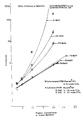
- Figure 1 illustrates a graph of viscosity versus concentration for various polymer solutions. The differences between salts of sulphonated EPDM and salts of sulphomaleated EPDM are demonstrated. The latter viscosity increases much more efficiently in the pressure of polar compounds, such as methanol.
- the present invention relates to polymers which are, e.g., sulphomaleic anhydride adducts with unsaturated hydrocarbons which are formed by reacting sulphomaleic anhydride with an unsaturated hydrocarbon in either the solution or the bulk state.
- Sulphomaleic anhydride which is represented by the formula: is formed by reacting maleic anhydride with sulfur trioxide.
- sulphomaleic anhydride itself, one can also employ various derivatives and isomers, notably sulphomaleic acid, sulphofumaric acid, beta-sulphoacrylic anhydride and their various esters and other derivatives of either or both of the carboxyl groups.
- the sulfomaleic compound is reacted with an unsaturated hydrocarbon polymer which may be selected from the group consisting of EPDM terpolymers, EPR, polyisoprene, polybutadienes, Butyl rubber, styrene-butadiene and styrene-isoprene "random" and block copolymers, Butyl rubbers, polybutenes, hydrocarbon resins such as a Escorez R resins, etc.
- Oligomers or polymers which have olefin functionality near the end of the chain are of interest.
- Such molecules include, but are not limited to, polyisobutene and polybutenes of various molecular weights.
- Vistanex R , Vistanex J R are examples of such polymers.
- Plastics such as polyethylene and polypropylene containing low levels of unsaturation are also suitable polyolefins.
- butyl rubber as employed in the specification and claims, is intended to include copolymers made from a polymerization reaction mixture having therein from 70 to 99.5% by weight of an isobutylene and 0.5 to 30% by weight of a conjugated multiolefin having from 4 to 14 carbon atoms, e.g. isoprene.
- the resulting copolymer contains 85 to 99.8% by weight of combined isoolefin and 0.2 to 15% of combined multiolefin.
- Butyl rubber generally has a Staudinger molecular weight as measured by GPC of 20,000 to 500,000, preferably 25,000 to 400,000 especially 100,000 to 400,000 and a Wijs Iodine No. of 0.5 to 50, preferably 1 to 15.
- GPC GPC
- 20,000 to 500,000 preferably 25,000 to 400,000 especially 100,000 to 400,000
- Wijs Iodine No. 0.5 to 50, preferably 1 to 15.
- the preparation of Butyl rubber is described in U.S. Patent 2,356,128.
- the Butyl rubber may have incorporated therein from 0.2 to 10% of combined multiolefin; preferably 0.5 to 6%; more preferably, 1 to 4%, e.g., 2%.
- butyl rubber Illustrative of such a Butyl rubber is Exxon Butyl 365 (Exxon Chemical Co.), having a mole percent unsaturation of 2.0% and a Mooney viscosity [ML, 1 + 3. 100°C (212 o F)] of 40 to 50.
- Butyl rubbers i.e. Butyl rubbers having a viscosity average molecular weight of 5,000 to 85,000, and a mole percent unsaturation of 1 to 5%, may be sulfonated to produce the polymers useful in this invention.
- these polymers Preferably, these polymers have a viscosity average molecular weight of 25,000 to 60,000.
- the EPDM terpolymers are low unsaturated polymers having 0.5 to 10.0 wt.% olefinic unsaturation, more preferably 2 to 8, most preferably 3 to 7 defined accordingly to the definition as found in ASTM-1418-64 and is intended to mean terpolymers containing ethylene and propylene in the backbone and an olefin residue in the side chain as result of multi-olefin incorporation in the backbone.
- Illustrative methods for producing these terpolymers are found in U.S.
- the preferred polymers contain 40 to 75 wt.% ethylene and 1 to 10 wt.% of a diene monomer, the balance of the polymer being propylene.
- the polymer contains 45 to 70 wt.% ethylene, e.g. 50 wt.% and 2.6 to 8.0 wt.% diene monomer, e.g. 5.0 wt.%.
- the diene monomer is preferably a nonconjugated diene.
- EPDM terpolymer
- a typical EPDM is Vistalon R 2504 (Exxon Chemical Co.), a terpolymer having a Mooney viscosity [ML, 1 + 8, 100°C (212 o F)] of 40 and having an ethylene content of 50 wt.% and a 5-ethylidene-2-norbornene content of 5.0 wt.%.
- the M n as measured by GPC of Vistalon R 2504 is 47,000, the M v as measured by GPC is 145,000 and the M w as measured by GPC is 174,000.
- Another EPDM terpolymer Vistalon R 2504-20 is derived from Vistalon R 2504 (Exxon Chemical Co.) by a controlled extrusion process, wherein the resultant Mooney viscosity at 100°C (212 o F) is 20.
- the M n as measured by GPC of Vistalon R 2504-20 is 26,000, the M v as measured by GPC is 90,000 and the M w as measured by GPC is 125,000.
- Nordel R 1320 (Dupont) is another terpolymer having a Mooney viscosity at 100°C (212 o F) of 25 and having 53 wt.% of ethylene, 3.5 wt.% of 1,4-hexadiene, and 43.5 wt.% of propylene.
- the EPDM terpolymers of this invention have a number average molecular weight ( M n ) as measured by GPC of 10,000 to 200,000, more preferably of 15,000 to 100,000, most preferably of 20,000 to 60,000.
- the Mooney viscosity [ML, 1 + 8, 100°C (212 o F)] of the EPDM terpolymer is about 5 to about 60, more preferably 10 to 50, most preferably 15 to 40.
- the M v as measured by GPC of the EPDM terpolymer is preferably below 350,000 and more preferably below 300,000.
- the M w as measured by GPC of the EPDM terpolymer is preferably below 500,000 and more preferably below 350,000.
- Suitable olefin polymers include polymers comprising a major molar amount of C2 to C5 monoolefins, e.g., ethylene, propylene, butylene, isobutylene and pentene.
- the polymers may be homopolymers such as polyisobutylene, as well as copolymers of two or more such olefins such as copolymers of ethylene and propylene, butylene and isobutylene, propylene and isobutylene
- the reaction of the sulphomaleic anhydride or its ester derivatives with the unsaturated hydrocarbon polymer can occur in solution, in a melt and in polymer processing equipment such as a rubber mill, a Brabender, an extruder or a Banbury mixer.
- the polymer of the sulphomaleic adduct with the unsaturated hydrocarbon can be covalently bonded through its anhydride group with molecules containing polar groups.
- polar functionality molecules can be low molecular weight compounds, oligomers or polymers.
- molecules containing amine functionality are molecules containing amine functionality. Polyamines provide polarity to form molecules with a polar head and a hydrocarbon tail in addition to the ionic sulphonate site.
- the sulphonic acid group of the sulfomaleic compound can be neutralized with ammonia, primary secondary or tertiary amines including the aforementioned amino compounds, or metal counterion selected from the group consisting of iron, lead, aluminum and groups IA, IIA, IB and IIB of the Periodic Table of Elements.
- the neutralization of the sulphonic acid groups of the sulfomaleic compound adduct of the unsaturated hydrocarbon polymer can be accomplished either in solution, in a melt or in polymeric processing equipment, as previously defined.
- the polymer adduct of the invention may be incorporated into an organic liquid, e.g. to control its viscosity, at a concentration level of 0.01 to 20 grams per 100 ml of organic liquid, more preferably 0.5 to 5.
- the organic liquid is preferably a hydrocarbon which has a solubility parameter of 6 to 10.5, wherein the organic liquid is selected from the group consisting of lubricating oils, synthetic oils, aliphatic oils, naphthenic oils, aromatic oils, aliphatic hydrocarbons, aromatic hydrocarbons and naphthenic hydrocarbons.
- the organic liquid preferably has a viscosity at 38°C (100 o F) of less than 35 centipoises.
- the method of the instant invention preferably includes incorporating a cosolvent, for example a polar cosolvent, into the mixture of organic liquid and the polymer to solubilize the pendant ionomeric groups.
- a cosolvent for example a polar cosolvent
- the polar cosolvent will preferably have a solubility parameter of at least 10.0, more preferably at least 11.0, and may comprise from 0.1 to 40 weight percent, preferably .5 to 20 weight of the total mixture of organic liquid, ionomeric polymer and polar cosolvent.
- the polar cosolvent be more polar than the organic liquid. This is required in order that the proper interaction between polar cosolvent and ionic groups be obtained.
- the polar cosolvent will be a liquid at room temperature, however, this is not a requirement. It is required that the polar cosolvent be soluble or miscible with the organic liquid at the levels employed in this invention. Under normal circumstances this miscibility requirements precludes the use of water as a polar cosolvent.
- the polar cosolvent must be present in amounts of from 20 to 600 moles per mole of ionic group in order to give the desirable results of the instant invention and preferably from 30 to 400 moles per mole of ionic group. This level of cosolvent is desirable in creating solutions which can be isoviscous with temperature on concentration.
- Example 5 EPDM Rubber with the methyl ester of chlorosulphonyl maleic anhydride.
- Vistalon R 2504 EPDM 50g was fluxed on a 3" electric mill at 120 o C. Sulphomaleic anhydride (1.05g) was added slowly. After the addition was complete the sample was mixed for a few minutes and zinc stearate (2.35g) was added and mixing continued for a few minutes longer.
- the resulting product was a tough elastic material that resembled a crosslinked rubber. However, the product was soluble in 95:5 toluene:methanol indicating that the product was a thermoplastic elastic "ionomer".
- Royalene R 521 EPDM rubber 50g (mill dried) dissolved in 1,000 ml dry xylene was treated with 2.67 g of sulphomaleic anhydride for 4 hours at 130 o C. After cooling, the resulting product was neutralized with either zinc methoxide, sodium methoxide or zinc acetate in methanol. A substantial viscosity increase was noted upon addition of the base. Additional methanol was added when necessary to reduce the viscosity. Stirring was continued to 0.5 hour and the polymer was isolated from isopropanol in a high speed mixer. The resulting crumb was dried in a vacuum oven at 50 o C.
- Examples 9 and 10 were compounded with 10 parts zinc stearate and 0.5 parts Irganox R 1010 on a hot mill (140-170 o C) for 20 minutes. The compounds were pressed at 192 o C into pads which were cut into dumbbells for testing on an Instron R (Model 1122).
- Example 12 Sulphonated EPDM Thermoplastic Elastic Ionomers from EPDM and Sulfomaleic Anhydride Ester (Methoxysulfonyl Maleic Anhydride)
- Sulphomaleic anhydride or maleic anhydride sulphoester-adducts with EPDM were hydrolyzed and neutralized during isolation. Solutions were prepared in xylene-methanol at several concentrations of polymer and varying methanol content. A comparison of a zinc salt of said polymer with zinc salts of sulpho-EPDM's shows that the material of the instant invention is much more efficient at viscosification than ordinary sulphonated EPDM zinc polymers. Even at higher sulphonation levels ordinary sulphonated EPDM's were inefficient in the presence of methanol.
Landscapes
- Chemical & Material Sciences (AREA)
- General Chemical & Material Sciences (AREA)
- Health & Medical Sciences (AREA)
- Chemical Kinetics & Catalysis (AREA)
- Medicinal Chemistry (AREA)
- Polymers & Plastics (AREA)
- Organic Chemistry (AREA)
- Addition Polymer Or Copolymer, Post-Treatments, Or Chemical Modifications (AREA)
Description
- The present invention relates to novel polymers which are adducts of sulphomaleic anhydride its isomers or derivatives, with unsaturated organic molecules, wherein the novel products are produced by contacting sulphomaleic anhydride with an unsaturated polymer to form the novel product. In particular the unsaturated polymer can be a polyolefin polymer ranging in molecular weight from about 500 to about 10,000,000.
- The resultant adduct of sulphomaleic anhydride and the unsaturated hydrocarbon polymer can be further reacted with: a polyamine, ammonia, amines or metallic bases which will neutralize the sulphonic acid group and react with the anhydride group as well. The products are ionomeric polymers which are useful as thermoplastic elastomers.
- The instant invention further relates to a process for controlling the viscosity of organic liquids by incorporating in said liquid a minor amount of a polymer which is a hydrolyzed and neutralized sulphomaleic anhydride adduct with an unsaturated hydrocarbon and, optionally, a cosolvent for the ionic groups of said polymer. A cosolvent is optionally added which will optionally solubilize the polymer groups and provide a reasonable homogeneous mixture of solvent, cosolvent and polymer. The preferred compositions prepared by the method of the instant invention comprise an organic liquid having a solubility parameter of from 6 to 10.5 in combination with the polymer and a non-volatile alcohol or amine as the cosolvent. Solutions of said polymers are unusually resistant to viscosity loss due to polar additives (such as alcohols) or polar impurities.
- Various unsaturated hydrocarbon polymers have been reacted with maleic anhydrides to form a variety of maleic anhydride adducts of unsaturated hydrocarbon polymers. The reactivity of maleic anhydride with many unsaturated hydrocarbon polymers is poor and in some instances, as for example with EPDM rubber, even employment of extensive boating is ineffective. Free radical reactions which graft maleic anhydride onto the unsaturated hydrocarbon polymer have been utilized as alternative routes. Free radical grafting leads to chain scission, crosslinking and solvent grafting if the solvent is sufficiently reactive. The reaction of sulphomaleic anhydride with the unsaturated hydrocarbon polymer overcomes these aforementioned deficiencies in that the sulfomaleic anhydride can be reacted with the unsaturated hydrocarbon polymer at moderate temperatures in either the bulk or solution state without the employment of free radical initiators. Subsequent neutralization and reaction of the anhydride groups of resultant adduct of sulphomaleic anhydride with unsaturated hydrocarbons produces valuable ionomers which are useful as thermoplastic elastomers and solution viscosifiers.
- The rapid decrease in viscosity of liquids with increasing temperature or polymer concentration is well-known. Ideally, for many applications (automobile lubricants,) it would be desirable to solve this problem so that viscosity would be insensitive to temperature or polymer level. Alternatively, it might be desirable to provide liquid systems whose viscosities actually increase with temperature or increase as polymer level is decreased. It is true that with selected polymeric additives it has been possible to reduce substantially the viscosity change with temperature which does occur with most oils and similar systems. These polymer additives, known as viscosity index improvers (or V.I. improvers) are generally high molecular weight polymers.
- The way in which these additives function can be summarized very briefly. In effect, they perform two functions, i.e., thickening, which merely increases fluid viscosity; and Viscosity Index (V.I.) improvement, which corresponds to limited thickening at ambient temperatures and a correspondingly greater thickening at elevated temperatures. This can be accomplished by utilizing a polymeric additive which is poorly solvated by the liquid at ambient temperatures; however, at elevated temperatures the polymer is more highly solvated, such that the polymer expands and is a relatively more effective thickener.
- While these V.I. Improvers have proven successful commercially, it is important to note that their effect at reducing viscosity changes with temperatures is rather mild. For a typical base oil containing a suitable V.I. Improver the kinematic viscosity will still decrease by a factor of from 5 to 10 as the temperature increases from 30oC to 100oC. Obviously, if it is desired to hold the viscosity roughly constant with such temperature changes current technology has not offered an appropriate additive system. Alternatively, it if is desired to hold viscosity reasonably constant as the polymer concentration is decreased conventional wisdom has not previously offered that option.
- U. S. Patent No. 3,396,136 describes how copolymers of alkenyl aromatic sulphonic acids, when properly neutralized, can be employed as thickeners for nonpolar solvents. Those metal sulfonate systems have been shown to be very effective; however, when employed as to component systems (i.e., ionic polymer plus non-polar solvent) the variation of viscosity with increased temperature is very conventional and predictable. That is, the solution viscosity decreases markedly as temperature is increased.
- U. S. Patent No. 3,396,136 further teaches "in situ" neutralization of the sulphonic acid polymer which, under some conditions, can result in the availability of a small amount of polar cosolvent, i.e., a solvent for the sulphonate groups, about equal in amount to the amount of sulphonate groups which are present. This amount of polar cosolvent is not within the limits of the instant invention, which only optionally requires amounts of the third component (which interacts with the ionomeric groups of the ionomer copolymer) at levels which range from 10 to 600 times the molar equivalence of ionic groups. This level of cosolvent is about one to two orders of magnitude or more higher than employed in the cited art. In addition, the cited patent is restricted to aromatic sulfonate polymers. The instant invention describes other polymers, such as sulphonated ethylene propylene terpolymers, and sulphonated Butyl., which are a portion of the polymer complex.
- U. S. Patent No. 3,666,430 teaches the gelling of organic liquids by the interaction of polar "associative bonds" which includes hydrogen bonding and "ionic cross-linking". Again, this patent specifies that two components are necessary -- the associating polymer (or polymers in some cases) and the non-polar organic liquid. There is no mention of a third polar cosolvent except to point out that such polar liquids should not be present. Specifically, this patent states (at
column 2, line 7) that the hydrocarbon liquids to which this invention is to be applied should not contain a substantial portion of a miscible protolytic liquid, such as methanol. It is clear that the language of this patent limits this invention to gels and further that any amount of polar liquids which are present to an extent where they disrupt those gels are undesirable. The instant invention is distinct from that cited in that amounts of such polar compounds as will break up gel at ambient conditions are often desirable and, in fact, the preferred state is free of any said gel at ambient temperatures. - U. S. Patent No. 3,679,382 teaches the thickening of aliphatic hydrocarbons with synthetic organic polymers which contain olefinically unsaturated copolymerizable acids, amides, hydroxyacrylic esters, and sulphonic acids, It is emphasized in this patent (at column 3, line 72) that it is critical that in the preparation of such polymers no surface active agent, catalyst or other additive be employed which introduces a metallic ion into the system. Therefore, it is preferred to employ ammonium or amine salts. It is clear that this invention (U. S. Patent No. 3,679,382) specifically precludes the use of metallic counterions and is directed towards amine or ammonium derivatives. Metallic counterions are very effective in the instant invention. Finally, this cited patent does describe (at column 7, lines 13-19) that the addition of alcohols will reduce the viscosity of the thickened hydrocarbon and alter flow characteristics thereof.
- FR-A-2 271 279 (GB-A-1 499 733) describes a process for controlling the viscosity of an organic liquid having a solubility parameter of from 6 to 10.5 by the addition of an ionic, preferably sulphonated, polymer having a backbone soluble in the organic liquid and a cosolvent (e.g. and alcohol or amine) which will solubilize the ionic groups. A preferred backbone component is sulphonated ethylene-propylene-ethylidene-norbornene (ENB). The ionic groups may be neutralised by elements of Groups IA, IIA, IB, or IIB of the Periodic Table or lead, tin or antimony.
- According to the present invention there is provided a polymer which is an adduct of an unsaturated hydrocarbon polymer with sulphomaleic anhydride or a derivative or isomer thereof selected from:

where X is halogen and R is alkyl, alkylsilyl or aryl; sulphofumeric acid and beta-sulphoacrylic anhydride. - The invention enables the production of ion containing polymers (ionomers) especially sulphonate ionomers, by a non-sulphonation route. The invention also enables the activation of maleic anhydride or its derivatives towards Alder "Ene" reactions or Diels-Alder reactions, such that polymers which have unsaturated sites will readily form adducts. In particular polymers such as EPDM rubbers which do not undergo thermal reaction readily with maleic anhydride will now react facily.
- It has been further discovered that the viscosity of organic liquids may be conveniently controlled by incorporating in said organic liquid a minor amount of a polymer which is a sulphomaleic anhydride adduct with an unsaturated hydrocarbon which has been hydrolyzed and neutralized.
- Figure 1 illustrates a graph of viscosity versus concentration for various polymer solutions. The differences between salts of sulphonated EPDM and salts of sulphomaleated EPDM are demonstrated. The latter viscosity increases much more efficiently in the pressure of polar compounds, such as methanol.
- The present invention relates to polymers which are, e.g., sulphomaleic anhydride adducts with unsaturated hydrocarbons which are formed by reacting sulphomaleic anhydride with an unsaturated hydrocarbon in either the solution or the bulk state.
- Sulphomaleic anhydride which is represented by the formula:

is formed by reacting maleic anhydride with sulfur trioxide. Besides sulphomaleic anhydride itself, one can also employ various derivatives and isomers, notably sulphomaleic acid, sulphofumaric acid, beta-sulphoacrylic anhydride and their various esters and other derivatives of either or both of the carboxyl groups. - Examples of sulphomaleic anhydride, its isomers and derivatives (hereinafter referred to as "sulphomaleic compounds") which are suitable for this reaction include, but are not limited to, the following:

where R = H, alkyl, alkylsilyl, and aryl,
The sulfomaleic compound is reacted with an unsaturated hydrocarbon polymer which may be selected from the group consisting of EPDM terpolymers, EPR, polyisoprene, polybutadienes, Butyl rubber, styrene-butadiene and styrene-isoprene "random" and block copolymers, Butyl rubbers, polybutenes, hydrocarbon resins such as a EscorezR resins, etc. Oligomers or polymers which have olefin functionality near the end of the chain are of interest. Such molecules include, but are not limited to, polyisobutene and polybutenes of various molecular weights. VistanexR, Vistanex JR are examples of such polymers. Plastics such as polyethylene and polypropylene containing low levels of unsaturation are also suitable polyolefins. - The expression "Butyl rubber", as employed in the specification and claims, is intended to include copolymers made from a polymerization reaction mixture having therein from 70 to 99.5% by weight of an isobutylene and 0.5 to 30% by weight of a conjugated multiolefin having from 4 to 14 carbon atoms, e.g. isoprene. The resulting copolymer contains 85 to 99.8% by weight of combined isoolefin and 0.2 to 15% of combined multiolefin.
- Butyl rubber generally has a Staudinger molecular weight as measured by GPC of 20,000 to 500,000, preferably 25,000 to 400,000 especially 100,000 to 400,000 and a Wijs Iodine No. of 0.5 to 50, preferably 1 to 15. The preparation of Butyl rubber is described in U.S. Patent 2,356,128.
- For the purposes of this invention, the Butyl rubber may have incorporated therein from 0.2 to 10% of combined multiolefin; preferably 0.5 to 6%; more preferably, 1 to 4%, e.g., 2%.
- Illustrative of such a Butyl rubber is Exxon Butyl 365 (Exxon Chemical Co.), having a mole percent unsaturation of 2.0% and a Mooney viscosity [ML, 1 + 3. 100°C (212oF)] of 40 to 50.
- Low molecular weight Butyl rubbers, i.e. Butyl rubbers having a viscosity average molecular weight of 5,000 to 85,000, and a mole percent unsaturation of 1 to 5%, may be sulfonated to produce the polymers useful in this invention. Preferably, these polymers have a viscosity average molecular weight of 25,000 to 60,000.
- The EPDM terpolymers are low unsaturated polymers having 0.5 to 10.0 wt.% olefinic unsaturation, more preferably 2 to 8, most preferably 3 to 7 defined accordingly to the definition as found in ASTM-1418-64 and is intended to mean terpolymers containing ethylene and propylene in the backbone and an olefin residue in the side chain as result of multi-olefin incorporation in the backbone. Illustrative methods for producing these terpolymers are found in U.S. Patent 3,280,082, British Patent 1,030,289 and French Patent 1,386,600, The preferred polymers contain 40 to 75 wt.% ethylene and 1 to 10 wt.% of a diene monomer, the balance of the polymer being propylene. Preferably the polymer contains 45 to 70 wt.% ethylene, e.g. 50 wt.% and 2.6 to 8.0 wt.% diene monomer, e.g. 5.0 wt.%. The diene monomer is preferably a nonconjugated diene.
- Illustrative of these nonconjugated diene monomers which may be used in the terpolymer (EPDM) are 1,4-hexadiene, dicyclopentadiene, 5-ethylidene-2-norbornene, 5-methylene-2-norbornene, 5-propenyl-norbornene, methyl tetrahydroindene and 4-methyl-5-methylene-2-norbornene.
- A typical EPDM is VistalonR 2504 (Exxon Chemical Co.), a terpolymer having a Mooney viscosity [ML, 1 + 8, 100°C (212oF)] of 40 and having an ethylene content of 50 wt.% and a 5-ethylidene-2-norbornene content of 5.0 wt.%. The
M n as measured by GPC of VistalonR 2504 is 47,000, theM v as measured by GPC is 145,000 and theM w as measured by GPC is 174,000. - Another EPDM terpolymer VistalonR 2504-20 is derived from VistalonR 2504 (Exxon Chemical Co.) by a controlled extrusion process, wherein the resultant Mooney viscosity at 100°C (212oF) is 20. The
M n as measured by GPC of VistalonR 2504-20 is 26,000, theM v as measured by GPC is 90,000 and theM w as measured by GPC is 125,000. - NordelR 1320 (Dupont) is another terpolymer having a Mooney viscosity at 100°C (212oF) of 25 and having 53 wt.% of ethylene, 3.5 wt.% of 1,4-hexadiene, and 43.5 wt.% of propylene.
- The EPDM terpolymers of this invention have a number average molecular weight (
M n) as measured by GPC of 10,000 to 200,000, more preferably of 15,000 to 100,000, most preferably of 20,000 to 60,000. The Mooney viscosity [ML, 1 + 8, 100°C (212oF)] of the EPDM terpolymer is about 5 to about 60, more preferably 10 to 50, most preferably 15 to 40. TheM v as measured by GPC of the EPDM terpolymer is preferably below 350,000 and more preferably below 300,000. TheM w as measured by GPC of the EPDM terpolymer is preferably below 500,000 and more preferably below 350,000. - Other suitable olefin polymers include polymers comprising a major molar amount of C₂ to C₅ monoolefins, e.g., ethylene, propylene, butylene, isobutylene and pentene. The polymers may be homopolymers such as polyisobutylene, as well as copolymers of two or more such olefins such as copolymers of ethylene and propylene, butylene and isobutylene, propylene and isobutylene
- The reaction of the sulphomaleic anhydride or its ester derivatives with the unsaturated hydrocarbon polymer can occur in solution, in a melt and in polymer processing equipment such as a rubber mill, a Brabender, an extruder or a Banbury mixer.
- The polymer of the sulphomaleic adduct with the unsaturated hydrocarbon can be covalently bonded through its anhydride group with molecules containing polar groups. Such polar functionality molecules can be low molecular weight compounds, oligomers or polymers. Of particular interest are molecules containing amine functionality. Polyamines provide polarity to form molecules with a polar head and a hydrocarbon tail in addition to the ionic sulphonate site.
- The sulphonic acid group of the sulfomaleic compound can be neutralized with ammonia, primary secondary or tertiary amines including the aforementioned amino compounds, or metal counterion selected from the group consisting of iron, lead, aluminum and groups IA, IIA, IB and IIB of the Periodic Table of Elements. The neutralization of the sulphonic acid groups of the sulfomaleic compound adduct of the unsaturated hydrocarbon polymer can be accomplished either in solution, in a melt or in polymeric processing equipment, as previously defined.
- The polymer adduct of the invention may be incorporated into an organic liquid, e.g. to control its viscosity, at a concentration level of 0.01 to 20 grams per 100 ml of organic liquid, more preferably 0.5 to 5.
- The organic liquid is preferably a hydrocarbon which has a solubility parameter of 6 to 10.5, wherein the organic liquid is selected from the group consisting of lubricating oils, synthetic oils, aliphatic oils, naphthenic oils, aromatic oils, aliphatic hydrocarbons, aromatic hydrocarbons and naphthenic hydrocarbons. The organic liquid preferably has a viscosity at 38°C (100oF) of less than 35 centipoises.
- The method of the instant invention preferably includes incorporating a cosolvent, for example a polar cosolvent, into the mixture of organic liquid and the polymer to solubilize the pendant ionomeric groups. The polar cosolvent will preferably have a solubility parameter of at least 10.0, more preferably at least 11.0, and may comprise from 0.1 to 40 weight percent, preferably .5 to 20 weight of the total mixture of organic liquid, ionomeric polymer and polar cosolvent.
- While this definition of polar cosolvent is adequate, we also observe that cosolvents with especially long alkyl groups with hydroxyl groups on one or both ends are especially preferred. These cosolvents are based on C₁₀-C₃₀ alkyl chains.
- It is also desirable that the polar cosolvent be more polar than the organic liquid. This is required in order that the proper interaction between polar cosolvent and ionic groups be obtained.
- Normally the polar cosolvent will be a liquid at room temperature, however, this is not a requirement. It is required that the polar cosolvent be soluble or miscible with the organic liquid at the levels employed in this invention. Under normal circumstances this miscibility requirements precludes the use of water as a polar cosolvent. The polar cosolvent must be present in amounts of from 20 to 600 moles per mole of ionic group in order to give the desirable results of the instant invention and preferably from 30 to 400 moles per mole of ionic group. This level of cosolvent is desirable in creating solutions which can be isoviscous with temperature on concentration.
- The following examples illustrate the present invention without, however, limiting the same thereto.
- A solution of 50g of dry EPDM Rubber (VistalonR 2504) in 1000 ml of dry xylene was heated at 130oC and stirred under nitrogen and 2.67g (15 mmole) of sulphomaleic anhydride was added and heating continued for four hours.
- After cooling the sulphonic acid was neutralized and the anhydride reacted with excess methyl amine (21.2g). The polymer solution became extremely viscous and began to climb the stirrer indicating that a polymeric methylammonium sulphonate ionomer had been formed. Methanol (50ml) was added to attenuate the strong intermolecular associations and the viscosity decreased.
- After standing overnight the polymer was precipitated in a high speed mixer with 4000 ml of isopropyl alcohol-water (70:30), collected on a filter and washed again in the mixer with another portion of IPA-water. A small quantity of IrganoxR 1010 antioxidant was added and the polymer filtered and vacuum dried at 50oC.
- Microanalysis indicated that the resulting product contained 0.46% S (14.2 mmole/100g) and 0.265% N (18.9 mmole/100g).
- Treatment of a solution of the modified polymer in 95:5 toluene methanol with excess sodium methoxide in methanol to free ionically bound methylamine and isolation as the sodium salt gave a product whose analysis showed 0.40% S (12.5 mmole/100g) and 0.115%N (8.2 mmole/100g).
- According to the method of example 1, 2.95g of chlorosulphonylmaleic anhydride was reacted with 50g of VistalonR 2504 EPDM rubber, followed by reaction of the sulphonyl chloride and carboxylic anhydride groups with excess methylamine. The polymer was isolated and cleaned as in example one.
- Microanalysis indicated the presence of 0.46% S (14.2 mmole/100g) and 0.359% N (25.6 meq/100g). Some gelation of the polymer product was observed.
- Treatment of this polymer with sodium methoxide solution and isolation as in example one gave a product whose microanalysis showed 0.39% S (12.2 mmole/100g) and 0.194% N (13.8 mmole/100g).
- According to the method of example 1, 2.95g of chlorosulphonyl maleic anhydride was reacted with 50g of Butyl Rubber (ExxonR 365 Butyl Rubber). After treatment with methylamine, the isolated polymer contained 0.47% S (14.7 mmole/100g) and 0.468% N (33.4 mmole/100g). Further reaction with sodium methoxide gave a polymer whose elemental analysis showed 0.45% S (14.4 mmole/100g) and 0.215% N (15.3 mmole/100g).
- According to the method of example 1, 50g of EPDM (V-2504) and 2.95g of 2-chloroformyl-3-sulphoacrylic anhydride were reacted. After treatment with methylamine the isolated polymer contained 0.40% S (12.5 mmole/100g) and 0.445% N (32.1 mmole/100g). After treatment with sodium methoxide the isolated polymer gave the following microanalysis: 0.52% S (16.3 mmole/100g) and 0.205% N (14.6 mmole/100g).
- Chlorosulphonyl maleic anhydride was reacted with one molar equivalent of methanol in chloroform solution. The chloroform was removed under vacuum and 3.43g of the resulting product was reacted with 50g of V-2504 EPDM according to the method of Example 1. After treatment with methylamine, the isolated polymer, according to microanalysis contained 0.38 % S (11.9 mmole/100g) and 0.179% N (12.8 mmole/100g). After treatment with sodium methoxide the analysis showed 0.36% S (11.2 mmole/100g) and 0.089% N (6.4 mmole/100g).
- According to the method of example 1, 2.67g of sulphomaleic anhydride was reacted with 50g of CD Butyl 7614. After treatment with methylamine and isolation the product contained 0.38% S (11.9 mmole/100g) and 0.248% N (17.7 mmole/100g).
- VistalonR 2504 EPDM (50g) was fluxed on a 3" electric mill at 120oC. Sulphomaleic anhydride (1.05g) was added slowly. After the addition was complete the sample was mixed for a few minutes and zinc stearate (2.35g) was added and mixing continued for a few minutes longer.
- The resulting product was a tough elastic material that resembled a crosslinked rubber. However, the product was soluble in 95:5 toluene:methanol indicating that the product was a thermoplastic elastic "ionomer".
- About 250g of polyisobutylene (
M n = 900) was dissolved in 200 ml of xylene at room temperature under a nitrogen blanket. To the stirred xylene solution was gradually added 60 g of sulphomaleic anhydride at about 35oC. The reaction mixture gas refluxed for about eight hours, and then concentrated by roto-evaporation. The residue was taken up in 2.5 ℓ of ether and washed twice with 500 ml portions of water. The ether solution was dried over MgSO4, filtered, and concentrated by roto evaporation to give a sulfomaleated product which analyzed for 0.33% sulfur. -
Royalene R 521 EPDM rubber, 50g (mill dried) dissolved in 1,000 ml dry xylene was treated with 2.67 g of sulphomaleic anhydride for 4 hours at 130oC. After cooling, the resulting product was neutralized with either zinc methoxide, sodium methoxide or zinc acetate in methanol. A substantial viscosity increase was noted upon addition of the base. Additional methanol was added when necessary to reduce the viscosity. Stirring was continued to 0.5 hour and the polymer was isolated from isopropanol in a high speed mixer. The resulting crumb was dried in a vacuum oven at 50oC. - According to the method of the
previous Example Royalene R 521 EPDM rubber in xylene was reacted with methoxysulphonyl anhydride at the rate of 15 or 10 mmole per 100 g of polymeric and the product neutralized and isolated as before. - The products of Examples 9 and 10 were compounded with 10 parts zinc stearate and 0.5 parts IrganoxR 1010 on a hot mill (140-170oC) for 20 minutes. The compounds were pressed at 192oC into pads which were cut into dumbbells for testing on an InstronR (Model 1122).
- Tensile results in the Table below show that the products are strong ionomers when compared with the modified EPDM (RoyaleneR 521). The products also compare favorably with sulphonated EPDM, suggesting even stronger associations at a given sulfur level.

- According to the method of Example 9
Royalene 521 EPDM rubber in xylene was reacted with sulphomaleic anhydride methyl ester or sulfomaleic anhydride trimethyl silylester at the rate of 10 or 30 mole per 100 g of polymeric and the product neutralized and isolated as before. - Sulphomaleic anhydride or maleic anhydride sulphoester-adducts with EPDM were hydrolyzed and neutralized during isolation. Solutions were prepared in xylene-methanol at several concentrations of polymer and varying methanol content. A comparison of a zinc salt of said polymer with zinc salts of sulpho-EPDM's shows that the material of the instant invention is much more efficient at viscosification than ordinary sulphonated EPDM zinc polymers. Even at higher sulphonation levels ordinary sulphonated EPDM's were inefficient in the presence of methanol.
Claims (15)
- A polymer which is an adduct of an unsaturated hydrocarbon polymer with sulphomaleic anhydride or a derivative or isomer thereof selected from:

- A polymer according to claim 1 wherein said unsaturated hydrocarbon polymer is selected from EPDM terpolymers, ethylene propylene copolymers, polyisoprene, Butyl rubber, polybutadiene; styrene-butadiene and styrene-isoprene random and block copolymers; polypropylenes and polyisobutylenes; and polyethylene and polypropylene containing low levels of unsaturation.
- A modification of the polymer of claim 1 or claim 2 wherein the sulphonic acid groups have been neutralised with a metal counterion selected from iron, aluminum, lead and Groups IA, IIA, IB, and IIB of the Periodic Table of Elements.
- A modification of the polymer of claim 1 or claim 2 wherein the sulphonic acid groups have been neutralised with ammonia or an organic amine or polyamine.
- Use of a polymer according to any preceding claim as a thermoplastic elastomer.
- Use of a polymer according to any of claims 1 to 4 as an additive for organic liquids.
- Use according to claim 6 wherein the organic liquid is a lubricating oil.
- A composition comprising a polymer according to any of claims 1 to 4 compounded with an ionic plasticiser.
- A method for controlling the viscosity of an organic liquid having a solubility parameter of from 6 to 10.5 which comprises incorporating therein a hydrolysed and neutralised polymer according to any of claims 1 to 4.
- A method according to claim 9 in which there is incorporated with said polymer and organic liquid from 0.1 to 40 weight percent of total weight of a polar cosolvent which is soluble or miscible with the organic liquid and which is present from 20 to 600 moles per mole of ionic group.
- A method according to claim 9 or claim 10 wherein said polymer is incorporated in said organic liquid at a level of from 0.01 to 20 grams/100 ml.
- A method according to any of claims 9 to 11 wherein said organic liquid has a viscosity at 38oC (100oF) of less than 35 centipoises.
- A method according to any of claims 9 to 11 wherein said organic liquid is a lubricating oil.
- A method according to any of claims 9 to 11 wherein said polar cosolvent is selected from non-volatile alcohols and amines.
- A lubricating oil having a viscosity at 38oC (100oF) of less than 35 centipoises containing from 0.01 to 20 grams per 100 ml. of a polymer according to any of claims 1 to 4.
Priority Applications (1)
| Application Number | Priority Date | Filing Date | Title |
|---|---|---|---|
| AT86307286T ATE90364T1 (en) | 1985-09-20 | 1986-09-22 | SULFOMALEINATION OF POLYOLEFINS. |
Applications Claiming Priority (5)
| Application Number | Priority Date | Filing Date | Title |
|---|---|---|---|
| US778269 | 1985-09-20 | ||
| US06/778,269 US4587304A (en) | 1985-09-20 | 1985-09-20 | Sulfomaleation of polyolefins |
| US809030 | 1985-12-16 | ||
| US06/809,030 US4652600A (en) | 1985-09-20 | 1985-12-16 | Sulfomaleation of polyolefins (C-1966) |
| CA000554149A CA1303784C (en) | 1985-09-20 | 1987-12-11 | Sulfomaleation of organic molecules and polymers |
Publications (3)
| Publication Number | Publication Date |
|---|---|
| EP0217618A2 EP0217618A2 (en) | 1987-04-08 |
| EP0217618A3 EP0217618A3 (en) | 1990-06-27 |
| EP0217618B1 true EP0217618B1 (en) | 1993-06-09 |
Family
ID=27167823
Family Applications (1)
| Application Number | Title | Priority Date | Filing Date |
|---|---|---|---|
| EP86307286A Expired - Lifetime EP0217618B1 (en) | 1985-09-20 | 1986-09-22 | Sulfomaleation of polyolefins |
Country Status (3)
| Country | Link |
|---|---|
| US (1) | US4652600A (en) |
| EP (1) | EP0217618B1 (en) |
| AU (1) | AU591175B2 (en) |
Families Citing this family (9)
| Publication number | Priority date | Publication date | Assignee | Title |
|---|---|---|---|---|
| US4920179A (en) * | 1985-09-20 | 1990-04-24 | Exxon Research And Engineering Company | Sulfonomaleation of organic molecules and polymers |
| US4772406A (en) * | 1987-04-08 | 1988-09-20 | Exxon Chemical Patents Inc. | Olefinic hydrocarbon modification with sulfur imides |
| AU611657B2 (en) * | 1987-12-23 | 1991-06-20 | Exxon Research And Engineering Company | Sulfomaleation of organic molecules and polymers |
| GB8826026D0 (en) * | 1988-11-07 | 1988-12-14 | Shell Int Research | Modified v i improvers |
| TW242630B (en) * | 1991-11-15 | 1995-03-11 | Shell Internat Res Schappej B V | |
| US5328960A (en) * | 1992-09-16 | 1994-07-12 | Mobil Oil Corporation | Oil soluble ionic graft copolymers |
| US5885944A (en) * | 1996-05-21 | 1999-03-23 | The Lubrizol Corporation | Low chlorine polyalkylene substituted carboxylic acylating agent compositions and compounds derived therefrom |
| US6410491B1 (en) * | 2000-03-17 | 2002-06-25 | Chevron Chemical Company Llc | Polyalkenyl sulfonates |
| WO2001098387A2 (en) * | 2000-06-22 | 2001-12-27 | The Lubrizol Corporation | Functionalized isobutylene-polyene copolymers and derivatives thereof |
Family Cites Families (4)
| Publication number | Priority date | Publication date | Assignee | Title |
|---|---|---|---|---|
| US3931021A (en) * | 1974-05-17 | 1976-01-06 | Exxon Research And Engineering Company | Method for controlling viscosity of lubricating oils |
| EP0014288B1 (en) * | 1978-12-07 | 1983-06-08 | Exxon Research And Engineering Company | Process for producing oil soluble derivatives of unsaturated c4-c10 dicarboxylic acid materials |
| US4529527A (en) * | 1984-05-14 | 1985-07-16 | Exxon Research And Engineering Co. | Method for controlling viscosity of lubricating oils |
| AU611657B2 (en) * | 1987-12-23 | 1991-06-20 | Exxon Research And Engineering Company | Sulfomaleation of organic molecules and polymers |
-
1985
- 1985-12-16 US US06/809,030 patent/US4652600A/en not_active Expired - Lifetime
-
1986
- 1986-09-19 AU AU62947/86A patent/AU591175B2/en not_active Ceased
- 1986-09-22 EP EP86307286A patent/EP0217618B1/en not_active Expired - Lifetime
Also Published As
| Publication number | Publication date |
|---|---|
| US4652600A (en) | 1987-03-24 |
| AU6294786A (en) | 1987-03-26 |
| EP0217618A2 (en) | 1987-04-08 |
| AU591175B2 (en) | 1989-11-30 |
| EP0217618A3 (en) | 1990-06-27 |
Similar Documents
| Publication | Publication Date | Title |
|---|---|---|
| US6020404A (en) | Bitumen/polymer compositions with improved stability and their application in carrying out surfacing operations | |
| EP0072244B1 (en) | Drilling mud | |
| EP0637611B1 (en) | Solid sheared polymer blends | |
| US4587304A (en) | Sulfomaleation of polyolefins | |
| US4652600A (en) | Sulfomaleation of polyolefins (C-1966) | |
| US4665115A (en) | Method for controlling viscosity of organic liquids and compositions | |
| EP0002351A1 (en) | Plasticisation of neutralised sulfonated elastomers with rosin salts | |
| EP0082709B1 (en) | Sulphonated polymers and compositions thereof | |
| US4362828A (en) | Hot melt adhesive compositions | |
| CA1241491A (en) | Sulfomaleation of polyolefins | |
| EP0050044B1 (en) | Hot melt adhesive compositions | |
| US4617337A (en) | Novel polymer compositions based on sulfonated ionomers and amine containing polymers | |
| US3903039A (en) | Sulfonated terpolymers and uses thereof | |
| US4737303A (en) | Sulfomaleation of organic molecules and polymers | |
| EP0005335A1 (en) | Plasticisation of neutralised sulphonated polymer with organic carbamate | |
| EP0050043B1 (en) | Hot melt adhesive compositions | |
| US4370432A (en) | Hot melt adhesive compositions of neutralized sulfonated EPDM and tackifier mixture | |
| EP0321625B1 (en) | Sulfomaleation of organic molecules and polymers | |
| US4647291A (en) | Anti-mist liquid degradation | |
| US5023005A (en) | Solution of oil and sulfone adduct | |
| CA1303784C (en) | Sulfomaleation of organic molecules and polymers | |
| US4134870A (en) | Elastomeric blend compositions of a sulfonated elastomeric polymer | |
| US4634542A (en) | Novel interpolymer complexes of sulfonated octene-1 copolymer | |
| US4920179A (en) | Sulfonomaleation of organic molecules and polymers | |
| US4421882A (en) | Blend compounds of sulfonated polymers and compositions thereof |
Legal Events
| Date | Code | Title | Description |
|---|---|---|---|
| PUAI | Public reference made under article 153(3) epc to a published international application that has entered the european phase |
Free format text: ORIGINAL CODE: 0009012 |
|
| 17P | Request for examination filed |
Effective date: 19861008 |
|
| AK | Designated contracting states |
Kind code of ref document: A2 Designated state(s): AT BE CH DE FR GB IT LI LU NL SE |
|
| PUAL | Search report despatched |
Free format text: ORIGINAL CODE: 0009013 |
|
| AK | Designated contracting states |
Kind code of ref document: A3 Designated state(s): AT BE CH DE FR GB IT LI LU NL SE |
|
| 17Q | First examination report despatched |
Effective date: 19910730 |
|
| GRAA | (expected) grant |
Free format text: ORIGINAL CODE: 0009210 |
|
| AK | Designated contracting states |
Kind code of ref document: B1 Designated state(s): AT BE CH DE FR GB IT LI LU NL SE |
|
| ITF | It: translation for a ep patent filed | ||
| PG25 | Lapsed in a contracting state [announced via postgrant information from national office to epo] |
Ref country code: LI Effective date: 19930609 Ref country code: CH Effective date: 19930609 Ref country code: AT Effective date: 19930609 |
|
| REF | Corresponds to: |
Ref document number: 90364 Country of ref document: AT Date of ref document: 19930615 Kind code of ref document: T |
|
| REF | Corresponds to: |
Ref document number: 3688548 Country of ref document: DE Date of ref document: 19930715 |
|
| ET | Fr: translation filed | ||
| REG | Reference to a national code |
Ref country code: CH Ref legal event code: PL |
|
| PG25 | Lapsed in a contracting state [announced via postgrant information from national office to epo] |
Ref country code: LU Free format text: LAPSE BECAUSE OF NON-PAYMENT OF DUE FEES Effective date: 19930930 |
|
| PLBE | No opposition filed within time limit |
Free format text: ORIGINAL CODE: 0009261 |
|
| STAA | Information on the status of an ep patent application or granted ep patent |
Free format text: STATUS: NO OPPOSITION FILED WITHIN TIME LIMIT |
|
| 26N | No opposition filed | ||
| EAL | Se: european patent in force in sweden |
Ref document number: 86307286.4 |
|
| REG | Reference to a national code |
Ref country code: GB Ref legal event code: IF02 |
|
| PGFP | Annual fee paid to national office [announced via postgrant information from national office to epo] |
Ref country code: NL Payment date: 20020618 Year of fee payment: 17 |
|
| PGFP | Annual fee paid to national office [announced via postgrant information from national office to epo] |
Ref country code: GB Payment date: 20020808 Year of fee payment: 17 |
|
| PGFP | Annual fee paid to national office [announced via postgrant information from national office to epo] |
Ref country code: FR Payment date: 20020903 Year of fee payment: 17 |
|
| PGFP | Annual fee paid to national office [announced via postgrant information from national office to epo] |
Ref country code: SE Payment date: 20020904 Year of fee payment: 17 |
|
| PGFP | Annual fee paid to national office [announced via postgrant information from national office to epo] |
Ref country code: DE Payment date: 20020930 Year of fee payment: 17 |
|
| PGFP | Annual fee paid to national office [announced via postgrant information from national office to epo] |
Ref country code: BE Payment date: 20021017 Year of fee payment: 17 |
|
| PG25 | Lapsed in a contracting state [announced via postgrant information from national office to epo] |
Ref country code: GB Free format text: LAPSE BECAUSE OF NON-PAYMENT OF DUE FEES Effective date: 20030922 |
|
| PG25 | Lapsed in a contracting state [announced via postgrant information from national office to epo] |
Ref country code: SE Free format text: LAPSE BECAUSE OF NON-PAYMENT OF DUE FEES Effective date: 20030923 |
|
| PG25 | Lapsed in a contracting state [announced via postgrant information from national office to epo] |
Ref country code: BE Free format text: LAPSE BECAUSE OF NON-PAYMENT OF DUE FEES Effective date: 20030930 |
|
| BERE | Be: lapsed |
Owner name: *EXXON RESEARCH AND ENGINEERING CY Effective date: 20030930 |
|
| PG25 | Lapsed in a contracting state [announced via postgrant information from national office to epo] |
Ref country code: NL Free format text: LAPSE BECAUSE OF NON-PAYMENT OF DUE FEES Effective date: 20040401 Ref country code: DE Free format text: LAPSE BECAUSE OF NON-PAYMENT OF DUE FEES Effective date: 20040401 |
|
| EUG | Se: european patent has lapsed | ||
| GBPC | Gb: european patent ceased through non-payment of renewal fee |
Effective date: 20030922 |
|
| PG25 | Lapsed in a contracting state [announced via postgrant information from national office to epo] |
Ref country code: FR Free format text: LAPSE BECAUSE OF NON-PAYMENT OF DUE FEES Effective date: 20040528 |
|
| NLV4 | Nl: lapsed or anulled due to non-payment of the annual fee |
Effective date: 20040401 |
|
| REG | Reference to a national code |
Ref country code: FR Ref legal event code: ST |
|
| PG25 | Lapsed in a contracting state [announced via postgrant information from national office to epo] |
Ref country code: IT Free format text: LAPSE BECAUSE OF NON-PAYMENT OF DUE FEES;WARNING: LAPSES OF ITALIAN PATENTS WITH EFFECTIVE DATE BEFORE 2007 MAY HAVE OCCURRED AT ANY TIME BEFORE 2007. THE CORRECT EFFECTIVE DATE MAY BE DIFFERENT FROM THE ONE RECORDED. Effective date: 20050922 |