EP0217572B1 - Improving carcass quality - Google Patents
Improving carcass quality Download PDFInfo
- Publication number
- EP0217572B1 EP0217572B1 EP86306992A EP86306992A EP0217572B1 EP 0217572 B1 EP0217572 B1 EP 0217572B1 EP 86306992 A EP86306992 A EP 86306992A EP 86306992 A EP86306992 A EP 86306992A EP 0217572 B1 EP0217572 B1 EP 0217572B1
- Authority
- EP
- European Patent Office
- Prior art keywords
- animal
- liveweight
- day
- dose rate
- male
- Prior art date
- Legal status (The legal status is an assumption and is not a legal conclusion. Google has not performed a legal analysis and makes no representation as to the accuracy of the status listed.)
- Expired - Lifetime
Links
- 241001465754 Metazoa Species 0.000 claims abstract description 73
- 102000018997 Growth Hormone Human genes 0.000 claims abstract description 61
- 108010051696 Growth Hormone Proteins 0.000 claims abstract description 61
- 239000000122 growth hormone Substances 0.000 claims abstract description 59
- 238000011282 treatment Methods 0.000 claims abstract description 53
- 238000000034 method Methods 0.000 claims abstract description 19
- 238000006243 chemical reaction Methods 0.000 claims abstract description 17
- 239000012634 fragment Substances 0.000 claims abstract description 6
- 235000013305 food Nutrition 0.000 claims abstract description 4
- 241000894007 species Species 0.000 claims abstract description 4
- 238000003307 slaughter Methods 0.000 claims description 26
- 241000282887 Suidae Species 0.000 claims description 25
- 241001494479 Pecora Species 0.000 claims description 23
- 241000283690 Bos taurus Species 0.000 claims description 21
- 230000037396 body weight Effects 0.000 claims description 7
- 239000010868 animal carcass Substances 0.000 claims description 2
- 230000003247 decreasing effect Effects 0.000 claims description 2
- 150000003839 salts Chemical class 0.000 abstract description 3
- 230000006872 improvement Effects 0.000 description 29
- 230000012010 growth Effects 0.000 description 22
- 210000001519 tissue Anatomy 0.000 description 15
- 235000005911 diet Nutrition 0.000 description 12
- 230000000694 effects Effects 0.000 description 11
- 235000013372 meat Nutrition 0.000 description 11
- 230000037213 diet Effects 0.000 description 10
- 230000000977 initiatory effect Effects 0.000 description 8
- 230000009467 reduction Effects 0.000 description 8
- 230000001195 anabolic effect Effects 0.000 description 4
- 238000010255 intramuscular injection Methods 0.000 description 4
- 239000007927 intramuscular injection Substances 0.000 description 4
- 238000004519 manufacturing process Methods 0.000 description 4
- 238000002474 experimental method Methods 0.000 description 3
- 235000020997 lean meat Nutrition 0.000 description 3
- 239000000203 mixture Substances 0.000 description 3
- 238000005303 weighing Methods 0.000 description 3
- 235000019786 weight gain Nutrition 0.000 description 3
- 230000004584 weight gain Effects 0.000 description 3
- 101001075376 Bos taurus Gamma-glutamyl hydrolase Proteins 0.000 description 2
- 239000000095 Growth Hormone-Releasing Hormone Substances 0.000 description 2
- 102000038461 Growth Hormone-Releasing Hormone Human genes 0.000 description 2
- 241000283903 Ovis aries Species 0.000 description 2
- 101710142969 Somatoliberin Proteins 0.000 description 2
- 239000000872 buffer Substances 0.000 description 2
- 230000007850 degeneration Effects 0.000 description 2
- 230000000378 dietary effect Effects 0.000 description 2
- 239000005556 hormone Substances 0.000 description 2
- 229940088597 hormone Drugs 0.000 description 2
- 210000003734 kidney Anatomy 0.000 description 2
- 210000004185 liver Anatomy 0.000 description 2
- 244000144972 livestock Species 0.000 description 2
- 125000001360 methionine group Chemical group N[C@@H](CCSC)C(=O)* 0.000 description 2
- 210000003205 muscle Anatomy 0.000 description 2
- 239000008188 pellet Substances 0.000 description 2
- 108090000623 proteins and genes Proteins 0.000 description 2
- 230000009261 transgenic effect Effects 0.000 description 2
- 210000002268 wool Anatomy 0.000 description 2
- 206010015719 Exsanguination Diseases 0.000 description 1
- 206010017788 Gastric haemorrhage Diseases 0.000 description 1
- 206010062767 Hypophysitis Diseases 0.000 description 1
- 108090000723 Insulin-Like Growth Factor I Proteins 0.000 description 1
- XNSAINXGIQZQOO-UHFFFAOYSA-N L-pyroglutamyl-L-histidyl-L-proline amide Natural products NC(=O)C1CCCN1C(=O)C(NC(=O)C1NC(=O)CC1)CC1=CN=CN1 XNSAINXGIQZQOO-UHFFFAOYSA-N 0.000 description 1
- GUBGYTABKSRVRQ-QKKXKWKRSA-N Lactose Natural products OC[C@H]1O[C@@H](O[C@H]2[C@H](O)[C@@H](O)C(O)O[C@@H]2CO)[C@H](O)[C@@H](O)[C@H]1O GUBGYTABKSRVRQ-QKKXKWKRSA-N 0.000 description 1
- 206010067482 No adverse event Diseases 0.000 description 1
- 206010030113 Oedema Diseases 0.000 description 1
- 108091005804 Peptidases Proteins 0.000 description 1
- 102000035195 Peptidases Human genes 0.000 description 1
- 102100032251 Pro-thyrotropin-releasing hormone Human genes 0.000 description 1
- 102000013275 Somatomedins Human genes 0.000 description 1
- 102000005157 Somatostatin Human genes 0.000 description 1
- 108010056088 Somatostatin Proteins 0.000 description 1
- 239000000627 Thyrotropin-Releasing Hormone Substances 0.000 description 1
- 101800004623 Thyrotropin-releasing hormone Proteins 0.000 description 1
- 230000009471 action Effects 0.000 description 1
- 230000003698 anagen phase Effects 0.000 description 1
- 238000003975 animal breeding Methods 0.000 description 1
- 235000019728 animal nutrition Nutrition 0.000 description 1
- 238000013459 approach Methods 0.000 description 1
- 239000012062 aqueous buffer Substances 0.000 description 1
- 206010003246 arthritis Diseases 0.000 description 1
- 235000021052 average daily weight gain Nutrition 0.000 description 1
- 210000000988 bone and bone Anatomy 0.000 description 1
- 238000009395 breeding Methods 0.000 description 1
- 230000001488 breeding effect Effects 0.000 description 1
- 239000012141 concentrate Substances 0.000 description 1
- 230000002939 deleterious effect Effects 0.000 description 1
- 230000006866 deterioration Effects 0.000 description 1
- RGLYKWWBQGJZGM-ISLYRVAYSA-N diethylstilbestrol Chemical compound C=1C=C(O)C=CC=1C(/CC)=C(\CC)C1=CC=C(O)C=C1 RGLYKWWBQGJZGM-ISLYRVAYSA-N 0.000 description 1
- 239000002552 dosage form Substances 0.000 description 1
- 239000003623 enhancer Substances 0.000 description 1
- 235000021050 feed intake Nutrition 0.000 description 1
- 230000036449 good health Effects 0.000 description 1
- 230000036541 health Effects 0.000 description 1
- 235000008085 high protein diet Nutrition 0.000 description 1
- 230000002401 inhibitory effect Effects 0.000 description 1
- 239000003999 initiator Substances 0.000 description 1
- 230000003993 interaction Effects 0.000 description 1
- 238000010253 intravenous injection Methods 0.000 description 1
- 239000008101 lactose Substances 0.000 description 1
- 230000000670 limiting effect Effects 0.000 description 1
- 150000002632 lipids Chemical class 0.000 description 1
- 230000007774 longterm Effects 0.000 description 1
- 235000013622 meat product Nutrition 0.000 description 1
- 230000002503 metabolic effect Effects 0.000 description 1
- 230000004060 metabolic process Effects 0.000 description 1
- 239000002207 metabolite Substances 0.000 description 1
- 235000015097 nutrients Nutrition 0.000 description 1
- 235000003170 nutritional factors Nutrition 0.000 description 1
- 230000001575 pathological effect Effects 0.000 description 1
- 230000001817 pituitary effect Effects 0.000 description 1
- 230000008092 positive effect Effects 0.000 description 1
- 239000002243 precursor Substances 0.000 description 1
- 230000003652 pro-growth Effects 0.000 description 1
- 238000012545 processing Methods 0.000 description 1
- 102000004169 proteins and genes Human genes 0.000 description 1
- 229940024999 proteolytic enzymes for treatment of wounds and ulcers Drugs 0.000 description 1
- XNSAINXGIQZQOO-SRVKXCTJSA-N protirelin Chemical compound NC(=O)[C@@H]1CCCN1C(=O)[C@@H](NC(=O)[C@H]1NC(=O)CC1)CC1=CN=CN1 XNSAINXGIQZQOO-SRVKXCTJSA-N 0.000 description 1
- 239000002994 raw material Substances 0.000 description 1
- 230000001603 reducing effect Effects 0.000 description 1
- 238000012552 review Methods 0.000 description 1
- 229910000030 sodium bicarbonate Inorganic materials 0.000 description 1
- 229910000029 sodium carbonate Inorganic materials 0.000 description 1
- 239000000243 solution Substances 0.000 description 1
- NHXLMOGPVYXJNR-ATOGVRKGSA-N somatostatin Chemical compound C([C@H]1C(=O)N[C@H](C(N[C@@H](CO)C(=O)N[C@@H](CSSC[C@@H](C(=O)N[C@@H](CCCCN)C(=O)N[C@@H](CC(N)=O)C(=O)N[C@@H](CC=2C=CC=CC=2)C(=O)N[C@@H](CC=2C=CC=CC=2)C(=O)N[C@@H](CC=2C3=CC=CC=C3NC=2)C(=O)N[C@@H](CCCCN)C(=O)N[C@H](C(=O)N1)[C@@H](C)O)NC(=O)CNC(=O)[C@H](C)N)C(O)=O)=O)[C@H](O)C)C1=CC=CC=C1 NHXLMOGPVYXJNR-ATOGVRKGSA-N 0.000 description 1
- 229960000553 somatostatin Drugs 0.000 description 1
- 230000001502 supplementing effect Effects 0.000 description 1
- 229940034199 thyrotropin-releasing hormone Drugs 0.000 description 1
- 238000009966 trimming Methods 0.000 description 1
- XLYOFNOQVPJJNP-UHFFFAOYSA-N water Substances O XLYOFNOQVPJJNP-UHFFFAOYSA-N 0.000 description 1
Classifications
-
- A—HUMAN NECESSITIES
- A61—MEDICAL OR VETERINARY SCIENCE; HYGIENE
- A61K—PREPARATIONS FOR MEDICAL, DENTAL OR TOILETRY PURPOSES
- A61K38/00—Medicinal preparations containing peptides
- A61K38/16—Peptides having more than 20 amino acids; Gastrins; Somatostatins; Melanotropins; Derivatives thereof
- A61K38/17—Peptides having more than 20 amino acids; Gastrins; Somatostatins; Melanotropins; Derivatives thereof from animals; from humans
- A61K38/22—Hormones
- A61K38/27—Growth hormone [GH], i.e. somatotropin
-
- A—HUMAN NECESSITIES
- A23—FOODS OR FOODSTUFFS; TREATMENT THEREOF, NOT COVERED BY OTHER CLASSES
- A23K—FODDER
- A23K50/00—Feeding-stuffs specially adapted for particular animals
- A23K50/30—Feeding-stuffs specially adapted for particular animals for swines
Definitions
- a recombinant growth hormone is preferred.
- a recombinant growth hormone selected from methionyl AA1-190 and AA4-190 has been found to be suitable for pigs.
- GH growth hormone
- the administration is initiated at a liveweight of 50 to 100 kg.
- Results are essentially similar in terms of carcass quality if GH is given when the pigs initially weigh 50 to 60 kg to those found when treatment is given over a longer period, for example from 35 kg. Surprisingly, it is not necessary to increase the dose rate of GH in order to attain the same improvement in carcass quality over the shorter period. However, an improvement in feed efficiency is more apparent in treated animals over the 35 to 60 kg range.
- the administration is initiated at a liveweight of 25 to 35 kg.
- the improvement in carcass quality is essentially similar to that achieved over the longer period.
- a greater relative improvement in feed conversion efficiency is noted.
- the dose rate when the animal is a female pig, the dose rate is 0.06 to 0.1 mg/kg liveweight/day and the treatment continues for approximately 20 days prior to slaughter, when the animal is an entire male pig, the dose rate is 0.1 to 0.15 mg/kg liveweight/day and the treatment continues for approximately 20 days prior to slaughter, and, when the animal is a castrated male pig, the dose rate is 0.06 to 0.1 mg/kg liveweight/day and the treatment continues for approximately 10 days to at least about 20 days prior to slaughter;
- the dose rate is 0.06 to 0.10 mg/kg liveweight/day and the treatment continues for 25 days prior to slaughter
- the dose rate is 0.10 to 0.15 mg/kg liveweight/day and the treatment continues for 25 days prior to slaughter
- the dose rate is 0.06 to 0.10 mg/kg bodyweight/day and the treatment continues for 25 days prior to slaughter
- the dose rate when the animal is a female sheep, the dose rate is 0.06 to less than 0.10 mg/kg liveweight/day and the treatment continues for 25 days prior to slaughter, when the animal is an entire male sheep, the dose rate is 0.10 to 0.15 mg/kg liveweight/day and the treatment continues for 25 days prior to slaughter; and, when the animal is a castrated male sheep, the dose rate is 0.06 to 0.10 mg/kg liveweight/day and the treatment continues for 25 days prior to slaughter.
- the treatment is continued for at least about 20 days prior to slaughter.
- the treatment is administered in a slow release form, for example in the form of implantable pellets or injectable pellets.
- a veterinary composition including an aqueous buffer solution of 3.3 to 6.6 mg/ml of a source of growth hormone selected from exogenous, homologous growth hormone, analogues, derivatives or salts thereof.
- porcine GH, bovine GH and ovine GH prepared from fresh pituitaries by the method of Ellis (Endocrinology (1961) 69 554) was dissolved in buffer containing 0.05 M Na 2 C0 3 and 0.05 M NaHC0 3 , pH 10 to 11, and administered daily by intramuscular injection.
- Control animals received intramuscular injections of the same buffer containing 1% lactose.
- the pigs were fed ad libitum on a standard high energy diet supplying 14.3 MJ/kg.
- Sheep and cattle were fed ad libitum a commerical concentrate diet. Treatment commenced when the animals were approximately the weight stated in each case, and continued until they attained their slaughter weight. The animals were deprived of food and water for 24 hours before slaughter to enable an empty liveweight to be measured.
- the improvement in carcass parameters is the same for treatment given only over the 60 to 90 kg range as it is if given over the whole 35 to 90 kg range (Dose of GH 0.066 mg/kg/day).
- Table 10 illustrates that in castrate males, feed conversion efficiency and growth rate are best when animals are treated over the 50 to 90 kg treatment range.
- Fat reduction as indicated by P2 backfat is effectively achieved at a dose rate of 0.066 and is only required over the last 10 kg of growth or over approximately the last 10 days prior to slaughter.
- Tables 11 and 12 illustrate the anabolic effect of treatment with growth hormone on carcass quality whereby the weight of dissectable lean tissue is observed.
- Tables 13 and 14 illustrate the effectivenss of the fat reducing effect of growth hormone at higher treatment initiation weights.
- Tables 15 to 18 illustrate that in cattle a treatment period of 50 days is to be preferred to obtain the best improvement in growth rate and feed conversion efficiency. However a greater relative improvement is achieved over the 25 day period.
- Tables 19 to 24 illustrate that in sheep a treatment period of 50 days is to be preferred to maximise carcass quality and growth rate.
- a dose rate of 0.132 mg/kg provides the best carcass quality and growth rate improvement but the best relative improvement for female and male castrate sheep is achieved at the lower dose rate. However, the greater relative improvement is achieved over the 25 day period.
- Table 25 illustrates the variation in the amount of wool obtained from sheep treated with GH over 25-50 days. It may be postulated that the improvement in lean tissue content may be in an inverse relation to the reduction in wool yield. This may constitute a redirection of dietary nutrients.
Landscapes
- Health & Medical Sciences (AREA)
- Life Sciences & Earth Sciences (AREA)
- Endocrinology (AREA)
- Chemical & Material Sciences (AREA)
- Engineering & Computer Science (AREA)
- Zoology (AREA)
- Epidemiology (AREA)
- Public Health (AREA)
- Polymers & Plastics (AREA)
- Veterinary Medicine (AREA)
- Gastroenterology & Hepatology (AREA)
- Bioinformatics & Cheminformatics (AREA)
- Immunology (AREA)
- Medicinal Chemistry (AREA)
- Pharmacology & Pharmacy (AREA)
- Proteomics, Peptides & Aminoacids (AREA)
- General Health & Medical Sciences (AREA)
- Animal Behavior & Ethology (AREA)
- Animal Husbandry (AREA)
- Food Science & Technology (AREA)
- Birds (AREA)
- Fodder In General (AREA)
- Feed For Specific Animals (AREA)
- Medicines That Contain Protein Lipid Enzymes And Other Medicines (AREA)
- Spinning Or Twisting Of Yarns (AREA)
- Springs (AREA)
- Devices For Conveying Motion By Means Of Endless Flexible Members (AREA)
- Feeding And Watering For Cattle Raising And Animal Husbandry (AREA)
- Catching Or Destruction (AREA)
- Pharmaceuticals Containing Other Organic And Inorganic Compounds (AREA)
- Superconductors And Manufacturing Methods Therefor (AREA)
- Paper (AREA)
- Developing Agents For Electrophotography (AREA)
Abstract
Description
- This invention relates to animal husbandry, and in particular to improving the quality of livestock carcasses.
- The quality of meat products is critically related to livestock husbandry and feeding practices, and is an important factor in consumer choice. The desirability to the consumer of a particular type of meat depends upon such parameters as price, tenderness, and appearance.
- Nutritional factors, including the perceived "healthiness" of the meat, are an increasingly important influence in this area, and among these a high ratio of lean meat to fat is important.
- A high ratio of lean meat to fat is also advantageous in the processing of the meat, since extensive trimming of fat and disposal of fat is avoided.
- In addition, a high ratio of lean to fat is advantageous for economy of feed conversion, in that typically greater than four times the feed requirement is necessary to deposit 1 kg of fat compared to that necessary to deposit 1 kg of lean tissue.
- In many countries the nature of the feed raw material and the genotype of the animal result in a relatively inefficient conversion of feed meat, and in an undesirably high proportion of fat both on the surface and within the muscle.
- Attempts to improve the ratio of lean to fat have been made using conventional breeding strategies. These have often been expensive, long-term, and not without undesirable side effects, such as deterioration in meat quality and increase in susceptibility of the target animal to stress.
- Specific treatment of animals prior to slaughter, such as intravenous injection of proteolytic enzymes (Australian Patent No. 230,148), or passing electrical current through the body between stunning and exsanguination (Australian Patent No. 529,833), has also been used in an attempt to improve tenderness of meat. However, these methods have generally not been economically viable.
- It is an object of the present invention to overcome or at least alleviate, one or more of the difficulties related to the prior art.
- According to the present invention there is provided a method for the treatment of an animal to improve carcass quality and food conversion efficiency, which method is characterised in that an exogenous, homologous growth hormone selected from natural or synthetic growth hormone, analogues, derivatives, or fragments thereof is administered to an animal to be treated selected from entire male, female and castrated male pigs, entire male, female and castrated male sheep, and entire male, female and castrated male bovine animals at a preselected liveweight and at a preselected constant dose rate depending on the species and sex of the animal, and in the absence of zearalin;
- wherein, when the animal is a pig, the administration is initiated at a liveweight of 35 to 100 kg, and, when the pig is female or a castrated male, the dose rate is 0.06 to 0.10 mg/kg liveweight/day, and, when the pig is an entire male, the dose rate is 0.1 to 0.15 mg/kg liveweight/day;
- wherein, when the animal is a bovine animal, administration is initiated at a bodyweight of 200 to 500 kg, and, when the bovine animal is a female or a castrated male, the dose rate is 0.06 to 0.10 mg/kg liveweight/day, and, when the bovine animal is an entire male, the dose rate is 0.10 to 0.15 mg/kg liveweight/day,
- and wherein, when the animal is a sheep, administration is initiated at a bodyweight of 15 to 50 kg, and, when the sheep is female or a castrated male, the dose rate is 0.06 to less than 0.10 mg/kg liveweight/day, and, when the sheep is an entire male, the dose rate is 0.10 to 0.15 mg/kg liveweight/day.
- Preferably the source of growth hormone is growth hormone in a unit dosage form.
- It is to be clearly understood that the use of biologically active fragments, analogues, derivatives or metabolites of growth hormone, and the veterinarily acceptable salts thereof, as well as the use of transgenic animals, are within the scope of the invention.
- As stated above, the method according to the present invention may be applied to transgenic animals. For such animals, administration of growth hormone may comprise the controlled use of an initiator (promoter enhancer) fused to the growth hormone gene.
- Similarly, although the invention is described particularly with reference to administration of growth hormone, (also known as somatotrophin) it will be apparent that other methods which increase the level of circulating growth hormone, such as administration of growth hormone releasing hormone (GHRH), or precursors of growth hormone such as preprogrowth hormone or progrowth hormone, or, in some animal species, thyrotropin releasing hormone, are within the scope of the invention. Reduction of inhibitory factors against growth hormone, such as somatostatin, or increasing mediators of growth hormone action such as somatomedin, is also contemplated.
- Further, where synthetic growth hormone is used, a recombinant growth hormone is preferred. A recombinant growth hormone selected from methionyl AA1-190 and AA4-190 has been found to be suitable for pigs.
- Although it is well known that growth hormone (GH) plays an important part in the control of normal growth, its precise role in the control of growth and of metabolism in domestic animals is not well understood. However, it is known that generally the administration of exogenous GH tends to increase the growth rate in all species studied. The role of GH in domestic animals has been briefly reviewed (C.G. Scanes: Monsanto Symposium on Present and Future Trends in Animal Nutrition and Feed Manufacturing Technology, Arkansas, 1983).
- Pigs currently provide an increasingly important source of meat in a large number of countries. According to usual practice, weaner pigs weighing 25 to 30 kg are transferred to grower sheds. Growth rate is relatively constant between 30 and 90 kg, but feed consumption increases significantly. Thus the economy of feed conversion progressively deteriorates as the animals approach the slaughter weight of approximately 90 to 110 kg. During the latter growth phase (60 to 110 kg), the carcass develops its final characteristics, and an increasing proportion of the weight gain is represented by fat. Since the energy requirement for production of fat is approximately 2.4 times greater than that for the production of lean tissue, it is clearly advantageous if a metabolic shift toward production of lean tissue can be achieved.
- Several studies have investigated the effect of GH on pigs, with considerable variation in results. Turman and Andrews (J. Animal Sci. (1955) 44 7) injected 45 kg pigs daily with porcine GH, and found that treated pigs showed more efficient feed conversion and had leaner carcasses than controls. However, no increase in total weight gain was observed. Moreover, four out of eleven treated pigs died during the experiment as a result of liver and kidney degeneration. Another study (K.D. Lind, R.D. Howard, D.H. Kropf and B.A. Koch: J. Animal Sci. (1968) 27 1763) showed no effect on 72 kg pigs following treatment with porcine GH.
- In a more detailed series of experiments, pigs of initial weight approximately 45 kg were treated daily with a range of GH concentration (L.J. Machlin: J. Animal Sci. (1972) 35 794) until they attained a weight of approximately 95 kg. Daily intramuscular injection of 0.22 or 1.10 mg porcine GH per kg bodyweight resulted in high mortality, with liver and kidney degeneration, gastric haemorrhage, oedema and arthritis. Doses of 0.033, 0.066 or 0.132 mg/kg/day resulted in improved average daily weight gain, efficiency of feed conversion, and lean/fat ratio, although the significance of the differences was variable. Furthermore, in 95 kg pigs fed a restricted high protein diet, GH treatment at 0.13 mg/kg/day improved the rate of weight gain compared to untreated controls.
- More recently, it has been found that daily intramuscular injection for 30 days of 0.022 mg GH/kg liveweight in male pigs initially weighing 32 kg increased the growth rate by about 10%, and improved feed efficiency. There was no differences between treated and control groups with respect to dressing percentage, marbling score, loin eye area, or backfat thickness, while percentage lipid in the longissiums muscle was increased. There were no adverse effects of treatment on the animals.
- In a review article of the state of the art with respect to growth hormone and its use to improve carcass compositions (Proc. Ann. Recip. Meat Conference Am. Meat Sci. Assoc. Natl. Live Stock Meat Board 37, 1984, 12-18) the author acknowledges the apparent attractiveness of growth hormone in the treatment of animals but concludes that GH will never come into general use as a growth promotant unless some significant problems are solved. No relationship of sex, dose rate and stage of initiation is disclosed or even suggested in this article.
- Another study (Commonwealth Agricultural Bureau, Abstract No. 85489825, OA054-00922, Animal Breeding Abstracts, I.D. Johnson et al) female lambs were treated with bovine GH at a dose rate of 0.1 mg/kg/day. This study did not consider a homologous treatment, and did not disclose any interrelationship between the initiation of treatment, dose rate and sex of the animal.
- A further article (J. Animal Sci. (1983) 56, 6, 1315-1323, L.A. Muir et al) illustrates the level of confusion and conflicting data typical in the art. The study was a comparison between the effects of ovine growth hormone and diethylstilbestrol (DES) on wether lambs in an eight week trial. The results reported were that ovine GH improved feed conversion but did not alter average daily gain or feed intake. Presumably treatment at high levels has no positive effect but merely subjects the animals to the negative effects of high doses of GH.
- We have now found that supplementing endogenous growth hormone levels in pigs, sheep and cattle results in improved carcass quality, as assessed by backfat thickness, fat and lean percentage, or loin eye area, optionally together with improved feed conversion efficiency.
- No deleterious effect upon the health of the animals was observed, and this was confirmed by pathological examination of all the body tissues of the animals.
- In a preferred embodiment wherein the animal is a pig, the administration is initiated at a liveweight of 50 to 100 kg.
- Within the preferred initiation range the improvement in carcass quality is essentially similar to that achieved over the longer period. A greater relative improvement in feed conversion efficiency is noted.
- Improvement in carcass quality can be measured as an overall increase in lean tissue content together with an increase in the proportion of lean tissue content may be attributed to an increased overall growth rate, an anabolic effect or a combination thereof.
- The increase in the proportion of lean tissue to fat tissue may be attributed both to the anabolic effect and a decrease in fat tissue content.
- Specifically, we have surprisingly found that there is a previously unsuspected critical interaction between dose of GH, the time of commencing treatment, the length of treatment, dietary energy supply, and sex of pig. The improved carcass quality in female and castrated male pigs, sheep and cattle was particularly unexpected, since normally they lay down fat more readily than entire males and produce an inferior carcass.
- Our studies have shown that treatment according to the present invention enhances the growth rate in treated animals relative to controls. Moreover, the carcass quality is greatly improved and the feed consumption of the animals is lower, as a result of the more efficient utilization of feed by animals treated with GH. At supra-optimal doses of GH, growth rate is not further enhanced, as apparently an appetite- suppressing effect can become limiting.
- Results are essentially similar in terms of carcass quality if GH is given when the pigs initially weigh 50 to 60 kg to those found when treatment is given over a longer period, for example from 35 kg. Surprisingly, it is not necessary to increase the dose rate of GH in order to attain the same improvement in carcass quality over the shorter period. However, an improvement in feed efficiency is more apparent in treated animals over the 35 to 60 kg range.
- We have found a striking increase in the proportion of lean meat in treated pigs. In a carcass of 60 to 65 kg dressed weight, for example, this represents an increase of 4 to 6 kg in the amount of meat, especially in the commercially valuable parts of the carcass. The economic desirability of such an improvement is clear.
- In an alternative preferred embodiment for bovine animals, the administration is initiated at a liveweight of 250 to 300 kg. Within the preferred initiation range the improvement in carcass quality is essentially similar to that achieved over the longer period. A greater relative improvement in feed conversion efficiency is noted.
- In a further alternative preferred embodiment for sheep, the administration is initiated at a liveweight of 25 to 35 kg. Within the preferred initiation range the improvement in carcass quality is essentially similar to that achieved over the longer period. A greater relative improvement in feed conversion efficiency is noted.
- As discussed above, it has surprisingly been found that, within specified parameter ranges for particular animals, an increase in lean tissue content together with an increase in the proportion of lean tissue to fat tissue may be achieved.
- The invention also provides a method of decreasing fat content of an animal carcass, which method is characterised in that an exogenous, homologous growth hormone selected from natural or synthetic growth hormone, analogues, derivatives or fragments thereof is administered to an animal to be treated at a generally constant dose rate and in the absence of zearalin;
- wherein, when the animal is a female pig, the dose rate is 0.06 to 0.1 mg/kg liveweight/day and the treatment continues for approximately 20 days prior to slaughter, when the animal is an entire male pig, the dose rate is 0.1 to 0.15 mg/kg liveweight/day and the treatment continues for approximately 20 days prior to slaughter, and, when the animal is a castrated male pig, the dose rate is 0.06 to 0.1 mg/kg liveweight/day and the treatment continues for approximately 10 days to at least about 20 days prior to slaughter;
- wherein, when the animal is a bovine female, the dose rate is 0.06 to 0.10 mg/kg liveweight/day and the treatment continues for 25 days prior to slaughter, when the animal is a bovine entire male, the dose rate is 0.10 to 0.15 mg/kg liveweight/day and the treatment continues for 25 days prior to slaughter, and, when the animal is a bovine castrated male, the dose rate is 0.06 to 0.10 mg/kg bodyweight/day and the treatment continues for 25 days prior to slaughter;
- and wherein, when the animal is a female sheep, the dose rate is 0.06 to less than 0.10 mg/kg liveweight/day and the treatment continues for 25 days prior to slaughter, when the animal is an entire male sheep, the dose rate is 0.10 to 0.15 mg/kg liveweight/day and the treatment continues for 25 days prior to slaughter; and, when the animal is a castrated male sheep, the dose rate is 0.06 to 0.10 mg/kg liveweight/day and the treatment continues for 25 days prior to slaughter.
- Preferably, when the animal is a castrated male pig, the treatment is continued for at least about 20 days prior to slaughter.
- In a particularly preferred embodiment, the treatment is administered in a slow release form, for example in the form of implantable pellets or injectable pellets.
- The methods of treatment described above may be provided utilising a veterinary composition including an aqueous buffer solution of 3.3 to 6.6 mg/ml of a source of growth hormone selected from exogenous, homologous growth hormone, analogues, derivatives or salts thereof.
- The present invention will now be more fully described with reference to the accompanying examples.
- The abbreviations used herein are defined as follows:
- GH Growth hormone
- ADG Average daily liveweight gain (gm/day)
- FCR Feed conversion ratio (kg feed/kg liveweight gain)
- ADFC Average daily feed consumption (kg/day)
- P2 Backfat Depth of backfat at the P2 position (mm)
- Lean tissue % Percentage of evisoerated carcass with head off remaining after fat and bones have been removed
- Dressing (%) Ratio of hot carcass weight to final liveweight prior to slaughter.
- In each experiment, porcine GH, bovine GH and ovine GH prepared from fresh pituitaries by the method of Ellis (Endocrinology (1961) 69 554) was dissolved in buffer containing 0.05 M Na2C03 and 0.05 M NaHC03, pH 10 to 11, and administered daily by intramuscular injection. Control animals received intramuscular injections of the same buffer containing 1% lactose. Unless otherwise stated, the pigs were fed ad libitum on a standard high energy diet supplying 14.3 MJ/kg. Sheep and cattle were fed ad libitum a commerical concentrate diet. Treatment commenced when the animals were approximately the weight stated in each case, and continued until they attained their slaughter weight. The animals were deprived of food and water for 24 hours before slaughter to enable an empty liveweight to be measured.
- In order to establish the optimum dose of GH, male pigs initially weighing 35 to 60 kg were treated with GH at dose of 0.0165, 0.033, 0.066, 0.099 and 0.132 mg/kg/day.
- As the lowest doses tested, 0.0165 and 0.033 mg/kg/day there is no increase in ADG. Their doses offer no improvement in carcass quality and feed requirements are unchanged.
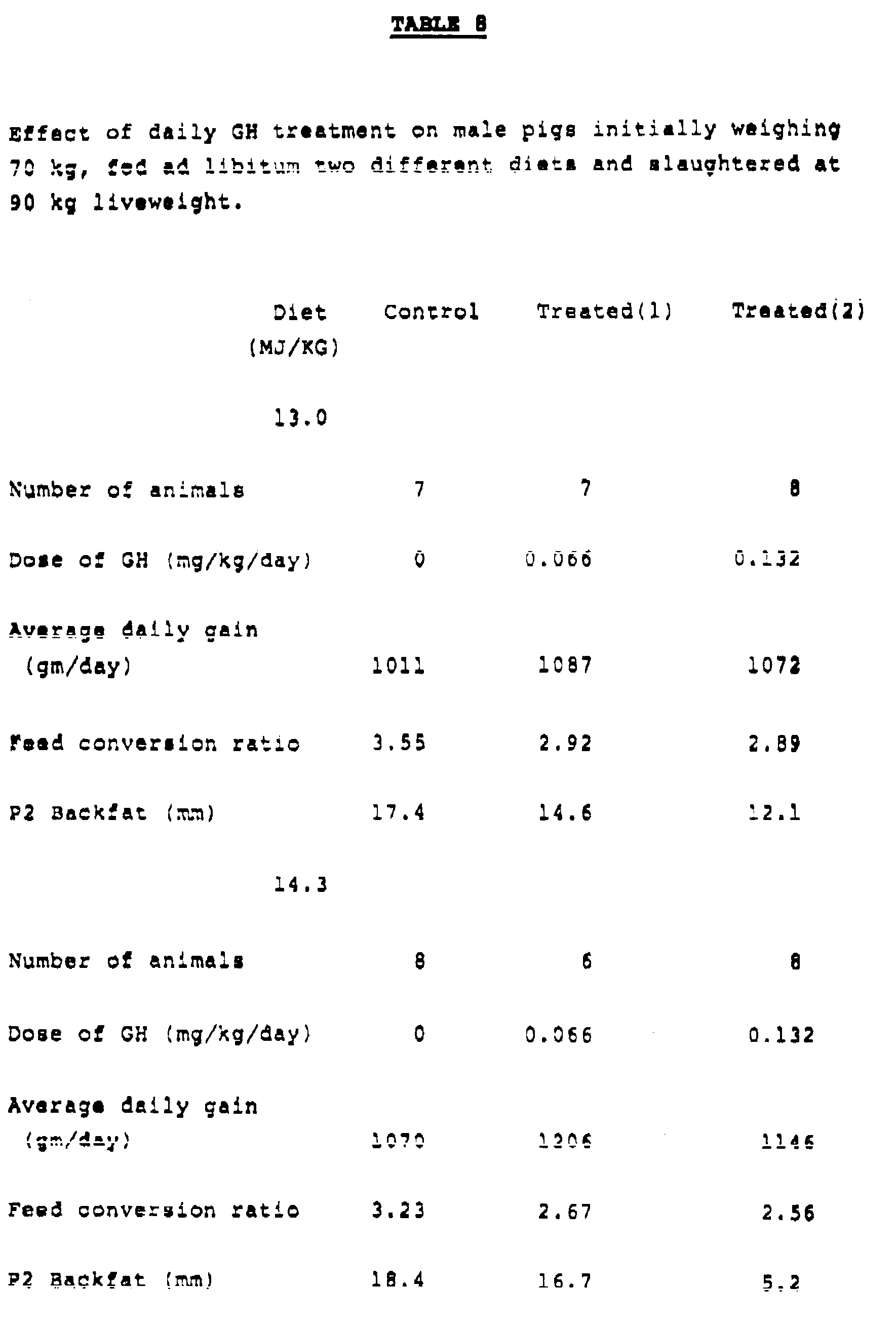
- At a dose of 0.066 mg/kg/day male pigs showed a marked improvement in growth rate and FCR and reduction in backfat (see Tables 1 and 3). At a higher dose of 0.132 mg/kg/day growth rate was not further improved compared with a dose of 0.066 mg/kg/day whereas there was further improvement in FCR and a reduction in backfat at the higher dose (see Tables 6 and 8).
- At a dose of 0.066 mg/kg/day female pigs also showed a marked improvement in growth rate and FCR and reduction in backfat (see Tables 2 and 4). At a higher dose of 0.132 mg/kg/day growth rate was not further improved compared with a dose of 0.066 mg/kg/day and there was only a marginal improvement in FCR and a minor reduction in backfat at the higher dose (see Tables 7 and 9).
- Thus, there is only a narrow dose range within which improvement in carcass quality occurs simultaneously with improved growth rate and FCR.
- If treatment is given over the entire range of 35 to 90 kg, a still further improvement in FCR is observed compared to treatment over the 60 to 90 kg range. However, there is a greater relative improvement in FCR when GH is administered over the liveweight range of 60 to 90 kg than over the range 35 to 50 kg.
- Furthermore, the improvement in carcass parameters (increase in lean percentage and decrease in fat percentage) is the same for treatment given only over the 60 to 90 kg range as it is if given over the whole 35 to 90 kg range (Dose of GH 0.066 mg/kg/day).
- Results are shown in Tables 1 to 4.
- Results are provided in Tables 6 to 9.
- In male pigs, treatment with GH at 0.066 or 0.132 mg/kg/day results in a greater improvement in FCR when the animals are fed on a relatively high energy diet, supplying 14.3 MJ/kg, compared to the relatively low energy diet supplying 13.0 MJ/kg. The compositions of the two diets are shown in Table 5. Each diet provided adequate protein for the animals.
- Similarly, in female pigs there is greater improvement in FCR when fed the high energy diet, except where treatment is initiated at 70 kg, where the greater improvement occurs on the low energy diet.
- For pigs of both sexes, the decrease in backfat thickness was greater on the low energy diet.
- These treatments were repeated utilising synthetic recombinant porcine growth hormones (methionyl AA1-190 and AA4-190). Results showed a similar improvement in feed conversion efficiency and growth rate.
- Table 10 illustrates that in castrate males, feed conversion efficiency and growth rate are best when animals are treated over the 50 to 90 kg treatment range.
- Fat reduction as indicated by P2 backfat is effectively achieved at a dose rate of 0.066 and is only required over the last 10 kg of growth or over approximately the last 10 days prior to slaughter.
- Tables 11 and 12 illustrate the anabolic effect of treatment with growth hormone on carcass quality whereby the weight of dissectable lean tissue is observed.
- The results suggest treatment of both male and female pigs at the higher dose rate of 0.132 mg will provide the best anabolic effect.
- Tables 13 and 14 illustrate the effectivenss of the fat reducing effect of growth hormone at higher treatment initiation weights.
- The results suggest the higher dose rate of 0.132 mg/kg will cause the greatest reduction in carcass fat.
- Tables 15 to 18 illustrate that in cattle a treatment period of 50 days is to be preferred to obtain the best improvement in growth rate and feed conversion efficiency. However a greater relative improvement is achieved over the 25 day period.
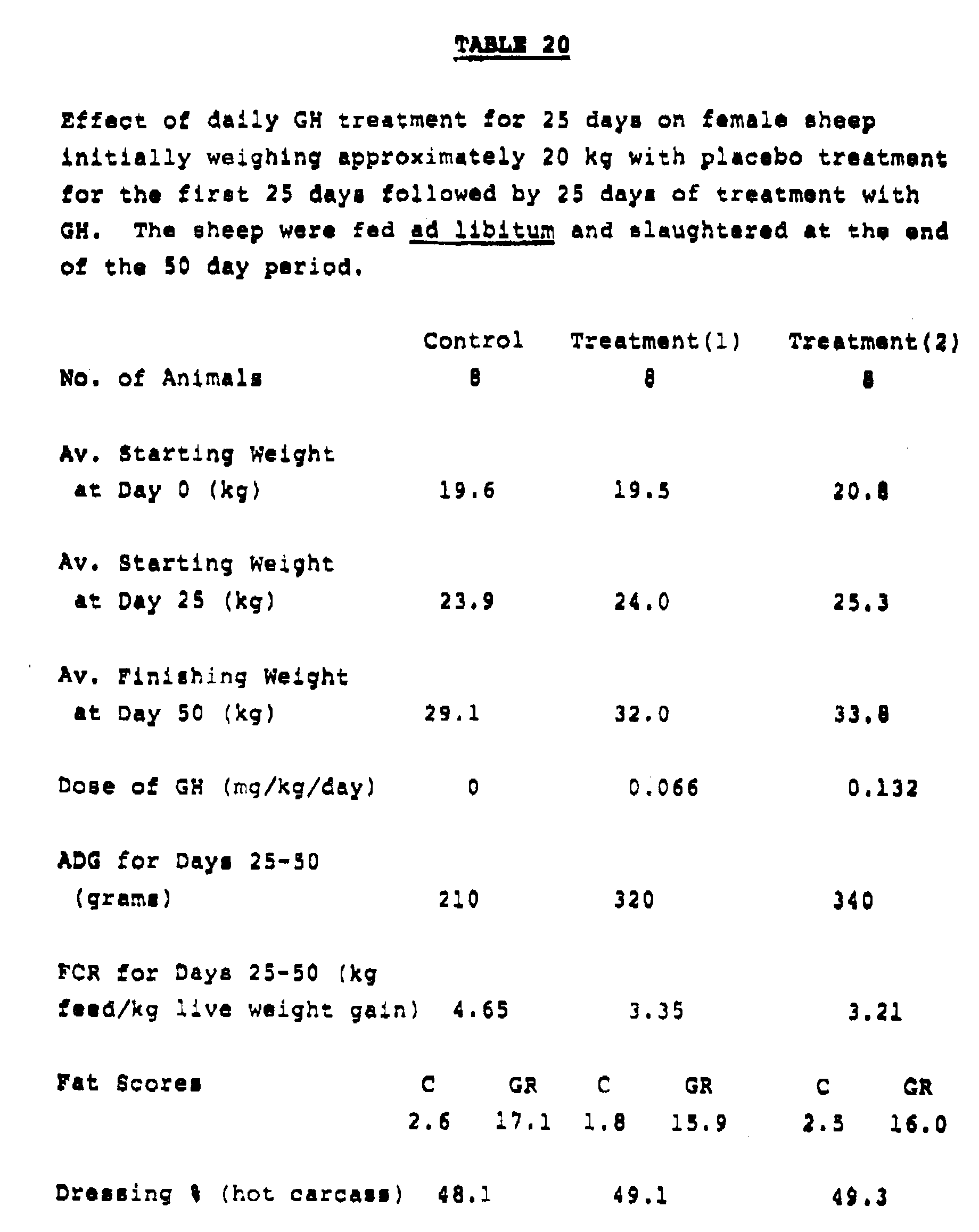
- Tables 19 to 24 illustrate that in sheep a treatment period of 50 days is to be preferred to maximise carcass quality and growth rate. A dose rate of 0.132 mg/kg provides the best carcass quality and growth rate improvement but the best relative improvement for female and male castrate sheep is achieved at the lower dose rate. However, the greater relative improvement is achieved over the 25 day period.
- Table 25 illustrates the variation in the amount of wool obtained from sheep treated with GH over 25-50 days. It may be postulated that the improvement in lean tissue content may be in an inverse relation to the reduction in wool yield. This may constitute a redirection of dietary nutrients.






Claims (6)
Priority Applications (1)
| Application Number | Priority Date | Filing Date | Title |
|---|---|---|---|
| AT86306992T ATE80040T1 (en) | 1985-09-10 | 1986-09-10 | BODY QUALITY IMPROVEMENT. |
Applications Claiming Priority (3)
| Application Number | Priority Date | Filing Date | Title |
|---|---|---|---|
| AUPH235685 | 1985-09-10 | ||
| AU2356/85 | 1985-09-10 | ||
| AU62522/86A AU599922B2 (en) | 1985-09-10 | 1986-09-09 | Improving carcass quality |
Publications (3)
| Publication Number | Publication Date |
|---|---|
| EP0217572A2 EP0217572A2 (en) | 1987-04-08 |
| EP0217572A3 EP0217572A3 (en) | 1988-06-29 |
| EP0217572B1 true EP0217572B1 (en) | 1992-09-02 |
Family
ID=3771267
Family Applications (1)
| Application Number | Title | Priority Date | Filing Date |
|---|---|---|---|
| EP86306992A Expired - Lifetime EP0217572B1 (en) | 1985-09-10 | 1986-09-10 | Improving carcass quality |
Country Status (8)
| Country | Link |
|---|---|
| EP (1) | EP0217572B1 (en) |
| JP (1) | JPS62130633A (en) |
| AT (1) | ATE80040T1 (en) |
| AU (1) | AU599922B2 (en) |
| CA (1) | CA1319609C (en) |
| DE (1) | DE3686625T2 (en) |
| DK (1) | DK171390B1 (en) |
| NZ (1) | NZ217525A (en) |
Families Citing this family (8)
| Publication number | Priority date | Publication date | Assignee | Title |
|---|---|---|---|---|
| EP0279616A3 (en) * | 1987-02-17 | 1990-03-07 | International Minerals And Chemical Corporation | Swine growth promotion |
| US5637566A (en) * | 1988-08-24 | 1997-06-10 | Southern Cross Biotech Pty. Ltd. | Method of improving carcass quality by administering growth hormone |
| DK173142B1 (en) * | 1988-08-24 | 2000-02-07 | Natinco Nv | Method for improving meat quality and feed conversion efficiency for pigs |
| US5122512A (en) * | 1988-09-12 | 1992-06-16 | Pitman-Moore, Inc. | Swine growth promoting composition |
| EP0363063A3 (en) * | 1988-09-29 | 1990-07-25 | Bunge (Australia) Proprietary Limited | Sheep growth hormone |
| AU647374B2 (en) * | 1988-09-29 | 1994-03-24 | Natinco Nv | Sheep growth hormone |
| CN102132683A (en) * | 2010-01-22 | 2011-07-27 | 张黎华 | New method for feeding, butchering and eating pig, cattle and sheep |
| CN105961334A (en) * | 2016-06-06 | 2016-09-28 | 天津市宁河原种猪场 | Management method for quantitatively feeding sow according to backfat |
Family Cites Families (7)
| Publication number | Priority date | Publication date | Assignee | Title |
|---|---|---|---|---|
| EP0085036A1 (en) * | 1982-01-18 | 1983-08-03 | Monsanto Company | Method for improved bovine milk production |
| EP0103395A3 (en) * | 1982-08-17 | 1985-05-22 | Biogen N.V. | Dna sequences, recombinant dna molecules and processes for producing bovine growth hormone-like polypeptides in high yield |
| BR8305206A (en) * | 1982-09-28 | 1984-05-02 | Sds Biotech Corp | PROCESS AND PREPARATION TO PROMOTE GROWTH AND IMPROVE THE PERFORMANCE OF ANIMAL FEED |
| PT79094B (en) * | 1983-08-29 | 1986-08-14 | Salk Inst For Biological Studi | Grf analogs |
| US4818531A (en) * | 1985-02-06 | 1989-04-04 | Eli Lilly And Company | Growth hormone and thyroid hormone |
| US5037806A (en) * | 1985-02-22 | 1991-08-06 | Monsanto Company | Biologically active method using somatotropins |
| US4670249A (en) * | 1985-04-12 | 1987-06-02 | International Minerals & Chemical Corp. | Growth-promoting compositions |
-
1986
- 1986-09-09 AU AU62522/86A patent/AU599922B2/en not_active Expired
- 1986-09-10 EP EP86306992A patent/EP0217572B1/en not_active Expired - Lifetime
- 1986-09-10 AT AT86306992T patent/ATE80040T1/en not_active IP Right Cessation
- 1986-09-10 CA CA000517861A patent/CA1319609C/en not_active Expired - Fee Related
- 1986-09-10 JP JP61213692A patent/JPS62130633A/en active Pending
- 1986-09-10 DE DE8686306992T patent/DE3686625T2/en not_active Expired - Lifetime
- 1986-09-10 DK DK431486A patent/DK171390B1/en not_active IP Right Cessation
- 1986-09-10 NZ NZ217525A patent/NZ217525A/en unknown
Also Published As
| Publication number | Publication date |
|---|---|
| CA1319609C (en) | 1993-06-29 |
| EP0217572A2 (en) | 1987-04-08 |
| AU599922B2 (en) | 1990-08-02 |
| NZ217525A (en) | 1989-09-27 |
| DK431486A (en) | 1987-03-11 |
| DK171390B1 (en) | 1996-10-14 |
| AU6252286A (en) | 1987-03-12 |
| EP0217572A3 (en) | 1988-06-29 |
| ATE80040T1 (en) | 1992-09-15 |
| JPS62130633A (en) | 1987-06-12 |
| DE3686625D1 (en) | 1992-10-08 |
| DK431486D0 (en) | 1986-09-10 |
| DE3686625T2 (en) | 1993-01-28 |
Similar Documents
| Publication | Publication Date | Title |
|---|---|---|
| Bauman et al. | Responses of high-producing dairy cows to long-term treatment with pituitary somatotropin and recombinant somatotropin | |
| US4818531A (en) | Growth hormone and thyroid hormone | |
| US5087472A (en) | Feed compositions for domestics animals containing hydroxymethylbutyrate | |
| EP0465646A1 (en) | METHOD FOR GROWING MEAT PRODUCING ANIMALS TO INCREASE THE DEVELOPMENT OF Lean Meat. | |
| KR100513420B1 (en) | How to breed ruminants | |
| US5004728A (en) | Methods of increasing milk yields in ruminants | |
| RU2160531C1 (en) | Pig feeding method | |
| EP0217572A2 (en) | Improving carcass quality | |
| Schneider et al. | Responses of dairy cows in early lactation to bovine somatotropin and ruminally inert fat | |
| Spencer et al. | Effect of recombinant human insulin-like growth factor-II on weight gain and body composition of broiler chickens | |
| US5686413A (en) | Ractopamine and growth hormone combinations | |
| KR20010000198A (en) | lacquer feed | |
| EP0362999B1 (en) | Improved carcass quality | |
| US5637566A (en) | Method of improving carcass quality by administering growth hormone | |
| EP0333349B1 (en) | Phenethanolamine and growth hormone combinations | |
| US5162302A (en) | Endocrine manipulation to improve body composition of poultry | |
| Wray-Cahen | Performance-enhancing substances | |
| Chalupa et al. | Bovine somatotropin: physiology, lactational responses and implications for the dairy industry | |
| US3737535A (en) | Method of fattening beef cattle | |
| SU755262A1 (en) | A METHOD FOR INCREASING THE PIG MEAT DAY 1 | |
| Eisenbeisz | Lactational evaluation of recombinant bovine somatotropin with corn and barley diets | |
| Sainz et al. | Exogenous growth hormone releasing factors and cottonseed meal improve growth performance and composition of gain in lambs fed lucerne chaff ad libitum | |
| Peisker | Efficiency of a Lysine-Tryptophan blend as a Tryptophan source in animal nutrition | |
| Fitzner et al. | Sustained effects of porcine somatotropin administered during the growing period on growth and carcass characteristics of finishing pigs. | |
| Carstens | Recombinant bovine somatotropin for us in beef cattle |
Legal Events
| Date | Code | Title | Description |
|---|---|---|---|
| PUAI | Public reference made under article 153(3) epc to a published international application that has entered the european phase |
Free format text: ORIGINAL CODE: 0009012 |
|
| AK | Designated contracting states |
Kind code of ref document: A2 Designated state(s): AT BE CH DE FR GB IT LI LU NL SE |
|
| PUAL | Search report despatched |
Free format text: ORIGINAL CODE: 0009013 |
|
| AK | Designated contracting states |
Kind code of ref document: A3 Designated state(s): AT BE CH DE FR GB IT LI LU NL SE |
|
| 17P | Request for examination filed |
Effective date: 19880812 |
|
| 17Q | First examination report despatched |
Effective date: 19900730 |
|
| RAP1 | Party data changed (applicant data changed or rights of an application transferred) |
Owner name: FIDELITY FOOD TECHNOLOGIES PTY. LTD. |
|
| GRAA | (expected) grant |
Free format text: ORIGINAL CODE: 0009210 |
|
| PGFP | Annual fee paid to national office [announced via postgrant information from national office to epo] |
Ref country code: LU Payment date: 19920819 Year of fee payment: 7 |
|
| AK | Designated contracting states |
Kind code of ref document: B1 Designated state(s): AT BE CH DE FR GB IT LI LU NL SE |
|
| REF | Corresponds to: |
Ref document number: 80040 Country of ref document: AT Date of ref document: 19920915 Kind code of ref document: T |
|
| ITF | It: translation for a ep patent filed | ||
| PGFP | Annual fee paid to national office [announced via postgrant information from national office to epo] |
Ref country code: CH Payment date: 19920928 Year of fee payment: 7 |
|
| REF | Corresponds to: |
Ref document number: 3686625 Country of ref document: DE Date of ref document: 19921008 |
|
| ET | Fr: translation filed | ||
| EPTA | Lu: last paid annual fee | ||
| PLBE | No opposition filed within time limit |
Free format text: ORIGINAL CODE: 0009261 |
|
| STAA | Information on the status of an ep patent application or granted ep patent |
Free format text: STATUS: NO OPPOSITION FILED WITHIN TIME LIMIT |
|
| 26N | No opposition filed | ||
| PG25 | Lapsed in a contracting state [announced via postgrant information from national office to epo] |
Ref country code: LU Free format text: LAPSE BECAUSE OF NON-PAYMENT OF DUE FEES Effective date: 19930910 |
|
| ITTA | It: last paid annual fee | ||
| PG25 | Lapsed in a contracting state [announced via postgrant information from national office to epo] |
Ref country code: LI Effective date: 19930930 Ref country code: CH Effective date: 19930930 |
|
| REG | Reference to a national code |
Ref country code: CH Ref legal event code: PL |
|
| REG | Reference to a national code |
Ref country code: GB Ref legal event code: 732E |
|
| EAL | Se: european patent in force in sweden |
Ref document number: 86306992.8 |
|
| REG | Reference to a national code |
Ref country code: FR Ref legal event code: TP |
|
| NLS | Nl: assignments of ep-patents |
Owner name: SOUTHERN CROSS BIOTECH PTY. LTD. |
|
| REG | Reference to a national code |
Ref country code: FR Ref legal event code: TP |
|
| NLS | Nl: assignments of ep-patents |
Owner name: NATINCO N.V. |
|
| REG | Reference to a national code |
Ref country code: GB Ref legal event code: 732E |
|
| BECA | Be: change of holder's address |
Free format text: 20000530 *NATINCO N.V.:PLAZA JOJO, CORREA 1-5 WILLEMSTED CURACAO |
|
| REG | Reference to a national code |
Ref country code: GB Ref legal event code: IF02 |
|
| PGFP | Annual fee paid to national office [announced via postgrant information from national office to epo] |
Ref country code: FR Payment date: 20050823 Year of fee payment: 20 |
|
| PGFP | Annual fee paid to national office [announced via postgrant information from national office to epo] |
Ref country code: NL Payment date: 20050904 Year of fee payment: 20 |
|
| PGFP | Annual fee paid to national office [announced via postgrant information from national office to epo] |
Ref country code: SE Payment date: 20050906 Year of fee payment: 20 |
|
| PGFP | Annual fee paid to national office [announced via postgrant information from national office to epo] |
Ref country code: GB Payment date: 20050907 Year of fee payment: 20 |
|
| PGFP | Annual fee paid to national office [announced via postgrant information from national office to epo] |
Ref country code: DE Payment date: 20050909 Year of fee payment: 20 |
|
| PGFP | Annual fee paid to national office [announced via postgrant information from national office to epo] |
Ref country code: AT Payment date: 20050913 Year of fee payment: 20 |
|
| PGFP | Annual fee paid to national office [announced via postgrant information from national office to epo] |
Ref country code: IT Payment date: 20050927 Year of fee payment: 20 |
|
| PGFP | Annual fee paid to national office [announced via postgrant information from national office to epo] |
Ref country code: BE Payment date: 20051121 Year of fee payment: 20 |
|
| PG25 | Lapsed in a contracting state [announced via postgrant information from national office to epo] |
Ref country code: GB Free format text: LAPSE BECAUSE OF EXPIRATION OF PROTECTION Effective date: 20060909 |
|
| PG25 | Lapsed in a contracting state [announced via postgrant information from national office to epo] |
Ref country code: NL Free format text: LAPSE BECAUSE OF EXPIRATION OF PROTECTION Effective date: 20060910 |
|
| REG | Reference to a national code |
Ref country code: GB Ref legal event code: PE20 |
|
| NLV7 | Nl: ceased due to reaching the maximum lifetime of a patent |
Effective date: 20060910 |
|
| EUG | Se: european patent has lapsed | ||
| BE20 | Be: patent expired |
Owner name: *NATINCO N.V. Effective date: 20060910 |