EP0215978B1 - Liquid electrophoretic developer composition - Google Patents
Liquid electrophoretic developer composition Download PDFInfo
- Publication number
- EP0215978B1 EP0215978B1 EP85201431A EP85201431A EP0215978B1 EP 0215978 B1 EP0215978 B1 EP 0215978B1 EP 85201431 A EP85201431 A EP 85201431A EP 85201431 A EP85201431 A EP 85201431A EP 0215978 B1 EP0215978 B1 EP 0215978B1
- Authority
- EP
- European Patent Office
- Prior art keywords
- polymer
- group
- acid
- alkyl
- carrier liquid
- Prior art date
- Legal status (The legal status is an assumption and is not a legal conclusion. Google has not performed a legal analysis and makes no representation as to the accuracy of the status listed.)
- Expired - Lifetime
Links
- 239000007788 liquid Substances 0.000 title claims description 73
- 239000000203 mixture Substances 0.000 title claims description 34
- 229920000642 polymer Polymers 0.000 claims description 145
- 239000002245 particle Substances 0.000 claims description 88
- 239000000049 pigment Substances 0.000 claims description 47
- 238000002360 preparation method Methods 0.000 claims description 42
- 239000006185 dispersion Substances 0.000 claims description 39
- 239000000178 monomer Substances 0.000 claims description 36
- 239000006229 carbon black Substances 0.000 claims description 30
- 125000000217 alkyl group Chemical group 0.000 claims description 22
- 125000004432 carbon atom Chemical group C* 0.000 claims description 18
- -1 araliphatic Chemical group 0.000 claims description 17
- NIXOWILDQLNWCW-UHFFFAOYSA-M Acrylate Chemical compound [O-]C(=O)C=C NIXOWILDQLNWCW-UHFFFAOYSA-M 0.000 claims description 14
- 239000002253 acid Substances 0.000 claims description 14
- 238000000034 method Methods 0.000 claims description 11
- 229910052698 phosphorus Inorganic materials 0.000 claims description 10
- 239000000126 substance Substances 0.000 claims description 10
- 125000000962 organic group Chemical group 0.000 claims description 9
- 150000003839 salts Chemical class 0.000 claims description 8
- 125000001931 aliphatic group Chemical group 0.000 claims description 7
- 125000003118 aryl group Chemical group 0.000 claims description 7
- 239000011248 coating agent Substances 0.000 claims description 7
- 238000000576 coating method Methods 0.000 claims description 7
- 229910052751 metal Inorganic materials 0.000 claims description 7
- 239000002184 metal Substances 0.000 claims description 7
- 230000008569 process Effects 0.000 claims description 7
- CERQOIWHTDAKMF-UHFFFAOYSA-N Methacrylic acid Chemical compound CC(=C)C(O)=O CERQOIWHTDAKMF-UHFFFAOYSA-N 0.000 claims description 6
- OAICVXFJPJFONN-UHFFFAOYSA-N Phosphorus Chemical compound [P] OAICVXFJPJFONN-UHFFFAOYSA-N 0.000 claims description 6
- 239000011574 phosphorus Substances 0.000 claims description 6
- 229910052799 carbon Inorganic materials 0.000 claims description 5
- 125000005521 carbonamide group Chemical group 0.000 claims description 5
- 150000002430 hydrocarbons Chemical class 0.000 claims description 5
- 125000002924 primary amino group Chemical group [H]N([H])* 0.000 claims description 5
- 229920002554 vinyl polymer Polymers 0.000 claims description 5
- PPBRXRYQALVLMV-UHFFFAOYSA-N Styrene Chemical compound C=CC1=CC=CC=C1 PPBRXRYQALVLMV-UHFFFAOYSA-N 0.000 claims description 4
- 230000001133 acceleration Effects 0.000 claims description 4
- 230000002378 acidificating effect Effects 0.000 claims description 4
- 150000001721 carbon Chemical group 0.000 claims description 4
- 125000003700 epoxy group Chemical group 0.000 claims description 4
- 125000005670 ethenylalkyl group Chemical group 0.000 claims description 4
- 230000005484 gravity Effects 0.000 claims description 4
- IQPQWNKOIGAROB-UHFFFAOYSA-N isocyanate group Chemical group [N-]=C=O IQPQWNKOIGAROB-UHFFFAOYSA-N 0.000 claims description 4
- 125000004437 phosphorous atom Chemical group 0.000 claims description 4
- 125000000391 vinyl group Chemical group [H]C([*])=C([H])[H] 0.000 claims description 4
- 125000004765 (C1-C4) haloalkyl group Chemical group 0.000 claims description 3
- 125000004018 acid anhydride group Chemical group 0.000 claims description 3
- 125000002521 alkyl halide group Chemical group 0.000 claims description 3
- 125000003710 aryl alkyl group Chemical group 0.000 claims description 3
- 150000004820 halides Chemical group 0.000 claims description 3
- 125000001570 methylene group Chemical group [H]C([H])([*:1])[*:2] 0.000 claims description 3
- 125000003544 oxime group Chemical group 0.000 claims description 3
- BDHFUVZGWQCTTF-UHFFFAOYSA-N sulfonic acid Chemical compound OS(=O)=O BDHFUVZGWQCTTF-UHFFFAOYSA-N 0.000 claims description 3
- 125000004178 (C1-C4) alkyl group Chemical group 0.000 claims description 2
- OHBKNWDVVSUTRV-UHFFFAOYSA-N 1-(prop-2-enoylamino)propane-2-sulfonic acid Chemical compound OS(=O)(=O)C(C)CNC(=O)C=C OHBKNWDVVSUTRV-UHFFFAOYSA-N 0.000 claims description 2
- SMZOUWXMTYCWNB-UHFFFAOYSA-N 2-(2-methoxy-5-methylphenyl)ethanamine Chemical compound COC1=CC=C(C)C=C1CCN SMZOUWXMTYCWNB-UHFFFAOYSA-N 0.000 claims description 2
- JAHNSTQSQJOJLO-UHFFFAOYSA-N 2-(3-fluorophenyl)-1h-imidazole Chemical compound FC1=CC=CC(C=2NC=CN=2)=C1 JAHNSTQSQJOJLO-UHFFFAOYSA-N 0.000 claims description 2
- NIXOWILDQLNWCW-UHFFFAOYSA-N 2-Propenoic acid Natural products OC(=O)C=C NIXOWILDQLNWCW-UHFFFAOYSA-N 0.000 claims description 2
- XUDBVJCTLZTSDC-UHFFFAOYSA-N 2-ethenylbenzoic acid Chemical compound OC(=O)C1=CC=CC=C1C=C XUDBVJCTLZTSDC-UHFFFAOYSA-N 0.000 claims description 2
- NEYTXADIGVEHQD-UHFFFAOYSA-N 2-hydroxy-2-(prop-2-enoylamino)acetic acid Chemical compound OC(=O)C(O)NC(=O)C=C NEYTXADIGVEHQD-UHFFFAOYSA-N 0.000 claims description 2
- CTHJQRHPNQEPAB-UHFFFAOYSA-N 2-methoxyethenylbenzene Chemical compound COC=CC1=CC=CC=C1 CTHJQRHPNQEPAB-UHFFFAOYSA-N 0.000 claims description 2
- ZSQWQTABLXAFEZ-UHFFFAOYSA-N 2-phenylbut-3-enoic acid Chemical compound OC(=O)C(C=C)C1=CC=CC=C1 ZSQWQTABLXAFEZ-UHFFFAOYSA-N 0.000 claims description 2
- AGBXYHCHUYARJY-UHFFFAOYSA-N 2-phenylethenesulfonic acid Chemical compound OS(=O)(=O)C=CC1=CC=CC=C1 AGBXYHCHUYARJY-UHFFFAOYSA-N 0.000 claims description 2
- KGIGUEBEKRSTEW-UHFFFAOYSA-N 2-vinylpyridine Chemical compound C=CC1=CC=CC=N1 KGIGUEBEKRSTEW-UHFFFAOYSA-N 0.000 claims description 2
- CYUZOYPRAQASLN-UHFFFAOYSA-N 3-prop-2-enoyloxypropanoic acid Chemical compound OC(=O)CCOC(=O)C=C CYUZOYPRAQASLN-UHFFFAOYSA-N 0.000 claims description 2
- JLBJTVDPSNHSKJ-UHFFFAOYSA-N 4-Methylstyrene Chemical compound CC1=CC=C(C=C)C=C1 JLBJTVDPSNHSKJ-UHFFFAOYSA-N 0.000 claims description 2
- 239000004215 Carbon black (E152) Substances 0.000 claims description 2
- IMROMDMJAWUWLK-UHFFFAOYSA-N Ethenol Chemical class OC=C IMROMDMJAWUWLK-UHFFFAOYSA-N 0.000 claims description 2
- CERQOIWHTDAKMF-UHFFFAOYSA-M Methacrylate Chemical compound CC(=C)C([O-])=O CERQOIWHTDAKMF-UHFFFAOYSA-M 0.000 claims description 2
- WHNWPMSKXPGLAX-UHFFFAOYSA-N N-Vinyl-2-pyrrolidone Chemical compound C=CN1CCCC1=O WHNWPMSKXPGLAX-UHFFFAOYSA-N 0.000 claims description 2
- 150000007513 acids Chemical class 0.000 claims description 2
- 125000005354 acylalkyl group Chemical group 0.000 claims description 2
- 238000007259 addition reaction Methods 0.000 claims description 2
- 125000003172 aldehyde group Chemical group 0.000 claims description 2
- 125000004183 alkoxy alkyl group Chemical group 0.000 claims description 2
- 125000005250 alkyl acrylate group Chemical group 0.000 claims description 2
- 150000001732 carboxylic acid derivatives Chemical class 0.000 claims description 2
- 150000001733 carboxylic acid esters Chemical class 0.000 claims description 2
- 238000006482 condensation reaction Methods 0.000 claims description 2
- LDHQCZJRKDOVOX-NSCUHMNNSA-N crotonic acid Chemical compound C\C=C\C(O)=O LDHQCZJRKDOVOX-NSCUHMNNSA-N 0.000 claims description 2
- 125000004093 cyano group Chemical group *C#N 0.000 claims description 2
- 150000005690 diesters Chemical class 0.000 claims description 2
- 230000008030 elimination Effects 0.000 claims description 2
- 238000003379 elimination reaction Methods 0.000 claims description 2
- 125000004185 ester group Chemical group 0.000 claims description 2
- 125000000623 heterocyclic group Chemical group 0.000 claims description 2
- 229930195733 hydrocarbon Natural products 0.000 claims description 2
- 125000004356 hydroxy functional group Chemical group O* 0.000 claims description 2
- 150000002576 ketones Chemical class 0.000 claims description 2
- 150000002734 metacrylic acid derivatives Chemical class 0.000 claims description 2
- LVHBHZANLOWSRM-UHFFFAOYSA-N methylenebutanedioic acid Natural products OC(=O)CC(=C)C(O)=O LVHBHZANLOWSRM-UHFFFAOYSA-N 0.000 claims description 2
- UCUUFSAXZMGPGH-UHFFFAOYSA-N penta-1,4-dien-3-one Chemical class C=CC(=O)C=C UCUUFSAXZMGPGH-UHFFFAOYSA-N 0.000 claims description 2
- ABLZXFCXXLZCGV-UHFFFAOYSA-N phosphonic acid group Chemical group P(O)(O)=O ABLZXFCXXLZCGV-UHFFFAOYSA-N 0.000 claims description 2
- 125000001453 quaternary ammonium group Chemical group 0.000 claims description 2
- 125000000467 secondary amino group Chemical group [H]N([*:1])[*:2] 0.000 claims description 2
- 150000003440 styrenes Chemical class 0.000 claims description 2
- 125000003107 substituted aryl group Chemical group 0.000 claims description 2
- 125000001302 tertiary amino group Chemical group 0.000 claims description 2
- 125000003396 thiol group Chemical group [H]S* 0.000 claims description 2
- LDHQCZJRKDOVOX-UHFFFAOYSA-N trans-crotonic acid Natural products CC=CC(O)=O LDHQCZJRKDOVOX-UHFFFAOYSA-N 0.000 claims description 2
- 229930195735 unsaturated hydrocarbon Natural products 0.000 claims description 2
- 229920001567 vinyl ester resin Polymers 0.000 claims description 2
- NLVXSWCKKBEXTG-UHFFFAOYSA-N vinylsulfonic acid Chemical compound OS(=O)(=O)C=C NLVXSWCKKBEXTG-UHFFFAOYSA-N 0.000 claims description 2
- FLCAEMBIQVZWIF-UHFFFAOYSA-N 6-(dimethylamino)-2-methylhex-2-enamide Chemical compound CN(C)CCCC=C(C)C(N)=O FLCAEMBIQVZWIF-UHFFFAOYSA-N 0.000 claims 1
- 125000004966 cyanoalkyl group Chemical group 0.000 claims 1
- UHZZMRAGKVHANO-UHFFFAOYSA-M chlormequat chloride Chemical compound [Cl-].C[N+](C)(C)CCCl UHZZMRAGKVHANO-UHFFFAOYSA-M 0.000 description 43
- OKKJLVBELUTLKV-UHFFFAOYSA-N Methanol Chemical compound OC OKKJLVBELUTLKV-UHFFFAOYSA-N 0.000 description 36
- 229920001577 copolymer Polymers 0.000 description 30
- GTJOHISYCKPIMT-UHFFFAOYSA-N 2-methylundecane Chemical compound CCCCCCCCCC(C)C GTJOHISYCKPIMT-UHFFFAOYSA-N 0.000 description 29
- SGVYKUFIHHTIFL-UHFFFAOYSA-N Isobutylhexyl Natural products CCCCCCCC(C)C SGVYKUFIHHTIFL-UHFFFAOYSA-N 0.000 description 29
- 235000019241 carbon black Nutrition 0.000 description 29
- VKPSKYDESGTTFR-UHFFFAOYSA-N isododecane Natural products CC(C)(C)CC(C)CC(C)(C)C VKPSKYDESGTTFR-UHFFFAOYSA-N 0.000 description 29
- 239000003795 chemical substances by application Substances 0.000 description 26
- YXFVVABEGXRONW-UHFFFAOYSA-N Toluene Chemical compound CC1=CC=CC=C1 YXFVVABEGXRONW-UHFFFAOYSA-N 0.000 description 18
- XLOMVQKBTHCTTD-UHFFFAOYSA-N Zinc monoxide Chemical compound [Zn]=O XLOMVQKBTHCTTD-UHFFFAOYSA-N 0.000 description 16
- HMZGPNHSPWNGEP-UHFFFAOYSA-N octadecyl 2-methylprop-2-enoate Chemical compound CCCCCCCCCCCCCCCCCCOC(=O)C(C)=C HMZGPNHSPWNGEP-UHFFFAOYSA-N 0.000 description 16
- 239000007787 solid Substances 0.000 description 16
- 230000008859 change Effects 0.000 description 15
- CSCPPACGZOOCGX-UHFFFAOYSA-N Acetone Chemical compound CC(C)=O CSCPPACGZOOCGX-UHFFFAOYSA-N 0.000 description 13
- 230000001276 controlling effect Effects 0.000 description 12
- RUMACXVDVNRZJZ-UHFFFAOYSA-N 2-methylpropyl 2-methylprop-2-enoate Chemical compound CC(C)COC(=O)C(C)=C RUMACXVDVNRZJZ-UHFFFAOYSA-N 0.000 description 11
- OKTJSMMVPCPJKN-UHFFFAOYSA-N Carbon Chemical compound [C] OKTJSMMVPCPJKN-UHFFFAOYSA-N 0.000 description 11
- 238000001556 precipitation Methods 0.000 description 11
- 239000000243 solution Substances 0.000 description 11
- 239000000463 material Substances 0.000 description 10
- JKNCOURZONDCGV-UHFFFAOYSA-N 2-(dimethylamino)ethyl 2-methylprop-2-enoate Chemical compound CN(C)CCOC(=O)C(C)=C JKNCOURZONDCGV-UHFFFAOYSA-N 0.000 description 9
- 239000000843 powder Substances 0.000 description 9
- PRAMZQXXPOLCIY-UHFFFAOYSA-N 2-(2-methylprop-2-enoyloxy)ethanesulfonic acid Chemical compound CC(=C)C(=O)OCCS(O)(=O)=O PRAMZQXXPOLCIY-UHFFFAOYSA-N 0.000 description 8
- 239000011787 zinc oxide Substances 0.000 description 8
- 238000002604 ultrasonography Methods 0.000 description 7
- SLBOQBILGNEPEB-UHFFFAOYSA-N 1-chloroprop-2-enylbenzene Chemical compound C=CC(Cl)C1=CC=CC=C1 SLBOQBILGNEPEB-UHFFFAOYSA-N 0.000 description 6
- KFZMGEQAYNKOFK-UHFFFAOYSA-N Isopropanol Chemical compound CC(C)O KFZMGEQAYNKOFK-UHFFFAOYSA-N 0.000 description 6
- 238000006243 chemical reaction Methods 0.000 description 6
- 229920005989 resin Polymers 0.000 description 6
- 239000011347 resin Substances 0.000 description 6
- CYNFVQATCBZAKL-UHFFFAOYSA-L zinc;2-butyloctyl phosphate Chemical compound [Zn+2].CCCCCCC(CCCC)COP([O-])([O-])=O CYNFVQATCBZAKL-UHFFFAOYSA-L 0.000 description 6
- VVQNEPGJFQJSBK-UHFFFAOYSA-N Methyl methacrylate Chemical compound COC(=O)C(C)=C VVQNEPGJFQJSBK-UHFFFAOYSA-N 0.000 description 5
- VLKZOEOYAKHREP-UHFFFAOYSA-N n-Hexane Chemical compound CCCCCC VLKZOEOYAKHREP-UHFFFAOYSA-N 0.000 description 5
- 238000004448 titration Methods 0.000 description 5
- IJGRMHOSHXDMSA-UHFFFAOYSA-N Atomic nitrogen Chemical compound N#N IJGRMHOSHXDMSA-UHFFFAOYSA-N 0.000 description 4
- 229920001400 block copolymer Polymers 0.000 description 4
- 230000000694 effects Effects 0.000 description 4
- RBTKNAXYKSUFRK-UHFFFAOYSA-N heliogen blue Chemical compound [Cu].[N-]1C2=C(C=CC=C3)C3=C1N=C([N-]1)C3=CC=CC=C3C1=NC([N-]1)=C(C=CC=C3)C3=C1N=C([N-]1)C3=CC=CC=C3C1=N2 RBTKNAXYKSUFRK-UHFFFAOYSA-N 0.000 description 4
- 229910052739 hydrogen Inorganic materials 0.000 description 4
- 125000002887 hydroxy group Chemical group [H]O* 0.000 description 4
- 238000002156 mixing Methods 0.000 description 4
- SJIXRGNQPBQWMK-UHFFFAOYSA-N 2-(diethylamino)ethyl 2-methylprop-2-enoate Chemical compound CCN(CC)CCOC(=O)C(C)=C SJIXRGNQPBQWMK-UHFFFAOYSA-N 0.000 description 3
- QPLDLSVMHZLSFG-UHFFFAOYSA-N Copper oxide Chemical compound [Cu]=O QPLDLSVMHZLSFG-UHFFFAOYSA-N 0.000 description 3
- YMWUJEATGCHHMB-UHFFFAOYSA-N Dichloromethane Chemical compound ClCCl YMWUJEATGCHHMB-UHFFFAOYSA-N 0.000 description 3
- LFQSCWFLJHTTHZ-UHFFFAOYSA-N Ethanol Chemical compound CCO LFQSCWFLJHTTHZ-UHFFFAOYSA-N 0.000 description 3
- WOBHKFSMXKNTIM-UHFFFAOYSA-N Hydroxyethyl methacrylate Chemical compound CC(=C)C(=O)OCCO WOBHKFSMXKNTIM-UHFFFAOYSA-N 0.000 description 3
- DNIAPMSPPWPWGF-UHFFFAOYSA-N Propylene glycol Chemical compound CC(O)CO DNIAPMSPPWPWGF-UHFFFAOYSA-N 0.000 description 3
- BZHJMEDXRYGGRV-UHFFFAOYSA-N Vinyl chloride Chemical compound ClC=C BZHJMEDXRYGGRV-UHFFFAOYSA-N 0.000 description 3
- 239000002270 dispersing agent Substances 0.000 description 3
- 239000000975 dye Substances 0.000 description 3
- 239000001257 hydrogen Substances 0.000 description 3
- 125000004435 hydrogen atom Chemical class [H]* 0.000 description 3
- 239000004570 mortar (masonry) Substances 0.000 description 3
- 229910052757 nitrogen Inorganic materials 0.000 description 3
- 229920005604 random copolymer Polymers 0.000 description 3
- 239000002904 solvent Substances 0.000 description 3
- ZWEHNKRNPOVVGH-UHFFFAOYSA-N 2-Butanone Chemical compound CCC(C)=O ZWEHNKRNPOVVGH-UHFFFAOYSA-N 0.000 description 2
- NEAQRZUHTPSBBM-UHFFFAOYSA-N 2-hydroxy-3,3-dimethyl-7-nitro-4h-isoquinolin-1-one Chemical compound C1=C([N+]([O-])=O)C=C2C(=O)N(O)C(C)(C)CC2=C1 NEAQRZUHTPSBBM-UHFFFAOYSA-N 0.000 description 2
- 230000005653 Brownian motion process Effects 0.000 description 2
- XEEYBQQBJWHFJM-UHFFFAOYSA-N Iron Chemical compound [Fe] XEEYBQQBJWHFJM-UHFFFAOYSA-N 0.000 description 2
- IMNFDUFMRHMDMM-UHFFFAOYSA-N N-Heptane Chemical compound CCCCCCC IMNFDUFMRHMDMM-UHFFFAOYSA-N 0.000 description 2
- 239000000654 additive Substances 0.000 description 2
- 230000000996 additive effect Effects 0.000 description 2
- 150000001299 aldehydes Chemical class 0.000 description 2
- 150000001338 aliphatic hydrocarbons Chemical class 0.000 description 2
- 125000002947 alkylene group Chemical group 0.000 description 2
- XXROGKLTLUQVRX-UHFFFAOYSA-N allyl alcohol Chemical compound OCC=C XXROGKLTLUQVRX-UHFFFAOYSA-N 0.000 description 2
- 125000003277 amino group Chemical group 0.000 description 2
- 125000000732 arylene group Chemical group 0.000 description 2
- QVGXLLKOCUKJST-UHFFFAOYSA-N atomic oxygen Chemical compound [O] QVGXLLKOCUKJST-UHFFFAOYSA-N 0.000 description 2
- 239000000987 azo dye Substances 0.000 description 2
- 230000015572 biosynthetic process Effects 0.000 description 2
- 238000009835 boiling Methods 0.000 description 2
- 238000005537 brownian motion Methods 0.000 description 2
- FUSUHKVFWTUUBE-UHFFFAOYSA-N buten-2-one Chemical compound CC(=O)C=C FUSUHKVFWTUUBE-UHFFFAOYSA-N 0.000 description 2
- FJMYNXGWSXFTMF-UHFFFAOYSA-L calcium;6-carboxy-2,3-di(propan-2-yl)phenolate Chemical compound [Ca+2].CC(C)C1=CC=C(C(O)=O)C([O-])=C1C(C)C.CC(C)C1=CC=C(C(O)=O)C([O-])=C1C(C)C FJMYNXGWSXFTMF-UHFFFAOYSA-L 0.000 description 2
- 238000001816 cooling Methods 0.000 description 2
- 238000010494 dissociation reaction Methods 0.000 description 2
- 208000018459 dissociative disease Diseases 0.000 description 2
- 238000009826 distribution Methods 0.000 description 2
- 238000001962 electrophoresis Methods 0.000 description 2
- VOZRXNHHFUQHIL-UHFFFAOYSA-N glycidyl methacrylate Chemical compound CC(=C)C(=O)OCC1CO1 VOZRXNHHFUQHIL-UHFFFAOYSA-N 0.000 description 2
- 125000005842 heteroatom Chemical group 0.000 description 2
- 239000001023 inorganic pigment Substances 0.000 description 2
- 125000000468 ketone group Chemical group 0.000 description 2
- RBQRWNWVPQDTJJ-UHFFFAOYSA-N methacryloyloxyethyl isocyanate Chemical compound CC(=C)C(=O)OCCN=C=O RBQRWNWVPQDTJJ-UHFFFAOYSA-N 0.000 description 2
- 150000007524 organic acids Chemical class 0.000 description 2
- 235000005985 organic acids Nutrition 0.000 description 2
- 239000012860 organic pigment Substances 0.000 description 2
- 229910052760 oxygen Inorganic materials 0.000 description 2
- 239000001301 oxygen Substances 0.000 description 2
- 239000011236 particulate material Substances 0.000 description 2
- WXNYILVTTOXAFR-UHFFFAOYSA-N prop-2-en-1-ol;styrene Chemical compound OCC=C.C=CC1=CC=CC=C1 WXNYILVTTOXAFR-UHFFFAOYSA-N 0.000 description 2
- 230000001105 regulatory effect Effects 0.000 description 2
- 238000001179 sorption measurement Methods 0.000 description 2
- 241000894007 species Species 0.000 description 2
- 239000004094 surface-active agent Substances 0.000 description 2
- 239000000725 suspension Substances 0.000 description 2
- 238000003786 synthesis reaction Methods 0.000 description 2
- XLYOFNOQVPJJNP-UHFFFAOYSA-N water Substances O XLYOFNOQVPJJNP-UHFFFAOYSA-N 0.000 description 2
- 125000006273 (C1-C3) alkyl group Chemical group 0.000 description 1
- ORTVZLZNOYNASJ-UPHRSURJSA-N (z)-but-2-ene-1,4-diol Chemical compound OC\C=C/CO ORTVZLZNOYNASJ-UPHRSURJSA-N 0.000 description 1
- RYHBNJHYFVUHQT-UHFFFAOYSA-N 1,4-Dioxane Chemical compound C1COCCO1 RYHBNJHYFVUHQT-UHFFFAOYSA-N 0.000 description 1
- LHHMNJZNWUJFOC-UHFFFAOYSA-N 1-chloro-2-[2-chloroethoxy(ethenyl)phosphoryl]oxyethane Chemical compound ClCCOP(=O)(C=C)OCCCl LHHMNJZNWUJFOC-UHFFFAOYSA-N 0.000 description 1
- DNJRKFKAFWSXSE-UHFFFAOYSA-N 1-chloro-2-ethenoxyethane Chemical compound ClCCOC=C DNJRKFKAFWSXSE-UHFFFAOYSA-N 0.000 description 1
- STMDPCBYJCIZOD-UHFFFAOYSA-N 2-(2,4-dinitroanilino)-4-methylpentanoic acid Chemical compound CC(C)CC(C(O)=O)NC1=CC=C([N+]([O-])=O)C=C1[N+]([O-])=O STMDPCBYJCIZOD-UHFFFAOYSA-N 0.000 description 1
- OZAIFHULBGXAKX-UHFFFAOYSA-N 2-(2-cyanopropan-2-yldiazenyl)-2-methylpropanenitrile Chemical compound N#CC(C)(C)N=NC(C)(C)C#N OZAIFHULBGXAKX-UHFFFAOYSA-N 0.000 description 1
- OEPOKWHJYJXUGD-UHFFFAOYSA-N 2-(3-phenylmethoxyphenyl)-1,3-thiazole-4-carbaldehyde Chemical compound O=CC1=CSC(C=2C=C(OCC=3C=CC=CC=3)C=CC=2)=N1 OEPOKWHJYJXUGD-UHFFFAOYSA-N 0.000 description 1
- NGNBDVOYPDDBFK-UHFFFAOYSA-N 2-[2,4-di(pentan-2-yl)phenoxy]acetyl chloride Chemical group CCCC(C)C1=CC=C(OCC(Cl)=O)C(C(C)CCC)=C1 NGNBDVOYPDDBFK-UHFFFAOYSA-N 0.000 description 1
- OFQCQIGMURIECL-UHFFFAOYSA-N 2-[2-(diethylamino)ethyl]-2',6'-dimethylspiro[isoquinoline-4,4'-oxane]-1,3-dione;phosphoric acid Chemical compound OP(O)(O)=O.O=C1N(CCN(CC)CC)C(=O)C2=CC=CC=C2C21CC(C)OC(C)C2 OFQCQIGMURIECL-UHFFFAOYSA-N 0.000 description 1
- 125000000954 2-hydroxyethyl group Chemical group [H]C([*])([H])C([H])([H])O[H] 0.000 description 1
- JNDVNJWCRZQGFQ-UHFFFAOYSA-N 2-methyl-N,N-bis(methylamino)hex-2-enamide Chemical compound CCCC=C(C)C(=O)N(NC)NC JNDVNJWCRZQGFQ-UHFFFAOYSA-N 0.000 description 1
- IJSVVICYGLOZHA-UHFFFAOYSA-N 2-methyl-n-phenylprop-2-enamide Chemical compound CC(=C)C(=O)NC1=CC=CC=C1 IJSVVICYGLOZHA-UHFFFAOYSA-N 0.000 description 1
- CFVWNXQPGQOHRJ-UHFFFAOYSA-N 2-methylpropyl prop-2-enoate Chemical compound CC(C)COC(=O)C=C CFVWNXQPGQOHRJ-UHFFFAOYSA-N 0.000 description 1
- 125000003903 2-propenyl group Chemical group [H]C([*])([H])C([H])=C([H])[H] 0.000 description 1
- QOXOZONBQWIKDA-UHFFFAOYSA-N 3-hydroxypropyl Chemical group [CH2]CCO QOXOZONBQWIKDA-UHFFFAOYSA-N 0.000 description 1
- AYKYXWQEBUNJCN-UHFFFAOYSA-N 3-methylfuran-2,5-dione Chemical compound CC1=CC(=O)OC1=O AYKYXWQEBUNJCN-UHFFFAOYSA-N 0.000 description 1
- OFNISBHGPNMTMS-UHFFFAOYSA-N 3-methylideneoxolane-2,5-dione Chemical compound C=C1CC(=O)OC1=O OFNISBHGPNMTMS-UHFFFAOYSA-N 0.000 description 1
- 125000002373 5 membered heterocyclic group Chemical group 0.000 description 1
- 125000004070 6 membered heterocyclic group Chemical group 0.000 description 1
- HGINCPLSRVDWNT-UHFFFAOYSA-N Acrolein Chemical compound C=CC=O HGINCPLSRVDWNT-UHFFFAOYSA-N 0.000 description 1
- OYPRJOBELJOOCE-UHFFFAOYSA-N Calcium Chemical compound [Ca] OYPRJOBELJOOCE-UHFFFAOYSA-N 0.000 description 1
- XDTMQSROBMDMFD-UHFFFAOYSA-N Cyclohexane Chemical compound C1CCCCC1 XDTMQSROBMDMFD-UHFFFAOYSA-N 0.000 description 1
- JIGUQPWFLRLWPJ-UHFFFAOYSA-N Ethyl acrylate Chemical compound CCOC(=O)C=C JIGUQPWFLRLWPJ-UHFFFAOYSA-N 0.000 description 1
- BDAGIHXWWSANSR-UHFFFAOYSA-M Formate Chemical group [O-]C=O BDAGIHXWWSANSR-UHFFFAOYSA-M 0.000 description 1
- 241000295146 Gallionellaceae Species 0.000 description 1
- NHTMVDHEPJAVLT-UHFFFAOYSA-N Isooctane Chemical compound CC(C)CC(C)(C)C NHTMVDHEPJAVLT-UHFFFAOYSA-N 0.000 description 1
- CNCOEDDPFOAUMB-UHFFFAOYSA-N N-Methylolacrylamide Chemical compound OCNC(=O)C=C CNCOEDDPFOAUMB-UHFFFAOYSA-N 0.000 description 1
- 239000004793 Polystyrene Substances 0.000 description 1
- NINIDFKCEFEMDL-UHFFFAOYSA-N Sulfur Chemical compound [S] NINIDFKCEFEMDL-UHFFFAOYSA-N 0.000 description 1
- 239000005864 Sulphur Substances 0.000 description 1
- XTXRWKRVRITETP-UHFFFAOYSA-N Vinyl acetate Chemical compound CC(=O)OC=C XTXRWKRVRITETP-UHFFFAOYSA-N 0.000 description 1
- 230000003213 activating effect Effects 0.000 description 1
- 239000003463 adsorbent Substances 0.000 description 1
- 238000004220 aggregation Methods 0.000 description 1
- 230000002776 aggregation Effects 0.000 description 1
- BHELZAPQIKSEDF-UHFFFAOYSA-N allyl bromide Chemical compound BrCC=C BHELZAPQIKSEDF-UHFFFAOYSA-N 0.000 description 1
- HXBPYFMVGFDZFT-UHFFFAOYSA-N allyl isocyanate Chemical compound C=CCN=C=O HXBPYFMVGFDZFT-UHFFFAOYSA-N 0.000 description 1
- 159000000013 aluminium salts Chemical class 0.000 description 1
- 150000003863 ammonium salts Chemical class 0.000 description 1
- 238000004873 anchoring Methods 0.000 description 1
- 125000004429 atom Chemical group 0.000 description 1
- JXLHNMVSKXFWAO-UHFFFAOYSA-N azane;7-fluoro-2,1,3-benzoxadiazole-4-sulfonic acid Chemical compound N.OS(=O)(=O)C1=CC=C(F)C2=NON=C12 JXLHNMVSKXFWAO-UHFFFAOYSA-N 0.000 description 1
- IRERQBUNZFJFGC-UHFFFAOYSA-L azure blue Chemical compound [Na+].[Na+].[Na+].[Na+].[Na+].[Na+].[Na+].[Na+].[Al+3].[Al+3].[Al+3].[Al+3].[Al+3].[Al+3].[S-]S[S-].[O-][Si]([O-])([O-])[O-].[O-][Si]([O-])([O-])[O-].[O-][Si]([O-])([O-])[O-].[O-][Si]([O-])([O-])[O-].[O-][Si]([O-])([O-])[O-].[O-][Si]([O-])([O-])[O-] IRERQBUNZFJFGC-UHFFFAOYSA-L 0.000 description 1
- 229910052788 barium Inorganic materials 0.000 description 1
- DSAJWYNOEDNPEQ-UHFFFAOYSA-N barium atom Chemical compound [Ba] DSAJWYNOEDNPEQ-UHFFFAOYSA-N 0.000 description 1
- 159000000009 barium salts Chemical class 0.000 description 1
- 230000004888 barrier function Effects 0.000 description 1
- 230000008901 benefit Effects 0.000 description 1
- 125000001797 benzyl group Chemical group [H]C1=C([H])C([H])=C(C([H])=C1[H])C([H])([H])* 0.000 description 1
- 239000011230 binding agent Substances 0.000 description 1
- 239000001055 blue pigment Substances 0.000 description 1
- 150000001661 cadmium Chemical class 0.000 description 1
- 229910052791 calcium Inorganic materials 0.000 description 1
- 239000011575 calcium Substances 0.000 description 1
- 159000000007 calcium salts Chemical class 0.000 description 1
- 150000004649 carbonic acid derivatives Chemical class 0.000 description 1
- 125000002843 carboxylic acid group Chemical group 0.000 description 1
- 238000005119 centrifugation Methods 0.000 description 1
- 239000006231 channel black Substances 0.000 description 1
- PZTQVMXMKVTIRC-UHFFFAOYSA-L chembl2028348 Chemical compound [Ca+2].[O-]S(=O)(=O)C1=CC(C)=CC=C1N=NC1=C(O)C(C([O-])=O)=CC2=CC=CC=C12 PZTQVMXMKVTIRC-UHFFFAOYSA-L 0.000 description 1
- BFGKITSFLPAWGI-UHFFFAOYSA-N chromium(3+) Chemical compound [Cr+3] BFGKITSFLPAWGI-UHFFFAOYSA-N 0.000 description 1
- 229920001688 coating polymer Polymers 0.000 description 1
- 150000001868 cobalt Chemical class 0.000 description 1
- 229910017052 cobalt Inorganic materials 0.000 description 1
- 239000010941 cobalt Substances 0.000 description 1
- GUTLYIVDDKVIGB-UHFFFAOYSA-N cobalt atom Chemical compound [Co] GUTLYIVDDKVIGB-UHFFFAOYSA-N 0.000 description 1
- 239000000084 colloidal system Substances 0.000 description 1
- 150000001875 compounds Chemical class 0.000 description 1
- 239000012141 concentrate Substances 0.000 description 1
- 150000001879 copper Chemical class 0.000 description 1
- XCJYREBRNVKWGJ-UHFFFAOYSA-N copper(II) phthalocyanine Chemical compound [Cu+2].C12=CC=CC=C2C(N=C2[N-]C(C3=CC=CC=C32)=N2)=NC1=NC([C]1C=CC=CC1=1)=NC=1N=C1[C]3C=CC=CC3=C2[N-]1 XCJYREBRNVKWGJ-UHFFFAOYSA-N 0.000 description 1
- 125000000753 cycloalkyl group Chemical group 0.000 description 1
- 230000008021 deposition Effects 0.000 description 1
- 238000010586 diagram Methods 0.000 description 1
- 239000003989 dielectric material Substances 0.000 description 1
- 238000010790 dilution Methods 0.000 description 1
- 239000012895 dilution Substances 0.000 description 1
- JVSWJIKNEAIKJW-UHFFFAOYSA-N dimethyl-hexane Natural products CCCCCC(C)C JVSWJIKNEAIKJW-UHFFFAOYSA-N 0.000 description 1
- 238000006073 displacement reaction Methods 0.000 description 1
- GMSCBRSQMRDRCD-UHFFFAOYSA-N dodecyl 2-methylprop-2-enoate Chemical compound CCCCCCCCCCCCOC(=O)C(C)=C GMSCBRSQMRDRCD-UHFFFAOYSA-N 0.000 description 1
- 230000005684 electric field Effects 0.000 description 1
- 239000003792 electrolyte Substances 0.000 description 1
- 230000005670 electromagnetic radiation Effects 0.000 description 1
- MEGHWIAOTJPCHQ-UHFFFAOYSA-N ethenyl butanoate Chemical compound CCCC(=O)OC=C MEGHWIAOTJPCHQ-UHFFFAOYSA-N 0.000 description 1
- GLVVKKSPKXTQRB-UHFFFAOYSA-N ethenyl dodecanoate Chemical compound CCCCCCCCCCCC(=O)OC=C GLVVKKSPKXTQRB-UHFFFAOYSA-N 0.000 description 1
- UJRIYYLGNDXVTA-UHFFFAOYSA-N ethenyl hexadecanoate Chemical compound CCCCCCCCCCCCCCCC(=O)OC=C UJRIYYLGNDXVTA-UHFFFAOYSA-N 0.000 description 1
- AFSIMBWBBOJPJG-UHFFFAOYSA-N ethenyl octadecanoate Chemical compound CCCCCCCCCCCCCCCCCC(=O)OC=C AFSIMBWBBOJPJG-UHFFFAOYSA-N 0.000 description 1
- UIWXSTHGICQLQT-UHFFFAOYSA-N ethenyl propanoate Chemical compound CCC(=O)OC=C UIWXSTHGICQLQT-UHFFFAOYSA-N 0.000 description 1
- FCZCIXQGZOUIDN-UHFFFAOYSA-N ethyl 2-diethoxyphosphinothioyloxyacetate Chemical compound CCOC(=O)COP(=S)(OCC)OCC FCZCIXQGZOUIDN-UHFFFAOYSA-N 0.000 description 1
- 238000001704 evaporation Methods 0.000 description 1
- 238000001914 filtration Methods 0.000 description 1
- NBVXSUQYWXRMNV-UHFFFAOYSA-N fluoromethane Chemical compound FC NBVXSUQYWXRMNV-UHFFFAOYSA-N 0.000 description 1
- 125000000524 functional group Chemical group 0.000 description 1
- 239000006232 furnace black Substances 0.000 description 1
- 125000003055 glycidyl group Chemical group C(C1CO1)* 0.000 description 1
- 229920000578 graft copolymer Polymers 0.000 description 1
- ZNAOFAIBVOMLPV-UHFFFAOYSA-N hexadecyl 2-methylprop-2-enoate Chemical compound CCCCCCCCCCCCCCCCOC(=O)C(C)=C ZNAOFAIBVOMLPV-UHFFFAOYSA-N 0.000 description 1
- 229920001519 homopolymer Polymers 0.000 description 1
- 230000002209 hydrophobic effect Effects 0.000 description 1
- 239000011810 insulating material Substances 0.000 description 1
- 125000003010 ionic group Chemical group 0.000 description 1
- 150000002500 ions Chemical class 0.000 description 1
- 229910052742 iron Inorganic materials 0.000 description 1
- 159000000014 iron salts Chemical class 0.000 description 1
- LIKBJVNGSGBSGK-UHFFFAOYSA-N iron(3+);oxygen(2-) Chemical compound [O-2].[O-2].[O-2].[Fe+3].[Fe+3] LIKBJVNGSGBSGK-UHFFFAOYSA-N 0.000 description 1
- VRWKTAYJTKRVCU-UHFFFAOYSA-N iron(6+);hexacyanide Chemical compound [Fe+6].N#[C-].N#[C-].N#[C-].N#[C-].N#[C-].N#[C-] VRWKTAYJTKRVCU-UHFFFAOYSA-N 0.000 description 1
- JEIPFZHSYJVQDO-UHFFFAOYSA-N iron(III) oxide Inorganic materials O=[Fe]O[Fe]=O JEIPFZHSYJVQDO-UHFFFAOYSA-N 0.000 description 1
- WARQUFORVQESFF-UHFFFAOYSA-N isocyanatoethene Chemical compound C=CN=C=O WARQUFORVQESFF-UHFFFAOYSA-N 0.000 description 1
- 239000006233 lamp black Substances 0.000 description 1
- PBOSTUDLECTMNL-UHFFFAOYSA-N lauryl acrylate Chemical compound CCCCCCCCCCCCOC(=O)C=C PBOSTUDLECTMNL-UHFFFAOYSA-N 0.000 description 1
- 235000010187 litholrubine BK Nutrition 0.000 description 1
- 159000000003 magnesium salts Chemical class 0.000 description 1
- FPYJFEHAWHCUMM-UHFFFAOYSA-N maleic anhydride Chemical compound O=C1OC(=O)C=C1 FPYJFEHAWHCUMM-UHFFFAOYSA-N 0.000 description 1
- 238000004519 manufacturing process Methods 0.000 description 1
- 230000007246 mechanism Effects 0.000 description 1
- 239000000155 melt Substances 0.000 description 1
- 229910000000 metal hydroxide Inorganic materials 0.000 description 1
- 150000004692 metal hydroxides Chemical class 0.000 description 1
- 239000000693 micelle Substances 0.000 description 1
- OMNKZBIFPJNNIO-UHFFFAOYSA-N n-(2-methyl-4-oxopentan-2-yl)prop-2-enamide Chemical compound CC(=O)CC(C)(C)NC(=O)C=C OMNKZBIFPJNNIO-UHFFFAOYSA-N 0.000 description 1
- 150000002815 nickel Chemical class 0.000 description 1
- 125000004433 nitrogen atom Chemical group N* 0.000 description 1
- 239000003960 organic solvent Substances 0.000 description 1
- 150000002903 organophosphorus compounds Chemical class 0.000 description 1
- 150000002923 oximes Chemical class 0.000 description 1
- PNJWIWWMYCMZRO-UHFFFAOYSA-N pent‐4‐en‐2‐one Natural products CC(=O)CC=C PNJWIWWMYCMZRO-UHFFFAOYSA-N 0.000 description 1
- 239000003208 petroleum Substances 0.000 description 1
- 239000003209 petroleum derivative Substances 0.000 description 1
- 125000001997 phenyl group Chemical group [H]C1=C([H])C([H])=C(*)C([H])=C1[H] 0.000 description 1
- IEQIEDJGQAUEQZ-UHFFFAOYSA-N phthalocyanine Chemical compound N1C(N=C2C3=CC=CC=C3C(N=C3C4=CC=CC=C4C(=N4)N3)=N2)=C(C=CC=C2)C2=C1N=C1C2=CC=CC=C2C4=N1 IEQIEDJGQAUEQZ-UHFFFAOYSA-N 0.000 description 1
- 239000001007 phthalocyanine dye Substances 0.000 description 1
- 239000002798 polar solvent Substances 0.000 description 1
- 229920002037 poly(vinyl butyral) polymer Polymers 0.000 description 1
- 238000006068 polycondensation reaction Methods 0.000 description 1
- 229920000193 polymethacrylate Polymers 0.000 description 1
- 229920001296 polysiloxane Polymers 0.000 description 1
- 229920002223 polystyrene Polymers 0.000 description 1
- AXLMPTNTPOWPLT-UHFFFAOYSA-N prop-2-enyl 3-oxobutanoate Chemical compound CC(=O)CC(=O)OCC=C AXLMPTNTPOWPLT-UHFFFAOYSA-N 0.000 description 1
- PNXMTCDJUBJHQJ-UHFFFAOYSA-N propyl prop-2-enoate Chemical compound CCCOC(=O)C=C PNXMTCDJUBJHQJ-UHFFFAOYSA-N 0.000 description 1
- 229960004063 propylene glycol Drugs 0.000 description 1
- 235000013772 propylene glycol Nutrition 0.000 description 1
- 239000011541 reaction mixture Substances 0.000 description 1
- 238000004062 sedimentation Methods 0.000 description 1
- 230000035945 sensitivity Effects 0.000 description 1
- 238000000926 separation method Methods 0.000 description 1
- 229920002545 silicone oil Polymers 0.000 description 1
- 238000004611 spectroscopical analysis Methods 0.000 description 1
- 239000003381 stabilizer Substances 0.000 description 1
- 238000003756 stirring Methods 0.000 description 1
- 238000003860 storage Methods 0.000 description 1
- 159000000008 strontium salts Chemical class 0.000 description 1
- UHEPJGULSIKKTP-UHFFFAOYSA-N sulcatone Chemical compound CC(C)=CCCC(C)=O UHEPJGULSIKKTP-UHFFFAOYSA-N 0.000 description 1
- CWERGRDVMFNCDR-UHFFFAOYSA-M thioglycolate(1-) Chemical compound [O-]C(=O)CS CWERGRDVMFNCDR-UHFFFAOYSA-M 0.000 description 1
- 150000003573 thiols Chemical class 0.000 description 1
- 150000003751 zinc Chemical class 0.000 description 1
Images

Classifications
-
- G—PHYSICS
- G03—PHOTOGRAPHY; CINEMATOGRAPHY; ANALOGOUS TECHNIQUES USING WAVES OTHER THAN OPTICAL WAVES; ELECTROGRAPHY; HOLOGRAPHY
- G03G—ELECTROGRAPHY; ELECTROPHOTOGRAPHY; MAGNETOGRAPHY
- G03G9/00—Developers
- G03G9/08—Developers with toner particles
- G03G9/12—Developers with toner particles in liquid developer mixtures
- G03G9/13—Developers with toner particles in liquid developer mixtures characterised by polymer components
- G03G9/133—Graft-or block polymers
-
- Y—GENERAL TAGGING OF NEW TECHNOLOGICAL DEVELOPMENTS; GENERAL TAGGING OF CROSS-SECTIONAL TECHNOLOGIES SPANNING OVER SEVERAL SECTIONS OF THE IPC; TECHNICAL SUBJECTS COVERED BY FORMER USPC CROSS-REFERENCE ART COLLECTIONS [XRACs] AND DIGESTS
- Y10—TECHNICAL SUBJECTS COVERED BY FORMER USPC
- Y10T—TECHNICAL SUBJECTS COVERED BY FORMER US CLASSIFICATION
- Y10T428/00—Stock material or miscellaneous articles
- Y10T428/29—Coated or structually defined flake, particle, cell, strand, strand portion, rod, filament, macroscopic fiber or mass thereof
- Y10T428/2982—Particulate matter [e.g., sphere, flake, etc.]
- Y10T428/2991—Coated
- Y10T428/2998—Coated including synthetic resin or polymer
Definitions
- the present invention relates to an electrophoretic developer suited for the development of electrostatic charge patterns and the preparation of such developer.
- electrostatography an electrostatic image is made visible, i.e. developed, by charged toner parti- des.
- an electrostatic image is obtained with an electrophotographic material typically comprising a coating of a photoconductive insulating material on a conductive support. Said coating is given a uniform surface charge in the dark and is then exposed to an image pattern of activating electromagnetic radiation such as light or X-rays.
- the charge on the photoconductive element is dissipated in the irradiated area to form an electrostatic charge pattern which is then developed with an electrostatically attractable marking material also called toner.
- the toner image may be fixed to the surface of the photoconductive element or transferred to another surface and fixed thereon.
- Developers of the electrophoretic type initially comprised basically a simple dispersion of a pigment but no binder. It was later proposed, e.g. by Metcalfe and Wright, J. Oil Colour Chem. Ass., 39 (1956) 851-853, to use liquid developers incorporating resins and control agents forming so-called "self-fixing" toners.
- liquid developers comprising coloured toner particles suspended in an insulating carrier liquid
- the volume resistivity of the liquid is preferably in excess of 109 Ohm. cm and has a dielectric constant below 3.
- the suspended toner particles which usually comprise finely divided pigments (which expression includes organic dyes in pigment form), obtain an electric charge of a definite polarity by a so-called charge control agent and develop the latent image under influence of the charge of the latent electrostatic image.
- the charging of the toner particles can be achieved by the addition of oil-soluble ionogenic substances e.g. metallic salts of organic acids with sufficiently long aliphatic chains.
- oil-soluble ionogenic substances e.g. metallic salts of organic acids with sufficiently long aliphatic chains.
- metallic salts of organic acids By predominant adsorption of one ionic species the particles receive a net charge, the amount of which can be regulated simply by changing the additive concentration.
- the polarity is controlled by the appropriate choice of ionogenic substance. For example, a suspension of carbon black in liquid isoparaffins becomes positively charged by calcium diisopropyl salicylate and by the organic phosphorus compounds described in GB-P 1,151,141.
- Negatively charged toner particles can be obtained by using as charge control agent overbased metal alkyl sulphonates (oil-soluble micelles of metal alkyl sulphonates with excess metal hydroxide or solubilized carbonates) as described in Proc. IEEE, Vol. 60, No. 4, April 1972, page 363 and GB-P 1,571,401.
- charge control agent overbased metal alkyl sulphonates oil-soluble micelles of metal alkyl sulphonates with excess metal hydroxide or solubilized carbonates
- the liquid developer contains dispersed in the carrier liquid polymer particles comprising in admixture at least two compatible copolymers one less polar than the other, the more polar copolymer providing a field extending effect and the less polar copolymer serving to disperse the particles in the carrier liquid.
- the field extending effect may be attributed to the extension of the electric field by a transfer of the charges from the surface of the photoconductor through developer particles deposited previously.
- Said copolymer more particularly comprises a polymer part A being an adsorbent group for the pigment particles to be dispersed and at least one polymer part B that is solvatable by the carrier liquid, characterized in that polymer part A is a polystyrene chain having a number average molecular weight of at least 2,000, preferably between 2,000 and 6,000, and said part B is a polymethacrylate fatty alcohol ester chain having a number average molecular weight of at least 7,000, preferably at least 10,000.
- a liquid electrophoretic developer composition for developing electrostatic latent images, which composition comprises pigment particles which in association with at least two polymers are dispersed in an electrically insulating non-polar carrier liquid having a volume resistivity of at least 10 9 ohm.cm and a dielectric constant less than 3, characterised in that the composition comprises at least one polymer (hereafter called “polymer A”) which forms a coating on the pigment particles and has a poor solubility in said liquid as determined by Test A defined hereinafter, and at least one polymer (hereafter called “polymer B”) which is chemically linked to the or a said polymer A and which has a good solubility in said liquid as defined by Test B hereinafter, said Tests A and B proceeding as follows:
- Fig. 1 represents a pigment particle surrounded by polymers A and B as defined herein having chemically reactive Ri and R 2 respectively, and
- Fig. 2 is a dispersion stability diagram (particle size versus storage time).
- the polymer A which has been pre-coated on the pigment particles acts as an anchoring layer for the polymer B which being substantially soluble in the carrier liquid extends (dangles) therein with its solvatable molecule part and provides a steric barrier preventing toner particles from direct contact. So, the different polymers together confer on the toner developer a better shelf life stability by sterical hindrance.
- At least one polymer A having such a poor solubility in the carrier liquid that at least 99% by weight of the polymer separates from the liquid under Test A above.
- At least one polymer B having such a good solubility in the carrier liquid that not more than 1% by weight of the polymer separates from the liquid under Test B above.
- Polymers A complying with the above solubility test A preferably contain structural units derived from monomers being non-solvatable by the carrier liquid. Examples thereof are enumerated in the following List I.
- Particularly useful are e.g. ethyl acrylate, propyl acrylate, isobutyl acrylate, isobutyl methacrylate, vinyl acetate, vinyl propionate, vinyl butyrate and mixtures thereof.
- Polymers B complying with the above solubility test B preferably contain structural units derived from non-ionic monomers being solvatable by the carrier liquid. Examples thereof are enumerated in the following List II.
- Preferred non-ionic hydrophobic solvatable monomers are : lauryl acrylate, lauryl methacrylate, hexadecyl methacrylate, octadecyl methacrylate, vinyl laurate, vinyl palmitate, vinyl stearate, vinyl eicosate and vinyl docosate.
- the polymer(s) A contain(s) at least one structural unit comprising a chemically reactive group capable of chemical reaction with a group present in at least one structural unit of the polymer(s) B.
- Chemically reactive groups that may be present in structural units of polymers A and B are, e.g. groups capable of addition, elimination or condensation reactions. Examples thereof are:
- Examples of monomer units containing an alkaline group are those having one of the following general formulae: wherein :
- alkaline monomers are:
- Examples of monomer units containing an epoxy group are:
- Examples of monomer units containing an isocyanate group are:
- Examples of monomer units containing an acid halide group are:
- Examples of monomer units containing an acid anhydride group are:
- Examples of monomer units containing a hydroxy group are:
- Examples of monomer units containing an alkyl halide group are:
- An example of a monomer unit containing an active methylene group is:
- Examples of monomer units containing an aldehyde or ketone group are:
- Examples of monomer units containing an oxime group are the oximes of the above specified monomers containing an aldehyde or ketone group.
- An example of a monomer containing a hydroxamic acid group is: methacryloylhydroxamic acid.
- the chemically reactive groups may be distributed over the polymer chain at random or in a specific order or may be linked terminally thereto.
- Polymers containing one or more terminal chemically reactive groups such as a carboxylic acid group, hydroxyl group, amino group, substituted amino group, acid chloride group, epoxy group or isocyanate group can be prepared according to procedures described in GB-P 1,096,912.
- Polymers containing chemically reactive terminal groups may further be prepared by polycondensation reaction of interreactive difunctional compounds having functional groups capable of mutual reaction selected from the terminal groups listed above.
- Structural units containing a chemically reactive group are preferably present in each of said polymers A and B in an amount of at least 1 percent by weight, e.g. between 5 and 20 percent by weight with respect to the total weight of the polymer.
- the determined C1-content was 1.354 meq./g , which indicates that 20.67 percent by weight of vinyl chloride groups are present in the copolymer.
- the obtained copolymer was separated by precipitation in methanol.
- the obtained copolymer was separated by precipitation in methanol.
- the obtained copolymer was separated by precipitation in methanol.
- the obtained copolymer was separated by precipitation in methanol.
- the obtained copolymer was separated by precipitation in methanol.
- the obtained copolymer was separated by precipitation in methanol.
- the determined C1-content was 0.676 meq./g, which indicates that 10.32 percent by weight of vinyl chloride groups are present in the copolymer.
- the present invention includes a process for the preparation of a liquid electrophoretic developer containing pigment particles dispersed in an electrically insulating non-polar organic carrier liquid having a volume resistivity of at least 10 9 ohm.cm and a dielectric constant less than 3, characterised in that said process comprises the following steps (1), (2) and (3):
- the pre-coating from a solution proceeds by mixing polymer A in dissolved form in an organic solvent wherein the pigment particles are present preferably already in dispersed state and evaporating the solvent leaving the polymer A coated to the pigment particles.
- the pre-coating of the pigment particles with polymer from the melt proceeds, e.g. by mixing in a kneader whereupon the mixture is solidified and ground.
- a step (4) is added wherein the pigment particles and associated polymers are separated from their carrier liquid in order to remove still dissolved non-reacted polymer B and are redispersed in a fresh quantity of carrier liquid.
- the separation of the pigment particles carrying reacted polymers A and B from still dissolved polymer B can be effected, e.g. by sedimentation, centrifugation or filtration.
- the redispersing of the toner particles can be accomplished, e.g. by ultra-sound, high speed mixing apparatus or ball mill.
- Solvents suitable for dissolving polymer A in step (1) are, e.g. polar solvents having a relatively low boiling point (preferably below 90°C) such as acetone, butanone, methylene chloride, methanol, ethanol, isopropanol or toluene.
- polar solvents having a relatively low boiling point such as acetone, butanone, methylene chloride, methanol, ethanol, isopropanol or toluene.
- a good dispersion stability can often be obtained even with small amounts of polymers A and B e.g. when using said polymers in an amount of 0.020 g per g of dry pigment particles.
- Optimal amounts for each pigment can be determined by simple tests.
- the carrier liquid may be any kind of electrically insulating non-polar, fat-dissolving solvent.
- Said liquid is preferably a hydrocarbon liquid e.g. an aliphatic hydrocarbon such as hexane, cyclohexane, isooctane, heptane or isododecane, a fluorocarbon or a silicone oil.
- the insulating liquid is e.g. isododecane or a commercial petroleum distillate, e.g.
- a mixture of aliphatic hydrocarbons preferably having a boiling range between 150 ° C and 220 ° C such as the ISOPARS G, H, K and L (trade marks) of Exxon and SHELLSOL T (trade mark) of the Shell Oil Company.
- the pigment substance used in the toner particles may be any inorganic or organic pigment (said term including carbon), including such pigments that are already pre-coated with a resin which is insoluble in the carrier liquid, e.g. pigments pre-coated with a styrene-allyl alcohol copolymer described in US-P 4,161,453.
- Preferred black pigments consist of or contain carbon black, e.g. pre-coated with resin.
- carbon black includes lamp black, channel black and furnace black.
- organic pigment dyes are e.g. phthalocyanine dyes, e.g. copper phthalocyanines, metal-free phthalocyanine, water insoluble azo dyes and metal complexes of azo dyes.
- phthalocyanine dyes e.g. copper phthalocyanines, metal-free phthalocyanine, water insoluble azo dyes and metal complexes of azo dyes.
- FANALROSA B Supra Pulver (trade-name of Badische Anilin- & Soda-Fabrik AG, Ludwigshafen, Western Germany), HELIOGENBLAU LG (trade-name of BASF for a metal-free phthalocyanine blue pigment), MONASTRAL BLUE (a copper phthalocyanine pigment, C.I. 74, 160).
- HELIOGENBLAU B Pulver (trade-name of BASF), HELIOECHTBLAU HG (trade-name of Bayer AG, Leverkusen, Western Germany, for a copper phthalocyanine (C.I. 74,160), BRILLIANT CARMINE 6B (C.I. 18,850) and VIOLET FANAL R (trade-name of BASF, C.I. 42,535).
- Typical inorganic pigments include black iron(III) oxide and mixed copper(II) oxide/chromium(III) ox- ide/iron(lII) oxide powder, milori blue, ultramarine cobalt blue and barium permanganate. Further are mentioned the pigments described in the French Patents 1,394,061 filed December 23, 1963 by Kodak Co., and 1,439,323 filed April 24, 1965 by Harris Int. Corp.
- the carbon blacks PRINTEX 140 and PRINTEX G are preferably used in the developer.
- the characteristics of said carbon blacks are listed in the following Table.
- a minor amount of copper phthalocyanine is used, e.g. from 1 to 20 parts by weight with respect to the carbon black.
- liquid suspended toner particles acquire normally their negative or positive charge from a chemical dissociation reaction on the toner particle surface and the introduction of a charged species in the carrier liquid to form the counterion.
- the principal charging mechanisms operating with a dissociation reaction are described e.g. by Robert B.Comizolli et al. in Proceedings of the IEEE, Vol. 60, No. 4, April 1972, p. 363-364.
- the maximum development density attainable with toner particles of a given size is determined by the charge/toner particle mass ratio, which is determined substantially by an amount of ionic electrical polarity controlling substance employed.
- the charge control of the pigment particles may stem from ionic groups belonging to polymers A and/or B so that such polymer(s) serve also as charge control substance(s).
- the charge control substance(s) may have positive or negative charging effect.
- Usually oil-soluble ionogenic substances (surfactants) e.g. metallic salts of organic acids with long aliphatic chain (e.g. containing at least 6 carbon atoms) are used for charge control.
- surfactants e.g. metallic salts of organic acids with long aliphatic chain (e.g. containing at least 6 carbon atoms) are used for charge control.
- a charge control agent if applied, may be added e.g. during one of the already mentioned steps (1) to (4) or following step (4). In this way the sensitivity of the toner (i.e. deposited mass per surface charge) can be controlled.
- the polarity can be determined by appropriate choice of the surfactant.
- a suspension of carbon black in liquid isoparaffins becomes negatively charged by overbased calcium petroleum sulphonate and positively charged by calcium diisopropyl salicylate.
- Mixtures of different charge control agents can be used.
- a mixture of different charge control agents having opposite charging effects can be used so that the strength of the charge on the toner or the polarity thereof can be adjusted by varying the ratio between the different agents (see U.K. Patent Specifications No. 1,411,287 - 1,411,537 and 1,411,739, all filed July 12, 1972 by Agfa-Gevaert N.V.).
- Particularly suitable positively working charge control agents are described in the United Kingdom Patent Specification 1,151,141 filed February 4, 1966 by Gevaert-Agfa N.V. These agents are bivalent or trivalent metal salts of:
- the or each organic group of agents (b) and (c) above is preferably a chain of at least 4 carbon atoms, most preferably from 10 to 18 carbon atoms, and such chain may be substituted and/or interrupted by hetero-atoms, e.g., oxygen, sulphur, or nitrogen atom(s).
- salts may likewise be used e.g. magnesium salts, calcium salts, strontium salts, barium salts, iron salts, cobalt salts, nickel salts, copper salts, cadmium salts, aluminium salts and lead salts.
- the solubility in the electrically insulating carrier liquid of such metal salts can be promoted by the presence of one or more organic groups with branched structure, e.g. branched aliphatic groups, such as a 2-butyl-octyl group.
- a liquid developer composition according to the present invention can be prepared by using dispersing and mixing apparatus well known in the art. It is conventional to use, e.g. a 3-roll mill, ball mill, colloid mills, high speed stirrers and ultra-sound generators.
- the toner developer is usually prepared in a concentrated form and diluted in the copying apparatus before actual use.
- Such concentrated toner, called pre-mix contains the toner particles normally in a concentration of 5 to 80 % by weight of solids with respect to the carrier liquid. It is generally suitable for a ready to use electrophoretic liquid developer to incorporate the toner in an amount between 0.3 g and 20 g per litre, preferably between 1 g and 10 g per litre.
- the electrophoretic development may be carried out using any known electrophoretic development technique or device.
- the field of the image to be developed may be influenced by the use of a development electrode.
- the use of a development electrode is of particular value in the development of continuous tone images.
- the developed image may exhibit exaggerated density gradients which may be of interest e.g. in certain medical X-ray images for diagnostic purposes.
- Step (1) 16 g of carbon black PRINTEX G (trade name) were added to a solution in 350 ml of acetone of 4 g of the copolymer of isobutyl methacrylate and 2-sulphoethyl methacrylate (polymer A) prepared according to preparation 1. The mixture was stirred for 24 h and treated with ultrasound for 10 minutes for obtaining a very homogeneous distribution of the carbon black in the solution. The acetone was evaporated using a rotary evaporator and the obtained solid mass was dried under vacuum.
- Step (2) the dry solid residue (about 20 g) was ground in a mortar in order to obtain a fine powder which was further ground in a I-liter vibrating ball mill in the presence of 12.6 g of the copolymer of isobutyl methacrylate, stearyl methacrylate and methacrylic acid (75/24.8/0.2), called herein NEO polymer, as dispersing agent and 240 ml of isododecane. To 250 ml of the obtained dispersion 250 ml of isododecane were added.
- Step (3) 8.8 g of the copolymer of stearyl methacrylate and dimethylaminoethyl methacrylate (polymer B) prepared according to preparation 2 were dissolved in 500 ml of isododecane. To the obtained solution containing polymer B the above prepared dispersion containing said polymer A was added portionwise in a high speed mixer and ultrasound was used intermittently over a period of 30 minutes. After the addition the mixture was stirred for a further hour to have the reaction of polymer A with polymer B practically completed.
- a part (1) of the dispersion was diluted with isododecane in order to obtain a pre-mix (I) containing about 0.3 g of carbon black per liter.
- Step (4) another part (2) of the dispersion was subjected to centrifuging at 9,000 rpm for 30 minutes in order to separate the solid toner particles carrying polymers A and B and remove unreacted polymer B.
- the solid toner particles were redispersed in pure isododecane in order to obtain a pre-mix (II) containing 0.3 g of carbon black per Iiter.
- the change of the particle size in the toner dispersions obtained from pre-mix (I) and (II) respectively was monitored over a period of 125 days.
- Figure 2 is represented how their average particle size diameter in (nm) varies versus time in days (d).
- the average diameter (average particle size) of the toner particles was measured with the COULTER (trade mark) NANO-SIZER.
- the measuring principles used in this instrument are those of Brownian motion and autocorrelation spectroscopy of scattered laser light.
- the frequency of this Brownian motion is inversely related to particle size.
- Example 1 was repeated with the difference, however, that to two equal parts of the pre-mix dispersion (II) were added respectively 4.8 mg and 14 mg of zinc mono-2-butyl-octyl phosphate as charge controlling agent (CCA); such means that 1.6 and 4.6 % by weight of charge controlling agent were used respectively with respect to pigment (P).
- CCA charge controlling agent
- the pigment obtains hereby a positive charge.
- the average toner particle size (APS) did not show a substantial change over a 22-day period.
- the mobility (My) expressed in m 2 N.s was measured in a micro-electrophoresis cell and is a measure for the Zeta-potential according to the equation:
- the current (I) is the result of a charge (Q) transport due to the inherent conductivity of the liquid per se and of the electrophoretic toner particle displacement towards one of the electrodes and the movement of its counter ions towards the other electrode.
- the toner-deposition (blackening) of the negative electrode (cathode) proves that the toner particles are positively charged.
- the Qr value which is expressed in coulomb (C) is the current I in amperes integrated over the period (t) of 0.5 s and is a measure. of the charging of the toner particles.
- the obtained electrophoretic toner proved to be suited for the positive development of negatively charged areas (-300V) of a photoconductive recording material containing photoconductive zinc oxide.
- Step (1) 1 part by weight of carbon black pigment particles PRINTEX G (trade name) was mixed at 120 ° C with 2 parts by weight of a styrene-allyl alcohol resin (hydroxyl content 5.5% and average molecular weight 1,600).
- the pigment-resin aggregate obtained on cooling was milled in dry state at 20 ° C to obtain again a particulate material (powder).
- 16 g of said particulate material were added to 200 ml of methanol wherein 2 g of the copolymer of isobutyl methacrylate and 2-sulphoethyl methacrylate (polymer A) prepared according to preparation 1 were dissolved.
- the mixture was milled for 15 h in a vibratory ball- mill.
- the methanol was evaporated using a rotary evaporator and the obtained solid mass was dried under vacuum.
- Step (2) the dried solid residue (about 17 g) was ground in a mortar in order to obtain a fine powder which was further ground in a 1-liter vibratory ball mill in the presence of 12.6 g of NEO polymer and 240 ml of isododecane. To 250 ml of the obtained dispersion 250 ml of isododecane were added.
- Step (3) 4.4 g of the copolymer of stearyl methacrylate and dimethylaminoethyl methacrylate (polymer B) prepared according to preparation 2 were dissolved in 500 ml of isododecane.
- polymer B dimethylaminoethyl methacrylate
- To the obtained solution of polymer B the above prepared dispersion containing said polymer A was added portionwise in a high speed mixer and ultrasound was used intermittently over a period of 30 minutes. After the addition the mixture was stirred for still 30 minutes to have the reaction of polymer A with polymer B completed.
- a part (1) of the obtained dispersion was diluted with isododecane in order to obtain a pre-mix (I) containing about 0. 3 g of carbon black per liter.
- Step (4) another part (2) of the dispersion was subjected to centrifuging at 9,000 rpm for 45 minutes in order to separate the solid toner particles carrying polymers A and B and removing unreacted polymer B.
- the solid toner particles were redispersed in pure isododecane in order to obtain a pre-mix (II) containing 0.3 g of carbon black per liter.
- the obtained electrophoretic toner proved to be suited for the reversal development of negatively charged areas (-300V) of a photoconductive recording material containing photoconductive zinc oxide.
- Example 4 was repeated with the difference, however, that to equal parts of the pre-mix dispersion (II) were added respectively 1.1 mg, 3.75 mg, 7.5 mg and 15 mg of zinc mono-2-butyl-octyl phosphate as charge controlling agent (CCA).
- CCA charge controlling agent
- 0.375%, 1.25%, 2.5% and 5% of CCA were present with respect to the pigment (P).
- the average toner particle size (APS) did not show a substantial change over a 50-day period.
- the Or value which is a measure of the charging of the toner particles was increased in direct relationship to the amount of charge controlling agent (see Table 3).
- the toner particles were negatively charged as indicated by the charge sign of the mobility My.
- the obtained electrophoretic toner proved to be suited for the reversal development of negatively charged areas (-300V) of a photoconductive recording material containing photoconductive zinc oxide.
- the change of the average particle size (APS) of said pre-mix was at the start 169 nm and after 32 days was 192 nm.
- Example 9 was repeated with the difference, however, that to the pre-mix increasing amounts of zinc mono-2-butyl-octyl phosphate as charge controlling agent (CCA) indicated in the following Table 4 with respect to the pigment (P) were added.
- CCA charge controlling agent
- the Or value which is a measure of the charging of the toner particles increased in direct relationship to the amount of charge controlling agent.
- the toner particles were positively charged as indicated by the charge sign of the mobility My.
- the obtained electrophoretic toner proved to be suited for the positive development of negatively charged areas (-300V) of a photoconductive recording material containing photoconductive zinc oxide.
- the obtained electrophoretic toner proved to be suited for the positive development of negatively charged areas (-300V) of a photoconductive recording material containing photoconductive zinc oxide.
- the obtained electrophoretic toner proved to be suited for the reversal development of negatively charged areas (-300V) of a photoconductive recording material containing photoconductive zinc oxide.
- Example 15 was repeated with the difference, however, that to the pre-mix dispersion (II) different amounts of zinc mono-2-butyl-octyl phosphate as charge controlling agent (CCA) with respect to the pigment (P) were added as indicated in Table 7.
- CCA charge controlling agent
- the obtained positively charged electrophoretic toner proved to be suited for the positive development of negatively charged areas (-300V) of a photoconductive recording material containing photoconductive zinc oxide.
- step (4) the dispersion was diluted with isododecane in order to obtain a pre-mix (I) and a pre-mix (II) each containing 0.3 g of carbon black per liter.
- Example 20 was repeated with the difference, however, that to the pre-mix dispersion (II) different amounts of zinc mono-2-butyl-octyl phosphate as charge controlling agent (CCA) with respect to the pigment (P) were added as indicated in Table 9. The pigment thereby obtained a positive charge.
- CCA charge controlling agent
- the obtained positively charged electrophoretic toner proved to be suited for the positive development of negatively charged areas (-300V) of a photoconductive recording material containing photoconductive zinc oxide.
- the dispersion was diluted with isododecane in order to obtain a pre-mix containing about 0.3 g of carbon black per liter.
- the change of the average particle size (APS) in the toner pre-mix was monitored over a period of II days. At the start the APS value was 220 nm and after 11 days it was 321 nm.
- step (4) the dispersion was diluted with isododecane in order to obtain a pre-mix (I) and pre-mix (II) each containing 0.3 g of carbon black per liter.
Landscapes
- Physics & Mathematics (AREA)
- General Physics & Mathematics (AREA)
- Liquid Developers In Electrophotography (AREA)
Description
- The present invention relates to an electrophoretic developer suited for the development of electrostatic charge patterns and the preparation of such developer.
- In electrostatography an electrostatic image is made visible, i.e. developed, by charged toner parti- des.
- In electrophotography an electrostatic image is obtained with an electrophotographic material typically comprising a coating of a photoconductive insulating material on a conductive support. Said coating is given a uniform surface charge in the dark and is then exposed to an image pattern of activating electromagnetic radiation such as light or X-rays. The charge on the photoconductive element is dissipated in the irradiated area to form an electrostatic charge pattern which is then developed with an electrostatically attractable marking material also called toner. The toner image may be fixed to the surface of the photoconductive element or transferred to another surface and fixed thereon. Instead of forming the electrostatic image by the steps described above it is also possible to charge directly a dielectric material in image configuration e.g. with a charged stylus, or through photo-electron emission or ionography.
- Historically, a one-component dry powder toner was first used for developing electrostatic images. Other development processes, presently known as cascade, fur brush, powder cloud, magnetic brush and liquid electrophoretic development were introduced.
- Developers of the electrophoretic type initially comprised basically a simple dispersion of a pigment but no binder. It was later proposed, e.g. by Metcalfe and Wright, J. Oil Colour Chem. Ass., 39 (1956) 851-853, to use liquid developers incorporating resins and control agents forming so-called "self-fixing" toners.
- In liquid developers comprising coloured toner particles suspended in an insulating carrier liquid, the volume resistivity of the liquid is preferably in excess of 109 Ohm. cm and has a dielectric constant below 3. The suspended toner particles, which usually comprise finely divided pigments (which expression includes organic dyes in pigment form), obtain an electric charge of a definite polarity by a so-called charge control agent and develop the latent image under influence of the charge of the latent electrostatic image.
- The charging of the toner particles can be achieved by the addition of oil-soluble ionogenic substances e.g. metallic salts of organic acids with sufficiently long aliphatic chains. By predominant adsorption of one ionic species the particles receive a net charge, the amount of which can be regulated simply by changing the additive concentration. The polarity is controlled by the appropriate choice of ionogenic substance. For example, a suspension of carbon black in liquid isoparaffins becomes positively charged by calcium diisopropyl salicylate and by the organic phosphorus compounds described in GB-P 1,151,141.
- Negatively charged toner particles can be obtained by using as charge control agent overbased metal alkyl sulphonates (oil-soluble micelles of metal alkyl sulphonates with excess metal hydroxide or solubilized carbonates) as described in Proc. IEEE, Vol. 60, No. 4, April 1972, page 363 and GB-P 1,571,401.
- The use of random, block or graft-copolymers in the preparation of a liquid developer for xerographic images has been described in GB-P 1,186,562. According thereto the liquid developer contains dispersed in the carrier liquid polymer particles comprising in admixture at least two compatible copolymers one less polar than the other, the more polar copolymer providing a field extending effect and the less polar copolymer serving to disperse the particles in the carrier liquid. The field extending effect may be attributed to the extension of the electric field by a transfer of the charges from the surface of the photoconductor through developer particles deposited previously.
- The use of specific block copolymers as dispersion stabilizing agent has been described in the published European Patent Application No. 83200852.8. Said copolymer more particularly comprises a polymer part A being an adsorbent group for the pigment particles to be dispersed and at least one polymer part B that is solvatable by the carrier liquid, characterized in that polymer part A is a polystyrene chain having a number average molecular weight of at least 2,000, preferably between 2,000 and 6,000, and said part B is a polymethacrylate fatty alcohol ester chain having a number average molecular weight of at least 7,000, preferably at least 10,000.
- Various methods for the preparation of block copolymers are described in Advances in Polymer Sci.,29, (1978) p.85-157.
- As is known to those skilled in the art the synthesis of block copolymers is a much more difficult process than the synthesis of random copolymers in which the different structural units are arranged in a purely random manner and so, where possible preference is given to random copolymers or homopolymers which promote the stability of the pigment dispersion.
- It is an object of the present invention to provide a liquid eletrophoretic developer containing in a carrier liquid a particularly stable dispersion of pigment particles carrying at least polymers, one of which coats said particles and is substantially insoluble in said carrier liquid and the other of which is substantially soluble in said carrier liquid and is chemically linked to the said coating polymer while having a solvatable molecule part extending, i.e. dangling, in the carrier liquid.
- According to the present invention there is provided a liquid electrophoretic developer composition for developing electrostatic latent images, which composition comprises pigment particles which in association with at least two polymers are dispersed in an electrically insulating non-polar carrier liquid having a volume resistivity of at least 109 ohm.cm and a dielectric constant less than 3, characterised in that the composition comprises at least one polymer (hereafter called "polymer A") which forms a coating on the pigment particles and has a poor solubility in said liquid as determined by Test A defined hereinafter, and at least one polymer (hereafter called "polymer B") which is chemically linked to the or a said polymer A and which has a good solubility in said liquid as defined by Test B hereinafter, said Tests A and B proceeding as follows:
- 2.5 g of the polymer to be tested is vigorously mixed at 20°C with 100 ml of carrier liquid for a time sufficient to reach the equilibrium of dissolving. The resulting composition is centrifuged for 60 min at 34,000 G (G being the acceleration factor 9.8 m/s2 for earth gravity). The polymer has the required poor solubility of a polymer A if 90% by weight of the polymer separates from the liquid.
- 2.5 g of the polymer to be tested is vigorously mixed at 20°C with 100 ml of carrier liquid for a time sufficient to reach the equilibrium of dissolving. The resulting composition is centrifuged for 60 min at 34,000 G (G being the acceleration factor 9.8 m/s2 for earth gravity). The polymer has the required good solubility of a polymer B if not more than 10% by weight of the polymer separates from the liquid.
- The present invention and its advantage are illustrated by Figures 1 and 2, of which:
- Fig. 1 represents a pigment particle surrounded by polymers A and B as defined herein having chemically reactive Ri and R2 respectively, and
- Fig. 2 is a dispersion stability diagram (particle size versus storage time).
- The polymer A which has been pre-coated on the pigment particles acts as an anchoring layer for the polymer B which being substantially soluble in the carrier liquid extends (dangles) therein with its solvatable molecule part and provides a steric barrier preventing toner particles from direct contact. So, the different polymers together confer on the toner developer a better shelf life stability by sterical hindrance.
- In carrying out the invention it is preferred to use at least one polymer A having such a poor solubility in the carrier liquid that at least 99% by weight of the polymer separates from the liquid under Test A above.
- In carrying out the invention it is preferred to use at least one polymer B having such a good solubility in the carrier liquid that not more than 1% by weight of the polymer separates from the liquid under Test B above.
- Polymers A complying with the above solubility test A preferably contain structural units derived from monomers being non-solvatable by the carrier liquid. Examples thereof are enumerated in the following List I.
- LIST I
- (a) Ethylenically unsaturated carboxylic acid esters having in the ester group C1-C4 alkyl, C1-C4 haloalkyl, C1-C4 alkoxyalkyl, C1-C4 acylalkyl, C1-C4 cyanolakyl, aralkyl, aryl or substituted aryl;
- (b) ethylenically unsaturated carbonitriles,
- (c) ethylenically unsaturated carbonamides and N-substituted carbonamides, e.g. Ci-C4 alkyl or C1-C4 haloalkyl substituted carbonamides,
- (d) halogenated aliphatically unsaturated hydrocarbons, e.g. vinyl chloride and vinylidene chloride,
- (e) styrene, methylstyrene, methoxystyrene and halogenated styrene,
- (f) vinyl alkyl ethers having from 1 to 4 carbon atoms in the alkyl group;
- (g) vinyl ketones having an alkyl group of at most 4 carbon atoms,
- (h) vinyl alcohol esters of aliphatic, araliphatic, aromatic or heterocyclic acids wherein alkyl, if present, is CrC4 alkyl,
- (i) vinyl acetals, e.g. polyvinyl butyral, and
- (j) N-vinyl pyrrolidinone.
- Particularly useful are e.g. ethyl acrylate, propyl acrylate, isobutyl acrylate, isobutyl methacrylate, vinyl acetate, vinyl propionate, vinyl butyrate and mixtures thereof.
- Polymers B complying with the above solubility test B preferably contain structural units derived from non-ionic monomers being solvatable by the carrier liquid. Examples thereof are enumerated in the following List II.
-
- (a) alkylstyrenes having from 3 to 10 carbon atoms in the alkyl group,
- (b) alkoxystyrenes having from 3 to 10 carbon atoms in the alkyl group,
- (c) alkyl acrylates and methacrylates having from 8 to 22 carbon atoms in the alkyl group,
- (d) vinyl alkyl ethers having from 8 to 22 carbon atoms in the alkyl group,
- (e) vinyl esters of alkanoic acids having from 6 to 22 carbon atoms in the alkyl group, and
- (f) alkyl substituted polysiloxanes.
- Preferred non-ionic hydrophobic solvatable monomers are : lauryl acrylate, lauryl methacrylate, hexadecyl methacrylate, octadecyl methacrylate, vinyl laurate, vinyl palmitate, vinyl stearate, vinyl eicosate and vinyl docosate.
- In conjunction with structural units derived from non-solvatable monomers the polymer(s) A contain(s) at least one structural unit comprising a chemically reactive group capable of chemical reaction with a group present in at least one structural unit of the polymer(s) B.
- Chemically reactive groups that may be present in structural units of polymers A and B are, e.g. groups capable of addition, elimination or condensation reactions. Examples thereof are:
- (a) an alkaline group, e.g. primary, secondary or tertiary amino group or quaternary ammonium base group,
- (b) an acidic group, e.g. carboxylic acid, sulphonic acid or phosphonic acid group,
- (c) an epoxy group,
- (d) an isocyanate group,
- (e) an acid halide group
- (f) an acid anhydride group
- (g) a hydroxy or thiol group,
- (h) an alkyl halide group,
- (i) an active methylene group,
- (j) a ketone or aldehyde group,
- (k) an oxime group,
- (I) an hydroxamic acid group, or
- (m) a chloroformiate group.
- Examples of monomer units containing an alkaline group are those having one of the following general formulae:


- each of R1 and R2 (same or different) represents hydrogen, an alkyl, a cycloalkyl, an aralkyl e.g. benzyl or an aryl group e.g. phenyl,
- R3 is hydrogen or C1-C4 alkyl,
- Q represents the atoms necessary to complete a 5- or 6-membered heterocyclic ring,
- Z is selected from the group consisting of - R4-, -COOR4-, -CONH-R4-, -O-COR4-, and -CH2-OCO-R4-, wherein R4 is alkylene, arylene or arylenealkylene (e.g. benzylene) having from 1 to 20 carbon atoms, and
- n is 0 or 1.
- The corresponding ammonium salts or bases of these monomers are described in US-P 4,273,849 wherefrom they can be easily produced.
- Specific alkaline monomers are:
- tert.-butylaminoethyl methacrylate,
- N,N-dialkylaminoethyl acrylate,
- N,N-dialkylaminoethyl methacrylate,
- N,N-dimethylaminopropyl methacrylamide,
- methacrylamido-n-propylene-trimethylammonium hydroxide, and vinyl pyridine.
- Examples of monomer units containing an acidic group are those within the scope of the following general formula:

- R11 represents hydrogen or alkyl, e.g. (C1-C3) alkyl, and
- Z represents a bivalent organic group, e.g. a bivalent hydrocarbon group such as an alkylene group or an arylene group or represents a bivalent hydrocarbon group interrupted by one or more hetero-atoms, e.g. nitrogen and/or oxygen or interrupted by a -O-CO-group or is a bivalent -CONH-alkylene group, n represents zero or 1, and
- X- represents -COO-, -SO-3, -SO-4, -P04H-, -P04R-, -POaH- or -P03R-, wherein R is a hydrocarbon group.
- Specific acidic monomers are:
- acrylamido-hydroxyacetic acid,
- acrylic acid,
- methacrylic acid,
- carboxyethyl acrylate,
- crotonic acid,
- itaconic acid,
- vinyl benzoic acid,
- vinylphenylacetic acid,
- 9(10)-acry)amidostearic acid,
- monoallylphthalic acid,
- sulphoethyl (meth)acrylate,
- sulphopropyl (meth)acrylate,
- sulphobutyl (meth)acrylate,
- acrylamido-2-propane-sulphonic acid,
- vinyl sulphonic acid, and
- styrenesulphonic acid.
- Several of the foregoing monomers in acid or salt form are described in US-P 3,788,995, 4,171,275 or 4,229,513.
- Examples of monomer units containing an epoxy group are:
- allylglycidyl ether, and
- glycidyl (meth)acrylate.
- Examples of monomer units containing an isocyanate group are:
- allyl isocyanate,
- vinyl isocyanate,
- isocyanatoethyl methacrylate.
- Examples of monomer units containing an acid halide group are:
- (meth)acrylic acid chloride,
- styrene-m-sulphofluoride, and
- styrene-p-sulphochloride.
- Examples of monomer units containing an acid anhydride group are:
- maleic acid anhydride,
- itaconic acid anhydride,
- citraconic acid anhydride, and
- cis-3-methyl-tetrahydrophthalic acid anhydride.
- Examples of monomer units containing a hydroxy group are:
- allyl alcohol,
- 2-butene-1,4-diol,
- 2-hydroxyethyl (meth)acrylate,
- 3-hydroxypropyl (meth)acrylate,
- N-methylol-acrylamide, and
- propyleneglycol mono(meth)acrylate.
- A thiol containing unit as present e.g. in polyvinyl mercapto-acetate.
- Examples of monomer units containing an alkyl halide group are:
- allyl choride,
- allyl bromide,
- Beta-chloroethyl (meth)acrylate,
- Beta-bromoethyl (meth)acrylate,
- vinylbenzyl chloride,
- vinyl-Beta-chloroethyl ether,
- Alpha-chloromethyl acrylate, and
- bis-(Beta-chloroethyl) vinyl phosphonate.
- An example of a monomer unit containing an active methylene group is:
- allyl acetoacetate.
- Examples of monomer units containing an aldehyde or ketone group are:
- (meth)acroleine,
- diacetone acrylamide,
- methylvinyl ketone, and
- 6-methyl-5-heptene-2-one.
- Examples of monomer units containing an oxime group are the oximes of the above specified monomers containing an aldehyde or ketone group. An example of a monomer containing a hydroxamic acid group is: methacryloylhydroxamic acid.
- An example of a monomer containing a formiate group is:
- methacrylamidobenzene chloroformiate.
- The chemically reactive groups may be distributed over the polymer chain at random or in a specific order or may be linked terminally thereto. Polymers containing one or more terminal chemically reactive groups such as a carboxylic acid group, hydroxyl group, amino group, substituted amino group, acid chloride group, epoxy group or isocyanate group can be prepared according to procedures described in GB-P 1,096,912. Polymers containing chemically reactive terminal groups may further be prepared by polycondensation reaction of interreactive difunctional compounds having functional groups capable of mutual reaction selected from the terminal groups listed above.
- Structural units containing a chemically reactive group are preferably present in each of said polymers A and B in an amount of at least 1 percent by weight, e.g. between 5 and 20 percent by weight with respect to the total weight of the polymer.
- In order to illustrate in detail the preparation of polymers A and B the following preparations are given.
- PREPARATION 1 (polymer A)
- - Copolymerisation of isobutyl methacrylate and 2-sulphoethyl methacrylate.
- In a pressure tube of 250 ml were introduced :
- 2-sulphoethyl methacrylate 5 g
- isobutyl methacrylate 45 g
- 2,2'-azo-diisobutyronitrile (ABN) 250 mg
- freshly distilled dioxan 100 ml.
- Into the reaction mixture nitrogen was introduced and bubbled through for 10 minutes. Thereupon the pressure tube was sealed and heated to 70°C at which temperature the copolymerisation proceeded for 16 h. Thereupon a further 100 mg of ABN were added and the polymerisation carried on for another 8 h at 70°C. After cooling to room temperature the copolymer was separated by precipitation in n-hexane and dried under vacuum conditions.
- By titration 0.512 milliequivalent per gram (meq./g) of -SOsH was found, which indicates that 9.95 percent by weight of 2-sulphoethyl methacrylate groups are present in the copolymer.
- PREPARATION 2 (polymer B)
- - Copolymerisation of stearyl methacrylate and dimethylaminoethyl methacrylate.
-
Preparation 1 was repeated with the difference that the following monomers were used in the indicated amounts : - dimethylaminoethyl methacrylate 5 g
- stearyl methacrylate 45 g
- The obtained copolymer was separated by precipitation in methanol.
- By titration 0.682 meq./g of free amino was found, which indicates that 10.83 percent by weight of dimethylaminoethyl methacrylate groups are present in the copolymer.
- PREPARATION 3 (polymer A)
- - Copolymerisation of isobutyl methacrylate and dimethylaminoethyl methacrylate.
-
Preparation 1 was repeated with the difference that the following monomers were used in the indicated amounts : - dimethylaminoethyl methacrylate 5 g
- isobutyl methacrylate 45 g
- The obtained copolymer was separated by precipitation in methanol.
- By titration 0.632 meq./g of free amino was found, which indicates that 9.94 percent by weight of dimethylaminoethyl methacrylate groups are present in the copolymer.
- PREPARATION 4 (polymer B)
- - Copolymerisation of stearyl methacrylate and 2-sulphoethyl methacrylate.
-
Preparation 1 was repeated with the difference that the following monomers were used in the indicated amounts : - 2-sulphoethyl methacrylate 5 g
- stearyl methacrylate /45 g
- The obtained copolymer was separated by precipitation in water.
- By titration 0.529 meq./g of free sulphonic acid was found, which indicates that 10.33 percent by weight of 2-sulphoethyl methacrylate groups are present in the copolymer.
- PREPARATION 5 (polymer A)
- - Copolymerisation of isobutyl methacrylate and vinylbenzyl chloride.
-
Preparation 1 was repeated with the difference that the following monomers were used In the indicated amounts : - vinylbenzyl chloride (60% m- and 40% p-) 10 g
- isobutyl methacrylate 40 g
- The obtained copolymer was separated by precipitation in methanol.
- The determined C1-content was 1.354 meq./g , which indicates that 20.67 percent by weight of vinyl chloride groups are present in the copolymer.
- PREPARATION 6 (polymer A)
- - Copolymerisation of methyl methacrylate and glycidyl methacrylate.
-
Preparation 1 was repeated with the difference that the following monomers were used in 100 ml of toluene: - glycidyl methacrylate 5 g
- methyl methacrylate 45 g
- The obtained copolymer was separated by precipitation in methanol.
- PREPARATION 7 (polymer B)
- - Copolymerisation of stearyl methacrylate and methacrylic acid.
-
Preparation 1 was repeated with the difference that the following monomers were used in 100 ml of toluene: - methacrylic acid 5 g
- stearyl methacrylate 45 g
- The obtained copolymer was separated by precipitation in methanol.
- PREPARATION 8 (polymer A)
- - Copolymerisation of methyl methacrylate and isocyanatoethyl methacrylate.
-
Preparation 1 was repeated with the difference that the following monomers were used in 100 ml of toluene: - 2-hydroxyethyl methacrylate 5 g
- stearyl methacrylate 45 g
- The obtained copolymer was separated by precipitation in methanol.
- PREPARATION 9 (polymer B)
- -Copolymerisation of stearyl methacrylate and 2-hydroxyethyl methacrylate.
-
Preparation 1 was repeated with the difference that the following monomers were used in 100 ml of toluene: - 2-hydroxyethyl methacrylate 5 g
- stearyl methacrylate 45 g
- The obtained copolymer was separated by precipitation in methanol.
- PREPARATION 10 (polymer A)
- - Copolymerisation of methyl methacrylate and diethylaminoethyl methacrylate.
-
Preparation 1 was repeated with the difference that the following monomers were used in 100 ml of toluene: - diethylaminoethyl methacrylate 10 g
- methyl methacrylate 40 g
- The obtained copolymer was separated by precipitation in methanol.
- By titration 0.991 meq./g of free amino was found, which indicates that 18.37 percent by weight of diethylaminoethyl methacrylate groups are present in the copolymer.
- PREPARATION II (polymer B)
- - Copolymerisation of stearyl methacrylate and vinylbenzyl chloride.
-
Preparation 1 was repeated with the difference that the following monomers were used in the indicated amounts : - vinylbenzyl chloride (60% m- and 40% p-) 5 g
- stearyl methacrylate 45 g
- The obtained copolymer was separated by precipitation in methanol.
- The determined C1-content was 0.676 meq./g, which indicates that 10.32 percent by weight of vinyl chloride groups are present in the copolymer.
- The present invention includes a process for the preparation of a liquid electrophoretic developer containing pigment particles dispersed in an electrically insulating non-polar organic carrier liquid having a volume resistivity of at least 109 ohm.cm and a dielectric constant less than 3, characterised in that said process comprises the following steps (1), (2) and (3):
- Step (1): the pigment particles are pre-coated from a solution or melt with a polymer (hereafter called "polymer A") having a poor solubility in the carrier liquid as determined by Test A described herein,
- Step (2): the coated pigment particles resulting from Step (1) are dispersed in a carrier liquid medium, and
- Step (3) the dispersion formed by Step (2) is mixed with dissolved polymer (hereafter called "polymer
- B) which has a good solubility in the carrier liquid as determined by Test B described herein, and polymer B is chemically linked to polymer A being pre-coated on said pigment particles.
- The pre-coating from a solution proceeds by mixing polymer A in dissolved form in an organic solvent wherein the pigment particles are present preferably already in dispersed state and evaporating the solvent leaving the polymer A coated to the pigment particles. The pre-coating of the pigment particles with polymer from the melt proceeds, e.g. by mixing in a kneader whereupon the mixture is solidified and ground.
- According to an embodiment a step (4) is added wherein the pigment particles and associated polymers are separated from their carrier liquid in order to remove still dissolved non-reacted polymer B and are redispersed in a fresh quantity of carrier liquid.
- The separation of the pigment particles carrying reacted polymers A and B from still dissolved polymer B can be effected, e.g. by sedimentation, centrifugation or filtration. The redispersing of the toner particles can be accomplished, e.g. by ultra-sound, high speed mixing apparatus or ball mill.
- Solvents suitable for dissolving polymer A in step (1) are, e.g. polar solvents having a relatively low boiling point (preferably below 90°C) such as acetone, butanone, methylene chloride, methanol, ethanol, isopropanol or toluene.
- A good dispersion stability can often be obtained even with small amounts of polymers A and B e.g. when using said polymers in an amount of 0.020 g per g of dry pigment particles. Optimal amounts for each pigment can be determined by simple tests.
- The carrier liquid may be any kind of electrically insulating non-polar, fat-dissolving solvent. Said liquid is preferably a hydrocarbon liquid e.g. an aliphatic hydrocarbon such as hexane, cyclohexane, isooctane, heptane or isododecane, a fluorocarbon or a silicone oil. Thus, the insulating liquid is e.g. isododecane or a commercial petroleum distillate, e.g. a mixture of aliphatic hydrocarbons preferably having a boiling range between 150°C and 220°C such as the ISOPARS G, H, K and L (trade marks) of Exxon and SHELLSOL T (trade mark) of the Shell Oil Company.
- The pigment substance used in the toner particles may be any inorganic or organic pigment (said term including carbon), including such pigments that are already pre-coated with a resin which is insoluble in the carrier liquid, e.g. pigments pre-coated with a styrene-allyl alcohol copolymer described in US-P 4,161,453.
- Preferred black pigments consist of or contain carbon black, e.g. pre-coated with resin. The terminology "carbon black" includes lamp black, channel black and furnace black.
- Examples of organic pigment dyes are e.g. phthalocyanine dyes, e.g. copper phthalocyanines, metal-free phthalocyanine, water insoluble azo dyes and metal complexes of azo dyes.
- The following dyes in pigment form are given for illustration purposes only : FANALROSA B Supra Pulver (trade-name of Badische Anilin- & Soda-Fabrik AG, Ludwigshafen, Western Germany), HELIOGENBLAU LG (trade-name of BASF for a metal-free phthalocyanine blue pigment), MONASTRAL BLUE (a copper phthalocyanine pigment, C.I. 74, 160). HELIOGENBLAU B Pulver (trade-name of BASF), HELIOECHTBLAU HG (trade-name of Bayer AG, Leverkusen, Western Germany, for a copper phthalocyanine (C.I. 74,160), BRILLIANT CARMINE 6B (C.I. 18,850) and VIOLET FANAL R (trade-name of BASF, C.I. 42,535).
- Typical inorganic pigments include black iron(III) oxide and mixed copper(II) oxide/chromium(III) ox- ide/iron(lII) oxide powder, milori blue, ultramarine cobalt blue and barium permanganate. Further are mentioned the pigments described in the French Patents 1,394,061 filed December 23, 1963 by Kodak Co., and 1,439,323 filed April 24, 1965 by Harris Int. Corp.
- The carbon blacks PRINTEX 140 and PRINTEX G (trade names of DEGUSSA - Frankfur/M, W.Germany).) are preferably used in the developer. The characteristics of said carbon blacks are listed in the following Table.

- As colour corrector for the PRINTEX pigments preferably a minor amount of copper phthalocyanine is used, e.g. from 1 to 20 parts by weight with respect to the carbon black.
- In contrast to dry toners the liquid suspended toner particles acquire normally their negative or positive charge from a chemical dissociation reaction on the toner particle surface and the introduction of a charged species in the carrier liquid to form the counterion. The principal charging mechanisms operating with a dissociation reaction are described e.g. by Robert B.Comizolli et al. in Proceedings of the IEEE, Vol. 60, No. 4, April 1972, p. 363-364.
- For a given charge density of the charge-carrying surface the maximum development density attainable with toner particles of a given size is determined by the charge/toner particle mass ratio, which is determined substantially by an amount of ionic electrical polarity controlling substance employed.
- In a liquid developer composition according to the present invention the charge control of the pigment particles may stem from ionic groups belonging to polymers A and/or B so that such polymer(s) serve also as charge control substance(s).
- The charge control substance(s) may have positive or negative charging effect. Mostly oil-soluble ionogenic substances (surfactants) e.g. metallic salts of organic acids with long aliphatic chain (e.g. containing at least 6 carbon atoms) are used for charge control. By predominant adsorption of one ionic species the toner particles receive a net charge whose amount can be regulated by changing the additive concentration. A charge control agent, if applied, may be added e.g. during one of the already mentioned steps (1) to (4) or following step (4). In this way the sensitivity of the toner (i.e. deposited mass per surface charge) can be controlled. The polarity can be determined by appropriate choice of the surfactant. For example, a suspension of carbon black in liquid isoparaffins becomes negatively charged by overbased calcium petroleum sulphonate and positively charged by calcium diisopropyl salicylate. Mixtures of different charge control agents can be used. For example a mixture of different charge control agents having opposite charging effects can be used so that the strength of the charge on the toner or the polarity thereof can be adjusted by varying the ratio between the different agents (see U.K. Patent Specifications No. 1,411,287 - 1,411,537 and 1,411,739, all filed July 12, 1972 by Agfa-Gevaert N.V.). Particularly suitable positively working charge control agents are described in the United Kingdom Patent Specification 1,151,141 filed February 4, 1966 by Gevaert-Agfa N.V. These agents are bivalent or trivalent metal salts of:
- (a) a monoester or diester of an oxyacid derived from phosphorus,
- (b) an oxyacid derived from phosphorus and containing one or two organic groups linked to the phosphorus atom by a carbon atom, or
- (c) an oxyacid derived from phosphorus and containing an ester group and an organic group linked by a carbon atom to the phosphorus atom, said organic group being aliphatic, cycloaliphatic or aromatic.
- The or each organic group of agents (b) and (c) above is preferably a chain of at least 4 carbon atoms, most preferably from 10 to 18 carbon atoms, and such chain may be substituted and/or interrupted by hetero-atoms, e.g., oxygen, sulphur, or nitrogen atom(s).
- Particularly good results are obtained with the zinc salts. However, other salts may likewise be used e.g. magnesium salts, calcium salts, strontium salts, barium salts, iron salts, cobalt salts, nickel salts, copper salts, cadmium salts, aluminium salts and lead salts.
- The solubility in the electrically insulating carrier liquid of such metal salts can be promoted by the presence of one or more organic groups with branched structure, e.g. branched aliphatic groups, such as a 2-butyl-octyl group.
- Other particularly suitable positively working charge control agents that are of special interest in the production of an electrophoretic developer with low charge/toner particle mass ratio are the metal alkyl sulphonates described in the United Kingdom Patent Specification No. 1,571,401 filed September 16, 1975 by Agfa-Gevaert N.V.
- Still other suitable positively working charge control agents are described in the published European Patent Application 83 2000 85.5 filed January 20, 1983 by Agfa-Gevaert N.V.
- A liquid developer composition according to the present invention can be prepared by using dispersing and mixing apparatus well known in the art. It is conventional to use, e.g. a 3-roll mill, ball mill, colloid mills, high speed stirrers and ultra-sound generators.
- The toner developer is usually prepared in a concentrated form and diluted in the copying apparatus before actual use. Such concentrated toner, called pre-mix contains the toner particles normally in a concentration of 5 to 80 % by weight of solids with respect to the carrier liquid. It is generally suitable for a ready to use electrophoretic liquid developer to incorporate the toner in an amount between 0.3 g and 20 g per litre, preferably between 1 g and 10 g per litre.
- The electrophoretic development may be carried out using any known electrophoretic development technique or device. The field of the image to be developed may be influenced by the use of a development electrode. The use of a development electrode is of particular value in the development of continuous tone images. When no development electrode is used, the developed image may exhibit exaggerated density gradients which may be of interest e.g. in certain medical X-ray images for diagnostic purposes.
- The following examples illustrate the present invention.
- All parts, ratios and percentages are by weight unless otherwise stated.
- Step (1): 16 g of carbon black PRINTEX G (trade name) were added to a solution in 350 ml of acetone of 4 g of the copolymer of isobutyl methacrylate and 2-sulphoethyl methacrylate (polymer A) prepared according to
preparation 1. The mixture was stirred for 24 h and treated with ultrasound for 10 minutes for obtaining a very homogeneous distribution of the carbon black in the solution. The acetone was evaporated using a rotary evaporator and the obtained solid mass was dried under vacuum. - Step (2): the dry solid residue (about 20 g) was ground in a mortar in order to obtain a fine powder which was further ground in a I-liter vibrating ball mill in the presence of 12.6 g of the copolymer of isobutyl methacrylate, stearyl methacrylate and methacrylic acid (75/24.8/0.2), called herein NEO polymer, as dispersing agent and 240 ml of isododecane. To 250 ml of the obtained dispersion 250 ml of isododecane were added.
- Step (3): 8.8 g of the copolymer of stearyl methacrylate and dimethylaminoethyl methacrylate (polymer B) prepared according to
preparation 2 were dissolved in 500 ml of isododecane. To the obtained solution containing polymer B the above prepared dispersion containing said polymer A was added portionwise in a high speed mixer and ultrasound was used intermittently over a period of 30 minutes. After the addition the mixture was stirred for a further hour to have the reaction of polymer A with polymer B practically completed. - A part (1) of the dispersion was diluted with isododecane in order to obtain a pre-mix (I) containing about 0.3 g of carbon black per liter.
- Step (4): another part (2) of the dispersion was subjected to centrifuging at 9,000 rpm for 30 minutes in order to separate the solid toner particles carrying polymers A and B and remove unreacted polymer B. The solid toner particles were redispersed in pure isododecane in order to obtain a pre-mix (II) containing 0.3 g of carbon black per Iiter.The change of the particle size in the toner dispersions obtained from pre-mix (I) and (II) respectively was monitored over a period of 125 days. In the accompanying Figure 2 is represented how their average particle size diameter in (nm) varies versus time in days (d).
- From said Figure 2 can be learned that the carbon black dispersions obtained from pre-mix (I) (points marked C1) and from pre-mix (II) (points marked C2) contain toner particles that are practically invariable in size with time, which means that no particle aggregation takes place and dispersion stability is very high.
- The average diameter (average particle size) of the toner particles was measured with the COULTER (trade mark) NANO-SIZER. The measuring principles used in this instrument are those of Brownian motion and autocorrelation spectroscopy of scattered laser light. The frequency of this Brownian motion is inversely related to particle size.
- Example 1 was repeated with the difference, however, that to two equal parts of the pre-mix dispersion (II) were added respectively 4.8 mg and 14 mg of zinc mono-2-butyl-octyl phosphate as charge controlling agent (CCA); such means that 1.6 and 4.6 % by weight of charge controlling agent were used respectively with respect to pigment (P). The pigment obtains hereby a positive charge.
- The average toner particle size (APS) did not show a substantial change over a 22-day period.
- The Or value expressed in coulomb (C) being a measure for the charging of the toner particles was increasing in direct relationship to the amount of charge controlling agent (see Table 1).
- The mobility (My) expressed in m2N.s was measured in a micro-electrophoresis cell and is a measure for the Zeta-potential according to the equation:
- My = Zeta.Epsilon/6.pi.Eta
- wherein: Epsilon is the permittivity of the electrolyte medium, pi is 3.1416..., and Eta is the Stokes' viscosity. The mobility is a measure of the deposition speed of the toner particles. The plus (+) sign indicates that the toner particles have moved towards the positively charged electrode.
- The Or value was obtained as follows :
- "An electrophoresis cell having two planar electrodes each with a surface of 20 cm2 spaced at a distance of 0.15 cm was filled with the above electrophoretic toner dispersions of which 4 ml were diluted with 1 litre of isododecane. The electric current (I) flowing between the two electrodes at a voltage puls of 500 V for 0.5 s was measured."
- The current (I) is the result of a charge (Q) transport due to the inherent conductivity of the liquid per se and of the electrophoretic toner particle displacement towards one of the electrodes and the movement of its counter ions towards the other electrode. The toner-deposition (blackening) of the negative electrode (cathode) proves that the toner particles are positively charged. The Qr value which is expressed in coulomb (C) is the current I in amperes integrated over the period (t) of 0.5 s and is a measure. of the charging of the toner particles.
- The obtained electrophoretic toner proved to be suited for the positive development of negatively charged areas (-300V) of a photoconductive recording material containing photoconductive zinc oxide.
- Step (1): 1 part by weight of carbon black pigment particles PRINTEX G (trade name) was mixed at 120°C with 2 parts by weight of a styrene-allyl alcohol resin (hydroxyl content 5.5% and average molecular weight 1,600). The pigment-resin aggregate obtained on cooling was milled in dry state at 20°C to obtain again a particulate material (powder). 16 g of said particulate material were added to 200 ml of methanol wherein 2 g of the copolymer of isobutyl methacrylate and 2-sulphoethyl methacrylate (polymer A) prepared according to
preparation 1 were dissolved. The mixture was milled for 15 h in a vibratory ball- mill. The methanol was evaporated using a rotary evaporator and the obtained solid mass was dried under vacuum. - Step (2): the dried solid residue (about 17 g) was ground in a mortar in order to obtain a fine powder which was further ground in a 1-liter vibratory ball mill in the presence of 12.6 g of NEO polymer and 240 ml of isododecane. To 250 ml of the obtained dispersion 250 ml of isododecane were added.
- Step (3): 4.4 g of the copolymer of stearyl methacrylate and dimethylaminoethyl methacrylate (polymer B) prepared according to
preparation 2 were dissolved in 500 ml of isododecane. To the obtained solution of polymer B the above prepared dispersion containing said polymer A was added portionwise in a high speed mixer and ultrasound was used intermittently over a period of 30 minutes. After the addition the mixture was stirred for still 30 minutes to have the reaction of polymer A with polymer B completed. A part (1) of the obtained dispersion was diluted with isododecane in order to obtain a pre-mix (I) containing about 0. 3 g of carbon black per liter. - Step (4): another part (2) of the dispersion was subjected to centrifuging at 9,000 rpm for 45 minutes in order to separate the solid toner particles carrying polymers A and B and removing unreacted polymer B. The solid toner particles were redispersed in pure isododecane in order to obtain a pre-mix (II) containing 0.3 g of carbon black per liter.
- The change of the average particle size (APS) in the toner dispersions obtained from pre-mix (I) and (II) respectively was monitored over a period of 40 days. The results with respect to the change in parti-. de size, the Or value and the My value are listed in the following Table 2.

- The obtained electrophoretic toner proved to be suited for the reversal development of negatively charged areas (-300V) of a photoconductive recording material containing photoconductive zinc oxide.
- Example 4 was repeated with the difference, however, that to equal parts of the pre-mix dispersion (II) were added respectively 1.1 mg, 3.75 mg, 7.5 mg and 15 mg of zinc mono-2-butyl-octyl phosphate as charge controlling agent (CCA). Hereby 0.375%, 1.25%, 2.5% and 5% of CCA were present with respect to the pigment (P).
- The average toner particle size (APS) did not show a substantial change over a 50-day period.
- The Or value which is a measure of the charging of the toner particles was increased in direct relationship to the amount of charge controlling agent (see Table 3). The toner particles were negatively charged as indicated by the charge sign of the mobility My.

- The obtained electrophoretic toner proved to be suited for the reversal development of negatively charged areas (-300V) of a photoconductive recording material containing photoconductive zinc oxide.
-
- Step (1) of Example 4 was repeated with the difference that a polymer A was used prepared according to
preparation 3. 2 g of said polymer A were dissolved in 250 ml of isopropanol and mixed in a vibratory ball mill together with 16 g of the milled carbon black powder which had been pre-coated with styrene-allyl alcohol resin (hydroxyl content 5.5% and average molecular weight 1,600) as described in Example 4. The isopropanol was evaporated using a rotary evaporator and the obtained solid mass was dried under vacuum. - Step (2) was the same as in Example 4.
- Step (3) of Example 4 was repeated with the difference that a polymer B was used prepared according to
preparation 4. 5. 62 g of said polymer B were dissolved in 500 ml of isododecane and the procedure for preparing the toner dispersion was executed as in Example 4. - Step (4): was the same as in Example 4 and the dispersion was subjected to centrifuging at 9,000 rpm for 45 minutes in order to separate the solid toner particles carrying polymers A and B and removing unreacted polymer B. The solid toner particles were redispersed in pure isododecane in order to obtain a pre-mix containing 0.3 g of carbon black per liter.
- The change of the average particle size (APS) of said pre-mix was at the start 169 nm and after 32 days was 192 nm.
- Example 9 was repeated with the difference, however, that to the pre-mix increasing amounts of zinc mono-2-butyl-octyl phosphate as charge controlling agent (CCA) indicated in the following Table 4 with respect to the pigment (P) were added.
- The Or value which is a measure of the charging of the toner particles increased in direct relationship to the amount of charge controlling agent. The toner particles were positively charged as indicated by the charge sign of the mobility My.

- The obtained electrophoretic toner proved to be suited for the positive development of negatively charged areas (-300V) of a photoconductive recording material containing photoconductive zinc oxide.
-
- Step (1) of Example 1 was repeated with the difference that a polymer A was used prepared according to
preparation 3. 2 g of said polymer A were dissolved in 250 ml of acetone and mixed in a vibratory ball- mill together with 16 g of carbon black powder. - In step (2) the carbon black coated with polymer A (about 17 g) was milled in a vibratory ball mill together with 12.6 g of the already mentioned dispersing agent NEO, and 2 g of zinc mono-2-butyl-octyl phosphate as charge control agent in 240 ml of isododecane.
- In step (3) a polymer B was used prepared according to
preparation 4. 5.64 g of polymer B were dissolved in 500 ml of isododecane and allowed to react with polymer A forming a pre-coating on the carbon black particles. - Step (4) was the same as step (4) in Example 1. Following step (4) a pre-mix was prepared by dilution of the toner concentrate with isododecane in order to obtain a toner developer liquid containing 0.3 g of carbon black per liter.
- The change of the average particle size (APS) of the toner of said pre-mix was monitored over a period of 60 days. The results with respect to charging and the change in particle size are given in the following Table 5.

- The obtained electrophoretic toner proved to be suited for the positive development of negatively charged areas (-300V) of a photoconductive recording material containing photoconductive zinc oxide.
-
- Step (1): 16 g of carbon black PRINTEX G (trade name) were added to a solution in 250 ml of acetone of 2 g of the copolymer of isobutyl methacrylate and vinylbenzyl chloride (polymer A) prepared according to
preparation 5. The mixture was stirred for several hours and treated three times during 10 minutes with ultrasound to obtain a very homogeneous distribution of the carbon black in the solution. The acetone was evaporated using a rotary evaporator and the obtained solid mass was dried under vacuum. - Step (2): the dry solid residue (about 18 g) was ground in a mortar in order to obtain a fine powder which was further ground in a I-liter vibrating ball mill in the presence of 12.6 g of the already mentioned dispersing agent NEO and 240 ml of isododecane. To 250 ml of the obtained dispersion 250 ml of isododecane were added.
- Step (3): 12 g of the copolymer of stearyl methacrylate and dimethylaminoethyl methacrylate (polymer B) prepared according to
preparation 2 were dissolved in 500 ml of isododecane. To the obtained solution containing polymer B the above prepared dispersion containing said polymer A was added portionwise in a high speed mixer and ultrasound was used intermittently over a period of 30 minutes. After the addition the mixture was stirred for another hour at 80°C to have the reaction of polymer A with polymer B practically completed. - A part (1) of the obtained dispersion was diluted with isododecane in order to obtain a pre-mix (I) containing about 0.3 g of carbon black per liter.
- Step (4): another part (2) of the dispersion was subjected to centrifuging at 9,000 rpm for 30 minutes in order to separate the solid toner particles carrying polymers A and B and remove unreacted polymer B. The solid toner particles were redispersed in pure isododecane in order to obtain a pre-mix (II) containing 0.3 g of carbon black per liter.
- The change of the particle size in the toner dispersions obtained from pre-mix (I) and (II) respectively was monitored over a period of 12 days. The results with respect to the change in average particle size (APS) and the Qr value are listed in the following Table 6.
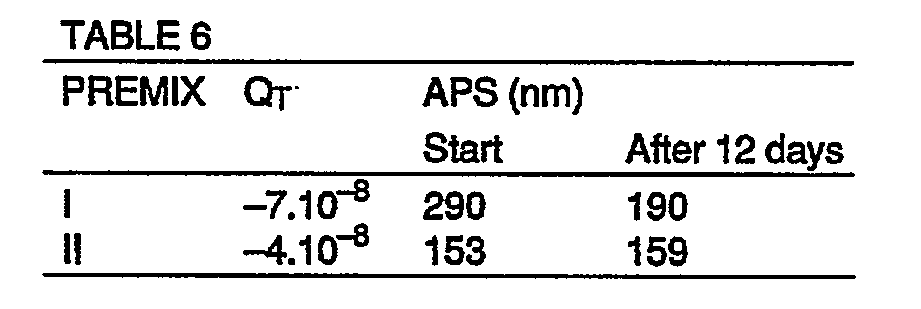
- The obtained electrophoretic toner proved to be suited for the reversal development of negatively charged areas (-300V) of a photoconductive recording material containing photoconductive zinc oxide.
- Example 15 was repeated with the difference, however, that to the pre-mix dispersion (II) different amounts of zinc mono-2-butyl-octyl phosphate as charge controlling agent (CCA) with respect to the pigment (P) were added as indicated in Table 7.
- By adding increasing amounts of charge controlling agent as shown in said Table 7 the sign of the charge polarity reverses and becomes positive. At the lower concentrations of charge controlling agent only a part of the toner particles shows a positive charge so that mobility (My) is found to be bipolar.

- The obtained positively charged electrophoretic toner proved to be suited for the positive development of negatively charged areas (-300V) of a photoconductive recording material containing photoconductive zinc oxide.
-
- Step (1) of Example 1 was repeated with the difference that a polymer A was used prepared according to
preparation 6. - Step (2) was the same as in Example I.
- Step (3) of Example 1 was repeated with the difference that a polymer B was used prepared according to
preparation 7. A solution of 3.5 g of polymer B in 500 ml of isododecane was heated to 80°C. At that temperature and while stirring vigorously the dispersion containing carbon black particles pre-coated with polymer A according to step (1) was added dropwise to the solution of polymer B and the reaction between said two polymers was allowed to proceed for 30 minutes at 80°C. In the next step the dispersion was cooled to room temperature (20°C) while being stirred. - Before and after step (4) the dispersion was diluted with isododecane in order to obtain a pre-mix (I) and a pre-mix (II) each containing 0.3 g of carbon black per liter.
- The change of the average particle size (APS) in the toner dispersions obtained from pre-mix (I) and (II) was monitored over a period of 14 days. The results with respect to Or value and the change in particle size (APS) are given in the following Table 8.

- Example 20 was repeated with the difference, however, that to the pre-mix dispersion (II) different amounts of zinc mono-2-butyl-octyl phosphate as charge controlling agent (CCA) with respect to the pigment (P) were added as indicated in Table 9. The pigment thereby obtained a positive charge.

- The obtained positively charged electrophoretic toner proved to be suited for the positive development of negatively charged areas (-300V) of a photoconductive recording material containing photoconductive zinc oxide.
-
- Step (1) of Example 20 was repeated with the difference that a polymer A was used prepared according to
preparation 8. - Step (2) was the same as in Example 20.
- Step (3) of Example 20 was repeated with the difference that a polymer B was used prepared according to
preparation 9. 5 g of polymer B in 500 ml isododecane were used. - The dispersion was diluted with isododecane in order to obtain a pre-mix containing about 0.3 g of carbon black per liter.
- The change of the average particle size (APS) in the toner pre-mix was monitored over a period of II days. At the start the APS value was 220 nm and after 11 days it was 321 nm.
-
- Step (1) of Example 20 was repeated with the difference that a polymer A was used prepared according to
preparation 10. - Step (2) was the same as in Example 20.
- Step (3) of Example 20 was repeated with the difference that a polymer B was used prepared according to
preparation 11. 10 g of polymer B in 500 ml of isododecane were used. - Before and after step (4) the dispersion was diluted with isododecane in order to obtain a pre-mix (I) and pre-mix (II) each containing 0.3 g of carbon black per liter.
- The change of the average particle size in the toner dispersions obtained from pre-mix (I) and (11) respectively was monitored over a period of 14 days. The results with respect to the change in average particle size (APS) are listed in the following Table 10.
-


Claims (13)
Priority Applications (4)
| Application Number | Priority Date | Filing Date | Title |
|---|---|---|---|
| EP85201431A EP0215978B1 (en) | 1985-09-10 | 1985-09-10 | Liquid electrophoretic developer composition |
| DE8585201431T DE3576745D1 (en) | 1985-09-10 | 1985-09-10 | LIQUID ELECTROPHORETIC DEVELOPER COMPOSITION. |
| US06/889,383 US4663265A (en) | 1985-09-10 | 1986-07-25 | Liquid electrophoretic developer composition |
| JP61195123A JPS6296954A (en) | 1985-09-10 | 1986-08-20 | Liquid electrophoretic developing agent |
Applications Claiming Priority (1)
| Application Number | Priority Date | Filing Date | Title |
|---|---|---|---|
| EP85201431A EP0215978B1 (en) | 1985-09-10 | 1985-09-10 | Liquid electrophoretic developer composition |
Publications (2)
| Publication Number | Publication Date |
|---|---|
| EP0215978A1 EP0215978A1 (en) | 1987-04-01 |
| EP0215978B1 true EP0215978B1 (en) | 1990-03-21 |
Family
ID=8194056
Family Applications (1)
| Application Number | Title | Priority Date | Filing Date |
|---|---|---|---|
| EP85201431A Expired - Lifetime EP0215978B1 (en) | 1985-09-10 | 1985-09-10 | Liquid electrophoretic developer composition |
Country Status (4)
| Country | Link |
|---|---|
| US (1) | US4663265A (en) |
| EP (1) | EP0215978B1 (en) |
| JP (1) | JPS6296954A (en) |
| DE (1) | DE3576745D1 (en) |
Families Citing this family (23)
| Publication number | Priority date | Publication date | Assignee | Title |
|---|---|---|---|---|
| US4814251A (en) * | 1987-10-29 | 1989-03-21 | Xerox Corporation | Liquid developer compositions |
| US5055370A (en) * | 1988-09-12 | 1991-10-08 | Fuji Photo Film Co., Ltd. | Image forming resin particles for liquid developer for printing plate |
| JPH087469B2 (en) * | 1988-09-12 | 1996-01-29 | 富士写真フイルム株式会社 | Liquid developer for electrostatic photography |
| US4925766A (en) * | 1988-12-02 | 1990-05-15 | Minnesota Mining And Manufacturing Company | Liquid electrophotographic toner |
| US5009980A (en) * | 1988-12-30 | 1991-04-23 | E. I. Du Pont De Nemours And Company | Aromatic nitrogen-containing compounds as adjuvants for electrostatic liquid developers |
| US5045425A (en) * | 1989-08-25 | 1991-09-03 | Commtech International Management Corporation | Electrophotographic liquid developer composition and novel charge directors for use therein |
| US5153090A (en) * | 1990-06-28 | 1992-10-06 | Commtech International Management Corporation | Charge directors for use in electrophotographic compositions and processes |
| US5035972A (en) * | 1989-10-31 | 1991-07-30 | E. I. Du Pont De Nemours And Company | AB diblock copolymers as charge directors for negative electrostatic liquid developer |
| US5130221A (en) * | 1990-03-07 | 1992-07-14 | Dximaging | Salts of acid-containing ab diblock copolymers as charge directors for positive-working electrostatic liquid developers |
| US5106717A (en) * | 1990-05-02 | 1992-04-21 | Dximaging | Ab diblock copolymers as toner particle dispersants for electrostatic liquid developers |
| US5298833A (en) * | 1992-06-22 | 1994-03-29 | Copytele, Inc. | Black electrophoretic particles for an electrophoretic image display |
| US5294891A (en) * | 1993-03-18 | 1994-03-15 | Powerprint Technologies, Inc. | Method and apparatus for determining the quality of a colloidal suspension |
| US5528133A (en) * | 1994-07-21 | 1996-06-18 | Powerpoint Technologies, Inc. | Method and apparatus for determining the quality of a colloidal suspension |
| EP0725317A1 (en) | 1995-01-30 | 1996-08-07 | Agfa-Gevaert N.V. | Polymer suspension method for producing toner particles |
| NO310360B1 (en) * | 1997-01-20 | 2001-06-25 | Polymers Holding As | Process for the preparation of self-activated polymer particles with a narrow size distribution |
| TW473653B (en) * | 1997-05-27 | 2002-01-21 | Clariant Japan Kk | Composition for anti-reflective film or photo absorption film and compound used therein |
| US6822782B2 (en) * | 2001-05-15 | 2004-11-23 | E Ink Corporation | Electrophoretic particles and processes for the production thereof |
| JP3774839B2 (en) * | 1999-09-28 | 2006-05-17 | 日立マクセル株式会社 | Dispersion composition and method for producing the same |
| EP1205815B1 (en) * | 2000-11-10 | 2009-12-23 | Samsung Electronics Co., Ltd. | Liquid inks comprising surface-treated colorant particles and manufacturing method thereof |
| US20050009952A1 (en) * | 2000-11-10 | 2005-01-13 | Samsung Electronics Co. Ltd. | Liquid inks comprising a stable organosol |
| US7230750B2 (en) * | 2001-05-15 | 2007-06-12 | E Ink Corporation | Electrophoretic media and processes for the production thereof |
| US20100148385A1 (en) * | 2001-05-15 | 2010-06-17 | E Ink Corporation | Electrophoretic media and processes for the production thereof |
| WO2011158611A1 (en) * | 2010-06-17 | 2011-12-22 | コニカミノルタホールディングス株式会社 | Liquid developer |
Family Cites Families (8)
| Publication number | Priority date | Publication date | Assignee | Title |
|---|---|---|---|---|
| US3427258A (en) * | 1965-11-12 | 1969-02-11 | Owens Illinois Inc | Electrostatic image developer powder composition |
| US3640863A (en) * | 1968-06-05 | 1972-02-08 | Ricoh Kk | A liquid electrostatic having pigment particles coated with a cyclized rubber |
| US3900412A (en) * | 1970-01-30 | 1975-08-19 | Hunt Chem Corp Philip A | Liquid toners with an amphipathic graft type polymeric molecule |
| GB1352067A (en) * | 1971-03-18 | 1974-05-15 | Hunt Chem Corp Philip A | Liquid toners |
| US3969238A (en) * | 1972-08-15 | 1976-07-13 | Canon Kabushiki Kaisha | Liquid developer for electrophotography and process for developing latent images |
| JPS5369635A (en) * | 1976-12-02 | 1978-06-21 | Ricoh Co Ltd | Liquid developing agent for use in static photography |
| US4476210A (en) * | 1983-05-27 | 1984-10-09 | Xerox Corporation | Dyed stabilized liquid developer and method for making |
| DE3373227D1 (en) * | 1983-06-10 | 1987-10-01 | Agfa Gevaert Nv | Improved liquid electrophoretic developer |
-
1985
- 1985-09-10 DE DE8585201431T patent/DE3576745D1/en not_active Expired - Fee Related
- 1985-09-10 EP EP85201431A patent/EP0215978B1/en not_active Expired - Lifetime
-
1986
- 1986-07-25 US US06/889,383 patent/US4663265A/en not_active Expired - Fee Related
- 1986-08-20 JP JP61195123A patent/JPS6296954A/en active Pending
Also Published As
| Publication number | Publication date |
|---|---|
| DE3576745D1 (en) | 1990-04-26 |
| JPS6296954A (en) | 1987-05-06 |
| US4663265A (en) | 1987-05-05 |
| EP0215978A1 (en) | 1987-04-01 |
Similar Documents
| Publication | Publication Date | Title |
|---|---|---|
| US4663265A (en) | Liquid electrophoretic developer composition | |
| US4564574A (en) | Liquid developer for development of electrostatic images | |
| EP0176629B1 (en) | Liquid developer for development of electrostatic images | |
| US4767688A (en) | Charge controlling method and developers containing a charge-exchange control agent comprising organic boron compound | |
| EP0128244B1 (en) | Improved liquid electrophoretic developer | |
| US4525446A (en) | Liquid developer for development of electrostatic images comprising onium salt polymer and an anion | |
| US5397672A (en) | Liquid developer compositions with block copolymers | |
| EP0176630B1 (en) | Liquid developer for development of electrostatic images | |
| EP0132718A1 (en) | Liquid developers for electrostatic images | |
| US4147812A (en) | Electrophoretic development | |
| US4138351A (en) | Electrophoretic liquid developer containing a metal alkyl sulphonate | |
| US4170563A (en) | Liquid electrographic developer comprising polymeric phosphonate dispersing agent | |
| US4789614A (en) | Toners and developers containing benzyldimethylalkylammonium charge-control agents | |
| US5286593A (en) | Liquid developer containing stabilized charge director composition | |
| US4161453A (en) | Electrophoretic developers | |
| EP0343923B1 (en) | Liquid developer compositions | |
| US4123374A (en) | Electrophoretic development | |
| US4171275A (en) | Liquid electrographic developer | |
| US6254929B1 (en) | Particulate surface treatment process | |
| US4631243A (en) | Electrostatographic suspension developer and a process for the production thereof | |
| US5206107A (en) | Siloxane surfactants as liquid developer additives | |
| US5232808A (en) | Electrostatographic toner and developer containing a fluorinated β-diketone metal complex charge-control agent | |
| US4223086A (en) | Electrostatic process using liquid developer comprising polymeric phosphonate dispersant | |
| GB1571401A (en) | Electrophoretic developer | |
| JP2898141B2 (en) | Liquid developer for electrostatic photography |
Legal Events
| Date | Code | Title | Description |
|---|---|---|---|
| PUAI | Public reference made under article 153(3) epc to a published international application that has entered the european phase |
Free format text: ORIGINAL CODE: 0009012 |
|
| AK | Designated contracting states |
Kind code of ref document: A1 Designated state(s): AT BE CH DE FR GB IT LI LU NL SE |
|
| RBV | Designated contracting states (corrected) |
Designated state(s): BE DE FR GB |
|
| 17P | Request for examination filed |
Effective date: 19870827 |
|
| 17Q | First examination report despatched |
Effective date: 19881123 |
|
| GRAA | (expected) grant |
Free format text: ORIGINAL CODE: 0009210 |
|
| AK | Designated contracting states |
Kind code of ref document: B1 Designated state(s): BE DE FR GB |
|
| REF | Corresponds to: |
Ref document number: 3576745 Country of ref document: DE Date of ref document: 19900426 |
|
| ET | Fr: translation filed | ||
| PLBE | No opposition filed within time limit |
Free format text: ORIGINAL CODE: 0009261 |
|
| STAA | Information on the status of an ep patent application or granted ep patent |
Free format text: STATUS: NO OPPOSITION FILED WITHIN TIME LIMIT |
|
| 26N | No opposition filed | ||
| PGFP | Annual fee paid to national office [announced via postgrant information from national office to epo] |
Ref country code: FR Payment date: 19920814 Year of fee payment: 8 |
|
| PGFP | Annual fee paid to national office [announced via postgrant information from national office to epo] |
Ref country code: GB Payment date: 19920818 Year of fee payment: 8 Ref country code: BE Payment date: 19920818 Year of fee payment: 8 |
|
| PGFP | Annual fee paid to national office [announced via postgrant information from national office to epo] |
Ref country code: DE Payment date: 19920827 Year of fee payment: 8 |
|
| PG25 | Lapsed in a contracting state [announced via postgrant information from national office to epo] |
Ref country code: GB Effective date: 19930910 |
|
| PG25 | Lapsed in a contracting state [announced via postgrant information from national office to epo] |
Ref country code: BE Effective date: 19930930 |
|
| BERE | Be: lapsed |
Owner name: AGFA-GEVAERT N.V. Effective date: 19930930 |
|
| GBPC | Gb: european patent ceased through non-payment of renewal fee |
Effective date: 19930910 |
|
| PG25 | Lapsed in a contracting state [announced via postgrant information from national office to epo] |
Ref country code: FR Free format text: LAPSE BECAUSE OF NON-PAYMENT OF DUE FEES Effective date: 19940531 |
|
| PG25 | Lapsed in a contracting state [announced via postgrant information from national office to epo] |
Ref country code: DE Effective date: 19940601 |
|
| REG | Reference to a national code |
Ref country code: FR Ref legal event code: ST |