EP0215533B1 - A method of extracting nucleic acids from cells - Google Patents
A method of extracting nucleic acids from cells Download PDFInfo
- Publication number
- EP0215533B1 EP0215533B1 EP86300075A EP86300075A EP0215533B1 EP 0215533 B1 EP0215533 B1 EP 0215533B1 EP 86300075 A EP86300075 A EP 86300075A EP 86300075 A EP86300075 A EP 86300075A EP 0215533 B1 EP0215533 B1 EP 0215533B1
- Authority
- EP
- European Patent Office
- Prior art keywords
- extraction vessel
- extraction
- phenol
- heating
- nucleic acids
- Prior art date
- Legal status (The legal status is an assumption and is not a legal conclusion. Google has not performed a legal analysis and makes no representation as to the accuracy of the status listed.)
- Expired - Lifetime
Links
- 238000000034 method Methods 0.000 title claims description 39
- 108020004707 nucleic acids Proteins 0.000 title claims description 29
- 102000039446 nucleic acids Human genes 0.000 title claims description 29
- 150000007523 nucleic acids Chemical class 0.000 title claims description 29
- 238000000605 extraction Methods 0.000 claims description 107
- HEDRZPFGACZZDS-UHFFFAOYSA-N Chloroform Chemical compound ClC(Cl)Cl HEDRZPFGACZZDS-UHFFFAOYSA-N 0.000 claims description 52
- ISWSIDIOOBJBQZ-UHFFFAOYSA-N Phenol Chemical compound OC1=CC=CC=C1 ISWSIDIOOBJBQZ-UHFFFAOYSA-N 0.000 claims description 41
- 238000000502 dialysis Methods 0.000 claims description 36
- 239000008346 aqueous phase Substances 0.000 claims description 29
- 239000003153 chemical reaction reagent Substances 0.000 claims description 29
- 238000005191 phase separation Methods 0.000 claims description 28
- 239000012530 fluid Substances 0.000 claims description 27
- 239000000839 emulsion Substances 0.000 claims description 23
- PHTQWCKDNZKARW-UHFFFAOYSA-N isoamylol Chemical compound CC(C)CCO PHTQWCKDNZKARW-UHFFFAOYSA-N 0.000 claims description 22
- 238000010438 heat treatment Methods 0.000 claims description 20
- 239000012074 organic phase Substances 0.000 claims description 17
- FAPWRFPIFSIZLT-UHFFFAOYSA-M Sodium chloride Chemical compound [Na+].[Cl-] FAPWRFPIFSIZLT-UHFFFAOYSA-M 0.000 claims description 16
- 108090000623 proteins and genes Proteins 0.000 claims description 16
- 238000005119 centrifugation Methods 0.000 claims description 15
- 239000012139 lysis buffer Substances 0.000 claims description 15
- 102000004169 proteins and genes Human genes 0.000 claims description 15
- 239000006166 lysate Substances 0.000 claims description 14
- 238000002156 mixing Methods 0.000 claims description 14
- 150000003839 salts Chemical class 0.000 claims description 13
- QKNYBSVHEMOAJP-UHFFFAOYSA-N 2-amino-2-(hydroxymethyl)propane-1,3-diol;hydron;chloride Chemical compound Cl.OCC(N)(CO)CO QKNYBSVHEMOAJP-UHFFFAOYSA-N 0.000 claims description 10
- 239000012071 phase Substances 0.000 claims description 10
- 239000002904 solvent Substances 0.000 claims description 10
- KCXVZYZYPLLWCC-UHFFFAOYSA-N EDTA Chemical compound OC(=O)CN(CC(O)=O)CCN(CC(O)=O)CC(O)=O KCXVZYZYPLLWCC-UHFFFAOYSA-N 0.000 claims description 9
- 108010067770 Endopeptidase K Proteins 0.000 claims description 9
- XSQUKJJJFZCRTK-UHFFFAOYSA-N Urea Chemical compound NC(N)=O XSQUKJJJFZCRTK-UHFFFAOYSA-N 0.000 claims description 9
- 239000004202 carbamide Substances 0.000 claims description 9
- 239000003599 detergent Substances 0.000 claims description 9
- 238000000926 separation method Methods 0.000 claims description 9
- 239000000203 mixture Substances 0.000 claims description 8
- 239000011780 sodium chloride Substances 0.000 claims description 8
- 239000000872 buffer Substances 0.000 claims description 7
- 238000012544 monitoring process Methods 0.000 claims description 7
- 230000008859 change Effects 0.000 claims description 4
- 239000002738 chelating agent Substances 0.000 claims description 4
- 230000003196 chaotropic effect Effects 0.000 claims description 2
- 239000003795 chemical substances by application Substances 0.000 claims description 2
- 238000001914 filtration Methods 0.000 claims description 2
- 230000003134 recirculating effect Effects 0.000 claims description 2
- 230000001737 promoting effect Effects 0.000 claims 1
- 108020004414 DNA Proteins 0.000 description 45
- 210000004027 cell Anatomy 0.000 description 18
- 239000007789 gas Substances 0.000 description 14
- 239000000243 solution Substances 0.000 description 13
- 239000011521 glass Substances 0.000 description 9
- 238000002955 isolation Methods 0.000 description 9
- 230000008569 process Effects 0.000 description 8
- 238000000746 purification Methods 0.000 description 8
- DBMJMQXJHONAFJ-UHFFFAOYSA-M Sodium laurylsulphate Chemical compound [Na+].CCCCCCCCCCCCOS([O-])(=O)=O DBMJMQXJHONAFJ-UHFFFAOYSA-M 0.000 description 7
- 238000002835 absorbance Methods 0.000 description 6
- 230000001276 controlling effect Effects 0.000 description 6
- 108091032973 (ribonucleotides)n+m Proteins 0.000 description 5
- 238000006243 chemical reaction Methods 0.000 description 5
- 239000007788 liquid Substances 0.000 description 5
- 210000004698 lymphocyte Anatomy 0.000 description 5
- 241001515965 unidentified phage Species 0.000 description 5
- 239000002699 waste material Substances 0.000 description 5
- LFQSCWFLJHTTHZ-UHFFFAOYSA-N Ethanol Chemical compound CCO LFQSCWFLJHTTHZ-UHFFFAOYSA-N 0.000 description 4
- 239000013611 chromosomal DNA Substances 0.000 description 4
- 230000029087 digestion Effects 0.000 description 4
- 239000000725 suspension Substances 0.000 description 4
- 241000894006 Bacteria Species 0.000 description 3
- 229920005372 Plexiglas® Polymers 0.000 description 3
- 102000006382 Ribonucleases Human genes 0.000 description 3
- 108010083644 Ribonucleases Proteins 0.000 description 3
- 238000013459 approach Methods 0.000 description 3
- 230000006037 cell lysis Effects 0.000 description 3
- 230000001413 cellular effect Effects 0.000 description 3
- 239000012141 concentrate Substances 0.000 description 3
- 239000012535 impurity Substances 0.000 description 3
- 239000010410 layer Substances 0.000 description 3
- 239000000463 material Substances 0.000 description 3
- 239000003960 organic solvent Substances 0.000 description 3
- 239000013612 plasmid Substances 0.000 description 3
- 239000004926 polymethyl methacrylate Substances 0.000 description 3
- 238000002360 preparation method Methods 0.000 description 3
- 238000012360 testing method Methods 0.000 description 3
- IJGRMHOSHXDMSA-UHFFFAOYSA-N Atomic nitrogen Chemical compound N#N IJGRMHOSHXDMSA-UHFFFAOYSA-N 0.000 description 2
- 108010053770 Deoxyribonucleases Proteins 0.000 description 2
- 102000016911 Deoxyribonucleases Human genes 0.000 description 2
- 102000004190 Enzymes Human genes 0.000 description 2
- 108090000790 Enzymes Proteins 0.000 description 2
- -1 KCl Chemical class 0.000 description 2
- TWRXJAOTZQYOKJ-UHFFFAOYSA-L Magnesium chloride Chemical compound [Mg+2].[Cl-].[Cl-] TWRXJAOTZQYOKJ-UHFFFAOYSA-L 0.000 description 2
- 102000016943 Muramidase Human genes 0.000 description 2
- 108010014251 Muramidase Proteins 0.000 description 2
- 108010062010 N-Acetylmuramoyl-L-alanine Amidase Proteins 0.000 description 2
- 108091005804 Peptidases Proteins 0.000 description 2
- 239000004365 Protease Substances 0.000 description 2
- 102100037486 Reverse transcriptase/ribonuclease H Human genes 0.000 description 2
- 239000004809 Teflon Substances 0.000 description 2
- 229920006362 Teflon® Polymers 0.000 description 2
- 230000001580 bacterial effect Effects 0.000 description 2
- 239000003855 balanced salt solution Substances 0.000 description 2
- 210000002421 cell wall Anatomy 0.000 description 2
- 239000000470 constituent Substances 0.000 description 2
- 230000008878 coupling Effects 0.000 description 2
- 238000010168 coupling process Methods 0.000 description 2
- 238000005859 coupling reaction Methods 0.000 description 2
- 230000009089 cytolysis Effects 0.000 description 2
- 238000013461 design Methods 0.000 description 2
- 230000000694 effects Effects 0.000 description 2
- 230000002708 enhancing effect Effects 0.000 description 2
- 229940088598 enzyme Drugs 0.000 description 2
- 210000003527 eukaryotic cell Anatomy 0.000 description 2
- 230000002068 genetic effect Effects 0.000 description 2
- 238000000338 in vitro Methods 0.000 description 2
- 238000001727 in vivo Methods 0.000 description 2
- 210000004185 liver Anatomy 0.000 description 2
- 210000004962 mammalian cell Anatomy 0.000 description 2
- 238000012986 modification Methods 0.000 description 2
- 230000004048 modification Effects 0.000 description 2
- 239000011368 organic material Substances 0.000 description 2
- 230000010355 oscillation Effects 0.000 description 2
- 239000002245 particle Substances 0.000 description 2
- 230000002572 peristaltic effect Effects 0.000 description 2
- 239000002244 precipitate Substances 0.000 description 2
- 235000019419 proteases Nutrition 0.000 description 2
- 239000000523 sample Substances 0.000 description 2
- 229920006395 saturated elastomer Polymers 0.000 description 2
- 238000012546 transfer Methods 0.000 description 2
- NWUYHJFMYQTDRP-UHFFFAOYSA-N 1,2-bis(ethenyl)benzene;1-ethenyl-2-ethylbenzene;styrene Chemical compound C=CC1=CC=CC=C1.CCC1=CC=CC=C1C=C.C=CC1=CC=CC=C1C=C NWUYHJFMYQTDRP-UHFFFAOYSA-N 0.000 description 1
- 239000005725 8-Hydroxyquinoline Substances 0.000 description 1
- RZVAJINKPMORJF-UHFFFAOYSA-N Acetaminophen Chemical compound CC(=O)NC1=CC=C(O)C=C1 RZVAJINKPMORJF-UHFFFAOYSA-N 0.000 description 1
- 108020000946 Bacterial DNA Proteins 0.000 description 1
- UXVMQQNJUSDDNG-UHFFFAOYSA-L Calcium chloride Chemical compound [Cl-].[Cl-].[Ca+2] UXVMQQNJUSDDNG-UHFFFAOYSA-L 0.000 description 1
- 102000012410 DNA Ligases Human genes 0.000 description 1
- 108010061982 DNA Ligases Proteins 0.000 description 1
- 238000007400 DNA extraction Methods 0.000 description 1
- 230000004543 DNA replication Effects 0.000 description 1
- 102000016928 DNA-directed DNA polymerase Human genes 0.000 description 1
- 108010014303 DNA-directed DNA polymerase Proteins 0.000 description 1
- 102000004163 DNA-directed RNA polymerases Human genes 0.000 description 1
- 108090000626 DNA-directed RNA polymerases Proteins 0.000 description 1
- 108010054576 Deoxyribonuclease EcoRI Proteins 0.000 description 1
- WQZGKKKJIJFFOK-GASJEMHNSA-N Glucose Natural products OC[C@H]1OC(O)[C@H](O)[C@@H](O)[C@@H]1O WQZGKKKJIJFFOK-GASJEMHNSA-N 0.000 description 1
- VEXZGXHMUGYJMC-UHFFFAOYSA-N Hydrochloric acid Chemical compound Cl VEXZGXHMUGYJMC-UHFFFAOYSA-N 0.000 description 1
- 208000026350 Inborn Genetic disease Diseases 0.000 description 1
- 102000011931 Nucleoproteins Human genes 0.000 description 1
- 108010061100 Nucleoproteins Proteins 0.000 description 1
- 108091034117 Oligonucleotide Proteins 0.000 description 1
- 102000015636 Oligopeptides Human genes 0.000 description 1
- 108010038807 Oligopeptides Proteins 0.000 description 1
- 108020002230 Pancreatic Ribonuclease Proteins 0.000 description 1
- 102000005891 Pancreatic ribonuclease Human genes 0.000 description 1
- 239000004698 Polyethylene Substances 0.000 description 1
- 240000004808 Saccharomyces cerevisiae Species 0.000 description 1
- 229920006328 Styrofoam Polymers 0.000 description 1
- JLCPHMBAVCMARE-UHFFFAOYSA-N [3-[[3-[[3-[[3-[[3-[[3-[[3-[[3-[[3-[[3-[[3-[[5-(2-amino-6-oxo-1H-purin-9-yl)-3-[[3-[[3-[[3-[[3-[[3-[[5-(2-amino-6-oxo-1H-purin-9-yl)-3-[[5-(2-amino-6-oxo-1H-purin-9-yl)-3-hydroxyoxolan-2-yl]methoxy-hydroxyphosphoryl]oxyoxolan-2-yl]methoxy-hydroxyphosphoryl]oxy-5-(5-methyl-2,4-dioxopyrimidin-1-yl)oxolan-2-yl]methoxy-hydroxyphosphoryl]oxy-5-(6-aminopurin-9-yl)oxolan-2-yl]methoxy-hydroxyphosphoryl]oxy-5-(6-aminopurin-9-yl)oxolan-2-yl]methoxy-hydroxyphosphoryl]oxy-5-(6-aminopurin-9-yl)oxolan-2-yl]methoxy-hydroxyphosphoryl]oxy-5-(6-aminopurin-9-yl)oxolan-2-yl]methoxy-hydroxyphosphoryl]oxyoxolan-2-yl]methoxy-hydroxyphosphoryl]oxy-5-(5-methyl-2,4-dioxopyrimidin-1-yl)oxolan-2-yl]methoxy-hydroxyphosphoryl]oxy-5-(4-amino-2-oxopyrimidin-1-yl)oxolan-2-yl]methoxy-hydroxyphosphoryl]oxy-5-(5-methyl-2,4-dioxopyrimidin-1-yl)oxolan-2-yl]methoxy-hydroxyphosphoryl]oxy-5-(5-methyl-2,4-dioxopyrimidin-1-yl)oxolan-2-yl]methoxy-hydroxyphosphoryl]oxy-5-(6-aminopurin-9-yl)oxolan-2-yl]methoxy-hydroxyphosphoryl]oxy-5-(6-aminopurin-9-yl)oxolan-2-yl]methoxy-hydroxyphosphoryl]oxy-5-(4-amino-2-oxopyrimidin-1-yl)oxolan-2-yl]methoxy-hydroxyphosphoryl]oxy-5-(4-amino-2-oxopyrimidin-1-yl)oxolan-2-yl]methoxy-hydroxyphosphoryl]oxy-5-(4-amino-2-oxopyrimidin-1-yl)oxolan-2-yl]methoxy-hydroxyphosphoryl]oxy-5-(6-aminopurin-9-yl)oxolan-2-yl]methoxy-hydroxyphosphoryl]oxy-5-(4-amino-2-oxopyrimidin-1-yl)oxolan-2-yl]methyl [5-(6-aminopurin-9-yl)-2-(hydroxymethyl)oxolan-3-yl] hydrogen phosphate Polymers Cc1cn(C2CC(OP(O)(=O)OCC3OC(CC3OP(O)(=O)OCC3OC(CC3O)n3cnc4c3nc(N)[nH]c4=O)n3cnc4c3nc(N)[nH]c4=O)C(COP(O)(=O)OC3CC(OC3COP(O)(=O)OC3CC(OC3COP(O)(=O)OC3CC(OC3COP(O)(=O)OC3CC(OC3COP(O)(=O)OC3CC(OC3COP(O)(=O)OC3CC(OC3COP(O)(=O)OC3CC(OC3COP(O)(=O)OC3CC(OC3COP(O)(=O)OC3CC(OC3COP(O)(=O)OC3CC(OC3COP(O)(=O)OC3CC(OC3COP(O)(=O)OC3CC(OC3COP(O)(=O)OC3CC(OC3COP(O)(=O)OC3CC(OC3COP(O)(=O)OC3CC(OC3COP(O)(=O)OC3CC(OC3COP(O)(=O)OC3CC(OC3CO)n3cnc4c(N)ncnc34)n3ccc(N)nc3=O)n3cnc4c(N)ncnc34)n3ccc(N)nc3=O)n3ccc(N)nc3=O)n3ccc(N)nc3=O)n3cnc4c(N)ncnc34)n3cnc4c(N)ncnc34)n3cc(C)c(=O)[nH]c3=O)n3cc(C)c(=O)[nH]c3=O)n3ccc(N)nc3=O)n3cc(C)c(=O)[nH]c3=O)n3cnc4c3nc(N)[nH]c4=O)n3cnc4c(N)ncnc34)n3cnc4c(N)ncnc34)n3cnc4c(N)ncnc34)n3cnc4c(N)ncnc34)O2)c(=O)[nH]c1=O JLCPHMBAVCMARE-UHFFFAOYSA-N 0.000 description 1
- 239000002253 acid Substances 0.000 description 1
- 239000011543 agarose gel Substances 0.000 description 1
- 150000001413 amino acids Chemical class 0.000 description 1
- 210000001776 amniocyte Anatomy 0.000 description 1
- 238000004458 analytical method Methods 0.000 description 1
- 239000002518 antifoaming agent Substances 0.000 description 1
- 239000007864 aqueous solution Substances 0.000 description 1
- 239000012298 atmosphere Substances 0.000 description 1
- 230000004888 barrier function Effects 0.000 description 1
- 210000004369 blood Anatomy 0.000 description 1
- 239000008280 blood Substances 0.000 description 1
- 238000009835 boiling Methods 0.000 description 1
- 239000007975 buffered saline Substances 0.000 description 1
- AIYUHDOJVYHVIT-UHFFFAOYSA-M caesium chloride Chemical compound [Cl-].[Cs+] AIYUHDOJVYHVIT-UHFFFAOYSA-M 0.000 description 1
- 239000001110 calcium chloride Substances 0.000 description 1
- 229910001628 calcium chloride Inorganic materials 0.000 description 1
- 235000011148 calcium chloride Nutrition 0.000 description 1
- 150000001720 carbohydrates Chemical class 0.000 description 1
- 235000014633 carbohydrates Nutrition 0.000 description 1
- 210000000170 cell membrane Anatomy 0.000 description 1
- 108091092356 cellular DNA Proteins 0.000 description 1
- 238000001311 chemical methods and process Methods 0.000 description 1
- YTRQFSDWAXHJCC-UHFFFAOYSA-N chloroform;phenol Chemical group ClC(Cl)Cl.OC1=CC=CC=C1 YTRQFSDWAXHJCC-UHFFFAOYSA-N 0.000 description 1
- 230000002759 chromosomal effect Effects 0.000 description 1
- 238000010276 construction Methods 0.000 description 1
- 239000000356 contaminant Substances 0.000 description 1
- 238000001816 cooling Methods 0.000 description 1
- 230000007423 decrease Effects 0.000 description 1
- 238000004925 denaturation Methods 0.000 description 1
- 230000036425 denaturation Effects 0.000 description 1
- 239000012154 double-distilled water Substances 0.000 description 1
- 230000009977 dual effect Effects 0.000 description 1
- 238000005516 engineering process Methods 0.000 description 1
- ZMMJGEGLRURXTF-UHFFFAOYSA-N ethidium bromide Chemical compound [Br-].C12=CC(N)=CC=C2C2=CC=C(N)C=C2[N+](CC)=C1C1=CC=CC=C1 ZMMJGEGLRURXTF-UHFFFAOYSA-N 0.000 description 1
- 229960005542 ethidium bromide Drugs 0.000 description 1
- 239000002657 fibrous material Substances 0.000 description 1
- NBVXSUQYWXRMNV-UHFFFAOYSA-N fluoromethane Chemical compound FC NBVXSUQYWXRMNV-UHFFFAOYSA-N 0.000 description 1
- 238000005187 foaming Methods 0.000 description 1
- 230000006870 function Effects 0.000 description 1
- 230000014509 gene expression Effects 0.000 description 1
- 102000034356 gene-regulatory proteins Human genes 0.000 description 1
- 108091006104 gene-regulatory proteins Proteins 0.000 description 1
- 208000016361 genetic disease Diseases 0.000 description 1
- 239000008103 glucose Substances 0.000 description 1
- 239000005337 ground glass Substances 0.000 description 1
- 238000012872 hydroxylapatite chromatography Methods 0.000 description 1
- 239000011261 inert gas Substances 0.000 description 1
- 230000000977 initiatory effect Effects 0.000 description 1
- 229910010272 inorganic material Inorganic materials 0.000 description 1
- 239000011147 inorganic material Substances 0.000 description 1
- 239000011810 insulating material Substances 0.000 description 1
- 239000003456 ion exchange resin Substances 0.000 description 1
- 229920003303 ion-exchange polymer Polymers 0.000 description 1
- 150000002632 lipids Chemical class 0.000 description 1
- 229960000274 lysozyme Drugs 0.000 description 1
- 239000004325 lysozyme Substances 0.000 description 1
- 235000010335 lysozyme Nutrition 0.000 description 1
- 229920002521 macromolecule Polymers 0.000 description 1
- 229910001629 magnesium chloride Inorganic materials 0.000 description 1
- 238000012423 maintenance Methods 0.000 description 1
- 238000004519 manufacturing process Methods 0.000 description 1
- 239000012528 membrane Substances 0.000 description 1
- 108020004999 messenger RNA Proteins 0.000 description 1
- 229910052751 metal Inorganic materials 0.000 description 1
- 239000002184 metal Substances 0.000 description 1
- 229910052757 nitrogen Inorganic materials 0.000 description 1
- 239000002777 nucleoside Substances 0.000 description 1
- 125000003835 nucleoside group Chemical group 0.000 description 1
- 239000002773 nucleotide Substances 0.000 description 1
- 125000003729 nucleotide group Chemical group 0.000 description 1
- 239000012044 organic layer Substances 0.000 description 1
- 229960003540 oxyquinoline Drugs 0.000 description 1
- 210000005105 peripheral blood lymphocyte Anatomy 0.000 description 1
- 230000005501 phase interface Effects 0.000 description 1
- 229920000573 polyethylene Polymers 0.000 description 1
- 238000001556 precipitation Methods 0.000 description 1
- 230000017854 proteolysis Effects 0.000 description 1
- 238000005086 pumping Methods 0.000 description 1
- 239000012521 purified sample Substances 0.000 description 1
- 239000005297 pyrex Substances 0.000 description 1
- MCJGNVYPOGVAJF-UHFFFAOYSA-N quinolin-8-ol Chemical compound C1=CN=C2C(O)=CC=CC2=C1 MCJGNVYPOGVAJF-UHFFFAOYSA-N 0.000 description 1
- 238000010188 recombinant method Methods 0.000 description 1
- 238000005215 recombination Methods 0.000 description 1
- 230000006798 recombination Effects 0.000 description 1
- 230000008439 repair process Effects 0.000 description 1
- 238000007789 sealing Methods 0.000 description 1
- 238000010008 shearing Methods 0.000 description 1
- 238000010186 staining Methods 0.000 description 1
- 239000008261 styrofoam Substances 0.000 description 1
- 238000010257 thawing Methods 0.000 description 1
- GPRLSGONYQIRFK-MNYXATJNSA-N triton Chemical compound [3H+] GPRLSGONYQIRFK-MNYXATJNSA-N 0.000 description 1
- 238000009423 ventilation Methods 0.000 description 1
Images


Classifications
-
- C—CHEMISTRY; METALLURGY
- C12—BIOCHEMISTRY; BEER; SPIRITS; WINE; VINEGAR; MICROBIOLOGY; ENZYMOLOGY; MUTATION OR GENETIC ENGINEERING
- C12N—MICROORGANISMS OR ENZYMES; COMPOSITIONS THEREOF; PROPAGATING, PRESERVING, OR MAINTAINING MICROORGANISMS; MUTATION OR GENETIC ENGINEERING; CULTURE MEDIA
- C12N15/00—Mutation or genetic engineering; DNA or RNA concerning genetic engineering, vectors, e.g. plasmids, or their isolation, preparation or purification; Use of hosts therefor
- C12N15/09—Recombinant DNA-technology
- C12N15/10—Processes for the isolation, preparation or purification of DNA or RNA
- C12N15/1003—Extracting or separating nucleic acids from biological samples, e.g. pure separation or isolation methods; Conditions, buffers or apparatuses therefor
Definitions
- This invention relates to the isolation and purification of nucleic acids from cells, and particularly to apparatus for automatically achieving such isolation.
- One of the first steps in the in vitro manipulation of nucleic acids involves their isolation, for example relatively pure samples of genomic DNA are required in order to perform tests for genetic disease and recombinant technology requires isolation of both the vector DNA and the DNA to be cloned.
- DNA does not exist as a free molecule in a cell, but instead exists as a complex association of DNA, RNA and proteins. This is a consequence of the role of DNA as the genetic blueprint of the cell.
- the DNA is used as a template for the production of messenger RNA, which is translated by the ribosome into protein. Proteins directly involved in the process of gene expression, such as RNA polymerase and regulatory proteins, interact with DNA in vivo to form nucleo-protein complexes.
- DNA polymerase DNA polymerase
- DNA ligase various unwinding and supercoiling enzymes, recombination and repair enzymes, and those proteins involved in the initiation or maintenance of DNA replication are also associated with DNA in vivo and hence complicate the isolation of pure DNA.
- the purification (isolation) approach for obtaining DNA can generally be thought of as a three step process: (1) releasing soluble, high molecular weight DNA from disrupted cell wall and membranes; (2) dissociating DNA-protein complexes by protein denaturation or proteolysis; and (3) separating DNA from the other macromolecules.
- DNA of bacterial origin is typically purified by different methods, depending on whether the DNA is chromosomal or extrachromosomal, such as plasmids or bacteriophage.
- the bacterial cell wall is generally weakened by freeze-thawing or by treatment with the enzyme lysozyme and the chelating agent ethylenediaminetetraacetic acid (EDTA).
- EDTA ethylenediaminetetraacetic acid
- Cell lysis is accomplished by the addition of a detergent such as sodium dodecyl sulfate (SDS) in a buffered saline solution.
- SDS sodium dodecyl sulfate
- the solution is treated with pancreatic ribonuclease to hydrolyze RNA and protease to degrade proteins.
- Residual proteins and oligopeptides are extracted with an organic solvent, such as phenol or an equal mixture of phenol and chloroform.
- organic solvent such as phenol or an equal mixture of phenol and chloroform.
- Most of the protein will denature and enter the organic phase or precipitate at the interface of the organic and aqueous phases, this phase separation being accomplished by means of centrifugation.
- the clear, viscous aqueous phase containing the DNA is then removed. With the addition of alcohol, the DNA precipitates out of the aqueous phase as a white fibrous material and can be spooled onto a glass rod.
- Precipitation from alcohol serves to concentrate the high molecular weight DNA while removing the small oligonucleotides of DNA and RNA, detergent, and the organic solvent used in the removal of proteins. Residual detergent and salts can be removed by dialysis of the resuspended DNA solution against the desired buffer. In some instances, it may be desirable to further purify the DNA by centrifugation on isopycnic cesium chloride gradients, or by hydroxylapatite chromatography. In the above process for chromosomal DNA, typical protocols often require at least two days for the DNA extraction and purification process. (See Recombinant Techniques by Raymond L. Rodrigues, and Robert C. Tact, 1983, p. 162).
- bacteriophage During the purification of extrachromosomal elements of prokaryotic DNA, including plasmids and bacteriophage, it is desirable to minimize the amount of chromosomal DNA contaminating the preparation. With bacteriophage, this is often accomplished by first purifying the phage particles from the infected bacteria, then treating the purified phage particles with protease and/or phenol to release the bacteriophage DNA. Further purification of the DNA is accomplished by means similar to those described for chromosomal DNA. Due to its size, however, precipitated bacteriophage and plasmid DNA cannot be spooled out on a glass rod and is therefore generally recovered by centrifugation. Again, three days is not atypical for the entire isolation and purification process.
- the proteinase K is then removed by extraction of the lysate with phenol or a phenol/chloroform mixture.
- the lysate/phenol or lysate/phenol-chloroform forms an emulsion, the aqueous and organic phases of which are separated by centrifugation.
- the upper, or aqueous phase containing the DNA is then poured off or removed using a pipette, and this essentially protein-free lysate is dialyzed to remove small molecular weight cellular contaminants and residual phenol.
- the present invention provides a method of extracting nucleic acid from cells which includes the steps of
- the present invention provides an apparatus for extracting nucleic acids from cells, the apparatus comprising: extraction vessel means for holding said cells; delivery means for delivering reagents to said extraction vessel means, and for removing fluids from said extraction vessel means; heater means for heating said extraction vessel means; temperature measuring means for measuring the temperature of said extraction vessel means; motor means for oscillating said extraction vessel means to mix said cells and said reagents; computer means for controlling said heater means, said motor means and said delivery means, for controlling volume of flow of said reagents into said extraction vessel means, for monitoring the temperature measured by said temperature measuring means, for monitoring flow of fluids from said extraction vessel means, for timing the heating of said extraction vessels by said heating means, and for timing the mixing by said motor means, said computer means operating according to a preselected instruction set to cause extraction of said nucleic acids from said cells without centrifugation.
- an automated apparatus which implements a new method of extracting and purifying nucleic acids from cells without the use of centrifugation.
- a lysate is created by treating the cells with proteinase K in the presence of a lysis buffer having a high concentration of a salt.
- the lysate is mixed with a phenol-based solvent system, thereby creating an emulsion.
- the emulsion is heated to a temperature of at least 45°C to promote phase separation. For optimum results, a temperature of about 55°C is preferred.
- the rate of phase separation is also enhanced by increasing the surface surface area of the emulsion.
- the lower organic phase is removed and the upper aqueous phase is repeatedly extracted with the phenol-based solvent a preselected number of times, and is finally extracted using chloroform.
- the remaining aqueous phase is then dialyzed to further purify and concentrate the nucleic acid solution.
- the apparatus for implementing this method includes at least one extraction vessel for holding the sample cells and a delivery system for delivering reagents to the extraction vessel and for removing fluids from the extraction vessel.
- a heating system is provided for maintaining the desired temperature of the extraction vessel during the phase separation process, and a motor is used for gently oscillating the extraction vessel to obtain mixing of the fluids contained therein.
- the motor also rotates the extraction vessel about a horizontal axis to achieve an increase in surface area of the emulsion resulting from treatment of the lysate with the phenol-based solvent system.
- the combination of the high salt concentration together with heating and increasing the surface area of the emulsion results in phase separation in 2 to 8 minutes, and thus totally eliminates the need for centrifugation.
- a computer system is used for controlling the heating system, the motor, and the delivery system, for timing the flow of the reagents into the reaction vessel to control volume, for monitoring the temperature in the reaction vessel, and for monitoring the flow of the organic phase out of the extraction vessel.
- the computer also serves as the master timer, timing the mixing by the motor and the wait time during phase separation, and operates according to a preselected instruction set based on the above method.
- a pressurized dialysis system is also included in the apparatus and is coupled to the extraction vessel by the delivery system.
- the dialysis system includes a pump for recirculating dialysate from a bath vessel through a spectrophotometer and a filter system back into the bath vessel in order to reuse the dialysate and to avoid excessive replenishment.
- Fig. 1 shows a schematic representation of a fluid delivery system according to the invention.
- Figs. 2A and 2B show two views of a chamber/rocker system according to the invention.
- Fig. 3 shows a pressurized dialysis system according to the invention.
- Fig. 4 shows a schematic representation of a computer system according to the invention.
- Fig. 5 illustrates a preferred design for an extraction vessel and its attachment in the apparatus.
- Fig. 6 illustrates the details of a suspension system for dialysis bags in the dialysis system.
- an “emulsion” is a mixture of two immiscible liquids which are kept in suspension, one within the other.
- an emulsion is formed, the constituent fluids of which are an aqueous phase containing the nucleic acids, and an organic phase containing the phenol, denatured proteins, and lipids.
- the aqueous phase also typically contains impurities which in many situations must be removed before further in vitro manipulations can be performed. These impurities include trace amounts of the phenol-based solvent system, many small molecular weight cellular constituents such as carbohydrates, amino acids, and smaller nucleic acids such as nucleosides and nucleotides (usually referred to as the cell sap).
- Dialysis is a separation process that depends on the differential transport of solutes of different sizes across a porous barrier separating two liquids where the driving force is a concentration gradient only. In the extraction of nucleic acids, dialysis is often used to remove the impurities in the aqueous phase of the emulsion.
- Restriction is the selective cleaving or endonucleitic cleaving of DNA at unique base sequence sites. Generally, restrictability is considered a strigent test for DNA purity.
- the approach of the invention relies on automation of a new method to achieve separation of the organic (phenol) and aqueous (DNA and/or RNA) phases during a nucleic acid extraction without the use of centrifugation.
- the protocol used is adapted to extraction of nucleic acids from mammalian cells and particularly to high molecular weight DNA (about 108 daltons) from tissues such as peripheral blood lymphocytes, liver, and amniocytes, although it can also be used for other eukaryotic cells if the tissue is properly prepared before the extraction is performed.
- the protocol is as follows:
- an apparatus for isolating and purifying nucleic acids from cells is illustrated in Figs. 1, 2A and 2B, 3, and 4, which show respectively, a fluid delivery system 100 for routing the various reagents and gases throughout the system; a chamber/rocker system 200 for controlling the environment and the physical orientation of extraction vessels during the extraction process; a dialysis system 300; and a computer system 400 for effecting automatic control.
- the fluid delivery system 100 illustrated in Fig. 1 includes a series of reagent vessels, 1 through 9, and a series of pairs of electrically operated gas valves 21 through 38, with one pair valves for each reagent vessel.
- Each gas valve of the series 21 through 38 is connected either to a pressure manifold 40 or to a vent manifold 41, and to a particular reagent vessel in the series 1 through 9, in order to control the pressure in that reagent vessel.
- Such reagent vessels are typically constructed of glass or polyethylene, depending on the reagent contained therein.
- the reagents include the enzyme proteinase K; the lysis buffer made up of 8M urea, 1M NaCl, 1% SDS, 50mM Tris-HCl, and 10mM EDTA, pH 8.0; the mixture of phenol/chloroform/isoamyl alcohol (50:48:2); chloroform; and RNase and/or DNase.
- other reagents which might be used would include for example, lysozyme, SDS, ethanol, Tris-HCl, EDTA, various saline solutions, and other buffers.
- Each of the reagent vessels is coupled to an electrically operated valve block 50, which is an assembly of zero dead volume valves similar to those described in U.S. Patent 4,008,736, issued February 22, 1977, entitled VALVE ARRANGEMENT FOR DISTRIBUTING FLUIDS, by Wittman-Liebold, et al., as are all other valve blocks in the system.
- An example of such an electrically operated valve block is manufactured by Applied Biosystems, Inc., part number 600656.
- Another example is described in copending application "Improved Apparatus and Method for the Sequential Performance of Chemical Processes," filed November 10, 1982, Serial Number 440,571,k by L. E. Hood, et al., assigned to the same assignee.
- Fluid flow from the various reagent vessels is controlled by opening the appropriate gas valve and closing the appropriate vent valve to increase the pressure in the desired reagent vessel and opening the appropriate valve in valve block 50.
- a valve block 51 which is coupled to valve block 50 then directs the flow to a particular extraction vessel, one of vessels 11 through 15. Flow into these extraction vessels is controlled via a series of pairs of electrically operated gas valves 61 through 70, each of which is coupled to either a gas manifold 72 or to a vent manifold 74.
- valve block 51 directs the flow through a conductivity detector 55 to another valve block 52 and to waste.
- a large increase in conductivity is seen when the organic phase has been educted, since the aqueous phase has a high conductivity due to its high salt content. This provides the signal necessary to the computer system to indicate that the phase interface has been detected and to stop any further removal of fluid from the extraction vessel.
- valve block 52 is closed and either the appropriate dialysis ports of valve block 51, i.e., one or more of ports 82 through 86, are opened to educt the aqueous phase to the dialysis system 300 or the dialysis ports are closed forcing the fluid of the aqueous phase remaining in the fluid delivery lines back into the appropriate reaction vessel in preparation for another phenol/chloroform/isoamyl alcohol extraction.
- a gas valve 39 is used to force a buffer such as Tris-HCl from an extraction vessel 10 into block valve 52 for backflushing.
- Tubing such as tube 16 in the above apparatus for connecting the various vessels and valves is typically constructed of TeflonTM.
- Each tube for transferring liquids in the system has a roughly calibrated flow resistance and operates at a fixed known pressure during transfers due to the pressure manifolds. Hence, the length of time required for a transfer corresponds directly to the volume of material transferred and is controlled by the computer system. Gas flows throughout the system are also controlled by the computer system, the gas valves 21 through 39 and 61 through 70 typically being solenoid operated.
- An example of such valves includes fluorocarbon valves made by Angar, Inc.
- An example of an appropriate conductivity detector 55 is a Wescon Instruments Model 219-200 conductivity flow cell coupled to a Model 212-100 conductivity meter.
- chamber/rocker system 200 Shown in Figs. 2A and 2B is the chamber/rocker system 200 which includes a motor 201, a rocker arm 203, and an insulated chamber 205 containing band heaters 221 through 225 (one for each extraction vessel), and corresponding thermisters 231 through 235, and the extraction vessels 11 through 15.
- chamber 205 is a rectangular parallelopiped, generally constructed of plexiglas for ease of construction and because it is transparent, the parallelopiped having a length L1 of about 20", a height H1 of about 14", and a width W1 of about 12", and having an insulating layer 211 located on the top of the parallelopiped to assist in temperature control.
- one or more fans are generally used to maintain ventilation through chamber 205 for cooling the extraction vessels.
- a typical material for layer 211 is styrofoam about 1/2" thick.
- the above dimensions for chamber 205 can vary considerably depending on the desired number and size of extraction vessels, and on the amount of space desired within the chamber to facilitate manipulations of the extraction vessels.
- Rocker arm 203 is typically a flat sheet of insulating material such plexiglas about 1/4" to 1/2" thick, about 16" long, and about 4" wide. Attached firmly to the rocker arm 203, generally along the length of the rocker arm, is a rocker arm shaft 213, typically metal, which is essentially an extended drive shaft for motor 201.
- the motor 201 is advanced to a position corresponding to full horizontal for the extraction vessels and held for several minutes, and is then returned to normal position (i.e., upright for the extraction vessels), generally over a period of about 10 seconds to ensure that phase separation is maintained.
- An example of such a motor 201 is an AIRPAX Model K82821-P2 geared down from 0.6 in pitch diameter to 3.6.
- Fig. 5 illustrates a preferred design for the extraction vessels 11 through 15.
- Each vessel is constructed of glass and has a total length L2 of about 150mm, a maximum outside cross-sectional diameter D1 of about 28mm, and tapers to a point P to facilitate the removal of fluids.
- the vessel is graduated and below a screw top 212 has a volume of about 40ml.
- An example of such a vessel is a pyrex conical screw cap centrifuge graduated tube available as Corning stock number 8082.
- the fittings used to hold the vessels in place in the rocker arm 203 are typically constructed of three pieces: a threaded cap 217; a flanged coupling 215 having a inner threaded opening to accept screw top 212, and an outer threaded area to accept cap 217; and a teflon insert 219 which is press fit into flanged coupling 215 and serves as an inert stopper for the extraction vessel.
- Insert 219 generally has three holes therethrough to accomodate the required liquids and gases. For example, for extracton vessel 11, there is educting tube 17, a pressure tube 18 which is coupled to gas manifold 72, and a vent tube 19 coupled to vent manifold 74.
- a key feature of this tube is the large change in surface area of the fluid it contains which occurs when the tube is reoriented from the vertical position to a horizontal position, this change in surface area enhancing the rate of phase separation of the emulsion.
- Other tube shapes can also be used which can attain this change in surface area, and in the general case, the angle of rotation required to increase the surface area of the fluid contained therein may not be 90°.
- System 300 includes a manifold housing 351 and a bath vessel 350, both of which are typically rectangular in cross-section, the bath vessel generally containing about 8 liters of a dialysate 370.
- the bath vessel 350 and the manifold housing 351 both abut a cover 352 which is used to exclude foreign matter from the dialysate, with vessel 350 sealed thereto via a seal 353, and manifold housing 351 connected thereto at one side by a hinge 354 and by a clasp 355 at the other side.
- Bath vessel 350 is generally vented to the ambient atmosphere.
- the bath vessel, the manifold housing and the cover are constructed of plexiglas. Attached to the cover and suspended through holes therein into the dialysate are a plurality of dialysis bags 311 through 315 which are typically in a corresponding relationship with extraction vessels 11 through 15, coupled thereto via valve block 51.
- Manifold housing 351 includes a bottom piece 356 so that housing 351 is a closed container except for holes through bottom piece 356 to accomodate the dialysis bags, the holes for gas tubes 323 and 324 and for fluid lines 101 through 105 being sealed by feedthroughs.
- Fig. 6 illustrates the details of the suspension of the dialysis bags and the sealing system so that pressure can be maintained in manifold housing. 351 during dialysis.
- the dialysis bags are first attached to a glass fitting independent of the dialysis apparatus.
- dialysis bag 311 is placed over a portion of a short piece of glass tubing 371 which is ground to a taper on one end. Then this tubing 371 and the dialysis bag 311 are pushed firmly into a mated piece of ground glass tubing 372 and given a turn to effect a seal between the two pieces of tubing thereby holding the dialysis bag firmly between them.
- the cover 352 is typically drilled to accomodate the larger tubing 372 and the dialysis bag 311 and is countersunk to accomodate an o-ring seal 374.
- the dialysis bag and the glass fitting made up of tubing 371 and 372 is then placed through the hole.
- Bottom piece 356 has a hole 375 which is aligned with the glass fitting when the manifold housing is rotated to the closed position about hinge 354.
- a grommet seal 376 is located in hole 375 and is used to affect a seal between the glass fitting and the manifold.
- the dialysis system 300 also includes a recirculation system 330 having a recirculation tube 336 for extracting dialysate 370 from the bath vessel, a peristaltic pump 337 for pumping the dialysate through the recirculation system, a spectrophotometer 335 for monitoring the absorbance of the dialysate, and a dual in-line filter 333 for filtering out phenol and other organic materials.
- filter 333 includes a carbonaceous filter 332 for removing organic materials, and a mixed bed ion-exchange resin filter 331 for removing inorganic material.
- spectrophotometer 335 typically measures absorbance at 270nm to provide a measure of the phenol remaining in the dialysate.
- the system generally sets a flag when the absorbance (A270) drops to 0.01 or below, indicating to the computer system that the dialysis function is complete.
- pressure in manifold housing 351 is maintained using an inert gas such as nitrogen and is generally maintained at about 1200mm Hg (guage) when using dialysis bags such as collodion bags from Schleicher and Schuell having a volume of 2 to 8 ml.
- Pump 337 typically provides a head of 15 psi and a flow rate of about 11/min. Double distilled water is typically used as dialysate 370. The purpose of this recirculation system is to allow the dialysate to be reused instead of being replenished at regular intervals thereby further facilitating automatic operation.
- Fig. 4 shows a schematic representation of the computer system 400 used for automatic control.
- the system is made up of a microprocessor based computer 401 such as a Hewlett-Packard 85, which is coupled to a converter system 403, for converting digital signals from the computer 401 to analog signals to drive a heater controller 409 for controlling the heating of the extraction vessels during extraction, and to provide input signals to drivers 410, 411, and 412 which control the solenoids of the valve blocks, the gas valves, and the peristaltic pump 436, respectively.
- Converter 403 also serves as an analog to digital converter for providing signals to the computer 401 from spectrophotometer 335 and from conductivity meter 55, and from thermister 231 through 235.
- An example of such a converter 403 is a Hewlett-Packard 3497 interface.
- the computer also provides signals to a motor controller 405 for controlling a stepper motor used to oscillate the extraction vessels during mixing operations and to positon the extraction vessels horizontally for phase separation.
- a typical example of such a controller 405 is a ModulynxTM Motion Control Interface Card, type 10D005A from Superior Electric.
- reagent vessel 1 contains the lysis buffer
- reagent vessel 2 contains the proteinase K
- reagent vessel 3 contains the phenol/chloroform/isoamyl alcohol
- reagent vessel 4 contains chloroform
- reagent vessel 5 contains RNase.
- Lymphocytes are first washed from one unit of whole blood and are resuspended in 4 ml balanced salt solution.
- Bath salt solution is made up of 1 volume of a solution A and 9 volumes of a solution B, whore solution A is 0.1% glucose, 5x10 ⁇ 10M CaCl2, 9.8x10 ⁇ 4M MgCl2, 5.4x10 ⁇ 3M KCl, 0.145M Tris-HCl, pH 7.6; and Solution B is 0.14M NaCl.
- 4 ml lysis buffer (1M NaCl, 1% SDS, 8M urea, 10 mM EDTA, 50 mM Tris-HCl, pH 8.0
- proteinase K in 0.65 ml lysis buffer to obtain a total volume of 5 ml.
- the digestion is performed in a conical tube (extraction vessel 11) as described earlier, at 55°C for 3 hours.
- About 5 ml of phenol/chloroform/isoamyl alcohol 50:48:2 is added to the tube and the two phases are mixed according to the protocol for 20 minutes.
- the extraction vessel is then rotated to the horizontal position for 10 minutes at 55°C to allow the phases to separate.
- the extraction vessel is then rotated slowly back up to the vertical position over a period of about 10 seconds, and the lower organic layer is removed to waste.
- a second extraction is performed with the phenol/chloroform/isoamyl alcohol mixture and a third extraction is performed using 5 ml of chloroform.
- the chloroform is removed to waste and the aqueous DNA-containing layer is pressure transferred to a dialysis bag, such as dialysis bag 311.
- a dialysis bag such as dialysis bag 311.
- This aqueous solution is then pressure dialyzed according to the protocol until A270 is below 0.01.
- the final DNA solution is then educted from the bag and collected.
- phase separation typically requires over 60 minutes. If instead the extraction vessel is heated to 55°C but is not also rotated to the horizontal position, the phase separation requires over 4 minutes. With heating to 55°C and rotation of the extraction vessel to the horizontal position, the phase separation typically requires only about 2.5 minutes. In each of these variations, however, the high salt content is enhancing the rate of phase separation by approximately a factor of two.
- valve block 52 may be placed ahead of conductivity meter 55.
- specific model numbers chosen for the various pieces of apparatus included in the automated extraction system are not meant to be restrictive as to the particular models which can be used, but are offered by way of example only.
- the apparatus may be only partially automated, by providing the fluid delivery system 100 and chamber/rocker system 200 independent of the dialysis system 300.
Landscapes
- Health & Medical Sciences (AREA)
- Chemical & Material Sciences (AREA)
- Engineering & Computer Science (AREA)
- Biomedical Technology (AREA)
- Life Sciences & Earth Sciences (AREA)
- Genetics & Genomics (AREA)
- Organic Chemistry (AREA)
- Zoology (AREA)
- Wood Science & Technology (AREA)
- Bioinformatics & Cheminformatics (AREA)
- Biotechnology (AREA)
- General Engineering & Computer Science (AREA)
- Molecular Biology (AREA)
- General Health & Medical Sciences (AREA)
- Biophysics (AREA)
- Microbiology (AREA)
- Physics & Mathematics (AREA)
- Crystallography & Structural Chemistry (AREA)
- Biochemistry (AREA)
- Plant Pathology (AREA)
- Analytical Chemistry (AREA)
- Apparatus Associated With Microorganisms And Enzymes (AREA)
- Saccharide Compounds (AREA)
- Preparation Of Compounds By Using Micro-Organisms (AREA)
- Measuring Or Testing Involving Enzymes Or Micro-Organisms (AREA)
- Extraction Or Liquid Replacement (AREA)
Description
- This invention relates to the isolation and purification of nucleic acids from cells, and particularly to apparatus for automatically achieving such isolation.
- One of the first steps in the in vitro manipulation of nucleic acids involves their isolation, for example relatively pure samples of genomic DNA are required in order to perform tests for genetic disease and recombinant technology requires isolation of both the vector DNA and the DNA to be cloned.
- As a general rule, DNA does not exist as a free molecule in a cell, but instead exists as a complex association of DNA, RNA and proteins. This is a consequence of the role of DNA as the genetic blueprint of the cell. In order to express genetic information, the DNA is used as a template for the production of messenger RNA, which is translated by the ribosome into protein. Proteins directly involved in the process of gene expression, such as RNA polymerase and regulatory proteins, interact with DNA in vivo to form nucleo-protein complexes. DNA polymerase, DNA ligase, various unwinding and supercoiling enzymes, recombination and repair enzymes, and those proteins involved in the initiation or maintenance of DNA replication are also associated with DNA in vivo and hence complicate the isolation of pure DNA. Because of this complex association of DNA with these other proteins and nucleic acids, the purification (isolation) approach for obtaining DNA can generally be thought of as a three step process: (1) releasing soluble, high molecular weight DNA from disrupted cell wall and membranes; (2) dissociating DNA-protein complexes by protein denaturation or proteolysis; and (3) separating DNA from the other macromolecules.
- Within this process, DNA of bacterial origin (prokaryotic DNA) is typically purified by different methods, depending on whether the DNA is chromosomal or extrachromosomal, such as plasmids or bacteriophage. In the purification of chromosomal DNA, the bacterial cell wall is generally weakened by freeze-thawing or by treatment with the enzyme lysozyme and the chelating agent ethylenediaminetetraacetic acid (EDTA). Cell lysis is accomplished by the addition of a detergent such as sodium dodecyl sulfate (SDS) in a buffered saline solution. Following lysis, the solution is treated with pancreatic ribonuclease to hydrolyze RNA and protease to degrade proteins. Residual proteins and oligopeptides are extracted with an organic solvent, such as phenol or an equal mixture of phenol and chloroform. Most of the protein will denature and enter the organic phase or precipitate at the interface of the organic and aqueous phases, this phase separation being accomplished by means of centrifugation. The clear, viscous aqueous phase containing the DNA is then removed. With the addition of alcohol, the DNA precipitates out of the aqueous phase as a white fibrous material and can be spooled onto a glass rod. Precipitation from alcohol serves to concentrate the high molecular weight DNA while removing the small oligonucleotides of DNA and RNA, detergent, and the organic solvent used in the removal of proteins. Residual detergent and salts can be removed by dialysis of the resuspended DNA solution against the desired buffer. In some instances, it may be desirable to further purify the DNA by centrifugation on isopycnic cesium chloride gradients, or by hydroxylapatite chromatography. In the above process for chromosomal DNA, typical protocols often require at least two days for the DNA extraction and purification process. (See Recombinant Techniques by Raymond L. Rodrigues, and Robert C. Tact, 1983, p. 162).
- During the purification of extrachromosomal elements of prokaryotic DNA, including plasmids and bacteriophage, it is desirable to minimize the amount of chromosomal DNA contaminating the preparation. With bacteriophage, this is often accomplished by first purifying the phage particles from the infected bacteria, then treating the purified phage particles with protease and/or phenol to release the bacteriophage DNA. Further purification of the DNA is accomplished by means similar to those described for chromosomal DNA. Due to its size, however, precipitated bacteriophage and plasmid DNA cannot be spooled out on a glass rod and is therefore generally recovered by centrifugation. Again, three days is not atypical for the entire isolation and purification process.
- For eukaryotic cells, isolation and purification of total cellular DNA is often achieved by a modification of the detergent lysis procedure described above for bacteria. The key difference is that typically cell lysis and digestion of cellular proteins are accomplished using proteinase K in the presence of the detergent. (See M. Gross-Bellard, P. Oudet, and P. Chambon, Eur. J. Biochem., 36(1973) 32-38; N. Blin, and D.W. Stafford, Nuc. Acid. Res., 3(1976) 230-2308; and D.J. Law, P.M. Frossard and D.L. Rucknagel, Gene, 28 (1984) 153-158). The proteinase K is then removed by extraction of the lysate with phenol or a phenol/chloroform mixture. Typically, in the mixing process as for the extraction of bacterial DNA, the lysate/phenol or lysate/phenol-chloroform forms an emulsion, the aqueous and organic phases of which are separated by centrifugation. The upper, or aqueous phase containing the DNA is then poured off or removed using a pipette, and this essentially protein-free lysate is dialyzed to remove small molecular weight cellular contaminants and residual phenol.
- In the above approaches, a major limitation on the extraction which critically limits the ability to automate the process, is the need for centrifugation to separate the aqueous and organic phases during the phenol extraction. Often several extractions are required to achieve the desired purity, each one requiring centrifugation. Largely due to these various centrifugations, the work is performed manually and is therefore expensive. Also these configurations make automating of the extraction process difficult and expensive.
- Accordingly, the present invention provides a method of extracting nucleic acid from cells which includes the steps of
- (a) creating a lysate by treating said cells with proteinase K in the presence of a lysis buffer;
- (b) mixing said lysate with a phenol-based solvent system, thereby creating an emulsion; and
- (c) separating the phases into an aqueous phase containing said nucleic acids and an organic phase containing phenol and denatured proteins characterised by
- (i) heating said emulsion to a temperature greater than 45°C prior to separation to cause phase separation; and
- (ii) removing said organic phase without centrifugation.
- Furthermore, the present invention provides an apparatus for extracting nucleic acids from cells, the apparatus comprising:
extraction vessel means for holding said cells;
delivery means for delivering reagents to said extraction vessel means, and for removing fluids from said extraction vessel means;
heater means for heating said extraction vessel means;
temperature measuring means for measuring the temperature of said extraction vessel means;
motor means for oscillating said extraction vessel means to mix said cells and said reagents;
computer means for controlling said heater means, said motor means and said delivery means, for controlling volume of flow of said reagents into said extraction vessel means, for monitoring the temperature measured by said temperature measuring means, for monitoring flow of fluids from said extraction vessel means, for timing the heating of said extraction vessels by said heating means, and for timing the mixing by said motor means, said computer means operating according to a preselected instruction set to cause extraction of said nucleic acids from said cells without centrifugation. - In accordance with a preferred embodiment of the invention, an automated apparatus is provided which implements a new method of extracting and purifying nucleic acids from cells without the use of centrifugation. In the method, a lysate is created by treating the cells with proteinase K in the presence of a lysis buffer having a high concentration of a salt. The lysate is mixed with a phenol-based solvent system, thereby creating an emulsion. The emulsion is heated to a temperature of at least 45°C to promote phase separation. For optimum results, a temperature of about 55°C is preferred. The rate of phase separation is also enhanced by increasing the surface surface area of the emulsion. Once the phase separation is complete, the lower organic phase is removed and the upper aqueous phase is repeatedly extracted with the phenol-based solvent a preselected number of times, and is finally extracted using chloroform. The remaining aqueous phase is then dialyzed to further purify and concentrate the nucleic acid solution.
- The apparatus for implementing this method includes at least one extraction vessel for holding the sample cells and a delivery system for delivering reagents to the extraction vessel and for removing fluids from the extraction vessel. A heating system is provided for maintaining the desired temperature of the extraction vessel during the phase separation process, and a motor is used for gently oscillating the extraction vessel to obtain mixing of the fluids contained therein. The motor also rotates the extraction vessel about a horizontal axis to achieve an increase in surface area of the emulsion resulting from treatment of the lysate with the phenol-based solvent system. The combination of the high salt concentration together with heating and increasing the surface area of the emulsion results in phase separation in 2 to 8 minutes, and thus totally eliminates the need for centrifugation.
- A computer system is used for controlling the heating system, the motor, and the delivery system, for timing the flow of the reagents into the reaction vessel to control volume, for monitoring the temperature in the reaction vessel, and for monitoring the flow of the organic phase out of the extraction vessel. The computer also serves as the master timer, timing the mixing by the motor and the wait time during phase separation, and operates according to a preselected instruction set based on the above method. A pressurized dialysis system is also included in the apparatus and is coupled to the extraction vessel by the delivery system. The dialysis system includes a pump for recirculating dialysate from a bath vessel through a spectrophotometer and a filter system back into the bath vessel in order to reuse the dialysate and to avoid excessive replenishment.
- Fig. 1 shows a schematic representation of a fluid delivery system according to the invention.
- Figs. 2A and 2B show two views of a chamber/rocker system according to the invention.
- Fig. 3 shows a pressurized dialysis system according to the invention.
- Fig. 4 shows a schematic representation of a computer system according to the invention.
- Fig. 5 illustrates a preferred design for an extraction vessel and its attachment in the apparatus.
- Fig. 6 illustrates the details of a suspension system for dialysis bags in the dialysis system.
- For the purpose of the description of the invention, the following definitions will apply:
- An "emulsion" is a mixture of two immiscible liquids which are kept in suspension, one within the other. In the context of the extraction of nucleic acids from cells, after cell lysis and mixing of the lysate with a phenol-based solvent system, an emulsion is formed, the constituent fluids of which are an aqueous phase containing the nucleic acids, and an organic phase containing the phenol, denatured proteins, and lipids. In addition to nucleic acids, the aqueous phase also typically contains impurities which in many situations must be removed before further in vitro manipulations can be performed. These impurities include trace amounts of the phenol-based solvent system, many small molecular weight cellular constituents such as carbohydrates, amino acids, and smaller nucleic acids such as nucleosides and nucleotides (usually referred to as the cell sap).
- "Dialysis" is a separation process that depends on the differential transport of solutes of different sizes across a porous barrier separating two liquids where the driving force is a concentration gradient only. In the extraction of nucleic acids, dialysis is often used to remove the impurities in the aqueous phase of the emulsion.
- "Restriction" is the selective cleaving or endonucleitic cleaving of DNA at unique base sequence sites. Generally, restrictability is considered a strigent test for DNA purity.
- The approach of the invention relies on automation of a new method to achieve separation of the organic (phenol) and aqueous (DNA and/or RNA) phases during a nucleic acid extraction without the use of centrifugation. The protocol used is adapted to extraction of nucleic acids from mammalian cells and particularly to high molecular weight DNA (about 10⁸ daltons) from tissues such as peripheral blood lymphocytes, liver, and amniocytes, although it can also be used for other eukaryotic cells if the tissue is properly prepared before the extraction is performed. The protocol is as follows:
-
Step 1. The tissue from which the nucleic acid is to be extracted is digested with the enzyme proteinase K in the presence of a lysis buffer which has a high concentration of a salt, the salt increasing the ionic strength. The preferred lysis buffer is the mixture 8M urea; 1M NaCl; 1% SDS, 50mM Tris-HCl, and 10mM EDTA, pH 8.0. The digestion is typically performed at about 55°C for 3 to 6 hours, depending on the nature of cells to be digested. The 8M urea concentration corresponds approximately to saturation and so represents an upper limit. Somewhat lower urea concentrations can be used, although 8M is preferred for best efficiency. A lower limit appears to be about 4M urea. Also, other chaotropic agents, e.g., guanadine hydrochloride, may be substituted for urea. The concentration of the detergent SDS can also be varied, typically from as low as 0.5% to as much as 2%, but a concentration of about 1% appears to be more than adequate for most types of mammalian cells. Other detergents such as Triton X-100™, Nonedit™, and lauroyolsarcosine may also be used. Similarly, the high salt concentration can be varied from 0.5M, which considerably slows down phase separation inStep 3 below, to as high as 2M, which does not seem to appreciably increase the rate of phase separation over that obtained with the preferred 1M NaCl solution. Other salts, e.g., KCl, may also be used, the preferred concentration depending on the ionic strength of the salt used. Also, chelating agents other than EDTA may be used, for example 8-hydroxyquinoline, and in some instances, the chelating agent may be omitted. The Tris-HCl serves as a buffer. -
Step 2. The lysate resulting fromStep 1 is gently mixed at room temperature for about 20 minutes with an equal volume of a phenol-based solvent system, preferrably phenol/chloroform/isoamyl alcohol at ratios of about 50:48:2, the phenol for denaturing and extracting the proteins, the chloroform to increase the hydrophobicity, and to ensure that the DNA remains in an aqueous phase (see Step 3), and the isoamyl alcohol to serve primarily as an antisurfactant (antifoaming agent). An emulsion is then formed as a result of the mixing. Variations on this organic solvent system may be used, such as replacing the phenol/chloroform/isoamyl alcohol system with a phenol saturated with Tris-HCl buffer, pH 8.0, but the phenol/chloroform/isoamyl alcohol system is preferred because of its efficiency in effecting the desired phase separation inStep 3, and because the DNA does not get lost in the interface between the organic and aqueous phases, as can happen with the system using phenol saturated with buffer. Similarly, the precise volumetric ratios (i.e., 50:48:2) of this preferred phenol based solvent system can be varied, but too low of a concentration of chloroform often permits the DNA to enter the organic phase rather than remain in the aqueous phase. As a general rule, a ratio of phenol to chloroform of about 1:1 seems to provide optimum performance. Similarly, too low of a concentration of the antisurfactant can result in foaming which can clog the tubes. -
Step 3. Phase separation of the emulsion resulting fromStep 2 is then accomplished by increasing the surface area of the emulsion while heating to a temperature preferably between 45°C and 55°C, more preferably to about 55°C, that latter temperature being close to the boiling point of chloroform. Increasing the surface area is typically done by positioning the reaction vessel containing the emulsion on its side which increases the cross-sectional area of the interface between the lysate and organic phase and decreases the depth of the two phases. The combination of the high concentration of salt, the large interface area, and the high temperature during this step causes the emulsion to separate into a two-phase system in 2 to 8 minutes, thus totally eliminating the need for centrifugation. - Step 4. The reaction vessel is slowly returned to its normal upright position to maintain the phase separation.
-
Step 5. The lower phenol phase is withdrawn and educted to waste. -
Step 6. The extraction procedure, Steps 2 through 5 above are repeated until the upper phase containing the nucleic acids is clear. Typically only one additional extraction is required for the isolation of nucleic acids from lymphocytes, whereas for some other cell types, for example liver, as many as three additional extractions may be required. Typically, the final extraction is performed with chloroform alone which removes most of the residual phenol, rather than with the phenol/chloroform/isoamyl alcohol mixture. -
Step 7. The aqueous phase remaining afterStep 6 is removed. -
Step 8. The solution removed inStep 7 is dialyzed, typically under pressure, to concentrate the nucleic acids and to remove residual organic molecules. -
Step 9. As an optional step, afterStep 8, the aqueous phase can be treated with either RNase or DNase, and theextraction Steps 2 through 8 repeated to leave only DNA or RNA, respectively, in the aqueous phase. -
Step 10. Collect the purified sample. - In accordance with a preferred embodiment of the invention, an apparatus for isolating and purifying nucleic acids from cells is illustrated in Figs. 1, 2A and 2B, 3, and 4, which show respectively, a
fluid delivery system 100 for routing the various reagents and gases throughout the system; a chamber/rocker system 200 for controlling the environment and the physical orientation of extraction vessels during the extraction process; adialysis system 300; and acomputer system 400 for effecting automatic control. - The
fluid delivery system 100 illustrated in Fig. 1 includes a series of reagent vessels, 1 through 9, and a series of pairs of electrically operated gas valves 21 through 38, with one pair valves for each reagent vessel. Each gas valve of the series 21 through 38 is connected either to apressure manifold 40 or to avent manifold 41, and to a particular reagent vessel in theseries 1 through 9, in order to control the pressure in that reagent vessel. Such reagent vessels are typically constructed of glass or polyethylene, depending on the reagent contained therein. For the particular protocol used in the extraction process described above, the reagents include the enzyme proteinase K; the lysis buffer made up of 8M urea, 1M NaCl, 1% SDS, 50mM Tris-HCl, and 10mM EDTA, pH 8.0; the mixture of phenol/chloroform/isoamyl alcohol (50:48:2); chloroform; and RNase and/or DNase. For other protocols, such as for extractions from bacteria and yeasts, other reagents which might be used would include for example, lysozyme, SDS, ethanol, Tris-HCl, EDTA, various saline solutions, and other buffers. - Each of the reagent vessels is coupled to an electrically operated
valve block 50, which is an assembly of zero dead volume valves similar to those described in U.S. Patent 4,008,736, issued February 22, 1977, entitled VALVE ARRANGEMENT FOR DISTRIBUTING FLUIDS, by Wittman-Liebold, et al., as are all other valve blocks in the system. An example of such an electrically operated valve block is manufactured by Applied Biosystems, Inc., part number 600656. Another example is described in copending application "Improved Apparatus and Method for the Sequential Performance of Chemical Processes," filed November 10, 1982, Serial Number 440,571,k by L. E. Hood, et al., assigned to the same assignee. Fluid flow from the various reagent vessels is controlled by opening the appropriate gas valve and closing the appropriate vent valve to increase the pressure in the desired reagent vessel and opening the appropriate valve invalve block 50. Avalve block 51 which is coupled tovalve block 50 then directs the flow to a particular extraction vessel, one of vessels 11 through 15. Flow into these extraction vessels is controlled via a series of pairs of electrically operatedgas valves 61 through 70, each of which is coupled to either agas manifold 72 or to avent manifold 74. Once the extraction in the extraction vessels is complete and organic and aqueous phases have been separated, the organic phase (which is on the bottom in the extraction vessels) is removed by increasing the pressure in the desired extraction vessel, and opening the corresponding valve invalve block 51, thus forcing the fluid out of the vessel through an educting tube, such astube 17 on extraction vessel 11.Valve block 51 directs the flow through aconductivity detector 55 to anothervalve block 52 and to waste. A large increase in conductivity is seen when the organic phase has been educted, since the aqueous phase has a high conductivity due to its high salt content. This provides the signal necessary to the computer system to indicate that the phase interface has been detected and to stop any further removal of fluid from the extraction vessel. Once that signal has been received, the waste valve invalve block 52 is closed and either the appropriate dialysis ports ofvalve block 51, i.e., one or more ofports 82 through 86, are opened to educt the aqueous phase to thedialysis system 300 or the dialysis ports are closed forcing the fluid of the aqueous phase remaining in the fluid delivery lines back into the appropriate reaction vessel in preparation for another phenol/chloroform/isoamyl alcohol extraction. Agas valve 39 is used to force a buffer such as Tris-HCl from anextraction vessel 10 intoblock valve 52 for backflushing. - Tubing such as tube 16 in the above apparatus for connecting the various vessels and valves is typically constructed of Teflon™. Each tube for transferring liquids in the system has a roughly calibrated flow resistance and operates at a fixed known pressure during transfers due to the pressure manifolds. Hence, the length of time required for a transfer corresponds directly to the volume of material transferred and is controlled by the computer system. Gas flows throughout the system are also controlled by the computer system, the gas valves 21 through 39 and 61 through 70 typically being solenoid operated. An example of such valves includes fluorocarbon valves made by Angar, Inc. An example of an
appropriate conductivity detector 55 is a Wescon Instruments Model 219-200 conductivity flow cell coupled to a Model 212-100 conductivity meter. - Shown in Figs. 2A and 2B is the chamber/
rocker system 200 which includes amotor 201, arocker arm 203, and aninsulated chamber 205 containingband heaters 221 through 225 (one for each extraction vessel), and correspondingthermisters 231 through 235, and the extraction vessels 11 through 15. In a typical implementation,chamber 205 is a rectangular parallelopiped, generally constructed of plexiglas for ease of construction and because it is transparent, the parallelopiped having a length L1 of about 20", a height H1 of about 14", and a width W1 of about 12", and having an insulatinglayer 211 located on the top of the parallelopiped to assist in temperature control. Also, one or more fans (not shown) are generally used to maintain ventilation throughchamber 205 for cooling the extraction vessels. A typical material forlayer 211 is styrofoam about 1/2" thick. The above dimensions forchamber 205 can vary considerably depending on the desired number and size of extraction vessels, and on the amount of space desired within the chamber to facilitate manipulations of the extraction vessels.Rocker arm 203 is typically a flat sheet of insulating material such plexiglas about 1/4" to 1/2" thick, about 16" long, and about 4" wide. Attached firmly to therocker arm 203, generally along the length of the rocker arm, is arocker arm shaft 213, typically metal, which is essentially an extended drive shaft formotor 201.Rocker arm 203 typically has holes bored therethrough to accomodate threaded fittings for holding each of the extraction vessels firmly in place, the extraction vessels typically having a threaded top and the fitting having three holes therethrough to accomodate the teflon lines for gas and liquid flow into the vessels. In the preferred mode,motor 201 is a stepper motor, geared to provide a slow oscillation of approximately one per second of the extraction vessels during mixing operations to avoid shearing of the DNA, that oscillation typically being through an angle of 50° to 60°. During phase separation, themotor 201 is advanced to a position corresponding to full horizontal for the extraction vessels and held for several minutes, and is then returned to normal position (i.e., upright for the extraction vessels), generally over a period of about 10 seconds to ensure that phase separation is maintained. An example of such amotor 201 is an AIRPAX Model K82821-P2 geared down from 0.6 in pitch diameter to 3.6. - Fig. 5 illustrates a preferred design for the extraction vessels 11 through 15. Each vessel is constructed of glass and has a total length L2 of about 150mm, a maximum outside cross-sectional diameter D1 of about 28mm, and tapers to a point P to facilitate the removal of fluids. In the preferred mode, the vessel is graduated and below a
screw top 212 has a volume of about 40ml. An example of such a vessel is a pyrex conical screw cap centrifuge graduated tube available as Corning stock number 8082. The fittings used to hold the vessels in place in therocker arm 203 are typically constructed of three pieces: a threadedcap 217; aflanged coupling 215 having a inner threaded opening to acceptscrew top 212, and an outer threaded area to acceptcap 217; and ateflon insert 219 which is press fit intoflanged coupling 215 and serves as an inert stopper for the extraction vessel.Insert 219 generally has three holes therethrough to accomodate the required liquids and gases. For example, for extracton vessel 11, there is eductingtube 17, apressure tube 18 which is coupled togas manifold 72, and avent tube 19 coupled to ventmanifold 74. A key feature of this tube is the large change in surface area of the fluid it contains which occurs when the tube is reoriented from the vertical position to a horizontal position, this change in surface area enhancing the rate of phase separation of the emulsion. Other tube shapes can also be used which can attain this change in surface area, and in the general case, the angle of rotation required to increase the surface area of the fluid contained therein may not be 90°. - Shown in Fig. 3 is a schematic representation of the
pressurized dialysis system 300 which is used for further purifying and concentrating the nucleic acids removed from the extraction vessels 11 through 15.System 300 includes amanifold housing 351 and abath vessel 350, both of which are typically rectangular in cross-section, the bath vessel generally containing about 8 liters of adialysate 370. Thebath vessel 350 and themanifold housing 351 both abut acover 352 which is used to exclude foreign matter from the dialysate, withvessel 350 sealed thereto via aseal 353, andmanifold housing 351 connected thereto at one side by ahinge 354 and by aclasp 355 at the other side.Bath vessel 350 is generally vented to the ambient atmosphere. In the preferred mode, the bath vessel, the manifold housing and the cover are constructed of plexiglas. Attached to the cover and suspended through holes therein into the dialysate are a plurality ofdialysis bags 311 through 315 which are typically in a corresponding relationship with extraction vessels 11 through 15, coupled thereto viavalve block 51.Manifold housing 351 includes abottom piece 356 so thathousing 351 is a closed container except for holes throughbottom piece 356 to accomodate the dialysis bags, the holes forgas tubes fluid lines 101 through 105 being sealed by feedthroughs. Fig. 6 illustrates the details of the suspension of the dialysis bags and the sealing system so that pressure can be maintained in manifold housing. 351 during dialysis. Generally, the dialysis bags are first attached to a glass fitting independent of the dialysis apparatus. Forexample dialysis bag 311 is placed over a portion of a short piece ofglass tubing 371 which is ground to a taper on one end. Then thistubing 371 and thedialysis bag 311 are pushed firmly into a mated piece ofground glass tubing 372 and given a turn to effect a seal between the two pieces of tubing thereby holding the dialysis bag firmly between them. - The
cover 352 is typically drilled to accomodate thelarger tubing 372 and thedialysis bag 311 and is countersunk to accomodate an o-ring seal 374. The dialysis bag and the glass fitting made up oftubing Bottom piece 356 has ahole 375 which is aligned with the glass fitting when the manifold housing is rotated to the closed position abouthinge 354. Agrommet seal 376 is located inhole 375 and is used to affect a seal between the glass fitting and the manifold. - The
dialysis system 300 also includes arecirculation system 330 having arecirculation tube 336 for extractingdialysate 370 from the bath vessel, aperistaltic pump 337 for pumping the dialysate through the recirculation system, aspectrophotometer 335 for monitoring the absorbance of the dialysate, and a dual in-line filter 333 for filtering out phenol and other organic materials. In a typical implementation,filter 333 includes acarbonaceous filter 332 for removing organic materials, and a mixed bed ion-exchange resin filter 331 for removing inorganic material. Also,spectrophotometer 335 typically measures absorbance at 270nm to provide a measure of the phenol remaining in the dialysate. The system generally sets a flag when the absorbance (A270) drops to 0.01 or below, indicating to the computer system that the dialysis function is complete. During dialysis operations, pressure inmanifold housing 351 is maintained using an inert gas such as nitrogen and is generally maintained at about 1200mm Hg (guage) when using dialysis bags such as collodion bags from Schleicher and Schuell having a volume of 2 to 8 ml. Pump 337 typically provides a head of 15 psi and a flow rate of about 11/min. Double distilled water is typically used asdialysate 370. The purpose of this recirculation system is to allow the dialysate to be reused instead of being replenished at regular intervals thereby further facilitating automatic operation. - Fig. 4 shows a schematic representation of the
computer system 400 used for automatic control. The system is made up of a microprocessor basedcomputer 401 such as a Hewlett-Packard 85, which is coupled to aconverter system 403, for converting digital signals from thecomputer 401 to analog signals to drive aheater controller 409 for controlling the heating of the extraction vessels during extraction, and to provide input signals todrivers Converter 403 also serves as an analog to digital converter for providing signals to thecomputer 401 fromspectrophotometer 335 and fromconductivity meter 55, and fromthermister 231 through 235. An example of such aconverter 403 is a Hewlett-Packard 3497 interface. The computer also provides signals to amotor controller 405 for controlling a stepper motor used to oscillate the extraction vessels during mixing operations and to positon the extraction vessels horizontally for phase separation. A typical example of such acontroller 405 is a Modulynx™ Motion Control Interface Card, type 10D005A from Superior Electric. - At the most basic level, software control of the extraction apparatus is a matter of opening and closing valves and turning switches on and off at the proper times to achieve the desired flows of the various materials from one vessel to another and to perform the required operations. The fact that the method of the invention is a sequence of steps lends itself conveniently to software control. The following is an example of a specific instruction set for each step of the extraction method which can be easily translated into whatever programming language it is desired to use. It is based on the assumption that
reagent vessel 1 contains the lysis buffer,reagent vessel 2 contains the proteinase K,reagent vessel 3 contains the phenol/chloroform/isoamyl alcohol, reagent vessel 4 contains chloroform, andreagent vessel 5 contains RNase.
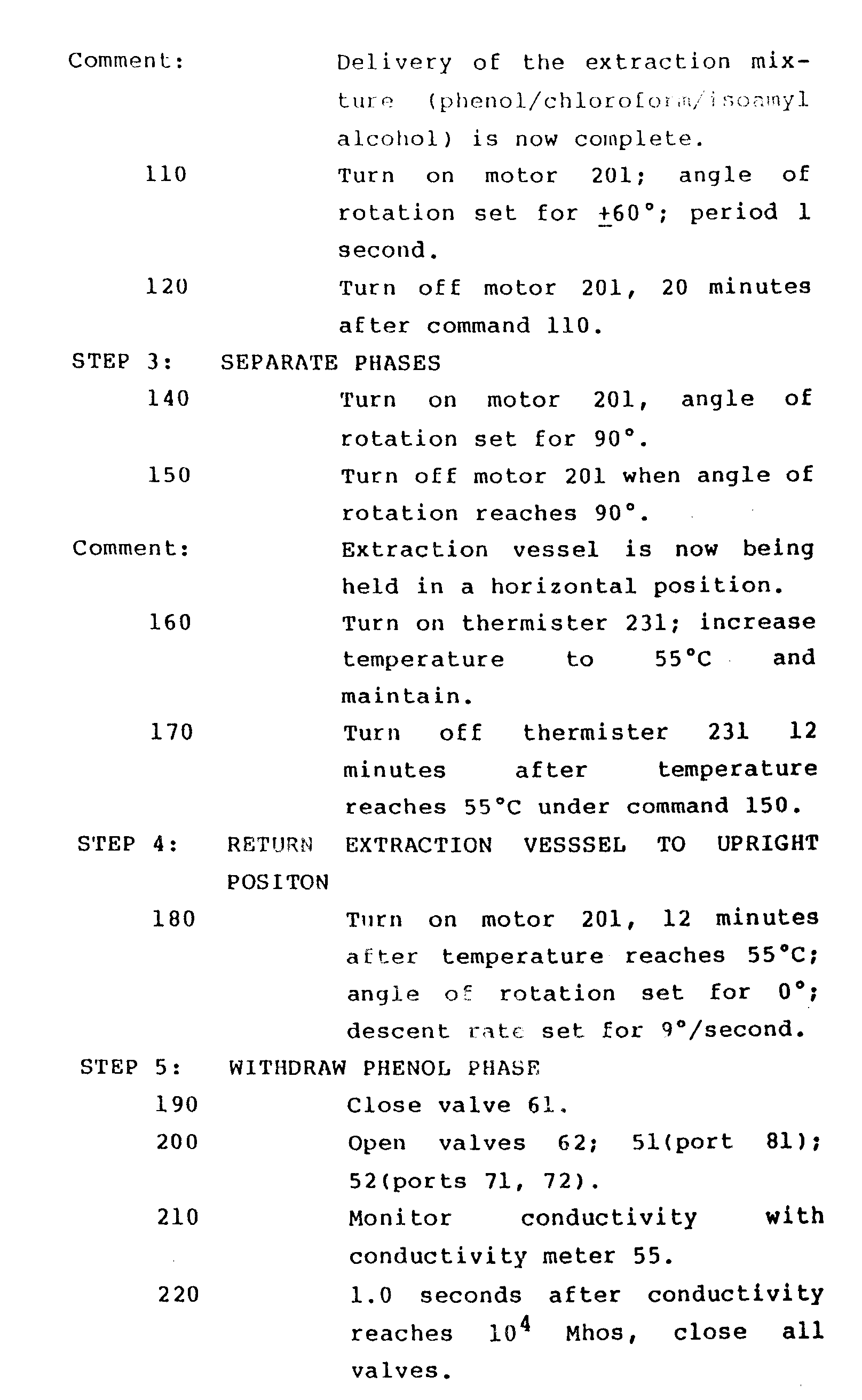


-
- Lymphocytes are first washed from one unit of whole blood and are resuspended in 4 ml balanced salt solution. (Balanced salt solution is made up of 1 volume of a solution A and 9 volumes of a solution B, whore solution A is 0.1% glucose, 5x10⁻¹⁰M CaCl₂, 9.8x10⁻⁴M MgCl₂, 5.4x10⁻³M KCl, 0.145M Tris-HCl, pH 7.6; and Solution B is 0.14M NaCl.) Then 0.35 ml of the lymphocyte suspension above is mixed with 4 ml lysis buffer (1M NaCl, 1% SDS, 8M urea, 10 mM EDTA, 50 mM Tris-HCl, pH 8.0), and 1 mg of proteinase K in 0.65 ml lysis buffer to obtain a total volume of 5 ml. The digestion is performed in a conical tube (extraction vessel 11) as described earlier, at 55°C for 3 hours. About 5 ml of phenol/chloroform/isoamyl alcohol 50:48:2 is added to the tube and the two phases are mixed according to the protocol for 20 minutes. The extraction vessel is then rotated to the horizontal position for 10 minutes at 55°C to allow the phases to separate. The extraction vessel is then rotated slowly back up to the vertical position over a period of about 10 seconds, and the lower organic layer is removed to waste. A second extraction is performed with the phenol/chloroform/isoamyl alcohol mixture and a third extraction is performed using 5 ml of chloroform. The chloroform is removed to waste and the aqueous DNA-containing layer is pressure transferred to a dialysis bag, such as
dialysis bag 311. This aqueous solution is then pressure dialyzed according to the protocol until A270 is below 0.01. The final DNA solution is then educted from the bag and collected. - Following this process yields about 1 ml of DNA solution containing about 250 micrograms of DNA The resulting solution had an absorbance ratio A230:A260 of 0.52 and an absorbance ratio A260:A280 of 1.90, demonstrating very high purity. (For absolutely pure DNA, the absorbance ratio A230:A260 is 0.5±0.05 and A260:A280 is 1.9±0.1.) Analysis of the sample using a 0.8% agarose gel and standard ethidium bromide staining techniques shows a single band with a size greater than 50 kbase pairs (i.e., greater than 3.5x10⁷ daltons). Also most importantly, digestion with the enzyme Eco RI is positive, indicating that the DNA is pure and therefore restrictable, a very stringent test for DNA purity.
- Variations on the above example demonstrate the importance of heating and increasing the surface area to effect the phase separation step. For example, for human lymphocytes, if the extraction vessel is not heated, but is maintained at room temperature, and the extraction vessel is not rotated to a horizontal position, phase separation typically requires over 60 minutes. If instead the extraction vessel is heated to 55°C but is not also rotated to the horizontal position, the phase separation requires over 4 minutes. With heating to 55°C and rotation of the extraction vessel to the horizontal position, the phase separation typically requires only about 2.5 minutes. In each of these variations, however, the high salt content is enhancing the rate of phase separation by approximately a factor of two.
- While there has been shown and described a preferred embodiment of the apparatus and method of the present invention, it will be apparent to those skilled in the art that many changes and modifications may be made without departing from the invention in its broader aspects. For example, it is apparent that the extraction vessel need not be rotated to a horizontal position to speed up phase separation, although it does have a major influence. Similarly, the phase separation can be performed at a temperature below the preferred range of 45°C to 55°C, but it will proceed at a slower rate, and the further below that range the slower the rate. In terms of apparatus it will be apparent that automated devices according to the invention can be constructed with either more or fewer extraction vessels, reagent vessels, and dialysis bags. Also, some valves nay be conveniently placed at different locations in the apparatus, for
example valve block 52 may be placed ahead ofconductivity meter 55. However, this would result in some loss of the aqueous phase when the flow is stopped. In addition, the specific model numbers chosen for the various pieces of apparatus included in the automated extraction system are not meant to be restrictive as to the particular models which can be used, but are offered by way of example only. Also, it will be apparent that the apparatus may be only partially automated, by providing thefluid delivery system 100 and chamber/rocker system 200 independent of thedialysis system 300.
Claims (23)
- A method of extracting nucleic acids from cells which includes the steps of(a) creating a lysate by treating said cells with proteinase K in the presence of a lysis buffer;(b) mixing said lysate with a phenol-based solvent system, thereby creating an emulsion; and(c) separating the phases into an aqueous phase containing said nucleic acids and an organic phase containing phenol and denatured proteins characterised by(i) heating said emulsion to a temperature greater than 45°C prior to separation to cause phase separation; and(ii) removing said organic phase without centrifugation.
- A method according to claim 1, wherein the lysis buffer contains a high concentration of salt.
- A method according to claim 1 or claim 2, wherein the said temperature is about 55°C.
- A method according to any preceding claim wherein after the heating step but prior to separation, the surface area of the emulsion is increased thereby further promoting phase separation.
- A method according to any preceding claim wherein the steps of mixing, heating (surface extension if employed) and separating are repeated, in order, N times, where N is a number greater than or equal to 1.
- A method according to any preceding claim wherein after final separation the remaining aqueous phase is mixed with chloroform thereby creating an emulsion and the heating and separation steps are repeated to leave an aqueous phase containing said nucleic acids.
- A method according to claim 6 wherein after the steps of mixing, heating, surface extension and separation have been repeated N times, the remaining aqueous phase is mixed with chloroform thereby creating an emulsion, and the steps of heating, surface extension and separation are repeated in that order to leave an aqueous phase containing said nucleic acids.
- The method of claim 5 wherein the remaining aqueous phase after mixing with chloroform is dialyzed.
- A method according to any preceding claim wherein said phenol-based solvent system comprises a mixture of phenol, chloroform, and an antisurfactant.
- The method of claim 8 wherein the ratios of phenol to chloroform to isoamyl alcohol are about 50:48:1.
- The method of any preceding claim wherein said lysis buffer includes a detergent.
- The method of claim 10 wherein said lysis buffer inlcudes one or more of a chaotropic agent, a chelating agent, and a buffer.
- A method according to any preceding claim wherein the molar concentration of salt in said lysis buffer is from 0.5 and 2.
- A method according to claim 13 wherein said lysis buffer comprises urea, NaCl, a detergent, Tris-HCℓ, and EDTA.
- The method of claim 14 wherein the lysis buffer comprises 8M urea, 1M NaCl, 1% SDS, 50mM Tris-HCℓ, and 10mM EDTA, pH 8.0.
- Apparatus for extracting nucleic acids from cells according to the method of claim 1, the apparatus comprising:
extraction vessel means (11-15) for holding said cells:
delivery means (100) for delivering reagents to said extraction vessel means, and for removing fluids from said extraction vessel means:
heater means (221-225) for heating said extraction vessel means;
temperature measuring means (231-235) for measuring the temperature of said extraction vessel means;
motor means (200) for oscillating said extraction vessel means to mix said cells and said reagents;
computer means (400) for controlling said heater means, said motor means and said delivery means, for controlling volume of flow of said reagents into said extraction vessel means, for monitoring the temperature measured by said temperature measuring means, for monitoring flow of fluids from said extraction vessel means, for timing the heating of said extraction vessels by said heating means, and for timing the mixing by said motor means, said computer means operating according to a preselected instruction set to cause extraction of said nucleic acids from said cells without centrifugation. - Apparatus according to claim 16 wherein said extraction vessel means is configured such that when it is rotated about a horizontal axis by an angle, a fluid contained therein will have a larger surface area than when said extraction vessel means is not rotated, and wherein said motor means is arranged for rotating said extraction vessel means to said angle and for holding said extraction vessel means at said angle at least for a period to permit phase separations of emulsions contained in said extraction vessel means.
- Apparatus according to claim 16 or claim 17 wherein said extraction vessel means comprises a plurality of tubes.
- Apparatus according to any of claims 16 to 18 further comprising dialysis means (300) coupled to said extraction vessel means via said delivery means, and said delivery means is arranged for delivering fluids to and from said dialysis means.
- Apparatus according to claim 19 wherein said dialysis means comprises recirculation means for recirculating and filtering dyalysate during dialysis.
- Apparatus according to any one of claims 16 to 20 wherein
the extraction vessel (11-15) has a cross-section area A1 in a horizontal plane through the extraction vessel, and has a cross-sectional area A2 in a plane oriented at an angle ϑ relative to the horizontal, where A2 is greater than A1; and the
motor means has a driveshaft coupled to the extraction vessel for rotating the extraction vessel by angle ϑ, and for holding the extraction vessel at angle ϑ for a period during or prior to the phase separation. - Apparatus according to claim 21 comprising also means for withdrawing the lower phase and control means for the withdrawing means, the control means including means for detecting a change in conductivity.
- Apparatus according to any one of claims 16 to 22 comprising also:
holding means for holding reagents to be reacted;
one or more extraction vessels (11-15);
first valve block means having a plurality of ports and being responsive to signals from the computer means for directing delivery of the reagents to the extraction vessel(s);
delivery means for delivering the reagents to the first valve block means from the holding means, and to the extraction vessel(s), and for removing fluids from bottom portion(s) of the extraction vessel(s), and for delivering the fluids from the bottom portion(s) to the first valve block means; and
measuring means coupled to said first valve block means for receiving fluids therefrom and for measuring conductivity of the fluids received from the first valve block means, and providing a signal to the computer means when the conductivity is above a preselected threshold.
Applications Claiming Priority (2)
| Application Number | Priority Date | Filing Date | Title |
|---|---|---|---|
| US69295885A | 1985-01-18 | 1985-01-18 | |
| US692958 | 1985-01-18 |
Publications (3)
| Publication Number | Publication Date |
|---|---|
| EP0215533A2 EP0215533A2 (en) | 1987-03-25 |
| EP0215533A3 EP0215533A3 (en) | 1988-06-22 |
| EP0215533B1 true EP0215533B1 (en) | 1993-12-15 |
Family
ID=24782760
Family Applications (1)
| Application Number | Title | Priority Date | Filing Date |
|---|---|---|---|
| EP86300075A Expired - Lifetime EP0215533B1 (en) | 1985-01-18 | 1986-01-07 | A method of extracting nucleic acids from cells |
Country Status (4)
| Country | Link |
|---|---|
| EP (1) | EP0215533B1 (en) |
| JP (1) | JPH0815437B2 (en) |
| CA (1) | CA1335963C (en) |
| DE (1) | DE3689398T2 (en) |
Families Citing this family (13)
| Publication number | Priority date | Publication date | Assignee | Title |
|---|---|---|---|---|
| EP0240191A3 (en) * | 1986-03-13 | 1989-10-25 | Seiko Instruments Inc. | Method of isolating dna contained in a virus or cell |
| EP0245945B1 (en) * | 1986-04-11 | 1993-11-10 | Applied Biosystems, Inc. | Automated nucleic acid extractor |
| SE8801098D0 (en) * | 1988-03-24 | 1988-03-24 | Pharmacia Ab | APPARATUS AND METHOD FOR AUTOMATIC EXTRACTION OF EXTRA-CHROMOSOMAL DNA FROM A CELL SUSPENSION IN A CONTAINER |
| DE68918282D1 (en) * | 1989-06-02 | 1994-10-20 | Mathias Uhlen | APPARATUS AND METHOD FOR AUTOMATICALLY SEPARATING EXTRACHROMOSOMAL DNA FROM A CELL SUSPENSION. |
| US5128247A (en) * | 1989-08-14 | 1992-07-07 | Board Of Regents, The University Of Texas System | Methods for isolation of nucleic acids from eukaryotic and prokaryotic sources |
| KR20020029476A (en) * | 2000-10-13 | 2002-04-19 | 박제철 | Lysis buffer reagent for gene extraction by one step |
| KR20020029477A (en) * | 2000-10-13 | 2002-04-19 | 박제철 | Method for gene extraction by one step |
| DE102007025276A1 (en) * | 2007-05-31 | 2008-12-04 | Qiagen Gmbh | Aromatic alcohols for the treatment of a biological sample |
| CA2682439A1 (en) * | 2008-10-17 | 2010-04-17 | F. Hoffmann-La Roche Ag | Cell monitoring and molecular analysis |
| EP3210667A1 (en) * | 2016-02-29 | 2017-08-30 | Max-Planck-Gesellschaft zur Förderung der Wissenschaften e.V. | Modular continuous flow device |
| HUE062204T2 (en) | 2017-01-16 | 2023-10-28 | Spectrum Solutions L L C | Nucleic acid preservation solution and methods of use |
| WO2020106891A1 (en) | 2018-11-20 | 2020-05-28 | Spectrum Solutions, Llc | Sample collection system including sealing cap and valve |
| US11701094B2 (en) | 2019-06-20 | 2023-07-18 | Spectrum Solutions L.L.C. | Sample collection system including valve and plug assemblies |
Family Cites Families (9)
| Publication number | Priority date | Publication date | Assignee | Title |
|---|---|---|---|---|
| BE605321A (en) * | 1960-07-04 | |||
| FR93454E (en) * | 1963-03-29 | 1969-04-04 | Saint Gobain Tech Nouvelles Et | Apparatus for bringing two normally immiscible liquids into contact. |
| US3389133A (en) * | 1966-08-10 | 1968-06-18 | Schwarz Biores Inc | Process for isolating and purifying soluble ribonucleic acid |
| US3582468A (en) * | 1968-09-27 | 1971-06-01 | Merck & Co Inc | Recovery of double-stranded ribonucleic acid |
| EP0048034A2 (en) * | 1978-08-04 | 1982-03-24 | DAVY MCKEE (MINERALS & METALS) LIMITED | Apparatus for effecting liquid-liquid contact |
| US4338285A (en) * | 1978-12-06 | 1982-07-06 | A. H. Ross & Associates | Liquid-liquid contact apparatus |
| GB2143238A (en) * | 1983-03-31 | 1985-02-06 | Dr Anthony Stuart Breeze | A method for enzyme liberation from bacterial cells |
| DD230560A3 (en) * | 1983-11-07 | 1985-12-04 | Leiser Robert Matthias | METHOD OF ISOLATING AND PARTIALLY CLEANING RNA |
| GB8331071D0 (en) * | 1983-11-22 | 1983-12-29 | Karayiannis P | Assay for dna/rna |
-
1986
- 1986-01-07 EP EP86300075A patent/EP0215533B1/en not_active Expired - Lifetime
- 1986-01-07 DE DE19863689398 patent/DE3689398T2/en not_active Expired - Lifetime
- 1986-01-14 CA CA 499532 patent/CA1335963C/en not_active Expired - Fee Related
- 1986-01-16 JP JP61005181A patent/JPH0815437B2/en not_active Expired - Lifetime
Non-Patent Citations (1)
| Title |
|---|
| MANIATIS et al., "Molecular Cloning, A laboratory manual", CSH symposia, 1982. * |
Also Published As
| Publication number | Publication date |
|---|---|
| JPS61167697A (en) | 1986-07-29 |
| EP0215533A2 (en) | 1987-03-25 |
| EP0215533A3 (en) | 1988-06-22 |
| JPH0815437B2 (en) | 1996-02-21 |
| DE3689398T2 (en) | 1994-07-14 |
| DE3689398D1 (en) | 1994-01-27 |
| CA1335963C (en) | 1995-06-20 |
Similar Documents
| Publication | Publication Date | Title |
|---|---|---|
| US5346999A (en) | Method of nucleic acid extraction | |
| EP0245945A2 (en) | Automated nucleic acid extractor | |
| CA1335963C (en) | Automated nucleic acid extractor | |
| EP0407444B1 (en) | Apparatus and method for automated purification of extra-chromosomal dna from a cell suspension in a container | |
| US5596092A (en) | Extraction of genomic DNA from blood using cationic detergents | |
| US5057426A (en) | Method for separating long-chain nucleic acids | |
| EP0508985B1 (en) | Method and kit for purifying nucleic acids | |
| Veide et al. | A process for large‐scale isolation of β‐galactosidase from E. coli in an aqueous two‐phase system | |
| EP0708827B1 (en) | Purification method and apparatus | |
| DE19610354C1 (en) | Device, method and device for isolating nucleic acids | |
| CA2983626C (en) | Device and process for automated extraction of nucleic acids | |
| WO2004108260A2 (en) | Devices and methods for biomaterial production | |
| JP2002521029A (en) | Nucleic acid purification method | |
| CN206069882U (en) | Nucleic acid sequencing equipment | |
| EP0432162B1 (en) | Apparatus and method for automated separation of extra-chromosomal dna from a cell suspension | |
| WO2001062976A1 (en) | Rapid nucleic acid separation, isolation and purification methods | |
| WO1991000924A1 (en) | Method for separating dna from a sample and kit therefor | |
| AU665750B2 (en) | Extraction system utilizing centrifugation | |
| JP2025501339A (en) | Polymer purification | |
| Towner | Purification of DNA | |
| CN106867994B (en) | Rapid precipitation buffer solution applied to plasmid DNA extraction and application thereof | |
| HK40024866A (en) | Method for quickly extracting long-fragment genomic dna by single reaction tube, and kit | |
| Stein et al. | Methods for dissociation, fractionation, and selective reconstitution of chromatin |
Legal Events
| Date | Code | Title | Description |
|---|---|---|---|
| PUAI | Public reference made under article 153(3) epc to a published international application that has entered the european phase |
Free format text: ORIGINAL CODE: 0009012 |
|
| AK | Designated contracting states |
Kind code of ref document: A2 Designated state(s): BE CH DE FR GB IT LI SE |
|
| PUAL | Search report despatched |
Free format text: ORIGINAL CODE: 0009013 |
|
| AK | Designated contracting states |
Kind code of ref document: A3 Designated state(s): BE CH DE FR GB IT LI SE |
|
| 17P | Request for examination filed |
Effective date: 19881130 |
|
| 17Q | First examination report despatched |
Effective date: 19900731 |
|
| GRAA | (expected) grant |
Free format text: ORIGINAL CODE: 0009210 |
|
| AK | Designated contracting states |
Kind code of ref document: B1 Designated state(s): BE CH DE FR GB IT LI SE |
|
| REF | Corresponds to: |
Ref document number: 3689398 Country of ref document: DE Date of ref document: 19940127 |
|
| ET | Fr: translation filed | ||
| ITF | It: translation for a ep patent filed | ||
| PLBE | No opposition filed within time limit |
Free format text: ORIGINAL CODE: 0009261 |
|
| STAA | Information on the status of an ep patent application or granted ep patent |
Free format text: STATUS: NO OPPOSITION FILED WITHIN TIME LIMIT |
|
| 26N | No opposition filed | ||
| EAL | Se: european patent in force in sweden |
Ref document number: 86300075.8 |
|
| REG | Reference to a national code |
Ref country code: CH Ref legal event code: PUE Owner name: APPLIED BIOSYSTEMS, INC. TRANSFER- PERKIN-ELMER CO |
|
| REG | Reference to a national code |
Ref country code: GB Ref legal event code: 732E |
|
| REG | Reference to a national code |
Ref country code: FR Ref legal event code: TP |
|
| REG | Reference to a national code |
Ref country code: GB Ref legal event code: IF02 |
|
| REG | Reference to a national code |
Ref country code: CH Ref legal event code: PUE Owner name: APPLERA CORPORATION Free format text: PE CORPORATION (NY)#850 LINCOLN CENTRE DRIVE#FOSTER CITY CALIFORNIA 94404 (US) -TRANSFER TO- APPLERA CORPORATION#850 LINCOLN CENTRE DRIVE#FOSTER CITY, CA 94404 (US) Ref country code: CH Ref legal event code: PFA Owner name: PE CORPORATION (NY) Free format text: PERKIN-ELMER CORPORATION#APPLIED BIOSYSTEMS DIVISION, 850 LINCOLN CENTRE DRIVE#FOSTER CITY, CA 94404 (US) -TRANSFER TO- PE CORPORATION (NY)#850 LINCOLN CENTRE DRIVE#FOSTER CITY CALIFORNIA 94404 (US) Ref country code: CH Ref legal event code: NV Representative=s name: E. BLUM & CO. PATENTANWAELTE |
|
| REG | Reference to a national code |
Ref country code: FR Ref legal event code: TP |
|
| REG | Reference to a national code |
Ref country code: GB Ref legal event code: 732E |
|
| PGFP | Annual fee paid to national office [announced via postgrant information from national office to epo] |
Ref country code: GB Payment date: 20041229 Year of fee payment: 20 |
|
| PGFP | Annual fee paid to national office [announced via postgrant information from national office to epo] |
Ref country code: FR Payment date: 20050117 Year of fee payment: 20 |
|
| PGFP | Annual fee paid to national office [announced via postgrant information from national office to epo] |
Ref country code: SE Payment date: 20050120 Year of fee payment: 20 |
|
| PGFP | Annual fee paid to national office [announced via postgrant information from national office to epo] |
Ref country code: CH Payment date: 20050124 Year of fee payment: 20 |
|
| PGFP | Annual fee paid to national office [announced via postgrant information from national office to epo] |
Ref country code: IT Payment date: 20050128 Year of fee payment: 20 |
|
| PGFP | Annual fee paid to national office [announced via postgrant information from national office to epo] |
Ref country code: DE Payment date: 20050228 Year of fee payment: 20 |
|
| PGFP | Annual fee paid to national office [announced via postgrant information from national office to epo] |
Ref country code: BE Payment date: 20050303 Year of fee payment: 20 |
|
| PG25 | Lapsed in a contracting state [announced via postgrant information from national office to epo] |
Ref country code: GB Free format text: LAPSE BECAUSE OF EXPIRATION OF PROTECTION Effective date: 20060106 |
|
| REG | Reference to a national code |
Ref country code: CH Ref legal event code: PL |
|
| REG | Reference to a national code |
Ref country code: GB Ref legal event code: PE20 |
|
| EUG | Se: european patent has lapsed | ||
| BE20 | Be: patent expired |
Owner name: *APPLIED BIOSYSTEMS INC. Effective date: 20060107 |