EP0215063B1 - PYRIDO (2,3-d )PYRIMIDIN DERIVATIVES - Google Patents
PYRIDO (2,3-d )PYRIMIDIN DERIVATIVES Download PDFInfo
- Publication number
- EP0215063B1 EP0215063B1 EP86901675A EP86901675A EP0215063B1 EP 0215063 B1 EP0215063 B1 EP 0215063B1 EP 86901675 A EP86901675 A EP 86901675A EP 86901675 A EP86901675 A EP 86901675A EP 0215063 B1 EP0215063 B1 EP 0215063B1
- Authority
- EP
- European Patent Office
- Prior art keywords
- compound according
- amino
- pyrimidin
- benzoyl
- hydroxy
- Prior art date
- Legal status (The legal status is an assumption and is not a legal conclusion. Google has not performed a legal analysis and makes no representation as to the accuracy of the status listed.)
- Expired - Lifetime
Links
- UDJFFSGCRRMVFH-UHFFFAOYSA-N pyrido[2,3-d]pyrimidine Chemical class N1=CN=CC2=CC=CN=C21 UDJFFSGCRRMVFH-UHFFFAOYSA-N 0.000 title description 3
- 150000001875 compounds Chemical class 0.000 claims abstract description 69
- 229960002989 glutamic acid Drugs 0.000 claims abstract description 13
- 125000003236 benzoyl group Chemical group [H]C1=C([H])C([H])=C(C([H])=C1[H])C(*)=O 0.000 claims abstract description 6
- 150000002306 glutamic acid derivatives Chemical class 0.000 claims abstract description 5
- 125000006244 carboxylic acid protecting group Chemical group 0.000 claims abstract description 4
- 125000004943 pyrimidin-6-yl group Chemical group N1=CN=CC=C1* 0.000 claims abstract description 4
- 239000001257 hydrogen Substances 0.000 claims description 22
- 229910052739 hydrogen Inorganic materials 0.000 claims description 22
- 238000000034 method Methods 0.000 claims description 14
- 125000002924 primary amino group Chemical group [H]N([H])* 0.000 claims description 12
- 239000002253 acid Substances 0.000 claims description 11
- 206010028980 Neoplasm Diseases 0.000 claims description 10
- 229910052799 carbon Inorganic materials 0.000 claims description 10
- 125000001495 ethyl group Chemical group [H]C([H])([H])C([H])([H])* 0.000 claims description 10
- 150000002431 hydrogen Chemical group 0.000 claims description 10
- 125000002887 hydroxy group Chemical group [H]O* 0.000 claims description 9
- 125000002496 methyl group Chemical group [H]C([H])([H])* 0.000 claims description 8
- ZUQBAQVRAURMCL-CVRLYYSRSA-N (2s)-2-[[4-[2-(2-amino-4-oxo-5,6,7,8-tetrahydro-1h-pyrido[2,3-d]pyrimidin-6-yl)ethyl]benzoyl]amino]pentanedioic acid Chemical compound C1NC=2NC(N)=NC(=O)C=2CC1CCC1=CC=C(C(=O)N[C@@H](CCC(O)=O)C(O)=O)C=C1 ZUQBAQVRAURMCL-CVRLYYSRSA-N 0.000 claims description 6
- UFHFLCQGNIYNRP-UHFFFAOYSA-N Hydrogen Chemical compound [H][H] UFHFLCQGNIYNRP-UHFFFAOYSA-N 0.000 claims description 6
- 125000004435 hydrogen atom Chemical group [H]* 0.000 claims description 6
- 241000124008 Mammalia Species 0.000 claims description 5
- QGZKDVFQNNGYKY-UHFFFAOYSA-O Ammonium Chemical compound [NH4+] QGZKDVFQNNGYKY-UHFFFAOYSA-O 0.000 claims description 4
- 229910052783 alkali metal Inorganic materials 0.000 claims description 4
- 230000007062 hydrolysis Effects 0.000 claims description 4
- 238000006460 hydrolysis reaction Methods 0.000 claims description 4
- 238000002360 preparation method Methods 0.000 claims description 4
- 150000001340 alkali metals Chemical class 0.000 claims description 3
- 150000003863 ammonium salts Chemical class 0.000 claims description 3
- 229910052751 metal Inorganic materials 0.000 claims description 3
- 239000002184 metal Substances 0.000 claims description 3
- 231100000252 nontoxic Toxicity 0.000 claims description 3
- 230000003000 nontoxic effect Effects 0.000 claims description 3
- 125000006239 protecting group Chemical group 0.000 claims description 3
- RKYBOAKGTWOIFJ-UHFFFAOYSA-N 5,6,7,8-tetrahydropyrido[2,3-d]pyrimidine Chemical compound C1=NC=C2CCCNC2=N1 RKYBOAKGTWOIFJ-UHFFFAOYSA-N 0.000 claims description 2
- 238000007327 hydrogenolysis reaction Methods 0.000 claims description 2
- 159000000018 pyrido[2,3-d]pyrimidines Chemical class 0.000 claims description 2
- 125000004432 carbon atom Chemical group C* 0.000 claims 4
- 239000003937 drug carrier Substances 0.000 claims 2
- 239000008194 pharmaceutical composition Substances 0.000 claims 2
- 125000004178 (C1-C4) alkyl group Chemical group 0.000 claims 1
- 125000000229 (C1-C4)alkoxy group Chemical group 0.000 claims 1
- 125000001449 isopropyl group Chemical group [H]C([H])([H])C([H])(*)C([H])([H])[H] 0.000 claims 1
- 150000003230 pyrimidines Chemical class 0.000 claims 1
- 125000002914 sec-butyl group Chemical group [H]C([H])([H])C([H])([H])C([H])(*)C([H])([H])[H] 0.000 claims 1
- 125000004213 tert-butoxy group Chemical group [H]C([H])([H])C(O*)(C([H])([H])[H])C([H])([H])[H] 0.000 claims 1
- 229940034982 antineoplastic agent Drugs 0.000 abstract description 3
- 239000002246 antineoplastic agent Substances 0.000 abstract description 3
- 125000000217 alkyl group Chemical group 0.000 abstract description 2
- 230000003301 hydrolyzing effect Effects 0.000 abstract 1
- OKKJLVBELUTLKV-UHFFFAOYSA-N Methanol Chemical compound OC OKKJLVBELUTLKV-UHFFFAOYSA-N 0.000 description 63
- 239000007787 solid Substances 0.000 description 37
- HEDRZPFGACZZDS-UHFFFAOYSA-N Chloroform Chemical compound ClC(Cl)Cl HEDRZPFGACZZDS-UHFFFAOYSA-N 0.000 description 34
- RTZKZFJDLAIYFH-UHFFFAOYSA-N Diethyl ether Chemical compound CCOCC RTZKZFJDLAIYFH-UHFFFAOYSA-N 0.000 description 30
- UHOVQNZJYSORNB-UHFFFAOYSA-N Benzene Chemical compound C1=CC=CC=C1 UHOVQNZJYSORNB-UHFFFAOYSA-N 0.000 description 24
- 125000004177 diethyl group Chemical group [H]C([H])([H])C([H])([H])* 0.000 description 22
- HEMHJVSKTPXQMS-UHFFFAOYSA-M Sodium hydroxide Chemical compound [OH-].[Na+] HEMHJVSKTPXQMS-UHFFFAOYSA-M 0.000 description 21
- 239000000203 mixture Substances 0.000 description 21
- QTBSBXVTEAMEQO-UHFFFAOYSA-N Acetic acid Chemical compound CC(O)=O QTBSBXVTEAMEQO-UHFFFAOYSA-N 0.000 description 20
- HEDRZPFGACZZDS-MICDWDOJSA-N Trichloro(2H)methane Chemical compound [2H]C(Cl)(Cl)Cl HEDRZPFGACZZDS-MICDWDOJSA-N 0.000 description 20
- 239000000243 solution Substances 0.000 description 20
- XLYOFNOQVPJJNP-UHFFFAOYSA-N water Substances O XLYOFNOQVPJJNP-UHFFFAOYSA-N 0.000 description 19
- CSCPPACGZOOCGX-UHFFFAOYSA-N Acetone Chemical compound CC(C)=O CSCPPACGZOOCGX-UHFFFAOYSA-N 0.000 description 18
- YMWUJEATGCHHMB-UHFFFAOYSA-N Dichloromethane Chemical compound ClCCl YMWUJEATGCHHMB-UHFFFAOYSA-N 0.000 description 18
- XEKOWRVHYACXOJ-UHFFFAOYSA-N Ethyl acetate Chemical compound CCOC(C)=O XEKOWRVHYACXOJ-UHFFFAOYSA-N 0.000 description 15
- 238000001914 filtration Methods 0.000 description 15
- 239000011541 reaction mixture Substances 0.000 description 14
- 239000002904 solvent Substances 0.000 description 13
- SJRJJKPEHAURKC-UHFFFAOYSA-N N-Methylmorpholine Chemical compound CN1CCOCC1 SJRJJKPEHAURKC-UHFFFAOYSA-N 0.000 description 12
- 229960000485 methotrexate Drugs 0.000 description 12
- FBOZXECLQNJBKD-ZDUSSCGKSA-N L-methotrexate Chemical compound C=1N=C2N=C(N)N=C(N)C2=NC=1CN(C)C1=CC=C(C(=O)N[C@@H](CCC(O)=O)C(O)=O)C=C1 FBOZXECLQNJBKD-ZDUSSCGKSA-N 0.000 description 11
- KDLHZDBZIXYQEI-UHFFFAOYSA-N Palladium Chemical compound [Pd] KDLHZDBZIXYQEI-UHFFFAOYSA-N 0.000 description 11
- VYPSYNLAJGMNEJ-UHFFFAOYSA-N Silicium dioxide Chemical compound O=[Si]=O VYPSYNLAJGMNEJ-UHFFFAOYSA-N 0.000 description 11
- IJGRMHOSHXDMSA-UHFFFAOYSA-N Atomic nitrogen Chemical compound N#N IJGRMHOSHXDMSA-UHFFFAOYSA-N 0.000 description 10
- JUJWROOIHBZHMG-UHFFFAOYSA-N Pyridine Chemical compound C1=CC=NC=C1 JUJWROOIHBZHMG-UHFFFAOYSA-N 0.000 description 10
- DTQVDTLACAAQTR-UHFFFAOYSA-N Trifluoroacetic acid Chemical compound OC(=O)C(F)(F)F DTQVDTLACAAQTR-UHFFFAOYSA-N 0.000 description 10
- 239000000741 silica gel Substances 0.000 description 10
- 229910002027 silica gel Inorganic materials 0.000 description 10
- 239000000725 suspension Substances 0.000 description 10
- -1 and the like Substances 0.000 description 9
- 230000000694 effects Effects 0.000 description 9
- 239000000047 product Substances 0.000 description 9
- KWOLFJPFCHCOCG-UHFFFAOYSA-N Acetophenone Chemical compound CC(=O)C1=CC=CC=C1 KWOLFJPFCHCOCG-UHFFFAOYSA-N 0.000 description 8
- IAZDPXIOMUYVGZ-WFGJKAKNSA-N Dimethyl sulfoxide Chemical compound [2H]C([2H])([2H])S(=O)C([2H])([2H])[2H] IAZDPXIOMUYVGZ-WFGJKAKNSA-N 0.000 description 8
- ZMXDDKWLCZADIW-UHFFFAOYSA-N N,N-Dimethylformamide Chemical compound CN(C)C=O ZMXDDKWLCZADIW-UHFFFAOYSA-N 0.000 description 8
- CDBYLPFSWZWCQE-UHFFFAOYSA-L Sodium Carbonate Chemical compound [Na+].[Na+].[O-]C([O-])=O CDBYLPFSWZWCQE-UHFFFAOYSA-L 0.000 description 8
- DKGAVHZHDRPRBM-UHFFFAOYSA-N Tert-Butanol Chemical compound CC(C)(C)O DKGAVHZHDRPRBM-UHFFFAOYSA-N 0.000 description 8
- 239000002585 base Substances 0.000 description 8
- 238000001704 evaporation Methods 0.000 description 8
- 230000008020 evaporation Effects 0.000 description 8
- 239000000706 filtrate Substances 0.000 description 8
- 238000003756 stirring Methods 0.000 description 8
- 108010022394 Threonine synthase Proteins 0.000 description 7
- 229960000583 acetic acid Drugs 0.000 description 7
- 239000000543 intermediate Substances 0.000 description 7
- FKHIFSZMMVMEQY-UHFFFAOYSA-N talc Chemical compound [Mg+2].[O-][Si]([O-])=O FKHIFSZMMVMEQY-UHFFFAOYSA-N 0.000 description 7
- RIOQSEWOXXDEQQ-UHFFFAOYSA-N triphenylphosphine Chemical compound C1=CC=CC=C1P(C=1C=CC=CC=1)C1=CC=CC=C1 RIOQSEWOXXDEQQ-UHFFFAOYSA-N 0.000 description 7
- WFDIJRYMOXRFFG-UHFFFAOYSA-N Acetic anhydride Chemical compound CC(=O)OC(C)=O WFDIJRYMOXRFFG-UHFFFAOYSA-N 0.000 description 6
- ZRALSGWEFCBTJO-UHFFFAOYSA-N Guanidine Chemical compound NC(N)=N ZRALSGWEFCBTJO-UHFFFAOYSA-N 0.000 description 6
- SECXISVLQFMRJM-UHFFFAOYSA-N N-Methylpyrrolidone Chemical compound CN1CCCC1=O SECXISVLQFMRJM-UHFFFAOYSA-N 0.000 description 6
- WYURNTSHIVDZCO-UHFFFAOYSA-N Tetrahydrofuran Chemical compound C1CCOC1 WYURNTSHIVDZCO-UHFFFAOYSA-N 0.000 description 6
- 238000010828 elution Methods 0.000 description 6
- 239000002244 precipitate Substances 0.000 description 6
- NNQBBVZQFURSBR-UHFFFAOYSA-N 4-[2-(2,4-diaminopyrido[2,3-d]pyrimidin-6-yl)ethenyl]benzoic acid Chemical compound C1=NC2=NC(N)=NC(N)=C2C=C1C=CC1=CC=C(C(O)=O)C=C1 NNQBBVZQFURSBR-UHFFFAOYSA-N 0.000 description 5
- WPYMKLBDIGXBTP-UHFFFAOYSA-N benzoic acid Chemical compound OC(=O)C1=CC=CC=C1 WPYMKLBDIGXBTP-UHFFFAOYSA-N 0.000 description 5
- 150000001721 carbon Chemical group 0.000 description 5
- 239000003054 catalyst Substances 0.000 description 5
- 238000006243 chemical reaction Methods 0.000 description 5
- 102000004419 dihydrofolate reductase Human genes 0.000 description 5
- 238000005984 hydrogenation reaction Methods 0.000 description 5
- 230000005764 inhibitory process Effects 0.000 description 5
- 208000032839 leukemia Diseases 0.000 description 5
- 229910052757 nitrogen Inorganic materials 0.000 description 5
- UMJSCPRVCHMLSP-UHFFFAOYSA-N pyridine Natural products COC1=CC=CN=C1 UMJSCPRVCHMLSP-UHFFFAOYSA-N 0.000 description 5
- 238000010992 reflux Methods 0.000 description 5
- BHDZQFSNQPIPGI-HNNXBMFYSA-N (2s)-2-[[4-[2-(2-amino-4-oxo-1h-pyrido[2,3-d]pyrimidin-6-yl)ethyl]benzoyl]amino]pentanedioic acid Chemical compound C=1N=C2NC(N)=NC(=O)C2=CC=1CCC1=CC=C(C(=O)N[C@@H](CCC(O)=O)C(O)=O)C=C1 BHDZQFSNQPIPGI-HNNXBMFYSA-N 0.000 description 4
- IOHPVZBSOKLVMN-UHFFFAOYSA-N 2-(2-phenylethyl)benzoic acid Chemical compound OC(=O)C1=CC=CC=C1CCC1=CC=CC=C1 IOHPVZBSOKLVMN-UHFFFAOYSA-N 0.000 description 4
- VHYFNPMBLIVWCW-UHFFFAOYSA-N 4-Dimethylaminopyridine Chemical compound CN(C)C1=CC=NC=C1 VHYFNPMBLIVWCW-UHFFFAOYSA-N 0.000 description 4
- HHMPMTSYJBEEFU-UHFFFAOYSA-N 4-[1-(2,4-diaminopyrido[2,3-d]pyrimidin-6-yl)prop-1-en-2-yl]benzoic acid Chemical compound C=1N=C2N=C(N)N=C(N)C2=CC=1C=C(C)C1=CC=C(C(O)=O)C=C1 HHMPMTSYJBEEFU-UHFFFAOYSA-N 0.000 description 4
- VTYYLEPIZMXCLO-UHFFFAOYSA-L Calcium carbonate Chemical compound [Ca+2].[O-]C([O-])=O VTYYLEPIZMXCLO-UHFFFAOYSA-L 0.000 description 4
- DGAQECJNVWCQMB-PUAWFVPOSA-M Ilexoside XXIX Chemical compound C[C@@H]1CC[C@@]2(CC[C@@]3(C(=CC[C@H]4[C@]3(CC[C@@H]5[C@@]4(CC[C@@H](C5(C)C)OS(=O)(=O)[O-])C)C)[C@@H]2[C@]1(C)O)C)C(=O)O[C@H]6[C@@H]([C@H]([C@@H]([C@H](O6)CO)O)O)O.[Na+] DGAQECJNVWCQMB-PUAWFVPOSA-M 0.000 description 4
- PCLIMKBDDGJMGD-UHFFFAOYSA-N N-bromosuccinimide Chemical compound BrN1C(=O)CCC1=O PCLIMKBDDGJMGD-UHFFFAOYSA-N 0.000 description 4
- ZVQASPPISASNEO-UHFFFAOYSA-M [5-cyano-6-(4-nitrophenyl)sulfanylpyridin-3-yl]methyl-triphenylphosphanium;bromide Chemical compound [Br-].C1=CC([N+](=O)[O-])=CC=C1SC(C(=C1)C#N)=NC=C1C[P+](C=1C=CC=CC=1)(C=1C=CC=CC=1)C1=CC=CC=C1 ZVQASPPISASNEO-UHFFFAOYSA-M 0.000 description 4
- 239000003153 chemical reaction reagent Substances 0.000 description 4
- 239000003480 eluent Substances 0.000 description 4
- QDTQSWCTJKHYOR-UHFFFAOYSA-N ethyl 4-[2-[5-cyano-6-(4-nitrophenyl)sulfanylpyridin-3-yl]ethenyl]benzoate Chemical compound C1=CC(C(=O)OCC)=CC=C1C=CC(C=C1C#N)=CN=C1SC1=CC=C([N+]([O-])=O)C=C1 QDTQSWCTJKHYOR-UHFFFAOYSA-N 0.000 description 4
- BDAGIHXWWSANSR-UHFFFAOYSA-N methanoic acid Natural products OC=O BDAGIHXWWSANSR-UHFFFAOYSA-N 0.000 description 4
- 229910052708 sodium Inorganic materials 0.000 description 4
- 239000011734 sodium Substances 0.000 description 4
- 229910000029 sodium carbonate Inorganic materials 0.000 description 4
- RGUQKUKRLMXLCM-HNNXBMFYSA-N (2s)-2-[[4-[2-(2,4-diaminopyrido[2,3-d]pyrimidin-6-yl)ethyl]benzoyl]amino]pentanedioic acid Chemical compound C1=NC2=NC(N)=NC(N)=C2C=C1CCC1=CC=C(C(=O)N[C@@H](CCC(O)=O)C(O)=O)C=C1 RGUQKUKRLMXLCM-HNNXBMFYSA-N 0.000 description 3
- RHUIHPSBQUICGP-UHFFFAOYSA-N 4-[1-(2-acetamido-4-oxo-1h-pyrido[2,3-d]pyrimidin-6-yl)prop-1-en-2-yl]benzoic acid Chemical compound C1=NC2=NC(NC(=O)C)=NC(O)=C2C=C1C=C(C)C1=CC=C(C(O)=O)C=C1 RHUIHPSBQUICGP-UHFFFAOYSA-N 0.000 description 3
- VMDMBHXOULMCDZ-UHFFFAOYSA-N 5-(bromomethyl)-2-(4-nitrophenyl)sulfanylpyridine-3-carbonitrile Chemical compound C1=CC([N+](=O)[O-])=CC=C1SC1=NC=C(CBr)C=C1C#N VMDMBHXOULMCDZ-UHFFFAOYSA-N 0.000 description 3
- WEVYAHXRMPXWCK-UHFFFAOYSA-N Acetonitrile Chemical compound CC#N WEVYAHXRMPXWCK-UHFFFAOYSA-N 0.000 description 3
- QGZKDVFQNNGYKY-UHFFFAOYSA-N Ammonia Chemical compound N QGZKDVFQNNGYKY-UHFFFAOYSA-N 0.000 description 3
- 0 CC(*)C1=CCC(**(*)=C)C=C1 Chemical compound CC(*)C1=CCC(**(*)=C)C=C1 0.000 description 3
- 102000004190 Enzymes Human genes 0.000 description 3
- 108090000790 Enzymes Proteins 0.000 description 3
- LFQSCWFLJHTTHZ-UHFFFAOYSA-N Ethanol Chemical compound CCO LFQSCWFLJHTTHZ-UHFFFAOYSA-N 0.000 description 3
- CSNNHWWHGAXBCP-UHFFFAOYSA-L Magnesium sulfate Chemical compound [Mg+2].[O-][S+2]([O-])([O-])[O-] CSNNHWWHGAXBCP-UHFFFAOYSA-L 0.000 description 3
- CHJJGSNFBQVOTG-UHFFFAOYSA-N N-methyl-guanidine Natural products CNC(N)=N CHJJGSNFBQVOTG-UHFFFAOYSA-N 0.000 description 3
- KEAYESYHFKHZAL-UHFFFAOYSA-N Sodium Chemical compound [Na] KEAYESYHFKHZAL-UHFFFAOYSA-N 0.000 description 3
- PMZURENOXWZQFD-UHFFFAOYSA-L Sodium Sulfate Chemical compound [Na+].[Na+].[O-]S([O-])(=O)=O PMZURENOXWZQFD-UHFFFAOYSA-L 0.000 description 3
- FAPWRFPIFSIZLT-UHFFFAOYSA-M Sodium chloride Chemical compound [Na+].[Cl-] FAPWRFPIFSIZLT-UHFFFAOYSA-M 0.000 description 3
- ZMANZCXQSJIPKH-UHFFFAOYSA-N Triethylamine Chemical compound CCN(CC)CC ZMANZCXQSJIPKH-UHFFFAOYSA-N 0.000 description 3
- 230000015572 biosynthetic process Effects 0.000 description 3
- SWSQBOPZIKWTGO-UHFFFAOYSA-N dimethylaminoamidine Natural products CN(C)C(N)=N SWSQBOPZIKWTGO-UHFFFAOYSA-N 0.000 description 3
- BHYVHYPBRYOMGC-UHFFFAOYSA-N ethyl 4-formylbenzoate Chemical compound CCOC(=O)C1=CC=C(C=O)C=C1 BHYVHYPBRYOMGC-UHFFFAOYSA-N 0.000 description 3
- 239000012065 filter cake Substances 0.000 description 3
- OVBPIULPVIDEAO-LBPRGKRZSA-N folic acid Chemical compound C=1N=C2NC(N)=NC(=O)C2=NC=1CNC1=CC=C(C(=O)N[C@@H](CCC(O)=O)C(O)=O)C=C1 OVBPIULPVIDEAO-LBPRGKRZSA-N 0.000 description 3
- 150000002224 folic acids Chemical class 0.000 description 3
- 229960004198 guanidine Drugs 0.000 description 3
- 239000012299 nitrogen atmosphere Substances 0.000 description 3
- 239000012044 organic layer Substances 0.000 description 3
- 230000020477 pH reduction Effects 0.000 description 3
- 238000007363 ring formation reaction Methods 0.000 description 3
- FJRJFQNTDCYPCP-UHFFFAOYSA-N tert-butyl 4-[2-(2,4-diaminopyrido[2,3-d]pyrimidin-6-yl)ethenyl]benzoate Chemical compound C1=CC(C(=O)OC(C)(C)C)=CC=C1C=CC1=CN=C(N=C(N)N=C2N)C2=C1 FJRJFQNTDCYPCP-UHFFFAOYSA-N 0.000 description 3
- YLQBMQCUIZJEEH-UHFFFAOYSA-N tetrahydrofuran Natural products C=1C=COC=1 YLQBMQCUIZJEEH-UHFFFAOYSA-N 0.000 description 3
- GOJUJUVQIVIZAV-UHFFFAOYSA-N 2-amino-4,6-dichloropyrimidine-5-carbaldehyde Chemical group NC1=NC(Cl)=C(C=O)C(Cl)=N1 GOJUJUVQIVIZAV-UHFFFAOYSA-N 0.000 description 2
- OSWFIVFLDKOXQC-UHFFFAOYSA-N 4-(3-methoxyphenyl)aniline Chemical compound COC1=CC=CC(C=2C=CC(N)=CC=2)=C1 OSWFIVFLDKOXQC-UHFFFAOYSA-N 0.000 description 2
- LZRPGCVLUWSFQD-UHFFFAOYSA-N 4-[1-(2-amino-4-oxo-1h-pyrido[2,3-d]pyrimidin-6-yl)prop-1-en-2-yl]benzoic acid Chemical compound C=1N=C2N=C(N)N=C(O)C2=CC=1C=C(C)C1=CC=C(C(O)=O)C=C1 LZRPGCVLUWSFQD-UHFFFAOYSA-N 0.000 description 2
- WMPWTMNCFSIEBH-UHFFFAOYSA-N 4-[2-(2-acetamido-4-oxo-1h-pyrido[2,3-d]pyrimidin-6-yl)ethenyl]benzoic acid Chemical compound C1=NC2=NC(NC(=O)C)=NC(O)=C2C=C1C=CC1=CC=C(C(O)=O)C=C1 WMPWTMNCFSIEBH-UHFFFAOYSA-N 0.000 description 2
- BOXUDBTXZREXRI-UHFFFAOYSA-N 4-[2-(2-amino-4-oxo-1h-pyrido[2,3-d]pyrimidin-6-yl)ethenyl]benzoic acid Chemical compound C1=NC2=NC(N)=NC(O)=C2C=C1C=CC1=CC=C(C(O)=O)C=C1 BOXUDBTXZREXRI-UHFFFAOYSA-N 0.000 description 2
- TVZGACDUOSZQKY-LBPRGKRZSA-N 4-aminofolic acid Chemical compound C1=NC2=NC(N)=NC(N)=C2N=C1CNC1=CC=C(C(=O)N[C@@H](CCC(O)=O)C(O)=O)C=C1 TVZGACDUOSZQKY-LBPRGKRZSA-N 0.000 description 2
- ZAQBUELCSTWMFY-UHFFFAOYSA-N 5-methyl-2-(4-nitrophenyl)sulfanylpyridine-3-carbonitrile Chemical compound N#CC1=CC(C)=CN=C1SC1=CC=C([N+]([O-])=O)C=C1 ZAQBUELCSTWMFY-UHFFFAOYSA-N 0.000 description 2
- OKKJLVBELUTLKV-MZCSYVLQSA-N Deuterated methanol Chemical compound [2H]OC([2H])([2H])[2H] OKKJLVBELUTLKV-MZCSYVLQSA-N 0.000 description 2
- VEXZGXHMUGYJMC-UHFFFAOYSA-N Hydrochloric acid Chemical compound Cl VEXZGXHMUGYJMC-UHFFFAOYSA-N 0.000 description 2
- 241000699666 Mus <mouse, genus> Species 0.000 description 2
- 208000015914 Non-Hodgkin lymphomas Diseases 0.000 description 2
- 102000005497 Thymidylate Synthase Human genes 0.000 description 2
- BHIIGRBMZRSDRI-UHFFFAOYSA-N [chloro(phenoxy)phosphoryl]oxybenzene Chemical compound C=1C=CC=CC=1OP(=O)(Cl)OC1=CC=CC=C1 BHIIGRBMZRSDRI-UHFFFAOYSA-N 0.000 description 2
- XQQGDFGLXIZHPM-UHFFFAOYSA-N acetyl 4-[2-(2-acetamido-4-oxo-1h-pyrido[2,3-d]pyrimidin-6-yl)ethenyl]benzoate Chemical compound C1=NC2=NC(NC(=O)C)=NC(O)=C2C=C1C=CC1=CC=C(C(=O)OC(C)=O)C=C1 XQQGDFGLXIZHPM-UHFFFAOYSA-N 0.000 description 2
- 150000001299 aldehydes Chemical class 0.000 description 2
- 229910052784 alkaline earth metal Inorganic materials 0.000 description 2
- 150000001342 alkaline earth metals Chemical class 0.000 description 2
- 229960003896 aminopterin Drugs 0.000 description 2
- 150000008064 anhydrides Chemical class 0.000 description 2
- 230000000340 anti-metabolite Effects 0.000 description 2
- 229940100197 antimetabolite Drugs 0.000 description 2
- 239000002256 antimetabolite Substances 0.000 description 2
- 229910000019 calcium carbonate Inorganic materials 0.000 description 2
- 235000010216 calcium carbonate Nutrition 0.000 description 2
- 208000035269 cancer or benign tumor Diseases 0.000 description 2
- 210000004027 cell Anatomy 0.000 description 2
- 238000005119 centrifugation Methods 0.000 description 2
- 238000009833 condensation Methods 0.000 description 2
- 230000005494 condensation Effects 0.000 description 2
- QTMDXZNDVAMKGV-UHFFFAOYSA-L copper(ii) bromide Chemical compound [Cu+2].[Br-].[Br-] QTMDXZNDVAMKGV-UHFFFAOYSA-L 0.000 description 2
- 239000013078 crystal Substances 0.000 description 2
- WSEQLMQNPBNMSL-FJXQXJEOSA-N diethyl (2s)-2-aminopentanedioate;hydron;chloride Chemical compound Cl.CCOC(=O)CC[C@H](N)C(=O)OCC WSEQLMQNPBNMSL-FJXQXJEOSA-N 0.000 description 2
- 229940079593 drug Drugs 0.000 description 2
- 239000003814 drug Substances 0.000 description 2
- VGZATOQZANGXEW-UHFFFAOYSA-N ethyl 4-[2-(6-amino-5-cyanopyridin-3-yl)ethenyl]benzoate Chemical compound C1=CC(C(=O)OCC)=CC=C1C=CC1=CN=C(N)C(C#N)=C1 VGZATOQZANGXEW-UHFFFAOYSA-N 0.000 description 2
- OAYLNYINCPYISS-UHFFFAOYSA-N ethyl acetate;hexane Chemical compound CCCCCC.CCOC(C)=O OAYLNYINCPYISS-UHFFFAOYSA-N 0.000 description 2
- 235000019152 folic acid Nutrition 0.000 description 2
- 239000011724 folic acid Substances 0.000 description 2
- 235000019253 formic acid Nutrition 0.000 description 2
- 229960000789 guanidine hydrochloride Drugs 0.000 description 2
- PJJJBBJSCAKJQF-UHFFFAOYSA-N guanidinium chloride Chemical compound [Cl-].NC(N)=[NH2+] PJJJBBJSCAKJQF-UHFFFAOYSA-N 0.000 description 2
- 239000012456 homogeneous solution Substances 0.000 description 2
- IXCSERBJSXMMFS-UHFFFAOYSA-N hydrogen chloride Substances Cl.Cl IXCSERBJSXMMFS-UHFFFAOYSA-N 0.000 description 2
- 229910000041 hydrogen chloride Inorganic materials 0.000 description 2
- 239000000463 material Substances 0.000 description 2
- 230000002503 metabolic effect Effects 0.000 description 2
- 125000000325 methylidene group Chemical group [H]C([H])=* 0.000 description 2
- ZUQYQPGYEFBITH-UHFFFAOYSA-N n-[chloro(phenoxy)phosphoryl]aniline Chemical compound C=1C=CC=CC=1OP(=O)(Cl)NC1=CC=CC=C1 ZUQYQPGYEFBITH-UHFFFAOYSA-N 0.000 description 2
- LYGJENNIWJXYER-UHFFFAOYSA-N nitromethane Chemical compound C[N+]([O-])=O LYGJENNIWJXYER-UHFFFAOYSA-N 0.000 description 2
- JUJWROOIHBZHMG-UHFFFAOYSA-O pyridinium Chemical compound C1=CC=[NH+]C=C1 JUJWROOIHBZHMG-UHFFFAOYSA-O 0.000 description 2
- 239000012047 saturated solution Substances 0.000 description 2
- 239000002002 slurry Substances 0.000 description 2
- 239000012312 sodium hydride Substances 0.000 description 2
- 229910000104 sodium hydride Inorganic materials 0.000 description 2
- PBYWLDZSZJRAFL-UHFFFAOYSA-N tert-butyl 4-[1-(2,4-diaminopyrido[2,3-d]pyrimidin-6-yl)prop-1-en-2-yl]benzoate Chemical compound C=1N=C2N=C(N)N=C(N)C2=CC=1C=C(C)C1=CC=C(C(=O)OC(C)(C)C)C=C1 PBYWLDZSZJRAFL-UHFFFAOYSA-N 0.000 description 2
- WDYIIWBTXZPPLK-UHFFFAOYSA-N tert-butyl 4-[2-(6-amino-5-cyanopyridin-3-yl)ethenyl]benzoate Chemical compound C1=CC(C(=O)OC(C)(C)C)=CC=C1C=CC1=CN=C(N)C(C#N)=C1 WDYIIWBTXZPPLK-UHFFFAOYSA-N 0.000 description 2
- XVIFFVIXANOMRC-UHFFFAOYSA-N tert-butyl 4-[2-[5-cyano-6-(4-nitrophenyl)sulfanylpyridin-3-yl]ethenyl]benzoate Chemical compound C1=CC(C(=O)OC(C)(C)C)=CC=C1C=CC(C=C1C#N)=CN=C1SC1=CC=C([N+]([O-])=O)C=C1 XVIFFVIXANOMRC-UHFFFAOYSA-N 0.000 description 2
- 125000000999 tert-butyl group Chemical group [H]C([H])([H])C(*)(C([H])([H])[H])C([H])([H])[H] 0.000 description 2
- 238000004809 thin layer chromatography Methods 0.000 description 2
- FYSNRJHAOHDILO-UHFFFAOYSA-N thionyl chloride Chemical compound ClS(Cl)=O FYSNRJHAOHDILO-UHFFFAOYSA-N 0.000 description 2
- QLPRLGAHKHCVEW-AWEZNQCLSA-N (2s)-2-[[4-[(2,4-diaminopyrido[2,3-d]pyrimidin-6-yl)methylamino]benzoyl]amino]pentanedioic acid Chemical compound C1=NC2=NC(N)=NC(N)=C2C=C1CNC1=CC=C(C(=O)N[C@@H](CCC(O)=O)C(O)=O)C=C1 QLPRLGAHKHCVEW-AWEZNQCLSA-N 0.000 description 1
- JVKOZIXIYHORFY-CVRLYYSRSA-N (2s)-2-[[4-[2-(2,4-diamino-5,6,7,8-tetrahydropyrido[2,3-d]pyrimidin-6-yl)ethyl]benzoyl]amino]pentanedioic acid Chemical compound C1NC2=NC(N)=NC(N)=C2CC1CCC1=CC=C(C(=O)N[C@@H](CCC(O)=O)C(O)=O)C=C1 JVKOZIXIYHORFY-CVRLYYSRSA-N 0.000 description 1
- LGFLRHWJJKLPCC-ZDUSSCGKSA-N (2s)-2-[[4-[2-(2,4-diaminopteridin-6-yl)ethyl]benzoyl]amino]pentanedioic acid Chemical compound C1=NC2=NC(N)=NC(N)=C2N=C1CCC1=CC=C(C(=O)N[C@@H](CCC(O)=O)C(O)=O)C=C1 LGFLRHWJJKLPCC-ZDUSSCGKSA-N 0.000 description 1
- MSTNYGQPCMXVAQ-RYUDHWBXSA-N (6S)-5,6,7,8-tetrahydrofolic acid Chemical compound C([C@H]1CNC=2N=C(NC(=O)C=2N1)N)NC1=CC=C(C(=O)N[C@@H](CCC(O)=O)C(O)=O)C=C1 MSTNYGQPCMXVAQ-RYUDHWBXSA-N 0.000 description 1
- 125000004973 1-butenyl group Chemical group C(=CCC)* 0.000 description 1
- WFQDTOYDVUWQMS-UHFFFAOYSA-N 1-fluoro-4-nitrobenzene Chemical compound [O-][N+](=O)C1=CC=C(F)C=C1 WFQDTOYDVUWQMS-UHFFFAOYSA-N 0.000 description 1
- UYUUMAIFLCHISV-UHFFFAOYSA-N 2,4-diaminopyrido[2,3-d]pyrimidine-6-carbaldehyde Chemical compound C1=C(C=O)C=NC2=NC(N)=NC(N)=C21 UYUUMAIFLCHISV-UHFFFAOYSA-N 0.000 description 1
- KKHRALNUNLADJB-UHFFFAOYSA-N 2-amino-5-[2-[4-[(2-methylpropan-2-yl)oxy]phenyl]ethenyl]pyridine-3-carbonitrile Chemical compound C1=CC(OC(C)(C)C)=CC=C1C=CC1=CN=C(N)C(C#N)=C1 KKHRALNUNLADJB-UHFFFAOYSA-N 0.000 description 1
- BHPYMZQTCPRLNR-UHFFFAOYSA-N 2-cyanoethanethioamide Chemical compound NC(=S)CC#N BHPYMZQTCPRLNR-UHFFFAOYSA-N 0.000 description 1
- KWPQTFXULUUCGD-UHFFFAOYSA-N 3,4,5,7,8,9,10,10a-octahydropyrido[1,2-a][1,4]diazepine Chemical compound C1CCN=CC2CCCCN21 KWPQTFXULUUCGD-UHFFFAOYSA-N 0.000 description 1
- KDOAHVPFGIYCEU-UHFFFAOYSA-N 3-ethoxy-2-methylprop-2-enal Chemical compound CCOC=C(C)C=O KDOAHVPFGIYCEU-UHFFFAOYSA-N 0.000 description 1
- MCSXGCZMEPXKIW-UHFFFAOYSA-N 3-hydroxy-4-[(4-methyl-2-nitrophenyl)diazenyl]-N-(3-nitrophenyl)naphthalene-2-carboxamide Chemical compound Cc1ccc(N=Nc2c(O)c(cc3ccccc23)C(=O)Nc2cccc(c2)[N+]([O-])=O)c(c1)[N+]([O-])=O MCSXGCZMEPXKIW-UHFFFAOYSA-N 0.000 description 1
- QBHDSQZASIBAAI-UHFFFAOYSA-N 4-acetylbenzoic acid Chemical compound CC(=O)C1=CC=C(C(O)=O)C=C1 QBHDSQZASIBAAI-UHFFFAOYSA-N 0.000 description 1
- HLASGKVMKXIMSD-UHFFFAOYSA-N 5-methyl-2-sulfanylidene-1h-pyridine-3-carbonitrile Chemical compound CC1=CNC(=S)C(C#N)=C1 HLASGKVMKXIMSD-UHFFFAOYSA-N 0.000 description 1
- VVIAGPKUTFNRDU-UHFFFAOYSA-N 6S-folinic acid Natural products C1NC=2NC(N)=NC(=O)C=2N(C=O)C1CNC1=CC=C(C(=O)NC(CCC(O)=O)C(O)=O)C=C1 VVIAGPKUTFNRDU-UHFFFAOYSA-N 0.000 description 1
- OMIHGPLIXGGMJB-UHFFFAOYSA-N 7-oxabicyclo[4.1.0]hepta-1,3,5-triene Chemical compound C1=CC=C2OC2=C1 OMIHGPLIXGGMJB-UHFFFAOYSA-N 0.000 description 1
- 239000005711 Benzoic acid Substances 0.000 description 1
- 239000004342 Benzoyl peroxide Substances 0.000 description 1
- OMPJBNCRMGITSC-UHFFFAOYSA-N Benzoylperoxide Chemical compound C=1C=CC=CC=1C(=O)OOC(=O)C1=CC=CC=C1 OMPJBNCRMGITSC-UHFFFAOYSA-N 0.000 description 1
- OYPRJOBELJOOCE-UHFFFAOYSA-N Calcium Chemical compound [Ca] OYPRJOBELJOOCE-UHFFFAOYSA-N 0.000 description 1
- OKTJSMMVPCPJKN-UHFFFAOYSA-N Carbon Chemical compound [C] OKTJSMMVPCPJKN-UHFFFAOYSA-N 0.000 description 1
- 208000006332 Choriocarcinoma Diseases 0.000 description 1
- 229910021590 Copper(II) bromide Inorganic materials 0.000 description 1
- 229940117937 Dihydrofolate reductase inhibitor Drugs 0.000 description 1
- WHUUTDBJXJRKMK-UHFFFAOYSA-N Glutamic acid Natural products OC(=O)C(N)CCC(O)=O WHUUTDBJXJRKMK-UHFFFAOYSA-N 0.000 description 1
- QNAYBMKLOCPYGJ-REOHCLBHSA-N L-alanine Chemical compound C[C@H](N)C(O)=O QNAYBMKLOCPYGJ-REOHCLBHSA-N 0.000 description 1
- WHUUTDBJXJRKMK-VKHMYHEASA-N L-glutamic acid Chemical compound OC(=O)[C@@H](N)CCC(O)=O WHUUTDBJXJRKMK-VKHMYHEASA-N 0.000 description 1
- 208000006552 Lewis Lung Carcinoma Diseases 0.000 description 1
- WHXSMMKQMYFTQS-UHFFFAOYSA-N Lithium Chemical compound [Li] WHXSMMKQMYFTQS-UHFFFAOYSA-N 0.000 description 1
- FYYHWMGAXLPEAU-UHFFFAOYSA-N Magnesium Chemical compound [Mg] FYYHWMGAXLPEAU-UHFFFAOYSA-N 0.000 description 1
- 241001465754 Metazoa Species 0.000 description 1
- 208000034578 Multiple myelomas Diseases 0.000 description 1
- 241001529936 Murinae Species 0.000 description 1
- 241000699670 Mus sp. Species 0.000 description 1
- OVBPIULPVIDEAO-UHFFFAOYSA-N N-Pteroyl-L-glutaminsaeure Natural products C=1N=C2NC(N)=NC(=O)C2=NC=1CNC1=CC=C(C(=O)NC(CCC(O)=O)C(O)=O)C=C1 OVBPIULPVIDEAO-UHFFFAOYSA-N 0.000 description 1
- 206010033128 Ovarian cancer Diseases 0.000 description 1
- XYFCBTPGUUZFHI-UHFFFAOYSA-N Phosphine Chemical compound P XYFCBTPGUUZFHI-UHFFFAOYSA-N 0.000 description 1
- 206010035226 Plasma cell myeloma Diseases 0.000 description 1
- ZLMJMSJWJFRBEC-UHFFFAOYSA-N Potassium Chemical compound [K] ZLMJMSJWJFRBEC-UHFFFAOYSA-N 0.000 description 1
- 201000004681 Psoriasis Diseases 0.000 description 1
- 229910019020 PtO2 Inorganic materials 0.000 description 1
- 206010041067 Small cell lung cancer Diseases 0.000 description 1
- UIIMBOGNXHQVGW-UHFFFAOYSA-M Sodium bicarbonate Chemical class [Na+].OC([O-])=O UIIMBOGNXHQVGW-UHFFFAOYSA-M 0.000 description 1
- HCHKCACWOHOZIP-UHFFFAOYSA-N Zinc Chemical compound [Zn] HCHKCACWOHOZIP-UHFFFAOYSA-N 0.000 description 1
- LFEYMWCCUAOUKZ-FVGYRXGTSA-N [(2s)-1,5-bis[(2-methylpropan-2-yl)oxy]-1,5-dioxopentan-2-yl]azanium;chloride Chemical compound Cl.CC(C)(C)OC(=O)CC[C@H](N)C(=O)OC(C)(C)C LFEYMWCCUAOUKZ-FVGYRXGTSA-N 0.000 description 1
- XVJPJTBZBTVIKR-UHFFFAOYSA-N [5-cyano-6-(4-nitrophenyl)sulfanylpyridin-3-yl]methyl-tritylphosphanium;bromide Chemical compound [Br-].C1=CC([N+](=O)[O-])=CC=C1SC(C(=C1)C#N)=NC=C1C[PH2+]C(C=1C=CC=CC=1)(C=1C=CC=CC=1)C1=CC=CC=C1 XVJPJTBZBTVIKR-UHFFFAOYSA-N 0.000 description 1
- 125000000738 acetamido group Chemical group [H]C([H])([H])C(=O)N([H])[*] 0.000 description 1
- 230000004913 activation Effects 0.000 description 1
- 230000010933 acylation Effects 0.000 description 1
- 238000005917 acylation reaction Methods 0.000 description 1
- YKIOKAURTKXMSB-UHFFFAOYSA-N adams's catalyst Chemical compound O=[Pt]=O YKIOKAURTKXMSB-UHFFFAOYSA-N 0.000 description 1
- 208000009956 adenocarcinoma Diseases 0.000 description 1
- 235000004279 alanine Nutrition 0.000 description 1
- 150000008044 alkali metal hydroxides Chemical class 0.000 description 1
- 229910052782 aluminium Inorganic materials 0.000 description 1
- XAGFODPZIPBFFR-UHFFFAOYSA-N aluminium Chemical compound [Al] XAGFODPZIPBFFR-UHFFFAOYSA-N 0.000 description 1
- 150000001413 amino acids Chemical group 0.000 description 1
- 229910021529 ammonia Inorganic materials 0.000 description 1
- 230000001399 anti-metabolic effect Effects 0.000 description 1
- 238000013459 approach Methods 0.000 description 1
- 239000011260 aqueous acid Substances 0.000 description 1
- 125000002648 azanetriyl group Chemical group *N(*)* 0.000 description 1
- 235000010233 benzoic acid Nutrition 0.000 description 1
- 235000019400 benzoyl peroxide Nutrition 0.000 description 1
- 210000000481 breast Anatomy 0.000 description 1
- 201000008274 breast adenocarcinoma Diseases 0.000 description 1
- 230000031709 bromination Effects 0.000 description 1
- 238000005893 bromination reaction Methods 0.000 description 1
- 229910052791 calcium Inorganic materials 0.000 description 1
- 239000011575 calcium Substances 0.000 description 1
- 201000011510 cancer Diseases 0.000 description 1
- 239000002775 capsule Substances 0.000 description 1
- 150000001732 carboxylic acid derivatives Chemical class 0.000 description 1
- 125000002843 carboxylic acid group Chemical group 0.000 description 1
- 238000004587 chromatography analysis Methods 0.000 description 1
- 238000004440 column chromatography Methods 0.000 description 1
- 239000012043 crude product Substances 0.000 description 1
- 231100000433 cytotoxic Toxicity 0.000 description 1
- 230000001472 cytotoxic effect Effects 0.000 description 1
- GYOZYWVXFNDGLU-XLPZGREQSA-N dTMP Chemical compound O=C1NC(=O)C(C)=CN1[C@@H]1O[C@H](COP(O)(O)=O)[C@@H](O)C1 GYOZYWVXFNDGLU-XLPZGREQSA-N 0.000 description 1
- TWPIQHUQGNKXGI-AWEZNQCLSA-N diethyl (2s)-2-[[4-(bromomethyl)benzoyl]amino]pentanedioate Chemical compound CCOC(=O)CC[C@@H](C(=O)OCC)NC(=O)C1=CC=C(CBr)C=C1 TWPIQHUQGNKXGI-AWEZNQCLSA-N 0.000 description 1
- HERPVHLYIHBEFW-ZETCQYMHSA-N diethyl (2s)-2-aminopentanedioate Chemical compound CCOC(=O)CC[C@H](N)C(=O)OCC HERPVHLYIHBEFW-ZETCQYMHSA-N 0.000 description 1
- 239000003166 dihydrofolate reductase inhibitor Substances 0.000 description 1
- OZRNSSUDZOLUSN-LBPRGKRZSA-N dihydrofolic acid Chemical compound N=1C=2C(=O)NC(N)=NC=2NCC=1CNC1=CC=C(C(=O)N[C@@H](CCC(O)=O)C(O)=O)C=C1 OZRNSSUDZOLUSN-LBPRGKRZSA-N 0.000 description 1
- 238000010790 dilution Methods 0.000 description 1
- 239000012895 dilution Substances 0.000 description 1
- 238000004821 distillation Methods 0.000 description 1
- 230000002255 enzymatic effect Effects 0.000 description 1
- 239000000284 extract Substances 0.000 description 1
- 229940014144 folate Drugs 0.000 description 1
- 229960000304 folic acid Drugs 0.000 description 1
- 239000004052 folic acid antagonist Substances 0.000 description 1
- VVIAGPKUTFNRDU-ABLWVSNPSA-N folinic acid Chemical compound C1NC=2NC(N)=NC(=O)C=2N(C=O)C1CNC1=CC=C(C(=O)N[C@@H](CCC(O)=O)C(O)=O)C=C1 VVIAGPKUTFNRDU-ABLWVSNPSA-N 0.000 description 1
- 235000008191 folinic acid Nutrition 0.000 description 1
- 239000011672 folinic acid Substances 0.000 description 1
- 239000012458 free base Substances 0.000 description 1
- 239000007789 gas Substances 0.000 description 1
- 239000012362 glacial acetic acid Substances 0.000 description 1
- 235000013922 glutamic acid Nutrition 0.000 description 1
- 239000004220 glutamic acid Substances 0.000 description 1
- 125000000291 glutamic acid group Chemical group N[C@@H](CCC(O)=O)C(=O)* 0.000 description 1
- 208000014829 head and neck neoplasm Diseases 0.000 description 1
- 125000001841 imino group Chemical group [H]N=* 0.000 description 1
- 238000011065 in-situ storage Methods 0.000 description 1
- 239000012442 inert solvent Substances 0.000 description 1
- 239000003112 inhibitor Substances 0.000 description 1
- 238000001361 intraarterial administration Methods 0.000 description 1
- 238000007918 intramuscular administration Methods 0.000 description 1
- 238000007912 intraperitoneal administration Methods 0.000 description 1
- 238000007913 intrathecal administration Methods 0.000 description 1
- 238000001990 intravenous administration Methods 0.000 description 1
- 229960001691 leucovorin Drugs 0.000 description 1
- 239000007788 liquid Substances 0.000 description 1
- 229910052744 lithium Inorganic materials 0.000 description 1
- 210000004072 lung Anatomy 0.000 description 1
- 201000005243 lung squamous cell carcinoma Diseases 0.000 description 1
- 208000025036 lymphosarcoma Diseases 0.000 description 1
- 229910052749 magnesium Inorganic materials 0.000 description 1
- 239000011777 magnesium Substances 0.000 description 1
- HCWCAKKEBCNQJP-UHFFFAOYSA-N magnesium orthosilicate Chemical compound [Mg+2].[Mg+2].[O-][Si]([O-])([O-])[O-] HCWCAKKEBCNQJP-UHFFFAOYSA-N 0.000 description 1
- 239000000391 magnesium silicate Substances 0.000 description 1
- 229910052919 magnesium silicate Inorganic materials 0.000 description 1
- 235000019792 magnesium silicate Nutrition 0.000 description 1
- 208000026037 malignant tumor of neck Diseases 0.000 description 1
- 230000008018 melting Effects 0.000 description 1
- 238000002844 melting Methods 0.000 description 1
- 229910044991 metal oxide Inorganic materials 0.000 description 1
- 150000004706 metal oxides Chemical class 0.000 description 1
- 239000012452 mother liquor Substances 0.000 description 1
- 201000005962 mycosis fungoides Diseases 0.000 description 1
- 229910000510 noble metal Inorganic materials 0.000 description 1
- 230000000269 nucleophilic effect Effects 0.000 description 1
- 239000006186 oral dosage form Substances 0.000 description 1
- 239000012074 organic phase Substances 0.000 description 1
- 239000003960 organic solvent Substances 0.000 description 1
- 229960003552 other antineoplastic agent in atc Drugs 0.000 description 1
- MUMZUERVLWJKNR-UHFFFAOYSA-N oxoplatinum Chemical compound [Pt]=O MUMZUERVLWJKNR-UHFFFAOYSA-N 0.000 description 1
- 229910052763 palladium Inorganic materials 0.000 description 1
- 229910003445 palladium oxide Inorganic materials 0.000 description 1
- 238000007911 parenteral administration Methods 0.000 description 1
- 239000003208 petroleum Substances 0.000 description 1
- 229910003446 platinum oxide Inorganic materials 0.000 description 1
- 229910052700 potassium Inorganic materials 0.000 description 1
- 239000011591 potassium Substances 0.000 description 1
- LPNYRYFBWFDTMA-UHFFFAOYSA-N potassium tert-butoxide Chemical compound [K+].CC(C)(C)[O-] LPNYRYFBWFDTMA-UHFFFAOYSA-N 0.000 description 1
- 239000000843 powder Substances 0.000 description 1
- 238000012746 preparative thin layer chromatography Methods 0.000 description 1
- KRIOVPPHQSLHCZ-UHFFFAOYSA-N propiophenone Chemical compound CCC(=O)C1=CC=CC=C1 KRIOVPPHQSLHCZ-UHFFFAOYSA-N 0.000 description 1
- 150000003195 pteridines Chemical class 0.000 description 1
- 238000000746 purification Methods 0.000 description 1
- 238000001953 recrystallisation Methods 0.000 description 1
- 230000008929 regeneration Effects 0.000 description 1
- 238000011069 regeneration method Methods 0.000 description 1
- 238000000926 separation method Methods 0.000 description 1
- 208000000587 small cell lung carcinoma Diseases 0.000 description 1
- 239000011780 sodium chloride Substances 0.000 description 1
- 239000007858 starting material Substances 0.000 description 1
- 150000003431 steroids Chemical class 0.000 description 1
- 239000000758 substrate Substances 0.000 description 1
- 238000003786 synthesis reaction Methods 0.000 description 1
- LMBFAGIMSUYTBN-MPZNNTNKSA-N teixobactin Chemical compound C([C@H](C(=O)N[C@@H]([C@@H](C)CC)C(=O)N[C@@H](CO)C(=O)N[C@H](CCC(N)=O)C(=O)N[C@H]([C@@H](C)CC)C(=O)N[C@@H]([C@@H](C)CC)C(=O)N[C@@H](CO)C(=O)N[C@H]1C(N[C@@H](C)C(=O)N[C@@H](C[C@@H]2NC(=N)NC2)C(=O)N[C@H](C(=O)O[C@H]1C)[C@@H](C)CC)=O)NC)C1=CC=CC=C1 LMBFAGIMSUYTBN-MPZNNTNKSA-N 0.000 description 1
- SRADMCLQPRJPPR-UHFFFAOYSA-N tert-butyl 4-[1-[5-cyano-6-(4-nitrophenyl)sulfanylpyridin-3-yl]but-1-en-2-yl]benzoate Chemical compound C=1C=C(C(=O)OC(C)(C)C)C=CC=1C(CC)=CC(C=C1C#N)=CN=C1SC1=CC=C([N+]([O-])=O)C=C1 SRADMCLQPRJPPR-UHFFFAOYSA-N 0.000 description 1
- QXQXBZLXIAUIBG-UHFFFAOYSA-N tert-butyl 4-acetylbenzoate Chemical compound CC(=O)C1=CC=C(C(=O)OC(C)(C)C)C=C1 QXQXBZLXIAUIBG-UHFFFAOYSA-N 0.000 description 1
- DUNFNBQQWYQKFE-UHFFFAOYSA-N tert-butyl 4-formylbenzoate Chemical compound CC(C)(C)OC(=O)C1=CC=C(C=O)C=C1 DUNFNBQQWYQKFE-UHFFFAOYSA-N 0.000 description 1
- 239000005460 tetrahydrofolate Substances 0.000 description 1
- 231100000331 toxic Toxicity 0.000 description 1
- 230000002588 toxic effect Effects 0.000 description 1
- 238000005809 transesterification reaction Methods 0.000 description 1
- GHOQEOOYGNUKJL-UHFFFAOYSA-M tributyl-[[5-cyano-6-(4-nitrophenyl)sulfanylpyridin-3-yl]methyl]phosphanium;bromide Chemical compound [Br-].N#CC1=CC(C[P+](CCCC)(CCCC)CCCC)=CN=C1SC1=CC=C([N+]([O-])=O)C=C1 GHOQEOOYGNUKJL-UHFFFAOYSA-M 0.000 description 1
- TUQOTMZNTHZOKS-UHFFFAOYSA-N tributylphosphine Chemical compound CCCCP(CCCC)CCCC TUQOTMZNTHZOKS-UHFFFAOYSA-N 0.000 description 1
- GSEJCLTVZPLZKY-UHFFFAOYSA-O triethanolammonium Chemical compound OCC[NH+](CCO)CCO GSEJCLTVZPLZKY-UHFFFAOYSA-O 0.000 description 1
- ZMANZCXQSJIPKH-UHFFFAOYSA-O triethylammonium ion Chemical compound CC[NH+](CC)CC ZMANZCXQSJIPKH-UHFFFAOYSA-O 0.000 description 1
- GETQZCLCWQTVFV-UHFFFAOYSA-N trimethylamine Chemical compound CN(C)C GETQZCLCWQTVFV-UHFFFAOYSA-N 0.000 description 1
- FIQMHBFVRAXMOP-UHFFFAOYSA-N triphenylphosphane oxide Chemical compound C=1C=CC=CC=1P(C=1C=CC=CC=1)(=O)C1=CC=CC=C1 FIQMHBFVRAXMOP-UHFFFAOYSA-N 0.000 description 1
- 238000001665 trituration Methods 0.000 description 1
- 210000004881 tumor cell Anatomy 0.000 description 1
- 125000000391 vinyl group Chemical group [H]C([*])=C([H])[H] 0.000 description 1
- 238000005406 washing Methods 0.000 description 1
- 229910052725 zinc Inorganic materials 0.000 description 1
- 239000011701 zinc Substances 0.000 description 1
Classifications
-
- C—CHEMISTRY; METALLURGY
- C07—ORGANIC CHEMISTRY
- C07D—HETEROCYCLIC COMPOUNDS
- C07D471/00—Heterocyclic compounds containing nitrogen atoms as the only ring hetero atoms in the condensed system, at least one ring being a six-membered ring with one nitrogen atom, not provided for by groups C07D451/00 - C07D463/00
- C07D471/02—Heterocyclic compounds containing nitrogen atoms as the only ring hetero atoms in the condensed system, at least one ring being a six-membered ring with one nitrogen atom, not provided for by groups C07D451/00 - C07D463/00 in which the condensed system contains two hetero rings
- C07D471/04—Ortho-condensed systems
-
- A—HUMAN NECESSITIES
- A61—MEDICAL OR VETERINARY SCIENCE; HYGIENE
- A61P—SPECIFIC THERAPEUTIC ACTIVITY OF CHEMICAL COMPOUNDS OR MEDICINAL PREPARATIONS
- A61P35/00—Antineoplastic agents
-
- Y—GENERAL TAGGING OF NEW TECHNOLOGICAL DEVELOPMENTS; GENERAL TAGGING OF CROSS-SECTIONAL TECHNOLOGIES SPANNING OVER SEVERAL SECTIONS OF THE IPC; TECHNICAL SUBJECTS COVERED BY FORMER USPC CROSS-REFERENCE ART COLLECTIONS [XRACs] AND DIGESTS
- Y02—TECHNOLOGIES OR APPLICATIONS FOR MITIGATION OR ADAPTATION AGAINST CLIMATE CHANGE
- Y02P—CLIMATE CHANGE MITIGATION TECHNOLOGIES IN THE PRODUCTION OR PROCESSING OF GOODS
- Y02P20/00—Technologies relating to chemical industry
- Y02P20/50—Improvements relating to the production of bulk chemicals
- Y02P20/55—Design of synthesis routes, e.g. reducing the use of auxiliary or protecting groups
Definitions
- the invention pertains to derivatives of N-(4-[2-(pyrido[2,3-d]pyrimidin-6-yl)alkyl]benzoyl)-L-glutamic acid, which derivatives are antineoplastic agents, and to their preparation and use.
- aminopterin and amethopterin are antineoplastic agents. These compounds inhibit enzymatic conversions involving metabolic derivatives of folic acid.
- Amethopterin for example, inhibits dihydrofolate reductase, an enzyme necessary for the regeneration of tetrahydrofolate from the dihydrofolate which is formed during the conversion of 2-deoxyuridylate to thymidylate by the enzyme thymidylate synthetase.
- folic acid and aminopterin have been synthesized and tested as antimetabolites.
- various "deaza" compounds in which.a methylene or methylidene group occupies a position in the molecule normally occupied by an imino or nitrilo group, respectively.
- 10-Deaza-aminopterin is highly active (Sirotak et al., Cancer Treat. Rep ., 1978, 62 , 1047) whereas 10-deazafolic acid shows no significant activity (Struck et al., J. Med. Chem ., 1971, 14 , 693).
- 5-Deazafolic acid is only weakly cytotoxic whereas 5-deazaaminopterin has activity similar to that of amethopterin (Taylor et al., J. Org. Chem ., 1983, 48 , 4852).
- 8,10-Dideazafolic acid is only marginally effective as a dihydrofolate reductase inhibitor (De Graw et al., "Chemistry and Biology of Pteridines", Elsevier, 1979, 229) while 5,8,10-trideazafolic acid also shows only marginal activity against mouse L1210 leukemia (Oatis et al., J. Med. Chem ., 1977, 20 , 1393).
- 8,10-Dideazaaminopterin is reported to be active (U.S. Patent No. 4,460,591) and 5,8,10-trideazaaminopterin exhibits activity against mouse L1210 leukemia (Yan et al., J. Heterocycl. Chem ., 1979, 16 , 54
- the invention pertains to
- the invention also pertains to methods for the preparation of such compounds, to intermediates useful in those preparations, and to methods and compositions for the use of such compounds in combatting neoplastic growth.
- the compounds of the invention are derivatives of the pyrido[2,3-d]pyrimidine heterocyclic ring which is numbered as follows:
- the compounds of Formulas IA and IB in which R1 is hydroxy exist in tautomeric equilibrium with the corresponding 3,4-dihydro-4-oxo compounds.
- the 4-hydroxy form is depicted and the corresponding nomenclature is used throughout this specification, it being understood that in each case such includes the tautomeric 3,4-dihydro-4-keto form.
- the absolute configuration about the carbon atom designated * in the glutamic acid chain is L, being the same absolute configuration as that about the corresponding alpha carbon atom in alanine.
- the invention includes the pharmaceutically acceptable alkali metal, alkaline earth metal, non-toxic metal, ammonium, and substituted ammonium salts, such as for example the sodium, potassium, lithium, calcium, magnesium, aluminum, zinc, ammonium, trimethylammonium, triethylammonium, triethanolammonium, pyridinium, sub stituted pyridinium, and the like.
- the compounds of this invention have an effect on one or more enzymes which utilize folic acid, and in particular metabolic derivatives of folic acid, as a substrate.
- the following compounds are representative:
- N-(4-[2-(2-amino-4-hydroxy-5,6,7,8-tetrahydropyrido[2,3-d]pyrimidin-6-yl)-ethyl]benzoyl)-L-glutamic acid in particular is a unique antimetabolite. While maintaining good activity against L-1210 leukemia which is comparable to methotrexate, the compound is a weak inhibitor of dihydrofolate reductase, indicating probable activity against the folate-related enzyme targets other than DHFR. This conclusion is supported by its activity against methotrexate-resistant cells.
- the compounds can be prepared by hydrolysis or hydrogenolysis of a glutamic acid derivative of the formula: in which R1 and R3 are as previously defined; R4 is R5 and R6 are the same or different carboxylic acid protecting group; and R7 is hydrogen or an amino acid protecting group.
- the hydrolysis is conducted at normal temperatures utilizing aqueous acid or base, such as for example, an aqueous alkali metal hydroxide, optionally in the presence of a water miscible organic solvent such as methanol, ethanol, tetrahydrofuran, dimethyl-formamide, and the like, or an acid, as for example trifluoroacetic acid.
- aqueous acid or base such as for example, an aqueous alkali metal hydroxide
- a water miscible organic solvent such as methanol, ethanol, tetrahydrofuran, dimethyl-formamide, and the like
- an acid as for example trifluoroacetic acid.
- base the product is initially formed as the dicationic glutamate salt and can be readily precipitated by adjustment of pH, as through acidification with, for example, acetic acid.
- the resulting products generally are high melting crystalline or microcrystalline solids.
- the glutamic acid intermediate of Formula II can be obtained by hydrogenating a pyrido[2,3-d]pyrimidine compound of the formula: wherein R1, R3, R5, R6 and R7 are as previously defined.
- the hydrogenation can be performed at from 50 to 100 psi in an inert solvent and in the presence of a suitable catalyst such as the noble metals or metal oxides such as palladium or platinum oxide, optionally on a support such as carbon or calcium carbonate; e.g. Pd/C, Pd/CaCO3, PtO2.
- the 5,6,7,8-tetrahydropyrido[2,3-d]pyrimidinyl intermediate of Formula II in which R4 is can be produced by independent hydrogenation of the corresponding compound of Formula II wherein R4 is
- a 5,6,7,8-tetrahydropyrido[2,3-d]pyrimidinyl intermediate of Formula II can be formed directly in the hydrogenation of the pyrido[2,3-d]pyrimidine intermediate of Formula III through the use of more vigorous conditions, such as increasing the hydrogenation time, increasing the pressure and/or raising the temperature.
- the intermediate of Formula III can be prepared in several ways.
- a benzoic acid derivative is coupled with a protected glutamic acid derivative of the formula utilizing conventional condensation techniques for forming peptide bonds, such as activation of the carboxylic acid through formation of the mixed anhydride, treatment with DCC, or use of diphenylchloro-phosphonate.
- an aldehyde of the formula (see Taylor et al., J. Org. Chem , 1983, 48 , 4852) can be coupled with a Wittig reagent of the formula (see Yan, J. Het. Chem ., 1979, 16 , 541) in the presence of sodium hydride, or another strong non-nucleophilic base, in a solvent such as N-methylpyrrolidone or dimethylformamide.
- the reverse reaction also can be employed, namely the reaction of a Wittig reagent of the formula with a N-(4-formyl- or 4-alkanoylbenzoyl)-L-glutamic acid in which the carboxylic acid groups are protected.
- the benzoic acid derivative of Formula IV can be prepared by cyclization of a 4-[1-(2-substituted 3-cyano-pyridin-5-yl)alk-1-en-2-yl]benzoate of the formula in which R8 is amino or 4-nitrophenylthio, with guanidine in t-butanol and an equimolar amount of an alkali metal t-butoxide such as sodium or potassium t-butoxide.
- the benzoate ester is a t-butyl ester.
- Other alkoxide-alcohol combinations can also be used for the guanidine cyclization reaction, but care should be taken to minimize transesterification.
- the product of this cyclization is a 4-[1-(2,4-diaminopyrido[2,3-d]pyrimidin-6-yl)alk-en-2-yl]benzoate of the formula
- the benzoate of Formula X can be hydrolyzed with acid such as aqueous formic acid to yield the corresponding benzoic acid derivative of Formula IV in which R1 is amino and R7 is hydrogen.
- the 2,4-diamino compounds of Formula IV are converted to the corresponding 2-amino-4-hydroxy compound through treatment with base. It is desirable first to protect the 2-amino group through conversion to the acetamido group.
- the compounds of Formula IA and IB can be used, alone or in combination, to treat neoplasms which in the past have been treated with methotrexate, including choriocarcinoma, leukemia, adenocarcinoma of the female breast, epidermid cancers of the head and neck, squamous or small-cell lung cancer, and various lymphosarcomas.
- methotrexate including choriocarcinoma, leukemia, adenocarcinoma of the female breast, epidermid cancers of the head and neck, squamous or small-cell lung cancer, and various lymphosarcomas.
- the compounds can also be used to treat mycosis fungoides and psoriasis which are responsive to methotrexate.
- the compounds may be administered either orally or preferably parenterally, alone or in combination with other anti-neoplastic agents, steroids, etc., to a mammal suffering from neoplasm and in need of treatment.
- Parenteral routes of administration include intramuscular, intrathecal, intravenous or intraarterial.
- N-(4-[2-(2-amino-4-hydroxy-5,6,7,8-tetrahydropyrido[2,3-d]pyrimidin-6-yl)ethyl]benzoyl)-L-glutamic acid can be administered in higher dosages than those usually employed with methotrexate Leucovorin rescue is not needed.
- Dosage regimens must be titrated to the particular neoplasm, the condition of the patient, and the response but generally doses will be from about 10 to about 100 mg/day for 5-10 days or single daily administration of 250-500 mg, repeated periodically; e.g. every 14 days.
- Oral dosage forms include tablets and capsules containing from 1-10 mg of drug per unit dosage. Isotonic saline solutions containing 20-100 mg/ml can be used for parenteral administration.
- the 4-(t-butoxycarbonyl)acetophenone utilized in the foregoing procedure can be prepared as follows: To a suspension of 1.64 g of 4-acetylbenzoic acid in 30 mL of dry benzene were added 3.0 mL of freshly distilled thionyl chloride. The mixture was heated under reflux for 5 hours. The reaction mixture was cooled to room temperature and the solvent was removed under reduced pressure. The resulting residue was dissolved in 5 mL of dry methylene chloride and the solution was added to a mixture of 1.11 g of dry tert-butanol and 1.42 g of dry pyridine. After stirring the reaction mixture under a nitrogen atmosphere for 15 hours, the mixture was diluted with methylene chloride and extracted with water.
- 4-(t-butoxycarbonyl)acetophenone can be isolated by distillation under reduced pressure, bp 90-100°C/0.1 mm.
- 4-(t-butoxycarbonyl)propiophenone is prepared and converted to 3-cyano-2-(4-nitrophenylthio)-5-[2-(4-tert-butoxycarbonylphenyl)but-1-enyl]pyridine.
- di-tert-butyl L-glutamate hydrochloride 2.2 g (0.0074 mol) of di-tert-butyl L-glutamate hydrochloride were allowed to react with 1.5 g (0.0049 mol) of 2,4-diamino-6-[2-(4-carboxyphenyl)ethenyl]pyrido[2,3-d]pyrimidine, to yield di-tert-butyl N-(4-[2-(2,4-diaminopyrido[2,3-d]pyrimidin-6-yl)ethenyl]benzoyl)-L-glutamate in a yield of 1.3 g (48%), mp >300°C.
- the solvent was evaporated under reduced pressure and the residual solid triturated with 50 mL of 1 N aqueous sodium carbonate. The mixture was filtered and the collected solid dissolved in 20 mL of chloroform. The chloroform solution was dried over anhydrous magnesium sulfate and filtered. The filtrate was evaporated to dryness and chromatographed on silica gel.
- the indicated tumor cells were implanted subcutaneously in the axillary region of mice. Following intraperitoneal administration of the first compound of Example 22, the length and width of the control tumor (receiving only saline) are measured at the indicated time and compared to those of animals receiving the test compound to calculate percentage of inhibition.
- % INHIBITION Tumor System Dose mg/kg Days of Treatment 25 50 100 200 6C3HED Lymphosarcoma 91 100 100 100 8 B-16 98 99 100 100 5 C3H Mammary Adenocarcinoma 86 100 100 100 10 Lewis Lung Carcinoma 58 77 94 100 10 M-5 Ovarian Carcinoma 12 31 54 80 10 * Madison Lung 54 72 87 90 10 X5563 Plasma Cell Myeloma 100 100 100 100 ⁇ 10 * 5 Day Delay ⁇ Toxic
Landscapes
- Organic Chemistry (AREA)
- Chemical & Material Sciences (AREA)
- Health & Medical Sciences (AREA)
- Life Sciences & Earth Sciences (AREA)
- General Health & Medical Sciences (AREA)
- Nuclear Medicine, Radiotherapy & Molecular Imaging (AREA)
- General Chemical & Material Sciences (AREA)
- Pharmacology & Pharmacy (AREA)
- Chemical Kinetics & Catalysis (AREA)
- Animal Behavior & Ethology (AREA)
- Medicinal Chemistry (AREA)
- Public Health (AREA)
- Veterinary Medicine (AREA)
- Pharmaceuticals Containing Other Organic And Inorganic Compounds (AREA)
- Nitrogen Condensed Heterocyclic Rings (AREA)
- Plural Heterocyclic Compounds (AREA)
- Agricultural Chemicals And Associated Chemicals (AREA)
- Cosmetics (AREA)
Abstract
Description
- The invention pertains to derivatives of N-(4-[2-(pyrido[2,3-d]pyrimidin-6-yl)alkyl]benzoyl)-L-glutamic acid, which derivatives are antineoplastic agents, and to their preparation and use.
- The folic acid antimetabolites aminopterin and amethopterin (also known as 10-methylaminopterin or methotrexate) are antineoplastic agents. These compounds inhibit enzymatic conversions involving metabolic derivatives of folic acid. Amethopterin, for example, inhibits dihydrofolate reductase, an enzyme necessary for the regeneration of tetrahydrofolate from the dihydrofolate which is formed during the conversion of 2-deoxyuridylate to thymidylate by the enzyme thymidylate synthetase.
- Other derivatives of folic acid and aminopterin have been synthesized and tested as antimetabolites. Among these are various "deaza" compounds in which.a methylene or methylidene group occupies a position in the molecule normally occupied by an imino or nitrilo group, respectively. These derivatives have varying degrees of antimetabolic activity. 10-Deaza-aminopterin is highly active (Sirotak et al., Cancer Treat. Rep., 1978, 62, 1047) whereas 10-deazafolic acid shows no significant activity (Struck et al., J. Med. Chem., 1971, 14, 693). 5-Deazafolic acid is only weakly cytotoxic whereas 5-deazaaminopterin has activity similar to that of amethopterin (Taylor et al., J. Org. Chem., 1983, 48, 4852). 8,10-Dideazafolic acid is only marginally effective as a dihydrofolate reductase inhibitor (De Graw et al., "Chemistry and Biology of Pteridines", Elsevier, 1979, 229) while 5,8,10-trideazafolic acid also shows only marginal activity against mouse L1210 leukemia (Oatis et al., J. Med. Chem ., 1977, 20 , 1393).
8,10-Dideazaaminopterin is reported to be active (U.S. Patent No. 4,460,591) and 5,8,10-trideazaaminopterin exhibits activity against mouse L1210 leukemia (Yan et al., J. Heterocycl. Chem ., 1979, 16 , 541). - In synthetic approaches to 5-Deaza and 5,10-Dideazafolic acid Harrington P.J. Princeton University 1982 there are disclosed various attempts to synthesize the compounds of the invention, but without success.
- The invention pertains to
- (ia) pyrido[2,3-d]pyrimidines of the formula:

R³ is hydrogen, methyl, or ethyl; the configuration about the carbon atom designated * being L; - (ib) 5,6,7,8-tetrahydropyrido[2,3-d]-pyrimidines of the formula:

R¹ is amino or hydroxy; and
R³ is hydrogen, methyl, or ethyl;
the configuration about the carbon atom designated * being L; - (ii) the tautomeric forms thereof; and
- (iii) the pharmaceutically acceptable alkali metal, alkaline earth metal, non-toxic metal, ammonium, and substituted ammonium salts thereof.
- The invention also pertains to methods for the preparation of such compounds, to intermediates useful in those preparations, and to methods and compositions for the use of such compounds in combatting neoplastic growth.
- The compounds of the invention are derivatives of the pyrido[2,3-d]pyrimidine heterocyclic ring which is numbered as follows:

The compounds of Formulas IA and IB in which R¹ is hydroxy exist in tautomeric equilibrium with the corresponding 3,4-dihydro-4-oxo compounds.
For convenience, the 4-hydroxy form is depicted and the corresponding nomenclature is used throughout this specification, it being understood that in each case such includes the tautomeric 3,4-dihydro-4-keto form. - The absolute configuration about the carbon atom designated * in the glutamic acid chain is L, being the same absolute configuration as that about the corresponding alpha carbon atom in alanine.
- When R³ is other than hydrogen, a second chiral center is present, thereby producing d,L- and l,L-diastereoisomers. These can be separated mechanically, as by chromatography. In the case of the 5,6,7,8-tetrahydro compounds of Formula IB, the carbon atom in the 6-position of the pyrido[2,3-d]pyrimidine ring system also is a chiral center, leading to d,L- and l,L-diastereoisomers if R³ is hydrogen and to d,l,L-, d,d,L-, l,l,L-, and l,d,L-diastereoisomers if R³ is other than hydrogen. All of the above forms, which can be separated as described above, are within the scope of the invention.
- The invention includes the pharmaceutically acceptable alkali metal, alkaline earth metal, non-toxic metal, ammonium, and substituted ammonium salts, such as for example the sodium, potassium, lithium, calcium, magnesium, aluminum, zinc, ammonium, trimethylammonium, triethylammonium, triethanolammonium, pyridinium, sub stituted pyridinium, and the like.
- The compounds of this invention have an effect on one or more enzymes which utilize folic acid, and in particular metabolic derivatives of folic acid, as a substrate. The following compounds are representative:
- Compound No. 1.
- N-(4-[2(2,4-diaminopyrido[2,3-d]-pyrimidin-6-yl)ethyl]benzoyl)-L-glutamic acid.
- Compound No. 2.
- N-(4-[2-(2-amino-4-hydroxypyrido[2,3-d]pyrimidin-6-yl)ethyl]benzoyl)-L-glutamic acid.
- Compound No. 3.
- N-(4-[2-(2,4-diamino-5,6,7,8-tetrahydropyrido[2,3-d]pyrimidin-6-yl)ethyl]benzoyl)-L-glutamic acid.
- Compound No. 4.
- N-(4-[2-(2-amino-4-hydroxy-5,6,7,8-tetrahydropyrido[2,3-d]pyrimidin-6-yl)ethyl]benzoyl)-L-glutamic acid.
- N-(4-[2-(2-amino-4-hydroxy-5,6,7,8-tetrahydropyrido[2,3-d]pyrimidin-6-yl)-ethyl]benzoyl)-L-glutamic acid in particular is a unique antimetabolite. While maintaining good activity against L-1210 leukemia which is comparable to methotrexate, the compound is a weak inhibitor of dihydrofolate reductase, indicating probable activity against the folate-related enzyme targets other than DHFR. This conclusion is supported by its activity against methotrexate-resistant cells.
Table 6 Effect on Methotrexate-Resistant L-1210 Leukemia Compound Dose (mg/kg) Mean Increased Life span in days control - 0 Methotrexate 2 0 4 2 +8 4 4 +11 4 8 +17 4 12 +25 - The compounds can be prepared by hydrolysis or hydrogenolysis of a glutamic acid derivative of the formula:

in which
R¹ and R³ are as previously defined;
R⁴ is
R⁵ and R⁶ are the same or different carboxylic acid protecting group; and
R⁷ is hydrogen or an amino acid protecting group. - The hydrolysis is conducted at normal temperatures utilizing aqueous acid or base, such as for example, an aqueous alkali metal hydroxide, optionally in the presence of a water miscible organic solvent such as methanol, ethanol, tetrahydrofuran, dimethyl-formamide, and the like, or an acid, as for example trifluoroacetic acid. When base is used, the product is initially formed as the dicationic glutamate salt and can be readily precipitated by adjustment of pH, as through acidification with, for example, acetic acid. The resulting products generally are high melting crystalline or microcrystalline solids.
- The glutamic acid intermediate of Formula II can be obtained by hydrogenating a pyrido[2,3-d]pyrimidine compound of the formula:

wherein R¹, R³, R⁵, R⁶ and R⁷ are as previously defined. The hydrogenation can be performed at from 50 to 100 psi in an inert solvent and in the presence of a suitable catalyst such as the noble metals or metal oxides such as palladium or platinum oxide, optionally on a support such as carbon or calcium carbonate; e.g. Pd/C, Pd/CaCO₃, PtO₂. - The 5,6,7,8-tetrahydropyrido[2,3-d]pyrimidinyl intermediate of Formula II in which R⁴ is
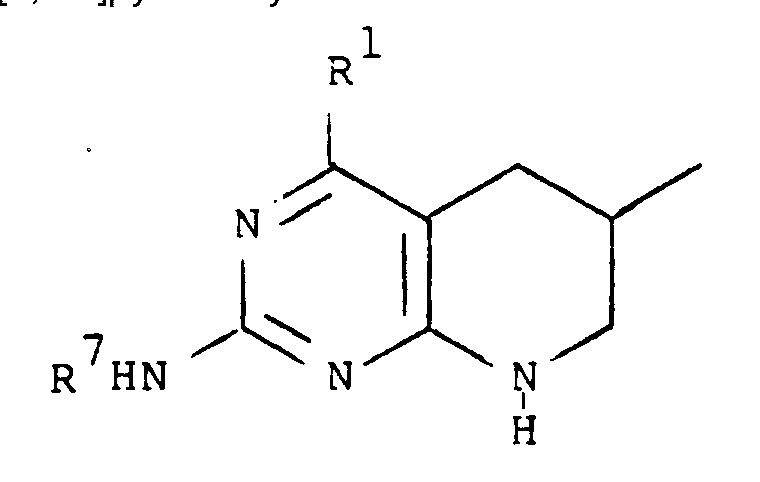
can be produced by independent hydrogenation of the corresponding compound of Formula II wherein R⁴ is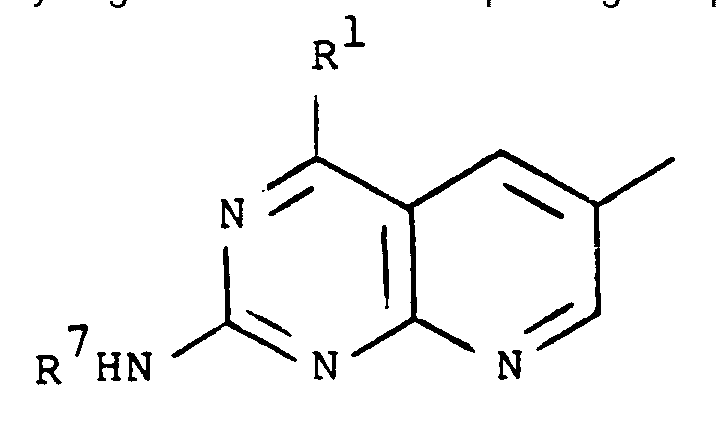
Alternatively, a 5,6,7,8-tetrahydropyrido[2,3-d]pyrimidinyl intermediate of Formula II can be formed directly in the hydrogenation of the pyrido[2,3-d]pyrimidine intermediate of Formula III through the use of more vigorous conditions, such as increasing the hydrogenation time, increasing the pressure and/or raising the temperature. - The intermediate of Formula III can be prepared in several ways. In one embodiment, a benzoic acid derivative

is coupled with a protected glutamic acid derivative of the formula
utilizing conventional condensation techniques for forming peptide bonds, such as activation of the carboxylic acid through formation of the mixed anhydride, treatment with DCC, or use of diphenylchloro-phosphonate. - Alternatively an aldehyde of the formula

(see Taylor et al., J. Org. Chem, 1983, 48, 4852) can be coupled with a Wittig reagent of the formula
(see Yan, J. Het. Chem., 1979, 16, 541) in the presence of sodium hydride, or another strong non-nucleophilic base, in a solvent such as N-methylpyrrolidone or dimethylformamide. The reverse reaction also can be employed, namely the reaction of a Wittig reagent of the formula
with a N-(4-formyl- or 4-alkanoylbenzoyl)-L-glutamic acid in which the carboxylic acid groups are protected. - The benzoic acid derivative of Formula IV can be prepared by cyclization of a 4-[1-(2-substituted 3-cyano-pyridin-5-yl)alk-1-en-2-yl]benzoate of the formula

in which R⁸ is amino or 4-nitrophenylthio, with guanidine in t-butanol and an equimolar amount of an alkali metal t-butoxide such as sodium or potassium t-butoxide. Generally, the benzoate ester is a t-butyl ester. Other alkoxide-alcohol combinations can also be used for the guanidine cyclization reaction, but care should be taken to minimize transesterification. The product of this cyclization is a 4-[1-(2,4-diaminopyrido[2,3-d]pyrimidin-6-yl)alk-en-2-yl]benzoate of the formula
The benzoate of Formula X can be hydrolyzed with acid such as aqueous formic acid to yield the corresponding benzoic acid derivative of Formula IV in which R¹ is amino and R⁷ is hydrogen. The 2,4-diamino compounds of Formula IV are converted to the corresponding 2-amino-4-hydroxy compound through treatment with base. It is desirable first to protect the 2-amino group through conversion to the acetamido group. Hence treatment with acetic anhydride in the presence of a hydrogen acceptor such as 4-dimethylaminopyridine results in acylation of the 2-amino group and formation of a benzoic acid mixed anhydride, the latter being hydrolyzed with base to regenerate the free benzoic acid derivative of Formula IV. Treatment with base such as 1 N sodium hydroxide then generates the corresponding 4-hydroxy compound. - Intermediate IX also can be prepared through use of a Wittig reagent. Thus [2-(4-nitrophenylthio)-3-cyanopyridin-5-ylmethyl] triphenylmethylphosphonium bromide can be obtained according to Taylor et al., J. Org. Chem., 1983, 48, 4852 by condensation of 2-methyl-3-ethoxyacrolein and alpha-cyanothioacetamide to yield 3-cyano-5-methyl-2(1H)pyridinethione, treatment of the product with 4-nitrofluorobenzene to yield 2-(4-nitrophenylthio)-3-cyano-5-methylpyridine, bromination with N-bromosuccinimide to yield 2-(4-nitrophenylthio)-3-cyano-5-bromomethylpyridine, and addition of triphenylphosphine. This compound is then coupled with a compound of the formula

in which R³ is as previously defined. - Amino and carboxylic acid protecting groups are described for example by Greene in "Protective Groups in Organic Synthesis", John Wiley & Sons, Inc., 1981, and McOmie in "Protective Groups in Organic Chemistry", Plenum Press, 1983.
- The compounds of Formula IA and IB can be used, alone or in combination, to treat neoplasms which in the past have been treated with methotrexate, including choriocarcinoma, leukemia, adenocarcinoma of the female breast, epidermid cancers of the head and neck, squamous or small-cell lung cancer, and various lymphosarcomas. The compounds can also be used to treat mycosis fungoides and psoriasis which are responsive to methotrexate.
- The compounds may be administered either orally or preferably parenterally, alone or in combination with other anti-neoplastic agents, steroids, etc., to a mammal suffering from neoplasm and in need of treatment. Parenteral routes of administration include intramuscular, intrathecal, intravenous or intraarterial. In general, the drug is administered in much the same fashion as methotrexate, but because of its different mode of action N-(4-[2-(2-amino-4-hydroxy-5,6,7,8-tetrahydropyrido[2,3-d]pyrimidin-6-yl)ethyl]benzoyl)-L-glutamic acid can be administered in higher dosages than those usually employed with methotrexate Leucovorin rescue is not needed. Dosage regimens must be titrated to the particular neoplasm, the condition of the patient, and the response but generally doses will be from about 10 to about 100 mg/day for 5-10 days or single daily administration of 250-500 mg, repeated periodically; e.g. every 14 days. Oral dosage forms include tablets and capsules containing from 1-10 mg of drug per unit dosage. Isotonic saline solutions containing 20-100 mg/ml can be used for parenteral administration.
- The following examples will serve to further illustrate the invention. In the NMR data, "s" denotes singlet, "d" denotes doublet, "t" denotes triplet, "q" denotes quartet, "m" denotes multiplet, and "br" denotes a broad peak.
-
- A. A mixture of 60.00 g (0.221 mol) of 3-cyano-2-(4-nitrophenylthio)-5-methylpyridine, 39.37 g (0.221 mol) of N-bromosuccinimide, 3.0 g of benzoyl peroxide and 60 mL of benzene was refluxed for 16 hours while being irradiated with a 275-W sunlamp. The solvent was removed under reduced pressure and the residue was shaken with a mixture of 1 L of water and 1 L of methylene chloride. The organic layer was separated, washed with 1 L of water, dried over anhydrous magnesium sulfate, and filtered. Removal of the solvent by evaporation under reduced pressure yielded 3-cyano-2-(4-nitrophenylthio)-5-bromomethylpyridine which can be used in the following step without further purification.
- B. The solid obtained in Part A was stirred at room temperature with a solution of 58.01 g (0.221 mol) of triphenylphosphine in 500 mL of benzene. Filtration of the reaction mixture gave 77.63 g of [3-cyano-2- (4-nitrophenylthio)-5-pyridinylmethyl]triphenylphosphonium bromide.
Stirring of the mother liquor at room temperature for 6 hours afforded an additional 5.67 g, (total yield 83.30 g, 62%) . Recrystallization from acetonitrile gave [3-cyano-2-(4-nitrophenylthio)-5-pyridinylmethyl]triphenylphosphonium bromide as light yellow crystals, mp < 200°C, with resolidification, mp 253-256°C with dec. - C. Alternatively, 3-cyano-2-(4-nitrophenylthio)-5-bromomethylpyridine is allowed to react in tetrahydrofuran with tri-(n-butyl)phosphine for ten hours. Following the addition of ether, the solid which forms is collected by filtration and washed with 1:1 tetrahydrofuran:ether to yield [3-cyano-2-(4-nitrophenylthio)pyridin-5-ylmethyl]-tri-(n-butyl)phosphonium bromide as a white solid; mp 175-176°C; NMR (CDCl₃, 80 MHz) d 0.85-2.63(m, 27H), 4.76(d, 2H, J=15.4 Hz), 7.74(d, 2H, J=9.0 Hz), 8.26(d, 2H, J=9.0 Hz), 8.55 (brs, 1H), 8.79 (brs, 1H); IR (KBr) 2950, 2860, 2220, 1595, 1575, 1515, 1390, 1340, 1075 and 845 cm⁻¹; HRMS 471.2116(M⁺-HBr), Calc'd. for C₂₅H₃₄N₃O₂ PS471.2109.
-
- A. A mixture of 4.544 g (7.42 mmol) of [3-cyano-2-(4-nitrophenylthio)-5-pyridinylmethyl]triphenylphosphonium bromide, 0.751 g (7.42 mmol) of triethylamine and 50 mL of chloroform was stirred at room temperature for 15 minutes and 1.322 g (7.42 mmol) of 4-ethoxycarbonylbenzaldehyde then were added. After stirring at room temperature for 96 hours, 100 mL of water were added, the mixture was filtered, and the organic layer was separated and washed twice with 100 mL portions of water, dried and filtered. Evaporation of the filtrate under reduced pressure gave a residue which was chromatographed on silica gel. Unreacted aldehyde was eluted with 2:1 petroleum ether:benzene, while the title compound, alternatively named as 2-(4-nitrophenylthio)-3-cyano-5-(4-ethoxycarbonylstyryl)pyridine, was eluted with benzene. Evaporation of the benzene eluate gave 2.82 g (88%) of 3-cyano-2-(4-nitrophenylthio)-5-[2-(4-ethoxycarbonylphenyl)ethenyl]pyridine as a light yellow solid. The product turns from a solid to a gum below 100°C and then to a clear liquid between 180 and 220°C; NMR (Me₂SO-d₆) delta 1.34 (t, 3H, J=6.3 Hz), 4.32 (q, 2H, J-6.3 Hz), 6.73 (d, 1H, J=13 Hz), 6.99 (d, 1H, J=13 Hz), 7.27 (d, 2H, J=9Hz), 7.74, 7.85, 7.94 (dd, 2H, 2H), 8.26, 8.31 (dd, 2H, 1H), 8.38 (d, 1H, J=1.8 Hz); IR (KBr) 2220, 1707, 1605, 1597, 1575, 1512, 1344, 1295-1277, 1174 cm⁻¹.
Anal.: Calc'd. for C₂₃H₁₇N₃O₄S: C, 64.08; H, 3.97; N, 9.74; S, 7.43. Found: C, 63.82; H, 4.01; N, 9.51; S, 7.38. - B. 3-Cyano-2-(4-nitrophenylthio)-5-[2-(4-tert-butoxycarbonylphenyl)ethenyl]pyridine was prepared in 81% yield by the above method utilizing however 4-(tert-butoxycarbonyl)benzaldehyde in place of 4-ethoxycarbonylbenzaldehyde; mp indefinite (cis-trans mixture); NMR (CDCl₃) delta 1.62 (s, 9H), 6.43 (d, 1H, J=13 Hz), 6.90 (d, 1H, J=13 Hz), 7.24 (d, 2H, J=9 Hz), 7.69 (d, 2H, J=8.1 Hz), 7.76 (d, 1H, J=2.7 Hz), 7.92 (d, 2H, J=8.1 Hz), 8.22 (d, 2H, J=9 Hz), 8.34 (d, 1H, J=2.7 Hz); IR (KBr) 2220, 1707, 1600, 1577, 1518, 1341, 1290, 1163 cm⁻¹.
Anal.: Calc'd. for C₂₅H₂₁N₃O₄S: C, 65.35; H, 4.61; N, 9.14; S, 6.98. Found: C, 65.28; H, 4.68; N, 9.20; S, 6.93. - In a similar fashion by substituting a 4-alkoxycarbonylacetophenone or a 4-alkoxycarbonylpropiophenone for 4-ethoxycarbonylbenzaldehyde, there is respectively obtained the corresponding 3-cyano-2-(4-nitrophenylthio)-5-[2-(4-alkoxycarbonylphenyl)prop-1-enyl]pyridine and 3-cyano-2-(4-nitrophenylthio)-5-[2-(4-alkoxycarbonylphenyl)but-1-enyl]pyridine compounds. This can be exemplified as follows:
- To a solution of 18.89 g of [3-cyano-2-(4-nitrophenylthio)-5-pyridinylmethyl]-tri-(n-butyl)phos phonium bromide in 150 mL of dry methylene chloride were added in several small portions 5.36 mL of 1,5-diazabicyclo[5.4.0]undec-5-ene. After stirring the reaction mixture under a nitrogen atmosphere for 15 minutes, 7.53 g of 4-(t-butoxycarbonyl)acetophenone (alternatively named as tert-butyl 4-acetylbenzoate) were added. The mixture was heated under reflux for 72 hours, cooled to room temperature, and extracted with a saturated sodium chloride solution. The extracts were dried over anhydrous sodium sulfate and then chromatographed on flash silica gel using methylene chloride as the eluent. The eluate was concentrated under reduced pressure and the residue was triturated with ether. The resulting solid was collected by filtration to yield 5.64 g (35%) of trans-3-cyano-2-[(4-nitrophenylthio)]-5-[2-(4-tert-butoxycarbonylphenyl)prop-1-enyl]pyridine as a pale yellowish solid: mp 180-181.5°C (benzene-ether); NMR (CDCl₃, 250 MHz) d 1.61 (s, 9H), 2.29 (d, 3H, J=1.23 Hz), 6.70 (brs, 1H), 7.52 (d, 1H, J=8.62 Hz), 7.74 (d, 1H, J=8.84 Hz), 7.92 (d, 1H, J=2.09 Hz), 8.00 (d, 1H, J=8.62 Hz), 8.27 (d, 1H, J=8.84 Hz), 8.53 (d, 1H, J=2.09 Hz); IR (KBr) 3060, 2970, 2220, 1695, 1595, 1515, 1425, 1380, 1365, 1340, 1290, 1160, 1110, 1010 and 840 cm⁻¹.
Anal. Calc'd. for C₂₆H₂₃N₃O₄S: C, 65.94; H, 4.90; N, 8.87; S, 6.77. Found: C, 66.88; H, 4.64; N, 8.51; S, 6.77. - Concentration of the filtrate under reduced pressure and trituration of the residue, followed by filtration and washing with ether, yielded 2.08 g (13%) of the cis-3-cyano-2-(4-nitrophenylthio)-5-[2-(4-tert-butoxycarbonylphenyl)prop-1-enyl]pyridine as a pale yellowish solid, mp 126-127°C (ethyl acetate-hexane); NMR (CDCl₃, 250 MHz) d 1.60 (s, 9H), 2.25 (d, 3H, J=1.41 Hz), 6.39 (brs), 7.18 (d, 1H, J=8.28 Hz), 7.41 (d, 1H, J=2.22 Hz), 7.63 (d, 1H, J=8.91 Hz), 7.95 (d, 1H, J=8.28 Hz), 8.09 (d, 1H, J=2.22 Hz), 8.23 (d, 1H, J=8.91 Hz); IR (KBr) 3110, 2970, 2225, 1720, 1520, 1345, 1165, 1105, 920 and 840 cm⁻¹.
Anal. Calc'd. for C₂₆H₂₃N₃O₄S: C, 65.94; H, 4.90; N, 8.87; S, 6.77. Found: C, 65.92; H, 4.81; N, 8.62; S, 656. - The 4-(t-butoxycarbonyl)acetophenone utilized in the foregoing procedure can be prepared as follows:
To a suspension of 1.64 g of 4-acetylbenzoic acid in 30 mL of dry benzene were added 3.0 mL of freshly distilled thionyl chloride. The mixture was heated under reflux for 5 hours. The reaction mixture was cooled to room temperature and the solvent was removed under reduced pressure. The resulting residue was dissolved in 5 mL of dry methylene chloride and the solution was added to a mixture of 1.11 g of dry tert-butanol and 1.42 g of dry pyridine. After stirring the reaction mixture under a nitrogen atmosphere for 15 hours, the mixture was diluted with methylene chloride and extracted with water. The organic solution was dried over anhydrous sodium sulfate and the solvent was removed under reduced pressure. The residue was chromatographed on a column of silica gel using a 20% ethyl acetate-hexane mixture as the eluent. The major fraction isolated from the column contained 2.01 g (91%) of 4-(t-butoxycarbonyl)acetophenone as a white solid: mp 56.5-57.5°C; NMR (CDCl₃ 80 MHz) d 1.61 (s, 9H), 2.63 (s, 3H, 7.95 (d, 2H, J=9.0 Hz), 8.09 (d, 2H, J=9.0 Hz); IR (KBr) 2980, 2930, 1720, 1680, 1400, 1365, 1295, 1250, 1165, 1100, 845, 760 and 690 cm⁻¹. - Alternatively, 4-(t-butoxycarbonyl)acetophenone can be isolated by distillation under reduced pressure, bp 90-100°C/0.1 mm. Analogously 4-(t-butoxycarbonyl)propiophenone is prepared and converted to 3-cyano-2-(4-nitrophenylthio)-5-[2-(4-tert-butoxycarbonylphenyl)but-1-enyl]pyridine.
- A suspension of 2.00 g (4.64 mmol) of 3-cyano-2-(4-nitrophenylthio)-5-[2-(4-ethoxycarbonylphenyl)ethenyl]pyridine, 1.553 g (6.95 mmol) of cupric bromide, and 50 mL of liquid ammonia was stirred in a pressure tube at room temperature for 13 days. Evaporation of the ammonia afforded a dark residue which was chromatographed over magnesium silicate using methylene chloride as eluant. The eluate was removed by evaporation under reduced pressure and the residue chromatographed on silica gel. Unreacted starting material was eluted with benzene while 0.87 g (64%) of the product, which can be alternatively named as 2-amino-3-cyano-5-(4-ethoxycarbonylstyryl)pyridine, was eluted with ethyl acetate and obtained by evaporation of the ethyl acetate solvent as a light yellow solid, mp 135-141.5°C; NMR (Me₂SO-d₆) delta 1.39 (t, 3H, J-6.3Hz), 4.38 (q, 2H, J=6.3 Hz), 6.67 (m, 2H), 7.10 (br, 2H), 7.45 (d, 2H, J=9 Hz), 7.71 (d, 1H, J=3.6 Hz), 7.97 (d, 2H, J=9 Hz), 8.11 (d, 1H, J=3.6 Hz); IR (KBr) 3155, 2218, 1715, 1650-1645, 1593, 1491, 1277, 1100 cm⁻¹.
Anal. Calc'd. for C₁₇H₁₅H₃O₂: C, 69.61; H, 5.16; N, 14.33. Found: C, 69.37; H, 5.25; N, 14.22. - By substituting an equivalent amount of 3-cyano-2-(4-nitrophenylthio)-5-[2-(4-tert-butoxycarbonylphenyl)ethenyl]pyridine in the foregoing procedure there is obtained 2-amino-3-cyano-5-[2-(4-tert-butoxycarbonylphenyl)ethenyl]pyridine, which can be alternatively named as 2-amino-3-cyano-5-(4-t-butoxycarbonylstyryl)pyridine; yield 1.14 g (84%) of light yellow crystals, mp 190-195°C; NMR (Me₂SO-d₆) delta 1.57 (s, 9H), 6.57-6.60 (m, 2H), 7.00 (br, 2H), 7.35 (d, 2H, J=8.1 Hz), 7.65 (d, 1H, J=2.7 Hz), 7.84 (d, 2H, J=8.1 Hz), 8.00 (d, 1H, J=2.7 Hz); IR (KBr) 3460, 3360, 2215, 1707, 1623, 1480, 1300, 1287, 1158 cm⁻¹.
Anal. Calc'd. for C₁₉H₁₉N₃O₂: C, 71.00; H, 5.96; N, 13.07. Found: C, 70.83; H, 6.03; N, 12.83. - To a solution of 4.54 mmol of guanidine as the free base (obtained from 0.433 g (4.54 mmol) of guanidine hydrochloride and 0.114 g of sodium in 25 mL of dry tert-butanol) was added 1.325 g (4.12 mmol) of 2-amino-3-cyano-5-[2-(4-tert-butoxyphenyl)ethenyl]pyridine. The deep red suspension was heated at reflux under dry nitrogen for 8 hours. The reaction mixture was cooled to room temperature and filtered. The precipitate was washed successively with water, acetone, and ether and was then dried under reduced pressure to yield 0.911 g (61%) of the title compound, which can be alternatively named as 2,4-diamino-6-(4-tert-butoxycarbonylstyryl)-5-deazapteridine, as a light yellow solid, mp >350°C; NMR (Me₂SO-d₆) delta 1.55 (s, 9H), 6.42 (br, 2H), 6.73 (m, 2H), 7.30-8.00 (br, 2H), 7.35 (d, 2H, J=9 Hz), 7.81 (d, 2H, J=9 Hz), 8.34 (m, 2H); IR (KBr) 3320-3300, 3200-3140, 2970, 1718, 1626, 1610-1600, 1550, 1450-1445, 1288, 1167, 812 cm⁻¹.
Anal.: Calc'd. for C₂₀H₂₁N₅O₂: C, 66.10; H, 5.82; N, 19.27. Found: C, 65.88; H, 5.86; N, 18.98. -
- A. A solution of 1.27 g of 2,4-diamino-6-[2-(4-tert-butoxycarbonylphenyl)ethenyl]pyrido[2,3-d]pyrimidine and 10 mL 88% formic acid was stirred at room temperature. A yellow solid started to form after about 12 hours and after 4 days of stirring, the reaction mixture was filtered. The collected solid was washed well successively with water, methanol, and acetone and was then dried under reduced pressure to give 0.85 g (79%) of the title compound, which can be alternatively named as 2,4-diamino-6-(4-carboxystyryl)-5-deazapteridine, mp >300°C.
- B. Alternatively, 0.48 g of 2,4-diamino-6-[2-(4-tert-butoxycarbonylphenyl)ethenyl]pyrido[2,3-d]pyrimidine was added to a saturated solution of hydrogen chloride in 20 mL of nitromethane at 0°. The reaction mixture quickly became viscous and turned a deep yellow color and after a few minutes of stirring, a granular solid formed. After 1 hour of stirring, 50 mL of ether were added and the precipitate was collected by filtration. The collected solid was dissolved in 50 mL of 10% aqueous sodium carbonate. Acidification with acetic acid then resulted in the separation of a yellow solid which was collected by filtration and dried under reduced pressure; yield 0.31 g (92%) of 2,4-diamino-6-[2-(4-carboxyphenyl)ethenyl]pyrido[2,3-d]pyrimidine; NMR (Me₂SO-d₆) delta 6.75 (s, 2H), 7.35, 7.85 (AB q, 4H, J=9 Hz), 8.38 (s, 2H); IR (Nujol) 3400-2300, 3380, 3150, 1700, 1650, 1630, 1590 cm⁻¹.
- To a suspension containing 1.93 g of guanidine hydrochloride in 75 mL of dry tert-butanol at 50°C under a nitrogen atmosphere was added 0.50 g of sodium metal. After all the sodium was dissolved, 7.97 g of trans-3-cyano-2-(4-nitrophenylthio)-5-[2-(4-tert-butoxycarbonylphenyl)prop-1-enyl]pyridine was added. The mixture was heated under reflux for 3 hours, cooled to room temperature, diluted with ether, and filtered. The solid was washed with water and acetone, and then dried under reduced pressure to yield 4.66 g (73%) of the title compound as a pale yellowish solid; mp >300°C; NMR (DMSO-d₆, 80 MHz) d 1.56(s, 9H), 2.23 and 2.29 (brs, 3H), 6.57 and 6.99 (brs, 1H), 7.25-8.73 (m, 8H); IR (KBr) 3340, 3130, 1710, 1640, 1608, 1540, 1450, 1365, 1340, 1290, 1165, 1110, 840 and 810 cm⁻¹.
- A suspension containing 4.58 g of 2,4-diamino-6-[2-(4-tert-butoxycarbonylphenyl)prop-1-enyl]pyrido[2,3-d]pyrimidine in 200 mL of a saturated solution of hydrogen chloride gas in nitromethane was stirred at 0°C for 1 hour, and then at room temperature for 3 hours. After dilution with ether, the reaction mixture was filtered and the collected solid was washed successively with water, methanol, and acetone and then dried under reduced pressure to give 3.90 g (100%) of 2,4-diamino-6-[2-(4-carboxyphenyl)prop-1-enyl]pyrido[2,3-d]pyrimidine. NMR (DMSO-d₆, 80 MHz) d 2.31 (brs, 3H), 6.77 and 7.07 (brs, 1H), 7.74 (d, 2H, J=8.5Hz), 7.98 (d, 2H, J=8.5 Hz), 8.26, (d, 1H, J=2.0 Hz), 8.74 d, 1H, J=2.0Hz).
-
- A. A suspension of 1.0 g of 2,4-diamino-6-[2-(4-carboxyphenyl)ethenyl]pyrido[2,3-d]pyrimidine in 30 mL of 1 N aqueous sodium hydroxide was heated under reflux under nitrogen for 3 hours. The resulting homogenous orange solution was cooled to room temperature, acidified with 6 mL of glacial acetic acid, and the resulting yellow precipitate collected by filtration. The filter cake was washed successively with water, methanol, acetone and ether and was then dried under reduced pressure to give 0.88 g (88%) of the title compound, which can be alternatively named as either 6-[2-(4-carboxyphenyl)ethenyl]-5-deazapterin or 6-(4-carboxystyryl)-5-deazapterin, as a microcrystalline yellow powder, mp >250°C; NMR (TFA-d₁ delta 6.8, 7.25 (AB q, 2H, J=12 Hz), 7.45, 8.2 (AB q, 4H, J=9 Hz), 8.55 (s, 1H), 8.85 (s, 1H); IR (Nujol) 3500-2500 (br), 1670, 1625, 1600 cm⁻¹.
- B. In a similar fashion, 2,4-diamino-6-[2-(4-carboxyphenyl)prop-1-enyl]pyrido[2,3-d]pyrimidine is converted to 2-amino-4-hydroxy-6-[2-(4-carboxyphenyl)prop-1-enyl]pyrido[2,3-d]pyrimidine, mp >250°C; NMR (DMSO-d₆, 80 MHz) d 2.28 and 2.30 (brs, 3H), 6.77 and 7.06 (brs, 1H), 7.72 (d, 2H, J=8.5Hz), 7.97 (d, 2H, J=8.5 Hz), 8.27 (d, 1H, J=2.0 Hz), 8.72 (d, 1H, J=2.0 Hz).
- A suspension of 0.88 g of 2-amino-4-hydroxy-6-[2-(4-carboxyphenyl)ethenyl]pyrido[2,3-d]pyrimidine in 20 mL of acetic anhydride containing 0.05 g of 4-dimethylaminopyridine was heated under nitrogen at 120°C for 3 hours. The reaction mixture was cooled to room temperature. Fifty milliliters of ether were added and the resulting yellow solid was collected by filtration to yield 0.95 g (84%) of the title compound; mp >300°C; IR (Nujol) 3350, 3150, 1800, 1670, 1600 cm⁻¹.
- To a suspension of 0.95 g of 2-acetamido-4-hydroxy-6-[2-(4-acetoxycarbonylphenyl)ethenyl]pyrido[2,3-d]pyrimidine in 50 mL of water was added 1 N aqueous sodium hydroxide until a homogenous solution was obtained. Acidification with acetic acid resulted in the formation of a yellow precipitate which was collected by filtration. The filter cake was washed sequentially with water, methanol, acetone and ether. The residual solid was recrystallized from DMF to give 0.65 g (77%) of the title compound, which can be alternatively named as 2-acetamido-6-(4-carboxystyryl)-5-deaza-4(3H)-pteridinone, as a microcrystalline yellow solid, mp >300°C; NMR (TFA-d₁) delta 2.5 (s, 3H), 6.85, 7.32 (AB q, 2H, J=12 Hz), 7.45, 8.18 (AB q, 4H, J=9Hz), 8.65 (s, 1H), 9.02 (s, 1H); IR (Nujol) 3300-2200 (br), 1685, 1655, 1630, 1600, 1565 cm⁻¹. MS: Calc'd. for C₁₈H₁₄N₄O₄: 350. Found: m/e 350 (base), 308.
- By subjecting 2-amino-4-hydroxy-6-[2-(4-carboxyphenyl)prop-1-enyl]pyrido[2,3-d]pyrimidine to the procedures of Examples 9 and 10, there was obtained 2-acetamido-4-hydroxy-6-[2-(4-carboxyphenyl)prop-1enyl]pyrido[2,3-d]pyrimidine, mp >250°C; in an overall yield of 45%; NMR (CF₃CO₂D/DMSO-d₆, 80 mHz) d 2.15 (s, 3H), 2.22 (s, 3H), 6.72 (brs, 1H), 7.45 (d, 2H, J=8.4 Hz), 7.92 (d, 2H, J=8.4 Hz), 8.65 (d, 1H, J=2.0 Hz), 8.98 (d, 1H, J=2.0 Hz).
-
- A. To a solution of 1.0 g (0.0033 mol) of 2,4-diamino-6-[2-(4-carboxyphenyl)ethenyl]pyrido[2,3-d]pyrimidine and 1 g of N-methylmorpholine in 120 mL of N-methylpyrrolidone cooled to 5°C is added, in a dropwise fashion, 1.4 g (0.0048 mol) of diphenyl chlorophosphonate. The reaction mixture was stirred for 1 hour and an additional 0.5 mL of N-methylmorpholine were added, followed by 1.1 g (0.0048 mol) of diethyl L-glutamate hydrochloride. The reaction mixture was stirred overnight at room temperature and the solvent then was removed under reduced pressure. The residual solid was washed with 50 mL of dry ether, triturated with 100 mL of 1 N aqueous sodium hydroxide, and the resulting suspension centrifuged. The collected solid was dissolved in 200 mL of 3:1 chloroform:methanol and filtered through Florisil. The filtrate was evaporated to a small volume; 10 g of Florisil were added, and the resulting impregnated Florisil added to the top of a Florisil column which was then eluted sequentially with ethyl acetate followed by ethyl acetate containing increasing quantities of methanol (9:1, 3:1, and 1:1). The title compound was collected in the 3:1 and 1:1 fractions. Evaporation of the combined eluates gave a glassy material which was triturated with ether and then collected by filtration; yield 0.41 g (26%), mp 183-185°C; NMR (Me₂SO-d₆/TFA) delta 1.25-1.45 (overlapping t, 6H, J=7 Hz), 2.25-2.50 (m, 2H), 2.5-2.8 (m, 2H), 4.05-4.45 (overlapping q, 4H, J=7 Hz), 4.8-5.0 (m, 1H), 6.8, 7.2 (AB q, 2H, J=16 Hz), 7.4, 7.85 (AB q, 4H, J=9 Hz), 8.6 (s, 1H), 9.05 (s, 1H); IR (Nujol) 3500-3000, 1730, 1635, 1605 cm⁻¹. MS: Calc'd. for C₂₅H₂₈N₆O₅: 492. Found: m/e 492, 290, 94, 84.
- B. Alternatively the triphenylphosphonium salt [prepared from triphenylphosphine and diethyl 4-bromomethylbenzoylglutamate (7.86 g, 0.012 mol) following the method of Yan et al., J. Het. Chem., 16, 541 (1979)] was added portionwise to a slurry of 0.4 g (0.01 mol) of sodium hydride (60% suspension in oil) in 70 mL of dry N-methylpyrrolidone over a period of 10 minutes. The resulting red reaction mixture was stirred at room temperature under nitrogen for 1 hour. To this in situ Wittig reagent were added 2.27 g (0.012 mol) of 2,4-diamino-6-formylpyrido[2,3-d]pyrimidine [prepared by the method of Baldwin et al., J. Org. Chem. 43, 2529 (1978)]. The resulting slurry was stirred at room temperature under nitrogen for 3 weeks. The solvent was then evaporated under reduced pressure, the residual solid triturated with benzene to remove triphenylphosphine oxide, and the purified solid collected by centrifugation. The solid was resuspended in water, filtered, and the collected solid dissolved in 200 mL of chloroform:methanol (1:2). Florisil (10 g) was added, the mixture was evaporated to dryness, and the impregnated Florisil residue applied to the top of a Florisil column which was then eluted with ethyl acetate containing increasing quantities of methanol (from 9:1 to 1:1). Fractions containing eluted material were combined and were shown to contain two products (TLC). The mixture was chromatographed again on silica gel utilizing chloroform and methanol as eluants. The initial fraction was a phosphorane and the product was thereafter eluted and obtained in a yield of 1.7 g (34.5%) in form identical to that obtained in part A of this example.
- C. Following the procedure of part A of this example but utilizing 2,4-diamino-6-[2-(4-carboxyphenyl)prop-1-enyl]pyrido[2,3-d]pyrimidine, there can be obtained diethyl N-(4-[2-(2,4-diaminopyrido[2,3-d]pyrimidin-6-yl)prop-1-enyl]benzoyl)-L-glutamate.
- Alternatively, 2.2 g (0.0074 mol) of di-tert-butyl L-glutamate hydrochloride were allowed to react with 1.5 g (0.0049 mol) of 2,4-diamino-6-[2-(4-carboxyphenyl)ethenyl]pyrido[2,3-d]pyrimidine, to yield di-tert-butyl N-(4-[2-(2,4-diaminopyrido[2,3-d]pyrimidin-6-yl)ethenyl]benzoyl)-L-glutamate in a yield of 1.3 g (48%), mp >300°C. NMR (CDCl₃/CD₃OD) delta 1.47, 1.52 (2s, 18H), 2.0-2.6 (m, 4H), 4.5-7.0 (m, 1H), 6.8 (br, s, 2H), 7.35, 7.78 (AB q, 4H, J=9 Hz), 8.38 (s, 1H), 8.5 (s, 1H); IR (Nujol) 3350, 3180, 1725, 1640, 1605 cm⁻¹. MS: Calc'd.: for C₂₉H₃₆N₆O₅: 548. Found: m/e 548, 446, 290.
-
- To an ice cold solution of 1.5 g (0.0043 mol) of 2-acetamido-4-hydroxy-6-[2-(4-carboxyphenyl)ethenyl]pyrido[2,3-d]pyrimidine in 40 mL of N-methylpyrrolidone containing 1.4 mL of N-methylmorpholine was added 1.72 g (0.0064 mol) of phenyl N-phenylphosphoramidochloridate in a single portion. The resulting mixture was stirred at 0°C for 30 minutes. Diethyl L-glutamate hydrochloride (1.53 g, 0.0064 mol) was then added and the reaction mixture was stirred at room temperature overnight. The solvent was evaporated under reduced pressure and the residual solid triturated with 50 mL of 1 N aqueous sodium carbonate. The mixture was filtered and the collected solid dissolved in 20 mL of chloroform. The chloroform solution was dried over anhydrous magnesium sulfate and filtered. The filtrate was evaporated to dryness and chromatographed on silica gel. Elution with chloroform:methanol (95:5) gave 1.52 g (66%) of the title compound, which may be alternatively named as diethyl 2-acetyl-5,10-dideaza-9,10-didehydrofolate, mp >250°C; NMR (CDCl₃Me₂SO-d₆) delta 1.15-1.45 (2t, 6H, J=6 Hz), 2.0-2.65 (m, 4H), 2.3 (s, 3H), 4.0-4.35 (2q, 4H, J=6 Hz), 4.5-4.75 (m, 1H), 6.7, 6.9 (AB q, 2H, J=15 Hz), 7.33, 7.84 (AB q, 4H, J=9 Hz), 8.25-8.38 (m, 2H), 8.62 (d, 1H, J=2Hz), 11.5-12.5 (br, 2H); IR (Nujol) 3320, 3150, 1730, 1680, 1630, 1600 cm⁻¹.
Anal.: Calc'd. for C₂₇H₂₉N₅O₇: C, 60.56; H, 5.42; N, 13.08. Found: C, 60.26; H, 5.45; N, 12.84. - To a solution of 0.2 g of 2-acetamido-4-hydroxy-6-[2-(4-carboxyphenyl)prop-1-enyl]pyrido[2,3-d]pyrimidine in 50 mL of N-methylpyrrolidinone containing 0.18 g of N-methylmorpholine was added 0.22 g of phenyl N-phenylphosphoramidochloridate in a single portion. After stirring the mixture at room temperature for 1 hour, 0.20 g of diethyl L-glutamate was added. The reaction mixture was stirred overnight, the solvent was removed under reduced pressure and the residue was triturated with chloroform. The mixture was filtered and the filtrate was evaporated under reduced pressure. The residue was subjected to preparative thin layer chromatography on silica gel using a 5% methanol in chloroform mixture as the eluent. This gave 74.6 mg (25%) of the title compound as a pale yellowish solid; NMR (CDCl₃, 250 MHz) d 1.22 (t, 3H, J=7.1 Hz), 1.30 (t, 3H J=7.1 Hz), 2.11-2.57 (m, 10H), 4.14 (q, 2H, J=7.1 Hz), 4.24 (q, 2H, J=7.1 Hz), 4.75-4.83 (m, 1H), 6.86 (brs, 1H), 7.18 (brs, 1H), 7.57 (d, 2H, J=8.42 Hz), 7.84 (d, 2H, J=8.42 Hz), 8.50 (d, 1H, J=2.01 Hz), 8.96 (brs, 1H), 10.34 (brs, 1H).
- A solution of 0.9 g of diethyl N-(4-[2-(2,4-diaminopyrido[2,3-d]pyrimidin-6-yl)ethenyl]benzoyl)-L-glutamate in 40 mL of trifluoroacetic acid was hydrogenated under 55 psi of hydrogen for 24 hours using 2.5 g of Pd/C as catalyst. The catalyst was removed by filtration through celite and the filtrate was evaporated. The residual solid was triturated with 30 mL of 2 N aqueous sodium carbonate, followed by a water wash. The resulting solid was purified by column chromatography on silica gel. Elution with chloroform:methanol (95:5) afforded a small amount (0.2 g) of the tetrahydro derivative while subsequent elution with chloroform:methanol (1:4) gave 0.52 g (58%) of the title compound, which can be alternatively named as diethyl N-[4-[2-(2,4-diamino-5-deaza-6-pteridyl)ethyl]benzoyl]-L-glutamate; mp >200°C; NMR (Me₂SO-d₆) delta 1.1-1.3 (2t, 6H, J=7 Hz) 1.8-2.6 (m, 4H), 3.05 (s, 4H), 3.1-3.8 (br, 5H), 3.9-4.2 (2q, 4H, J=7 Hz), 4.3-4.5 (m, 1H), 7.35, 7.85 (AB q, 4H, J=9 Hz), 8.6 (br, s, 2H): IR (Nujol) 3320, 3150, 1650 cm⁻¹.
- By repeating the procedure of Example 15 but continuing the hydrogenation for 72 hours, the title compound, which can be alternatively named as diethyl N-(4-[2-(2,4-diamino-5-deaza-5,6,7,8-tetrahydro-6-pteridyl)ethyl]-benzoyl)-L-glutamate, was obtained as a crude product which was chromatographed on silica gel using chloroform:methanol (95:5) to give 0.42 g (31%) of the product as a colorless microcrystalline solid; mp >250°C; NMR (Me₂SO-d₆) delta 1.6, 1.8 (2t, 6H, J=6 Hz), 1.4-3.8 (m, 13H), 4.1 (2q, 4H, J=6 Hz), 4.3-4.6 (m, 1H), 6.8 (s, 2H), 7.35, 7.85 (AB q, 4H, J=9Hz), 8.7 (d, 1H, J=9 Hz); IR (Nujol) 3350, 3150, 1730, 1630 cm⁻¹. MS: Calc'd. for C₂₅H₃₄N₆O₅: 498. Found: m/e 498, 425, 178, 165 (base), 150.
- A solution of diethyl N-(4-[2-(2-acetamido-4-hydroxypyrido[2,3-d]pyrimidin-6-yl)ethenyl]benzoyl)-L-glutamate in 30 mL of trifluoroacetic acid was hydrogenated at 55 psi of hydrogen in the presence of 1.0 g of 5% Pd/C at room temperature for 14 hours. The catalyst was removed by filtration, the filtrate evaporated under reduced pressure, and the residual solid partitioned between 100 mL of chloroform and 50 ml of 2N aqueous sodium carbonate. The organic phase was separated, dried over anhydrous magnesium sulfate, and the solvent removed by evaporation to give a gum which was chromatographed on silica gel. Elution with chloroform:methanol (97:3) gave 0.25 g (56%) of diethyl N-(4-[2-(2-acetamido-4-hydroxypyrido[2,3-d]pyrimidin-6-yl)ethyl]benzoyl)-L-glutamate; mp 215-217°C; NMR (CDCl₃) delta 1.25, 1.35 (2t, 6H, J=6 Hz), 2.1-2.5 (m, 4H), 2.55 (s, 3H), 3.1 (s, 4H), 4.15, 4.25 (2q, 4H, J=6 Hz), 4.6-4.96 (m, 1H), 7.05 (s, 1H), 7.25, 7.75 (AB q, 4H, J=9 Hz), 8.35 (d, 1H, J=3 Hz), 8.77 (d, 1H, J=3 Hz); IR (Nujol) 3200, 3150, 1725, 1675, 1630, 1605 cm⁻¹. Anal.: Calc'd. for C₂₇H₃₁N₅O₇: C, 60.32; H, 5.81; N, 13.03. Found: C, 59.98; H, 6.03; N, 12.92).
- Further elution with 95:5 chloroform:methanol yielded 0.08 g (18%) of the title compound, which can be alternatively named as diethyl 2-acetyl-5,10-dideaza-5,6,7,8-tetrahydrofolate; mp>200°C; NMR (CDCl₃/Me₂SO-d₆) delta 1.24, 1.28 (2t, 6H, J=6 Hz), 1.5-3.3 (m, 13H), 2.18 (s, 3H), 4.1, 4.18 (2a, 4H, J=6 Hz), 4.4-4.7 (m, 1H), 6.2 (s, 1H), 7.28, 7.85 (AB q, 4H, J=9 Hz), 8.4 (d, 1H, J=8 Hz); IR (Nujol) 3320, 3250, 1730, 1630, 1575 cm⁻¹. Anal.: Calc'd. for C₂₇H₃₅N₅O₇: C, 59.87; H, 6.51; N, 12.93. Found: C, 59.66; H, 6.71; N, 12.77.
- A solution of 84.4 mg of diethyl N-(4-[2-(2-acetamido-4-hydroxypyrido[2,3-d]pyrimidin-6-yl) prop-1-enyl]benzoyl)-L-glutamate in 30 mL of trifluoroacetic acid was hydrogenated at 55 psi of hydrogen in the presence of 0.42 g of 5% Pd/C at room temperature for 24 hours. The catalyst was removed by filtration and the filtrate was evaporated under reduced pressure. The resulting residue was taken up in chloroform and was extracted with a saturated sodium bicarbonate solution. The organic layer was dried over anhydrous sodium sulfate and the solvent was removed under reduced pressure. The residue was then subjected to thin layer chromatography using a 5% methanol:chloroform mixture as the eluent. After elution of a first fraction, there was obtained 19.6 mg of the title compound, NMR (CDCl₃ 250 MHz), d 1.20-1.33 (m, overlapping methyls, 9H), 2.45-3.36 (m, 15H), 4.11 (q, 2H, J=7.14 Hz), 4.23 (q, 2H, J=7.10 Hz), 4.89 (m, 1H), 5.44 (brs, 1H), 7.24 (d, 2H, J=7.54 Hz), 7.72 (d, 2H, J=7.54 Hz), 9.77 (brs, 1H), 11.26 (brs, 1H).
- A solution of 0.38 g of diethyl N-(4-[2-(2,4-diaminopyrido[2,3-d]pyrimidin-6-yl)ethyl]benzoyl)-L-glutamate in 50 mL of methanol containing 4.6 mL of 0.5 N aqueous sodium hydroxide was stirred at room temperature for 72 hours. Acetic acid (5 mL) was added, and the resulting white precipitate collected by filtration. The filter cake was washed well with water, methanol, and ether and was dried under reduced pressure to yield 0.15 g (44%) of the title compound, which can be alternatively named as 5,10-dideazaaminopterin; mp >250°C; NMR (TFA-d₁) delta 2.2-2.7 (m, 2H), 2.28; 2.7-2.95 (m, 2H), 5.0-5.2 (m, 1H), 7.35 and 7.85 (AB q, 4H, J=9 Hz), 8.7 (s, 1H), 9.1 (s, 1H).
- Following the procedure of Example 19, hydrolysis of 0.35 g of diethyl N-(4-[2-(2,4-diamino-5,6,7,8-tetrahydropyrido[2,3-d]pyrimidin-6-yl)ethyl]benzoyl)-L-glutamate yielded 0.13 g (42%) of the title compound, which can be alternatively named as 5,10-dideaza-5,6,7,8-tetrahydroaminopterin, mp >250°C.
- A homogeneous solution of 0.175 of diethyl N-(4-[2-(2-acetamido-4-hydroxypyrido[2,3-d]pyrimidin-6-yl)ethyl]benzoyl)-L-glutamate in 50 mL of methanol containing 3 mL of 1N aqueous sodium hydroxide was stirred at room temperature for 72 hours. Addition of 2 mL of acetic acid followed by centrifugation gave 0.125 g (86%) of the title compound, which can be alternatively named as 5,10-dideazafolic acid, as a micro-crystalline colorless solid, mp >200°C; NMR (TFA-d₁) delta 2.3-2.7 (m, 2H), 2.7-3.0 (m, 2H), 3.25 (s, 5H), 4.9-5.25 (m, 1H), 7.35, 7.85 (AB q, 4H, J=9 Hz), 8.50 (s, 1H), 8.90 (s, 1H).
-
- Diethyl N-(4-[2-(2-acetamido-4-hydroxy-5,6,7,8-tetrahydropyrido[2,3-d]pyrimidin-6-yl)ethyl] benzoyl)-L-glutamate was hydrolyzed in an analogous fashion to that described in Example 21 to yield the title compound, which can be alternatively named as 5,10-dideaza-5,6,7,8-tetrahydrofolic acid, in 87% yield; mp >250°C, NMR (TFA) delta 1.7-3.9 (m, 13H), 5.0-5.25 (m, 1H), 7. 45, 7.85 (AB q, 4H, J=9 Hz).
- Similarly obtained from diethyl N-(4-[2-(2-acetamido-4-hydroxypyrido[2,3-d]pyrimidin-6-yl)ethenyl]benzoyl)-L-glutamate was N-(4-[2-(2-amino-4-hydroxypyrido[2,3-d]pyrimidin-6-yl)ethenyl]benzoyl)-L-glutamic acid, mp >200°C.
- A homogeneous solution of 17.5 mg of diethyl N-(4-[2-(2-acetamido-4-hydroxy-5,6,7,8-tetrahydropyrido[2,3-d]pyrimidin-6-yl)propyl]benzoyl)-L-glutamate in 2 mL of methanolic sodium hydroxide solution was allowed to stand at room temperature for 72 hours. Most of the solvent was then removed under reduced pressure and the mixture was diluted with water and acidified with acetic acid. The precipitate was collected by filtration, washed with water, and dried under reduced pressure (0.1 mm) for 48 hours to give 9.7 mg (67%) of the title compound, which may be alternatively named as 5,10-dideaza-10-methyl-5,6,7,8-tetrahydrofolic acid. mp >250°C, NMR delta 0.87-0.88 (brs, 1H each), 1-2.8 (m, 11H), 3.13 (m, 1H), 4.59 (m, 1H), 6.96 (d, 2H, J=9 Hz), 7.34 (d, 2H, J=9 Hz.
- Analogously N-(4-[1-(2-amino-4-hydroxy-5,6,7,8-tetrahydropyrido[2,3-d]pyrimidin-6-yl)but-2-yl]benzoyl)-L-glutamic acid and N-(4-[1-(2,4-diamino-5,6,7,8-tetrahydropyrido[2,3-d]pyrimidin-6-yl)but-2-yl]benzoyl)-L-glutamic acid are prepared.
- In typical models, the indicated tumor cells were implanted subcutaneously in the axillary region of mice. Following intraperitoneal administration of the first compound of Example 22, the length and width of the control tumor (receiving only saline) are measured at the indicated time and compared to those of animals receiving the test compound to calculate percentage of inhibition.
% INHIBITION Tumor System Dose mg/kg Days of Treatment 25 50 100 200 6C3HED Lymphosarcoma 91 100 100 100 8 B-16 98 99 100 100 5 C3H Mammary Adenocarcinoma 86 100 100 100 10 Lewis Lung Carcinoma 58 77 94 100 10 M-5 Ovarian Carcinoma 12 31 54 80 10* Madison Lung 54 72 87 90 10 X5563 Plasma Cell Myeloma 100 100 100 100† 10 * 5 Day Delay † Toxic
| Inhibition of Dihydrofolate Reductase (DHFR) (Kaufman et al., "Methods in Enzymology", Jacobs and Wilcheck, Eds., Academic Press: New York, 1974, pp 272-281) | |
| Compound | IC₅₀M |
| 1 | 4.3x10⁻⁸ |
| 2 | 4.9x10⁻⁵ |
| 3 | 7.1x10⁻⁸ |
| 4 | 5.6x10⁻⁴ |
| Inhibition of Thymidylate Synthetase (Wahba et al., J. Biol. Chem., 1961, 236, p 611) | |
| Compound | IC₅₀M |
| 1 | 9.2x10⁻⁵ |
| 2 | 7.7x10⁻⁵ |
| 3 | 9.2x10⁻⁴ |
| 4 | >1x10⁻³ |

| Inhibition of L1210 murine leukemic cells in tissue culture - see Foley et al., Biochem. Pharmacol., 1967, 16, 658. | |
| Compound | IC₅₀M |
| 1 | 1.7x10⁻⁸ |
| 2 | >10⁻⁴ |
| 3 | 3.3x10⁻⁹ |
| 4 | 5.9x10⁻⁸ |


Claims (20)
- A compound selected from the group consisting of:(ia) pyrido[2,3-d]pyrimidines of the formula:

R¹ is amino or hydroxy;
R³ is hydrogen, methyl, or ethyl; and
the configuration about the carbon atom designated * is L;(ib) 5,6,7,8-tetrahydropyrido[2,3-d]pyrimidineS of the formula:
R¹ is amino or hydroxy;
R³ is hydrogen, methyl, or ethyl; and
the configuration about the carbon atom designated * is L;(ii) the tautomeric forms thereof; and(iii) the pharmaceutically acceptable alkali metal, alkaline earth, non-toxic metal, ammonium, and substituted ammonium salts thereof. - A compound according to claim 1 which is a 5,6,7,8-tetrahydropyrido[2,3-d]pyrimidine of the formula:

- A compound according to claim 2 wherein R³ is hydrogen.
- A compound according to claim 3 wherein R¹ is hydroxy.
- A compound according to claim 1 wherein R³ is hydrogen, and wherein the product is selected from a d,L- or a l,L- diaesteroisomer.
- A compound according to claim 1, wherein R³ is as defined in claim 5 but is other than hydrogen and wherein the product is selected from a d, l, L-; a d,d,L-, a l, l, L; or l, d, L-diasteroisomer.
- The compound according to claim 1 which is N-(4-[2-(2-amino-4-hydroxy-5,6,7,8-tetrahydropyrido[2,3-d]pyrimidin-6-yl)ethyl]benzoyl)-L-glutamic acid.
- The compound according to claim 1 which is N-(4-[1-(2-amino-4-hydroxy-5,6,7,8-tetrahydropyrido[2,3-d]pyrimidin-6-yl)prop-2-yl]benzoyl)-L-glutamic acid.
- The compound according to claim 1 which is N-(4-[1-(2-amino-4-hydroxy-5,6,7,8-tetrahydropyrido[2,3-d]pyrimidin-6-yl)but-2-yl]benzoyl)-L-glutamic acid.
- A compound according to claim 2 wherein R¹ is amino.
- The compound according to claim 1 which is N-(4-[2-(2,4-diamino-5,6,7,8-tetrahydropyrido[2,3-d]pyrimidin-6-yl)ethyl]benzoyl)-L-glutamic acid.
- The compound according to claim 1 which is N-(4-[1-(2,4-diamino-5,6,7,8-tetrahydropyrido[2,3-d]pyrimidin-6-yl)prop-2-yl]benzoyl)-L-glumatic acid.
- The compound according to claim 1 which is N-(4-[1-(2,4-diamino-5,6,7,8-tetraphydropyrido[2,3-d]pyrimidin-6-yl)but-2-yl]benzoyl)-L-glumatic acid.
- The compound according to claim 1 which is N-(4-[2-(2-amino-4-hydroxypyrido[2,3-d]pyrimidin-6-yl)ethyl]-benzoyl)-L-glumatic acid.
- The compound according to claim 1 which is N-(4-[1-(2-amino-4-hydroxypyrido[2,3,-d]pyrimidin-6-yl)prop-2-yl]benzoyl)-L-glumatic acid.
- The compound according to claim 1 which is N-(4-[1-(2-amino-4-hydroxypyrido[2,3-d]pyrimidin-6-yl)but-2-yl]benzoyl)-L-glumatic acid.
- A pharmaceutical composition for combating neoplastic growth in a mammal which comprises an amount of a compound according to any preceding claim whichupon administration to the mammal in a single or multiple dose regimen is effective to combat said growth, in combination with a pharmaceutically acceptable carrier.
- A pharmaceutical composition for combating neoplastic growth in a mammal which comprises an amount of a compound according to claim 7 which upon administration to the mammal in a single or multiple dose regimen is effective to combat said growth, in combination with a pharmaceutically acceptable carrier.
- The process for the preparation of a compound according to claim 1 which comprises subjecting a glutamic acid derivative of the formula:

R¹ is as therein defined;
R³ is hydrogen, methyl or ethyl;
R⁴ is
R⁷ is hydrogen or an amino protecting group, to hydrolysis or hydrogenolysis. - A compound of the formula:

R¹ is amino or hydroxy;
R³ is hydrogen, methyl, or ethyl; and
Z is hydroxy, C₁₋₄ alkoxy, or -NH-C*H(COOX)-CH₂CH₂COOX in which X is hydrogen or C₁₋₄ alkyl and the configuration about the carbon atom designated * is L, with the proviso that when R³ is hydrogen, and R¹ is NH₂, Z cannot be OtBu.
Priority Applications (1)
| Application Number | Priority Date | Filing Date | Title |
|---|---|---|---|
| AT86901675T ATE96790T1 (en) | 1985-03-08 | 1986-02-24 | PYRIDO-(-2,3-D-)-PYRIMIDINE DERIVATIVES. |
Applications Claiming Priority (2)
| Application Number | Priority Date | Filing Date | Title |
|---|---|---|---|
| US70962285A | 1985-03-08 | 1985-03-08 | |
| US709622 | 1985-03-08 |
Publications (3)
| Publication Number | Publication Date |
|---|---|
| EP0215063A1 EP0215063A1 (en) | 1987-03-25 |
| EP0215063A4 EP0215063A4 (en) | 1987-11-23 |
| EP0215063B1 true EP0215063B1 (en) | 1993-11-03 |
Family
ID=24850641
Family Applications (1)
| Application Number | Title | Priority Date | Filing Date |
|---|---|---|---|
| EP86901675A Expired - Lifetime EP0215063B1 (en) | 1985-03-08 | 1986-02-24 | PYRIDO (2,3-d )PYRIMIDIN DERIVATIVES |
Country Status (22)
| Country | Link |
|---|---|
| EP (1) | EP0215063B1 (en) |
| JP (2) | JPH0822860B2 (en) |
| KR (1) | KR940002952B1 (en) |
| CN (1) | CN1016174B (en) |
| AT (1) | ATE96790T1 (en) |
| AU (1) | AU578813B2 (en) |
| CA (1) | CA1276637C (en) |
| DE (1) | DE3689250T2 (en) |
| DK (1) | DK168666B1 (en) |
| EG (1) | EG18371A (en) |
| ES (2) | ES8704167A1 (en) |
| GR (1) | GR860592B (en) |
| HU (1) | HU196202B (en) |
| IE (1) | IE63653B1 (en) |
| IL (1) | IL78059A (en) |
| MX (1) | MX9203357A (en) |
| NZ (1) | NZ215404A (en) |
| PH (1) | PH23136A (en) |
| PT (1) | PT82149B (en) |
| SU (1) | SU1676449A3 (en) |
| WO (1) | WO1986005181A1 (en) |
| ZA (1) | ZA861235B (en) |
Families Citing this family (23)
| Publication number | Priority date | Publication date | Assignee | Title |
|---|---|---|---|---|
| NZ219971A (en) * | 1986-06-06 | 1989-08-29 | Univ Princeton | Tetrahydropyrido (2,3-d pyrimidine derivatives and pharmaceutical compositions |
| IE60038B1 (en) * | 1986-06-30 | 1994-05-18 | Univ Princeton | 4(3H)-oxo-5, 6, 7, 8-tetrahydropyrido-[2, 3-d]pyrimidine derivatives |
| US4818819A (en) * | 1986-10-20 | 1989-04-04 | The Trustees Of Princeton University | Process for the preparation of fused pyridine compounds |
| GB8702758D0 (en) * | 1987-02-06 | 1987-03-11 | Wellcome Found | Treatment of disease |
| EP0278686A1 (en) * | 1987-02-07 | 1988-08-17 | The Wellcome Foundation Limited | Pyridopyrimidines methods for their preparation and pharmaceutical formulations thereof |
| EP0305667A3 (en) * | 1987-09-03 | 1989-10-25 | American Cyanamid Company | Improved process for producing 5,10-dideaza-(5,6,7,8)-tetrahydrofolic acid |
| US4895946A (en) * | 1987-10-26 | 1990-01-23 | The Trustees Of Princeton University | Process for the preparation of fused pyridine compounds |
| US4889859A (en) * | 1988-02-05 | 1989-12-26 | The Trustees Of Princeton University | Pyrido[2,3-d]pyrimidine derivatives |
| DK172753B1 (en) * | 1988-05-25 | 1999-06-28 | Lilly Co Eli | N- (5,6,7,8-tetrahydropyrido [2,3-d] pyrimidin-6-yl-alkanoyl) -glutamic acid derivatives, their use, pharmaceutical preparations |
| JPH03173890A (en) * | 1989-09-21 | 1991-07-29 | Takeda Chem Ind Ltd | Pyrrolo(2,3-d)pyrimidine derivative, its production, use and intermediate |
| CA2066898A1 (en) * | 1991-04-29 | 1992-10-30 | Chuan Shih | Pharmaceutical compounds |
| US5196424A (en) * | 1992-03-24 | 1993-03-23 | Eli Lilly And Company | N-[2-amino-4-substituted[[(pyrrollo or pyrido)[2,3-d]pyrimidinyl]-alkyl]benzoyl]-L-glutamic acids |
| WO1993020075A1 (en) * | 1992-04-01 | 1993-10-14 | The University Of Sydney | 8-substituted-n5-deazapterins as antifolates |
| ZA932731B (en) * | 1992-04-23 | 1994-10-19 | Lilly Co Eli | Method of treating gar-transformylase-dependent tumors |
| DE69327312T2 (en) * | 1992-04-29 | 2000-07-13 | Sri International, Menlo Park | DEAZAAMINOPTERINE FOR TREATING INFLAMMATION |
| EP0681584B1 (en) * | 1993-01-29 | 2001-06-06 | Agouron Pharmaceuticals, Inc. | Condensed heterocyclic glutamic acid derivatives as antiproliferative agents |
| US5594139A (en) * | 1993-01-29 | 1997-01-14 | Agouron Pharmaceuticals, Inc. | Processes for preparing antiproliferative garft-inhibiting compounds |
| CN1053448C (en) * | 1994-07-28 | 2000-06-14 | 阿格罗尼制药公司 | Compounds useful as antiproliferative agents and GARFT inhibitors |
| DE69432801T2 (en) * | 1994-07-28 | 2003-12-04 | Agouron Pharmaceuticals, Inc. | CONNECTIONS THAT CAN BE USED AS ANTIPROLIFERING AGENTS AND GARFT INHIBITORS |
| US5831100A (en) * | 1995-06-07 | 1998-11-03 | Agouron Pharmaceuticals, Inc. | Syntheses of optically pure compounds useful as GARFT inhibitors and their intermediates |
| MXPA01012206A (en) * | 1999-05-24 | 2002-06-21 | Sankyo Co | MEDICINAL COMPOSITIONS CONTAINING ANTI-Fas ANTIBODY. |
| US8546425B2 (en) | 2008-09-17 | 2013-10-01 | Purdue Research Foundation | Folate receptor binding conjugates of antifolates |
| CN116333411B (en) * | 2023-05-29 | 2023-08-11 | 石家庄启宏新材料制品有限公司 | Flame-retardant EVA (ethylene vinyl acetate) heat-insulating material and preparation method thereof |
Family Cites Families (8)
| Publication number | Priority date | Publication date | Assignee | Title |
|---|---|---|---|---|
| US4512992A (en) * | 1980-06-13 | 1985-04-23 | Burroughs Wellcome Co. | Treatment with dialkoxy pyridopyrimidine compounds |
| US4431805A (en) * | 1981-09-25 | 1984-02-14 | Southern Research Institute | Pyrido[2,3-d]-pyrimidines |
| US4526964A (en) * | 1982-01-11 | 1985-07-02 | Southern Research Institute | 2,4-Diamino-6-(hydroxymethyl)pyrido[2,3-d]pyrimidine |
| US4536575A (en) * | 1982-01-11 | 1985-08-20 | Southern Research Institute | 2-Amino-4(3H)-oxopyrido[2,3-d]pyrimidino |
| US4532241A (en) * | 1982-08-26 | 1985-07-30 | Sri International | 8,10-Dideazaminopterins |
| US4460591A (en) * | 1982-08-26 | 1984-07-17 | Sri International | 8,10-Dideazaminopterins |
| US4432981A (en) * | 1982-11-05 | 1984-02-21 | Sterling Drug Inc. | 2-(Pyridinyl or hydroxyphenyl)-8-substituted pyrido[2,3-d]pyrimidin-5(8H)-ones |
| JPS61500845A (en) * | 1983-12-27 | 1986-05-01 | エス・ア−ル・アイ・インタ−ナシヨナル | 8,10-dideazaminopterin and antileukemia composition |
-
1986
- 1986-02-19 ZA ZA861235A patent/ZA861235B/en unknown
- 1986-02-24 AU AU55108/86A patent/AU578813B2/en not_active Ceased
- 1986-02-24 DE DE86901675T patent/DE3689250T2/en not_active Expired - Fee Related
- 1986-02-24 HU HU862011A patent/HU196202B/en not_active IP Right Cessation
- 1986-02-24 EP EP86901675A patent/EP0215063B1/en not_active Expired - Lifetime
- 1986-02-24 WO PCT/US1986/000368 patent/WO1986005181A1/en not_active Ceased
- 1986-02-24 AT AT86901675T patent/ATE96790T1/en not_active IP Right Cessation
- 1986-02-24 JP JP61501296A patent/JPH0822860B2/en not_active Expired - Fee Related
- 1986-02-24 KR KR1019860700771A patent/KR940002952B1/en not_active Expired - Fee Related
- 1986-03-03 GR GR860592A patent/GR860592B/en unknown
- 1986-03-03 IE IE56186A patent/IE63653B1/en not_active IP Right Cessation
- 1986-03-05 ES ES552684A patent/ES8704167A1/en not_active Expired
- 1986-03-06 IL IL78059A patent/IL78059A/en unknown
- 1986-03-06 EG EG107/86A patent/EG18371A/en active
- 1986-03-06 PT PT82149A patent/PT82149B/en not_active IP Right Cessation
- 1986-03-07 CA CA000503509A patent/CA1276637C/en not_active Expired - Lifetime
- 1986-03-07 PH PH33489A patent/PH23136A/en unknown
- 1986-03-07 NZ NZ215404A patent/NZ215404A/en unknown
- 1986-03-08 CN CN86101475A patent/CN1016174B/en not_active Expired
- 1986-10-02 DK DK472186A patent/DK168666B1/en not_active IP Right Cessation
- 1986-10-31 ES ES557174A patent/ES8801268A1/en not_active Expired
- 1986-11-03 SU SU864028461A patent/SU1676449A3/en active
-
1992
- 1992-06-25 MX MX9203357A patent/MX9203357A/en unknown
-
1995
- 1995-09-05 JP JP7228382A patent/JPH08193084A/en active Pending
Non-Patent Citations (1)
| Title |
|---|
| Synthetic approaches to 5-deaza and 5,10-dideazafolic acid analogs by Harrington, P.J. (Princeton Univ. 1982) * |
Also Published As
Similar Documents
| Publication | Publication Date | Title |
|---|---|---|
| US4684653A (en) | Pyrido(2,3-d)pyrimidine derivatives | |
| AU578813B2 (en) | Pyrido (2,3-d) pyrimidin derivatives | |
| AU640182B2 (en) | N-(pyrrolo(2,3-d)pyrimidin-3-ylacyl)-glutamic acid derivatives | |
| US5321150A (en) | 5-deaza-10-oxo- and 5-deaza-10-thio-5,6,7,8-tetrahydrofolic acids | |
| US5344932A (en) | N-(pyrrolo(2,3-d)pyrimidin-3-ylacyl)-glutamic acid derivatives | |
| US4889859A (en) | Pyrido[2,3-d]pyrimidine derivatives | |
| US4460591A (en) | 8,10-Dideazaminopterins | |
| EP0340905A1 (en) | Fused pyrimidines, their production and use | |
| US4927828A (en) | Diastereoisomeric tetrahydropyrido-(2,3,d) pyrimidine derivatives | |
| US4431805A (en) | Pyrido[2,3-d]-pyrimidines | |
| US4536575A (en) | 2-Amino-4(3H)-oxopyrido[2,3-d]pyrimidino | |
| US5026851A (en) | Pyrido[2,3-]pyrimidine derivatives | |
| CA1301156C (en) | 4(3h)-oxo-5,6,7,8-tetrahydropyrido[2,3-d]pyrimidine derivatives | |
| US4833145A (en) | 4(3H)-oxo-5,6,7,8-tetrahydropyrido[2,3-d]pyrimidine derivatives | |
| CA2091978A1 (en) | Pharmaceutical compounds | |
| NZ248841A (en) | Pyrido[4,3-b]carbazole derivatives (or ellipticines) and medicaments | |
| CA1308411C (en) | Pyrido ¬2,3-d|pyrimidines derivatives | |
| JPH05262746A (en) | L-glutamic acid derivative | |
| Gangjee et al. | Synthesis and biological activity of 5, 11-methylenetetrahydro-5-deazahomofolic acid | |
| WO1997041115A1 (en) | 5,6,7,8-TETRAHYDROPYRIDO[2,3-d]PYRIMIDINES | |
| CA1233176A (en) | 8,10-dideazaminopterins | |
| HU211941A9 (en) | N-(pyrrolo(2,3-d)pyrimidin-3-ylacyl)-glutamic acid derivatives |
Legal Events
| Date | Code | Title | Description |
|---|---|---|---|
| PUAI | Public reference made under article 153(3) epc to a published international application that has entered the european phase |
Free format text: ORIGINAL CODE: 0009012 |
|
| 17P | Request for examination filed |
Effective date: 19861103 |
|
| AK | Designated contracting states |
Kind code of ref document: A1 Designated state(s): AT BE CH DE FR GB IT LI LU NL SE |
|
| A4 | Supplementary search report drawn up and despatched |
Effective date: 19871123 |
|
| RAP1 | Party data changed (applicant data changed or rights of an application transferred) |
Owner name: THE TRUSTEES OF PRINCETON UNIVERSITY |
|
| 17Q | First examination report despatched |
Effective date: 19900530 |
|
| GRAA | (expected) grant |
Free format text: ORIGINAL CODE: 0009210 |
|
| AK | Designated contracting states |
Kind code of ref document: B1 Designated state(s): AT BE CH DE FR GB IT LI LU NL SE |
|
| REF | Corresponds to: |
Ref document number: 96790 Country of ref document: AT Date of ref document: 19931115 Kind code of ref document: T |
|
| REF | Corresponds to: |
Ref document number: 3689250 Country of ref document: DE Date of ref document: 19931209 |
|
| ET | Fr: translation filed | ||
| ITF | It: translation for a ep patent filed | ||
| EPTA | Lu: last paid annual fee | ||
| PLBE | No opposition filed within time limit |
Free format text: ORIGINAL CODE: 0009261 |
|
| STAA | Information on the status of an ep patent application or granted ep patent |
Free format text: STATUS: NO OPPOSITION FILED WITHIN TIME LIMIT |
|
| 26N | No opposition filed | ||
| EAL | Se: european patent in force in sweden |
Ref document number: 86901675.8 |
|
| REG | Reference to a national code |
Ref country code: GB Ref legal event code: IF02 |
|
| PGFP | Annual fee paid to national office [announced via postgrant information from national office to epo] |
Ref country code: GB Payment date: 20040107 Year of fee payment: 19 |
|
| PGFP | Annual fee paid to national office [announced via postgrant information from national office to epo] |
Ref country code: AT Payment date: 20040108 Year of fee payment: 19 |
|
| PGFP | Annual fee paid to national office [announced via postgrant information from national office to epo] |
Ref country code: NL Payment date: 20040112 Year of fee payment: 19 |
|
| PGFP | Annual fee paid to national office [announced via postgrant information from national office to epo] |
Ref country code: LU Payment date: 20040121 Year of fee payment: 19 |
|
| PGFP | Annual fee paid to national office [announced via postgrant information from national office to epo] |
Ref country code: FR Payment date: 20040202 Year of fee payment: 19 |
|
| PGFP | Annual fee paid to national office [announced via postgrant information from national office to epo] |
Ref country code: SE Payment date: 20040203 Year of fee payment: 19 |
|
| PGFP | Annual fee paid to national office [announced via postgrant information from national office to epo] |
Ref country code: DE Payment date: 20040227 Year of fee payment: 19 |
|
| PGFP | Annual fee paid to national office [announced via postgrant information from national office to epo] |
Ref country code: CH Payment date: 20040319 Year of fee payment: 19 |
|
| PGFP | Annual fee paid to national office [announced via postgrant information from national office to epo] |
Ref country code: BE Payment date: 20040518 Year of fee payment: 19 |
|
| PG25 | Lapsed in a contracting state [announced via postgrant information from national office to epo] |
Ref country code: LU Free format text: LAPSE BECAUSE OF NON-PAYMENT OF DUE FEES Effective date: 20050224 Ref country code: IT Free format text: LAPSE BECAUSE OF NON-PAYMENT OF DUE FEES;WARNING: LAPSES OF ITALIAN PATENTS WITH EFFECTIVE DATE BEFORE 2007 MAY HAVE OCCURRED AT ANY TIME BEFORE 2007. THE CORRECT EFFECTIVE DATE MAY BE DIFFERENT FROM THE ONE RECORDED. Effective date: 20050224 Ref country code: GB Free format text: LAPSE BECAUSE OF NON-PAYMENT OF DUE FEES Effective date: 20050224 Ref country code: AT Free format text: LAPSE BECAUSE OF NON-PAYMENT OF DUE FEES Effective date: 20050224 |
|
| PG25 | Lapsed in a contracting state [announced via postgrant information from national office to epo] |
Ref country code: SE Free format text: LAPSE BECAUSE OF NON-PAYMENT OF DUE FEES Effective date: 20050225 |
|
| PG25 | Lapsed in a contracting state [announced via postgrant information from national office to epo] |
Ref country code: LI Free format text: LAPSE BECAUSE OF NON-PAYMENT OF DUE FEES Effective date: 20050228 Ref country code: CH Free format text: LAPSE BECAUSE OF NON-PAYMENT OF DUE FEES Effective date: 20050228 Ref country code: BE Free format text: LAPSE BECAUSE OF NON-PAYMENT OF DUE FEES Effective date: 20050228 |
|
| BERE | Be: lapsed |
Owner name: THE *TRUSTEES OF PRINCETON UNIVERSITY Effective date: 20050228 |
|
| PG25 | Lapsed in a contracting state [announced via postgrant information from national office to epo] |
Ref country code: NL Free format text: LAPSE BECAUSE OF NON-PAYMENT OF DUE FEES Effective date: 20050901 Ref country code: DE Free format text: LAPSE BECAUSE OF NON-PAYMENT OF DUE FEES Effective date: 20050901 |
|
| EUG | Se: european patent has lapsed | ||
| GBPC | Gb: european patent ceased through non-payment of renewal fee |
Effective date: 20050224 |
|
| REG | Reference to a national code |
Ref country code: CH Ref legal event code: PL |
|
| PG25 | Lapsed in a contracting state [announced via postgrant information from national office to epo] |
Ref country code: FR Free format text: LAPSE BECAUSE OF NON-PAYMENT OF DUE FEES Effective date: 20051031 |
|
| NLV4 | Nl: lapsed or anulled due to non-payment of the annual fee |
Effective date: 20050901 |
|
| REG | Reference to a national code |
Ref country code: FR Ref legal event code: ST Effective date: 20051031 |
|
| BERE | Be: lapsed |
Owner name: THE *TRUSTEES OF PRINCETON UNIVERSITY Effective date: 20050228 |