EP0214472B1 - Control circuit for use with electronic attenuators and method for providing a control signal proportional to absolute temperature - Google Patents
Control circuit for use with electronic attenuators and method for providing a control signal proportional to absolute temperature Download PDFInfo
- Publication number
- EP0214472B1 EP0214472B1 EP86110924A EP86110924A EP0214472B1 EP 0214472 B1 EP0214472 B1 EP 0214472B1 EP 86110924 A EP86110924 A EP 86110924A EP 86110924 A EP86110924 A EP 86110924A EP 0214472 B1 EP0214472 B1 EP 0214472B1
- Authority
- EP
- European Patent Office
- Prior art keywords
- circuit
- current
- output
- coupled
- control signal
- Prior art date
- Legal status (The legal status is an assumption and is not a legal conclusion. Google has not performed a legal analysis and makes no representation as to the accuracy of the status listed.)
- Expired - Lifetime
Links
- 238000005513 bias potential Methods 0.000 claims description 5
- 238000009877 rendering Methods 0.000 claims description 5
- 230000000295 complement effect Effects 0.000 claims description 2
- 239000004020 conductor Substances 0.000 claims 8
- 238000010586 diagram Methods 0.000 description 5
- 230000005540 biological transmission Effects 0.000 description 3
- 230000005236 sound signal Effects 0.000 description 3
- 239000003990 capacitor Substances 0.000 description 2
- 230000036961 partial effect Effects 0.000 description 2
- 230000002441 reversible effect Effects 0.000 description 2
- 230000002411 adverse Effects 0.000 description 1
- 230000007423 decrease Effects 0.000 description 1
- 230000003247 decreasing effect Effects 0.000 description 1
- 230000001419 dependent effect Effects 0.000 description 1
- 238000004519 manufacturing process Methods 0.000 description 1
- 230000002829 reductive effect Effects 0.000 description 1
Images
Classifications
-
- G—PHYSICS
- G05—CONTROLLING; REGULATING
- G05B—CONTROL OR REGULATING SYSTEMS IN GENERAL; FUNCTIONAL ELEMENTS OF SUCH SYSTEMS; MONITORING OR TESTING ARRANGEMENTS FOR SUCH SYSTEMS OR ELEMENTS
- G05B11/00—Automatic controllers
-
- H—ELECTRICITY
- H03—ELECTRONIC CIRCUITRY
- H03G—CONTROL OF AMPLIFICATION
- H03G3/00—Gain control in amplifiers or frequency changers
- H03G3/20—Automatic control
- H03G3/30—Automatic control in amplifiers having semiconductor devices
- H03G3/3005—Automatic control in amplifiers having semiconductor devices in amplifiers suitable for low-frequencies, e.g. audio amplifiers
-
- H—ELECTRICITY
- H03—ELECTRONIC CIRCUITRY
- H03G—CONTROL OF AMPLIFICATION
- H03G3/00—Gain control in amplifiers or frequency changers
- H03G3/02—Manually-operated control
-
- H—ELECTRICITY
- H04—ELECTRIC COMMUNICATION TECHNIQUE
- H04M—TELEPHONIC COMMUNICATION
- H04M9/00—Arrangements for interconnection not involving centralised switching
- H04M9/08—Two-way loud-speaking telephone systems with means for conditioning the signal, e.g. for suppressing echoes for one or both directions of traffic
-
- Y—GENERAL TAGGING OF NEW TECHNOLOGICAL DEVELOPMENTS; GENERAL TAGGING OF CROSS-SECTIONAL TECHNOLOGIES SPANNING OVER SEVERAL SECTIONS OF THE IPC; TECHNICAL SUBJECTS COVERED BY FORMER USPC CROSS-REFERENCE ART COLLECTIONS [XRACs] AND DIGESTS
- Y10—TECHNICAL SUBJECTS COVERED BY FORMER USPC
- Y10S—TECHNICAL SUBJECTS COVERED BY FORMER USPC CROSS-REFERENCE ART COLLECTIONS [XRACs] AND DIGESTS
- Y10S323/00—Electricity: power supply or regulation systems
- Y10S323/907—Temperature compensation of semiconductor
Definitions
- the present invention relates to electronic attenuators and, more particularly, to a circuit and method for producing a control signal proportional to absolute temperature for controlling the attenuation of such circuits.
- the automatic control of attenuator circuits is frequently required in the design of telephones and other audio products.
- contemporary speakerphones are typically operated in a half-duplex mode of operation wherein transmission and reception of speech audio signals is not permitted simultaneously.
- the speakerphone is either in a transmit mode, idle mode or receive mode as is well understood.
- the speakerphone includes a pair of attenuators, a transmit attenuator circuit placed in the transmit signal path of the speakerphone and a receive attenuator circuit in the receive signal path thereof.
- the transmit and receive attenuators are controlled by a single circuit and are complimentary in function, i.e., in response to a control signal supplied from the control circuit, one is operated at maximum gain while the other is operated at maximum attenuation and vice versa.
- the two attenuators are never both on or both off.
- the speakerphone is placed in the transmit mode wherein the transmit attenuator is operated at maximum gain while the receive attenuator is operated at maximum attenuation to inhibit a receive signal from adversely affecting the transmission of the speech signal from the user.
- the receive attenuator is automatically switched to maximum gain while the transmit attenuator is operated at maximum attenuation.
- the idle mode whenever audio signals are neither being transmitted or received, the gains of both the transmit and receive channels are reduced to some mid value thereof.
- the transmit and receive attenuators, as well as, the attenuator control circuit are manufactured in integrated circuit form.
- the transmit and receive attenuators in this prior art speakerphone are actually a pair of gain controlled two or four quadrant multiplier circuits which are well known to those skilled in the art.
- the two attenuators have a commonly connected gain control input to which the gain control signal is applied.
- the gain control inputs of the two multiplier circuits are such that, in the absence of a gain control signal, the transmit attenuator is operated at maximum gain while the receive attenuator is operated at maximum attenuation.
- At least one manufacturer in an attempt to provide temperature compensation, uses an external thermistor to produce a current internally to the integrated speakerphone circuit which has a predetermined temperature coefficient.
- This internally generated current produces a control voltage that drives the two attenuators.
- the control voltage has a temperature characteristic which approximates the gain verses temperature characteristics of the two attenuators.
- a problem exists with this temperature compensation scheme in that the control voltage does not precisely track the variations and the gain of the attentuators over temperature because the temperature characteristic of the external thermistor does not track that of the integrated circuit attenuator circuits. This can produce an undesirable offset between the relative gains of each of the two attenuators whereby the log gains thereof do not remain constant.
- DE-A-3148202 discloses a control circuit in which two current sources are utlilised separately to vary the gains of respective amplifiers.
- WO-A-403407 discloses a voice switch control for switching a current steering circuit and FR-A-2500698 discloses a differential amplifier in a hands free telephone circuit.
- the present invention seeks to provide an attenuator control circuit suitable to be used in a speakerphone or the like having a pair of complimentary operated attenuators for producing a control voltage to vary the gains of the attenuators in which the above described problem is mitigated.
- a control circuit for a half-duplex operated communication system including a pair of attentuators the gain/attenuation of which are varied in a complementary manner and which are a function of temperature; the control circuit providing a voltage control signal that is supplied to the pair of attenuators characterised by the voltage control signal having a temperature coefficient proportional to absolute temperature, the control circuit including: a single current source which supplies a current (I) having a predetermined temperature coefficient; a first steering circuit coupled to said current source and being responsive to a direct current (dc) control signal (VLC) for proportionally steering said current to an output of the control circuit to generate the voltage control signal when said first steering circuit is rendered operative responsive to the system being in a first mode of operation; a second current steering circuit being rendered operative responsive to the system being in a second mode of operation and which is coupled to said current source to proportionally steering current to said output to generate the voltage control signal in response to a control signal (XD) supplied to said second steering circuit; a switch
- FIG. 1 there is shown a simplified block diagram of an integrated speakerphone circuit within dashed outline 10 which incorporates attenuator control circuit 12 of the present invention.
- the speakerphone provides hand free communication in a half-duplex mode operation.
- Half-duplex operation is provided by controlling the gain-attenuation of attenuators 14 and 16 which are respectively situated in transmit and receive signal paths of the speakerphone.
- the speakerphone in a typical application, is coupled to telephone lines at terminals l8 and 20 to provide voice transmission and reception thereover.
- Attenuator control circuit l2 controls the gain of the two attenuators and is voice activated to place the speakerphone in either a transmit or receive mode accordingly.
- the transmit signal path comprises a microphone (not shown) coupled externally at input 22 to audio amplifier 24.
- the output of audio amplifier 24 is connected both to a background level detector 26 and the input of transmit attenuator l4, the output of the latter being connected to output terminal l8.
- the receive signal path includes receive attenuator l6 coupled between terminal 20 and audio amplifier 28.
- a speaker (not shown) is externally connected at terminal 30 to the output of audio amplifier 28.
- a source of operating potential V+ is provided to the speaker phone at terminal 32 and is utilized to derive the power supply voltage V CC for biasing the internal circuitry of the speakerphone.
- the speakerphone is voice switched to be operated in either a transmit mode or receive mode.
- Attenuator control circuit l2 provides a voltage via lead 34 that commonly drives transmit and receive attenuators l4 and l6 accordingly.
- transmitter and receive attenuators l4 and l6 are complimentary in function, i.e., when one is operated at maximum gain the other is operated at maximum attenuation and vice versa.
- Attenuator control circuit l2 The operation of attenuator control circuit l2 is controlled by the three control signals supplied thereto. These signals are, (l) a background level signal XDC supplied via lead 36, (2) a volume level control signal VLC supplied via lead 37, and (3) a control signal applied over lead 38 from T-R comparator 40. Volume control is provided by varying the potentiometer wiper arm of external potentiometer 42 and is connected at terminal 44 to the speakerphone. Thus, by increasing VLC by moving the wiper arm towards V B , a modulated control voltage V is produced at the output of attenuator control circuit l2 via lead 34 to increase the gain of receive attenuator l6 while reducing the relative gain of transmit attenuator l4. The maximum gain/attenuation values of transmit and receive attenuators l4 and l6 are determined respectively by adjusting variable resistors 46 and 48 which are coupled to the attenuators at terminals 50 and 52.
- the speakerphone In addition to operating in a transmit and receive mode, the speakerphone is operated in an idle mode. In the idle mode, no controlling speech signals are coupled to inputs 54 and 56. In this condition the outputs of transmit and receive level detectors 58 and 60, which are coupled respectfully to terminals 54 and 56, cause the output of comparator 40 to be in a high level state. Simultaneously, the voltage at terminal 62 (established across capacitor 64 and resistor 66) is sufficiently low which in conjunction with the output of detector 26 also being in a low level state causes the output of attenuator control circuit l2 to be at a value that reduces the gain of the two attenuators to some midrange value thereof.
- the speakerphone is placed in a transmit mode when there is sufficient transmit signal, such as speech signal, present over and above any receive signal.
- transmit signal such as speech signal
- the relative outputs of transmit and receive level detectors 58 and 60 cause T-R comparator 40 to go to a high output level state.
- background level detector 26 determines whether the transmit signal is a result of background noise or speech. If the signal is due to background noise, the attenuators are placed in the idle mode as described above.
- transmit and receive attenuators l4 and l6 will be switched to a transmit mode by background level detector 26 producing the appropriate control signal at the output of attenuator control circuit 12 to maximize the gain of transmit attenuator 14 while minimizing the gain of receive attenuator 16.
- the speakerphone is placed in the receive mode by the output of attenuator control circuit 12 being switched accordingly when the output of T-R comparator 40 goes low. This occurs whenever there is sufficient receive signal supplied at terminal 20 to overcome any background noise and any speech signals appearing at output 18. In this situation the outputs of transmit and receive level detectors 58 and 60 are such to cause the output of T-R comparator 40 to go to its low level state. Hence, the gain of the receive attenuator 16 is maximized simultaneously with the gain of transmitted attenuator 14 being minimized by the output of attenuator control circuit 12.
- transmit and receive attenuators 14 and 16 may be realized by conventional 2 or 4 quadrant multiplier circuits which are known to those skilled in the art.
- the gains of the attenuators are varied by varying the DC voltage drive supplied thereto accordingly. It is important, that the relative gains of attenuators 14 and 16 do not change over temperature.
- the voltage which drives these multipliers must have a voltage temperature characteristics that varies in the same manner as that of the multipliers themselves. Attenuator control circuit 12 of the present invention provides such a voltage as will be hereinafter explained.
- Thermal current reference 70 produces a current I having a predetermined temperature coefficient.
- the current I flows through either receive volume control circuit 74 or transmit gain control circuit 80 depending upon the state of electronic switch 72.
- receive voltage control circuit 74 in response to the output of T-R comparator 40 being low, the current I flows through receive voltage control circuit 74 to develop the corresponding voltage V across resistor 76 which is proportional to absolute temperature.
- the voltage at node 78 that appears over lead 34 to drive transmit and receive attenuators 14 and 16 has the same voltage-temperature characteristics as the attenuators.
- switch 72 In response to the speakerphone being in a transmit mode, switch 72 renders receive volume control circuit 74 nonoperative while transmit gain control circuit 80 is rendered operative to permit the current I to flow through the latter.
- the signal appearing on lead 36 is high such that none of the current I is steered to node 78, to flow through resistor 76.
- resistor 76 In the transmit mode the signal appearing on lead 36 is high such that none of the current I is steered to node 78, to flow through resistor 76.
- the voltage V developed is equal to zero.
- the current I flows through transmit gain control circuit 80 as during the transmit mode. However, in this event a current is steered to node 78 to produce a voltage drop across resistor 76 that is proportional to the value of the voltage appearing at node 62 produced across resistor 66 and capacitor 64.
- the voltage drop across resistor 76 in the idle mode is also proportional to absolute temperature such that the gains of the respective transmit and receive attenuators is not temperature dependent.
- Thermal current source 70 includes PNP transistor 82 interconnected with NPN transistors 84, 86, 88 and 90 to provide the thermal current I at node 92.
- Current source 70 is conventional in structure and the operation thereof is understood by those skilled in the art. Briefly, however, the emitter of transistor 82 is coupled via resistor 94 and 96 to V CC , a source of substantially constant potential having a zero temperature coefficient.
- Transistor 82 is biased on by its base being biased at a potential less than V CC whereby equal currents flow from the two collectors thereof to the respective collectors of NPN transistors 84 and 86.
- Transistor 84 is connected as a diode and forms with transistor 86 a conventional current mirror circuit whereby the current flowing through transistor 86 is substantially equal to the current flowing through the diode connected transistor 84.
- the emitters of transistors 84 and 86 are coupled respectively through resistors 98 and 100 to ground reference.
- area ratioing the effective emitter areas of transistors 84 and 86 the current densities of the two are substantially different. For example, by making the effective area of transistor 84 larger than the effective emitter area of transistor 86 a smaller base to emitter voltage is developed in the former which causes a delta voltage to be developed across resistor 98 which has a positive temperature coefficient.
- This voltage produces a current through resistor 98 which flows through Darlington configured transistors 88 and 90 to node 92.
- This current will also have a positive temperature coefficient due to the fact that it was produced by a positive temperature voltage established across resistor 98.
- Darlington configured transistors 88 and 90 also provide feedback from the collector of transistor 86 to the emitter of transistor 84 to ensure that the two collector currents flowing through transistors 84 and 86 are maintained substantially constant.
- a thermal current I is produced at node 92 which is steered to either receive volume control circuit 74 or transmit gain control circuit 80.
- Transistor 102 which is coupled between receive volume control circuit 74 and transmit gain control circuit 80 to node 92 functions as an electronic switch whereby current is steered to one or the other of the two aforementioned circuits. For example, if the output of T-R comparator 40 is high, thermal current I flows through the current mirror comprising PNP transistors 106 and 108 and resistors 110 and 112 as transistor 102 is turned on. In this condition, the voltage developed at the emitter of transistor 102, which is one diode voltage drop below the voltage applied at the base thereof, is sufficient to render receive volume control circuit 74 nonoperative.
- Transmit gain control circuit 80 is now rendered operative whereby the current at node 92 flows through transistor 108 of the current mirror to produce a current through transistor 106 which is substantially equal in magnitude to the current flowing at node 92 and has the same temperature coefficient thereas.
- the current flowing through transistor 106 provides the "tail" current required by the comparator comprising differentially connected transistors 114 and 116, the emitters of which are commonly connected to the collector of transistor 106.
- the collector current of transistor 106 is steered proportionally between transistors 114 and 116.
- a high level output signal is supplied over lead 36 which will reverse bias PNP transistors 118 and 120, which are connected in a Darlington configuration and via resistor 122 to the base of transistor 114. Since these transistors are reverse biased, transistor 114 is rendered nonconductive as there is no path for base current flow therefrom. Therefore all of the tail current supplied from transistor l06 is steered through transistor ll6 to ground reference through the collector of this transistor. Transistor ll6 is biased in a conducting state since its base is connected at node l24 to which a substantially constant bias potential is established. The bias potential is developed through diodes l26 and l28 which are series connected between V CC and the base of transistor ll6.
- transmit gain control circuit 80 does not have any control over attenuator control circuit l2.
- the input to the comparator, at the base of transistor ll8, is a function of the voltage XDC. If XDC is less than the voltage established at node l24 transistors ll8, l20 and ll4 are turned on as a path for base current drive is now provided to transistor ll4 through resistor l22. Diode l26 provides current flow therethrough from diode l36 through resistor l22. As transistor ll4 is turned on one-half of the tail current supplied by transistor l06 is steered through the current mirror comprising NPN transistors l38 and l40. Transistor l38 is connected as a diode and has its emitter connected through resistor l42 to ground reference.
- transistor l40 has its base connected to the collector-base of transistor l38 and its emitter coupled through resistor l44 to ground.
- the current steered through transistor ll4 is mirrored at the collector of transistor l40 such that this current now flows through node 78 and resistor 76 to produce the modulated voltage V thereacross.
- the current flowing through node 78 has substantially the same temperature coefficient as the current produced by thermal current reference source 70.
- the magnitude of current steered at the output of the comparator (the collector of transistor l40) is a function of magnitude of the voltage VXDC.
- receive volume control circuit 74 includes a differential amplifier circuit comprising NPN transistors l46 and l48 the emitters of which are commonly connected via resistors l50 and l52.
- a source of tail current is supplied to this differential amplifier at the interconnection of the two resistors by transistor l54 which has its collector emitter path coupled therebetween to ground.
- the base of transistor l54 is biased at a bias potential that is developed across diode l56.
- the bias current in diode l56 will have a zero temperature coefficient since the current through the diode is provided by transistor l58 via resistor 96 which are series coupled between V CC and the diode assuming that the current through resistor 94 is negligibly small in comparison to the current flow through resistor 96.
- the current through resistor 96, transistor l58 and diode l56 also has a zero temperature coefficient.
- the base of transistor l58 is connected with the base of PNP transistor 82 to the interconnection between the emitter of transistor l60 and resistor l62, the other side of which is connected to ground reference.
- the voltage resistor divider comprising resistor l64 and l66 connected between V CC and ground reference produces the potential, V B , which is supplied at the base of transistor l60 and is substantially constant having a zero temperature coefficient.
- the base of transistor l46 is also connected to V B with the base of transistor l48 being connected at terminal 44 to the potentiometer 42.
- the external bias voltage VLC applied to the base of transistor l48, also has a zero temperature coefficient such that the operation of the differential amplifier is independent of temperature.
- the outputs of the differential amplifier (the collectors of transistors l46 and l48) are connected through respective diodes l74 and l76 to V CC through diode l78.
- Receive volume control circuit 74 also includes differential amplifier l68 formed by NPN transistors l70 and l72 the emitters of which are commonly connected to node 92 to thermal current reference source 70. The base electrodes of these two transistors are connected respectively to the collectors of transistors l46 and l48. The outputs of the differential amplifier are taken at the collectors of transistors l70 and l72 with the former being connected to node 78 to resistor 76 and the latter being connected to V CC .
- the current I appearing at node 92 is steered to the common emitters of transistors of l70 and l72 of differential amplifier l68.
- VLC the magnitude of the current flowing through transistor l70 can be varied with respect to the current flowing through transistor l72. For example, as VLC is increased, diode l76 is turned on harder to supply more collector current to transistor l48 which, in turn, causes transistor l72 to be rendered less conductive.
- the speakerphone is therefore operated in a receive mode whenever transistor l02 is turned off. Also, by varying VLC the volume of the receive signal path is increased as the voltage drive signal produced at node 78 and via lead 34 to transmit and receive attenuators l4 and l6 decreases which increases the gain of receive attenuator l6 while increasing the attenuation of the transmit attenuator l4.
- control circuit for producing a voltage drive signal that is proportional to absolute temperature.
- the control circuit can be used in many applications including controlling the gain/attenuation of the receive and transmit signal paths of a half-duplex operated speaker phone system.
Landscapes
- Engineering & Computer Science (AREA)
- Multimedia (AREA)
- Signal Processing (AREA)
- Physics & Mathematics (AREA)
- General Physics & Mathematics (AREA)
- Automation & Control Theory (AREA)
- Amplifiers (AREA)
- Control Of Amplification And Gain Control (AREA)
- Networks Using Active Elements (AREA)
- Transceivers (AREA)
Description
- The present invention relates to electronic attenuators and, more particularly, to a circuit and method for producing a control signal proportional to absolute temperature for controlling the attenuation of such circuits.
- The automatic control of attenuator circuits is frequently required in the design of telephones and other audio products. For example, contemporary speakerphones are typically operated in a half-duplex mode of operation wherein transmission and reception of speech audio signals is not permitted simultaneously. Hence, at any particular time, the speakerphone is either in a transmit mode, idle mode or receive mode as is well understood. In order to provide the required half-duplex operation the speakerphone includes a pair of attenuators, a transmit attenuator circuit placed in the transmit signal path of the speakerphone and a receive attenuator circuit in the receive signal path thereof. The transmit and receive attenuators are controlled by a single circuit and are complimentary in function, i.e., in response to a control signal supplied from the control circuit, one is operated at maximum gain while the other is operated at maximum attenuation and vice versa. The two attenuators are never both on or both off. Thus, for instance, if the user is speaking, the speakerphone is placed in the transmit mode wherein the transmit attenuator is operated at maximum gain while the receive attenuator is operated at maximum attenuation to inhibit a receive signal from adversely affecting the transmission of the speech signal from the user. Similarly, in response to a controlling received audio signal the receive attenuator is automatically switched to maximum gain while the transmit attenuator is operated at maximum attenuation. In the idle mode, whenever audio signals are neither being transmitted or received, the gains of both the transmit and receive channels are reduced to some mid value thereof.
- In at least one prior art speakerphone the transmit and receive attenuators, as well as, the attenuator control circuit, are manufactured in integrated circuit form. The transmit and receive attenuators in this prior art speakerphone are actually a pair of gain controlled two or four quadrant multiplier circuits which are well known to those skilled in the art. The two attenuators have a commonly connected gain control input to which the gain control signal is applied. The gain control inputs of the two multiplier circuits are such that, in the absence of a gain control signal, the transmit attenuator is operated at maximum gain while the receive attenuator is operated at maximum attenuation.
- A problem arises due to the temperature dependency of the multiplier circuits, i.e., the gain of the transmit and receive attenuators varies as a function of temperature. This is undesirable as the gains of each attenuator should remain constant in order to provide high quality speakerphone operation.
- At least one manufacturer, in an attempt to provide temperature compensation, uses an external thermistor to produce a current internally to the integrated speakerphone circuit which has a predetermined temperature coefficient. This internally generated current produces a control voltage that drives the two attenuators. In this manner the control voltage has a temperature characteristic which approximates the gain verses temperature characteristics of the two attenuators. However, a problem exists with this temperature compensation scheme in that the control voltage does not precisely track the variations and the gain of the attentuators over temperature because the temperature characteristic of the external thermistor does not track that of the integrated circuit attenuator circuits. This can produce an undesirable offset between the relative gains of each of the two attenuators whereby the log gains thereof do not remain constant.
- DE-A-3148202 discloses a control circuit in which two current sources are utlilised separately to vary the gains of respective amplifiers. WO-A-403407 discloses a voice switch control for switching a current steering circuit and FR-A-2500698 discloses a differential amplifier in a hands free telephone circuit.
- The present invention seeks to provide an attenuator control circuit suitable to be used in a speakerphone or the like having a pair of complimentary operated attenuators for producing a control voltage to vary the gains of the attenuators in which the above described problem is mitigated.
- In accordance with the invention there is provided a control circuit for a half-duplex operated communication system including a pair of attentuators the gain/attenuation of which are varied in a complementary manner and which are a function of temperature; the control circuit providing a voltage control signal that is supplied to the pair of attenuators characterised by the voltage control signal having a temperature coefficient proportional to absolute temperature, the control circuit including:
a single current source which supplies a current (I) having a predetermined temperature coefficient;
a first steering circuit coupled to said current source and being responsive to a direct current (dc) control signal (VLC) for proportionally steering said current to an output of the control circuit to generate the voltage control signal when said first steering circuit is rendered operative responsive to the system being in a first mode of operation;
a second current steering circuit being rendered operative responsive to the system being in a second mode of operation and which is coupled to said current source to proportionally steering current to said output to generate the voltage control signal in response to a control signal (XD) supplied to said second steering circuit;
a switch coupled between said first and second steering circuit and to said current source which is reponsive to an applied control signal (T-R) for rendering said second steering circuit operative while rendering said first steering circuit inoperative so that the voltage control signal is developed by independent operation of said first and second steering circuits; and
a load coupled to the output of the control circuit across which voltage control signal is developed. -
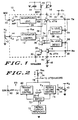
- FIG. 1 is a partial block and schematic diagram illustrating a speakerphone including an attenuator control circuit of the present invention;
- FIG. 2 is a partial schematic and block diagram illustrating the attenuator control circuit of the present invention; and
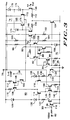
- FIG. 3 is a detailed schematic diagram illustrating the attenuator control circuit of FIG. 2.
- Turning to FIG. 1 there is shown a simplified block diagram of an integrated speakerphone circuit within dashed
outline 10 which incorporatesattenuator control circuit 12 of the present invention. As understood, the speakerphone provides hand free communication in a half-duplex mode operation. Half-duplex operation is provided by controlling the gain-attenuation ofattenuators input 22 toaudio amplifier 24. The output ofaudio amplifier 24 is connected both to abackground level detector 26 and the input of transmit attenuator l4, the output of the latter being connected to output terminal l8. Likewise, the receive signal path includes receive attenuator l6 coupled betweenterminal 20 andaudio amplifier 28. A speaker (not shown) is externally connected atterminal 30 to the output ofaudio amplifier 28. A source of operating potential V+ is provided to the speaker phone atterminal 32 and is utilized to derive the power supply voltage VCC for biasing the internal circuitry of the speakerphone. As will be described in more detail later, the speakerphone is voice switched to be operated in either a transmit mode or receive mode. Depending on the particular mode of operation, attenuator control circuit l2 provides a voltage vialead 34 that commonly drives transmit and receive attenuators l4 and l6 accordingly. As previously mentioned, transmitter and receive attenuators l4 and l6 are complimentary in function, i.e., when one is operated at maximum gain the other is operated at maximum attenuation and vice versa. - The operation of attenuator control circuit l2 is controlled by the three control signals supplied thereto. These signals are, (l) a background level signal XDC supplied via
lead 36, (2) a volume level control signal VLC supplied vialead 37, and (3) a control signal applied overlead 38 fromT-R comparator 40. Volume control is provided by varying the potentiometer wiper arm ofexternal potentiometer 42 and is connected atterminal 44 to the speakerphone. Thus, by increasing VLC by moving the wiper arm towards VB, a modulated control voltage V is produced at the output of attenuator control circuit l2 vialead 34 to increase the gain of receive attenuator l6 while reducing the relative gain of transmit attenuator l4. The maximum gain/attenuation values of transmit and receive attenuators l4 and l6 are determined respectively by adjustingvariable resistors terminals - In addition to operating in a transmit and receive mode, the speakerphone is operated in an idle mode. In the idle mode, no controlling speech signals are coupled to
inputs level detectors terminals comparator 40 to be in a high level state. Simultaneously, the voltage at terminal 62 (established acrosscapacitor 64 and resistor 66) is sufficiently low which in conjunction with the output ofdetector 26 also being in a low level state causes the output of attenuator control circuit l2 to be at a value that reduces the gain of the two attenuators to some midrange value thereof. - The speakerphone is placed in a transmit mode when there is sufficient transmit signal, such as speech signal, present over and above any receive signal. In this event the relative outputs of transmit and receive
level detectors T-R comparator 40 to go to a high output level state. Simultaneously,background level detector 26 determines whether the transmit signal is a result of background noise or speech. If the signal is due to background noise, the attenuators are placed in the idle mode as described above. However, if the signal consists of speech, transmit and receive attenuators l4 and l6 will be switched to a transmit mode bybackground level detector 26 producing the appropriate control signal at the output ofattenuator control circuit 12 to maximize the gain oftransmit attenuator 14 while minimizing the gain of receiveattenuator 16. - In a like manner, the speakerphone is placed in the receive mode by the output of
attenuator control circuit 12 being switched accordingly when the output ofT-R comparator 40 goes low. This occurs whenever there is sufficient receive signal supplied atterminal 20 to overcome any background noise and any speech signals appearing atoutput 18. In this situation the outputs of transmit and receivelevel detectors T-R comparator 40 to go to its low level state. Hence, the gain of the receiveattenuator 16 is maximized simultaneously with the gain of transmittedattenuator 14 being minimized by the output ofattenuator control circuit 12. - As it is generally understood, transmit and receive
attenuators attenuators Attenuator control circuit 12 of the present invention provides such a voltage as will be hereinafter explained. - Turning now to FIG. 2 there is illustrated a simplified schematic and block diagram of
attenuator control circuit 12 of the present invention. Thermalcurrent reference 70 produces a current I having a predetermined temperature coefficient. The current I flows through either receivevolume control circuit 74 or transmitgain control circuit 80 depending upon the state ofelectronic switch 72. For example, in response to the output ofT-R comparator 40 being low, the current I flows through receivevoltage control circuit 74 to develop the corresponding voltage V acrossresistor 76 which is proportional to absolute temperature. Thus, the voltage atnode 78 that appears overlead 34 to drive transmit and receiveattenuators resistor 76, i.e., the greater the value of VLC the greater amount of the current I that flows throughresistor 76. - In response to the speakerphone being in a transmit mode, switch 72 renders receive
volume control circuit 74 nonoperative while transmitgain control circuit 80 is rendered operative to permit the current I to flow through the latter. In the transmit mode the signal appearing onlead 36 is high such that none of the current I is steered tonode 78, to flow throughresistor 76. Hence, there is no voltage developed acrossresistor 76 and the voltage V developed is equal to zero. This results in the transmit and receiveattenuators lead 34 is the quiescent operating voltage VCC. - In the idle mode, the current I flows through transmit
gain control circuit 80 as during the transmit mode. However, in this event a current is steered tonode 78 to produce a voltage drop acrossresistor 76 that is proportional to the value of the voltage appearing atnode 62 produced acrossresistor 66 andcapacitor 64. The voltage drop acrossresistor 76 in the idle mode is also proportional to absolute temperature such that the gains of the respective transmit and receive attenuators is not temperature dependent. - Referring now to FIG. 3,
attenuator control circuit 12 is shown in full detail. Thermalcurrent source 70 includesPNP transistor 82 interconnected withNPN transistors node 92.Current source 70 is conventional in structure and the operation thereof is understood by those skilled in the art. Briefly, however, the emitter oftransistor 82 is coupled viaresistor Transistor 82 is biased on by its base being biased at a potential less than VCC whereby equal currents flow from the two collectors thereof to the respective collectors ofNPN transistors Transistor 84 is connected as a diode and forms with transistor 86 a conventional current mirror circuit whereby the current flowing throughtransistor 86 is substantially equal to the current flowing through the diode connectedtransistor 84. The emitters oftransistors resistors transistors transistor 84 larger than the effective emitter area of transistor 86 a smaller base to emitter voltage is developed in the former which causes a delta voltage to be developed acrossresistor 98 which has a positive temperature coefficient. This voltage produces a current throughresistor 98 which flows through Darlington configuredtransistors node 92. This current will also have a positive temperature coefficient due to the fact that it was produced by a positive temperature voltage established acrossresistor 98. Darlington configuredtransistors transistor 86 to the emitter oftransistor 84 to ensure that the two collector currents flowing throughtransistors node 92 which is steered to either receivevolume control circuit 74 or transmitgain control circuit 80. -
Transistor 102 which is coupled between receivevolume control circuit 74 and transmitgain control circuit 80 tonode 92 functions as an electronic switch whereby current is steered to one or the other of the two aforementioned circuits. For example, if the output ofT-R comparator 40 is high, thermal current I flows through the current mirror comprisingPNP transistors 106 and 108 andresistors transistor 102 is turned on. In this condition, the voltage developed at the emitter oftransistor 102, which is one diode voltage drop below the voltage applied at the base thereof, is sufficient to render receivevolume control circuit 74 nonoperative. Transmitgain control circuit 80 is now rendered operative whereby the current atnode 92 flows throughtransistor 108 of the current mirror to produce a current through transistor 106 which is substantially equal in magnitude to the current flowing atnode 92 and has the same temperature coefficient thereas. The current flowing through transistor 106 provides the "tail" current required by the comparator comprising differentially connectedtransistors level detector circuit 26 supplied vialead 36 to the input of the comparator at the base oftransistors 118, and the voltage established atterminal 62, the collector current of transistor 106 is steered proportionally betweentransistors lead 36 which will reversebias PNP transistors resistor 122 to the base oftransistor 114. Since these transistors are reverse biased,transistor 114 is rendered nonconductive as there is no path for base current flow therefrom. Therefore all of the tail current supplied from transistor l06 is steered through transistor ll6 to ground reference through the collector of this transistor. Transistor ll6 is biased in a conducting state since its base is connected at node l24 to which a substantially constant bias potential is established. The bias potential is developed through diodes l26 and l28 which are series connected between VCC and the base of transistor ll6. Hence, current flows through the two diodes and via resistor l30 through Darlington configured PNP transistors l32 and l34 to ground reference. Since all of the tail current supplied at the common emitters of transistors ll4 and ll6 of the comparator is steered to ground, in this case one output of the comparator, there is no current flowing throughnode 78 and resistor 76 (FIG. 2). Thus, transmit attenuator l4 will be operated at maximum gain as previously described with receive attenuator l6 being set at maximum attenuation. - When the speakerphone is in a receive mode, the output of
T-R comparator 40 is low which turns off transistor l02. Hence, no tail current is supplied to the transmit comparator. Thus, transmitgain control circuit 80 does not have any control over attenuator control circuit l2. - With the speakerphone operated in an idle mode, the input to the comparator, at the base of transistor ll8, is a function of the voltage XDC. If XDC is less than the voltage established at node l24 transistors ll8, l20 and ll4 are turned on as a path for base current drive is now provided to transistor ll4 through resistor l22. Diode l26 provides current flow therethrough from diode l36 through resistor l22. As transistor ll4 is turned on one-half of the tail current supplied by transistor l06 is steered through the current mirror comprising NPN transistors l38 and l40. Transistor l38 is connected as a diode and has its emitter connected through resistor l42 to ground reference. Similarly, transistor l40 has its base connected to the collector-base of transistor l38 and its emitter coupled through resistor l44 to ground. The current steered through transistor ll4 is mirrored at the collector of transistor l40 such that this current now flows through
node 78 andresistor 76 to produce the modulated voltage V thereacross. The current flowing throughnode 78 has substantially the same temperature coefficient as the current produced by thermalcurrent reference source 70. The magnitude of current steered at the output of the comparator (the collector of transistor l40) is a function of magnitude of the voltage VXDC. - As illustrated, receive
volume control circuit 74 includes a differential amplifier circuit comprising NPN transistors l46 and l48 the emitters of which are commonly connected via resistors l50 and l52. A source of tail current is supplied to this differential amplifier at the interconnection of the two resistors by transistor l54 which has its collector emitter path coupled therebetween to ground. The base of transistor l54 is biased at a bias potential that is developed across diode l56. The bias current in diode l56 will have a zero temperature coefficient since the current through the diode is provided by transistor l58 viaresistor 96 which are series coupled between VCC and the diode assuming that the current throughresistor 94 is negligibly small in comparison to the current flow throughresistor 96. Since the voltage VCC has a zero temperature coefficient the current throughresistor 96, transistor l58 and diode l56 also has a zero temperature coefficient. The base of transistor l58 is connected with the base ofPNP transistor 82 to the interconnection between the emitter of transistor l60 and resistor l62, the other side of which is connected to ground reference. The voltage resistor divider comprising resistor l64 and l66 connected between VCC and ground reference produces the potential, VB, which is supplied at the base of transistor l60 and is substantially constant having a zero temperature coefficient. As illustrated, the base of transistor l46 is also connected to VB with the base of transistor l48 being connected at terminal 44 to thepotentiometer 42. The external bias voltage VLC, applied to the base of transistor l48, also has a zero temperature coefficient such that the operation of the differential amplifier is independent of temperature. The outputs of the differential amplifier (the collectors of transistors l46 and l48) are connected through respective diodes l74 and l76 to VCC through diode l78. - Receive
volume control circuit 74 also includes differential amplifier l68 formed by NPN transistors l70 and l72 the emitters of which are commonly connected tonode 92 to thermalcurrent reference source 70. The base electrodes of these two transistors are connected respectively to the collectors of transistors l46 and l48. The outputs of the differential amplifier are taken at the collectors of transistors l70 and l72 with the former being connected tonode 78 toresistor 76 and the latter being connected to VCC. - With transistor l02 in a nonconducting state the current I appearing at
node 92 is steered to the common emitters of transistors of l70 and l72 of differential amplifier l68. This renders receivevolume control 74 operative whereby the current flowing through transistors l70 and l72 is proportionally steered therethrough tonode 78 and VCC depending on the magnitude of VLC. By varying VLC the magnitude of the current flowing through transistor l70 can be varied with respect to the current flowing through transistor l72. For example, as VLC is increased, diode l76 is turned on harder to supply more collector current to transistor l48 which, in turn, causes transistor l72 to be rendered less conductive. This will allow more of the current I to be steered through transistor l70 tonode 78 to increase the voltage V developed acrossresistor 76. Conversely, as VLC is decreased, diode l74 conducts harder which reduces the degree of conduction of transistor l70 as well as the magnitude of current I that is steered tonode 78. It is understood that the proportional amount of current I steered tonode 78 can be varied by ratioing resistors l50 and l52 accordingly. - The speakerphone is therefore operated in a receive mode whenever transistor l02 is turned off. Also, by varying VLC the volume of the receive signal path is increased as the voltage drive signal produced at
node 78 and vialead 34 to transmit and receive attenuators l4 and l6 decreases which increases the gain of receive attenuator l6 while increasing the attenuation of the transmit attenuator l4. - Hence, what has been described above is a novel control circuit for producing a voltage drive signal that is proportional to absolute temperature. The control circuit can be used in many applications including controlling the gain/attenuation of the receive and transmit signal paths of a half-duplex operated speaker phone system.
Claims (9)
- A control circuit for a half-duplex operated communication system including a pair of attentuators the gain/attenuation of which are varied in a complementary manner and which are a function of temperature; the control circuit (12) providing a voltage control signal that is supplied to the pair of attenuators characterised by the voltage control signal having a temperature coefficient proportional to absolute temperature, the control circuit including:
a single current source (70) which supplies a current (I) having a predetermined temperature coefficient;
a first steering circuit (74) coupled to said current source and being responsive to a direct current (dc) control signal (VLC) for proportionally steering said current to an output of the control circuit to generate the voltage control signal when said first steering circuit is rendered operative responsive to the system being in a first mode of operation;
a second current steering circuit (80) being rendered operative responsive to the system being in a second mode of operation and which is coupled to said current source for proportionally steering current to said output to generate the voltage control signal in response to a control signal (XD) supplied to said second steering circuit;
a switch (72) coupled between said first and second steering circuit and to said current source which is reponsive to an applied control signal (T-R) for rendering said second steering circuit operative while rendering said first steering circuit inoperative so that the voltage control signal is developed by independent operation of said first and second steering circuits; and
a load coupled to the output of the control circuit across which voltage control signal is developed. - The circuit of claim 1 wherein said switch circuit (72) includes a transistor (102) having first, second and control electrodes, said first electrode being coupled both to said current source (70) and said first current steering circuit (74), said second electrode being coupled to said second current steering circuit (80), said control electrode receiving said control signal, said transistor (102) providing said current to said second current steering circuit and rendering said first current steering
- The circuit of claim 2 including a first power supply conductor at which is supplied an operating potential; and a resistor (76) coupled between said first power supply conductor and the output (34) of the circuit.
- The circuit of claim 3 wherein said first current steering circuit (74) includes:
a first differential amplifier (146, 148) having first and second inputs and outputs, said first input being coupled to an input terminal (44) of the circuit (12) at which is supplied a second control signal, said second input being supplied a substantially constant bias potential (VB); and
a second differential amplifier (168) having first and second inputs and outputs and a common terminal, said common terminal being coupled to said first electrode of said transistor (102) and to said current source (70), said first and second inputs being coupled respectively to said first and second outputs of said first differential amplifier, said first output being said output of said first current steering circuit and said second output being coupled to a said first power supply conductor. - The circuit of claim 4 wherein said first current steering circuit (74) includes first (174) and second (176) diodes coupled between said first power supply conductor and said first and second inputs respectively of said second differential amplifier (168).
- The circuit of claim 5 wherein said first current steering circuit includes a third diode (178) connected between said first power supply conductor and said first and second diodes.
- The circuit of claim 2 wherein said second current steering circuit includes:
a first current mirror circuit (106, 108) coupled to said second electrode of said transistor (102) which is responsive to said transistor (102) being turned on for providing current at an output thereof the magnitude and temperature coefficient of which are substantially the same as said current provided by said current source (70); and
a comparator (114, 116) having first and second inputs and outputs and a common terminal, said common terminal being coupled to said output of said first current mirror circuit, said first and second outputs being said first and second outputs of said second current steering circuit respectively, said first input being biased at a first bias potential, said second input receiving a second control signal such that current related to said first current mirror circuit output current is steered to said first output when said second control signal is at a first level and steered to said second output when said second control signal is at a second level. - The circuit of claim 7 wherein said comparator includes second current mirror circuit (138, 140) for providing said related current to said first output of said comparator.
- The circuit of claim 8 including:
first and second power supply conductors at which are supplied an operating potential and ground reference signal respectively;
a resistor (76) connected between said first power supply conductor and the output (34) of the circuit (12); and
said second output of said comparator being coupled to said second power supply conductor;
Applications Claiming Priority (2)
| Application Number | Priority Date | Filing Date | Title |
|---|---|---|---|
| US772482 | 1985-09-04 | ||
| US06/772,482 US4689506A (en) | 1985-09-04 | 1985-09-04 | Control circuit for use with electronic attenuators and method for providing a control signal proportional to absolute temperature |
Publications (3)
| Publication Number | Publication Date |
|---|---|
| EP0214472A2 EP0214472A2 (en) | 1987-03-18 |
| EP0214472A3 EP0214472A3 (en) | 1988-07-20 |
| EP0214472B1 true EP0214472B1 (en) | 1991-12-27 |
Family
ID=25095211
Family Applications (1)
| Application Number | Title | Priority Date | Filing Date |
|---|---|---|---|
| EP86110924A Expired - Lifetime EP0214472B1 (en) | 1985-09-04 | 1986-08-07 | Control circuit for use with electronic attenuators and method for providing a control signal proportional to absolute temperature |
Country Status (7)
| Country | Link |
|---|---|
| US (1) | US4689506A (en) |
| EP (1) | EP0214472B1 (en) |
| JP (1) | JPS6259407A (en) |
| KR (1) | KR910000688B1 (en) |
| DE (1) | DE3683105D1 (en) |
| HK (1) | HK5194A (en) |
| SG (1) | SG141893G (en) |
Families Citing this family (3)
| Publication number | Priority date | Publication date | Assignee | Title |
|---|---|---|---|---|
| FR2613157A1 (en) * | 1987-03-27 | 1988-09-30 | Mennecier Philippe | Miniature, personal radio intercom device allowing simultaneous dialogue by several users |
| US7221659B1 (en) * | 2001-12-31 | 2007-05-22 | Cisco Technology, Inc. | Method and system for managing erroneous attenuation of signal |
| EP1689732A4 (en) * | 2003-12-05 | 2008-10-22 | Univ North Carolina | SUBSTITUTED CATIONIC BENZOFURANES USEFUL AS ANTIMICROBIAL AGENTS |
Family Cites Families (9)
| Publication number | Priority date | Publication date | Assignee | Title |
|---|---|---|---|---|
| FR2500698B1 (en) * | 1981-02-20 | 1989-02-17 | Thomson Csf Mat Tel | LARSEN ANTI-EFFECT DEVICE FOR TELEPHONE SET |
| DE3148202A1 (en) * | 1981-12-05 | 1983-06-09 | Licentia Patent-Verwaltungs-GmbH, 60325 Frankfurt | Circuit arrangement for oppositely directed gain control of amplifiers |
| FR2518854B1 (en) * | 1981-12-18 | 1986-08-08 | Thomson Csf Mat Tel | TELEPHONE SET WITH SPEECH AMPLIFIERS |
| JPS5979617A (en) * | 1982-10-27 | 1984-05-08 | Mitsubishi Electric Corp | Control circuit for variable gain amplifier |
| US4490582A (en) * | 1983-02-18 | 1984-12-25 | At&T Information Systems Inc. | Speakerphone control circuit |
| NL8301138A (en) * | 1983-03-31 | 1984-10-16 | Philips Nv | POWER SOURCE SWITCH. |
| US4591743A (en) * | 1983-12-19 | 1986-05-27 | National Semiconductor Corporation | Temperature compensated current sensing circuit |
| JPS60134548A (en) * | 1983-12-22 | 1985-07-17 | Fujitsu Ltd | Loudspeaker telephone set |
| US4593208A (en) * | 1984-03-28 | 1986-06-03 | National Semiconductor Corporation | CMOS voltage and current reference circuit |
-
1985
- 1985-09-04 US US06/772,482 patent/US4689506A/en not_active Expired - Fee Related
-
1986
- 1986-08-07 EP EP86110924A patent/EP0214472B1/en not_active Expired - Lifetime
- 1986-08-07 DE DE8686110924T patent/DE3683105D1/en not_active Expired - Lifetime
- 1986-08-20 KR KR1019860006862A patent/KR910000688B1/en not_active Expired
- 1986-09-04 JP JP61208842A patent/JPS6259407A/en not_active Expired - Lifetime
-
1993
- 1993-12-31 SG SG141893A patent/SG141893G/en unknown
-
1994
- 1994-01-20 HK HK51/94A patent/HK5194A/en not_active IP Right Cessation
Also Published As
| Publication number | Publication date |
|---|---|
| JPS6259407A (en) | 1987-03-16 |
| US4689506A (en) | 1987-08-25 |
| SG141893G (en) | 1994-03-31 |
| EP0214472A2 (en) | 1987-03-18 |
| KR870003414A (en) | 1987-04-17 |
| KR910000688B1 (en) | 1991-01-31 |
| EP0214472A3 (en) | 1988-07-20 |
| DE3683105D1 (en) | 1992-02-06 |
| HK5194A (en) | 1994-01-28 |
Similar Documents
| Publication | Publication Date | Title |
|---|---|---|
| US4002852A (en) | Electronic telephone network | |
| US4431874A (en) | Balanced current multiplier circuit for a subscriber loop interface circuit | |
| WO1992012588A1 (en) | Adaptive amplifier circuit | |
| US4464632A (en) | Volume control circuit | |
| US4453038A (en) | Circuit arrangement for producing control means from line current | |
| CA1257724A (en) | Telephone circuits | |
| EP0225332B1 (en) | Balanced variable reactance circuit and method of producing the same | |
| EP0214472B1 (en) | Control circuit for use with electronic attenuators and method for providing a control signal proportional to absolute temperature | |
| US4567384A (en) | Voltage offset producing circuit for use with a line receiver or the like | |
| KR910004058B1 (en) | Telephone with a loud speaker | |
| EP0095774A2 (en) | A switching circuit operable as an amplifier and a muting circuit | |
| US4432097A (en) | Tone control circuit | |
| US4485341A (en) | Current limiter circuit | |
| CA1134522A (en) | Voice switch for hands free communication apparatus | |
| US4723280A (en) | Constant current line circuit | |
| US5570064A (en) | Automatic gain control amplifier for use in radio transmitter-receiver | |
| US4723278A (en) | Voice circuit of telephone | |
| US4856058A (en) | Office line interface circuits | |
| US5321746A (en) | Adjustable gain range current mirror | |
| US4405903A (en) | Variolosser for an automatic gain control circuit | |
| US3950708A (en) | Gain-controlled amplifier | |
| US4392114A (en) | Audio device having a tone control cancelling circuit | |
| CA1072698A (en) | Electronic telephone network | |
| JPH0413903B2 (en) | ||
| US4006427A (en) | Automatic gain control circuit |
Legal Events
| Date | Code | Title | Description |
|---|---|---|---|
| PUAI | Public reference made under article 153(3) epc to a published international application that has entered the european phase |
Free format text: ORIGINAL CODE: 0009012 |
|
| AK | Designated contracting states |
Kind code of ref document: A2 Designated state(s): DE FR GB IT NL SE |
|
| PUAL | Search report despatched |
Free format text: ORIGINAL CODE: 0009013 |
|
| AK | Designated contracting states |
Kind code of ref document: A3 Designated state(s): DE FR GB IT NL SE |
|
| 17P | Request for examination filed |
Effective date: 19880929 |
|
| 17Q | First examination report despatched |
Effective date: 19900507 |
|
| GRAA | (expected) grant |
Free format text: ORIGINAL CODE: 0009210 |
|
| AK | Designated contracting states |
Kind code of ref document: B1 Designated state(s): DE FR GB IT NL SE |
|
| ITF | It: translation for a ep patent filed | ||
| REF | Corresponds to: |
Ref document number: 3683105 Country of ref document: DE Date of ref document: 19920206 |
|
| ET | Fr: translation filed | ||
| PLBE | No opposition filed within time limit |
Free format text: ORIGINAL CODE: 0009261 |
|
| STAA | Information on the status of an ep patent application or granted ep patent |
Free format text: STATUS: NO OPPOSITION FILED WITHIN TIME LIMIT |
|
| 26N | No opposition filed | ||
| EAL | Se: european patent in force in sweden |
Ref document number: 86110924.7 |
|
| REG | Reference to a national code |
Ref country code: GB Ref legal event code: 746 Effective date: 19990706 |
|
| PGFP | Annual fee paid to national office [announced via postgrant information from national office to epo] |
Ref country code: NL Payment date: 20000620 Year of fee payment: 15 |
|
| PGFP | Annual fee paid to national office [announced via postgrant information from national office to epo] |
Ref country code: GB Payment date: 20000703 Year of fee payment: 15 |
|
| PGFP | Annual fee paid to national office [announced via postgrant information from national office to epo] |
Ref country code: DE Payment date: 20000720 Year of fee payment: 15 |
|
| PGFP | Annual fee paid to national office [announced via postgrant information from national office to epo] |
Ref country code: SE Payment date: 20000802 Year of fee payment: 15 |
|
| PGFP | Annual fee paid to national office [announced via postgrant information from national office to epo] |
Ref country code: FR Payment date: 20000803 Year of fee payment: 15 |
|
| PG25 | Lapsed in a contracting state [announced via postgrant information from national office to epo] |
Ref country code: GB Free format text: LAPSE BECAUSE OF NON-PAYMENT OF DUE FEES Effective date: 20010807 |
|
| PG25 | Lapsed in a contracting state [announced via postgrant information from national office to epo] |
Ref country code: SE Free format text: LAPSE BECAUSE OF NON-PAYMENT OF DUE FEES Effective date: 20010808 |
|
| PG25 | Lapsed in a contracting state [announced via postgrant information from national office to epo] |
Ref country code: NL Free format text: LAPSE BECAUSE OF NON-PAYMENT OF DUE FEES Effective date: 20020301 |
|
| GBPC | Gb: european patent ceased through non-payment of renewal fee |
Effective date: 20010807 |
|
| EUG | Se: european patent has lapsed |
Ref document number: 86110924.7 |
|
| PG25 | Lapsed in a contracting state [announced via postgrant information from national office to epo] |
Ref country code: FR Free format text: LAPSE BECAUSE OF NON-PAYMENT OF DUE FEES Effective date: 20020430 |
|
| NLV4 | Nl: lapsed or anulled due to non-payment of the annual fee |
Effective date: 20020301 |
|
| PG25 | Lapsed in a contracting state [announced via postgrant information from national office to epo] |
Ref country code: DE Free format text: LAPSE BECAUSE OF NON-PAYMENT OF DUE FEES Effective date: 20020501 |
|
| REG | Reference to a national code |
Ref country code: FR Ref legal event code: ST |
|
| REG | Reference to a national code |
Ref country code: FR Ref legal event code: D6 |
|
| PG25 | Lapsed in a contracting state [announced via postgrant information from national office to epo] |
Ref country code: IT Free format text: LAPSE BECAUSE OF NON-PAYMENT OF DUE FEES;WARNING: LAPSES OF ITALIAN PATENTS WITH EFFECTIVE DATE BEFORE 2007 MAY HAVE OCCURRED AT ANY TIME BEFORE 2007. THE CORRECT EFFECTIVE DATE MAY BE DIFFERENT FROM THE ONE RECORDED. Effective date: 20050807 |