EP0212940B1 - A process for the preparation of a graphite intercalation compound - Google Patents
A process for the preparation of a graphite intercalation compound Download PDFInfo
- Publication number
- EP0212940B1 EP0212940B1 EP86306249A EP86306249A EP0212940B1 EP 0212940 B1 EP0212940 B1 EP 0212940B1 EP 86306249 A EP86306249 A EP 86306249A EP 86306249 A EP86306249 A EP 86306249A EP 0212940 B1 EP0212940 B1 EP 0212940B1
- Authority
- EP
- European Patent Office
- Prior art keywords
- chloride
- graphite
- reaction
- metal
- metal chloride
- Prior art date
- Legal status (The legal status is an assumption and is not a legal conclusion. Google has not performed a legal analysis and makes no representation as to the accuracy of the status listed.)
- Expired - Lifetime
Links
Classifications
-
- C—CHEMISTRY; METALLURGY
- C01—INORGANIC CHEMISTRY
- C01B—NON-METALLIC ELEMENTS; COMPOUNDS THEREOF; METALLOIDS OR COMPOUNDS THEREOF NOT COVERED BY SUBCLASS C01C
- C01B32/00—Carbon; Compounds thereof
- C01B32/20—Graphite
- C01B32/21—After-treatment
- C01B32/22—Intercalation
Definitions
- This invention relates to a method for the production of a graphite intercalation compound. More particularly, this invention relates to a method for the production of a graphite intercalation compound which, by effecting the reaction for the production in the presence of a second metal chloride besides the metal chloride destined to form the intercalant aimed at, notably shortens the time required for the synthesis of the graphite intercalation compound and permits the synthesis to be carried out effectively without using chlorine.
- the graphite intercalation compounds have been found to combine the chemical stability inherent in graphite and other properties with high degrees of electroconductivity characteristic of metals. The knowledge has encouraged numerous researches. These researches have unveiled the fact that graphite intercalation compounds have their nature governed by the kinds of intercalants inserted therein.
- the graphite intercalation compound which has an alkali metal such as, for example, potassium as an intercalant
- the graphite intercalation compound lacks stability in the air and tends to decompose, though it possesses improved electroconductivity (Y. Iye et al., Phys. Rev. B, 25, 4583, 1982).
- the graphite intercalation compounds using metal chlorides as their intercalants possess degrees of electroconductivity that fall short of that of copper metal but compare favorably with those of almost all metals and, what is more, possess stability in the air.
- the graphite intercalation compound is stable not only in the air but also under water.
- the reaction for the intercalation of cupric chloride into graphite proceeds so slowly that some tens of days are required for completion of the reaction (Takahashi et al., Glossary of Lectures for the 11th Annual Meeting of The Carbon Society of Japan, page 42, 1984). Owing to the slowness of the reaction, quantity use of the compound has proved virtually impracticable.
- the inventors have continued a diligent study for the purpose of solving the problems and notably increasing the velocity of the reaction. They have consequently found that the velocity of the reaction can be heightened by allowing a second method chloride of a low boiling point to be present in a minute amount in the reaction system and that the presence of the minute amount of the second metal chloride of a low boiling point enables the reaction for which the presence of chlorine gas has been found an indispensable requirement to proceed to completion in the absence of chlorine gas.
- the present invention has been perfected as the result.
- a metal chloride such as, for example, ferric chloride, cupric chloride, nickel chloride, aluminium chloride, or cobalt chloride
- a specific metal chloride such as, for example, nickel chloride
- a metal chloride such as, for example, ferric chloride, cupric chloride, aluminum chloride, nickel chloride, cobalt chloride, manganese chloride, or chromium chloride
- a metal chloride such as, for example, ferric chloride, cupric chloride, aluminum chloride, nickel chloride, cobalt chloride, manganese chloride, or chromium chloride
- a second metal chloride of a relatively low boiling point such as, for example, ferric chloride (boiling point, 317°C), aluminum chloride (sublimation point 183°C), cupric chloride, or cobalt chloride and, in the production of a graphite intercalation compound using a specific metal chloride such as, for example, nickel chloride previously held capable of inducing successful synthesis of the compound only under an atmosphere of chlorine, obviates necessity for use of chlorine by the use of a minute amount of the second metal chloride.
- a specific metal chloride such as, for example, nickel chloride previously held
- the production of a graphite intercalation compound in accordance with this invention may be attained by charging a reaction vessel with graphite, a metal chloride intended as an intercalant, and a minute amount of a second metal chloride as an additive, vacuumizing the reaction vessel, and sealing it tightly, and allowing the contents thereof to react.
- Any of the various kinds of graphite know to produce graphite intercalation compounds can be used as the graphite for the sake of the reaction.
- Powdery natural graphite, sheetlike natural graphite, sheetlike swelled graphite, graphite fibers, and man-made graphite are examples.
- the amount of the second metal chloride to be added may be in the range of 0.1 to 2.0% by weight, preferably 0.3 to 2.0% by weight, based on the metal chloride intended as an intercalant. If the second metal chloride is added in an amount exceeding the upper limit of the aforementioned range, there is the possibility that the pressure inside the reaction vessel will rise so much as to jeopardize the safety of the reaction and the second metal chloride will mingle in a large amount in the product and render the control of characteristics such as, for example, thermal stability and electroconductivity difficult. If the amount of the second metal chloride to be added is less than the lower limit of the aforementioned range, the velocity of the reaction is not heightened so much as expected.
- the reaction vessel charged with the raw marterials described above may be heated to a temperature in the range of 200°C to 700°C, though variable with the particular kind of metal chloride intended for intercalation, to induce reaction of the raw materials and give rise to the graphite intercalation compound aimed at.
- the addition of a minute amount of a metal chloride other than the metal chloride intended for intercalation between graphite layers is recognized to bring about a notable increase in the velocity of the reaction.
- the exact mechanism responsible for the acceleration of the reaction remains yet to be elucidated.
- the accelerated reaction velocity may be logically explained by a postulate that when the added metal chloride of a relatively low boiling point such as, for example, ferric chloride or aluminum chloride is inserted into the graphite layers or when the chlorine generated in consequence of thermodynamic equilibrium is incorporated between the graphite layers in the initial stage of reaction, it confers electric charge upon the graphite layers and consequently activates the reaction for the intercalation of the metal chloride between the layers; and that the added metal chloride partly forms a metal chloride complex and consequently increases the apparent gaseous partial pressure of the metal chloride intended for intercalation between graphite layers.
- a relatively low boiling point such as, for example, ferric chloride or aluminum chloride
- This invention in the production of a graphite intercalatin compound using a metal chloride as an intercalant, provides a method of production which permits a notable reduction in the reaction time heretofore protracted so much as to raise a problem. Further, in the production of a graphite intercalation compound using as an intercalant thereof a specific metal chloride capable of inducing the synthesis of the compound only under an atmosphere of chlorine, this invention obviates the necessity for use of chlorine gas owing to the addition of a second metal chloride. Thus, this invention decreases the heating time required during the course of the reaction and brings about an effect of saving energy consumption. Since it permits synthesis of the graphite intercalation compound without use of chlorine, a highly corrosive gas, it contributes to improving the work environment.
- graphite intercalation compounds may be of light weight, good electroconductivity characteristic of metals, and highly stable in air; arid have many uses such as for a light leading wire, EMI shield materials, electroconductive paint, packings, compound, etc..
Landscapes
- Chemical & Material Sciences (AREA)
- Organic Chemistry (AREA)
- Life Sciences & Earth Sciences (AREA)
- General Life Sciences & Earth Sciences (AREA)
- Geology (AREA)
- Inorganic Chemistry (AREA)
- Carbon And Carbon Compounds (AREA)
- Inorganic Compounds Of Heavy Metals (AREA)
Description
- This invention relates to a method for the production of a graphite intercalation compound. More particularly, this invention relates to a method for the production of a graphite intercalation compound which, by effecting the reaction for the production in the presence of a second metal chloride besides the metal chloride destined to form the intercalant aimed at, notably shortens the time required for the synthesis of the graphite intercalation compound and permits the synthesis to be carried out effectively without using chlorine.
- The graphite intercalation compounds have been found to combine the chemical stability inherent in graphite and other properties with high degrees of electroconductivity characteristic of metals. The knowledge has encouraged numerous researches. These researches have unveiled the fact that graphite intercalation compounds have their nature governed by the kinds of intercalants inserted therein.
- In the case of a graphite intercalation compound which has an alkali metal such as, for example, potassium as an intercalant, the graphite intercalation compound lacks stability in the air and tends to decompose, though it possesses improved electroconductivity (Y. Iye et al., Phys. Rev. B, 25, 4583, 1982).
- It has been reported that when an intercalant formed of antimony pentafluoride is used, the electroconductivity of the graphite intercalation compound using this intercalant is better than that of copper metal. In this case again, the graphite intercalation compound lacks stability in the air and, therefore, has much to be desired for the sake of practical applications (F. Vogel et al., Bull. Am. Phys. Soc., 21, 262, 1976).
- The graphite intercalation compounds using metal chlorides as their intercalants possess degrees of electroconductivity that fall short of that of copper metal but compare favorably with those of almost all metals and, what is more, possess stability in the air.
- Particularly, when an intercalant of cupric chloride is used, the graphite intercalation compound is stable not only in the air but also under water. The reaction for the intercalation of cupric chloride into graphite, however, proceeds so slowly that some tens of days are required for completion of the reaction (Takahashi et al., Glossary of Lectures for the 11th Annual Meeting of The Carbon Society of Japan, page 42, 1984). Owing to the slowness of the reaction, quantity use of the compound has proved virtually impracticable.
- In the intercalation of nickel chloride into graphite, no graphite intercalation compound is obtained simply by heating graphite and nickel chloride intended as an intercalant for incorporation in the graphite layer under a vacuum. It has been known that in this case, the intercalation is obtained only when nickel chloride is sealed in under an atmosphere of chlorine and the graphite intercalation compound is not formed under a vacuum or under an atmosphere of any other gas than chlorine (S. Flandrois, Synth. Met., 3, 1, 1981).
- For the production of a graphite intercalation compound using such a metal chloride as a substance for intercalation in the graphite layer, therefore, the presence of chlorine, a highly corrosive gas, in the reaction system is indispensable. Experimentally and practically it has been difficult to attain the synthesis easily.
- It has been also known that in the intercalation of aluminum chloride in the graphite layer, the reaction time is considerably shorter when the reaction is effected under an atmosphere of chlorine than under a vacuum. Thus, the use of chlorine gas has been involved in the reaction system of this kind.
- It has been further known that in the synthesis of graphite intercalation compounds using metal chlorides, when the reaction for this intercalation is carried out in the presence of aluminum chloride, etc. under an atmosphere of chlorine, the aluminum chloride, etc. forms a complex with the metal chloride intended for the intercalation and enhances the velocity of the reaction (E. Stumpp, Mat. Sci. Eng., 31, 53, 1977). This method however, poses problems that the reaction requires chlorine.
- The inventors have continued a diligent study for the purpose of solving the problems and notably increasing the velocity of the reaction. They have consequently found that the velocity of the reaction can be heightened by allowing a second method chloride of a low boiling point to be present in a minute amount in the reaction system and that the presence of the minute amount of the second metal chloride of a low boiling point enables the reaction for which the presence of chlorine gas has been found an indispensable requirement to proceed to completion in the absence of chlorine gas. The present invention has been perfected as the result.
- It is desirable to provide a method for the production of a graphite intercalation compound using as an intercalant thereof a metal chloride such as, for example, ferric chloride, cupric chloride, nickel chloride, aluminium chloride, or cobalt chloride, which permits a marked reduction in the reaction time heretofore so protracted as to pose a serious problem.
- It is also desirable to provide a method for the production of a graphite intercalation compound using a specific metal chloride such as, for example, nickel chloride, which hitherto could be synthesised only under an atmosphere of chlorine, which method obviates the necessity for use of chlorine in the reaction.
- According to the present invention, there is provided a process for the preparation of a graphite intercalation compound having a first metal chloride as an intercalant thereof; wherein graphite is reacted with the first metal chloride in the presence of a second metal chloride whose vapour pressure at the reaction temperature is higher than that of the desired metal chloride; characterized in that the preparation is carried out in the absence of chlorine gas.
- For example, applying this invention to the production of a graphite intercalation compound using as an intercalant thereof a metal chloride such as, for example, ferric chloride, cupric chloride, aluminum chloride, nickel chloride, cobalt chloride, manganese chloride, or chromium chloride, permits a notable reduction in the reaction time by adding a minute amount of a second metal chloride of a relatively low boiling point such as, for example, ferric chloride (boiling point, 317°C), aluminum chloride (sublimation point 183°C), cupric chloride, or cobalt chloride and, in the production of a graphite intercalation compound using a specific metal chloride such as, for example, nickel chloride previously held capable of inducing successful synthesis of the compound only under an atmosphere of chlorine, obviates necessity for use of chlorine by the use of a minute amount of the second metal chloride.
- Use of just one second metal chloride is as effective in this invention as use of two or more second metal chlorides in a mixed form. Preferred metal chlorides which are usable as said second metal chloride comprise those which have boiling points or sublimation points of not more than 320°C as described above.
- Now, the present invention will be described in detail below. The production of a graphite intercalation compound in accordance with this invention may be attained by charging a reaction vessel with graphite, a metal chloride intended as an intercalant, and a minute amount of a second metal chloride as an additive, vacuumizing the reaction vessel, and sealing it tightly, and allowing the contents thereof to react. Any of the various kinds of graphite know to produce graphite intercalation compounds can be used as the graphite for the sake of the reaction. Powdery natural graphite, sheetlike natural graphite, sheetlike swelled graphite, graphite fibers, and man-made graphite are examples. The amount of the second metal chloride to be added may be in the range of 0.1 to 2.0% by weight, preferably 0.3 to 2.0% by weight, based on the metal chloride intended as an intercalant. If the second metal chloride is added in an amount exceeding the upper limit of the aforementioned range, there is the possibility that the pressure inside the reaction vessel will rise so much as to jeopardize the safety of the reaction and the second metal chloride will mingle in a large amount in the product and render the control of characteristics such as, for example, thermal stability and electroconductivity difficult. If the amount of the second metal chloride to be added is less than the lower limit of the aforementioned range, the velocity of the reaction is not heightened so much as expected. The reaction vessel charged with the raw marterials described above may be heated to a temperature in the range of 200°C to 700°C, though variable with the particular kind of metal chloride intended for intercalation, to induce reaction of the raw materials and give rise to the graphite intercalation compound aimed at.
- In the present invention, the addition of a minute amount of a metal chloride other than the metal chloride intended for intercalation between graphite layers is recognized to bring about a notable increase in the velocity of the reaction. The exact mechanism responsible for the acceleration of the reaction remains yet to be elucidated. The accelerated reaction velocity may be logically explained by a postulate that when the added metal chloride of a relatively low boiling point such as, for example, ferric chloride or aluminum chloride is inserted into the graphite layers or when the chlorine generated in consequence of thermodynamic equilibrium is incorporated between the graphite layers in the initial stage of reaction, it confers electric charge upon the graphite layers and consequently activates the reaction for the intercalation of the metal chloride between the layers; and that the added metal chloride partly forms a metal chloride complex and consequently increases the apparent gaseous partial pressure of the metal chloride intended for intercalation between graphite layers.
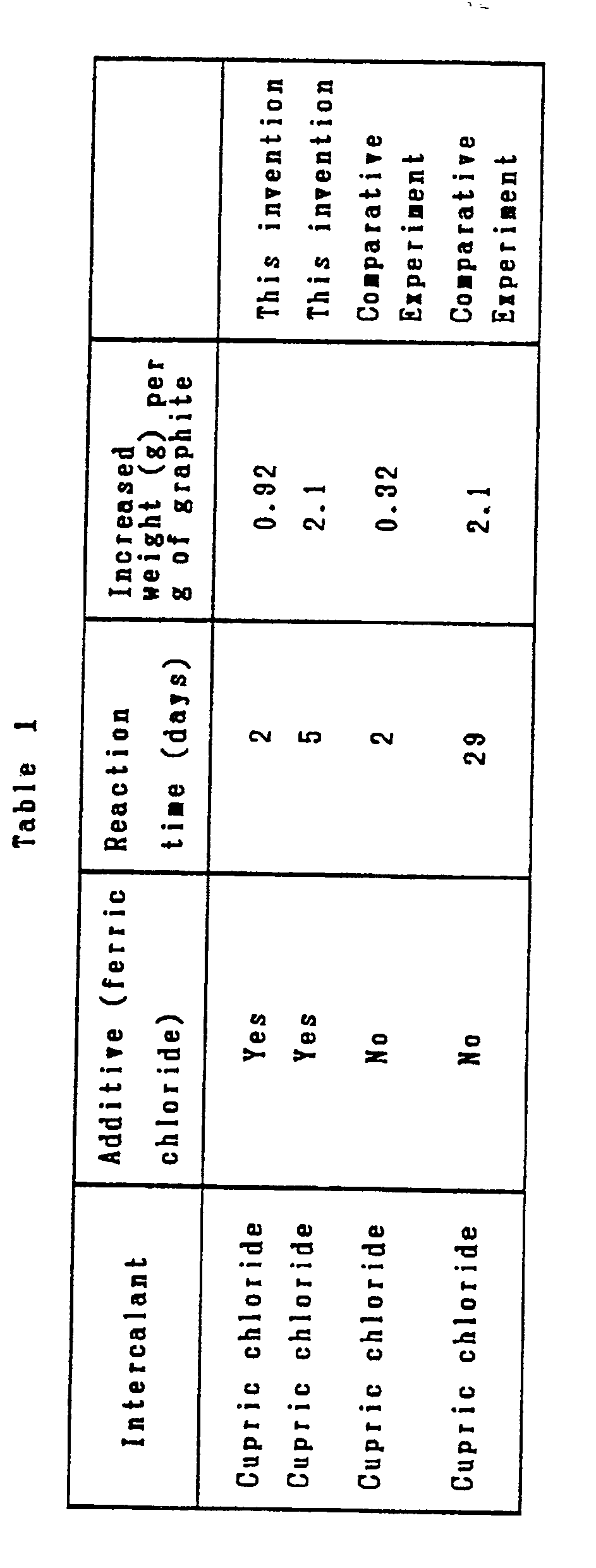
- In synthesizing a graphite intercalation compound by using sheetlike natural graphite and cupric chloride as an intercalant for insertion between graphite layers, the reaction was carried out in the presence of ferric chloride added to the reaction system in an amount of about 1% by weight based on the cupric chloride. A reaction vessel was charged with the raw materials, vacuumized, then sealed tightly, and heated to induce reaction of the contents thereof at 480°C. Formation of the graphite intercalation compound was confirmed by measurement of X-ray diffraction. The results are shown in Table 1. For comparison, the reaction was carried out in the absence of ferric chloride. The results are also shown in the same table. It is noted from this table that the increased weight per g of the graphite existing at the end of the reaction was 0.32 g after 2 days and 2.10 g after 29 days respectively of reaction time in the reaction performed in the absence of ferric chloride, whereas it was 0.92 g after 2 days and 2.10 g after 5 days respectively of reaction time, indicating that the addition of ferric chloride brought about a notable increase in the reaction velocity.
- In synthesizing a graphite intercalation compound by using sheetlike natural graphite and aluminum chloride as an intercalant for insertion between graphite layers, the reaction was carried out in the presence of ferric chloride added to the reaction system in an amount of about 1% by weight based on the aluminum chloride. The reaction temperature was 255°C and the reaction time was 6 hours. Confirmation of the formation of the graphite intercalation compound and the reaction were carried out by following the procedure of Example 1. In the reaction performed in the presence of ferric chloride, an increased weight of 2.10 g per g of graphite was recognized, whereas the amount of aluminum chloride intercalated was only 0.26 g per g of graphite in the reaction performed in the absence of ferric chloride.
- In synthesizing a graphite intercalation compound by using sheetlike natural graphite and cupric chloride as an intercalant for insertion between graphite layers, the reaction was carried out in the presence of aluminum chloride added to the reaction system in an amount of about 1% by weight based on the cupric chloride. The reaction temperature was 480°C and the reaction time was 3 days. Confirmation of the formation of the graphite intercalation compound and the reaction were carried out by following the procedure of Example 1. In the reaction performed in the presence of aluminum chloride, an increased weight of 1.10 g of per g of graphite was recognized. In contrast, in the reaction performed under the same conditions except for the absence of aluminum chloride, only 0.46 g of cupric chloride was intercalated per g of graphite.
- In synthesizing a graphite intercalation compound by using powdery natural graphite and nickel chloride as an intercalant for insertion between graphite layers, the reaction was carried out in the presence of ferric chloride added to the reaction system in an amount of about 1% by weight based on the nickel chloride. The reaction temperature was 600°C and the reaction time was 3 days. Confirmation of the formation of the graphite intercalation compound and the reaction were carried out by following the procedure of Example 1. In the reaction performed in the presence of ferric chloride, an increased weight of 0.05 g per g of graphite was recognized. In contrast in the reaction performed under the same conditions except for the absence of ferric chloride, absolutely no increased weight was recognized. It has been known that in the reaction system for intercalation of nickel chloride between graphite layers, the desired graphite intercalation compound is formed only under an atmosphere of chlorine gas. The inventors have found that, by using ferric chloride as an additive, the graphite intercalation compound of nickel chloride can be synthesized even in the absence of chlorine gas.
- In synthesizing a graphite intercalation compound by using powdery natural graphite and cupric chloride as an intercalant for insertion between graphite layers, the reaction was carried out in the presence of cobalt chloride added to the reaction system in an amount of about 1% by weight based on the cupric chloride. The reaction temperature was 480°C and the reaction time was 24 hours. Confirmation of the formation of the graphite intercalation compound and the reaction were carried out by following the procedure of Example 1. In the reaction performed in the presence of cobalt chloride, an increased weitht of 0.80 g per g of graphite was recognized, whereas the amount of cupric chloride intercalated was only 0.42 g per g of graphite in the reaction performed in the absence of cobalt chloride.
- This invention, in the production of a graphite intercalatin compound using a metal chloride as an intercalant, provides a method of production which permits a notable reduction in the reaction time heretofore protracted so much as to raise a problem. Further, in the production of a graphite intercalation compound using as an intercalant thereof a specific metal chloride capable of inducing the synthesis of the compound only under an atmosphere of chlorine, this invention obviates the necessity for use of chlorine gas owing to the addition of a second metal chloride. Thus, this invention decreases the heating time required during the course of the reaction and brings about an effect of saving energy consumption. Since it permits synthesis of the graphite intercalation compound without use of chlorine, a highly corrosive gas, it contributes to improving the work environment.
- Thus obtained graphite intercalation compounds may be of light weight, good electroconductivity characteristic of metals, and highly stable in air; arid have many uses such as for a light leading wire, EMI shield materials, electroconductive paint, packings, compound, etc..
Claims (4)
wherein said second metal chloride is as least one of ferric chloride, aluminium chloride, cupric chloride and cobalt chloride.
Applications Claiming Priority (2)
| Application Number | Priority Date | Filing Date | Title |
|---|---|---|---|
| JP180046/85 | 1985-08-17 | ||
| JP60180046A JPS6241706A (en) | 1985-08-17 | 1985-08-17 | Production of graphite intercalation compound |
Publications (3)
| Publication Number | Publication Date |
|---|---|
| EP0212940A2 EP0212940A2 (en) | 1987-03-04 |
| EP0212940A3 EP0212940A3 (en) | 1988-03-16 |
| EP0212940B1 true EP0212940B1 (en) | 1991-03-27 |
Family
ID=16076537
Family Applications (1)
| Application Number | Title | Priority Date | Filing Date |
|---|---|---|---|
| EP86306249A Expired - Lifetime EP0212940B1 (en) | 1985-08-17 | 1986-08-13 | A process for the preparation of a graphite intercalation compound |
Country Status (4)
| Country | Link |
|---|---|
| US (1) | US4729884A (en) |
| EP (1) | EP0212940B1 (en) |
| JP (1) | JPS6241706A (en) |
| DE (1) | DE3678360D1 (en) |
Families Citing this family (18)
| Publication number | Priority date | Publication date | Assignee | Title |
|---|---|---|---|---|
| JPS62138315A (en) * | 1985-12-10 | 1987-06-22 | Fuji Carbon Seizosho:Kk | Production of interlaminar compound consisting of metallic chloride and graphite |
| JPS62265112A (en) * | 1986-05-13 | 1987-11-18 | Nippon Steel Corp | Production of graphite intercalation complex |
| EP0311298B1 (en) * | 1987-10-06 | 1996-04-03 | Cabotex Co. Ltd. | Preparing an intercalation compound |
| US4837377A (en) * | 1987-12-28 | 1989-06-06 | Trustees Of Boston University | Rubbery, electrically non-conductive, and intrinsically magnetic graphite intercalation compounds and methods for their making |
| US5065948A (en) * | 1988-11-21 | 1991-11-19 | Battelle Memorial Institute | Apparatus for producing thin flakes |
| US5019446A (en) * | 1988-11-21 | 1991-05-28 | Battelle Memorial Institute | Enhancement of mechanical properties of polymers by thin flake addition and apparatus for producing such thin flakes |
| US4987175A (en) * | 1988-11-21 | 1991-01-22 | Battelle Memorial Institute | Enhancement of the mechanical properties by graphite flake addition |
| JPH02153812A (en) * | 1988-12-06 | 1990-06-13 | Fuji Carbon Seizosho:Kk | Graphite interlaminar compound into which two kinds or more of metal halides are simultaneously inserted and production thereof |
| JPH04171605A (en) * | 1990-11-02 | 1992-06-18 | Alps Electric Co Ltd | conductive paste |
| JPH04170310A (en) * | 1990-11-02 | 1992-06-18 | Alps Electric Co Ltd | Graphite intercalation compound and its manufacturing method |
| US5352430A (en) * | 1992-07-17 | 1994-10-04 | Inland Steel Company | Method of manufacturing intercalation compounds |
| JP3434928B2 (en) * | 1995-04-03 | 2003-08-11 | 科学技術振興事業団 | Graphite intercalation compound and method for producing the same |
| WO2007130869A2 (en) * | 2006-05-01 | 2007-11-15 | Yazaki Corporation | Organized carbon and non-carbon assembly and methods of making |
| BRPI0703826A2 (en) * | 2007-08-28 | 2009-04-28 | Nac De Grafite Ltda | alkaline battery |
| CN105655002B (en) * | 2014-11-27 | 2017-06-23 | 松下知识产权经营株式会社 | Conductive material |
| DE102021207914A1 (en) | 2020-12-15 | 2022-06-15 | Robert Bosch Gesellschaft mit beschränkter Haftung | Method for producing an electrically conductive strand of conductors with at least one carbon conductor |
| WO2022128495A1 (en) | 2020-12-15 | 2022-06-23 | Robert Bosch Gmbh | Method for producing an electrically conductive conductor strand having at least one carbon conductor |
| DE102024200193A1 (en) | 2024-01-10 | 2025-07-10 | Robert Bosch Gesellschaft mit beschränkter Haftung | Method for producing an electrically conductive conductor strand with at least one carbon conductor |
Family Cites Families (7)
| Publication number | Priority date | Publication date | Assignee | Title |
|---|---|---|---|---|
| FR2196293B1 (en) * | 1972-08-18 | 1975-03-07 | Armand Michel | |
| GB1522808A (en) * | 1974-08-23 | 1978-08-31 | Vogel F L | Graphite intercalation compounds |
| US4565649A (en) * | 1974-08-23 | 1986-01-21 | Intercal Company | Graphite intercalation compounds |
| US4477374A (en) * | 1981-10-03 | 1984-10-16 | Central Glass Co., Ltd. | Ternary intercalation compound of a graphite with a metal fluoride and fluorine, a process for producing the same, and an electrically conductive material comprising the ternary intercalation compound |
| US4604276A (en) * | 1983-09-19 | 1986-08-05 | Gte Laboratories Incorporated | Intercalation of small graphite flakes with a metal halide |
| US4608192A (en) * | 1984-01-16 | 1986-08-26 | Gte Laboratories Incorporated | Graphite intercalates containing metal-charge transfer salts |
| US4560409A (en) * | 1984-08-29 | 1985-12-24 | Superior Graphite | Metal bearing graphitic carbons |
-
1985
- 1985-08-17 JP JP60180046A patent/JPS6241706A/en active Granted
-
1986
- 1986-08-05 US US06/893,259 patent/US4729884A/en not_active Expired - Fee Related
- 1986-08-13 EP EP86306249A patent/EP0212940B1/en not_active Expired - Lifetime
- 1986-08-13 DE DE8686306249T patent/DE3678360D1/en not_active Expired - Lifetime
Also Published As
| Publication number | Publication date |
|---|---|
| JPS6362446B2 (en) | 1988-12-02 |
| EP0212940A2 (en) | 1987-03-04 |
| JPS6241706A (en) | 1987-02-23 |
| US4729884A (en) | 1988-03-08 |
| DE3678360D1 (en) | 1991-05-02 |
| EP0212940A3 (en) | 1988-03-16 |
Similar Documents
| Publication | Publication Date | Title |
|---|---|---|
| EP0212940B1 (en) | A process for the preparation of a graphite intercalation compound | |
| EP0311298B1 (en) | Preparing an intercalation compound | |
| US2765270A (en) | Alkali titanium halide compositions | |
| Schäufer | Gaseous Chloride Complexes Containing Halogen Bridges | |
| Deacon et al. | Synthesis and structural properties of anhydrous rare earth cinnamates,[RE (cinn) 3] | |
| EP0246037B1 (en) | Graphite intercalation compounds, and process for their preparation | |
| Akimoto et al. | Synthesis of FeSiO3 pyroxene (ferrosilite) at high pressures | |
| Bailey et al. | Synthesis and characterization of dimethyl-and dimethoxyphenylbis (N, N-dialkyldithiocarbamato) tellurium (IV) and chlorodimethyl-and chlorodimethoxyphenyl-(N, N-dialkyldithiocarbamato) tellurium (IV). Crystal structures of Me2Te [S2CNMe2] 2 and (p-MeOC6H4) 2Te [S2CNMe2] 2 | |
| GB2127798A (en) | Graphite intercalation compound | |
| Holliday et al. | The chemistry of carbon: organometallic chemistry | |
| JPH03209338A (en) | Production of perhalogenated ethylene | |
| Andersen et al. | Characterization and structures of the 2, 2, 7-trimethyl-3, 5-octanedionate chelates of cerium (IV) and terbium (III) | |
| CA1162400A (en) | Intercalation compound of a graphite with a thiazyl salt, a process for producing the same, and an electrically conductive material comprising the intercalation compound of a graphite with a thiazyl salt | |
| Inagaki | Intercalation reactions in molten salt systems | |
| JP2534146B2 (en) | Gold-containing organic composition for paste and process for producing the same | |
| Chong et al. | Reactivities of copper-germanium alloys in the direct synthesis of dimethyldichlorogermane | |
| RU2116246C1 (en) | Method of preparing fluorinated diamonds | |
| CN1432553A (en) | Prepn process of dialkoxy tribenzyl halide | |
| JPH06219719A (en) | Graphite interlaminar compound | |
| Gaponik et al. | Heterometallic Ferrocene-based Transition Metal Compounds | |
| US3136621A (en) | Reduction of ferric chloride with an aluminum compound r2aiy in an inert organic reaction medium | |
| JPH01176210A (en) | Production of graphite intercalation compound | |
| US3098864A (en) | Arylferrocenes and a process for preparing them | |
| US3376346A (en) | Boron-containing compounds and method for making the same | |
| CN1449401A (en) | Synthesis of organotin oxides |
Legal Events
| Date | Code | Title | Description |
|---|---|---|---|
| PUAI | Public reference made under article 153(3) epc to a published international application that has entered the european phase |
Free format text: ORIGINAL CODE: 0009012 |
|
| AK | Designated contracting states |
Kind code of ref document: A2 Designated state(s): DE FR GB |
|
| PUAL | Search report despatched |
Free format text: ORIGINAL CODE: 0009013 |
|
| AK | Designated contracting states |
Kind code of ref document: A3 Designated state(s): DE FR GB |
|
| 17P | Request for examination filed |
Effective date: 19880609 |
|
| 17Q | First examination report despatched |
Effective date: 19891214 |
|
| GRAA | (expected) grant |
Free format text: ORIGINAL CODE: 0009210 |
|
| AK | Designated contracting states |
Kind code of ref document: B1 Designated state(s): DE FR GB |
|
| REF | Corresponds to: |
Ref document number: 3678360 Country of ref document: DE Date of ref document: 19910502 |
|
| ET | Fr: translation filed | ||
| PLBE | No opposition filed within time limit |
Free format text: ORIGINAL CODE: 0009261 |
|
| STAA | Information on the status of an ep patent application or granted ep patent |
Free format text: STATUS: NO OPPOSITION FILED WITHIN TIME LIMIT |
|
| 26N | No opposition filed | ||
| PGFP | Annual fee paid to national office [announced via postgrant information from national office to epo] |
Ref country code: GB Payment date: 19930803 Year of fee payment: 8 |
|
| PGFP | Annual fee paid to national office [announced via postgrant information from national office to epo] |
Ref country code: FR Payment date: 19930817 Year of fee payment: 8 |
|
| PGFP | Annual fee paid to national office [announced via postgrant information from national office to epo] |
Ref country code: DE Payment date: 19930819 Year of fee payment: 8 |
|
| PG25 | Lapsed in a contracting state [announced via postgrant information from national office to epo] |
Ref country code: GB Effective date: 19940813 |
|
| GBPC | Gb: european patent ceased through non-payment of renewal fee |
Effective date: 19940813 |
|
| PG25 | Lapsed in a contracting state [announced via postgrant information from national office to epo] |
Ref country code: FR Effective date: 19950428 |
|
| PG25 | Lapsed in a contracting state [announced via postgrant information from national office to epo] |
Ref country code: DE Effective date: 19950503 |
|
| REG | Reference to a national code |
Ref country code: FR Ref legal event code: ST |