EP0212752B1 - Process and composition for inhibiting iron and steel corrosion - Google Patents
Process and composition for inhibiting iron and steel corrosion Download PDFInfo
- Publication number
- EP0212752B1 EP0212752B1 EP86201401A EP86201401A EP0212752B1 EP 0212752 B1 EP0212752 B1 EP 0212752B1 EP 86201401 A EP86201401 A EP 86201401A EP 86201401 A EP86201401 A EP 86201401A EP 0212752 B1 EP0212752 B1 EP 0212752B1
- Authority
- EP
- European Patent Office
- Prior art keywords
- alkenylphenone
- carbons
- unsubstituted
- corrosion
- acid
- Prior art date
- Legal status (The legal status is an assumption and is not a legal conclusion. Google has not performed a legal analysis and makes no representation as to the accuracy of the status listed.)
- Expired - Lifetime
Links
Images

Classifications
-
- C—CHEMISTRY; METALLURGY
- C23—COATING METALLIC MATERIAL; COATING MATERIAL WITH METALLIC MATERIAL; CHEMICAL SURFACE TREATMENT; DIFFUSION TREATMENT OF METALLIC MATERIAL; COATING BY VACUUM EVAPORATION, BY SPUTTERING, BY ION IMPLANTATION OR BY CHEMICAL VAPOUR DEPOSITION, IN GENERAL; INHIBITING CORROSION OF METALLIC MATERIAL OR INCRUSTATION IN GENERAL
- C23F—NON-MECHANICAL REMOVAL OF METALLIC MATERIAL FROM SURFACE; INHIBITING CORROSION OF METALLIC MATERIAL OR INCRUSTATION IN GENERAL; MULTI-STEP PROCESSES FOR SURFACE TREATMENT OF METALLIC MATERIAL INVOLVING AT LEAST ONE PROCESS PROVIDED FOR IN CLASS C23 AND AT LEAST ONE PROCESS COVERED BY SUBCLASS C21D OR C22F OR CLASS C25
- C23F11/00—Inhibiting corrosion of metallic material by applying inhibitors to the surface in danger of corrosion or adding them to the corrosive agent
- C23F11/04—Inhibiting corrosion of metallic material by applying inhibitors to the surface in danger of corrosion or adding them to the corrosive agent in markedly acid liquids
Definitions
- the present invention relates to a new and useful class of corrosion inhibitors, and a process of using them. More particularly, the present invention concerns novel compositions of matter which reduce the attack of aqueous acid solutions on ferrous metals, and a process of using them.
- U.S. Patent No. 3,077,454 discloses a class of inhibitors comprising certain active nitrogen-containing compounds combined with organic ketones and an aliphatic or aromatic aldehyde, capable of reducing aqueous acid attack on metals.
- U.S. Patent No. 4,493,775 discloses a formulation including (A) a reaction mixture prepared by reacting a formaldehyde component, an acetophenone component, a cyclohexylamine component and, optionally, an aliphatic carboxylic acid component, and (B) an acetylenic alcohol and excess (unreacted) formaldehyde.
- a C1-C4 alkanol, a surfactant, or other inert compound may optionally be present in the formulation.
- the formulation is a corrosion inhibitor which is especially effective in sour wells, where hydrogen sulfide corrosion is a potential problem.
- the invention provides a composition and method for inhibiting the corrosion of iron and steel in the presence of aqueous acid, especially concentrated hydrochloric acid comprising at least 5 percent by weight HCl.
- the composition and method comprises adding to the acid an effective corrosion-inhibiting amount of an alkenylphenone having the following structure: wherein R1 may be unsubstituted or inertly substituted aryl of 6 to 10 carbons; and R2 and R3 may be the same or different and each be hydrogen, halogen, or an unsubstituted or inertly substituted aliphatic of 3 to 12 carbons.
- R2 may also be hydroxyalkyl, alkoxyalkyl or an unsubstituted or inertly substituted aryl of 6 to 10 carbons.
- the total number of carbon atoms in the compound (I) should not exceed 16.
- Inert substituents by definition have no effect on the corrosion inhibition of the corresponding unsubstituted alkenylphenone and include, for example, lower alkyl (one to four carbons), halo, an ether, alkoxy, or nitro.
- the novel composition is preferably used in combination with a surfactant.
- the composition and method of the invention are surprisingly effective in inhibiting the corrosion of iron and steel over a broad range of hydrochloric acid concentration.
- the improved composition is surprisingly effective in inhibiting the corrosion of iron and steel over a broad range of acid concentrations.
- the improved method for inhibiting corrosion is especially effective in highly concentrated aqueous acid solutions.
- compounds of the structure in aqueous acid form an alkenylphenone.
- R4 is an ether or alcohol of 1 to 8 carbon atoms in length
- R5 is hydrogen, or an alkyl, alkenyl, alkynyl, cycloaliphatic or aryl group of 1 to 8 carbon atoms in length.
- compounds of the structure in aqueous acid form an alkenylphenone.
- (j) is an integer from 2 to 8
- (k) is 0 or 2.
- R6 and R7 may be the same or different, and each may be hydrogen, alkyl, alkenyl, alkynyl, cycloaliphatic or an aryl group of 0 to 8 carbon atoms in length.
- the corrosion inhibitors of the present invention may be formed in either of two ways : (A) the direct addition of an alkenylphenone to the corrosive aqueous fluid, preferably together with a surfactant ; or (b) the addition of a precursor of an alkenylphenone which interacts with a corrosive aqueous acid fluid to form an alkenylphenone, preferably in the presence of a surfactant.
- alkenylphenones include : Precursors of alkenylphenones may take a variety of forms. Examples include:
- the corrosion inhibitors of the present invention may contain more than one precursor of an alkenylphenone.
- the corrosion inhibitors of the present invention may include a mixture of precursors including an alpha-hydroxy vinylidene compound and a hydroxy ketone, preferably together with a surfactant.
- the alpha-hydroxy vinylidene compound has the form where R1 may be an aryl hydrocarbon or inertly substituted aryl hydrocarbon: m and n must each be less than 5, and the total number of carbons in the compound should be 16 or less.
- R1 may be an aryl hydrocarbon or inertly substituted aryl hydrocarbon: m and n must each be less than 5, and the total number of carbons in the compound should be 16 or less.
- a preferred example of an alpha-hydroxy vinylidene compound is 2-benzoyl-3-hydroxy-1-propene.
- the hydroxy ketone has the form where R2 may be an aryl hydrocarbon or inertly substituted aryl hydrocarbon.
- the value of j must be less than 5, and the compound should contain not more than 16 carbon atoms.
- a preferred example of a hydroxy ketone is 3-hydroxy-1-phenyl-1-propanone.
- compositions of the present invention comprise an alkenylphenone of the structure (I).
- the composition preferably contains a surfactant in an amount from 0 to 2% by weight, based on the weight of the entire composition.
- the surfactant may be chosen from nonionic, cationic, anionic or amphoteric surface active agents.
- a nonionic surfactant is "THEO”, an adduct of trimethyl-1-heptanol with 7 moles of ethylene oxide.
- An example of a cationic surfactant is "DDPB”, dodecylpyridinium bromide.
- An example of an anionic surfactant is disodium 4-decylated oxydibenzenesulfonate.
- An example of an amphoteric surfactant is coco beta-amino propionate.
- compositions of the invention include at least one of the following:
- the amount of an alkenylphenone in the composition of the present invention may vary from 0.01% to 2% by weight, based on the weight of the entire composition.
- the compositions of the present invention may be used for acidizing hydrocarbon producing agents, cleaning metal, or completing oil and gas wells.
- the present invention also includes a process for inhibiting the corrosion of iron and steel caused by corrosive aqueous acids, especially concentrated hydrochloric acid comprising at least 5 percent by weight HCl.
- the process is performed by introducing an effective corrosion inhibiting amount of an alkenylphenone or an alkenylphenone precursor into a corrosive aqueous acid.
- the alkenylphenone precursor can be selected from any material which generates structure (I) when brought into contact with an aqueous fluid.
- the inhibition of the present process is enhanced by the addition of from 0.01 to 2% by weight, compared to the weight of the entire composition, of a surfactant, selected from the surface active agents discussed above.
- the process of the present invention is normally practiced from 20°C to 200°C.
- the inhibitor composition is usually 0.1 to 4% by weight compared to the weight of aqueous fluid.
- the total amount of inhibitor compositions used in the process will depend on the corrosive aqueous acid, its temperature and intended time of contact.
- the ratio of surfactant to inhibitor composition will depend on the corrosive aqueous fluid, and the water solubility of the inhibitor composition. The exact amounts are determined using the test methods described in the examples below.
- Mass spectra were obtained on a Hewlett-Packard Model 5985 GC/MS system equipped with a 50m capillary column coaterd with SP-2100.
- API Grade J55 coupons were cleaned in an ultra-sonic cleaner containing a chlorinated hydrocarbon solvent, lightly scrubbed with a steel wool pad and water, rinsed with acetone, dried and weighed.
- the coupons were suspended from glass hooks attached to the lids of 4-oz. Bottles and immersed in 100 mL of 15% HCl, whereupon they were heated to 65° C and maintained at that temperature for 24 hours. After the test, the coupons were cleaned and weighed as before.
- the corrosion rate was calculated from the change in weight over the test period using the following formula : where A, the surface area of the coupons, was taken to be 25.0 cm2.
- the corrosion rate measured for the uninhibited acid was 1.03 1b/ft2-day (0,2 kg/m2 jour).
Landscapes
- Chemical & Material Sciences (AREA)
- Engineering & Computer Science (AREA)
- Materials Engineering (AREA)
- Mechanical Engineering (AREA)
- Metallurgy (AREA)
- Organic Chemistry (AREA)
- Preventing Corrosion Or Incrustation Of Metals (AREA)
- Organic Low-Molecular-Weight Compounds And Preparation Thereof (AREA)
Description
- The present invention relates to a new and useful class of corrosion inhibitors, and a process of using them. More particularly, the present invention concerns novel compositions of matter which reduce the attack of aqueous acid solutions on ferrous metals, and a process of using them.
- In the exploration and recovery of oil from underground fields, it is common to "acidize" both new and producing wells with aqueous solutions of strong acids. Various inhibitors for preventing the attack of acids on ferrous metals have been proposed. Of the many inhibitors especially designed to prevent acid attack on the well casings, very few provide satisfactory protection. Arsenic and/or various arsenic compounds were used as corrosion inhibitors, despite their toxic effect. The toxic nature of arsenic and its compounds, and their adverse effect on catalysts used in petroleum refineries, have caused an extensive search for new corrosion inhibitors.
- U.S. Patent No. 3,077,454 discloses a class of inhibitors comprising certain active nitrogen-containing compounds combined with organic ketones and an aliphatic or aromatic aldehyde, capable of reducing aqueous acid attack on metals.
- U.S. Patent No. 4,493,775 discloses a formulation including (A) a reaction mixture prepared by reacting a formaldehyde component, an acetophenone component, a cyclohexylamine component and, optionally, an aliphatic carboxylic acid component, and (B) an acetylenic alcohol and excess (unreacted) formaldehyde. A C₁-C₄ alkanol, a surfactant, or other inert compound, may optionally be present in the formulation. The formulation is a corrosion inhibitor which is especially effective in sour wells, where hydrogen sulfide corrosion is a potential problem.
- However, it would be desirable to have a corrosion inhibitor which is useful in a broader number of situations. For example, highly concentrated hydrochloric acid is often employed in oil well stimulation treatment, but its use can lead to severe corrosion problems. Thus it would be desirable to have a corrosion inhibitor composition which could inhibit the acid corrosion of ferrous metals even in the presence of concentrated hydrochloric acid, and which is compatible with a variety of additives, for example, surfactants.
- The invention provides a composition and method for inhibiting the corrosion of iron and steel in the presence of aqueous acid, especially concentrated hydrochloric acid comprising at least 5 percent by weight HCl. The composition and method comprises adding to the acid an effective corrosion-inhibiting amount of an alkenylphenone having the following structure:

wherein R₁ may be unsubstituted or inertly substituted aryl of 6 to 10 carbons; and R₂ and R₃ may be the same or different and each be hydrogen, halogen, or an unsubstituted or inertly substituted aliphatic of 3 to 12 carbons. R₂ may also be hydroxyalkyl, alkoxyalkyl or an unsubstituted or inertly substituted aryl of 6 to 10 carbons. The total number of carbon atoms in the compound (I) should not exceed 16.Inert substituents by definition have no effect on the corrosion inhibition of the corresponding unsubstituted alkenylphenone and include, for example, lower alkyl (one to four carbons), halo, an ether, alkoxy, or nitro. The novel composition is preferably used in combination with a surfactant. The composition and method of the invention are surprisingly effective in inhibiting the corrosion of iron and steel over a broad range of hydrochloric acid concentration. - It is an object of the invention to provide an improved composition for inhibiting iron and steel corrosion caused by a corrosive aqueous fluid, comprising an aqueous acid an alkenylphenone of structure (I), and preferably including a surfactant.
- It is another object of the invention to provide an improved method for inhibiting iron and steel corrosion caused by a corrosive aqueous fluid, comprising mixing a compound which in aqueous acid forms an effective corrosion-inhibiting amount of an alkenylphenone of structure (I), and preferably also including a surfactant, together with said corrosive aqueous fluid.
- It is an advantage of the invention that the improved composition is surprisingly effective in inhibiting the corrosion of iron and steel over a broad range of acid concentrations.
- It is another advantage of the invention that the improved method for inhibiting corrosion is especially effective in highly concentrated aqueous acid solutions.
- It is a feature of the invention that compounds with diverse structures (hereafter called "precursors") will form, in aqueous acid, an alkenylphenone of the structure (I).
- It is another feature of the invention that compounds of the structure

in aqueous acid form an alkenylphenone. In compounds of this structure, R₄ is an ether or alcohol of 1 to 8 carbon atoms in length, and R5 is hydrogen, or an alkyl, alkenyl, alkynyl, cycloaliphatic or aryl group of 1 to 8 carbon atoms in length. - It is yet another feature of the invention that compounds of the structure

in aqueous acid, form an alkenylphenone. In compounds of this structure, (j) is an integer from 2 to 8, and (k) is 0 or 2. - It is another feature of the invention that compounds of the structure.

in aqueous acid, form an alkenylphenone. In this structure, R₆ and R₇ may be the same or different, and each may be hydrogen, alkyl, alkenyl, alkynyl, cycloaliphatic or an aryl group of 0 to 8 carbon atoms in length. -
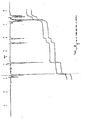
- Figure 1 illustrates the PMR spectrum of 2-benzoyl-1 3-dimethoxy propane.
- Figure 2 illustrates the PMR spectrum of 2-benzoyl-3-methoxy-1-propene.
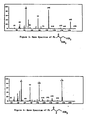
- Figure 3 illustrates the mass spectrum of 2-benzoyl-1,3-dimethoxy propane.
- Figure 4 illustrates the mass spectrum of 2-benzoyl-3-methoxy-1-propene.
- The corrosion inhibitors of the present invention may be formed in either of two ways : (A) the direct addition of an alkenylphenone to the corrosive aqueous fluid, preferably together with a surfactant ; or (b) the addition of a precursor of an alkenylphenone which interacts with a corrosive aqueous acid fluid to form an alkenylphenone, preferably in the presence of a surfactant. Examples of alkenylphenones include :

Precursors of alkenylphenones may take a variety of forms. Examples include:

- The corrosion inhibitors of the present invention may contain more than one precursor of an alkenylphenone. For example, the corrosion inhibitors of the present invention may include a mixture of precursors including an alpha-hydroxy vinylidene compound and a hydroxy ketone, preferably together with a surfactant. The alpha-hydroxy vinylidene compound has the form
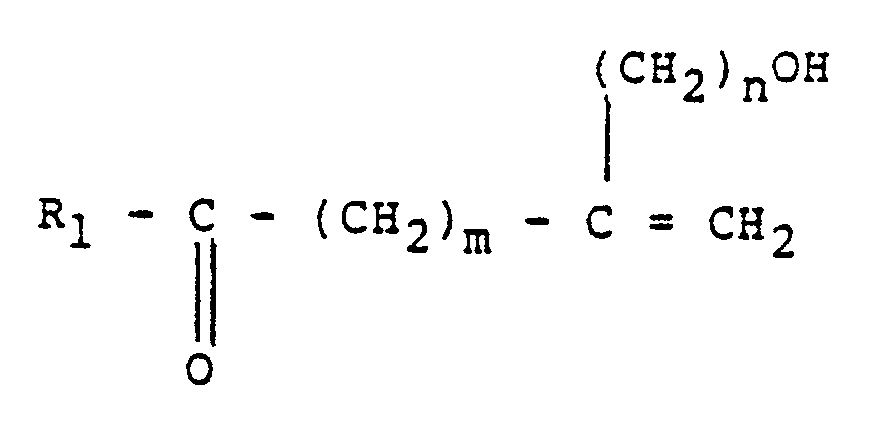
where R₁ may be an aryl hydrocarbon or inertly substituted aryl hydrocarbon: m and n must each be less than 5, and the total number of carbons in the compound should be 16 or less. A preferred example of an alpha-hydroxy vinylidene compound is 2-benzoyl-3-hydroxy-1-propene. - The hydroxy ketone has the form

where R₂ may be an aryl hydrocarbon or inertly substituted aryl hydrocarbon. The value of j must be less than 5, and the compound should contain not more than 16 carbon atoms. A preferred example of a hydroxy ketone is 3-hydroxy-1-phenyl-1-propanone. - The compositions of the present invention comprise an alkenylphenone of the structure (I). In addition, the composition preferably contains a surfactant in an amount from 0 to 2% by weight, based on the weight of the entire composition. The surfactant may be chosen from nonionic, cationic, anionic or amphoteric surface active agents. An example of a nonionic surfactant is "THEO", an adduct of trimethyl-1-heptanol with 7 moles of ethylene oxide. An example of a cationic surfactant is "DDPB", dodecylpyridinium bromide. An example of an anionic surfactant is disodium 4-decylated oxydibenzenesulfonate. An example of an amphoteric surfactant is coco beta-amino propionate.
- Finally, the compositions of the invention include at least one of the following:
- (1) Non-oxidizing mineral or organic acids, for example hydrochloric acid, hydrofluoric acid, sulfuric acid, phosphoric acid, formic acid, acetic acid, citric acid, and mixtures thereof. The acid solutions may optionally contain chelating agents such as EDTA. The concentration of a non-oxidizing mineral or organic acid in the composition of the present invention may vary from 0.1 to 35% by weight based on the entire weight of the composition.
- (2) An alkaline chelating agent, such as the ammonium salts of EDTA, HEDTA, and DPTA. Alkaline chelating agents may be present in the composition of the present invention in an amount from 0.1 to 15% by weight, based on the weight of the entire composition.
- (3) Salt solutions, such as, solutions of sodium chloride, potassium chloride, calcium chloride, calcium bromide, zinc bromide and mixtures thereof. Concentrations of salt solutions in the compositions of the present invention may vary from 0.1% by weight to saturation, based on the weight of the entire composition.
- (4) A salt solution, as described above, may be mixed with an acid gas, such as carbon dioxide or hydrogen sulfide, and/or hydrocarbons such as mineral oil, crude oil and refined hydrocarbon products.
- The amount of an alkenylphenone in the composition of the present invention may vary from 0.01% to 2% by weight, based on the weight of the entire composition. The compositions of the present invention may be used for acidizing hydrocarbon producing agents, cleaning metal, or completing oil and gas wells.
- The present invention also includes a process for inhibiting the corrosion of iron and steel caused by corrosive aqueous acids, especially concentrated hydrochloric acid comprising at least 5 percent by weight HCl. The process is performed by introducing an effective corrosion inhibiting amount of an alkenylphenone or an alkenylphenone precursor into a corrosive aqueous acid. As discussed above, the alkenylphenone precursor can be selected from any material which generates structure (I) when brought into contact with an aqueous fluid. In many cases, the inhibition of the present process is enhanced by the addition of from 0.01 to 2% by weight, compared to the weight of the entire composition, of a surfactant, selected from the surface active agents discussed above. The process of the present invention is normally practiced from 20°C to 200°C. In the process of the present invention, the inhibitor composition is usually 0.1 to 4% by weight compared to the weight of aqueous fluid. The total amount of inhibitor compositions used in the process will depend on the corrosive aqueous acid, its temperature and intended time of contact. The ratio of surfactant to inhibitor composition will depend on the corrosive aqueous fluid, and the water solubility of the inhibitor composition. The exact amounts are determined using the test methods described in the examples below.
- In order that those skilled in the art may better understand how the present invention may be practiced, the following Examples are given by way of illustration and not by way of limitation. All parts and percentages are by weight, unless otherwise noted.
- The condensation procedure described by Fuson, Ross and McKeever in J. Am Chem. Soc., Vol. 60, page 2935 (1938) for formaldehyde and acetophenone was modified as follows. Acetophenone (180 g, 1.5 mol), and paraformaldehyde (45g, 1.5 mol) were dissolved in 150 ml of CH₃OH. K₂CO₃ (2g, 1.5 x 10⁻³ mol) was added and the solution stirred at 25°C for 64 hr. The solution was then acidified to pH = 2 with 10% HCl and the CH₃OH was removed in vacuo. The resulting orange liquid was then distilled in two fractions at
0.2-0.3 mm. Fraction #1 was residual acetophenone. -
Fraction # 2 distilled at 87-90°, 0.25 mm. The latter fraction was then distilled again giving an 87% yield of a mixture of 1 and 2 (of which 88% was the desired dimethyl diether 1). Spectral assignments were as follows: PMR (CDCl₃) see Figure 1: 3.20 (s, methoxy, 6H), 3.5-3.75 (m, methylene, 4H), 3.8 - 4.1 (m, methine, 1H), 7.2-8.1 (m, aromatic 5H).Gas chromatographies were run on a Hewlett-Packard Model 5710 Flame Ionization Gas Chromatograph equipped with a 30m capillary column coated with DB-5; T₁ = 100° programmed at 32°C/min to 220°C (8 min);
T(inj) = T(det) = 250°C. Flow rate: 42mL/min; Ret times (min): diether 1 3.30;monoether 2, 3.41. - Mass spectra were obtained on a Hewlett-Packard Model 5985 GC/MS system equipped with a 50m capillary column coaterd with SP-2100. Pmr spectra
(90 mHz) were obtained on a Varian Model EM-390 spectrometer.
m/e (%); see Figure 3: =
176 (1.5), 175 (1.5), 164 (4.7), 163 (38.0),
106 (7.5), 105 (100), 85 (12), 77 (49.1)
72 (11.5), 71 (9.2), 55 (6.2), 50 (10.9),
45 (91.0), 41 (11.9), 29 (14.9).
- An 84g sample of 91% pure 2-benzoyl-1,3-dimethoxy propane 1 was heated with 4.2g (5 wt %) of p-toluene sulfonic acid (p-TSA) to 80° with stirring. After 5 hr. a second 4.2g sample of p-TSA was added. A third p-TSA addition of 2g was made after another 5 hr. This mixture was left stirring for 6.5 hrs longer and then cooled. The reaction mixture was diluted with 150 ml of Et₂O and 100 ml H₂O added. This mixture was then neutralized to pH = 6-7 with dilute Na₂CO₃ and the organic layer dried over MgSO₄. Filtration and removal of the ether in vacuo left an orange liquid, 2, which was distilled at 0.1 mm and 76° C. Yield : 73%. Purity : 93%.
- Spectral assigments were as follows : Pmr (CDC1₃): see Figure 2 : 3.35 (s, methoxy, 3H), 4.3 (s, methylene, 2H), 5.7 (m, vinyl, 1H), 6.1 (m, vinyl, 1H), 7.2-8.0 (m, aromatic, 5H).
m/e (%) see Figure 4 : =
176 (18.7), 175 (100), 145 (12.2), 144 (12.6),
115 (9.6), 105 (88.5), 99 (9.5), 77 (63.1),
51 (96.6), 50 (53.3), 45 (47.0), 41 (22.0),
40 (12.0), 39 (34.1), 29 (19.7). - API Grade J55 coupons were cleaned in an ultra-sonic cleaner containing a chlorinated hydrocarbon solvent, lightly scrubbed with a steel wool pad and water, rinsed with acetone, dried and weighed. The coupons were suspended from glass hooks attached to the lids of 4-oz. Bottles and immersed in 100 mL of 15% HCl, whereupon they were heated to 65° C and maintained at that temperature for 24 hours. After the test, the coupons were cleaned and weighed as before. The corrosion rate was calculated from the change in weight over the test period using the following formula :

where A, the surface area of the coupons, was taken to be 25.0 cm2. The corrosion rate measured for the uninhibited acid was 1.03 1b/ft²-day (0,2 kg/m² jour). When 0.20 g of 2-benzoyl-3-hydroxy-1-propene and 0.05 g of the adduct of trimethyl-1-heptanol with 7 moles of ethylene oxide were added prior to a test, the corrosion rate was reduced to 0.0090 1b/ ft²-day (0.0018 kg/m²-jour). The % protection was
- The effect of surfactant on the ability of the claimed inhibitors to inhibit the corrosion of J55 steel in 15% HCl is shown below. The test sequence is the same as in Example 3.

- The effect of acid concentration on the effectiveness of the claimed inhibitors is shown below. The test sequence is the same as that described in Example 3.

Claims (11)
- The use of an alkenylphenone of the structure :

- The use as claimed in claim 1, wherein in said alkenylphenone R₁ is unsubstituted aryl, preferably phenyl.
- The use as claimed in claim 1, wherein in said alkenylphenone R₃ is hydrogen.
- The use as claimed in claim 1, wherein in said alkenyl phenone R₂ is an hydroxyalkyl of one to four carbons or an alkoxyalkyl of two to four carbons.
- The use as claimed in claim 1, wherein said alkenylphenone is 2-benzoyl-3-hydroxy-1-propene.
- The use as claimed in claim 1, wherein said alkenylphenone is 2-benzoyl-3-methoxy-1-propene.
- The use as claimed in claim 1, wherein in said alkenylphenone R₁ is phenyl and R₃ is hydrogen.
- The use as claimed in claim 1, including a surfactant selected from the group consisting of nonionic, cationic, anionic, and amphoteric surface active agents.
- An inhibited acid composition, characterized in that it comprises at least one non-oxidizing mineral or organic acid and an effective corrosion inhibiting amount of an alkenylphenone of the structure :

- The composition set forth in claim 9, including an acid gas and/or a hydrocarbon.
- A process for inhibiting corrosion of a ferrous surface in the presence of an aqueous acid, comprising :
contacting said ferrous surface with an aqueous acid composition containing an effective corrosion inhibiting amount of an alkenylphenone of the structure :
Applications Claiming Priority (2)
| Application Number | Priority Date | Filing Date | Title |
|---|---|---|---|
| US76589085A | 1985-08-14 | 1985-08-14 | |
| US765890 | 1985-08-14 |
Publications (2)
| Publication Number | Publication Date |
|---|---|
| EP0212752A1 EP0212752A1 (en) | 1987-03-04 |
| EP0212752B1 true EP0212752B1 (en) | 1991-09-11 |
Family
ID=25074809
Family Applications (1)
| Application Number | Title | Priority Date | Filing Date |
|---|---|---|---|
| EP86201401A Expired - Lifetime EP0212752B1 (en) | 1985-08-14 | 1986-08-08 | Process and composition for inhibiting iron and steel corrosion |
Country Status (5)
| Country | Link |
|---|---|
| US (1) | US5013483A (en) |
| EP (1) | EP0212752B1 (en) |
| CA (1) | CA1269521A (en) |
| DE (1) | DE3681378D1 (en) |
| NO (1) | NO171460C (en) |
Families Citing this family (24)
| Publication number | Priority date | Publication date | Assignee | Title |
|---|---|---|---|---|
| US5120471A (en) * | 1985-08-14 | 1992-06-09 | Dowell Schlumberger Incorporated | Process and composition for protecting chrome steel |
| DE3865688D1 (en) * | 1987-01-30 | 1991-11-28 | Pumptech Nv | METHOD AND COMPOSITION FOR CORROSION INHIBITATION OF IRON AND STEEL. |
| CA1336039C (en) * | 1987-02-12 | 1995-06-27 | Dowell Schlumberger Canada Inc. | High temperature corrosion inhibitor |
| US5366643A (en) * | 1988-10-17 | 1994-11-22 | Halliburton Company | Method and composition for acidizing subterranean formations |
| DE4003893A1 (en) * | 1990-02-09 | 1991-08-14 | Norol Hoechst Oil Chemicals As | Preventing corrosion in liquids in oil fields |
| US5411670A (en) * | 1990-11-05 | 1995-05-02 | Halliburton Company | Method and composition for protecting metal surfaces from oxidative environments |
| US5126059A (en) * | 1991-05-28 | 1992-06-30 | Nalco Chemical Company | Precipitation control |
| US5456767A (en) * | 1993-10-15 | 1995-10-10 | Petrolite Corporation | Corrosion inhibition with bilayer-forming surfactants |
| US5972876A (en) | 1996-10-17 | 1999-10-26 | Robbins; Michael H. | Low odor, hard surface cleaner with enhanced soil removal |
| US5814591A (en) * | 1996-04-12 | 1998-09-29 | The Clorox Company | Hard surface cleaner with enhanced soil removal |
| US5948741A (en) * | 1996-04-12 | 1999-09-07 | The Clorox Company | Aerosol hard surface cleaner with enhanced soil removal |
| US6245728B1 (en) | 1996-10-17 | 2001-06-12 | The Clorox Company | Low odor, hard surface cleaner with enhanced soil removal |
| US5854180A (en) * | 1998-03-24 | 1998-12-29 | Clearwater, Inc. | Environmentally improved acid corrosion inhibitor |
| US6068056A (en) | 1999-10-13 | 2000-05-30 | Schlumberger Technology Corporation | Well treatment fluids comprising mixed aldehydes |
| US6436880B1 (en) | 2000-05-03 | 2002-08-20 | Schlumberger Technology Corporation | Well treatment fluids comprising chelating agents |
| US6534448B1 (en) | 2000-11-02 | 2003-03-18 | Halliburton Energy Services, Inc. | Composition and method for acidizing wells and equipment without damaging precipitation |
| US6415865B1 (en) | 2001-03-08 | 2002-07-09 | Halliburton Energy Serv Inc | Electron transfer agents in well acidizing compositions and methods |
| US6653260B2 (en) | 2001-12-07 | 2003-11-25 | Halliburton Energy Services, Inc. | Electron transfer system for well acidizing compositions and methods |
| US7842127B2 (en) * | 2006-12-19 | 2010-11-30 | Nalco Company | Corrosion inhibitor composition comprising a built-in intensifier |
| US7902124B2 (en) * | 2008-08-29 | 2011-03-08 | Schlumberger Technology Corporation | Self-diverting acid treatment with formic-acid-free corrosion inhibitor |
| US9074289B2 (en) | 2011-11-08 | 2015-07-07 | Nalco Company | Environmentally friendly corrosion inhibitor |
| GB2532990A (en) * | 2014-12-05 | 2016-06-08 | Schlumberger Holdings | Corrosion inhibition |
| GB2543498A (en) | 2015-10-19 | 2017-04-26 | Schlumberger Holdings | Corrosion inhibition |
| US20220145179A1 (en) * | 2020-11-12 | 2022-05-12 | Saudi Arabian Oil Company | Synthesis of aryl 1-(methoxymethyl) vinyl ketones and their use as inhibitors of mild steel corrosion |
Family Cites Families (11)
| Publication number | Priority date | Publication date | Assignee | Title |
|---|---|---|---|---|
| US3107221A (en) * | 1958-04-18 | 1963-10-15 | Dow Chemical Co | Corrosion inhibitor composition |
| US3077454A (en) * | 1960-07-14 | 1963-02-12 | Dow Chemical Co | Compositions for inhibiting corrosion |
| US3077453A (en) * | 1961-09-01 | 1963-02-12 | Dow Chemical Co | Corrosion inhibition |
| US3382179A (en) * | 1965-09-07 | 1968-05-07 | Halliburton Co | Corrosion inhibitor composition |
| US3404094A (en) * | 1965-09-07 | 1968-10-01 | Halliburton Co | Corrosion inhibitor composition |
| US3640895A (en) * | 1968-07-02 | 1972-02-08 | Exxon Research Engineering Co | Inhibition of corrosion using alkyl aryl ketones |
| US4444668A (en) * | 1981-12-31 | 1984-04-24 | Halliburton Company | Well completion fluid compositions |
| US4493775A (en) * | 1983-09-30 | 1985-01-15 | The Dow Chemical Company | Method and composition for corrosion |
| DE3338953A1 (en) * | 1983-10-27 | 1985-05-09 | Henkel KGaA, 4000 Düsseldorf | USE OF CORROSION INHIBITORS IN AQUEOUS SYSTEMS |
| US4522658A (en) * | 1984-06-21 | 1985-06-11 | Halliburton Company | Method and composition for protecting metal surfaces from oxidative environments |
| US4552672A (en) * | 1984-06-21 | 1985-11-12 | Halliburton Company | Method and composition for acidizing subterranean formations |
-
1986
- 1986-08-08 EP EP86201401A patent/EP0212752B1/en not_active Expired - Lifetime
- 1986-08-08 DE DE8686201401T patent/DE3681378D1/en not_active Expired - Lifetime
- 1986-08-13 NO NO863262A patent/NO171460C/en unknown
- 1986-08-13 CA CA000515844A patent/CA1269521A/en not_active Expired - Lifetime
-
1990
- 1990-01-30 US US07/474,232 patent/US5013483A/en not_active Expired - Lifetime
Non-Patent Citations (1)
| Title |
|---|
| PATENT ABSTRACTS OF JAPAN, unexamined applications, section C, vol. 3, no. 87, July 25, 1979; THE PATENT OFFICE JAPANESE GOVERNMENT, page 167 C 53 * |
Also Published As
| Publication number | Publication date |
|---|---|
| NO863262L (en) | 1987-02-16 |
| NO171460C (en) | 1993-03-17 |
| NO863262D0 (en) | 1986-08-13 |
| NO171460B (en) | 1992-12-07 |
| US5013483A (en) | 1991-05-07 |
| CA1269521A (en) | 1990-05-29 |
| DE3681378D1 (en) | 1991-10-17 |
| EP0212752A1 (en) | 1987-03-04 |
Similar Documents
| Publication | Publication Date | Title |
|---|---|---|
| EP0212752A1 (en) | Process and composition for inhibiting iron and steel corrosion | |
| US4734259A (en) | Mixtures of α,β-unsaturated aldehides and surface active agents used as corrosion inhibitors in aqueous fluids | |
| EP0139567B1 (en) | Method and composition for inhibiting corrosion | |
| US3404094A (en) | Corrosion inhibitor composition | |
| EP0471400B1 (en) | Process and composition for protecting chrome steel | |
| US3773465A (en) | Inhibited treating acid | |
| EP0446616B1 (en) | Process for inhibiting corrosion in oil production fluids | |
| US5854180A (en) | Environmentally improved acid corrosion inhibitor | |
| US20070071887A1 (en) | Methods of inhibiting corrosion of a metal surface | |
| US5096618A (en) | Process and composition for inhibiting high-temperature iron and steel corrosion | |
| EP0965657A1 (en) | Corrosion inhibiting compositions | |
| US3382179A (en) | Corrosion inhibitor composition | |
| US4557838A (en) | Inhibiting acid corrosion of metals | |
| US20070069182A1 (en) | Corrosion inhibitor compositions and associated methods | |
| EP0276879B1 (en) | Process and composition for inhibiting iron and steel corrosion | |
| US2955083A (en) | Corrosion inhibitors in well treating compositions | |
| EP0593230A1 (en) | Metal corrosion inhibiting compositions | |
| EP0878606B1 (en) | Reducing metal corrosivity of organic acids | |
| WO2002103081A2 (en) | Halogen acid corrosion inhibitor base | |
| US4065260A (en) | Halogen derivatives of alkynoxymethyl amines as corrosion inhibitors | |
| US3600321A (en) | Dimethyl formamide-containing corrosion inhibitor | |
| US3062748A (en) | Inhibited aqueous acidic composition | |
| US4605737A (en) | Acyl derivatives of tris-hydroxy-ethyl-perhydro-1,3,5-triazine | |
| US3428566A (en) | Process of corrosion inhibition with 1-hexyn-3-ol | |
| EP0278543B1 (en) | Process and composition for inhibiting high-temperature iron and steel corrosion |
Legal Events
| Date | Code | Title | Description |
|---|---|---|---|
| PUAI | Public reference made under article 153(3) epc to a published international application that has entered the european phase |
Free format text: ORIGINAL CODE: 0009012 |
|
| AK | Designated contracting states |
Kind code of ref document: A1 Designated state(s): DE FR GB IT NL |
|
| 17P | Request for examination filed |
Effective date: 19870515 |
|
| 17Q | First examination report despatched |
Effective date: 19880712 |
|
| RAP1 | Party data changed (applicant data changed or rights of an application transferred) |
Owner name: COMPAGNIE DES SERVICES DOWELL SCHLUMBERGER Owner name: PUMPTECH N.V. |
|
| GRAA | (expected) grant |
Free format text: ORIGINAL CODE: 0009210 |
|
| ITF | It: translation for a ep patent filed | ||
| AK | Designated contracting states |
Kind code of ref document: B1 Designated state(s): DE FR GB IT NL |
|
| ET | Fr: translation filed | ||
| REF | Corresponds to: |
Ref document number: 3681378 Country of ref document: DE Date of ref document: 19911017 |
|
| PLBE | No opposition filed within time limit |
Free format text: ORIGINAL CODE: 0009261 |
|
| STAA | Information on the status of an ep patent application or granted ep patent |
Free format text: STATUS: NO OPPOSITION FILED WITHIN TIME LIMIT |
|
| 26N | No opposition filed | ||
| PGFP | Annual fee paid to national office [announced via postgrant information from national office to epo] |
Ref country code: DE Payment date: 19960830 Year of fee payment: 11 |
|
| PG25 | Lapsed in a contracting state [announced via postgrant information from national office to epo] |
Ref country code: DE Free format text: LAPSE BECAUSE OF NON-PAYMENT OF DUE FEES Effective date: 19980501 |
|
| PGFP | Annual fee paid to national office [announced via postgrant information from national office to epo] |
Ref country code: FR Payment date: 19980709 Year of fee payment: 13 |
|
| PGFP | Annual fee paid to national office [announced via postgrant information from national office to epo] |
Ref country code: GB Payment date: 19980731 Year of fee payment: 13 |
|
| PG25 | Lapsed in a contracting state [announced via postgrant information from national office to epo] |
Ref country code: GB Free format text: LAPSE BECAUSE OF NON-PAYMENT OF DUE FEES Effective date: 19990808 |
|
| GBPC | Gb: european patent ceased through non-payment of renewal fee |
Effective date: 19990808 |
|
| PG25 | Lapsed in a contracting state [announced via postgrant information from national office to epo] |
Ref country code: FR Free format text: LAPSE BECAUSE OF NON-PAYMENT OF DUE FEES Effective date: 20000428 |
|
| REG | Reference to a national code |
Ref country code: FR Ref legal event code: ST |
|
| PGFP | Annual fee paid to national office [announced via postgrant information from national office to epo] |
Ref country code: NL Payment date: 20010830 Year of fee payment: 16 |
|
| PG25 | Lapsed in a contracting state [announced via postgrant information from national office to epo] |
Ref country code: NL Free format text: LAPSE BECAUSE OF NON-PAYMENT OF DUE FEES Effective date: 20030301 |
|
| NLV4 | Nl: lapsed or anulled due to non-payment of the annual fee |
Effective date: 20030301 |
|
| PG25 | Lapsed in a contracting state [announced via postgrant information from national office to epo] |
Ref country code: IT Free format text: LAPSE BECAUSE OF NON-PAYMENT OF DUE FEES;WARNING: LAPSES OF ITALIAN PATENTS WITH EFFECTIVE DATE BEFORE 2007 MAY HAVE OCCURRED AT ANY TIME BEFORE 2007. THE CORRECT EFFECTIVE DATE MAY BE DIFFERENT FROM THE ONE RECORDED. Effective date: 20050808 |