EP0207676B1 - Polymers for use in continuous peritoneal dialysis - Google Patents
Polymers for use in continuous peritoneal dialysis Download PDFInfo
- Publication number
- EP0207676B1 EP0207676B1 EP86304624A EP86304624A EP0207676B1 EP 0207676 B1 EP0207676 B1 EP 0207676B1 EP 86304624 A EP86304624 A EP 86304624A EP 86304624 A EP86304624 A EP 86304624A EP 0207676 B1 EP0207676 B1 EP 0207676B1
- Authority
- EP
- European Patent Office
- Prior art keywords
- molecular weight
- polymers
- glucose
- weight
- mixture
- Prior art date
- Legal status (The legal status is an assumption and is not a legal conclusion. Google has not performed a legal analysis and makes no representation as to the accuracy of the status listed.)
- Expired - Lifetime
Links
Images


Classifications
-
- A—HUMAN NECESSITIES
- A61—MEDICAL OR VETERINARY SCIENCE; HYGIENE
- A61M—DEVICES FOR INTRODUCING MEDIA INTO, OR ONTO, THE BODY; DEVICES FOR TRANSDUCING BODY MEDIA OR FOR TAKING MEDIA FROM THE BODY; DEVICES FOR PRODUCING OR ENDING SLEEP OR STUPOR
- A61M1/00—Suction or pumping devices for medical purposes; Devices for carrying-off, for treatment of, or for carrying-over, body-liquids; Drainage systems
- A61M1/14—Dialysis systems; Artificial kidneys; Blood oxygenators ; Reciprocating systems for treatment of body fluids, e.g. single needle systems for hemofiltration or pheresis
- A61M1/28—Peritoneal dialysis ; Other peritoneal treatment, e.g. oxygenation
- A61M1/287—Dialysates therefor
-
- A—HUMAN NECESSITIES
- A61—MEDICAL OR VETERINARY SCIENCE; HYGIENE
- A61K—PREPARATIONS FOR MEDICAL, DENTAL OR TOILETRY PURPOSES
- A61K31/00—Medicinal preparations containing organic active ingredients
- A61K31/70—Carbohydrates; Sugars; Derivatives thereof
- A61K31/715—Polysaccharides, i.e. having more than five saccharide radicals attached to each other by glycosidic linkages; Derivatives thereof, e.g. ethers, esters
-
- C—CHEMISTRY; METALLURGY
- C08—ORGANIC MACROMOLECULAR COMPOUNDS; THEIR PREPARATION OR CHEMICAL WORKING-UP; COMPOSITIONS BASED THEREON
- C08B—POLYSACCHARIDES; DERIVATIVES THEREOF
- C08B30/00—Preparation of starch, degraded or non-chemically modified starch, amylose, or amylopectin
- C08B30/12—Degraded, destructured or non-chemically modified starch, e.g. mechanically, enzymatically or by irradiation; Bleaching of starch
- C08B30/18—Dextrin, e.g. yellow canari, white dextrin, amylodextrin or maltodextrin; Methods of depolymerisation, e.g. by irradiation or mechanically
-
- C—CHEMISTRY; METALLURGY
- C13—SUGAR INDUSTRY
- C13K—SACCHARIDES OBTAINED FROM NATURAL SOURCES OR BY HYDROLYSIS OF NATURALLY OCCURRING DISACCHARIDES, OLIGOSACCHARIDES OR POLYSACCHARIDES
- C13K1/00—Glucose; Glucose-containing syrups
- C13K1/06—Glucose; Glucose-containing syrups obtained by saccharification of starch or raw materials containing starch
Definitions
- This invention relates to a new form of polymer, a method for its production and compositions containing it.
- Maltodextrins are produced by the hydrolysis of pure starch isolated from various natural products, e.g. wheat, rice and tapioca. In a typical process a pure isolated starch is produced by a multi-stage separation process involving removal of protein, oil, fibre and glutens before being hydrolysed.
- M w weight average molecular weight
- M n number average molecular weight
- Glucose polymers are often characterised by the expression "degree of polymerisation” (DP).
- DP degree of polymerisation
- a product may be described as having 20% of its weight comprising molecules with a DP greater than 10, ie. 20% has a molecular weight greater than 1656 (a polymer comprising 10 glucose units).
- British Patent Application 2132914A describes a glucose polymer mixture having at least 15% by weight of glucose polymers of DP greater than 12 for use in continuous ambulatory peritoneal dialysis (CAPD).
- PCT/US Application 82/00774 describes a CAPD solution comprising glucose polymers of DP of at least 4.
- European Patent Application 0076355 A2 discloses glucose polymer mixtures having at least 99% of glucose polymers of DP less than 12 for use in CAPD.
- European patent specification No 153,164 also discloses glucose polymer mixtures for use in peritoneal dialysis, the mixtures containing more than 50% by weight of glucose polymers of D.P. greater than 12 (in the claims) and as low as 15% of polymers of D.P. greater than 12 (in the examples). Milner makes no mention of the number average molecular weight values for these mixtures, and the mixtures which he discloses span an extremely wide range of possible M n values.
- a peritoneal dialysis composition containing an osmotic agent which is a mixture of glucose polymers, wherein at least 50% by weight of the mixture comprises polymers having molecular weights in the range of from 5,000 to 30,000, and wherein the mixture has a weight average molecular weight of from 5,000 to 50,000 and a number average molecular weight of from 2,900 to 8,000, both the weight average molecular weight and the number average molecular weight being determined using chromatographic columns calibrated with dextran standards.
- an osmotic agent which is a mixture of glucose polymers, wherein at least 50% by weight of the mixture comprises polymers having molecular weights in the range of from 5,000 to 30,000, and wherein the mixture has a weight average molecular weight of from 5,000 to 50,000 and a number average molecular weight of from 2,900 to 8,000, both the weight average molecular weight and the number average molecular weight being determined using chromatographic columns calibrated with dextran standards.
- the mixture of glucose polymers preferably contains less than 5% by weight of polymers of molecular weight greater than 100,000. More preferably, it contains no more than 20% by weight of polymers having molecular weights of from 800 to 10,000.
- composition may additionally comprise a pharmaceutically acceptable adjuvant, diluent or carrier.
- the glucose polymer mixture of the present invention has at least 50% by weight of polymers of molecular weight in the range 5000 to 30000.
- glucose polymer mixture wherein at least 80% by weight of the polymers are of molecular weight in the range 5000 to 50,000.
- glucose polymer mixture to have a weight average molecular weight in the range of from 5000 to 100000, preferably of from 5000 to 50000, more preferably of from 12000 to 25000, and most preferably of from 14000 to 20000.
- the content of mono-, di-, and tri-saccharide compounds present in the glucose polymer mixture to be less than 5% by weight, more preferably less than 2% and most preferably 0% by weight.
- 0% we mean an amount which is undetectable by conventional methods.
- the content of glucose polymers with molecular weight greater than 100000 in the glucose polymer mixture should be less than 5%, preferably less than 3% and most preferably less than 1% by weight.
- glucose polymers we prefer the glucose polymers to be substantially free from endotoxins and nitrogenous contaminants arising from the original starch, or from the enzyme preparations used for its hydrolysis.
- endotoxin level to be less than 0.25 endotoxin units/ml, more preferably less than 0.12 endotoxin units/ml and most preferably less than 0.06 endotoxin units/ml as determined by the Limilus Lysate Test (US Pharmacopoeia).
- the nitrogen content of the glucose polymers to be less than 0.01% w/w, more preferably less than 0.001% w/w and most preferably zero as determined by the Kjeldahl method (British Pharmacopoeia).
- glucose polymers to be substantially free of undesirable metals, e.g. aluminium.
- level of aluminium to be less than 500 ppb, more preferably less than 200 ppb and most preferably less than 100 ppb.
- an aqueous solution comprising 10% w/v of the glucose polymer to be substantially clear and colourless.
- a solution to have a turbidity value of less than 30 EEL units (US Pharmacopoeia), more preferably less than 20 EEL units and most preferably less than 10 EEL units.
- the content of colour precursors such as 5-hydroxymethyl furfural can be measured by absorption of ultraviolet light of wavelength 275 or 284nm.
- the absorbance to be less than 0.5, more preferably less than 0.25 and most preferably less than 0.15.
- the transmission of ultraviolet light measured at a wavelength of 430 nm is preferably greater than 90% and more preferably greater than 95%.
- a glucose polymer (I) having up to 20% by weight of glucose polymers with a molecular weight of from 800 to 10,000, preferably of from 1500 to 4000.
- a glucose polymer (I) having up to 20% by weight of glucose polymers with a molecular weight of from 1500 to 2500, more preferably up to 10% by weight and most preferably up to 7% by weight.
- the process parameters used are interdependent and each parameter may vary depending upon the desired quality of the product, the desired molecular weight range, etc.
- the water miscible solvent may be an alcohol, eg an alkanol, such as ethanol.
- the solvent may be present in an aqueous solution which is mixed with an aqueous glucose polymer.
- the concentration of the solvent in the aqueous solution before mixing may be from 60 to 100% v/v, preferably from 75 to 90% v/v, and most preferably about 85% v/v.
- the concentration of the aqueous glucose polymer solution before mixing may be from 0 to 80% w/v, preferably from 15 to 65% w/v, and most preferably from 30 to 40% w/v.
- the fractionation may be carried out at a temperature of from 10 to 40°C and more preferably from 20 to 30°C.
- the type of membrane material used may vary with the particular molecular weight distribution which is desired.
- a chemically inert plastics material may be used for the membrane, eg. a cellulose acetate or polytetrafluoro-ethylene.
- a material which is mechanically stable at high temperatures and pressures eg. a polysulphone.
- a series of membranes may be used consecutively such that both a high and a low molecular weight fractionation is carried out.
- the membrane fractionation may be carried out at elevated temperature sufficient to prevent bacteriological contamination.
- the feed solution may be of a concentration of from 1.0 to 30.0% w/v, preferably from 5 to 15% w/v and most preferably about 10% w/v.
- the glucose polymer starting material is preferably prepared by a method, e.g. hydrolysis, designed to optimise the proportion of polymer (I), and the progress of that method is preferably monitored by size exclusion chromotography.
- a method e.g. hydrolysis, designed to optimise the proportion of polymer (I), and the progress of that method is preferably monitored by size exclusion chromotography.
- Any starch may be used in the hydrolysis but we prefer to use a cornstarch.
- the molecular weight distribution of the fractions may be determined using the chromatographic techniques described by Alsop et al J. Chromatography 246 , 227-240 (1982).
- the optical rotation of the various solutions produced may also be used to identify the concentrations of the polymer contained by the solutions.
- the high molecular weight waste products from the fractionations may be further hydrolysed to produce further quantities of lower molecular weight products which can be fractionated.
- the low molecular weight waste products may be useful in the production of glucose syrups.
- the polymer Before, during and/or after the fractionation of process a) or b) the polymer may be purified.
- the purification may be to remove undesirable colour or to remove contaminants, for example proteins, bacteria, bacterial toxins, fibres or trace metals, eg aluminium.
- Any conventional purification technique may be applied, for example, filtration and/or absorption/adsorption techniques such as ion exchange or charcoal treatment.
- the product of the fractionation of process a) or b) may be packaged and transported as a syrup or solution, for example an aqueous solution.
- a syrup or solution for example an aqueous solution.
- the glucose polymer (I) is useful in a wide variety of medical indications, e.g. peritoneal dialysis, as a nutritional agent or for the prevention of post-operative adhesions etc.
- a pharmaceutical composition comprising a glucose polymer mixture, wherein at least 50% of the mixture comprises polymers of a molecular weight in the range 5000 to 30000 and wherein the mixture has a weight average molecular weight of from 5,000 to 50,000 and a number average molecular weight of from 2,890 to 8,000, in admixture with a pharmaceutically acceptable adjuvant, diluent or carrier.
- composition for in CAPD preferably comprises physiologically acceptable electrolytes, eg. sodium, potassium, calcium and magnesium, in order to prevent the transfer of desirable electrolytes from the serum to the peritoneum.
- physiologically acceptable electrolytes eg. sodium, potassium, calcium and magnesium
- the amounts may vary depending upon the requirements of any individual patient and are generally sufficient to provide an osmolarity of from about 240 to 275 mOsm/litre (see Example A).
- a physiologically acceptable polysaccharide (II) with an osmolarity of less than 160 mOsm/litre, preferably less than 110 mOsm/litre more preferably less than 90 mOsm/litre and most preferably less than 20 mOsm/litre, which is capable of being used in solution in the dialysis of normal human serum.
- normal human serum we mean serum with an osmolarity of between 280 and 290 mOsm/litre at 37°C.
- the polysaccharide (II) preferably has the molecular weight and other parameters described above with respect to glucose polymer (I). Any suitable polysaccharide may be used but we prefer the polysaccharide to be a glucose polymer (I).
- the polysaccharide (II) may be prepared by any of the processes hereinbefore described or by conventional processes known per se .
- compositions capable of dialysing normal human serum comprising a polysaccharide (II) and having an osmolarity somewhat greater than normal serum.
- the osmolarity of the composition is preferably less than 400 mOsm/litre, more preferably less than 350 mOsm/litre and most preferably less than 330 mOsm/litre at 37°C.
- the composition may be in solid form, eg suitable for extemporaneous production of a solution, or it may be a liquid, eg in the form of an aqueous solution.
- the composition preferably includes pharmacologically acceptable electrolytes.
- electrolytes may include appropriate ions , eg of sodium, potassium, calcium, magnesium and chloride; buffers, eg. lactate, acetate or bisulphite; or other additives, such as amino acids, polyols or insulin.
- the polymer (I) and the polysaccharide (II) are advantageous over the prior art.
- the long term use of high osmolarity glucose solutions in peritoneal dialysis can result in irreversible changes to the peritoneal membrane due to the continuous high pressure differentials across the peritoneum.
- glucose solution with a low osmolarity is used in CAPD for greater than four hours glucose may be lost from the peritoneum to the serum, this is undesirable, particularly in diabetic patients.
- the present invention provides a method of applying an osmotic pressure over the peritoneum for greater than four hours without causing damage to the peritoneum whilst preventing appreciable loss of polysaccharide to the serum from the peritoneum and maintaining the flow of water from the serum to the peritoneum.
- the molecular weight distribution of the starch hydrolysate starting material which was used in Examples 1 and 2 is shown in Table 1.
- the starting material was found to have an M w of 6309 and an M n of 401.
- Syrup V (10.51 at 102.4° OR ⁇ 5.5kg dissolved maltodextrins) was drawn off. This represents 23.9% recovery of the maltodextrins present in the initial syrup.
- 3.8kg of Syrup V was dissolved in pyrogen free water (25 l) and refluxed with stirring in the presence of 0.4kg of activated carbon (Norit UK, GSX grade). The carbon was removed by filtration and the resulting syrup was used to prepare peritoneal dialysis solutions.
- the M w of the product maltodextrin after carbon treatment was 18949 and the M n was 6316.
- the molecular weight distribution is shown in Table 2, 61% of the product lies within the range 5000 to 30000.
- Example 1 The procedure of Example 1 was repeated using the quantities shown in Figure 2. However, the carbon treatment was carried out by adding the activated carbon (Norit UK, grade GSX 5kg) to the alcoholic Syrup V. The alcohol was removed by steam distillation and the carbon by depth filtration (Carlson Ford grade NA90). The resulting syrup was then spray dried.
- the M w of the product maltodextrin was 12027 and the M n was 3447.
- the molecular weight distribution is shown in Table 3, 60% of the product lies within the range 5000 to 30000.
- the M w of the product maltodextrin after carbon treatment was 12027 and the M n was 3447.
- the molecular weight distribution is shown in Table 3, 60% of the product lies within the range 5000 to 30000.
- the molecular weight distribution of the starting material is shown in Table 4.
- the starting material had an M w of 11534 and an M n of 586.
- Example 1 The procedure of Example 1 was repeated using the quantities shown in Figure 3. However, the carbon treatment was carried out by adding the activated carbon (Norit UK, Grade GSX 60kg) to the alcoholic syrup IV. The activated carbon was filtered off by depth filtration (Carlson Ford Grade 'O' pads). A further carbon treatment was carried out on the syrup VI (15kg Norit UK Grade GSX, filtered off using Carlson Ford Grade NA90 pads) during ethanol removal by steam distillation. The ethanol-free syrup was spray dried.
- the activated carbon Naorit UK, Grade GSX 60kg
- the activated carbon was filtered off by depth filtration (Carlson Ford Grade 'O' pads).
- a further carbon treatment was carried out on the syrup VI (15kg Norit UK Grade GSX, filtered off using Carlson Ford Grade NA90 pads) during ethanol removal by steam distillation. The ethanol-free syrup was spray dried.
- the M w of the product maltodextrin was 21838 and the M n was 7105.
- the molecular weight distribution is shown in Table 5, 58% of the product lies within the range 5000 to 30000.
- the molecular weight distribution of the starting material is shown in Table 6.
- the starting material had an M w of 12636 and an M n of 639.
- Example 1 The procedure of Example 1 was repeated using the quantities shown in Figure 5.
- the carbon treatment was carried out by adding activated carbon (Norit UK, Grade GSX, 20kg) to the alcoholic syrup IV.
- the carbon was filtered by depth filtration (Carlson Ford Grade 'O' pads).
- Ethanol was removed from the final syrup (syrup V) by steam distillation and the aqueous product ion exchanged (mixed bed system), and spray dried.
- the mixed bed resin was Duolite A1725 in the hydroxyl form and C225H in the chloride form. (Duolite is a trade mark).
- the M w of the product maltodextrin was 22020 and The M n was 7767.
- the molecular weight distribution is shown in Table 7; 60% of the product lies within the range 5000 to 30000.
- a high molecular weight fractionation was carried out by passing 2.0kg of starch hydrolysate, (molecular weight distribution, see Table 8), as a 10% w/v solution (20 litres) through a series of membranes. Polysulphone membranes with an approximate molecular weight cut-off of 25,000 and an area of 0.144m2 were used. The feed flowrate was 6.6 litres/min at a temperature of 70°C. The total solids level of the retained liquid was maintained at 10% w/v and the low molecular weight species were washed through the membrane. After 5.5 hours the concentration of carbohydrate in the permeate product stream leaving the ultrafiltration module was undetectable (see Table 9) and the process was terminated. The high molecular weight residues were recovered from the membrane (0.384 kg, 19.2%) and the permeative low molecular weight product was isolated from the permeate (1.61 kg, 80.6%).
- M w was found to be 4906 and M n determined as 744.
- the syrup from the fractionation had an M w of 19712 and an M n of 4798.
- the molecular weight distribution is shown in Table 11; 55% of the product lies within the range 5000 to 30000.
Landscapes
- Health & Medical Sciences (AREA)
- Chemical & Material Sciences (AREA)
- Life Sciences & Earth Sciences (AREA)
- Emergency Medicine (AREA)
- Urology & Nephrology (AREA)
- General Health & Medical Sciences (AREA)
- Heart & Thoracic Surgery (AREA)
- Veterinary Medicine (AREA)
- Public Health (AREA)
- Animal Behavior & Ethology (AREA)
- Engineering & Computer Science (AREA)
- Hematology (AREA)
- Biochemistry (AREA)
- Medicinal Chemistry (AREA)
- Organic Chemistry (AREA)
- Vascular Medicine (AREA)
- Anesthesiology (AREA)
- Biomedical Technology (AREA)
- Crystallography & Structural Chemistry (AREA)
- Polymers & Plastics (AREA)
- Chemical Kinetics & Catalysis (AREA)
- Materials Engineering (AREA)
- Molecular Biology (AREA)
- Pharmacology & Pharmacy (AREA)
- Epidemiology (AREA)
- External Artificial Organs (AREA)
- Polysaccharides And Polysaccharide Derivatives (AREA)
- Pharmaceuticals Containing Other Organic And Inorganic Compounds (AREA)
- Saccharide Compounds (AREA)
- Transition And Organic Metals Composition Catalysts For Addition Polymerization (AREA)
Abstract
Description
- This invention relates to a new form of polymer, a method for its production and compositions containing it.
- Maltodextrins (glucose polymers) are produced by the hydrolysis of pure starch isolated from various natural products, e.g. wheat, rice and tapioca. In a typical process a pure isolated starch is produced by a multi-stage separation process involving removal of protein, oil, fibre and glutens before being hydrolysed.
- As no single number can adequately characterise the molecular weight of a polymer, such as a maltodextrin, various averages are used. The most commonly used are the weight average molecular weight (
M w) and the number average molecular weight (M n):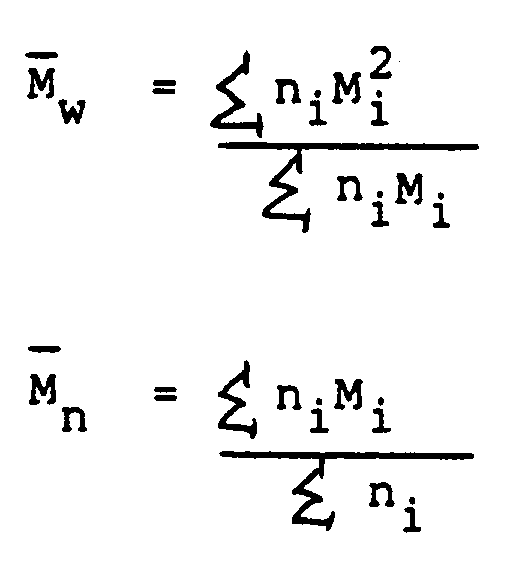
where ni is the number of molecules of molecular weight Mi.M w is particularly sensitive to changes in the high-molecular-weight content of the maltodextrin polymer whilstM n is largely influenced by changes in the low molecular weight of the sample. - We have now found that it is possible to monitor starch hydrolysis and in particular to stop the hydrolytic action when the hydrolysate contains the maximum amount of molecules in the desired molecular weight range. The monitoring may be carried out by a technique known as size exclusion chromatography. Furthermore, fractionation of the starch hydrolysate can be monitored by size exclusion chromatography and a weight average molecular weight, a number average molecular weight and a molecular weight distribution of the products can be determined using chromatographic columns calibrated with dextran standards (Alsop et al Process Biochem 2 10-15 (1977) and Alsop et al J. Chromatography 246, 227-240, (1982)).
- We have also found a method for optimising the yield of a glucose polymer with a preselected molecular weight range.
- Glucose polymers are often characterised by the expression "degree of polymerisation" (DP). In this terminology a product may be described as having 20% of its weight comprising molecules with a DP greater than 10, ie. 20% has a molecular weight greater than 1656 (a polymer comprising 10 glucose units).
- British Patent Application 2132914A describes a glucose polymer mixture having at least 15% by weight of glucose polymers of DP greater than 12 for use in continuous ambulatory peritoneal dialysis (CAPD). PCT/US Application 82/00774 describes a CAPD solution comprising glucose polymers of DP of at least 4.
- European Patent Application 0076355 A2 discloses glucose polymer mixtures having at least 99% of glucose polymers of DP less than 12 for use in CAPD.
- European patent specification No 153,164 (Milner) also discloses glucose polymer mixtures for use in peritoneal dialysis, the mixtures containing more than 50% by weight of glucose polymers of D.P. greater than 12 (in the claims) and as low as 15% of polymers of D.P. greater than 12 (in the examples). Milner makes no mention of the number average molecular weight values for these mixtures, and the mixtures which he discloses span an extremely wide range of possible Mn values.
- It has now been surprisingly found that a small sub-range of the wide range of polymer mixtures disclosed by Milner is particularly effective for use in peritoneal dialysis. This sub-range is defined by reference to the Mn values for the mixtures, which values have been found to be critical in predicting the effectiveness of the mixtures in, in particular, CAPD.
- According to the present invention there is provided a peritoneal dialysis composition containing an osmotic agent which is a mixture of glucose polymers, wherein at least 50% by weight of the mixture comprises polymers having molecular weights in the range of from 5,000 to 30,000, and wherein the mixture has a weight average molecular weight of from 5,000 to 50,000 and a number average molecular weight of from 2,900 to 8,000, both the weight average molecular weight and the number average molecular weight being determined using chromatographic columns calibrated with dextran standards.
- The mixture of glucose polymers preferably contains less than 5% by weight of polymers of molecular weight greater than 100,000. More preferably, it contains no more than 20% by weight of polymers having molecular weights of from 800 to 10,000.
- The composition may additionally comprise a pharmaceutically acceptable adjuvant, diluent or carrier.
- It has surprisingly been found that certain polydisperse glucose polymer mixtures of high molecular weight are useful in medicine, e.g. in CAPD and in prevention of post-operative adhesions.
- The glucose polymer mixture of the present invention has at least 50% by weight of polymers of molecular weight in the range 5000 to 30000.
- We particularly prefer a glucose polymer mixture wherein at least 80% by weight of the polymers are of molecular weight in the range 5000 to 50,000.
- We prefer the glucose polymer mixture to have a weight average molecular weight in the range of from 5000 to 100000, preferably of from 5000 to 50000, more preferably of from 12000 to 25000, and most preferably of from 14000 to 20000.
- We prefer the content of mono-, di-, and tri-saccharide compounds present in the glucose polymer mixture to be less than 5% by weight, more preferably less than 2% and most preferably 0% by weight. By 0% we mean an amount which is undetectable by conventional methods.
- We further prefer that the content of glucose polymers with molecular weight greater than 100000 in the glucose polymer mixture should be less than 5%, preferably less than 3% and most preferably less than 1% by weight.
- We prefer the glucose polymers to be substantially free from endotoxins and nitrogenous contaminants arising from the original starch, or from the enzyme preparations used for its hydrolysis.
- We particularly prefer the endotoxin level to be less than 0.25 endotoxin units/ml, more preferably less than 0.12 endotoxin units/ml and most preferably less than 0.06 endotoxin units/ml as determined by the Limilus Lysate Test (US Pharmacopoeia).
- We prefer the nitrogen content of the glucose polymers to be less than 0.01% w/w, more preferably less than 0.001% w/w and most preferably zero as determined by the Kjeldahl method (British Pharmacopoeia).
- We also prefer the glucose polymers to be substantially free of undesirable metals, e.g. aluminium. Thus we prefer the level of aluminium to be less than 500 ppb, more preferably less than 200 ppb and most preferably less than 100 ppb.
- We also prefer an aqueous solution comprising 10% w/v of the glucose polymer to be substantially clear and colourless. Thus we prefer such a solution to have a turbidity value of less than 30 EEL units (US Pharmacopoeia), more preferably less than 20 EEL units and most preferably less than 10 EEL units. We also prefer such a solution to have no substantially visible colour. We particularly prefer the solution to have a visible colour of less than 10 APHA Hazen units and more preferably less than 5 APHA Hazen units. The content of colour precursors such as 5-hydroxymethyl furfural can be measured by absorption of ultraviolet light of wavelength 275 or 284nm. We prefer the absorbance to be less than 0.5, more preferably less than 0.25 and most preferably less than 0.15. The transmission of ultraviolet light measured at a wavelength of 430 nm is preferably greater than 90% and more preferably greater than 95%.
- We also disclose a glucose polymer (I) having up to 20% by weight of glucose polymers with a molecular weight of from 800 to 10,000, preferably of from 1500 to 4000. We particularly prefer a glucose polymer (I) having up to 20% by weight of glucose polymers with a molecular weight of from 1500 to 2500, more preferably up to 10% by weight and most preferably up to 7% by weight.
- We also disclose a method for the production of a glucose polymer (I), which comprises
- a) fractional precipitation of an aqueous solution of a glucose polymer containing polymer (I) with a water miscible solvent, and/or
- b) filtration of an aqueous solution of a glucose polymer containing polymer (I) through membranes possessing an appropriate molecular weight cut-off range. The molecular weight cut-off range may be determined empirically.
- In process a) the process parameters used are interdependent and each parameter may vary depending upon the desired quality of the product, the desired molecular weight range, etc. The water miscible solvent may be an alcohol, eg an alkanol, such as ethanol. The solvent may be present in an aqueous solution which is mixed with an aqueous glucose polymer. The concentration of the solvent in the aqueous solution before mixing may be from 60 to 100% v/v, preferably from 75 to 90% v/v, and most preferably about 85% v/v.
- The concentration of the aqueous glucose polymer solution before mixing may be from 0 to 80% w/v, preferably from 15 to 65% w/v, and most preferably from 30 to 40% w/v.
- The fractionation may be carried out at a temperature of from 10 to 40°C and more preferably from 20 to 30°C.
- In process b) the type of membrane material used may vary with the particular molecular weight distribution which is desired. A chemically inert plastics material may be used for the membrane, eg. a cellulose acetate or polytetrafluoro-ethylene. We particularly prefer to use a material which is mechanically stable at high temperatures and pressures, eg. a polysulphone.
- A series of membranes may be used consecutively such that both a high and a low molecular weight fractionation is carried out. The membrane fractionation may be carried out at elevated temperature sufficient to prevent bacteriological contamination. We prefer the fractionation to be carried out at a temperature of from 0 to 90°C, preferably from 20 to 80°C, and most preferably from 65° to 75°C.
- The feed solution may be of a concentration of from 1.0 to 30.0% w/v, preferably from 5 to 15% w/v and most preferably about 10% w/v.
- The glucose polymer starting material is preferably prepared by a method, e.g. hydrolysis, designed to optimise the proportion of polymer (I), and the progress of that method is preferably monitored by size exclusion chromotography. Any starch may be used in the hydrolysis but we prefer to use a cornstarch.
- The molecular weight distribution of the fractions may be determined using the chromatographic techniques described by Alsop et al J. Chromatography 246, 227-240 (1982). The optical rotation of the various solutions produced may also be used to identify the concentrations of the polymer contained by the solutions.
- The high molecular weight waste products from the fractionations may be further hydrolysed to produce further quantities of lower molecular weight products which can be fractionated. The low molecular weight waste products may be useful in the production of glucose syrups.
- Before, during and/or after the fractionation of process a) or b) the polymer may be purified. The purification may be to remove undesirable colour or to remove contaminants, for example proteins, bacteria, bacterial toxins, fibres or trace metals, eg aluminium. Any conventional purification technique may be applied, for example, filtration and/or absorption/adsorption techniques such as ion exchange or charcoal treatment.
- The product of the fractionation of process a) or b) may be packaged and transported as a syrup or solution, for example an aqueous solution. However, we prefer the product to be in a solid form, preferably a powder, and most preferably spray dried granules.
- The glucose polymer (I) is useful in a wide variety of medical indications, e.g. peritoneal dialysis, as a nutritional agent or for the prevention of post-operative adhesions etc.
- According to the invention we also provide a pharmaceutical composition comprising a glucose polymer mixture, wherein at least 50% of the mixture comprises polymers of a molecular weight in the range 5000 to 30000 and wherein the mixture has a weight average molecular weight of from 5,000 to 50,000 and a number average molecular weight of from 2,890 to 8,000, in admixture with a pharmaceutically acceptable adjuvant, diluent or carrier.
- Any composition for in CAPD preferably comprises physiologically acceptable electrolytes, eg. sodium, potassium, calcium and magnesium, in order to prevent the transfer of desirable electrolytes from the serum to the peritoneum. The amounts may vary depending upon the requirements of any individual patient and are generally sufficient to provide an osmolarity of from about 240 to 275 mOsm/litre (see Example A).
- According to the invention we also provide a physiologically acceptable polysaccharide (II) with an osmolarity of less than 160 mOsm/litre, preferably less than 110 mOsm/litre more preferably less than 90 mOsm/litre and most preferably less than 20 mOsm/litre, which is capable of being used in solution in the dialysis of normal human serum. By normal human serum we mean serum with an osmolarity of between 280 and 290 mOsm/litre at 37°C. The polysaccharide (II) preferably has the molecular weight and other parameters described above with respect to glucose polymer (I). Any suitable polysaccharide may be used but we prefer the polysaccharide to be a glucose polymer (I).
- The polysaccharide (II) may be prepared by any of the processes hereinbefore described or by conventional processes known per se.
- We also provide a composition capable of dialysing normal human serum comprising a polysaccharide (II) and having an osmolarity somewhat greater than normal serum. The osmolarity of the composition is preferably less than 400 mOsm/litre, more preferably less than 350 mOsm/litre and most preferably less than 330 mOsm/litre at 37°C. We particularly prefer a composition with an osmolarity less than 300 mOsm/litre at 37°C.
- The composition may be in solid form, eg suitable for extemporaneous production of a solution, or it may be a liquid, eg in the form of an aqueous solution. The composition preferably includes pharmacologically acceptable electrolytes. Such electrolytes may include appropriate ions , eg of sodium, potassium, calcium, magnesium and chloride; buffers, eg. lactate, acetate or bisulphite; or other additives, such as amino acids, polyols or insulin.
- The polymer (I) and the polysaccharide (II) are advantageous over the prior art. The long term use of high osmolarity glucose solutions in peritoneal dialysis can result in irreversible changes to the peritoneal membrane due to the continuous high pressure differentials across the peritoneum. When a glucose solution with a low osmolarity is used in CAPD for greater than four hours glucose may be lost from the peritoneum to the serum, this is undesirable, particularly in diabetic patients. The present invention provides a method of applying an osmotic pressure over the peritoneum for greater than four hours without causing damage to the peritoneum whilst preventing appreciable loss of polysaccharide to the serum from the peritoneum and maintaining the flow of water from the serum to the peritoneum.
- The invention will now be described by way of example only and by reference to the attached drawings in which
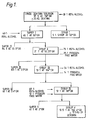
- Figure 1 is a flow diagram of the process described in Example 1;
- Figure 2 is a flow diagram of the process described in Example 2;
- Figure 3 is a flow diagram of the process described in Example 3;
- Figure 4 is a flow diagram of the process described in Example 4; and
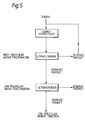
- Figure 5 is a flow diagram of the process described in Example 5.
- In the Examples OR means optical rotations.
- The molecular weight distribution of the starch hydrolysate starting material which was used in Examples 1 and 2 is shown in Table 1. The starting material was found to have an
M w of 6309 and anM n of 401. - The fractionation procedure used to isolate the required molecular weight distribution of a maltodextrin syrup is given in Figure 1. The precise technique to be used will of course be varied to take account of the quality and molecular weight distribution of the maltodextrin used as the starting material.
- Aqueous ethanol (33 l at 85%v/v) was added, with stirring, to 37 l of a maltodextrin syrup (at 116°OR=23kg, dissolved maltodextrins). After settling the resulting Syrup I (5 l at 92° OR) was drawn from the bottom outlet of the fractionator.
- Aqueous ethanol (40 l at 85% v/v) was added, with stirring, to the Supernatant I. After settling the Supernatant II (84 l at 13.5° OR) was decanted.
- Aqueous ethanol (75 l at 85% v/v) and pyrogen free water (25 l) were added, with stirring, to the Syrup II (46 l at 50.25° OR). After settling the Supernatant III (103 l at 3.5° OR) was decanted.
- Aqueous ethanol (54 l at 85% v/v) and pyrogen free water (14 l) were added, with stirring, to the resulting Syrup III (13 l at 104° OR). After settling the Supernatant IV (69 l at 3.4° OR) was decanted.
- Aqueous ethanol (48 l at 85% v/v) and pyrogen free water (12 l) were added with stirring, to the resulting Syrup IV (12 l at 98° OR). After settling the required maltodextrin fraction, Syrup V, (10.51 at 102.4° OR ≡ 5.5kg dissolved maltodextrins) was drawn off. This represents 23.9% recovery of the maltodextrins present in the initial syrup. 3.8kg of Syrup V was dissolved in pyrogen free water (25 l) and refluxed with stirring in the presence of 0.4kg of activated carbon (Norit UK, GSX grade). The carbon was removed by filtration and the resulting syrup was used to prepare peritoneal dialysis solutions.
- The
M w of the product maltodextrin after carbon treatment was 18949 and theM n was 6316. The molecular weight distribution is shown in Table 2, 61% of the product lies within the range 5000 to 30000. -
- The procedure of Example 1 was repeated using the quantities shown in Figure 2. However, the carbon treatment was carried out by adding the activated carbon (Norit UK, grade GSX 5kg) to the alcoholic Syrup V. The alcohol was removed by steam distillation and the carbon by depth filtration (Carlson Ford grade NA90). The resulting syrup was then spray dried.
- The
M w of the product maltodextrin was 12027 and theM n was 3447. The molecular weight distribution is shown in Table 3, 60% of the product lies within the range 5000 to 30000. - The
M w of the product maltodextrin after carbon treatment was 12027 and theM n was 3447. The molecular weight distribution is shown in Table 3, 60% of the product lies within the range 5000 to 30000. - The molecular weight distribution of the starting material is shown in Table 4. The starting material had an
M w of 11534 and anM n of 586. - The procedure of Example 1 was repeated using the quantities shown in Figure 3. However, the carbon treatment was carried out by adding the activated carbon (Norit UK, Grade GSX 60kg) to the alcoholic syrup IV. The activated carbon was filtered off by depth filtration (Carlson Ford Grade 'O' pads). A further carbon treatment was carried out on the syrup VI (15kg Norit UK Grade GSX, filtered off using Carlson Ford Grade NA90 pads) during ethanol removal by steam distillation. The ethanol-free syrup was spray dried.
- The
M w of the product maltodextrin was 21838 and theM n was 7105. The molecular weight distribution is shown in Table 5, 58% of the product lies within the range 5000 to 30000. - The molecular weight distribution of the starting material is shown in Table 6. The starting material had an
M w of 12636 and anM n of 639. - The procedure of Example 1 was repeated using the quantities shown in Figure 5. The carbon treatment was carried out by adding activated carbon (Norit UK, Grade GSX, 20kg) to the alcoholic syrup IV. The carbon was filtered by depth filtration (Carlson Ford Grade 'O' pads). Ethanol was removed from the final syrup (syrup V) by steam distillation and the aqueous product ion exchanged (mixed bed system), and spray dried. The mixed bed resin was Duolite A1725 in the hydroxyl form and C225H in the chloride form. (Duolite is a trade mark).
- The
M w of the product maltodextrin was 22020 and The Mn was 7767. The molecular weight distribution is shown in Table 7; 60% of the product lies within the range 5000 to 30000. - A high molecular weight fractionation was carried out by passing 2.0kg of starch hydrolysate, (molecular weight distribution, see Table 8), as a 10% w/v solution (20 litres) through a series of membranes. Polysulphone membranes with an approximate molecular weight cut-off of 25,000 and an area of 0.144m² were used. The feed flowrate was 6.6 litres/min at a temperature of 70°C. The total solids level of the retained liquid was maintained at 10% w/v and the low molecular weight species were washed through the membrane. After 5.5 hours the concentration of carbohydrate in the permeate product stream leaving the ultrafiltration module was undetectable (see Table 9) and the process was terminated. The high molecular weight residues were recovered from the membrane (0.384 kg, 19.2%) and the permeative low molecular weight product was isolated from the permeate (1.61 kg, 80.6%).
- The molecular weight distribution of the permeate is shown in Table 10. Mw was found to be 4906 and Mn determined as 744.
- 1.7kg of maltodextrin from Example 5a) in 53 litres of pyrogen free water was mixed with 132.5 litres of aqueous ethanol (85% v/v).
- The syrup from the fractionation had an Mw of 19712 and an Mn of 4798. The molecular weight distribution is shown in Table 11; 55% of the product lies within the range 5000 to 30000.
- Two examples of peritoneal dialysis solutions are shown below. The ionic electrolytes behave ideally and therefore 1 mOsm/l is equivalent to 1 mmol/l.
1 2 Sodium (mOsm/l) 131 138 Potassium (mOsm/l) 0 0 Calcium (mOsm/l) 1.8 1.78 Magnesium (mOsm/l) 0.75 0.75 Chloride (mOsm/l) 91 90 Lactate (mOsm/l) 45 45 Acetate (mOsm/l) - - Bisulphite (mOsm/l) - - Total Electrolyte Osmolarity (mOsm/l) 269.6 275.5 Glucose polymer (I) (mOsm/l) 12.9 (50g/l) 12.9 (50g/l) Total Osmolarity 282.5 288.4 Table 1 Molecular Weight Distribution MOLECULAR WEIGHTS INTEGRAL DISTRIBUTION 165 0.00 167 2.50 172 5.00 178 7.50 184 10.00 191 12.50 199 15.00 207 17.50 216 20.00 226 22.50 237 25.00 249 27.50 262 30.00 276 32.50 291 35.00 307 37.50 326 40.00 346 42.50 366 45.00 391 47.50 419 50.00 446 52.50 488 55.00 532 57.50 598 60.00 681 62.50 837 65.00 1099 67.50 1570 70.00 2328 72.50 3436 75.00 4915 77.50 6789 80.00 7135 82.50 12074 85.00 13825 87.50 20735 90.00 27447 92.50 37044 95.00 53463 97.50 199559 100.00 Table 2 Molecular Weight Distribution MOLECULAR WEIGHTS INTEGRAL DISTRIBUTION 296 0.00 1231 2.50 1756 5.00 2279 7.50 2795 10.00 3291 12.50 3771 15.00 4246 17.50 4722 20.00 5203 22.50 5696 25.00 6196 27.50 6718 30.00 7247 32.50 7809 35.00 8378 37.50 8986 40.00 9607 42.50 10272 45.00 10960 47.50 11695 50.00 12472 52.50 13295 55.00 14184 57.50 15126 60.00 16162 62.50 17274 65.00 18499 67.50 19872 70.00 21352 72.50 23122 75.00 25084 77.50 27319 80.00 30070 82.50 33400 85.00 37527 87.50 42867 90.00 50412 92.50 61686 95.00 82648 97.50 288182 100.00 Table 3 Molecular Weight Distribution MOLECULAR WEIGHTS INTEGRAL DISTRIBUTION 183 0.00 484 2.50 874 5.00 1292 7.50 1695 10.00 2082 12.50 2460 15.00 2836 17.50 3215 20.00 3595 22.50 3986 25.00 4382 27.50 4786 30.00 5204 32.50 5627 35.00 6072 37.50 6519 40.00 6994 42.50 7473 45.00 7982 47.50 8499 50.00 9048 52.50 9611 55.00 10212 57.50 10836 60.00 11502 62.50 12208 65.00 12955 67.50 13777 70.00 14637 72.50 15626 75.00 16708 77.50 17905 80.00 19298 82.50 20957 85.00 22960 87.50 25476 90.00 29002 92.50 34287 95.00 44550 97.50 299523 100.00 Table 4 Molecular Weight Distribution MOLECULAR WEIGHTS INTEGRAL DISTRIBUTION 146 0.00 157 2.50 173 5.00 192 7.50 213 10.00 235 12.50 259 15.00 285 17.50 313 20.00 343 22.50 378 25.00 411 27.50 450 30.00 489 32.50 536 35.00 583 37.50 636 40.00 695 42.50 755 45.00 837 47.50 920 50.00 1036 52.50 1161 55.00 1350 57.50 1590 60.00 1919 62.50 2393 65.00 3094 67.50 4176 70.00 5731 75.00 7802 75.00 10354 77.50 13393 80.00 17014 82.50 21436 85.00 27030 87.50 34348 90.00 44586 92.50 60087 95.00 89965 97.50 578156 100.00 Table 5 Molecular Weight Distribution MOLECULAR WEIGHTS INTEGRAL DISTRIBUTION 1394 2.50 2060 5.00 2644 7.50 3199 10.00 3751 12.50 4299 15.00 4856 17.50 5421 20.00 6003 22.50 6597 25.00 7208 27.50 7841 30.00 8497 32.50 9175 35.00 9881 37.50 10615 40.00 11385 42.50 12189 45.00 13033 47.50 13924 50.00 14870 52.50 15874 55.00 16947 57.50 18096 60.00 19333 62.50 20685 65.00 22167 67.50 23793 70.00 25616 72.50 27661 75.00 29973 77.50 32624 80.00 35745 82.50 39445 85.00 44003 87.50 49720 90.00 57401 92.50 68831 95.00 90432 97.50 Table 6 Molecular Weight Distribution MOLECULAR WEIGHTS INTEGRAL DISTRIBUTION 146 0.00 156 2.50 175 5.00 197 7.50 223 10.00 250 12.50 279 15.00 311 17.50 345 20.00 381 22.50 420 25.00 462 27.50 506 30.00 555 32.50 603 35.00 662 37.50 721 40.00 792 42.50 875 45.00 971 47.50 1099 50.00 1269 52.50 1496 55.00 1827 57.50 2320 60.00 3043 62.50 4107 65.00 5556 67.50 7396 70.00 9581 75.00 12065 75.00 14880 77.50 18153 80.00 21986 82.50 26590 85.00 32293 87.50 39532 90.00 49285 92.50 63509 95.00 89961 97.50 439968 100.00 Table 7 Molecular Weight Distribution MOLECULAR WEIGHTS INTEGRAL DISTRIBUTION 1586 2.50 2290 5.00 2882 7.50 3443 10.00 3991 12.50 4545 15.00 5110 17.50 5694 20.00 6302 22.50 6931 25.00 7587 27.50 8263 30.00 8965 32.50 9692 35.00 10441 37.50 11218 40.00 12030 42.50 12878 45.00 13761 47.50 14691 50.00 15671 52.50 16705 55.00 17805 57.50 18982 60.00 20244 62.50 21615 65.00 23120 67.50 24766 70.00 26584 72.50 28624 75.00 30930 77.50 33568 80.00 36623 82.50 40240 85.00 44626 87.50 50148 90.00 57346 92.50 67788 95.00 86399 97.50 Table 8 Starch Hydrolysate Molecular Weight Distribution MOLECULAR WEIGHTS INTEGRAL DISTRIBUTION 146 0.00 160 2.50 176 5.00 195 7.50 217 10.00 240 12.50 264 15.00 291 17.50 322 20.00 354 22.50 390 25.00 428 27.50 470 30.00 511 32.50 558 35.00 605 37.50 657 40.00 714 42.50 772 45.00 852 47.50 934 50.00 1050 52.50 1185 55.00 1398 57.50 1688 60.00 2104 62.50 2708 65.00 3617 67.50 4870 70.00 6517 75.00 8552 75.00 10946 77.50 13729 80.00 17036 82.50 21022 85.00 25964 87.50 32324 90.00 40911 92.50 53516 95.00 76329 97.50 356145 100.00 Table 9 Time Pressure Temp °C Permeate Flow Rate l/min Feed Soln Concn % w/v Permeate Conc % w/v in out Bar 0.75 4.7 3.3 67 225 9.5 5.0 1.25 4.7 3.8 68 184 10.5 5.5 2.50 4.8 3.2 70 150 9.0 4.0 3.50 4.8 3.2 70 144 8.0 1.5 4.50 4.8 3.2 69 130 6.5 0.5 5.50 4.8 3.2 69 123 6.0 0 Table 10 Permeate (Ex 5a) Molecular Weight Distribution MOLECULAR WEIGHTS INTEGRAL DISTRIBUTION 146 0.00 170 2.50 207 5.00 251 7.50 293 10.00 335 12.50 378 15.00 423 17.50 469 20.00 516 22.50 566 25.00 616 27.50 660 30.00 720 32.50 773 35.00 827 37.50 882 40.00 939 42.50 1004 45.00 1070 47.50 1135 50.00 1226 52.50 1320 55.00 1418 57.50 1567 60.00 1717 62.50 1947 65.00 2218 67.50 2566 70.00 3056 72.50 3718 75.00 4671 77.50 5959 80.00 7656 82.50 9753 85.00 12271 87.50 15332 90.00 19237 92.50 24688 95.00 34400 97.50 98105 100.00 Table 11 Molecular Weight Distribution MOLECULAR WEIGHTS INTEGRAL DISTRIBUTION 170 0.00 845 2.50 1292 5.00 1674 7.50 2044 10.00 2429 12.50 2841 15.00 3283 17.50 3754 20.00 4269 22.50 4805 25.00 5361 27.50 5958 30.00 6583 32.50 7232 35.00 7937 37.50 8666 40.00 9447 42.50 10273 45.00 11129 47.50 12062 50.00 13024 52.50 14053 55.00 15147 57.50 16281 60.00 17537 62.50 18860 65.00 20264 67.50 21839 70.00 23542 72.50 25408 75.00 27488 77.50 29900 80.00 32694 82.50 36020 85.00 40183 87.50 45419 90.00 52731 92.50 64063 95.00 85249 97.50 349210 100.00
Claims (4)
- A peritoneal dialysis composition containing an osmotic agent which is a mixture of glucose polymers, wherein at least 50% by weight of the mixture comprises polymers having molecular weights in the range of from 5,000 to 30,000, and wherein the mixture has a weight average molecular weight of from 5,000 to 50,000 and a number average molecular weight of from 2,900 to 8,000, both the weight average molecular weight and the number average molecular weight being determined using chromatographic columns calibrated with dextran standards (Alsop et al, Process Biochem [2], 10-15 (1977) and Alsop et al, J. Chromatography, [246], 227-240 (1982)).
- A composition according to claim 1, wherein the mixture of glucose polymers contains less than 5% by weight of polymers of molecular weight greater than 100,000.
- A composition according to claim 1 or claim 2, wherein the mixture of glucose polymers contains no more than 20% by weight of polymers having molecular weights of from 800 to 10,000.
- A composition according to any one of the preceding claims, additionally comprising a pharmaceutically acceptable adjuvant, diluent or carrier.
Applications Claiming Priority (4)
| Application Number | Priority Date | Filing Date | Title |
|---|---|---|---|
| GB8515842 | 1985-06-22 | ||
| GB858515842A GB8515842D0 (en) | 1985-06-22 | 1985-06-22 | Polymer |
| GB868610841A GB8610841D0 (en) | 1986-05-02 | 1986-05-02 | Polymer |
| GB8610841 | 1986-05-02 |
Publications (3)
| Publication Number | Publication Date |
|---|---|
| EP0207676A2 EP0207676A2 (en) | 1987-01-07 |
| EP0207676A3 EP0207676A3 (en) | 1988-04-20 |
| EP0207676B1 true EP0207676B1 (en) | 1994-06-01 |
Family
ID=26289407
Family Applications (1)
| Application Number | Title | Priority Date | Filing Date |
|---|---|---|---|
| EP86304624A Expired - Lifetime EP0207676B1 (en) | 1985-06-22 | 1986-06-16 | Polymers for use in continuous peritoneal dialysis |
Country Status (8)
| Country | Link |
|---|---|
| EP (1) | EP0207676B1 (en) |
| JP (1) | JPH0816121B2 (en) |
| AT (1) | ATE106410T1 (en) |
| AU (1) | AU594060B2 (en) |
| DE (1) | DE3689863T2 (en) |
| DK (1) | DK288586A (en) |
| FI (1) | FI86141C (en) |
| NO (1) | NO168945C (en) |
Cited By (4)
| Publication number | Priority date | Publication date | Assignee | Title |
|---|---|---|---|---|
| US6861519B2 (en) | 2002-06-06 | 2005-03-01 | Roquette Freres | Soluble highly branched glucose polymers and their method of production |
| US7053059B2 (en) | 2003-07-25 | 2006-05-30 | Baxter International Inc. | Dialysis solutions with reduced levels of glucose degradation products |
| US7732428B1 (en) | 1998-05-13 | 2010-06-08 | Innovata Limited | Surgical compositions and methods of using the same |
| DE102010012183A1 (en) | 2010-03-19 | 2011-09-22 | Fresenius Medical Care Deutschland Gmbh | Esterified polysaccharide osmotica |
Families Citing this family (26)
| Publication number | Priority date | Publication date | Assignee | Title |
|---|---|---|---|---|
| JPH07120753B2 (en) * | 1986-09-18 | 1995-12-20 | キヤノン株式会社 | Semiconductor memory device and manufacturing method thereof |
| DE3903381A1 (en) * | 1989-02-04 | 1990-08-09 | Frankenthal Ag Albert | DEVICE FOR STOPPING FOLDED PRODUCTS |
| US5079920A (en) * | 1989-12-11 | 1992-01-14 | Whitehead Charles A | Hydraulic shape memory material stress to hydraulic pressure transducer |
| US5382904A (en) * | 1992-04-15 | 1995-01-17 | Houston Advanced Research Center | Structured coil electromagnets for magnetic resonance imaging and method for fabricating the same |
| US5359310A (en) * | 1992-04-15 | 1994-10-25 | Houston Advanced Research Center | Ultrashort cylindrical shielded electromagnet for magnetic resonance imaging |
| US6306836B1 (en) * | 1994-01-21 | 2001-10-23 | Baxter International Inc. | Peritoneal dialysis solutions containing maltodextrins and amino acids |
| FR2716199B1 (en) * | 1994-02-15 | 1996-04-26 | Roquette Freres | Process for the manufacture of a starch hydrolyzate with a low polymolecularity index, a new starch hydrolyzate thus obtained and its use in peritoneal dialysis. |
| FR2723690B1 (en) * | 1994-08-17 | 1996-09-27 | Seb Sa | FOOD HEATING APPARATUS, PARTICULARLY FOR FRYING, COMPRISING A BACK-TANK |
| WO1999058168A1 (en) * | 1998-05-13 | 1999-11-18 | Ml Laboratories Plc | Dextrin-containing composition for preventing surgical adhesions |
| DE69929555T8 (en) | 1998-06-17 | 2007-05-31 | Nipro Corp. | Use of a liquid for the preparation of a dialysis solution for continuous recirculating peritoneal dialysis |
| US6770148B1 (en) * | 1998-12-04 | 2004-08-03 | Baxter International Inc. | Peritoneal dialysis solution containing modified icodextrins |
| US7118857B2 (en) | 2004-02-27 | 2006-10-10 | Baxter International Inc. | Methods and compositions for detection of microbial contaminants in peritoneal dialysis solutions |
| JP4625657B2 (en) * | 2004-06-29 | 2011-02-02 | バクスター・インターナショナル・インコーポレイテッド | Solution set for peritoneal dialysate preparation |
| JP4933041B2 (en) * | 2004-12-06 | 2012-05-16 | 佐々木商事有限会社 | Process for producing branched dextrin with improved efficiency |
| US7674897B2 (en) * | 2005-09-09 | 2010-03-09 | Tate & Lyle Ingredients Americas, Inc. | Production of crystalline short chain amylose |
| DK2129370T3 (en) | 2007-03-02 | 2013-02-11 | Zytoprotec Gmbh | Carbohydrate-based peritoneal dialysis fluid containing glutamine residue |
| MX2010010271A (en) | 2008-03-20 | 2010-12-02 | Baxter Int | Destruction of microbial products by enzymatic digestion. |
| FR2955861B1 (en) | 2010-02-02 | 2013-03-22 | Roquette Freres | SOLUBLE GLUCOSE BRANCHES POLYMERS FOR PERITONEAL DIALYSIS |
| MX362554B (en) | 2011-03-18 | 2019-01-24 | Baxter Healthcare Sa | Peritoneal dialysis solutions comprising glucose polymers. |
| CA2831003C (en) | 2011-04-08 | 2021-06-01 | Roquette Freres | Methods for detecting contaminants in solutions containing glucose polymers |
| CN103946448B (en) * | 2011-11-18 | 2016-12-28 | 罗盖特公司 | Coatings based on partially soluble high molecular weight dextrins |
| IN2014DN09655A (en) | 2012-05-29 | 2015-07-31 | Roquette Freres | |
| CN106068279B (en) | 2014-03-21 | 2018-11-09 | 罗盖特兄弟公司 | Optimization method for the production for purifying glucose polymer and glucose polymer hydrolysate |
| FR3037063B1 (en) | 2015-06-04 | 2017-05-19 | Roquette Freres | OPTIMIZED DECONTAMINATION PROCESS FOR STARCH AS A RAW MATERIAL FOR THE PRODUCTION OF GLUCOSE POLYMERS FOR PERITONEAL DIALYSIS |
| EP3381484A1 (en) * | 2017-03-31 | 2018-10-03 | Opterion Health AG | Carbohydrate composition for dialysis |
| EP4000109B1 (en) | 2019-07-19 | 2025-08-27 | Evatec AG | Piezoelectric coating and deposition process |
Family Cites Families (3)
| Publication number | Priority date | Publication date | Assignee | Title |
|---|---|---|---|---|
| JPS5188645A (en) * | 1975-01-31 | 1976-08-03 | BUNSHIDE KISUTORINNOSEIZOHO | |
| EP0075594A1 (en) * | 1981-03-31 | 1983-04-06 | SILK, David B. A. | Glucose polymers and method of producing same |
| GB8404299D0 (en) * | 1984-02-18 | 1984-03-21 | Milner Research Ireland Ltd | Peritoneal dialysis |
-
1986
- 1986-06-16 AT AT86304624T patent/ATE106410T1/en not_active IP Right Cessation
- 1986-06-16 DE DE3689863T patent/DE3689863T2/en not_active Expired - Lifetime
- 1986-06-16 EP EP86304624A patent/EP0207676B1/en not_active Expired - Lifetime
- 1986-06-17 FI FI862563A patent/FI86141C/en not_active IP Right Cessation
- 1986-06-18 AU AU58811/86A patent/AU594060B2/en not_active Expired
- 1986-06-19 DK DK288586A patent/DK288586A/en not_active Application Discontinuation
- 1986-06-19 NO NO862449A patent/NO168945C/en not_active IP Right Cessation
- 1986-06-20 JP JP61143119A patent/JPH0816121B2/en not_active Expired - Lifetime
Cited By (7)
| Publication number | Priority date | Publication date | Assignee | Title |
|---|---|---|---|---|
| US7732428B1 (en) | 1998-05-13 | 2010-06-08 | Innovata Limited | Surgical compositions and methods of using the same |
| US8063027B2 (en) | 1998-05-13 | 2011-11-22 | Innovata Limited | Surgical compositions for reducing the incidence of adhesions |
| US6861519B2 (en) | 2002-06-06 | 2005-03-01 | Roquette Freres | Soluble highly branched glucose polymers and their method of production |
| US7211662B2 (en) * | 2002-06-06 | 2007-05-01 | Roquette Freres | Soluble highly branched glucose polymers and their method of production |
| US7053059B2 (en) | 2003-07-25 | 2006-05-30 | Baxter International Inc. | Dialysis solutions with reduced levels of glucose degradation products |
| DE102010012183A1 (en) | 2010-03-19 | 2011-09-22 | Fresenius Medical Care Deutschland Gmbh | Esterified polysaccharide osmotica |
| WO2011113608A1 (en) | 2010-03-19 | 2011-09-22 | Fresenius Medical Care Deutschland Gmbh | Esterified polysaccharide osmotic agents |
Also Published As
| Publication number | Publication date |
|---|---|
| NO168945C (en) | 1992-04-22 |
| DE3689863T2 (en) | 1995-01-05 |
| NO862449D0 (en) | 1986-06-19 |
| EP0207676A3 (en) | 1988-04-20 |
| FI862563L (en) | 1986-12-23 |
| FI86141C (en) | 1992-07-27 |
| JPH0816121B2 (en) | 1996-02-21 |
| NO168945B (en) | 1992-01-13 |
| DK288586D0 (en) | 1986-06-19 |
| AU5881186A (en) | 1986-12-24 |
| FI862563A0 (en) | 1986-06-17 |
| DK288586A (en) | 1986-12-23 |
| AU594060B2 (en) | 1990-03-01 |
| FI86141B (en) | 1992-04-15 |
| JPS6248701A (en) | 1987-03-03 |
| EP0207676A2 (en) | 1987-01-07 |
| DE3689863D1 (en) | 1994-07-07 |
| ATE106410T1 (en) | 1994-06-15 |
| NO862449L (en) | 1986-12-23 |
Similar Documents
| Publication | Publication Date | Title |
|---|---|---|
| AU594060B2 (en) | Preparation of glucose polymers | |
| US6248726B1 (en) | Method of peritoneal dialysis using glucose polymer solutions | |
| EP0265865B1 (en) | Blood substitute | |
| Alsop | History, chemical, and pharmaceutical development of icodextrin | |
| EP0049847B1 (en) | Alpha-amylase inactivator, process for its preparation, composition containing said inactivator, and this inactivator for the regulation of the blood sugar level | |
| KR100528551B1 (en) | How to make inulin product | |
| US9200087B2 (en) | Branched soluble glucose polymers for peritoneal dialysis | |
| CA1099639A (en) | High calorie solutions of low molecular weight glucose polymer mixtures useful for intravenous administration | |
| CA2142528C (en) | Process for the manufacture of a starch hydrolysate of low polymolecularity index, obtention and use of novel starch hydrolysate in peritoneal dialysis | |
| EP0244235B1 (en) | Process for the preparation of lmw-heparin | |
| JP6436958B2 (en) | Method for decontaminating starch hydrolyzate to prepare glucose polymer for peritoneal dialysis | |
| KR102591794B1 (en) | Method for producing polypentosan sulfate | |
| US5110918A (en) | Process for preparing EDTA-free heparins, heparin fractions and fragments | |
| EP3683242A1 (en) | Pentosan polysulfate and method for producing pentosan polysulfate | |
| NO834346L (en) | PROCEDURE FOR CLEANING AND FRACTIONING HEPARIN | |
| KR100200547B1 (en) | Separation and Purification Method of Low Molecular Chitosan Using Multistage Membrane Process | |
| CN101134952A (en) | Human urine kininogenase and method for making same | |
| JP2003212889A (en) | Method for producing chitosan oligosaccharide and method for producing alcoholic chitosan oligosaccharide | |
| US4507205A (en) | Process for the purification of glucosaminoglucans | |
| JPH06293788A (en) | Purification method of high-purity sialic acid | |
| Sloana et al. | Large scale production of glucose oligomers and polymers for physiological studies in humans | |
| GB2027728A (en) | Physiologically Acceptable Heparin | |
| EP0994122A1 (en) | Acetylfucoidan prepared from okinawa nemacystis decipiens and process for preparing the same | |
| KR0139262B1 (en) | Preparation method of branched dextrins and oligosaccharides | |
| JPS6121481B2 (en) |
Legal Events
| Date | Code | Title | Description |
|---|---|---|---|
| PUAI | Public reference made under article 153(3) epc to a published international application that has entered the european phase |
Free format text: ORIGINAL CODE: 0009012 |
|
| 17P | Request for examination filed |
Effective date: 19860630 |
|
| AK | Designated contracting states |
Kind code of ref document: A2 Designated state(s): AT BE CH DE FR GB IT LI LU NL SE |
|
| PUAL | Search report despatched |
Free format text: ORIGINAL CODE: 0009013 |
|
| AK | Designated contracting states |
Kind code of ref document: A3 Designated state(s): AT BE CH DE FR GB IT LI LU NL SE |
|
| 17Q | First examination report despatched |
Effective date: 19911119 |
|
| RAP1 | Party data changed (applicant data changed or rights of an application transferred) |
Owner name: M L LABORATORIES PLC |
|
| GRAA | (expected) grant |
Free format text: ORIGINAL CODE: 0009210 |
|
| AK | Designated contracting states |
Kind code of ref document: B1 Designated state(s): AT BE CH DE FR GB IT LI LU NL SE |
|
| REF | Corresponds to: |
Ref document number: 106410 Country of ref document: AT Date of ref document: 19940615 Kind code of ref document: T |
|
| ITTA | It: last paid annual fee | ||
| REF | Corresponds to: |
Ref document number: 3689863 Country of ref document: DE Date of ref document: 19940707 |
|
| EPTA | Lu: last paid annual fee | ||
| ITF | It: translation for a ep patent filed | ||
| ET | Fr: translation filed | ||
| EAL | Se: european patent in force in sweden |
Ref document number: 86304624.9 |
|
| PLBI | Opposition filed |
Free format text: ORIGINAL CODE: 0009260 |
|
| 26 | Opposition filed |
Opponent name: BAXTER INTERNATIONAL INC. Effective date: 19950227 |
|
| NLR1 | Nl: opposition has been filed with the epo |
Opponent name: BAXTER INTERNATIONAL INC. |
|
| PLBL | Opposition procedure terminated |
Free format text: ORIGINAL CODE: EPIDOS OPPC |
|
| PLBM | Termination of opposition procedure: date of legal effect published |
Free format text: ORIGINAL CODE: 0009276 |
|
| STAA | Information on the status of an ep patent application or granted ep patent |
Free format text: STATUS: OPPOSITION PROCEDURE CLOSED |
|
| 27C | Opposition proceedings terminated |
Effective date: 19960718 |
|
| NLR2 | Nl: decision of opposition | ||
| REG | Reference to a national code |
Ref country code: FR Ref legal event code: TP |
|
| REG | Reference to a national code |
Ref country code: GB Ref legal event code: 732E |
|
| REG | Reference to a national code |
Ref country code: GB Ref legal event code: IF02 |
|
| PGFP | Annual fee paid to national office [announced via postgrant information from national office to epo] |
Ref country code: FR Payment date: 20050526 Year of fee payment: 20 |
|
| PGFP | Annual fee paid to national office [announced via postgrant information from national office to epo] |
Ref country code: BE Payment date: 20050603 Year of fee payment: 20 |
|
| PGFP | Annual fee paid to national office [announced via postgrant information from national office to epo] |
Ref country code: SE Payment date: 20050608 Year of fee payment: 20 |
|
| PGFP | Annual fee paid to national office [announced via postgrant information from national office to epo] |
Ref country code: GB Payment date: 20050610 Year of fee payment: 20 |
|
| PGFP | Annual fee paid to national office [announced via postgrant information from national office to epo] |
Ref country code: AT Payment date: 20050613 Year of fee payment: 20 |
|
| PGFP | Annual fee paid to national office [announced via postgrant information from national office to epo] |
Ref country code: NL Payment date: 20050622 Year of fee payment: 20 Ref country code: IT Payment date: 20050622 Year of fee payment: 20 |
|
| PGFP | Annual fee paid to national office [announced via postgrant information from national office to epo] |
Ref country code: LU Payment date: 20050627 Year of fee payment: 20 |
|
| PGFP | Annual fee paid to national office [announced via postgrant information from national office to epo] |
Ref country code: DE Payment date: 20050628 Year of fee payment: 20 |
|
| PGFP | Annual fee paid to national office [announced via postgrant information from national office to epo] |
Ref country code: CH Payment date: 20050701 Year of fee payment: 20 |
|
| PG25 | Lapsed in a contracting state [announced via postgrant information from national office to epo] |
Ref country code: GB Free format text: LAPSE BECAUSE OF EXPIRATION OF PROTECTION Effective date: 20060615 |
|
| PG25 | Lapsed in a contracting state [announced via postgrant information from national office to epo] |
Ref country code: NL Free format text: LAPSE BECAUSE OF EXPIRATION OF PROTECTION Effective date: 20060616 |
|
| REG | Reference to a national code |
Ref country code: GB Ref legal event code: PE20 |
|
| REG | Reference to a national code |
Ref country code: CH Ref legal event code: PL |
|
| NLV7 | Nl: ceased due to reaching the maximum lifetime of a patent |
Effective date: 20060616 |
|
| EUG | Se: european patent has lapsed | ||
| BE20 | Be: patent expired |
Owner name: *M L LABORATORIES P.L.C. Effective date: 20060616 |