EP0206383B1 - Bismaleimide compositions - Google Patents
Bismaleimide compositions Download PDFInfo
- Publication number
- EP0206383B1 EP0206383B1 EP86200904A EP86200904A EP0206383B1 EP 0206383 B1 EP0206383 B1 EP 0206383B1 EP 86200904 A EP86200904 A EP 86200904A EP 86200904 A EP86200904 A EP 86200904A EP 0206383 B1 EP0206383 B1 EP 0206383B1
- Authority
- EP
- European Patent Office
- Prior art keywords
- group
- carbon atoms
- parts
- composition according
- compounds
- Prior art date
- Legal status (The legal status is an assumption and is not a legal conclusion. Google has not performed a legal analysis and makes no representation as to the accuracy of the status listed.)
- Expired
Links
- 239000000203 mixture Substances 0.000 title claims abstract description 62
- 229920003192 poly(bis maleimide) Polymers 0.000 title abstract description 14
- XQUPVDVFXZDTLT-UHFFFAOYSA-N 1-[4-[[4-(2,5-dioxopyrrol-1-yl)phenyl]methyl]phenyl]pyrrole-2,5-dione Chemical compound O=C1C=CC(=O)N1C(C=C1)=CC=C1CC1=CC=C(N2C(C=CC2=O)=O)C=C1 XQUPVDVFXZDTLT-UHFFFAOYSA-N 0.000 title description 14
- 150000001875 compounds Chemical class 0.000 claims abstract description 29
- 125000004432 carbon atom Chemical group C* 0.000 claims abstract description 23
- -1 bismaleimide compound Chemical class 0.000 claims abstract description 22
- 229920001002 functional polymer Polymers 0.000 claims abstract description 6
- 229920000642 polymer Polymers 0.000 claims description 16
- PPBRXRYQALVLMV-UHFFFAOYSA-N Styrene Natural products C=CC1=CC=CC=C1 PPBRXRYQALVLMV-UHFFFAOYSA-N 0.000 claims description 15
- 229910052736 halogen Inorganic materials 0.000 claims description 14
- 150000002367 halogens Chemical group 0.000 claims description 14
- 125000000449 nitro group Chemical group [O-][N+](*)=O 0.000 claims description 14
- 150000001252 acrylic acid derivatives Chemical class 0.000 claims description 8
- 125000003118 aryl group Chemical group 0.000 claims description 8
- 125000001931 aliphatic group Chemical group 0.000 claims description 6
- 125000004122 cyclic group Chemical group 0.000 claims description 6
- 125000005843 halogen group Chemical group 0.000 claims description 6
- 125000004435 hydrogen atom Chemical group [H]* 0.000 claims description 6
- 125000002768 hydroxyalkyl group Chemical group 0.000 claims description 6
- 125000001140 1,4-phenylene group Chemical group [H]C1=C([H])C([*:2])=C([H])C([H])=C1[*:1] 0.000 claims description 4
- 229940044192 2-hydroxyethyl methacrylate Drugs 0.000 claims description 4
- WOBHKFSMXKNTIM-UHFFFAOYSA-N Hydroxyethyl methacrylate Chemical compound CC(=C)C(=O)OCCO WOBHKFSMXKNTIM-UHFFFAOYSA-N 0.000 claims description 4
- 125000000217 alkyl group Chemical group 0.000 claims description 4
- 125000004103 aminoalkyl group Chemical group 0.000 claims description 4
- 125000005156 substituted alkylene group Chemical group 0.000 claims description 4
- 125000001989 1,3-phenylene group Chemical group [H]C1=C([H])C([*:1])=C([H])C([*:2])=C1[H] 0.000 claims description 3
- 125000002887 hydroxy group Chemical group [H]O* 0.000 claims description 3
- OWIKHYCFFJSOEH-UHFFFAOYSA-N Isocyanic acid Chemical compound N=C=O OWIKHYCFFJSOEH-UHFFFAOYSA-N 0.000 claims description 2
- 125000002877 alkyl aryl group Chemical group 0.000 claims description 2
- 125000003710 aryl alkyl group Chemical group 0.000 claims description 2
- 125000000753 cycloalkyl group Chemical group 0.000 claims description 2
- 125000004356 hydroxy functional group Chemical group O* 0.000 claims description 2
- 125000003011 styrenyl group Chemical group [H]\C(*)=C(/[H])C1=C([H])C([H])=C([H])C([H])=C1[H] 0.000 claims 1
- 229920005989 resin Polymers 0.000 description 11
- 239000011347 resin Substances 0.000 description 11
- WFDIJRYMOXRFFG-UHFFFAOYSA-N Acetic anhydride Chemical compound CC(=O)OC(C)=O WFDIJRYMOXRFFG-UHFFFAOYSA-N 0.000 description 10
- CSCPPACGZOOCGX-UHFFFAOYSA-N Acetone Chemical compound CC(C)=O CSCPPACGZOOCGX-UHFFFAOYSA-N 0.000 description 10
- 239000002253 acid Substances 0.000 description 8
- 229920001971 elastomer Polymers 0.000 description 8
- 239000005060 rubber Substances 0.000 description 6
- 150000008064 anhydrides Chemical class 0.000 description 4
- 230000015572 biosynthetic process Effects 0.000 description 4
- 238000006243 chemical reaction Methods 0.000 description 4
- FPYJFEHAWHCUMM-UHFFFAOYSA-N maleic anhydride Chemical class O=C1OC(=O)C=C1 FPYJFEHAWHCUMM-UHFFFAOYSA-N 0.000 description 4
- 239000002244 precipitate Substances 0.000 description 4
- 238000002360 preparation method Methods 0.000 description 4
- 238000003786 synthesis reaction Methods 0.000 description 4
- IMNIMPAHZVJRPE-UHFFFAOYSA-N triethylenediamine Chemical compound C1CN2CCN1CC2 IMNIMPAHZVJRPE-UHFFFAOYSA-N 0.000 description 4
- ZWEHNKRNPOVVGH-UHFFFAOYSA-N 2-Butanone Chemical compound CCC(C)=O ZWEHNKRNPOVVGH-UHFFFAOYSA-N 0.000 description 3
- LYCAIKOWRPUZTN-UHFFFAOYSA-N Ethylene glycol Chemical compound OCCO LYCAIKOWRPUZTN-UHFFFAOYSA-N 0.000 description 3
- PEEHTFAAVSWFBL-UHFFFAOYSA-N Maleimide Chemical compound O=C1NC(=O)C=C1 PEEHTFAAVSWFBL-UHFFFAOYSA-N 0.000 description 3
- 239000002202 Polyethylene glycol Substances 0.000 description 3
- DNIAPMSPPWPWGF-UHFFFAOYSA-N Propylene glycol Chemical compound CC(O)CO DNIAPMSPPWPWGF-UHFFFAOYSA-N 0.000 description 3
- VYPSYNLAJGMNEJ-UHFFFAOYSA-N Silicium dioxide Chemical compound O=[Si]=O VYPSYNLAJGMNEJ-UHFFFAOYSA-N 0.000 description 3
- 238000007259 addition reaction Methods 0.000 description 3
- 239000003054 catalyst Substances 0.000 description 3
- 125000005439 maleimidyl group Chemical group C1(C=CC(N1*)=O)=O 0.000 description 3
- 229920001223 polyethylene glycol Polymers 0.000 description 3
- 239000000047 product Substances 0.000 description 3
- 239000002904 solvent Substances 0.000 description 3
- 239000000126 substance Substances 0.000 description 3
- 0 *C(C(N1)=O)=C(*)C1=O Chemical compound *C(C(N1)=O)=C(*)C1=O 0.000 description 2
- MYRTYDVEIRVNKP-UHFFFAOYSA-N 1,2-Divinylbenzene Chemical compound C=CC1=CC=CC=C1C=C MYRTYDVEIRVNKP-UHFFFAOYSA-N 0.000 description 2
- YBRVSVVVWCFQMG-UHFFFAOYSA-N 4,4'-diaminodiphenylmethane Chemical compound C1=CC(N)=CC=C1CC1=CC=C(N)C=C1 YBRVSVVVWCFQMG-UHFFFAOYSA-N 0.000 description 2
- QTBSBXVTEAMEQO-UHFFFAOYSA-N Acetic acid Chemical compound CC(O)=O QTBSBXVTEAMEQO-UHFFFAOYSA-N 0.000 description 2
- NIXOWILDQLNWCW-UHFFFAOYSA-M Acrylate Chemical compound [O-]C(=O)C=C NIXOWILDQLNWCW-UHFFFAOYSA-M 0.000 description 2
- KAKZBPTYRLMSJV-UHFFFAOYSA-N Butadiene Chemical compound C=CC=C KAKZBPTYRLMSJV-UHFFFAOYSA-N 0.000 description 2
- NIQCNGHVCWTJSM-UHFFFAOYSA-N Dimethyl phthalate Chemical compound COC(=O)C1=CC=CC=C1C(=O)OC NIQCNGHVCWTJSM-UHFFFAOYSA-N 0.000 description 2
- 230000002411 adverse Effects 0.000 description 2
- 150000001412 amines Chemical class 0.000 description 2
- 229910052799 carbon Inorganic materials 0.000 description 2
- 239000003795 chemical substances by application Substances 0.000 description 2
- 229920001577 copolymer Polymers 0.000 description 2
- 150000004985 diamines Chemical class 0.000 description 2
- 239000012973 diazabicyclooctane Substances 0.000 description 2
- 239000000806 elastomer Substances 0.000 description 2
- 150000002170 ethers Chemical class 0.000 description 2
- 229940052303 ethers for general anesthesia Drugs 0.000 description 2
- 125000000524 functional group Chemical group 0.000 description 2
- 239000011159 matrix material Substances 0.000 description 2
- 229910052751 metal Inorganic materials 0.000 description 2
- 239000002184 metal Substances 0.000 description 2
- 238000000034 method Methods 0.000 description 2
- 239000000178 monomer Substances 0.000 description 2
- 239000007787 solid Substances 0.000 description 2
- 229920001169 thermoplastic Polymers 0.000 description 2
- 239000004416 thermosoftening plastic Substances 0.000 description 2
- 229920002554 vinyl polymer Polymers 0.000 description 2
- 238000003809 water extraction Methods 0.000 description 2
- AZQWKYJCGOJGHM-UHFFFAOYSA-N 1,4-benzoquinone Chemical compound O=C1C=CC(=O)C=C1 AZQWKYJCGOJGHM-UHFFFAOYSA-N 0.000 description 1
- JKNCOURZONDCGV-UHFFFAOYSA-N 2-(dimethylamino)ethyl 2-methylprop-2-enoate Chemical compound CN(C)CCOC(=O)C(C)=C JKNCOURZONDCGV-UHFFFAOYSA-N 0.000 description 1
- WFUGQJXVXHBTEM-UHFFFAOYSA-N 2-hydroperoxy-2-(2-hydroperoxybutan-2-ylperoxy)butane Chemical compound CCC(C)(OO)OOC(C)(CC)OO WFUGQJXVXHBTEM-UHFFFAOYSA-N 0.000 description 1
- 229940095095 2-hydroxyethyl acrylate Drugs 0.000 description 1
- OMIGHNLMNHATMP-UHFFFAOYSA-N 2-hydroxyethyl prop-2-enoate Chemical compound OCCOC(=O)C=C OMIGHNLMNHATMP-UHFFFAOYSA-N 0.000 description 1
- VHSHLMUCYSAUQU-UHFFFAOYSA-N 2-hydroxypropyl methacrylate Chemical compound CC(O)COC(=O)C(C)=C VHSHLMUCYSAUQU-UHFFFAOYSA-N 0.000 description 1
- 125000003903 2-propenyl group Chemical group [H]C([*])([H])C([H])=C([H])[H] 0.000 description 1
- UPMLOUAZCHDJJD-UHFFFAOYSA-N 4,4'-Diphenylmethane Diisocyanate Chemical compound C1=CC(N=C=O)=CC=C1CC1=CC=C(N=C=O)C=C1 UPMLOUAZCHDJJD-UHFFFAOYSA-N 0.000 description 1
- JLBJTVDPSNHSKJ-UHFFFAOYSA-N 4-Methylstyrene Chemical compound CC1=CC=C(C=C)C=C1 JLBJTVDPSNHSKJ-UHFFFAOYSA-N 0.000 description 1
- NLHHRLWOUZZQLW-UHFFFAOYSA-N Acrylonitrile Chemical compound C=CC#N NLHHRLWOUZZQLW-UHFFFAOYSA-N 0.000 description 1
- 241000531908 Aramides Species 0.000 description 1
- OKTJSMMVPCPJKN-UHFFFAOYSA-N Carbon Chemical compound [C] OKTJSMMVPCPJKN-UHFFFAOYSA-N 0.000 description 1
- 235000008733 Citrus aurantifolia Nutrition 0.000 description 1
- 229940126062 Compound A Drugs 0.000 description 1
- 239000004641 Diallyl-phthalate Substances 0.000 description 1
- 229920002943 EPDM rubber Polymers 0.000 description 1
- NLDMNSXOCDLTTB-UHFFFAOYSA-N Heterophylliin A Natural products O1C2COC(=O)C3=CC(O)=C(O)C(O)=C3C3=C(O)C(O)=C(O)C=C3C(=O)OC2C(OC(=O)C=2C=C(O)C(O)=C(O)C=2)C(O)C1OC(=O)C1=CC(O)=C(O)C(O)=C1 NLDMNSXOCDLTTB-UHFFFAOYSA-N 0.000 description 1
- MHAJPDPJQMAIIY-UHFFFAOYSA-N Hydrogen peroxide Chemical compound OO MHAJPDPJQMAIIY-UHFFFAOYSA-N 0.000 description 1
- 239000005062 Polybutadiene Substances 0.000 description 1
- 239000004698 Polyethylene Substances 0.000 description 1
- 239000004743 Polypropylene Substances 0.000 description 1
- 239000004793 Polystyrene Substances 0.000 description 1
- WYURNTSHIVDZCO-UHFFFAOYSA-N Tetrahydrofuran Chemical compound C1CCOC1 WYURNTSHIVDZCO-UHFFFAOYSA-N 0.000 description 1
- 235000011941 Tilia x europaea Nutrition 0.000 description 1
- QYKIQEUNHZKYBP-UHFFFAOYSA-N Vinyl ether Chemical class C=COC=C QYKIQEUNHZKYBP-UHFFFAOYSA-N 0.000 description 1
- 150000007513 acids Chemical class 0.000 description 1
- 125000005396 acrylic acid ester group Chemical group 0.000 description 1
- 239000000654 additive Substances 0.000 description 1
- XYLMUPLGERFSHI-UHFFFAOYSA-N alpha-Methylstyrene Chemical compound CC(=C)C1=CC=CC=C1 XYLMUPLGERFSHI-UHFFFAOYSA-N 0.000 description 1
- 150000001408 amides Chemical class 0.000 description 1
- 229920003235 aromatic polyamide Polymers 0.000 description 1
- 230000001588 bifunctional effect Effects 0.000 description 1
- QUDWYFHPNIMBFC-UHFFFAOYSA-N bis(prop-2-enyl) benzene-1,2-dicarboxylate Chemical class C=CCOC(=O)C1=CC=CC=C1C(=O)OCC=C QUDWYFHPNIMBFC-UHFFFAOYSA-N 0.000 description 1
- 239000007795 chemical reaction product Substances 0.000 description 1
- 238000001816 cooling Methods 0.000 description 1
- 238000006210 cyclodehydration reaction Methods 0.000 description 1
- WMWXXXSCZVGQAR-UHFFFAOYSA-N dialuminum;oxygen(2-);hydrate Chemical compound O.[O-2].[O-2].[O-2].[Al+3].[Al+3] WMWXXXSCZVGQAR-UHFFFAOYSA-N 0.000 description 1
- FBSAITBEAPNWJG-UHFFFAOYSA-N dimethyl phthalate Natural products CC(=O)OC1=CC=CC=C1OC(C)=O FBSAITBEAPNWJG-UHFFFAOYSA-N 0.000 description 1
- 229960001826 dimethylphthalate Drugs 0.000 description 1
- 230000008034 disappearance Effects 0.000 description 1
- 230000000694 effects Effects 0.000 description 1
- 150000002148 esters Chemical class 0.000 description 1
- 229940093476 ethylene glycol Drugs 0.000 description 1
- 239000000945 filler Substances 0.000 description 1
- 238000001879 gelation Methods 0.000 description 1
- 238000007429 general method Methods 0.000 description 1
- 239000003365 glass fiber Substances 0.000 description 1
- PYGSKMBEVAICCR-UHFFFAOYSA-N hexa-1,5-diene Chemical group C=CCCC=C PYGSKMBEVAICCR-UHFFFAOYSA-N 0.000 description 1
- 239000008240 homogeneous mixture Substances 0.000 description 1
- 230000007062 hydrolysis Effects 0.000 description 1
- 238000006460 hydrolysis reaction Methods 0.000 description 1
- 238000011065 in-situ storage Methods 0.000 description 1
- 239000004615 ingredient Substances 0.000 description 1
- 239000003112 inhibitor Substances 0.000 description 1
- 239000003999 initiator Substances 0.000 description 1
- 239000004571 lime Substances 0.000 description 1
- 239000000463 material Substances 0.000 description 1
- 125000005397 methacrylic acid ester group Chemical group 0.000 description 1
- 238000012986 modification Methods 0.000 description 1
- 230000004048 modification Effects 0.000 description 1
- 150000002976 peresters Chemical class 0.000 description 1
- 239000000049 pigment Substances 0.000 description 1
- 229920000058 polyacrylate Polymers 0.000 description 1
- 229920002857 polybutadiene Polymers 0.000 description 1
- 229920000573 polyethylene Polymers 0.000 description 1
- 238000006116 polymerization reaction Methods 0.000 description 1
- 229920001155 polypropylene Polymers 0.000 description 1
- 229920001451 polypropylene glycol Polymers 0.000 description 1
- 229920001296 polysiloxane Polymers 0.000 description 1
- 229920002223 polystyrene Polymers 0.000 description 1
- HJWLCRVIBGQPNF-UHFFFAOYSA-N prop-2-enylbenzene Chemical compound C=CCC1=CC=CC=C1 HJWLCRVIBGQPNF-UHFFFAOYSA-N 0.000 description 1
- 229960004063 propylene glycol Drugs 0.000 description 1
- 235000013772 propylene glycol Nutrition 0.000 description 1
- 238000010526 radical polymerization reaction Methods 0.000 description 1
- 238000007348 radical reaction Methods 0.000 description 1
- 239000012744 reinforcing agent Substances 0.000 description 1
- 239000011342 resin composition Substances 0.000 description 1
- 239000004576 sand Substances 0.000 description 1
- 239000000377 silicon dioxide Substances 0.000 description 1
- 238000009864 tensile test Methods 0.000 description 1
- 229920001187 thermosetting polymer Polymers 0.000 description 1
- KOZCZZVUFDCZGG-UHFFFAOYSA-N vinyl benzoate Chemical compound C=COC(=O)C1=CC=CC=C1 KOZCZZVUFDCZGG-UHFFFAOYSA-N 0.000 description 1
- 229920001567 vinyl ester resin Chemical class 0.000 description 1
- 229960000834 vinyl ether Drugs 0.000 description 1
- 125000002348 vinylic group Chemical group 0.000 description 1
Classifications
-
- C—CHEMISTRY; METALLURGY
- C08—ORGANIC MACROMOLECULAR COMPOUNDS; THEIR PREPARATION OR CHEMICAL WORKING-UP; COMPOSITIONS BASED THEREON
- C08F—MACROMOLECULAR COMPOUNDS OBTAINED BY REACTIONS ONLY INVOLVING CARBON-TO-CARBON UNSATURATED BONDS
- C08F222/00—Copolymers of compounds having one or more unsaturated aliphatic radicals, each having only one carbon-to-carbon double bond, and at least one being terminated by a carboxyl radical and containing at least one other carboxyl radical in the molecule; Salts, anhydrides, esters, amides, imides, or nitriles thereof
- C08F222/36—Amides or imides
- C08F222/40—Imides, e.g. cyclic imides
-
- C—CHEMISTRY; METALLURGY
- C08—ORGANIC MACROMOLECULAR COMPOUNDS; THEIR PREPARATION OR CHEMICAL WORKING-UP; COMPOSITIONS BASED THEREON
- C08G—MACROMOLECULAR COMPOUNDS OBTAINED OTHERWISE THAN BY REACTIONS ONLY INVOLVING UNSATURATED CARBON-TO-CARBON BONDS
- C08G73/00—Macromolecular compounds obtained by reactions forming a linkage containing nitrogen with or without oxygen or carbon in the main chain of the macromolecule, not provided for in groups C08G12/00 - C08G71/00
- C08G73/06—Polycondensates having nitrogen-containing heterocyclic rings in the main chain of the macromolecule
- C08G73/10—Polyimides; Polyester-imides; Polyamide-imides; Polyamide acids or similar polyimide precursors
- C08G73/12—Unsaturated polyimide precursors
Definitions
- the invention relates to new compositions containing a bismaleimide and a maleimide-amide compound, and the polymers and objects obtained with these new compositions and by curing thereof.
- EP-A-135964 discloses a composition comprising bismaleimide and maleimide-amide compounds.
- the polymers and objects prepared thereof have excellent properties, such as a high HDT (heat distortion temperature) and a good resistance to hydrolysis.
- a disadvantage of the products prepared on the basis of those compositions is their brittleness or low impact strength, as is apparent from, for instance, the low percentage of the elongation at break (from a tensile test).
- a general method for reducing the brittleness is to incorporate thermoplastics, rubbers or elastomers in the composition. To obtain a good impact strength of the fully cured polymer, it is desirable for the rubber to form a fine, properly dispersed microphase in the polymer matrix.
- the bismaleimide and maleimide-amide compounds mentioned in EP-A-135964 can be polymerized both with and without comonomer.
- comonomer use can be made of a vinyl aromatic compound such as styrene. If this comonomer is used, thermoplastics, rubbers or elastomers cannot be dissolved in the mixtures containing bismaleimide and maleimide-amide without further measures being taken.
- composition according to the invention comprises
- the compounds A that contain at least 5 wt. % of one or more 15 maleimide-amide compounds can be prepared in a very convenient manner by the following method:
- the mixture thus will mainly contain bismaleimide, maleimide-isomaleimide and bisi- somaleimide compounds (shortly called bismaleimide compounds), maleimide-amide and isomaleimide- amide compounds (shortly called maleimide-amide compounds) and maleic anhydride compounds.
- amide-amide compounds may be present and possibly, to an even more limited extent, compounds with amide acid groups.
- compositions that comprise bismaleimide compounds, maleimide-amide compounds and acid compounds, appear to be soluble as such in simple solvents such as acetone or methylethylketone, but also in ethylenically unsaturated compounds.
- Solutions in copolymerizable ethylenically unsaturated compounds with 5-50 C-atoms comprise bismaleimide compounds, maleimide-amide compounds and an acid anhydride compound, in such an amount that the weight ratio between ethylenically unsaturated compound and composition A is 2:1 and 1:4,
- Ethylenically unsaturated compounds are here particularly understood to mean vinyl aromatic compounds such as: styrene, a-methylstyrene, para-methylstyrene, divinylbenzene, vinyltoluene; allyl compounds such as monoallyl esters or ethers and diallyl esters or ethers, for instance diallyl phthalate; vinylether and vinylester compounds such as vinyl benzoate; and acrylic acid esters and methacrylic acid esters.
- vinyl aromatic compounds such as: styrene, a-methylstyrene, para-methylstyrene, divinylbenzene, vinyltoluene
- allyl compounds such as monoallyl esters or ethers and diallyl esters or ethers, for instance diallyl phthalate
- vinylether and vinylester compounds such as vinyl benzoate
- acrylic acid esters and methacrylic acid esters are here particularly understood to mean vinyl aromatic compounds such as: styren
- the flexibilizer can be added after synthesis of composition A, but also previously. In the latter case, the amount of component C needed for obtaining a homogeneous mixture generally can be smaller, also higher amounts of flexibilizer can be added. Furthermore, the viscosity of the mixture is lower in case the flexibilizer is added before synthesis of compound A.
- composition A If the bismaleimide and maleimide-amide mixture is cured without vinylic comonomer, it is particularly advantageous to add the terminally functional polymer during the synthesis of composition A. This yields a very good end product, which is particularly suitable for prepregs.
- the terminal functional polymers react with the (iso)maleimide-containing components, so that these become part of the matrix. It also is possible that a portion of the terminally functional compound reacts with other components of the composition to yield modified prepolymers already before the eventual curing process. These prepolymers, too, are compatible with the bismaleimide and maleimide-amide containing composition according to the invention.
- hydroxyalkyl(meth)acrylates or aminoalkyl(meth)acrylates are 2-hydroxy-ethylmethacrylate, 2-hydroxypropylmethacrylate, 2-hydroxyethylacrylate and 2-dimethylamino-ethylmethacrylate; particularly the hydroxyalkyl(meth)acrylates are suitable, preference being given to 2-hydroxyethylmethacrylate.
- a compound from this group is applied in the composition in an amount of 5-40 wt.%, in particular 6-30 wt.%.
- flexibilizer a wide variety of polymers can be applied. It is essential for these to possess a terminally functional group suitable for an addition or radical polymerization reaction.
- the flexibilizers are preferably applied in the composition in an amount between 4 and 16 wt.%.
- the polymer itself can be constituted of various sorts of organic monomers like ethyleneglycol, propyleneglycol, tetrahydrofurane, butadiene, acryloni- tril, and mixtures thereof. Even better results can be achieved using fluoridized rubbers or polysiloxanes that are provided with a terminally functional group. Also hydroxylated or carboxylated EPDM rubbers can be applied. These types of rubber do have a molecular weight preferably between 10,000 and 100,000.
- ком ⁇ онент such as inhibitors, pigments, fillers, reinforcing agents, shrinkage-controlling substances, etc.
- additives are glass fibres, carbon fibres, metal fibres, aramide fibres, chalk, lime, sand, silica, aluminium oxide hydrate, polybutadiene, polystyrene, polyethylene, polypropylene and polyacrylates.
- a radical source can be added.
- it is also possible to induce curing e.g. by ultra-violet light, optionally with an initiator.
- compositions according to the invention are characterized by a lower brittleness, with a relatively small adverse effect on the chemical, physical and thermal properties.
- a reaction vessel provided with a stirrer and placed in a bath that is kept at a temperature of 80-100 C by means of a thermostat, is charged with amounts as specified in Table 1 (resins 1-3) of the composition according to Example I, styrene, 2-hydroxymethylmethacrylate and in each resin a different type of a functional terminal polymer.
- the mixture is stirred during 10-15 minutes, upon which a clear, transparent, reddish solution is obtained.
- Stabilized with 300 ppm benzoquinone the solution remains homogeneous also after cooling to 15-20 C.
- the resin After deaeration of the solution and addition of 1 wt.-% methyl ethyl ketone peroxide (50 wt.-% solution in dimethylphthalate), the resin is poured into a rectangular metal mould (130 x 75 x 4 mm). Curing takes place at room temperature, the gelation time is about 1 hour. After 8 hours, the plate obtained is kept at a temperature of 80 C for 24 hours, then at a temperature of 150 C for 24 hours and finally at a temperature of 200 C for 24 hours.
- Table 1 The mechanical properties of these cast objects are presented in Table 1.
- the flexibilizer modification can also be integrated with the synthesis of the maleimide composition.
- Example II Further treatment of the mixture is as described in Example I.
- the composition thus obtained contains about 10 wt.% flexibilizer.
- the heat distortion temperature (HDT) is higher or equals 200 ° C, as long as more than 50 wt.-% BMI-solid is used.
- the amount of BMI solid is lowered to 35 wt.-% which has a lower HDT as a result.
- PEG polyethyleneglycol
- the HDT was 225 ° C, the elongation at break amounted to 1.6 %.
Landscapes
- Chemical & Material Sciences (AREA)
- Chemical Kinetics & Catalysis (AREA)
- Medicinal Chemistry (AREA)
- Polymers & Plastics (AREA)
- Organic Chemistry (AREA)
- Health & Medical Sciences (AREA)
- Addition Polymer Or Copolymer, Post-Treatments, Or Chemical Modifications (AREA)
- Pyrrole Compounds (AREA)
- Compositions Of Macromolecular Compounds (AREA)
- Indole Compounds (AREA)
- Epoxy Resins (AREA)
- Macromolecular Compounds Obtained By Forming Nitrogen-Containing Linkages In General (AREA)
- Static Random-Access Memory (AREA)
- Measurement Of Radiation (AREA)
- Magnetic Heads (AREA)
- Polymerisation Methods In General (AREA)
Abstract
Description
- The invention relates to new compositions containing a bismaleimide and a maleimide-amide compound, and the polymers and objects obtained with these new compositions and by curing thereof.
- It is known to apply bismaleimides and maleimide-amide compounds as bifunctional monomer or comonomer in compositions that are cured thermally by an addition reaction or via radicals. EP-A-135964 discloses a composition comprising bismaleimide and maleimide-amide compounds. The polymers and objects prepared thereof have excellent properties, such as a high HDT (heat distortion temperature) and a good resistance to hydrolysis.
- A disadvantage of the products prepared on the basis of those compositions is their brittleness or low impact strength, as is apparent from, for instance, the low percentage of the elongation at break (from a tensile test). A general method for reducing the brittleness is to incorporate thermoplastics, rubbers or elastomers in the composition. To obtain a good impact strength of the fully cured polymer, it is desirable for the rubber to form a fine, properly dispersed microphase in the polymer matrix.
- The bismaleimide and maleimide-amide compounds mentioned in EP-A-135964 can be polymerized both with and without comonomer. As comonomer, use can be made of a vinyl aromatic compound such as styrene. If this comonomer is used, thermoplastics, rubbers or elastomers cannot be dissolved in the mixtures containing bismaleimide and maleimide-amide without further measures being taken.
- The composition according to the invention comprises
- A:4-64 parts by wt. of a mixture of:
- a)80 to 30 wt.% of one or more compounds of the general formula:

where- R1 and R2 each and independently represent a hydrogen atom, an aliphatic, cycloaliphatic or aromatic group containing 1-12 carbon atoms, or a halogen atom, or where ? and R2, together with the carbon atoms to which they are bound, form a ring system with at least one polymerizable C=C bond, and Z represents an optionally halogen, hydroxyd or nitro substituted alkylene group containing 2-25 carbon atoms, an optionally halogen or nitro substituted meta- or paraphenylene group, or an optionally halogen or nitro substituted group having the formula

- R1 and R2 each and independently represent a hydrogen atom, an aliphatic, cycloaliphatic or aromatic group containing 1-12 carbon atoms, or a halogen atom, or where ? and R2, together with the carbon atoms to which they are bound, form a ring system with at least one polymerizable C=C bond, and Z represents an optionally halogen, hydroxyd or nitro substituted alkylene group containing 2-25 carbon atoms, an optionally halogen or nitro substituted meta- or paraphenylene group, or an optionally halogen or nitro substituted group having the formula
- (b) 5 to 60 wt.% of one or more compounds of the general formula:
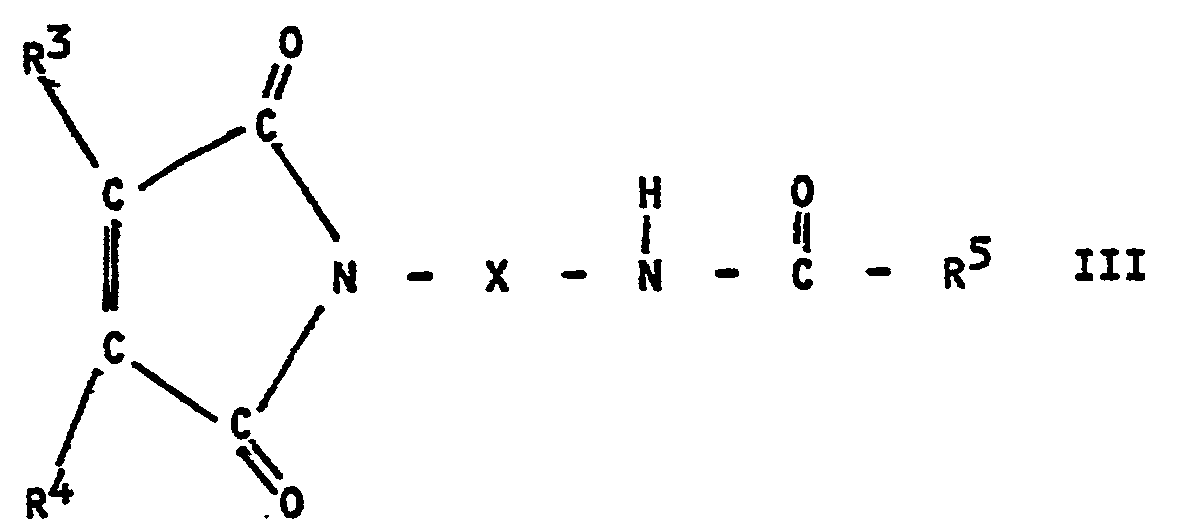
- R3 and R4 each and independently represent a hydrogen atom, an aliphatic, cycloaliphatic or aromatic group containing 1-12 carbon atoms, or a halogen atom, or where R3 and R4, together with the carbon atoms to which they are bound, form a ring system with at least one polymerizable C=C bond, X represents an optionally halogen, hydroxy or nitro substituted alkylene groups containing 2-25 carbon atoms, an optionally halogen or nitro substituted meta- or paraphenylene group, or an optionally halogen or nitro substituted group having the formula

- R3 and R4 each and independently represent a hydrogen atom, an aliphatic, cycloaliphatic or aromatic group containing 1-12 carbon atoms, or a halogen atom, or where R3 and R4, together with the carbon atoms to which they are bound, form a ring system with at least one polymerizable C=C bond, X represents an optionally halogen, hydroxy or nitro substituted alkylene groups containing 2-25 carbon atoms, an optionally halogen or nitro substituted meta- or paraphenylene group, or an optionally halogen or nitro substituted group having the formula
- c) 1 to 10 wt.% of a maleic anhydride compound having the formula:

- R6 and R7 each and independently represent a hydrogen atom, an aliphatic, cycloaliphatic or aromatic group containing 1-12 carbon atoms, or a halogen atom, or where R6 and R7, together with the carbon atoms to which they are bound, form a ring system with at least one polymerizable C=C bond, with the proviso that the sum of the wt.-% of (a) + (b) + (c) is 100 wt.%.
- a)80 to 30 wt.% of one or more compounds of the general formula:
- B: 7-77 parts by wt. of one or more ethylenically unsaturated compounds with 5-50 C-atoms, characterised in that the composition further comprises
- C: 3-60 parts by wt. of one or more compounds from the group of hydroxyalkyl(meth)acrylates or aminoalkyl(meth)acrylates,
- D: 1-20 parts by wt. of one or more terminally functional polymers as flexibilizer, with the proviso that the sum of parts of compounds A + B + C and D amounts to 100.
- It has, surprisingly, been found that, when using a hydroxyalkyl(meth)acrylate or aminoalkyl(meth)acrylate in the compositions containing bismaleimide, maleimide-amide, and polymerizable monomeric compounds like styrene, terminally functional polymers as flexibilizer indeed can be incorporated homogeneously.
- The compounds A that contain at least 5 wt. % of one or more 15 maleimide-amide compounds can be prepared in a very convenient manner by the following method:
- A diamine having the formula
- H2N - Z - NH2 VI
- For the preparation of homogeneous, curable compositions with ethylenically unsaturated compounds it is not necessary to separate the components from the mixture obtained. Removal of solvent used, alkylcarboxylic acid formed and possibly an excess of alkylcarboxylic anhydride is sufficient.
- In the mixtures thus obtained, mostly about 30-50 % of the maleimide groups will be present in the isomeric isomaleimide form. The mixture thus will mainly contain bismaleimide, maleimide-isomaleimide and bisi- somaleimide compounds (shortly called bismaleimide compounds), maleimide-amide and isomaleimide- amide compounds (shortly called maleimide-amide compounds) and maleic anhydride compounds.
- Moreover, depending on the reaction conditions, small amounts (up to about 5 %) of amide-amide compounds may be present and possibly, to an even more limited extent, compounds with amide acid groups.
- Said compositions, that comprise bismaleimide compounds, maleimide-amide compounds and acid compounds, appear to be soluble as such in simple solvents such as acetone or methylethylketone, but also in ethylenically unsaturated compounds.
- Solutions in copolymerizable ethylenically unsaturated compounds with 5-50 C-atoms comprise bismaleimide compounds, maleimide-amide compounds and an acid anhydride compound, in such an amount that the weight ratio between ethylenically unsaturated compound and composition A is 2:1 and 1:4,
- Ethylenically unsaturated compounds are here particularly understood to mean vinyl aromatic compounds such as: styrene, a-methylstyrene, para-methylstyrene, divinylbenzene, vinyltoluene; allyl compounds such as monoallyl esters or ethers and diallyl esters or ethers, for instance diallyl phthalate; vinylether and vinylester compounds such as vinyl benzoate; and acrylic acid esters and methacrylic acid esters.
- The flexibilizer can be added after synthesis of composition A, but also previously. In the latter case, the amount of component C needed for obtaining a homogeneous mixture generally can be smaller, also higher amounts of flexibilizer can be added. Furthermore, the viscosity of the mixture is lower in case the flexibilizer is added before synthesis of compound A.
- If the bismaleimide and maleimide-amide mixture is cured without vinylic comonomer, it is particularly advantageous to add the terminally functional polymer during the synthesis of composition A. This yields a very good end product, which is particularly suitable for prepregs.
- During polymerization or curing by addition reactions or via radical reactions, the terminal functional polymers react with the (iso)maleimide-containing components, so that these become part of the matrix. It also is possible that a portion of the terminally functional compound reacts with other components of the composition to yield modified prepolymers already before the eventual curing process. These prepolymers, too, are compatible with the bismaleimide and maleimide-amide containing composition according to the invention.
- Examples of hydroxyalkyl(meth)acrylates or aminoalkyl(meth)acrylates are 2-hydroxy-ethylmethacrylate, 2-hydroxypropylmethacrylate, 2-hydroxyethylacrylate and 2-dimethylamino-ethylmethacrylate; particularly the hydroxyalkyl(meth)acrylates are suitable, preference being given to 2-hydroxyethylmethacrylate. By preference, a compound from this group is applied in the composition in an amount of 5-40 wt.%, in particular 6-30 wt.%.
- As flexibilizer a wide variety of polymers can be applied. It is essential for these to possess a terminally functional group suitable for an addition or radical polymerization reaction. By preference, use is made of mainly linear polymers that are amino-, amide hydroxy-, isocyanate-, carboxyl-, epoxy- or vinyl-terminated polymers, preferably with a molecular weight between 400 and 20,000, more preferably between 500 and 5000, particularly aminoterminated polymers. The flexibilizers are preferably applied in the composition in an amount between 4 and 16 wt.%. The polymer itself can be constituted of various sorts of organic monomers like ethyleneglycol, propyleneglycol, tetrahydrofurane, butadiene, acryloni- tril, and mixtures thereof. Even better results can be achieved using fluoridized rubbers or polysiloxanes that are provided with a terminally functional group. Also hydroxylated or carboxylated EPDM rubbers can be applied. These types of rubber do have a molecular weight preferably between 10,000 and 100,000.
- It further is to a limited extent possible to add customary substances such as inhibitors, pigments, fillers, reinforcing agents, shrinkage-controlling substances, etc. Examples of possible additives are glass fibres, carbon fibres, metal fibres, aramide fibres, chalk, lime, sand, silica, aluminium oxide hydrate, polybutadiene, polystyrene, polyethylene, polypropylene and polyacrylates. For curing a radical source can be added. As such, a hydroperoxide, a perester, a perketone, and/or another compound that is suitable for curing a styrene containing mixture with copolymers. Otherwise, it is also possible to induce curing e.g. by ultra-violet light, optionally with an initiator.
- The polymers or objects obtained by curing of compositions according to the invention are characterized by a lower brittleness, with a relatively small adverse effect on the chemical, physical and thermal properties.
- The invention will be elucidated with reference to the following examples.
- At room temperature a solution of 100 g 4,4'-diaminodiphenylmethane in 300 ml acetone is added dropwise to 100 g maleic anhydride dissolved in 700 ml acetone. A precipitate of the corresponding dimaleimid- ic acid is formed quantitatively. At 60 MC 150 g acetic anhydride and 1.5 g DABCO (1,4-diaza-bicyclo-(2,2,2)-octane) is added; the anhydride serves as water extraction agent and the amine as catalyst. The end of the reaction is characterized by complete disappearance of the diamido-acid precipitate. After removal under vacuum 13.3 N/m2 (0.1 mm Hg) of the solvent, acetic acid and acetic anhydride at 50-100 MC, in a quantitative yield a mixture is obtained that consists of approx. 70 wt.-% N,N',4,4'-diphenylmethane-bismaleimide, 25 wt.-% 4-acetylaminophenyl 4'-maleimidophenyl-methane and approx. 5 wt.-% maleic anhydride and minor amounts of N,N',4,4'-diphenylmethane bisacetamide. In this mixture, about 40 wt.-% of the 'maleimide' groups is present in the isomeric isomaleimide form and 60 wt.-% in the maleimide form. This mixture is eminently suitable as basic ingredient for the preparation of thermosetting resins.
- A reaction vessel, provided with a stirrer and placed in a bath that is kept at a temperature of 80-100 C by means of a thermostat, is charged with amounts as specified in Table 1 (resins 1-3) of the composition according to Example I, styrene, 2-hydroxymethylmethacrylate and in each resin a different type of a functional terminal polymer. The mixture is stirred during 10-15 minutes, upon which a clear, transparent, reddish solution is obtained. Stabilized with 300 ppm benzoquinone, the solution remains homogeneous also after cooling to 15-20 C.
- After deaeration of the solution and addition of 1 wt.-% methyl ethyl ketone peroxide (50 wt.-% solution in dimethylphthalate), the resin is poured into a rectangular metal mould (130 x 75 x 4 mm). Curing takes place at room temperature, the gelation time is about 1 hour. After 8 hours, the plate obtained is kept at a temperature of 80 C for 24 hours, then at a temperature of 150 C for 24 hours and finally at a temperature of 200 C for 24 hours. The mechanical properties of these cast objects are presented in Table 1.
- It is clear that objects containing the amino-terminated polymer are considerably less brittle than the unmodified products. It is remarkable to note that the addition of the reported amounts of flexibilizer does not have any adverse consequences for the HDT (heat distortion temperature) of the material.

- In analogous way to examples and II resins 4-14 were prepared and tested, results are shown in table 2.


- Instead of adding a flexibilizer to the maleimide composition obtained according to Example I, the flexibilizer modification can also be integrated with the synthesis of the maleimide composition.
- A solution of 100 g 4,4'-diamino-diphenylmethane and 17.5 g NH2-terminated polypropylene oxide (MW 2000) in 300 ml acetone is added dropwise at room temperature to 105 g maleic anhydride dissolved in 700 ml acetone. A quantitative precipitate of the corresponding diamido acids is formed. At 60 C 150 g acetic anhydride and 1.5 g DABCO (1,4-diaza-bicyclo-(2,2,2)-octane) is added; the anhydride serves as water extraction agent and the amine as catalyst. The end of the reaction is characterized by complete dissappearance of the precipitate.
- Further treatment of the mixture is as described in Example I. The composition thus obtained contains about 10 wt.% flexibilizer.
- A resin (number 15) on the basis of 57 wt.% of composition thus prepared, 25 wt.% styrene and 18 wt.% 2-hydroxyethylmethacrylate yields cured products having virtually the same mechanical properties as those of resin 2 of Example II.
- In analogous way to example IV resins 16-20 were prepared and tested. Results are shown in table 3.


- As is clear from the results with resins 1-17 the heat distortion temperature (HDT) is higher or equals 200°C, as long as more than 50 wt.-% BMI-solid is used. In examples 18-20 the amount of BMI solid is lowered to 35 wt.-% which has a lower HDT as a result.
- In an analogous way to example I and II resin 21 was prepared with an OH-terminated rubber based on polyethyleneglycol (PEG) with the following composition: BMI-resin : styrene : PEG = 50 wt.-%; 27 wt.- %; 18 wt.-%, 5 wt.-%.
- The HDT was 225°C, the elongation at break amounted to 1.6 %.
where Z has the meaning indicated, is reacted with a maleic anhydride compound having formula V in a molar ratio of diamine to maleic anhydride compound of 1:0.75 to 1:2.5 and the mixture obtained is subsequently reacted, in the presence of a suitable catalyst, with an adapted amount of anhydride of an alkylcarboxylic acid with 2 to 7 carbon atoms, whereupon a mixture is obtained showing the desired ratio between (iso)maleimide groups formed by cyclodehydration, the amount of alkylamide groups formed by (re)-alkylamidation and the amount of acid anhydride compound.
Claims (11)

or a corresponding isomaleimide isomer thereof, where


Priority Applications (1)
| Application Number | Priority Date | Filing Date | Title |
|---|---|---|---|
| AT86200904T ATE45367T1 (en) | 1985-06-08 | 1986-05-23 | BISMAIL COMPOSITIONS. |
Applications Claiming Priority (2)
| Application Number | Priority Date | Filing Date | Title |
|---|---|---|---|
| NL8501660A NL8501660A (en) | 1985-06-08 | 1985-06-08 | BISMALEIMIDE COMPOSITIONS. |
| NL8501660 | 1985-06-08 |
Publications (2)
| Publication Number | Publication Date |
|---|---|
| EP0206383A1 EP0206383A1 (en) | 1986-12-30 |
| EP0206383B1 true EP0206383B1 (en) | 1989-08-09 |
Family
ID=19846108
Family Applications (1)
| Application Number | Title | Priority Date | Filing Date |
|---|---|---|---|
| EP86200904A Expired EP0206383B1 (en) | 1985-06-08 | 1986-05-23 | Bismaleimide compositions |
Country Status (12)
| Country | Link |
|---|---|
| US (1) | US4766179A (en) |
| EP (1) | EP0206383B1 (en) |
| JP (1) | JPS61285208A (en) |
| AT (1) | ATE45367T1 (en) |
| CA (1) | CA1275339C (en) |
| DE (1) | DE3664917D1 (en) |
| DK (1) | DK267786A (en) |
| ES (2) | ES8705478A1 (en) |
| FI (1) | FI85870C (en) |
| NL (1) | NL8501660A (en) |
| NO (1) | NO167040C (en) |
| PT (1) | PT82721B (en) |
Families Citing this family (13)
| Publication number | Priority date | Publication date | Assignee | Title |
|---|---|---|---|---|
| US4826995A (en) * | 1987-11-25 | 1989-05-02 | Texaco Inc. | Bismaleimide derivatives of higher molecular weight polyoxyalkyleneamines |
| NL8802605A (en) * | 1988-10-22 | 1990-05-16 | Stamicarbon | BISMALEIMIDE COMPOSITIONS. |
| US4954195A (en) * | 1989-02-13 | 1990-09-04 | Lockheed Corporation | Production of thermoset composites containing thermoplastic fillers |
| FR2645540B1 (en) * | 1989-04-10 | 1991-06-14 | Rhone Poulenc Chimie | POLYMERS WITH IMIDE GROUPS BASED ON MALEIMIDES INCLUDING A BISMALEIMIDE SILOXANE AND AROMATIC DIAMINES AND THEIR PREPARATION METHOD |
| NL9002758A (en) * | 1990-12-14 | 1992-07-01 | Stamicarbon | ENDLESS ARTICLES OF THERMO-HARDONABLE MONOMERS. |
| FR2672898B1 (en) * | 1991-02-15 | 1993-07-09 | Rhone Poulenc Chimie | PREPOLYMERS WITH IMID GROUPS AND THEIR PREPARATION METHOD, SUITABLE FOR THE PRODUCTION OF RESIN CURABLE RESINS WITH IONIZING RADIATION. |
| FR2672896B1 (en) * | 1991-02-15 | 1993-06-04 | Aerospatiale Soc Nat Industrielle | HARDENING PROCESS WITH IONIZING RADIATION OF A BIS-MALEIMIDE RESIN AND A COMPOSITE MATERIAL USING THE SAME. |
| US6034194A (en) * | 1994-09-02 | 2000-03-07 | Quantum Materials/Dexter Corporation | Bismaleimide-divinyl adhesive compositions and uses therefor |
| US7645899B1 (en) | 1994-09-02 | 2010-01-12 | Henkel Corporation | Vinyl compounds |
| US6960636B2 (en) | 1994-09-02 | 2005-11-01 | Henkel Corporation | Thermosetting resin compositions containing maleimide and/or vinyl compounds |
| US6852814B2 (en) * | 1994-09-02 | 2005-02-08 | Henkel Corporation | Thermosetting resin compositions containing maleimide and/or vinyl compounds |
| US20030055121A1 (en) * | 1996-09-10 | 2003-03-20 | Dershem Stephen M. | Thermosetting resin compositions containing maleimide and/or vinyl compounds |
| JP2024051547A (en) * | 2022-09-30 | 2024-04-11 | 日本化薬株式会社 | CURABLE RESIN COMPOSITION, RESIN SHEET, AND CURED PRODUCT |
Family Cites Families (5)
| Publication number | Priority date | Publication date | Assignee | Title |
|---|---|---|---|---|
| NL263735A (en) * | 1960-04-22 | |||
| IT1043117B (en) * | 1975-10-03 | 1980-02-20 | Snam Progetti | SHOCK RESINS AND METHOD FOR THEIR AREPARATION |
| IE56255B1 (en) * | 1982-11-06 | 1991-06-05 | Dsm Resins Bv | Bismaleimide-containing thermosetting compositions and polymers |
| NL8303229A (en) * | 1983-09-20 | 1985-04-16 | Dsm Resins Bv | NEW MALEIMIDE-AMIDE COMPOUNDS AND COMPOSITIONS INCLUDING THESE, PREPARATION AND APPLICATION THEREOF. |
| WO1984002528A1 (en) * | 1982-12-24 | 1984-07-05 | Secr Defence Brit | Curable thermosetting prepolymerised imide resin compositions |
-
1985
- 1985-06-08 NL NL8501660A patent/NL8501660A/en not_active Application Discontinuation
-
1986
- 1986-05-23 EP EP86200904A patent/EP0206383B1/en not_active Expired
- 1986-05-23 AT AT86200904T patent/ATE45367T1/en not_active IP Right Cessation
- 1986-05-23 DE DE8686200904T patent/DE3664917D1/en not_active Expired
- 1986-05-28 US US06/867,691 patent/US4766179A/en not_active Expired - Fee Related
- 1986-06-05 FI FI862398A patent/FI85870C/en not_active IP Right Cessation
- 1986-06-05 PT PT82721A patent/PT82721B/en not_active IP Right Cessation
- 1986-06-06 ES ES555789A patent/ES8705478A1/en not_active Expired
- 1986-06-06 ES ES555803A patent/ES8707269A1/en not_active Expired
- 1986-06-06 CA CA000510975A patent/CA1275339C/en not_active Expired - Lifetime
- 1986-06-06 NO NO862271A patent/NO167040C/en unknown
- 1986-06-06 JP JP61130454A patent/JPS61285208A/en active Pending
- 1986-06-06 DK DK267786A patent/DK267786A/en not_active Application Discontinuation
Also Published As
| Publication number | Publication date |
|---|---|
| EP0206383A1 (en) | 1986-12-30 |
| DE3664917D1 (en) | 1989-09-14 |
| FI85870B (en) | 1992-02-28 |
| PT82721B (en) | 1988-04-21 |
| NO167040B (en) | 1991-06-17 |
| ES555803A0 (en) | 1987-07-01 |
| ES8705478A1 (en) | 1987-05-01 |
| ATE45367T1 (en) | 1989-08-15 |
| FI862398A0 (en) | 1986-06-05 |
| FI862398L (en) | 1986-12-09 |
| NO862271L (en) | 1986-12-09 |
| PT82721A (en) | 1986-07-01 |
| NO167040C (en) | 1991-09-25 |
| DK267786A (en) | 1986-12-09 |
| ES555789A0 (en) | 1987-05-01 |
| ES8707269A1 (en) | 1987-07-01 |
| DK267786D0 (en) | 1986-06-06 |
| CA1275339C (en) | 1990-10-16 |
| NO862271D0 (en) | 1986-06-06 |
| NL8501660A (en) | 1987-01-02 |
| FI85870C (en) | 1992-06-10 |
| US4766179A (en) | 1988-08-23 |
| JPS61285208A (en) | 1986-12-16 |
Similar Documents
| Publication | Publication Date | Title |
|---|---|---|
| US4766179A (en) | Bismaleimide compositions | |
| EP0035760B1 (en) | Thermosetting resin composition, process for preparation thereof and cured product thereof | |
| US4683276A (en) | Cyanate functional maleimide thermosetting composition | |
| EP0135964B1 (en) | Compositions containing maleimide-amide compounds as well as the preparation and application thereof | |
| CA1277090C (en) | Heat-curable mixtures containing substituted bicyclo[2.2.1]-hept-5-ene-2,3-dicarboximides and polymaleimides | |
| US4769440A (en) | Cyanate functional maleimide aromatic polycyanate thermosetting composition | |
| CA1234949A (en) | Bismaleimide-containing thermosetting compositions and polymers | |
| US5021487A (en) | Thermally stabilized acrylic adhesive compositions and novel methacrylated malemide compounds useful therein | |
| US4737568A (en) | Curable resin from bis-imide amino acid hydrazide and alkenyl phenol or ether | |
| EP0156038B1 (en) | High temperature stable adhesive compositions employing aromatic polyimide and polyisoimide bis-acetylene additives | |
| US4731426A (en) | Polymerization product from cyanate functional maleimide | |
| CA1338630C (en) | Alkenyl-modified polyimides | |
| US4593083A (en) | Curable composition comprising bismaleimide and maleimide-amide | |
| CA1305488C (en) | Cyanate functional maleimides | |
| JPS63170358A (en) | (poly)oxaalkylene-alpha, omega-bisimide compound of aryl-bicyclo (2.2.1) hept-5-ene-2, 3-dicarboxylic acid and its production and curable mixture containing the same | |
| JPS5937286B2 (en) | resin composition | |
| KR830000098B1 (en) | Thermosetting resin composition | |
| JPH04227931A (en) | Curable composition | |
| JPH0892333A (en) | Curable resin composition | |
| JPS59168016A (en) | Production of thermoplastic resin | |
| JPH01266120A (en) | Heat-resistant vinyl ester resin composition | |
| JPH0431412A (en) | Curable resin composition | |
| JPH03290414A (en) | Curable resin composition | |
| JPH0129804B2 (en) | ||
| JPH01174514A (en) | Thermosetting resin composition |
Legal Events
| Date | Code | Title | Description |
|---|---|---|---|
| PUAI | Public reference made under article 153(3) epc to a published international application that has entered the european phase |
Free format text: ORIGINAL CODE: 0009012 |
|
| AK | Designated contracting states |
Kind code of ref document: A1 Designated state(s): AT BE CH DE FR GB IT LI NL SE |
|
| 17P | Request for examination filed |
Effective date: 19870512 |
|
| 17Q | First examination report despatched |
Effective date: 19880812 |
|
| GRAA | (expected) grant |
Free format text: ORIGINAL CODE: 0009210 |
|
| AK | Designated contracting states |
Kind code of ref document: B1 Designated state(s): AT BE CH DE FR GB IT LI NL SE |
|
| REF | Corresponds to: |
Ref document number: 45367 Country of ref document: AT Date of ref document: 19890815 Kind code of ref document: T |
|
| REF | Corresponds to: |
Ref document number: 3664917 Country of ref document: DE Date of ref document: 19890914 |
|
| ITF | It: translation for a ep patent filed | ||
| ET | Fr: translation filed | ||
| PLBE | No opposition filed within time limit |
Free format text: ORIGINAL CODE: 0009261 |
|
| STAA | Information on the status of an ep patent application or granted ep patent |
Free format text: STATUS: NO OPPOSITION FILED WITHIN TIME LIMIT |
|
| 26N | No opposition filed | ||
| PGFP | Annual fee paid to national office [announced via postgrant information from national office to epo] |
Ref country code: SE Payment date: 19910403 Year of fee payment: 6 |
|
| PGFP | Annual fee paid to national office [announced via postgrant information from national office to epo] |
Ref country code: CH Payment date: 19910422 Year of fee payment: 6 |
|
| ITTA | It: last paid annual fee | ||
| PGFP | Annual fee paid to national office [announced via postgrant information from national office to epo] |
Ref country code: NL Payment date: 19910531 Year of fee payment: 6 |
|
| PGFP | Annual fee paid to national office [announced via postgrant information from national office to epo] |
Ref country code: BE Payment date: 19920409 Year of fee payment: 7 |
|
| PGFP | Annual fee paid to national office [announced via postgrant information from national office to epo] |
Ref country code: FR Payment date: 19920428 Year of fee payment: 7 |
|
| PGFP | Annual fee paid to national office [announced via postgrant information from national office to epo] |
Ref country code: AT Payment date: 19920515 Year of fee payment: 7 |
|
| PGFP | Annual fee paid to national office [announced via postgrant information from national office to epo] |
Ref country code: GB Payment date: 19920520 Year of fee payment: 7 |
|
| PG25 | Lapsed in a contracting state [announced via postgrant information from national office to epo] |
Ref country code: SE Effective date: 19920524 |
|
| PG25 | Lapsed in a contracting state [announced via postgrant information from national office to epo] |
Ref country code: LI Effective date: 19920531 Ref country code: CH Effective date: 19920531 |
|
| PGFP | Annual fee paid to national office [announced via postgrant information from national office to epo] |
Ref country code: DE Payment date: 19920731 Year of fee payment: 7 |
|
| PG25 | Lapsed in a contracting state [announced via postgrant information from national office to epo] |
Ref country code: NL Effective date: 19921201 |
|
| NLV4 | Nl: lapsed or anulled due to non-payment of the annual fee | ||
| REG | Reference to a national code |
Ref country code: CH Ref legal event code: PL |
|
| PG25 | Lapsed in a contracting state [announced via postgrant information from national office to epo] |
Ref country code: GB Effective date: 19930523 Ref country code: AT Effective date: 19930523 |
|
| PG25 | Lapsed in a contracting state [announced via postgrant information from national office to epo] |
Ref country code: BE Effective date: 19930531 |
|
| BERE | Be: lapsed |
Owner name: DSM RESINS B.V. Effective date: 19930531 |
|
| GBPC | Gb: european patent ceased through non-payment of renewal fee |
Effective date: 19930523 |
|
| PG25 | Lapsed in a contracting state [announced via postgrant information from national office to epo] |
Ref country code: FR Effective date: 19940131 |
|
| PG25 | Lapsed in a contracting state [announced via postgrant information from national office to epo] |
Ref country code: DE Effective date: 19940201 |
|
| REG | Reference to a national code |
Ref country code: FR Ref legal event code: ST |
|
| EUG | Se: european patent has lapsed |
Ref document number: 86200904.0 Effective date: 19921204 |
|
| PG25 | Lapsed in a contracting state [announced via postgrant information from national office to epo] |
Ref country code: IT Free format text: LAPSE BECAUSE OF NON-PAYMENT OF DUE FEES;WARNING: LAPSES OF ITALIAN PATENTS WITH EFFECTIVE DATE BEFORE 2007 MAY HAVE OCCURRED AT ANY TIME BEFORE 2007. THE CORRECT EFFECTIVE DATE MAY BE DIFFERENT FROM THE ONE RECORDED. Effective date: 20050523 |