EP0204316B1 - X-ray film cassette for daylight system - Google Patents
X-ray film cassette for daylight system Download PDFInfo
- Publication number
- EP0204316B1 EP0204316B1 EP86107520A EP86107520A EP0204316B1 EP 0204316 B1 EP0204316 B1 EP 0204316B1 EP 86107520 A EP86107520 A EP 86107520A EP 86107520 A EP86107520 A EP 86107520A EP 0204316 B1 EP0204316 B1 EP 0204316B1
- Authority
- EP
- European Patent Office
- Prior art keywords
- film
- pressure plate
- cassette
- intensifying
- bonded
- Prior art date
- Legal status (The legal status is an assumption and is not a legal conclusion. Google has not performed a legal analysis and makes no representation as to the accuracy of the status listed.)
- Expired
Links
- 238000003780 insertion Methods 0.000 claims abstract description 17
- 230000037431 insertion Effects 0.000 claims abstract description 17
- 238000000034 method Methods 0.000 description 5
- 238000012360 testing method Methods 0.000 description 3
- 239000012790 adhesive layer Substances 0.000 description 2
- 238000010276 construction Methods 0.000 description 2
- 230000004913 activation Effects 0.000 description 1
- 239000000853 adhesive Substances 0.000 description 1
- 230000001070 adhesive effect Effects 0.000 description 1
- 238000007796 conventional method Methods 0.000 description 1
- 230000001934 delay Effects 0.000 description 1
- 230000003111 delayed effect Effects 0.000 description 1
- 238000011161 development Methods 0.000 description 1
- 230000018109 developmental process Effects 0.000 description 1
- 238000010586 diagram Methods 0.000 description 1
- 230000000694 effects Effects 0.000 description 1
- 239000013013 elastic material Substances 0.000 description 1
- 239000010410 layer Substances 0.000 description 1
- 238000004519 manufacturing process Methods 0.000 description 1
- 238000005259 measurement Methods 0.000 description 1
- 239000002184 metal Substances 0.000 description 1
- 238000000926 separation method Methods 0.000 description 1
Images


Classifications
-
- G—PHYSICS
- G03—PHOTOGRAPHY; CINEMATOGRAPHY; ANALOGOUS TECHNIQUES USING WAVES OTHER THAN OPTICAL WAVES; ELECTROGRAPHY; HOLOGRAPHY
- G03B—APPARATUS OR ARRANGEMENTS FOR TAKING PHOTOGRAPHS OR FOR PROJECTING OR VIEWING THEM; APPARATUS OR ARRANGEMENTS EMPLOYING ANALOGOUS TECHNIQUES USING WAVES OTHER THAN OPTICAL WAVES; ACCESSORIES THEREFOR
- G03B42/00—Obtaining records using waves other than optical waves; Visualisation of such records by using optical means
- G03B42/02—Obtaining records using waves other than optical waves; Visualisation of such records by using optical means using X-rays
- G03B42/04—Holders for X-ray films
Definitions
- the invention relates to an X-ray cassette for daylight x-ray systems, composed of:
- Such X-ray film cassettes are known from DE-C3-21 66 251, DE-A1-24 38 278 and US-A-3,870,889. These are used in daylight systems, which make it possible to automatically load and unload x-ray cassettes with film without a darkroom.
- the empty cassette with the film insertion slot up is inserted into a film dispenser, which has a device to open the film insertion opening and simultaneously lift the pressure plate and its screen from the opposite intensifying screen so that the sheet of film can fall from the dispenser into the cassette where it comes to rest between the two intensifying screens.
- the film insertion opening is closed to light and the pressure plate presses the two intensifying screens into good contact with both sides of the x-ray film.
- the cassette After exposure, the cassette is inserted into an unloading apparatus - for example, a developing machine - wherein the film insertion opening is opened again and the pressure plate lifted, so that the film falls of its own weight either directly into a developing machine or into a collector from where it can be transported, as desired, into a developing machine.
- an unloading apparatus for example, a developing machine - wherein the film insertion opening is opened again and the pressure plate lifted, so that the film falls of its own weight either directly into a developing machine or into a collector from where it can be transported, as desired, into a developing machine.
- the film can, despite the release of the pressure plate, stick to one or both intensifying screens and either not drop or be delayed. Delays of more than three seconds hinder rapid and continuous work flow. Various measures have already been proposed for faster and more reliable unloading of the cassette.
- either a part of the intensifying screen or a special metal part is so linked to the cassette wall that the free ends swing away from the wall to a perpendicular position and thus release the film.
- the construction requires that the cassette be placed in a specific position for loading as well as unloading. A change in the orientation of the cassette would hinder loading; in unloading, the apparatus would be useless.
- European Patent Application EP 00 75 876 describes a cassette furnished with a "buckler", which is automatically activated in the unloading process and momentarily pushes against the film edges, buckling the film and thus releasing it from the screens.
- a lever serves the same purpose. It is installed in a corner of the cassette on the side opposite the opening of the cassette and on being activated, pushes the film in an essentially diagonal direction with respect to the cassette wall, as a result of which the film is buckled and released from the intensifying screens.
- the activation of the lever is not automatic, but requires an extra handle.
- the object of the subject invention is to produce an x-ray film cassette of the above named type such that very short film drop times are attained at unloading without additional mechanical devices.
- the intensifying screen affixed to the pressure plate has edge zones that are not attached to the pressure plate surface on the two long dimensions and optionally, on the short dimension opposite the film insertion opening. Film drop times of less than three seconds are attained.
- edge zones free of adhesive.
- the width of these zones is 0.03 to 0.2 times the short dimension of the intensifying screen and in the conventional cassette sizes is preferably between 10 and 60 mm.
- the edge zones are bent slightly toward the plane of the film. In this case, an edge zone width of only 2-5 mm is adequate.
- the fourth side of the intensifying screen at the film insertion opening is advantageously bent, by known methods, away from the plane of the film to assure problem-free insertion of the film into the cassette.
- Fig. 1 shows a pictorial representation of a typical x-ray film cassette basic to the invention.
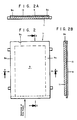
- Fig. 2 shows the pressure plate/intensifying screen combination in one embodiment of the invention having adhesive-free edge zones.
- Figs. 2A and 2B are cross-sectional views taken along the section lines A-A and B-B respectively of Fig. 2.
- Figs. 3A, 3B, 3C, and 3D are fragmentary cross-sectional views taken along the section lines A-A, B-B, C-C, and D-D, respectively of Fig. 3.
- Fig. 3 shows an alternative embodiment of the invention in which the pressure plate/intensifying screen combination has canted edge zones.
- Fig. 1 shows only the important elements of an x-ray daylight cassette; the prior art shows additional details, as, for example, in EP 00 75 876.
- the cassette consists of a housing 1 comprising a frame with long dimensions 2 and short dimensions 3 and 4 as well as front and back cover plates 5 and 6.
- a film insertion slot or opening is located on the short dimension 4 and is covered in a light-tight fashion by the closure 7 when the cassette is closed.
- Two intensifying screens 8 and 9 are situated inside the cassette housing, shown in 2-6, one of which, 8 is affixed on a resilient or elastic pad 10 and the other 9 on a moveable firm pressure plate 11.
- the film 12 is positioned between the two intensifying screens.
- the pressure plate 11 exerts pressure through springs 13 toward the opposite intensifying screen to assure good contact between film and intensifying screens. Opening the closure 7 of the film insertion slot, lifting the pressure plate 11 and releasing the pressure of the springs 13 in loading and unloading the cassette is accomplished by a release device, not shown in detail, since it does not form part of this invention, which is inserted into the channels 14 in the long dimension 2 and activated by external loading and unloading apparatuses.
- the intensifying screen 9 is affixed to the pressure plate 11 by an adhesive layer 15 in such a way that the edge tones 9a on the long sides of the rectangular cassette and edge zone 9b opposite the side opening on the short dimension 4 are adhesive-free.
- Fig. 2 shows the pressure plate 11 with the intensifying screen 9 adhering to the entire surface except the edge zones 9a and 9b.
- the adhesive layer is identified by 15.
- the intensifying screen is not bent.
- the width of the edge zones is about 0.03 to 0.2 times the short side dimension 4 and for typical cassettes lies in the range of 10-60 mm.
- the particular ratios used are not critical as will be seen from the Examples
- Fig. 3 shows an alternative embodiment wherein the intensifying screen 9 is adhered to the pressure plate 11 up to the small edge zones 9c and 9d. These edge zones are bent away from the pressure plate 11 toward the plane of the film as illustrated in Figs. 3A, 3B and 3C. The ratio of the width (a) of the bent edge zones to the height (b) of the bend is about 10:1.
- Fig. 3B shows the prior art bend in edge zone 9e that serves to facilitate film insertion. Edge zone 9e is not supported by the pressure plate and bends in the opposite direction. The width of the bent edge zone may be about 2-5 mm wide for a typical cassette.
- x-ray daylight cassettes of the type previously described are used for film sizes of 24 x 30 cm, 30 x 40 cm, 35 x 35 cm, and 35 x 43 cm (2 cassettes). These are furnished with "bucklers". except for the 24 x 30 cm cassette and one 35 x 43 cm cassette.
- the cassettes contain pressure plates on the entire surfaces of which intensifying screens have been adhered by conventional methods.
- the cassettes are loaded with x-ray film of corresponding sizes and then installed in an unloading apparatus for daylight film. The time for the film to drop is measured. Ten measurements are made for each cassette and the mean values of the film drop times calculated ("Comparison").
- a 35 x 43 cm cassette is furnished successively with pressure plates bearing intensifying screens with various widths of adhesive-free edge zones.
- the drop times are measured as in Example 1.
- the results are listed in Table 2.
Landscapes
- Physics & Mathematics (AREA)
- General Physics & Mathematics (AREA)
- Radiography Using Non-Light Waves (AREA)
- Measurement Of Radiation (AREA)
- Analysing Materials By The Use Of Radiation (AREA)
- Silver Salt Photography Or Processing Solution Therefor (AREA)
Abstract
Description
- The invention relates to an X-ray cassette for daylight x-ray systems, composed of:
- · a flat housing, impervious to light, containing on one side a light-tight, closeable, slit-shaped opening for the insertion of film,
- · two intensifying screens that have been inserted into the housing substantially parallel to each other, one of which is affixed to an elastic pad and the other to a firm pressure plate that is moveable in a direction substantially perpendicular to the plane of the intensifying screens,
- · an externally operated apparatus to simultaneously open the light-tight closure of the film insertion opening and lift the pressure plate and its intensifying screen from the opposite intensifying screen or from the sheet of film located between the two intensifying screens.
- Such X-ray film cassettes are known from DE-C3-21 66 251, DE-A1-24 38 278 and US-A-3,870,889. These are used in daylight systems, which make it possible to automatically load and unload x-ray cassettes with film without a darkroom. In this method, the empty cassette with the film insertion slot up is inserted into a film dispenser, which has a device to open the film insertion opening and simultaneously lift the pressure plate and its screen from the opposite intensifying screen so that the sheet of film can fall from the dispenser into the cassette where it comes to rest between the two intensifying screens. When the cassette is removed from the dispenser, the film insertion opening is closed to light and the pressure plate presses the two intensifying screens into good contact with both sides of the x-ray film. After exposure, the cassette is inserted into an unloading apparatus - for example, a developing machine - wherein the film insertion opening is opened again and the pressure plate lifted, so that the film falls of its own weight either directly into a developing machine or into a collector from where it can be transported, as desired, into a developing machine. This type of apparatus is described in US-A-3,715,087.
- During the unloading procedure, the film can, despite the release of the pressure plate, stick to one or both intensifying screens and either not drop or be delayed. Delays of more than three seconds hinder rapid and continuous work flow. Various measures have already been proposed for faster and more reliable unloading of the cassette.
- According to DE-A1-24 38 278, either a part of the intensifying screen or a special metal part is so linked to the cassette wall that the free ends swing away from the wall to a perpendicular position and thus release the film. The construction requires that the cassette be placed in a specific position for loading as well as unloading. A change in the orientation of the cassette would hinder loading; in unloading, the apparatus would be useless.
- European Patent Application EP 00 75 876 describes a cassette furnished with a "buckler", which is automatically activated in the unloading process and momentarily pushes against the film edges, buckling the film and thus releasing it from the screens. Although the relatively expensive construction accelerates unloading, the desired short fall time of three seconds is not always attained, especially when intensifying screens with smooth surfaces and large film sizes are used.
- In WO 84/01040, a lever serves the same purpose. It is installed in a corner of the cassette on the side opposite the opening of the cassette and on being activated, pushes the film in an essentially diagonal direction with respect to the cassette wall, as a result of which the film is buckled and released from the intensifying screens. However, the activation of the lever is not automatic, but requires an extra handle.
- For another type of cassette, namely, the so-called book cassette, in which the housing and the cover are connected by a hinge, procedures are described to facilitate the release of the film from the intensifying screen. In x-ray cassettes in accordance with US-A-3,511,990, both intensifying screens are placed on layers of elastic material, the edges of which bear thicker elastic strips; when the cassette cover is opened, the expansion of the elastic edge strips lifts the film from the intensifying screens. This arrangement cannot be used in the daylight cassettes of the subject invention in which one intensifying screen must be attached directly to the pressure plate without an elastic underpad.
- In addition to the above described individual disadvantages, all of these prior art developments have the common disadvantage of requiring additional mechanical devices that complicate cassette production without the required short film drop times being attained.
- Therefore the object of the subject invention is to produce an x-ray film cassette of the above named type such that very short film drop times are attained at unloading without additional mechanical devices.
- The object is solved, according to the invention, with the features of claim 1.
- These objectives are fulfilled in a surprisingly simple manner such that the intensifying screen affixed to the pressure plate has edge zones that are not attached to the pressure plate surface on the two long dimensions and optionally, on the short dimension opposite the film insertion opening. Film drop times of less than three seconds are attained.
- This is achieved by having the edge zones free of adhesive. The width of these zones is 0.03 to 0.2 times the short dimension of the intensifying screen and in the conventional cassette sizes is preferably between 10 and 60 mm. In one particular embodiment, the edge zones are bent slightly toward the plane of the film. In this case, an edge zone width of only 2-5 mm is adequate. The fourth side of the intensifying screen at the film insertion opening is advantageously bent, by known methods, away from the plane of the film to assure problem-free insertion of the film into the cassette.
- The invention is described in greater detail in the following diagrams and examples.
- Fig. 1 shows a pictorial representation of a typical x-ray film cassette basic to the invention.
- Fig. 2 shows the pressure plate/intensifying screen combination in one embodiment of the invention having adhesive-free edge zones.
- Figs. 2A and 2B are cross-sectional views taken along the section lines A-A and B-B respectively of Fig. 2.
- Figs. 3A, 3B, 3C, and 3D are fragmentary cross-sectional views taken along the section lines A-A, B-B, C-C, and D-D, respectively of Fig. 3.
- Fig. 3 shows an alternative embodiment of the invention in which the pressure plate/intensifying screen combination has canted edge zones.
- Fig. 1 shows only the important elements of an x-ray daylight cassette; the prior art shows additional details, as, for example, in EP 00 75 876. The cassette consists of a housing 1 comprising a frame with
long dimensions 2 andshort dimensions 3 and 4 as well as front andback cover plates screens 8 and 9 are situated inside the cassette housing, shown in 2-6, one of which, 8 is affixed on a resilient orelastic pad 10 and the other 9 on a moveablefirm pressure plate 11. Thefilm 12 is positioned between the two intensifying screens. Thepressure plate 11 exerts pressure throughsprings 13 toward the opposite intensifying screen to assure good contact between film and intensifying screens. Opening the closure 7 of the film insertion slot, lifting thepressure plate 11 and releasing the pressure of thesprings 13 in loading and unloading the cassette is accomplished by a release device, not shown in detail, since it does not form part of this invention, which is inserted into thechannels 14 in thelong dimension 2 and activated by external loading and unloading apparatuses. - The intensifying
screen 9 is affixed to thepressure plate 11 by anadhesive layer 15 in such a way that the edge tones 9a on the long sides of the rectangular cassette andedge zone 9b opposite the side opening on the short dimension 4 are adhesive-free. - Fig. 2 shows the
pressure plate 11 with the intensifyingscreen 9 adhering to the entire surface except theedge zones - Fig. 3 shows an alternative embodiment wherein the intensifying
screen 9 is adhered to thepressure plate 11 up to thesmall edge zones pressure plate 11 toward the plane of the film as illustrated in Figs. 3A, 3B and 3C. The ratio of the width (a) of the bent edge zones to the height (b) of the bend is about 10:1. Fig. 3B shows the prior art bend inedge zone 9e that serves to facilitate film insertion.Edge zone 9e is not supported by the pressure plate and bends in the opposite direction. The width of the bent edge zone may be about 2-5 mm wide for a typical cassette. - The effect of the invention on film drop times in unloading cassettes is illustrated in the following examples.
- Five x-ray daylight cassettes of the type previously described are used for film sizes of 24 x 30 cm, 30 x 40 cm, 35 x 35 cm, and 35 x 43 cm (2 cassettes). These are furnished with "bucklers". except for the 24 x 30 cm cassette and one 35 x 43 cm cassette. The cassettes contain pressure plates on the entire surfaces of which intensifying screens have been adhered by conventional methods. The cassettes are loaded with x-ray film of corresponding sizes and then installed in an unloading apparatus for daylight film. The time for the film to drop is measured. Ten measurements are made for each cassette and the mean values of the film drop times calculated ("Comparison").
- Then the same cassettes are furnished with pressure plates on which intensifying screens have been adhered with edge zones 18 mm wide that do not adhere on three sides. The film drop tests are repeated as above ("Variation A"). In a similar manner, the cassettes are then furnished with pressure plates on which the intensifying screens are bent upward as seen in Figs. 3A 3C, and 3D about 0.3 mm over a width of 3 mm. The film drop times are determined as before ("Variation B"). The results of the three test series are presented in Table 1.

- These date show the substantial reduction in film drop time with the use of the invention, which is applicable also if the cassettes are furnished with a mechanical device for better film separation.
- A 35 x 43 cm cassette is furnished successively with pressure plates bearing intensifying screens with various widths of adhesive-free edge zones. The drop times are measured as in Example 1. The results are listed in Table 2.

- All tests were conducted with the Du Pont Daylight System with daylight cassettes, "Quanta" III intensifying screens, the CDPL Unloader and "Cronex" 4 x-ray film.
Claims (5)
- An x-ray film cassette for daylight systems, comprising:
a flat, light-impermeable housing (1), which has on one face (4) a light-tight, closeable, slit-shaped film insertion opening (7),
two intensifying screens (8,9) fitted inside the housing substantially parallel to each other, one of which (8) is affixed on an elastic pad (10) and the other (9) directly bonded on a firm, film pressure plate (11) that is capable of being moved substantially perpendicularly to the plane of the intensifying screens,
externally activated devices to simultaneously open the light-tight closure (7) of the film insertion opening and lift the film pressure plate (11) and its intensifying screen (9) from the opposite intensifying screen (8) or from the film sheet (12) between the two intensifying screens,
characterized in that
the intensifying screen (9) affixed to the pressure plate (11) has edge zones (9a-9d) that are not bonded to the pressure plate surface on the two long dimensions (2) and optionally, on the short dimension (3) opposite the film insertion opening (7). - An x-ray film cassette in accordance with claim 1, characterized in that the intensifying screens are rectangular having a long dimension (2) and short dimension (3,4) and that the edge zones (9a,9b) of the intensifying screen (9) that are not bonded to the pressure plate (11) are 0.03 to 0.2 times as wide as the short dimension (4).
- An x-ray film cassette in accordance with claim 2, characterized in that the width of the edge zones (9a,9b) that are not bonded to the pressure plate (11) is 10-60 mm.
- An x-ray film cassette in accordance with claim 1, characterized in that the edge zones (9c,9d) of the intensifying screen (9) that are not bonded to the pressure plate (11) are 2-5 mm wide and bent towards the plane of the film (12).
- An x-ray film cassette in accordance with claim 4, characterized in that the height of the bend (b) is about one tenth the width (a) of the edge zone (9c,9d).
Priority Applications (1)
| Application Number | Priority Date | Filing Date | Title |
|---|---|---|---|
| AT86107520T ATE68891T1 (en) | 1985-06-05 | 1986-06-03 | X-RAY FILM CASSETTE FOR A DAYLIGHT SYSTEM. |
Applications Claiming Priority (2)
| Application Number | Priority Date | Filing Date | Title |
|---|---|---|---|
| DE3520196A DE3520196C1 (en) | 1985-06-05 | 1985-06-05 | X-ray film cassette for daylight systems |
| DE3520196 | 1985-06-05 |
Publications (3)
| Publication Number | Publication Date |
|---|---|
| EP0204316A2 EP0204316A2 (en) | 1986-12-10 |
| EP0204316A3 EP0204316A3 (en) | 1987-07-01 |
| EP0204316B1 true EP0204316B1 (en) | 1991-10-23 |
Family
ID=6272532
Family Applications (1)
| Application Number | Title | Priority Date | Filing Date |
|---|---|---|---|
| EP86107520A Expired EP0204316B1 (en) | 1985-06-05 | 1986-06-03 | X-ray film cassette for daylight system |
Country Status (7)
| Country | Link |
|---|---|
| US (1) | US4734926A (en) |
| EP (1) | EP0204316B1 (en) |
| JP (1) | JPS61279846A (en) |
| AT (1) | ATE68891T1 (en) |
| AU (1) | AU588597B2 (en) |
| CA (1) | CA1271939A (en) |
| DE (2) | DE3520196C1 (en) |
Families Citing this family (7)
| Publication number | Priority date | Publication date | Assignee | Title |
|---|---|---|---|---|
| US4763346A (en) * | 1986-06-27 | 1988-08-09 | Eastman Kodak Company | Photographic cassette and method of dispensing |
| DE3740169A1 (en) * | 1987-11-26 | 1989-06-08 | Siemens Ag | RECORDING UNIT AT A FILM CHANGER |
| US4980903A (en) * | 1989-05-30 | 1990-12-25 | Eastman Kodak Company | Photographic cassette |
| US5083764A (en) * | 1990-07-16 | 1992-01-28 | E. I. Du Pont De Nemours And Company | Suction cup for curling a sheet near its edge and method of use |
| DE69314382T2 (en) * | 1992-06-02 | 1998-04-30 | Sterling Diagnostic Imaging | Device for separating film from X-ray film cassettes |
| US5388140A (en) * | 1993-06-30 | 1995-02-07 | Eastman Kodak Company | Film cassette |
| US5684853A (en) * | 1994-05-24 | 1997-11-04 | Minnesota Mining And Manufacturing Company | Flexible radiographic cassette holder |
Family Cites Families (18)
| Publication number | Priority date | Publication date | Assignee | Title |
|---|---|---|---|---|
| US3511990A (en) * | 1967-06-26 | 1970-05-12 | Eastman Kodak Co | Radiographic film cassette having a resilient film release strip therein |
| US3934735A (en) * | 1970-07-07 | 1976-01-27 | Productron, Inc. | Daylight film handling system |
| US3790160A (en) * | 1970-07-07 | 1974-02-05 | Production Inc | Daylight film handling system |
| BE795357A (en) * | 1970-07-07 | 1973-08-13 | Productron Inc | DAYLIGHT FILM HANDLING SYSTEM AND FILM CASSETTE |
| DE2166251C3 (en) * | 1970-07-07 | 1975-10-30 | Productron, Inc., Los Angeles, Calif. (V.St.A.) | Plan film casserole |
| US3715087A (en) * | 1971-02-18 | 1973-02-06 | Prod Inc | Sheet film storage magazine |
| CH581843A5 (en) * | 1973-08-10 | 1976-11-15 | Ciba Geigy Ag | |
| GB1454750A (en) * | 1973-08-10 | 1976-11-03 | Ciba Geigy Ag | Film cassette |
| US4018033A (en) * | 1973-09-27 | 1977-04-19 | Cubic Productron Inc. | Daylight film handling system |
| US3870889A (en) * | 1973-12-26 | 1975-03-11 | Production Inc | Film sheet cassette |
| US3930165A (en) * | 1974-10-21 | 1975-12-30 | U S Radium Corp | Cassette |
| DE2917547C2 (en) * | 1979-04-30 | 1981-11-19 | Agfa-Gevaert Ag, 5090 Leverkusen | X-ray film cassette |
| US4383330A (en) * | 1981-09-28 | 1983-05-10 | E. I. Du Pont De Nemours And Company | X-Ray cassette having quick film release mechanism |
| JPS5883840A (en) * | 1981-11-14 | 1983-05-19 | Fuji Photo Film Co Ltd | Accumulation type phosphor sheet and structure body consisting of cassette storing this sheet |
| US4444484A (en) * | 1982-08-25 | 1984-04-24 | Eastman Kodak Company | Photographic cassette and dispensing method |
| JPS5983151A (en) * | 1982-11-02 | 1984-05-14 | Fuji Photo Film Co Ltd | Cassette for cumulative phosphor sheet |
| JPS59151148A (en) * | 1983-02-16 | 1984-08-29 | Toshiba Corp | X-ray film holding device |
| US4613984A (en) * | 1984-11-07 | 1986-09-23 | E. I. Du Pont De Nemours And Company | Quick film release x-ray cassette mechanism |
-
1985
- 1985-06-05 DE DE3520196A patent/DE3520196C1/en not_active Expired
-
1986
- 1986-05-20 US US06/864,856 patent/US4734926A/en not_active Expired - Fee Related
- 1986-06-03 AU AU58296/86A patent/AU588597B2/en not_active Ceased
- 1986-06-03 AT AT86107520T patent/ATE68891T1/en active
- 1986-06-03 EP EP86107520A patent/EP0204316B1/en not_active Expired
- 1986-06-03 DE DE8686107520T patent/DE3682114D1/en not_active Expired - Lifetime
- 1986-06-05 CA CA000510936A patent/CA1271939A/en not_active Expired
- 1986-06-05 JP JP61129368A patent/JPS61279846A/en active Pending
Also Published As
| Publication number | Publication date |
|---|---|
| AU5829686A (en) | 1986-12-11 |
| ATE68891T1 (en) | 1991-11-15 |
| DE3682114D1 (en) | 1991-11-28 |
| DE3520196C1 (en) | 1986-09-11 |
| EP0204316A2 (en) | 1986-12-10 |
| AU588597B2 (en) | 1989-09-21 |
| JPS61279846A (en) | 1986-12-10 |
| EP0204316A3 (en) | 1987-07-01 |
| CA1271939A (en) | 1990-07-24 |
| US4734926A (en) | 1988-03-29 |
Similar Documents
| Publication | Publication Date | Title |
|---|---|---|
| US5712486A (en) | Flexible cassette for holding storage phosphor screen | |
| US4734926A (en) | X-ray film cassette for daylight system | |
| US4438164A (en) | Containers for X-ray films or the like | |
| GB1581683A (en) | X-ray film cassette and method of making | |
| US3870889A (en) | Film sheet cassette | |
| GB1295967A (en) | ||
| US4418420A (en) | Method and arrangement for gripping X-ray film | |
| US4383330A (en) | X-Ray cassette having quick film release mechanism | |
| EP0212624B1 (en) | Daylight x-ray cassette having variable size leaf springs | |
| US4613984A (en) | Quick film release x-ray cassette mechanism | |
| US3930165A (en) | Cassette | |
| US3174039A (en) | Self-developing x-ray film cassette | |
| AU587559B2 (en) | Photographic cassette and method of dispensing | |
| EP0118792B1 (en) | X-ray film-holding device | |
| EP0632319A1 (en) | Film cassette | |
| JPH0342650B2 (en) | ||
| US2530321A (en) | X-ray cassette | |
| EP0536582A1 (en) | Radiographic cassette having coding for identifying exposed and unexposed film | |
| JPH0221300A (en) | X ray recording film having phosphor coated layer and processor thereof | |
| JPS59102227A (en) | High speed photographing base using accumulative fluorescent body sheet | |
| US4198009A (en) | X-ray film cassette | |
| EP0475313B1 (en) | Method and apparatus for referencing a cassette and/or an intensifying screen on a radiograph | |
| US4612661A (en) | Suction engaging x-ray cassette container | |
| CA1082023A (en) | Photographic sheet film cassette with cam release | |
| US3928770A (en) | Film cassette |
Legal Events
| Date | Code | Title | Description |
|---|---|---|---|
| PUAI | Public reference made under article 153(3) epc to a published international application that has entered the european phase |
Free format text: ORIGINAL CODE: 0009012 |
|
| AK | Designated contracting states |
Kind code of ref document: A2 Designated state(s): AT BE CH DE FR GB IT LI NL SE |
|
| PUAL | Search report despatched |
Free format text: ORIGINAL CODE: 0009013 |
|
| AK | Designated contracting states |
Kind code of ref document: A3 Designated state(s): AT BE CH DE FR GB IT LI NL SE |
|
| 17P | Request for examination filed |
Effective date: 19871222 |
|
| 17Q | First examination report despatched |
Effective date: 19900621 |
|
| GRAA | (expected) grant |
Free format text: ORIGINAL CODE: 0009210 |
|
| AK | Designated contracting states |
Kind code of ref document: B1 Designated state(s): AT BE CH DE FR GB IT LI NL SE |
|
| PG25 | Lapsed in a contracting state [announced via postgrant information from national office to epo] |
Ref country code: IT Free format text: LAPSE BECAUSE OF FAILURE TO SUBMIT A TRANSLATION OF THE DESCRIPTION OR TO PAY THE FEE WITHIN THE PRE;WARNING: LAPSES OF ITALIAN PATENTS WITH EFFECTIVE DATE BEFORE 2007 MAY HAVE OCCURRED AT ANY TIME BEFORE 2007. THE CORRECT EFFECTIVE DATE MAY BE DIFFERENT FROM THE ONE RECORDED.SCRIBED TIME-LIMIT Effective date: 19911023 Ref country code: FR Effective date: 19911023 Ref country code: CH Effective date: 19911023 Ref country code: SE Effective date: 19911023 Ref country code: LI Effective date: 19911023 Ref country code: NL Effective date: 19911023 Ref country code: AT Effective date: 19911023 Ref country code: BE Effective date: 19911023 |
|
| REF | Corresponds to: |
Ref document number: 68891 Country of ref document: AT Date of ref document: 19911115 Kind code of ref document: T |
|
| REF | Corresponds to: |
Ref document number: 3682114 Country of ref document: DE Date of ref document: 19911128 |
|
| REG | Reference to a national code |
Ref country code: CH Ref legal event code: PL |
|
| EN | Fr: translation not filed | ||
| NLV1 | Nl: lapsed or annulled due to failure to fulfill the requirements of art. 29p and 29m of the patents act | ||
| PG25 | Lapsed in a contracting state [announced via postgrant information from national office to epo] |
Ref country code: GB Effective date: 19920603 |
|
| PLBE | No opposition filed within time limit |
Free format text: ORIGINAL CODE: 0009261 |
|
| STAA | Information on the status of an ep patent application or granted ep patent |
Free format text: STATUS: NO OPPOSITION FILED WITHIN TIME LIMIT |
|
| 26N | No opposition filed | ||
| GBPC | Gb: european patent ceased through non-payment of renewal fee |
Effective date: 19920603 |
|
| PG25 | Lapsed in a contracting state [announced via postgrant information from national office to epo] |
Ref country code: DE Effective date: 19930302 |