EP0202775A2 - Liquid dye preparations - Google Patents
Liquid dye preparations Download PDFInfo
- Publication number
- EP0202775A2 EP0202775A2 EP86302938A EP86302938A EP0202775A2 EP 0202775 A2 EP0202775 A2 EP 0202775A2 EP 86302938 A EP86302938 A EP 86302938A EP 86302938 A EP86302938 A EP 86302938A EP 0202775 A2 EP0202775 A2 EP 0202775A2
- Authority
- EP
- European Patent Office
- Prior art keywords
- dye
- mixture
- water
- optical density
- filtrate
- Prior art date
- Legal status (The legal status is an assumption and is not a legal conclusion. Google has not performed a legal analysis and makes no representation as to the accuracy of the status listed.)
- Granted
Links
- 0 C*(C)*=C1*(C)C(C)(*2)*2C(*)*1 Chemical compound C*(C)*=C1*(C)C(C)(*2)*2C(*)*1 0.000 description 1
Classifications
-
- C—CHEMISTRY; METALLURGY
- C09—DYES; PAINTS; POLISHES; NATURAL RESINS; ADHESIVES; COMPOSITIONS NOT OTHERWISE PROVIDED FOR; APPLICATIONS OF MATERIALS NOT OTHERWISE PROVIDED FOR
- C09B—ORGANIC DYES OR CLOSELY-RELATED COMPOUNDS FOR PRODUCING DYES, e.g. PIGMENTS; MORDANTS; LAKES
- C09B67/00—Influencing the physical, e.g. the dyeing or printing properties of dyestuffs without chemical reactions, e.g. by treating with solvents grinding or grinding assistants, coating of pigments or dyes; Process features in the making of dyestuff preparations; Dyestuff preparations of a special physical nature, e.g. tablets, films
- C09B67/0071—Process features in the making of dyestuff preparations; Dehydrating agents; Dispersing agents; Dustfree compositions
- C09B67/0084—Dispersions of dyes
- C09B67/0085—Non common dispersing agents
-
- C—CHEMISTRY; METALLURGY
- C09—DYES; PAINTS; POLISHES; NATURAL RESINS; ADHESIVES; COMPOSITIONS NOT OTHERWISE PROVIDED FOR; APPLICATIONS OF MATERIALS NOT OTHERWISE PROVIDED FOR
- C09B—ORGANIC DYES OR CLOSELY-RELATED COMPOUNDS FOR PRODUCING DYES, e.g. PIGMENTS; MORDANTS; LAKES
- C09B67/00—Influencing the physical, e.g. the dyeing or printing properties of dyestuffs without chemical reactions, e.g. by treating with solvents grinding or grinding assistants, coating of pigments or dyes; Process features in the making of dyestuff preparations; Dyestuff preparations of a special physical nature, e.g. tablets, films
- C09B67/0071—Process features in the making of dyestuff preparations; Dehydrating agents; Dispersing agents; Dustfree compositions
- C09B67/0072—Preparations with anionic dyes or reactive dyes
- C09B67/0073—Preparations of acid or reactive dyes in liquid form
Definitions
- This invention relates to liquid dye preparations and especially to concentrated aqueous solutions of anionic dyes.
- Water-soluble anionic dyes are currently formulated, in the main, as powders. These can be dusty causing an environmental hazard and they are not suitable for automatic metering until dissolved in water, an operation which can be time-consuming and difficult. There is therefore a need for liquid dye preparations, particularly aqueous solutions, which avoid these problems. Such solutions need to be concentrated in order to reduce the volume of the product to a minimum and reduce transportation and packaging costs but the aqueous solubility of anionic dyes is often insufficient to permit the preparation of concentrated solutions especially when the dye is contaminated by inorganic salts from the manufacturing process. Agents are known, however, which have the effect of increasing the aqueous solubility of anionic dyes. Such agents include urea and caprolactam which are commonly used for this purpose whilst other agents proposed include alkylphenol ethylene oxide condensates although these are generally much less effective.
- aqueous solubility of anionic dyes may be significantly increased by the presence of polyalkyleneoxy compounds based on naphthalene, the effect being much greater than could have been predicted from the behaviour of the corresponding alkylphenol ethoxylates.
- the invention provides a liquid dye preparation comprising an aqueous solution containing at least 0.5% by weight of a water-soluble anionic dye and at least 0.1% by weight of a surfactant of the formula: wherein R represents a non-ionic substituent,
- Non-ionic substituents which may be represented by R include halogen, alkoxy, alkenyl and alkyl, especially C 1-4 alkyl.
- Divalent bridging groups which may be represented by X include -S-, -COO- and -NQ- wherein Q is hydrogen, lower alkyl or a further (YO) n Z group but the preferred bridging group is -0-.
- n is usually in the range 3-100 and Y is preferably an ethylene radical.
- Z is preferably H or S0 3 H.
- Especially useful surfactants for use in the dye preparations have the formula: wherein R is C I-4 alkyl,
- the water-soluble anionic dye may be, for example, an acid, direct or reactive dye and it may belong to any of the known chemical classes, for example the azo, anthraquinone, triphenodioxazine and phthalocyanine classes. Particularly important dyes are those which, in the absence of the surfactant, have low solubility in water.
- the dye may be in the free acid form but is preferably in the form of a salt, for example a sodium, potassium, lithium, ammonium or alkanolamine salt.
- concentration of dye in the liquid preparations will vary from dye to dye. In some cases, the production of a liquid preparation containing 1% by weight of dye is a useful improvement. In other cases, the liquid preparations will contain at least 10% by weight of dye.
- the surfactant may be present in the liquid preparations in an amount of from 0.1 to 50% by weight but concentrations of from 1 to 30% and especially from 5 to 20% by weight are common.
- the preparations can also contain other normal ingredients of such compositions, for example anti-foaming agents, buffers, humectants, thickeners, diluents and preservatives.
- anti-foaming agents for example anti-foaming agents, buffers, humectants, thickeners, diluents and preservatives.
- the preparations of the invention which may be made by mixing the dye and surfactant with water in appropriate proportions, may be used in conventional coloration processes, for example textile printing and dyeing processes.
- CPC represents the copper phthalocyanine chromophore.
- a liquid formulation was prepared of the following dye:
- the salt-free dye were mixed with 7.5g of 2-naphthol condensed with 10 molecular proportions of ethylene oxide, 0.75g of sodium diethylaniline sulphonate and 61.75g of water. The pH was adjusted to 7.5. The formulation was fluid down to 0°C, and showed no significant printing strength deterioration or increase in viscosity on storage for 14 days at 60°C. Similar formulations in which the non-ionic agent was replaced by urea or caprolactam were reduced significantly in their printing strength after a similar storage period at 60°C. Formulations in which the non-ionic agent was replaced by an alkyl or alkylphenol based agent, were unacceptably viscous at 0°C.
- a liquid formulation was prepared containing the sodium salt of the following dye:
- Ig of a commercial brand of the dye (containing conventional diluents) was mixed with 47.5g of distilled water and 1.5g of sodium chloride.
- the mixture was left to stand for 30 minutes and then filtered to remove any precipitated dye.
- the optical density of the filtrate was determined at the wavelength of maximum absorbance of the dye and multiplied by a factor ⁇ 1 to generate the value 1.0.
- a second mixture was prepared in the same way except that 2g of the water were replaced by 2g of a 10% solution of the adduct of 2-naphthol with 10 moles of ethylene oxide.
- the mixture was filtered after 30 minutes standing and the optical density of the filtrate recorded.
- the value of the optical density multiplied by ⁇ 1 was 1.5 indicating that substantially more dye was dissolved than in the absence of the naphthol adduct.
- a third mixture was prepared in the same way except that 2g of the water were replaced by 2g of a 10% solution of the adduct of orthophenylphenol with 10 moles of ethylene oxide.
- the mixture was filtered after 30 minutes standing and the optical density of the filtrate recorded.
- the value of the optical density multiplied by ⁇ 1 was 1.1 indicating that less dye was dissolved in the filtrate than when the naphthol adduct was used.
- a fourth mixture was prepared in the same way except that 2g of the water were replaced by 2g of a 10% solution of the adduct of bisphenol with 15 moles of ethylene oxide.
- the mixture was filtered after 30 minutes standing and the optical density of the filtrate recorded.
- the value of the optical density multiplied by ⁇ 1 was 1.3 indicating that less dye was dissolved in the filtrate than when the naphthol adduct was used.
- a liquid formulation was prepared containing the sodium salt of the following yellow dye:
- the mixture was left to stand for 30 minutes and then filtered to remove any precipitated dye.
- the optical density of the filtrate was determined at the wavelength of maximum absorbance of the dye and multiplied by a factor ⁇ 2 to generate the value 1.0.
- a second mixture was prepared in the same way except that 6g of the water were replaced by 6g of a 10% solution of the adduct of 2-naphthol with 10 moles of ethylene oxide.
- the mixture was filtered after 30 minutes standing and the optical density of the filtrate recorded.
- the value.of the optical density multiplied by ⁇ 2 was 3.9 indicating that substantially more dye was dissolved in the filtrate than in the absence of the naphthol adduct.
- a third mixture was prepared in the same way except that 6g of the water were replaced by 6g of a 10X solution of the adduct of orthophenylphenol with 10 moles of ethylene oxide.
- the mixture was filtered after 30 minutes standing and the optical density of the filtrate recorded.
- the value of the optical density multiplied by ⁇ 2 was 0.9 indicating that less dye was dissolved in the filtrate than when the naphthol adduct was used.
- a fourth mixture was prepared in the same way except that 6g of the water were replaced by 6g of a 10% solution of the adduct of bisphenol with 15 moles of ethylene oxide.
- the mixture was filtered after 30 minutes standing and the optical density of the filtrate recorded.
- the value of the optical density multiplied by ⁇ 2 was 0.9 indicating that less dye was dissolved in the filtrate than when the naphthol adduct was used.
- a liquid formulation was prepared containing the sodium salt of the following dye:
- the mixture was left to stand for 30 minutes and then filtered to remove any precipitated dye.
- the optical density of the filtrate was determined at the wavelength of maximum absorbance of the dye and multiplied by a factor ⁇ 3 to generate the value 1.0.
- a second mixture was prepared in the same way except that 8g of the water were replaced by 8g of a 10% solution of the adduct of 2-naphthol with 10 moles of ethylene oxide.
- the mixture was filtered after 30 minutes standing and the optical density of the filtrate recorded.
- the value of the optical density multiplied by ⁇ 3 was 2.5 indicating that substantially more dye was dissolved in the filtrate than in the absence of the naphthol adduct.
- a third mixture was prepared in the same way except that 8g of the water were replaced by 8g of a 10% solution of the adduct of orthophenylphenol with 10 moles of ethylene oxide.
- the mixture was filtered after 30 minutes standing and the optical density of the filtrate recorded.
- the value of the optical density multiplied by u 3 was 1.3 indicating that less dye was dissolved in the filtrate than when the naphthol adduct was used.
- a fourth mixture was prepared in the same way except that 8g of the water were replaced by 8g of a 10% solution of the adduct of bisphenol with 15 moles of ethylene oxide.
- the mixture was filtered after 30 minutes standing and the optical density of the filtrate recorded.
- the value of the optical density multiplied by ⁇ 3 was 1.4 indicating that less dye was dissolved in the filtrate than when the naphthol adduct was used.
- a liquid formulation was prepared containing the sodium salt of the following blue dye:
- the mixture was left to stand for 30 minutes and then filtered to remove any precipitated dye.
- the optical density of the filtrate was determined at the wavelength of maximum absorbance of the dye and multiplied by a factor p 4 to generate the value 1.0.
- a second mixture was prepared in the same way except that 5g of the water were replaced by 5g of a 10% solution of the adduct of 2-naphthol with 10 moles of-ethylene oxide.
- the mixture was filtered after 30 minutes standing and the optical density of the filtrate recorded.
- the value of the optical density multiplied by ⁇ 4 was 1.7 indicating that substantially more dye was dissolved in the filtrate than in the absence of the naphthol adduct.
- a third mixture was prepared in the same way except that 5g of the water were replaced by 5g of a 10% solution of the adduct of orthophenylphenol with 10 moles of ethylene oxide.
- the mixture was filtered after 30 minutes standing and the optical density of the filtrate recorded.
- the value of the optical density multiplied by ⁇ 4 was 1.0 indicating that less dye was dissolved in the filtrate than when the naphthol adduct was used.
- a fourth mixture was prepared in the same way except that 5g of the water were replaced by 5g of a 10% solution of the adduct of bisphenol with 15 moles of ethylene oxide.
- the mixture was filtered after 30 minutes standing and the optical density of the filtrate recorded.
- the value of the optical density multiplied by ⁇ 4 was 0.95 indicating that less dye was dissolved in the filtrate than when the naphthol adduct was used.
- a liquid formulation was prepared containing the sodium salt of the following dye:
- a liquid composition was prepared containing the sodium salt of the following blue dye:
- the mixture was left to stand for 30 minutes and then filtered to remove any precipitated dye.
- the optical density of the filtrate was determined at the wavelength of maximum absorbance of the dye and multiplied by a factor p5 to generate the value 1.0.
- a second mixture was prepared in the same way except that 2g of the water were replaced by 2g of a 10% solution of the adduct of 2-naphthol with 10 moles of ethylene oxide.
- the mixture was filtered after 30 minutes standing and the optical density of the filtrate recorded.
- the value of the optical density multiplied by ⁇ 5 was 16.7 indicating that much more dye was dissolved in the filtrate than in the absence of the naphthol adduct.
- a liquid composition was prepared containing the sodium salt of the following red dye:
- the mixture was left to stand for 30 minutes and then filtered to remove any precipitated dyestuff.
- the optical density of the filtrate was determined at the wavelength of maximum absorbance of the dye and multiplied by a factor ⁇ 6 to generate the value 1.0.
- a second mixture was prepared in the same way except that 9g of the water were replaced by 9g of a 10X solution of the adduct of 2-naphthol with 10 moles of ethylene oxide.
- the mixture was filtered after 30 minutes standing and the optical density of the filtrate recorded.
- the value of the optical density multiplied by ⁇ 6 was 2.1 indicating that substantially more dye was dissolved in the filtrate than in the absence of the naphthol adduct.
- a liquid composition was prepared containing the sodium salt of the following blue dye:
- the mixture was left to stand for 30 minutes and then filtered to remove any precipitated dye.
- the optical density of the filtrate was determined at the wavelength of maximum absorbance of the dye and multiplied by a factor ⁇ 7 to generate the value 1.0.
- a second mixture was prepared in the same way except that 4g of the water were replaced by 4g of a 10% solution of the adduct of 2-naphthol with 10 moles of ethylene oxide.
- the mixture was filtered after 30 minutes standing and the optical density of the filtrate recorded.
- the value of the optical density multiplied by ⁇ 7 was 1.3 indicating that more dye was dissolved in the filtrate than in the absence of the naphthol adduct.
Landscapes
- Chemical & Material Sciences (AREA)
- Chemical Kinetics & Catalysis (AREA)
- Organic Chemistry (AREA)
- Dispersion Chemistry (AREA)
- Coloring (AREA)
- Cosmetics (AREA)
- Detergent Compositions (AREA)
- Inks, Pencil-Leads, Or Crayons (AREA)
Abstract
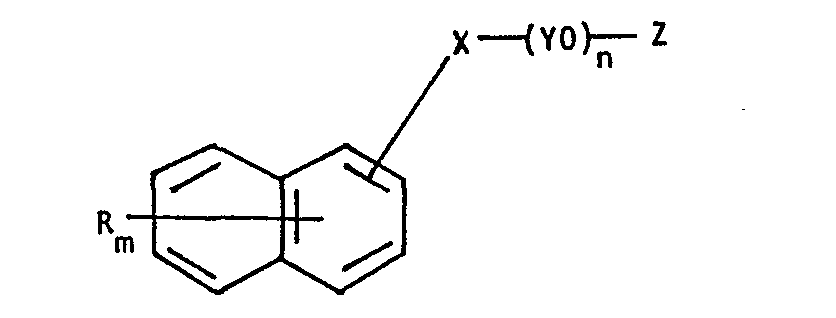
- R represents a non-ionic substituent,
- m represents an integer from 0 to 3,
- X represents a divalent bridging atom or group,
- Y represents a C2-4 alkylene radical,
- n represents an integer of at least 2, and
- Z represents hydrogen, alkyl, sulpho or phosphino.
Description
- This invention relates to liquid dye preparations and especially to concentrated aqueous solutions of anionic dyes.
- Water-soluble anionic dyes are currently formulated, in the main, as powders. These can be dusty causing an environmental hazard and they are not suitable for automatic metering until dissolved in water, an operation which can be time-consuming and difficult. There is therefore a need for liquid dye preparations, particularly aqueous solutions, which avoid these problems. Such solutions need to be concentrated in order to reduce the volume of the product to a minimum and reduce transportation and packaging costs but the aqueous solubility of anionic dyes is often insufficient to permit the preparation of concentrated solutions especially when the dye is contaminated by inorganic salts from the manufacturing process. Agents are known, however, which have the effect of increasing the aqueous solubility of anionic dyes. Such agents include urea and caprolactam which are commonly used for this purpose whilst other agents proposed include alkylphenol ethylene oxide condensates although these are generally much less effective.
- It has now been found that the aqueous solubility of anionic dyes may be significantly increased by the presence of polyalkyleneoxy compounds based on naphthalene, the effect being much greater than could have been predicted from the behaviour of the corresponding alkylphenol ethoxylates.
- Accordingly, the invention provides a liquid dye preparation comprising an aqueous solution containing at least 0.5% by weight of a water-soluble anionic dye and at least 0.1% by weight of a surfactant of the formula:

- m represents an integer from 0 to 3,
- X represents a divalent bridging atom or group,
- Y represents a C2-4 alkylene radical,
- n represents an integer of at least 2, and
- Z represents hydrogen, alkyl, sulpho or phosphino.
- Non-ionic substituents which may be represented by R include halogen, alkoxy, alkenyl and alkyl, especially C1-4 alkyl.
- Divalent bridging groups which may be represented by X include -S-, -COO- and -NQ- wherein Q is hydrogen, lower alkyl or a further (YO)n Z group but the preferred bridging group is -0-.
- Typical values for n are usually in the range 3-100 and Y is preferably an ethylene radical. Z is preferably H or S03H.
- Especially useful surfactants for use in the dye preparations have the formula:

- m is 0 or 1,
- n is 3-100, preferably 5-30, more especially 8-12, and Z is H or S03H.
- Particular mention may be made of the adduct of 2-naphthol with 10 molecular proportions of ethylene oxide and its sulphuric acid ester.
- The water-soluble anionic dye may be, for example, an acid, direct or reactive dye and it may belong to any of the known chemical classes, for example the azo, anthraquinone, triphenodioxazine and phthalocyanine classes. Particularly important dyes are those which, in the absence of the surfactant, have low solubility in water. The dye may be in the free acid form but is preferably in the form of a salt, for example a sodium, potassium, lithium, ammonium or alkanolamine salt. The concentration of dye in the liquid preparations will vary from dye to dye. In some cases, the production of a liquid preparation containing 1% by weight of dye is a useful improvement. In other cases, the liquid preparations will contain at least 10% by weight of dye.
- The surfactant may be present in the liquid preparations in an amount of from 0.1 to 50% by weight but concentrations of from 1 to 30% and especially from 5 to 20% by weight are common.
- The preparations can also contain other normal ingredients of such compositions, for example anti-foaming agents, buffers, humectants, thickeners, diluents and preservatives.
- The preparations of the invention, which may be made by mixing the dye and surfactant with water in appropriate proportions, may be used in conventional coloration processes, for example textile printing and dyeing processes.
- The invention is illustrated but not limited by the following Examples, in which CPC represents the copper phthalocyanine chromophore.
- A liquid formulation was prepared of the following dye:

- 30g of the salt-free dye were mixed with 7.5g of 2-naphthol condensed with 10 molecular proportions of ethylene oxide, 0.75g of sodium diethylaniline sulphonate and 61.75g of water. The pH was adjusted to 7.5. The formulation was fluid down to 0°C, and showed no significant printing strength deterioration or increase in viscosity on storage for 14 days at 60°C. Similar formulations in which the non-ionic agent was replaced by urea or caprolactam were reduced significantly in their printing strength after a similar storage period at 60°C. Formulations in which the non-ionic agent was replaced by an alkyl or alkylphenol based agent, were unacceptably viscous at 0°C.
- A liquid formulation was prepared containing the sodium salt of the following dye:

- Ig of a commercial brand of the dye (containing conventional diluents) was mixed with 47.5g of distilled water and 1.5g of sodium chloride.
- The mixture was left to stand for 30 minutes and then filtered to remove any precipitated dye. The optical density of the filtrate was determined at the wavelength of maximum absorbance of the dye and multiplied by a factor µ1 to generate the value 1.0.
- A second mixture was prepared in the same way except that 2g of the water were replaced by 2g of a 10% solution of the adduct of 2-naphthol with 10 moles of ethylene oxide. The mixture was filtered after 30 minutes standing and the optical density of the filtrate recorded. The value of the optical density multiplied by µ1 was 1.5 indicating that substantially more dye was dissolved than in the absence of the naphthol adduct.
- A third mixture was prepared in the same way except that 2g of the water were replaced by 2g of a 10% solution of the adduct of orthophenylphenol with 10 moles of ethylene oxide. The mixture was filtered after 30 minutes standing and the optical density of the filtrate recorded. The value of the optical density multiplied by µ1 was 1.1 indicating that less dye was dissolved in the filtrate than when the naphthol adduct was used.
- A fourth mixture was prepared in the same way except that 2g of the water were replaced by 2g of a 10% solution of the adduct of bisphenol with 15 moles of ethylene oxide. The mixture was filtered after 30 minutes standing and the optical density of the filtrate recorded. The value of the optical density multiplied by µ1 was 1.3 indicating that less dye was dissolved in the filtrate than when the naphthol adduct was used.
- A liquid formulation was prepared containing the sodium salt of the following yellow dye:

- The components of the mixture were as follows:

- The mixture was left to stand for 30 minutes and then filtered to remove any precipitated dye. The optical density of the filtrate was determined at the wavelength of maximum absorbance of the dye and multiplied by a factor µ2 to generate the value 1.0.
- A second mixture was prepared in the same way except that 6g of the water were replaced by 6g of a 10% solution of the adduct of 2-naphthol with 10 moles of ethylene oxide. The mixture was filtered after 30 minutes standing and the optical density of the filtrate recorded. The value.of the optical density multiplied by µ2 was 3.9 indicating that substantially more dye was dissolved in the filtrate than in the absence of the naphthol adduct.
- A third mixture was prepared in the same way except that 6g of the water were replaced by 6g of a 10X solution of the adduct of orthophenylphenol with 10 moles of ethylene oxide. The mixture was filtered after 30 minutes standing and the optical density of the filtrate recorded. The value of the optical density multiplied by µ2 was 0.9 indicating that less dye was dissolved in the filtrate than when the naphthol adduct was used.
- A fourth mixture was prepared in the same way except that 6g of the water were replaced by 6g of a 10% solution of the adduct of bisphenol with 15 moles of ethylene oxide. The mixture was filtered after 30 minutes standing and the optical density of the filtrate recorded. The value of the optical density multiplied by µ2 was 0.9 indicating that less dye was dissolved in the filtrate than when the naphthol adduct was used.
- A liquid formulation was prepared containing the sodium salt of the following dye:

- The components of the mixture were as follows:

- The mixture was left to stand for 30 minutes and then filtered to remove any precipitated dye. The optical density of the filtrate was determined at the wavelength of maximum absorbance of the dye and multiplied by a factor µ3 to generate the value 1.0.
- A second mixture was prepared in the same way except that 8g of the water were replaced by 8g of a 10% solution of the adduct of 2-naphthol with 10 moles of ethylene oxide. The mixture was filtered after 30 minutes standing and the optical density of the filtrate recorded. The value of the optical density multiplied by µ3 was 2.5 indicating that substantially more dye was dissolved in the filtrate than in the absence of the naphthol adduct.
- A third mixture was prepared in the same way except that 8g of the water were replaced by 8g of a 10% solution of the adduct of orthophenylphenol with 10 moles of ethylene oxide. The mixture was filtered after 30 minutes standing and the optical density of the filtrate recorded. The value of the optical density multiplied by u3 was 1.3 indicating that less dye was dissolved in the filtrate than when the naphthol adduct was used.
- A fourth mixture was prepared in the same way except that 8g of the water were replaced by 8g of a 10% solution of the adduct of bisphenol with 15 moles of ethylene oxide. The mixture was filtered after 30 minutes standing and the optical density of the filtrate recorded. The value of the optical density multiplied by µ3 was 1.4 indicating that less dye was dissolved in the filtrate than when the naphthol adduct was used.
- A liquid formulation was prepared containing the sodium salt of the following blue dye:
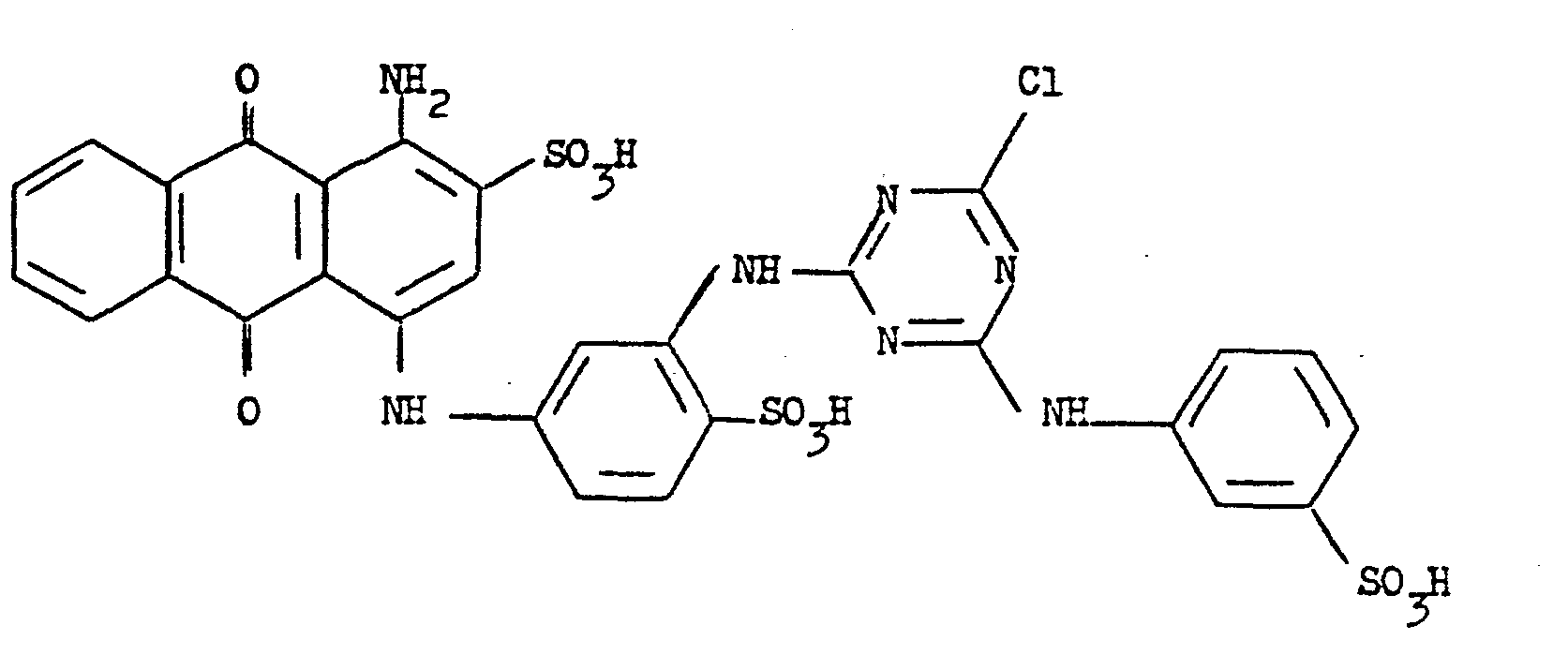
- The components of the mixture were as follows:

- The mixture was left to stand for 30 minutes and then filtered to remove any precipitated dye. The optical density of the filtrate was determined at the wavelength of maximum absorbance of the dye and multiplied by a factor p 4 to generate the value 1.0.
- A second mixture was prepared in the same way except that 5g of the water were replaced by 5g of a 10% solution of the adduct of 2-naphthol with 10 moles of-ethylene oxide. The mixture was filtered after 30 minutes standing and the optical density of the filtrate recorded. The value of the optical density multiplied by µ4 was 1.7 indicating that substantially more dye was dissolved in the filtrate than in the absence of the naphthol adduct.
- A third mixture was prepared in the same way except that 5g of the water were replaced by 5g of a 10% solution of the adduct of orthophenylphenol with 10 moles of ethylene oxide. The mixture was filtered after 30 minutes standing and the optical density of the filtrate recorded. The value of the optical density multiplied by µ4 was 1.0 indicating that less dye was dissolved in the filtrate than when the naphthol adduct was used.
- A fourth mixture was prepared in the same way except that 5g of the water were replaced by 5g of a 10% solution of the adduct of bisphenol with 15 moles of ethylene oxide. The mixture was filtered after 30 minutes standing and the optical density of the filtrate recorded. The value of the optical density multiplied by µ4 was 0.95 indicating that less dye was dissolved in the filtrate than when the naphthol adduct was used.
- A liquid formulation was prepared containing the sodium salt of the following dye:

- 30g of the dye were mixed with 6g of 2-naphthol condensed with 10 molecular proportions of ethylene oxide, 0.75g of sodium diethylaniline sulphonate and 43.25g of water, the pH being adjusted to 7.5. The formulation was fluid over a wide range of temperatures. Formulations containing conventional solubilising additives, for example urea, became extremely viscous on storage at 60°C.
- A liquid composition was prepared containing the sodium salt of the following blue dye:

- The components of the mixture were as follows:
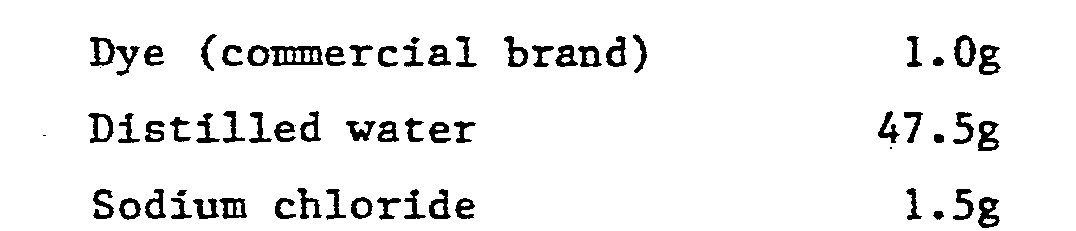
- The mixture was left to stand for 30 minutes and then filtered to remove any precipitated dye. The optical density of the filtrate was determined at the wavelength of maximum absorbance of the dye and multiplied by a factor p5 to generate the value 1.0.
- A second mixture was prepared in the same way except that 2g of the water were replaced by 2g of a 10% solution of the adduct of 2-naphthol with 10 moles of ethylene oxide. The mixture was filtered after 30 minutes standing and the optical density of the filtrate recorded. The value of the optical density multiplied by µ5 was 16.7 indicating that much more dye was dissolved in the filtrate than in the absence of the naphthol adduct.
- A liquid composition was prepared containing the sodium salt of the following red dye:
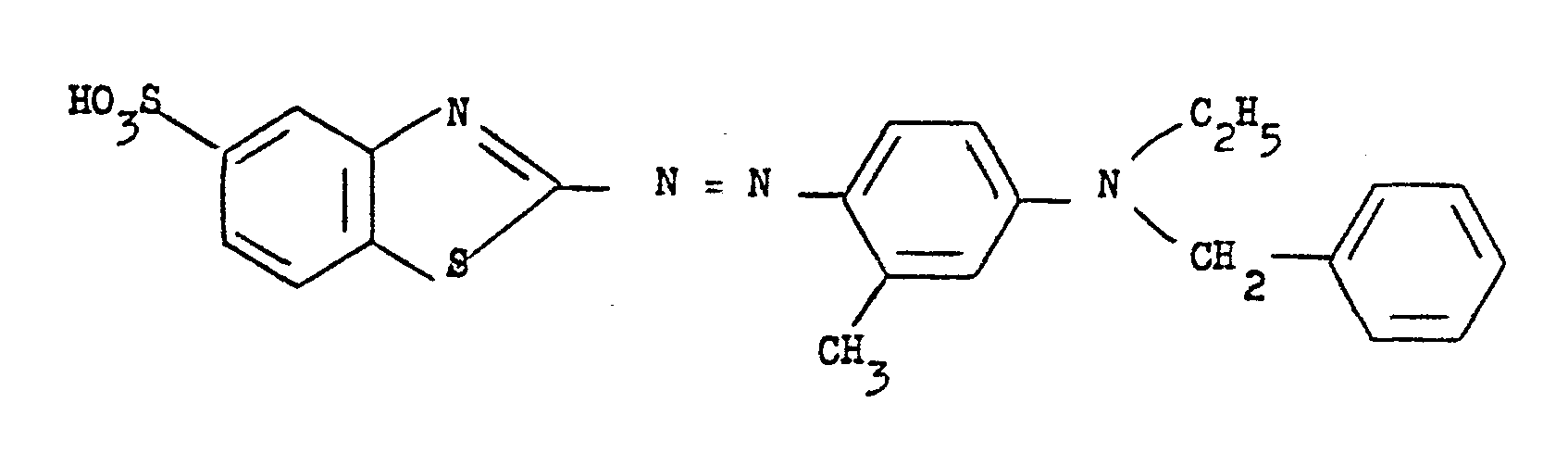
- The components of the mixture were as follows:

- The mixture was left to stand for 30 minutes and then filtered to remove any precipitated dyestuff. The optical density of the filtrate was determined at the wavelength of maximum absorbance of the dye and multiplied by a factor µ6 to generate the value 1.0.
- A second mixture was prepared in the same way except that 9g of the water were replaced by 9g of a 10X solution of the adduct of 2-naphthol with 10 moles of ethylene oxide. The mixture was filtered after 30 minutes standing and the optical density of the filtrate recorded. The value of the optical density multiplied by µ6 was 2.1 indicating that substantially more dye was dissolved in the filtrate than in the absence of the naphthol adduct.
- A liquid composition was prepared containing the sodium salt of the following blue dye:

- The components of the mixture were as follows:

- The mixture was left to stand for 30 minutes and then filtered to remove any precipitated dye. The optical density of the filtrate was determined at the wavelength of maximum absorbance of the dye and multiplied by a factor µ7 to generate the value 1.0.
- A second mixture was prepared in the same way except that 4g of the water were replaced by 4g of a 10% solution of the adduct of 2-naphthol with 10 moles of ethylene oxide. The mixture was filtered after 30 minutes standing and the optical density of the filtrate recorded. The value of the optical density multiplied by µ7 was 1.3 indicating that more dye was dissolved in the filtrate than in the absence of the naphthol adduct.
Claims (8)


Applications Claiming Priority (2)
| Application Number | Priority Date | Filing Date | Title |
|---|---|---|---|
| GB858512401A GB8512401D0 (en) | 1985-05-16 | 1985-05-16 | Liquid dye preparations |
| GB8512401 | 1985-05-16 |
Publications (3)
| Publication Number | Publication Date |
|---|---|
| EP0202775A2 true EP0202775A2 (en) | 1986-11-26 |
| EP0202775A3 EP0202775A3 (en) | 1989-12-13 |
| EP0202775B1 EP0202775B1 (en) | 1992-06-24 |
Family
ID=10579234
Family Applications (1)
| Application Number | Title | Priority Date | Filing Date |
|---|---|---|---|
| EP86302938A Expired - Lifetime EP0202775B1 (en) | 1985-05-16 | 1986-04-18 | Liquid dye preparations |
Country Status (5)
| Country | Link |
|---|---|
| US (1) | US4702743A (en) |
| EP (1) | EP0202775B1 (en) |
| JP (1) | JPH0759675B2 (en) |
| DE (1) | DE3685777T2 (en) |
| GB (1) | GB8512401D0 (en) |
Cited By (1)
| Publication number | Priority date | Publication date | Assignee | Title |
|---|---|---|---|---|
| EP0430871A1 (en) * | 1989-11-16 | 1991-06-05 | Ciba-Geigy Ag | Aqueous dyestuff-preparations |
Families Citing this family (3)
| Publication number | Priority date | Publication date | Assignee | Title |
|---|---|---|---|---|
| US5205862A (en) * | 1989-10-26 | 1993-04-27 | Kabushiki Kaisha Pilot | Water resistant ink compositions and process for preparation |
| DE4419533A1 (en) * | 1994-06-03 | 1995-12-07 | Hoechst Ag | Process for avoiding the hardening of the handle when printing and dyeing cellulose-containing textiles |
| GB0004527D0 (en) * | 2000-02-26 | 2000-04-19 | Avecia Ltd | Inks |
Family Cites Families (7)
| Publication number | Priority date | Publication date | Assignee | Title |
|---|---|---|---|---|
| DE1469723A1 (en) * | 1965-04-08 | 1968-12-12 | Hoechst Ag | Stable, storable, aqueous dispersions of o-dianisidine for the production of water-insoluble azo dyes on the fiber |
| GB2035384B (en) * | 1978-10-16 | 1982-12-01 | Ici Ltd | Stabilised aqueous dyestuff dispersions |
| EP0018947B1 (en) * | 1979-05-04 | 1984-02-01 | Ciba-Geigy Ag | Dyeing composition and processes for dyeing fabrics made of polyester or a polyester blend with cotton or wool |
| DE3065890D1 (en) * | 1979-10-03 | 1984-01-19 | Ici Plc | Aqueous dispersions of colouring materials and the derived print pastes |
| EP0056523A3 (en) * | 1981-01-14 | 1982-08-04 | Imperial Chemical Industries Plc | Aqueous dispersions |
| US4436522A (en) * | 1981-12-31 | 1984-03-13 | Mitsubishi Chemical Industries Limited | Disperse dye composition |
| US4567171A (en) * | 1983-04-21 | 1986-01-28 | Ciba-Geigy Corporation | Stable, concentrated, liquid dispersions of anionic dyestuffs |
-
1985
- 1985-05-16 GB GB858512401A patent/GB8512401D0/en active Pending
-
1986
- 1986-04-18 EP EP86302938A patent/EP0202775B1/en not_active Expired - Lifetime
- 1986-04-18 DE DE8686302938T patent/DE3685777T2/en not_active Expired - Lifetime
- 1986-05-05 US US06/859,712 patent/US4702743A/en not_active Expired - Lifetime
- 1986-05-15 JP JP61109738A patent/JPH0759675B2/en not_active Expired - Lifetime
Cited By (1)
| Publication number | Priority date | Publication date | Assignee | Title |
|---|---|---|---|---|
| EP0430871A1 (en) * | 1989-11-16 | 1991-06-05 | Ciba-Geigy Ag | Aqueous dyestuff-preparations |
Also Published As
| Publication number | Publication date |
|---|---|
| DE3685777D1 (en) | 1992-07-30 |
| JPH0759675B2 (en) | 1995-06-28 |
| GB8512401D0 (en) | 1985-06-19 |
| JPS6211774A (en) | 1987-01-20 |
| DE3685777T2 (en) | 1993-01-21 |
| EP0202775B1 (en) | 1992-06-24 |
| US4702743A (en) | 1987-10-27 |
| EP0202775A3 (en) | 1989-12-13 |
Similar Documents
| Publication | Publication Date | Title |
|---|---|---|
| EP0237586B1 (en) | Aqueous liquid dye composition | |
| US4218218A (en) | Stable finely dispersed aqueous formulations of disperse dyes and optical brighteners, and their use | |
| CA1191656A (en) | Liquid reactive dyestuff preparations and their use | |
| US4063880A (en) | Concentrated disazo dye-surfactant solution | |
| US4087245A (en) | Process for the preparation of concentrated solutions of anionic dyestuffs | |
| US4179267A (en) | Stable, highly concentrated dyestuff solutions miscible with water in any proportion | |
| US4415333A (en) | Solid compositions of water-soluble fiber-reactive dyestuffs and dialkylnaphthalene sulfonic acid and formaldehye condensate | |
| US4702743A (en) | Liquid dye preparations anionic dyes and polyalkylene-oxy naphthalene derivatives | |
| US3989452A (en) | Stable, concentrated solutions of complex metal compounds of azo dyestuffs | |
| CA1098259A (en) | Preparation of stable dispersions of bis- triazinylaminostilbene-disulphonic acids | |
| US4581036A (en) | Process for preparing liquid low-salt aqueous reactive dyestuff compositions | |
| DE3209533C2 (en) | ||
| US3679353A (en) | Direct dye,alkanolamine or morpholine,and neutral salt concentrate and milling preparation thereof | |
| CA2052634C (en) | Concentrated aqueous solutions of anionic disazo dyes | |
| US4074967A (en) | Dyestuff preparations for dyeing and printing natural and synthetic polyamide fibre materials | |
| US5366512A (en) | Low-dust or dust-free dye preparations | |
| EP0087703B1 (en) | Process for the manufacture of reactive-dye preparations | |
| GB2079771A (en) | Process for the preparation of concentrated solutions of azo dyestuffs and solutions thus obtained | |
| EP0130711B1 (en) | Aqueous solutions of reactive dyes | |
| US4711642A (en) | Liquid, water containing mono-fluoro-triazinyl reactive dyestuff preparation with pH 8-12 | |
| US4439205A (en) | Aqueous liquid dye composition: storage stable reactive dye with reduction inhibitor | |
| EP0208968A2 (en) | Aqueous liquid reactive dye composition | |
| US4348204A (en) | Aqueous dyestuff formulation, a process for its preparation and its use for dyeing and printing | |
| US4585459A (en) | Process for preparing liquid low-salt aqueous reactive dyestuff compositions | |
| US5320647A (en) | Fluent polyazo dye preparations and method of dying leather or wool therewith |
Legal Events
| Date | Code | Title | Description |
|---|---|---|---|
| PUAI | Public reference made under article 153(3) epc to a published international application that has entered the european phase |
Free format text: ORIGINAL CODE: 0009012 |
|
| AK | Designated contracting states |
Kind code of ref document: A2 Designated state(s): CH DE GB IT LI |
|
| PUAL | Search report despatched |
Free format text: ORIGINAL CODE: 0009013 |
|
| AK | Designated contracting states |
Kind code of ref document: A3 Designated state(s): CH DE GB IT LI |
|
| 17P | Request for examination filed |
Effective date: 19900511 |
|
| 17Q | First examination report despatched |
Effective date: 19910206 |
|
| GRAA | (expected) grant |
Free format text: ORIGINAL CODE: 0009210 |
|
| AK | Designated contracting states |
Kind code of ref document: B1 Designated state(s): CH DE GB IT LI |
|
| ITF | It: translation for a ep patent filed | ||
| REF | Corresponds to: |
Ref document number: 3685777 Country of ref document: DE Date of ref document: 19920730 |
|
| PLBE | No opposition filed within time limit |
Free format text: ORIGINAL CODE: 0009261 |
|
| STAA | Information on the status of an ep patent application or granted ep patent |
Free format text: STATUS: NO OPPOSITION FILED WITHIN TIME LIMIT |
|
| ITTA | It: last paid annual fee | ||
| 26N | No opposition filed | ||
| REG | Reference to a national code |
Ref country code: GB Ref legal event code: 732E |
|
| REG | Reference to a national code |
Ref country code: CH Ref legal event code: PUE Owner name: ZENECA LIMITED |
|
| ITPR | It: changes in ownership of a european patent |
Owner name: CESSIONE;ZENECA LIMITED |
|
| REG | Reference to a national code |
Ref country code: GB Ref legal event code: 732E |
|
| REG | Reference to a national code |
Ref country code: CH Ref legal event code: PUE Owner name: SYNGENTA LIMITED TRANSFER- AVECIA LIMITED Ref country code: CH Ref legal event code: PFA Free format text: ZENECA LIMITED TRANSFER- SYNGENTA LIMITED |
|
| REG | Reference to a national code |
Ref country code: GB Ref legal event code: IF02 |
|
| PGFP | Annual fee paid to national office [announced via postgrant information from national office to epo] |
Ref country code: GB Payment date: 20050413 Year of fee payment: 20 |
|
| PGFP | Annual fee paid to national office [announced via postgrant information from national office to epo] |
Ref country code: DE Payment date: 20050414 Year of fee payment: 20 |
|
| PGFP | Annual fee paid to national office [announced via postgrant information from national office to epo] |
Ref country code: CH Payment date: 20050415 Year of fee payment: 20 |
|
| PGFP | Annual fee paid to national office [announced via postgrant information from national office to epo] |
Ref country code: IT Payment date: 20050430 Year of fee payment: 20 |
|
| PG25 | Lapsed in a contracting state [announced via postgrant information from national office to epo] |
Ref country code: GB Free format text: LAPSE BECAUSE OF EXPIRATION OF PROTECTION Effective date: 20060417 |
|
| REG | Reference to a national code |
Ref country code: GB Ref legal event code: PE20 |
|
| REG | Reference to a national code |
Ref country code: CH Ref legal event code: PL |