EP0202765A2 - Stable aqueous epoxy resin dispersions - Google Patents
Stable aqueous epoxy resin dispersions Download PDFInfo
- Publication number
- EP0202765A2 EP0202765A2 EP86302825A EP86302825A EP0202765A2 EP 0202765 A2 EP0202765 A2 EP 0202765A2 EP 86302825 A EP86302825 A EP 86302825A EP 86302825 A EP86302825 A EP 86302825A EP 0202765 A2 EP0202765 A2 EP 0202765A2
- Authority
- EP
- European Patent Office
- Prior art keywords
- epoxy resin
- parts
- accordance
- weight
- resin dispersion
- Prior art date
- Legal status (The legal status is an assumption and is not a legal conclusion. Google has not performed a legal analysis and makes no representation as to the accuracy of the status listed.)
- Withdrawn
Links
Classifications
-
- C—CHEMISTRY; METALLURGY
- C08—ORGANIC MACROMOLECULAR COMPOUNDS; THEIR PREPARATION OR CHEMICAL WORKING-UP; COMPOSITIONS BASED THEREON
- C08G—MACROMOLECULAR COMPOUNDS OBTAINED OTHERWISE THAN BY REACTIONS ONLY INVOLVING UNSATURATED CARBON-TO-CARBON BONDS
- C08G59/00—Polycondensates containing more than one epoxy group per molecule; Macromolecules obtained by polymerising compounds containing more than one epoxy group per molecule using curing agents or catalysts which react with the epoxy groups
- C08G59/18—Macromolecules obtained by polymerising compounds containing more than one epoxy group per molecule using curing agents or catalysts which react with the epoxy groups ; e.g. general methods of curing
- C08G59/40—Macromolecules obtained by polymerising compounds containing more than one epoxy group per molecule using curing agents or catalysts which react with the epoxy groups ; e.g. general methods of curing characterised by the curing agents used
- C08G59/62—Alcohols or phenols
- C08G59/621—Phenols
-
- C—CHEMISTRY; METALLURGY
- C08—ORGANIC MACROMOLECULAR COMPOUNDS; THEIR PREPARATION OR CHEMICAL WORKING-UP; COMPOSITIONS BASED THEREON
- C08G—MACROMOLECULAR COMPOUNDS OBTAINED OTHERWISE THAN BY REACTIONS ONLY INVOLVING UNSATURATED CARBON-TO-CARBON BONDS
- C08G59/00—Polycondensates containing more than one epoxy group per molecule; Macromolecules obtained by polymerising compounds containing more than one epoxy group per molecule using curing agents or catalysts which react with the epoxy groups
- C08G59/02—Polycondensates containing more than one epoxy group per molecule
- C08G59/04—Polycondensates containing more than one epoxy group per molecule of polyhydroxy compounds with epihalohydrins or precursors thereof
- C08G59/06—Polycondensates containing more than one epoxy group per molecule of polyhydroxy compounds with epihalohydrins or precursors thereof of polyhydric phenols
- C08G59/066—Polycondensates containing more than one epoxy group per molecule of polyhydroxy compounds with epihalohydrins or precursors thereof of polyhydric phenols with chain extension or advancing agents
-
- C—CHEMISTRY; METALLURGY
- C08—ORGANIC MACROMOLECULAR COMPOUNDS; THEIR PREPARATION OR CHEMICAL WORKING-UP; COMPOSITIONS BASED THEREON
- C08G—MACROMOLECULAR COMPOUNDS OBTAINED OTHERWISE THAN BY REACTIONS ONLY INVOLVING UNSATURATED CARBON-TO-CARBON BONDS
- C08G59/00—Polycondensates containing more than one epoxy group per molecule; Macromolecules obtained by polymerising compounds containing more than one epoxy group per molecule using curing agents or catalysts which react with the epoxy groups
- C08G59/18—Macromolecules obtained by polymerising compounds containing more than one epoxy group per molecule using curing agents or catalysts which react with the epoxy groups ; e.g. general methods of curing
- C08G59/20—Macromolecules obtained by polymerising compounds containing more than one epoxy group per molecule using curing agents or catalysts which react with the epoxy groups ; e.g. general methods of curing characterised by the epoxy compounds used
- C08G59/22—Di-epoxy compounds
- C08G59/226—Mixtures of di-epoxy compounds
-
- C—CHEMISTRY; METALLURGY
- C08—ORGANIC MACROMOLECULAR COMPOUNDS; THEIR PREPARATION OR CHEMICAL WORKING-UP; COMPOSITIONS BASED THEREON
- C08L—COMPOSITIONS OF MACROMOLECULAR COMPOUNDS
- C08L63/00—Compositions of epoxy resins; Compositions of derivatives of epoxy resins
Definitions
- compositions made from aqueous epoxy dispersions are coated compositions made from aqueous epoxy dispersions.
- Aqueous dispersions of Bisphenol A type epoxy resins which exhibit long term stability under ambient storage conditions are described in U.S. Patent No. 4,315,044.
- Such stable dispersions are comprised of an aqueous medium having dispersed therein 50-70 weight percent of a self-emulsifying epoxy resin.
- the epoxy resin is made from 40-90 parts by weight of a diglycidyl ether of a dihydric phenol, 5-35 parts by weight of a dihydric phenol and 2-15 parts by weight of a diglycidyl ether of a polyoxyalkylene glycol, said epoxy resin having a molecular weight of about 500 to about 20,000.
- the dispersion can also contain 1-25 weight percent based on resin solids of a water-immiscible Ca-CM aliphatic monoepoxide reactive diluent.
- This invention in one aspect is directed to stable aqueous dispersions of epoxy resin compositions wherein the epoxy resin composition is modified with an alkyl phenol-formaldehyde novolac resin in which the alkyl group contains about 4 to about 12 carbon atoms.
- this invention pertains to coating compositions made from the aqueous dispersions.
- the stable aqueous epoxy resin dispersions of this invention are comprised of (1) an aqueous medium; and (2) between about 50 to about 70 weight percent of self-emulsifying epoxy resin which is the addition reaction product of (a) 40-90 parts by weight of a diglycidyl ether of a dihydric phenol; (b) 5-35 parts of a dihydric phenol; (c) 2-15 parts by weight of a diglycidyl ether of a polyoxyalkylene glycol; and (d) 2 to 15 parts by weight of an alkyl phenol-formaldehyde novolac resin wherein the molecular weight of the epoxy resin is in the range of about 1000 to about 20,000.
- the stable dispersions can be modified by the addition of about 1 to about 25 weight percent of an aliphatic monoepoxide reactive diluent.
- the stable aqueous epoxy resin dispersions of this invention can be modified by the addition of about 5-20 weight percent, based on resin solids weight, of a water-miscible solvent which, preferably, is a 2 to 8 carbon glycol or glycol ether.
- Water-borne coating compositions are made from the aqueous epoxy resin dispersions of this invention by adding to the dispersions polyamine curing agents wherein the ratio of active amine hydrogens to epoxy groups is in the range between about 0.5 to 2:1.
- the diglycidyl ethers of dihydric phenols useful in this invention are the reaction products of dihydric phenols and epihalohydrins, which are described in U.S. Patent Nos. 2,582,985; 2,615,007 and 2,633,458.
- Suitable dihydric phenols are those which contain no groups other than phenolic groups which are reactive with the epihalohydrins.
- dihydric phenols examples include 2.2-bis-(4-hydroxyphenyl)propane, 2,2-bis(3-bromo-4-hydroxyphenyl)propane, 2,2-bis(3,5-dichloro-4-hydroxyphenyl)propane, 2,2-bis(3-chloro-4-hydroxyphenyl) propane, bis(4-hydroxyphenyl) methane, bis(4-hydroxyphenyl) sulfone, bis(4-hydroxyphenyl) sulfide, resorcinol, hydroquinone, and the like.
- the preferred dihydric phenol is 2,2-bis(4-hydroxyphenyl)propane (Bisphenol A) for reasons of cost and availability.
- the diglycidyl ether of a dihydric phenol component can be replaced with a diglycidyl ether of a hydrogenated dihydric phenol derivative.
- the said diglycidyl ether of dihydric phenol can have up to essentially 100 percent of its weight substituted by a diglycidyl alicyclic ether such as 2,2-bis(4-hydroxycyclohexyl) propane or bis(4-hydroxycyclohexyl)methane.
- diglycidyl ethers have epoxide equivalent weights of about 110 to about 300 and, preferably, about 170 to about 200.
- dihydric phenols which are with the diglycidyl ethers are the same as those listed hereinbefore.
- An important feature of the stable aqueous dispersions of the present invention is the incorporation of a diglycidyl ether of polyoxyalkylene component into the curable epoxy resin vehicle of the aqueous systems.
- the preferred diglycidyl ether of polyoxyalkylene glycols are those having a molecular weight in the range between about 4000-20,000.
- the said glycidyl ethers are conveniently prepared by reacting epichlorohydrin with a selected polyoxyalkylene glycol, in a molar proportion which provides a glycidyl ether reaction product having more than one up to two glycidyl groups per molecule.
- polyoxyalkylene glycol reactant after dehydrohalogenation with caustic is soluble or at least partially soluble in water.
- Polyalkylene glycol compounds are prepared by the condensation of an alkylene oxide with a suitable polyhydric alcohol.
- alkylene oxides are ethylene oxide and propylene oxide and mixtures thereof.
- polyhydric alcohols are aliphatic alcohols such as ethylene glycol, 1,3-propylene glycol, 1,2-propylene glycol, 1,4-butylene glycol, 1,3-butylene glycol, 1,2-butylene glycol, 1,5-pentandiol, 1,4-pentandiol, 1,3-pentandiol, 1,6-hexandiol, 1,7-heptan- diol, 2,2-bis(4-hydroxycyclohexyl)propane, and the like.
- aliphatic alcohols such as ethylene glycol, 1,3-propylene glycol, 1,2-propylene glycol, 1,4-butylene glycol, 1,3-butylene glycol, 1,2-butylene glycol, 1,5-pentandiol, 1,4-pentandiol, 1,3-pentandiol, 1,6-hexandiol, 1,7-heptan- diol, 2,2-bis(4-hydroxycyclohexy
- Preferred polyoxyalkylene glycols are those prepared by the reaction of ethylene oxide and/or propylene oxide with a dihydric aliphatic alcohol, e.g., ethylene glycol.
- ethylene glycol e.g., ethylene glycol.
- Illustrative of polyoxyalkylene glycols are commercial Pluronic (BASF-Wyandotte) type products which are block copolymers of ethylene oxide and propylene oxide of about 5000-10,000 molecular weight, containing from about 50 to about 90 weight percent ethylene oxide and about 10 to about 50 weight percent propylene oxide.
- the novolac resins useful in this invention are those made from alkyl phenols and formaldehyde wherein the alkyl group contains 4 to 12 carbon atoms.
- alkyl phenols include tertiary-butyl phenol, hexyl phenol, octyl phenol, nonyl phenol and dodecyl phenol.
- a preferred alkyl phenol is nonyl phenol.
- Novolac resins are made by reacting the phenol with formaldehyde under acid conditions. In novolac resins the phenol moieties are linked together through methylene bridges. Novolac resins contain no reactive methylol groups.
- Novolac resins useful in this invention have molecular weights within the range of about 1000 to about 5000 and melting points of about 50° to about 200°C. Cured coatings made from the compositions of this invention show dramatic improvements in flexibility, solvent resistance, salt spray resistance and humidity resistance over coatings made from compositions which do not contain the alkyl phenol novolac resins.
- the highly preferred stable aqueous epoxy resin dispersions of the present invention are those which contain a water-immiscible C.-C. o aliphatic monoepoxide reactive diluent component.
- the said monoepoxide component can contain alicyclic and aromatic structures, as well as halogen, sulfur, phosphorus, and other such heteroatoms.
- monoepoxide reactive diluents are epoxidized unsaturated hydrocarbons such as de- cene and cyclohexene; glycidyl ethers of monohydric alcohols such as 2-ethylhexanol, dodecanol and eicosanol; glycidyl esters of monocarboxylic acids such as hexanoic acids; acetals of glycidal- dehyde; and the like.
- the preferred reactive diluent is the glycidyl ether of monohydric C s -C, 7 aliphatic alcohols.
- a water-immiscible C.-C2 o aliphatic monoepoxide reactive diluent in an aqueous epoxy resin dispersion has a beneficial effect on the properties of the aqueous dispersion.
- the said water-immiscible reactive diluent appears to function by coating the particles of epoxy resin solids and thereby providing the aqueous dispersion with improved shear, freeze-thaw resistance, shelf viscosity stability, and paint gloss.
- the reactive diluent is epoxy functional, it becomes incorporated into the film-forming substrate during the subsequent room temperature curing of the aqueous dispersion composition after it has been blended with a curing agent and coated on a surface.
- the total quantity of reactive diluent contributes to the calculated proportion of non- volatiles in the dispersion composition.
- water-miscible glycols or glycol ethers preferably can be added to the dispersions in the amount of about 5 to about 20 weight percent based on the total resin solids weight of the dispersion.
- suitable glycols and glycol ethers are those having 2 to '18 carbon atoms.
- Such glycols and glycol ethers include ethylene glycol, propylene glycol, monomethyl ether of ethylene glycol, monoethyl ether of ethylene glycol, monobutyl ether of ethylene glycol, monomethyl ether of propylene glycol, monopropyl ether of ethylene glycol, monoethyl ether of propylene glycol, monobutyl ether of propylene glycol, monomethyl ether of diethylene glycol, monoethyl ether of diethylene glycol, monobutyl ether of diethylene glycol and the like.
- the glycidyl ether of a dihydric phenol, the dihydric phenol, the diglycidyl ether of the polyoxyalkylene glycol and the novolac resin are heated in the presence of a catalyst, e.g., potassium hydroxide, triphenyl phosphine, benzyl dimethylamine and the like, to a temperature of about 240°-300°F. with stirring.
- a catalyst e.g., potassium hydroxide, triphenyl phosphine, benzyl dimethylamine and the like.
- the exothermic reaction will then raise the temperature to about 330°-400°F.
- the temperature is maintained at 300°-350°F. for about 1-3 hours.
- Glycol or glycol ether can then be added, if desired.
- Water is then slowly added, first forming a water-in-oil emulsion. With continued addition of water, the emulsion will invert to an oil-in-water emulsion. An aliphatic monoepoxide reactive diluent can now be added, if desired.
- the aqueous epoxy resin dispersions of this invention have a maximum particle size of about 3 microns.
- the resin solids are generally at about 50-70 weight percent, but, of course, can be Iower, if desired, simply by diluting the dispersion with water. Generally, the dispersion at 50-60 weight percent solids will have a Brookfield viscosity of 1000 to 20,000 cps.
- a room temperature curable water-borne coating composition is prepared by admixing a stable epoxy dispersion composition as described above with an epoxy-interacting curing vehicle, such as a polyamine curing agent.
- an epoxy-interacting curing vehicle such as a polyamine curing agent.
- the ratio of active amino hydrogens to epoxy groups in the admixture is in the range of 0.5-2:1 and, preferably, is in the range between about 0.8-1.5:1.
- the amino hydrogens must be sufficiently reactive to effect crosslinking interaction with the epoxy groups at ambient temperatures.
- Suitable polyamine curing agents are those which are soluble or dispersible in water and which contain more than 2 active hydrogen atoms per molecule.
- Examples of such curing agents are alkylene polyamines represented by the formula
- R is an alkylene radical containing 2 to 4 carbon atoms and x has the value of 0 to 5.
- alkylene polyamines are ethylene diamine, diethylene triamine, triethylene tetramine, tetraethylene. pentamine, pentaethylene hexamine, propylene diamine, dibutylene triamine, and the like.
- Other polyamine curing agents are the polyamido amines, which are reaction products of alkylene polyamines and fatty acids. Such polyamidoamines are well known in the art and are described in U.S. Patent Nos. 2,705,223; 2,811,495 and 2,899,397, which patents are hereby incorporated by reference.
- polyamine curing agents are the adducts of polyamines and epoxy compounds, such as those described in U.S. Patent Nos. 2,651,589; 2,864,775; 4,116,900 and commonly assigned pending patent application, Serial No. 652,581, filed September 20, 1984, which patents and application are hereby incorporated by reference.
- curing agents can be used in the composition of this invention, particularly when the coatings made from the compositions are heated to effect a cure.
- additional curing agents are the aminoplast and phenolplast resins.
- Suitable aminoplast resins are the reaction products of ureas and melamines with aldehydes further etherified in some cases with an alcohol.
- Examples of aminoplast resin components are urea, ethylene urea, thiourea, metamine, benzoguanamine and acetoguanamine.
- Aldehydes include formaldehyde, acetaldehyde and propionaldehyde.
- the aminoplast resins can be used in the alkylol form but, preferably, are utilized in the ether form wherein the etherifying agent is a monohydric alcohol containing from 1 to 8 carbon atoms.
- suitable aminoplast resins are methylol urea, dimethoxymethylol urea, butylated polymeric urea-formaldehyde resins, hexamethoxymethyl melamine, methylated polymeric melamine-formaldehyde resins and butylated polymeric melamine- formaldehyde resins.
- Phenolplast resins are the reaction products of phenols and aldehydes which contain reactive methylol groups. These compositions can be monomeric or polymeric in nature depending on the molar ratio of phenol to aldehyde used in the initial condensation reaction. Examples of suitable phenols are phenol, o, m or p-cresol, 2,4-xylenol, 3,4-xylenol, 2,5-xylenol, cardanol, p-tert-butyl phenol, and the like.
- Useful aldehydes are formaldehyde, acetaldehyde and propionaldehyde.
- Particularly useful phenolplast resins are polymethylol phenols wherein the phenolic group is etherified with an alkyl, e.g., methyl or ethyl group.
- An aqueous epoxy resin paint composition of the present invention may further contain additives conventionally employed in coating technology, such as organic pigments, inorganic pigments, surfactants, thickeners, and the like.
- a water-bome paint composition is prepared using a polyamine curing agent, it is coated on a substrate by roller, spray, dip, doctor blade, or similar application means.
- the film-formation and curing is accomplished by airdrying under ambient temperature conditions.
- the present invention provides water-bome epoxy compositions which have properties suitable for use as a one-package coating system.
- This type of coating system is prepared by blending a stable epoxy dispersion composition as described above with a crosslinking agent which is substantially unreactive with the epoxy groups at room temperature. In this type of system, crosslinking is accomplished by baking an applied coating at an elevated temperature.
- crosslinking agents suitable for the one-package coating systems are novolacs, dibasic carboxylic acids, carboxyl phthalocyanines, dimer and trimer fatty acids, aliphatic and aromatic polycarboxylic acids; acid containing acrylic resins such as polyacrylic and polymethacrylic acids, anhydrides, amides and miscellaneous nitrogen compounds such as dicyandiamide and hydrazides.
- the various curing agents useful with epoxy resins are discussed in Lee and Neville's "Handbook of Epoxy Resins", McGraw-Hill (1967).
- a present invention one-package coating system as described above can be cured by heating a coated article at a temperature between about 90°-250°C. for a period of time between about 5 minutes and two hours sufficient to effect a thermosetting cure.
- Pluronic F88 is a block copolymer of 80 weight percent ethylene oxide and 20 weight percent propylene oxide with the polyoxypropylene block in the middle with terminal polyoxyethylene blocks, said block copolymer having an average molecular weight of 10,800.
- Heat and agitation were applied raising the temperature to 165°F.
- Triphenyl phosphine 0.3 part, was added and the temperature was raised to 350°F. Heating was discontinued allowing the temperature to rise to 380°F.
- the resulting stable dispersion had a Brookfield viscosity of 10,000 cps (Spindle #5 at 20 rpm) at 25°C.
- Propylene glycol monomethyl ether 140 parts was added over a 5 minute period, and the temperature was allowed to drop to 218°F. over a 15 minute period.
- Demineralized water 187 parts, was slowly added with good agitation over a 40 minute period with the temperature dropping to 150°F. Agitation was continued for 20 minutes with the temperature dropping to 140°F. Water, 40 parts, was added. Agitation was continued for 30 minutes with the temperature rising to 150°F. Water, 14 parts, was added. After 15 minutes agitation, the temperature was 130°F. Water, 20 parts, was added. With this addition of water, the dispersion inverted from water-in-oil to oil-in-water. After 5 minutes agitation and heating, the temperature was 158°F.
- the resulting stable dispersion had a Brookfield viscosity of 6,200 cps (No. 5 spindle, 20 rpm) at 25°C., and a solids content of 54.7%.
- Example 2 Using the same procedure described in Example 2, 664 parts of the diglycidyl ether of Bisphenol A having an epoxide equivalent weight of 190, 196 parts of Bisphenol A, 60 parts of the diglycidyl ether of Pluronic F88 and 60 parts of the nonylphenol-formaldehyde novolac resin described in Example 1 were reacted using 0.35 part of triphenyl phosphine as catalyst.
- An aqueous oil-in-water dispersion was made by adding to the above reaction product 140 parts of ethylene glycol monopropyl ether, 658 parts of demineralized water and 20 parts of the glycidyl ether of mixed C 8 -C 10 alcohols having an epoxide equivalent weight of 220-235.
- the resulting stable dispersion had a Brookfield viscosity of 9100 (No. 5 spindle, 20 rpm) at 25°C., a solids content of 54.5% and an average particle size of 1 micron.
- the dispersion exhibited no settling after 4 hours at 1000 rpm in a centrifuge and no settling after 6 months at 120°F.
- a coating composition was prepared using the following formula:
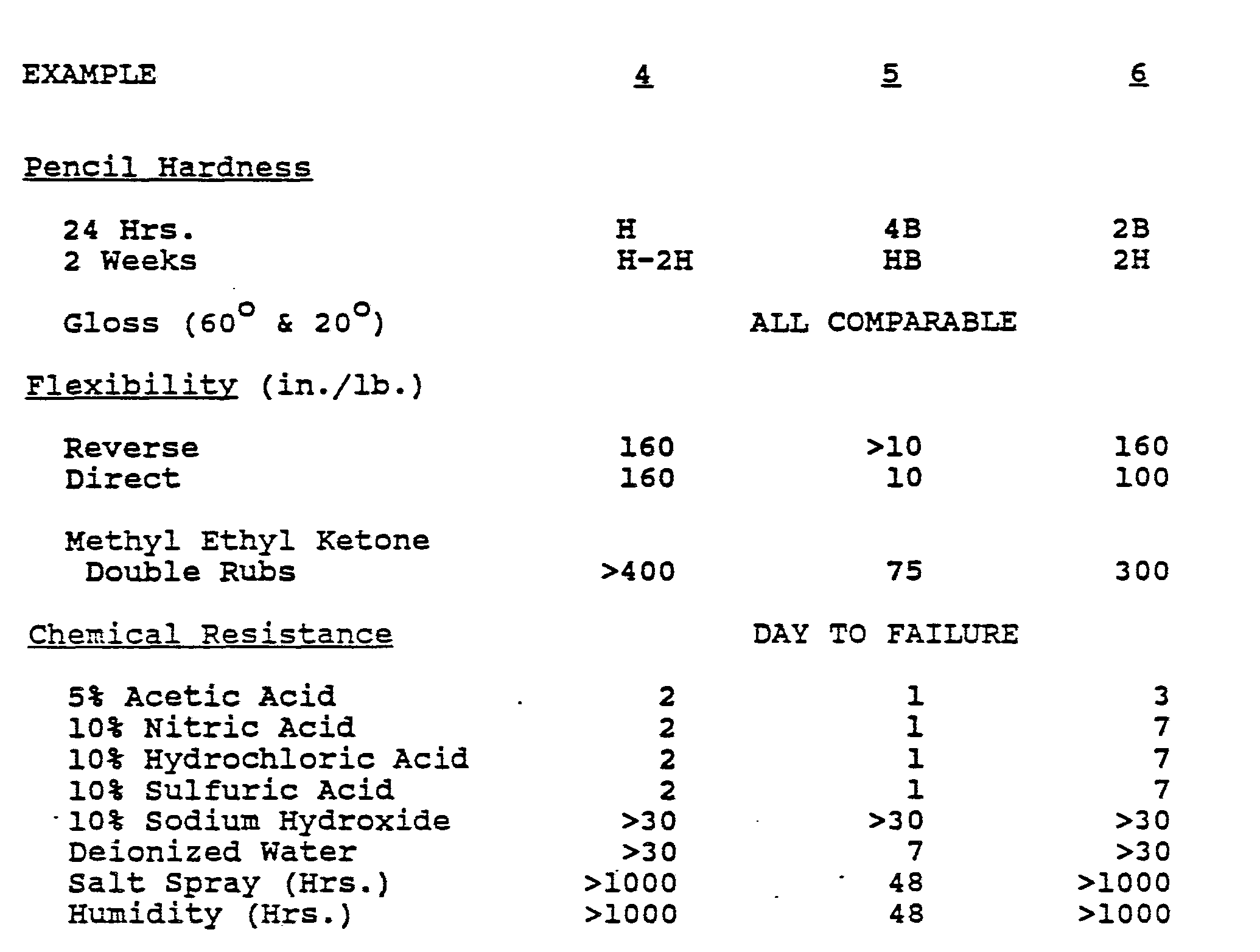
- Part A 581.0 parts, was blended with 473.1 parts of Part B. After a 30 minute induction time, the resulting enamel was sprayed on metal panels, Bonderite 1000, to a dry film thickness of 2 mils. Performance data are listed in Table I. Pencil hardness was determined after 24 hours at room temperature and after 2 weeks at room temperature. All other properties were determined after 2 weeks at room temperature.
- a coating composition was prepared from an epoxy dispersion which did not contain an alkyl phenol-formaldehyde novolac resin, i.e., a dispersion described in U.S. Patent No. 4,315,044.
- the formula was as follows:
- Part A 453.1 parts, was blended with 619.8 parts of Part B. After 30 minutes induction time, the resulting enamel was sprayed on metal panels, Bonderite 1000, to a dry film thickness of 2 mils. Performance data are listed in Table I.
- a coating composition was prepared from a non-aqueous epoxy-amine resin system.
- Part A 632.7 parts, was blended with 372.7 parts of Part B. After a 1 hour induction period, the enamel was sprayed on metal panels, Bonderite 1000, to a dry film thickness of 2 mils. Performance data are listed in Table I.
Landscapes
- Chemical & Material Sciences (AREA)
- Health & Medical Sciences (AREA)
- Chemical Kinetics & Catalysis (AREA)
- Medicinal Chemistry (AREA)
- Polymers & Plastics (AREA)
- Organic Chemistry (AREA)
- Epoxy Resins (AREA)
- Paints Or Removers (AREA)
- Compositions Of Macromolecular Compounds (AREA)
- Phenolic Resins Or Amino Resins (AREA)
Abstract
Description
- The field of art to which this invention pertains is coating compositions made from aqueous epoxy dispersions.
- Aqueous dispersions of Bisphenol A type epoxy resins which exhibit long term stability under ambient storage conditions are described in U.S. Patent No. 4,315,044. Such stable dispersions are comprised of an aqueous medium having dispersed therein 50-70 weight percent of a self-emulsifying epoxy resin. The epoxy resin is made from 40-90 parts by weight of a diglycidyl ether of a dihydric phenol, 5-35 parts by weight of a dihydric phenol and 2-15 parts by weight of a diglycidyl ether of a polyoxyalkylene glycol, said epoxy resin having a molecular weight of about 500 to about 20,000. The dispersion can also contain 1-25 weight percent based on resin solids of a water-immiscible Ca-CM aliphatic monoepoxide reactive diluent.
- This invention in one aspect is directed to stable aqueous dispersions of epoxy resin compositions wherein the epoxy resin composition is modified with an alkyl phenol-formaldehyde novolac resin in which the alkyl group contains about 4 to about 12 carbon atoms. In another aspect this invention pertains to coating compositions made from the aqueous dispersions.
- The stable aqueous epoxy resin dispersions of this invention are comprised of (1) an aqueous medium; and (2) between about 50 to about 70 weight percent of self-emulsifying epoxy resin which is the addition reaction product of (a) 40-90 parts by weight of a diglycidyl ether of a dihydric phenol; (b) 5-35 parts of a dihydric phenol; (c) 2-15 parts by weight of a diglycidyl ether of a polyoxyalkylene glycol; and (d) 2 to 15 parts by weight of an alkyl phenol-formaldehyde novolac resin wherein the molecular weight of the epoxy resin is in the range of about 1000 to about 20,000.
- The stable dispersions can be modified by the addition of about 1 to about 25 weight percent of an aliphatic monoepoxide reactive diluent.
- In order to improve freeze-thaw stability, the stable aqueous epoxy resin dispersions of this invention can be modified by the addition of about 5-20 weight percent, based on resin solids weight, of a water-miscible solvent which, preferably, is a 2 to 8 carbon glycol or glycol ether.
- Water-borne coating compositions are made from the aqueous epoxy resin dispersions of this invention by adding to the dispersions polyamine curing agents wherein the ratio of active amine hydrogens to epoxy groups is in the range between about 0.5 to 2:1.
- The diglycidyl ethers of dihydric phenols useful in this invention are the reaction products of dihydric phenols and epihalohydrins, which are described in U.S. Patent Nos. 2,582,985; 2,615,007 and 2,633,458. Suitable dihydric phenols are those which contain no groups other than phenolic groups which are reactive with the epihalohydrins. Examples of such dihydric phenols include 2.2-bis-(4-hydroxyphenyl)propane, 2,2-bis(3-bromo-4-hydroxyphenyl)propane, 2,2-bis(3,5-dichloro-4-hydroxyphenyl)propane, 2,2-bis(3-chloro-4-hydroxyphenyl) propane, bis(4-hydroxyphenyl) methane, bis(4-hydroxyphenyl) sulfone, bis(4-hydroxyphenyl) sulfide, resorcinol, hydroquinone, and the like. The preferred dihydric phenol is 2,2-bis(4-hydroxyphenyl)propane (Bisphenol A) for reasons of cost and availability.
- Optionally at least a portion of the diglycidyl ether of a dihydric phenol component can be replaced with a diglycidyl ether of a hydrogenated dihydric phenol derivative. For example, the said diglycidyl ether of dihydric phenol can have up to essentially 100 percent of its weight substituted by a diglycidyl alicyclic ether such as 2,2-bis(4-hydroxycyclohexyl) propane or bis(4-hydroxycyclohexyl)methane. Useful diglycidyl ethers have epoxide equivalent weights of about 110 to about 300 and, preferably, about 170 to about 200.
- The dihydric phenols which are with the diglycidyl ethers are the same as those listed hereinbefore.
- An important feature of the stable aqueous dispersions of the present invention is the incorporation of a diglycidyl ether of polyoxyalkylene component into the curable epoxy resin vehicle of the aqueous systems.
- The preferred diglycidyl ether of polyoxyalkylene glycols are those having a molecular weight in the range between about 4000-20,000. The said glycidyl ethers are conveniently prepared by reacting epichlorohydrin with a selected polyoxyalkylene glycol, in a molar proportion which provides a glycidyl ether reaction product having more than one up to two glycidyl groups per molecule.
- The polyoxyalkylene glycol reactant after dehydrohalogenation with caustic is soluble or at least partially soluble in water. Polyalkylene glycol compounds are prepared by the condensation of an alkylene oxide with a suitable polyhydric alcohol. Illustrative of alkylene oxides are ethylene oxide and propylene oxide and mixtures thereof. Illustrative of polyhydric alcohols are aliphatic alcohols such as ethylene glycol, 1,3-propylene glycol, 1,2-propylene glycol, 1,4-butylene glycol, 1,3-butylene glycol, 1,2-butylene glycol, 1,5-pentandiol, 1,4-pentandiol, 1,3-pentandiol, 1,6-hexandiol, 1,7-heptan- diol, 2,2-bis(4-hydroxycyclohexyl)propane, and the like.
- Preferred polyoxyalkylene glycols are those prepared by the reaction of ethylene oxide and/or propylene oxide with a dihydric aliphatic alcohol, e.g., ethylene glycol. Illustrative of polyoxyalkylene glycols are commercial Pluronic (BASF-Wyandotte) type products which are block copolymers of ethylene oxide and propylene oxide of about 5000-10,000 molecular weight, containing from about 50 to about 90 weight percent ethylene oxide and about 10 to about 50 weight percent propylene oxide.
- The novolac resins useful in this invention are those made from alkyl phenols and formaldehyde wherein the alkyl group contains 4 to 12 carbon atoms. Such alkyl phenols include tertiary-butyl phenol, hexyl phenol, octyl phenol, nonyl phenol and dodecyl phenol. A preferred alkyl phenol is nonyl phenol. Novolac resins are made by reacting the phenol with formaldehyde under acid conditions. In novolac resins the phenol moieties are linked together through methylene bridges. Novolac resins contain no reactive methylol groups. Novolac resins useful in this invention have molecular weights within the range of about 1000 to about 5000 and melting points of about 50° to about 200°C. Cured coatings made from the compositions of this invention show dramatic improvements in flexibility, solvent resistance, salt spray resistance and humidity resistance over coatings made from compositions which do not contain the alkyl phenol novolac resins.
- The highly preferred stable aqueous epoxy resin dispersions of the present invention are those which contain a water-immiscible C.-C.o aliphatic monoepoxide reactive diluent component. The said monoepoxide component can contain alicyclic and aromatic structures, as well as halogen, sulfur, phosphorus, and other such heteroatoms.
- Illustrative of monoepoxide reactive diluents are epoxidized unsaturated hydrocarbons such as de- cene and cyclohexene; glycidyl ethers of monohydric alcohols such as 2-ethylhexanol, dodecanol and eicosanol; glycidyl esters of monocarboxylic acids such as hexanoic acids; acetals of glycidal- dehyde; and the like. The preferred reactive diluent is the glycidyl ether of monohydric Cs-C,7 aliphatic alcohols.
- The presence of a water-immiscible C.-C2o aliphatic monoepoxide reactive diluent in an aqueous epoxy resin dispersion has a beneficial effect on the properties of the aqueous dispersion. The said water-immiscible reactive diluent appears to function by coating the particles of epoxy resin solids and thereby providing the aqueous dispersion with improved shear, freeze-thaw resistance, shelf viscosity stability, and paint gloss.
- Also, since the reactive diluent is epoxy functional, it becomes incorporated into the film-forming substrate during the subsequent room temperature curing of the aqueous dispersion composition after it has been blended with a curing agent and coated on a surface. The total quantity of reactive diluent contributes to the calculated proportion of non- volatiles in the dispersion composition.
- In order to obtain improved freeze-thaw stability of the aqueous epoxy resin dispersions of this invention, water-miscible glycols or glycol ethers preferably can be added to the dispersions in the amount of about 5 to about 20 weight percent based on the total resin solids weight of the dispersion. Examples of suitable glycols and glycol ethers are those having 2 to '18 carbon atoms. Such glycols and glycol ethers include ethylene glycol, propylene glycol, monomethyl ether of ethylene glycol, monoethyl ether of ethylene glycol, monobutyl ether of ethylene glycol, monomethyl ether of propylene glycol, monopropyl ether of ethylene glycol, monoethyl ether of propylene glycol, monobutyl ether of propylene glycol, monomethyl ether of diethylene glycol, monoethyl ether of diethylene glycol, monobutyl ether of diethylene glycol and the like.
- In preparing the stable aqueous epoxy resin dispersions of this invention, the glycidyl ether of a dihydric phenol, the dihydric phenol, the diglycidyl ether of the polyoxyalkylene glycol and the novolac resin are heated in the presence of a catalyst, e.g., potassium hydroxide, triphenyl phosphine, benzyl dimethylamine and the like, to a temperature of about 240°-300°F. with stirring. The exothermic reaction will then raise the temperature to about 330°-400°F. When the exotherm is over, the temperature is maintained at 300°-350°F. for about 1-3 hours. Glycol or glycol ether can then be added, if desired. Water is then slowly added, first forming a water-in-oil emulsion. With continued addition of water, the emulsion will invert to an oil-in-water emulsion. An aliphatic monoepoxide reactive diluent can now be added, if desired.
- The aqueous epoxy resin dispersions of this invention have a maximum particle size of about 3 microns. The resin solids are generally at about 50-70 weight percent, but, of course, can be Iower, if desired, simply by diluting the dispersion with water. Generally, the dispersion at 50-60 weight percent solids will have a Brookfield viscosity of 1000 to 20,000 cps.
- A room temperature curable water-borne coating composition is prepared by admixing a stable epoxy dispersion composition as described above with an epoxy-interacting curing vehicle, such as a polyamine curing agent. The ratio of active amino hydrogens to epoxy groups in the admixture is in the range of 0.5-2:1 and, preferably, is in the range between about 0.8-1.5:1. For purposes of industrial maintenance paint compositions, the amino hydrogens must be sufficiently reactive to effect crosslinking interaction with the epoxy groups at ambient temperatures.
- Suitable polyamine curing agents are those which are soluble or dispersible in water and which contain more than 2 active hydrogen atoms per molecule. Examples of such curing agents are alkylene polyamines represented by the formula
- wherein R is an alkylene radical containing 2 to 4 carbon atoms and x has the value of 0 to 5. Such alkylene polyamines are ethylene diamine, diethylene triamine, triethylene tetramine, tetraethylene. pentamine, pentaethylene hexamine, propylene diamine, dibutylene triamine, and the like. Other polyamine curing agents are the polyamido amines, which are reaction products of alkylene polyamines and fatty acids. Such polyamidoamines are well known in the art and are described in U.S. Patent Nos. 2,705,223; 2,811,495 and 2,899,397, which patents are hereby incorporated by reference. Other polyamine curing agents are the adducts of polyamines and epoxy compounds, such as those described in U.S. Patent Nos. 2,651,589; 2,864,775; 4,116,900 and commonly assigned pending patent application, Serial No. 652,581, filed September 20, 1984, which patents and application are hereby incorporated by reference.
- Other curing agents can be used in the composition of this invention, particularly when the coatings made from the compositions are heated to effect a cure. Examples of such additional curing agents are the aminoplast and phenolplast resins. Suitable aminoplast resins are the reaction products of ureas and melamines with aldehydes further etherified in some cases with an alcohol. Examples of aminoplast resin components are urea, ethylene urea, thiourea, metamine, benzoguanamine and acetoguanamine. Aldehydes include formaldehyde, acetaldehyde and propionaldehyde. The aminoplast resins can be used in the alkylol form but, preferably, are utilized in the ether form wherein the etherifying agent is a monohydric alcohol containing from 1 to 8 carbon atoms. Examples of suitable aminoplast resins are methylol urea, dimethoxymethylol urea, butylated polymeric urea-formaldehyde resins, hexamethoxymethyl melamine, methylated polymeric melamine-formaldehyde resins and butylated polymeric melamine- formaldehyde resins.
- Phenolplast resins are the reaction products of phenols and aldehydes which contain reactive methylol groups. These compositions can be monomeric or polymeric in nature depending on the molar ratio of phenol to aldehyde used in the initial condensation reaction. Examples of suitable phenols are phenol, o, m or p-cresol, 2,4-xylenol, 3,4-xylenol, 2,5-xylenol, cardanol, p-tert-butyl phenol, and the like. Useful aldehydes are formaldehyde, acetaldehyde and propionaldehyde. Particularly useful phenolplast resins are polymethylol phenols wherein the phenolic group is etherified with an alkyl, e.g., methyl or ethyl group.
- An aqueous epoxy resin paint composition of the present invention may further contain additives conventionally employed in coating technology, such as organic pigments, inorganic pigments, surfactants, thickeners, and the like.
- In normal usage, after a water-bome paint composition is prepared using a polyamine curing agent, it is coated on a substrate by roller, spray, dip, doctor blade, or similar application means. The film-formation and curing is accomplished by airdrying under ambient temperature conditions.
- As a further embodiment, the present invention provides water-bome epoxy compositions which have properties suitable for use as a one-package coating system. This type of coating system is prepared by blending a stable epoxy dispersion composition as described above with a crosslinking agent which is substantially unreactive with the epoxy groups at room temperature. In this type of system, crosslinking is accomplished by baking an applied coating at an elevated temperature.
- In addition to the aminoplast and phenolplast curing agents described hereinbefore, other crosslinking agents suitable for the one-package coating systems are novolacs, dibasic carboxylic acids, carboxyl phthalocyanines, dimer and trimer fatty acids, aliphatic and aromatic polycarboxylic acids; acid containing acrylic resins such as polyacrylic and polymethacrylic acids, anhydrides, amides and miscellaneous nitrogen compounds such as dicyandiamide and hydrazides. The various curing agents useful with epoxy resins are discussed in Lee and Neville's "Handbook of Epoxy Resins", McGraw-Hill (1967).
- A present invention one-package coating system as described above can be cured by heating a coated article at a temperature between about 90°-250°C. for a period of time between about 5 minutes and two hours sufficient to effect a thermosetting cure.
- The following examples describe the invention in more detail. Parts and percentages, unless otherwise indicated, are parts and percentages by weight.
- To a suitable reactor were added 702 parts of the diglycidyl ether of Bisphenol A having an epoxide equivalent weight of 190, 208 parts of Bisphenol A and 50 parts of a diglycidyl ether of Pluronic F88 (BASF-Wyandotte). Pluronic F88 is a block copolymer of 80 weight percent ethylene oxide and 20 weight percent propylene oxide with the polyoxypropylene block in the middle with terminal polyoxyethylene blocks, said block copolymer having an average molecular weight of 10,800. Heat and agitation were applied raising the temperature to 165°F. Triphenyl phosphine, 0.3 part, was added and the temperature was raised to 350°F. Heating was discontinued allowing the temperature to rise to 380°F. from the exothermic reaction. The temperature was then allowed to drop to 240°F. A nonylphenol-formaldehyde novolac resin, 20 parts, was then added. Heat was reapplied raising the temperature to 295°F. Propylene glycol monomethyl ether, 160 parts, was added over a 20 minute period with the temperature dropping to 265°F. The temperature was then raised to 290°F. over a one hour period. The temperature was lowered to 215°F. Demineralized water, 167 parts, was added over 30 minutes with good agitation with the temperature dropping to 130°F. After 25 minutes, 40 parts of water were added. After 20 minutes, an additional 40 parts of water were added. After 15 minutes, 20 parts of water were added. After 25 minutes, 35 parts of water were added. The temperature during these additions was raised to 170°F. After the final addition of water, the temperature was allowed to drop to 140°F. over a 40 minute period. During this period, the dispersion inverted from a water-in-oil emulsion to an oil-in-water dispersion. Increased agitation with heating to 155°F. was continued for 30 minutes. A glycidyl ether of a mixed Ca-C,o alcohol having an epoxide equivalent weight of 220-235, 20 parts, was then added. The particle size of the dispersed particles was in the range of 2-3 microns. Additional water, 356 parts; was added over a 1 hour period.
- The resulting stable dispersion had a Brookfield viscosity of 10,000 cps (Spindle #5 at 20 rpm) at 25°C.
- To a suitable reactor were added 687 parts of the diglycidyl ether of Bisphenol A having an epoxide equivalent weight of 190, 203 parts of Bisphenol A, 50 parts of the diglycidyl ether of Pluronic F88 and 40 parts of the nonylphenol-formaldehyde resin described in Example 1. Heat was applied and at 155°F., 0.3 part of triphenyl phosphine was added. Agitation was begun and heating was continued. When the temperature reach 225°F., heating was discontinued and the temperature was allowed to .rise to 350°F. due to the exothermic reaction. The temperature was held between 315° and 350°F. for 40 minutes. Propylene glycol monomethyl ether, 140 parts, was added over a 5 minute period, and the temperature was allowed to drop to 218°F. over a 15 minute period. Demineralized water, 187 parts, was slowly added with good agitation over a 40 minute period with the temperature dropping to 150°F. Agitation was continued for 20 minutes with the temperature dropping to 140°F. Water, 40 parts, was added. Agitation was continued for 30 minutes with the temperature rising to 150°F. Water, 14 parts, was added. After 15 minutes agitation, the temperature was 130°F. Water, 20 parts, was added. With this addition of water, the dispersion inverted from water-in-oil to oil-in-water. After 5 minutes agitation and heating, the temperature was 158°F. A glycidyl ether of mixed Ce-C,, alcohols having an epoxide equivalent weight of 220-235, 20 parts, was added. After 25 minutes and with the temperature at 158°F., 417 parts of water were added over a one hour period with the temperature dropping to 125°F. After 20 minutes additional stirring and heating, the dispersion was filtered through an 80 mesh bag and stored.
- The resulting stable dispersion had a Brookfield viscosity of 6,200 cps (No. 5 spindle, 20 rpm) at 25°C., and a solids content of 54.7%.
- Using the same procedure described in Example 2, 664 parts of the diglycidyl ether of Bisphenol A having an epoxide equivalent weight of 190, 196 parts of Bisphenol A, 60 parts of the diglycidyl ether of Pluronic F88 and 60 parts of the nonylphenol-formaldehyde novolac resin described in Example 1 were reacted using 0.35 part of triphenyl phosphine as catalyst. An aqueous oil-in-water dispersion was made by adding to the above reaction product 140 parts of ethylene glycol monopropyl ether, 658 parts of demineralized water and 20 parts of the glycidyl ether of mixed C8-C10 alcohols having an epoxide equivalent weight of 220-235.
- The resulting stable dispersion had a Brookfield viscosity of 9100 (No. 5 spindle, 20 rpm) at 25°C., a solids content of 54.5% and an average particle size of 1 micron. The dispersion exhibited no settling after 4 hours at 1000 rpm in a centrifuge and no settling after 6 months at 120°F.
- A coating composition was prepared using the following formula:
- Part A
- 442.2 parts Example 3
- 22.3 parts High Flash Aromatic Hydrocarbon
- 22.7 parts Ethylene Glycol Monopropyl Ether
- 93.8 parts Water
- Part B
- 135.1 parts CMD J60-8290 Curing Agent
- 4.0 parts Defoamer 2
- 250.0 parts Rutile Titanium Dioxide
- 12.5 parts Water
- High speed disperse to a texture of 10 P.C.S. (Paint Club Scale)
- 68.9 parts Water
- 3.2 parts Glacial Acetic Acid
- 1 An adduct of a polyamine and a polyepoxide having a solids content of 60% in 95.5% ethylene glycol monopropyl ether and 4.5% glacial acetic acid, supplied by Celanese Speciality Resins.
- 2 Patcote 847, supplied by C.J. Patterson Company.
- Part A, 581.0 parts, was blended with 473.1 parts of Part B. After a 30 minute induction time, the resulting enamel was sprayed on metal panels, Bonderite 1000, to a dry film thickness of 2 mils. Performance data are listed in Table I. Pencil hardness was determined after 24 hours at room temperature and after 2 weeks at room temperature. All other properties were determined after 2 weeks at room temperature.
- A coating composition was prepared from an epoxy dispersion which did not contain an alkyl phenol-formaldehyde novolac resin, i.e., a dispersion described in U.S. Patent No. 4,315,044. The formula was as follows:
- Part A
- 411.6 parts CMD-WC-55-3520 Epoxy Dispersion'
- 27.8 parts Mar and Slip Agent2
- 13.7 parts Water
- Part B
- 160.0 parts Epi-Cure WC-60-8537 Curing Agenf
- 82 parts Diethylene Glycol Monobutyl Ether Acetate
- 4.0 parts Defoamer'
- 250.0 parts Rutile Titanium Dioxide
- High Speed Disperse to a texture of 10 P.C.S.
- 42.4 parts Epi-Cure WC-60-8537 Curing Agent
- 1522 parts Water
- 1 An epoxy dispersion having a solids content of 55% in 82.9% water and 17.1% ethylene glycol monoethyl ether, supplied by Celanese Specialty Resins.
- 2 Michemlube 182 Wax Emulsion, Michel- man Chemicals, Inc.
- 3 An adduct of a polyamine and a polyepoxide having a solids content of 60% in 49% water, 38% ethylene glycol monoethyl ether and 13% glacial acetic acid, supplied by Celanese Specialty Resins.
- 4 Troy Q-148, Troy Chemical Company.
- Part A, 453.1 parts, was blended with 619.8 parts of Part B. After 30 minutes induction time, the resulting enamel was sprayed on metal panels, Bonderite 1000, to a dry film thickness of 2 mils. Performance data are listed in Table I.
- A coating composition was prepared from a non-aqueous epoxy-amine resin system.
- Part A
- 268.2 parts Rutile Titanium Dioxide
- 2.0 parts X-2280 Anti-Flooding Compound'
- 273.0 parts Epi-Rez 21362
- 12.9 parts Syn-U-Tex 4023
- - 43.2 parts Diacetone Alcohol
- 33.4 parts Methyl Isobutyl Ketone
- Part B
- 112.5 parts Epi-Cure 85154
- 37.5 parts Butyl Cellosolve
- 222.7 parts Xylene
- 1 Available from Imperial Color & Chemicals Dept., Hercules, Inc.
- 2 A glycidyl ether of Bisphenol A having an epoxide equivalent weight of 500 at 75% solids in xylene, supplied by Celanese Specialty Resins.
- 3 A butylated urea-formaldehyde resin at 60% solids in 87.5% butanol and 12.5% xylene, supplied by Celanese Specialty Resins.
- 4 A polymeric amido-amine at 70% solids in xylene, supplied by Celanese Specialty Resins.
- Part A, 632.7 parts, was blended with 372.7 parts of Part B. After a 1 hour induction period, the enamel was sprayed on metal panels, Bonderite 1000, to a dry film thickness of 2 mils. Performance data are listed in Table I.

- The principles, preferred embodiments and modes of operation of the present invention have been described in the foregoing specification. The invention which is intended to be protected herein, however, is not to be construed as limited to the particular forms disclosed, since these are to be regarded as illustrative rather than restrictive. Variations and changes may be made by those skilled in the art without departing from the spirit of the invention.
Claims (10)
Applications Claiming Priority (2)
| Application Number | Priority Date | Filing Date | Title |
|---|---|---|---|
| US724439 | 1985-04-18 | ||
| US06/724,439 US4608406A (en) | 1985-04-18 | 1985-04-18 | Stable aqueous epoxy resin dispersions |
Publications (2)
| Publication Number | Publication Date |
|---|---|
| EP0202765A2 true EP0202765A2 (en) | 1986-11-26 |
| EP0202765A3 EP0202765A3 (en) | 1988-07-20 |
Family
ID=24910446
Family Applications (1)
| Application Number | Title | Priority Date | Filing Date |
|---|---|---|---|
| EP86302825A Withdrawn EP0202765A3 (en) | 1985-04-18 | 1986-04-16 | Stable aqueous epoxy resin dispersions |
Country Status (5)
| Country | Link |
|---|---|
| US (1) | US4608406A (en) |
| EP (1) | EP0202765A3 (en) |
| JP (1) | JPH0689111B2 (en) |
| CA (1) | CA1266140A (en) |
| ES (1) | ES8800290A1 (en) |
Cited By (3)
| Publication number | Priority date | Publication date | Assignee | Title |
|---|---|---|---|---|
| EP0272595A3 (en) * | 1986-12-20 | 1990-08-01 | Hoechst Aktiengesellschaft | Aqueous stable epoxy resin dispersion, process for its preparation and its use |
| WO1991002038A1 (en) * | 1989-08-01 | 1991-02-21 | H.B. Fuller Company | Liquid thermosetting composition |
| US5118729A (en) * | 1990-01-10 | 1992-06-02 | The Dow Chemical Company | Modified polyoxyethylene epoxy resin amphiphiles and stable aqueous epoxy dispersions thereof |
Families Citing this family (46)
| Publication number | Priority date | Publication date | Assignee | Title |
|---|---|---|---|---|
| US5064880A (en) * | 1987-07-02 | 1991-11-12 | The Dow Chemical Company | Cationic diphenol advanced epoxy resins with diglycidylether of aliphatic diol |
| US5260355A (en) * | 1987-07-02 | 1993-11-09 | The Dow Chemical Company | Aqueous dispersion of cationic advanced diglycidyl ether blend |
| US5206274A (en) * | 1987-07-02 | 1993-04-27 | The Dow Chemical Company | Aqueous dispersion of cationic advanced diglycidyl ether blend |
| US5589534A (en) * | 1990-10-16 | 1996-12-31 | Akzo Nobel N.V. | Aqueous coating compositions including a reactive emulsifier |
| EP0507271A3 (en) * | 1991-04-03 | 1993-04-21 | The Dow Chemical Company | Epoxy resin compositions for use in electrical laminates |
| MY108731A (en) * | 1992-04-16 | 1996-11-30 | Akzo Nv | Aqueous coating compositions |
| ES2112518T3 (en) * | 1993-01-06 | 1998-04-01 | Akzo Nobel Nv | STERICALLY IMPAIRED OLIGOMERIC POLYAMID RETICULATING AGENTS AND COATING COMPOSITIONS CONTAINING THEM. |
| TW251298B (en) * | 1993-01-12 | 1995-07-11 | Shell Internat Res Schappej Bv | |
| US5565505A (en) * | 1993-06-30 | 1996-10-15 | Henkel Corporation | Self-dispersing curable epoxy resins, dispersions made therewith, and coating compositions made therefrom |
| US5583167A (en) * | 1993-06-30 | 1996-12-10 | Henkel Corporation | Curing agents for aqueous epoxy resins |
| JPH09507873A (en) | 1993-12-27 | 1997-08-12 | ヘンケル コーポレーション | Self-dispersible curable epoxy resin, dispersion produced with the same, and paint produced therefrom |
| US5604269A (en) * | 1993-12-27 | 1997-02-18 | Henkel Corporation | Self-dispersing curable epoxy resins, dispersions made therewith, and coating compositions made therefrom |
| US5565506A (en) * | 1994-03-01 | 1996-10-15 | Henkel Corporation | Self-dispersing curable epoxy resins, dispersions made therewith, and coating compositions made therefrom |
| WO1996003452A1 (en) * | 1994-07-25 | 1996-02-08 | Henkel Corporation | Curing agents for aqueous epoxy resins |
| US5508373A (en) * | 1994-08-04 | 1996-04-16 | Henkel Corporation | Curing agents for epoxy resins based on 1,2-diaminocyclohexane |
| DE4441684A1 (en) * | 1994-11-23 | 1996-05-30 | Basf Lacke & Farben | Coating agents based on a sterically stabilized, non-aqueous dispersion, process for their preparation and their use for coating enamel layers |
| US5489630A (en) * | 1994-11-28 | 1996-02-06 | Air Products And Chemicals, Inc. | Self-emulsifying epoxy curing agent |
| US5527839A (en) * | 1994-12-13 | 1996-06-18 | Air Products And Chemicals, Inc. | Self-emulsifying epoxy curing agent based on the reaction product of epoxy resin and polyether polyol |
| US5576416A (en) * | 1994-12-13 | 1996-11-19 | Air Products And Chemicals, Inc. | Amide-containing self-emulsifying epoxy curing agent |
| US5648409A (en) * | 1994-12-29 | 1997-07-15 | Henkel Corporation | Aqueous self-dispersible epoxy resin based on epoxy-amine adducts containing aromatic polyepoxide |
| WO1996020970A1 (en) * | 1994-12-29 | 1996-07-11 | Henkel Corporation | Aqueous self-dispersible epoxy resin based on epoxy-amine adducts |
| US5643976A (en) * | 1994-12-29 | 1997-07-01 | Henkel Corporation | Self-dispersing curable epoxy resin dispersions and coating compositions made therefrom |
| US5750595A (en) * | 1994-12-29 | 1998-05-12 | Henkel Corporation | Self-dispersing curable epoxy resin dispersions and coating compositions made therefrom |
| US5618891A (en) * | 1995-03-29 | 1997-04-08 | General Electric Co. | Solventless resin composition having minimal reactivity at room temperature |
| DE19536381A1 (en) * | 1995-09-29 | 1997-04-03 | Hoechst Ag | Epoxy and epoxy polyacrylate dispersions containing reactive diluents, process for their preparation and their use |
| US5760108A (en) * | 1996-10-22 | 1998-06-02 | Henkel Corporation | Self-dispersing curable epoxy resin esters, dispersions thereof and coating compositions made therefrom |
| US5741835A (en) * | 1995-10-31 | 1998-04-21 | Shell Oil Company | Aqueous dispersions of epoxy resins |
| US5602193A (en) * | 1995-10-31 | 1997-02-11 | Shell Oil Company | Aqueous dispersions of epoxy resins |
| US5798398A (en) * | 1996-10-18 | 1998-08-25 | Henkel Corporation | Epoxy curing agent comprising a metaxylylenediamine-epichlorohydrin adduct |
| US5719210A (en) * | 1996-11-26 | 1998-02-17 | Henkel Corporation | Self-dispersing curable epoxy resins, dispersions made therewith, and coating compositions made therefrom |
| DE19830283A1 (en) * | 1998-07-07 | 2000-01-13 | Henkel Kgaa | Self-dispersible curable epoxy resins |
| DE19830282A1 (en) | 1998-07-07 | 2000-01-13 | Henkel Kgaa | Self-dispersible curable epoxy resins |
| DE19858920A1 (en) | 1998-12-19 | 2000-06-21 | Cognis Deutschland Gmbh | Self-dispersible, curable epoxy resin for use in coating materials, obtained by reacting epoxy resin with a poly:functional phenol and the adduct of an aromatic poly:epoxide and a polyoxyalkylene-amine |
| US6331583B1 (en) | 2000-04-04 | 2001-12-18 | Air Products And Chemicals, Inc. | Acid catalyzed polymerization of aqueous epoxy resin emulsions and uses thereof |
| CN100532480C (en) * | 2002-10-24 | 2009-08-26 | 同济大学 | A kind of waterborne epoxy resin coating and preparation method thereof |
| DE602006006016D1 (en) * | 2006-01-05 | 2009-05-14 | Cognis Ip Man Gmbh | Preparation of epoxy-containing aqueous compositions |
| JP5028844B2 (en) * | 2006-04-14 | 2012-09-19 | Dic株式会社 | Epoxy resin composition, cured product thereof, novel epoxy compound and production method thereof |
| RU2365607C2 (en) * | 2007-10-11 | 2009-08-27 | Татьяна Валентиновна Лапицкая | Method of obtaining water epoxide dispersion |
| RU2365608C2 (en) * | 2007-10-11 | 2009-08-27 | Татьяна Валентиновна Лапицкая | Water-soluble epoxy composition |
| EP2836531B1 (en) | 2012-05-31 | 2019-02-20 | Dow Global Technologies Llc | Epoxy resins for waterborne dispersions |
| CN103865357B (en) * | 2012-12-14 | 2016-03-02 | 中国人民解放军总后勤部军需装备研究所 | A kind of aluminium kettle undercoat and tailor-(made) coating thereof |
| CN109476821B (en) * | 2016-07-06 | 2021-05-07 | Dic株式会社 | Active ester resin and cured product thereof |
| JP6332719B1 (en) * | 2016-07-06 | 2018-05-30 | Dic株式会社 | Active ester resin and its cured product |
| US10741464B2 (en) * | 2016-07-06 | 2020-08-11 | Dic Corporation | Active ester resin and cured product thereof |
| JP7596356B2 (en) * | 2019-07-19 | 2024-12-09 | ブルー キューブ アイピー エルエルシー | Phenolic hardeners for epoxy powder coatings. |
| EP4025649A4 (en) * | 2019-09-04 | 2023-04-19 | Rhodia Operations | SELF-EMULSIFYING EPOXY COMPOSITION AND COATING COMPOSITION PREPARED THEREOF |
Family Cites Families (4)
| Publication number | Priority date | Publication date | Assignee | Title |
|---|---|---|---|---|
| CA1055643A (en) * | 1975-01-28 | 1979-05-29 | Thomas M. Galkiewicz | Reaction product of oxirane-alkyl phenol novolac tackifier system |
| US4315044A (en) * | 1980-11-05 | 1982-02-09 | Celanese Corporation | Stable aqueous epoxy dispersions |
| US4399242A (en) | 1982-03-08 | 1983-08-16 | Celanese Corporation | Aqueous epoxy-urethane dispersions |
| US4539347A (en) * | 1984-09-20 | 1985-09-03 | Celanese Corporation | Novolac based epoxy resin curing agents for use in aqueous systems |
-
1985
- 1985-04-18 US US06/724,439 patent/US4608406A/en not_active Expired - Lifetime
-
1986
- 1986-04-16 JP JP61087860A patent/JPH0689111B2/en not_active Expired - Lifetime
- 1986-04-16 EP EP86302825A patent/EP0202765A3/en not_active Withdrawn
- 1986-04-17 ES ES554103A patent/ES8800290A1/en not_active Expired
- 1986-04-17 CA CA000506949A patent/CA1266140A/en not_active Expired
Cited By (3)
| Publication number | Priority date | Publication date | Assignee | Title |
|---|---|---|---|---|
| EP0272595A3 (en) * | 1986-12-20 | 1990-08-01 | Hoechst Aktiengesellschaft | Aqueous stable epoxy resin dispersion, process for its preparation and its use |
| WO1991002038A1 (en) * | 1989-08-01 | 1991-02-21 | H.B. Fuller Company | Liquid thermosetting composition |
| US5118729A (en) * | 1990-01-10 | 1992-06-02 | The Dow Chemical Company | Modified polyoxyethylene epoxy resin amphiphiles and stable aqueous epoxy dispersions thereof |
Also Published As
| Publication number | Publication date |
|---|---|
| CA1266140A (en) | 1990-02-20 |
| JPH0689111B2 (en) | 1994-11-09 |
| ES554103A0 (en) | 1987-10-16 |
| JPS61243822A (en) | 1986-10-30 |
| EP0202765A3 (en) | 1988-07-20 |
| ES8800290A1 (en) | 1987-10-16 |
| US4608406A (en) | 1986-08-26 |
Similar Documents
| Publication | Publication Date | Title |
|---|---|---|
| US4608406A (en) | Stable aqueous epoxy resin dispersions | |
| US4315044A (en) | Stable aqueous epoxy dispersions | |
| JP2534286B2 (en) | Stable epoxy resin aqueous dispersion, method for producing the same and use thereof | |
| US4399242A (en) | Aqueous epoxy-urethane dispersions | |
| US5236974A (en) | Process for the preparation of aqueous epoxy resin dispersions | |
| US6294596B1 (en) | Self-dispersing curable epoxy resins, dispersions made therewith, and coating compositions made therefrom | |
| US4423201A (en) | Co-reactive urethane surfactants and stable aqueous epoxy dispersions | |
| JP2836811B2 (en) | Self-emulsifying epoxy curing agent | |
| US5763506A (en) | Self-dispersing curable epoxy resins, dispersions made therewith, and coating compositions made therefrom | |
| US5648409A (en) | Aqueous self-dispersible epoxy resin based on epoxy-amine adducts containing aromatic polyepoxide | |
| US5602193A (en) | Aqueous dispersions of epoxy resins | |
| US4415682A (en) | Stable aqueous epoxide resin dispersion, a process for its preparation, and its use | |
| US5874490A (en) | Aqueous self-dispersible epoxy resin based on epoxy-amine adducts | |
| EP0488547A2 (en) | Water reducible epoxy resin curing agent | |
| US5750595A (en) | Self-dispersing curable epoxy resin dispersions and coating compositions made therefrom | |
| US4048179A (en) | Process for preparing water-dilutable, heat-curing coating compositions | |
| US5741835A (en) | Aqueous dispersions of epoxy resins | |
| US5604269A (en) | Self-dispersing curable epoxy resins, dispersions made therewith, and coating compositions made therefrom | |
| KR100568095B1 (en) | Aqueous dispersion of epoxy resin and preparation method thereof | |
| US4331574A (en) | Process for preparation of water-thinnable epoxy resins | |
| US5719210A (en) | Self-dispersing curable epoxy resins, dispersions made therewith, and coating compositions made therefrom | |
| US7087684B2 (en) | Self-dispersing, hardenable epoxy resins, processes for producing the same and methods of using the same | |
| JPH0885751A (en) | Resin water dispersion and method for producing the same |
Legal Events
| Date | Code | Title | Description |
|---|---|---|---|
| PUAI | Public reference made under article 153(3) epc to a published international application that has entered the european phase |
Free format text: ORIGINAL CODE: 0009012 |
|
| AK | Designated contracting states |
Kind code of ref document: A2 Designated state(s): BE DE FR GB IT NL |
|
| RAP1 | Party data changed (applicant data changed or rights of an application transferred) |
Owner name: INTEREZ, INC. |
|
| RAP1 | Party data changed (applicant data changed or rights of an application transferred) |
Owner name: INTEREZ, INC. (A GEORGIA CORPORATION) |
|
| PUAL | Search report despatched |
Free format text: ORIGINAL CODE: 0009013 |
|
| AK | Designated contracting states |
Kind code of ref document: A3 Designated state(s): BE DE FR GB IT NL |
|
| 17P | Request for examination filed |
Effective date: 19890106 |
|
| 17Q | First examination report despatched |
Effective date: 19911202 |
|
| RAP1 | Party data changed (applicant data changed or rights of an application transferred) |
Owner name: HI-TEK POLYMERS, INC. |
|
| RAP1 | Party data changed (applicant data changed or rights of an application transferred) |
Owner name: SHELL INTERNATIONALE RESEARCH MAATSCHAPPIJ B.V. |
|
| APAB | Appeal dossier modified |
Free format text: ORIGINAL CODE: EPIDOS NOAPE |
|
| APAB | Appeal dossier modified |
Free format text: ORIGINAL CODE: EPIDOS NOAPE |
|
| APAD | Appeal reference recorded |
Free format text: ORIGINAL CODE: EPIDOS REFNE |
|
| APCB | Communication from the board of appeal sent |
Free format text: ORIGINAL CODE: EPIDOS OBAPE |
|
| APCB | Communication from the board of appeal sent |
Free format text: ORIGINAL CODE: EPIDOS OBAPE |
|
| APAB | Appeal dossier modified |
Free format text: ORIGINAL CODE: EPIDOS NOAPE |
|
| APAB | Appeal dossier modified |
Free format text: ORIGINAL CODE: EPIDOS NOAPE |
|
| RAP1 | Party data changed (applicant data changed or rights of an application transferred) |
Owner name: RESOLUTION RESEARCH NEDERLAND B.V. |
|
| GRAG | Despatch of communication of intention to grant |
Free format text: ORIGINAL CODE: EPIDOS AGRA |
|
| GRAG | Despatch of communication of intention to grant |
Free format text: ORIGINAL CODE: EPIDOS AGRA |
|
| GRAH | Despatch of communication of intention to grant a patent |
Free format text: ORIGINAL CODE: EPIDOS IGRA |
|
| RAP1 | Party data changed (applicant data changed or rights of an application transferred) |
Owner name: RESOLUTION RESEARCH NEDERLAND B.V. |
|
| APAF | Appeal reference modified |
Free format text: ORIGINAL CODE: EPIDOSCREFNE |
|
| STAA | Information on the status of an ep patent application or granted ep patent |
Free format text: STATUS: THE APPLICATION IS DEEMED TO BE WITHDRAWN |
|
| 18D | Application deemed to be withdrawn |
Effective date: 20020523 |
|
| RIN1 | Information on inventor provided before grant (corrected) |
Inventor name: BURT, RUSSELL V. Inventor name: WILLIAMS, JR., PAUL R. Inventor name: GOLDEN, RONALD |