EP0202736B1 - Synthesis of 3s, 4s-boc-statine - Google Patents
Synthesis of 3s, 4s-boc-statine Download PDFInfo
- Publication number
- EP0202736B1 EP0202736B1 EP86301869A EP86301869A EP0202736B1 EP 0202736 B1 EP0202736 B1 EP 0202736B1 EP 86301869 A EP86301869 A EP 86301869A EP 86301869 A EP86301869 A EP 86301869A EP 0202736 B1 EP0202736 B1 EP 0202736B1
- Authority
- EP
- European Patent Office
- Prior art keywords
- boc
- statine
- mixture
- isomer
- salt
- Prior art date
- Legal status (The legal status is an assumption and is not a legal conclusion. Google has not performed a legal analysis and makes no representation as to the accuracy of the status listed.)
- Expired - Lifetime
Links
- 230000015572 biosynthetic process Effects 0.000 title 1
- 238000003786 synthesis reaction Methods 0.000 title 1
- 239000000203 mixture Substances 0.000 claims abstract description 32
- 238000000034 method Methods 0.000 claims abstract description 23
- KJIQRHBVNGRPCO-UWVGGRQHSA-N (3s,4s)-3-hydroxy-6-methyl-4-[(2-methylpropan-2-yl)oxycarbonylamino]heptanoic acid Chemical class OC(=O)C[C@H](O)[C@H](CC(C)C)NC(=O)OC(C)(C)C KJIQRHBVNGRPCO-UWVGGRQHSA-N 0.000 claims abstract description 18
- 150000003839 salts Chemical class 0.000 claims abstract description 15
- RQEUFEKYXDPUSK-SSDOTTSWSA-N (1R)-1-phenylethanamine Chemical class C[C@@H](N)C1=CC=CC=C1 RQEUFEKYXDPUSK-SSDOTTSWSA-N 0.000 claims abstract description 8
- 238000001640 fractional crystallisation Methods 0.000 claims abstract description 7
- 230000001172 regenerating effect Effects 0.000 claims abstract 2
- 238000002425 crystallisation Methods 0.000 claims description 19
- 230000008025 crystallization Effects 0.000 claims description 18
- XEKOWRVHYACXOJ-UHFFFAOYSA-N Ethyl acetate Chemical compound CCOC(C)=O XEKOWRVHYACXOJ-UHFFFAOYSA-N 0.000 description 36
- 239000007787 solid Substances 0.000 description 16
- RTZKZFJDLAIYFH-UHFFFAOYSA-N Diethyl ether Chemical compound CCOCC RTZKZFJDLAIYFH-UHFFFAOYSA-N 0.000 description 14
- CSNNHWWHGAXBCP-UHFFFAOYSA-L Magnesium sulfate Chemical compound [Mg+2].[O-][S+2]([O-])([O-])[O-] CSNNHWWHGAXBCP-UHFFFAOYSA-L 0.000 description 12
- OKKJLVBELUTLKV-UHFFFAOYSA-N Methanol Chemical compound OC OKKJLVBELUTLKV-UHFFFAOYSA-N 0.000 description 12
- 239000000047 product Substances 0.000 description 11
- VLKZOEOYAKHREP-UHFFFAOYSA-N n-Hexane Chemical compound CCCCCC VLKZOEOYAKHREP-UHFFFAOYSA-N 0.000 description 9
- 238000011084 recovery Methods 0.000 description 7
- 230000008929 regeneration Effects 0.000 description 7
- 238000011069 regeneration method Methods 0.000 description 7
- 229910052943 magnesium sulfate Inorganic materials 0.000 description 6
- 235000019341 magnesium sulphate Nutrition 0.000 description 6
- DFVFTMTWCUHJBL-BQBZGAKWSA-N statine Chemical compound CC(C)C[C@H](N)[C@@H](O)CC(O)=O DFVFTMTWCUHJBL-BQBZGAKWSA-N 0.000 description 6
- VEXZGXHMUGYJMC-UHFFFAOYSA-N Hydrochloric acid Chemical compound Cl VEXZGXHMUGYJMC-UHFFFAOYSA-N 0.000 description 5
- 239000002253 acid Substances 0.000 description 5
- 239000012074 organic phase Substances 0.000 description 5
- 239000002244 precipitate Substances 0.000 description 5
- 238000000926 separation method Methods 0.000 description 5
- FAPWRFPIFSIZLT-UHFFFAOYSA-M Sodium chloride Chemical class [Na+].[Cl-] FAPWRFPIFSIZLT-UHFFFAOYSA-M 0.000 description 4
- QPPGGDLXGCHWBS-RYUDHWBXSA-N ethyl (3s,4s)-3-hydroxy-6-methyl-4-[(2-methylpropan-2-yl)oxycarbonylamino]heptanoate Chemical compound CCOC(=O)C[C@H](O)[C@H](CC(C)C)NC(=O)OC(C)(C)C QPPGGDLXGCHWBS-RYUDHWBXSA-N 0.000 description 4
- 238000000746 purification Methods 0.000 description 4
- RYHBNJHYFVUHQT-UHFFFAOYSA-N 1,4-Dioxane Chemical compound C1COCCO1 RYHBNJHYFVUHQT-UHFFFAOYSA-N 0.000 description 3
- UIIMBOGNXHQVGW-UHFFFAOYSA-M Sodium bicarbonate Chemical class [Na+].OC([O-])=O UIIMBOGNXHQVGW-UHFFFAOYSA-M 0.000 description 3
- HEMHJVSKTPXQMS-UHFFFAOYSA-M Sodium hydroxide Chemical compound [OH-].[Na+] HEMHJVSKTPXQMS-UHFFFAOYSA-M 0.000 description 3
- 238000013019 agitation Methods 0.000 description 3
- 239000008346 aqueous phase Substances 0.000 description 3
- 238000004587 chromatography analysis Methods 0.000 description 3
- KRKNYBCHXYNGOX-UHFFFAOYSA-N citric acid Chemical compound OC(=O)CC(O)(C(O)=O)CC(O)=O KRKNYBCHXYNGOX-UHFFFAOYSA-N 0.000 description 3
- UAOMVDZJSHZZME-UHFFFAOYSA-N diisopropylamine Chemical compound CC(C)NC(C)C UAOMVDZJSHZZME-UHFFFAOYSA-N 0.000 description 3
- 238000010943 off-gassing Methods 0.000 description 3
- 125000006239 protecting group Chemical group 0.000 description 3
- 238000005057 refrigeration Methods 0.000 description 3
- 239000002904 solvent Substances 0.000 description 3
- PAMIQIKDUOTOBW-UHFFFAOYSA-N 1-methylpiperidine Chemical compound CN1CCCCC1 PAMIQIKDUOTOBW-UHFFFAOYSA-N 0.000 description 2
- OEOIWYCWCDBOPA-UHFFFAOYSA-N 6-methyl-heptanoic acid Chemical compound CC(C)CCCCC(O)=O OEOIWYCWCDBOPA-UHFFFAOYSA-N 0.000 description 2
- XKRFYHLGVUSROY-UHFFFAOYSA-N Argon Chemical compound [Ar] XKRFYHLGVUSROY-UHFFFAOYSA-N 0.000 description 2
- MZRVEZGGRBJDDB-UHFFFAOYSA-N N-Butyllithium Chemical compound [Li]CCCC MZRVEZGGRBJDDB-UHFFFAOYSA-N 0.000 description 2
- 108090000284 Pepsin A Proteins 0.000 description 2
- 102000057297 Pepsin A Human genes 0.000 description 2
- DTQVDTLACAAQTR-UHFFFAOYSA-N Trifluoroacetic acid Chemical compound OC(=O)C(F)(F)F DTQVDTLACAAQTR-UHFFFAOYSA-N 0.000 description 2
- 150000001413 amino acids Chemical class 0.000 description 2
- 239000003153 chemical reaction reagent Substances 0.000 description 2
- 238000004128 high performance liquid chromatography Methods 0.000 description 2
- 239000003112 inhibitor Substances 0.000 description 2
- SYSQUGFVNFXIIT-UHFFFAOYSA-N n-[4-(1,3-benzoxazol-2-yl)phenyl]-4-nitrobenzenesulfonamide Chemical class C1=CC([N+](=O)[O-])=CC=C1S(=O)(=O)NC1=CC=C(C=2OC3=CC=CC=C3N=2)C=C1 SYSQUGFVNFXIIT-UHFFFAOYSA-N 0.000 description 2
- 229940111202 pepsin Drugs 0.000 description 2
- 239000012071 phase Substances 0.000 description 2
- 238000002360 preparation method Methods 0.000 description 2
- 238000003756 stirring Methods 0.000 description 2
- 239000000725 suspension Substances 0.000 description 2
- RQEUFEKYXDPUSK-UHFFFAOYSA-N 1-phenylethylamine Chemical compound CC(N)C1=CC=CC=C1 RQEUFEKYXDPUSK-UHFFFAOYSA-N 0.000 description 1
- YMWUJEATGCHHMB-UHFFFAOYSA-N Dichloromethane Chemical compound ClCCl YMWUJEATGCHHMB-UHFFFAOYSA-N 0.000 description 1
- 229910010084 LiAlH4 Inorganic materials 0.000 description 1
- 238000005684 Liebig rearrangement reaction Methods 0.000 description 1
- MDXGYYOJGPFFJL-QMMMGPOBSA-N N(alpha)-t-butoxycarbonyl-L-leucine Chemical compound CC(C)C[C@@H](C(O)=O)NC(=O)OC(C)(C)C MDXGYYOJGPFFJL-QMMMGPOBSA-N 0.000 description 1
- 208000018583 New-onset refractory status epilepticus Diseases 0.000 description 1
- 108010036222 Pepstatins Proteins 0.000 description 1
- 108091005804 Peptidases Proteins 0.000 description 1
- 102000035195 Peptidases Human genes 0.000 description 1
- 239000004365 Protease Substances 0.000 description 1
- 108090000783 Renin Proteins 0.000 description 1
- 102100028255 Renin Human genes 0.000 description 1
- 150000001299 aldehydes Chemical class 0.000 description 1
- 150000001412 amines Chemical class 0.000 description 1
- 229910052786 argon Inorganic materials 0.000 description 1
- 239000000872 buffer Substances 0.000 description 1
- 150000001875 compounds Chemical class 0.000 description 1
- 239000000356 contaminant Substances 0.000 description 1
- 238000007796 conventional method Methods 0.000 description 1
- 229940043279 diisopropylamine Drugs 0.000 description 1
- QKIUAMUSENSFQQ-UHFFFAOYSA-N dimethylazanide Chemical compound C[N-]C QKIUAMUSENSFQQ-UHFFFAOYSA-N 0.000 description 1
- 230000000694 effects Effects 0.000 description 1
- 238000010931 ester hydrolysis Methods 0.000 description 1
- 239000000706 filtrate Substances 0.000 description 1
- USZLCYNVCCDPLQ-UHFFFAOYSA-N hydron;n-methoxymethanamine;chloride Chemical compound Cl.CNOC USZLCYNVCCDPLQ-UHFFFAOYSA-N 0.000 description 1
- 239000012535 impurity Substances 0.000 description 1
- 239000000543 intermediate Substances 0.000 description 1
- 239000012280 lithium aluminium hydride Substances 0.000 description 1
- 238000004519 manufacturing process Methods 0.000 description 1
- 239000000463 material Substances 0.000 description 1
- 238000010907 mechanical stirring Methods 0.000 description 1
- FBBDOOHMGLLEGJ-UHFFFAOYSA-N methane;hydrochloride Chemical compound C.Cl FBBDOOHMGLLEGJ-UHFFFAOYSA-N 0.000 description 1
- WHIKSLGSXKIHCA-QJJXMMRLSA-N n-[(2z,5r,6s,9s,10r,11r)-2-butan-2-ylidene-10-hydroxy-5,11-dimethyl-3,7,12-trioxo-9-(pyridin-3-ylmethyl)-1,4-dioxa-8-azacyclododec-6-yl]-3-hydroxypyridine-2-carboxamide Chemical compound C([C@H]1[C@H](O)[C@@H](C)C(=O)O\C(C(O[C@H](C)[C@H](NC(=O)C=2C(=CC=CN=2)O)C(=O)N1)=O)=C(C)/CC)C1=CC=CN=C1 WHIKSLGSXKIHCA-QJJXMMRLSA-N 0.000 description 1
- RIWRFSMVIUAEBX-UHFFFAOYSA-N n-methyl-1-phenylmethanamine Chemical compound CNCC1=CC=CC=C1 RIWRFSMVIUAEBX-UHFFFAOYSA-N 0.000 description 1
- 230000020477 pH reduction Effects 0.000 description 1
- 238000012856 packing Methods 0.000 description 1
- 238000010926 purge Methods 0.000 description 1
- 108010017145 pyridomycin Proteins 0.000 description 1
- WHIKSLGSXKIHCA-UHFFFAOYSA-N pyridomycin Natural products N1C(=O)C(NC(=O)C=2C(=CC=CN=2)O)C(C)OC(=O)C(=C(C)CC)OC(=O)C(C)C(O)C1CC1=CC=CN=C1 WHIKSLGSXKIHCA-UHFFFAOYSA-N 0.000 description 1
- 230000006340 racemization Effects 0.000 description 1
- 238000001953 recrystallisation Methods 0.000 description 1
- 238000010992 reflux Methods 0.000 description 1
- RQSBRFZHUKLKNO-VIFPVBQESA-N tert-butyl n-[(2s)-4-methyl-1-oxopentan-2-yl]carbamate Chemical compound CC(C)C[C@@H](C=O)NC(=O)OC(C)(C)C RQSBRFZHUKLKNO-VIFPVBQESA-N 0.000 description 1
- 125000005931 tert-butyloxycarbonyl group Chemical group [H]C([H])([H])C(OC(*)=O)(C([H])([H])[H])C([H])([H])[H] 0.000 description 1
Classifications
-
- C—CHEMISTRY; METALLURGY
- C07—ORGANIC CHEMISTRY
- C07C—ACYCLIC OR CARBOCYCLIC COMPOUNDS
- C07C271/00—Derivatives of carbamic acids, i.e. compounds containing any of the groups, the nitrogen atom not being part of nitro or nitroso groups
- C07C271/06—Esters of carbamic acids
- C07C271/08—Esters of carbamic acids having oxygen atoms of carbamate groups bound to acyclic carbon atoms
- C07C271/10—Esters of carbamic acids having oxygen atoms of carbamate groups bound to acyclic carbon atoms with the nitrogen atoms of the carbamate groups bound to hydrogen atoms or to acyclic carbon atoms
- C07C271/22—Esters of carbamic acids having oxygen atoms of carbamate groups bound to acyclic carbon atoms with the nitrogen atoms of the carbamate groups bound to hydrogen atoms or to acyclic carbon atoms to carbon atoms of hydrocarbon radicals substituted by carboxyl groups
Definitions
- Statine (4S-amino, 3S-hydroxy, 6-methylheptanoic acid) is of pharmaceutical interest as a key intermediate in the preparation of inhibitors of proteases such as pepsin and renin. It is disclosed as compound No. 8652 at page 1258 of The Merck Index , 10 th edition (1983). Its structure is: (CH3)2CHCH2CH(NH2)CH(OH)CH2CO2H.
- pepsin inhibitors containing the unnatural 3R, 4S isomer of statine exhibit as much as a thousand-fold decrease in activity when compared to their counterparts prepared from the naturally occuring 3S, 4S isomer.
- Boc-3S, 4S statine in large quantities for synthetic purposes. Its structure is: (CH3)2CHCH2CH(NHR)CH(OH)CH2CO2H wherein R is C(O)OC(CH3)3.
- 3S, 4S statine was obtained by the purification of the hydrolysates of a number of pepstatins or pyridomycin, which yielded the natural isomer. However, the scale of these preparative procedures has been increased to only a modest level.
- Chiral and diastereomeric statines can be made by a variety of techniques.
- the chiral methods suffer from various disadvantages. Often, they are multi-step procedures having moderate to poor yields, requiring exotic reagents, which in most cases do not yield a sufficiently high enantiomeric excess or purity to avoid a purification step to remove the unwanted isomer or other contaminants.
- the diastereomeric procedures while being synthetically efficient, share with the Chiral procedures the necessity for a purification step to remove the unwanted isomer.
- the invention deals with a novel method for separating a mixture of 3S and 3R Boc-statine. It is based on the discovery of an amine which can be used to form the salts of a mixture of 3S and 3R Boc-statine, which salts can be separated by fractional crystallization to yield the desired 3S, 4S isomer.
- four crystallizations or less are needed to separate a 55/45 mixture of 3RS, 4S-Boc statine (as the R-(+)-alpha-phenethylamine salt to a purity of 97% in the desired 3S isomer.
- the isomer can be further purified by regeneration to free the Boc statine acid, which can be crystallized to 100% purity based on HPLC analysis. Overall yield is approximately 70% of the available 3S isomer.
- Alpha-phenethylamine also known as methyl benzylamine conforms to the formula: C6H5CH(CH3)NH2.
- the method of this invention has several advantages over known processes for separating this amino acid. The advantages of this procedure over the use of chromatography to make the separation are in the savings of labor, solvent, and column packing.
- the R-(+)-alpha-phenethylamine can be recovered and reused. Yield may be increased above the claimed 70% by recovery and recycle of the filtrates of the crystallizations, which contain enriched amounts of the correct 3S, 4S isomer in the final two crystallizations.
- the invention deals with a process for the separation of 3S, 4S Boc-statine from the unwanted 3R, 4S Boc-statine formed when the process of US 4,397,786 is carried out.
- t-Boc leucinaldehyde was prepared from the O,N dimethyl amide in a similar manner to that described by Rague, B.; et.al.
- a solution was prepared from the addition of Boc-Leucine H2O (Bachem, 200 g, 0.8 moles) to two liters of 80/20 MeCl2/THF. The solution was dried over MgSO4, filtered, and added to a 5 L flask equipped with argon purge and mechanical stirring. The solution was cooled to -18°C and carbonyldiimadazole (AIdrich, 136.7 g, 0.842 moles) was added, with offgassing.
- Boc-Leucine H2O Bochem, 200 g, 0.8 moles
- Boc Leucine-O,N-dimethylamide (180.9 g, 0.66 moles) and 800 ml dry THF were charged to a 5 L flask giving solution.
- the mixture was cooled to -20°C.
- a suspension of LiAlH4 (Ventron, 26.24 g, 0.69 moles, 5% excess) in 500 ml THF was charged from a cooled addition funnel, giving vigorous offgassing.
- the mixture was stirred and allowed to warm to 5°C over 15 minutes. 3 N HCI, approximately 1.2 liters at 0°C was added as rapidly as possible in small increments, with vigorous offgassing. A paste formed, which later thinned out as pH was adjusted to 3.0.
- Boc-Statine-Ethyl Ester (222.9 g, 0.755 moles) was charged to a 5 L flask containing 1 L dioxane, giving solution. 1 L H2O was added, giving a cloudy suspension.
- a pH meter was standardized at pH 10 using 50/50 dioxane/pH 10 buffer. The meter was used to monitor the addition of 50% NaOH to the mixture over 45 minutes, at a rate that maintained pH at 12.0. After pH had stabilized at 12.0, the mixture was stirred an additional 45 minutes at 25°C. pH was then adjusted to 6.5 with 12% HCl and the dioxane was removed in vacuo, reducing the total volume by approximately one half. The mixture was extracted three times with 1000 ml ethyl acetate to remove impurities. The aqueous phase was cooled to 3°C and acidified to pH 2 with 12% HCl. This was extracted twice with 1.5 L ethyl acetate, which was washed with 100 ml saturated NaCl solution, dried over MgSO4, filtered and stripped to a solid, 160.8 g, 77% yield.
- the salt product from the 1st crystallization (153.5 g, 0.387 moles) is dissolved in 12.62 L of 98.6% ethyl acetate 1.3% methanol at 65°C. This is allowed to cool to room temperature with occasional agitation over five hours, giving a fibrous, solid precipitate. The mixture is refrigerated overnight at 3°C. The solid is filtered, washed with 1 L ethyl acetate and is dried to constant weight in vacuo at 40°C, giving a white solid, 123.5 g, 0.31 moles, 80.4% recovery mp 150-3°C.
- the isomer ratio of the product of the second crystallization is determined by regeneration of the acid from the salt as mentioned before, giving a white solid.
- the salt product from the 2nd crystallization (122.2 g, 0.31 mole) is dissolved on 6 L hot ethyl acetate 99%/methanol 1%. The mixture is cooled to room temperature over 4 hours with occasional agitation, followed by refrigeration at 3°C overnight. A solid precipitates, which is filtered, washed with 1 L ETOAC and dried to constant weight in vacuo at 40°C giving a white solid, 107.8 g, 0.2 moles, 88% recovery. mp 151-153°C.
- the isomer ratio of the product of the third crystallization is determined by regeneration of the acid from the salt as mentioned before, giving a white solid, mp 114-118°C
- the salt product from the 3rd crystallization 105.9 g, 0.27 moles) is dissolved in 4.5 L hot ethyl acetate 99.5%/methanol 0.5%. The mixture is cooled to room temperature over 2 hours, followed by refrigeration at 3°C overnight. A solid is filtered off, washed with 1.0 L ethyl acetate, and dried to constant weight in vacuo at 40°C, giving a white solid, 97.8 g, 0.246 moles, 90.7% recovery, mp 153-4°C.
- the isomer ratio of the product of the fourth crystallization is determined by regeneration of the acid from the salt as mentioned before giving a white solid, mp 118-120°C.
- the salt product of the 4th crystallization (95.5 g, 0.24 moles) is suspended on 3 L ethyl acetate at 0°C.
- the mixture is extracted twice with 500 ml 1 N hydrochloric acid at 0°C and twice with 500 ml saturated sodium chloride solution.
- the organic phase is dried over magnesium sulfate, filtered, and the solvent removed in vacuo, giving an oil.
- the oil is dissolved in 500 ml diethyl ether, to which is charged 2 L Hexane, giving a precipitate.
- the mixture is heated to reflux.
- the resultant solution is then gradually cooled to room temperature, followed by removal of diethyl ether in vacuo.
- the mixture is refrigerated at 3°C over-night, giving a precipitate.
- the solid is filtered, washed with 1 L hexane, and dried to constant weight in vacuo at 40°C, giving a white solid, 58.1 g, 0.21 moles, 87.6% recovery. Mp 118-120°C. 71.7% overall yield of the available 3S, 4S isomer.
- Boc protecting group For synthetic purposes, it may be desirable to leave the Boc protecting group intact; however the product can be converted to statine by removing the protecting group via conventional techniques. Removal via acidification, eg., with dilute trifluoroacetic acid or other suitable reagent in preferred.
Landscapes
- Chemical & Material Sciences (AREA)
- Organic Chemistry (AREA)
- Organic Low-Molecular-Weight Compounds And Preparation Thereof (AREA)
- Peptides Or Proteins (AREA)
- Light Receiving Elements (AREA)
Abstract
Description
- Statine (4S-amino, 3S-hydroxy, 6-methylheptanoic acid) is of pharmaceutical interest as a key intermediate in the preparation of inhibitors of proteases such as pepsin and renin. It is disclosed as compound No. 8652 at page 1258 of The Merck Index, 10 th edition (1983). Its structure is:

- It has been demonstrated that pepsin inhibitors containing the unnatural 3R, 4S isomer of statine exhibit as much as a thousand-fold decrease in activity when compared to their counterparts prepared from the naturally occuring 3S, 4S isomer. See Liu, W.; Smith, S.; Glover, G.; J. Med. Chem. Vol. 22, No. 5. 577-579 (1979, CA 90:161943h); Kawai, M.; Boparai, A.; Bermatowicz, M.; Rich, D.; J. Org. Chem., 48, No. 11, 1876-1879 (1983, CA 98; 215995Z); and Rich, D.H.; Son, Eric, T.O.; J. Med. Chem. 23, No. 1, 27-33 (1980, CA 52413F). For these reasons it has become desirable to prepare Boc-3S, 4S statine in large quantities for synthetic purposes. Its structure is:

wherein R is C(O)OC(CH₃)₃. - Initially, 3S, 4S statine was obtained by the purification of the hydrolysates of a number of pepstatins or pyridomycin, which yielded the natural isomer. However, the scale of these preparative procedures has been increased to only a modest level.
- Chiral and diastereomeric statines can be made by a variety of techniques. The chiral methods suffer from various disadvantages. Often, they are multi-step procedures having moderate to poor yields, requiring exotic reagents, which in most cases do not yield a sufficiently high enantiomeric excess or purity to avoid a purification step to remove the unwanted isomer or other contaminants. The diastereomeric procedures, while being synthetically efficient, share with the Chiral procedures the necessity for a purification step to remove the unwanted isomer.
- Previously, such purification was accomplished by chromatographic methods which are not trivial, in that the Rf values of protected statine isomers are very similar. The selection of various derivatives of, or protecting groups, for the desired product(s) can increase or decrease the difficulty of this separation. See U.S. patent 4,397,786; Rich, D.; Son, E.; Bopari, A.; J. Org. Chem., Vol. 43, No. 18, 3624-3626 (1978. CA 89: 147704r); Rague, B.; Fehrentz, J.; Guegan, R.; Chapleur, Y., Castro, B.; Bull. Soc. Chem. Fr., 107-8 Pt. 11 230-2 (1983, CA 100; 210370e); and Gesellchen, P.; Univ. of Wisconsin, Madison, Wis., Diss. Abstr. Int. B 38 (8) 3703-4, (1978), CA 88; 152951a).
- Chemistry and biochemistry of the Amino Acids (Ed. G.C.Barrett), pages 338-342 discusses methods for the resolution of DL-amino acids, as does Houben-Weyl "Methoden der organischen Chemie", Vol.4, part 2, 4th Edition, Pages 519-525.
- The separation of isomers of Boc-statine by fractional crystallization has only been cited twice in prior literature. In one reference, the separation of 3S, 4S Boc statine from the 3RS, 4S Boc statine mixture was set out. However, it was later determined by another investigator that the product was still a mixture of isomers. That investigator obtained the pure isomers by chromatography. See the Rich et.al. article (cited above) and Steulmann, R.; Klostermeyer, H.; Liebigs Ann. Chem., 2245-2250 (1975, CA 84:106020f.)
- The invention deals with a novel method for separating a mixture of 3S and 3R Boc-statine. It is based on the discovery of an amine which can be used to form the salts of a mixture of 3S and 3R Boc-statine, which salts can be separated by fractional crystallization to yield the desired 3S, 4S isomer.
- In a preferred embodiment, four crystallizations or less are needed to separate a 55/45 mixture of 3RS, 4S-Boc statine (as the R-(+)-alpha-phenethylamine salt to a purity of 97% in the desired 3S isomer. The isomer can be further purified by regeneration to free the Boc statine acid, which can be crystallized to 100% purity based on HPLC analysis. Overall yield is approximately 70% of the available 3S isomer.
- Alpha-phenethylamine, also known as methyl benzylamine conforms to the formula:

The method of this invention has several advantages over known processes for separating this amino acid. The advantages of this procedure over the use of chromatography to make the separation are in the savings of labor, solvent, and column packing. The R-(+)-alpha-phenethylamine can be recovered and reused. Yield may be increased above the claimed 70% by recovery and recycle of the filtrates of the crystallizations, which contain enriched amounts of the correct 3S, 4S isomer in the final two crystallizations. - Other aspects and advantages will be apparent upon consideration of the following description of the invention.
- The invention deals with a process for the separation of 3S, 4S Boc-statine from the unwanted 3R, 4S Boc-statine formed when the process of US 4,397,786 is carried out.
- A typical scheme for the production of the R-(+)-alpha-phenethylamine salt of 3S, 4S Boc-statine and the subsequent regeneration of 3S, 4S Boc-statine is described below.
- t-Boc leucinaldehyde was prepared from the O,N dimethyl amide in a similar manner to that described by Rague, B.; et.al.
- Crude 3RS, 4S Boc-statine ethyl ester is prepared from this aldehyde and was hydrolysed to 3RS, 4S-Boc-statine as described in U.S. patent 4,397,786. These procedures are described as follows:
- A solution was prepared from the addition of Boc-Leucine H₂O (Bachem, 200 g, 0.8 moles) to two liters of 80/20 MeCl₂/THF. The solution was dried over MgSO₄, filtered, and added to a 5 L flask equipped with argon purge and mechanical stirring. The solution was cooled to -18°C and carbonyldiimadazole (AIdrich, 136.7 g, 0.842 moles) was added, with offgassing. The mixture was stirred for one hour at -15°C and O,N-dimethyl-hydroxylamine hydrochloride (Aldrich, 87.4 g, 0.896 moles) was charged, followed by the addition of N-methylpiperidine (AIdrich, 83.96 g, 0.864 moles, 103 ml). Exotherm to -10°C was observed. The mixture was stirred, and allowed to warm to room temperature overnight. The mixture was stripped to an oil, taken up into 1.5 L ethyl acetate and extracted three times with 1 L of 1N citric acid, once with saturated NaHCO₃ solution (500 ml and once with saturated NaCl solution (300 ml). The organic phase was dried over MgSO₄, filtered, and stripped to an oil, 193.2 g, 88% yield.

- Boc Leucine-O,N-dimethylamide (180.9 g, 0.66 moles) and 800 ml dry THF were charged to a 5 L flask giving solution. The mixture was cooled to -20°C. Over 15 minutes, a suspension of LiAlH₄ (Ventron, 26.24 g, 0.69 moles, 5% excess) in 500 ml THF was charged from a cooled addition funnel, giving vigorous offgassing. The mixture was stirred and allowed to warm to 5°C over 15 minutes. 3N HCI, approximately 1.2 liters at 0°C was added as rapidly as possible in small increments, with vigorous offgassing. A paste formed, which later thinned out as pH was adjusted to 3.0. 1 L ethyl ether was added and the phases were separated. The aqueous phase was extracted twice with 1 L ethyl ether, and the organic phases were combined. The organic phases were washed with 1 L saturated NaHCO₃ solution, 1 L saturatedNaCl solution, and dried over MgSO₄. The mixture was filtered and stripped of solvent at 30°C in vacuo, giving an oil, 150.0 g, 105% yield.

- Material should be stored at _30°C and used as soon as possible to avoid racemization.
- To a 3 L flask containing THF (350 ml) was charged diisopropylamine (145.2 ml, 112.09 g, 1.11 moles). The mixture was cooled to -35°C and N-butyllithium, (2.4 M in hexane, 462 ml, 1.11 moles) was charged over 15 minutes. The mixture was cooled to -85°C over 15 minutes, after which ethyl acetate (108 ml, 97.6 g, 1.11 moles) was added over ten minutes, with temperature not exceeding -80°C. After stirring for 15 minutes at -85°C, the mixture was cooled to -90°C. A solution of Boc Leucinaldehyde (159 g, 0.738 moles) in 400 ml THF was cooled to -70°C and charged from a cooled addition funnel to the mixture over 15 minutes, with temperature not exceeding -80°C. The mixture was stirred at -90°C for 15 minutes. With rapid stirring, approximately 600 ml of 3N HCl was added, allowing the temperature to rise to -5°C over the course of the addition, with the pH reaching 2.0 by litmus. The mixture was then warmed to +1O°C, and 2 liters of ethyl ether were charged to the mixture with vigorous agitation. The phases were separated, and the aqueous phase was again washed with 1 L ethyl ether. The organic phases were combined, washed with saturated NaHCO₃ (400 ml) and saturated NaCl solution, dried over MgSO₄, filtered and stripped to an oil, 211.1 g, 94% yield.
- Boc-Statine-Ethyl Ester (222.9 g, 0.755 moles) was charged to a 5 L flask containing 1 L dioxane, giving solution. 1 L H₂O was added, giving a cloudy suspension.
- A pH meter was standardized at pH 10 using 50/50 dioxane/pH 10 buffer. The meter was used to monitor the addition of 50% NaOH to the mixture over 45 minutes, at a rate that maintained pH at 12.0. After pH had stabilized at 12.0, the mixture was stirred an additional 45 minutes at 25°C. pH was then adjusted to 6.5 with 12% HCl and the dioxane was removed in vacuo, reducing the total volume by approximately one half. The mixture was extracted three times with 1000 ml ethyl acetate to remove impurities. The aqueous phase was cooled to 3°C and acidified to pH 2 with 12% HCl. This was extracted twice with 1.5 L ethyl acetate, which was washed with 100 ml saturated NaCl solution, dried over MgSO₄, filtered and stripped to a solid, 160.8 g, 77% yield.

- 3RS, 4S Boc-statine (173.38 g, 0.63 mol.) prepared as described above, was dissolved in 11.67 L hot ethyl acetate to which was added 170 ml methanol. To this was added R-(+)-alpha-phenethylamine (76.34 g, 0.63 m from Norse Chemical Co.). The mixture was briefly agitated and was allowed to stand at room temperature for 24 hours, giving a crystalline precipitate. After refrigeration for 3 days at 4°C, the mixture was filtered, and the solid was washed with 1.5 L ethyl acetate. The solid was dried at 40°C for 6 hours under vacuum to constant weight, yielding 154.9 g, 0.39 mol., 62.0% recovery of a white solid, mp 149-151°C.

- In order to determine the isomer ratio, a small sample of the salt was regenerated to the acid by appropriately scaling down the procedure described on page 10 under "REGENERATION OF 4 TH RECRYSTALLIZATION". HPLC of this product yields the isomer ratio.

- The salt product from the 1st crystallization (153.5 g, 0.387 moles) is dissolved in 12.62 L of 98.6% ethyl acetate 1.3% methanol at 65°C. This is allowed to cool to room temperature with occasional agitation over five hours, giving a fibrous, solid precipitate. The mixture is refrigerated overnight at 3°C. The solid is filtered, washed with 1 L ethyl acetate and is dried to constant weight in vacuo at 40°C, giving a white solid, 123.5 g, 0.31 moles, 80.4% recovery mp 150-3°C.

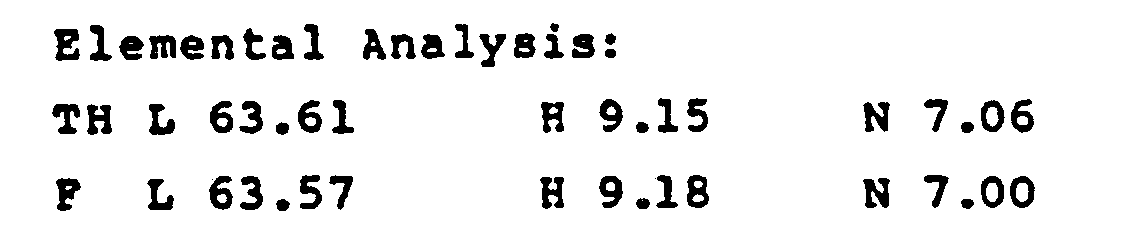
- The isomer ratio of the product of the second crystallization is determined by regeneration of the acid from the salt as mentioned before, giving a white solid.

- The salt product from the 2nd crystallization (122.2 g, 0.31 mole) is dissolved on 6 L hot ethyl acetate 99%/methanol 1%. The mixture is cooled to room temperature over 4 hours with occasional agitation, followed by refrigeration at 3°C overnight. A solid precipitates, which is filtered, washed with 1 L ETOAC and dried to constant weight in vacuo at 40°C giving a white solid, 107.8 g, 0.2 moles, 88% recovery. mp 151-153°C.

- The isomer ratio of the product of the third crystallization is determined by regeneration of the acid from the salt as mentioned before, giving a white solid, mp 114-118°C


- The salt product from the 3rd crystallization 105.9 g, 0.27 moles) is dissolved in 4.5 L hot ethyl acetate 99.5%/methanol 0.5%. The mixture is cooled to room temperature over 2 hours, followed by refrigeration at 3°C overnight. A solid is filtered off, washed with 1.0 L ethyl acetate, and dried to constant weight in vacuo at 40°C, giving a white solid, 97.8 g, 0.246 moles, 90.7% recovery, mp 153-4°C.

- The isomer ratio of the product of the fourth crystallization is determined by regeneration of the acid from the salt as mentioned before giving a white solid, mp 118-120°C.

- The salt product of the 4th crystallization (95.5 g, 0.24 moles) is suspended on 3 L ethyl acetate at 0°C. The mixture is extracted twice with 500 ml 1N hydrochloric acid at 0°C and twice with 500 ml saturated sodium chloride solution. The organic phase is dried over magnesium sulfate, filtered, and the solvent removed in vacuo, giving an oil. The oil is dissolved in 500 ml diethyl ether, to which is charged 2 L Hexane, giving a precipitate. The mixture is heated to reflux.
- The resultant solution is then gradually cooled to room temperature, followed by removal of diethyl ether in vacuo. The mixture is refrigerated at 3°C over-night, giving a precipitate. The solid is filtered, washed with 1 L hexane, and dried to constant weight in vacuo at 40°C, giving a white solid, 58.1 g, 0.21 moles, 87.6% recovery. Mp 118-120°C. 71.7% overall yield of the available 3S, 4S isomer.

- Rich, et al., in J. Org. Chem., 43, 3624 (1978) reported 3S, 4S Boc statine Mp 117-118°C,

- For synthetic purposes, it may be desirable to leave the Boc protecting group intact; however the product can be converted to statine by removing the protecting group via conventional techniques. Removal via acidification, eg., with dilute trifluoroacetic acid or other suitable reagent in preferred.
- While the invention is described above as employing four crystallization steps, it is contemplated that a lesser or greater number of such steps be used.
- Other conventional recovery techniques may be used in combination with or, in place of, one or more of the steps described above.
Claims (4)
Priority Applications (1)
| Application Number | Priority Date | Filing Date | Title |
|---|---|---|---|
| AT86301869T ATE61346T1 (en) | 1985-05-20 | 1986-03-14 | SYNTHESIS OF 3S,4S-BOC-STATIN. |
Applications Claiming Priority (2)
| Application Number | Priority Date | Filing Date | Title |
|---|---|---|---|
| US735933 | 1985-05-20 | ||
| US06/735,933 US4650897A (en) | 1985-05-20 | 1985-05-20 | Organic synthesis |
Publications (3)
| Publication Number | Publication Date |
|---|---|
| EP0202736A2 EP0202736A2 (en) | 1986-11-26 |
| EP0202736A3 EP0202736A3 (en) | 1987-07-29 |
| EP0202736B1 true EP0202736B1 (en) | 1991-03-06 |
Family
ID=24957822
Family Applications (1)
| Application Number | Title | Priority Date | Filing Date |
|---|---|---|---|
| EP86301869A Expired - Lifetime EP0202736B1 (en) | 1985-05-20 | 1986-03-14 | Synthesis of 3s, 4s-boc-statine |
Country Status (6)
| Country | Link |
|---|---|
| US (1) | US4650897A (en) |
| EP (1) | EP0202736B1 (en) |
| JP (1) | JPS61268662A (en) |
| AT (1) | ATE61346T1 (en) |
| DE (1) | DE3677816D1 (en) |
| ES (1) | ES8707176A1 (en) |
Families Citing this family (3)
| Publication number | Priority date | Publication date | Assignee | Title |
|---|---|---|---|---|
| JPH0772167B2 (en) * | 1986-09-04 | 1995-08-02 | サントリー株式会社 | Process for producing 4-amino-3-hydroxybutyric acid derivative |
| US4681972A (en) * | 1986-09-16 | 1987-07-21 | Warner-Lambert Company | Separation of diastereomers |
| GB9625455D0 (en) * | 1996-12-07 | 1997-01-22 | Glaxo Group Ltd | Process for resolving mixtures of carbocyclic steroisomers |
Family Cites Families (4)
| Publication number | Priority date | Publication date | Assignee | Title |
|---|---|---|---|---|
| JPS5069039A (en) * | 1973-10-23 | 1975-06-09 | ||
| US4397786A (en) * | 1981-11-23 | 1983-08-09 | Merck & Co., Inc. | Method of preparing statine and derivatives |
| US4487963A (en) * | 1983-01-03 | 1984-12-11 | Merck & Co., Inc. | Enantioselective synthesis of 4-amino-3-hydroxy-2,4-(disubstituted)pentanoic acid |
| IT1164319B (en) * | 1983-07-27 | 1987-04-08 | Blaschim Spa | ACID RESOLUTION PROCEDURE (+ -) 2- (6'-METHOXY-2'-NAFTIL) -PROPIONIC |
-
1985
- 1985-05-20 US US06/735,933 patent/US4650897A/en not_active Expired - Fee Related
-
1986
- 1986-03-14 EP EP86301869A patent/EP0202736B1/en not_active Expired - Lifetime
- 1986-03-14 DE DE8686301869T patent/DE3677816D1/en not_active Expired - Fee Related
- 1986-03-14 AT AT86301869T patent/ATE61346T1/en not_active IP Right Cessation
- 1986-03-19 JP JP61059629A patent/JPS61268662A/en active Pending
- 1986-05-20 ES ES555144A patent/ES8707176A1/en not_active Expired
Non-Patent Citations (1)
| Title |
|---|
| Chemistry and Biochemistry of the Amino Acids (Ed. G.C. Barret), Chapman and Hall, Chap. 10 * |
Also Published As
| Publication number | Publication date |
|---|---|
| ES8707176A1 (en) | 1987-07-16 |
| ES555144A0 (en) | 1987-07-16 |
| EP0202736A3 (en) | 1987-07-29 |
| JPS61268662A (en) | 1986-11-28 |
| DE3677816D1 (en) | 1991-04-11 |
| US4650897A (en) | 1987-03-17 |
| ATE61346T1 (en) | 1991-03-15 |
| EP0202736A2 (en) | 1986-11-26 |
Similar Documents
| Publication | Publication Date | Title |
|---|---|---|
| EP0430336B1 (en) | Process for the preparation of 4-O-phosphates of dopamine and dopamine derivatives | |
| US4585887A (en) | Process for the production of optically active 3-aminocarboxylic acid esters | |
| US5616727A (en) | Process for purifying 1-[N2 -((S)-ethoxycarbonyl)-3-phenylpropyl)-N6 -trifluoroacetyl]-l-lysyl-l-proline (lisinopril (TFA) ethyl ester | |
| US4650897A (en) | Organic synthesis | |
| US4246428A (en) | Method for separation of diastereoisomeric 3-(3,4-dibenzyloxyphenyl)serine | |
| JP3084345B2 (en) | Method for producing optically active 2-propyloctanoic acid | |
| Jones et al. | A new protocol for the synthesis of N (1)-unsubstituted 2-substituted 2-imidazolines | |
| SU1192612A3 (en) | Method of producing alpha-isomers of n,n-dialkyl-2-chlorpropionamides | |
| CA1292012C (en) | Process for making and isolating (r)-2-hydroxy-4- phenylbutyric acid and esters | |
| EP0260668B1 (en) | Separation of diastereomers | |
| JP2841196B2 (en) | α-substituted α-fluorocarboxylic acid compound | |
| KR950013082B1 (en) | (R) -2-hydroxy-4-phenylbutyric acid and preparation and separation method | |
| US5939554A (en) | Diarylaminopropanediol and diarylmethyl-oxazolidinone compounds | |
| JPH0737440B2 (en) | Method for producing sulfonium compound | |
| EP1489066B1 (en) | Process for production of optically active carboxylic acid | |
| US4886914A (en) | Process for synthesis of alpha aklyl amino aldehydes | |
| US7122696B2 (en) | Processes for preparation of N-protected-β-amino alcohols and N-protected-β-amino epoxides | |
| JPH07107033B2 (en) | Optically active 3-amino-4-cyclohexyl-2-hydroxybutyric acid hydrochloride and method for producing the same | |
| WO2002048095A1 (en) | Process for producing a-aminohalomethyl ketone derivatives | |
| US5367091A (en) | Optical resolution of DL-3-acetylthio-2-methylpropionic acid using L-(+)-2-aminobutanol as resolving agent | |
| US5099022A (en) | Process for purification of 1,2-bis(nicotinamido)propane | |
| KR100255040B1 (en) | Process for preparing D-(-)-pantolacton with amino acid silyl ester | |
| HUT56812A (en) | Process for enantioselective producing of gamma-keto-delta-amino acid derivatives | |
| JPWO2000055113A1 (en) | Method for producing α-aminoketone derivatives | |
| CN108084043A (en) | A kind of substitution (3S, 4R)/(3R, 4S)-Statines compounds and preparation method thereof |
Legal Events
| Date | Code | Title | Description |
|---|---|---|---|
| PUAI | Public reference made under article 153(3) epc to a published international application that has entered the european phase |
Free format text: ORIGINAL CODE: 0009012 |
|
| AK | Designated contracting states |
Kind code of ref document: A2 Designated state(s): AT BE CH DE FR GB IT LI LU NL SE |
|
| PUAL | Search report despatched |
Free format text: ORIGINAL CODE: 0009013 |
|
| RHK1 | Main classification (correction) |
Ipc: C07C125/065 |
|
| AK | Designated contracting states |
Kind code of ref document: A3 Designated state(s): AT BE CH DE FR GB IT LI LU NL SE |
|
| 17P | Request for examination filed |
Effective date: 19880119 |
|
| 17Q | First examination report despatched |
Effective date: 19890315 |
|
| GRAA | (expected) grant |
Free format text: ORIGINAL CODE: 0009210 |
|
| AK | Designated contracting states |
Kind code of ref document: B1 Designated state(s): AT BE CH DE FR GB IT LI LU NL SE |
|
| REF | Corresponds to: |
Ref document number: 61346 Country of ref document: AT Date of ref document: 19910315 Kind code of ref document: T |
|
| PGFP | Annual fee paid to national office [announced via postgrant information from national office to epo] |
Ref country code: GB Payment date: 19910308 Year of fee payment: 6 |
|
| PGFP | Annual fee paid to national office [announced via postgrant information from national office to epo] |
Ref country code: LU Payment date: 19910313 Year of fee payment: 6 Ref country code: FR Payment date: 19910313 Year of fee payment: 6 |
|
| PGFP | Annual fee paid to national office [announced via postgrant information from national office to epo] |
Ref country code: AT Payment date: 19910324 Year of fee payment: 6 |
|
| ITF | It: translation for a ep patent filed | ||
| PGFP | Annual fee paid to national office [announced via postgrant information from national office to epo] |
Ref country code: CH Payment date: 19910326 Year of fee payment: 6 |
|
| PGFP | Annual fee paid to national office [announced via postgrant information from national office to epo] |
Ref country code: BE Payment date: 19910328 Year of fee payment: 6 |
|
| PGFP | Annual fee paid to national office [announced via postgrant information from national office to epo] |
Ref country code: NL Payment date: 19910331 Year of fee payment: 6 |
|
| ET | Fr: translation filed | ||
| REF | Corresponds to: |
Ref document number: 3677816 Country of ref document: DE Date of ref document: 19910411 |
|
| PGFP | Annual fee paid to national office [announced via postgrant information from national office to epo] |
Ref country code: SE Payment date: 19910417 Year of fee payment: 6 |
|
| PGFP | Annual fee paid to national office [announced via postgrant information from national office to epo] |
Ref country code: DE Payment date: 19910529 Year of fee payment: 6 |
|
| EPTA | Lu: last paid annual fee | ||
| PLBE | No opposition filed within time limit |
Free format text: ORIGINAL CODE: 0009261 |
|
| STAA | Information on the status of an ep patent application or granted ep patent |
Free format text: STATUS: NO OPPOSITION FILED WITHIN TIME LIMIT |
|
| 26N | No opposition filed | ||
| PG25 | Lapsed in a contracting state [announced via postgrant information from national office to epo] |
Ref country code: LU Free format text: LAPSE BECAUSE OF NON-PAYMENT OF DUE FEES Effective date: 19920314 Ref country code: GB Effective date: 19920314 Ref country code: AT Effective date: 19920314 |
|
| PG25 | Lapsed in a contracting state [announced via postgrant information from national office to epo] |
Ref country code: SE Effective date: 19920315 |
|
| PG25 | Lapsed in a contracting state [announced via postgrant information from national office to epo] |
Ref country code: LI Effective date: 19920331 Ref country code: CH Effective date: 19920331 Ref country code: BE Effective date: 19920331 |
|
| BERE | Be: lapsed |
Owner name: WARNER-LAMBERT CY Effective date: 19920331 |
|
| PG25 | Lapsed in a contracting state [announced via postgrant information from national office to epo] |
Ref country code: NL Effective date: 19921001 |
|
| GBPC | Gb: european patent ceased through non-payment of renewal fee | ||
| NLV4 | Nl: lapsed or anulled due to non-payment of the annual fee | ||
| PG25 | Lapsed in a contracting state [announced via postgrant information from national office to epo] |
Ref country code: FR Effective date: 19921130 |
|
| REG | Reference to a national code |
Ref country code: CH Ref legal event code: PL |
|
| PG25 | Lapsed in a contracting state [announced via postgrant information from national office to epo] |
Ref country code: DE Effective date: 19921201 |
|
| REG | Reference to a national code |
Ref country code: FR Ref legal event code: ST |
|
| EUG | Se: european patent has lapsed |
Ref document number: 86301869.3 Effective date: 19921005 |
|
| PG25 | Lapsed in a contracting state [announced via postgrant information from national office to epo] |
Ref country code: IT Free format text: LAPSE BECAUSE OF NON-PAYMENT OF DUE FEES;WARNING: LAPSES OF ITALIAN PATENTS WITH EFFECTIVE DATE BEFORE 2007 MAY HAVE OCCURRED AT ANY TIME BEFORE 2007. THE CORRECT EFFECTIVE DATE MAY BE DIFFERENT FROM THE ONE RECORDED. Effective date: 20050314 |