EP0202710A2 - Zirconium phosphate and method for its preparation - Google Patents
Zirconium phosphate and method for its preparation Download PDFInfo
- Publication number
- EP0202710A2 EP0202710A2 EP86200806A EP86200806A EP0202710A2 EP 0202710 A2 EP0202710 A2 EP 0202710A2 EP 86200806 A EP86200806 A EP 86200806A EP 86200806 A EP86200806 A EP 86200806A EP 0202710 A2 EP0202710 A2 EP 0202710A2
- Authority
- EP
- European Patent Office
- Prior art keywords
- zirconium phosphate
- zirconium
- suspension
- water
- drying
- Prior art date
- Legal status (The legal status is an assumption and is not a legal conclusion. Google has not performed a legal analysis and makes no representation as to the accuracy of the status listed.)
- Granted
Links
- LEHFSLREWWMLPU-UHFFFAOYSA-B zirconium(4+);tetraphosphate Chemical compound [Zr+4].[Zr+4].[Zr+4].[O-]P([O-])([O-])=O.[O-]P([O-])([O-])=O.[O-]P([O-])([O-])=O.[O-]P([O-])([O-])=O LEHFSLREWWMLPU-UHFFFAOYSA-B 0.000 title claims abstract description 39
- 229910000166 zirconium phosphate Inorganic materials 0.000 title claims abstract description 38
- 238000000034 method Methods 0.000 title claims abstract description 36
- 238000002360 preparation method Methods 0.000 title claims description 7
- 229910001868 water Inorganic materials 0.000 claims abstract description 46
- XLYOFNOQVPJJNP-UHFFFAOYSA-N water Substances O XLYOFNOQVPJJNP-UHFFFAOYSA-N 0.000 claims abstract description 44
- 239000011229 interlayer Substances 0.000 claims abstract description 20
- 239000002253 acid Substances 0.000 claims abstract description 19
- 150000007513 acids Chemical class 0.000 claims abstract description 12
- 238000002604 ultrasonography Methods 0.000 claims abstract description 12
- 238000009830 intercalation Methods 0.000 claims abstract description 11
- 239000000126 substance Substances 0.000 claims abstract description 8
- 239000002245 particle Substances 0.000 claims abstract description 7
- 238000005406 washing Methods 0.000 claims abstract description 6
- WGYKZJWCGVVSQN-UHFFFAOYSA-N propylamine Chemical compound CCCN WGYKZJWCGVVSQN-UHFFFAOYSA-N 0.000 claims description 24
- 239000000725 suspension Substances 0.000 claims description 19
- OKKJLVBELUTLKV-UHFFFAOYSA-N Methanol Chemical compound OC OKKJLVBELUTLKV-UHFFFAOYSA-N 0.000 claims description 9
- LFQSCWFLJHTTHZ-UHFFFAOYSA-N Ethanol Chemical compound CCO LFQSCWFLJHTTHZ-UHFFFAOYSA-N 0.000 claims description 8
- QCWXUUIWCKQGHC-UHFFFAOYSA-N Zirconium Chemical compound [Zr] QCWXUUIWCKQGHC-UHFFFAOYSA-N 0.000 claims description 7
- 238000001035 drying Methods 0.000 claims description 7
- 230000002687 intercalation Effects 0.000 claims description 7
- 239000002244 precipitate Substances 0.000 claims description 7
- 229910052726 zirconium Inorganic materials 0.000 claims description 7
- 229910019142 PO4 Inorganic materials 0.000 claims description 6
- 230000002378 acidificating effect Effects 0.000 claims description 6
- NBIIXXVUZAFLBC-UHFFFAOYSA-K phosphate Chemical compound [O-]P([O-])([O-])=O NBIIXXVUZAFLBC-UHFFFAOYSA-K 0.000 claims description 6
- 239000010452 phosphate Substances 0.000 claims description 6
- 150000001412 amines Chemical class 0.000 claims description 5
- 239000007900 aqueous suspension Substances 0.000 claims description 5
- 230000036571 hydration Effects 0.000 claims description 5
- 238000006703 hydration reaction Methods 0.000 claims description 5
- 239000012736 aqueous medium Substances 0.000 claims description 4
- 239000003054 catalyst Substances 0.000 claims description 4
- 150000001875 compounds Chemical class 0.000 claims description 4
- 229910052500 inorganic mineral Inorganic materials 0.000 claims description 4
- 239000011707 mineral Substances 0.000 claims description 4
- 230000003287 optical effect Effects 0.000 claims description 4
- -1 Ba++ ions Chemical class 0.000 claims description 3
- 230000015572 biosynthetic process Effects 0.000 claims description 3
- 238000001914 filtration Methods 0.000 claims description 3
- BAVYZALUXZFZLV-UHFFFAOYSA-N mono-methylamine Natural products NC BAVYZALUXZFZLV-UHFFFAOYSA-N 0.000 claims description 3
- 238000011084 recovery Methods 0.000 claims description 3
- 238000000926 separation method Methods 0.000 claims description 3
- 238000001694 spray drying Methods 0.000 claims description 3
- 238000004108 freeze drying Methods 0.000 claims description 2
- 125000003158 alcohol group Chemical group 0.000 claims 1
- 125000000250 methylamino group Chemical group [H]N(*)C([H])([H])[H] 0.000 claims 1
- 239000010410 layer Substances 0.000 abstract description 5
- 125000004435 hydrogen atom Chemical group [H]* 0.000 abstract description 4
- 230000001172 regenerating effect Effects 0.000 abstract 1
- 239000000047 product Substances 0.000 description 33
- 239000000243 solution Substances 0.000 description 19
- DLYUQMMRRRQYAE-UHFFFAOYSA-N tetraphosphorus decaoxide Chemical compound O1P(O2)(=O)OP3(=O)OP1(=O)OP2(=O)O3 DLYUQMMRRRQYAE-UHFFFAOYSA-N 0.000 description 18
- 238000010521 absorption reaction Methods 0.000 description 11
- LOUPRKONTZGTKE-WZBLMQSHSA-N Quinine Chemical compound C([C@H]([C@H](C1)C=C)C2)C[N@@]1[C@@H]2[C@H](O)C1=CC=NC2=CC=C(OC)C=C21 LOUPRKONTZGTKE-WZBLMQSHSA-N 0.000 description 10
- 239000013078 crystal Substances 0.000 description 9
- NBIIXXVUZAFLBC-UHFFFAOYSA-N Phosphoric acid Chemical compound OP(O)(O)=O NBIIXXVUZAFLBC-UHFFFAOYSA-N 0.000 description 8
- 230000001143 conditioned effect Effects 0.000 description 8
- CXKWCBBOMKCUKX-UHFFFAOYSA-M methylene blue Chemical compound [Cl-].C1=CC(N(C)C)=CC2=[S+]C3=CC(N(C)C)=CC=C3N=C21 CXKWCBBOMKCUKX-UHFFFAOYSA-M 0.000 description 8
- 229960000907 methylthioninium chloride Drugs 0.000 description 8
- 239000007864 aqueous solution Substances 0.000 description 7
- 238000003756 stirring Methods 0.000 description 7
- KRHYYFGTRYWZRS-UHFFFAOYSA-N Fluorane Chemical compound F KRHYYFGTRYWZRS-UHFFFAOYSA-N 0.000 description 6
- 238000007792 addition Methods 0.000 description 6
- 150000002500 ions Chemical class 0.000 description 6
- 235000001258 Cinchona calisaya Nutrition 0.000 description 5
- LOUPRKONTZGTKE-UHFFFAOYSA-N cinchonine Natural products C1C(C(C2)C=C)CCN2C1C(O)C1=CC=NC2=CC=C(OC)C=C21 LOUPRKONTZGTKE-UHFFFAOYSA-N 0.000 description 5
- 229960000948 quinine Drugs 0.000 description 5
- 238000010992 reflux Methods 0.000 description 5
- 238000001228 spectrum Methods 0.000 description 5
- IJGRMHOSHXDMSA-UHFFFAOYSA-N Atomic nitrogen Chemical compound N#N IJGRMHOSHXDMSA-UHFFFAOYSA-N 0.000 description 4
- 229910000147 aluminium phosphate Inorganic materials 0.000 description 4
- 238000001556 precipitation Methods 0.000 description 4
- BDERNNFJNOPAEC-UHFFFAOYSA-N propan-1-ol Chemical compound CCCO BDERNNFJNOPAEC-UHFFFAOYSA-N 0.000 description 4
- 239000010414 supernatant solution Substances 0.000 description 4
- MDFWXZBEVCOVIO-UHFFFAOYSA-N 4,7,7-trimethylbicyclo[2.2.1]heptan-3-amine Chemical compound C1CC2(C)C(N)CC1C2(C)C MDFWXZBEVCOVIO-UHFFFAOYSA-N 0.000 description 3
- 238000002441 X-ray diffraction Methods 0.000 description 3
- 239000006185 dispersion Substances 0.000 description 3
- 239000000463 material Substances 0.000 description 3
- 239000000203 mixture Substances 0.000 description 3
- 230000004048 modification Effects 0.000 description 3
- 238000012986 modification Methods 0.000 description 3
- 150000001298 alcohols Chemical class 0.000 description 2
- HUCVOHYBFXVBRW-UHFFFAOYSA-M caesium hydroxide Chemical compound [OH-].[Cs+] HUCVOHYBFXVBRW-UHFFFAOYSA-M 0.000 description 2
- 229910001417 caesium ion Inorganic materials 0.000 description 2
- 230000003750 conditioning effect Effects 0.000 description 2
- 238000007598 dipping method Methods 0.000 description 2
- 238000001704 evaporation Methods 0.000 description 2
- YIXJRHPUWRPCBB-UHFFFAOYSA-N magnesium nitrate Chemical compound [Mg+2].[O-][N+]([O-])=O.[O-][N+]([O-])=O YIXJRHPUWRPCBB-UHFFFAOYSA-N 0.000 description 2
- 229910052757 nitrogen Inorganic materials 0.000 description 2
- 239000000843 powder Substances 0.000 description 2
- 230000008929 regeneration Effects 0.000 description 2
- 238000011069 regeneration method Methods 0.000 description 2
- 239000007858 starting material Substances 0.000 description 2
- DGAQECJNVWCQMB-PUAWFVPOSA-M Ilexoside XXIX Chemical compound C[C@@H]1CC[C@@]2(CC[C@@]3(C(=CC[C@H]4[C@]3(CC[C@@H]5[C@@]4(CC[C@@H](C5(C)C)OS(=O)(=O)[O-])C)C)[C@@H]2[C@]1(C)O)C)C(=O)O[C@H]6[C@@H]([C@H]([C@@H]([C@H](O6)CO)O)O)O.[Na+] DGAQECJNVWCQMB-PUAWFVPOSA-M 0.000 description 1
- UEZVMMHDMIWARA-UHFFFAOYSA-N Metaphosphoric acid Chemical compound OP(=O)=O UEZVMMHDMIWARA-UHFFFAOYSA-N 0.000 description 1
- ZLMJMSJWJFRBEC-UHFFFAOYSA-N Potassium Chemical compound [K] ZLMJMSJWJFRBEC-UHFFFAOYSA-N 0.000 description 1
- NPYPAHLBTDXSSS-UHFFFAOYSA-N Potassium ion Chemical compound [K+] NPYPAHLBTDXSSS-UHFFFAOYSA-N 0.000 description 1
- QAOWNCQODCNURD-UHFFFAOYSA-N Sulfuric acid Chemical compound OS(O)(=O)=O QAOWNCQODCNURD-UHFFFAOYSA-N 0.000 description 1
- 239000002250 absorbent Substances 0.000 description 1
- 230000002745 absorbent Effects 0.000 description 1
- 238000004458 analytical method Methods 0.000 description 1
- WDIHJSXYQDMJHN-UHFFFAOYSA-L barium chloride Chemical compound [Cl-].[Cl-].[Ba+2] WDIHJSXYQDMJHN-UHFFFAOYSA-L 0.000 description 1
- 229910001626 barium chloride Inorganic materials 0.000 description 1
- 230000003197 catalytic effect Effects 0.000 description 1
- 239000007795 chemical reaction product Substances 0.000 description 1
- 230000018044 dehydration Effects 0.000 description 1
- 238000006297 dehydration reaction Methods 0.000 description 1
- 238000001599 direct drying Methods 0.000 description 1
- 239000012153 distilled water Substances 0.000 description 1
- 238000011067 equilibration Methods 0.000 description 1
- 230000008020 evaporation Effects 0.000 description 1
- 238000005189 flocculation Methods 0.000 description 1
- 230000016615 flocculation Effects 0.000 description 1
- 239000008187 granular material Substances 0.000 description 1
- 238000010438 heat treatment Methods 0.000 description 1
- 230000000887 hydrating effect Effects 0.000 description 1
- 229910001410 inorganic ion Inorganic materials 0.000 description 1
- 239000000138 intercalating agent Substances 0.000 description 1
- 238000005342 ion exchange Methods 0.000 description 1
- 230000002427 irreversible effect Effects 0.000 description 1
- 239000007788 liquid Substances 0.000 description 1
- 238000010907 mechanical stirring Methods 0.000 description 1
- 229910052751 metal Inorganic materials 0.000 description 1
- 239000002184 metal Substances 0.000 description 1
- 150000002739 metals Chemical class 0.000 description 1
- 239000013081 microcrystal Substances 0.000 description 1
- 230000000877 morphologic effect Effects 0.000 description 1
- 150000002892 organic cations Chemical class 0.000 description 1
- 230000020477 pH reduction Effects 0.000 description 1
- 239000004033 plastic Substances 0.000 description 1
- 229920003023 plastic Polymers 0.000 description 1
- 239000011591 potassium Substances 0.000 description 1
- 229910052700 potassium Inorganic materials 0.000 description 1
- 229910001414 potassium ion Inorganic materials 0.000 description 1
- 238000000634 powder X-ray diffraction Methods 0.000 description 1
- 230000000284 resting effect Effects 0.000 description 1
- 150000003839 salts Chemical class 0.000 description 1
- 239000012047 saturated solution Substances 0.000 description 1
- 239000011734 sodium Substances 0.000 description 1
- 229910052708 sodium Inorganic materials 0.000 description 1
- 239000012265 solid product Substances 0.000 description 1
- 238000009210 therapy by ultrasound Methods 0.000 description 1
- 238000005979 thermal decomposition reaction Methods 0.000 description 1
- 238000005303 weighing Methods 0.000 description 1
- 230000004580 weight loss Effects 0.000 description 1
- GBNDTYKAOXLLID-UHFFFAOYSA-N zirconium(4+) ion Chemical compound [Zr+4] GBNDTYKAOXLLID-UHFFFAOYSA-N 0.000 description 1
- ATYZRBBOXUWECY-UHFFFAOYSA-N zirconium;hydrate Chemical compound O.[Zr] ATYZRBBOXUWECY-UHFFFAOYSA-N 0.000 description 1
Images

Classifications
-
- C—CHEMISTRY; METALLURGY
- C01—INORGANIC CHEMISTRY
- C01B—NON-METALLIC ELEMENTS; COMPOUNDS THEREOF; METALLOIDS OR COMPOUNDS THEREOF NOT COVERED BY SUBCLASS C01C
- C01B25/00—Phosphorus; Compounds thereof
- C01B25/16—Oxyacids of phosphorus; Salts thereof
- C01B25/26—Phosphates
- C01B25/37—Phosphates of heavy metals
- C01B25/372—Phosphates of heavy metals of titanium, vanadium, zirconium, niobium, hafnium or tantalum
-
- B—PERFORMING OPERATIONS; TRANSPORTING
- B01—PHYSICAL OR CHEMICAL PROCESSES OR APPARATUS IN GENERAL
- B01J—CHEMICAL OR PHYSICAL PROCESSES, e.g. CATALYSIS OR COLLOID CHEMISTRY; THEIR RELEVANT APPARATUS
- B01J39/00—Cation exchange; Use of material as cation exchangers; Treatment of material for improving the cation exchange properties
- B01J39/08—Use of material as cation exchangers; Treatment of material for improving the cation exchange properties
- B01J39/09—Inorganic material
-
- C—CHEMISTRY; METALLURGY
- C07—ORGANIC CHEMISTRY
- C07D—HETEROCYCLIC COMPOUNDS
- C07D453/00—Heterocyclic compounds containing quinuclidine or iso-quinuclidine ring systems, e.g. quinine alkaloids
- C07D453/02—Heterocyclic compounds containing quinuclidine or iso-quinuclidine ring systems, e.g. quinine alkaloids containing not further condensed quinuclidine ring systems
- C07D453/04—Heterocyclic compounds containing quinuclidine or iso-quinuclidine ring systems, e.g. quinine alkaloids containing not further condensed quinuclidine ring systems having a quinolyl-4, a substituted quinolyl-4 or a alkylenedioxy-quinolyl-4 radical linked through only one carbon atom, attached in position 2, e.g. quinine
Definitions
- the present invention relates to a particular type of zirconium phosphate and to the method for its preparation.
- zirconium phosphate with layer structure of alpha type [A. Clearfield, Inorganic Ion Exchange Materials, C.R.C. Press, Boca Raton (FA) USA, 1982].
- Such an ion exchanger has been obtained by two different preparation methods.
- zirconium phosphate is first prepared in the amorphous state, and the product is then made crystallize by refluxing it in aqueous solutions of phosphoric acid [ A. Clearfield and J.A. Stynes, J. lnorg. Nucl. Chem. 26, 117 (1964) ].
- the degree of crystallinity increases with the reflux time, and with the reflux time being the same, it increases with increasing concentration of the solution of phosphoric acid. Parallelly to the crystallinity degree the crystal sizes increase. In order to obtain microcrystals having dimensions of ⁇ m order and a good crystallinity degree, reflux times longer than 100 hours in 10-12 M phosphoric acid are required.
- a solution is first prepared containing a zirconium-(IV) fluorocomplex in phosphoric acid [G. Alberti, E. Torraca, J.Inor. Nucl. Chem. 30, 317 - (1968)].
- the crystalline zirconium phosphate is then made precipitate by decomposing the fluorocomplex by slowly evaporating hydrofluoric acid.
- the cristallinity degree and the crystal dimensions depend on the speed with which hydrofluoric acid has been evaporated off. If the evaporation is controlled in such a way that the precipitation may occur during a time longer than 24 hours, optimum crystallinity degrees and particles having sizes of from some tens to some hundreds of ⁇ m are obtained.
- the zirconium phosphate having layer structure of alpha type has the composition: Zr(HPO 4 ) 2 .H 2 O and an interlayer distance of 7.6 A.
- the water molecule is easily lost by heating to 110°C with decrease of the interlayer distance from 7.6 A to 7.4 A.
- the zirconium phosphate according to the invention is in the hydrogen form and has particles having dimensions comprised within the range of from 1 to 100 ⁇ m, a lamellar structure with interlayer distance in the anhydrous state comprised within the range of from 7.9 A to 8.2 A and a surface area comprised within the range of from 9 to 20 m2/ g .
- the method for the preparation of the zirconium phosphate according to the invention comprises:
- the treatment with ultrasounds is continued until the optical density of the suspension remains constant and is no longer influenced by said treatment with ultrasounds.
- the zirconium acid phosphate having modified lammelar structure obtained according to the invention and hereunder indicated also as “delaminated-ZPH”, has properties of exchange, intercalation and absorption very different from those of the materials of the prior art on the basis of lamellar zirconium phosphate with layer structure of alpha type.
- an amine is preferably used as the organic substance containing proton-acceptor groups and this is preferably selected between methylamine and n-propylamine.
- the crystals of ⁇ -Zr(HPO 4 ) 2 .H 2 O are dispersed in water and n-propylamine is added to the dispersion under mechanical stirring.
- the amount of propylamine can be varied within the range of from 25% to 75% (preferably 50%) of the number of gram-atoms of acidic protons present in the ⁇ -Zr(HPO 4 ) 2 .H 2 O amount used; usually, n-propylamine is added at a slow addition rate, but the addition modalities are not crytical.
- the ratio between the amount of crystals and the amount of water used can be varied within a wide range, from a minimum of 0.05 g per 100 g of water up to a maximum value which is essentially a function of the stirring system used and of its efficiency.
- the mixture viscosity tends to increase, and the higher the zirconium phosphate / water ratio, the greater such an increase in viscosity.
- the modification in lamellar structure caused by the intercalating of n-propylamine is such, that a very stable colloidal suspension is even formed.
- Such a suspension can be obtained also by causing the intercalation to take place in a non-aqueous medium - (e.g., in an alcohol, in particular in methanol) and then adding water.
- a non-aqueous medium e.g., in an alcohol, in particular in methanol
- the suspension of zirconium phosphate with modified lamellar structure obtained by intercalation in water or by dispersion in water of the intercalated product previously prepared in a non-aqueous medium is used for the treatment with ultrasounds.
- the regeneration of zirconium phosphate in hydrogen form is carried out by acidifying the colloidal suspension up to a pH value comprised within the range of from 0 to 3, preferably to pH 1.
- the acidification causes also the flocculation of zirconium acid phosphate, which can be recovered by simple filtering, and washing and drying in air at room temperature or by spray-drying or freeze-drying.
- the product according to the present invention exchanges quickly such large-sized ions as Cs * and Ba2+, and is furthermore able to absorb amines, alcohols and organic cations of even large size from aqueous or organic solutions.
- the product according to the present invention can be used as absorbent and intercalating agent for proton-acceptor organic substances having molecular weights up to 500 Daltons.
- the dry product has also the property of considerably hydrating when it is contacted with water, with formation of ⁇ -Zr(HPO 4 ) 2- nH 2 O, the value of n of which depends on the relative humidity under which the sample is conditioned.
- the hydration causes an increase of the interplanar distance, which can be easily detected by the powder X-ray diffraction spectrum. For example, a sample conditioned under a relative humidity of 92% has increased its interlayer distance up to 10.1 A, and n has resulted equal to 3.5.
- the hydration is so high that when they are placed in water, they swell up to yield a gelified mass showing an X-ray diffraction spectrum similar to that of the amorphous substances.
- the gradual reappearance occurs of the peaks typical of the phases with lower hydration degree, until finally the anhydrous compound having an interlayer distance comprised within the range of from 7.9 to 8,2 A is obtained.
- the interlayer distance of the samples dipped into water may reach even larger values than those obtained by the conditioning under relative moisture of 92% (10.1 A).
- the method according to the present invention leads also to the obtainment of powders 'constituted by particles the planar dimensions of which are of the same order of magnitude as of the initial ⁇ -Zr(HPO 4 ) 2 .H 2 O crystals, whilst the thickness, due to the modification occurred in the lamellar structure, is considerably lower (from 10 to 200 times as lower).
- the surface area of delaminated-ZPH according to the present invention is considerably larger than that of crystalline zirconium phosphate ⁇ -Zr(HPO 4 ) 2 .H 2 O being used as the starting material.
- crystalline zirconium phosphate ⁇ -Zr(HPO 4 ) 2 .H 2 O being used as the starting material.
- the combination of a high surface area with particles having considerable planar distances is a typical characteristic of delaminated-ZPH according to the present invention and such a characteristic, besides to the purpose of the surface absorption of various polar substances, can be advantageously used in all catalytic processes in which zirconium phosphate is used, both as catalyst and as catalyst support.
- Zirconium phosphate with layer structure of alpha type has been prepared by the method of direct precipitation in the presence of hydrofluoric acid.
- 85 g of ZrOCI,.8H 2 0 was dissolved in 1.2 of water.
- 80 ml of concentrated solution at 40% by weight of HF and then 715 ml of phosphoric acid at 85% by weight were added.
- the clear solution placed in a plastics vessel was heated in water bath at 80°C and into it pre-humidified air was bubbled. The complete precipitation was reached over a time of about 4 days.
- the crystals were separated from the solution, washed with distilled water up to pH 4-4.5 and stored in dryer over phosphoric anhydride.
- the optical density of the suspension at 620 nm varied from the initial value of 0.41 to an end value of 0.10.
- the solution was then acidified with 6 M HCI up to pH 0.7.
- the so-obtained precipitate was filtered off, washed three times each time with 100 cc of 0.1 M HCI, and finally with water until the washing liquors reached a pH ? 3.5.
- To the moist product obtained water was added up to a total volume of 60 ml, and stirred, to obtain a suspension which was poured by small portions into liquid nitrogen.
- the frozen granules were freeze-dried.
- the solid product obtained was further dried at 70°C and under a pressure of 15 mm u g (End yield 0.96 g).
- the obtained product after conditioning at room temperature over phosphoric anhydride, had an interlayer distance, measured from the powder X-ray dispersion spectrum, of 8.1 ⁇ . (It should be observed that during the determination of the diffraction spectrum the sample must be protected against atmospheric humidity, otherways phenomena of rehydrating occur, which cause an increase of the interlayer distance).
- the surface area of the product was of 19 m 2 / g.
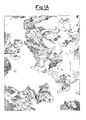
- Fig. 1A a photomicrograph of the product obtained by a scanning electron microscope (Philips Mod. 501/B) at 791X magnification
- Fig 1 B the photomicrograph of the same product at 6330X magnification is reported.
- the white segments represent 10 u.m and 1 ⁇ m respectively. From the two photomicrographs the dimensions and the morphological characteristics of the individual particles can be easily seen.
- the absorption power of the product for methylene blue from aqueous solution has resulted of 1.1 mmol of dye per g of product.
- Example 1 One gram of ⁇ -Zr(HPO 4 ) 2 .H 2 O of Example 1 was sus pended in 50 ml of water and to it 25 ml of 0.13 M n-propylamine aqueous solution was added. The addition modalities and all other operations were carried out exactly as described in Example 1.
- Example 2 The process was carried out exactly as described in Example 2, with the difference that the recovery of the product in the dry state was carried out by spray-drying.
- the yield was of 0.8 g
- the interlayer distance of the product obtained under the same conditions as of Example 2 was of 8.6 A
- the absorption power for methylene blue was of 0.9 mmol/g.
- Example 2 The process was carried out exactly as described in Example 2.
- the recovery of the end product in the dry state was carried out by direct drying of the moist product at 70°C and under a pressure of 15 mm Hg .
- the yield was of 0.92 g, the interlayer distance was of 8.8 A, (relative humidity of 60%) and the absorption power for methylene blue of 1.3 mmol/g.
- the intercalary-amine containing product after filtering and drying, was suspended in 150 ml of water and stirred for 30 minutes.
- the so-obtained colloidal suspension was submitted to treatment with ultrasounds by the same modalities as described in Example 1.
- the optical density of the ultrasound-treated end solution was of 0.099 at 620 nm.
- the surface area of 10 this product (T.B.E.) was of 15 m2/ g.
- Example 2 One g of a -Zr(HPO 4 ) 2 .H 2 O was treated according to as described in Example 1, until the colloidal solution was obtained. This latter, after having undergone the treatment with ultrasounds was acidified. The obtained precipitate was washed first with 0.1 M HCI and then with water according to as described in Example 1. The moist product which was obtained was washed three times with absolute ethanol.
- the product had absorbed 1.85 mmol of dye per g of product conditioned over phosphoric anhydride.
- Example 10 To 15 ml of the aqueous suspension of Example 10, containing 142.5 mg of anhydrous product, 55 ml of absolute ethanol and 30 ml of a 0.073 M solution of bornylamine in alcohol were added.
- Example 10 To 8 ml of the aqueous suspension of Example 10, containing 76 mg of anhydrous product, 89.5 ml of absolute ethanol and 2.5 ml of a 0.052 N solution of quinine in alcohol were added.
Landscapes
- Chemical & Material Sciences (AREA)
- Organic Chemistry (AREA)
- Inorganic Chemistry (AREA)
- Chemical Kinetics & Catalysis (AREA)
- Solid-Sorbent Or Filter-Aiding Compositions (AREA)
- Catalysts (AREA)
- Materials For Medical Uses (AREA)
- Silicates, Zeolites, And Molecular Sieves (AREA)
Abstract
Description
- The present invention relates to a particular type of zirconium phosphate and to the method for its preparation.
- One among the most widely used and studied ion exchangers belonging to the class of acid salts of tetravalent metals is zirconium phosphate with layer structure of alpha type [A. Clearfield, Inorganic Ion Exchange Materials, C.R.C. Press, Boca Raton (FA) USA, 1982].
- Such an ion exchanger has been obtained by two different preparation methods.
- In the first method, known as the "reflux method", zirconium phosphate is first prepared in the amorphous state, and the product is then made crystallize by refluxing it in aqueous solutions of phosphoric acid [ A. Clearfield and J.A. Stynes, J. lnorg. Nucl. Chem. 26, 117 (1964) ]. The degree of crystallinity increases with the reflux time, and with the reflux time being the same, it increases with increasing concentration of the solution of phosphoric acid. Parallelly to the crystallinity degree the crystal sizes increase. In order to obtain microcrystals having dimensions of µm order and a good crystallinity degree, reflux times longer than 100 hours in 10-12 M phosphoric acid are required.
- In the second method, also known as the "method by direct precipitation in the presence of HF", a solution is first prepared containing a zirconium-(IV) fluorocomplex in phosphoric acid [G. Alberti, E. Torraca, J.Inor. Nucl. Chem. 30, 317 - (1968)]. The crystalline zirconium phosphate is then made precipitate by decomposing the fluorocomplex by slowly evaporating hydrofluoric acid. In this method, the cristallinity degree and the crystal dimensions depend on the speed with which hydrofluoric acid has been evaporated off. If the evaporation is controlled in such a way that the precipitation may occur during a time longer than 24 hours, optimum crystallinity degrees and particles having sizes of from some tens to some hundreds of µm are obtained.
- By slow thermal decomposition of zirconium fluorocomplexes even crystals having sizes of some mm can be obtained G. [Alberti, U. Costantino, R. Giulietti, J. Inorg. Nucl. Chem., 42, 1062 - (1980)].
- Independently from the preparation method, the zirconium phosphate having layer structure of alpha type has the composition: Zr(HPO4)2.H2O and an interlayer distance of 7.6 A. The water molecule is easily lost by heating to 110°C with decrease of the interlayer distance from 7.6 A to 7.4 A.
- The dehydration is irreversible in the sense that the anhydrous zirconium phosphate cannot be re-hydrated even by dipping it into water. The crystalline structure of α-Zr(HPO4)2.H2O is presently known [A. Clearfield and G.D. Smith, Inorg. Chem., 8,431 (1969)].
- The arrangement of =P-OH groups is such that in the interlayer region cavities are formed (one cavity per each zirconium atom) connected by windows though which ions or molecules having a cross-section lower than or equal to that of potassium ion can easily pass, whilst larger species, such as Rb+, Cs*, Ba2+ or large organic ions cannot enter due to steric reasons.
- It has been surprisingly found that a type of zirconium phospate allows the passage and hence the intercala tion and/or the exchange of ions larger than potassium, thus overcoming the disadvantages of the prior art.
- The zirconium phosphate according to the invention is in the hydrogen form and has particles having dimensions comprised within the range of from 1 to 100 µm, a lamellar structure with interlayer distance in the anhydrous state comprised within the range of from 7.9 A to 8.2 A and a surface area comprised within the range of from 9 to 20 m2/g.
- The method for the preparation of the zirconium phosphate according to the invention comprises:
- a) the intercalating into a crystalline zirconium phosphate α-Zr(HPO4)2.H2O having interplanar distance d 7.6 A of an organic substance contaning an proton-acceptor group and water up to obtain a stable colloidal aqueous suspension of said intercalated Zr phosphate;
- b) the treatment of the colloidal suspension with ultra-sounds, then with acids, preferably mineral acids, not zirconium-complexing, in particular selected from HCI, H2SO4 and HNO,, for the regeneration of the hydrogen form, with the formation of a precipitate of zirconium acid phosphate with modified lamellar structure;
- c) the separation of precipitate from mother liquors, and the washing of the same with diluted acids, preferably mineral acids, and/or water.
- According to a preferred form of embodiment of the method according to the present invention, the treatment with ultrasounds is continued until the optical density of the suspension remains constant and is no longer influenced by said treatment with ultrasounds.
- It should be observed that the zirconium acid phosphate having modified lammelar structure obtained according to the invention and hereunder indicated also as "delaminated-ZPH", has properties of exchange, intercalation and absorption very different from those of the materials of the prior art on the basis of lamellar zirconium phosphate with layer structure of alpha type.
- As the organic substance containing proton-acceptor groups, an amine is preferably used and this is preferably selected between methylamine and n-propylamine.
- In the following, reference is made to this latter for easiness' sake, and the phenomena which can be evidenced during the process of the invention are explained.
- The crystals of α-Zr(HPO4)2.H2O are dispersed in water and n-propylamine is added to the dispersion under mechanical stirring. For example, the amount of propylamine can be varied within the range of from 25% to 75% (preferably 50%) of the number of gram-atoms of acidic protons present in the α-Zr(HPO4)2.H2O amount used; usually, n-propylamine is added at a slow addition rate, but the addition modalities are not crytical. Also the ratio between the amount of crystals and the amount of water used can be varied within a wide range, from a minimum of 0.05 g per 100 g of water up to a maximum value which is essentially a function of the stirring system used and of its efficiency. In fact, while the amine is being progressively added, the mixture viscosity tends to increase, and the higher the zirconium phosphate / water ratio, the greater such an increase in viscosity. The modification in lamellar structure caused by the intercalating of n-propylamine is such, that a very stable colloidal suspension is even formed. Such a suspension can be obtained also by causing the intercalation to take place in a non-aqueous medium - (e.g., in an alcohol, in particular in methanol) and then adding water. The suspension of zirconium phosphate with modified lamellar structure obtained by intercalation in water or by dispersion in water of the intercalated product previously prepared in a non-aqueous medium is used for the treatment with ultrasounds.
- The regeneration of zirconium phosphate in hydrogen form is carried out by acidifying the colloidal suspension up to a pH value comprised within the range of from 0 to 3, preferably to pH 1. The acidification causes also the flocculation of zirconium acid phosphate, which can be recovered by simple filtering, and washing and drying in air at room temperature or by spray-drying or freeze-drying.
- Differently from α-Zr(HPO)2-H2O (d = 7.6 A), the product according to the present invention exchanges quickly such large-sized ions as Cs* and Ba2+, and is furthermore able to absorb amines, alcohols and organic cations of even large size from aqueous or organic solutions. In general, the product according to the present invention can be used as absorbent and intercalating agent for proton-acceptor organic substances having molecular weights up to 500 Daltons.
- For example, the absorption of Cs+ ion from an 0.1 M CsCI aqueous solution maintained at pH = 3 is of 1.25 meq/g, that of methylene blue from aqueous solution arrives up to 1.85 meq/g, bornylamine and quinine can be accomodated inside the interlayer region, whilst alcohols are even intercalated by the exchanger also by simple cold washing with them.
- The dry product has also the property of considerably hydrating when it is contacted with water, with formation of α-Zr(HPO4)2-nH2O, the value of n of which depends on the relative humidity under which the sample is conditioned. The hydration causes an increase of the interplanar distance, which can be easily detected by the powder X-ray diffraction spectrum. For example, a sample conditioned under a relative humidity of 92% has increased its interlayer distance up to 10.1 A, and n has resulted equal to 3.5.
- In some samples the hydration is so high that when they are placed in water, they swell up to yield a gelified mass showing an X-ray diffraction spectrum similar to that of the amorphous substances. However, by carrying out a gradual drying, it has been found, by controlling the X-ray diffraction spectrum of the samples, that the gradual reappearance occurs of the peaks typical of the phases with lower hydration degree, until finally the anhydrous compound having an interlayer distance comprised within the range of from 7.9 to 8,2 A is obtained. Such a behaviour would let think that the interlayer distance of the samples dipped into water may reach even larger values than those obtained by the conditioning under relative moisture of 92% (10.1 A).
- It should be observed that the method according to the present invention leads also to the obtainment of powders 'constituted by particles the planar dimensions of which are of the same order of magnitude as of the initial α-Zr(HPO4)2.H2O crystals, whilst the thickness, due to the modification occurred in the lamellar structure, is considerably lower (from 10 to 200 times as lower).
- As a consequence, the surface area of delaminated-ZPH according to the present invention is considerably larger than that of crystalline zirconium phosphate α-Zr(HPO4)2.H2O being used as the starting material. By starting for example from crystals having sizes of some tens of u.m and surface areas of 0.1-0.2 m2/g, products with surface areas of 9-20 m2/g can be obtained.
- The combination of a high surface area with particles having considerable planar distances is a typical characteristic of delaminated-ZPH according to the present invention and such a characteristic, besides to the purpose of the surface absorption of various polar substances, can be advantageously used in all catalytic processes in which zirconium phosphate is used, both as catalyst and as catalyst support.
- Some examples are now supplied to the purpose of better illustrating the invention, it being understood that the invention must not be considered as limited to them or by them.
- Because the number of equivalents of acidic protons present per g of delaminated-ZPH depends on the hydration degree, which depends in its turn on the relative humidity under which the sample has been conditioned, in the following examples the absorption capacity, for comparison homogeneousness' sake, is referred, unless otherways specified, to 1 g of anhydrous product.
- Zirconium phosphate with layer structure of alpha type has been prepared by the method of direct precipitation in the presence of hydrofluoric acid. In particular, 85 g of ZrOCI,.8H20 was dissolved in 1.2 of water. To the solution first 80 ml of concentrated solution at 40% by weight of HF and then 715 ml of phosphoric acid at 85% by weight were added. The clear solution placed in a plastics vessel was heated in water bath at 80°C and into it pre-humidified air was bubbled. The complete precipitation was reached over a time of about 4 days. The crystals were separated from the solution, washed with distilled water up to pH 4-4.5 and stored in dryer over phosphoric anhydride.
- One gram of α-Zr(HPO4)2.H2O (prepared as above said) with average crystal size around 15 µm and surface area of 0.2 m2/g was suspended in 100 ml of water, and 50 ml was added of an 0.066 M n-propylamine aqueous solution. The additions was carried out slowly, dropwise during about 4 hours under vigorous stirring. By keeping the mixture stirred for further about 20 hours a colloidal suspension of product with modified lamellar structure was obtained. This suspension was treated with ultrasounds (frequency of 7 MHz and power of 150 W) for a total time of 14 minutes. The ultrasound treatment was carried out by alternating 2 minutes of treatment to one minute of rest interval, during which the vessel was cooled by dipping into water. After this treatment, the optical density of the suspension at 620 nm varied from the initial value of 0.41 to an end value of 0.10. The solution was then acidified with 6 M HCI up to pH 0.7. The so-obtained precipitate was filtered off, washed three times each time with 100 cc of 0.1 M HCI, and finally with water until the washing liquors reached a pH ? 3.5. To the moist product obtained water was added up to a total volume of 60 ml, and stirred, to obtain a suspension which was poured by small portions into liquid nitrogen. The frozen granules were freeze-dried. The solid product obtained was further dried at 70°C and under a pressure of 15 mmug (End yield 0.96 g).
- The obtained product, after conditioning at room temperature over phosphoric anhydride, had an interlayer distance, measured from the powder X-ray dispersion spectrum, of 8.1 Å. (It should be observed that during the determination of the diffraction spectrum the sample must be protected against atmospheric humidity, otherways phenomena of rehydrating occur, which cause an increase of the interlayer distance).
- The surface area of the product, computated from the nitrogen absorption data by the T.B.E. theory, was of 19 m 2 /g.
- In Fig. 1A a photomicrograph of the product obtained by a scanning electron microscope (Philips Mod. 501/B) at 791X magnification, and in Fig 1 B the photomicrograph of the same product at 6330X magnification is reported. In the two photomicrographs the white segments represent 10 u.m and 1 µm respectively. From the two photomicrographs the dimensions and the morphological characteristics of the individual particles can be easily seen.
- The absorption power of the product for methylene blue from aqueous solution has resulted of 1.1 mmol of dye per g of product.
- One gram of α-Zr(HPO4)2.H2O of Example 1 was sus pended in 50 ml of water and to it 25 ml of 0.13 M n-propylamine aqueous solution was added. The addition modalities and all other operations were carried out exactly as described in Example 1. The end yield in dry delaminated-ZPH was of 0.97 g, its interlayer distance (at room temperature and under relative humidity = 60%) was of 8.7 A. Its absorption power for methylene blue was of 1.2 mmol/g.
- The process was carried out exactly as described in Example 2, with the difference that the recovery of the product in the dry state was carried out by spray-drying. The yield was of 0.8 g, the interlayer distance of the product obtained under the same conditions as of Example 2 was of 8.6 A, and the absorption power for methylene blue was of 0.9 mmol/g.
- The process was carried out exactly as described in Example 2. The recovery of the end product in the dry state was carried out by direct drying of the moist product at 70°C and under a pressure of 15 mmHg.
- The yield was of 0.92 g, the interlayer distance was of 8.8 A, (relative humidity of 60%) and the absorption power for methylene blue of 1.3 mmol/g.
- One gram of α-Zr(HPO4)2..H2O2 the same sample as of Example 1, was suspended in 50 ml of absolute methanol containing 0.28 ml (0.0033 mol) of n-propylamine and was kept under stirring for about 10 hours.'
- The intercalary-amine containing product, after filtering and drying, was suspended in 150 ml of water and stirred for 30 minutes. The so-obtained colloidal suspension was submitted to treatment with ultrasounds by the same modalities as described in Example 1. The optical density of the ultrasound-treated end solution was of 0.099 at 620 nm. By proceeding exactly as described in Example 1, 0.94 g of product having and interlayer distance of 8.6 A (relative humidity = 60%) and an absorption power for methylene blue of 0.9 mmol/g of product conditioned over P2O5 was obtained. The surface area of 10 this product (T.B.E.) was of 15 m2/g.
- An amount of 1.000 g of product obtained according to as described in Example 1 was brought to constant weight in vacuum dryer over phosphoric anhydride and subsequently equilibrated over saturated solutions of magnesium nitrate - [relative humidity (R.H.) 60%], of sodium chloride-(R.H. 75%), and barium chloride (R.H. 92%). The following % weight increases and the following values of interlayer distance were recorded:

- The sample reconditioned over phosphoric anhydride returned back to its starting weight of 1.000 g-
- Another sample of 0.284 g of delaminated-ZPH, prepared according to Example 2, stored in air (R.H. = 60%), dried in oven at 150°C for 24 hours showed a weight loss of 7.6%. This dry product, kept resting in air on the analytical balance returned to its initial weight within a time of about 2 hours.
- One gram of zirconium phosphate with modified lamellar structure and conditioned over P2O5 prepared as described in Example 2 was dispersed with strong stirring in 100 ml of 0.100 M CsCI solution having pH = 3.00.
- An immediate decrease was observed in solution pH which, about 1 minute after the addition of delaminated-ZPH resulted equal to 1.79. To the purpose of raising the solution pH to the value of 3.00, 12.5 ml of a 0.100 M CsOH solution was added. It can be inferred that under these conditions 1 g of delaminated-ZPH exchanges 1.25 mmol of its acidic protons with 1.25 mmol of Cs+.
- The same test has been carried out by using 1 g of α-Zr(HPO4)2.H2O (starting material of Example 1 used to obtain the delaminated-ZPH). In this case, no appreciable changes were observed in solution pH and hence no absorption of Cs had occurred.
- One gram of delaminated-ZPH conditioned over P2O5 prepared as described in Example 2 was dispersed under strong stirring in 150 ml of a 0.050 M BaCi2 solution having pH = 5.25.
- An immediate decrease was observed in solution pH which, about 1 minute after the addition, resulted equal to 1.75. The analysis of the supernatant solution for Ba contents showed the presence of residual 6.45 mmol of Ba++ ions, as compared to the 7.50 mmol initially present. It can be inferred that under these conditions 1 g of delaminated-ZPH exchanges 2.1 mmol of its acidic protons with 2.1 mmol of Ba++ ions.
- One g of a -Zr(HPO4)2.H2O was treated according to as described in Example 1, until the colloidal solution was obtained. This latter, after having undergone the treatment with ultrasounds was acidified. The obtained precipitate was washed first with 0.1 M HCI and then with water according to as described in Example 1. The moist product which was obtained was washed three times with absolute ethanol.
- Its interlayer distance resulted to be of 14.2 A similar to that of crystalline zirconium phosphate with two intercalary alcohol molecules.
- Another aliquot of the product was washed with n-propyl alcohol (three times). In this case, the moist product showed on X-ray analysis an interlayer distance of 16.6 A, similar to that of the intercalation compound Zr(HPO4)2.n-propanol [ U. Costantino, J. Chem. S. Dalton, 402 (1979)].
- One g of α-Zr(HPO4)2.H2O underwent the lamellar structure modification, was ultrasound-treated and washed according to as described in Example 1, until the moist product was obtained. This latter was dispersed again in water up to a total volume of 100 ml. This suspension was analyzed for its contents in zirconium phosphate by drawing, under stirring, 5-ml portions, which, placed inside weighing bottles, were kept at 70°C and under a pressure of 15 mmHg until the most of water had evaporated off, and finally were conditioned to constant weight over phosphoric anhydride in vacuum dryer. The contents of the suspension, so determined, resulted equal to 9.5 mg of 14. anhydrous material per ml.
- To 10 ml of suspension 25 ml was added of a 0.0102 M aqueous solution of methylene blue (equivalent to 0.255 mmol). After letting the equilibrium to be reached under stirring for 48 hours, the supernatant solution was analyzed for its contents in methylene blue. Such contents resulted of residual 0.088 mmol.
- It can be inferred that the product had absorbed 1.85 mmol of dye per g of product conditioned over phosphoric anhydride.
- To 15 ml of the aqueous suspension of Example 10, containing 142.5 mg of anhydrous product, 55 ml of absolute ethanol and 30 ml of a 0.073 M solution of bornylamine in alcohol were added.
- After 24 hours of equilibration, 10 ml of supernatant solution was drawn and titrated with 3.16 ml of 0.05 M HCI, from which it can be inferred that the intercalary bornylamine was equal to 4.28 mmol/g.
- To 8 ml of the aqueous suspension of Example 10, containing 76 mg of anhydrous product, 89.5 ml of absolute ethanol and 2.5 ml of a 0.052 N solution of quinine in alcohol were added.
- After 24 hours of contact time, the supernatant solution was analyzed for its contents in residual quinine.
- Such a contents resulted equal to 0.0809 mmol as compared to the 0.130 mmol initially added to react. It can be inferred that the product capacity to absorb quinine was equal to 0.31 mmol of quinine per g.
Claims (25)
Priority Applications (1)
| Application Number | Priority Date | Filing Date | Title |
|---|---|---|---|
| AT86200806T ATE72421T1 (en) | 1985-05-15 | 1986-05-09 | ZIRCONIUM PHOSPHATE AND PROCESS FOR PRODUCTION THEREOF. |
Applications Claiming Priority (2)
| Application Number | Priority Date | Filing Date | Title |
|---|---|---|---|
| IT20716/85A IT1191613B (en) | 1985-05-15 | 1985-05-15 | ZIRCONIUM PHOSPHATE AND ITS PREPARATION METHOD |
| IT2071685 | 1985-05-15 |
Publications (3)
| Publication Number | Publication Date |
|---|---|
| EP0202710A2 true EP0202710A2 (en) | 1986-11-26 |
| EP0202710A3 EP0202710A3 (en) | 1988-03-02 |
| EP0202710B1 EP0202710B1 (en) | 1992-02-05 |
Family
ID=11171003
Family Applications (1)
| Application Number | Title | Priority Date | Filing Date |
|---|---|---|---|
| EP86200806A Expired - Lifetime EP0202710B1 (en) | 1985-05-15 | 1986-05-09 | Zirconium phosphate and method for its preparation |
Country Status (6)
| Country | Link |
|---|---|
| US (1) | US4826663A (en) |
| EP (1) | EP0202710B1 (en) |
| JP (1) | JPS61270204A (en) |
| AT (1) | ATE72421T1 (en) |
| DE (1) | DE3683799D1 (en) |
| IT (1) | IT1191613B (en) |
Cited By (3)
| Publication number | Priority date | Publication date | Assignee | Title |
|---|---|---|---|---|
| EP1074290A1 (en) * | 1999-08-04 | 2001-02-07 | Institut Francais Du Petrole | Process for the adsorption and desorption of nitrogen oxides in exhaust gases |
| WO2008015072A1 (en) * | 2006-08-02 | 2008-02-07 | Rhodia Operations | Crystalline zirconium and/or titanium phosphate, having a lamellar structure and including a diamine as intercalation agent, method of preparation and use in a macromolecular material |
| FR2904619A1 (en) * | 2006-08-02 | 2008-02-08 | Rhodia Recherches & Tech | ZIRCONIUM AND / OR TITANIUM PHOSPHATE WITH LAMELLAR STRUCTURE MODIFIED BY ALKYLAMINE OR DIAMINE, PROCESS FOR PREPARING SAME AND USE THEREOF. |
Families Citing this family (89)
| Publication number | Priority date | Publication date | Assignee | Title |
|---|---|---|---|---|
| JPH01103908A (en) * | 1987-10-15 | 1989-04-21 | Res Dev Corp Of Japan | Interlayer separatable layer body |
| US5085845A (en) * | 1989-11-02 | 1992-02-04 | Tayca Corporation | Production and use of crystalline hydrogen-phosphate compounds having layer structure |
| US5746943A (en) * | 1997-02-25 | 1998-05-05 | Sterling Diagnostic Imaging, Inc. | X-ray intensifying screen based on barium hafnium zirconium phosphate |
| FR2813300B1 (en) * | 2000-08-23 | 2002-10-25 | Rhodianyl | PROCESS FOR THE PREPARATION OF MINERAL COMPOUNDS, COMPOUNDS OBTAINED, AND THEIR USE IN THERMOPLASTIC MATERIALS |
| US6627164B1 (en) * | 2000-11-28 | 2003-09-30 | Renal Solutions, Inc. | Sodium zirconium carbonate and zirconium basic carbonate and methods of making the same |
| US7241272B2 (en) * | 2001-11-13 | 2007-07-10 | Baxter International Inc. | Method and composition for removing uremic toxins in dialysis processes |
| US6897027B2 (en) * | 2002-03-27 | 2005-05-24 | Decode Genetics Ehf. | Method for desalting nucleic acids |
| US7169297B2 (en) * | 2002-07-15 | 2007-01-30 | Magnesium Elektron, Inc. | pH adjuster-based system for treating liquids |
| US7442310B2 (en) * | 2002-07-15 | 2008-10-28 | Magnesium Elektron, Inc. | Treating liquids with pH adjuster-based system |
| US20050077246A1 (en) * | 2002-07-15 | 2005-04-14 | Pardini James J. | Treatment of liquid using porous polymer containment member |
| US6936175B2 (en) * | 2002-07-15 | 2005-08-30 | Magnesium Elektron, Inc. | Zirconium phosphate, hafnium phosphate and method of making same |
| US6960328B2 (en) * | 2002-07-15 | 2005-11-01 | Magnesium Elektron, Inc. | Zirconium phosphate and method of making same |
| ITPG20030005A1 (en) * | 2003-02-19 | 2004-08-20 | Giulio Alberti | PREPARATION OF NEW ACID PHOSPHATES OF TETRAVALENT METALS |
| AU2005322322B2 (en) * | 2004-12-28 | 2010-04-01 | Renal Solutions, Inc. | Method of synthesizing zirconium phosphate particles |
| US20060217771A1 (en) | 2005-02-07 | 2006-09-28 | Medtronic, Inc. | Potassium monitoring |
| WO2008053694A1 (en) | 2006-10-27 | 2008-05-08 | Toagosei Co., Ltd. | Novel lamellar zirconium phosphate |
| US8597505B2 (en) | 2007-09-13 | 2013-12-03 | Fresenius Medical Care Holdings, Inc. | Portable dialysis machine |
| US8240636B2 (en) | 2009-01-12 | 2012-08-14 | Fresenius Medical Care Holdings, Inc. | Valve system |
| US9308307B2 (en) | 2007-09-13 | 2016-04-12 | Fresenius Medical Care Holdings, Inc. | Manifold diaphragms |
| US8105487B2 (en) | 2007-09-25 | 2012-01-31 | Fresenius Medical Care Holdings, Inc. | Manifolds for use in conducting dialysis |
| US8137553B2 (en) | 2007-11-29 | 2012-03-20 | Fresenius Medical Care Holdings, Inc. | Priming system and method for dialysis systems |
| US9358331B2 (en) | 2007-09-13 | 2016-06-07 | Fresenius Medical Care Holdings, Inc. | Portable dialysis machine with improved reservoir heating system |
| JP5099380B2 (en) * | 2007-10-01 | 2012-12-19 | 東亞合成株式会社 | Antiallergen |
| CA2706919C (en) | 2007-11-29 | 2018-03-06 | Fresenius Medical Care Holdings, Inc. | System and method for conducting hemodialysis and hemofiltration |
| JP5712131B2 (en) * | 2008-10-03 | 2015-05-07 | フレセニウス メディカル ケア ホールディングス インコーポレーテッド | Zirconium phosphate particles with improved adsorption capacity and method for synthesizing the zirconium phosphate particles |
| JP5628186B2 (en) | 2008-10-30 | 2014-11-19 | フレセニウス メディカル ケア ホールディングス インコーポレーテッド | Modular portable dialysis system |
| WO2010114932A1 (en) | 2009-03-31 | 2010-10-07 | Xcorporeal, Inc. | Modular reservoir assembly for a hemodialysis and hemofiltration system |
| US9399091B2 (en) | 2009-09-30 | 2016-07-26 | Medtronic, Inc. | System and method to regulate ultrafiltration |
| US8906270B2 (en) * | 2010-03-19 | 2014-12-09 | Colorado School Of Mines | Acidic ion exchange membrane and method for making and using the same |
| JP5594367B2 (en) * | 2010-10-14 | 2014-09-24 | 東亞合成株式会社 | Antiallergen |
| US8641659B2 (en) | 2011-02-17 | 2014-02-04 | Medtronic, Inc. | Method and device to treat kidney disease |
| JP5821258B2 (en) * | 2011-04-20 | 2015-11-24 | 東亞合成株式会社 | Method for producing layered zirconium phosphate |
| US9848778B2 (en) | 2011-04-29 | 2017-12-26 | Medtronic, Inc. | Method and device to monitor patients with kidney disease |
| US9456755B2 (en) | 2011-04-29 | 2016-10-04 | Medtronic, Inc. | Method and device to monitor patients with kidney disease |
| US9061099B2 (en) | 2011-04-29 | 2015-06-23 | Medtronic, Inc. | Cardiovascular monitoring for fluid removal processes |
| US9017277B2 (en) | 2011-05-02 | 2015-04-28 | Medtronic, Inc. | System and implantable device for treating chronic kidney disease |
| EP3165245B1 (en) | 2011-08-02 | 2019-02-20 | Medtronic, Inc. | Hemodialysis system having a flow path with a controlled compliant volume |
| WO2013025844A2 (en) | 2011-08-16 | 2013-02-21 | Medtronic, Inc. | Modular hemodialysis system |
| WO2013103906A1 (en) | 2012-01-04 | 2013-07-11 | Medtronic, Inc. | Multi-staged filtration system for blood fluid removal |
| US10905816B2 (en) | 2012-12-10 | 2021-02-02 | Medtronic, Inc. | Sodium management system for hemodialysis |
| US9201036B2 (en) | 2012-12-21 | 2015-12-01 | Fresenius Medical Care Holdings, Inc. | Method and system of monitoring electrolyte levels and composition using capacitance or induction |
| US9157786B2 (en) | 2012-12-24 | 2015-10-13 | Fresenius Medical Care Holdings, Inc. | Load suspension and weighing system for a dialysis machine reservoir |
| US11565029B2 (en) | 2013-01-09 | 2023-01-31 | Medtronic, Inc. | Sorbent cartridge with electrodes |
| US9707328B2 (en) | 2013-01-09 | 2017-07-18 | Medtronic, Inc. | Sorbent cartridge to measure solute concentrations |
| US11154648B2 (en) | 2013-01-09 | 2021-10-26 | Medtronic, Inc. | Fluid circuits for sorbent cartridge with sensors |
| US9713666B2 (en) | 2013-01-09 | 2017-07-25 | Medtronic, Inc. | Recirculating dialysate fluid circuit for blood measurement |
| US9526822B2 (en) | 2013-02-01 | 2016-12-27 | Medtronic, Inc. | Sodium and buffer source cartridges for use in a modular controlled compliant flow path |
| US10010663B2 (en) | 2013-02-01 | 2018-07-03 | Medtronic, Inc. | Fluid circuit for delivery of renal replacement therapies |
| US10850016B2 (en) | 2013-02-01 | 2020-12-01 | Medtronic, Inc. | Modular fluid therapy system having jumpered flow paths and systems and methods for cleaning and disinfection |
| US10543052B2 (en) | 2013-02-01 | 2020-01-28 | Medtronic, Inc. | Portable dialysis cabinet |
| US9623164B2 (en) | 2013-02-01 | 2017-04-18 | Medtronic, Inc. | Systems and methods for multifunctional volumetric fluid control |
| US9144640B2 (en) | 2013-02-02 | 2015-09-29 | Medtronic, Inc. | Sorbent cartridge configurations for improved dialysate regeneration |
| US9827361B2 (en) | 2013-02-02 | 2017-11-28 | Medtronic, Inc. | pH buffer measurement system for hemodialysis systems |
| WO2015066731A2 (en) | 2013-11-04 | 2015-05-07 | Medtronic, Inc. | Method and device to manage fluid volumes in the body |
| US9354640B2 (en) | 2013-11-11 | 2016-05-31 | Fresenius Medical Care Holdings, Inc. | Smart actuator for valve |
| US10537875B2 (en) | 2013-11-26 | 2020-01-21 | Medtronic, Inc. | Precision recharging of sorbent materials using patient and session data |
| US9884145B2 (en) | 2013-11-26 | 2018-02-06 | Medtronic, Inc. | Parallel modules for in-line recharging of sorbents using alternate duty cycles |
| US10617349B2 (en) | 2013-11-27 | 2020-04-14 | Medtronic, Inc. | Precision dialysis monitoring and synchronization system |
| US10357757B2 (en) | 2014-06-24 | 2019-07-23 | Medtronic, Inc. | Stacked sorbent assembly |
| US10172991B2 (en) | 2014-06-24 | 2019-01-08 | Medtronic, Inc. | Modular dialysate regeneration assembly |
| US10098993B2 (en) | 2014-12-10 | 2018-10-16 | Medtronic, Inc. | Sensing and storage system for fluid balance |
| US9713665B2 (en) | 2014-12-10 | 2017-07-25 | Medtronic, Inc. | Degassing system for dialysis |
| US10874787B2 (en) | 2014-12-10 | 2020-12-29 | Medtronic, Inc. | Degassing system for dialysis |
| US9895479B2 (en) | 2014-12-10 | 2018-02-20 | Medtronic, Inc. | Water management system for use in dialysis |
| US10335534B2 (en) | 2015-11-06 | 2019-07-02 | Medtronic, Inc. | Dialysis prescription optimization for decreased arrhythmias |
| US10994064B2 (en) | 2016-08-10 | 2021-05-04 | Medtronic, Inc. | Peritoneal dialysate flow path sensing |
| US10874790B2 (en) | 2016-08-10 | 2020-12-29 | Medtronic, Inc. | Peritoneal dialysis intracycle osmotic agent adjustment |
| EP3439711A1 (en) | 2016-04-04 | 2019-02-13 | Medtronic Inc. | Peritoneal dialysate fluid generation system |
| US12329892B2 (en) | 2016-04-04 | 2025-06-17 | Mozarc Medical Us Llc | Dextrose concentration sensor for a peritoneal dialysis system |
| US11013843B2 (en) | 2016-09-09 | 2021-05-25 | Medtronic, Inc. | Peritoneal dialysis fluid testing system |
| US10981148B2 (en) | 2016-11-29 | 2021-04-20 | Medtronic, Inc. | Zirconium oxide module conditioning |
| US10960381B2 (en) | 2017-06-15 | 2021-03-30 | Medtronic, Inc. | Zirconium phosphate disinfection recharging and conditioning |
| US11278654B2 (en) | 2017-12-07 | 2022-03-22 | Medtronic, Inc. | Pneumatic manifold for a dialysis system |
| US11033667B2 (en) | 2018-02-02 | 2021-06-15 | Medtronic, Inc. | Sorbent manifold for a dialysis system |
| US11110215B2 (en) | 2018-02-23 | 2021-09-07 | Medtronic, Inc. | Degasser and vent manifolds for dialysis |
| US12285552B2 (en) | 2018-08-14 | 2025-04-29 | Mozarc Medical Us Llc | Precision dialysis therapy based on sorbent effluent analysis |
| US11213616B2 (en) | 2018-08-24 | 2022-01-04 | Medtronic, Inc. | Recharge solution for zirconium phosphate |
| US11806457B2 (en) | 2018-11-16 | 2023-11-07 | Mozarc Medical Us Llc | Peritoneal dialysis adequacy meaurements |
| US11806456B2 (en) | 2018-12-10 | 2023-11-07 | Mozarc Medical Us Llc | Precision peritoneal dialysis therapy based on dialysis adequacy measurements |
| US12433976B2 (en) | 2019-01-08 | 2025-10-07 | Mozarc Medical Us Llc | Bicarbonate sensor for dialysis |
| CN110879246B (en) * | 2019-11-28 | 2020-09-08 | 中国科学院地质与地球物理研究所 | Emitting agent for trace sample nickel isotope analysis and preparation and application thereof |
| US12128165B2 (en) | 2020-04-27 | 2024-10-29 | Mozarc Medical Us Llc | Dual stage degasser |
| US12569601B2 (en) | 2021-04-07 | 2026-03-10 | Mozarc Medical Us Llc | Increased operational capabilities of a dialysis system |
| US12397093B2 (en) | 2021-05-18 | 2025-08-26 | Mozarc Medical Us Llc | Sorbent cartridge designs |
| US12154673B2 (en) | 2021-08-02 | 2024-11-26 | Mozarc Medical Us Llc | Artificial intelligence assisted home therapy settings for dialysis |
| US11850344B2 (en) | 2021-08-11 | 2023-12-26 | Mozarc Medical Us Llc | Gas bubble sensor |
| US11965763B2 (en) | 2021-11-12 | 2024-04-23 | Mozarc Medical Us Llc | Determining fluid flow across rotary pump |
| US11944733B2 (en) | 2021-11-18 | 2024-04-02 | Mozarc Medical Us Llc | Sodium and bicarbonate control |
| CN118164447B (en) * | 2024-03-29 | 2025-11-14 | 中南民族大学 | A method for preparing intercalated zirconium phosphate using a solvent extraction system |
Family Cites Families (5)
| Publication number | Priority date | Publication date | Assignee | Title |
|---|---|---|---|---|
| GB983211A (en) * | 1960-11-25 | 1965-02-10 | Degussa | Process for the production of finely divided salts having a large surface |
| US3416884A (en) * | 1966-11-04 | 1968-12-17 | Nat Lead Co | Crystalline zirconium phosphates |
| GB1499805A (en) * | 1973-12-27 | 1978-02-01 | Magnesium Elektron Ltd | Zirconium phosphate product |
| US4381289A (en) * | 1980-12-10 | 1983-04-26 | National Research Development Corporation | Process for preparing zirconium phosphate |
| IT1154308B (en) * | 1982-05-17 | 1987-01-21 | Consiglio Nazionale Ricerche | INORGANIC ION EXCHANGE FILMS CONSISTING OF INSOLUBLE ACID SALTS OF TETRAVALENT METALS WITH A LAYER STRUCTURE AND / OR THEIR DERIVATIVES AND RELATED PREPARATION PROCEDURE |
-
1985
- 1985-05-15 IT IT20716/85A patent/IT1191613B/en active
-
1986
- 1986-05-09 EP EP86200806A patent/EP0202710B1/en not_active Expired - Lifetime
- 1986-05-09 AT AT86200806T patent/ATE72421T1/en not_active IP Right Cessation
- 1986-05-09 DE DE8686200806T patent/DE3683799D1/en not_active Expired - Lifetime
- 1986-05-13 US US06/862,809 patent/US4826663A/en not_active Expired - Fee Related
- 1986-05-15 JP JP61109723A patent/JPS61270204A/en active Granted
Cited By (6)
| Publication number | Priority date | Publication date | Assignee | Title |
|---|---|---|---|---|
| EP1074290A1 (en) * | 1999-08-04 | 2001-02-07 | Institut Francais Du Petrole | Process for the adsorption and desorption of nitrogen oxides in exhaust gases |
| FR2797200A1 (en) * | 1999-08-04 | 2001-02-09 | Inst Francais Du Petrole | MATERIAL FOR ADSORPTION AND DESORPTION OF NITROGEN OXIDES |
| WO2008015072A1 (en) * | 2006-08-02 | 2008-02-07 | Rhodia Operations | Crystalline zirconium and/or titanium phosphate, having a lamellar structure and including a diamine as intercalation agent, method of preparation and use in a macromolecular material |
| FR2904618A1 (en) * | 2006-08-02 | 2008-02-08 | Rhodia Recherches & Tech | CRYSTALLIZED ZIRCONIUM AND / OR TITANIUM PHOSPHATE HAVING A LAMELLAR STRUCTURE AND COMPRISING AS DIAMINE INTERCALATING AGENT A PROCESS FOR THE PREPARATION AND USE IN A MACROMOLECULAR MATERIAL |
| FR2904619A1 (en) * | 2006-08-02 | 2008-02-08 | Rhodia Recherches & Tech | ZIRCONIUM AND / OR TITANIUM PHOSPHATE WITH LAMELLAR STRUCTURE MODIFIED BY ALKYLAMINE OR DIAMINE, PROCESS FOR PREPARING SAME AND USE THEREOF. |
| WO2008017755A3 (en) * | 2006-08-02 | 2008-07-24 | Rhodia Operations | Lamellar zirconium and/or titanium phosphate structure modified by an alkylamine or a diamine, method of preparation and use thereof |
Also Published As
| Publication number | Publication date |
|---|---|
| US4826663A (en) | 1989-05-02 |
| IT1191613B (en) | 1988-03-23 |
| JPH0572323B2 (en) | 1993-10-12 |
| IT8520716A0 (en) | 1985-05-15 |
| JPS61270204A (en) | 1986-11-29 |
| ATE72421T1 (en) | 1992-02-15 |
| EP0202710B1 (en) | 1992-02-05 |
| EP0202710A3 (en) | 1988-03-02 |
| DE3683799D1 (en) | 1992-03-19 |
Similar Documents
| Publication | Publication Date | Title |
|---|---|---|
| US4826663A (en) | Zirconium phosphate and method for its preparation | |
| Ding et al. | Two-dimensional nanocomposites: alternating inorganic-organic polymer layers in zirconium phosphate | |
| Bailey et al. | Growth mechanisms of iron oxide particles of differing morphologies from the forced hydrolysis of ferric chloride solutions | |
| Han et al. | Exfoliation of layered perovskite, KCa2Nb3O10, into colloidal nanosheets by a novel chemical process | |
| EP0537375B1 (en) | Method of preparing high-purity aqueous silica sol | |
| JP3200623B2 (en) | Method for producing hollow spherical silicate cluster | |
| US3416884A (en) | Crystalline zirconium phosphates | |
| JPS6270212A (en) | Calcium phosphate based hydroxyapatite and production thereof | |
| Kannan et al. | Microwave assisted rapid crystallization of Mg–M (III) hydrotalcite where M (III)= Al, Fe or Cr | |
| JPH0788205B2 (en) | Chromatography-separation calcium phosphate-based hydroxyapatite and method for producing the same | |
| Ruiz‐Hitzky et al. | Novel organic–inorganic mesophases: self‐templating synthesis and intratubular swelling | |
| US3442817A (en) | Preparation of zirconia and hafnia sols | |
| JPH10505317A (en) | Synthetic swellable clay mineral | |
| Alberti et al. | Formation of colloidal dispersions of layered γ-zirconium phosphate in water/acetone mixtures | |
| CN114620698B (en) | Large-particle zirconium phosphate and preparation method thereof | |
| Carrado | Preparation of hectorite clays utilizing organic and organometallic complexes during hydrothermal crystallization | |
| Sylvester et al. | Pillaring of layered tetravalent metal phosphates and oxides using (3-aminopropyl) trimethoxysilane | |
| US4792539A (en) | Process for producing clay derivatives having a porous structure and novel clay derivatives obtained by the process | |
| US5559070A (en) | Synthetic inorganic porous material and method for the preparation thereof | |
| EP4276067A1 (en) | Method for producing layered silicate and application thereof in silica nanosheet production, etc. | |
| JP2008184368A (en) | Crystalline aluminum phosphate porous structure and method for producing the same | |
| Yasukawa et al. | Preparation and characterization of carbonated barium hydroxyapatites | |
| Holland et al. | Transformation of layered polyoxometallate cluster salts into mesoporous materials | |
| Carlino et al. | High-resolution solid-state magic angle spinning nuclear magnetic resonance studies on the layered antimony hydrogen phosphate, HSb (PO 4) 2· 2H 2 O, and its reaction products with tetrakis (pyridyl) iron (II) chloride | |
| EP0322013B1 (en) | A process for the preparation of solid dispersions of acid salts of tetravalent metals having lamellar structure in an inert inorganic matrix, and the products so obtained |
Legal Events
| Date | Code | Title | Description |
|---|---|---|---|
| PUAI | Public reference made under article 153(3) epc to a published international application that has entered the european phase |
Free format text: ORIGINAL CODE: 0009012 |
|
| AK | Designated contracting states |
Kind code of ref document: A2 Designated state(s): AT BE CH DE FR GB LI LU NL SE |
|
| PUAL | Search report despatched |
Free format text: ORIGINAL CODE: 0009013 |
|
| AK | Designated contracting states |
Kind code of ref document: A3 Designated state(s): AT BE CH DE FR GB LI LU NL SE |
|
| 17P | Request for examination filed |
Effective date: 19880610 |
|
| 17Q | First examination report despatched |
Effective date: 19891201 |
|
| GRAA | (expected) grant |
Free format text: ORIGINAL CODE: 0009210 |
|
| AK | Designated contracting states |
Kind code of ref document: B1 Designated state(s): AT BE CH DE FR GB LI LU NL SE |
|
| REF | Corresponds to: |
Ref document number: 72421 Country of ref document: AT Date of ref document: 19920215 Kind code of ref document: T |
|
| ET | Fr: translation filed | ||
| REF | Corresponds to: |
Ref document number: 3683799 Country of ref document: DE Date of ref document: 19920319 |
|
| PLBE | No opposition filed within time limit |
Free format text: ORIGINAL CODE: 0009261 |
|
| STAA | Information on the status of an ep patent application or granted ep patent |
Free format text: STATUS: NO OPPOSITION FILED WITHIN TIME LIMIT |
|
| 26N | No opposition filed | ||
| EPTA | Lu: last paid annual fee | ||
| EAL | Se: european patent in force in sweden |
Ref document number: 86200806.7 |
|
| PGFP | Annual fee paid to national office [announced via postgrant information from national office to epo] |
Ref country code: GB Payment date: 19960430 Year of fee payment: 11 |
|
| PGFP | Annual fee paid to national office [announced via postgrant information from national office to epo] |
Ref country code: FR Payment date: 19960510 Year of fee payment: 11 |
|
| PGFP | Annual fee paid to national office [announced via postgrant information from national office to epo] |
Ref country code: DE Payment date: 19960513 Year of fee payment: 11 |
|
| PGFP | Annual fee paid to national office [announced via postgrant information from national office to epo] |
Ref country code: AT Payment date: 19960514 Year of fee payment: 11 |
|
| PGFP | Annual fee paid to national office [announced via postgrant information from national office to epo] |
Ref country code: SE Payment date: 19960517 Year of fee payment: 11 |
|
| PGFP | Annual fee paid to national office [announced via postgrant information from national office to epo] |
Ref country code: CH Payment date: 19960528 Year of fee payment: 11 |
|
| PGFP | Annual fee paid to national office [announced via postgrant information from national office to epo] |
Ref country code: NL Payment date: 19960529 Year of fee payment: 11 |
|
| PGFP | Annual fee paid to national office [announced via postgrant information from national office to epo] |
Ref country code: LU Payment date: 19960601 Year of fee payment: 11 |
|
| PGFP | Annual fee paid to national office [announced via postgrant information from national office to epo] |
Ref country code: BE Payment date: 19960625 Year of fee payment: 11 |
|
| PG25 | Lapsed in a contracting state [announced via postgrant information from national office to epo] |
Ref country code: LU Free format text: LAPSE BECAUSE OF NON-PAYMENT OF DUE FEES Effective date: 19970509 Ref country code: GB Effective date: 19970509 Ref country code: AT Effective date: 19970509 |
|
| PG25 | Lapsed in a contracting state [announced via postgrant information from national office to epo] |
Ref country code: SE Effective date: 19970510 |
|
| PG25 | Lapsed in a contracting state [announced via postgrant information from national office to epo] |
Ref country code: LI Free format text: LAPSE BECAUSE OF NON-PAYMENT OF DUE FEES Effective date: 19970531 Ref country code: CH Free format text: LAPSE BECAUSE OF NON-PAYMENT OF DUE FEES Effective date: 19970531 Ref country code: BE Effective date: 19970531 |
|
| BERE | Be: lapsed |
Owner name: ENIRICERCHE S.P.A. Effective date: 19970531 |
|
| PG25 | Lapsed in a contracting state [announced via postgrant information from national office to epo] |
Ref country code: NL Effective date: 19971201 |
|
| GBPC | Gb: european patent ceased through non-payment of renewal fee |
Effective date: 19970509 |
|
| REG | Reference to a national code |
Ref country code: CH Ref legal event code: PL |
|
| PG25 | Lapsed in a contracting state [announced via postgrant information from national office to epo] |
Ref country code: FR Free format text: LAPSE BECAUSE OF NON-PAYMENT OF DUE FEES Effective date: 19980130 |
|
| EUG | Se: european patent has lapsed |
Ref document number: 86200806.7 |
|
| NLV4 | Nl: lapsed or anulled due to non-payment of the annual fee |
Effective date: 19971201 |
|
| PG25 | Lapsed in a contracting state [announced via postgrant information from national office to epo] |
Ref country code: DE Free format text: LAPSE BECAUSE OF NON-PAYMENT OF DUE FEES Effective date: 19980203 |
|
| REG | Reference to a national code |
Ref country code: FR Ref legal event code: ST |