EP0200803A1 - Fat mixture, process for its preparation, its use and margarine containing it - Google Patents
Fat mixture, process for its preparation, its use and margarine containing it Download PDFInfo
- Publication number
- EP0200803A1 EP0200803A1 EP85105647A EP85105647A EP0200803A1 EP 0200803 A1 EP0200803 A1 EP 0200803A1 EP 85105647 A EP85105647 A EP 85105647A EP 85105647 A EP85105647 A EP 85105647A EP 0200803 A1 EP0200803 A1 EP 0200803A1
- Authority
- EP
- European Patent Office
- Prior art keywords
- oil
- hardened
- fat mixture
- margarine
- fat
- Prior art date
- Legal status (The legal status is an assumption and is not a legal conclusion. Google has not performed a legal analysis and makes no representation as to the accuracy of the status listed.)
- Withdrawn
Links
- 235000013310 margarine Nutrition 0.000 title claims abstract description 70
- 235000019197 fats Nutrition 0.000 title claims abstract description 52
- 239000000203 mixture Substances 0.000 title claims abstract description 51
- 239000003264 margarine Substances 0.000 title claims abstract description 44
- 238000000034 method Methods 0.000 title claims abstract description 8
- 238000002360 preparation method Methods 0.000 title abstract description 3
- 239000003921 oil Substances 0.000 claims abstract description 71
- 239000007788 liquid Substances 0.000 claims abstract description 28
- IPCSVZSSVZVIGE-UHFFFAOYSA-N hexadecanoic acid Chemical compound CCCCCCCCCCCCCCCC(O)=O IPCSVZSSVZVIGE-UHFFFAOYSA-N 0.000 claims abstract description 23
- 238000004519 manufacturing process Methods 0.000 claims abstract description 19
- 238000005984 hydrogenation reaction Methods 0.000 claims abstract description 17
- 238000002844 melting Methods 0.000 claims abstract description 17
- 230000008018 melting Effects 0.000 claims abstract description 17
- 235000014113 dietary fatty acids Nutrition 0.000 claims abstract description 12
- 229930195729 fatty acid Natural products 0.000 claims abstract description 12
- 239000000194 fatty acid Substances 0.000 claims abstract description 12
- 150000004665 fatty acids Chemical class 0.000 claims abstract description 12
- 235000021314 Palmitic acid Nutrition 0.000 claims abstract description 11
- WQEPLUUGTLDZJY-UHFFFAOYSA-N n-Pentadecanoic acid Natural products CCCCCCCCCCCCCCC(O)=O WQEPLUUGTLDZJY-UHFFFAOYSA-N 0.000 claims abstract description 11
- 238000005809 transesterification reaction Methods 0.000 claims abstract description 11
- 125000004432 carbon atom Chemical group C* 0.000 claims abstract description 10
- 235000019198 oils Nutrition 0.000 claims description 67
- 235000019486 Sunflower oil Nutrition 0.000 claims description 16
- 239000002600 sunflower oil Substances 0.000 claims description 16
- 235000019482 Palm oil Nutrition 0.000 claims description 10
- 239000002540 palm oil Substances 0.000 claims description 10
- PXHVJJICTQNCMI-UHFFFAOYSA-N Nickel Chemical compound [Ni] PXHVJJICTQNCMI-UHFFFAOYSA-N 0.000 claims description 8
- 235000019484 Rapeseed oil Nutrition 0.000 claims description 7
- 239000003054 catalyst Substances 0.000 claims description 7
- UFHFLCQGNIYNRP-UHFFFAOYSA-N Hydrogen Chemical compound [H][H] UFHFLCQGNIYNRP-UHFFFAOYSA-N 0.000 claims description 5
- 229910052739 hydrogen Inorganic materials 0.000 claims description 5
- 239000001257 hydrogen Substances 0.000 claims description 5
- VBICKXHEKHSIBG-UHFFFAOYSA-N 1-monostearoylglycerol Chemical compound CCCCCCCCCCCCCCCCCC(=O)OCC(O)CO VBICKXHEKHSIBG-UHFFFAOYSA-N 0.000 claims description 3
- DCXXMTOCNZCJGO-UHFFFAOYSA-N Glycerol trioctadecanoate Natural products CCCCCCCCCCCCCCCCCC(=O)OCC(OC(=O)CCCCCCCCCCCCCCCCC)COC(=O)CCCCCCCCCCCCCCCCC DCXXMTOCNZCJGO-UHFFFAOYSA-N 0.000 claims description 3
- 235000019483 Peanut oil Nutrition 0.000 claims description 3
- 235000019774 Rice Bran oil Nutrition 0.000 claims description 3
- 235000019485 Safflower oil Nutrition 0.000 claims description 3
- 235000005687 corn oil Nutrition 0.000 claims description 3
- 239000002285 corn oil Substances 0.000 claims description 3
- 239000008169 grapeseed oil Substances 0.000 claims description 3
- 239000004006 olive oil Substances 0.000 claims description 3
- 235000008390 olive oil Nutrition 0.000 claims description 3
- 239000000312 peanut oil Substances 0.000 claims description 3
- 239000008165 rice bran oil Substances 0.000 claims description 3
- 235000005713 safflower oil Nutrition 0.000 claims description 3
- 239000003813 safflower oil Substances 0.000 claims description 3
- 239000008159 sesame oil Substances 0.000 claims description 3
- 235000011803 sesame oil Nutrition 0.000 claims description 3
- 235000012424 soybean oil Nutrition 0.000 claims description 3
- 239000003549 soybean oil Substances 0.000 claims description 3
- 238000006317 isomerization reaction Methods 0.000 claims description 2
- 235000003301 Ceiba pentandra Nutrition 0.000 claims 1
- 244000146553 Ceiba pentandra Species 0.000 claims 1
- 230000001737 promoting effect Effects 0.000 claims 1
- 239000003925 fat Substances 0.000 description 38
- 239000007787 solid Substances 0.000 description 6
- ZCYVEMRRCGMTRW-UHFFFAOYSA-N 7553-56-2 Chemical compound [I] ZCYVEMRRCGMTRW-UHFFFAOYSA-N 0.000 description 4
- 229910052740 iodine Inorganic materials 0.000 description 4
- 239000011630 iodine Substances 0.000 description 4
- OYHQOLUKZRVURQ-HZJYTTRNSA-N Linoleic acid Chemical compound CCCCC\C=C/C\C=C/CCCCCCCC(O)=O OYHQOLUKZRVURQ-HZJYTTRNSA-N 0.000 description 3
- 235000021355 Stearic acid Nutrition 0.000 description 3
- 239000003240 coconut oil Substances 0.000 description 3
- 235000019864 coconut oil Nutrition 0.000 description 3
- 235000020778 linoleic acid Nutrition 0.000 description 3
- OYHQOLUKZRVURQ-IXWMQOLASA-N linoleic acid Natural products CCCCC\C=C/C\C=C\CCCCCCCC(O)=O OYHQOLUKZRVURQ-IXWMQOLASA-N 0.000 description 3
- QIQXTHQIDYTFRH-UHFFFAOYSA-N octadecanoic acid Chemical compound CCCCCCCCCCCCCCCCCC(O)=O QIQXTHQIDYTFRH-UHFFFAOYSA-N 0.000 description 3
- OQCDKBAXFALNLD-UHFFFAOYSA-N octadecanoic acid Natural products CCCCCCCC(C)CCCCCCCCC(O)=O OQCDKBAXFALNLD-UHFFFAOYSA-N 0.000 description 3
- 239000003346 palm kernel oil Substances 0.000 description 3
- 235000019865 palm kernel oil Nutrition 0.000 description 3
- 235000014594 pastries Nutrition 0.000 description 3
- 239000008117 stearic acid Substances 0.000 description 3
- 240000002791 Brassica napus Species 0.000 description 2
- 244000060011 Cocos nucifera Species 0.000 description 2
- RWSOTUBLDIXVET-UHFFFAOYSA-N Dihydrogen sulfide Chemical compound S RWSOTUBLDIXVET-UHFFFAOYSA-N 0.000 description 2
- 240000004808 Saccharomyces cerevisiae Species 0.000 description 2
- WQDUMFSSJAZKTM-UHFFFAOYSA-N Sodium methoxide Chemical compound [Na+].[O-]C WQDUMFSSJAZKTM-UHFFFAOYSA-N 0.000 description 2
- 238000006243 chemical reaction Methods 0.000 description 2
- 229910000037 hydrogen sulfide Inorganic materials 0.000 description 2
- 238000003860 storage Methods 0.000 description 2
- 235000015112 vegetable and seed oil Nutrition 0.000 description 2
- 239000008158 vegetable oil Substances 0.000 description 2
- XLYOFNOQVPJJNP-UHFFFAOYSA-N water Substances O XLYOFNOQVPJJNP-UHFFFAOYSA-N 0.000 description 2
- 208000010470 Ageusia Diseases 0.000 description 1
- 241000208818 Helianthus Species 0.000 description 1
- 235000003222 Helianthus annuus Nutrition 0.000 description 1
- DGAQECJNVWCQMB-PUAWFVPOSA-M Ilexoside XXIX Chemical compound C[C@@H]1CC[C@@]2(CC[C@@]3(C(=CC[C@H]4[C@]3(CC[C@@H]5[C@@]4(CC[C@@H](C5(C)C)OS(=O)(=O)[O-])C)C)[C@@H]2[C@]1(C)O)C)C(=O)O[C@H]6[C@@H]([C@H]([C@@H]([C@H](O6)CO)O)O)O.[Na+] DGAQECJNVWCQMB-PUAWFVPOSA-M 0.000 description 1
- 229910000799 K alloy Inorganic materials 0.000 description 1
- ZLMJMSJWJFRBEC-UHFFFAOYSA-N Potassium Chemical compound [K] ZLMJMSJWJFRBEC-UHFFFAOYSA-N 0.000 description 1
- 239000002253 acid Substances 0.000 description 1
- 230000006978 adaptation Effects 0.000 description 1
- 235000019666 ageusia Nutrition 0.000 description 1
- 229910052783 alkali metal Inorganic materials 0.000 description 1
- 229910000573 alkali metal alloy Inorganic materials 0.000 description 1
- 150000001340 alkali metals Chemical class 0.000 description 1
- 235000013339 cereals Nutrition 0.000 description 1
- 230000000052 comparative effect Effects 0.000 description 1
- 238000010924 continuous production Methods 0.000 description 1
- 238000001816 cooling Methods 0.000 description 1
- 239000000498 cooling water Substances 0.000 description 1
- 238000002425 crystallisation Methods 0.000 description 1
- 230000008025 crystallization Effects 0.000 description 1
- 235000005911 diet Nutrition 0.000 description 1
- 230000037213 diet Effects 0.000 description 1
- 238000007865 diluting Methods 0.000 description 1
- 238000009826 distribution Methods 0.000 description 1
- 230000000694 effects Effects 0.000 description 1
- 230000002349 favourable effect Effects 0.000 description 1
- 238000001914 filtration Methods 0.000 description 1
- 235000013312 flour Nutrition 0.000 description 1
- 239000008172 hydrogenated vegetable oil Substances 0.000 description 1
- 230000000704 physical effect Effects 0.000 description 1
- BITYAPCSNKJESK-UHFFFAOYSA-N potassiosodium Chemical compound [Na].[K] BITYAPCSNKJESK-UHFFFAOYSA-N 0.000 description 1
- 229910052700 potassium Inorganic materials 0.000 description 1
- 239000011591 potassium Substances 0.000 description 1
- 239000011541 reaction mixture Substances 0.000 description 1
- 238000007670 refining Methods 0.000 description 1
- 230000000630 rising effect Effects 0.000 description 1
- 229910052708 sodium Inorganic materials 0.000 description 1
- 239000011734 sodium Substances 0.000 description 1
- 238000010561 standard procedure Methods 0.000 description 1
- 238000003756 stirring Methods 0.000 description 1
- WWNBZGLDODTKEM-UHFFFAOYSA-N sulfanylidenenickel Chemical class [Ni]=S WWNBZGLDODTKEM-UHFFFAOYSA-N 0.000 description 1
- 239000000725 suspension Substances 0.000 description 1
- 230000001131 transforming effect Effects 0.000 description 1
- 235000019871 vegetable fat Nutrition 0.000 description 1
Classifications
-
- A—HUMAN NECESSITIES
- A23—FOODS OR FOODSTUFFS; TREATMENT THEREOF, NOT COVERED BY OTHER CLASSES
- A23D—EDIBLE OILS OR FATS, e.g. MARGARINES, SHORTENINGS OR COOKING OILS
- A23D7/00—Edible oil or fat compositions containing an aqueous phase, e.g. margarines
- A23D7/001—Spread compositions
Definitions
- the invention relates to a fat mixture suitable for the production of margarines.
- Margarines are used in many ways these days. Examples of this are table margarine, which can be packaged in paper (wrappers) or in containers, and margarine, which are used for the industrial or manual production of various cereal or flour products.
- the fat mixtures on which the margarines are based must meet a large number of requirements which are either general in nature or are related to a specific application of the margarine.
- the former group includes, for example, the requirement that the margarines produced using fat mixtures have a stable structure, have a long shelf life without loss of taste, melt easily in the mouth and give as fresh an impression as possible. Furthermore, they must be able to be produced without difficulty in continuous production plants and be packable in various ways. They must not oil, not harden and must not turn into a "sandy" mass during long storage.
- margarines for puff pastry or Danish pastries must have a hard and plastic consistency. To quickly assess the quality of such a margarine, you can put it between the palm of your hand and knead your fingers. A good margarine is similar to plasticine and must not be brittle or crumbly. Other margarines for yeast dough must be softer and remain plastic in order to be incorporated into the dough without the oil being excreted during preparation.
- table margarines and margarines dough at a temperature between 30 and 35 0 C and preferably a temperature of 32-33 ° C are completely melted.
- the margarine fats can be characterized approximately according to the intended application and the desired properties on the basis of the solid fat fractions, expressed in% of the fat phase and determined by the NMR method.
- Fat and oil mixtures that have been completely or at least partially transesterified are often used for the production of margarines packed in cups, which can still be spread after storage in refrigerators (3 to 5 ° C).
- Transesterified mixtures of palm oil or palm oil fractions with a high melting point and varying proportions of coconut or palm kernel oil have long been common as a fat component for margarine. Instead of coconut or palm kernel oil, you can also use liquid vegetable oils.
- the consistency of the margarines produced using the above-mentioned mixtures can be adjusted to a certain extent in the temperature range that is important depending on the intended use. However, this causes these margarines to lose their good melting properties and fresh taste. The melting temperature of these mixtures is too high.
- a large number of different margarines which are designed to be packaged differently than in cups, consist of mixtures of natural fats such as coconut oil, palm kernel oil and palm oil and hydrogenated vegetable oils and liquid oils.
- the hardened oils are obtained by partial and selective hydrogenation of liquid oil, the hydrogenation being carried out under customary conditions in the presence of a nickel catalyst.
- the object of the invention is to eliminate the disadvantages described and to enable the production of a margarine fat using preferably only two oils, the margarine fat obtained being characterized by great versatility with regard to its possible uses.
- the fat mixture according to the invention can be processed into margarine in the usual way. Since the measures required for this are readily familiar to the person skilled in the art, there is no need to go into this in greater detail.
- the essence of the invention is that the fat mixture according to the invention can be changed by varying the quantitative proportions of the three components so that it has extremely favorable properties depending on the intended use of the margarines to be produced therefrom.
- the surprising thing is that this is possible by using preferably only two oils.
- the invention enables astonishing flexibility in the production of different margarines using a very small number of starting oils, which can be used depending on the market situation.
- the catalyst used in the hydrogenation of the liquid oil with a high content of fatty acids with 18 carbon atoms is produced either by the action of hydrogen on nickel sulfides or by contacting hydrogen sulfide with a selective nickel catalyst.
- the hydrogenation is continued until an iodine number of 74 to 80 is reached.
- the monoenoic acid content is higher than 75%, of which more than 60% are transisomers.
- the hardened oils produced in this way have advantageous solids contents and apparently enable the various fat mixtures required for the production of various margarines to be obtained.
- these hardened oils in this form are not suitable for the production of margarines. If only these hardened oils were used together with liquid oils, the margarines made from them would become too hard and turn into a brittle and sandy mass. For example, a margarine made from 80% hardened rapeseed oil and 20% liquid rapeseed oil is not very plastic and becomes powdery after four days at 20 ° C.
- this is understood to mean a treatment in which the completely dried oil is subjected to a transesterification catalyst such as powdered sodium or potassium alcoholate, alkali metals or alloys of alkali metals (for example sodium-potassium alloys in a ratio of 1: 1) in amounts of 0.02 to 0. Admits 2%.
- a transesterification catalyst such as powdered sodium or potassium alcoholate, alkali metals or alloys of alkali metals (for example sodium-potassium alloys in a ratio of 1: 1) in amounts of 0.02 to 0.
- Admits 2% Admits 2%.
- the reaction starts with stirring, usually at a temperature of 80 to 100 ° C. Depending on the activity of the catalyst, it is also possible to work at lower temperatures.
- the catalyst is inactivated by adding water and the product obtained is refined.
- the transesterified product contains 2 to 3% less solids after crystallization compared to the cured but not transesterified product at any temperature.
- the fat rich in palmitic acid is also hardened in the presence of a sulfurized nickel catalyst under the conditions already described above, until a product with a melting point of 50 to 55 ° C. is obtained.
- the hardened oil is said to contain less than 22% stearic acid, while the mono fatty acid content is generally more than 25%.
- the fat mixtures according to the invention are produced in such a way that they meet the general requirements to be imposed on margarine and also the special requirements which depend on the intended use of the margarine.
- the general requirements are essentially satisfied by the use of two components, namely the liquid oil and the hardened and transesterified oil.
- the adaptation to the respective special requirements and thus the improvement according to the invention takes place through the use of the third component or better said through the use of the combination of liquid oil, hardened and transesterified oil and hardened oil rich in palmitic acid.
- the three-component fat mixtures according to the invention which are used for margarine to be packed in cups, can contain up to 75% liquid oil, corresponding fat mixtures with only two components can only contain 65% liquid oil. This makes it clear that the mixture of three components according to the invention is advantageous for the production of linoleic acid is rich diet margarine.
- an essential aspect of the invention is the flexibility of the margarine fat according to the invention, i.e. the adaptability to the requirements of the particular margarine desired, and this flexibility is achieved essentially by changing the quantitative proportions of the three components, it can be stated quite generally that the proportion of the liquid oil with a high content of fatty acids with 18 carbon atoms in the The fat mixture according to the invention is generally 20 to 75%, the proportion of the hardened and transesterified oil is 10 to 75% and the proportion of the hardened palmitic oil is 3 to 20%.
- the hardened product was transferred to a transesterification reactor.
- the product was dried for one hour at 140 ° C under an absolute pressure of 20 mmHg and then cooled to 80 ° C. 10 kg were then stirred under atmospheric pressure Sodium methylate added. After 30 minutes the reaction mixture had turned dark brown. After a further 30 minutes, the catalyst was inactivated with 250 l of water. The product was washed and centrifuged, then dried, bleached and deodorized.
- margarines 1 through 6 were made in a conventional manner using fat blends 1 through 6 and compared with each other or with good quality test margarine.
- the numbers assigned to the margarines correspond to the numbers of the fat mixtures used in each case.
- Fat mixture 1 contained more than 45% essential linoleic acid.
- Margarine 3 was judged to be equivalent to a good comparative margarine, both for use and for taste.
- the melting points specified in the description, the example and the claims are rising melting points (cf. DGF standard methods C-IV 3a. (52)).
Landscapes
- Chemical & Material Sciences (AREA)
- Oil, Petroleum & Natural Gas (AREA)
- Life Sciences & Earth Sciences (AREA)
- Engineering & Computer Science (AREA)
- Food Science & Technology (AREA)
- Polymers & Plastics (AREA)
- Edible Oils And Fats (AREA)
- Fats And Perfumes (AREA)
Abstract
Description
Die Erfindung betrifft eine zur Herstellung von Margarinen geeignete Fettmischung.The invention relates to a fat mixture suitable for the production of margarines.
Margarinen finden heutzutage eine vielseitige Verwendung. Beispiele hierfür sind Tafelmargarine, die in Papier (Einwicklern) oder in Behältern verpackt sein kann, und Margarinen, die zur industriellen oder handwerklichen Herstellung von verschiedenen Getreide- bzw. Mehlprodukten dienen. Die den Margarinen zugrundeliegenden Fettmischungen müssen einer Vielzahl von Anforderungen genügen, die entweder allgemeiner Natur sind oder mit einer speziellen Anwendung der Margarine zusammenhängen. Zu der ersteren Gruppe gehört beispielsweise die Forderung, daß die bei der Verwendung von Fettmischungen hergestellten Margarinen eine beständige Struktur besitzen, lange ohne Geschmackseinbußen haltbar sind, leicht im Mund schmelzen und so gut wie möglich einen Frischeeindruck vermitteln. Weiterhin müssen sie ohne Schwierigkeiten in kontinuierlichen Herstellungsanlagen herstellbar und auf verschiedene Art und Weise verpackbar sein. Sie dürfen nicht ausölen, nicht nachhärten und sich bei der längerer Lagerung nicht in eine "sandige", Masse verwandeln.Margarines are used in many ways these days. Examples of this are table margarine, which can be packaged in paper (wrappers) or in containers, and margarine, which are used for the industrial or manual production of various cereal or flour products. The fat mixtures on which the margarines are based must meet a large number of requirements which are either general in nature or are related to a specific application of the margarine. The former group includes, for example, the requirement that the margarines produced using fat mixtures have a stable structure, have a long shelf life without loss of taste, melt easily in the mouth and give as fresh an impression as possible. Furthermore, they must be able to be produced without difficulty in continuous production plants and be packable in various ways. They must not oil, not harden and must not turn into a "sandy" mass during long storage.
Gegenüber diesen allgemeinen Anforderungen hängen die speziellen Anforderungen an die Margarine von deren jeweils vorgesehener Verwendung ab. So müssen Margarinen für Blätterteig oder dänisches Gebäck eine harte und plastische Konsistenz haben. Zur schnellen Abschätzung der Qualität einer solchen Margarine kann man sie zwischen der Handfläche und den Fingern kneten. Eine gute Margarine ähnelt Knetmasse und darf nicht brüchig oder krümelig sein. Andere Margarinen für Hefeteig müssen weicher sein und plastisch bleiben, um in den Teig eingearbeitet zu werden, ohne daß das Öl während der Zubereitung ausgeschieden wird.Compared to these general requirements, the special requirements for margarine depend on its intended use. For example, margarines for puff pastry or Danish pastries must have a hard and plastic consistency. To quickly assess the quality of such a margarine, you can put it between the palm of your hand and knead your fingers. A good margarine is similar to plasticine and must not be brittle or crumbly. Other margarines for yeast dough must be softer and remain plastic in order to be incorporated into the dough without the oil being excreted during preparation.
Es ist bekannt, daß die Eigenschaften von Margarinen bei vorgegebenem Herstellungsverfahren von der zugrundeliegenden Fettmischung abhängen. Die Eigenschaften der Fettmischung wiederum werden indirekt durch das Verhältnis der festen und flüssigen Anteile bei bestimmten Temperaturen innerhalb eines Temperaturintervalls ermittelt. Das jeweils als wichtig angesehene Temperaturintervall hängt von der vorgesehenen Anwendung der Margarine ab. Für streichfähige, in Behälter verpackte Tafelmargarinen umfaßt dieses Temperaturintervall den Bereich von 5 bis 25°C, während für in Einwickler verpackte Tafelmargarine und für Margarine für Hefeteig das Temperaturintervall von 12 bis 18°C und für Blätterteigmargarine das Temperaturintervall von 20 bis 30°C von Bedeutung sind.It is known that the properties of margarines in a given manufacturing process depend on the underlying fat mixture. The properties of the fat mixture are determined indirectly through the ratio of the solid and liquid components at certain temperatures within a temperature interval. The temperature interval considered to be important depends on the intended application of the margarine. For spreadable, margarine packaged in containers, this temperature range is 5 to 25 ° C, while for margarine packaged in wrappers and margarine for yeast dough the temperature range is 12 to 18 ° C, and for puff pastry margarine the temperature range is 20 to 30 ° C Meaning.
Es wird verlangt, daß Tafelmargarinen und Hefeteigmargarinen bei einer Temperatur zwischen 30 und 350C und vorzugsweise einer Temperatur von 32 bis 33°C vollständig geschmolzen sind. Die Margarinefette können nach der vorgesehenen Anwendung und den gewünschten Eigenschaften in etwa anhand der festen Fettanteile, ausgedrückt in % der fetten Phase und bestimmt durch die NMR-Methode, charakterisiert werden.

Die obigen Angaben stellen nur Beispiele dar, die sich je nach Jahreszeit, Klima und regionalen Gewohnheiten ändern können.The above information is only examples that can change depending on the season, climate and regional habits.
Für die Herstellung von in Bechern verpackten Margarinen, die nach Lagerung in Kühlschränken (3 bis 5°C) noch streichbar sind, verwendet man häufig Fett- und Ölmischungen, die ganz oder zumindest teilweise umgeestert worden sind. So sind umgeesterte Mischungen aus Palmöl oder Palmölfraktionen mit hohem Schmelzpunkt und wechselnden Anteilen Kokos- oder Palmkernöl schon lange als Fettkomponente für Margarine üblich. Statt Kokos- oder Palmkernöl kann man auch flüssige Pflanzenöle verwenden.Fat and oil mixtures that have been completely or at least partially transesterified are often used for the production of margarines packed in cups, which can still be spread after storage in refrigerators (3 to 5 ° C). Transesterified mixtures of palm oil or palm oil fractions with a high melting point and varying proportions of coconut or palm kernel oil have long been common as a fat component for margarine. Instead of coconut or palm kernel oil, you can also use liquid vegetable oils.
möglich, eine Sonnenblumenmargarine herzustellen, indem man durch Hydrierung gehärtetes Sonnenblumenöl mit flüssigem Sonnenblumenöl umestert_und dann das Umesterungsprodukt wiederum mit flüssigem Sonnenblumenöl verdünnt. Durch Einstellung des Härtungsgrades und der jeweiligen Anteile der verschiedenen Komponenten, gelingt es, eine in Becher verpackbare Tafelmargarine, die bei Kühlschranktemperatur leicht streichbar ist, oder eine in Papiereinwickler verpackbare Tafelmargarine zu erhalten. Das Verhältnis der festen und flüssigen Anteile im umgeesterten Produkt ist allerdings zu niedrig, um den Gehalt an festen Fetten auf die Erfordernisse bei Backmargarinen einzustellen. Bei den üblicherweise verwendeten Härtungsgraden wird die Konsistenz der mit diesen umgeesterten Mischungen erhaltenen Margarinen zu weich. Andererseits verliert die Mischung bei Zusatz von zu viel gehärteten, nicht umgeesterten Fetten ihre Widerstandsfähigkeit gegen kristalline Veränderungen, die zu dem bekannten Phänomen der "Sandigkeit" führen.possible to produce a sunflower margarine by transesterifying hardened sunflower oil with liquid sunflower oil and then again diluting the transesterification product with liquid sunflower oil. By adjusting the degree of hardening and the respective proportions of the various components, it is possible to obtain a table margarine that can be packaged in cups, which is easily spreadable at refrigerator temperature, or a table margarine that can be packaged in paper wrappers. The ratio of the solid and liquid parts in the transesterified product is however, too low to adjust the solid fat content to the requirements of baking margarines. With the degrees of hardening usually used, the consistency of the margarines obtained with these transesterified mixtures becomes too soft. On the other hand, if too much hardened, unesterified fats are added, the mixture loses its resistance to crystalline changes, which lead to the known phenomenon of "sandyness".
Durch Mitverwendung von höher gehärteten Ölen kann man zwar die Konsistenz der unter Verwendung der oben genannten Mischungen hergestellten Margarinen in dem jeweils in Abhängigkeit vom vorgesehenen Gebrauch wichtigen Temperaturbereich in gewissem Umfang einstellen. Dies führt jedoch dazu, daß diese Margarinen ihre guten Schmelzeigenschaften und den frischen Geschmack verlieren. Die Schmelztemperatur dieser Mischungen ist zu hoch.By using higher-hardened oils, the consistency of the margarines produced using the above-mentioned mixtures can be adjusted to a certain extent in the temperature range that is important depending on the intended use. However, this causes these margarines to lose their good melting properties and fresh taste. The melting temperature of these mixtures is too high.
Eine große Anzahl von verschiedenen Margarinen, die dazu bestimmt sind, anders als in Bechern eingepackt zu werden, bestehen aus Mischungen von natürlichen Fetten wie Kokosnußöl, Palmkernöl und Palmöl und durch Hydrierung gehärteten pflanzlichen Ölen und von flüssigen Ölen. Die gehärteten Öle erhält man durch partielle und selektive Hydrierung von flüssigem Öl, wobei man die Hydrierung unter üblichen Bedingungen in Gegenwart eines Nickelkatalysators durchführt.A large number of different margarines, which are designed to be packaged differently than in cups, consist of mixtures of natural fats such as coconut oil, palm kernel oil and palm oil and hydrogenated vegetable oils and liquid oils. The hardened oils are obtained by partial and selective hydrogenation of liquid oil, the hydrogenation being carried out under customary conditions in the presence of a nickel catalyst.
Die erforderliche Strukturstabilität und insbesondere die Eigenschaft, keine Ölphase auszuscheiden, sowie die Eigenschaft, sich nicht in eine "sandige" Masse zu verwandeln, kann aber nur durch eine Zusammensetzung der Fettmischung sichergestellt werden, wie man sie bei Verwendung einer großen Anzahl der angegebenen Bestandteile erhält. So zeigen einige gehärtete Öle wie z.B. gehärtetes Raps- und Sonnenblumenöl eine deutliche Tendenz, sich in eine "sandige" Masse zu verwandeln. Andere Öle wie Palmöl kristallisieren sehr langsam. Diese Nachteile schränken die Verwendbarkeit dieser Öle bei der Margarineherstellung ein und zwingen den Hersteller, über eine große Zahl von verwendbaren Komponenten verfügen zu müssen, um die verschiedenen Margarinen herstellen zu können.The required structural stability and in particular the property of not separating out an oil phase and the property of not transforming into a "sandy" mass can only be ensured by a composition of the fat mixture, as is the case when using a large number of the specified components receives. Some hardened oils such as hardened rapeseed and sunflower oil show a clear tendency to turn into a "sandy" mass. Other oils such as palm oil crystallize very slowly. These disadvantages limit the usability of these oils in margarine production and force the manufacturer to have to have a large number of usable components in order to be able to produce the various margarines.
Angesichts der oben erläuterten Probleme liegt der Erfindung die Aufgabe zugrunde, die geschilderten Nachteile zu beseitigen und die Herstellung eines Margarinefetts unter Verwendung von vorzugsweise nur zwei Ölen zu ermöglichen, wobei das erhaltene Margarinefett sich durch eine große Vielseitigkeit hinsichtlich seiner Anwendungsmöglichkeiten auszeichnet.In view of the problems explained above, the object of the invention is to eliminate the disadvantages described and to enable the production of a margarine fat using preferably only two oils, the margarine fat obtained being characterized by great versatility with regard to its possible uses.
Zur Lösung dieser Aufgabe wird eine zur Herstellung von Margarinen geeignete Fettmischung vorgeschlagen, die gekennzeichnet ist durch die folgenden drei Komponenten:
- a) ein flüssiges Öl mit einem hohen Gehalt an Fettsäuren mit 18 Kohlenstoffatomen,
- b) ein gehärtetes und umgeestertes Öl, das durch partielle, selektive und isomerisierende Hydrierung eines Öls gemäß a) auf einen Schmelzpunkt von 38 bis 420C und anschließende ungelenkte Umesterung des Hydrierungsproduktes erhalten worden ist, und
- c) ein unter selektiven und isomerisierenden Bedingungen auf einen Schmelzpunkt von 50 bis 550C gehärtetes, palmitinsäurereiches Öl.
- a) a liquid oil with a high content of fatty acids with 18 carbon atoms,
- b) a hardened and transesterified oil which has been obtained by partial, selective and isomerizing hydrogenation of an oil according to a) to a melting point of 38 to 42 ° C. and subsequent unguided transesterification of the hydrogenation product, and
- c) 0 to 55 C and hydrogenated under selective isomerizing conditions to a melting point of 50, palmitinsäurereiches oil.
Zur Herstellung der erfindungsgemäßen Fettmischung geht man wie folgt vor:
- 1) Man hydriert ein flüssiges Öl mit einem hohen Gehalt an Fettsäuren mit 18 Kohlenstoffatomen wie Rapsöl, Sonnenblumenöl, Sojaöl, Weintraubenkernöl, Saffloröl, Maiskeimöl, Reiskleieöl, Erdnußöl, Sesamöl, Olivenöl und/oder Kapoköl in Gegenwart eines geschwefelten Nickelkatalysators bei einer Temperatur von 160 bis 200°C und einem Wasserstoffdruck von 1 bis 10 bar auf einen Schmelzpunkt von 38 bis 42°C. Der Stearinsäuregehalt des so erhaltenen gehärteten Fettes ist kleiner als 13 % und vorzugsweise kleiner als 12 % (z.B. zwischen 10 und 12 %).
- 2) Man unterwirft das gehärtete Öl einer ungelenkten Umesterung.
- 3) Man hydriert ein palmitinsäurereiches pflanzliches Öl oder Fett wie Palmöl oder Palmstearin mit einem Palmitinsäuregehalt von mehr als 25 % und vorzugsweise mehr als 45 % in Gegenwart eines geschwefelten Nickelkatalysators bei einer Temperatur von 160 bis 200°C und einem Wasserstoffdruck von 1 bis 10 bar bis zum Erhalt eines gehärteten Fettes mit einem Schmelzpunkt von 50 bis 55°C.
- 4) Man mischt das gehärtete und umgeesterte Öl mit einem flüssigen Öl, bei dem es sich um ein Öl mit einem hohen Gehalt an Fettsäuren mit 18 Kohlenstoffatomen wie Rapsöl, Sonnenblumenöl, Sojaöl, Weintraubenkernöl, Saffloröl, Maiskeimöl, Reiskleieöl, Erdnußöl, Sesamöl, Olivenöl und/oder Kapoköl handelt, und stellt das Gemisch durch Zusatz eines kleinen Anteils des gehärteten palmitinsäurereichen Öls bzw. Fetts so ein, daß die für die herzustellende Margarine gewünschten Eigenschaften erhalten werden. Vorzugsweise wird als flüssiges Öl das gleiche Öl eingesetzt, das auch zur Herstellung des gehärteten und umgeesterten Öls verwendet worden ist. Auf diese Weise ist es möglich, aus nur zwei Ausgangsölen eine äußerst anpassungsfähige Fettmischung herzustellen.
- 1) Hydrogenate a liquid oil with a high content of fatty acids with 18 carbon atoms such as rapeseed oil, sunflower oil, soybean oil, grape seed oil, safflower oil, corn oil, rice bran oil, peanut oil, sesame oil, olive oil and / or capo oil in the presence of a sulfurized nickel catalyst at a temperature of 160 up to 200 ° C and a hydrogen pressure of 1 to 10 bar to a melting point of 38 to 42 ° C. The stearic acid content of the hardened fat thus obtained is less than 13% and preferably less than 12% (for example between 10 and 12%).
- 2) The hardened oil is subjected to an unguided transesterification.
- 3) A vegetable oil or fat rich in palmitic acid, such as palm oil or palm stearin, with a palmitic acid content of more than 25% and preferably more than 45% is hydrogenated in the presence of a sulfurized nickel catalyst at a temperature of 160 to 200 ° C. and a hydrogen pressure of 1 to 10 bar until a hardened fat with a melting point of 50 to 55 ° C is obtained.
- 4) Mix the hardened and transesterified oil with a liquid oil, which is an oil with a high content of fatty acids with 18 carbon atoms such as rapeseed oil, sunflower oil, soybean oil, grape seed oil, safflower oil, corn oil, rice bran oil, peanut oil, sesame oil, olive oil and / or Kapoköl, and provides that Mix by adding a small proportion of the hardened oil or fat rich in palmitic acid so that the properties desired for the margarine to be produced are obtained. Preferably, the same oil is used as the liquid oil that was also used to produce the hardened and transesterified oil. In this way it is possible to produce an extremely adaptable fat mixture from just two starting oils.
Die erfindungsgemäße Fettmischung läßt sich in üblicher Weise zu Margarine verarbeiten. Da die hierfür erforderlichen Maßnahmen dem Fachmann ohne weiteres geläufig sind, braucht hierauf nicht näher eingegangen zu werden.The fat mixture according to the invention can be processed into margarine in the usual way. Since the measures required for this are readily familiar to the person skilled in the art, there is no need to go into this in greater detail.
Das Wesen der Erfindung liegt darin, daß die erfindungsgemäße Fettmischung durch Variation der mengemäßigen Anteile der drei Komponenten so verändert werden kann, daß sie je nach Verwendungszweck der daraus herzustellenden Margarinen äußerst günstige Eigenschaften besitzt. Das Überraschende dabei ist, daß dies durch Verwendung von vorzugsweise nur zwei Ölen möglich ist. Mit anderen Worten ermöglicht die Erfindung eine erstaunliche Flexibilität bei der Herstellung unterschiedlicher Margarinen unter Verwendung einer sehr geringen Anzahl von Ausgangsölen, die jeweils nach Marktlage eingesetzt werden können.The essence of the invention is that the fat mixture according to the invention can be changed by varying the quantitative proportions of the three components so that it has extremely favorable properties depending on the intended use of the margarines to be produced therefrom. The surprising thing is that this is possible by using preferably only two oils. In other words, the invention enables astonishing flexibility in the production of different margarines using a very small number of starting oils, which can be used depending on the market situation.
Der bei der Hydrierung des flüssigen Öls mit einem hohen Gehalt an Fettsäuren mit 18 Kohlenstoffatomen (siehe Stufe 1) verwendete Katalysator wird entweder durch Einwirkung von Wasserstoff auf Nickelsulfide oder durch Kontakt von Schwefelwasserstoff mit einem selektiven Nickelkatalysator hergestellt. Die Hydrierung wird solange fortgesetzt, bis eine Jodzahl von 74 bis 80 erreicht ist. Auf diese Weise ist es möglich, einen Stearinsäuregehalt von weniger als 12% und einen Linolsäuregehalt von weniger als 7% zu erreichen. Im Fall von Raps- oder Sonnenblumenöl liegt der Monoensäuregehalt höher als 75%, wovon mehr als 60% Transisomere sind.The catalyst used in the hydrogenation of the liquid oil with a high content of fatty acids with 18 carbon atoms (see step 1) is produced either by the action of hydrogen on nickel sulfides or by contacting hydrogen sulfide with a selective nickel catalyst. The hydrogenation is continued until an iodine number of 74 to 80 is reached. In this way it is possible to have a stearic acid content less than 12% and a linoleic acid content of less than 7%. In the case of rapeseed or sunflower oil, the monoenoic acid content is higher than 75%, of which more than 60% are transisomers.
Die so hergestellten gehärteten Öle besitzen vorteilhafte Feststoffgehalte und ermöglichen scheinbar den Erhalt der verschiedenen Fettmischungen, die zur Herstellung diverser Margarinen benötigt werden. Leider sind diese gehärteten Öle in dieser Form jedoch für die Herstellung von Margarinen nicht geeignet. Wenn man nur diese gehärteten Öle zusammen mit flüssigen Ölen verwenden würde, würden die daraus hergestellten Margarinen zu hart werden und sich in eine brüchige und sandige Masse verwandeln. So ist beispielsweise eine Margarine, die man aus 80% gehärtetem Rapsöl und 20% flüssigem Rapsöl herstellt, wenig plastisch und wird nach vier Tagen bei 20°C pulverförmig.The hardened oils produced in this way have advantageous solids contents and apparently enable the various fat mixtures required for the production of various margarines to be obtained. Unfortunately, these hardened oils in this form are not suitable for the production of margarines. If only these hardened oils were used together with liquid oils, the margarines made from them would become too hard and turn into a brittle and sandy mass. For example, a margarine made from 80% hardened rapeseed oil and 20% liquid rapeseed oil is not very plastic and becomes powdery after four days at 20 ° C.
Diese Schwierigkeiten können mit Hilfe der ungelenkten Umesterung vermieden werden. Hierunter versteht man bekanntlich eine Behandlung, bei der man dem vollständig getrockneten Öl einen Umesterungskatalysator wie pulverförmiges Natrium- oder Kaliumalkoholat, Alkalimetalle oder Legierungen von Alkalimetallen (z.B. Natrium-Kalium-Legierungen im Verhältnis 1:1) in Mengen von 0,02 bis 0,2% zugibt. Die Reaktion setzt unter Rühren ein, gewöhnlich bei einer Temperatur von 80 bis 100°C. Je nach Aktivität des Katalysators kann aber auch bei tieferen Temperaturen gearbeitet werden.Nach Beendigung der Umesterung wird der Katalysator durch Zusatz von Wasser inaktiviert und das erhaltene Produkt wird nachraffiniert. Man stellt fest, daß das umgeesterte Produkt nach der Kristallisation im Vergleich zu dem gehärteten aber nicht umgeesterten Produkt bei jeder Temperatur 2 bis 3% weniger Feststoffe enthält. Auch die Härtung des palmitinsäurereichen Fettes in Gegenwart eines geschwefelten Nickelkatalysators erfolgt unter den bereits oben beschriebenen Bedingungen, bis ein Produkt mit einem Schmelzpunkt von 50 bis 55°C erhalten wird. Das gehärtete Öl soll weniger als 22% Stearinsäure enthalten, während der Gehalt an Monoenfettsäuren in der Regel mehr als 25% beträgt.These difficulties can be avoided with the help of unguided transesterification. As is known, this is understood to mean a treatment in which the completely dried oil is subjected to a transesterification catalyst such as powdered sodium or potassium alcoholate, alkali metals or alloys of alkali metals (for example sodium-potassium alloys in a ratio of 1: 1) in amounts of 0.02 to 0. Admits 2%. The reaction starts with stirring, usually at a temperature of 80 to 100 ° C. Depending on the activity of the catalyst, it is also possible to work at lower temperatures. After the transesterification has ended, the catalyst is inactivated by adding water and the product obtained is refined. It is found that the transesterified product contains 2 to 3% less solids after crystallization compared to the cured but not transesterified product at any temperature. The fat rich in palmitic acid is also hardened in the presence of a sulfurized nickel catalyst under the conditions already described above, until a product with a melting point of 50 to 55 ° C. is obtained. The hardened oil is said to contain less than 22% stearic acid, while the mono fatty acid content is generally more than 25%.
Sowohl die selektive Hydrierung unter die Isomerisierung fördernden Bedingungen als auch die ungelenkte Umesterung sind Verfahren, die jedem Fachmann geläufig sind, so daß sich zusätzliche Erläuterungen erübrigen.Both the selective hydrogenation under conditions which promote isomerization and the unguided transesterification are processes which are familiar to any person skilled in the art, so that additional explanations are unnecessary.
Wie bereits erwähnt, werden die erfindungsgemäßen Fettmischungen so hergestellt, daß sie den allgemeinen an Margarine zu stellenden Anforderungen und auch den speziellen, von dem jeweils vorgesehenen Anwendungszweck der Margarine abhängenden Anforderungen genügen. Dabei werden die allgemeinen Anforderungen im wesentlichen durch die Verwendung von zwei Komponenten, nämlich dem flüssigen Öl und dem gehärteten und umgeesterten Öl, zufriedengestellt. Die Anpassung an die jeweiligen speziellen Anforderungen und damit die erfindungsgemäße Verbesserung erfolgt durch die Mitverwendung der dritten Komponente oder besser gesagt durch die Verwendung der Kombination von flüssigem Öl, gehärtetem und umgeestertem Öl und palmitinsäurereichem gehärteten Öl.As already mentioned, the fat mixtures according to the invention are produced in such a way that they meet the general requirements to be imposed on margarine and also the special requirements which depend on the intended use of the margarine. The general requirements are essentially satisfied by the use of two components, namely the liquid oil and the hardened and transesterified oil. The adaptation to the respective special requirements and thus the improvement according to the invention takes place through the use of the third component or better said through the use of the combination of liquid oil, hardened and transesterified oil and hardened oil rich in palmitic acid.
Während die erfindungsgemäßen drei Komponenten enthaltenden Fettmischungen, die für in Becher zu verpackende Margarine verwendet werden, bis zu 75 % flüssiges Öl enthalten können, können entsprechende Fettmischungen mit nur zwei Komponenten nur 65% flüssiges Öl enthalten. Dies macht deutlich, daß die erfindungsgemäße Mischung aus drei Komponenten vorteilhaft für die Herstellung von linolsäurereicher Diätmargarine ist.While the three-component fat mixtures according to the invention, which are used for margarine to be packed in cups, can contain up to 75% liquid oil, corresponding fat mixtures with only two components can only contain 65% liquid oil. This makes it clear that the mixture of three components according to the invention is advantageous for the production of linoleic acid is rich diet margarine.
Wenngleich ein wesentlicher Gesichtspunkt der Erfindung die Flexibilität des erfindungsgemäßen Margarinefetts, d.h. die Anpassungsfähigkeit an die Anforderungen der jeweils gewünschten Margarine, ist und diese Flexibilität im wesentlichen durch Veränderung der mengenmäßigen Anteile der drei Komponenten erreicht wird, kann ganz allgemein festgestellt werden, daß der Anteil des flüssigen Öls mit einem hohen Gehalt an Fettsäuren mit 18 Kohlenstoffatomen in der erfindungsgemäßen Fettmischung im allgemeinen 20 bis 75%, der Anteil des gehärteten und umgeesterten Öls 10 bis 75% und der Anteil des gehärteten palmitinsäurereichen Öls 3 bis 20% betragen. Eine für die Margarineherstellung ausgezeichnet geeignete Fettmischung gemäß der bereits erwähnten bevorzugten Ausführungsform der Erfindung (Einsatz von nur 2 Ölen) besteht dementsprechend aus etwa 70% Sonnenblumenöl, etwa 26% gehärtetem und umgeestertem Sonnenblumenöl und etwa 4% gehärtetem Palmöl oder Palmstearin.Although an essential aspect of the invention is the flexibility of the margarine fat according to the invention, i.e. the adaptability to the requirements of the particular margarine desired, and this flexibility is achieved essentially by changing the quantitative proportions of the three components, it can be stated quite generally that the proportion of the liquid oil with a high content of fatty acids with 18 carbon atoms in the The fat mixture according to the invention is generally 20 to 75%, the proportion of the hardened and transesterified oil is 10 to 75% and the proportion of the hardened palmitic oil is 3 to 20%. A fat mixture which is excellently suitable for margarine production in accordance with the preferred embodiment of the invention already mentioned (use of only 2 oils) accordingly consists of approximately 70% sunflower oil, approximately 26% hardened and transesterified sunflower oil and approximately 4% hardened palm oil or palm stearin.
Die Erfindung soll anhand der folgenden Beispiele näher erläutert werden.The invention is illustrated by the following examples.
18 t raffiniertes Sonnenblumenöl wurden unter einem Druck von 10 bis 20 mmHg in einem Hydrierungsautoklaven auf 180°C erhitzt. Dann wurden 80 kg geschwefelter Nickelkatalysator in Form einer Suspension in 500 1 raffiniertem Sonnenblumenöl zugegeben. Der Katalysator war durch Einwirkung von Schwefelwasserstoff auf einen Nickelkatalysator erhalten worden. Anschließend wurde Wasserstoff unter einem Druck von 1 bar eingeleitet. Die Reaktion setzte ein, was zu einer Erhöhung der Temperatur im Autoklaven führte. Die Kühlung des Autoklaven mittels Kühlwasser wurde so reguliert, daß die Hydrierungstemperatur zwischen 190 und 200°C lag. In regelmäßigen Abständen wurden Proben entnommen, deren Jodzahl nach der Hoffmann-Green-Methode bestimmt wurde. Nach einer Hydrierungszeit von 195 Minuten betrug die Jodzahl 75,7. Die Hydrierung wurde an diesem Punkte abgebrochen.18 tons of refined sunflower oil were heated to 180 ° C. in a hydrogenation autoclave under a pressure of 10 to 20 mmHg. Then 80 kg of sulfurized nickel catalyst were added in the form of a suspension in 500 l of refined sunflower oil. The catalyst was obtained by the action of hydrogen sulfide on a nickel catalyst. Hydrogen was then introduced under a pressure of 1 bar. The reaction started, which led to an increase in the temperature in the autoclave. The cooling of the autoclave using cooling water was like this regulates that the hydrogenation temperature was between 190 and 200 ° C. Samples were taken at regular intervals, the iodine number of which was determined according to the Hoffmann-Green method. After a hydrogenation time of 195 minutes, the iodine number was 75.7. The hydrogenation was stopped at this point.
In der folgenden Aufstellung sind die Eigenschaften und die Verteilung der Fettsäuren im Ausgangsprodukt und im gehärteten Produkt angegeben:


Nach Filtration und Nachraffination wurde das gehärtete Produkt in einen Umesterungsreaktor überführt. Das Produkt wurde eine Stunde bei 140°C unter einem absoluten Druck von 20 mmHg getrocknet und dann auf 80°C gekühlt. Unter atmosphärischem Druck wurden dann unter Rühren 10 kg Natriummethylat zugegeben. Nach 30 Minuten war das Reaktionsgemisch dunkelbraun geworden. Nach weiteren 30 Minuten wurde der Katalysator mit 250 1 Wasser inaktiviert. Das Produkt wurde gewaschen und zentrifugiert, dann getrocknet, gebleicht und desodoriert.After filtration and post-refining, the hardened product was transferred to a transesterification reactor. The product was dried for one hour at 140 ° C under an absolute pressure of 20 mmHg and then cooled to 80 ° C. 10 kg were then stirred under atmospheric pressure Sodium methylate added. After 30 minutes the reaction mixture had turned dark brown. After a further 30 minutes, the catalyst was inactivated with 250 l of water. The product was washed and centrifuged, then dried, bleached and deodorized.
Das so erhaltene Produkt besaß folgende Eigenschaften:The product thus obtained had the following properties:


Es wurden Mischungen aus zwei oder drei Komponenten hergestellt, wobei das in der oben beschriebenen Weise hergestellte gehärtete und umgeesterte Sonnenblumenöl und das entsprechende nicht gehärtete und nicht umgeesterte als Ausgangsmaterial dienende Sonnenblumenöl sowie das gehärtete Palmöl verwendet wurden. Die jeweilige Zusammensetzung und die physikalischen Eigenschaften der hergestellten Mischungen sind in der folgenden Tabelle wiedergegeben:
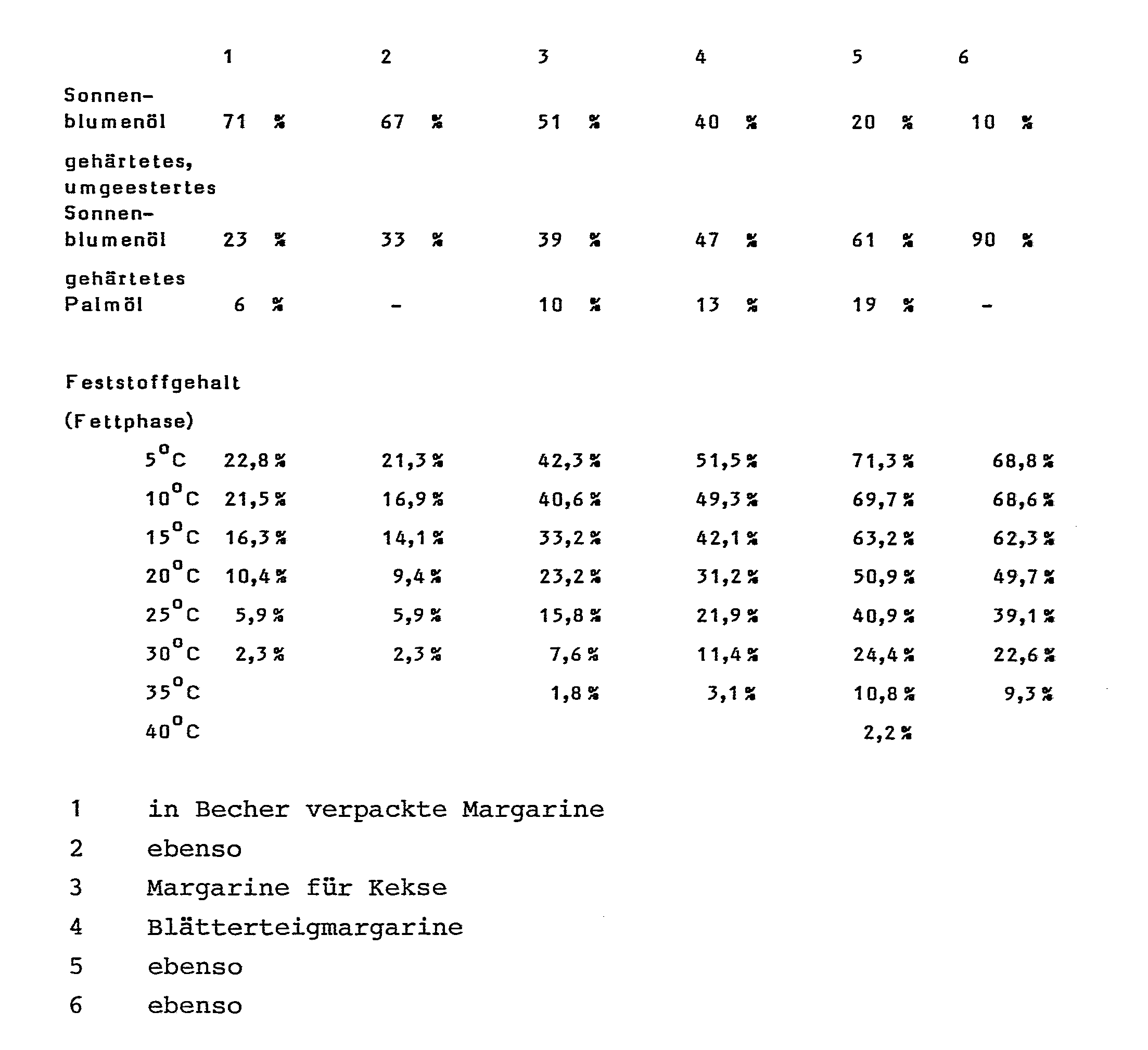
Um die Gebrauchseigenschaften zu vergleichen, wurden die Margarinen 1 bis 6 in herkömmlicher Weise unter Verwendung der Fettmischungen 1 bis 6 hergestellt und untereinander oder mit Testmargarine guter Qualität verglichen. Die den Margarinen zugeordneten Zahlen entsprechen dabei den Zahlen der jeweils verwendeten Fettmischungen.To compare performance characteristics, margarines 1 through 6 were made in a conventional manner using fat blends 1 through 6 and compared with each other or with good quality test margarine. The numbers assigned to the margarines correspond to the numbers of the fat mixtures used in each case.
Die Margarinen 1 und 2 wurden beim Gebrauch und im Geschmack als gleichwertig beurteilt. Die Fettmischung 1 enthielt aber mehr als 45% essentielle Linolsäure.Margarines 1 and 2 were judged to be equivalent in use and taste. Fat mixture 1 contained more than 45% essential linoleic acid.
Die Margarine 3 wurde als einer guten Vergleichsmargarine gleichwertig beurteilt, was sowohl für den Gebrauch als auch für den Geschmack galt.Margarine 3 was judged to be equivalent to a good comparative margarine, both for use and for taste.
Die Margarinen 4 und 5 wurden im Geschmack gleichwertig mit Margarine 6 beurteilt, besaßen aber bessere Anwendungseigenschaften.Margarines 4 and 5 were judged to be equivalent in taste to margarine 6, but had better application properties.
Die in der Beschreibung, dem Beispiel und den Patentansprüchen angegebenen Schmelzpunkte sind Steigschmelzpunkte (vgl. DGF Einheitsmethoden C-IV 3a.(52)).The melting points specified in the description, the example and the claims are rising melting points (cf. DGF standard methods C-IV 3a. (52)).
Claims (10)
Priority Applications (1)
| Application Number | Priority Date | Filing Date | Title |
|---|---|---|---|
| EP85105647A EP0200803A1 (en) | 1985-05-08 | 1985-05-08 | Fat mixture, process for its preparation, its use and margarine containing it |
Applications Claiming Priority (1)
| Application Number | Priority Date | Filing Date | Title |
|---|---|---|---|
| EP85105647A EP0200803A1 (en) | 1985-05-08 | 1985-05-08 | Fat mixture, process for its preparation, its use and margarine containing it |
Publications (1)
| Publication Number | Publication Date |
|---|---|
| EP0200803A1 true EP0200803A1 (en) | 1986-11-12 |
Family
ID=8193488
Family Applications (1)
| Application Number | Title | Priority Date | Filing Date |
|---|---|---|---|
| EP85105647A Withdrawn EP0200803A1 (en) | 1985-05-08 | 1985-05-08 | Fat mixture, process for its preparation, its use and margarine containing it |
Country Status (1)
| Country | Link |
|---|---|
| EP (1) | EP0200803A1 (en) |
Cited By (1)
| Publication number | Priority date | Publication date | Assignee | Title |
|---|---|---|---|---|
| US4996074A (en) * | 1988-11-14 | 1991-02-26 | The Procter & Gamble Company | Tailored beta-prime stable triglyceride hardstock |
Citations (2)
| Publication number | Priority date | Publication date | Assignee | Title |
|---|---|---|---|---|
| US2996388A (en) * | 1959-01-29 | 1961-08-15 | Procter & Gamble | Margarine oil manufacture |
| FR1562284A (en) * | 1967-02-27 | 1969-04-04 |
-
1985
- 1985-05-08 EP EP85105647A patent/EP0200803A1/en not_active Withdrawn
Patent Citations (2)
| Publication number | Priority date | Publication date | Assignee | Title |
|---|---|---|---|---|
| US2996388A (en) * | 1959-01-29 | 1961-08-15 | Procter & Gamble | Margarine oil manufacture |
| FR1562284A (en) * | 1967-02-27 | 1969-04-04 |
Cited By (1)
| Publication number | Priority date | Publication date | Assignee | Title |
|---|---|---|---|---|
| US4996074A (en) * | 1988-11-14 | 1991-02-26 | The Procter & Gamble Company | Tailored beta-prime stable triglyceride hardstock |
Similar Documents
| Publication | Publication Date | Title |
|---|---|---|
| DE69509785T2 (en) | FAT BLEND FOR MARGARINE AND W / O BREADS | |
| DE69504038T2 (en) | Fat mixtures containing diglycerides | |
| DE2705608C2 (en) | Process for the rearrangement of fatty acid residues in fat reactants | |
| DE69505235T2 (en) | DIGLYCERIDE CONTAINING FAT BLENDS | |
| DE69327568T2 (en) | Process for the preparation of a substitute for butterfat or vegetable butter, product and composition thereof | |
| DE69405096T2 (en) | Breast milk substitutes made from transesterified triglyceride mixtures | |
| DE60112179T2 (en) | Hard structure fat without trans content for margarine mixtures and spreads | |
| DE69206512T2 (en) | Manufacturing process of hard fats. | |
| DE1910062C3 (en) | Vegetable margarine fat | |
| DE1692534C3 (en) | Process for the production of a margarine fat | |
| DE2608991C2 (en) | Fat product | |
| DE1045777B (en) | Process for the production of edible suspensions of solid glycerides in liquid glycerides, which are still fluid at a temperature of 16ÒC | |
| DE2448233C3 (en) | Fat composition | |
| DE60024401T2 (en) | Palmitoleic acid and its use in food | |
| DE19632088C2 (en) | Fast crystallizing fat with low trans fatty acid content | |
| DE69103845T2 (en) | Improvement of edible fats. | |
| DE2608990C2 (en) | ||
| DE69803491T2 (en) | WATER-IN-OIL EMULSIFIED FAT COMPOSITION | |
| DE2248921C3 (en) | Process for the production of a mixture of vegetable and animal oils or fats and fatty acid ester esters | |
| DE69504701T2 (en) | METHOD FOR PRODUCING A TRIGLYCERIDE FAT MIXTURE AND PLASTIC BREAD COAT CONTAINING THIS FAT MIXTURE | |
| DE68921372T2 (en) | Butter-like spread. | |
| DE2717602A1 (en) | HYDROGENATED VEGETABLE FAT | |
| DE1692538B2 (en) | Margarine oil | |
| DE2848718C2 (en) | ||
| DE2401945C2 (en) | Fat mixtures, in particular for the production of emulsions, such as margarine |
Legal Events
| Date | Code | Title | Description |
|---|---|---|---|
| PUAI | Public reference made under article 153(3) epc to a published international application that has entered the european phase |
Free format text: ORIGINAL CODE: 0009012 |
|
| AK | Designated contracting states |
Kind code of ref document: A1 Designated state(s): BE CH DE FR GB LI LU NL |
|
| 17P | Request for examination filed |
Effective date: 19870217 |
|
| 17Q | First examination report despatched |
Effective date: 19880627 |
|
| STAA | Information on the status of an ep patent application or granted ep patent |
Free format text: STATUS: THE APPLICATION IS DEEMED TO BE WITHDRAWN |
|
| 18D | Application deemed to be withdrawn |
Effective date: 19890808 |
|
| RIN1 | Information on inventor provided before grant (corrected) |
Inventor name: DIZIER, JACQUES, DIPL.-ING. Inventor name: LEFEBVRE, JACQUES, DR. |