EP0200522B1 - Process for preparing griseolic acid derivatives - Google Patents
Process for preparing griseolic acid derivatives Download PDFInfo
- Publication number
- EP0200522B1 EP0200522B1 EP86303213A EP86303213A EP0200522B1 EP 0200522 B1 EP0200522 B1 EP 0200522B1 EP 86303213 A EP86303213 A EP 86303213A EP 86303213 A EP86303213 A EP 86303213A EP 0200522 B1 EP0200522 B1 EP 0200522B1
- Authority
- EP
- European Patent Office
- Prior art keywords
- group
- groups
- reaction
- compound
- ring
- Prior art date
- Legal status (The legal status is an assumption and is not a legal conclusion. Google has not performed a legal analysis and makes no representation as to the accuracy of the status listed.)
- Expired - Lifetime
Links
- 238000004519 manufacturing process Methods 0.000 title claims description 4
- IAPZXUKYTCQQFE-QZKDJMESSA-N (2r,3r,3as,5s)-2-(6-aminopurin-9-yl)-5-[carboxy(hydroxy)methyl]-3-hydroxy-3,3a-dihydro-2h-furo[3,2-b]furan-5-carboxylic acid Chemical class NC1=NC=NC2=C1N=CN2[C@H]1[C@H](O)[C@@H]2O[C@](C(O)=O)(C(O)C(O)=O)C=C2O1 IAPZXUKYTCQQFE-QZKDJMESSA-N 0.000 title abstract description 24
- 150000001875 compounds Chemical class 0.000 claims abstract description 64
- 125000005843 halogen group Chemical group 0.000 claims abstract description 24
- 125000003710 aryl alkyl group Chemical group 0.000 claims abstract description 18
- 125000000217 alkyl group Chemical group 0.000 claims abstract description 17
- 230000008707 rearrangement Effects 0.000 claims abstract description 8
- 238000003385 ring cleavage reaction Methods 0.000 claims abstract description 3
- 238000005730 ring rearrangement reaction Methods 0.000 claims abstract description 3
- 238000006243 chemical reaction Methods 0.000 claims description 106
- 238000000034 method Methods 0.000 claims description 24
- 125000006239 protecting group Chemical group 0.000 claims description 22
- 125000004435 hydrogen atom Chemical group [H]* 0.000 claims description 11
- 125000002887 hydroxy group Chemical group [H]O* 0.000 claims description 11
- 125000005278 alkyl sulfonyloxy group Chemical group 0.000 claims description 8
- 125000004432 carbon atom Chemical group C* 0.000 claims description 8
- 238000007363 ring formation reaction Methods 0.000 claims description 7
- 125000005279 aryl sulfonyloxy group Chemical group 0.000 claims description 5
- 238000006462 rearrangement reaction Methods 0.000 claims description 5
- 238000007142 ring opening reaction Methods 0.000 claims description 5
- 125000005947 C1-C6 alkylsulfonyloxy group Chemical group 0.000 claims description 4
- 238000010438 heat treatment Methods 0.000 claims description 3
- 125000002496 methyl group Chemical group [H]C([H])([H])* 0.000 claims description 3
- 239000011203 carbon fibre reinforced carbon Substances 0.000 claims description 2
- LJXQPZWIHJMPQQ-UHFFFAOYSA-N pyrimidin-2-amine Chemical group NC1=NC=CC=N1 LJXQPZWIHJMPQQ-UHFFFAOYSA-N 0.000 claims description 2
- 150000003839 salts Chemical class 0.000 claims description 2
- -1 sulfonyloxy Chemical group 0.000 abstract description 81
- 239000002253 acid Substances 0.000 abstract description 25
- IAPZXUKYTCQQFE-UHFFFAOYSA-N Griseolic acid Natural products NC1=NC=NC2=C1N=CN2C1C(O)C2OC(C(O)=O)(C(O)C(O)=O)C=C2O1 IAPZXUKYTCQQFE-UHFFFAOYSA-N 0.000 abstract description 17
- 125000001424 substituent group Chemical group 0.000 abstract description 14
- 125000003277 amino group Chemical group 0.000 abstract description 2
- 229910052757 nitrogen Inorganic materials 0.000 abstract 2
- 229910052736 halogen Inorganic materials 0.000 abstract 1
- IJGRMHOSHXDMSA-UHFFFAOYSA-N nitrogen Substances N#N IJGRMHOSHXDMSA-UHFFFAOYSA-N 0.000 abstract 1
- 238000006798 ring closing metathesis reaction Methods 0.000 abstract 1
- 239000002904 solvent Substances 0.000 description 45
- 239000000203 mixture Substances 0.000 description 31
- HEMHJVSKTPXQMS-UHFFFAOYSA-M Sodium hydroxide Chemical compound [OH-].[Na+] HEMHJVSKTPXQMS-UHFFFAOYSA-M 0.000 description 30
- LFQSCWFLJHTTHZ-UHFFFAOYSA-N Ethanol Chemical compound CCO LFQSCWFLJHTTHZ-UHFFFAOYSA-N 0.000 description 28
- ZMXDDKWLCZADIW-UHFFFAOYSA-N N,N-Dimethylformamide Chemical compound CN(C)C=O ZMXDDKWLCZADIW-UHFFFAOYSA-N 0.000 description 27
- XLYOFNOQVPJJNP-UHFFFAOYSA-N water Substances O XLYOFNOQVPJJNP-UHFFFAOYSA-N 0.000 description 25
- QTBSBXVTEAMEQO-UHFFFAOYSA-N Acetic acid Chemical compound CC(O)=O QTBSBXVTEAMEQO-UHFFFAOYSA-N 0.000 description 24
- CSCPPACGZOOCGX-UHFFFAOYSA-N Acetone Chemical compound CC(C)=O CSCPPACGZOOCGX-UHFFFAOYSA-N 0.000 description 24
- OKKJLVBELUTLKV-UHFFFAOYSA-N Methanol Chemical compound OC OKKJLVBELUTLKV-UHFFFAOYSA-N 0.000 description 21
- 125000003118 aryl group Chemical group 0.000 description 19
- 239000000243 solution Substances 0.000 description 19
- VEXZGXHMUGYJMC-UHFFFAOYSA-N Hydrochloric acid Chemical compound Cl VEXZGXHMUGYJMC-UHFFFAOYSA-N 0.000 description 17
- WEVYAHXRMPXWCK-UHFFFAOYSA-N Acetonitrile Chemical compound CC#N WEVYAHXRMPXWCK-UHFFFAOYSA-N 0.000 description 15
- YXFVVABEGXRONW-UHFFFAOYSA-N Toluene Chemical compound CC1=CC=CC=C1 YXFVVABEGXRONW-UHFFFAOYSA-N 0.000 description 15
- WYURNTSHIVDZCO-UHFFFAOYSA-N Tetrahydrofuran Chemical compound C1CCOC1 WYURNTSHIVDZCO-UHFFFAOYSA-N 0.000 description 14
- 239000000047 product Substances 0.000 description 13
- 125000002252 acyl group Chemical group 0.000 description 12
- 125000003545 alkoxy group Chemical group 0.000 description 12
- 239000007864 aqueous solution Substances 0.000 description 12
- 239000002585 base Substances 0.000 description 11
- 231100000989 no adverse effect Toxicity 0.000 description 11
- 238000001704 evaporation Methods 0.000 description 10
- 125000004453 alkoxycarbonyl group Chemical group 0.000 description 9
- 125000004849 alkoxymethyl group Chemical group 0.000 description 8
- 238000001727 in vivo Methods 0.000 description 8
- 239000011541 reaction mixture Substances 0.000 description 8
- OKTJSMMVPCPJKN-UHFFFAOYSA-N Carbon Chemical compound [C] OKTJSMMVPCPJKN-UHFFFAOYSA-N 0.000 description 7
- 239000003638 chemical reducing agent Substances 0.000 description 7
- 125000001495 ethyl group Chemical group [H]C([H])([H])C([H])([H])* 0.000 description 7
- 230000008020 evaporation Effects 0.000 description 7
- 239000003960 organic solvent Substances 0.000 description 7
- 239000000843 powder Substances 0.000 description 7
- 239000007858 starting material Substances 0.000 description 7
- YLQBMQCUIZJEEH-UHFFFAOYSA-N tetrahydrofuran Natural products C=1C=COC=1 YLQBMQCUIZJEEH-UHFFFAOYSA-N 0.000 description 7
- 125000000229 (C1-C4)alkoxy group Chemical group 0.000 description 6
- RYHBNJHYFVUHQT-UHFFFAOYSA-N 1,4-Dioxane Chemical compound C1COCCO1 RYHBNJHYFVUHQT-UHFFFAOYSA-N 0.000 description 6
- IAZDPXIOMUYVGZ-UHFFFAOYSA-N Dimethylsulphoxide Chemical compound CS(C)=O IAZDPXIOMUYVGZ-UHFFFAOYSA-N 0.000 description 6
- 239000003153 chemical reaction reagent Substances 0.000 description 6
- 150000002170 ethers Chemical class 0.000 description 6
- INQOMBQAUSQDDS-UHFFFAOYSA-N iodomethane Chemical compound IC INQOMBQAUSQDDS-UHFFFAOYSA-N 0.000 description 6
- 238000002360 preparation method Methods 0.000 description 6
- HCHKCACWOHOZIP-UHFFFAOYSA-N Zinc Chemical compound [Zn] HCHKCACWOHOZIP-UHFFFAOYSA-N 0.000 description 5
- 150000001298 alcohols Chemical class 0.000 description 5
- 125000001931 aliphatic group Chemical group 0.000 description 5
- 125000005129 aryl carbonyl group Chemical group 0.000 description 5
- 238000004587 chromatography analysis Methods 0.000 description 5
- 238000004440 column chromatography Methods 0.000 description 5
- 230000000694 effects Effects 0.000 description 5
- 125000003808 silyl group Chemical class [H][Si]([H])([H])[*] 0.000 description 5
- 230000001225 therapeutic effect Effects 0.000 description 5
- JUJWROOIHBZHMG-UHFFFAOYSA-N Pyridine Chemical compound C1=CC=NC=C1 JUJWROOIHBZHMG-UHFFFAOYSA-N 0.000 description 4
- FAPWRFPIFSIZLT-UHFFFAOYSA-M Sodium chloride Chemical compound [Na+].[Cl-] FAPWRFPIFSIZLT-UHFFFAOYSA-M 0.000 description 4
- 150000001408 amides Chemical class 0.000 description 4
- 239000007853 buffer solution Substances 0.000 description 4
- 125000003178 carboxy group Chemical group [H]OC(*)=O 0.000 description 4
- 239000003795 chemical substances by application Substances 0.000 description 4
- 238000007796 conventional method Methods 0.000 description 4
- 239000013078 crystal Substances 0.000 description 4
- 238000001914 filtration Methods 0.000 description 4
- 150000004820 halides Chemical class 0.000 description 4
- 239000012433 hydrogen halide Substances 0.000 description 4
- 229910000039 hydrogen halide Inorganic materials 0.000 description 4
- XMBWDFGMSWQBCA-UHFFFAOYSA-N hydrogen iodide Chemical compound I XMBWDFGMSWQBCA-UHFFFAOYSA-N 0.000 description 4
- 239000002609 medium Substances 0.000 description 4
- 238000001953 recrystallisation Methods 0.000 description 4
- GEHJYWRUCIMESM-UHFFFAOYSA-L sodium sulfite Chemical compound [Na+].[Na+].[O-]S([O-])=O GEHJYWRUCIMESM-UHFFFAOYSA-L 0.000 description 4
- 239000000126 substance Substances 0.000 description 4
- 125000001412 tetrahydropyranyl group Chemical group 0.000 description 4
- 125000004178 (C1-C4) alkyl group Chemical group 0.000 description 3
- WFDIJRYMOXRFFG-UHFFFAOYSA-N Acetic anhydride Chemical compound CC(=O)OC(C)=O WFDIJRYMOXRFFG-UHFFFAOYSA-N 0.000 description 3
- UHOVQNZJYSORNB-UHFFFAOYSA-N Benzene Chemical compound C1=CC=CC=C1 UHOVQNZJYSORNB-UHFFFAOYSA-N 0.000 description 3
- YMWUJEATGCHHMB-UHFFFAOYSA-N Dichloromethane Chemical compound ClCCl YMWUJEATGCHHMB-UHFFFAOYSA-N 0.000 description 3
- RTZKZFJDLAIYFH-UHFFFAOYSA-N Diethyl ether Chemical compound CCOCC RTZKZFJDLAIYFH-UHFFFAOYSA-N 0.000 description 3
- XEKOWRVHYACXOJ-UHFFFAOYSA-N Ethyl acetate Chemical compound CCOC(C)=O XEKOWRVHYACXOJ-UHFFFAOYSA-N 0.000 description 3
- WMFOQBRAJBCJND-UHFFFAOYSA-M Lithium hydroxide Chemical compound [Li+].[OH-] WMFOQBRAJBCJND-UHFFFAOYSA-M 0.000 description 3
- KWYUFKZDYYNOTN-UHFFFAOYSA-M Potassium hydroxide Chemical compound [OH-].[K+] KWYUFKZDYYNOTN-UHFFFAOYSA-M 0.000 description 3
- 230000002411 adverse Effects 0.000 description 3
- 229910052977 alkali metal sulfide Inorganic materials 0.000 description 3
- 125000005092 alkenyloxycarbonyl group Chemical group 0.000 description 3
- 239000003125 aqueous solvent Substances 0.000 description 3
- 125000005098 aryl alkoxy carbonyl group Chemical group 0.000 description 3
- 125000002837 carbocyclic group Chemical group 0.000 description 3
- 125000000118 dimethyl group Chemical group [H]C([H])([H])* 0.000 description 3
- 239000003814 drug Substances 0.000 description 3
- 229940079593 drug Drugs 0.000 description 3
- 125000001153 fluoro group Chemical group F* 0.000 description 3
- 125000001188 haloalkyl group Chemical group 0.000 description 3
- 125000000623 heterocyclic group Chemical group 0.000 description 3
- 238000006460 hydrolysis reaction Methods 0.000 description 3
- 125000000449 nitro group Chemical group [O-][N+](*)=O 0.000 description 3
- 150000007530 organic bases Chemical class 0.000 description 3
- 238000012746 preparative thin layer chromatography Methods 0.000 description 3
- 238000010992 reflux Methods 0.000 description 3
- 238000007086 side reaction Methods 0.000 description 3
- 150000003462 sulfoxides Chemical class 0.000 description 3
- 239000000725 suspension Substances 0.000 description 3
- 125000003718 tetrahydrofuranyl group Chemical group 0.000 description 3
- 125000005958 tetrahydrothienyl group Chemical group 0.000 description 3
- 125000004632 tetrahydrothiopyranyl group Chemical group S1C(CCCC1)* 0.000 description 3
- NWUYHJFMYQTDRP-UHFFFAOYSA-N 1,2-bis(ethenyl)benzene;1-ethenyl-2-ethylbenzene;styrene Chemical compound C=CC1=CC=CC=C1.CCC1=CC=CC=C1C=C.C=CC1=CC=CC=C1C=C NWUYHJFMYQTDRP-UHFFFAOYSA-N 0.000 description 2
- 125000000453 2,2,2-trichloroethyl group Chemical group [H]C([H])(*)C(Cl)(Cl)Cl 0.000 description 2
- YYROPELSRYBVMQ-UHFFFAOYSA-N 4-toluenesulfonyl chloride Chemical compound CC1=CC=C(S(Cl)(=O)=O)C=C1 YYROPELSRYBVMQ-UHFFFAOYSA-N 0.000 description 2
- QGZKDVFQNNGYKY-UHFFFAOYSA-N Ammonia Chemical compound N QGZKDVFQNNGYKY-UHFFFAOYSA-N 0.000 description 2
- CPELXLSAUQHCOX-UHFFFAOYSA-M Bromide Chemical compound [Br-] CPELXLSAUQHCOX-UHFFFAOYSA-M 0.000 description 2
- VTYYLEPIZMXCLO-UHFFFAOYSA-L Calcium carbonate Chemical compound [Ca+2].[O-]C([O-])=O VTYYLEPIZMXCLO-UHFFFAOYSA-L 0.000 description 2
- VEXZGXHMUGYJMC-UHFFFAOYSA-M Chloride anion Chemical compound [Cl-] VEXZGXHMUGYJMC-UHFFFAOYSA-M 0.000 description 2
- HEDRZPFGACZZDS-UHFFFAOYSA-N Chloroform Chemical compound ClC(Cl)Cl HEDRZPFGACZZDS-UHFFFAOYSA-N 0.000 description 2
- IVOMOUWHDPKRLL-KQYNXXCUSA-N Cyclic adenosine monophosphate Chemical compound C([C@H]1O2)OP(O)(=O)O[C@H]1[C@@H](O)[C@@H]2N1C(N=CN=C2N)=C2N=C1 IVOMOUWHDPKRLL-KQYNXXCUSA-N 0.000 description 2
- XTHFKEDIFFGKHM-UHFFFAOYSA-N Dimethoxyethane Chemical compound COCCOC XTHFKEDIFFGKHM-UHFFFAOYSA-N 0.000 description 2
- ROSDSFDQCJNGOL-UHFFFAOYSA-N Dimethylamine Chemical compound CNC ROSDSFDQCJNGOL-UHFFFAOYSA-N 0.000 description 2
- ZHNUHDYFZUAESO-UHFFFAOYSA-N Formamide Chemical compound NC=O ZHNUHDYFZUAESO-UHFFFAOYSA-N 0.000 description 2
- UFHFLCQGNIYNRP-UHFFFAOYSA-N Hydrogen Chemical compound [H][H] UFHFLCQGNIYNRP-UHFFFAOYSA-N 0.000 description 2
- CPELXLSAUQHCOX-UHFFFAOYSA-N Hydrogen bromide Chemical compound Br CPELXLSAUQHCOX-UHFFFAOYSA-N 0.000 description 2
- KFZMGEQAYNKOFK-UHFFFAOYSA-N Isopropanol Chemical compound CC(C)O KFZMGEQAYNKOFK-UHFFFAOYSA-N 0.000 description 2
- BAVYZALUXZFZLV-UHFFFAOYSA-N Methylamine Chemical compound NC BAVYZALUXZFZLV-UHFFFAOYSA-N 0.000 description 2
- LRHPLDYGYMQRHN-UHFFFAOYSA-N N-Butanol Chemical compound CCCCO LRHPLDYGYMQRHN-UHFFFAOYSA-N 0.000 description 2
- PXHVJJICTQNCMI-UHFFFAOYSA-N Nickel Chemical compound [Ni] PXHVJJICTQNCMI-UHFFFAOYSA-N 0.000 description 2
- 229910019142 PO4 Inorganic materials 0.000 description 2
- KDLHZDBZIXYQEI-UHFFFAOYSA-N Palladium Chemical compound [Pd] KDLHZDBZIXYQEI-UHFFFAOYSA-N 0.000 description 2
- 102000004861 Phosphoric Diester Hydrolases Human genes 0.000 description 2
- 108090001050 Phosphoric Diester Hydrolases Proteins 0.000 description 2
- VYPSYNLAJGMNEJ-UHFFFAOYSA-N Silicium dioxide Chemical compound O=[Si]=O VYPSYNLAJGMNEJ-UHFFFAOYSA-N 0.000 description 2
- CDBYLPFSWZWCQE-UHFFFAOYSA-L Sodium Carbonate Chemical compound [Na+].[Na+].[O-]C([O-])=O CDBYLPFSWZWCQE-UHFFFAOYSA-L 0.000 description 2
- QAOWNCQODCNURD-UHFFFAOYSA-N Sulfuric acid Chemical compound OS(O)(=O)=O QAOWNCQODCNURD-UHFFFAOYSA-N 0.000 description 2
- DKGAVHZHDRPRBM-UHFFFAOYSA-N Tert-Butanol Chemical compound CC(C)(C)O DKGAVHZHDRPRBM-UHFFFAOYSA-N 0.000 description 2
- 238000000862 absorption spectrum Methods 0.000 description 2
- 150000007513 acids Chemical class 0.000 description 2
- 229910052783 alkali metal Inorganic materials 0.000 description 2
- 229910000272 alkali metal oxide Inorganic materials 0.000 description 2
- 150000001340 alkali metals Chemical class 0.000 description 2
- 229910001860 alkaline earth metal hydroxide Inorganic materials 0.000 description 2
- 230000029936 alkylation Effects 0.000 description 2
- 238000005804 alkylation reaction Methods 0.000 description 2
- 125000001797 benzyl group Chemical group [H]C1=C([H])C([H])=C(C([H])=C1[H])C([H])([H])* 0.000 description 2
- 235000010633 broth Nutrition 0.000 description 2
- 125000000484 butyl group Chemical group [H]C([*])([H])C([H])([H])C([H])([H])C([H])([H])[H] 0.000 description 2
- 125000001589 carboacyl group Chemical group 0.000 description 2
- 239000003054 catalyst Substances 0.000 description 2
- 239000000460 chlorine Substances 0.000 description 2
- 238000001816 cooling Methods 0.000 description 2
- 125000004093 cyano group Chemical group *C#N 0.000 description 2
- 125000005982 diphenylmethyl group Chemical group [H]C1=C([H])C([H])=C(C([H])=C1[H])C([H])(*)C1=C([H])C([H])=C([H])C([H])=C1[H] 0.000 description 2
- 239000000284 extract Substances 0.000 description 2
- 239000000706 filtrate Substances 0.000 description 2
- 150000002367 halogens Chemical group 0.000 description 2
- GNOIPBMMFNIUFM-UHFFFAOYSA-N hexamethylphosphoric triamide Chemical compound CN(C)P(=O)(N(C)C)N(C)C GNOIPBMMFNIUFM-UHFFFAOYSA-N 0.000 description 2
- 229910052739 hydrogen Inorganic materials 0.000 description 2
- 239000001257 hydrogen Substances 0.000 description 2
- 239000000543 intermediate Substances 0.000 description 2
- 239000003456 ion exchange resin Substances 0.000 description 2
- 229920003303 ion-exchange polymer Polymers 0.000 description 2
- 125000000959 isobutyl group Chemical group [H]C([H])([H])C([H])(C([H])([H])[H])C([H])([H])* 0.000 description 2
- 125000001449 isopropyl group Chemical group [H]C([H])([H])C([H])(*)C([H])([H])[H] 0.000 description 2
- 125000001160 methoxycarbonyl group Chemical group [H]C([H])([H])OC(*)=O 0.000 description 2
- 125000004184 methoxymethyl group Chemical group [H]C([H])([H])OC([H])([H])* 0.000 description 2
- 239000012046 mixed solvent Substances 0.000 description 2
- 238000000655 nuclear magnetic resonance spectrum Methods 0.000 description 2
- 235000021317 phosphate Nutrition 0.000 description 2
- 239000008363 phosphate buffer Substances 0.000 description 2
- BASFCYQUMIYNBI-UHFFFAOYSA-N platinum Chemical compound [Pt] BASFCYQUMIYNBI-UHFFFAOYSA-N 0.000 description 2
- 239000002798 polar solvent Substances 0.000 description 2
- BWHMMNNQKKPAPP-UHFFFAOYSA-L potassium carbonate Chemical compound [K+].[K+].[O-]C([O-])=O BWHMMNNQKKPAPP-UHFFFAOYSA-L 0.000 description 2
- DPLVEEXVKBWGHE-UHFFFAOYSA-N potassium sulfide Chemical compound [S-2].[K+].[K+] DPLVEEXVKBWGHE-UHFFFAOYSA-N 0.000 description 2
- 239000002244 precipitate Substances 0.000 description 2
- 238000000039 preparative column chromatography Methods 0.000 description 2
- BDERNNFJNOPAEC-UHFFFAOYSA-N propan-1-ol Chemical compound CCCO BDERNNFJNOPAEC-UHFFFAOYSA-N 0.000 description 2
- 125000001436 propyl group Chemical group [H]C([*])([H])C([H])([H])C([H])([H])[H] 0.000 description 2
- UMJSCPRVCHMLSP-UHFFFAOYSA-N pyridine Natural products COC1=CC=CN=C1 UMJSCPRVCHMLSP-UHFFFAOYSA-N 0.000 description 2
- 238000006722 reduction reaction Methods 0.000 description 2
- 239000000741 silica gel Substances 0.000 description 2
- 229910002027 silica gel Inorganic materials 0.000 description 2
- 239000011780 sodium chloride Substances 0.000 description 2
- 229910052979 sodium sulfide Inorganic materials 0.000 description 2
- GRVFOGOEDUUMBP-UHFFFAOYSA-N sodium sulfide (anhydrous) Chemical compound [Na+].[Na+].[S-2] GRVFOGOEDUUMBP-UHFFFAOYSA-N 0.000 description 2
- 235000010265 sodium sulphite Nutrition 0.000 description 2
- 238000003756 stirring Methods 0.000 description 2
- 125000000999 tert-butyl group Chemical group [H]C([H])([H])C(*)(C([H])([H])[H])C([H])([H])[H] 0.000 description 2
- FPGGTKZVZWFYPV-UHFFFAOYSA-M tetrabutylammonium fluoride Chemical compound [F-].CCCC[N+](CCCC)(CCCC)CCCC FPGGTKZVZWFYPV-UHFFFAOYSA-M 0.000 description 2
- DLYUQMMRRRQYAE-UHFFFAOYSA-N tetraphosphorus decaoxide Chemical compound O1P(O2)(=O)OP3(=O)OP1(=O)OP2(=O)O3 DLYUQMMRRRQYAE-UHFFFAOYSA-N 0.000 description 2
- JOXIMZWYDAKGHI-UHFFFAOYSA-N toluene-4-sulfonic acid Chemical compound CC1=CC=C(S(O)(=O)=O)C=C1 JOXIMZWYDAKGHI-UHFFFAOYSA-N 0.000 description 2
- 231100000419 toxicity Toxicity 0.000 description 2
- 230000001988 toxicity Effects 0.000 description 2
- DBGVGMSCBYYSLD-UHFFFAOYSA-N tributylstannane Chemical compound CCCC[SnH](CCCC)CCCC DBGVGMSCBYYSLD-UHFFFAOYSA-N 0.000 description 2
- GETQZCLCWQTVFV-UHFFFAOYSA-N trimethylamine Chemical compound CN(C)C GETQZCLCWQTVFV-UHFFFAOYSA-N 0.000 description 2
- 125000000026 trimethylsilyl group Chemical group [H]C([H])([H])[Si]([*])(C([H])([H])[H])C([H])([H])[H] 0.000 description 2
- CSRZQMIRAZTJOY-UHFFFAOYSA-N trimethylsilyl iodide Chemical compound C[Si](C)(C)I CSRZQMIRAZTJOY-UHFFFAOYSA-N 0.000 description 2
- RIOQSEWOXXDEQQ-UHFFFAOYSA-N triphenylphosphine Chemical compound C1=CC=CC=C1P(C=1C=CC=CC=1)C1=CC=CC=C1 RIOQSEWOXXDEQQ-UHFFFAOYSA-N 0.000 description 2
- 125000002221 trityl group Chemical group [H]C1=C([H])C([H])=C([H])C([H])=C1C([*])(C1=C(C(=C(C(=C1[H])[H])[H])[H])[H])C1=C([H])C([H])=C([H])C([H])=C1[H] 0.000 description 2
- 238000005406 washing Methods 0.000 description 2
- 229910052725 zinc Inorganic materials 0.000 description 2
- 239000011701 zinc Substances 0.000 description 2
- 125000004765 (C1-C4) haloalkyl group Chemical group 0.000 description 1
- 125000006656 (C2-C4) alkenyl group Chemical group 0.000 description 1
- ALNMIZPLJQILKN-UHFFFAOYSA-N 1-(aminodiazenyl)-4-methylbenzene Chemical class CC1=CC=C(NN=N)C=C1 ALNMIZPLJQILKN-UHFFFAOYSA-N 0.000 description 1
- CERXDWLUWLFFEK-UHFFFAOYSA-N 1-chloroethyl methyl carbonate Chemical compound COC(=O)OC(C)Cl CERXDWLUWLFFEK-UHFFFAOYSA-N 0.000 description 1
- UTQNKKSJPHTPBS-UHFFFAOYSA-N 2,2,2-trichloroethanone Chemical group ClC(Cl)(Cl)[C]=O UTQNKKSJPHTPBS-UHFFFAOYSA-N 0.000 description 1
- YQTCQNIPQMJNTI-UHFFFAOYSA-N 2,2-dimethylpropan-1-one Chemical group CC(C)(C)[C]=O YQTCQNIPQMJNTI-UHFFFAOYSA-N 0.000 description 1
- 125000005999 2-bromoethyl group Chemical group 0.000 description 1
- 125000001340 2-chloroethyl group Chemical group [H]C([H])(Cl)C([H])([H])* 0.000 description 1
- 125000004777 2-fluoroethyl group Chemical group [H]C([H])(F)C([H])([H])* 0.000 description 1
- 125000005806 3,4,5-trimethoxybenzyl group Chemical group [H]C1=C(OC([H])([H])[H])C(OC([H])([H])[H])=C(OC([H])([H])[H])C([H])=C1C([H])([H])* 0.000 description 1
- GWFALVUXAGYMHR-UHFFFAOYSA-N 4-(bromomethyl)-5-methyl-1,3-dioxol-2-one Chemical compound CC=1OC(=O)OC=1CBr GWFALVUXAGYMHR-UHFFFAOYSA-N 0.000 description 1
- 125000000242 4-chlorobenzoyl group Chemical group ClC1=CC=C(C(=O)*)C=C1 0.000 description 1
- QTBSBXVTEAMEQO-UHFFFAOYSA-M Acetate Chemical compound CC([O-])=O QTBSBXVTEAMEQO-UHFFFAOYSA-M 0.000 description 1
- 229930024421 Adenine Natural products 0.000 description 1
- GFFGJBXGBJISGV-UHFFFAOYSA-N Adenine Chemical compound NC1=NC=NC2=C1N=CN2 GFFGJBXGBJISGV-UHFFFAOYSA-N 0.000 description 1
- ATRRKUHOCOJYRX-UHFFFAOYSA-N Ammonium bicarbonate Chemical compound [NH4+].OC([O-])=O ATRRKUHOCOJYRX-UHFFFAOYSA-N 0.000 description 1
- 229910000013 Ammonium bicarbonate Inorganic materials 0.000 description 1
- BTBUEUYNUDRHOZ-UHFFFAOYSA-N Borate Chemical compound [O-]B([O-])[O-] BTBUEUYNUDRHOZ-UHFFFAOYSA-N 0.000 description 1
- WKBOTKDWSSQWDR-UHFFFAOYSA-N Bromine atom Chemical group [Br] WKBOTKDWSSQWDR-UHFFFAOYSA-N 0.000 description 1
- KZBUYRJDOAKODT-UHFFFAOYSA-N Chlorine Chemical compound ClCl KZBUYRJDOAKODT-UHFFFAOYSA-N 0.000 description 1
- YXHKONLOYHBTNS-UHFFFAOYSA-N Diazomethane Chemical compound C=[N+]=[N-] YXHKONLOYHBTNS-UHFFFAOYSA-N 0.000 description 1
- BUDQDWGNQVEFAC-UHFFFAOYSA-N Dihydropyran Chemical compound C1COC=CC1 BUDQDWGNQVEFAC-UHFFFAOYSA-N 0.000 description 1
- WQZGKKKJIJFFOK-GASJEMHNSA-N Glucose Natural products OC[C@H]1OC(O)[C@H](O)[C@@H](O)[C@@H]1O WQZGKKKJIJFFOK-GASJEMHNSA-N 0.000 description 1
- 239000012359 Methanesulfonyl chloride Substances 0.000 description 1
- FXHOOIRPVKKKFG-UHFFFAOYSA-N N,N-Dimethylacetamide Chemical compound CN(C)C(C)=O FXHOOIRPVKKKFG-UHFFFAOYSA-N 0.000 description 1
- 241000364057 Peoria Species 0.000 description 1
- 235000019764 Soybean Meal Nutrition 0.000 description 1
- 241000187747 Streptomyces Species 0.000 description 1
- 241000970978 Streptomyces griseoaurantiacus Species 0.000 description 1
- ITLHXEGAYQFOHJ-UHFFFAOYSA-N [diazo(phenyl)methyl]benzene Chemical compound C=1C=CC=CC=1C(=[N+]=[N-])C1=CC=CC=C1 ITLHXEGAYQFOHJ-UHFFFAOYSA-N 0.000 description 1
- WETWJCDKMRHUPV-UHFFFAOYSA-N acetyl chloride Chemical compound CC(Cl)=O WETWJCDKMRHUPV-UHFFFAOYSA-N 0.000 description 1
- 239000012346 acetyl chloride Substances 0.000 description 1
- 125000002777 acetyl group Chemical group [H]C([H])([H])C(*)=O 0.000 description 1
- 150000008065 acid anhydrides Chemical class 0.000 description 1
- 230000002378 acidificating effect Effects 0.000 description 1
- 150000001266 acyl halides Chemical class 0.000 description 1
- 230000010933 acylation Effects 0.000 description 1
- 238000005917 acylation reaction Methods 0.000 description 1
- 125000005042 acyloxymethyl group Chemical group 0.000 description 1
- 229960000643 adenine Drugs 0.000 description 1
- 238000005273 aeration Methods 0.000 description 1
- 238000013019 agitation Methods 0.000 description 1
- 150000007933 aliphatic carboxylic acids Chemical class 0.000 description 1
- 150000001338 aliphatic hydrocarbons Chemical class 0.000 description 1
- 229910000288 alkali metal carbonate Inorganic materials 0.000 description 1
- 150000008041 alkali metal carbonates Chemical class 0.000 description 1
- 238000005904 alkaline hydrolysis reaction Methods 0.000 description 1
- 125000003342 alkenyl group Chemical group 0.000 description 1
- 150000003973 alkyl amines Chemical class 0.000 description 1
- 239000002168 alkylating agent Substances 0.000 description 1
- 230000002152 alkylating effect Effects 0.000 description 1
- 125000005530 alkylenedioxy group Chemical group 0.000 description 1
- 229910021529 ammonia Inorganic materials 0.000 description 1
- 235000012538 ammonium bicarbonate Nutrition 0.000 description 1
- 239000001099 ammonium carbonate Substances 0.000 description 1
- 239000003146 anticoagulant agent Substances 0.000 description 1
- 239000002246 antineoplastic agent Substances 0.000 description 1
- 229960004676 antithrombotic agent Drugs 0.000 description 1
- 239000012435 aralkylating agent Substances 0.000 description 1
- 150000004945 aromatic hydrocarbons Chemical class 0.000 description 1
- 125000004104 aryloxy group Chemical group 0.000 description 1
- QVGXLLKOCUKJST-UHFFFAOYSA-N atomic oxygen Chemical compound [O] QVGXLLKOCUKJST-UHFFFAOYSA-N 0.000 description 1
- AQIHMSVIAGNIDM-UHFFFAOYSA-N benzoyl bromide Chemical compound BrC(=O)C1=CC=CC=C1 AQIHMSVIAGNIDM-UHFFFAOYSA-N 0.000 description 1
- 125000003236 benzoyl group Chemical group [H]C1=C([H])C([H])=C(C([H])=C1[H])C(*)=O 0.000 description 1
- AGEZXYOZHKGVCM-UHFFFAOYSA-N benzyl bromide Chemical compound BrCC1=CC=CC=C1 AGEZXYOZHKGVCM-UHFFFAOYSA-N 0.000 description 1
- 125000001584 benzyloxycarbonyl group Chemical group C(=O)(OCC1=CC=CC=C1)* 0.000 description 1
- 239000011230 binding agent Substances 0.000 description 1
- 238000009835 boiling Methods 0.000 description 1
- 125000001246 bromo group Chemical group Br* 0.000 description 1
- NHYXMAKLBXBVEO-UHFFFAOYSA-N bromomethyl acetate Chemical compound CC(=O)OCBr NHYXMAKLBXBVEO-UHFFFAOYSA-N 0.000 description 1
- YXASHNSJWVCWQQ-UHFFFAOYSA-N bromomethyl propanoate Chemical compound CCC(=O)OCBr YXASHNSJWVCWQQ-UHFFFAOYSA-N 0.000 description 1
- 239000000872 buffer Substances 0.000 description 1
- 125000004063 butyryl group Chemical group O=C([*])C([H])([H])C([H])([H])C([H])([H])[H] 0.000 description 1
- 239000006227 byproduct Substances 0.000 description 1
- 229910000019 calcium carbonate Inorganic materials 0.000 description 1
- AXCZMVOFGPJBDE-UHFFFAOYSA-L calcium dihydroxide Chemical compound [OH-].[OH-].[Ca+2] AXCZMVOFGPJBDE-UHFFFAOYSA-L 0.000 description 1
- 239000000920 calcium hydroxide Substances 0.000 description 1
- 229910001861 calcium hydroxide Inorganic materials 0.000 description 1
- 229940041514 candida albicans extract Drugs 0.000 description 1
- 229910052799 carbon Inorganic materials 0.000 description 1
- 125000002843 carboxylic acid group Chemical group 0.000 description 1
- 238000010531 catalytic reduction reaction Methods 0.000 description 1
- 230000002490 cerebral effect Effects 0.000 description 1
- 239000007810 chemical reaction solvent Substances 0.000 description 1
- 229910052801 chlorine Inorganic materials 0.000 description 1
- 125000002668 chloroacetyl group Chemical group ClCC(=O)* 0.000 description 1
- GGRHYQCXXYLUTL-UHFFFAOYSA-N chloromethyl 2,2-dimethylpropanoate Chemical compound CC(C)(C)C(=O)OCCl GGRHYQCXXYLUTL-UHFFFAOYSA-N 0.000 description 1
- SMJYMSAPPGLBAR-UHFFFAOYSA-N chloromethyl acetate Chemical compound CC(=O)OCCl SMJYMSAPPGLBAR-UHFFFAOYSA-N 0.000 description 1
- 239000007979 citrate buffer Substances 0.000 description 1
- 239000012141 concentrate Substances 0.000 description 1
- 238000000354 decomposition reaction Methods 0.000 description 1
- 150000008049 diazo compounds Chemical class 0.000 description 1
- 235000014113 dietary fatty acids Nutrition 0.000 description 1
- 238000002845 discoloration Methods 0.000 description 1
- 239000012153 distilled water Substances 0.000 description 1
- 239000002934 diuretic Substances 0.000 description 1
- 229940030606 diuretics Drugs 0.000 description 1
- 238000001035 drying Methods 0.000 description 1
- 230000008030 elimination Effects 0.000 description 1
- 238000003379 elimination reaction Methods 0.000 description 1
- 239000003480 eluent Substances 0.000 description 1
- 238000010828 elution Methods 0.000 description 1
- 238000005516 engineering process Methods 0.000 description 1
- 230000032050 esterification Effects 0.000 description 1
- 238000005886 esterification reaction Methods 0.000 description 1
- 150000002148 esters Chemical class 0.000 description 1
- 125000003754 ethoxycarbonyl group Chemical group C(=O)(OCC)* 0.000 description 1
- 125000005745 ethoxymethyl group Chemical group [H]C([H])([H])C([H])([H])OC([H])([H])* 0.000 description 1
- BDHXJIRTSWHBPR-UHFFFAOYSA-N ethyl 1-iodoethyl carbonate Chemical compound CCOC(=O)OC(C)I BDHXJIRTSWHBPR-UHFFFAOYSA-N 0.000 description 1
- 239000000194 fatty acid Substances 0.000 description 1
- 229930195729 fatty acid Natural products 0.000 description 1
- 150000004665 fatty acids Chemical class 0.000 description 1
- 238000000855 fermentation Methods 0.000 description 1
- 230000004151 fermentation Effects 0.000 description 1
- 125000000524 functional group Chemical group 0.000 description 1
- 239000008103 glucose Substances 0.000 description 1
- 239000001963 growth medium Substances 0.000 description 1
- 150000008282 halocarbons Chemical class 0.000 description 1
- 125000005842 heteroatom Chemical group 0.000 description 1
- 150000002391 heterocyclic compounds Chemical class 0.000 description 1
- 125000004051 hexyl group Chemical group [H]C([H])([H])C([H])([H])C([H])([H])C([H])([H])C([H])([H])C([H])([H])* 0.000 description 1
- 229910000042 hydrogen bromide Inorganic materials 0.000 description 1
- IXCSERBJSXMMFS-UHFFFAOYSA-N hydrogen chloride Substances Cl.Cl IXCSERBJSXMMFS-UHFFFAOYSA-N 0.000 description 1
- 229910000041 hydrogen chloride Inorganic materials 0.000 description 1
- 229910000043 hydrogen iodide Inorganic materials 0.000 description 1
- 230000007062 hydrolysis Effects 0.000 description 1
- 125000004356 hydroxy functional group Chemical group O* 0.000 description 1
- 239000012442 inert solvent Substances 0.000 description 1
- 239000002198 insoluble material Substances 0.000 description 1
- 239000013067 intermediate product Substances 0.000 description 1
- PNDPGZBMCMUPRI-UHFFFAOYSA-N iodine Chemical compound II PNDPGZBMCMUPRI-UHFFFAOYSA-N 0.000 description 1
- 125000005929 isobutyloxycarbonyl group Chemical group [H]C([H])([H])C([H])(C([H])([H])[H])C([H])([H])OC(*)=O 0.000 description 1
- 238000002955 isolation Methods 0.000 description 1
- 150000002576 ketones Chemical class 0.000 description 1
- 229910052744 lithium Inorganic materials 0.000 description 1
- 238000012423 maintenance Methods 0.000 description 1
- 239000000463 material Substances 0.000 description 1
- 235000013372 meat Nutrition 0.000 description 1
- 238000002844 melting Methods 0.000 description 1
- 230000008018 melting Effects 0.000 description 1
- QARBMVPHQWIHKH-UHFFFAOYSA-N methanesulfonyl chloride Chemical compound CS(Cl)(=O)=O QARBMVPHQWIHKH-UHFFFAOYSA-N 0.000 description 1
- XELZGAJCZANUQH-UHFFFAOYSA-N methyl 1-acetylthieno[3,2-c]pyrazole-5-carboxylate Chemical compound CC(=O)N1N=CC2=C1C=C(C(=O)OC)S2 XELZGAJCZANUQH-UHFFFAOYSA-N 0.000 description 1
- 244000005700 microbiome Species 0.000 description 1
- 239000012452 mother liquor Substances 0.000 description 1
- PSHKMPUSSFXUIA-UHFFFAOYSA-N n,n-dimethylpyridin-2-amine Chemical compound CN(C)C1=CC=CC=N1 PSHKMPUSSFXUIA-UHFFFAOYSA-N 0.000 description 1
- 229930014626 natural product Natural products 0.000 description 1
- 239000003076 neurotropic agent Substances 0.000 description 1
- 229910052759 nickel Inorganic materials 0.000 description 1
- 150000002825 nitriles Chemical class 0.000 description 1
- 231100000252 nontoxic Toxicity 0.000 description 1
- 230000003000 nontoxic effect Effects 0.000 description 1
- 150000007524 organic acids Chemical class 0.000 description 1
- 235000005985 organic acids Nutrition 0.000 description 1
- 229910052760 oxygen Inorganic materials 0.000 description 1
- 239000001301 oxygen Substances 0.000 description 1
- 125000006505 p-cyanobenzyl group Chemical group [H]C1=C([H])C(=C([H])C([H])=C1C#N)C([H])([H])* 0.000 description 1
- 125000003232 p-nitrobenzoyl group Chemical group [N+](=O)([O-])C1=CC=C(C(=O)*)C=C1 0.000 description 1
- 125000006503 p-nitrobenzyl group Chemical group [H]C1=C([H])C(=C([H])C([H])=C1[N+]([O-])=O)C([H])([H])* 0.000 description 1
- 125000005440 p-toluyl group Chemical group [H]C1=C([H])C(=C([H])C([H])=C1C(*)=O)C([H])([H])[H] 0.000 description 1
- 229910052763 palladium Inorganic materials 0.000 description 1
- 125000001147 pentyl group Chemical group C(CCCC)* 0.000 description 1
- UYWQUFXKFGHYNT-UHFFFAOYSA-N phenylmethyl ester of formic acid Natural products O=COCC1=CC=CC=C1 UYWQUFXKFGHYNT-UHFFFAOYSA-N 0.000 description 1
- NBIIXXVUZAFLBC-UHFFFAOYSA-K phosphate Chemical compound [O-]P([O-])([O-])=O NBIIXXVUZAFLBC-UHFFFAOYSA-K 0.000 description 1
- 239000010452 phosphate Substances 0.000 description 1
- XNGIFLGASWRNHJ-UHFFFAOYSA-L phthalate(2-) Chemical compound [O-]C(=O)C1=CC=CC=C1C([O-])=O XNGIFLGASWRNHJ-UHFFFAOYSA-L 0.000 description 1
- 125000005633 phthalidyl group Chemical group 0.000 description 1
- 125000004591 piperonyl group Chemical group C(C1=CC=2OCOC2C=C1)* 0.000 description 1
- 229910052697 platinum Inorganic materials 0.000 description 1
- 229920001467 poly(styrenesulfonates) Polymers 0.000 description 1
- 229910000027 potassium carbonate Inorganic materials 0.000 description 1
- 125000001501 propionyl group Chemical group O=C([*])C([H])([H])C([H])([H])[H] 0.000 description 1
- 125000005767 propoxymethyl group Chemical group [H]C([H])([H])C([H])([H])C([H])([H])[#8]C([H])([H])* 0.000 description 1
- 239000004089 psychotropic agent Substances 0.000 description 1
- 230000000506 psychotropic effect Effects 0.000 description 1
- 125000000714 pyrimidinyl group Chemical group 0.000 description 1
- 238000011084 recovery Methods 0.000 description 1
- 239000011347 resin Substances 0.000 description 1
- 229920005989 resin Polymers 0.000 description 1
- 125000006413 ring segment Chemical group 0.000 description 1
- 125000002914 sec-butyl group Chemical group [H]C([H])([H])C([H])([H])C([H])(*)C([H])([H])[H] 0.000 description 1
- 239000000050 smooth muscle relaxant Substances 0.000 description 1
- 229910000029 sodium carbonate Inorganic materials 0.000 description 1
- 239000004455 soybean meal Substances 0.000 description 1
- 230000001954 sterilising effect Effects 0.000 description 1
- 238000004659 sterilization and disinfection Methods 0.000 description 1
- 239000000758 substrate Substances 0.000 description 1
- 150000003461 sulfonyl halides Chemical class 0.000 description 1
- 230000006103 sulfonylation Effects 0.000 description 1
- 238000005694 sulfonylation reaction Methods 0.000 description 1
- 229910052717 sulfur Inorganic materials 0.000 description 1
- 239000011593 sulfur Substances 0.000 description 1
- ILMRJRBKQSSXGY-UHFFFAOYSA-N tert-butyl(dimethyl)silicon Chemical group C[Si](C)C(C)(C)C ILMRJRBKQSSXGY-UHFFFAOYSA-N 0.000 description 1
- 125000004187 tetrahydropyran-2-yl group Chemical group [H]C1([H])OC([H])(*)C([H])([H])C([H])([H])C1([H])[H] 0.000 description 1
- 238000004809 thin layer chromatography Methods 0.000 description 1
- 125000004665 trialkylsilyl group Chemical group 0.000 description 1
- DQWPFSLDHJDLRL-UHFFFAOYSA-N triethyl phosphate Chemical compound CCOP(=O)(OCC)OCC DQWPFSLDHJDLRL-UHFFFAOYSA-N 0.000 description 1
- 125000004044 trifluoroacetyl group Chemical group FC(C(=O)*)(F)F 0.000 description 1
- GRGCWBWNLSTIEN-UHFFFAOYSA-N trifluoromethanesulfonyl chloride Chemical compound FC(F)(F)S(Cl)(=O)=O GRGCWBWNLSTIEN-UHFFFAOYSA-N 0.000 description 1
- 125000005951 trifluoromethanesulfonyloxy group Chemical group 0.000 description 1
- 125000000025 triisopropylsilyl group Chemical group C(C)(C)[Si](C(C)C)(C(C)C)* 0.000 description 1
- 125000003774 valeryl group Chemical group O=C([*])C([H])([H])C([H])([H])C([H])([H])C([H])([H])[H] 0.000 description 1
- 239000012138 yeast extract Substances 0.000 description 1
Classifications
-
- C—CHEMISTRY; METALLURGY
- C07—ORGANIC CHEMISTRY
- C07H—SUGARS; DERIVATIVES THEREOF; NUCLEOSIDES; NUCLEOTIDES; NUCLEIC ACIDS
- C07H19/00—Compounds containing a hetero ring sharing one ring hetero atom with a saccharide radical; Nucleosides; Mononucleotides; Anhydro-derivatives thereof
- C07H19/02—Compounds containing a hetero ring sharing one ring hetero atom with a saccharide radical; Nucleosides; Mononucleotides; Anhydro-derivatives thereof sharing nitrogen
-
- Y—GENERAL TAGGING OF NEW TECHNOLOGICAL DEVELOPMENTS; GENERAL TAGGING OF CROSS-SECTIONAL TECHNOLOGIES SPANNING OVER SEVERAL SECTIONS OF THE IPC; TECHNICAL SUBJECTS COVERED BY FORMER USPC CROSS-REFERENCE ART COLLECTIONS [XRACs] AND DIGESTS
- Y02—TECHNOLOGIES OR APPLICATIONS FOR MITIGATION OR ADAPTATION AGAINST CLIMATE CHANGE
- Y02P—CLIMATE CHANGE MITIGATION TECHNOLOGIES IN THE PRODUCTION OR PROCESSING OF GOODS
- Y02P20/00—Technologies relating to chemical industry
- Y02P20/50—Improvements relating to the production of bulk chemicals
- Y02P20/55—Design of synthesis routes, e.g. reducing the use of auxiliary or protecting groups
Definitions
- the present invention relates to a novel process for preparing certain griseolic acid derivatives, which process enables the derivatives to be prepared in a high yield and by means of a simple process.
- Griseolic acid is a nucleoside-type compound having an adenine base and two carboxylic acid groups. It was first disclosed in, inter alia, European Patent Specification No. 29,329A, and subsequently its structure was disclosed in US Patent Specification No. 4,460,765.
- the general class of griseolic acid derivatives and especially the N s- alkyl and N6-aralkyl griseolic acid derivatives, are non-toxic and have a variety of valuable therapeutic activities arising primarily from their abilities to inhibit the activity of phosphodiesterases (PDE) of, for example, cyclic adenosine monophosphate (cAMP).
- PDE phosphodiesterases
- cAMP cyclic adenosine monophosphate
- they have shown the potential to be used as ameliorators of cerebral function, as angiocardiokinetic agents, as antithrombotic agents, as diuretics, as psychotropic and neurotropic agents, as smooth muscle relaxants and as anticancer agents.
- drugs should be capable of preparation at a cost at most commensurate with their therapeutic value and preferably as cheaply as possible.
- a drug is prepared by a multi-stage sequence of reactions or in low yield, there is always an increased danger that the drug may be contaminated by by-products which may be difficult or impossible to remove, and its value may thereby be degraded.
- the compounds prepared by the process of the present invention are those compounds of formula (I): wherein:
- the process of the present invention comprises reacting a compound of formula (II): (in which Ri, R2, R3, R4, R5 and R6 are as defined above) with a compound of formula (III): (in which: R 7 is as defined above; and X represents a halogen atom, a C 1 -C 6 alkylsulfonyloxy group, a fluorinated C 1 -C 6 alkylsulfonyloxy group, an arylsulfonyloxy group or a C 1 -C 6 alkylsulfonyloxy group), subjecting the aminopyrimidine ring of the product to ring cleavage, rearrangement and ring formation and, if desired, removing any protecting group and, if desired, salifying the product.
- the process of the present invention may be represented by the reaction shown in the following scheme: (in which R i- R 7 and X are as defined above) followed, if necessary, by removal of protecting groups and/or salification.
- Ri, R2, R3 or R4 represents a protecting or protected group
- the nature of such a group is not critical to the present invention.
- the final products of formula (I) are themselves to be used directly for therapeutic purposes, and where such a protecting group remains in the product of formula (I), it is, of course, necessary that the protecting group should not adversely affect the therapeutic value of the compounds (for example by either reducing their activity or increasing their toxicity to an unacceptable extent).
- protecting groups may easily be removed in the final step of the reaction sequence (as described in more detail hereafter).
- the protecting groups employed may be pharmaceutically acceptable and, in that case, the resulting compounds of formula (I) may be used directly for therapeutic purposes.
- the compounds of formula (I) are themselves to be employed as intermediates in the preparation of yet other griseolic acid derivatives, it may be unnecessary to remove protecting groups and the nature of such protecting groups will not be critical.
- R 1 or R 2 represents, respectively, a hydroxy-protecting group or a protected hydroxy group
- suitable hydroxy-protecting groups include aliphatic acyl groups, aromatic acyl groups, heterocyclic groups, tri-substituted silyl groups, lower alkyl groups, lower alkoxymethyl groups, substituted ethyl groups, aralkyl groups, lower alkoxycarbonyl groups, lower alkenyloxycarbonyl groups and protecting groups which are easily hydrolized in vivo.
- the hydroxy-protecting group is an aliphatic acyl group
- this is a carboxylic acyl group preferably having up to 6 carbon atoms and is more preferably an alkanoyl or alkenoyl group having up to 6, preferably up to 5, carbon atoms, which group may be unsubstituted or may have at least one substituent selected from the group consisting of halogen atoms, C 1 -C 4 alkoxy groups and aryloxy groups.
- Examples include the acetyl, chloroacetyl, dichloroacetyl, trichloroacetyl, trifluoroacetyl, methoxyacetyl, propionyl, butyryl, (E)-2-methyl-2-butenoyl, isobutyryl, valeryl, isovaleryl and pivaloyl groups.
- the hydroxy-protecting group is an aromatic acyl group
- this is preferably an arylcarbonyl group
- the aryl part is preferably a C 6 -C 14 , more preferably C 6 -C 10 , carbocyclic aryl group, which may be unsubstituted or may have at least one substituent selected from the group consisting of halogen atoms, C 1 -C 4 alkyl groups, C l -C 4 alkoxy groups, aryl groups (which themselves are as defined in relation to the aryl groups of these arylcarbonyl groups), C 1 -C 4 haloalkyl groups, C 2 -Cs alkoxycarbonyl groups, cyano groups and nitro groups.
- aromatic acyl groups include the benzoyl, o-(dibromomethyl)benzoyl, o-(methoxycarbonyl)benzoyl, p-phenylbenzoyl, 2,4,6-triniethylbenzoyl, p-toluoyl, p-anisoyl, p-chlorobenzoyl, p-nitrobenzoyl, o-nitrobenzoyl and a-naphthoyl groups.
- the hydroxy-protecting group is a heterocyclic group
- this is preferably such a group containing a single oxygen or sulfur hetero-atom and having 5 or 6 ring atoms (including the hetero-atom), for example a tetrahydrofuryl, tetrahydrothienyl, tetrahydropyranyl or tetrahydrothiopyranyl group.
- This may be unsubstituted or may have at least one substituent selected from the group consisting of the substituents defined above in relation to substituents on aryl groups, preferably halogen atoms or C 1 -C 4 alkoxy groups.
- tetrahydropyranyl, tetrahydrothiopyranyl, tetrahydrofuryl and tetrahydrothienyl groups are preferred.
- examples of such groups include the tetrahydropyran-2-yl, 3-bromotetrahydropyran-2-yl, 4-methoxytetrahydropyran-4-yl, tetrahydrothiopyran-2-yl and 4-methoxytetrahydrothiopyran-4-yl groups.
- the substituents which may be the same or different, are preferably C i -C 4 alkyl groups and examples of such substituted silyl groups include the trimethylsilyl, triethylsilyl, isopropyldimethylsilyl, t-butyldimethylsilyl, diisopropylmethylsilyl, methyldi-t-butylsilyl and triisopropylsilyl groups.
- hydroxy-protecting groups are lower alkyl groups, these preferably have from 1 to 6 carbon atoms and may be straight or branched chain groups. Examples include the methyl, ethyl, propyl, isopropyl, butyl, isobutyl, sec-butyl, t-butyl, pentyl and hexyl groups.
- the hydroxy-protecting group is a lower alkoxymethyl group
- this may be a mono-alkoxymethyl or di-alkoxymethyl group and the alkoxy part is preferably a C 1 -C 6 , more preferably C 1 -C 4 , alkoxy group which may be unsubstituted or have at least one substituent selected from the group consisting of C 1 -C 4 alkoxy groups and halogen atoms.
- alkoxymethyl groups include the methoxymethyl, t-butoxymethyl, 2-methoxyethoxymethyl, 2,2,2-trichloroethoxymethyl and bis(2-chloroethoxy)methyl groups.
- the ethyl group may have one or more, preferably from 1 to 3, substituents selected from the group consisting of Ci-C 4 alkoxy groups, C 1 -C 4 alkyl groups, halogen atoms, C 1 -C 4 alkylselenyl and arylselenyl groups (in which the aryl part is as defined in relation to the aryl parts of arylcarbonyl groups above).
- substituents selected from the group consisting of Ci-C 4 alkoxy groups, C 1 -C 4 alkyl groups, halogen atoms, C 1 -C 4 alkylselenyl and arylselenyl groups (in which the aryl part is as defined in relation to the aryl parts of arylcarbonyl groups above).
- Examples include the 1-ethoxyethyl, 1-methyl-1-methoxyethyl, 1-isopropoxyethyl, 2,2,2-trichloroethyl and 2-phenyls
- hydroxy-protecting group is an aralkyl group
- this may be a monoaryl-alkyl group, a diaryl-alkyl group or a triaryl-alkyl group.
- Each aryl part is preferably a C 6 -C 14 , more preferably C 6 -C 10 , carbocyclic aryl group and is as defined above in relation to the aryl groups of arylcarbonyl groups. It is preferably unsubstituted or has at least one substituent selected from the group consisting of C l -C 4 alkyl groups, C 1 -C 4 alkoxy groups, halogen atoms, nitro groups and cyano groups.
- the alkyl part is a straight or branched chain group preferably having from 1 to 4, more preferably 1 to 3 and most preferably 1 or 2, carbon atoms.
- aralkyl groups include the benzyl, p-methoxybenzyl, o-nitrobenzyl, g-nitrobenzyl, p-halobenzyl (where the halo is preferably chloro, iodo, bromo or fluoro), p-cyanobenzyl, diphenylmethyl, triphenylmethyl, a-naphthyldiphenylmethyl and p-methoxyphenyldiphenylmethyl groups.
- the hydroxy-protecting group is a lower alkoxycarbonyl group, this is preferably a C 2 -C 7 , more preferably C 2 -C 5 , alkoxycarbonyl group (i.e. the alkoxy part is C 1 -C 6 , more preferably C 1 -C 4 ) and the alkoxy part may be unsubstituted or may have at least one substituent selected from the group consisting of halogen atoms and tri-substituted silyl groups (e.g. as defined above in relation to the substituted silyl groups which may act as hydroxy-protecting groups).
- alkoxycarbonyl groups include the methoxycarbonyl, ethoxycarbonyl, t-butoxycarbonyl, 2,2,2-trichloroethoxycarbonyl, isobutoxycarbonyl and 2-trimethylsilylethoxycarbonyl groups.
- the alkenyl part is preferably a C 2 -C 4 alkenyl group and examples include the vinyloxycarbonyl and allyloxycarbonyl groups.
- hydroxy-protecting group is a group which is easily hydrolized in vivo
- the group may fall within a number of different classes, including some classes which overlap with those hydroxy-protecting groups described above.
- preferred such hydroxy-protecting groups include: the aralkyloxycarbonyl groups (in which the aralkyl part may be as defined above in relation to aralkyl groups which themselves serve as hydroxy-protecting groups), for example the benzyloxycarbonyl, p-methoxybenzyloxycarbonyl, 3,4-dimethoxybenzyloxycarbonyl, o-nitrobenzyloxycarbonyl and g-nitrobenzyloxycarbonyl groups; and the acyloxy-substituted alkoxycarbonyl, preferably methoxycarbonyl, groups, such as the pivaloyloxymethoxycarbonyl group.
- R3 or R4 represents a carboxy-protecting group
- examples include lower alkyl groups, lower haloalkyl groups, aralkyl groups and carboxy-protecting groups which are easily hydrolized in vivo.
- R3 or R4 represents a lower alkyl group, this has from 1 to 6, preferably from 1 to 4, carbon atoms and may be a straight or branched chain group. Examples include the methyl, ethyl, propyl, isopropyl, butyl, isobutyl and t-butyl groups.
- R 3 or R 4 represents a lower haloalkyl group, this likewise has from 1 to 6, preferably from 1 to 4, carbon atoms and at least one halogen substituent, although more halogen substituents may be present, up to complete perhalogenation.
- Examples include the 2,2,2-trichloroethyl, 2-chloroethyl, 2-bromoethyl, 2-iodoethyl, 2-fluoroethyl and 2,2-dibromoethyl groups.
- R3 or R4 represents an aralkyl group
- this may be a monoaryl-alkyl, diaryl-alkyl or triaryl-alkyl group, preferably a monoaryl-alkyl or diaryl-alkyl group.
- the aryl part is preferably a C 6 -C 14 carbocyclic aryl group which may be unsubstituted or may have at least one substituent selected from the group consisting of nitro groups, C 1 -C 4 alkyl groups, C 1 -C 4 alkoxy groups, halogen atoms and C 1 or C 2 alkylenedioxy groups.
- aralkyl groups include the benzyl, p-nitrobenzyl, o-nitrobenzyl, triphenylmethyl, diphenylmethyl, bis(o-nitrophenyl)methyl, 9-anthrylmethyl, 2,4,6-trimethylbenzyl, R-bromobenzyl, p-methoxybenzyl, 3,4,5-trimethoxybenzyl and piperonyl groups.
- R3 or R4 represents a carboxy-protecting group which can easily be hydrolized in vivo
- these may be selected from a wide range of different classes of groups, which are well-known to those skilled in the art.
- groups include: aliphatic acyloxymethyl groups, in which the aliphatic acyl part is preferably a C 2 -C 6 alkanoyl group, for example the acetoxymethyl, propionyloxymethyl, butyryloxymethyl or pivaloyloxymethyl groups; alkoxymethyl groups, where the alkoxy part is a C 1 -C 6 , preferably C l -C 4 , alkoxy group, and may be unsubstituted or have at least one substituent (if substituted, the substituent is preferably a single C 1 -C 4 alkoxy substitutent) and examples of such alkoxymethyl groups include the methoxymethyl, ethoxymethyl, propoxymethyl, isopropoxymethyl, butoxymethyl and 2-methoxyeth
- the alkyl groups, aralkyl groups and groups which are easily hydrolized in vivo are particularly preferred.
- R 7 represents a lower alkyl group or an aralkyl group, these may be as defined above in relation to the equivalent carboxy-protecting groups which may be represented by R 3 or R 4 .
- X represents a halogen atom, a lower alkylsulfonyloxy group, a fluorinated lower alkylsulfonyloxy group, an arylsulfonyloxy group or a lower alkoxysulfonyloxy group.
- X represents a halogen atom, this is preferably an iodine, chlorine or bromine atom.
- X represents a lower alkylsulfonyloxy group
- this is a C 1 -C 6 , preferably C l -C 4 , alkanesulfo- nyloxy group, for example a methanesulfonyloxy, ethanesulfonyloxy or propanesulfonyloxy group.
- X represents a fluorinated lower alkylsulfonyloxy group
- this is an alkylsulfonyloxy group as defined above which has at least one fluorine substituent, but which may have more than one fluorine substituent and may be, and preferably is, completely perfluorinated.
- Examples include the trifluorometh- anesulfonyloxy and pentafluoroethanesulfonyloxy groups.
- X represents an arylsulfonyloxy group
- the aryl part may be as defined above in relation to the aryl part of the arylcarbonyl group which serves as a hydroxy-protecting group, and examples include the benzenesulfonyloxy and p-toluenesulfonyloxy groups.
- X represents an alkoxysulfonyloxy group
- the alkoxy part is a Cu-C 6 , preferably C l -C 4 , alkoxy group and examples include the methoxysulfonyloxy, ethoxysulfonyloxy and propoxysulfonyloxy groups.
- X should represent a halogen atom.
- the griseolic acid or derivative thereof of formula (11) is subjected to alkylation or aralkylation with an alkylating or aralkylating agent (III) in an inert solvent.
- an alkylating or aralkylating agent (III) in an inert solvent.
- the nature of the solvent is not particularly critical, provided that it has no adverse effect upon the reaction.
- suitable solvents include: alcohols, such as methanol, ethanol, isopropanol, butanol, and t-butanol; ethers, such as diethyl ether, tetrahydrofuran, dioxane or ethylene glycol dimethyl ether; nitriles, such as acetonitrile; amides, such as dimethylformamide, dimethylacetamide or hexamethylphosphoric triamide; and sulfoxides, such as dimethyl sulfoxide.
- the preferred solvents are amides or sulfoxides.
- the reaction will take place over a wide range of temperatures, but we prefer to carry out the reaction at a temperature of from 0 ° C to 100 ° C, more preferably from room temperature to 70 ° C.
- the time required for the reaction may vary widely, depending upon many factors, notably the reaction temperature and the natures of the solvents and reagents employed. In general, a period of from 30 minutes to 10 days will suffice. If, for example, the reaction is carried out at room temperature, it is generally complete within from 1 to 7 days; on the other hand, at 70°C, it will normally be complete within from 1 to 20 hours.
- the intermediate product of formula (11') may be obtained from the reaction mixture by evaporating off the solvent under reduced pressure and then the product may be subjected to Step (b) without further isolation, in the same reaction vessel.
- the intermediate (II') may be isolated by conventional means before being subjected to Step (b).
- Step (b) the compound is subjected to a ring-opening, rearrangement and ring-closure reaction involving the pyrimidine ring and the free amino group.
- the residue obtained from the alkylation or aralkylation reaction of Step (a) is dissolved or suspended in a suitable solvent and the pH of the resulting solution or suspension is adjusted or maintained at a value not less than 4, to effect the aforesaid ring-opening, rearrangement and ring-closure reactions.
- the pH value employed for these reactions is more preferably at least 5 and still more preferably at least 7.
- Maintenance of the chosen pH value may be achieved, for example, either (1) by conducting the reactions in a buffer solution previously adjusted to an appropriate pH value or (2) by standing or heating the residue in an excess of an aqueous solution of an alkali metal or alkaline earth metal hydroxide or a solution containing an organic base in water or in a suitable organic solvent.
- buffer solution there is no particular limitation upon the nature of the buffer solution to be employed, provided that it is capable of maintaining an appropriate pH value throughout the reaction of Step (b).
- Any conventional buffer solution for example an acetate, phosphate, borate, ammonium bicarbonate, phthalate or citrate buffer, may be used.
- alkali metal and alkaline earth metal hydroxides which may be used in the aqueous solution include sodium hydroxide, potassium hydroxide, lithium hydroxide and calcium hydroxide.
- suitable organic bases include, for example, lower alkylamines, such as monomethylamine, dimethylamine or trimethylamine.
- the pH of the reaction solution is preferably maintained within the range from 4 to 12, although higher pH values may also be employed.
- Suitable solvents include, for example: water; alcohols, such as methanol, ethanol or propanol; and other water-miscible solvents, such as acetone, tetrahydrofuran, dioxane, dimethylformamide or dimethyl sulfoxide.
- alcohols such as methanol, ethanol or propanol
- other water-miscible solvents such as acetone, tetrahydrofuran, dioxane, dimethylformamide or dimethyl sulfoxide.
- a single such solvent or a mixture or any two or more thereof may be employed.
- the organic base may also act as the reaction solvent.
- the reaction may take place over a wide range of temperatures, for example from 0 ° C to 150°C, more preferably from 20 ° C to 100°C.
- the temperature chosen may depend upon various factors. For example, heating may be preferable when the reaction is carried out at a pH value within the range from 4 to 10; on the other hand, the reaction will generally proceed satisfactorily at ambient temperature at a pH of 10 or above.
- the time required for the reaction may vary widely, depending upon many factors, notably the nature of the substrates, the reaction temperature and the pH and nature of the buffer or other medium used, especially the temperature and pH; however, within the preferred ranges indicated above, a period of from 5 minutes to 50 hours will normally suffice.
- the resulting compound of formula (I) may be recovered from the reaction mixture by conventional means, for example any one or any appropriate combination of the following steps: adjustment of the pH of the reaction mixture; concentration of the reaction mixture, e.g. by evaporating off the solvent under reduced pressure; separating, e.g. by filtration, of the precipitate obtained from recrystallization of the reaction residue; or, if no crystalline precipitate is thereby produced, extracting the mixture with a water-immiscible solvent and then evaporating the solvent from the extract.
- the resulting product may be further purified by conventional techniques, for example recrystallization or the various chromatography techniques such as column chromatography or preparative thin layer chromatography.
- Step (b) where the resulting compound of formula (I) contains a hydroxy-protecting group and/or a carboxy-protecting group, such protecting groups may, if desired, be removed in a step following Step (b).
- the nature of the process employed to remove these protecting groups will vary depending upon the nature of the protecting group, as is well-known in the art.
- a trialkylsilyl group may be removed by treating the compound of formula (I) with a compound which produces fluoride anions, for example tetrabutylammonium fluoride.
- a compound which produces fluoride anions for example tetrabutylammonium fluoride.
- the reaction is preferably effected in the presence of a solvent, the nature of which is not critical, provided that it has no adverse effect upon the reaction; suitable solvents include ethers, such as tetrahydrofuran or dioxane.
- the reaction temperature is not particularly critical, and we generally find it convenient to carry out the reaction at about room temperature, at which temperature a period of from 10 to 18 hours is normally required.
- an aralkyloxycarbonyl group or aralkyl group may be removed by contacting the compound with a reducing agent.
- Suitable reducing agents include, for example, hydrogen in the presence of a catalyst (e.g. palladium-on-activated carbon or platinum) or an alkali metal sulfide (such as sodium sulfide or potassium sulfide). These reactions are preferably carried out in the presence of a solvent, the nature of which is not critical, provided that it has no adverse effect upon the reaction.
- Examples of preferred solvents include: alcohols, such as methanol or ethanol; ethers, such as tetrahydrofuran or dioxane; fatty acids, such as acetic acid; and mixtures of one or more of these organic solvents with water.
- the reaction will take place over a wide range of temperatures, the preferred temperature depending upon the nature of the reducing agent. For example, in the case of catalytic reduction, room temperature is preferred. In the case of reduction employing alkali metal sulfides or similar reducing agents, a temperature of about room temperature or below, e.g. down to 0 ° C, is normally preferred.
- the time required for the reaction may vary widely, depending upon many factors, notably the natures of the starting materials and reducing agents, and the reaction temperature; however, a period of from 5 minutes to 12 hours will normally suffice.
- a lower alkyl group, lower aliphatic acyl group, aromatic acyl group or alkoxycarbonyl group may be removed by treating the compound of formula (I) with a base in the presence of an aqueous solvent.
- a solvent there is no particular limitation on the nature of the solvent to be employed and any solvent commonly used in hydrolysis reactions may equally be used in this reaction.
- preferred solvents include water itself and mixtures of water with one or more organic solvents, for example: alcohols, such as methanol, ethanol or propanol; and ethers, such as tetrahydrofuran or dioxane.
- any base commonly used in hydrolysis reactions may be employed, provided that it does not adversely affect other functional groups of the compound.
- preferred bases include: alkali metal carbonates, such as sodium carbonate or potassium carbonate; and ammonia in water or in a suitable organic solvent.
- the reaction will take place over a wide range of temperatures, but we generally prefer to employ a temperature of about room temperature or below, e.g. down to 0 ° C.
- the time required for the reaction will vary, depending upon many factors, notably the nature of the starting materials and the reaction temperature, but a period of from 1 to 6 hours will normally suffice.
- a heterocyclic group e.g. a tetrahydropyranyl, tetrahydrothiopyranyl, tetrahydrofuryl or tetrahydrothienyl group
- an alkoxymethyl group or a substituted ethyl group is employed as the hydroxy-protecting group, it may be removed by treating the compound of formula (I) with an acid in a solvent.
- an acid there is no particular limitation on the nature of the acid and examples include hydrochloric acid, a mixture of acetic acid with sulfuric acid, or a mixture of p-toluenesulfonic acid with acetic acid.
- the solvent provided that it has no adverse effect upon the reaction.
- Examples of preferred solvents include: alcohols, such as methanol or ethanol; ethers, such as tetrahydrofuran or dioxane; and mixtures of water with one or more of these organic solvents.
- alcohols such as methanol or ethanol
- ethers such as tetrahydrofuran or dioxane
- mixtures of water with one or more of these organic solvents include: alcohols, such as methanol or ethanol; ethers, such as tetrahydrofuran or dioxane; and mixtures of water with one or more of these organic solvents.
- the reaction will take place over a wide range of temperatures, but we generally prefer to carry out the reaction at a temperature within the range from 0 to 50°C.
- the time required for the reaction will vary, depending upon many factors, notably the nature of the starting materials and acids and the reaction temperature, but a period of from 10 minutes to 18 hours will normally suffice.
- an alkenyloxycarbonyl group may be removed by treating the compound with a base in the presence of an aqueous solvent, under the same conditions as employed for removal of lower alkyl, aliphatic acyl, aromatic acyl and alkoxycarbonyl groups. If the group is an allyloxycarbonyl group, it can also simply be removed by using palladium and triphenylphosphine or nickel tetracarbonyl, and this has the advantage that very few side reactions may occur.
- the desired compounds may be recovered from the reaction mixture by conventional means, and, if required, may be further purified by such conventional techniques as recrystallization or the various chromatography techniques, particularly preparative thin layer chromatography or column chromatography.
- a lower alkyl group is employed as a carboxy-protecting group, it may be removed by treating the compound of formula (I) with a base in the presence of an aqueous solvent.
- the reaction is carried out under the same conditions as are employed for elimination of a hydroxy-protecting group, when that group is a lower alkyl, aliphatic acyl, aromatic acyl or alkoxycarbonyl group; such groups may, therefore, be removed simultaneously.
- an aralkyl or lower haloalkyl group may be removed by contacting the compound of formula (I) with a reducing agent, for example zinc in acetic acid.
- a reducing agent for example zinc in acetic acid.
- other reducing agents include hydrogen in the presence of a catalyst and alkali metal sulfides (such as potassium sulfide or sodium sulfide); such a reaction may be carried out under the same conditions as are employed for removing a hydroxy-protecting group when that group is an aralkyloxycarbonyl or aralkyl group; such a protecting group may, therefore, be removed simultaneously.
- an alkoxymethyl group may be eliminated by treating the compound with an acid.
- the reaction is carried out under the same conditions as are employed for eliminating a hydroxy-protecting group when that group is an alkoxymethyl or substituted ethyl group; such a protecting group may, therefore, be removed simultaneously.
- the desired compounds may be recovered from the reaction mixture by conventional means.
- one suitable recovery technique comprises: filtering off insoluble materials, if any; washing the resulting organic solvent solution containing the desired compound with water; drying the solution; and then distilling off the solvent.
- the resulting residue may, if desired, be further purified by various conventional techniques, such as recrystallization or the various chromatography techniques, particularly preparative thin layer chromatography or column chromatography.
- hydroxy-protecting groups and carboxy-protecting groups are removed is not critical and these may be removed in any desired sequence or simultaneously.
- the resulting product contains a free hydroxy and/or carboxy group
- one or more of these may be protected by a group which can easily be hydrolized in vivo.
- This reaction may be carried out by conventional methods well-known to those skilled in the art, the precise method chosen depending upon the nature of the protecting group which is to be introduced.
- a carboxy group may be protected by conversion to the corresponding ester capable of easy hydrolysis in vivo by reacting the acid with a halide corresponding to the protecting group which it is desired to introduce, for example with: an aliphatic acyloxymethyl halide, such as acetoxymethyl chloride, propionyloxymethyl bromide or pivaloyloxymethyl chloride; a lower alkoxycarbonyloxyethyl halide, such as 1-methoxycarbonyloxyethyl chloride or 1-ethoxycarbonyloxyethyl iodide; a phthalidyl halide, e.g.
- an aliphatic acyloxymethyl halide such as acetoxymethyl chloride, propionyloxymethyl bromide or pivaloyloxymethyl chloride
- a lower alkoxycarbonyloxyethyl halide such as 1-methoxycarbonyloxyethyl chloride or 1-ethoxycarbonyl
- the reaction is preferably effected in the presence of a solvent, the nature of which is not critical, provided that it has no adverse effect upon the reaction.
- a solvent the nature of which is not critical, provided that it has no adverse effect upon the reaction.
- Preferred solvents are such polar solvents as dimethylformamide.
- the reaction will take place over a wide range of temperatures, but we generally find it convenient to carry out the reaction at a temperature in the range from 0 to 100 ° C. The time required for the reaction may vary widely, depending upon many factors; however, under the conditions suggested, a period of from 30 minutes to 10 hours will normally suffice.
- the compounds of formula (II) used as starting materials in the process of the invention may be prepared by a variety of reactions starting either from griseolic acid itself [which has the formula (A) shown below] or dihydrodesoxygriseolic acid [which has the formula (B) shown below]:
- griseolic acid is a known compound disclosed, for example, in European Patent Specification No. 29,329 or in US Patent Specification No. 4,460,765.
- Dihydrodesoxygriseolic acid was disclosed in European Patent Publication No. 0162715, published after the priority hereof.
- Both griseolic acid and dihydrodesoxygriseolic acid may be produced by cultivating suitable microorganisms of the genus Streptomyces, especially Streptomycesgriseoaurantiacus SANK 63479 (deposited on 9th October 1979 at the Fermentation Research Institue, Agency of Industrial Science and Technology, Japan, whence it is available under the Accession No.
- R i , R 3 and R4 are as defined above.
- R ia represents any of the groups defined above for R1 and may be the same as or different from R1.
- R1b represents an acyl group, including any of the acyl groups hereinbefore defined in relation to R 1 .
- R8 represents an alkylsulfonyloxy group, a fluorinated lower alkylsulfonyloxy group or an arylsulfonyloxy group, and examples of such groups are given previously in relation to the same groups which may be represented by X.
- Xa represents a halogen atom, e.g. any one of those halogen atoms given previously in relation to X.
- the free carboxy groups of the griseolic acid of formula (A), the dihydrodesoxygriseolic acid of formula (B) or the griseolic acid derivative of formula (X) are, in Steps 1, 5 and 8, respectively, protected by protecting groups R 3 and R 4 , to give compounds of formulae (IV), (VIII) or (XI) respectively.
- This reaction may be effected by reacting the compond of formula (A), (B) or (X) with a diazo compound, such as diazomethane or diphenyl diazomethane, or a p-tolyltriazene derivative, such as N-methyl- R -tolyltriazene.
- the reaction is preferably effected in the presence of a solvent, the nature of which is not critical, provided that it has no adverse effect upon the reaction and that it is capable of dissolving, at least to some degree, the starting materials employed in the reaction.
- suitable solvents include: ketones, such as acetone; ethers, such as tetrahydrofuran; amides, such as dimethylformamide; and mixtures of water with one or more of these organic solvents.
- the reaction will take place over a wide range of temperatures, and there is no particular limitation on the precise temperature chosen. We generally find it convenient to carry out the reaction at a temperature in the range from -20 ° C to +50 ° C.
- the time required for the reaction may vary widely, depending upon many factors, notably the reaction temperature, but, for example, if the reaction is carried out, as is preferred, at room temperature, a period of from 1 to 24 hours will normally suffice.
- this protection step may be achieved by reacting the alkali metal salt with a halide, for example methyl iodide, benzyl bromide, acetoxymethyl bromide, 1-methoxycarbonyloxy iodide or (2-oxo-5-methyl-1,3-dioxolen-4-yl)methyl bromide, by conventional means, to introduce the corresponding carboxy-protecting groups.
- a halide for example methyl iodide, benzyl bromide, acetoxymethyl bromide, 1-methoxycarbonyloxy iodide or (2-oxo-5-methyl-1,3-dioxolen-4-yl)methyl bromide
- the hydroxy groups of the compound of formula (IV) or the hydroxy group of the compound of formula (VIII) may be protected by reacting the compound with a corresponding acyl halide (such as acetyl chloride or benzoyl bromide) or a corresponding acid anhydride (such as acetic anhydride) or with another halide corresponding to the protecting group R i or R 1a (such as trimethylsilyl iodide) in the presence of a base to give the protected compound of formula (V) or (IX), respectively.
- the reaction is preferably effected in the presence of a solvent, the nature of which is not critical, provided that it has no adverse effect upon the reaction. In general, we prefer to use pyridine as the solvent, as this has the advantage of also acting as the base.
- the reaction will take place over a wide range of temperatures, although we generally prefer to use a relatively low temperature, e.g. from -20°C to room temperature, in order to control side reactions.
- the time required for the reaction will vary widely, depending upon many factors, notably the reaction temperature; however, at temperatures within the preferred range, a period of from 1 to 15 hours will normal- iy suffice.
- the compound of formula (IV) or (VIII) can be reacted with an unsaturated heterocyclic compound, such as dihydropyran, in the presence of an acid (e.g. hydrochloric acid) to give a protected compound (V) or (IX) protected with a corresponding protecting group.
- an unsaturated heterocyclic compound such as dihydropyran
- the compound of formula (V) is reacted with a hydrogen halide HX a to add the hydrogen halide across the double bond and give the compound of formula (VI).
- the reaction is preferably effected in the presence of a solvent, the nature of which is not critical, provided that it has no adverse effect upon the reaction and that it can dissolve the starting materials, at least to some degree.
- Preferred solvents are organic acids, such as acetic acid.
- the hydrogen halide employed is preferably hydrogen chloride, hydrogen bromide or hydrogen iodide.
- the reaction will take place over a wide range of temperatures, e.g. from 0 ° C to 100 ° C, preferably either from 0 ° C to room temperature or from 80 ° C to 100 ° C.
- the time required for the reaction will vary, depending upon many factors, notably the reaction temperature and the natures of the solvents and reagents, but a period of from 1 to 72 hours will normally suffice.
- hydroxy-protecting groups R 1 or R ia are capable of removal under acidic conditions (e.g. the trimethylsilyl or tetrahydropyranyl groups), they may be removed in the course of this step. In such a case, it may be necessary or desirable to reinstate such protecting groups at the end of the step, e.g. as described in relation to Steps 2 and 6.
- the halogen atom at the 4'-position of the compound of formula (VI) is reduced to give the compound of formula (VII).
- This reaction may be carried out either by using a tri-substituted tin hydride (such as tributyltin hydride) in an aromatic hydrocarbon (such as benzene) or by using zinc powder in a lower aliphatic carboxylic acid (such as acetic acid) or an alcohol (such as methanol or ethanol).
- the reaction is preferably conducted either: using tributyltin hydride at the boiling point of the solvent for a period of from 2 to 10 hours; or using zinc powder at a temperature of from room temperature to 100 ° C for a period of from 2 to 20 hours
- the hydroxy group at the 2'-position of griseolic acid (A) is selectively acylated to give the compound of formula (X).
- This reaction may be effected either: by adding an acylating agent to griseolic acid whilst the pH of the reaction solution is maintained at a value of from 10 to 13 by means of a base, such as sodium hydroxide; or by adding an acylating agent to a solution of griseolic acid in a buffer solution of pH 10-13.
- the reaction is preferably effected in the presence of a solvent, the nature of which is not critical, provided that it has no adverse effect upon the reaction; water-immiscible solvents are preferred.
- the reaction will take place over a wide range of temperatures, although we generally prefer to employ a temperature of from -20 ° C to +50 ° C.
- the time required for the reaction may vary widely, depending upon many factors, notably the reaction temperature and the natures of the solvents, bases and reagents, but a period of from 1 to 10 hours will normally suffice.
- the hydroxy group at the 7'-position of the compound of formula (XI) is sulfonylated, to give the compound of formula (XII).
- the reaction is preferably effected using a sulfonyl halide, such as methanesulfonyl chloride, p-toluenesulfonyl chloride or trifluoromethanesulfonyl chloride, in the presence of an acid-binding agent, such as pyridine or dimethylaminopyridine.
- the reaction is preferably effected in the presence of a solvent, the nature of which is not critical, provided that it has no adverse effect upon the reaction.
- Preferred solvents are halogenated hydrocarbons, especially halogenated aliphatic hydrocarbons, such as methylene chloride or chloroform.
- the reaction will take place over a wide range of temperatures, although we generally prefer to employ a relatively low temperature, e.g. from -10°C to room temperature. in order to control side reactions.
- the time required for the reaction may vary widely, depending upon many factors, notably the reaction temperature and the natures of the reagents, but a period of from 1 to 20 hours will normally suffice.
- the compound of formula (XIII) is prepared by replacing the sulfonyloxy group at the 7'-position of the compound of formula (XII) by a halogen atom and then replacing this halogen atom by a hydrogen atom.
- Replacement of the sulfonyloxy group by a halogen atom is effected by reacting the compound of formula (XII) with an anhydrous lithium halide.
- the reaction is preferably effected in the presence of a solvent, the nature of which is not critical, provided that it has no adverse effect upon the reaction.
- a solvent such as: acid amides, such as dimethylformamide or hexamethylphosphoric triamide; sulfoxides, such as dimethyl sulfoxide; and alkyl phosphates, such as triethyl phosphate.
- acid amides such as dimethylformamide or hexamethylphosphoric triamide
- sulfoxides such as dimethyl sulfoxide
- alkyl phosphates such as triethyl phosphate.
- the reaction will take place over a wide range of temperatures and the precise temperature chosen is not critical.
- a temperature in the range from 0 to 150 ° C.
- the time required for the reaction may vary, depending on many factors, notably the temperature and nature of the reagents; however, under the conditions suggested above, a period of from 1 to 10 hours will normally suffice.
- the halogen atom is replaced by a hydrogen atom.
- This may be effected by means of any conventional reducing (hydrogenating) agent capably of replacing a halogen atom by a hydrogen atom. It is preferably effected using zinc/acetic acid and may be carried out by adding zinc powder to a solution of the halogenated compound of formula (XII) in aqueous acetic acid.
- the reaction will take place over a wide range of temperatures, although a temperature from 0°C to 150 ° C is preferred. The time required for the reaction will vary, depending upon many factors, notably the reaction temperature and the nature of the reagents, but a period of from 1 to 10 hours will normally suffice.
- the group R 1b may be removed by conventional alkaline hydrolysis (for example with sodium hydroxide in aqueous methanol) and then the resulting hydroxy group may, if desired, be reprotected, as described in Step 2.
- griseolic acid may be prepared as described in aforementioned US Patent Specification No. 4,460,765
- dimethyl griseolate may be prepared by simple esterification of griseolic acid (e.g. as described in Steps 1, 5 and 8 above) and dihydrodesoxygriseolic acid may be prepared as described in the subsequent Preparation.
- the mixture was then adjusted to a pH value of 2.3 with concentrated hydrochloric acid and allowed to stand for 1.5 hours whilst ice-cooling.
- the crystals which precipitated were collected by filtration, to yield 3.0 g of the title compound as crude crystals.
- the filtrate was then subjected to column chromatography using 200 ml of a CHP-20 resin. After washing with 1.5 litre of water, the main fractions were eluted with water containing 3% v/v acetonitrile, followed by lyophilizing to give 0.9 g of the title compound.
- the two culture broths were then filtered to remove the mycelial cake and the combined filtrates (pH 7.0), in a total volume of 28 litres, were passed through a column of Diaion HP 20 ( a trademark for an ion-exchange resin produced by Mitsubishi Chemical Industries Ltd.) and then adsorbed on a column of activated charcoal. This column was washed with water and then the adsorbed material was eluted with a 60:40 by volume mixture of acetone and water. The acetone was evaporated from the resulting solution under reduced pressure and the remaining aqueous solution was concentrated by evaporation under reduced pressure and then lyophilized, to give 150 mg of a crude powder.
- Diaion HP 20 a trademark for an ion-exchange resin produced by Mitsubishi Chemical Industries Ltd.
Landscapes
- Chemical & Material Sciences (AREA)
- Organic Chemistry (AREA)
- Engineering & Computer Science (AREA)
- Health & Medical Sciences (AREA)
- Biochemistry (AREA)
- Biotechnology (AREA)
- General Health & Medical Sciences (AREA)
- Genetics & Genomics (AREA)
- Molecular Biology (AREA)
- Life Sciences & Earth Sciences (AREA)
- Saccharide Compounds (AREA)
- Pharmaceuticals Containing Other Organic And Inorganic Compounds (AREA)
- Steroid Compounds (AREA)
Abstract
Description
- The present invention relates to a novel process for preparing certain griseolic acid derivatives, which process enables the derivatives to be prepared in a high yield and by means of a simple process.
- Griseolic acid is a nucleoside-type compound having an adenine base and two carboxylic acid groups. It was first disclosed in, inter alia, European Patent Specification No. 29,329A, and subsequently its structure was disclosed in US Patent Specification No. 4,460,765.
- Subsequently, copending European Patent Publication No. 0143557, disclosed a class of griseolic acid derivatives having activities at least as good as the natural product, griseolic acid, but having significantly lower toxicities. Certain of the compounds prepared by the process of the present invention are embraced by the general disclosure of said European Patent Publication, although only one such compound, Ns-methylgriseolic acid, is specifically disclosed. Other compounds prepared by the present invention are disclosed in European Patent Application No. 86303000.3.
- The general class of griseolic acid derivatives, and especially the Ns-alkyl and N6-aralkyl griseolic acid derivatives, are non-toxic and have a variety of valuable therapeutic activities arising primarily from their abilities to inhibit the activity of phosphodiesterases (PDE) of, for example, cyclic adenosine monophosphate (cAMP). For example, they have shown the potential to be used as ameliorators of cerebral function, as angiocardiokinetic agents, as antithrombotic agents, as diuretics, as psychotropic and neurotropic agents, as smooth muscle relaxants and as anticancer agents.
- However, it is always necessary that drugs should be capable of preparation at a cost at most commensurate with their therapeutic value and preferably as cheaply as possible. In any case, regardless of cost, where a drug is prepared by a multi-stage sequence of reactions or in low yield, there is always an increased danger that the drug may be contaminated by by-products which may be difficult or impossible to remove, and its value may thereby be degraded.
- We have now discovered a process for preparing certain griseolic acid derivatives, which process allows the derivatives to be obtained in a high yield and in very few reaction steps.
- The compounds prepared by the process of the present invention are those compounds of formula (I):

- R1 represents a hydrogen atom or a hydroxy-protecting group;
- R2 represents a hydrogen atom, a hydroxy group or a protected hydroxy group;
- R3 and R4 are independently selected from the group consisting of hydrogen atoms and carboxy-protecting groups;
- R5 and R6 each represent hydrogen atoms or together represent an extra carbon-carbon bond between
- the carbon atoms to which they are attached; and
- R7 represents an alkyl group or an aralkyl group;
- and salts thereof.
- The process of the present invention comprises reacting a compound of formula (II):
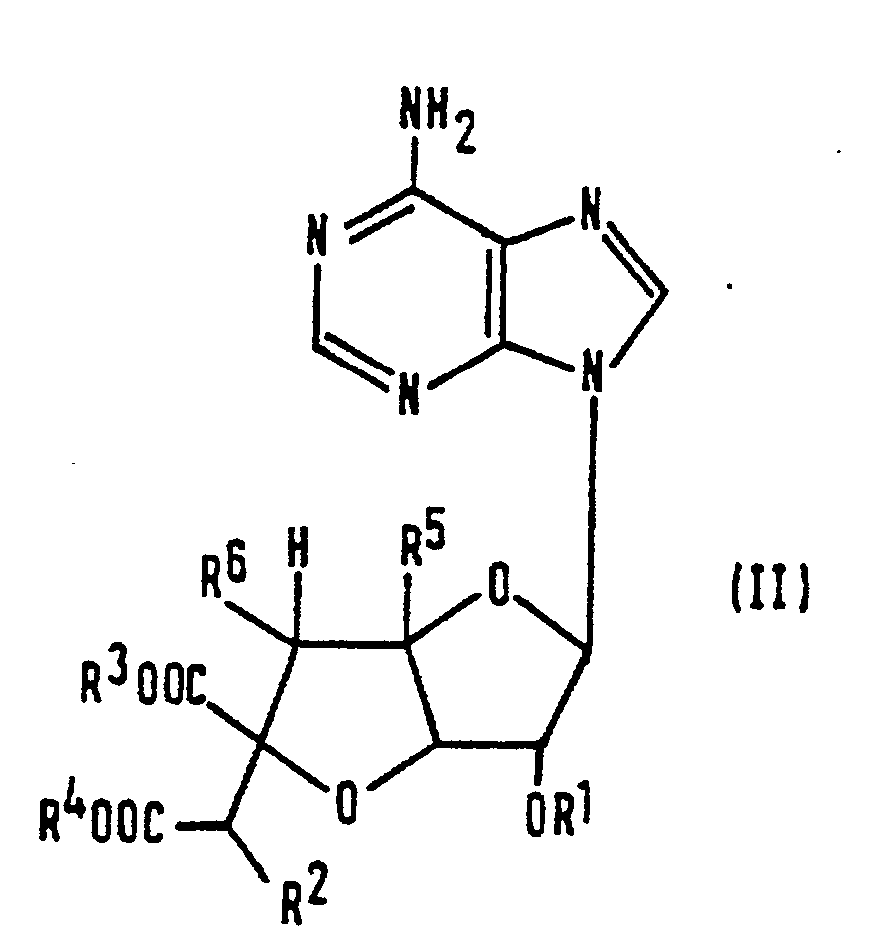

- Reactions analogous to the present process are known in the literature. For example, GB 1 139 160 and 1 101 108 describe the preparation of N6-substituted adenosine derivatives. The preparation of N6-substituted and their derivatives is described in Chem. Abs. (1984) 100, 103 820c.
- The process of the present invention may be represented by the reaction shown in the following scheme:


- Where Ri, R2, R3 or R4 represents a protecting or protected group, the nature of such a group is not critical to the present invention. Where the final products of formula (I) are themselves to be used directly for therapeutic purposes, and where such a protecting group remains in the product of formula (I), it is, of course, necessary that the protecting group should not adversely affect the therapeutic value of the compounds (for example by either reducing their activity or increasing their toxicity to an unacceptable extent). However, where protecting groups are employed which do have such an adverse effect, they may easily be removed in the final step of the reaction sequence (as described in more detail hereafter). Alternatively, the protecting groups employed may be pharmaceutically acceptable and, in that case, the resulting compounds of formula (I) may be used directly for therapeutic purposes. Also, of course, if the compounds of formula (I) are themselves to be employed as intermediates in the preparation of yet other griseolic acid derivatives, it may be unnecessary to remove protecting groups and the nature of such protecting groups will not be critical.
- Where R1 or R2 represents, respectively, a hydroxy-protecting group or a protected hydroxy group, examples of suitable hydroxy-protecting groups include aliphatic acyl groups, aromatic acyl groups, heterocyclic groups, tri-substituted silyl groups, lower alkyl groups, lower alkoxymethyl groups, substituted ethyl groups, aralkyl groups, lower alkoxycarbonyl groups, lower alkenyloxycarbonyl groups and protecting groups which are easily hydrolized in vivo.
- Where the hydroxy-protecting group is an aliphatic acyl group, this is a carboxylic acyl group preferably having up to 6 carbon atoms and is more preferably an alkanoyl or alkenoyl group having up to 6, preferably up to 5, carbon atoms, which group may be unsubstituted or may have at least one substituent selected from the group consisting of halogen atoms, C1-C4 alkoxy groups and aryloxy groups. Examples include the acetyl, chloroacetyl, dichloroacetyl, trichloroacetyl, trifluoroacetyl, methoxyacetyl, propionyl, butyryl, (E)-2-methyl-2-butenoyl, isobutyryl, valeryl, isovaleryl and pivaloyl groups.
- Where the hydroxy-protecting group is an aromatic acyl group, this is preferably an arylcarbonyl group, where the aryl part is preferably a C6-C14, more preferably C6-C10, carbocyclic aryl group, which may be unsubstituted or may have at least one substituent selected from the group consisting of halogen atoms, C1-C4 alkyl groups, Cl-C4 alkoxy groups, aryl groups (which themselves are as defined in relation to the aryl groups of these arylcarbonyl groups), C1-C4 haloalkyl groups, C2-Cs alkoxycarbonyl groups, cyano groups and nitro groups. Examples of such aromatic acyl groups include the benzoyl, o-(dibromomethyl)benzoyl, o-(methoxycarbonyl)benzoyl, p-phenylbenzoyl, 2,4,6-triniethylbenzoyl, p-toluoyl, p-anisoyl, p-chlorobenzoyl, p-nitrobenzoyl, o-nitrobenzoyl and a-naphthoyl groups.
- Where the hydroxy-protecting group is a heterocyclic group, this is preferably such a group containing a single oxygen or sulfur hetero-atom and having 5 or 6 ring atoms (including the hetero-atom), for example a tetrahydrofuryl, tetrahydrothienyl, tetrahydropyranyl or tetrahydrothiopyranyl group. This may be unsubstituted or may have at least one substituent selected from the group consisting of the substituents defined above in relation to substituents on aryl groups, preferably halogen atoms or C1-C4 alkoxy groups. The tetrahydropyranyl, tetrahydrothiopyranyl, tetrahydrofuryl and tetrahydrothienyl groups are preferred. Examples of such groups include the tetrahydropyran-2-yl, 3-bromotetrahydropyran-2-yl, 4-methoxytetrahydropyran-4-yl, tetrahydrothiopyran-2-yl and 4-methoxytetrahydrothiopyran-4-yl groups.
- Where the hydroxy-protecting group is a tri-substituted silyl group, the substituents, which may be the same or different, are preferably Ci-C4 alkyl groups and examples of such substituted silyl groups include the trimethylsilyl, triethylsilyl, isopropyldimethylsilyl, t-butyldimethylsilyl, diisopropylmethylsilyl, methyldi-t-butylsilyl and triisopropylsilyl groups.
- Where the hydroxy-protecting groups are lower alkyl groups, these preferably have from 1 to 6 carbon atoms and may be straight or branched chain groups. Examples include the methyl, ethyl, propyl, isopropyl, butyl, isobutyl, sec-butyl, t-butyl, pentyl and hexyl groups.
- Where the hydroxy-protecting group is a lower alkoxymethyl group, this may be a mono-alkoxymethyl or di-alkoxymethyl group and the alkoxy part is preferably a C1-C6, more preferably C1-C4, alkoxy group which may be unsubstituted or have at least one substituent selected from the group consisting of C1-C4 alkoxy groups and halogen atoms. Examples of such alkoxymethyl groups include the methoxymethyl, t-butoxymethyl, 2-methoxyethoxymethyl, 2,2,2-trichloroethoxymethyl and bis(2-chloroethoxy)methyl groups.
- Where the hydroxy-protecting group is a substituted ethyl group, the ethyl group may have one or more, preferably from 1 to 3, substituents selected from the group consisting of Ci-C4 alkoxy groups, C1-C4 alkyl groups, halogen atoms, C1-C4 alkylselenyl and arylselenyl groups (in which the aryl part is as defined in relation to the aryl parts of arylcarbonyl groups above). Examples include the 1-ethoxyethyl, 1-methyl-1-methoxyethyl, 1-isopropoxyethyl, 2,2,2-trichloroethyl and 2-phenylselenylethyl groups.
- Where the hydroxy-protecting group is an aralkyl group, this may be a monoaryl-alkyl group, a diaryl-alkyl group or a triaryl-alkyl group. Each aryl part is preferably a C6-C14, more preferably C6-C10, carbocyclic aryl group and is as defined above in relation to the aryl groups of arylcarbonyl groups. It is preferably unsubstituted or has at least one substituent selected from the group consisting of Cl-C4 alkyl groups, C1-C4 alkoxy groups, halogen atoms, nitro groups and cyano groups. The alkyl part is a straight or branched chain group preferably having from 1 to 4, more preferably 1 to 3 and most preferably 1 or 2, carbon atoms. Examples of such aralkyl groups include the benzyl, p-methoxybenzyl, o-nitrobenzyl, g-nitrobenzyl, p-halobenzyl (where the halo is preferably chloro, iodo, bromo or fluoro), p-cyanobenzyl, diphenylmethyl, triphenylmethyl, a-naphthyldiphenylmethyl and p-methoxyphenyldiphenylmethyl groups.
- Where the hydroxy-protecting group is a lower alkoxycarbonyl group, this is preferably a C2-C7, more preferably C2-C5, alkoxycarbonyl group (i.e. the alkoxy part is C1-C6, more preferably C1-C4) and the alkoxy part may be unsubstituted or may have at least one substituent selected from the group consisting of halogen atoms and tri-substituted silyl groups (e.g. as defined above in relation to the substituted silyl groups which may act as hydroxy-protecting groups). Examples of such alkoxycarbonyl groups include the methoxycarbonyl, ethoxycarbonyl, t-butoxycarbonyl, 2,2,2-trichloroethoxycarbonyl, isobutoxycarbonyl and 2-trimethylsilylethoxycarbonyl groups.
- Where the hydroxy-protecting group is a lower alkenyloxycarbonyl group, the alkenyl part is preferably a C2-C4 alkenyl group and examples include the vinyloxycarbonyl and allyloxycarbonyl groups.
- Where the hydroxy-protecting group is a group which is easily hydrolized in vivo, the group may fall within a number of different classes, including some classes which overlap with those hydroxy-protecting groups described above. In general, preferred such hydroxy-protecting groups include: the aralkyloxycarbonyl groups (in which the aralkyl part may be as defined above in relation to aralkyl groups which themselves serve as hydroxy-protecting groups), for example the benzyloxycarbonyl, p-methoxybenzyloxycarbonyl, 3,4-dimethoxybenzyloxycarbonyl, o-nitrobenzyloxycarbonyl and g-nitrobenzyloxycarbonyl groups; and the acyloxy-substituted alkoxycarbonyl, preferably methoxycarbonyl, groups, such as the pivaloyloxymethoxycarbonyl group.
- Of these, we prefer the aliphatic acyl groups, the aromatic acyl groups and those protecting groups which are easily hydrolized in vivo.
- Where R3 or R4 represents a carboxy-protecting group, examples include lower alkyl groups, lower haloalkyl groups, aralkyl groups and carboxy-protecting groups which are easily hydrolized in vivo.
- Where R3 or R4 represents a lower alkyl group, this has from 1 to 6, preferably from 1 to 4, carbon atoms and may be a straight or branched chain group. Examples include the methyl, ethyl, propyl, isopropyl, butyl, isobutyl and t-butyl groups.
- Where R3 or R4 represents a lower haloalkyl group, this likewise has from 1 to 6, preferably from 1 to 4, carbon atoms and at least one halogen substituent, although more halogen substituents may be present, up to complete perhalogenation. Examples include the 2,2,2-trichloroethyl, 2-chloroethyl, 2-bromoethyl, 2-iodoethyl, 2-fluoroethyl and 2,2-dibromoethyl groups.
- Where R3 or R4 represents an aralkyl group, this may be a monoaryl-alkyl, diaryl-alkyl or triaryl-alkyl group, preferably a monoaryl-alkyl or diaryl-alkyl group. The aryl part is preferably a C6-C14 carbocyclic aryl group which may be unsubstituted or may have at least one substituent selected from the group consisting of nitro groups, C1-C4 alkyl groups, C1-C4 alkoxy groups, halogen atoms and C1 or C2 alkylenedioxy groups. Examples of such aralkyl groups include the benzyl, p-nitrobenzyl, o-nitrobenzyl, triphenylmethyl, diphenylmethyl, bis(o-nitrophenyl)methyl, 9-anthrylmethyl, 2,4,6-trimethylbenzyl, R-bromobenzyl, p-methoxybenzyl, 3,4,5-trimethoxybenzyl and piperonyl groups.
- Where R3 or R4 represents a carboxy-protecting group which can easily be hydrolized in vivo, these may be selected from a wide range of different classes of groups, which are well-known to those skilled in the art. Examples include: aliphatic acyloxymethyl groups, in which the aliphatic acyl part is preferably a C2-C6 alkanoyl group, for example the acetoxymethyl, propionyloxymethyl, butyryloxymethyl or pivaloyloxymethyl groups; alkoxymethyl groups, where the alkoxy part is a C1-C6, preferably Cl-C4, alkoxy group, and may be unsubstituted or have at least one substituent (if substituted, the substituent is preferably a single C1-C4 alkoxy substitutent) and examples of such alkoxymethyl groups include the methoxymethyl, ethoxymethyl, propoxymethyl, isopropoxymethyl, butoxymethyl and 2-methoxyethoxymethyl groups; 1-alkoxycarbonyloxyethyl groups in which the alkoxy part is a C1-C6, preferably Ci-C4, alkoxy group, for example the 1-methoxycarbonyloxyethyl, 1-ethoxycarbonyloxyethyl, 1-propoxycarbonyloxyethyl, 1-isopropoxycarbonyloxyethyl, 1-butoxycarbonyloxyethyl or 1-isobutoxycarbonyloxyethyl groups; the phthalidyl group; and the (2-oxo-5-methyl-1,3-dioxolen-4-yl)methyl group.
- Of these carboxy-protecting groups, the alkyl groups, aralkyl groups and groups which are easily hydrolized in vivo are particularly preferred.
- Where R7 represents a lower alkyl group or an aralkyl group, these may be as defined above in relation to the equivalent carboxy-protecting groups which may be represented by R3 or R4.
- X represents a halogen atom, a lower alkylsulfonyloxy group, a fluorinated lower alkylsulfonyloxy group, an arylsulfonyloxy group or a lower alkoxysulfonyloxy group.
- Where X represents a halogen atom, this is preferably an iodine, chlorine or bromine atom.
- Where X represents a lower alkylsulfonyloxy group, this is a C1-C6, preferably Cl-C4, alkanesulfo- nyloxy group, for example a methanesulfonyloxy, ethanesulfonyloxy or propanesulfonyloxy group.
- Where X represents a fluorinated lower alkylsulfonyloxy group, this is an alkylsulfonyloxy group as defined above which has at least one fluorine substituent, but which may have more than one fluorine substituent and may be, and preferably is, completely perfluorinated. Examples include the trifluorometh- anesulfonyloxy and pentafluoroethanesulfonyloxy groups.
- Where X represents an arylsulfonyloxy group, the aryl part may be as defined above in relation to the aryl part of the arylcarbonyl group which serves as a hydroxy-protecting group, and examples include the benzenesulfonyloxy and p-toluenesulfonyloxy groups.
- Where X represents an alkoxysulfonyloxy group, the alkoxy part is a Cu-C6, preferably Cl-C4, alkoxy group and examples include the methoxysulfonyloxy, ethoxysulfonyloxy and propoxysulfonyloxy groups. We particularly prefer that X should represent a halogen atom.
- In Step (a) of the process of the invention, the griseolic acid or derivative thereof of formula (11) is subjected to alkylation or aralkylation with an alkylating or aralkylating agent (III) in an inert solvent. The nature of the solvent is not particularly critical, provided that it has no adverse effect upon the reaction. Examples of suitable solvents include: alcohols, such as methanol, ethanol, isopropanol, butanol, and t-butanol; ethers, such as diethyl ether, tetrahydrofuran, dioxane or ethylene glycol dimethyl ether; nitriles, such as acetonitrile; amides, such as dimethylformamide, dimethylacetamide or hexamethylphosphoric triamide; and sulfoxides, such as dimethyl sulfoxide. The preferred solvents are amides or sulfoxides.
- The reaction will take place over a wide range of temperatures, but we prefer to carry out the reaction at a temperature of from 0°C to 100°C, more preferably from room temperature to 70°C.
- The time required for the reaction may vary widely, depending upon many factors, notably the reaction temperature and the natures of the solvents and reagents employed. In general, a period of from 30 minutes to 10 days will suffice. If, for example, the reaction is carried out at room temperature, it is generally complete within from 1 to 7 days; on the other hand, at 70°C, it will normally be complete within from 1 to 20 hours.
- The intermediate product of formula (11') may be obtained from the reaction mixture by evaporating off the solvent under reduced pressure and then the product may be subjected to Step (b) without further isolation, in the same reaction vessel. Alternatively, if desired, the intermediate (II') may be isolated by conventional means before being subjected to Step (b).
- In Step (b), the compound is subjected to a ring-opening, rearrangement and ring-closure reaction involving the pyrimidine ring and the free amino group.
- In this step, the residue obtained from the alkylation or aralkylation reaction of Step (a) is dissolved or suspended in a suitable solvent and the pH of the resulting solution or suspension is adjusted or maintained at a value not less than 4, to effect the aforesaid ring-opening, rearrangement and ring-closure reactions. The pH value employed for these reactions is more preferably at least 5 and still more preferably at least 7.
- Maintenance of the chosen pH value may be achieved, for example, either (1) by conducting the reactions in a buffer solution previously adjusted to an appropriate pH value or (2) by standing or heating the residue in an excess of an aqueous solution of an alkali metal or alkaline earth metal hydroxide or a solution containing an organic base in water or in a suitable organic solvent.
- There is no particular limitation upon the nature of the buffer solution to be employed, provided that it is capable of maintaining an appropriate pH value throughout the reaction of Step (b). Any conventional buffer solution, for example an acetate, phosphate, borate, ammonium bicarbonate, phthalate or citrate buffer, may be used.
- Examples of suitable alkali metal and alkaline earth metal hydroxides which may be used in the aqueous solution include sodium hydroxide, potassium hydroxide, lithium hydroxide and calcium hydroxide. Examples of suitable organic bases include, for example, lower alkylamines, such as monomethylamine, dimethylamine or trimethylamine.
- In geneal, the pH of the reaction solution is preferably maintained within the range from 4 to 12, although higher pH values may also be employed.
- There is no particular limitation on the nature of the solvent employed in this reaction, provided that it does not interfere with the reactions. Suitable solvents include, for example: water; alcohols, such as methanol, ethanol or propanol; and other water-miscible solvents, such as acetone, tetrahydrofuran, dioxane, dimethylformamide or dimethyl sulfoxide. A single such solvent or a mixture or any two or more thereof may be employed. In some cases, the organic base may also act as the reaction solvent.
- The reaction may take place over a wide range of temperatures, for example from 0°C to 150°C, more preferably from 20°C to 100°C. The temperature chosen may depend upon various factors. For example, heating may be preferable when the reaction is carried out at a pH value within the range from 4 to 10; on the other hand, the reaction will generally proceed satisfactorily at ambient temperature at a pH of 10 or above.
- The time required for the reaction may vary widely, depending upon many factors, notably the nature of the substrates, the reaction temperature and the pH and nature of the buffer or other medium used, especially the temperature and pH; however, within the preferred ranges indicated above, a period of from 5 minutes to 50 hours will normally suffice.
- After completion of the reaction, the resulting compound of formula (I) may be recovered from the reaction mixture by conventional means, for example any one or any appropriate combination of the following steps: adjustment of the pH of the reaction mixture; concentration of the reaction mixture, e.g. by evaporating off the solvent under reduced pressure; separating, e.g. by filtration, of the precipitate obtained from recrystallization of the reaction residue; or, if no crystalline precipitate is thereby produced, extracting the mixture with a water-immiscible solvent and then evaporating the solvent from the extract. If desired, the resulting product may be further purified by conventional techniques, for example recrystallization or the various chromatography techniques such as column chromatography or preparative thin layer chromatography.
- Where the resulting compound of formula (I) contains a hydroxy-protecting group and/or a carboxy-protecting group, such protecting groups may, if desired, be removed in a step following Step (b). The nature of the process employed to remove these protecting groups will vary depending upon the nature of the protecting group, as is well-known in the art.
- For example, where a trialkylsilyl group is employed as a hydroxy-protecting group, it may be removed by treating the compound of formula (I) with a compound which produces fluoride anions, for example tetrabutylammonium fluoride. The reaction is preferably effected in the presence of a solvent, the nature of which is not critical, provided that it has no adverse effect upon the reaction; suitable solvents include ethers, such as tetrahydrofuran or dioxane. The reaction temperature is not particularly critical, and we generally find it convenient to carry out the reaction at about room temperature, at which temperature a period of from 10 to 18 hours is normally required.
- Where an aralkyloxycarbonyl group or aralkyl group is employed as a hydroxy-protecting group, it may be removed by contacting the compound with a reducing agent. Suitable reducing agents include, for example, hydrogen in the presence of a catalyst (e.g. palladium-on-activated carbon or platinum) or an alkali metal sulfide (such as sodium sulfide or potassium sulfide). These reactions are preferably carried out in the presence of a solvent, the nature of which is not critical, provided that it has no adverse effect upon the reaction. Examples of preferred solvents include: alcohols, such as methanol or ethanol; ethers, such as tetrahydrofuran or dioxane; fatty acids, such as acetic acid; and mixtures of one or more of these organic solvents with water. The reaction will take place over a wide range of temperatures, the preferred temperature depending upon the nature of the reducing agent. For example, in the case of catalytic reduction, room temperature is preferred. In the case of reduction employing alkali metal sulfides or similar reducing agents, a temperature of about room temperature or below, e.g. down to 0°C, is normally preferred. The time required for the reaction may vary widely, depending upon many factors, notably the natures of the starting materials and reducing agents, and the reaction temperature; however, a period of from 5 minutes to 12 hours will normally suffice.
- Where a lower alkyl group, lower aliphatic acyl group, aromatic acyl group or alkoxycarbonyl group is employed as the hydroxy-protecting group, it may be removed by treating the compound of formula (I) with a base in the presence of an aqueous solvent. There is no particular limitation on the nature of the solvent to be employed and any solvent commonly used in hydrolysis reactions may equally be used in this reaction. Examples of preferred solvents include water itself and mixtures of water with one or more organic solvents, for example: alcohols, such as methanol, ethanol or propanol; and ethers, such as tetrahydrofuran or dioxane. Equally, there is no particular limitation on the nature of the base to be employed, and any base commonly used in hydrolysis reactions may be employed, provided that it does not adversely affect other functional groups of the compound. Examples of preferred bases include: alkali metal carbonates, such as sodium carbonate or potassium carbonate; and ammonia in water or in a suitable organic solvent. The reaction will take place over a wide range of temperatures, but we generally prefer to employ a temperature of about room temperature or below, e.g. down to 0°C. The time required for the reaction will vary, depending upon many factors, notably the nature of the starting materials and the reaction temperature, but a period of from 1 to 6 hours will normally suffice.
- Where a heterocyclic group (e.g. a tetrahydropyranyl, tetrahydrothiopyranyl, tetrahydrofuryl or tetrahydrothienyl group), an alkoxymethyl group or a substituted ethyl group is employed as the hydroxy-protecting group, it may be removed by treating the compound of formula (I) with an acid in a solvent. There is no particular limitation on the nature of the acid and examples include hydrochloric acid, a mixture of acetic acid with sulfuric acid, or a mixture of p-toluenesulfonic acid with acetic acid. There is equally no particular limitation on the nature of the solvent, provided that it has no adverse effect upon the reaction. Examples of preferred solvents include: alcohols, such as methanol or ethanol; ethers, such as tetrahydrofuran or dioxane; and mixtures of water with one or more of these organic solvents. The reaction will take place over a wide range of temperatures, but we generally prefer to carry out the reaction at a temperature within the range from 0 to 50°C. The time required for the reaction will vary, depending upon many factors, notably the nature of the starting materials and acids and the reaction temperature, but a period of from 10 minutes to 18 hours will normally suffice.
- Where an alkenyloxycarbonyl group is employed as the hydroxy-protecting group, it may be removed by treating the compound with a base in the presence of an aqueous solvent, under the same conditions as employed for removal of lower alkyl, aliphatic acyl, aromatic acyl and alkoxycarbonyl groups. If the group is an allyloxycarbonyl group, it can also simply be removed by using palladium and triphenylphosphine or nickel tetracarbonyl, and this has the advantage that very few side reactions may occur.
- Depending upon the nature of the respective hydroxy-protecting groups and carboxy-protecting groups, some of the reactions employed above may simultaneously remove carboxy-protecting groups, as described below.
- After completion of any of the above reactions, the desired compounds may be recovered from the reaction mixture by conventional means, and, if required, may be further purified by such conventional techniques as recrystallization or the various chromatography techniques, particularly preparative thin layer chromatography or column chromatography.
- Where a lower alkyl group is employed as a carboxy-protecting group, it may be removed by treating the compound of formula (I) with a base in the presence of an aqueous solvent. The reaction is carried out under the same conditions as are employed for elimination of a hydroxy-protecting group, when that group is a lower alkyl, aliphatic acyl, aromatic acyl or alkoxycarbonyl group; such groups may, therefore, be removed simultaneously.
- Where an aralkyl or lower haloalkyl group is employed as a carboxy-protecting group, it may be removed by contacting the compound of formula (I) with a reducing agent, for example zinc in acetic acid. In the case of the aralkyl group, other reducing agents include hydrogen in the presence of a catalyst and alkali metal sulfides (such as potassium sulfide or sodium sulfide); such a reaction may be carried out under the same conditions as are employed for removing a hydroxy-protecting group when that group is an aralkyloxycarbonyl or aralkyl group; such a protecting group may, therefore, be removed simultaneously.
- . Where an alkoxymethyl group is employed as the carboxy-protecting group, it may be eliminated by treating the compound with an acid. The reaction is carried out under the same conditions as are employed for eliminating a hydroxy-protecting group when that group is an alkoxymethyl or substituted ethyl group; such a protecting group may, therefore, be removed simultaneously.
- After completion of these reactions, the desired compounds may be recovered from the reaction mixture by conventional means. For example, one suitable recovery technique comprises: filtering off insoluble materials, if any; washing the resulting organic solvent solution containing the desired compound with water; drying the solution; and then distilling off the solvent. The resulting residue may, if desired, be further purified by various conventional techniques, such as recrystallization or the various chromatography techniques, particularly preparative thin layer chromatography or column chromatography.
- The order in which the hydroxy-protecting groups and carboxy-protecting groups are removed is not critical and these may be removed in any desired sequence or simultaneously.
- Also, if desired, where the resulting product contains a free hydroxy and/or carboxy group, one or more of these may be protected by a group which can easily be hydrolized in vivo. This reaction may be carried out by conventional methods well-known to those skilled in the art, the precise method chosen depending upon the nature of the protecting group which is to be introduced.
- For example, a carboxy group may be protected by conversion to the corresponding ester capable of easy hydrolysis in vivo by reacting the acid with a halide corresponding to the protecting group which it is desired to introduce, for example with: an aliphatic acyloxymethyl halide, such as acetoxymethyl chloride, propionyloxymethyl bromide or pivaloyloxymethyl chloride; a lower alkoxycarbonyloxyethyl halide, such as 1-methoxycarbonyloxyethyl chloride or 1-ethoxycarbonyloxyethyl iodide; a phthalidyl halide, e.g. chloride, bromide or iodide; or a (2-oxo-5-methyl-1,3-dioxolen-4-yl)methyl halide, e.g. chloride, bromide or iodide. The reaction is preferably effected in the presence of a solvent, the nature of which is not critical, provided that it has no adverse effect upon the reaction. Preferred solvents are such polar solvents as dimethylformamide. The reaction will take place over a wide range of temperatures, but we generally find it convenient to carry out the reaction at a temperature in the range from 0 to 100°C. The time required for the reaction may vary widely, depending upon many factors; however, under the conditions suggested, a period of from 30 minutes to 10 hours will normally suffice.
- The compounds of formula (II) used as starting materials in the process of the invention may be prepared by a variety of reactions starting either from griseolic acid itself [which has the formula (A) shown below] or dihydrodesoxygriseolic acid [which has the formula (B) shown below]:

- As already described above, griseolic acid is a known compound disclosed, for example, in European Patent Specification No. 29,329 or in US Patent Specification No. 4,460,765. Dihydrodesoxygriseolic acid was disclosed in European Patent Publication No. 0162715, published after the priority hereof. Both griseolic acid and dihydrodesoxygriseolic acid may be produced by cultivating suitable microorganisms of the genus Streptomyces, especially Streptomycesgriseoaurantiacus SANK 63479 (deposited on 9th October 1979 at the Fermentation Research Institue, Agency of Industrial Science and Technology, Japan, whence it is available under the Accession No. FERM-P5223, and on 22nd October 1980 at the Agricultural Research Service, Peoria, U.S.A., whence it is available under the Accession No. NRRL 12314). Full details of the characteristics of Streptomvces oriseoaurantiacus SANK 63479 are given in European Patent Publication No. 29,329A and in US Patent Specification No. 4,460,765.
- The various methods employed for preparing the compounds of formula (II) may be summarized by the following reaction scheme:


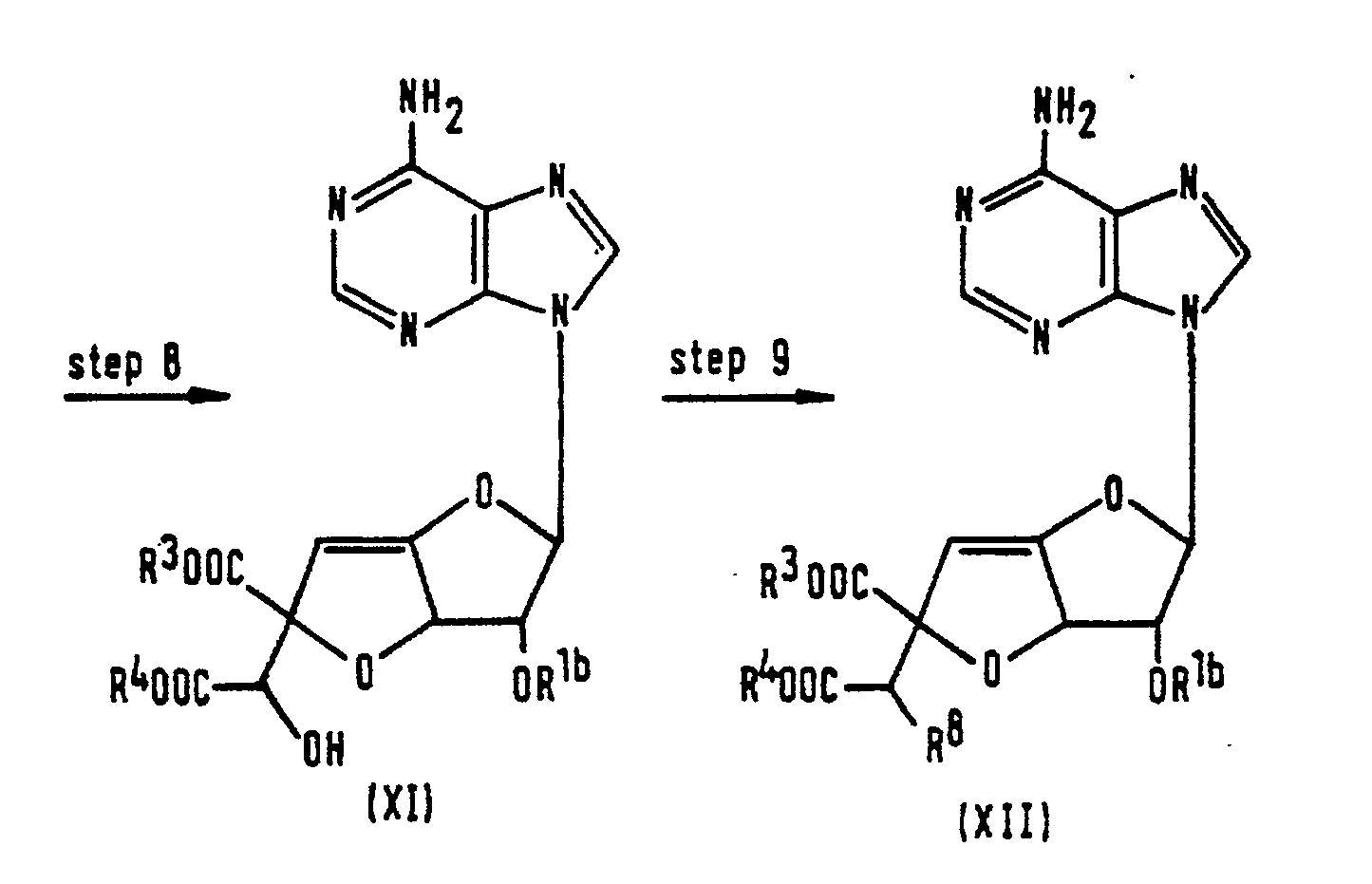

- In the above formulae, Ri, R3 and R4 are as defined above. Ria represents any of the groups defined above for R1 and may be the same as or different from R1. R1b represents an acyl group, including any of the acyl groups hereinbefore defined in relation to R1. R8 represents an alkylsulfonyloxy group, a fluorinated lower alkylsulfonyloxy group or an arylsulfonyloxy group, and examples of such groups are given previously in relation to the same groups which may be represented by X. Xa represents a halogen atom, e.g. any one of those halogen atoms given previously in relation to X.
- The various reactions involved in this reaction scheme may be carried out as described below:
- Protection of Carboxy Groups (Steps 1, 5 and 8)
- In these reactions, the free carboxy groups of the griseolic acid of formula (A), the dihydrodesoxygriseolic acid of formula (B) or the griseolic acid derivative of formula (X) are, in Steps 1, 5 and 8, respectively, protected by protecting groups R3 and R4, to give compounds of formulae (IV), (VIII) or (XI) respectively. This reaction may be effected by reacting the compond of formula (A), (B) or (X) with a diazo compound, such as diazomethane or diphenyl diazomethane, or a p-tolyltriazene derivative, such as N-methyl-R-tolyltriazene. The reaction is preferably effected in the presence of a solvent, the nature of which is not critical, provided that it has no adverse effect upon the reaction and that it is capable of dissolving, at least to some degree, the starting materials employed in the reaction. Examples of suitable solvents include: ketones, such as acetone; ethers, such as tetrahydrofuran; amides, such as dimethylformamide; and mixtures of water with one or more of these organic solvents.
- The reaction will take place over a wide range of temperatures, and there is no particular limitation on the precise temperature chosen. We generally find it convenient to carry out the reaction at a temperature in the range from -20°C to +50°C. The time required for the reaction may vary widely, depending upon many factors, notably the reaction temperature, but, for example, if the reaction is carried out, as is preferred, at room temperature, a period of from 1 to 24 hours will normally suffice.
- If, instead of the free acids of formula (A), (B) or (X), the corresponding alkali metal salts are employed, this protection step may be achieved by reacting the alkali metal salt with a halide, for example methyl iodide, benzyl bromide, acetoxymethyl bromide, 1-methoxycarbonyloxy iodide or (2-oxo-5-methyl-1,3-dioxolen-4-yl)methyl bromide, by conventional means, to introduce the corresponding carboxy-protecting groups.
- In these reactions, the hydroxy groups of the compound of formula (IV) or the hydroxy group of the compound of formula (VIII) may be protected by reacting the compound with a corresponding acyl halide (such as acetyl chloride or benzoyl bromide) or a corresponding acid anhydride (such as acetic anhydride) or with another halide corresponding to the protecting group Ri or R1a (such as trimethylsilyl iodide) in the presence of a base to give the protected compound of formula (V) or (IX), respectively. The reaction is preferably effected in the presence of a solvent, the nature of which is not critical, provided that it has no adverse effect upon the reaction. In general, we prefer to use pyridine as the solvent, as this has the advantage of also acting as the base.
- The reaction will take place over a wide range of temperatures, although we generally prefer to use a relatively low temperature, e.g. from -20°C to room temperature, in order to control side reactions. The time required for the reaction will vary widely, depending upon many factors, notably the reaction temperature; however, at temperatures within the preferred range, a period of from 1 to 15 hours will normal- iy suffice.
- Alternatively, the compound of formula (IV) or (VIII) can be reacted with an unsaturated heterocyclic compound, such as dihydropyran, in the presence of an acid (e.g. hydrochloric acid) to give a protected compound (V) or (IX) protected with a corresponding protecting group.
- In this step, the compound of formula (V) is reacted with a hydrogen halide HXa to add the hydrogen halide across the double bond and give the compound of formula (VI). The reaction is preferably effected in the presence of a solvent, the nature of which is not critical, provided that it has no adverse effect upon the reaction and that it can dissolve the starting materials, at least to some degree. Preferred solvents are organic acids, such as acetic acid. The hydrogen halide employed is preferably hydrogen chloride, hydrogen bromide or hydrogen iodide. The reaction will take place over a wide range of temperatures, e.g. from 0°C to 100°C, preferably either from 0°C to room temperature or from 80°C to 100°C. The time required for the reaction will vary, depending upon many factors, notably the reaction temperature and the natures of the solvents and reagents, but a period of from 1 to 72 hours will normally suffice.
- If the hydroxy-protecting groups R1 or Ria are capable of removal under acidic conditions (e.g. the trimethylsilyl or tetrahydropyranyl groups), they may be removed in the course of this step. In such a case, it may be necessary or desirable to reinstate such protecting groups at the end of the step, e.g. as described in relation to Steps 2 and 6.
- In this step, the halogen atom at the 4'-position of the compound of formula (VI) is reduced to give the compound of formula (VII). This reaction may be carried out either by using a tri-substituted tin hydride (such as tributyltin hydride) in an aromatic hydrocarbon (such as benzene) or by using zinc powder in a lower aliphatic carboxylic acid (such as acetic acid) or an alcohol (such as methanol or ethanol). The reaction is preferably conducted either: using tributyltin hydride at the boiling point of the solvent for a period of from 2 to 10 hours; or using zinc powder at a temperature of from room temperature to 100°C for a period of from 2 to 20 hours
- In this step, the hydroxy group at the 2'-position of griseolic acid (A) is selectively acylated to give the compound of formula (X). This reaction may be effected either: by adding an acylating agent to griseolic acid whilst the pH of the reaction solution is maintained at a value of from 10 to 13 by means of a base, such as sodium hydroxide; or by adding an acylating agent to a solution of griseolic acid in a buffer solution of pH 10-13. The reaction is preferably effected in the presence of a solvent, the nature of which is not critical, provided that it has no adverse effect upon the reaction; water-immiscible solvents are preferred. The reaction will take place over a wide range of temperatures, although we generally prefer to employ a temperature of from -20°C to +50°C. The time required for the reaction may vary widely, depending upon many factors, notably the reaction temperature and the natures of the solvents, bases and reagents, but a period of from 1 to 10 hours will normally suffice.
- Sulfonylation of the 7'-Hydroxy Group (Step 9)
- In this step, the hydroxy group at the 7'-position of the compound of formula (XI) is sulfonylated, to give the compound of formula (XII). The reaction is preferably effected using a sulfonyl halide, such as methanesulfonyl chloride, p-toluenesulfonyl chloride or trifluoromethanesulfonyl chloride, in the presence of an acid-binding agent, such as pyridine or dimethylaminopyridine. The reaction is preferably effected in the presence of a solvent, the nature of which is not critical, provided that it has no adverse effect upon the reaction. Preferred solvents are halogenated hydrocarbons, especially halogenated aliphatic hydrocarbons, such as methylene chloride or chloroform. The reaction will take place over a wide range of temperatures, although we generally prefer to employ a relatively low temperature, e.g. from -10°C to room temperature. in order to control side reactions. The time required for the reaction may vary widely, depending upon many factors, notably the reaction temperature and the natures of the reagents, but a period of from 1 to 20 hours will normally suffice.
- In this reaction, the compound of formula (XIII) is prepared by replacing the sulfonyloxy group at the 7'-position of the compound of formula (XII) by a halogen atom and then replacing this halogen atom by a hydrogen atom.
- Replacement of the sulfonyloxy group by a halogen atom is effected by reacting the compound of formula (XII) with an anhydrous lithium halide. The reaction is preferably effected in the presence of a solvent, the nature of which is not critical, provided that it has no adverse effect upon the reaction. Examples of preferred solvents are such polar solvents as: acid amides, such as dimethylformamide or hexamethylphosphoric triamide; sulfoxides, such as dimethyl sulfoxide; and alkyl phosphates, such as triethyl phosphate. The reaction will take place over a wide range of temperatures and the precise temperature chosen is not critical. We generally find it convenient to employ a temperature in the range from 0 to 150°C. The time required for the reaction may vary, depending on many factors, notably the temperature and nature of the reagents; however, under the conditions suggested above, a period of from 1 to 10 hours will normally suffice.
- In a next stage, the halogen atom is replaced by a hydrogen atom. This may be effected by means of any conventional reducing (hydrogenating) agent capably of replacing a halogen atom by a hydrogen atom. It is preferably effected using zinc/acetic acid and may be carried out by adding zinc powder to a solution of the halogenated compound of formula (XII) in aqueous acetic acid. The reaction will take place over a wide range of temperatures, although a temperature from 0°C to 150°C is preferred. The time required for the reaction will vary, depending upon many factors, notably the reaction temperature and the nature of the reagents, but a period of from 1 to 10 hours will normally suffice.
- In addition, if desired, the group R1b may be removed by conventional alkaline hydrolysis (for example with sodium hydroxide in aqueous methanol) and then the resulting hydroxy group may, if desired, be reprotected, as described in Step 2.
- The process of the present invention is further illustrated by the following Examples. Of the starting materials, griseolic acid may be prepared as described in aforementioned US Patent Specification No. 4,460,765, dimethyl griseolate may be prepared by simple esterification of griseolic acid (e.g. as described in Steps 1, 5 and 8 above) and dihydrodesoxygriseolic acid may be prepared as described in the subsequent Preparation.
- N6 -Methylgriseolic acid
- (a) 2 ml of methyl iodide were added to a solution of 1.63 g of dimethyl griseolate in 20 ml of dimethyl. formamide, and the mixture was stirred at room temperature for 48 hours in a sealed vessel. The solvent was then evaporated off under reduced pressure, and the residue was mixed with 10 ml each of acetone and toluene, and then the solution was concentrated by evaporation under reduced pressure. This operation was repeated a total of three times to give a residue, which was dissolved in 30 ml of water and adjusted to a pH value of 5.7 with a 0.1 N aqueous solution of sodium hydroxide. The mixture was heated at 100°C for 2.5 hours, while at 30 minutes intervals the pH was re-adjusted to 5.7. The reaction mixture was then evaporated under reduced pressure to reduce the volume to 10 ml. 10 ml of a 2N aqueous solution of sodium hydroxide were added to the concentrate and the mixture was allowed to stand for 2 hours. The mixture was then adjusted to a pH value of 2.3 and purified by chromatography using an RP-8 prepacked column (Merck). The main fractions were collected, lyophilized and recrystallized from water, to give 690 mg of the title compound.
- (b) 25 ml of methyl iodide were added to a solution of 18.95 g of griseolic acid in 230 ml of dimethylformamide, and the mixture was stirred at room temperature for 42 hours in a sealed vessel. At the end of this time, the solution was concentrated by evaporation under reduced pressure. The residue was then mixed with 70 ml each of ethanol and toluene and again concentrated by evaporation under reduced pressure. This operation was repeated a total of four times to give a residue, to which 300 ml of ethanol were added. The mixture was again concentrated by evaporation under reduced pressure to give a powdery residue. A suspension of the residue in 800 ml of ethyl acetate was ultrasonically treated to give a powder, and was then allowed to stand overnight in a refrigerator. Filtration of the suspension yielded 27.2 g of a pale yellow powder. The powder was dissolved in a 1 N aqueous solution of sodium hydroxide, and adjusted to a pH value of 7.0. Water was added to the solution to give a total volume of 200 ml. A mixture of the solution with 50 ml of a 0.5M phosphate buffer (pH 7.0) was heated for 3 hours under reflux, and then the pH of the mixture was adjusted with a 1 N aqueous solution of sodium hydroxide to a value of 7.0. The mixture was heated under reflux for 2 hours, and then its pH was adjusted with concentrated hydrochloric acid to a value of 2.3. It was then treated with activated carbon, concentrated by evaporation under reduced pressure to an amount of about 130 ml, and then subjected to column chromatography using an RP-8 prepacked column (Merck), eluted with water containing 3% v/v acetonitrile. The main fractions were collected, concentrated and recrystallized from water to give 12.73 g of the title compound. Concentration and cooling of the mother liquor yielded an additional 2.01 g of the title compound.
- Ultraviolet Absorption Spectrum (H20) λmaxnm (e):
- 265 (17200).
- Nuclear Magnetic Resonance Spectrum [(CD3)2SO] 20s ppm: 4.52 (1 H, singlet);
- 4.60 (1 H, doublet, J=6.0Hz);
- 5.10 (1 H, doublet, J=3.0Hz);
- 6.08 (1 H, doublet of doublets, J=3.0 & 6.0Hz);
- 6.53 (1 H, singlet);
- 8.31 (1 H, singlet);
- 8.35 (1 H, singlet).
- 1 ml of methyl iodide was added to a solution of 100 mg of 7'-desoxy-4'a,5'-dihydrogriseolic acid in 20 ml of dimethylformamide, and the mixture was allowed to stand at room temperature for 24 hours in a sealed vessel. The solvent was distilled off under reduced pressure to give a residue. 10 ml each of acetone and toluene were added to the residue and the mixture was concentrated by evaporation under reduced pressure. This operation was repeated twice. A solution of the resulting residue in 20 mi of a 0.5M phosphate buffer of pH 7.0 was stirred for 3 hours under reflux, to give a reaction mixture which was purified by column chromatography using an RP-8 prepacked column (Merck), eluted with water containing 3% v/v acetonitrile, followed by lyophilizing the main fractions to give 67 mg of the title compound as a white powder.
- Ultraviolet Absorption Spectrum (e) X max:
- pH 1.0 262 nm (17700).
- H20 264 nm (16700).
- pH 13 266 nm (17100).
- Nuclear Magnetic Resonance Spectrum [(CD3)3SO+D3O] 8 ppm: 2.28-2.31 (2H, multiplet);
- 2.80-3.03 (5H, multiplet);
- 4.37-4.46 (3H, multiplet);
- 6.16 (1 H, singlet);
- 8.26 (1 H, doublet);
- 8.28 (1 H, singlet).
- 6 ml of methyl iodide and 250 mg of sodium sulfite were added to a solution of 3.8 g of griseolic acid in 50 ml of dimethylformamide, and the mixture was heated at 40°C for 17 hours, whilst stirring. The solvent was then distilled off under reduced pressure to give a residue. 20 ml each of ethanol and toluene were added to the residue, and the mixed solvent was distilled off under reduced pressure. This operation was repeatd three times. 50 ml of a 1 N aqueous solution of sodium hydroxide were added to the residue and the mixture was allowed to stand at room temperature for 4 days. The mixture was then adjusted to a pH value of 2.3 with concentrated hydrochloric acid and allowed to stand for 1.5 hours whilst ice-cooling. The crystals which precipitated were collected by filtration, to yield 3.0 g of the title compound as crude crystals. The filtrate was then subjected to column chromatography using 200 ml of a CHP-20 resin. After washing with 1.5 litre of water, the main fractions were eluted with water containing 3% v/v acetonitrile, followed by lyophilizing to give 0.9 g of the title compound. The above crude crystals and the substance lyophilized were together dissolved in 20 ml of a 1 N aqueous solution of sodium hydroxide and the mixture was weakly acidified with 5 ml of a 1 N aqueous solution of hydrochloric acid, treated with active carbon, and then further acidified with 15 ml of a 1N aqueous solution of hydrochloric acid. It was then allowed to stand at 5°C overnight. The crystals which precipitated were collected and dried over phosphorus pentoxide to give 2.90 g of the title compound, whose priorities were the same as those of the product of Example 1.
- 1 ml of methyl iodide and 7 mg of sodium sulfite were added to a solution of 100 mg of 7'-desoxy-4'a,5'-dihydrogriseolic acid in 20 ml of dimethylformamide, and the mixture was heated at 40°C for 17 hours, whilst stirring. The solvent was then distilled off under reduced pressure to give a residue. 10 ml each of acetone and toluene were added to the residue and the mixed solvent was distilled off under reduced pressure. This operation was repeated three times. 1.5 ml of a 1 N aqueous solution of sodium hydroxide were added to the residue and the mixture was allowed to stand at room temperature for 4 days. The mixture was then adjusted to a pH value of 2.3 with concentrated hydrochloric acid and purified by chromatography using an RP-8 prepacked column (Merck) (eluent : water containing 3% v/v acetonitrile). The main fractions were collected and lyophilized to give 80 mg of the title compound as a white powder, whose properties were the same as those of the product of Example 2.
- 30 litres of a medium having a pH of 7.0 before sterilization and the following composition (percentages are w/v) were prepared:
- Glucose 5%
- Soybean Meal 1 %
- Yeast Extract 0.1%
- Polypeptone 0.4%
- Meat Extract 0.4%
- Sodium Chloride 0.25%
- Calcium Carbonate 0.5%
- Water to 100%
- 15 litres of this medium were charged into each of two 30 litre jar fermenters, which were then sterilized under pressure at 120°C for 30 minutes. The culture medium was cooled, and then 150 ml (1 % by volume) of a culture broth of Streptomvces griseoaurantiacus SANK 63479 (which had previously been incubated in the medium described above by means of a rotatory shaking cultivator at 28°C for 72 hours) were inoculated into each fermenter. Cultivation was then carried out at 28°C for 96 hours under aeration at the rate of 15 litres per minute and with agitation at the rate of 200 rpm.
- The two culture broths were then filtered to remove the mycelial cake and the combined filtrates (pH 7.0), in a total volume of 28 litres, were passed through a column of Diaion HP 20 ( a trademark for an ion-exchange resin produced by Mitsubishi Chemical Industries Ltd.) and then adsorbed on a column of activated charcoal. This column was washed with water and then the adsorbed material was eluted with a 60:40 by volume mixture of acetone and water. The acetone was evaporated from the resulting solution under reduced pressure and the remaining aqueous solution was concentrated by evaporation under reduced pressure and then lyophilized, to give 150 mg of a crude powder.
- This crude powder was dissolved in a small amount of distilled water and then adsorbed on Dowex 1 x 4 (Cl - form, a trademark for an ion-exchange resin produced by the Dow Chemical Company). At this stage, the product was a mixture of griseolic acid and dihydroesoxygriseolic acid. This mixture was subjected to gradient elution with a sodium chloride gradient to separate the two components and then the eluate was subjected to column chromatography through Sephadex LH-20 (a trademark for a product of Pharmacia Co) and the dihydrodesoxygriseolic acid was eluted with water. The fractions containing this substance were combined and their pH was adjusted to a value of 2.5 by the addition of 1 N aqueous hydrochloric acid. The product was then adsorbed on a column of Diaion HP 20, washed with water and then eluted with a 60:40 by volume mixture of acetone and water. The eluate was left to stand overnight at 4°C, whereupon the dihydrodesoxygriseolic acid separated out as plates. These were separated from the liquor, giving a total of 1.87 mg of dihydrodesoxy griseolic acid, as white plates melting at 160°C (with decomposition, accompanied by a brown discoloration). This compound gave a single spot on silica gel thin layer chromatography (silica gel Art. 5715, a product of Merck & Co. Inc.).
Claims (9)


Priority Applications (1)
| Application Number | Priority Date | Filing Date | Title |
|---|---|---|---|
| AT86303213T ATE57934T1 (en) | 1985-04-27 | 1986-04-28 | PROCESS FOR THE PRODUCTION OF GRISEOLINSIC ACID DERIVATIVES. |
Applications Claiming Priority (2)
| Application Number | Priority Date | Filing Date | Title |
|---|---|---|---|
| JP9198985 | 1985-04-27 | ||
| JP91989/85 | 1985-04-27 |
Publications (3)
| Publication Number | Publication Date |
|---|---|
| EP0200522A2 EP0200522A2 (en) | 1986-11-05 |
| EP0200522A3 EP0200522A3 (en) | 1987-09-02 |
| EP0200522B1 true EP0200522B1 (en) | 1990-10-31 |
Family
ID=14041867
Family Applications (1)
| Application Number | Title | Priority Date | Filing Date |
|---|---|---|---|
| EP86303213A Expired - Lifetime EP0200522B1 (en) | 1985-04-27 | 1986-04-28 | Process for preparing griseolic acid derivatives |
Country Status (6)
| Country | Link |
|---|---|
| EP (1) | EP0200522B1 (en) |
| JP (2) | JPH0631307B2 (en) |
| AT (1) | ATE57934T1 (en) |
| CA (1) | CA1267410A (en) |
| DE (1) | DE3675249D1 (en) |
| ES (1) | ES8706716A1 (en) |
Families Citing this family (2)
| Publication number | Priority date | Publication date | Assignee | Title |
|---|---|---|---|---|
| DK675688A (en) * | 1987-12-02 | 1989-06-03 | Sankyo Co | GRISOOL ACID MONOESTERS AND THE PROCEDURE AND APPLICATION OF THEREOF |
| NZ231737A (en) * | 1988-12-14 | 1991-11-26 | Mitsubishi Electric Corp | Microwave oven feed by oscillating antenna in side wall |
Citations (2)
| Publication number | Priority date | Publication date | Assignee | Title |
|---|---|---|---|---|
| US4460765A (en) * | 1979-11-10 | 1984-07-17 | Sankyo Company Limited | Enzyme inhibitor produced by cultivation of streptomyces microorganisms |
| EP0143557A2 (en) * | 1983-10-28 | 1985-06-05 | Sankyo Company Limited | Griseolic acid derivatives, and their use |
Family Cites Families (4)
| Publication number | Priority date | Publication date | Assignee | Title |
|---|---|---|---|---|
| DE1545645A1 (en) * | 1965-12-06 | 1969-08-21 | Boehringer Mannheim Gmbh | Process for the preparation of disubstituted adenosine derivatives |
| DE1670116A1 (en) * | 1966-07-21 | 1970-11-05 | Boehringer Mannheim Gmbh | Process for the production of new adenosine derivatives |
| NL130136C (en) * | 1966-10-20 | |||
| US4167565A (en) * | 1976-11-08 | 1979-09-11 | Abbott Laboratories | Adenosine-5'-carboxamides and method of use |
-
1985
- 1985-11-12 JP JP60251959A patent/JPH0631307B2/en not_active Expired - Lifetime
-
1986
- 1986-04-25 JP JP61094752A patent/JPS6230798A/en active Pending
- 1986-04-28 AT AT86303213T patent/ATE57934T1/en not_active IP Right Cessation
- 1986-04-28 ES ES554475A patent/ES8706716A1/en not_active Expired
- 1986-04-28 CA CA000507750A patent/CA1267410A/en not_active Expired - Fee Related
- 1986-04-28 EP EP86303213A patent/EP0200522B1/en not_active Expired - Lifetime
- 1986-04-28 DE DE8686303213T patent/DE3675249D1/en not_active Expired - Fee Related
Patent Citations (2)
| Publication number | Priority date | Publication date | Assignee | Title |
|---|---|---|---|---|
| US4460765A (en) * | 1979-11-10 | 1984-07-17 | Sankyo Company Limited | Enzyme inhibitor produced by cultivation of streptomyces microorganisms |
| EP0143557A2 (en) * | 1983-10-28 | 1985-06-05 | Sankyo Company Limited | Griseolic acid derivatives, and their use |
Also Published As
| Publication number | Publication date |
|---|---|
| CA1267410A (en) | 1990-04-03 |
| JPS6230798A (en) | 1987-02-09 |
| ES8706716A1 (en) | 1987-07-01 |
| JPH0631307B2 (en) | 1994-04-27 |
| EP0200522A3 (en) | 1987-09-02 |
| ATE57934T1 (en) | 1990-11-15 |
| DE3675249D1 (en) | 1990-12-06 |
| ES554475A0 (en) | 1987-07-01 |
| EP0200522A2 (en) | 1986-11-05 |
| JPS6230797A (en) | 1987-02-09 |
Similar Documents
| Publication | Publication Date | Title |
|---|---|---|
| US4399282A (en) | Camptothecin derivatives | |
| US4965374A (en) | Process for and intermediates of 2',2'-difluoronucleosides | |
| EP0688782B1 (en) | Stereoselective process for preparing protected 2',2'-difluorolactonen | |
| EP0143557B1 (en) | Griseolic acid derivatives, and their use | |
| EP0214708B1 (en) | Griseolic acid derivatives, their preparation and their use | |
| US4783532A (en) | Process for preparing griseolic acid derivatives | |
| IL25712A (en) | 5',5'-dinucleoside phosphate | |
| EP0200522B1 (en) | Process for preparing griseolic acid derivatives | |
| EP0393923B1 (en) | 6-Fluoroshikimic acid derivatives | |
| US4463171A (en) | Derivatives of macrolide antibiotics | |
| EP0017970A1 (en) | Novel beta-lactam derivatives and process for production thereof | |
| CZ287404B6 (en) | Process for preparing doramectin | |
| US5214165A (en) | Compounds useful as intermediates in the synthesis of shikimic acid derivatives | |
| EP0076066A1 (en) | Penicillin derivatives | |
| CA1093071A (en) | 5.alpha.-BICYCLOMYCIN DERIVATIVES | |
| EP0318060B1 (en) | Griseolic acid derivatives, their preparation and their use | |
| US4755596A (en) | Optically active carbacephems | |
| SU860707A1 (en) | Method of preparing derivatives of 4"-desoxy-4"-sulfonylaminooleandomycin or their salts | |
| EP0114331B1 (en) | A process for preparing oxanosine | |
| US4656274A (en) | Polyfluorinated substituted tricyclic quinoline mono and dioxo antifungal agents and process for their preparation | |
| US4933474A (en) | Process for the preparation of macrolide compounds | |
| EP0456514B1 (en) | 2-Fluoroneplanocin A and its production | |
| JP3101474B2 (en) | Method for producing 4'-demethyl-4-formylmethyl-4-desoxy-4-epipodophyllotoxin derivative | |
| EP0233441A1 (en) | New enzyme inhibitor | |
| NO126318B (en) |
Legal Events
| Date | Code | Title | Description |
|---|---|---|---|
| PUAI | Public reference made under article 153(3) epc to a published international application that has entered the european phase |
Free format text: ORIGINAL CODE: 0009012 |
|
| AK | Designated contracting states |
Kind code of ref document: A2 Designated state(s): AT BE CH DE FR GB IT LI LU NL SE |
|
| PUAB | Information related to the publication of an a document modified or deleted |
Free format text: ORIGINAL CODE: 0009199EPPU |
|
| RA1 | Application published (corrected) |
Date of ref document: 19861210 Kind code of ref document: A2 |
|
| PUAL | Search report despatched |
Free format text: ORIGINAL CODE: 0009013 |
|
| AK | Designated contracting states |
Kind code of ref document: A3 Designated state(s): AT BE CH DE FR GB IT LI LU NL SE |
|
| 17P | Request for examination filed |
Effective date: 19880302 |
|
| 17Q | First examination report despatched |
Effective date: 19890907 |
|
| GRAA | (expected) grant |
Free format text: ORIGINAL CODE: 0009210 |
|
| AK | Designated contracting states |
Kind code of ref document: B1 Designated state(s): AT BE CH DE FR GB IT LI LU NL SE |
|
| REF | Corresponds to: |
Ref document number: 57934 Country of ref document: AT Date of ref document: 19901115 Kind code of ref document: T |
|
| REF | Corresponds to: |
Ref document number: 3675249 Country of ref document: DE Date of ref document: 19901206 |
|
| ET | Fr: translation filed | ||
| ITF | It: translation for a ep patent filed | ||
| ITTA | It: last paid annual fee | ||
| PLBE | No opposition filed within time limit |
Free format text: ORIGINAL CODE: 0009261 |
|
| STAA | Information on the status of an ep patent application or granted ep patent |
Free format text: STATUS: NO OPPOSITION FILED WITHIN TIME LIMIT |
|
| 26N | No opposition filed | ||
| PGFP | Annual fee paid to national office [announced via postgrant information from national office to epo] |
Ref country code: FR Payment date: 19940411 Year of fee payment: 9 |
|
| PGFP | Annual fee paid to national office [announced via postgrant information from national office to epo] |
Ref country code: AT Payment date: 19940414 Year of fee payment: 9 |
|
| PGFP | Annual fee paid to national office [announced via postgrant information from national office to epo] |
Ref country code: SE Payment date: 19940415 Year of fee payment: 9 |
|
| PGFP | Annual fee paid to national office [announced via postgrant information from national office to epo] |
Ref country code: GB Payment date: 19940419 Year of fee payment: 9 |
|
| PGFP | Annual fee paid to national office [announced via postgrant information from national office to epo] |
Ref country code: CH Payment date: 19940425 Year of fee payment: 9 |
|
| PGFP | Annual fee paid to national office [announced via postgrant information from national office to epo] |
Ref country code: DE Payment date: 19940426 Year of fee payment: 9 |
|
| PGFP | Annual fee paid to national office [announced via postgrant information from national office to epo] |
Ref country code: NL Payment date: 19940430 Year of fee payment: 9 |
|
| PGFP | Annual fee paid to national office [announced via postgrant information from national office to epo] |
Ref country code: LU Payment date: 19940531 Year of fee payment: 9 |
|
| PGFP | Annual fee paid to national office [announced via postgrant information from national office to epo] |
Ref country code: BE Payment date: 19940607 Year of fee payment: 9 |
|
| EPTA | Lu: last paid annual fee | ||
| EAL | Se: european patent in force in sweden |
Ref document number: 86303213.2 |
|
| PG25 | Lapsed in a contracting state [announced via postgrant information from national office to epo] |
Ref country code: LU Free format text: LAPSE BECAUSE OF NON-PAYMENT OF DUE FEES Effective date: 19950428 Ref country code: GB Effective date: 19950428 Ref country code: AT Effective date: 19950428 |
|
| PG25 | Lapsed in a contracting state [announced via postgrant information from national office to epo] |
Ref country code: SE Effective date: 19950429 |
|
| PG25 | Lapsed in a contracting state [announced via postgrant information from national office to epo] |
Ref country code: LI Effective date: 19950430 Ref country code: CH Effective date: 19950430 Ref country code: BE Effective date: 19950430 |
|
| BERE | Be: lapsed |
Owner name: SANKYO CY LTD Effective date: 19950430 |
|
| PG25 | Lapsed in a contracting state [announced via postgrant information from national office to epo] |
Ref country code: NL Effective date: 19951101 |
|
| REG | Reference to a national code |
Ref country code: CH Ref legal event code: PL |
|
| PG25 | Lapsed in a contracting state [announced via postgrant information from national office to epo] |
Ref country code: FR Effective date: 19951229 |
|
| NLV4 | Nl: lapsed or anulled due to non-payment of the annual fee |
Effective date: 19951101 |
|
| GBPC | Gb: european patent ceased through non-payment of renewal fee |
Effective date: 19950428 |
|
| PG25 | Lapsed in a contracting state [announced via postgrant information from national office to epo] |
Ref country code: DE Effective date: 19960103 |
|
| EUG | Se: european patent has lapsed |
Ref document number: 86303213.2 |
|
| REG | Reference to a national code |
Ref country code: FR Ref legal event code: ST |
|
| PG25 | Lapsed in a contracting state [announced via postgrant information from national office to epo] |
Ref country code: IT Free format text: LAPSE BECAUSE OF NON-PAYMENT OF DUE FEES Effective date: 20050428 |