EP0200359A2 - Induktive Breitbandverbindung zur Übertragung von Energie und Daten - Google Patents
Induktive Breitbandverbindung zur Übertragung von Energie und Daten Download PDFInfo
- Publication number
- EP0200359A2 EP0200359A2 EP86302272A EP86302272A EP0200359A2 EP 0200359 A2 EP0200359 A2 EP 0200359A2 EP 86302272 A EP86302272 A EP 86302272A EP 86302272 A EP86302272 A EP 86302272A EP 0200359 A2 EP0200359 A2 EP 0200359A2
- Authority
- EP
- European Patent Office
- Prior art keywords
- coil
- link
- coils
- coupling
- gain
- Prior art date
- Legal status (The legal status is an assumption and is not a legal conclusion. Google has not performed a legal analysis and makes no representation as to the accuracy of the status listed.)
- Granted
Links
Images
Classifications
-
- A—HUMAN NECESSITIES
- A61—MEDICAL OR VETERINARY SCIENCE; HYGIENE
- A61N—ELECTROTHERAPY; MAGNETOTHERAPY; RADIATION THERAPY; ULTRASOUND THERAPY
- A61N1/00—Electrotherapy; Circuits therefor
- A61N1/18—Applying electric currents by contact electrodes
- A61N1/32—Applying electric currents by contact electrodes alternating or intermittent currents
- A61N1/36—Applying electric currents by contact electrodes alternating or intermittent currents for stimulation
- A61N1/372—Arrangements in connection with the implantation of stimulators
- A61N1/37211—Means for communicating with stimulators
- A61N1/37217—Means for communicating with stimulators characterised by the communication link, e.g. acoustic or tactile
- A61N1/37223—Circuits for electromagnetic coupling
-
- Y—GENERAL TAGGING OF NEW TECHNOLOGICAL DEVELOPMENTS; GENERAL TAGGING OF CROSS-SECTIONAL TECHNOLOGIES SPANNING OVER SEVERAL SECTIONS OF THE IPC; TECHNICAL SUBJECTS COVERED BY FORMER USPC CROSS-REFERENCE ART COLLECTIONS [XRACs] AND DIGESTS
- Y10—TECHNICAL SUBJECTS COVERED BY FORMER USPC
- Y10S—TECHNICAL SUBJECTS COVERED BY FORMER USPC CROSS-REFERENCE ART COLLECTIONS [XRACs] AND DIGESTS
- Y10S128/00—Surgery
- Y10S128/903—Radio telemetry
Definitions
- the present invention is directed generally to the field of medical electronics, and more particularly to a method and apparatus for conveying power and data through the skin of a subject without breaking the skin.
- an inductive link has neither of these limitations since it leaves the skin intact and can draw from outside power source.
- an inductive link is usually composed of two pancake shaped coils, one implanted in the body and one outside the body. These coils form a transformer through which energy can be sent.
- Inductive links are already used to deliver power and information into implanted stimulators. Examples of this can be found in the Ph.D. Dissertation of M. Soma, "Design and Fabrication of an Implantable Multi-channel Neutral Stimulator" Ph.D. Dissertion June, 1980; the Ph.D. Dissertion of T.
- Yet another objective of the present invention is to provide an inductive link which has a relatively wide bandwidth.
- Efficiency is one of the major problems to be attacked in designing such coupling. systems. Efficiency is a problem because the freedom of the implanted person is limited by the portability of the transmitter power source. If the transdermal link is inefficient, an implant of even modest power demand may require a large amount of power to the transmitter. If the system requires an excessive amount of power, the individual must carry a large battery pack. For example, the systems described in the above-referenced Ph.D. theses required a battery pack about the size of a brick which needed recharging every eight hours.
- Inductive links have been inefficient because designs to compensate for coil misalignment have been inefficient.
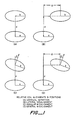
- the coils can move relative to one another as shown in Figure 1. As they move, their gain (voltage gain, current gain, transconductance gain, or transimpedance gain, depending on the input and output circuitry) changes, since their coupling depends on their relative positions. Many applications require a stable intemal power supply, and therefore, must regulate the output of the receiver coil.
- the earlier links also had another problem, i.e., poor bandwidth. These links were usually single tuned (transmitter coil only) or double tuned (both coils) to the carrier frequency so that they could be driven by a semi-passive RF transmitter (Class C, for example) for higher efficiency. Semi-passive transmitters need a high Q tuned circuit to operate efficiently. Unfortunately, the higher the Q, the smaller the band width. The previous Stanford stimulators used a separate ultrasonic data link to obtain a wide band data path, but that link proved much less tolerant to misalignment than the inductive link, and unreliable in use due to acoustic impedance mismatches. Clearly,an efficient wide band power and data link would solve some difficult problems.
- the new approach described in the present invention utilizes a pair of coils, one beneath the skin and one outside the skin, each connected to a capacitor.
- the values of the capacitor and coil inductance are selected to provide a stagger-tuned link. That is, the values of the components are selected to place the pole of one filter above the operating frequency, and the pole of the other filter below the operating frequency of the link.
- the poles will move as the coupling coefficient changes, desensitizing the link to the coupling so that the coils can be misaligned in any manner with little effect on the output.
- the present invention includes a number of approaches which differ from obvious uses of stagger tuning or any prior art approaches.
- the problem is that when the coils move, the coupling coefficient changes and so does the ratio of input to output.
- the present invention applies stagger tuning to desensitize the link going into the coupling coefficient rather than broaden the band width as is normally done in stagger-tuned filters.
- the gain is stabilized due to an approach which takes into account and relies on the interaction of two components; typically, gain is stablized by isolating components from affecting one another.
- a fully active driver or class D amplifier is preferably utilized to effectively drive the link with a square wave signal.
- This signal can be modulated to convey data information to the implanted receiver coil beneath the skin.
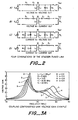
- the "Voltage Driven:Voltage Out” link of Figure 2A will illustrate the approach of the present invention to gain control.
- the voltage gain across an untuned or singly tuned two-coil system varies linearly with the coupling coefficient (assuming the load resistance is large compared to the coil reactance), so if the coupling increases by a factor of three, it will cause the voltage gain to triple.
- This lax gain control is generally unacceptable because it usually wastes most of the received power in the voltage regulation.
- This circuit reduces the coupling dependent gain variations by tuning the coils to two different frequencies; one above and one below the operating frequency. If these coils' resonances are placed optimally, their effective poles will shift as the mutual coupling of the coils changes. The gain will be compensated as a result.
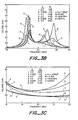
- Figure 3 is a plot of the voltage gain versus frequency and coupling .for a link that was designed to operate at 20 MHz.
- the link is stagger-tuned, i.e., the component values are selected as shown so that one pole is placed above the operating frequency (20 MHz) and one pole below.
- the poles move as the coupling coefficient changes. If they are placed properly, their positions move to compensate for the changing coupling. To illustrate, in Figure 3 as the coupling increases, the poles move away from the operating frequency.
- the link needs a transmitter that can efficiently handle a variable load impedance while maintaining a constant driving voltage or current.
- Semi-passive drivers such as class C or class E, are not practical because they lose efficiency if the load impedance is not resonant at the operating frequency, a fundamental incompatibility with stagger tuning.
- a class D transmitter can drive these loads efficiently, and can supply a constant driving source so that the link output voltage, or current, remains stable.
- a class D transmitter can drive these loads efficiently, because it can supply a constant source which is independent of the load. It simply switches the input of the link between the two terminals of the power supply. Reactive loads and load variations, due to changing coupling, should not affect its output level.
- This driver also has a theoretical maximum efficiency of 100%, meaning that its efficiency is not bounded by a sub-optimum theoretical limit, an advantage in any design.
- the driver's loss is proportional to the ratio of the voltage dropped across its switches to the supply voltage. It is fairly simple to make this ratio quite small, and in practice, the design tends to become more efficient as the output power level is raised, In fact, the efficiency improves when it is needed most, when the transmitter is delivering the maximum power.
- the class D driver therefore, meets the requirements for driving the stagger tuned link; it can efficiently drive a variable load with a stable source.
- a class D driver has another advantage due to its square wave output.
- the Fourier Series of a square wave has a fundamental sine wave whose amplitude is 4/.w times the amplitude of the square wave.
- the stagger tuned link passes the fundamental and attenuates the harmonics, meaning that the class D driver provides the added advantage of another 27% increase in gain.
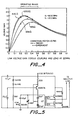
- Figure 4 shows the theoretical and experimental gain versus coupling for the 20 MHz link described above. It has a correction factor of 0.745 which means that the theoretical gain is multiplied by 0.745 to match the experimental results. The difference between theory and practice comes from operating the coils near their self-resonant frequencies.
- the parasitic capacitance of the transmitter coil acts with the tuning capacitance to form a voltage divider between the transmitter and the inductor. It lowers the amount of voltage reaching the tuned circuit. In this example, the additional square wave gain (27%) was used to replenish the gain lost to the self resonance.
- a typical class D driver usable with the coils described above is shown in Figure 5.
- This procedure initially determines whether a design is feasible. If so, then it uses an iterative process to meet the design goals.
- the procedure begins by specifying the type of link, coupling range, load range, and operating frequency. These choices may be limited by size constraints, FCC regulations, or power requirements.
- the equation below is an approximation which applies to all of the link combinations. It gives the ratio of the magnitude of the minimum gain to the maximum gain (G) in terms of a ratio of the minimum and maximum coupling coefficients - ( Xmin and Xmax ). Note that O ⁇ x min ⁇ x max ⁇ and O ⁇ G ⁇ 1.
- the coupling range (x min and x max ) is usually found experimentally. If the gain variation is too large (G is too small),. then the coupling range needs to be reduced (preferably by raising the minimum value of coupling which has the added advantages of lowering the transmitter coil losses by reducing the transmitter current, and also improving the load insensitivity of the gain by lowering the link output impedance).
- One possible solution is to use larger coil diameters. A larger diameter will reduce the coupling range as long as the alignment tolerance is held constant.
- Another solution is to use a ferrite backing on either or both coils. The ferrite will compress the magnetic field around the coils and raise their mutual coupling.
- the procedure tends to be iterative.
- the minimum inductance of each of the two coils is chosen.
- the receiver coil inductance must provide a reasonable Q (for example, greater than 10) for the loaded receiver tank circuit. If the Q is too low, the output voltage will be sensitive to changes in the load. Also, to maintain a reasonable overall efficiency, the transmitter coil inductance should provide a large enough input impedance so that the transmitter will not have to supply an excessive current into the link (generally, raising the transmitter coil's inductance raises the link's input impedance).
- the next step is to set the minimum gain and reduce the gain variation over a band of frequencies.
- a ratio of receiver resonance to the operating frequency ( ⁇ r / ⁇ ) is chosen. (Remember, if the link is driven by a class D transmitter, ( ⁇ r / ⁇ ) should be chosen so that the input impedance looks inductive, which allows the transmitter to provide efficient switching.) This ratio along with the resistances, coupling range and coil inductances, fixes the ratio of the transmitter resonance to the operating frequency ( ⁇ t / ⁇ ).
- the equations which specify ⁇ t / ⁇ are different for each type of link and are given below.
- plots are made ' of the gain versus frequency for the six combinations of minimum and maximum load (R min ,R max ); and minimum, optimum, and maximum values of coupling (k min , K opt ,K max ).
- the required gain is obtained by varying the turns ratio (inductance of the coils and adjusting ⁇ r / ⁇ . For example, if the gain is too small, then the turns ratio should be changed or ⁇ r / ⁇ moved closure to unity. If the gain variation, due to loading, is too large over the frequency band, then the receiver coil Q should be increased. If the spread is lop-sided (more variation on one side of the band than on the other), then ⁇ r / ⁇ needs to be slightly adjusted until the gain is acceptably uniform about the operating frequency.
- link gain equation There are four combinations of link gain; voltage gain, current gain, transconductance gain, and transimpedance gain.
- the link gain equation for all four combinations has the form where k is the coupling coefficient (O ⁇ x ⁇ 1), and A, B, C, D, and E are variables dependent on the link combination.
- the ratio of the minimum gain to the maximum gain is the ratio of the minimum gain to the maximum gain.
- Figure 2A is a circuit diagram of a stagger-tuned link which is driven by a voltage source and whose output appears as a voltage source. This arrangement is the type used by a preferred embodiment. For this circuit the general parameters are
- the ratio of minimum to maximum voltage gain is approximately 0.90, which is well within the goal of 0.5.
- two identical coils, with ferrite backings for high coupling are chosen. They are 1.96 ⁇ h with a series resistance of 5.8 ⁇ at 20 MHz. These numbers give a transmitter tank Q of about 40 and a receiver tank Q, including the 1x ⁇ load, of about four.
- Figure 3B is a plot of the gain versus frequency for the six combinations of coupling and load, using the equations in the appendix for a "voltage driven:voltage out" link.
- Figure 3C is an expanded view of the gain around the operating frequency (20 MHz).
- the maximum gain deviation occurs at the high end of the frequency range (21 MHz).
- the ratio of minimum to maximum gain is 0.7 which exceeds the design goal of 0.5.
- the minimum gain is about 1.9 which is only 5% below the goal of 2, well within the tolerances of most components, and probably acceptable.
- the output impedance of the link (equivalent to about 800 ohms) is significant compared to the load, so the output voltage is somewhat load sensitive.
- Two ways of reducing the output impedance are: one, raise the coupling coefficient (use ferrite backings and larger coil diameters); and two, make sure that the Q of the loaded receiver coil is reasonably high (adjust the receiver coil inductance).
- FIG. 5 shows a preferred embodiment of a transmitter design used to drive the link.
- This circuit is a class D FM voltage driver with several features for portable, efficient operation. Its frequency is fairly insensitive to changes in the power supply voltage, so that it can operate from transistor radio batteries without regulation. Its frequency deviation is controlled by a CMOS compatible input which interfaces easily to portable digital logic. It also uses core drivers in the output stage to rapidly and efficiently switch the high output currents.
- the stagger-tuned link in this example, has a minimum input impedance of about 47H, a fairly small load for the transmitter to drive.
- AM efficiency of 35% allows the link to operate for a full day (16 hours) on two nine volt transistor radio batteries. This efficiency provides a major reduction in power consumption and battery size over previous Stanford stimulators (a worst case power consumption of 140mW intead of 400mW, and two nine volt batteries instead of a brick-sized battery pack).
- the link receives its power from an RF carrier sent across the inductive link, and extracts its data from a frequency-modulation (FM) of this carrier.
- FM frequency-modulation
- This approach decouples the information from the output voltage, again keeping the output voltage fairly constant for the sake of efficiency.
- FM requires a wider bandwidth than that needed for just the data.
- This link provides that additional bandwidth.
- This link is still capable of delivering a base-band data rate of one megabit per second. This data rate is very high for a neural stimulator.
- the band-width limiting element of this system was not the link, but the FM receiver (due to transistors with only a 20 MHz beta cutoff frequency).
- the stagger-tuned link can provide both a large bandwidth and a high efficiency; two characteristics which were mutually exclusive in previous links.
- Inductive links provide a safe means of delivering both power and data into devices implanted in the body. With the appropriate applications of stagger tuning, these links can now provide a high efficiency by taking advantage of a coupling desensitized link gain. They can also supply a large bandwidth without adversely effecting their efficiency. This technique is successful in neural stimulators and can easily be applied to many other applications requiring coupling insensitivity.
Landscapes
- Health & Medical Sciences (AREA)
- Physics & Mathematics (AREA)
- Life Sciences & Earth Sciences (AREA)
- Animal Behavior & Ethology (AREA)
- Engineering & Computer Science (AREA)
- Biomedical Technology (AREA)
- Nuclear Medicine, Radiotherapy & Molecular Imaging (AREA)
- Radiology & Medical Imaging (AREA)
- Electromagnetism (AREA)
- Acoustics & Sound (AREA)
- General Health & Medical Sciences (AREA)
- Public Health (AREA)
- Veterinary Medicine (AREA)
- Amplifiers (AREA)
- Electrotherapy Devices (AREA)
- Near-Field Transmission Systems (AREA)
Applications Claiming Priority (2)
| Application Number | Priority Date | Filing Date | Title |
|---|---|---|---|
| US719232 | 1985-04-02 | ||
| US06/719,232 US4679560A (en) | 1985-04-02 | 1985-04-02 | Wide band inductive transdermal power and data link |
Publications (3)
| Publication Number | Publication Date |
|---|---|
| EP0200359A2 true EP0200359A2 (de) | 1986-11-05 |
| EP0200359A3 EP0200359A3 (en) | 1987-12-02 |
| EP0200359B1 EP0200359B1 (de) | 1992-07-29 |
Family
ID=24889283
Family Applications (1)
| Application Number | Title | Priority Date | Filing Date |
|---|---|---|---|
| EP86302272A Expired - Lifetime EP0200359B1 (de) | 1985-04-02 | 1986-03-26 | Induktive Breitbandverbindung zur Übertragung von Energie und Daten |
Country Status (7)
| Country | Link |
|---|---|
| US (1) | US4679560A (de) |
| EP (1) | EP0200359B1 (de) |
| JP (1) | JPS625358A (de) |
| CN (1) | CN1005456B (de) |
| AU (2) | AU5535186A (de) |
| CA (1) | CA1276242C (de) |
| DE (1) | DE3686194D1 (de) |
Cited By (2)
| Publication number | Priority date | Publication date | Assignee | Title |
|---|---|---|---|---|
| EP0417634A3 (en) * | 1989-09-12 | 1992-12-02 | Siemens Elema Ab | Adjustable output level signal transmitter |
| WO1997015125A1 (en) * | 1995-10-19 | 1997-04-24 | The University Of Melbourne | Embedded data link and protocol |
Families Citing this family (120)
| Publication number | Priority date | Publication date | Assignee | Title |
|---|---|---|---|---|
| JP2907342B2 (ja) * | 1988-01-29 | 1999-06-21 | ザ リージェンツ オブ ザ ユニバーシティー オブ カリフォルニア | イオン滲透非侵襲的サンプリングまたは送出装置 |
| US5362307A (en) | 1989-01-24 | 1994-11-08 | The Regents Of The University Of California | Method for the iontophoretic non-invasive-determination of the in vivo concentration level of an inorganic or organic substance |
| US5042084A (en) * | 1989-09-07 | 1991-08-20 | Cochlear Pty. Limited | Three wire system for Cochlear implant processor |
| US5876425A (en) * | 1989-09-22 | 1999-03-02 | Advanced Bionics Corporation | Power control loop for implantable tissue stimulator |
| US5603726A (en) * | 1989-09-22 | 1997-02-18 | Alfred E. Mann Foundation For Scientific Research | Multichannel cochlear implant system including wearable speech processor |
| GB9011970D0 (en) * | 1990-05-29 | 1990-07-18 | Leigh Stewart Prod | Electrical control system for,for example,an air spa bath |
| US5350413B1 (en) * | 1990-06-21 | 1999-09-07 | Heart Inst Research Corp | Transcutaneous energy transfer device |
| US5117825A (en) * | 1990-11-09 | 1992-06-02 | John Grevious | Closed loop transmitter for medical implant |
| US5314453A (en) * | 1991-12-06 | 1994-05-24 | Spinal Cord Society | Position sensitive power transfer antenna |
| US5193539A (en) * | 1991-12-18 | 1993-03-16 | Alfred E. Mann Foundation For Scientific Research | Implantable microstimulator |
| US5193540A (en) * | 1991-12-18 | 1993-03-16 | Alfred E. Mann Foundation For Scientific Research | Structure and method of manufacture of an implantable microstimulator |
| US5358514A (en) * | 1991-12-18 | 1994-10-25 | Alfred E. Mann Foundation For Scientific Research | Implantable microdevice with self-attaching electrodes |
| DE69228531T2 (de) * | 1992-02-20 | 1999-07-29 | Neomedics, Inc., Budd Lake, N.J. | Implantierbarer Knochenwachstumsstimulator |
| US5565005A (en) * | 1992-02-20 | 1996-10-15 | Amei Technologies Inc. | Implantable growth tissue stimulator and method operation |
| US5423334A (en) * | 1993-02-01 | 1995-06-13 | C. R. Bard, Inc. | Implantable medical device characterization system |
| USD361555S (en) | 1993-02-17 | 1995-08-22 | Amei Technologies Inc. | Combined programmer and monitor for an implantable tissue growth stimulator |
| US5314457A (en) * | 1993-04-08 | 1994-05-24 | Jeutter Dean C | Regenerative electrical |
| US5524624A (en) * | 1994-05-05 | 1996-06-11 | Amei Technologies Inc. | Apparatus and method for stimulating tissue growth with ultrasound |
| US5549658A (en) * | 1994-10-24 | 1996-08-27 | Advanced Bionics Corporation | Four-Channel cochlear system with a passive, non-hermetically sealed implant |
| US5630836A (en) * | 1995-01-19 | 1997-05-20 | Vascor, Inc. | Transcutaneous energy and information transmission apparatus |
| US5833714A (en) * | 1996-01-18 | 1998-11-10 | Loeb; Gerald E. | Cochlear electrode array employing tantalum metal |
| US5957958A (en) * | 1997-01-15 | 1999-09-28 | Advanced Bionics Corporation | Implantable electrode arrays |
| AU732701B2 (en) * | 1997-02-03 | 2001-04-26 | Sony Corporation | Electric power transmission device and electric power transmission method |
| US5991170A (en) * | 1998-02-03 | 1999-11-23 | Sony Corporation | Equipment and method for transmitting electric power |
| US6281611B1 (en) | 1998-02-10 | 2001-08-28 | Light Sciences Corporation | Use of moving element to produce heat |
| US6331744B1 (en) | 1998-02-10 | 2001-12-18 | Light Sciences Corporation | Contactless energy transfer apparatus |
| US5945762A (en) * | 1998-02-10 | 1999-08-31 | Light Sciences Limited Partnership | Movable magnet transmitter for inducing electrical current in an implanted coil |
| US8489200B2 (en) | 1998-07-06 | 2013-07-16 | Abiomed, Inc. | Transcutaneous energy transfer module with integrated conversion circuitry |
| US6389318B1 (en) * | 1998-07-06 | 2002-05-14 | Abiomed, Inc. | Magnetic shield for primary coil of transcutaneous energy transfer device |
| US6324431B1 (en) | 1998-07-06 | 2001-11-27 | Abiomed, Inc. | Transcutaneous energy transfer device with magnetic field protected components in secondary coil |
| US6324430B1 (en) | 1998-07-06 | 2001-11-27 | Abiomed, Inc. | Magnetic shield for primary coil of transcutaneous energy transfer device |
| US6240318B1 (en) | 1998-10-27 | 2001-05-29 | Richard P. Phillips | Transcutaneous energy transmission system with full wave Class E rectifier |
| US6464628B1 (en) | 1999-08-12 | 2002-10-15 | Obtech Medical Ag | Mechanical anal incontinence |
| US6482145B1 (en) | 2000-02-14 | 2002-11-19 | Obtech Medical Ag | Hydraulic anal incontinence treatment |
| US6471635B1 (en) | 2000-02-10 | 2002-10-29 | Obtech Medical Ag | Anal incontinence disease treatment with controlled wireless energy supply |
| US6503189B1 (en) | 1999-08-12 | 2003-01-07 | Obtech Medical Ag | Controlled anal incontinence disease treatment |
| US6589205B1 (en) | 1999-12-17 | 2003-07-08 | Advanced Bionica Corporation | Externally-controllable constant-flow medication delivery system |
| US6477425B1 (en) * | 1999-12-23 | 2002-11-05 | Mmc/Gatx Partnership No. 1 | External transmitter for implanted medical device |
| WO2001047434A2 (en) | 2000-02-10 | 2001-07-05 | Potencia Medical Ag | Mechanical impotence treatment apparatus |
| CN1222254C (zh) | 2000-02-10 | 2005-10-12 | 波滕西亚医疗公司 | 用无线能量源进行尿失禁治疗 |
| DE60134585D1 (de) | 2000-02-10 | 2008-08-07 | Potencia Medical Ag | Kontrollierte Harninkontinenzbehandlung |
| CN1400888A (zh) | 2000-02-11 | 2003-03-05 | 波滕西亚医疗公司 | 带能量变换装置的阳痿治疗设备 |
| WO2001050832A2 (en) * | 2000-02-11 | 2001-07-19 | Potencia Medical Ag | Controlled impotence treatment |
| EP1255514B1 (de) | 2000-02-14 | 2006-04-26 | Potencia Medical AG | Männliche impotentzprothesevorrichtung mit drahtloser energieversorgung |
| US7442165B2 (en) | 2000-02-14 | 2008-10-28 | Obtech Medical Ag | Penile prosthesis |
| US20030100929A1 (en) | 2000-02-14 | 2003-05-29 | Peter Forsell | Controlled penile prosthesis |
| US8155752B2 (en) * | 2000-03-17 | 2012-04-10 | Boston Scientific Neuromodulation Corporation | Implantable medical device with single coil for charging and communicating |
| US6631296B1 (en) * | 2000-03-17 | 2003-10-07 | Advanced Bionics Corporation | Voltage converter for implantable microstimulator using RF-powering coil |
| AU2002364009B2 (en) | 2002-01-02 | 2007-01-25 | Advanced Bionics Corporation | Wideband low-noise implantable microphone assembly |
| US7001329B2 (en) * | 2002-07-23 | 2006-02-21 | Pentax Corporation | Capsule endoscope guidance system, capsule endoscope holder, and capsule endoscope |
| US20040034275A1 (en) * | 2002-07-29 | 2004-02-19 | Peter Forsell | Multi-material incontinence treatment constriction device |
| EP1539262A1 (de) * | 2002-07-29 | 2005-06-15 | Potencia Medical AG | Haltbares implantat |
| DE10235947A1 (de) * | 2002-08-06 | 2004-02-19 | Diehl Ako Stiftung & Co. Kg | Verfahren zur Übertragung von Energie und Daten und Elektrogerät zur Durchführung dieses Verfahrens |
| ATE356598T1 (de) * | 2003-01-31 | 2007-04-15 | Potencia Medical Ag | Elektrisch bedienbare vorrichtung zur inkontinenzbehandlung |
| WO2004066879A1 (en) * | 2003-01-31 | 2004-08-12 | Potencia Medical Ag | Electrically operable impotence treatment apparatus |
| AU2003904032A0 (en) * | 2003-08-04 | 2003-08-14 | Ventracor Limited | Improved Transcutaneous Power and Data Transceiver System |
| US8026729B2 (en) | 2003-09-16 | 2011-09-27 | Cardiomems, Inc. | System and apparatus for in-vivo assessment of relative position of an implant |
| CA2539261C (en) | 2003-09-16 | 2011-05-17 | Cardiomems, Inc. | Implantable wireless sensor |
| JP2005245938A (ja) * | 2004-03-08 | 2005-09-15 | Pentax Corp | 診断用着衣、診断用着衣システム、及び内視鏡システム |
| JP2005245937A (ja) * | 2004-03-08 | 2005-09-15 | Pentax Corp | 通信機能付き着衣、及び内視鏡システム |
| US20050195785A1 (en) * | 2004-03-08 | 2005-09-08 | Pentax Corporation | Image signal processing device |
| WO2005104779A2 (en) * | 2004-04-28 | 2005-11-10 | Transoma Medical, Inc. | Implantable medical devices and related methods |
| US7794499B2 (en) | 2004-06-08 | 2010-09-14 | Theken Disc, L.L.C. | Prosthetic intervertebral spinal disc with integral microprocessor |
| JP4706036B2 (ja) * | 2005-02-03 | 2011-06-22 | 学校法人東京理科大学 | 非接触電力供給システム及びそれを用いた医療システム |
| EP1893080A2 (de) | 2005-06-21 | 2008-03-05 | CardioMems, Inc. | Verfahren zur herstellung eines implantierbaren drahtlosen sensors für in-vivo-druckmessung |
| CA2614599C (en) * | 2005-07-08 | 2016-02-02 | Jason Kroh | Coupling loop, cable assembly and method for positioning coupling loop |
| KR101136889B1 (ko) | 2005-07-12 | 2012-04-20 | 메사추세츠 인스티튜트 오브 테크놀로지 | 무선 비-방사성 에너지 전달 |
| US7825543B2 (en) | 2005-07-12 | 2010-11-02 | Massachusetts Institute Of Technology | Wireless energy transfer |
| US8111150B2 (en) | 2006-09-08 | 2012-02-07 | Cardiomems, Inc. | Physiological data acquisition and management system for use with an implanted wireless sensor |
| US20080078567A1 (en) * | 2006-09-08 | 2008-04-03 | Miller Donald J | Antenna cable |
| WO2010042045A1 (en) | 2008-10-10 | 2010-04-15 | Milux Holding S.A. | A system, an apparatus, and a method for treating a sexual dysfunctional female patient |
| WO2009051538A1 (en) * | 2007-10-16 | 2009-04-23 | Milux Holding Sa | A method and apparatus for supplying energy to a medical device |
| US9452296B2 (en) * | 2007-10-16 | 2016-09-27 | Peter Forsell | Method and system for controlling supply of energy to an implantable medical device |
| CN101896224B (zh) | 2007-10-16 | 2014-03-12 | 米卢克斯控股股份有限公司 | 一种向医疗设备供应能量的装置 |
| CA2749771C (en) * | 2008-01-28 | 2018-05-01 | Milux Holding S.A. | A drainage device comprising an active filter |
| EP3476371B1 (de) | 2008-01-29 | 2022-03-09 | Implantica Patent Ltd. | Vorrichtung zur behandlung von refluxösophagitis |
| JP5241381B2 (ja) * | 2008-08-25 | 2013-07-17 | 株式会社日立製作所 | 電力受信装置 |
| EP2349170B1 (de) | 2008-10-10 | 2023-09-27 | Implantica Patent Ltd. | Vorrichtung zur behandlung von weiblicher sexueller dysfunktion |
| AU2009302955B2 (en) | 2008-10-10 | 2017-01-05 | Implantica Patent Ltd. | Fastening means for implantable medical control assembly |
| WO2010042012A1 (en) | 2008-10-10 | 2010-04-15 | Milux Holding Sa | Heart help device, system, and method |
| WO2010042058A1 (en) | 2008-10-10 | 2010-04-15 | Milux Holding S.A. | An improved artificial valve |
| US20210378811A1 (en) * | 2008-10-10 | 2021-12-09 | Peter Forsell | Fastening means for implantable medical control assembly |
| US10583234B2 (en) | 2008-10-10 | 2020-03-10 | Peter Forsell | Heart help device, system and method |
| US9949812B2 (en) | 2009-07-17 | 2018-04-24 | Peter Forsell | Vaginal operation method for the treatment of anal incontinence in women |
| US10952836B2 (en) | 2009-07-17 | 2021-03-23 | Peter Forsell | Vaginal operation method for the treatment of urinary incontinence in women |
| US9042995B2 (en) * | 2010-02-03 | 2015-05-26 | Medtronic, Inc. | Implantable medical devices and systems having power management for recharge sessions |
| WO2011097289A1 (en) | 2010-02-03 | 2011-08-11 | Medtronic, Inc. | Implantable medical devices and systems having dual frequency inductive telemetry and recharge |
| JP5177187B2 (ja) * | 2010-08-10 | 2013-04-03 | 株式会社村田製作所 | 電力伝送システム |
| EP4112115B1 (de) | 2010-12-20 | 2026-02-11 | Abiomed, Inc. | Verfahren und system zum genauen verfolgen der verfügbaren last in einem transkutanen energieübertragungssystem |
| US9002469B2 (en) | 2010-12-20 | 2015-04-07 | Abiomed, Inc. | Transcutaneous energy transfer system with multiple secondary coils |
| WO2012087819A2 (en) | 2010-12-20 | 2012-06-28 | Abiomed, Inc. | Transcutaneous energy transfer system with vibration inducing warning circuitry |
| EP4119184B1 (de) | 2011-04-14 | 2025-09-03 | Abiomed, Inc. | Transkutane energieübertragungsspule mit integrierter funkfrequenzantenne |
| US9136728B2 (en) | 2011-04-28 | 2015-09-15 | Medtronic, Inc. | Implantable medical devices and systems having inductive telemetry and recharge on a single coil |
| US8764621B2 (en) | 2011-07-11 | 2014-07-01 | Vascor, Inc. | Transcutaneous power transmission and communication for implanted heart assist and other devices |
| GB201120036D0 (en) | 2011-11-21 | 2012-01-04 | The Technology Partnership Plc | Method of providing power and data |
| US9002468B2 (en) | 2011-12-16 | 2015-04-07 | Abiomed, Inc. | Automatic power regulation for transcutaneous energy transfer charging system |
| US10291067B2 (en) | 2012-07-27 | 2019-05-14 | Tc1 Llc | Computer modeling for resonant power transfer systems |
| US9592397B2 (en) | 2012-07-27 | 2017-03-14 | Thoratec Corporation | Thermal management for implantable wireless power transfer systems |
| EP2878062A4 (de) | 2012-07-27 | 2016-04-20 | Thoratec Corp | Resonante leistungsübertragungsspulen und systeme |
| US10525181B2 (en) | 2012-07-27 | 2020-01-07 | Tc1 Llc | Resonant power transfer system and method of estimating system state |
| WO2014018974A1 (en) | 2012-07-27 | 2014-01-30 | Thoratec Corporation | Magnetic power transmission utilizing phased transmitter coil arrays and phased receiver coil arrays |
| WO2014018971A1 (en) | 2012-07-27 | 2014-01-30 | Thoratec Corporation | Resonant power transfer systems with protective algorithm |
| WO2014018967A1 (en) | 2012-07-27 | 2014-01-30 | Thoratec Corporation | Self-tuning resonant power transfer systems |
| US10383990B2 (en) | 2012-07-27 | 2019-08-20 | Tc1 Llc | Variable capacitor for resonant power transfer systems |
| US9094913B2 (en) | 2012-11-20 | 2015-07-28 | Georgia Tech Research Corporation | Wideband data and power transmission using pulse delay modulation |
| WO2014145664A1 (en) | 2013-03-15 | 2014-09-18 | Thoratec Corporation | Integrated implantable tets housing including fins and coil loops |
| EP2984731B8 (de) | 2013-03-15 | 2019-06-26 | Tc1 Llc | Verformbare tets-spule mit verbesserter anatomischer passform |
| US10695476B2 (en) | 2013-11-11 | 2020-06-30 | Tc1 Llc | Resonant power transfer systems with communications |
| JP6521993B2 (ja) | 2013-11-11 | 2019-05-29 | ティーシー1 エルエルシー | 通信を有する共振電力伝送システム |
| US9855437B2 (en) | 2013-11-11 | 2018-01-02 | Tc1 Llc | Hinged resonant power transfer coil |
| US10610692B2 (en) | 2014-03-06 | 2020-04-07 | Tc1 Llc | Electrical connectors for implantable devices |
| EP3826104B1 (de) | 2014-09-22 | 2023-05-03 | Tc1 Llc | Antennenentwürfe zur kommunikation zwischen einem drahtlos betriebenen implantat mit einer externen vorrichtung ausserhalb des körpers |
| US9583874B2 (en) | 2014-10-06 | 2017-02-28 | Thoratec Corporation | Multiaxial connector for implantable devices |
| US10001579B2 (en) * | 2015-03-18 | 2018-06-19 | The United States Of America As Represented By The Secretary Of The Army | High frequency electromagnetic induction |
| US10148126B2 (en) | 2015-08-31 | 2018-12-04 | Tc1 Llc | Wireless energy transfer system and wearables |
| EP3902100A1 (de) | 2015-10-07 | 2021-10-27 | Tc1 Llc | Resonante leistungsübertragungssysteme mit effizienzoptimierung basierend auf empfängerimpedanz |
| EP3497775B1 (de) | 2016-09-21 | 2022-07-13 | Tc1 Llc | Systeme und verfahren zur ortung von implantierten vorrichtungen zur drahtlosen stromübertragung |
| US11197990B2 (en) | 2017-01-18 | 2021-12-14 | Tc1 Llc | Systems and methods for transcutaneous power transfer using microneedles |
| WO2019135890A1 (en) | 2018-01-04 | 2019-07-11 | Tc1 Llc | Systems and methods for elastic wireless power transmission devices |
| DE112021007117T5 (de) * | 2021-02-17 | 2023-12-28 | Apple Inc. | Zubehörvorrichtung zur Verbesserung der Effizienz der drahtlosen Leistungsübertragung |
Family Cites Families (6)
| Publication number | Priority date | Publication date | Assignee | Title |
|---|---|---|---|---|
| US3195540A (en) * | 1963-03-29 | 1965-07-20 | Louis C Waller | Power supply for body implanted instruments |
| US3796221A (en) * | 1971-07-07 | 1974-03-12 | N Hagfors | Apparatus for delivering electrical stimulation energy to body-implanted apparatus with signal-receiving means |
| JPS5060085A (de) * | 1973-09-27 | 1975-05-23 | ||
| US4044775A (en) * | 1976-04-29 | 1977-08-30 | Medtronic, Inc. | Implantable receiver circuit |
| US4134408A (en) * | 1976-11-12 | 1979-01-16 | Research Corporation | Cardiac pacer energy conservation system |
| US4441210A (en) * | 1981-09-18 | 1984-04-03 | Hochmair Erwin S | Transcutaneous signal transmission system and methods |
-
1985
- 1985-04-02 US US06/719,232 patent/US4679560A/en not_active Expired - Fee Related
-
1986
- 1986-03-26 DE DE8686302272T patent/DE3686194D1/de not_active Expired - Lifetime
- 1986-03-26 EP EP86302272A patent/EP0200359B1/de not_active Expired - Lifetime
- 1986-03-27 AU AU55351/86A patent/AU5535186A/en not_active Abandoned
- 1986-03-31 CN CN86103021.4A patent/CN1005456B/zh not_active Expired
- 1986-04-01 CA CA000505519A patent/CA1276242C/en not_active Expired - Lifetime
- 1986-04-02 JP JP61076406A patent/JPS625358A/ja active Pending
-
1990
- 1990-05-23 AU AU55788/90A patent/AU5578890A/en not_active Abandoned
Cited By (3)
| Publication number | Priority date | Publication date | Assignee | Title |
|---|---|---|---|---|
| EP0417634A3 (en) * | 1989-09-12 | 1992-12-02 | Siemens Elema Ab | Adjustable output level signal transmitter |
| WO1997015125A1 (en) * | 1995-10-19 | 1997-04-24 | The University Of Melbourne | Embedded data link and protocol |
| US5741314A (en) * | 1995-10-19 | 1998-04-21 | Daly; Christopher Newton | Embedded data link and protocol |
Also Published As
| Publication number | Publication date |
|---|---|
| DE3686194D1 (de) | 1992-09-03 |
| AU5535186A (en) | 1986-10-09 |
| EP0200359B1 (de) | 1992-07-29 |
| CN1005456B (zh) | 1989-10-18 |
| CA1276242C (en) | 1990-11-13 |
| EP0200359A3 (en) | 1987-12-02 |
| JPS625358A (ja) | 1987-01-12 |
| AU5578890A (en) | 1990-09-20 |
| US4679560A (en) | 1987-07-14 |
| CN86103021A (zh) | 1986-11-12 |
Similar Documents
| Publication | Publication Date | Title |
|---|---|---|
| EP0200359B1 (de) | Induktive Breitbandverbindung zur Übertragung von Energie und Daten | |
| CA1246680A (en) | Power transfer for implanted prosthesis | |
| AU2005202322B2 (en) | Spatially decoupled twin secondary coils for optimizing transcutaneous energy transfer (TET) power transfer characteristics | |
| US5314457A (en) | Regenerative electrical | |
| US11577087B2 (en) | Power and data transfer in hearing prostheses | |
| EP0076070B1 (de) | Transkutanes Signalübertragungssystem | |
| US6212431B1 (en) | Power transfer circuit for implanted devices | |
| CA1276240C (en) | Transcutaneous power and signal transmission system and methods for increased signal transmission efficiency | |
| CN103262435B (zh) | 用于可植入医疗设备的磁感应通信系统 | |
| US20090030488A1 (en) | Implanted antenna and radio communications link | |
| EP2498871B1 (de) | Verwendung des gehäuses einer implantierbaren medizinischen vorrichtung zur erweiterung der kommunikationsbandbreite | |
| US6675045B2 (en) | Split-can dipole antenna for an implantable medical device | |
| US7209792B1 (en) | RF-energy modulation system through dynamic coil detuning | |
| US20140324127A1 (en) | Implantable Medical Device with Multi-Function Single Coil | |
| US9067072B2 (en) | Switchable dual-coil communication circuitry for extending communication range in an implantable medical device system | |
| US20210220655A1 (en) | Radio Frequency Antenna Capacitively Coupled to a Charging Coil in an Implantable Medical Device | |
| EP3683973B1 (de) | Schaltung zur induktiven kommunikation mit mehreren bändern | |
| US20240238603A1 (en) | Systems and Methods for Multisite Stimulation Using a Double-Tuned Transmitter Coil | |
| Afagdolen | Technical Aspects of Electrical Neurostimulation. | |
| RU2752139C1 (ru) | Устройство для чрескожной передачи энергии с помощью индуктивной связи | |
| Jendernalik et al. | Automatic tuning of a resonant circuit in wireless power supply systems for biomedical sensors | |
| Türkyılmaz | Battery Management System With Autonomous Wireless Power and Data Transmission for Inductively Charged Implantable Devices | |
| Zhou et al. | A Novel Design of Transcutaneous Power and Data Bidirectional Transfer System for Biomedical Implants | |
| IMPLANT-ANALOG | Hamidreza Taghavi, Bo Håkansson, Sabine Reinfeldt |
Legal Events
| Date | Code | Title | Description |
|---|---|---|---|
| PUAI | Public reference made under article 153(3) epc to a published international application that has entered the european phase |
Free format text: ORIGINAL CODE: 0009012 |
|
| AK | Designated contracting states |
Kind code of ref document: A2 Designated state(s): BE DE FR GB NL SE |
|
| PUAB | Information related to the publication of an a document modified or deleted |
Free format text: ORIGINAL CODE: 0009199EPPU |
|
| RA1 | Application published (corrected) |
Date of ref document: 19861210 Kind code of ref document: A2 |
|
| PUAL | Search report despatched |
Free format text: ORIGINAL CODE: 0009013 |
|
| AK | Designated contracting states |
Kind code of ref document: A3 Designated state(s): BE DE FR GB NL SE |
|
| 17P | Request for examination filed |
Effective date: 19880216 |
|
| 17Q | First examination report despatched |
Effective date: 19901001 |
|
| GRAA | (expected) grant |
Free format text: ORIGINAL CODE: 0009210 |
|
| AK | Designated contracting states |
Kind code of ref document: B1 Designated state(s): BE DE FR GB NL SE |
|
| PG25 | Lapsed in a contracting state [announced via postgrant information from national office to epo] |
Ref country code: SE Effective date: 19920729 Ref country code: NL Effective date: 19920729 Ref country code: FR Effective date: 19920729 Ref country code: DE Effective date: 19920729 Ref country code: BE Effective date: 19920729 |
|
| REF | Corresponds to: |
Ref document number: 3686194 Country of ref document: DE Date of ref document: 19920903 |
|
| EN | Fr: translation not filed | ||
| NLV1 | Nl: lapsed or annulled due to failure to fulfill the requirements of art. 29p and 29m of the patents act | ||
| PG25 | Lapsed in a contracting state [announced via postgrant information from national office to epo] |
Ref country code: GB Effective date: 19930326 |
|
| PLBE | No opposition filed within time limit |
Free format text: ORIGINAL CODE: 0009261 |
|
| STAA | Information on the status of an ep patent application or granted ep patent |
Free format text: STATUS: NO OPPOSITION FILED WITHIN TIME LIMIT |
|
| 26N | No opposition filed | ||
| GBPC | Gb: european patent ceased through non-payment of renewal fee |
Effective date: 19930326 |