EP0200322B1 - Heterocyclic compounds - Google Patents
Heterocyclic compounds Download PDFInfo
- Publication number
- EP0200322B1 EP0200322B1 EP86301989A EP86301989A EP0200322B1 EP 0200322 B1 EP0200322 B1 EP 0200322B1 EP 86301989 A EP86301989 A EP 86301989A EP 86301989 A EP86301989 A EP 86301989A EP 0200322 B1 EP0200322 B1 EP 0200322B1
- Authority
- EP
- European Patent Office
- Prior art keywords
- indole
- formula
- fluorophenyl
- tetrahydropyridin
- methyl
- Prior art date
- Legal status (The legal status is an assumption and is not a legal conclusion. Google has not performed a legal analysis and makes no representation as to the accuracy of the status listed.)
- Expired - Lifetime
Links
- 150000002391 heterocyclic compounds Chemical class 0.000 title 1
- 150000001875 compounds Chemical class 0.000 claims description 51
- 238000000034 method Methods 0.000 claims description 33
- 150000003839 salts Chemical class 0.000 claims description 27
- 239000002253 acid Substances 0.000 claims description 22
- 150000002475 indoles Chemical class 0.000 claims description 17
- 125000002887 hydroxy group Chemical group [H]O* 0.000 claims description 14
- 125000004432 carbon atom Chemical group C* 0.000 claims description 13
- -1 2-furoyl Chemical group 0.000 claims description 12
- IJGRMHOSHXDMSA-UHFFFAOYSA-N Atomic nitrogen Chemical compound N#N IJGRMHOSHXDMSA-UHFFFAOYSA-N 0.000 claims description 12
- 239000012458 free base Substances 0.000 claims description 12
- 229910052739 hydrogen Inorganic materials 0.000 claims description 12
- 239000001257 hydrogen Substances 0.000 claims description 12
- 125000004435 hydrogen atom Chemical group [H]* 0.000 claims description 10
- 125000002496 methyl group Chemical group [H]C([H])([H])* 0.000 claims description 10
- 229910052757 nitrogen Inorganic materials 0.000 claims description 9
- 125000004178 (C1-C4) alkyl group Chemical group 0.000 claims description 8
- NCZRXRGIUPSHIH-UHFFFAOYSA-N 2-[4-[1-(4-fluorophenyl)-5-(trifluoromethyl)indol-3-yl]piperazin-1-yl]ethanol Chemical compound C1CN(CCO)CCN1C(C1=CC(=CC=C11)C(F)(F)F)=CN1C1=CC=C(F)C=C1 NCZRXRGIUPSHIH-UHFFFAOYSA-N 0.000 claims description 8
- SIKJAQJRHWYJAI-UHFFFAOYSA-N Indole Chemical compound C1=CC=C2NC=CC2=C1 SIKJAQJRHWYJAI-UHFFFAOYSA-N 0.000 claims description 8
- 229910052736 halogen Inorganic materials 0.000 claims description 8
- 125000002023 trifluoromethyl group Chemical group FC(F)(F)* 0.000 claims description 8
- OKTJSMMVPCPJKN-UHFFFAOYSA-N Carbon Chemical compound [C] OKTJSMMVPCPJKN-UHFFFAOYSA-N 0.000 claims description 7
- 229940054051 antipsychotic indole derivative Drugs 0.000 claims description 7
- 229910052799 carbon Inorganic materials 0.000 claims description 7
- XMEYKENMGPBBQT-UHFFFAOYSA-N 1-(4-fluorophenyl)-3-(1-methyl-3,6-dihydro-2h-pyridin-4-yl)-5-nitroindole Chemical compound C1N(C)CCC(C=2C3=CC(=CC=C3N(C=3C=CC(F)=CC=3)C=2)[N+]([O-])=O)=C1 XMEYKENMGPBBQT-UHFFFAOYSA-N 0.000 claims description 6
- GLUUGHFHXGJENI-UHFFFAOYSA-N Piperazine Chemical compound C1CNCCN1 GLUUGHFHXGJENI-UHFFFAOYSA-N 0.000 claims description 6
- 125000001997 phenyl group Chemical group [H]C1=C([H])C([H])=C(*)C([H])=C1[H] 0.000 claims description 6
- 238000002360 preparation method Methods 0.000 claims description 6
- 150000002148 esters Chemical class 0.000 claims description 5
- VRJHQPZVIGNGMX-UHFFFAOYSA-N 4-piperidinone Chemical compound O=C1CCNCC1 VRJHQPZVIGNGMX-UHFFFAOYSA-N 0.000 claims description 4
- 125000004399 C1-C4 alkenyl group Chemical group 0.000 claims description 4
- NINIDFKCEFEMDL-UHFFFAOYSA-N Sulfur Chemical group [S] NINIDFKCEFEMDL-UHFFFAOYSA-N 0.000 claims description 4
- 150000007933 aliphatic carboxylic acids Chemical class 0.000 claims description 4
- QVGXLLKOCUKJST-UHFFFAOYSA-N atomic oxygen Chemical group [O] QVGXLLKOCUKJST-UHFFFAOYSA-N 0.000 claims description 4
- 239000003054 catalyst Substances 0.000 claims description 4
- 125000001309 chloro group Chemical group Cl* 0.000 claims description 4
- 239000011737 fluorine Chemical group 0.000 claims description 4
- 229910052731 fluorine Inorganic materials 0.000 claims description 4
- 125000005843 halogen group Chemical group 0.000 claims description 4
- 150000002367 halogens Chemical group 0.000 claims description 4
- PZOUSPYUWWUPPK-UHFFFAOYSA-N indole Natural products CC1=CC=CC2=C1C=CN2 PZOUSPYUWWUPPK-UHFFFAOYSA-N 0.000 claims description 4
- RKJUIXBNRJVNHR-UHFFFAOYSA-N indolenine Natural products C1=CC=C2CC=NC2=C1 RKJUIXBNRJVNHR-UHFFFAOYSA-N 0.000 claims description 4
- 125000000449 nitro group Chemical group [O-][N+](*)=O 0.000 claims description 4
- 229910052760 oxygen Inorganic materials 0.000 claims description 4
- 239000001301 oxygen Substances 0.000 claims description 4
- 125000002924 primary amino group Chemical group [H]N([H])* 0.000 claims description 4
- 229910052717 sulfur Chemical group 0.000 claims description 4
- 239000011593 sulfur Chemical group 0.000 claims description 4
- 125000004414 alkyl thio group Chemical group 0.000 claims description 3
- 239000003638 chemical reducing agent Substances 0.000 claims description 3
- 125000001495 ethyl group Chemical group [H]C([H])([H])C([H])([H])* 0.000 claims description 3
- 238000010438 heat treatment Methods 0.000 claims description 3
- RAXXELZNTBOGNW-UHFFFAOYSA-N imidazole Substances C1=CNC=N1 RAXXELZNTBOGNW-UHFFFAOYSA-N 0.000 claims description 3
- 125000004769 (C1-C4) alkylsulfonyl group Chemical group 0.000 claims description 2
- 125000000229 (C1-C4)alkoxy group Chemical group 0.000 claims description 2
- 125000002030 1,2-phenylene group Chemical group [H]C1=C([H])C([*:1])=C([*:2])C([H])=C1[H] 0.000 claims description 2
- QBZDSLKRZFOTKQ-UHFFFAOYSA-N 2-[4-[1-(4-fluorophenyl)-5-(trifluoromethyl)indol-3-yl]-3,6-dihydro-2h-pyridin-1-yl]ethanol Chemical compound C1N(CCO)CCC(C=2C3=CC(=CC=C3N(C=3C=CC(F)=CC=3)C=2)C(F)(F)F)=C1 QBZDSLKRZFOTKQ-UHFFFAOYSA-N 0.000 claims description 2
- BOSUTADHBOJFNQ-UHFFFAOYSA-N 2-[4-[1-(4-fluorophenyl)-5-nitroindol-3-yl]-3,6-dihydro-2h-pyridin-1-yl]ethanol Chemical compound C1N(CCO)CCC(C=2C3=CC(=CC=C3N(C=3C=CC(F)=CC=3)C=2)[N+]([O-])=O)=C1 BOSUTADHBOJFNQ-UHFFFAOYSA-N 0.000 claims description 2
- 125000004105 2-pyridyl group Chemical group N1=C([*])C([H])=C([H])C([H])=C1[H] 0.000 claims description 2
- 125000000175 2-thienyl group Chemical group S1C([*])=C([H])C([H])=C1[H] 0.000 claims description 2
- CRKFIZHTSSGESG-UHFFFAOYSA-N 3-[4-[5-fluoro-1-(4-fluorophenyl)indol-3-yl]-3,6-dihydro-2h-pyridin-1-yl]propan-1-ol Chemical compound C1N(CCCO)CCC(C=2C3=CC(F)=CC=C3N(C=3C=CC(F)=CC=3)C=2)=C1 CRKFIZHTSSGESG-UHFFFAOYSA-N 0.000 claims description 2
- QOXOZONBQWIKDA-UHFFFAOYSA-N 3-hydroxypropyl Chemical group [CH2]CCO QOXOZONBQWIKDA-UHFFFAOYSA-N 0.000 claims description 2
- 125000003349 3-pyridyl group Chemical group N1=C([H])C([*])=C([H])C([H])=C1[H] 0.000 claims description 2
- 125000001541 3-thienyl group Chemical group S1C([H])=C([*])C([H])=C1[H] 0.000 claims description 2
- 125000000339 4-pyridyl group Chemical group N1=C([H])C([H])=C([*])C([H])=C1[H] 0.000 claims description 2
- VMZWFUNEODYUEN-UHFFFAOYSA-N 5-chloro-1-(4-fluorophenyl)-3-(1-methyl-3,6-dihydro-2h-pyridin-4-yl)indole Chemical compound C1N(C)CCC(C=2C3=CC(Cl)=CC=C3N(C=3C=CC(F)=CC=3)C=2)=C1 VMZWFUNEODYUEN-UHFFFAOYSA-N 0.000 claims description 2
- PXGOKWXKJXAPGV-UHFFFAOYSA-N Fluorine Chemical group FF PXGOKWXKJXAPGV-UHFFFAOYSA-N 0.000 claims description 2
- 125000003282 alkyl amino group Chemical group 0.000 claims description 2
- 239000000460 chlorine Substances 0.000 claims description 2
- 229910052801 chlorine Inorganic materials 0.000 claims description 2
- 125000004093 cyano group Chemical group *C#N 0.000 claims description 2
- 125000000753 cycloalkyl group Chemical group 0.000 claims description 2
- 125000004981 cycloalkylmethyl group Chemical group 0.000 claims description 2
- 125000000113 cyclohexyl group Chemical group [H]C1([H])C([H])([H])C([H])([H])C([H])(*)C([H])([H])C1([H])[H] 0.000 claims description 2
- 150000002118 epoxides Chemical class 0.000 claims description 2
- 125000001153 fluoro group Chemical group F* 0.000 claims description 2
- 125000001072 heteroaryl group Chemical group 0.000 claims description 2
- 229910052751 metal Inorganic materials 0.000 claims description 2
- 239000002184 metal Substances 0.000 claims description 2
- QJGQUHMNIGDVPM-UHFFFAOYSA-N nitrogen group Chemical group [N] QJGQUHMNIGDVPM-UHFFFAOYSA-N 0.000 claims description 2
- 125000006273 (C1-C3) alkyl group Chemical group 0.000 claims 1
- 125000006274 (C1-C3)alkoxy group Chemical group 0.000 claims 1
- 125000000954 2-hydroxyethyl group Chemical group [H]C([*])([H])C([H])([H])O[H] 0.000 claims 1
- RTZKZFJDLAIYFH-UHFFFAOYSA-N Diethyl ether Chemical compound CCOCC RTZKZFJDLAIYFH-UHFFFAOYSA-N 0.000 description 39
- CSCPPACGZOOCGX-UHFFFAOYSA-N Acetone Chemical compound CC(C)=O CSCPPACGZOOCGX-UHFFFAOYSA-N 0.000 description 27
- LFQSCWFLJHTTHZ-UHFFFAOYSA-N Ethanol Chemical compound CCO LFQSCWFLJHTTHZ-UHFFFAOYSA-N 0.000 description 21
- VZCYOOQTPOCHFL-UHFFFAOYSA-N trans-butenedioic acid Natural products OC(=O)C=CC(O)=O VZCYOOQTPOCHFL-UHFFFAOYSA-N 0.000 description 16
- XEKOWRVHYACXOJ-UHFFFAOYSA-N Ethyl acetate Chemical compound CCOC(C)=O XEKOWRVHYACXOJ-UHFFFAOYSA-N 0.000 description 15
- 239000000203 mixture Substances 0.000 description 12
- 238000012360 testing method Methods 0.000 description 11
- 229910001868 water Inorganic materials 0.000 description 11
- 229910052943 magnesium sulfate Inorganic materials 0.000 description 10
- VZCYOOQTPOCHFL-UPHRSURJSA-N maleic acid Chemical compound OC(=O)\C=C/C(O)=O VZCYOOQTPOCHFL-UPHRSURJSA-N 0.000 description 10
- 239000002904 solvent Substances 0.000 description 9
- 241000700159 Rattus Species 0.000 description 8
- 239000012074 organic phase Substances 0.000 description 8
- MUBZPKHOEPUJKR-UHFFFAOYSA-N Oxalic acid Chemical compound OC(=O)C(O)=O MUBZPKHOEPUJKR-UHFFFAOYSA-N 0.000 description 7
- 239000000243 solution Substances 0.000 description 7
- 239000003826 tablet Substances 0.000 description 7
- XLYOFNOQVPJJNP-UHFFFAOYSA-N water Chemical compound O XLYOFNOQVPJJNP-UHFFFAOYSA-N 0.000 description 7
- VZCYOOQTPOCHFL-OWOJBTEDSA-N Fumaric acid Chemical compound OC(=O)\C=C\C(O)=O VZCYOOQTPOCHFL-OWOJBTEDSA-N 0.000 description 6
- VEXZGXHMUGYJMC-UHFFFAOYSA-N Hydrochloric acid Chemical compound Cl VEXZGXHMUGYJMC-UHFFFAOYSA-N 0.000 description 6
- CPELXLSAUQHCOX-UHFFFAOYSA-N Hydrogen bromide Chemical compound Br CPELXLSAUQHCOX-UHFFFAOYSA-N 0.000 description 6
- KFZMGEQAYNKOFK-UHFFFAOYSA-N Isopropanol Chemical compound CC(C)O KFZMGEQAYNKOFK-UHFFFAOYSA-N 0.000 description 6
- DTQVDTLACAAQTR-UHFFFAOYSA-N Trifluoroacetic acid Chemical compound OC(=O)C(F)(F)F DTQVDTLACAAQTR-UHFFFAOYSA-N 0.000 description 6
- VYFYYTLLBUKUHU-UHFFFAOYSA-N dopamine Chemical compound NCCC1=CC=C(O)C(O)=C1 VYFYYTLLBUKUHU-UHFFFAOYSA-N 0.000 description 6
- 230000000694 effects Effects 0.000 description 6
- 239000007924 injection Substances 0.000 description 6
- 238000002347 injection Methods 0.000 description 6
- 231100000252 nontoxic Toxicity 0.000 description 6
- 230000003000 nontoxic effect Effects 0.000 description 6
- BWHMMNNQKKPAPP-UHFFFAOYSA-L potassium carbonate Chemical compound [K+].[K+].[O-]C([O-])=O BWHMMNNQKKPAPP-UHFFFAOYSA-L 0.000 description 6
- 239000011541 reaction mixture Substances 0.000 description 6
- 102000005962 receptors Human genes 0.000 description 6
- 108020003175 receptors Proteins 0.000 description 6
- YMWUJEATGCHHMB-UHFFFAOYSA-N Dichloromethane Chemical compound ClCCl YMWUJEATGCHHMB-UHFFFAOYSA-N 0.000 description 5
- GNOIPBMMFNIUFM-UHFFFAOYSA-N hexamethylphosphoric triamide Chemical compound CN(C)P(=O)(N(C)C)N(C)C GNOIPBMMFNIUFM-UHFFFAOYSA-N 0.000 description 5
- 230000000144 pharmacologic effect Effects 0.000 description 5
- 229910000027 potassium carbonate Inorganic materials 0.000 description 5
- 238000010992 reflux Methods 0.000 description 5
- 239000000126 substance Substances 0.000 description 5
- 0 **1C=CC(N(*)CC2)=C2C=C1 Chemical compound **1C=CC(N(*)CC2)=C2C=C1 0.000 description 4
- 241000282414 Homo sapiens Species 0.000 description 4
- 241001465754 Metazoa Species 0.000 description 4
- SECXISVLQFMRJM-UHFFFAOYSA-N N-Methylpyrrolidone Chemical compound CN1CCCC1=O SECXISVLQFMRJM-UHFFFAOYSA-N 0.000 description 4
- 208000028017 Psychotic disease Diseases 0.000 description 4
- 239000004480 active ingredient Substances 0.000 description 4
- 125000000217 alkyl group Chemical group 0.000 description 4
- 150000001412 amines Chemical class 0.000 description 4
- 230000036461 convulsion Effects 0.000 description 4
- 238000001816 cooling Methods 0.000 description 4
- 239000012071 phase Substances 0.000 description 4
- QTBSBXVTEAMEQO-UHFFFAOYSA-N Acetic acid Chemical compound CC(O)=O QTBSBXVTEAMEQO-UHFFFAOYSA-N 0.000 description 3
- VHUUQVKOLVNVRT-UHFFFAOYSA-N Ammonium hydroxide Chemical compound [NH4+].[OH-] VHUUQVKOLVNVRT-UHFFFAOYSA-N 0.000 description 3
- UHOVQNZJYSORNB-UHFFFAOYSA-N Benzene Chemical compound C1=CC=CC=C1 UHOVQNZJYSORNB-UHFFFAOYSA-N 0.000 description 3
- 229910010084 LiAlH4 Inorganic materials 0.000 description 3
- OKKJLVBELUTLKV-UHFFFAOYSA-N Methanol Chemical compound OC OKKJLVBELUTLKV-UHFFFAOYSA-N 0.000 description 3
- DUGOZIWVEXMGBE-UHFFFAOYSA-N Methylphenidate Chemical compound C=1C=CC=CC=1C(C(=O)OC)C1CCCCN1 DUGOZIWVEXMGBE-UHFFFAOYSA-N 0.000 description 3
- 241000699670 Mus sp. Species 0.000 description 3
- 206010028347 Muscle twitching Diseases 0.000 description 3
- ZMANZCXQSJIPKH-UHFFFAOYSA-N Triethylamine Chemical compound CCN(CC)CC ZMANZCXQSJIPKH-UHFFFAOYSA-N 0.000 description 3
- 150000007513 acids Chemical class 0.000 description 3
- 230000000202 analgesic effect Effects 0.000 description 3
- 238000004458 analytical method Methods 0.000 description 3
- 230000027455 binding Effects 0.000 description 3
- 238000009739 binding Methods 0.000 description 3
- 239000002775 capsule Substances 0.000 description 3
- 230000002903 catalepsic effect Effects 0.000 description 3
- 238000006243 chemical reaction Methods 0.000 description 3
- 229960003638 dopamine Drugs 0.000 description 3
- 239000012280 lithium aluminium hydride Substances 0.000 description 3
- 229960001344 methylphenidate Drugs 0.000 description 3
- IPCSVZSSVZVIGE-UHFFFAOYSA-N palmitic acid group Chemical group C(CCCCCCCCCCCCCCC)(=O)O IPCSVZSSVZVIGE-UHFFFAOYSA-N 0.000 description 3
- 239000000843 powder Substances 0.000 description 3
- 239000000047 product Substances 0.000 description 3
- 208000020016 psychiatric disease Diseases 0.000 description 3
- XRXDAJYKGWNHTQ-UHFFFAOYSA-N quipazine Chemical compound C1CNCCN1C1=CC=C(C=CC=C2)C2=N1 XRXDAJYKGWNHTQ-UHFFFAOYSA-N 0.000 description 3
- 229950002315 quipazine Drugs 0.000 description 3
- 239000006188 syrup Substances 0.000 description 3
- 235000020357 syrup Nutrition 0.000 description 3
- NGCRUNVSVIEPOF-UHFFFAOYSA-N 5-fluoro-1-(4-fluorophenyl)-3-(1,2,3,6-tetrahydropyridin-4-yl)indole Chemical compound C1=CC(F)=CC=C1N1C2=CC=C(F)C=C2C(C=2CCNCC=2)=C1 NGCRUNVSVIEPOF-UHFFFAOYSA-N 0.000 description 2
- HEDRZPFGACZZDS-UHFFFAOYSA-N Chloroform Chemical compound ClC(Cl)Cl HEDRZPFGACZZDS-UHFFFAOYSA-N 0.000 description 2
- 229910021589 Copper(I) bromide Inorganic materials 0.000 description 2
- UFHFLCQGNIYNRP-UHFFFAOYSA-N Hydrogen Chemical compound [H][H] UFHFLCQGNIYNRP-UHFFFAOYSA-N 0.000 description 2
- CSNNHWWHGAXBCP-UHFFFAOYSA-L Magnesium sulfate Chemical compound [Mg+2].[O-][S+2]([O-])([O-])[O-] CSNNHWWHGAXBCP-UHFFFAOYSA-L 0.000 description 2
- KDLHZDBZIXYQEI-UHFFFAOYSA-N Palladium Chemical compound [Pd] KDLHZDBZIXYQEI-UHFFFAOYSA-N 0.000 description 2
- VYPSYNLAJGMNEJ-UHFFFAOYSA-N Silicium dioxide Chemical compound O=[Si]=O VYPSYNLAJGMNEJ-UHFFFAOYSA-N 0.000 description 2
- 235000011054 acetic acid Nutrition 0.000 description 2
- 230000002378 acidificating effect Effects 0.000 description 2
- 239000002671 adjuvant Substances 0.000 description 2
- 125000003342 alkenyl group Chemical group 0.000 description 2
- 125000003545 alkoxy group Chemical group 0.000 description 2
- 230000003110 anti-inflammatory effect Effects 0.000 description 2
- 238000006254 arylation reaction Methods 0.000 description 2
- 239000002585 base Substances 0.000 description 2
- WPYMKLBDIGXBTP-UHFFFAOYSA-N benzoic acid group Chemical group C(C1=CC=CC=C1)(=O)O WPYMKLBDIGXBTP-UHFFFAOYSA-N 0.000 description 2
- 230000037396 body weight Effects 0.000 description 2
- NJMYODHXAKYRHW-DVZOWYKESA-N cis-flupenthixol Chemical compound C1CN(CCO)CCN1CC\C=C\1C2=CC(C(F)(F)F)=CC=C2SC2=CC=CC=C2/1 NJMYODHXAKYRHW-DVZOWYKESA-N 0.000 description 2
- 238000004440 column chromatography Methods 0.000 description 2
- 239000012043 crude product Substances 0.000 description 2
- WZHCOOQXZCIUNC-UHFFFAOYSA-N cyclandelate Chemical compound C1C(C)(C)CC(C)CC1OC(=O)C(O)C1=CC=CC=C1 WZHCOOQXZCIUNC-UHFFFAOYSA-N 0.000 description 2
- 239000002552 dosage form Substances 0.000 description 2
- 230000035929 gnawing Effects 0.000 description 2
- 238000000338 in vitro Methods 0.000 description 2
- 230000005764 inhibitory process Effects 0.000 description 2
- 238000002955 isolation Methods 0.000 description 2
- HQKMJHAJHXVSDF-UHFFFAOYSA-L magnesium stearate Chemical compound [Mg+2].CCCCCCCCCCCCCCCCCC([O-])=O.CCCCCCCCCCCCCCCCCC([O-])=O HQKMJHAJHXVSDF-UHFFFAOYSA-L 0.000 description 2
- 239000012528 membrane Substances 0.000 description 2
- 125000004433 nitrogen atom Chemical group N* 0.000 description 2
- 150000003891 oxalate salts Chemical class 0.000 description 2
- 150000005623 oxindoles Chemical class 0.000 description 2
- BASFCYQUMIYNBI-UHFFFAOYSA-N platinum Substances [Pt] BASFCYQUMIYNBI-UHFFFAOYSA-N 0.000 description 2
- 239000002798 polar solvent Substances 0.000 description 2
- 239000002244 precipitate Substances 0.000 description 2
- GZKLJWGUPQBVJQ-UHFFFAOYSA-N sertindole Chemical compound C1=CC(F)=CC=C1N1C2=CC=C(Cl)C=C2C(C2CCN(CCN3C(NCC3)=O)CC2)=C1 GZKLJWGUPQBVJQ-UHFFFAOYSA-N 0.000 description 2
- 239000000741 silica gel Substances 0.000 description 2
- 229910002027 silica gel Inorganic materials 0.000 description 2
- 229950001675 spiperone Drugs 0.000 description 2
- 238000003756 stirring Methods 0.000 description 2
- WGAHDTJJTLAAKS-UHFFFAOYSA-N 1-(1-chloroethyl)imidazolidin-2-one Chemical compound CC(Cl)N1CCNC1=O WGAHDTJJTLAAKS-UHFFFAOYSA-N 0.000 description 1
- ZTRPBNFJIIWFNB-UHFFFAOYSA-N 1-(1h-indol-2-yl)pyrrolidin-2-one Chemical class O=C1CCCN1C1=CC2=CC=CC=C2N1 ZTRPBNFJIIWFNB-UHFFFAOYSA-N 0.000 description 1
- BQMUVWHEUBUXPZ-UHFFFAOYSA-N 1-(2-fluorophenyl)-3-(1-methyl-3,6-dihydro-2h-pyridin-4-yl)-5-nitroindole Chemical compound C1N(C)CCC(C=2C3=CC(=CC=C3N(C=3C(=CC=CC=3)F)C=2)[N+]([O-])=O)=C1 BQMUVWHEUBUXPZ-UHFFFAOYSA-N 0.000 description 1
- AJBPYAASKNVYDK-UHFFFAOYSA-N 1-(3-fluorophenyl)-3-(1-methyl-3,6-dihydro-2h-pyridin-4-yl)-5-nitroindole Chemical compound C1N(C)CCC(C=2C3=CC(=CC=C3N(C=3C=C(F)C=CC=3)C=2)[N+]([O-])=O)=C1 AJBPYAASKNVYDK-UHFFFAOYSA-N 0.000 description 1
- NSFYNKYRZNMNME-UHFFFAOYSA-N 1-(4-fluorophenyl)-3-(1,2,3,6-tetrahydropyridin-4-yl)-5-(trifluoromethyl)indole Chemical compound C1=CC(F)=CC=C1N1C2=CC=C(C(F)(F)F)C=C2C(C=2CCNCC=2)=C1 NSFYNKYRZNMNME-UHFFFAOYSA-N 0.000 description 1
- BMVAHRHNUHKMHM-UHFFFAOYSA-N 1-(4-fluorophenyl)-3-(1-methyl-3,6-dihydro-2h-pyridin-4-yl)-5-(trifluoromethyl)indole Chemical compound C1N(C)CCC(C=2C3=CC(=CC=C3N(C=3C=CC(F)=CC=3)C=2)C(F)(F)F)=C1 BMVAHRHNUHKMHM-UHFFFAOYSA-N 0.000 description 1
- ZFHKKAVAZIIWGM-UHFFFAOYSA-N 1-(4-fluorophenyl)-3-(1-methyl-3,6-dihydro-2h-pyridin-4-yl)indol-5-amine Chemical compound C1N(C)CCC(C=2C3=CC(N)=CC=C3N(C=3C=CC(F)=CC=3)C=2)=C1 ZFHKKAVAZIIWGM-UHFFFAOYSA-N 0.000 description 1
- QVTIYLFSBMCCJG-UHFFFAOYSA-N 1-(4-fluorophenyl)-3-(1-methyl-3,6-dihydro-2h-pyridin-4-yl)indole Chemical compound C1N(C)CCC(C=2C3=CC=CC=C3N(C=3C=CC(F)=CC=3)C=2)=C1 QVTIYLFSBMCCJG-UHFFFAOYSA-N 0.000 description 1
- HASBQEQTIGJBGO-UHFFFAOYSA-N 1-(4-fluorophenyl)-3-(1-methylpiperidin-4-yl)-5-(trifluoromethyl)indole Chemical compound C1CN(C)CCC1C(C1=CC(=CC=C11)C(F)(F)F)=CN1C1=CC=C(F)C=C1 HASBQEQTIGJBGO-UHFFFAOYSA-N 0.000 description 1
- WJUXFTRBTDQINE-UHFFFAOYSA-N 1-(4-fluorophenyl)-3-(4-methylpiperazin-1-yl)-5-(trifluoromethyl)indole Chemical compound C1CN(C)CCN1C(C1=CC(=CC=C11)C(F)(F)F)=CN1C1=CC=C(F)C=C1 WJUXFTRBTDQINE-UHFFFAOYSA-N 0.000 description 1
- JSDALFJCAZJXCI-UHFFFAOYSA-N 1-(4-fluorophenyl)-3-(4-propan-2-ylpiperazin-1-yl)-5-(trifluoromethyl)indole Chemical compound C1CN(C(C)C)CCN1C(C1=CC(=CC=C11)C(F)(F)F)=CN1C1=CC=C(F)C=C1 JSDALFJCAZJXCI-UHFFFAOYSA-N 0.000 description 1
- RGQJPQPIPVEJKK-UHFFFAOYSA-N 1-(4-fluorophenyl)-3-hydroxy-5-methyl-3-(1-methylpiperidin-4-yl)indol-2-one Chemical compound C1CN(C)CCC1C1(O)C2=CC(C)=CC=C2N(C=2C=CC(F)=CC=2)C1=O RGQJPQPIPVEJKK-UHFFFAOYSA-N 0.000 description 1
- BXKILDRPXJWUSF-UHFFFAOYSA-N 1-(4-fluorophenyl)-3-piperazin-1-yl-5-(trifluoromethyl)indole Chemical compound C1=CC(F)=CC=C1N1C2=CC=C(C(F)(F)F)C=C2C(N2CCNCC2)=C1 BXKILDRPXJWUSF-UHFFFAOYSA-N 0.000 description 1
- JJMLMTMHOYDTQX-UHFFFAOYSA-N 1-(4-fluorophenyl)-5-methyl-3-(1-methyl-3,6-dihydro-2h-pyridin-4-yl)indole Chemical compound C1N(C)CCC(C=2C3=CC(C)=CC=C3N(C=3C=CC(F)=CC=3)C=2)=C1 JJMLMTMHOYDTQX-UHFFFAOYSA-N 0.000 description 1
- YGVJGTHUHAVAQG-UHFFFAOYSA-N 1-(4-fluorophenyl)-5-methyl-3-(1-methylpiperidin-4-yl)-3h-indol-2-one Chemical compound C1CN(C)CCC1C1C2=CC(C)=CC=C2N(C=2C=CC(F)=CC=2)C1=O YGVJGTHUHAVAQG-UHFFFAOYSA-N 0.000 description 1
- VLDUIVUFRNXOKW-UHFFFAOYSA-N 1-(4-fluorophenyl)-5-methyl-3-(1-methylpiperidin-4-yl)indole Chemical compound C1CN(C)CCC1C(C1=CC(C)=CC=C11)=CN1C1=CC=C(F)C=C1 VLDUIVUFRNXOKW-UHFFFAOYSA-N 0.000 description 1
- GEWUAWGPFLQOAW-UHFFFAOYSA-N 1-(4-fluorophenyl)-5-methylindole Chemical compound C1=CC2=CC(C)=CC=C2N1C1=CC=C(F)C=C1 GEWUAWGPFLQOAW-UHFFFAOYSA-N 0.000 description 1
- TVACDAYPUNMYQP-UHFFFAOYSA-N 1-(4-fluorophenyl)-5-methylindole-2,3-dione Chemical compound O=C1C(=O)C2=CC(C)=CC=C2N1C1=CC=C(F)C=C1 TVACDAYPUNMYQP-UHFFFAOYSA-N 0.000 description 1
- HMZNTJHPOBRYRO-UHFFFAOYSA-N 1-(4-fluorophenyl)-5-nitro-3-(1,2,3,6-tetrahydropyridin-4-yl)indole Chemical compound C12=CC([N+](=O)[O-])=CC=C2N(C=2C=CC(F)=CC=2)C=C1C1=CCNCC1 HMZNTJHPOBRYRO-UHFFFAOYSA-N 0.000 description 1
- PVOAHINGSUIXLS-UHFFFAOYSA-N 1-Methylpiperazine Chemical compound CN1CCNCC1 PVOAHINGSUIXLS-UHFFFAOYSA-N 0.000 description 1
- XNLMBXHQWTXCGD-UHFFFAOYSA-N 1-[1-[4-[1-(4-fluorophenyl)-5-(trifluoromethyl)indol-3-yl]piperidin-1-yl]ethyl]pyrrolidin-2-one Chemical compound C1CC(C=2C3=CC(=CC=C3N(C=3C=CC(F)=CC=3)C=2)C(F)(F)F)CCN1C(C)N1CCCC1=O XNLMBXHQWTXCGD-UHFFFAOYSA-N 0.000 description 1
- DVFBHANNQGYZKZ-UHFFFAOYSA-N 1-[2-[4-[1-(2-fluorophenyl)-5-nitroindol-3-yl]-3,6-dihydro-2h-pyridin-1-yl]ethyl]imidazolidin-2-one Chemical compound C12=CC([N+](=O)[O-])=CC=C2N(C=2C(=CC=CC=2)F)C=C1C(CC1)=CCN1CCN1CCNC1=O DVFBHANNQGYZKZ-UHFFFAOYSA-N 0.000 description 1
- UTUHICVEPACBGO-UHFFFAOYSA-N 1-[2-[4-[1-(4-fluorophenyl)-5-(trifluoromethyl)indol-3-yl]-3,6-dihydro-2h-pyridin-1-yl]ethyl]imidazolidin-2-one Chemical compound C1=CC(F)=CC=C1N1C2=CC=C(C(F)(F)F)C=C2C(C=2CCN(CCN3C(NCC3)=O)CC=2)=C1 UTUHICVEPACBGO-UHFFFAOYSA-N 0.000 description 1
- ZDPCATSNJXDABV-UHFFFAOYSA-N 1-[2-[4-[1-(4-fluorophenyl)-5-nitroindol-3-yl]-3,6-dihydro-2h-pyridin-1-yl]ethyl]imidazolidin-2-one Chemical compound C12=CC([N+](=O)[O-])=CC=C2N(C=2C=CC(F)=CC=2)C=C1C(CC1)=CCN1CCN1CCNC1=O ZDPCATSNJXDABV-UHFFFAOYSA-N 0.000 description 1
- FPFNLDJLMDWQNP-UHFFFAOYSA-N 1-[2-[4-[1-(4-fluorophenyl)indol-3-yl]-3,6-dihydro-2h-pyridin-1-yl]ethyl]imidazolidin-2-one Chemical compound C1=CC(F)=CC=C1N1C2=CC=CC=C2C(C=2CCN(CCN3C(NCC3)=O)CC=2)=C1 FPFNLDJLMDWQNP-UHFFFAOYSA-N 0.000 description 1
- QPOLRENOYJQNEP-UHFFFAOYSA-N 1-[2-[4-[1-(4-fluorophenyl)indol-3-yl]piperidin-1-yl]ethyl]imidazolidin-2-one Chemical compound C1=CC(F)=CC=C1N1C2=CC=CC=C2C(C2CCN(CCN3C(NCC3)=O)CC2)=C1 QPOLRENOYJQNEP-UHFFFAOYSA-N 0.000 description 1
- PFOLMILRZUSKJO-UHFFFAOYSA-N 1-[2-[4-[5-chloro-1-(4-fluorophenyl)indol-3-yl]-3,6-dihydro-2h-pyridin-1-yl]ethyl]imidazolidin-2-one Chemical compound C1=CC(F)=CC=C1N1C2=CC=C(Cl)C=C2C(C=2CCN(CCN3C(NCC3)=O)CC=2)=C1 PFOLMILRZUSKJO-UHFFFAOYSA-N 0.000 description 1
- BNMLTDSGRWBJII-UHFFFAOYSA-N 1-[2-[4-[5-fluoro-2-(4-fluorophenyl)-1h-indol-3-yl]-3,6-dihydro-2h-pyridin-1-yl]ethyl]imidazolidin-2-one Chemical compound C1=CC(F)=CC=C1C1=C(C=2CCN(CCN3C(NCC3)=O)CC=2)C2=CC(F)=CC=C2N1 BNMLTDSGRWBJII-UHFFFAOYSA-N 0.000 description 1
- KGNQDBQYEBMPFZ-UHFFFAOYSA-N 1-fluoro-4-iodobenzene Chemical compound FC1=CC=C(I)C=C1 KGNQDBQYEBMPFZ-UHFFFAOYSA-N 0.000 description 1
- HUUPVABNAQUEJW-UHFFFAOYSA-N 1-methylpiperidin-4-one Chemical compound CN1CCC(=O)CC1 HUUPVABNAQUEJW-UHFFFAOYSA-N 0.000 description 1
- 125000006017 1-propenyl group Chemical group 0.000 description 1
- XUDGCZURHPXFLU-UHFFFAOYSA-N 2-(1,2,3,4-tetrahydropyridin-4-yl)-1h-indole Chemical class C1=CNCCC1C1=CC2=CC=CC=C2N1 XUDGCZURHPXFLU-UHFFFAOYSA-N 0.000 description 1
- AEYHIZZYMFAUNU-UHFFFAOYSA-N 2-(3,4-dihydro-2h-pyridin-1-yl)-1h-indole Chemical class C1CCC=CN1C1=CC2=CC=CC=C2N1 AEYHIZZYMFAUNU-UHFFFAOYSA-N 0.000 description 1
- WUMARFDQLKBKQE-UHFFFAOYSA-N 2-[1-(4-fluorophenyl)-3-oxo-5-(trifluoromethyl)-2h-indol-2-yl]acetic acid Chemical compound C12=CC=C(C(F)(F)F)C=C2C(=O)C(CC(=O)O)N1C1=CC=C(F)C=C1 WUMARFDQLKBKQE-UHFFFAOYSA-N 0.000 description 1
- SSMHPAWLTOGZMF-UHFFFAOYSA-N 2-[4-(5-chloro-1h-indol-3-yl)-3,6-dihydro-2h-pyridin-1-yl]ethanol Chemical compound C1N(CCO)CCC(C=2C3=CC(Cl)=CC=C3NC=2)=C1 SSMHPAWLTOGZMF-UHFFFAOYSA-N 0.000 description 1
- WFPIAZLQTJBIFN-BLLMUTORSA-N 2-[4-[(3e)-3-(2-chlorothioxanthen-9-ylidene)propyl]piperazin-1-yl]ethanol Chemical compound C1CN(CCO)CCN1CC\C=C/1C2=CC(Cl)=CC=C2SC2=CC=CC=C2\1 WFPIAZLQTJBIFN-BLLMUTORSA-N 0.000 description 1
- ODVVGUPUQZLQQP-UHFFFAOYSA-N 2-[4-[5-chloro-1-(4-fluorophenyl)indol-3-yl]-3,6-dihydro-2h-pyridin-1-yl]ethanol Chemical compound C1N(CCO)CCC(C=2C3=CC(Cl)=CC=C3N(C=3C=CC(F)=CC=3)C=2)=C1 ODVVGUPUQZLQQP-UHFFFAOYSA-N 0.000 description 1
- ALPYHEALOUHLDX-UHFFFAOYSA-N 2-[4-[5-fluoro-1-(4-fluorophenyl)indol-3-yl]-3,6-dihydro-2h-pyridin-1-yl]ethanol Chemical compound C1N(CCO)CCC(C=2C3=CC(F)=CC=C3N(C=3C=CC(F)=CC=3)C=2)=C1 ALPYHEALOUHLDX-UHFFFAOYSA-N 0.000 description 1
- 125000004974 2-butenyl group Chemical group C(C=CC)* 0.000 description 1
- GRIXINIGTYIHSN-UHFFFAOYSA-N 2-chloro-n,n-diphenylacetamide Chemical class C=1C=CC=CC=1N(C(=O)CCl)C1=CC=CC=C1 GRIXINIGTYIHSN-UHFFFAOYSA-N 0.000 description 1
- XVEVGQMGZGEJRG-UHFFFAOYSA-N 3-(1-methyl-3,6-dihydro-2h-pyridin-4-yl)-5-nitro-1-pyridin-2-ylindole Chemical compound C1N(C)CCC(C=2C3=CC(=CC=C3N(C=3N=CC=CC=3)C=2)[N+]([O-])=O)=C1 XVEVGQMGZGEJRG-UHFFFAOYSA-N 0.000 description 1
- FUFIWWJGWHXNDD-UHFFFAOYSA-N 3-(1-methyl-3,6-dihydro-2h-pyridin-4-yl)-5-nitro-1-pyridin-3-ylindole Chemical compound C1N(C)CCC(C=2C3=CC(=CC=C3N(C=3C=NC=CC=3)C=2)[N+]([O-])=O)=C1 FUFIWWJGWHXNDD-UHFFFAOYSA-N 0.000 description 1
- NJHHVLISGXUEGS-UHFFFAOYSA-N 3-(1-methyl-3,6-dihydro-2h-pyridin-4-yl)-5-nitro-1-thiophen-2-ylindole Chemical compound C1N(C)CCC(C=2C3=CC(=CC=C3N(C=3SC=CC=3)C=2)[N+]([O-])=O)=C1 NJHHVLISGXUEGS-UHFFFAOYSA-N 0.000 description 1
- MWJUXAHARLFJAN-UHFFFAOYSA-N 3-(1-methyl-3,6-dihydro-2h-pyridin-4-yl)-5-nitro-1h-indole Chemical compound C1N(C)CCC(C=2C3=CC(=CC=C3NC=2)[N+]([O-])=O)=C1 MWJUXAHARLFJAN-UHFFFAOYSA-N 0.000 description 1
- PTPXWYMIGCWDGV-UHFFFAOYSA-N 3-[2-[4-[1-(4-fluorophenyl)-5-nitroindol-3-yl]-3,6-dihydro-2h-pyridin-1-yl]ethyl]-1,3-oxazolidin-2-one Chemical compound C12=CC([N+](=O)[O-])=CC=C2N(C=2C=CC(F)=CC=2)C=C1C(CC1)=CCN1CCN1CCOC1=O PTPXWYMIGCWDGV-UHFFFAOYSA-N 0.000 description 1
- WSFFJEAAOUOLBF-UHFFFAOYSA-N 3-[4-[1-(4-fluorophenyl)-5-(trifluoromethyl)indol-3-yl]-3,6-dihydro-2h-pyridin-1-yl]propan-1-ol Chemical compound C1N(CCCO)CCC(C=2C3=CC(=CC=C3N(C=3C=CC(F)=CC=3)C=2)C(F)(F)F)=C1 WSFFJEAAOUOLBF-UHFFFAOYSA-N 0.000 description 1
- NYPYPOZNGOXYSU-UHFFFAOYSA-N 3-bromopyridine Chemical compound BrC1=CC=CN=C1 NYPYPOZNGOXYSU-UHFFFAOYSA-N 0.000 description 1
- IULXLSXYZXWLSR-UHFFFAOYSA-N 3-chloro-5-cyclohexyl-1-phenylpiperazine;1h-indole Chemical compound C1=CC=C2NC=CC2=C1.N1C(Cl)CN(C=2C=CC=CC=2)CC1C1CCCCC1 IULXLSXYZXWLSR-UHFFFAOYSA-N 0.000 description 1
- JTAQARADBDTISW-UHFFFAOYSA-N 3-chloro-5-methyl-1-phenylpiperazine;1h-indole Chemical compound C1=CC=C2NC=CC2=C1.C1C(Cl)NC(C)CN1C1=CC=CC=C1 JTAQARADBDTISW-UHFFFAOYSA-N 0.000 description 1
- VASVHOLFOSSBKT-UHFFFAOYSA-N 3-piperazin-1-yl-1h-indole Chemical class C1CNCCN1C1=CNC2=CC=CC=C12 VASVHOLFOSSBKT-UHFFFAOYSA-N 0.000 description 1
- MYGXGCCFTPKWIH-UHFFFAOYSA-N 4-chloro-1-methylpiperidine Chemical compound CN1CCC(Cl)CC1 MYGXGCCFTPKWIH-UHFFFAOYSA-N 0.000 description 1
- NSXWVWBHCINPIG-UHFFFAOYSA-N 4-methoxyphenylthionophosphine sulfide Chemical class COC1=CC=C(P(=S)=S)C=C1 NSXWVWBHCINPIG-UHFFFAOYSA-N 0.000 description 1
- WLQZFXJVVNNEJU-UHFFFAOYSA-N 5-chloro-1-(4-fluorophenyl)-3-(1,2,3,6-tetrahydropyridin-4-yl)indole Chemical compound C1=CC(F)=CC=C1N1C2=CC=C(Cl)C=C2C(C=2CCNCC=2)=C1 WLQZFXJVVNNEJU-UHFFFAOYSA-N 0.000 description 1
- PWNNDUGSMKBEKE-UHFFFAOYSA-N 5-chloro-1-(4-fluorophenyl)-3-[1-(2-methylpropyl)-3,6-dihydro-2h-pyridin-4-yl]indole Chemical compound C1N(CC(C)C)CCC(C=2C3=CC(Cl)=CC=C3N(C=3C=CC(F)=CC=3)C=2)=C1 PWNNDUGSMKBEKE-UHFFFAOYSA-N 0.000 description 1
- UCJJTLAITWKXNR-UHFFFAOYSA-N 5-chloro-3-(1-methyl-3,6-dihydro-2h-pyridin-4-yl)-1-thiophen-3-ylindole Chemical compound C1N(C)CCC(C=2C3=CC(Cl)=CC=C3N(C3=CSC=C3)C=2)=C1 UCJJTLAITWKXNR-UHFFFAOYSA-N 0.000 description 1
- SVBAGYYAUYNFJX-UHFFFAOYSA-N 5-chloro-3-(4-methylpiperazin-1-yl)-1-phenylindole Chemical compound C1CN(C)CCN1C(C1=CC(Cl)=CC=C11)=CN1C1=CC=CC=C1 SVBAGYYAUYNFJX-UHFFFAOYSA-N 0.000 description 1
- ZFOGIHQMXAYDAX-UHFFFAOYSA-N 5-fluoro-1-(4-fluorophenyl)-3-(1-methyl-3,6-dihydro-2h-pyridin-4-yl)indole Chemical compound C1N(C)CCC(C=2C3=CC(F)=CC=C3N(C=3C=CC(F)=CC=3)C=2)=C1 ZFOGIHQMXAYDAX-UHFFFAOYSA-N 0.000 description 1
- NYNWFPPCKZIGCE-UHFFFAOYSA-N 5-fluoro-1-(4-fluorophenyl)-3-(1-propan-2-yl-3,6-dihydro-2h-pyridin-4-yl)indole Chemical compound C1N(C(C)C)CCC(C=2C3=CC(F)=CC=C3N(C=3C=CC(F)=CC=3)C=2)=C1 NYNWFPPCKZIGCE-UHFFFAOYSA-N 0.000 description 1
- FCSKOFQQCWLGMV-UHFFFAOYSA-N 5-{5-[2-chloro-4-(4,5-dihydro-1,3-oxazol-2-yl)phenoxy]pentyl}-3-methylisoxazole Chemical compound O1N=C(C)C=C1CCCCCOC1=CC=C(C=2OCCN=2)C=C1Cl FCSKOFQQCWLGMV-UHFFFAOYSA-N 0.000 description 1
- SKTFQHRVFFOHTQ-UHFFFAOYSA-N 8-bromo-1,3-dimethyl-7h-purine-2,6-dione Chemical compound O=C1N(C)C(=O)N(C)C2=C1NC(Br)=N2 SKTFQHRVFFOHTQ-UHFFFAOYSA-N 0.000 description 1
- 235000021357 Behenic acid Nutrition 0.000 description 1
- UKMSUNONTOPOIO-UHFFFAOYSA-N Behenic acid Natural products CCCCCCCCCCCCCCCCCCCCCC(O)=O UKMSUNONTOPOIO-UHFFFAOYSA-N 0.000 description 1
- COVZYZSDYWQREU-UHFFFAOYSA-N Busulfan Chemical compound CS(=O)(=O)OCCCCOS(C)(=O)=O COVZYZSDYWQREU-UHFFFAOYSA-N 0.000 description 1
- PCLDSRKJJBFFCW-UHFFFAOYSA-N CC(NCC1)[NH+]1[NH-] Chemical compound CC(NCC1)[NH+]1[NH-] PCLDSRKJJBFFCW-UHFFFAOYSA-N 0.000 description 1
- GAWIXWVDTYZWAW-UHFFFAOYSA-N C[CH]O Chemical group C[CH]O GAWIXWVDTYZWAW-UHFFFAOYSA-N 0.000 description 1
- 241000282472 Canis lupus familiaris Species 0.000 description 1
- 208000024172 Cardiovascular disease Diseases 0.000 description 1
- 208000009132 Catalepsy Diseases 0.000 description 1
- RYGMFSIKBFXOCR-UHFFFAOYSA-N Copper Chemical compound [Cu] RYGMFSIKBFXOCR-UHFFFAOYSA-N 0.000 description 1
- 229920002261 Corn starch Polymers 0.000 description 1
- 241000283086 Equidae Species 0.000 description 1
- PIICEJLVQHRZGT-UHFFFAOYSA-N Ethylenediamine Chemical compound NCCN PIICEJLVQHRZGT-UHFFFAOYSA-N 0.000 description 1
- 241000282326 Felis catus Species 0.000 description 1
- PLDUPXSUYLZYBN-UHFFFAOYSA-N Fluphenazine Chemical compound C1CN(CCO)CCN1CCCN1C2=CC(C(F)(F)F)=CC=C2SC2=CC=CC=C21 PLDUPXSUYLZYBN-UHFFFAOYSA-N 0.000 description 1
- 239000001828 Gelatine Substances 0.000 description 1
- GUBGYTABKSRVRQ-QKKXKWKRSA-N Lactose Natural products OC[C@H]1O[C@@H](O[C@H]2[C@H](O)[C@@H](O)C(O)O[C@@H]2CO)[C@H](O)[C@@H](O)[C@H]1O GUBGYTABKSRVRQ-QKKXKWKRSA-N 0.000 description 1
- AFVFQIVMOAPDHO-UHFFFAOYSA-N Methanesulfonic acid Chemical class CS(O)(=O)=O AFVFQIVMOAPDHO-UHFFFAOYSA-N 0.000 description 1
- GRYLNZFGIOXLOG-UHFFFAOYSA-N Nitric acid Chemical class O[N+]([O-])=O GRYLNZFGIOXLOG-UHFFFAOYSA-N 0.000 description 1
- 229910019142 PO4 Inorganic materials 0.000 description 1
- 235000021314 Palmitic acid Nutrition 0.000 description 1
- 241001494479 Pecora Species 0.000 description 1
- FAPWRFPIFSIZLT-UHFFFAOYSA-M Sodium chloride Chemical compound [Na+].[Cl-] FAPWRFPIFSIZLT-UHFFFAOYSA-M 0.000 description 1
- ZFXYFBGIUFBOJW-UHFFFAOYSA-N Theophylline Natural products O=C1N(C)C(=O)N(C)C2=C1NC=N2 ZFXYFBGIUFBOJW-UHFFFAOYSA-N 0.000 description 1
- 206010047853 Waxy flexibility Diseases 0.000 description 1
- 150000001242 acetic acid derivatives Chemical class 0.000 description 1
- WETWJCDKMRHUPV-UHFFFAOYSA-N acetyl chloride Chemical compound CC(Cl)=O WETWJCDKMRHUPV-UHFFFAOYSA-N 0.000 description 1
- 239000012346 acetyl chloride Substances 0.000 description 1
- 239000003377 acid catalyst Substances 0.000 description 1
- 230000007059 acute toxicity Effects 0.000 description 1
- 231100000403 acute toxicity Toxicity 0.000 description 1
- 150000001350 alkyl halides Chemical class 0.000 description 1
- 125000004390 alkyl sulfonyl group Chemical group 0.000 description 1
- 150000001450 anions Chemical class 0.000 description 1
- 230000008485 antagonism Effects 0.000 description 1
- 239000003420 antiserotonin agent Substances 0.000 description 1
- 101150024767 arnT gene Proteins 0.000 description 1
- 229940116226 behenic acid Drugs 0.000 description 1
- 230000015572 biosynthetic process Effects 0.000 description 1
- 238000009835 boiling Methods 0.000 description 1
- 244000309464 bull Species 0.000 description 1
- 125000000484 butyl group Chemical group [H]C([*])([H])C([H])([H])C([H])([H])C([H])([H])[H] 0.000 description 1
- ZPEIMTDSQAKGNT-UHFFFAOYSA-N chlorpromazine Chemical compound C1=C(Cl)C=C2N(CCCN(C)C)C3=CC=CC=C3SC2=C1 ZPEIMTDSQAKGNT-UHFFFAOYSA-N 0.000 description 1
- 229960001076 chlorpromazine Drugs 0.000 description 1
- 150000001860 citric acid derivatives Chemical class 0.000 description 1
- 229960001184 clopenthixol Drugs 0.000 description 1
- 229910052802 copper Inorganic materials 0.000 description 1
- 239000010949 copper Substances 0.000 description 1
- 239000008120 corn starch Substances 0.000 description 1
- 230000001054 cortical effect Effects 0.000 description 1
- 239000013078 crystal Substances 0.000 description 1
- 150000001954 decanoic acid esters Chemical class 0.000 description 1
- 238000000354 decomposition reaction Methods 0.000 description 1
- 229960004132 diethyl ether Drugs 0.000 description 1
- SBZXBUIDTXKZTM-UHFFFAOYSA-N diglyme Chemical compound COCCOCCOC SBZXBUIDTXKZTM-UHFFFAOYSA-N 0.000 description 1
- 239000003210 dopamine receptor blocking agent Substances 0.000 description 1
- 238000001035 drying Methods 0.000 description 1
- 239000003480 eluent Substances 0.000 description 1
- CCIVGXIOQKPBKL-UHFFFAOYSA-N ethanesulfonic acid Chemical class CCS(O)(=O)=O CCIVGXIOQKPBKL-UHFFFAOYSA-N 0.000 description 1
- 239000012259 ether extract Substances 0.000 description 1
- SFXBSJABBHUGTF-UHFFFAOYSA-N ethyl 4-(5-chloro-1h-indol-3-yl)-3,6-dihydro-2h-pyridine-1-carboxylate Chemical compound C1N(C(=O)OCC)CCC(C=2C3=CC(Cl)=CC=C3NC=2)=C1 SFXBSJABBHUGTF-UHFFFAOYSA-N 0.000 description 1
- KDUAYMNEUHRZBZ-UHFFFAOYSA-N ethyl 4-[5-chloro-1-(4-fluorophenyl)indol-3-yl]-3,6-dihydro-2h-pyridine-1-carboxylate Chemical compound C1N(C(=O)OCC)CCC(C=2C3=CC(Cl)=CC=C3N(C=3C=CC(F)=CC=3)C=2)=C1 KDUAYMNEUHRZBZ-UHFFFAOYSA-N 0.000 description 1
- 125000006125 ethylsulfonyl group Chemical group 0.000 description 1
- 238000011156 evaluation Methods 0.000 description 1
- 238000001704 evaporation Methods 0.000 description 1
- 239000000284 extract Substances 0.000 description 1
- 238000000605 extraction Methods 0.000 description 1
- 230000002349 favourable effect Effects 0.000 description 1
- 239000000706 filtrate Substances 0.000 description 1
- 229960002419 flupentixol Drugs 0.000 description 1
- 229960002690 fluphenazine Drugs 0.000 description 1
- 229920000159 gelatin Polymers 0.000 description 1
- 235000019322 gelatine Nutrition 0.000 description 1
- 125000000623 heterocyclic group Chemical group 0.000 description 1
- 150000003840 hydrochlorides Chemical class 0.000 description 1
- 238000005984 hydrogenation reaction Methods 0.000 description 1
- 238000001727 in vivo Methods 0.000 description 1
- JYGFTBXVXVMTGB-UHFFFAOYSA-N indolin-2-one Chemical compound C1=CC=C2NC(=O)CC2=C1 JYGFTBXVXVMTGB-UHFFFAOYSA-N 0.000 description 1
- 230000002401 inhibitory effect Effects 0.000 description 1
- 229910017053 inorganic salt Inorganic materials 0.000 description 1
- 239000000543 intermediate Substances 0.000 description 1
- 125000001449 isopropyl group Chemical group [H]C([H])([H])C([H])(*)C([H])([H])[H] 0.000 description 1
- 150000002576 ketones Chemical class 0.000 description 1
- 150000003893 lactate salts Chemical class 0.000 description 1
- 239000008101 lactose Substances 0.000 description 1
- CFHGBZLNZZVTAY-UHFFFAOYSA-N lawesson's reagent Chemical compound C1=CC(OC)=CC=C1P1(=S)SP(=S)(C=2C=CC(OC)=CC=2)S1 CFHGBZLNZZVTAY-UHFFFAOYSA-N 0.000 description 1
- 230000005923 long-lasting effect Effects 0.000 description 1
- 239000011777 magnesium Substances 0.000 description 1
- 235000019359 magnesium stearate Nutrition 0.000 description 1
- 150000002688 maleic acid derivatives Chemical class 0.000 description 1
- 239000000463 material Substances 0.000 description 1
- VNWKTOKETHGBQD-UHFFFAOYSA-N methane Natural products C VNWKTOKETHGBQD-UHFFFAOYSA-N 0.000 description 1
- 150000007522 mineralic acids Chemical class 0.000 description 1
- 230000000116 mitigating effect Effects 0.000 description 1
- 238000012986 modification Methods 0.000 description 1
- 230000004048 modification Effects 0.000 description 1
- WQEPLUUGTLDZJY-UHFFFAOYSA-N n-Pentadecanoic acid Natural products CCCCCCCCCCCCCCC(O)=O WQEPLUUGTLDZJY-UHFFFAOYSA-N 0.000 description 1
- 125000004108 n-butyl group Chemical group [H]C([H])([H])C([H])([H])C([H])([H])C([H])([H])* 0.000 description 1
- 125000004123 n-propyl group Chemical group [H]C([H])([H])C([H])([H])C([H])([H])* 0.000 description 1
- 230000000701 neuroleptic effect Effects 0.000 description 1
- 150000002823 nitrates Chemical class 0.000 description 1
- 150000007524 organic acids Chemical class 0.000 description 1
- 239000003960 organic solvent Substances 0.000 description 1
- 239000008188 pellet Substances 0.000 description 1
- 239000008194 pharmaceutical composition Substances 0.000 description 1
- 230000003285 pharmacodynamic effect Effects 0.000 description 1
- 235000021317 phosphate Nutrition 0.000 description 1
- 150000003013 phosphoric acid derivatives Chemical class 0.000 description 1
- 229910052697 platinum Inorganic materials 0.000 description 1
- 229920001592 potato starch Polymers 0.000 description 1
- 230000003389 potentiating effect Effects 0.000 description 1
- 230000002035 prolonged effect Effects 0.000 description 1
- 239000002464 receptor antagonist Substances 0.000 description 1
- 229940044551 receptor antagonist Drugs 0.000 description 1
- 238000001953 recrystallisation Methods 0.000 description 1
- 230000004044 response Effects 0.000 description 1
- 238000006798 ring closing metathesis reaction Methods 0.000 description 1
- 229920006395 saturated elastomer Polymers 0.000 description 1
- 239000011780 sodium chloride Substances 0.000 description 1
- 239000007858 starting material Substances 0.000 description 1
- 239000008174 sterile solution Substances 0.000 description 1
- 238000007920 subcutaneous administration Methods 0.000 description 1
- 238000010254 subcutaneous injection Methods 0.000 description 1
- 239000007929 subcutaneous injection Substances 0.000 description 1
- IIACRCGMVDHOTQ-UHFFFAOYSA-N sulfamic acid Chemical class NS(O)(=O)=O IIACRCGMVDHOTQ-UHFFFAOYSA-N 0.000 description 1
- 150000003467 sulfuric acid derivatives Chemical class 0.000 description 1
- 239000000725 suspension Substances 0.000 description 1
- 238000003786 synthesis reaction Methods 0.000 description 1
- 239000000454 talc Substances 0.000 description 1
- 229910052623 talc Inorganic materials 0.000 description 1
- 235000012222 talc Nutrition 0.000 description 1
- 150000003892 tartrate salts Chemical class 0.000 description 1
- 229960000278 theophylline Drugs 0.000 description 1
- 238000011287 therapeutic dose Methods 0.000 description 1
- 230000001519 thymoleptic effect Effects 0.000 description 1
- 239000003204 tranquilizing agent Substances 0.000 description 1
- 230000002936 tranquilizing effect Effects 0.000 description 1
- 238000007514 turning Methods 0.000 description 1
- 125000000391 vinyl group Chemical group [H]C([*])=C([H])[H] 0.000 description 1
Classifications
-
- C—CHEMISTRY; METALLURGY
- C07—ORGANIC CHEMISTRY
- C07D—HETEROCYCLIC COMPOUNDS
- C07D401/00—Heterocyclic compounds containing two or more hetero rings, having nitrogen atoms as the only ring hetero atoms, at least one ring being a six-membered ring with only one nitrogen atom
- C07D401/02—Heterocyclic compounds containing two or more hetero rings, having nitrogen atoms as the only ring hetero atoms, at least one ring being a six-membered ring with only one nitrogen atom containing two hetero rings
- C07D401/04—Heterocyclic compounds containing two or more hetero rings, having nitrogen atoms as the only ring hetero atoms, at least one ring being a six-membered ring with only one nitrogen atom containing two hetero rings directly linked by a ring-member-to-ring-member bond
-
- A—HUMAN NECESSITIES
- A61—MEDICAL OR VETERINARY SCIENCE; HYGIENE
- A61P—SPECIFIC THERAPEUTIC ACTIVITY OF CHEMICAL COMPOUNDS OR MEDICINAL PREPARATIONS
- A61P25/00—Drugs for disorders of the nervous system
-
- A—HUMAN NECESSITIES
- A61—MEDICAL OR VETERINARY SCIENCE; HYGIENE
- A61P—SPECIFIC THERAPEUTIC ACTIVITY OF CHEMICAL COMPOUNDS OR MEDICINAL PREPARATIONS
- A61P25/00—Drugs for disorders of the nervous system
- A61P25/18—Antipsychotics, i.e. neuroleptics; Drugs for mania or schizophrenia
-
- A—HUMAN NECESSITIES
- A61—MEDICAL OR VETERINARY SCIENCE; HYGIENE
- A61P—SPECIFIC THERAPEUTIC ACTIVITY OF CHEMICAL COMPOUNDS OR MEDICINAL PREPARATIONS
- A61P43/00—Drugs for specific purposes, not provided for in groups A61P1/00-A61P41/00
-
- A—HUMAN NECESSITIES
- A61—MEDICAL OR VETERINARY SCIENCE; HYGIENE
- A61P—SPECIFIC THERAPEUTIC ACTIVITY OF CHEMICAL COMPOUNDS OR MEDICINAL PREPARATIONS
- A61P9/00—Drugs for disorders of the cardiovascular system
-
- C—CHEMISTRY; METALLURGY
- C07—ORGANIC CHEMISTRY
- C07D—HETEROCYCLIC COMPOUNDS
- C07D209/00—Heterocyclic compounds containing five-membered rings, condensed with other rings, with one nitrogen atom as the only ring hetero atom
- C07D209/02—Heterocyclic compounds containing five-membered rings, condensed with other rings, with one nitrogen atom as the only ring hetero atom condensed with one carbocyclic ring
- C07D209/04—Indoles; Hydrogenated indoles
- C07D209/30—Indoles; Hydrogenated indoles with hetero atoms or with carbon atoms having three bonds to hetero atoms with at the most one bond to halogen, directly attached to carbon atoms of the hetero ring
- C07D209/40—Nitrogen atoms, not forming part of a nitro radical, e.g. isatin semicarbazone
-
- C—CHEMISTRY; METALLURGY
- C07—ORGANIC CHEMISTRY
- C07D—HETEROCYCLIC COMPOUNDS
- C07D401/00—Heterocyclic compounds containing two or more hetero rings, having nitrogen atoms as the only ring hetero atoms, at least one ring being a six-membered ring with only one nitrogen atom
- C07D401/14—Heterocyclic compounds containing two or more hetero rings, having nitrogen atoms as the only ring hetero atoms, at least one ring being a six-membered ring with only one nitrogen atom containing three or more hetero rings
-
- C—CHEMISTRY; METALLURGY
- C07—ORGANIC CHEMISTRY
- C07D—HETEROCYCLIC COMPOUNDS
- C07D413/00—Heterocyclic compounds containing two or more hetero rings, at least one ring having nitrogen and oxygen atoms as the only ring hetero atoms
- C07D413/14—Heterocyclic compounds containing two or more hetero rings, at least one ring having nitrogen and oxygen atoms as the only ring hetero atoms containing three or more hetero rings
Definitions
- the present invention relates to novel indole derivatives which have interesting pharmacodynamic effects indicating pronounced activity in the treatment of psychic disorders; especially psychoses and, at the same time, a low degree of undesired side effects.
- the invention relates to methods for the preparation of said indole derivatives, pharmaceutical compositions containing same, and methods for the treatment of psychic disorders, especially psychoses, by administering a therapeutically active amount of one of said derivatives to a living animal body, including human beings.
- novel indole derivatives of the present invention are represented by the following formula: wherein
- novel indole derivatives of Formula I are potent dopaminergic antagonists in pharmacological tests, both in vivo and in vitro, as compared with well known neuroleptics commonly used in the treatment of psychoses; and especially very long-lasting effects - up to several days - were observed with many of the compounds of Formula I. Additionally, most of the indoles of Formula I are strong 5-HT antagonists both periferically and centrally, which is considered to be important for the treatment of psychic disorders or cardiovascular diseases.
- lower alkyl, lower alkoxy, lower alkylthio and lower'alkylsulfonyl designate such groups having from one to four carbon atoms inclusive.
- exemplary of such groups are methyl, ethyl, n-propyl, isopropyl, n-butyl, sec.butyl, methoxy, ethoxy, propoxy, butoxy, methylthio, ethylthio, propylthio, methylsulfonyl, ethylsulfonyl.
- lower alkenyl designates alkenyl groups having from two to four carbon atoms, for example ethenyl, 1-propenyl, 2-butenyl.
- This invention also includes pharmaceutically acceptable salts of the compounds of Formula I formed with non-toxic acids. Such salts are easily prepared by methods known to the art.
- the base is reacted with either the calculated amount of organic or inorganic acid in an aqueous miscible solvent, such as acetone or ethanol, with isolation of the salt by concentration and cooling or an excess of the acid in aqueous immiscible solvent, such as ethyl ether or chloroform, with the desired salt separating directly.
- an aqueous miscible solvent such as acetone or ethanol
- organic salts are those with maleic, fumaric, benzoic, ascorbic, embonic, succinic, oxalic, bis-methylenesalicylic, methanesulfonic, ethanedisulfonic, acetic, propionic, tartaric, salicylic, citric, gluconic, lactic, malic, mandelic, cinnamic, citraconic, aspartic, stearic, palmitic, itaconic, glycolic, p-aminobenzoic, glutamic, benzene sulfonic and theophylline acetic acids, as well as the 8-halotheophyllines, for example 8-bromo-theophylline.
- inorganic salts are those with hydrochloric, hydrobromic, sulfuric, sulfamic, phosphoric and nitric acids.
- these salts may also be prepared by the classical method of double decomposition of appropriate salts, which is well known to the art.
- the compounds of Formula I as well as the pharmaceutically acceptable acid addition salts thereof may be administered both orally and parenterally, for example in the form of tablets, capsules, powders, syrups or solutions for injection.
- R 1 is chlorine, fluorine, trifluoromethyl, methyl, nitro or amino in the 5-position
- R is phenyl substituted with fluorine in the 4'- or the 2'-position
- R 2 is methyl, hydroxyethyl or 3-hydroxypropyl
- A is as defined above
- the invention moreover relates to a method for the preparation of the novel indoles of Formula I, which comprises
- reaction is performed under strong acidic conditions by heating.
- Trifluoroacetic acid or HCI in ethanol are preferred as acid catalysts.
- the starting compounds of Formula II are conveniently prepared according to procedures described in the literature, e.g. by reduction of R substituted isatins or oxindoles by a method described by H. Sirowej et al. in Synthesis 1972, 84, according to the following reaction scheme:
- Isatins and oxindoles are prepared by a Fiedel-Craft ring closure under standard conditions from N-oxalylchloro- or N-(2-chloroacetyl) diphenylamines respectively.
- the compounds of Formula II may alternatively be prepared by arylation of N-unsubstituted indoles according to the method described by M. A. Khan and E. K. Rocha, Chem.Pharm.Bull. 25 (11), 3110-3114 (1977).
- the reduction is preferably carried out at low hydrogen pressures (3 ato.) in the presence of platinum or palladium on carbon black.
- the arylation is preferably carried out at about 160-210°C in aprotic polar solvents as e.g. N-methyl-2-pyrrolidone or hexamethylphosphoric triamide with K 2 C0 3 as base and copper as a catalyst.
- aprotic polar solvents as e.g. N-methyl-2-pyrrolidone or hexamethylphosphoric triamide with K 2 C0 3 as base and copper as a catalyst.
- the reduction is preferably carried out with LiAIH 4 in THF or diethylether or with diborane in THF.
- Method f) is a two step procedure in which compound VII first is decarboxyalkylated in the presence of an inorganic salt as e.g. LiCI or MgC1 2 in a polar solvent as e.g. diglyme, hexamethylphosphoric triamide or N-methyl-2-pyrrolidone at elevated temperatures (120 ⁇ 150°C). Finally, the appropriate piperazine is added and the temperature raised to about 200°C and kept there until the corresponding indoxyle has disappeared according to TLC analysis.
- the compounds of Formula VII are conveniently prepared according to the procedures reported by P. C. Unangst and M. E. Carethers, J.Heterocyclic Chem. 21, 709 (1984).
- diborane in THF is conveniently used as a reducing agent.
- the compounds of Formula VIII are prepared from the corresponding R-substituted isatins according to the following reaction scheme:
- the compounds of Formula I and the non-toxic acid addition salts thereof may'be administered to animals such as dogs, cats, horses, sheep or the like, including human beings, both orally and parenterally, and may be used for example in the form of tablets, capsules, powders, syrups or in the form of the usual sterile solutions for injection.
- animals such as dogs, cats, horses, sheep or the like, including human beings, both orally and parenterally, and may be used for example in the form of tablets, capsules, powders, syrups or in the form of the usual sterile solutions for injection.
- - Results upon administration to human beings have been very gratifying.
- each dosage unit containing the free amine or a non-toxic acid addition salt of one of the said compounds in an amount of from about 0.10 to about 100 mg, most preferably, however, from about 5 to 50 mg, calculated as the free amine, the total daily dosage usually ranging from about 1.0 to about 500 mg.
- the exact individual dosages as well as daily dosages in a particular case will, of course, be determined according to established medical principles under the direction Of a physician.
- the active ingredient is for the most part mixed with ordinary tablet adjuvants such as corn starch, potato starch, talcum, magnesium stearate, gelatine, lactose, gums.
- the composition may advantageously be an oily solution for injection, and such solutions often have a very prolonged effect when compared with the corresponding unesterified compound.
- composition containing 1-(4'-fluorophenyl)-3-(4-(2-hydroxyethyl-1-piperazinyl)-5-trifluoromethylindole (called Lu 21-152 for short) as the active ingredient, are as follows:
- any other pharmaceutical tableting adjuvants may be used provided that they are compatible with the active ingredient, and additional compositions and dosage forms may be similar to those presently used for neuroleptics, such as chlorpenthixol, flupentixol or fluphenazine.
- the acid when isolating the compounds of Formula I in the form of an acid addition salt the acid is preferably selected so as to contain an anion which is non-toxic and pharmacologically acceptable, at least in usual therapeutic doses.
- Representative salts which are included in this preferred group are the hydrochlorides, hydrobromides, sulphates, acetates, phosphates, nitrates, methanesulphonates, ethane-sulphonates, lactates, citrates, tartrates or bitartrates, pamoates and maleates of the amines of Formula I.
- Other acids are likewise suitable and may be employed if desired.
- fumaric, benzoic, ascorbic, succinic, salicylic, bismethylenesalicylic, propionic, gluconic, malic, malonic, mandelic, cannamic, citraconic, stearic, palmitic, itaconic, glycolic, benzenesulphonic, and sulphamic acids may also be employed as acid addition salt forming acids.
- the invention also comprises a method for the alleviation, palliation, mitigation or inhibition of the manifestations of certain physiological-psychological abnormalies of animals, including psychoses, by administering to a living animal body, including human beings, an adequate quantity of a compound of Formula I or a non-toxic acid addition salt thereof.
- An adequate quantity would be from about 0.001 mg to about 10 mg per kg of body weight in each unit dosage, and from about 0.003 milligrams to about 7 milligrams/kg of body weight per day.
Landscapes
- Chemical & Material Sciences (AREA)
- Organic Chemistry (AREA)
- Health & Medical Sciences (AREA)
- Engineering & Computer Science (AREA)
- Bioinformatics & Cheminformatics (AREA)
- Life Sciences & Earth Sciences (AREA)
- Public Health (AREA)
- General Chemical & Material Sciences (AREA)
- Medicinal Chemistry (AREA)
- Nuclear Medicine, Radiotherapy & Molecular Imaging (AREA)
- Chemical Kinetics & Catalysis (AREA)
- Pharmacology & Pharmacy (AREA)
- Veterinary Medicine (AREA)
- Animal Behavior & Ethology (AREA)
- General Health & Medical Sciences (AREA)
- Biomedical Technology (AREA)
- Neurology (AREA)
- Neurosurgery (AREA)
- Cardiology (AREA)
- Psychiatry (AREA)
- Heart & Thoracic Surgery (AREA)
- Pharmaceuticals Containing Other Organic And Inorganic Compounds (AREA)
- Plural Heterocyclic Compounds (AREA)
- Indole Compounds (AREA)
Description
- The present invention relates to novel indole derivatives which have interesting pharmacodynamic effects indicating pronounced activity in the treatment of psychic disorders; especially psychoses and, at the same time, a low degree of undesired side effects.
- Moreover, the invention relates to methods for the preparation of said indole derivatives, pharmaceutical compositions containing same, and methods for the treatment of psychic disorders, especially psychoses, by administering a therapeutically active amount of one of said derivatives to a living animal body, including human beings.
- The novel indole derivatives of the present invention are represented by the following formula:

- R is phenyl, optionally substituted with halogen, C1-C4 alkyl or trifluoromethyl, or a hetero aromatic group, chosen from 2-thienyl, 3-thienyl, 2-furoyl, 3-furoyl, 2-thiazol, 2-oxazol, 2-imidazole, 2-pyridyl, 3-pyridyl or 4-pyridyl;
- R1 is hydrogen, halogen, C1-C4 alkyl, C1-C4 alkoxy, hydroxy, cyano, nitro, C1-C4 alkylthio, trifluoromethyl, C1-C4 alkylsulfonyl, amino, C1-C4 alkylamino or di-C1-C4-alkylamino;
- "A" is nitrogen or carbon, and the dotted line indicates - when A is carbon - an optional bond;
- R2 is hydrogen, C,-C4 alkyl or C1-C4 alkenyl, optionally substituted with one or two hydroxy groups, any hydroxy group present being optionally esterified with an aliphatic carboxylic acid radical having from two to twenty-four carbon atoms, inclusive, or R2 is the group

- "n" is an integer of 2-6;
- X is oxygen or sulfur, or >C = X may constitute the group CH = when Y is =N- or =CH-;
- Y is oxygen, sulfur, =N-, =CH-, CH2 or N R3, where R3 is hydrogen or C1-C4 alkyl, C1-C4 alkenyl or a cycloalkylmethyl group, said "cycloalkyl" having from three to six carbon atoms inclusive;
- Z is ―(CH2)m―, "m" being 2 or 3, or Z is -CH = CH- or 1,2-phenylene optionally substituted with halogen or trifluoromethyl, or Z is -CO(or S)CH2―;
- U is nitrogen or carbon, provided that when R1 is chloro, A is nitrogen and R2 is methyl or cyclohexyl, R may not be phenyl; as well as their pharmaceutically acceptable acid addition salts.
- In the past, several indole derivatives being substituted at the nitrogen atom with a carboxylic acid radical have been found to possess analgetic and antiinflammatory properties. Recently it was suggested in German OLS No. 2811031 that also indoles having a phenylsubstituent at the nitrogen atom might have the desired analgetic or antiinflammatory effects, but no data were given for the 1-phenyl-5-chloro-3-methylpiperazine-indole or 1-phenyl-5-chloro-3-cyclohexylpiperazine-indole actually disclosed in the specification. We have prepared the first-mentioned of these compounds (Lu 23―015) and found that it was without interesting effects in the pharmacological testing carried out in our laboratories.
- In European Patent Application No. 80401005.6 some derivatives of tetrahydropyridinyl-indoles having at the 1-position either hydrogen or alkyl (1-3 C-atoms), were described as being neuroleptics. The pharmacological data given in the specification, however, indicate only weak to moderate neuroleptic activity.
- We have prepared one of these compounds, 5-chloro-3-(1-(2-hydroxyethyl)-1,2,3,6-tetrahydropyrid-4-yl)indol (Lu 23-143) and found that it was almost inactive compared with the compounds of Formula I.
- It has now surprisingly been found that the novel indole derivatives of Formula I are potent dopaminergic antagonists in pharmacological tests, both in vivo and in vitro, as compared with well known neuroleptics commonly used in the treatment of psychoses; and especially very long-lasting effects - up to several days - were observed with many of the compounds of Formula I. Additionally, most of the indoles of Formula I are strong 5-HT antagonists both periferically and centrally, which is considered to be important for the treatment of psychic disorders or cardiovascular diseases.
- The terms lower alkyl, lower alkoxy, lower alkylthio and lower'alkylsulfonyl designate such groups having from one to four carbon atoms inclusive. Exemplary of such groups are methyl, ethyl, n-propyl, isopropyl, n-butyl, sec.butyl, methoxy, ethoxy, propoxy, butoxy, methylthio, ethylthio, propylthio, methylsulfonyl, ethylsulfonyl.
- The term lower alkenyl designates alkenyl groups having from two to four carbon atoms, for example ethenyl, 1-propenyl, 2-butenyl.
- This invention also includes pharmaceutically acceptable salts of the compounds of Formula I formed with non-toxic acids. Such salts are easily prepared by methods known to the art.
- The base is reacted with either the calculated amount of organic or inorganic acid in an aqueous miscible solvent, such as acetone or ethanol, with isolation of the salt by concentration and cooling or an excess of the acid in aqueous immiscible solvent, such as ethyl ether or chloroform, with the desired salt separating directly.
- Exemplary of such organic salts are those with maleic, fumaric, benzoic, ascorbic, embonic, succinic, oxalic, bis-methylenesalicylic, methanesulfonic, ethanedisulfonic, acetic, propionic, tartaric, salicylic, citric, gluconic, lactic, malic, mandelic, cinnamic, citraconic, aspartic, stearic, palmitic, itaconic, glycolic, p-aminobenzoic, glutamic, benzene sulfonic and theophylline acetic acids, as well as the 8-halotheophyllines, for example 8-bromo-theophylline. Exemplary of such inorganic salts are those with hydrochloric, hydrobromic, sulfuric, sulfamic, phosphoric and nitric acids. Of course, these salts may also be prepared by the classical method of double decomposition of appropriate salts, which is well known to the art.
- The compounds of Formula I as well as the pharmaceutically acceptable acid addition salts thereof may be administered both orally and parenterally, for example in the form of tablets, capsules, powders, syrups or solutions for injection.
- Of the indoles of Formula I, those wherein R1 is chlorine, fluorine, trifluoromethyl, methyl, nitro or amino in the 5-position, R is phenyl substituted with fluorine in the 4'- or the 2'-position, R2 is methyl, hydroxyethyl or 3-hydroxypropyl, and A is as defined above, have shown especially favourable effects in the pharmacological testing, and also have few undesired side effects.
- The invention moreover relates to a method for the preparation of the novel indoles of Formula I, which comprises
- a) reacting an indole derivative of the following formula:


- b) reducing a compound of the following formula:

- c) reacting a compound of the following formula:


- d) reacting a compound of the following formula:


- e) reducing a compound of the following formula:

- f) heating a compound of the following formula:


- g) reducing a compound of the following formula:

- In method a) the reaction is performed under strong acidic conditions by heating. Trifluoroacetic acid or HCI in ethanol are preferred as acid catalysts. The starting compounds of Formula II are conveniently prepared according to procedures described in the literature, e.g. by reduction of R substituted isatins or oxindoles by a method described by H. Sirowej et al. in Synthesis 1972, 84, according to the following reaction scheme:
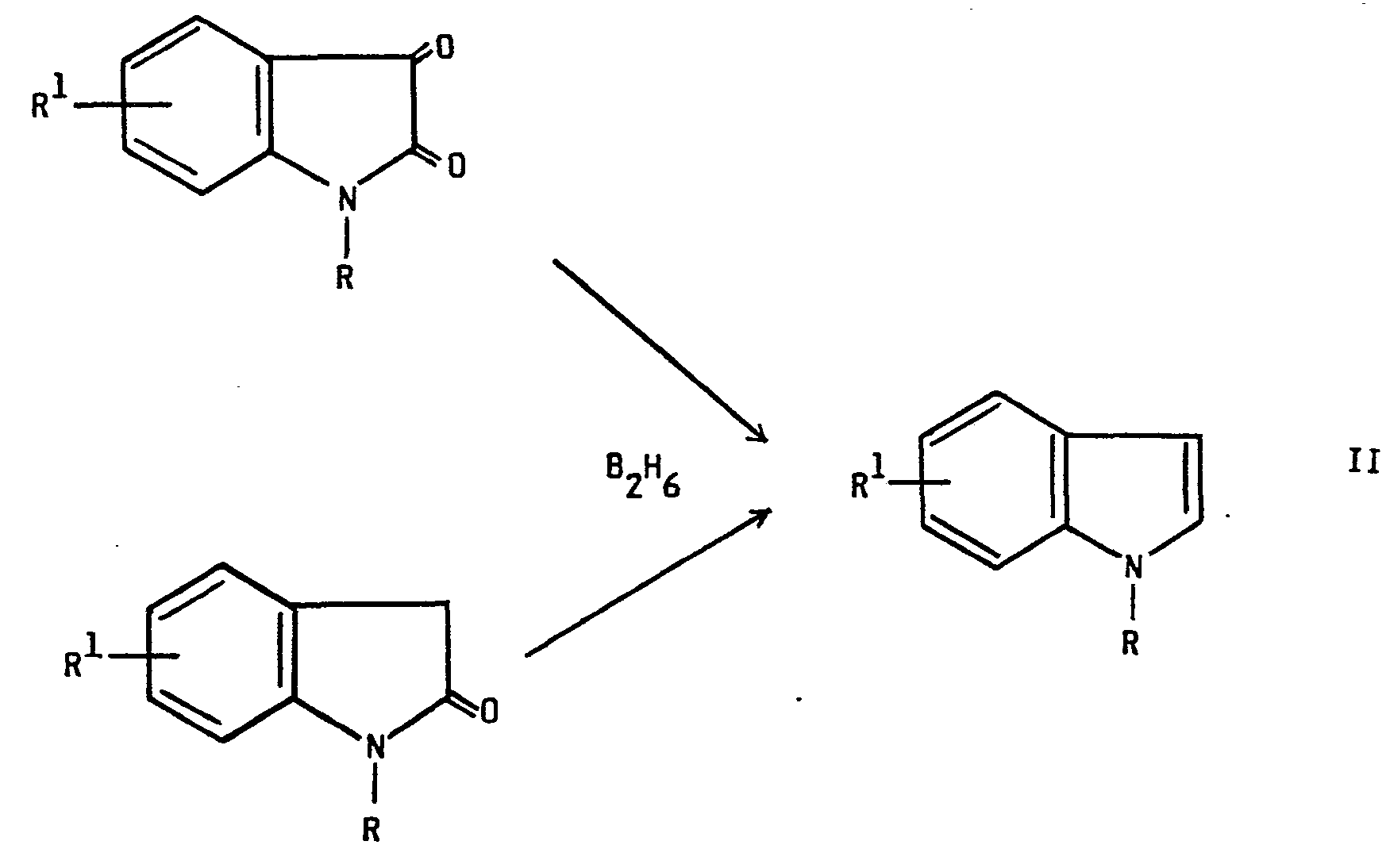
- Isatins and oxindoles are prepared by a Fiedel-Craft ring closure under standard conditions from N-oxalylchloro- or N-(2-chloroacetyl) diphenylamines respectively. The compounds of Formula II may alternatively be prepared by arylation of N-unsubstituted indoles according to the method described by M. A. Khan and E. K. Rocha, Chem.Pharm.Bull. 25 (11), 3110-3114 (1977).
- An alternative way of obtaining the intermediates of Formula II is that from an indoxyl-2-carboxylic ester as outlined below:
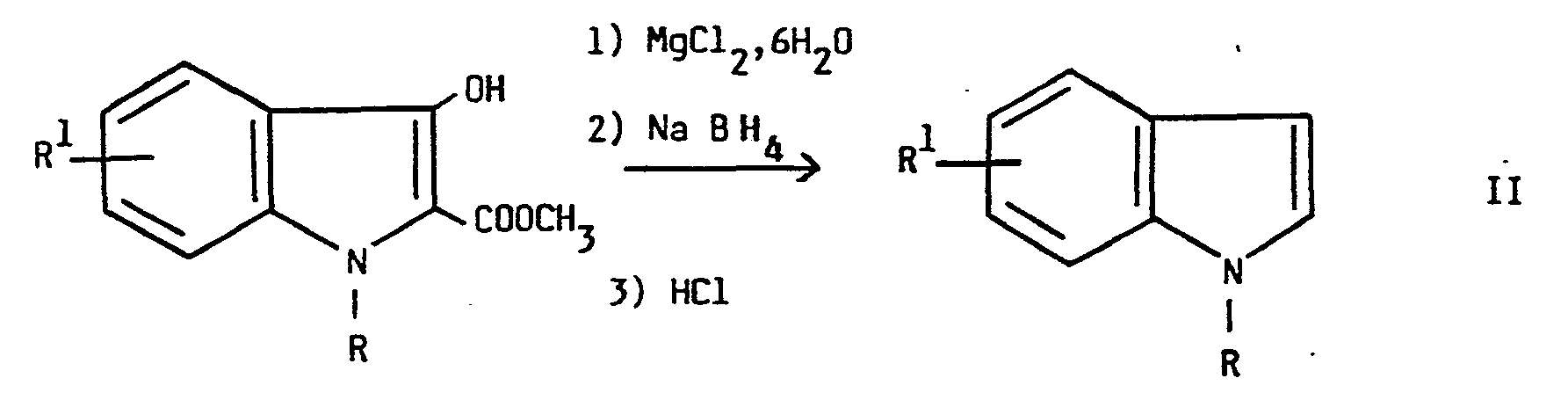
- In method b) the reduction is preferably carried out at low hydrogen pressures (3 ato.) in the presence of platinum or palladium on carbon black.
- In method c) the arylation is preferably carried out at about 160-210°C in aprotic polar solvents as e.g. N-methyl-2-pyrrolidone or hexamethylphosphoric triamide with K2C03 as base and copper as a catalyst.
- In method e) the reduction is preferably carried out with LiAIH4 in THF or diethylether or with diborane in THF.
- Method f) is a two step procedure in which compound VII first is decarboxyalkylated in the presence of an inorganic salt as e.g. LiCI or MgC12 in a polar solvent as e.g. diglyme, hexamethylphosphoric triamide or N-methyl-2-pyrrolidone at elevated temperatures (120―150°C). Finally, the appropriate piperazine is added and the temperature raised to about 200°C and kept there until the corresponding indoxyle has disappeared according to TLC analysis. The compounds of Formula VII are conveniently prepared according to the procedures reported by P. C. Unangst and M. E. Carethers, J.Heterocyclic Chem. 21, 709 (1984).
- In method g) diborane in THF is conveniently used as a reducing agent. The compounds of Formula VIII are prepared from the corresponding R-substituted isatins according to the following reaction scheme:

- The methods of the invention shall be illustrated in the following by some examples, which may not be construed as limiting:
- 1-(4'-fluorophenyl)-5-methyl-1 H-indole (4.5 g) and 1-methyl-4-piperidone (5 g) were dissolved in 25 ml of acetic acid and added dropwise to 50 ml of trifluoroacetic acid kept almost at the boiling point. The mixture was gently refluxed for another 1/2 h. Excess trifluoroacetic acid was evaporated and the reaction mixture was added to 50 ml of 6 M HCI and 50 ml of ether. The precipitated title compound was filtered off and dried. Yield: 3.1 g (43%). M.p. 262-266°C.
- In a corresponding manner the following tetrahydropyridin-4-ylindoles were prepared:
- 5-Fluoro-1-(4'-fluorophenyl)-3-(1-methyl-1,2,3,6-tetrahydropyridin-4-yl)-1H-indole, hydrochloride (Lu 21-018). M.p.256°C.
- 1-(4'-Fluorophenyl)-3-(1-methyl-1,2,3,6-tetrahydropyridin-4-yl)-5-trifluoromethyl-1H-indole, oxalate. (Lu 21―120). M.p. 228-229°C.
- 1-(4'-Fluorophenyl)-5-nitro-3-(1-methyl-1,2,3,6-tetrahydropyridin-4-yl)-1H-indole. (Lu 22-135). M.p.168―170°C.
- 1-(3'-Fluorophenyl)-5-nitro-3-(1-methyl-1,2,3,6-tetrahydropyridin-4-yl)-1H-indole, maleate. (Lu 24―004). M.p. 216-217°C.
- 1-(2'-Fluorophenyl)-5-nitro-3-(1-methyl-1,2,3,6-tetrahydropyridin-4-yl)-1H-indole, maleate. (Lu 24―003). M.p.208°C.
- 3-(1-(2-Hydroxyethyl)-1,2,3,6-tetrahydropyridin-4-yl)-1-(4'-trifluoromethylphenyl-1H-indole, fumarate. (Lu 24-012). M.p. 174-175°C.
- 1-(4'-Fluorophenyl)-3-(1-methyl-1,2,3,6-tetrahydropyridin-4-yl)-1H-indole, hydrochloride. (Lu 23―083), M.p.268―270°C.
- 1-(4'-Fluorophenyl)-5-nitro-3-(1,2,3,6-tetrahydropyridin-4-yl)-1H-indole, maleate. (Lu 23―133). M.p. 204-205°C.
- 5-Chloro-1-(4'-fluorophenyl)-3-(1-(2-hydroxyethyl)-1,2,3,6-tetrahydropyridin-4-yl)-1H-indole, hydrochloride. (Lu 23―146). M.p. 280-282°C.
- 5-Chloro-1-(4'-fluorophenyl)-3-(1,2,3,6-tetrahydropyridin-4-yl)-1H-indole. (Lu 23―147). M.p. 105―107°C.
- 1-(4'-Fluorophenyl)-3-(1-(2-hydroxyethyl)-1,2,3,6-tetrahydropyridin-4-yl)-5-nitro-1H-indole. (Lu 23―150). M.p. 151―152°C.
- 1-(4'-Fluorophenyl)-3-(1,2,3,6-tetrahydropyridin-4-yl)-5-trifluoromethyl-1H-indole. (Lu 23―155). M.p. 128―130°C.
- 1-(4'-Fluorophenyl)-3-(1-(2-hydroxyethyl)-1,2,3,6-tetrahydropyridin-4-yl)-5-trifluoromethyl-1H-indole. (Lu 23-156). M.p. 140―141°C.
- 5-Fluoro-1-(4'-fluorophenyl)-3-(1,2,3,6-tetrahydropyridin-4-yl)-1H-indole. (Lu 23―159). M.p.75―77°C.
- 5-Fluoro-1-(4'-fluorophenyl)-3-(1-(2-hydroxyethyl)-1,2,3,6-tetrahydropyridin-4-yl)-1H-indole, oxalate. (Lu 23―160). M.p. 180-184°C.
- 5-Fluoro-1-(4'-fluorophenyl)-3-(1-(2-propyl)-1,2,3,6-tetrahydropyridin-4-yl)-1H-indole, fumarate. (Lu 23―167). M.p. 190-195°C.
- 1-(4'-Fluorophenyl)-3-(1-(3-hydroxypropyl)-1,2,3,6-tetrahydropyridin-4-yl)-5-trifluoromethyl-1H-indole. (Lu 23―171). M.p.159―161°C.
- 5-Fluoro-1-(4'-fluorophenyl)-3-(1-(3-hydroxypropyl)-1,2,3,6-tetrahydropyridin-4-yl)-1H-indole, oxalate. (Lu 23―175). M.p. 173―175°C.
- Compound Lu 21-120, oxalate (2.5 g) is dissolved in ethanol (200 ml), and Pt02 (0.2 g) is added. Hydrogenation is continued for 3h at 3 atm. The catalyst was then filtered off, ethanol evaporated and the title compound crystallized from acetone/ether. Yield: 1.2 g (48%). M.p. 251-252°C.
- In a corresponding manner were also prepared:
- 1-(4'-Fluorophenyl)-3-(1-(2-imidazolidinon-1-ylethyl)-4-piperidyl)-1H-indole. (Lu 23-086). M.p. 174―175°C.
- 1-(4'-Fluorophenyl)-3-(1-(1-pyrrolidin-2-onylethyl)-4-piperidyl)-5-trifluoromethyl-1H-indole, fumarate. (Lu 23―158). M.p.240―241°C.
- 5-Chloro-1-(4'-fluorophenyl)-3-(1-(2-imidazolidinon-1-ylethyl)-4-piperidyl)-1H-indole, maleate. (Lu 23―174). M.p.155―160°C.
- 3-(1-Methyl-1,2,3,6-tetrahydropyridin-4-yl)-5-nitro-1H-indole (4.5 g), 3-bromopyridin (6.0 g), CuBr (4.5 g) and K2CO3 (8.0 g) were heated under stirring at 160°C for 2.5 h. After cooling the reaction mixture was poured into diluted NH4OH (500 ml) and extracted with ethyl acetate (2 x 300 ml). The combined organic phases were dried (MgSO4) and the solvent evaporated. The title compound was obtained by recrystallization from acetone. Yield: 3.4 g (58%). M.p. 175-177°C.
- In a corresponding manner were also prepared:
- 3-(1-Methyl-1,2,3,6-tetrahydropyridin-4-yl)-5-nitro-1-pyridin-2-yl-1H-indole. (Lu 24―015). M.p. 134°C.
- 3-(1-Methyl-1,2,3,6-tetrahydropyridin-4-yl)-5-nitro-1-(2-thiazolo)-1H-indole. (Lu 24―022). M.p.204―206°C.
- 5-Chloro-3-(1-methyl-1,2,3,6-tetrahydropyridin-4-yl)-1-(3-thienyl)-1H-indole, maleate. (Lu 24―001), M.p. 168-170°C.
- 3-(1-Methyl-1,2,3,6-tetrahydropyridin-4-yl)-5-nitro-1-(2-thienyl)-1H-indole, maleate. (Lu 24―014). M.p. 206-208°C.
- 5-Chloro-3-(1-carbethoxy-1,2,3,6-tetrahydropyridin-4-yl)-1H-indole (10 g), 1,4-fluoroiodobenzene (15 g), CuBr (10 g) and K2CO3 (15 g) in HMPA (50 ml) were heated (180-200°C) while stirring for 3h. After cooling the reaction mixture was poured into H20 (1 Itr.) and ethylenediamine (100 ml). The crude product was obtained by extraction twice with ether/ethyl acetate (2:1). The combined organic phases were dried (MgS04) and the solvents were evaporated. The pure 5-chloro-1-(4'-fluorophenyl)-3-(1-carbethoxy-1,2,3,6-tetrahydropyridin-4-yl)-1 H-indole was obtained by column chromatography on silica gel (eluent 30% ether in dichloromethane). Yield: 8.9 g (68%). M.p. 120―122°C. The carbethoxy compound then obtained (3 g) was dissolved in dry THF (50 ml) and LiAlH4 pellets (2 g) were added. The mixture was refluxed for 1 h, cooled and H2O/THF added to destroy excess LiAIH4. The precipitate was filtered off and THF evaporated. The remaining oil was dissolved in acetone and the title compound precipitated as a hydrobromide salt. Yield: 2.4 g (75%). M.p. 285°C.
- In a corresponding manner were also prepared:
- 5-Chloro-1-(4'-fluorophenyl)-3-(1-isobutyl-1,2,3,6-tetrahydropyridin-4-yl)-1H-indole, hydrobromide. (Lu 22-134). M.p. 285-286°C.
- 5-Fluoro-3-(1-methyl-1,2,3,6-tetrahydropyridin-4-yl)-1-(2-thiazolo)-1H-indole, fumarate. (Lu 24-013). M.p. 190-194°C.
- 5-Fluoro-1-(4'-fluorophenyl)-3-(1,2,3,6-tetrahydropyridin-4-yl)-1H-indole (2 g) prepared as described in Example 1; 1-chloroethyl-2-imidazolidinon (2 g), K2CO3 (3 g) and a small crystal of KI were refluxed in methyl isobytyl ketone (50 ml) for 16 h. The reaction mixture was poured into H20 and CH2CI2 (200 ml) was added. The organic phase was separated, dried (MgS04) and the solvents evaporated. The crude product was dissolved in acetone and precipitated as an oxalate salt. Yield: 1.2 g (36%). M.p. 186-189°C.
- In a corresponding manner the following indoles were prepared:
- 1-(4'-Fluorophenyl)-3-(4-(2-imidazolidinon-1-ylethyl)-1-piperazino)-5-trifluoromethyl-1H-indole, dihydrobromide. (Lu 23―001). M.p. 262-263°C.
- 1-(4'-Fluorophenyl)-3-(4-(1-pyrrolidin-2-onylethyl)-1-piperazino)-5-trifluoromethyl-1H-indole. (Lu 22-133). M.p. 224―227°C.
- 1-(4'-Fluorophenyl)-5-nitro-3-(1-pyrrolidin-2-onylethyl)-1,2,3,6-tetrahydropyridin-4-yl)-1H-indole, hydrochloride. (Lu 23―024). M.p. 263-265°C.
- 1-(4'-Fluorophenyl)-3-(1-(2-imidazolidinon-1-ylethyl)-1,2,3,6-tetrahydropyridin-4-yl)-1H-indole, hydrochloride. (Lu 23-075). M.p. 259―262°C.
- 1-(4'-Fluorophenyl)-5-nitro-3-(1-(2-oxazolidinon-3-ylethyl)-1,2,3,6-tetrahydropyridin-4-yl)-1H-indole, maleate. (Lu 23-134). M.p. 128―130°C.
- 1-(4'-Fluorophenyl)-3-(1-(2-imidazolidinon-1-ylethyl)-1,2,3,6-tetrahydropyridin-4-yl)-5-nitro-1H-indole. (Lu 23―142). M.p. 177-179°C.
- 5-Chloro-1-(4'-fluorophenyl)-3-(1-(2-imidazolidinon-1-ylethyl)-1,2,3,6-tetrahydropyridin-4-yl)-1H-indole. (Lu 23―148). M.p. 138-140°C.
- 1-(4'-Fluorophenyl)-3-(1-(2-imidazolidinon-1-ylethyl)-1,2,3,6-tetrahydropyridin-4-yl)-5-trifluoromethyl-1H-indole. (Lu 23―157). M.p. 164―165°C.
- 1-(2'-Fluorophenyl)-3-(1-(2-imidazolidinon-1-ylethyl)-1,2,3,6-tetrahydropyridin-4-yl)-5-nitro-1H-indole, maleate. (Lu 24-024). M.p. 200°C.
- 1 - (4' - Fluorophenyl) - 3 - (1 - pyrrolo - 2 - aceto) - 1,2,3,6 - tetrahydropyridin - 4 - yl) - 5 - trifluoromethyl - 1H - indole (2.5 g) was refluxed with LiAlH4 (1 g) in dry THF (50 ml) for 1.5 h. After cooling H2O/THF was added to destroy excess of LiAIH4. The precipitate was filtered off and THF evaporated. The remaining oil was dissolved in 2-propanol and the title compound precipitated as a maleate. Yield: 1.3 g (42%). M.p. 194-195°C.
- In a corresponding manner were also prepared:
- 1 - (4' - Fluorophenyl) - 3 - (1 - (1 - imidazole - 2 - ethyl) - 1,2,3,6 - tetrahydropyridin - 4 - yl) - 5 - trifluoromethyl - 1H - indole, dimaleate. (Lu 24-002). M.p. 165-167°C.
- 2-Carboxymethyl-1-(4'-fluorophenyl)-5-trifluoromethylindolin-3-on (15 g) and MgCl2-6H2O (30 g) in HMPA (100 ml) were heated under N2 at 120-140°C for 1 h and finally at 150°C for another 1/2 h. 1-Methylpiperazin (25 ml) was added and the mixture was refluxed under N2 at an oil bath temperature of 200°C for 16 h. The mixture was cooled and poured into 1 Itr. of H20 and extracted with ether (3 x 200 ml). The combined ether extracts were washed with 0,5 M HCI (3 x 300 ml). The acidic H2O phase was made alkaline and reextracted with ether (2 x 200 ml). The combined organic phase was dried (MgS04) and the ether evaporated. The remaining oil was dissolved in acetone and the title compound precipitated as a dihydrochloride. Yield: 6.7 g (35%). M.p. 245-247°C.
- In a corresponding manner the following 3-piperazinoindoles were prepared:
- 1-(4'-Fluorophenyl)-3-(4-(2-hydroxyethyl)-piperazino)-5-trifluoromethyl-1H-indole. (Lu 21―152). M.p. 164°C.
- 1-(4'-Fluorophenyl)-3-piperazino-5-trifluoromethyl-1H-indole. (Lu 21―153). M.p. 168-170°C.
- 1-(4'-Fluorophenyl)-3-(4-isopropyl-piperazino)-5-trifluoromethyl-1H-indole, dihydrochloride. (Lu 23―016). M.p. 278―280°C.
- 5-Chloro-3-(4-methylpiperazino)-1-phenyl-1H-indole. (Lu 23―015). M.p. 174―175°C. This compound is known from GB-1570374.
- To 14 g of Mg turnings was added 4-chloro-1-methylpiperidine (35 g) in dry THF (500 ml). The mixture was refluxed for 1 hour and filtered under N2 into an ice cooled solution of 1-(4'-fluorophenyl)-5-methylisatin (60 g) in dry THF (500 ml). The mixture was heated to reflux and poured into H20 (1 ltr.) saturated with NH4CI and extracted with ether (2 x 300 ml). The combined organic phases were dried (MgS04), the ether evaporated yielding 48.5 g (58%) of 1-(4'-fluorophenyl)-3-hydroxy-5-methyl-3-(1-methyl-4-piperidyl)indolin-2-on. M.p. 177-179°C.
- To a suspension of LiAlH4 (1 g) in dry THF (100 ml) was added 2.5 g of the above prepared indolin-2-on. The mixture was refluxed for 1 hour, excess of LiAIH4 destroyed by addition of H20/THF, and filtered; and 2 M HCI (500 ml) was added to the filtrate and gently heated. The H20 phase was made alkaline and the product extracted with ether (2 x 300 ml). The combined ether phases were dried (MgS04) and the ether evaporated. The remaining oil was dissolved in acetone and 1-(4'-fluorophenyl)-5-methyl-3-(1-methyl-4-piperidyl)indolin-2-on was precipitated as an oxalate. Yield: 2.0 g (66%). M.p. 222°C. To a solution of B2H6 in THF (100 ml) kept under N2 at 0°C was added 11.0 g of the oxalate salt prepared as above. The mixture was heated slowly to 50°C and kept there for 2 hours. It was finally poured onto ice (1 Itr.) and extracted with ether (2 x 200 ml). The combined ether phases were dried (MgS04) and the ether evaporated. The remaining oil was dissolved in 2-propanol and the title compound precipitated as a hydrobromide salt. Yield: 3.7 g (36%). M.p. 254-256°C.
- 1-(4'-Fluorophenyl)-3-(1-methyl-1,2,3,6-tetrahydropyridin-4-yl)-5-nitro-1H-indole (Lu 22-135) (10 g) in 90% ethanol (150 ml) was heated to reflux and dil. HCI (2 ml) and Fe-powder (5 g) were added within 0.5 hour. Reflux was continued for another hour. The reaction mixture was filtered, cooled down and subsequently poured into 1 litre of NH4OH and extracted with ethyl acetate (2 x 400 ml). The combined organic phases were dried (MgS04) and the solvent evaporated. The remaining oil was purified by column chromatography on silica gel (eluted with ethyl acetate/methanol 1:1 containing 2% of triethylamine). The title compound was finally precipitated as a fumarate from ethanol/acetone (1:1). Yield 4.2 g (34%). M.p. 128-134°C.
- The pyrrolidonyl indole derivative (Lu 22-133) (2.8 g) prepared in Example 4 and p-methoxyphenylthionophosphine sulfide dimer (2.0 g) (Lawesson reagent) were heated in HMPA (25 ml) at 110°C for 1 hour. The reaction mixture was poured into H2O (500 ml) and K2C03 (10 g) added. The product was extracted with ether containing 10% of ethyl acetate (2 x 200 ml). The combined organic phases were dried (MgS04), the solvents evaporated and the resulting crystalline product was recrystallized from ethanol yielding 2.1 g (73%) of the title compound. M.p. 199-201°C.
- 1-(4'-Fluorophenyl)-3-(4-(2-hydroxyethyl)-1-piperazino)-5-trifluoromethyl-1H-indole (Lu 21-152) (5 g) was heated to reflux in acetone (50 ml). Acetylchloride (2 ml) was added slowly. Refluxing was continued for 1.5 h. The solvent was evaporated and the remaining oil was extracted with CH2Cl2 (2 x 200 ml) from NH4OH at Ph 10. The combined organic phases were dried (MgS04) and the solvent evaporated. The title compound precipitated from ether. Yield: 3.7 g (72%). M.p. 129-131°C.
- In a corresponding manner the following esterified indole derivatives were prepared:
- 3-(4-(1-decanoyloxyethyl)-1-piperazino)-1-(4'-fluorophenyl)-5-trifluoromethyl-1H-indole. (Lu 23-162). M.p. 71―73°C.
- 1-(4'-Fluorophenyl)-3-(4-(1-oleyloxyethyl)-1-piperazino)-5-trifluoromethyl-1H-indole, dihydrochloride. (Lu 23―163). M.p. 158-162°C.
- The compounds of Formula I were tested according to reliable and well recognized pharmacological tests as follows:
- 1. Methylphenidate antagonism
- The inhibiting effect of test substances on the methylphenidate-induced gnawing in mice is determined as described by Pedersen and Christensen (1972).
- The test substance is given i.p. in different doses, while methylphenidate is given s.c. in the dose 60 mg/kg, 1/2, 2 or 24 hours after injection of test substance. Per dose of the test substance is used 3 x 2 mice (♂, 18-25 g). The results are given in fractions: 0/3, 113, 2/3 and 3/3, where 0, 1, 2 and 3 are the number of pairs, which has not been gnawing on receipt of the test substance. Ref.:
- Pedersen, V. and Christensen, A. V.: Acta pharmacol. et toxicol. 31, 488―496, 1972.
- 2. Catalepsy
- Evaluation of catalepsy is made according to Arnt (1983). The rat is placed on a vertical wire mesh (mesh diameter 12 mm) and considered as cataleptic if it remains immobile for more than 15 seconds. The number of cataleptic rats in each dose group is determined every hour, 1-6 hours and 24 hours following peroral administration of test compound. The maximal numbers of cataleptic rats in each of at least 3 dose groups, each consisting of at least 4 rats, is recorded. These numbers are used for calculation of ED50 values by log-probit analysis. Ref.:
- Arnt, J.: European J. Pharmacol. 90, 47―55, 1983.
- Evaluation of catalepsy is made according to Arnt (1983). The rat is placed on a vertical wire mesh (mesh diameter 12 mm) and considered as cataleptic if it remains immobile for more than 15 seconds. The number of cataleptic rats in each dose group is determined every hour, 1-6 hours and 24 hours following peroral administration of test compound. The maximal numbers of cataleptic rats in each of at least 3 dose groups, each consisting of at least 4 rats, is recorded. These numbers are used for calculation of ED50 values by log-probit analysis. Ref.:
- 3. Quipazine inhibition
- Quipazine and a number of other compounds, which increase 5-HT2 receptor activity in the CNS, induce a characteristic rapid shake (twitch) of the head. This response is inhibited by 5-HT2 receptor antagonists (Vetulani et al. 1980, Arnt et al. 1984).
- The test compound or saline is injected subcutaneously 2 hours before subcutaneous injection of quipazine hemimaleate (15 pmol/kg). At least 3 dose groups, each consisting of at least 4 rats, are used. The rats are individually placed in observation cages (12 x 25 cm) and the number of head twitches are counted 30-40 min after quipazine administration. Inhibition of head twitches is expressed in per cent of the number of head twitches in the control group. ED50 values are calculated by log-probit analysis. Ref.:
- Vetulani, J., B. B. Beduarczyk, K. Reichenberg and A. Rokost: Neuropharmacology 19, 155―158, 1983. Arnt, J., J. Hyttel and J.-J. Larsen: Acta pharmacol. et toxicol. 55, 363-372, 1984.
- 4. 3H-spiroperidol bindings
- The affinity of compounds to dopamine (DA) D-2 receptors and serotonin2 (5-HT2) receptors was determined by in vitro receptor binding technique. Binding of 3H-spiroperidol to DA D-2 receptors in rat striatal membranes and to 5-HT2 receptors in rat cortical membranes was determined as described in detail by Arnt et al. (1984). Ref.:
- Arnt, J., J. Hyttel and J.-J. Larsen: Acta pharmacol. et toxicol. 55, 363-372, 1984.

 LD50 i.v. in mice was determined for Lu 21-152 and Lu 22-135 to be 147 pmol/kg and 276 pmol/kg respectively which indicates a comparatively low acute toxicity as compared with known neuroleptics such as chlorpromazine, cis(Z)-flupentixol and tefludazin having values between 120-180 µmol/kg.
- Arnt, J., J. Hyttel and J.-J. Larsen: Acta pharmacol. et toxicol. 55, 363-372, 1984.
- The affinity of compounds to dopamine (DA) D-2 receptors and serotonin2 (5-HT2) receptors was determined by in vitro receptor binding technique. Binding of 3H-spiroperidol to DA D-2 receptors in rat striatal membranes and to 5-HT2 receptors in rat cortical membranes was determined as described in detail by Arnt et al. (1984). Ref.:
- The compounds of Formula I and the non-toxic acid addition salts thereof may'be administered to animals such as dogs, cats, horses, sheep or the like, including human beings, both orally and parenterally, and may be used for example in the form of tablets, capsules, powders, syrups or in the form of the usual sterile solutions for injection. - Results upon administration to human beings have been very gratifying.
- Most conveniently the compounds of Formula I are administered orally in unit dosage form such as tablets or capsules, each dosage unit containing the free amine or a non-toxic acid addition salt of one of the said compounds in an amount of from about 0.10 to about 100 mg, most preferably, however, from about 5 to 50 mg, calculated as the free amine, the total daily dosage usually ranging from about 1.0 to about 500 mg. The exact individual dosages as well as daily dosages in a particular case will, of course, be determined according to established medical principles under the direction Of a physician.
- When preparing tablets, the active ingredient is for the most part mixed with ordinary tablet adjuvants such as corn starch, potato starch, talcum, magnesium stearate, gelatine, lactose, gums.
- When the compound of Formula I is an ester, preferably a decanoic acid ester, palmitic acid ester or a behenic acid ester, the composition may advantageously be an oily solution for injection, and such solutions often have a very prolonged effect when compared with the corresponding unesterified compound.
- Typical examples of formulas for composition containing 1-(4'-fluorophenyl)-3-(4-(2-hydroxyethyl-1-piperazinyl)-5-trifluoromethylindole (called Lu 21-152 for short) as the active ingredient, are as follows:
- 1) Tablets containing 5 milligrams of Lu 21-152 calculated as the free base:


- 2) Tablets containing 50 milligrams of Lu 21-152 calculated as the free base:

- 3) Syrup containing per milliliter:
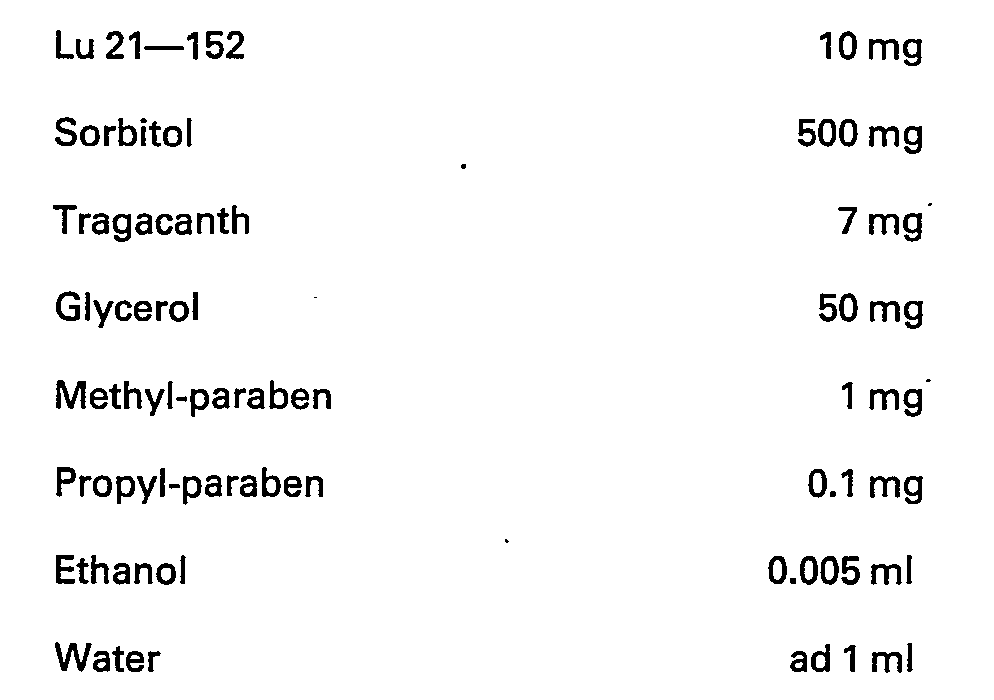
- 4) Solution for injection containing per milliliter:

- 5) Solution for injection containing per milliliter:

- Any other pharmaceutical tableting adjuvants may be used provided that they are compatible with the active ingredient, and additional compositions and dosage forms may be similar to those presently used for neuroleptics, such as chlorpenthixol, flupentixol or fluphenazine.
- Also combinations of the compounds of Formula I as well as their non-toxic acid salts with other active ingredients, especially other neuroleptics, thymoleptics, tranquilizers or analgetics, fall within the scope of the present invention.
- As previously stated, when isolating the compounds of Formula I in the form of an acid addition salt the acid is preferably selected so as to contain an anion which is non-toxic and pharmacologically acceptable, at least in usual therapeutic doses. Representative salts which are included in this preferred group are the hydrochlorides, hydrobromides, sulphates, acetates, phosphates, nitrates, methanesulphonates, ethane-sulphonates, lactates, citrates, tartrates or bitartrates, pamoates and maleates of the amines of Formula I. Other acids are likewise suitable and may be employed if desired. For example: fumaric, benzoic, ascorbic, succinic, salicylic, bismethylenesalicylic, propionic, gluconic, malic, malonic, mandelic, cannamic, citraconic, stearic, palmitic, itaconic, glycolic, benzenesulphonic, and sulphamic acids may also be employed as acid addition salt forming acids.
- When it is desired to isolate a compound of the invention in the form of the free base, this may be done according to conventional procedure as by dissolving the isolated or unisolated salt in water, treating with a suitable alkaline material, extracting the liberated free base with a suitable organic solvent drying the extract and evaporating to dryness or fractionally distilling to effect isolation of the free basic amine.
- The invention also comprises a method for the alleviation, palliation, mitigation or inhibition of the manifestations of certain physiological-psychological abnormalies of animals, including psychoses, by administering to a living animal body, including human beings, an adequate quantity of a compound of Formula I or a non-toxic acid addition salt thereof. An adequate quantity would be from about 0.001 mg to about 10 mg per kg of body weight in each unit dosage, and from about 0.003 milligrams to about 7 milligrams/kg of body weight per day.
- It is to be understood that the invention is not limited to the exact details of operation or exact compound or compositions shown and described, as obvious modifications and equivalents will be apparent to one skilled in the art.
Claims (11)


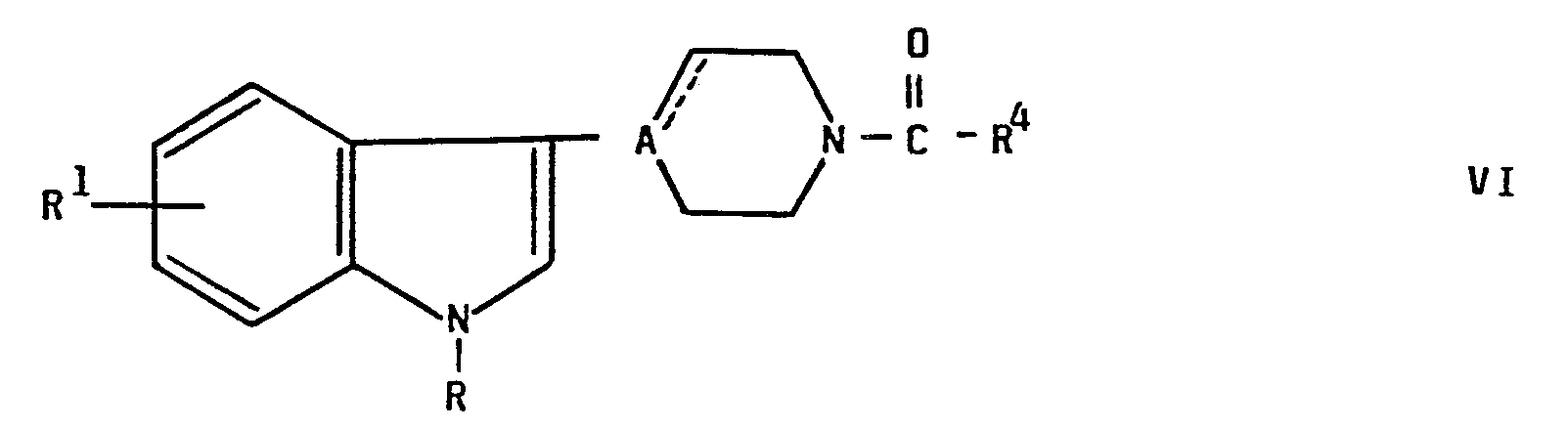


Priority Applications (3)
| Application Number | Priority Date | Filing Date | Title |
|---|---|---|---|
| AT86301989T ATE50564T1 (en) | 1985-04-10 | 1986-03-18 | HETEROCYCLIC COMPOUNDS. |
| MX9203347A MX9203347A (en) | 1985-04-10 | 1992-06-25 | HETERO CYCLIC COMPOUNDS. |
| LV960079A LV5743B4 (en) | 1985-04-10 | 1996-03-14 | Heterocyclic compounds |
Applications Claiming Priority (3)
| Application Number | Priority Date | Filing Date | Title |
|---|---|---|---|
| GB8509164 | 1985-04-10 | ||
| GB858509164A GB8509164D0 (en) | 1985-04-10 | 1985-04-10 | Heterocyclic compounds |
| CA0616585A CA1338327B (en) | 1985-04-10 | 1993-03-11 | 1-(4'-Fluorophenyl)-3,5-Substituted Indoles Useful in the Treatment of Psychic Disorders |
Publications (2)
| Publication Number | Publication Date |
|---|---|
| EP0200322A1 EP0200322A1 (en) | 1986-11-05 |
| EP0200322B1 true EP0200322B1 (en) | 1990-02-28 |
Family
ID=25673246
Family Applications (1)
| Application Number | Title | Priority Date | Filing Date |
|---|---|---|---|
| EP86301989A Expired - Lifetime EP0200322B1 (en) | 1985-04-10 | 1986-03-18 | Heterocyclic compounds |
Country Status (11)
| Country | Link |
|---|---|
| US (2) | US4710500A (en) |
| EP (1) | EP0200322B1 (en) |
| JP (1) | JPH064587B2 (en) |
| AU (1) | AU583607B2 (en) |
| CA (2) | CA1256437A (en) |
| DK (2) | DK169674B1 (en) |
| FI (1) | FI90976C (en) |
| HK (1) | HK116793A (en) |
| IE (1) | IE58370B1 (en) |
| LU (1) | LU90218I2 (en) |
| NL (1) | NL970016I2 (en) |
Families Citing this family (119)
| Publication number | Priority date | Publication date | Assignee | Title |
|---|---|---|---|---|
| US4742057A (en) * | 1985-12-05 | 1988-05-03 | Fujisawa Pharmaceutical Co., Ltd. | Antiallergic thiazole compounds |
| FR2608157B1 (en) * | 1986-12-11 | 1989-09-08 | Roussel Uclaf | NOVEL AZASPIRODECANE DERIVATIVES, SALTS THEREOF, PROCESS FOR THEIR PREPARATION, APPLICATION AS MEDICAMENTS AND COMPOSITIONS CONTAINING AND INTERMEDIATES THEREOF |
| US4999356A (en) * | 1987-08-07 | 1991-03-12 | Hoechst-Roussel Pharmaceuticals, Inc. | 1-phenyl-3-(1-piperazinyl)-1H-indazoles |
| DK172696B1 (en) * | 1987-08-13 | 1999-05-31 | Glaxo Group Ltd | Indole derivatives, processes for their preparation and pharmaceutical compositions containing the compounds |
| GB8719167D0 (en) * | 1987-08-13 | 1987-09-23 | Glaxo Group Ltd | Chemical compounds |
| FR2621588B1 (en) * | 1987-10-08 | 1991-05-24 | Roussel Uclaf | NOVEL DERIVATIVES OF 1,1-DIOXO 1,2-BENZOISOTHIAZOL 3-ONE, THEIR PREPARATION PROCESS AND THEIR APPLICATION AS MEDICAMENTS |
| FR2621586B1 (en) * | 1987-10-08 | 1990-02-02 | Roussel Uclaf | NOVEL AZAPIRODECANE DERIVATIVES, THEIR PREPARATION PROCESS AND THEIR APPLICATION AS MEDICAMENTS |
| DK733788A (en) * | 1988-01-14 | 1989-07-15 | Fujisawa Pharmaceutical Co | INDOLYL PIPERIDE INGREDIENTS AND PROCEDURES FOR PREPARING THEREOF |
| IL90858A (en) * | 1988-07-07 | 1994-08-26 | Rhone Poulenc Sante | Derivatives of (AZA) naphthalensultam, their preparation and compositions containing them |
| FR2643265B1 (en) * | 1989-02-20 | 1991-04-26 | Rhone Poulenc Sante | DERIVATIVES OF (AZA) NAPHTO (1,8-CD) ISOTHIAZOLE DIOXIDE-1,1 THEIR PREPARATION PROCESSES AND THE MEDICINAL PRODUCTS CONTAINING THEM |
| FR2633928B1 (en) * | 1988-07-07 | 1991-04-26 | Rhone Poulenc Sante | (AZA) NAPHTALENESULTAME DERIVATIVES, PROCESSES FOR THEIR PREPARATION AND MEDICINES CONTAINING THEM |
| GB8819024D0 (en) * | 1988-08-10 | 1988-09-14 | Glaxo Group Ltd | Chemical compounds |
| GB8908085D0 (en) * | 1989-04-11 | 1989-05-24 | Lundbeck & Co As H | New therapeutic use |
| US5238945A (en) * | 1989-04-11 | 1993-08-24 | H. Lundbeck A/S | Method of treating psychoses |
| FR2656306A1 (en) * | 1989-12-26 | 1991-06-28 | Rhone Poulenc Sante | Heterocyclic derivatives, their preparation and the medicaments containing them |
| FR2663635A2 (en) * | 1989-12-26 | 1991-12-27 | Rhone Poulenc Sante | Heterocyclic derivatives, their preparation and the medicaments containing them |
| EP0429341A3 (en) * | 1989-11-20 | 1991-11-13 | Rhone-Poulenc Sante | Heterocyclic derivatives, their preparation and pharmaceuticals containing them |
| FR2654729B1 (en) * | 1989-11-20 | 1992-02-07 | Rhone Poulenc Sante | PIPERIDINE DERIVATIVES, THEIR PREPARATION AND THE MEDICINAL PRODUCTS CONTAINING THEM. |
| DK152090D0 (en) * | 1990-06-22 | 1990-06-22 | Lundbaek A S H | PIPERIDYL-SUBSTITUTED INDEX DERIVATIVES |
| DK158590D0 (en) * | 1990-07-02 | 1990-07-02 | Lundbeck & Co As H | indole derivatives |
| US5322851A (en) * | 1990-07-02 | 1994-06-21 | H. Lundbeck A/S | Indole derivatives |
| DK181190D0 (en) * | 1990-07-30 | 1990-07-30 | Lundbeck & Co As H | 3-ARYL-INDOL OR 3-ARYL-INDAZOL DERIVATIVES |
| DK238190D0 (en) * | 1990-10-03 | 1990-10-03 | Lundbeck & Co As H | DEPOT DERIVATIVES |
| US5643784A (en) * | 1990-12-04 | 1997-07-01 | H, Lundbeck A/S | Indan derivatives |
| DE4101686A1 (en) * | 1991-01-22 | 1992-07-23 | Merck Patent Gmbh | INDOLDER DERIVATIVES |
| SK278998B6 (en) * | 1991-02-01 | 1998-05-06 | Merck Sharp & Dohme Limited | Imidazole, triazole and tetrazole derivatives, method of producing same, their use and pharmaceutical compositons on their base |
| US5466704A (en) * | 1991-02-26 | 1995-11-14 | E. R. Squibb & Sons, Inc. | N-substituted imidazole and benzimidazole derivatives useful as angiotenson II antagonists |
| CA2061159A1 (en) * | 1991-02-26 | 1992-08-27 | Michael A. Poss | Imidazole and benzimidazole derivatives |
| DK36391D0 (en) * | 1991-03-01 | 1991-03-01 | Lundbeck & Co As H | APPLICATION OF PIPERIDYL-SUBSTITUTED INDUSTRIAL DERIVATIVES FOR TREATMENT OF SUBSTANCE ABUSE |
| DK36291D0 (en) * | 1991-03-01 | 1991-03-01 | Lundbeck & Co As H | APPLICATION OF PIPERIDYL-SUBSTITUTED INDEX DERIVATIVES FOR TREATMENT OF COGNITIVE DISORDERS |
| WO1992015301A1 (en) * | 1991-03-01 | 1992-09-17 | H. Lundbeck A/S | Treatment of hypertension and peripheral vascular diseases |
| US5328920A (en) * | 1991-04-17 | 1994-07-12 | Hoechst-Roussel Pharmaceuticals Incorporated | Substituted (pyridinylamino)-indoles |
| US5177088A (en) * | 1991-04-17 | 1993-01-05 | Hoechst-Roussel Pharmaceuticals Incorporated | Substituted 3-(pyridinylamino)-indoles |
| US5225412A (en) * | 1991-04-29 | 1993-07-06 | Hoechst-Roussel Pharmaceuticals Incorporated | Benzoisothiazole-and benzisoxazole-3-carboxamides |
| US5143923B1 (en) * | 1991-04-29 | 1993-11-02 | Hoechst-Roussel Pharmaceuticals Incorporated | Benzoisothiazole-and benzisoxazole-3-carboxamides |
| NZ243065A (en) * | 1991-06-13 | 1995-07-26 | Lundbeck & Co As H | Piperidine derivatives and pharmaceutical compositions |
| IT1251144B (en) * | 1991-07-30 | 1995-05-04 | Boehringer Ingelheim Italia | BENZIMIDAZOLONE DERIVATIVES |
| DK206591D0 (en) * | 1991-12-23 | 1991-12-23 | Lundbeck & Co As H | TREATMENT OF PSYCHOSIS |
| US5599774A (en) * | 1992-01-22 | 1997-02-04 | Imperial Chemical Industries Plc | N-arylindoles and their use as herbicides |
| DK8492D0 (en) * | 1992-01-23 | 1992-01-23 | Lundbeck & Co As H | TREATMENT OF PSYCHOSIS |
| DK55192D0 (en) * | 1992-04-28 | 1992-04-28 | Lundbeck & Co As H | 1-piperazino-1,2-dihydroindene derivatives |
| GB9210400D0 (en) * | 1992-05-15 | 1992-07-01 | Merck Sharp & Dohme | Therapeutic agents |
| US5240927A (en) * | 1992-05-19 | 1993-08-31 | Hoechst-Roussel Pharmaceuticals Incorporated | Benzo[β]thiophen-3-yl piperazines as antipsychotic agents |
| DE69214633T2 (en) * | 1992-06-19 | 1997-05-22 | Agfa Gevaert Nv | Thermally transferable fluorescent compounds |
| IL106445A (en) * | 1992-07-30 | 1998-01-04 | Merck Sharp & Dohme | 4-substituted 1, 2, 4-triazole derivatives, their preparation and pharmaceutical compositions containing them |
| US5272148A (en) * | 1992-09-09 | 1993-12-21 | Hoechst-Roussel Pharmaceuticals Incorporated | Heteroarenylpiperazines |
| CA2163986A1 (en) * | 1993-06-25 | 1995-01-05 | Takayuki Namiki | Dopamine re-uptake inhibitor |
| DK123493D0 (en) * | 1993-11-01 | 1993-11-01 | Lundbeck & Co As H | COMPOUNDS |
| DE4414113A1 (en) * | 1994-04-22 | 1995-10-26 | Merck Patent Gmbh | 3-indolylpiperidines |
| CA2157348A1 (en) * | 1994-09-01 | 1996-03-02 | Aventis Pharmaceuticals Inc. | 3-¬4-(1-substituted-4-piperazinyl)butyl|-4-thiazolidinone and related compounds |
| US5521196A (en) * | 1994-10-05 | 1996-05-28 | Eli Lilly And Company | 5-HT1F agonists for the treatment of migraine |
| US5521197A (en) * | 1994-12-01 | 1996-05-28 | Eli Lilly And Company | 3-<1-alkylenearyl>-4-<1,2,3,6-tetrahydropyridinyl>-and 3-<1-alkylenearyl>-4-piperidinyl-1h-indoles: new 5-HT1F agonists |
| JP3274579B2 (en) * | 1995-01-12 | 2002-04-15 | 住友製薬株式会社 | Agent for treating psychiatric symptoms associated with cerebrovascular disorders |
| AU702322B2 (en) * | 1995-03-20 | 1999-02-18 | Eli Lilly And Company | 5-substituted-3-(1,2,3,6-tetrahydropyridin-4-yl)- and 3-(piperidin-4-yl)-1h-indoles: new 5-ht1f agonists |
| US5889010A (en) * | 1995-05-18 | 1999-03-30 | Pfizer Inc. | Benzimidazole derivatives having dopaminergic activity |
| GB9523583D0 (en) * | 1995-11-17 | 1996-01-17 | Merck Sharp & Dohme | Therapeutic agents |
| CA2288334C (en) * | 1997-05-09 | 2005-03-01 | H. Lundbeck A/S | Method of manufacturing sertindole |
| AR013669A1 (en) * | 1997-10-07 | 2001-01-10 | Smithkline Beecham Corp | COMPOUNDS AND METHODS |
| ES2291024T4 (en) * | 1999-04-21 | 2009-03-01 | Nps Allelix Corp. | PIPERIDINE-INDOL COMPOUNDS WITH AFFINITY WITH 5-HT6. |
| US6489341B1 (en) | 1999-06-02 | 2002-12-03 | Sepracor Inc. | Methods for the treatment of neuroleptic and related disorders using sertindole derivatives |
| FR2802101B1 (en) | 1999-12-10 | 2003-02-28 | Aventis Pharma Sa | COMBINATION OF CYMEMAZINE AND AN ATYPICAL NEUROLEPTIC |
| US20040023951A1 (en) * | 2001-06-18 | 2004-02-05 | Bymaster Franklin Porter | Combination therapy for treatment of psychoses |
| US7034059B2 (en) * | 2001-07-02 | 2006-04-25 | Sepracor Inc. | Methods of using norfluoxetine |
| US7183410B2 (en) | 2001-08-02 | 2007-02-27 | Bidachem S.P.A. | Stable polymorph of flibanserin |
| US10675280B2 (en) | 2001-10-20 | 2020-06-09 | Sprout Pharmaceuticals, Inc. | Treating sexual desire disorders with flibanserin |
| UA78974C2 (en) | 2001-10-20 | 2007-05-10 | Boehringer Ingelheim Pharma | Use of flibanserin for treating disorders of sexual desire |
| ATE503845T1 (en) * | 2001-12-10 | 2011-04-15 | Novartis Pharma Gmbh | METHOD FOR THE TREATMENT OF PSYCHOSES AND SCHIZOPHRENIA BASED ON A POLYMORPHISM IN THE CNTF GENE |
| AU2003214018A1 (en) * | 2002-02-22 | 2003-09-09 | H. Lundbeck A/S | 5-heteroaryl substituted indoles |
| AR039116A1 (en) * | 2002-03-27 | 2005-02-09 | Lundbeck & Co As H | METHOD FOR THE MANUFACTURE OF SERTINDOL |
| US20050101788A1 (en) * | 2002-03-27 | 2005-05-12 | Jacopo Zanon | Method for manufacture of sertindole |
| EP1633400A2 (en) * | 2003-05-16 | 2006-03-15 | Pfizer Products Inc. | Therapeutic combinations of atypical antipsychotics with gaba modulators, anticonvulsants or benzodiazapines |
| GB0326148D0 (en) | 2003-11-10 | 2003-12-17 | Lilly Co Eli | Morpholine derivatives |
| US20050245540A1 (en) * | 2003-12-09 | 2005-11-03 | Fujisawa Pharmaceutical Co., Ltd. | New methods |
| CA2567249A1 (en) * | 2004-04-19 | 2006-10-05 | Jds Pharmaceuticals, Llc | Lithium combinations, and uses related thereto |
| MY147767A (en) * | 2004-06-16 | 2013-01-31 | Janssen Pharmaceutica Nv | Novel sulfamate and sulfamide derivatives useful for the treatment of epilepsy and related disorders |
| TW200612905A (en) * | 2004-06-16 | 2006-05-01 | Janssen Pharmaceutica Nv | Novel sulfamate and sulfamide derivatives useful for the treatment of epilepsy and related disorders |
| TW200616608A (en) * | 2004-07-09 | 2006-06-01 | Forest Laboratories | Memantine as adjunctive treatment to atypical antipsychotics in schizophrenia patients |
| PE20060500A1 (en) * | 2004-08-24 | 2006-07-13 | Janssen Pharmaceutica Nv | DERIVATIVES OF BENZO-FUSED HETEROARYL SULFAMIDE AS ANTI-CONFUSIONS |
| EP1863485A2 (en) * | 2005-03-18 | 2007-12-12 | Abbott Laboratories | Alpha7 neuronal nicotinic receptor ligand and antipsychotic compositions |
| BRPI0610864A2 (en) * | 2005-05-20 | 2010-08-03 | Janssen Pharmaceutica Nv | process for preparing sulfamide derivatives |
| ES2646326T3 (en) | 2005-08-03 | 2017-12-13 | Sprout Pharmaceuticals, Inc. | Use of flibanserin in the treatment of obesity |
| US20070212412A1 (en) * | 2005-09-08 | 2007-09-13 | H. Lundbeck A/S | Stable solid formulation of sertindole |
| WO2007048803A1 (en) | 2005-10-29 | 2007-05-03 | Boehringer Ingelheim International Gmbh | Benzimidazolone derivatives for the treatment of premenstrual and other female sexual disorders |
| AR058389A1 (en) * | 2005-12-19 | 2008-01-30 | Janssen Pharmaceutica Nv | USE OF SULFAMIDE BENZO-FUSED HETEROCICLIC DERIVATIVES FOR THE TREATMENT OF OBESITY |
| US8937096B2 (en) * | 2005-12-19 | 2015-01-20 | Janssen Pharmaceutica Nv | Use of benzo-fused heterocyle sulfamide derivatives for the treatment of mania and bipolar disorder |
| US8716231B2 (en) | 2005-12-19 | 2014-05-06 | Janssen Pharmaceutica Nv | Use of benzo-fused heterocycle sulfamide derivatives for the treatment of pain |
| US20070155827A1 (en) * | 2005-12-19 | 2007-07-05 | Smith-Swintosky Virginia L | Use of benzo-fused heterocycle sulfamide derivatives for the treatment of depression |
| US8497298B2 (en) * | 2005-12-19 | 2013-07-30 | Janssen Pharmaceutica Nv | Use of benzo-fused heterocycle sulfamide derivatives for lowering lipids and lowering blood glucose levels |
| US20070155823A1 (en) * | 2005-12-19 | 2007-07-05 | Smith-Swintosky Virginia L | Use of benzo-fused heterocycle sulfamide derivatives as neuroprotective agents |
| US8691867B2 (en) * | 2005-12-19 | 2014-04-08 | Janssen Pharmaceutica Nv | Use of benzo-fused heterocycle sulfamide derivatives for the treatment of substance abuse and addiction |
| JP2009537635A (en) * | 2006-05-19 | 2009-10-29 | ジヤンセン・フアーマシユーチカ・ナームローゼ・フエンノートシヤツプ | Co-therapy for treatment of hemorrhoids |
| TW200821296A (en) * | 2006-06-01 | 2008-05-16 | Lundbeck & Co As H | Use of sertindole for the preventive treatment of suicidal behaviour |
| EP2041304B1 (en) | 2006-06-12 | 2011-09-07 | Hadasit Medical Research Services & Development Limited | Rgs2 genotypes associated with extrapyramidal symptoms induced by antipsychotic medication |
| US20080004260A1 (en) * | 2006-06-29 | 2008-01-03 | Transcept Pharmaceuticals, Inc. | Compositions of 5-HT3 antagonists and dopamine D2 antagonists for treatment of dopamine-associated chronic conditions |
| WO2008000760A1 (en) | 2006-06-30 | 2008-01-03 | Boehringer Ingelheim International Gmbh | Flibanserin for the treatment of urinary incontinence and related diseases |
| BRPI0716439B8 (en) | 2006-08-14 | 2021-05-25 | Boehringer Ingelheim Int | pharmaceutical delivery systems comprising flibanserin, process for preparation and use thereof |
| CL2007002214A1 (en) | 2006-08-14 | 2008-03-07 | Boehringer Ingelheim Int | PHARMACEUTICAL COMPOSITION IN THE FORM OF COMPRESSED, WHERE AT LEAST THE LENGTH OF THE COMPRESSED IN THE PREVIOUS STATE OF THE APPLICATION IS AT LEAST 7/12 OF THE PILOR DIAMETER OF THE PATIENT AND AFTER INGERING IT IN THE FOOD STATE, THE LENGTH OF THE COMP |
| BRPI0716436B8 (en) | 2006-08-25 | 2021-05-25 | Boehringer Ingelheim Int | controlled release system and method for manufacturing it |
| PL2083811T3 (en) | 2006-11-22 | 2017-05-31 | Clinical Research Associates, Llc | Methods of treating down's syndrome, fragile x syndrome and autism |
| CL2008002693A1 (en) | 2007-09-12 | 2009-10-16 | Boehringer Ingelheim Int | Use of flibanserin for the treatment of selected vasomotor symptoms of hot flashes, night sweats, mood swings, and irritability |
| US20090247617A1 (en) * | 2008-03-26 | 2009-10-01 | Abdel-Magid Ahmed F | Process for the preparation of benzo-fused heteroaryl sulfamates |
| US20110034565A1 (en) | 2008-04-18 | 2011-02-10 | University College Dublin, National University Of Ireland, Dublin | Psycho-pharmaceuticals |
| PE20110060A1 (en) * | 2008-06-23 | 2011-01-31 | Janssen Pharmaceutica Nv | CRYSTALLINE FORM OF (2S) - (-) - N- (6-CHLORO-2,3-DIHYDRO-BENZO [1,4] DIOXIN-2-ILMETHYL) -SULFAMIDE |
| EP2321011A1 (en) * | 2008-06-25 | 2011-05-18 | Pfizer Inc. | Diaryl compounds and uses thereof |
| US8815939B2 (en) * | 2008-07-22 | 2014-08-26 | Janssen Pharmaceutica Nv | Substituted sulfamide derivatives |
| CA2686480A1 (en) | 2008-12-15 | 2010-06-15 | Boehringer Ingelheim International Gmbh | New salts |
| US20100298397A1 (en) * | 2009-05-19 | 2010-11-25 | Singh Nikhilesh N | Method of treatment of obsessive compulsive disorder with ondansetron |
| US8252801B1 (en) | 2009-06-03 | 2012-08-28 | Abbott Laboratories | Treatment of schizophrenia and related disorders |
| CN101591330B (en) * | 2009-06-29 | 2013-03-06 | 上海医药工业研究院 | Sertindole crystal form and preparation method thereof |
| DK3034079T3 (en) | 2010-11-15 | 2018-02-05 | Agenebio Inc | PYRIDAZINE DERIVATIVES, COMPOSITIONS AND PROCEDURES FOR TREATING COGNITIVE WEAKNESS |
| WO2014078568A1 (en) | 2012-11-14 | 2014-05-22 | The Johns Hopkins University | Methods and compositions for treating schizophrenia |
| CN103214463A (en) * | 2013-03-30 | 2013-07-24 | 北京德众万全药物技术开发有限公司 | Novel preparation method of sertindole |
| CN112409363B (en) | 2013-12-20 | 2023-11-14 | 艾吉因生物股份有限公司 | Benzodiazepine derivatives, compositions and methods for the treatment of cognitive impairment |
| WO2016205739A1 (en) | 2015-06-19 | 2016-12-22 | Belew Mekonnen | Benzodiazepine derivatives, compositions, and methods for treating cognitive impairment |
| CN104926734B (en) * | 2015-07-07 | 2017-04-05 | 苏州立新制药有限公司 | The preparation method of flibanserin |
| US11505555B2 (en) | 2016-12-19 | 2022-11-22 | Agenebio, Inc. | Benzodiazepine derivatives, compositions, and methods for treating cognitive impairment |
| US20180170941A1 (en) | 2016-12-19 | 2018-06-21 | Agenebio, Inc. | Benzodiazepine derivatives, compositions, and methods for treating cognitive impairment |
| BR112020026062B1 (en) | 2018-06-19 | 2023-04-04 | Agenebio, Inc | COMPOUNDS DERIVATIVES OF BENZODIAZEPINE OR A PHARMACEUTICALLY ACCEPTABLE SALT, ISOMER OR COMBINATION THEREOF, PHARMACEUTICAL COMPOSITION COMPRISING THEM AND USES THEREOF FOR THE TREATMENT OF COGNITIVE IMPAIRMENT, BRAIN CANCER AND PSYCHOSIS OF PARKINSON'S DISEASE |
| US20240132513A1 (en) | 2022-08-19 | 2024-04-25 | Agenebio, Inc. | Benzazepine derivatives, compositions, and methods for treating cognitive impairment |
Citations (1)
| Publication number | Priority date | Publication date | Assignee | Title |
|---|---|---|---|---|
| GB1570374A (en) * | 1977-03-17 | 1980-07-02 | Sauba Lab | Indoles |
Family Cites Families (29)
| Publication number | Priority date | Publication date | Assignee | Title |
|---|---|---|---|---|
| US3429886A (en) * | 1964-11-11 | 1969-02-25 | Ciba Geigy Corp | 1-tertiaryaminoalkyl-3-(4-pyridyl)-indoles |
| GB1429861A (en) * | 1972-03-29 | 1976-03-31 | Sandoz Ltd | Vincamine derivatives |
| FR2193584B1 (en) * | 1972-07-28 | 1975-08-08 | Roussel Uclaf | |
| US3947578A (en) * | 1972-07-28 | 1976-03-30 | Roussel Uclaf | Omega-[4-(3"-indolyl)-piperidino]-alkyl-arylketones as nevroleptics |
| DE2322470A1 (en) * | 1973-05-04 | 1974-11-21 | Boehringer Sohn Ingelheim | NEW INDOLYL-PIPERIDINO- (OR 1,2,5,6TETRAHYDRO-PYRIDYL-) BUTYROPHENONE AND METHOD FOR THEIR PRODUCTION |
| IL48508A (en) * | 1974-12-09 | 1979-10-31 | Roussel Uclaf | Pharmaceutical compositions comprising piperidylindole derivatives |
| FR2349331A1 (en) * | 1976-04-30 | 1977-11-25 | Roussel Uclaf | NEW DERIVATIVES OF 2,3 DIHYDRO A / 4- (3-INDOLYL) 1-PIPERIDINYL / METHYL 1,4-BENZODIOXIN-2-METHANOL, A PROCESS FOR THEIR PREPARATION AND APPLICATION AS MEDICINAL PRODUCTS |
| FR2362628A1 (en) * | 1976-08-26 | 1978-03-24 | Roussel Uclaf | NEW DERIVATIVES OF PIPERIDYL-INDOLE AND THEIR SALTS, METHOD OF PREPARATION AND APPLICATION AS MEDICINAL PRODUCTS |
| FR2421899A1 (en) * | 1978-01-16 | 1979-11-02 | Roussel Uclaf | NEW TETRAHYDROPYRIDINYL-INDOLE DERIVATIVES AND THEIR SALTS, THE PREPARATION PROCESS AND THE MEDICINAL APPLICATION OF THESE NEW PRODUCTS |
| FR2426465B1 (en) * | 1978-01-16 | 1983-04-29 | Roussel Uclaf | |
| FR2444678A2 (en) * | 1978-12-22 | 1980-07-18 | Roussel Uclaf | NOVEL PROCESS FOR THE PREPARATION OF PIPERIDYL-INDOLE DERIVATIVES AND THEIR SALTS |
| FR2458550A1 (en) * | 1979-06-12 | 1981-01-02 | Roussel Uclaf | Antidepressant tetra:hydro pyridinyl indole(s) - also with neuroleptic and antiemetic activity |
| FR2460947A1 (en) * | 1979-07-13 | 1981-01-30 | Roussel Uclaf | NOVEL N-SUBSTITUTED TETRAHYDROPYRIDINYL-INDOLE DERIVATIVES, THEIR SALTS, PREPARATION METHOD, MEDICAMENT APPLICATION AND COMPOSITIONS COMPRISING SAME |
| SE8004129L (en) * | 1979-07-13 | 1981-01-14 | Roussel Uclaf | NEW TETRAHYDROPYRIDIN-4-YL-INDOLD DERIVATIVES AND SALTS THEREOF, PREPARATION AND USE THEREOF AS A MEDICINAL PRODUCT AND COMPOSITIONS CONTAINING THESE COMPOUNDS |
| IE50867B1 (en) * | 1980-02-29 | 1986-08-06 | Kefalas As | Indane derivatives |
| US4359468A (en) * | 1981-02-25 | 1982-11-16 | Boehringer Ingelheim Ltd. | Antiallergic N-[4-(indolyl)-piperidino-alkyl]-benzimidazolones |
| US4352811A (en) * | 1981-11-12 | 1982-10-05 | Hoechst-Roussel Pharmaceuticals Inc. | 3-(1-Substituted-4-piperidyl)-1,2-benzisoxazoles |
| FR2533924A1 (en) * | 1982-10-05 | 1984-04-06 | Roussel Uclaf | NOVEL 4- (1H-INDOL-3-YL) A-METHYL PIPERIDINE-1-ETHANOL DERIVATIVES, THEIR SALTS, THE PREPARATION PROCESS, THE MEDICINAL APPLICATION AND THE COMPOSITIONS COMPRISING THE SAME |
| IE55972B1 (en) * | 1982-10-07 | 1991-03-13 | Kefalas As | Phenylindene derivatives,acid addition salts thereof,and methods of preparation |
| US4524074A (en) * | 1983-05-31 | 1985-06-18 | Hoechst-Roussel Pharmaceuticals Inc. | 3-(4-Piperidinyl)-1,2-benzisothiazoles |
| US4458076A (en) * | 1983-05-31 | 1984-07-03 | Hoechst-Roussel Pharmaceuticals | 3-(4-Piperidinyl)-1,2-benzisothiazoles |
| US4853470A (en) * | 1983-08-22 | 1989-08-01 | Hoechst-Roussel Pharmaceuticals, Inc. | 3-(piperidinyl)- and 3-(pyrrolidinyl)-1H-indazoles |
| US4806649A (en) * | 1983-08-22 | 1989-02-21 | Hoechst-Roussel Pharmaceuticals, Inc. | 3-(piperidinyl)- and 3- (pyrrolidinyl)-1H-indazoles |
| US4710573A (en) * | 1983-08-22 | 1987-12-01 | Hoechst Roussel Pharmaceuticals, Inc. | 3-(piperidinyl)-and 3-(pyrrolidinyl)-1H-indazoles |
| US4758668A (en) * | 1983-08-22 | 1988-07-19 | Hoechst-Roussel Pharmaceuticals Inc. | 3-(piperidinyl)- and 3-(pyrrolidinyl)-1H-indazoles |
| US4775761A (en) * | 1983-08-22 | 1988-10-04 | Hoechst-Roussel Pharmaceuticals, Inc. | 3-(piperidinyl)- and 3-(pyrrolidinyl)-1H-indazoles |
| US4670447A (en) * | 1983-08-22 | 1987-06-02 | Hoechst-Roussel Pharmaceuticals Inc. | Antipsychotic 3-(piperidinyl)- and 3-(pyrrolidinyl)-1H-indazoles |
| GB8427125D0 (en) * | 1984-10-26 | 1984-12-05 | Lundbeck & Co As H | Organic compounds |
| US4742057A (en) * | 1985-12-05 | 1988-05-03 | Fujisawa Pharmaceutical Co., Ltd. | Antiallergic thiazole compounds |
-
1986
- 1986-03-10 IE IE61886A patent/IE58370B1/en not_active IP Right Cessation
- 1986-03-18 EP EP86301989A patent/EP0200322B1/en not_active Expired - Lifetime
- 1986-04-01 US US06/846,912 patent/US4710500A/en not_active Ceased
- 1986-04-04 CA CA000505930A patent/CA1256437A/en not_active Expired
- 1986-04-08 DK DK157686D patent/DK169674B1/en not_active IP Right Cessation
- 1986-04-08 DK DK157686A patent/DK157686A/en not_active IP Right Cessation
- 1986-04-09 AU AU55901/86A patent/AU583607B2/en not_active Expired
- 1986-04-09 JP JP61080293A patent/JPH064587B2/en not_active Expired - Lifetime
- 1986-04-09 FI FI861505A patent/FI90976C/en not_active IP Right Cessation
-
1991
- 1991-09-13 US US07/759,517 patent/USRE34299E/en not_active Expired - Lifetime
-
1993
- 1993-03-11 CA CA0616585A patent/CA1338327B/en not_active Expired - Lifetime
- 1993-10-28 HK HK1167/93A patent/HK116793A/en not_active IP Right Cessation
-
1997
- 1997-03-26 NL NL970016C patent/NL970016I2/en unknown
-
1998
- 1998-02-25 LU LU90218C patent/LU90218I2/en unknown
Patent Citations (1)
| Publication number | Priority date | Publication date | Assignee | Title |
|---|---|---|---|---|
| GB1570374A (en) * | 1977-03-17 | 1980-07-02 | Sauba Lab | Indoles |
Also Published As
| Publication number | Publication date |
|---|---|
| DK157686A (en) | 1986-10-11 |
| DK157686D0 (en) | 1986-04-08 |
| HK116793A (en) | 1993-11-05 |
| FI90976B (en) | 1994-01-14 |
| FI861505A7 (en) | 1986-10-11 |
| JPH064587B2 (en) | 1994-01-19 |
| EP0200322A1 (en) | 1986-11-05 |
| NL970016I2 (en) | 1997-09-01 |
| AU583607B2 (en) | 1989-05-04 |
| CA1256437A (en) | 1989-06-27 |
| FI90976C (en) | 1994-04-25 |
| FI861505A0 (en) | 1986-04-09 |
| USRE34299E (en) | 1993-06-29 |
| NL970016I1 (en) | 1997-06-02 |
| IE860618L (en) | 1986-10-10 |
| US4710500A (en) | 1987-12-01 |
| LU90218I2 (en) | 1998-04-27 |
| JPS61236764A (en) | 1986-10-22 |
| IE58370B1 (en) | 1993-09-08 |
| CA1338327B (en) | 1996-05-14 |
| DK169674B1 (en) | 1995-01-09 |
| AU5590186A (en) | 1986-10-16 |
Similar Documents
| Publication | Publication Date | Title |
|---|---|---|
| US4710500A (en) | 1-(4'-fluorophenyl)-3,5-substituted indoles useful in the treatment of psychic disorders and pharmaceutical compositions thereof | |
| EP0376607B1 (en) | Piperazinyl derivatives | |
| EP0465398B1 (en) | Novel indole derivatives | |
| AU765317B2 (en) | 4,5,6 and 7-indole and indoline derivatives, their preparation and use | |
| AU646679B2 (en) | Novel 3-arylindole and 3-arylindazole derivatives | |
| US5576336A (en) | Indole derivatives as dopamine D4 antagonists | |
| CA2085987C (en) | Piperidyl-substituted indoles | |
| US6391882B1 (en) | 4,5,6 and 7-indole and indoline derivatitives, their preparation and use | |
| WO1999046259A1 (en) | 5-heteroaryl substituted indoles | |
| NL8703003A (en) | NEW AZASPIRODECAN COMPOUNDS, THEIR SALTS, PROCESS FOR THEIR PREPARATION, THEIR USE AS MEDICINES AND PREPARATIONS CONTAINING THEM. | |
| NO165837B (en) | ANALOGY PROCEDURE FOR THE PREPARATION OF THERAPEUTICALLY ACTIVE INDEX DERIVATIVES AND ACID ADDITION SALTS THEREOF. | |
| EP1214312A1 (en) | 5-aminoalkyl and 5-aminocarbonyl substituted indoles | |
| MXPA00012609A (en) | 4,5,6 and 7-indole and indoline derivatives, their preparation and use |
Legal Events
| Date | Code | Title | Description |
|---|---|---|---|
| PUAI | Public reference made under article 153(3) epc to a published international application that has entered the european phase |
Free format text: ORIGINAL CODE: 0009012 |
|
| AK | Designated contracting states |
Kind code of ref document: A1 Designated state(s): AT BE CH DE FR GB IT LI LU NL SE |
|
| 17P | Request for examination filed |
Effective date: 19870303 |
|
| 17Q | First examination report despatched |
Effective date: 19880302 |
|
| GRAA | (expected) grant |
Free format text: ORIGINAL CODE: 0009210 |
|
| AK | Designated contracting states |
Kind code of ref document: B1 Designated state(s): AT BE CH DE FR GB IT LI LU NL SE |
|
| REF | Corresponds to: |
Ref document number: 50564 Country of ref document: AT Date of ref document: 19900315 Kind code of ref document: T |
|
| ITF | It: translation for a ep patent filed | ||
| REF | Corresponds to: |
Ref document number: 3669153 Country of ref document: DE Date of ref document: 19900405 |
|
| ET | Fr: translation filed | ||
| REG | Reference to a national code |
Ref country code: AT Ref legal event code: UEP Ref document number: 86301989 Country of ref document: AT Kind code of ref document: T |
|
| PLBE | No opposition filed within time limit |
Free format text: ORIGINAL CODE: 0009261 |
|
| STAA | Information on the status of an ep patent application or granted ep patent |
Free format text: STATUS: NO OPPOSITION FILED WITHIN TIME LIMIT |
|
| 26N | No opposition filed | ||
| ITTA | It: last paid annual fee | ||
| EPTA | Lu: last paid annual fee | ||
| EAL | Se: european patent in force in sweden |
Ref document number: 86301989.9 |
|
| REG | Reference to a national code |
Ref country code: GB Ref legal event code: CTFF Free format text: GBCTFFSPC/GB96/050, 961108 |
|
| REG | Reference to a national code |
Ref country code: GB Ref legal event code: CTFG Free format text: GBCTFGSPC/GB96/050, 970314, EXPIRES:20110317 |
|
| REG | Reference to a national code |
Ref country code: NL Ref legal event code: AC1 Free format text: NLAC1 970016, 970326 |
|
| REG | Reference to a national code |
Ref country code: NL Ref legal event code: KC1 Free format text: NLKC1 970016, 20060318, EXPIRES: 20110317 |
|
| MEDD | It: supplementary protection certificate for pharmaceutical products: granted |
Free format text: CCP 581, 19970617; H.LUNDBECK A/S |
|
| CCPV | Be: grant of a complementary protection certificate |
Free format text: 097C0110, EXPIRES: 20110318 |
|
| REG | Reference to a national code |
Ref country code: CH Ref legal event code: SPCF Free format text: PRODUCT NAME: SERTINDOL; IKS-NR. 53845/19970826 Spc suppl protection certif: C00200322/01 Filing date: 19980202 |
|
| REG | Reference to a national code |
Ref country code: LU Ref legal event code: CCP Free format text: LUCCP 90218, EXPIRES: 20110523 |
|
| REG | Reference to a national code |
Ref country code: AT Ref legal event code: ESZA Ref document number: 86301989 Country of ref document: AT Kind code of ref document: T Free format text: PRODUCT NAME: SERTINDOL Spc suppl protection certif: SZ 19/1997 Filing date: 19970613 |
|
| REG | Reference to a national code |
Ref country code: AT Ref legal event code: EEZF Ref document number: 86301989 Country of ref document: AT Kind code of ref document: T Free format text: PRODUCT NAME: SERTINDOL Spc suppl protection certif: SZ 19/1997 Filing date: 19970613 Extension date: 20110318 Effective date: 20000609 |
|
| REG | Reference to a national code |
Ref country code: GB Ref legal event code: IF02 |
|
| PGFP | Annual fee paid to national office [announced via postgrant information from national office to epo] |
Ref country code: NL Payment date: 20050303 Year of fee payment: 20 |
|
| PGFP | Annual fee paid to national office [announced via postgrant information from national office to epo] |
Ref country code: SE Payment date: 20050304 Year of fee payment: 20 |
|
| PGFP | Annual fee paid to national office [announced via postgrant information from national office to epo] |
Ref country code: FR Payment date: 20050308 Year of fee payment: 20 |
|
| PGFP | Annual fee paid to national office [announced via postgrant information from national office to epo] |
Ref country code: DE Payment date: 20050310 Year of fee payment: 20 |
|
| PGFP | Annual fee paid to national office [announced via postgrant information from national office to epo] |
Ref country code: AT Payment date: 20050311 Year of fee payment: 20 |
|
| PGFP | Annual fee paid to national office [announced via postgrant information from national office to epo] |
Ref country code: CH Payment date: 20050316 Year of fee payment: 20 Ref country code: LU Payment date: 20050316 Year of fee payment: 20 Ref country code: GB Payment date: 20050316 Year of fee payment: 20 |
|
| PGFP | Annual fee paid to national office [announced via postgrant information from national office to epo] |
Ref country code: IT Payment date: 20050330 Year of fee payment: 20 |
|
| PGFP | Annual fee paid to national office [announced via postgrant information from national office to epo] |
Ref country code: BE Payment date: 20050509 Year of fee payment: 20 |
|
| REG | Reference to a national code |
Ref country code: SE Ref legal event code: SPCF Free format text: PRODUCT NAME: SERDOLECT; NAT REG. NO/DATE: GB 13751/0001 19960523; FIRST REG.: SE 20576 20050318 Spc suppl protection certif: 05900337.L Ref country code: SE Ref legal event code: SPCF Free format text: 0590033-7, 20050318 Spc suppl protection certif: 0590033-7 Filing date: 20050318 |
|
| PG25 | Lapsed in a contracting state [announced via postgrant information from national office to epo] |
Ref country code: GB Free format text: LAPSE BECAUSE OF EXPIRATION OF PROTECTION Effective date: 20060317 |
|
| REG | Reference to a national code |
Ref country code: FR Ref legal event code: CP Free format text: PRODUCT NAME: SERTINDOLE; NAT. REGISTRATION NO/DATE: 360 861.8 20051219; FIRST REGISTRATION: GB - UK13761/0001 19960523 Spc suppl protection certif: 06C0011 Filing date: 20060317 |
|
| PG25 | Lapsed in a contracting state [announced via postgrant information from national office to epo] |
Ref country code: NL Free format text: LAPSE BECAUSE OF EXPIRATION OF PROTECTION Effective date: 20060318 |
|
| REG | Reference to a national code |
Ref country code: GB Ref legal event code: PE20 Ref country code: GB Ref legal event code: CTFE Free format text: SPC/GB96/050: 20060318, EXPIRES: 20110317 Spc suppl protection certif: SPC/GB96/050 Filing date: 20060318 Expiry date: 20110317 |
|
| REG | Reference to a national code |
Ref country code: CH Ref legal event code: PL |
|
| NLV7 | Nl: ceased due to reaching the maximum lifetime of a patent |
Effective date: 20060318 |
|
| REG | Reference to a national code |
Ref country code: FR Ref legal event code: CR Free format text: PRODUCT NAME: SERTINDOLE; REGISTRATION NO/DATE IN FRANCE: 360 861.8 DU 20051219; REGISTRATION NO/DATE AT EEC: UK13761/0001 DU 19960523 Spc suppl protection certif: 06C0011 Filing date: 20060317 |
|
| EUG | Se: european patent has lapsed | ||
| REG | Reference to a national code |
Ref country code: AT Ref legal event code: EELA Ref document number: 50564 Country of ref document: AT Kind code of ref document: T |
|
| REG | Reference to a national code |
Ref country code: FR Ref legal event code: CP |
|
| REG | Reference to a national code |
Ref country code: SE Ref legal event code: SPCG Spc suppl protection certif: 05900337.L Ref country code: SE Ref legal event code: SPCG Free format text: 0590033-7 Spc suppl protection certif: 0590033-7 |
|
| REG | Reference to a national code |
Ref country code: CH Ref legal event code: SPCN Free format text: FORMER REPRESENTATIVE: E. BLUM AND CO. PATENTANWAELTE, CH Spc suppl protection certif: C00200322/01 Representative=s name: E. BLUM AND CO. AG PATENT- UND MARKENANWAELTE VSP |
|
| BE20 | Be: patent expired |
Owner name: H. *LUNDBECK A/S Effective date: 20060318 |
|
| REG | Reference to a national code |
Ref country code: FR Ref legal event code: CX Free format text: PRODUCT NAME: SERTINDOLE; REGISTRATION NO/DATE IN FRANCE: 360 861.8 DU 20051219; REGISTRATION NO/DATE AT EEC: UK13761/0001 DU 19960523 Spc suppl protection certif: 06C0011 Filing date: 20060317 Ref country code: FR Ref legal event code: AV Ref country code: FR Ref legal event code: AV Spc suppl protection certif: 2006C0011 |
|
| REG | Reference to a national code |
Ref country code: NL Ref legal event code: SPCX Free format text: PRODUCT NAME: SERTINDOLUM, DESGEWENST IN DE VORM VAN EEN FARMACEUTISCH AANVAA RDBAAR ZUURADDITIEZOUT; NAT. REGISTRATION: RVG 20610 - RVG 20615 19961106; FIRST REGISTRATION: GB 13761/0001 - 13761/0006 19960523 Spc suppl protection certif: C970016 Filing date: 19970326 Expiry date: 20060318 Extension date: 20110317 |
|
| REG | Reference to a national code |
Ref country code: BE Ref legal event code: CCRE Free format text: PRODUCT NAME: SERTINDOL; NAT. REGISTRATION NO/DATE: 7004 IE 1 F 3 19970609; FIRST REGISTRATION: GB PL 13761/0001 19960523 Spc suppl protection certif: 97C0110 Filing date: 19971205 Expiry date: 20060318 Extension date: 20110318 Effective date: 20110318 Ref country code: CH Ref legal event code: SPCL Spc suppl protection certif: C00200322/01 |
|
| REG | Reference to a national code |
Ref country code: GB Ref legal event code: SPCE Free format text: PRODUCT NAME: SERTINDOLE OPTIONALLY IN THE FORM OF A PHARMACEUTICALLY ACCEPTABLE ACID ADDITION SALT THEREOF; REGISTERED: UK 13761/0001 19960523; UK 13761/0002 19960523; UK 13761/0003 19960523; UK 13761/0004 19960523; UK 13761/0005 19960523; UK 13761/0006 19960523 Spc suppl protection certif: SPC/GB96/050 Filing date: 19961108 Expiry date: 20060318 Extension date: 20110317 |