EP0200219B1 - Verfahren zur Herstellung von Naphthazarinderivaten - Google Patents
Verfahren zur Herstellung von Naphthazarinderivaten Download PDFInfo
- Publication number
- EP0200219B1 EP0200219B1 EP86105957A EP86105957A EP0200219B1 EP 0200219 B1 EP0200219 B1 EP 0200219B1 EP 86105957 A EP86105957 A EP 86105957A EP 86105957 A EP86105957 A EP 86105957A EP 0200219 B1 EP0200219 B1 EP 0200219B1
- Authority
- EP
- European Patent Office
- Prior art keywords
- group
- groups
- general formula
- process according
- acid
- Prior art date
- Legal status (The legal status is an assumption and is not a legal conclusion. Google has not performed a legal analysis and makes no representation as to the accuracy of the status listed.)
- Expired
Links
- 0 C[C@]1*CCC1 Chemical compound C[C@]1*CCC1 0.000 description 3
- KSCDFJMYIQDMTD-UHFFFAOYSA-N CC(C)(CC1)OC1C(C(c(c(CO)c(C1)cc2)c2O)=O)=CC1=O Chemical compound CC(C)(CC1)OC1C(C(c(c(CO)c(C1)cc2)c2O)=O)=CC1=O KSCDFJMYIQDMTD-UHFFFAOYSA-N 0.000 description 1
- BCLKBVRXMNUEGS-UHFFFAOYSA-N CCC(OC(CC=C(C)C)C(C(C(C12)=C3C([O]=C=C)=CC1C2[O](=C)=C)=O)=CC3=C)=C Chemical compound CCC(OC(CC=C(C)C)C(C(C(C12)=C3C([O]=C=C)=CC1C2[O](=C)=C)=O)=CC3=C)=C BCLKBVRXMNUEGS-UHFFFAOYSA-N 0.000 description 1
- TXXUBEQXPAAZRY-UHFFFAOYSA-N Cc(cc1)c(C(C=CC2=O)=O)c2c1O Chemical compound Cc(cc1)c(C(C=CC2=O)=O)c2c1O TXXUBEQXPAAZRY-UHFFFAOYSA-N 0.000 description 1
Classifications
-
- C—CHEMISTRY; METALLURGY
- C07—ORGANIC CHEMISTRY
- C07D—HETEROCYCLIC COMPOUNDS
- C07D307/00—Heterocyclic compounds containing five-membered rings having one oxygen atom as the only ring hetero atom
- C07D307/02—Heterocyclic compounds containing five-membered rings having one oxygen atom as the only ring hetero atom not condensed with other rings
- C07D307/04—Heterocyclic compounds containing five-membered rings having one oxygen atom as the only ring hetero atom not condensed with other rings having no double bonds between ring members or between ring members and non-ring members
- C07D307/10—Heterocyclic compounds containing five-membered rings having one oxygen atom as the only ring hetero atom not condensed with other rings having no double bonds between ring members or between ring members and non-ring members with substituted hydrocarbon radicals attached to ring carbon atoms
- C07D307/12—Radicals substituted by oxygen atoms
Definitions
- the present invention relates to a process for preparing derivatives of naphthazarin which are important materials for dyes and medicines.
- Derivatives of naphthazarin are important materials in the production of dyes and medicines.
- the R-form isomer of 5,8-dihydroxy-2-(1-hydroxy-4-methyl-3-pentenyl)-1,4-naphthalenedione represented by the following structural formula of: is referred to as Shikonin whereas the S-form isomer thereof is referred to as Alkannin, and both isomers have been used as dyes, medicines and starting materials therefor.
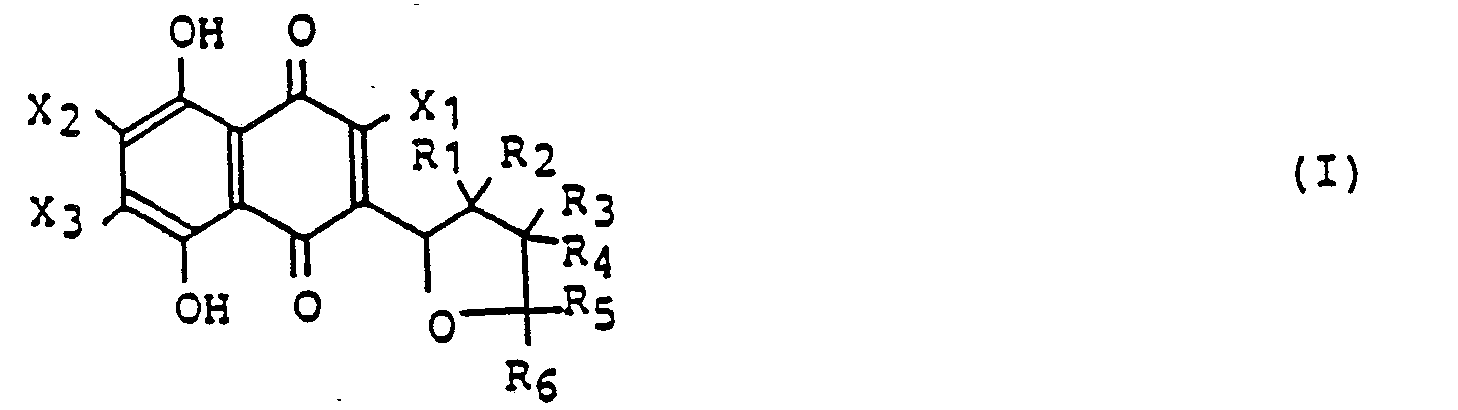
- the compounds represented by the general formula (I) are important as dyes, medicines and starting materials therefor.
- 5,8-dihydroxy-2-(tetrahydro-5,5-dimethyl-2-furanyl)-1 ,4-naphthalenedione represented by the following structural formula of: may be prepared by processing the natural Shikonin and Alkannin with an acid catalyst, such as SnCl 4 , and usually referred to as Cycloshikonin and Cycloalkannin. It has been known in the art that these compounds exert excellent efficacies when used as anti-tumour agents, as reported, for example, by Chem. Pharm. Bull., 29, 116 to 122 (1981 ).
- Ann. 540, 51 to 71 (1939) discloses a process for preparing derivatives of naphthazarin by reacting naphthazarin with aldehydes in the presence of hydrochloric acid as the catalyst.
- One example of such process may be represented by the following reaction formula of:
- a principal object of this invention is to provide a simple process for preparing a derivative of naphthazarin by a single step reaction without complicated plural steps.
- Another object of this invention is to provide a process for preparing a derivative of naphthazarin in high yield within a short period of time.
- the organic residues included in the substituting groups X 1 , X 2 and X 3 are generally selected from organic residues each having 1 to 15 carbon atoms, the examples being hydrocarbon groups such as methyl, ethyl, propyl, isopropyl, cyclohexyl, phenyl and decyl groups; alkoxy groups such as methoxy, ethoxy, propoxy, isopropoxy, cyclohexyloxy and phenoxy groups; amino groups such as methylamino, dimethylamino and phenylamino groups; acyl groups such as formyl and acetyl groups; acyloxy groups such as formyl
- the most important starting material is 5,8-dihydroxy-1,4-naphthalenedione (commonly referred to as naphthazarin) which may be prepared in good yield, for example, by the nitration of naphthalene to obtain 1,5-dinitronaphthalene which is then treated with fuming sulfuric acid.
- naphthazarin 5,8-dihydroxy-1,4-naphthalenedione
- the hydrocarbon groups indicated by R 1 to R 6 are generally selected from hydrocarbon groups each having 1 to 15 carbon atoms, the specific examples thereof being methyl, ethyl, propyl, isopropyl, cyclohexyl, phenyl, decyl and naphthyl groups.
- the oxyhydrocarbon group indicated by R in the structural formula (III) includes alkoxy groups, preferably C, to C 15 alkoxy groups, the specific examples being methoxy, ethoxy, propoxy, cyclohexyloxy, phenoxy and naphthoxy groups.
- the siloxy group indicated by R in the general formula (III) may be a siloxy group substituted by three C 1 to C 15 hydrocarbon groups which may be the same as included in the groups R 1 to R 6 , the specific examples being trimethylsiloxy and diphenylmethylsiloxy groups.
- Preferable acyloxy groups used as the group R in the general formula (III) are C 1 to C 15 acyloxy groups including sulfoxy, sulfinyloxy and phosphoxy groups other than the carboxy groups, the specific examples being formyloxy, acetyloxy, propionyloxy, cyclohexylcarboxy, benzoyloxy and paratoluylsulfoxy groups.
- the process of the invention includes the processes wherein the compounds represented by the general formulae (IV) and (V) are used.
- the compounds represented by the general formula (III) may be easily prepared by reducing y-lactones represented by the general formula of: wherein R 1 to R 6 each stands for an atom or a group selected from the group consisting of hydrogen and hydrocarbon groups; while using diisobutylaluminumhydride or the like reducing agent to prepare hemiacetal isomers thereof followed by etherization, silylation or acylation through a suitable method, as desired.
- the y-lactones used as the starting materials in such a process may also be easily prepared, for example by the processes described below.
- y-Methyl-y-valerolactone which may be used as a starting material for the synthesis of Cycloshikonin and/or Cycloalkannin, may be prepared by using isoprene as the starting material through a simple operation in good yield by the process disclosed in the specification of Japanese Patent Application No. 54219/1985 entitled “Process for the Simultaneous Preparation of Lactone and Carboxylic Acid” filed with the Japanese Patent Office on March 20,1985 in the name of the assignee same as this application.
- the compounds used as the starting materials in the process of the invention may be easily available.
- Examples of the acid catalyst used in the process of the invention include hydroacids such as sulfuric acid, phosphoric acid, hydrochloric acid, hydrobromic acid, paratoluenesulfonic acid and trifluoroacetic acid; Lewis acids such as BF 3 , BF 3 -etherate, ZnCl 2 , SnCl 4 , AICI 3 and silica-alumina; and cation exchange resins such as Amberlite IR-120B® (Trade Name) and Dowex HCR O (Trade Name). It is desirable that 0.5 to 2 equivalent, preferably 0.8 to 1.5 equivalents, of such an acid be used per unit equivalent of the compound (II).
- hydroacids such as sulfuric acid, phosphoric acid, hydrochloric acid, hydrobromic acid, paratoluenesulfonic acid and trifluoroacetic acid
- Lewis acids such as BF 3 , BF 3 -etherate, ZnCl 2 , SnCl 4 , AICI 3 and si
- the 0.05 to 2 mols, preferably 0.1 to 0.8 mol, of the compound (III) be used per mol of the compound (II).
- the reaction temperature may be selected depending on the specific substituting groups included in the compounds (II) and (III) and also in consideration of the specific acid catalyst and the solvent used. In general, it is recommended to adopt a temperature in the range of lower than the contact heating, and preferable temperature ranges from - (minus) 20°C to 150°C, more preferably from 0°C to 50°C. The reaction speed becomes too low if the reaction temperature is set to an excessively low level.
- the reaction time may be properly selected depending on the specific substituting groups included in the starting materials and the specific acid catalyst used, for example, within the range of from 1 minute to 150 hours, preferably from 1 minute to 15 hours, more preferably from 20 minutes to 10 hours.
- the process of the invention may be carried out under the solventless condition or in the presence of a solvent.
- solvents used for this purpose include hydrocarbons such as hexane, heptane, octane, benzene, totuene and Xylene; alcohols such as methanol; ethanol and propanol; carboxylic acids such as acetic acid, propionic acid and butyric acid; ethers such as diethyl ether, tetrahydrofuran and 1,4-dioxane; lactones such as y-butylolactone and y-valerolactone; nitriles such as acetonitrile and benzonitrile; nitro- compounds such as nitromethane and nitrobenzene; esters such as methyl acetate and ethyl
- the first compound (II) is initially contacted with any one of the aforementioned acid catalysts prior to reacting the compound (II) with the compound (lll), and then the compound (III) is introduced in the reaction system to prepare the compound represented by the general formula (I).
- the reaction speed and the yield in the synthesis of the compound (I) are surprisingly increased.
- the mixture thereof is heated to a temperature of from 50°C to 150°C, if necessary.
- the time for heating the mixture of the compound (II) and the acid catalyst is not critical, and ranges generally from one minute to 3 hours. However, it is not preferred that the mixture is heated at a too high temperature for an excessively long time, since the compound (II) might be affected by such an excessive heating to cause change in its property.
- the mixture of the compound (II) and the acid catalyst after having been heated, is reacted with the compound (III).
- the process of the invention may be carried out through a batch system or by the use of a continuous reaction system.
- the first important feature of the invention resides in that a synthesis of various derivatives of naphthazarin has been developed thereby.
- a variety of derivatives of naphthazarin which have been synthesized through exceedingly complicated steps or which cannot be synthesized by the conventional technology, can be synthesized only through a single step. This provides significant progresses not only from the industrial standpoint of view but also from the standpoint of development of science.
- the second important feature of the invention resides in that it provides an epoch-making process for the synthesis of Shikonin or Alkannin which is the most important derivative of naphthazarin.
- Shikonin and Alkannin may be synthesized from 5,8-dihydroxy-2-(tetrahydro-5,5-dimethyl-2-furanyl)-1,4-naphthalenedione which is one of the compounds synthesizable by the process of the invention. Since the products of the process of the invention are racemic modifications or racemic mixtures, it is of course necessary to subject the same to optical resolution in order to obtain Shikonin or Alkannin. However, by the present trend of the development in synthetic technology, such an optical resolution would be realized in due course.
- Shikonin is a principal ingredient contained in the extract of lithospermum root and has been widely used as a dye in the Orient for a long time. It has been also used as a Chinese medicine for a long time as an antifebrile and a toxicide, for example, in the form of an ointment to be applied on a burnt portion. It is set forth in The Pharmacopedia of Japan at the present day and continuously used for a medicine for remedying anal fistula and as Shiunkou.
- Alkannin is a principal ingredient contained in the extract of alkanna tinctoria (2004) predominantly produced in Europe, and has been utilized as a coloring agent for foodstuffs, particularly for coloring wines.
- the present invention has opened a route for an economical chemical synthesis of a large quantity of Shikonin and Alkannin which are the compounds of great utility to provide an unfathomable contribution to the dye and pharmaceutical industries.
- reaction solution was poured into 500 ml of a saturated saline solution, and extracted with 200 ml of diethyl ether, the extraction with diethyl ether being repeated by two times.
- organic phases were joined together and rinsed with 200 ml of a saturated saline solution by two times, and then dried with anhydrous sodium sulfate.
- the solution was added dropwisely for 10 minutes with a mixed solution containing 0.84 g (5.3 millimols) of tetrahydro-5,5-dimethyl-2-furanyl acetate and 30 ml of acetic acid at the room temperature, while agitating the solution in the flask by a magnetic rotor. After continuing agitation at the room temperature for additional 5 hours, the reaction mixture was poured into ice water. The product was extracted with 200 ml of chloroform by two times, and the extracted organic phase was rinsed with a saturated saline solution and then dried with anhydrous Na 2 SO 4 .
Landscapes
- Chemical & Material Sciences (AREA)
- Organic Chemistry (AREA)
- Organic Low-Molecular-Weight Compounds And Preparation Thereof (AREA)
Claims (16)


Applications Claiming Priority (4)
| Application Number | Priority Date | Filing Date | Title |
|---|---|---|---|
| JP92295/85 | 1985-05-01 | ||
| JP9229585A JPS61251677A (ja) | 1985-05-01 | 1985-05-01 | ナフタザリン誘導体の製造方法 |
| JP242658/85 | 1985-10-31 | ||
| JP24265885A JPS62106090A (ja) | 1985-10-31 | 1985-10-31 | ナフタザリン誘導体の製造方法 |
Publications (3)
| Publication Number | Publication Date |
|---|---|
| EP0200219A2 EP0200219A2 (de) | 1986-11-05 |
| EP0200219A3 EP0200219A3 (en) | 1988-04-20 |
| EP0200219B1 true EP0200219B1 (de) | 1991-02-06 |
Family
ID=26433743
Family Applications (1)
| Application Number | Title | Priority Date | Filing Date |
|---|---|---|---|
| EP86105957A Expired EP0200219B1 (de) | 1985-05-01 | 1986-04-30 | Verfahren zur Herstellung von Naphthazarinderivaten |
Country Status (3)
| Country | Link |
|---|---|
| US (1) | US4650885A (de) |
| EP (1) | EP0200219B1 (de) |
| DE (1) | DE3677405D1 (de) |
Cited By (2)
| Publication number | Priority date | Publication date | Assignee | Title |
|---|---|---|---|---|
| CN102424696A (zh) * | 2011-09-05 | 2012-04-25 | 江西农业大学 | 紫草素氨基去氧糖苷类化合物及其在制备抗肿瘤药物中的应用 |
| EP4302757A1 (de) | 2022-07-07 | 2024-01-10 | Christian-Albrechts-Universität zu Kiel | Pharmazeutische verbindungen zur behandlung von onychomykosen |
-
1986
- 1986-04-30 DE DE8686105957T patent/DE3677405D1/de not_active Expired - Lifetime
- 1986-04-30 EP EP86105957A patent/EP0200219B1/de not_active Expired
- 1986-04-30 US US06/857,357 patent/US4650885A/en not_active Expired - Fee Related
Cited By (3)
| Publication number | Priority date | Publication date | Assignee | Title |
|---|---|---|---|---|
| CN102424696A (zh) * | 2011-09-05 | 2012-04-25 | 江西农业大学 | 紫草素氨基去氧糖苷类化合物及其在制备抗肿瘤药物中的应用 |
| EP4302757A1 (de) | 2022-07-07 | 2024-01-10 | Christian-Albrechts-Universität zu Kiel | Pharmazeutische verbindungen zur behandlung von onychomykosen |
| WO2024008861A1 (en) | 2022-07-07 | 2024-01-11 | Christian-Albrechts-Universität Zu Kiel | Naphthazarin derivatives for treatment of onychomycosis |
Also Published As
| Publication number | Publication date |
|---|---|
| DE3677405D1 (de) | 1991-03-14 |
| EP0200219A3 (en) | 1988-04-20 |
| US4650885A (en) | 1987-03-17 |
| EP0200219A2 (de) | 1986-11-05 |
Similar Documents
| Publication | Publication Date | Title |
|---|---|---|
| Suggs et al. | Synthesis of a chiral rhodium alkyl via metal insertion into an unstrained CC bond and use of the rate of racemization at carbon to obtain rhodium-carbon bond dissociation energy | |
| Rice et al. | Spirans XXII. Synthesis of 4, 4‐dialkyl‐4‐germacyclohexanone and 8, 8‐dialkyl‐8‐germaazaspiro [4.5] decanes | |
| EP0200219B1 (de) | Verfahren zur Herstellung von Naphthazarinderivaten | |
| Plamondon et al. | 1, 3-Elimination reactions of (3, 4-epoxybutyl) stannanes. Approach to the synthesis of cycloeudesmol | |
| Findlay et al. | On the structure, chemistry, and 13C nuclear magnetic resonance of ravidomycin | |
| US4039573A (en) | Process for preparation of 1,4-benzohydroquinone derivatives | |
| Tius | Aromatic annelation; application to the synthesis of unsymmetrical biphenyls. | |
| Wulff et al. | Preparation, structure, and chemistry of (O-acyl imidato)-and (O-alkyl imidato) carbene pentacarbonyl complexes of chromium | |
| Elfehail et al. | . alpha.-Nitro ketones. 5. Synthesis of 2-nitrocyclopentanones | |
| KATO et al. | Studies on Ketene and Its Derivatives. LVII. Reaction of Diketene with β-Diketones | |
| JPS62106090A (ja) | ナフタザリン誘導体の製造方法 | |
| Sallam et al. | Structure and anomeric configuration of the 3, 6-anhydroosazone derivatives obtained from d-lyxo-hexulose phenylosazone and d-xylo-hexulose phenylosazone | |
| Russell et al. | Anthracyclines. X. The enantiospecific synthesis of (–)-(7R)-7-Acetyl-7-hydroxy-4, 4-dimethoxy-5, 6, 7, 8-tetrahydronaphthalen-1 (4H)-one; a type I chiral dienone for the synthesis of 7-Deoxydaunomycinone | |
| Roy et al. | Regiospecific synthesis of carboxylated and simple α-tetralones with homophthalates and various acrylates by a simple condensation method | |
| Finch et al. | The synthesis of methyl 5-hydroxy-2-methyl-3-oxo-1-cyclopentene-1-carboxylate: The methyl ester of a picrotoxinin degradation product | |
| JPS61251677A (ja) | ナフタザリン誘導体の製造方法 | |
| EP0114001A1 (de) | Anthracyclinone und ihre Herstellung | |
| Yamashita et al. | Syntheses of Naphthoquinone Compounds Using Chromium Carbonyl Carbene Complexes. | |
| Kono et al. | Nitroalkenylferrocene. III. Condensation Reaction of Acetylferrocene Using Lewis Acid and Cyclic Amine | |
| Scherkenbeck et al. | 1, 9-Dideoxyforskolin: Enolate formation-oxidation | |
| Marchand et al. | Boron trifluoride-mediated reaction of 1, 9-dihalopentacyclo [5.4. 0.02, 6.03, 10.05, 9] undecane-8, 11-diones with ethyl diazoacetate: a novel synthetic entry into the cyclopent [a] indene ring system | |
| US4543428A (en) | Production of a hexahydronaphthalenone compound | |
| US4451658A (en) | Process for producing substituted pyrroles | |
| US4205000A (en) | Dibenzo-oxa-bicyclonona-2,6-dienes | |
| JPS6011896B2 (ja) | キノン誘導体の製造方法 |
Legal Events
| Date | Code | Title | Description |
|---|---|---|---|
| PUAI | Public reference made under article 153(3) epc to a published international application that has entered the european phase |
Free format text: ORIGINAL CODE: 0009012 |
|
| AK | Designated contracting states |
Kind code of ref document: A2 Designated state(s): CH DE FR GB LI |
|
| PUAL | Search report despatched |
Free format text: ORIGINAL CODE: 0009013 |
|
| AK | Designated contracting states |
Kind code of ref document: A3 Designated state(s): CH DE FR GB LI |
|
| 17P | Request for examination filed |
Effective date: 19881011 |
|
| 17Q | First examination report despatched |
Effective date: 19890721 |
|
| GRAA | (expected) grant |
Free format text: ORIGINAL CODE: 0009210 |
|
| AK | Designated contracting states |
Kind code of ref document: B1 Designated state(s): CH DE FR GB LI |
|
| ET | Fr: translation filed | ||
| REF | Corresponds to: |
Ref document number: 3677405 Country of ref document: DE Date of ref document: 19910314 |
|
| PLBE | No opposition filed within time limit |
Free format text: ORIGINAL CODE: 0009261 |
|
| STAA | Information on the status of an ep patent application or granted ep patent |
Free format text: STATUS: NO OPPOSITION FILED WITHIN TIME LIMIT |
|
| 26N | No opposition filed | ||
| PGFP | Annual fee paid to national office [announced via postgrant information from national office to epo] |
Ref country code: GB Payment date: 19940422 Year of fee payment: 9 Ref country code: FR Payment date: 19940422 Year of fee payment: 9 |
|
| PGFP | Annual fee paid to national office [announced via postgrant information from national office to epo] |
Ref country code: CH Payment date: 19940427 Year of fee payment: 9 |
|
| PGFP | Annual fee paid to national office [announced via postgrant information from national office to epo] |
Ref country code: DE Payment date: 19940620 Year of fee payment: 9 |
|
| PG25 | Lapsed in a contracting state [announced via postgrant information from national office to epo] |
Ref country code: LI Effective date: 19950430 Ref country code: GB Effective date: 19950430 Ref country code: CH Effective date: 19950430 |
|
| REG | Reference to a national code |
Ref country code: CH Ref legal event code: PL |
|
| PG25 | Lapsed in a contracting state [announced via postgrant information from national office to epo] |
Ref country code: FR Effective date: 19951229 |
|
| GBPC | Gb: european patent ceased through non-payment of renewal fee |
Effective date: 19950430 |
|
| PG25 | Lapsed in a contracting state [announced via postgrant information from national office to epo] |
Ref country code: DE Effective date: 19960103 |
|
| REG | Reference to a national code |
Ref country code: FR Ref legal event code: ST |