EP0198622B1 - Paper coating apparatus and method - Google Patents
Paper coating apparatus and method Download PDFInfo
- Publication number
- EP0198622B1 EP0198622B1 EP86302307A EP86302307A EP0198622B1 EP 0198622 B1 EP0198622 B1 EP 0198622B1 EP 86302307 A EP86302307 A EP 86302307A EP 86302307 A EP86302307 A EP 86302307A EP 0198622 B1 EP0198622 B1 EP 0198622B1
- Authority
- EP
- European Patent Office
- Prior art keywords
- blade
- web
- trailing blade
- trailing
- cellulosic material
- Prior art date
- Legal status (The legal status is an assumption and is not a legal conclusion. Google has not performed a legal analysis and makes no representation as to the accuracy of the status listed.)
- Expired
Links
- 238000000576 coating method Methods 0.000 title claims abstract description 64
- 239000011248 coating agent Substances 0.000 title claims abstract description 61
- 238000000034 method Methods 0.000 title claims abstract description 16
- 239000008199 coating composition Substances 0.000 claims abstract description 39
- 239000000463 material Substances 0.000 claims abstract description 38
- 238000011144 upstream manufacturing Methods 0.000 claims abstract description 7
- 239000000049 pigment Substances 0.000 claims description 11
- 239000000853 adhesive Substances 0.000 claims description 4
- 230000001070 adhesive effect Effects 0.000 claims description 4
- 239000012736 aqueous medium Substances 0.000 claims description 4
- 239000013536 elastomeric material Substances 0.000 claims description 4
- 239000007769 metal material Substances 0.000 claims description 2
- 239000004033 plastic Substances 0.000 claims description 2
- 229920003023 plastic Polymers 0.000 claims description 2
- 230000000717 retained effect Effects 0.000 claims description 2
- 239000002245 particle Substances 0.000 description 34
- 239000000203 mixture Substances 0.000 description 15
- -1 polytetrafluoroethylene Polymers 0.000 description 7
- 229910052604 silicate mineral Inorganic materials 0.000 description 7
- XLYOFNOQVPJJNP-UHFFFAOYSA-N water Substances O XLYOFNOQVPJJNP-UHFFFAOYSA-N 0.000 description 6
- 229910000639 Spring steel Inorganic materials 0.000 description 5
- 238000007646 gravure printing Methods 0.000 description 5
- 239000007787 solid Substances 0.000 description 5
- 239000005995 Aluminium silicate Substances 0.000 description 4
- 235000012211 aluminium silicate Nutrition 0.000 description 4
- 239000004927 clay Substances 0.000 description 4
- NLYAJNPCOHFWQQ-UHFFFAOYSA-N kaolin Chemical compound O.O.O=[Al]O[Si](=O)O[Si](=O)O[Al]=O NLYAJNPCOHFWQQ-UHFFFAOYSA-N 0.000 description 4
- 229920001343 polytetrafluoroethylene Polymers 0.000 description 4
- 239000004810 polytetrafluoroethylene Substances 0.000 description 4
- 238000007639 printing Methods 0.000 description 4
- 239000010445 mica Substances 0.000 description 3
- 229910052618 mica group Inorganic materials 0.000 description 3
- 229910000831 Steel Inorganic materials 0.000 description 2
- 238000003490 calendering Methods 0.000 description 2
- 238000001035 drying Methods 0.000 description 2
- 238000009472 formulation Methods 0.000 description 2
- 229910052500 inorganic mineral Inorganic materials 0.000 description 2
- 239000001023 inorganic pigment Substances 0.000 description 2
- 239000011707 mineral Substances 0.000 description 2
- 239000010959 steel Substances 0.000 description 2
- 238000012360 testing method Methods 0.000 description 2
- KXGFMDJXCMQABM-UHFFFAOYSA-N 2-methoxy-6-methylphenol Chemical compound [CH]OC1=CC=CC([CH])=C1O KXGFMDJXCMQABM-UHFFFAOYSA-N 0.000 description 1
- 239000004677 Nylon Substances 0.000 description 1
- BPQQTUXANYXVAA-UHFFFAOYSA-N Orthosilicate Chemical compound [O-][Si]([O-])([O-])[O-] BPQQTUXANYXVAA-UHFFFAOYSA-N 0.000 description 1
- 239000004698 Polyethylene Substances 0.000 description 1
- GLLRIXZGBQOFLM-UHFFFAOYSA-N Xanthorin Natural products C1=C(C)C=C2C(=O)C3=C(O)C(OC)=CC(O)=C3C(=O)C2=C1O GLLRIXZGBQOFLM-UHFFFAOYSA-N 0.000 description 1
- 230000001154 acute effect Effects 0.000 description 1
- 230000000712 assembly Effects 0.000 description 1
- 238000000429 assembly Methods 0.000 description 1
- 239000013078 crystal Substances 0.000 description 1
- 230000000694 effects Effects 0.000 description 1
- 238000005516 engineering process Methods 0.000 description 1
- QYFRTHZXAGSYGT-UHFFFAOYSA-L hexaaluminum dipotassium dioxosilane oxygen(2-) difluoride hydrate Chemical compound O.[O--].[O--].[O--].[O--].[O--].[O--].[O--].[O--].[O--].[F-].[F-].[Al+3].[Al+3].[Al+3].[Al+3].[Al+3].[Al+3].[K+].[K+].O=[Si]=O.O=[Si]=O.O=[Si]=O.O=[Si]=O.O=[Si]=O.O=[Si]=O QYFRTHZXAGSYGT-UHFFFAOYSA-L 0.000 description 1
- 238000010348 incorporation Methods 0.000 description 1
- 238000004519 manufacturing process Methods 0.000 description 1
- 229920003052 natural elastomer Polymers 0.000 description 1
- 229920001194 natural rubber Polymers 0.000 description 1
- 229920001778 nylon Polymers 0.000 description 1
- 238000007645 offset printing Methods 0.000 description 1
- 239000011236 particulate material Substances 0.000 description 1
- 229920001568 phenolic resin Polymers 0.000 description 1
- 229920000573 polyethylene Polymers 0.000 description 1
- 229920000915 polyvinyl chloride Polymers 0.000 description 1
- 239000004800 polyvinyl chloride Substances 0.000 description 1
- 238000006748 scratching Methods 0.000 description 1
- 230000002393 scratching effect Effects 0.000 description 1
- 239000007921 spray Substances 0.000 description 1
- 239000000725 suspension Substances 0.000 description 1
- 229920003051 synthetic elastomer Polymers 0.000 description 1
- 239000005061 synthetic rubber Substances 0.000 description 1
- 239000000454 talc Substances 0.000 description 1
- 229910052623 talc Inorganic materials 0.000 description 1
- 239000004753 textile Substances 0.000 description 1
Images

Classifications
-
- D—TEXTILES; PAPER
- D21—PAPER-MAKING; PRODUCTION OF CELLULOSE
- D21H—PULP COMPOSITIONS; PREPARATION THEREOF NOT COVERED BY SUBCLASSES D21C OR D21D; IMPREGNATING OR COATING OF PAPER; TREATMENT OF FINISHED PAPER NOT COVERED BY CLASS B31 OR SUBCLASS D21G; PAPER NOT OTHERWISE PROVIDED FOR
- D21H23/00—Processes or apparatus for adding material to the pulp or to the paper
- D21H23/02—Processes or apparatus for adding material to the pulp or to the paper characterised by the manner in which substances are added
- D21H23/22—Addition to the formed paper
- D21H23/32—Addition to the formed paper by contacting paper with an excess of material, e.g. from a reservoir or in a manner necessitating removal of applied excess material from the paper
- D21H23/34—Knife or blade type coaters
- D21H23/36—Knife or blade forming part of the fluid reservoir, e.g. puddle-type trailing blade or short-dwell coaters
-
- D—TEXTILES; PAPER
- D21—PAPER-MAKING; PRODUCTION OF CELLULOSE
- D21H—PULP COMPOSITIONS; PREPARATION THEREOF NOT COVERED BY SUBCLASSES D21C OR D21D; IMPREGNATING OR COATING OF PAPER; TREATMENT OF FINISHED PAPER NOT COVERED BY CLASS B31 OR SUBCLASS D21G; PAPER NOT OTHERWISE PROVIDED FOR
- D21H5/00—Special paper or cardboard not otherwise provided for
- D21H5/0005—Processes or apparatus specially adapted for applying liquids or other fluent materials to finished paper or board, e.g. impregnating, coating
- D21H5/0012—Processes or apparatus specially adapted for applying liquids or other fluent materials to finished paper or board, e.g. impregnating, coating by bringing paper into contact with an excess of fluids, the paper carrying away only a part of the fluid material, e.g. by passing through liquids, gases or vapours
- D21H5/0015—Processes or apparatus specially adapted for applying liquids or other fluent materials to finished paper or board, e.g. impregnating, coating by bringing paper into contact with an excess of fluids, the paper carrying away only a part of the fluid material, e.g. by passing through liquids, gases or vapours only one side of the paper being in contact with the treating medium, e.g. paper carried by support
- D21H5/0017—Trailing blade coaters, e.g. blade engaging paper and forming bottom wall of reservoir
Definitions
- This invention relates to an apparatus for, and to a method of, applying to the surface of a cellulosic sheet material, such as paper or board, a coating composition comprising a particulate inorganic pigment and an adhesive in an aqueous medium. More particularly, but not exclusively, the invention is concerned with the production of what is usually known as ultra-lightweight coated papers, i.e. papers coated with not more than 9g. of dry coating composition per square metre of paper surface per side of paper.
- Inorganic pigments which have been found most suitable for incorporation in coating compositions for producing ultra-lightweight coated papers are minerals of the layer lattice silicate type of which kaolin clay is the most widely used, but coating compositions may also comprise other layer lattice silicate minerals such as talc. These layer lattice silicate minerals generally crystallise in the form of flat plates which may be relatively easily cleaved apart along a plane parallel to the face of the plates. If the coating applied to the surface of a sheet of cellulosic material is light in weight, it follows that the thickness of the dry coating will be small.
- the particles of the layer lattice silicate mineral in the coating composition should generally be of high aspect ratio, in other words the ratio of the longest dimension measured across the face of the particle to the thickness of the particle should be large, and the particles should be generally oriented with the plane of the plates parallel to the surface of the cellulosic material.
- Layer lattice silicate minerals generally exist in the form of particles consisting of stacks or clusters of plate-like crystals and the aspect ratio of the particles of such a mineral may be increased by cleaving apart the plates to provide a particulate material which consists predominantly of individual plates.
- paper coating compositions containing a high proportion of particles of high aspect ratio suffer from the disadvantage that their rheological properties are generally poor, i.e. a paper coating composition containing a high percentage by weight of such particles tends to be highly viscous and to exhibit rheological dilatancy, i.e. the viscosity of the composition increases with the rate of shear applied to the composition.
- One way of overcoming this disadvantage would be to reduce the percentage by weight of particulate silicate mineral in the paper coating composition but such a measure would introduce other disadvantages, viz:
- a widely used method of coating webs of cellulosic material utilises apparatus which includes a spring steel blade which in use extends across the web of cellulosic material to be coated and is biased into contact with the web, the web being generally supported on a slightly resilient curved surface, such as a roll faced with an elastomeric material.
- the blade generally makes an acute angle with the tangent to the curved supporting surface along the line of contact of the blade with the surface and is in a trailing attitude with respect to the direction of motion of the web.
- a blade is known as a "trailing blade” and an apparatus using such a blade is generally known as a “trailing blade paper coating apparatus”.
- an aqueous coating composition is introduced into a trough of which the floor and back are formed by the blade and its supporting struchure, the sides are formed by suitable dams, and the front of the trough is closed by the web of cellulosic material on the curved support.
- an aqueous coating composition is applied to the web upstream of the trailing blade by a suitable applicator, such as a rotating roll or brush in contact with the moving web or by means of spray jets.
- a suitable applicator such as a rotating roll or brush in contact with the moving web or by means of spray jets.
- the trailing blade serves to remove surplus coating composition and to smooth and level the coating.
- a coating composition which is supported on a moving web of cellulosic material and contains a high percentage by weight of particles which are predominantly of high aspect ratio,.is constrained to pass at high velocity beneath a trailing blade, the coating is suddenly exposed to conditions of very high shear and, as a result of the poor rheological properties of the coating composition (by virtue of the random orientation of particles of high aspect ratio), there to occur sudden changes in the velocity of flow of the composition beneath the blade and in the clearance between the blade and the web with the result that the coating is unevenly applied.
- the present invention provides a trailing blade paper coating apparatus which comprises means providing a resilient curved surface for supporting a moving web of cellulosic material, an applicator for a paper coating composition and a trailing blade which in use is biased towards and in contact with the moving web of cellulosic material, and which further includes a flexible blade mounted so that, in operation of the trailing blade paper coating apparatus, the flexible blade is in contact with a web of cellulosic material to be coated at a location which is upstream relative to the trailing blade and downstream relative to the applicator for the coating composition.
- the present invention provides a method of coating a web of cellulosic material with a coating composition comprising a particulate pigment material and an adhesive in an aqueous medium, which method comprises applying said coating composition to the surface of a moving web of a cellulosic material, passing the web and applied coating composition between a resilient supporting member and a trailing blade one edge of which is biased towards the supporting member, characterised in that the web and its applied coating are acted upon, at a position upstream relative to the trailing blade, by a flexible blade.
- the flexible blade employed in the apparatus and method of the present invention should be constructed and mounted so that when it is in contact with a web of cellulosic material its free edge flexes sufficiently to be substantially tangential to the web at the point of contact.
- the flexible blade is advantageously made of a plastics materials, such as polytetrafluoroethylene or poly(vinylchloride), although an elastomeric material, such as a natural or synthetic rubber, can be used. It may also be possible to employ a thin, flexible metallic material.
- the flexible blade is retained, for example clamped, along one edge in suitable retaining means and its free edge is arranged to contact the web supported on a curved surface substantially tangentially.
- the flexible blade should be mounted in a manner such that it applies enough pressure to limit the weight of wet paper coating composition which is allowed to pass beneath the flexible blade to not more than 10 % by weight in excess of the amount which is required to give the final desired dry coating weight.
- the flexible blade is itself supported near to the retaining means by a curved former, for example a resilient bar, which may advantageously be a length of flexible, plastomeric or elastomeric tubing.
- the flexible blade is preferably mounted so that, in operation, the distance between the lines of contact of the flexible blade and the trailing blade with the web of cellulosic material is such that the time taken for a fixed point on the web to travel between the two lines of contact at the normal operating speed of travel of the web is not larger than 15 milliseconds.
- the time taken to travel between the two blades is 10 ms (milliseconds) if the blades are 25 cm apart.
- the trailing blade and/or the flexible blade are movable relative to each other to enable the time taken for a fixed point on the web to travel between the two lines of contact of the flexible blade and the trailing blade to be adjusted.
- the flexible blade of a trailing blade paper coating apparatus in accordance with the invention functions by applying to the coating composition on the surface of the web a gradually increasing shear which causes particles, especially those in the form of platelets having a high aspect ratio, in the coating composition to orient themselves with the plane of the platelet parallel to the surface of the web.
- the coating composition passing under the trailing blade has its particles preoriented and a much smoother flow of coating composition under the trailing blade is possible. It is therefore possible to use coating compositions containing pigment particles of high aspect ratio at a higher percentage by weight of pigment in the composition than is possible with conventional trailing blade coating apparatus.
- FIG. 1 there is shown a web of paper 1 supported on a steel roll 2 which is provided with a facing 3 of an elastomeric material.
- the roll 2 is rotated so as to advance the web in the direction shown by the arrow 4.
- a flexible blade 5, made of polytetrafluoroethylene, is clamped along one edge to a supporting member 6 and the free edge 7 of the blade contacts the moving web substantially tangentially to the roll 2.
- a length of polyethylene tubing 8 part of the curved outer surface of which supports and defines the curvature of the flexible blade 5.
- a trailing blade 11 made of thin spring steel is biased againsl the web by means not shown.
- a coating composition 9 which comprises a layer lattice silicate mineral having particles of high aspect ratio and an adhesive in suspension in water, is introduced into a trough 10 which is defined by the web 1, the flexible blade 5, the supporting member 6 and two dams (not shown).
- the trailing blade 11 serves to remove excess coating composition and to smooth and level the coating.
- the distance "d" between the lines of contact of the flexible blade 5 and trailing blade 11 is 6 cm which, for a speed of travel of the web of 400 m.min- 1 , gives a time of travel between the two blades of 9 ms. This is a typical spacing between the blades but many other configurations are possible although it is preferred that the time of travel of the coated web between the flexible blade and trailing blade does not exceed 15 ms.
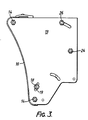
- FIGs 2 and 3 there is shown a coating head which has been designed for use in conjunction with a laboratory scale, trailing blade paper coating apparatus of the type described in British Patent Specification No. 1 032 536.
- the coating head comprises two side walls 12 and 13 which are held in the desired parallel relationship with one another by nut and bolt assemblies 14 in rigid tubular sleeves 15.
- the forward facing edges 16 of the side walls are curved to confirm to the periphery of the roll 2 (corresponding to the backing roll 4 shown in Figure 1 of British Patent Specification No. 1 032 536) of the laboratory scale trailing blade paper coating apparatus and are faced with strips of poly(tetrafluoroehhylene) of thickness 1.6 mm.
- a trailing blade 11 of thin, spring steel is clamped between steel jaws 25 attached to a substantially rectangular holder 17 which is fixed in place by means of screws 18 passing through holes 19 in the side walls.
- a flexible blade 5 made of polytetrafluoroethylene and having a thickness of 1.6 mm is clamped with a length of 16 mm of the blade protruding in a holder 20 of dog leg shape which is pivotally connected to the side walls by a nut and bolt assembly 26.
- the angle of the holder 20 is adjustable by means of a screw 21 provided with a knurled knob 22, the screw co-operating with a threaded block 23 which is fixed in place by means of a nut and bolt assembly 24.
- the side walls, blade holders and sleeves 15 are made from the material known as "TUFNOL" (Registered Trade Mark) which is formed by impregnating a textile material with a phenolformaldehyde resin.
- the sleeves 15 are made of nylon.
- the coating heads were mounted on a "HELI-COATER" (Registered Trade Mark) laboratory scale paper coating apparatus of the type described in British Patent Specification No. 1 032 536 and the drum was rotated at a speed such that the paper attached to the drum passed beneath the blades at a speed of 400 metres per minute.
- the percentage by weight of total dry solids in each paper coating composition was determined and the viscosity was measured by means of a Brookfield Viscometer with a spindle speed of 100 rpm.
- Coatings were applied to the base paper to give weights of dry coating varying in the range from about 4 to about 11 gm- 2 by varying the pressure applied to bias the coating head against the drum.
- a further advantage of the higher solids concentration and thus higher viscosity is that the time during which water from hhe composition drains into the base paper is reduced and therefore hhe particles in the composition are more likely to retain the orientation given to them as they pass beneath the pre-orientating flexible blade. It can also be seen from these results that the use of the coating head of the invention gives improved gravure printing quality and, in most cases, improved gloss. These improvements become more pronounced as the proportion of high aspect ratio particles, i.e. the proportion of mica particles between about 5 ⁇ m and about 50 ⁇ m in size is increased.
- Samples of a web offset printing base paper were coated on the laboratory scale trailing blade paper coating apparatus at a paper speed of 400 metres per minute with a composition prepared according to the following formulation:
- the pigment comprised 90 % by weight of a kaolin clay, having a particle size distribution such that 1 % by weight of particles had an equivalent spherical diameter larger than 10 ⁇ m and 80 % by weight of particles had an equivalent spherical diameter smaller than 2 ⁇ m, and 10 % by weight of the same mica as was used in
- the pigment was coated on to samples of paper using coating heads of both Type 1 and Type 2 as described in Example 1 above.
- water was added to the composition to give a viscosity of 1500 mPa ⁇ s as measured by means of the Brookfield Viscometer at a spindle speed of 100 rpm and the percentage by weight of total dry solids in the composition was found to be 60 %.
- water was added to give a viscosity of 2000 mPa. or a solids concentration of 63 % by weight.
- Coatings were applied at varying blade pressures to give dry coating weights in the range from about 3 to about 9 gm- 2 .
- Each sample of coated paper was thermally dried and calendered at a line pressure of 89 kg per cm for 10 passes at 65°C and the gloss was measured according to TAPPI Standard No T 480 ts-65. The gloss corresponding to.a dry coating weight of 5 gm- 2 was found in each case by interpolation.
- Table II The results obtained are set forth in Table II below:
Landscapes
- Paper (AREA)
- Application Of Or Painting With Fluid Materials (AREA)
- Coating Apparatus (AREA)
- Storage Of Web-Like Or Filamentary Materials (AREA)
- Pens And Brushes (AREA)
- Photographic Developing Apparatuses (AREA)
- General Preparation And Processing Of Foods (AREA)
- Pharmaceuticals Containing Other Organic And Inorganic Compounds (AREA)
- Control Of Metal Rolling (AREA)
- Non-Silver Salt Photosensitive Materials And Non-Silver Salt Photography (AREA)
- Saccharide Compounds (AREA)
- Fats And Perfumes (AREA)
Abstract
Description
- This invention relates to an apparatus for, and to a method of, applying to the surface of a cellulosic sheet material, such as paper or board, a coating composition comprising a particulate inorganic pigment and an adhesive in an aqueous medium. More particularly, but not exclusively, the invention is concerned with the production of what is usually known as ultra-lightweight coated papers, i.e. papers coated with not more than 9g. of dry coating composition per square metre of paper surface per side of paper.
- Inorganic pigments which have been found most suitable for incorporation in coating compositions for producing ultra-lightweight coated papers are minerals of the layer lattice silicate type of which kaolin clay is the most widely used, but coating compositions may also comprise other layer lattice silicate minerals such as talc. These layer lattice silicate minerals generally crystallise in the form of flat plates which may be relatively easily cleaved apart along a plane parallel to the face of the plates. If the coating applied to the surface of a sheet of cellulosic material is light in weight, it follows that the thickness of the dry coating will be small. It has been found that, if a coating is to possess good opacity, gloss and printing properties, the particles of the layer lattice silicate mineral in the coating composition should generally be of high aspect ratio, in other words the ratio of the longest dimension measured across the face of the particle to the thickness of the particle should be large, and the particles should be generally oriented with the plane of the plates parallel to the surface of the cellulosic material. Layer lattice silicate minerals generally exist in the form of particles consisting of stacks or clusters of plate-like crystals and the aspect ratio of the particles of such a mineral may be increased by cleaving apart the plates to provide a particulate material which consists predominantly of individual plates.
- However, paper coating compositions containing a high proportion of particles of high aspect ratio suffer from the disadvantage that their rheological properties are generally poor, i.e. a paper coating composition containing a high percentage by weight of such particles tends to be highly viscous and to exhibit rheological dilatancy, i.e. the viscosity of the composition increases with the rate of shear applied to the composition. One way of overcoming this disadvantage would be to reduce the percentage by weight of particulate silicate mineral in the paper coating composition but such a measure would introduce other disadvantages, viz:
- 1. the cost of drying the coated material would be increased because the quantity of water to be evaporated per unit weight of pigment applied is increased;
- 2. the aqueous medium would tend to migrate rapidly into the cellulosic sheet material leaving the platelet particles immobilised in an orientation which may be far removed from the optimum orientation in which the plane of the plates are parallel to the surface of the cellulosic material; and
- 3. the particles would tend to collapse in random orientation into relatively large holes or fissures between fibres of the cellulosic sheet material with the result that the upper surface of the coating, when dried, would not be sufficiently smooth to receive a good print impression.
- It is therefore desirable to use a coating composition containing the highest possible percentage by weight of particulate silicate mineral of high aspect ratio to produce an ultra-lightweight coated paper.
- A widely used method of coating webs of cellulosic material utilises apparatus which includes a spring steel blade which in use extends across the web of cellulosic material to be coated and is biased into contact with the web, the web being generally supported on a slightly resilient curved surface, such as a roll faced with an elastomeric material. The blade generally makes an acute angle with the tangent to the curved supporting surface along the line of contact of the blade with the surface and is in a trailing attitude with respect to the direction of motion of the web. For obvious reasons such a blade is known as a "trailing blade" and an apparatus using such a blade is generally known as a "trailing blade paper coating apparatus". In one method of coating cellulosic material using a trailing blade paper coating apparatus an aqueous coating composition is introduced into a trough of which the floor and back are formed by the blade and its supporting struchure, the sides are formed by suitable dams, and the front of the trough is closed by the web of cellulosic material on the curved support. In another method, an aqueous coating composition is applied to the web upstream of the trailing blade by a suitable applicator, such as a rotating roll or brush in contact with the moving web or by means of spray jets. In either method the trailing blade serves to remove surplus coating composition and to smooth and level the coating. If a coating composition, which is supported on a moving web of cellulosic material and contains a high percentage by weight of particles which are predominantly of high aspect ratio,.is constrained to pass at high velocity beneath a trailing blade, the coating is suddenly exposed to conditions of very high shear and, as a result of the poor rheological properties of the coating composition (by virtue of the random orientation of particles of high aspect ratio), there to occur sudden changes in the velocity of flow of the composition beneath the blade and in the clearance between the blade and the web with the result that the coating is unevenly applied.
- In US-A-3 486 482 there is disclosed an apparatus for paper coating using a trailing blade, and including a second blade which forms part of the coating applicator positioned upstream of the trailing blade. The use of the two blades minimises scratching and streaking of the coated surface.
- It is an object of the the present invention to provide an apparatus for, and a method of, applying to a cellulosic sheet material a substantially smooth and level coating even at a small thickness, of a composition which contains a relatively high percentage by weight of particles which are predominantly of high aspect ratio.
- Accordingly, in one aspect, the present invention provides a trailing blade paper coating apparatus which comprises means providing a resilient curved surface for supporting a moving web of cellulosic material, an applicator for a paper coating composition and a trailing blade which in use is biased towards and in contact with the moving web of cellulosic material, and which further includes a flexible blade mounted so that, in operation of the trailing blade paper coating apparatus, the flexible blade is in contact with a web of cellulosic material to be coated at a location which is upstream relative to the trailing blade and downstream relative to the applicator for the coating composition.
- In another aspect, the present invention provides a method of coating a web of cellulosic material with a coating composition comprising a particulate pigment material and an adhesive in an aqueous medium, which method comprises applying said coating composition to the surface of a moving web of a cellulosic material, passing the web and applied coating composition between a resilient supporting member and a trailing blade one edge of which is biased towards the supporting member, characterised in that the web and its applied coating are acted upon, at a position upstream relative to the trailing blade, by a flexible blade.
- The flexible blade employed in the apparatus and method of the present invention should be constructed and mounted so that when it is in contact with a web of cellulosic material its free edge flexes sufficiently to be substantially tangential to the web at the point of contact. The flexible blade is advantageously made of a plastics materials, such as polytetrafluoroethylene or poly(vinylchloride), although an elastomeric material, such as a natural or synthetic rubber, can be used. It may also be possible to employ a thin, flexible metallic material. In one embodiment the flexible blade is retained, for example clamped, along one edge in suitable retaining means and its free edge is arranged to contact the web supported on a curved surface substantially tangentially. More generally, the flexible blade should be mounted in a manner such that it applies enough pressure to limit the weight of wet paper coating composition which is allowed to pass beneath the flexible blade to not more than 10 % by weight in excess of the amount which is required to give the final desired dry coating weight. Preferably, the flexible blade is itself supported near to the retaining means by a curved former, for example a resilient bar, which may advantageously be a length of flexible, plastomeric or elastomeric tubing.
- The flexible blade is preferably mounted so that, in operation, the distance between the lines of contact of the flexible blade and the trailing blade with the web of cellulosic material is such that the time taken for a fixed point on the web to travel between the two lines of contact at the normal operating speed of travel of the web is not larger than 15 milliseconds. For example, on an industrial paper coating machine which normally runs at a speed of 1500 m .min-1 (metres per minute) the time taken to travel between the two blades is 10 ms (milliseconds) if the blades are 25 cm apart. In one embodiment of the invention the trailing blade and/or the flexible blade are movable relative to each other to enable the time taken for a fixed point on the web to travel between the two lines of contact of the flexible blade and the trailing blade to be adjusted.
- It is believed that the flexible blade of a trailing blade paper coating apparatus in accordance with the invention functions by applying to the coating composition on the surface of the web a gradually increasing shear which causes particles, especially those in the form of platelets having a high aspect ratio, in the coating composition to orient themselves with the plane of the platelet parallel to the surface of the web. As a result, the coating composition passing under the trailing blade has its particles preoriented and a much smoother flow of coating composition under the trailing blade is possible. It is therefore possible to use coating compositions containing pigment particles of high aspect ratio at a higher percentage by weight of pigment in the composition than is possible with conventional trailing blade coating apparatus. It is also possible to increase the pressure under which the trailing blade is biased againsh the resilient supporting member, and trailing blade pressures up to about twice those used in conventional trailing blade paper coating apparatus are practicable. As a result, very thin coatings having a coat weight in the range of from 2 to 3 g-m-2 per side are obtainable. A further consequence of the preorientation of the particles is that the particles, substantially all of which are oriented with the platelets parallel to the surface of the paper, pack closely together in, or bridge across, any relatively large holes or fissures between the fibres of the cellulosic material, and remain oriented by virtue of the high viscosity of the composition, with the result that a smooth, level coating having good opacity, gloss and printing properties is obtainable.
- For a better understanding of the invention, and to show more clearly how the same may be carried into effect, reference will now be made, by way of example, to the accompanying drawings in which:
- Figure 1 shows diagrammatically part of one embodiment of a trailing blade paper coating apparatus in accordance with the invention; and
- Figures 2 and 3 show diagrammatically part of another embodiment of a trailing blade paper coating apparatus in accordance with the invention.
- Referring first to Figure 1, there is shown a web of paper 1 supported on a
steel roll 2 which is provided with a facing 3 of an elastomeric material. Theroll 2 is rotated so as to advance the web in the direction shown by the arrow 4. Aflexible blade 5, made of polytetrafluoroethylene, is clamped along one edge to a supporting member 6 and the free edge 7 of the blade contacts the moving web substantially tangentially to theroll 2. Along that edge of the supporting member 6 facing the roll there is secured a length of polyethylene tubing 8, part of the curved outer surface of which supports and defines the curvature of theflexible blade 5. Atrailing blade 11 made of thin spring steel is biased againsl the web by means not shown. - In operation, a coating composition 9, which comprises a layer lattice silicate mineral having particles of high aspect ratio and an adhesive in suspension in water, is introduced into a
trough 10 which is defined by the web 1, theflexible blade 5, the supporting member 6 and two dams (not shown). Thetrailing blade 11 serves to remove excess coating composition and to smooth and level the coating. The distance "d" between the lines of contact of theflexible blade 5 andtrailing blade 11 is 6 cm which, for a speed of travel of the web of 400 m.min-1, gives a time of travel between the two blades of 9 ms. This is a typical spacing between the blades but many other configurations are possible although it is preferred that the time of travel of the coated web between the flexible blade and trailing blade does not exceed 15 ms. - Turning now to Figures 2 and 3, there is shown a coating head which has been designed for use in conjunction with a laboratory scale, trailing blade paper coating apparatus of the type described in British Patent Specification No. 1 032 536. The coating head comprises two
side walls tubular sleeves 15. The forward facingedges 16 of the side walls are curved to confirm to the periphery of the roll 2 (corresponding to the backing roll 4 shown in Figure 1 of British Patent Specification No. 1 032 536) of the laboratory scale trailing blade paper coating apparatus and are faced with strips of poly(tetrafluoroehhylene) of thickness 1.6 mm. Atrailing blade 11 of thin, spring steel is clamped betweensteel jaws 25 attached to a substantiallyrectangular holder 17 which is fixed in place by means ofscrews 18 passing throughholes 19 in the side walls. Aflexible blade 5 made of polytetrafluoroethylene and having a thickness of 1.6 mm is clamped with a length of 16 mm of the blade protruding in aholder 20 of dog leg shape which is pivotally connected to the side walls by a nut andbolt assembly 26. The angle of theholder 20 is adjustable by means of ascrew 21 provided with aknurled knob 22, the screw co-operating with a threadedblock 23 which is fixed in place by means of a nut andbolt assembly 24. The side walls, blade holders andsleeves 15 are made from the material known as "TUFNOL" (Registered Trade Mark) which is formed by impregnating a textile material with a phenolformaldehyde resin. Thesleeves 15 are made of nylon. - The invention is further illustrated by the following Examples.
- Examples of a gravure printing base paper were coated with a rotogravure paper coating composition prepared according to the following formulation:

- The following four pigments were used:
- A. A kaolin clay having a particle size distribution such that 6 % by weight of particles had an equivalent spherical diameter larger than 10 wm, 40 % by weight of particles had an equivalent spherical diameter smaller than 2 µm and 25 % by weight of particles had an equivalent spherical diameter smaller than 1 µm;
- B. A kaolin clay having a particle size distribution such that 4 % by weight of particles had an equivalent spherical diameter larger than 10 ¡.tm, 82 % by weight of particles had an equivalent spherical diameter smaller than 2 µm and 60 % by weight of particles had an equivalent spherical diameter smaller than 1 µm;
- C. 90 % by weight of pigment B + 10 % by weight of muscovite mica consisting predominantly of particles having diameters in the range from 5 pm to 50 um; and
- D. 70 % by weight of pigment B + 30 % by weight of the same mica as was used in pigment C.
- Samples of the base paper were coated with compositions containing each of the four pigments by means of:
- Type 1. A conventional trailing blade coating head comprising a single spring steel blade; and
-
Type 2. A coating head according to the invention and as shown in Figures 2 and 3 comprising a trailing blade of thin spring steel and a flexible, preorientating blade of polytetrafluoroethylene of thickness 1.6 mm. - The coating heads were mounted on a "HELI-COATER" (Registered Trade Mark) laboratory scale paper coating apparatus of the type described in British Patent Specification No. 1 032 536 and the drum was rotated at a speed such that the paper attached to the drum passed beneath the blades at a speed of 400 metres per minute. Before coating, the percentage by weight of total dry solids in each paper coating composition was determined and the viscosity was measured by means of a Brookfield Viscometer with a spindle speed of 100 rpm. Coatings were applied to the base paper to give weights of dry coating varying in the range from about 4 to about 11 gm-2 by varying the pressure applied to bias the coating head against the drum. Each coating was thermally dried and the gloss of the dry coating was measured according to TAPPI Standard No. T 480 ts-65 and the gravure printing quality was tested by the method described in the article "Realistic paper tests for various printing processes" by A Swan published in "Printing Technology" vol. 13, No. 1, April 1969, pages 9 - 12 and in British Patent Specification No. 2 058 734.
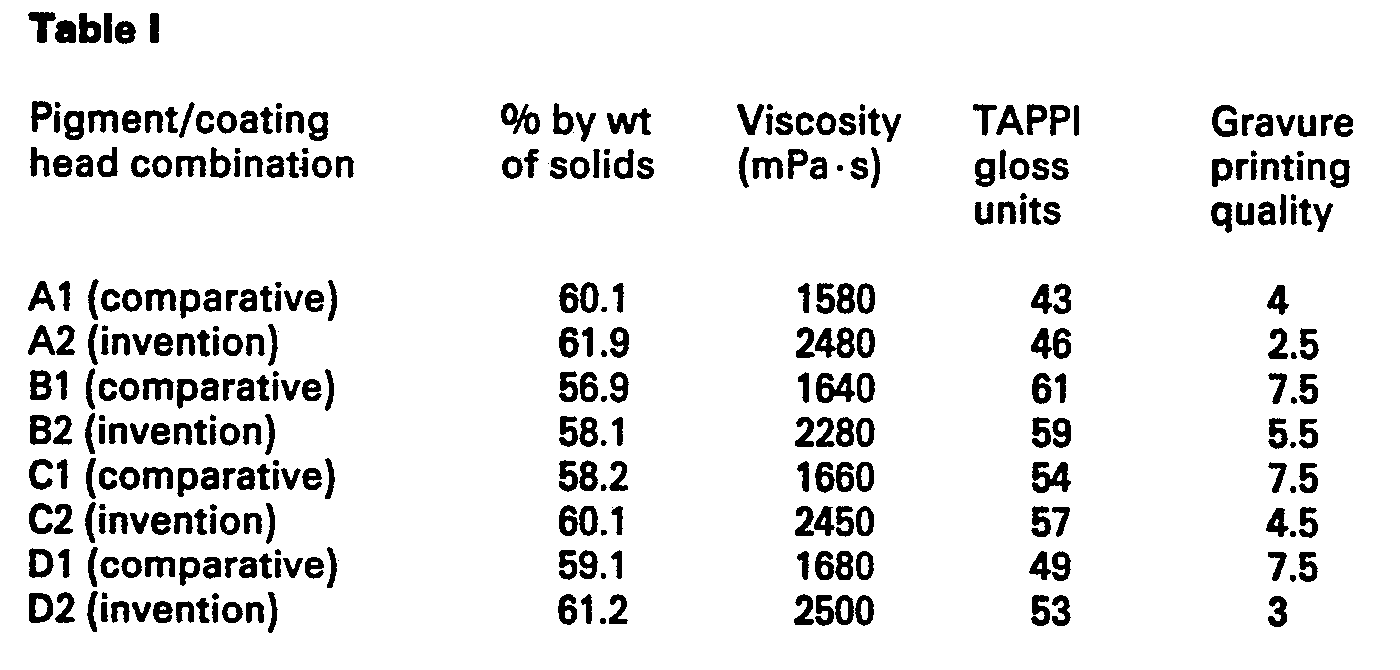
- Before testing, the samples of coated paper were calendered at a line pressure of 500 Ib per linear inch (89 kg per cm) for 10 passes at 65°C. For each combination of coating composition and coating head there were estimated, by interpolation, the gloss and gravure printing quality results which corresponded to a dry coating weight of 7 gm-2. In the case of gravure printing quality the lowest figure represents the best result. The results obtained are set forth in Table I below:
- Samples of a web offset printing base paper were coated on the laboratory scale trailing blade paper coating apparatus at a paper speed of 400 metres per minute with a composition prepared according to the following formulation:

- The pigment was coated on to samples of paper using coating heads of both Type 1 and
Type 2 as described in Example 1 above. In the case of the Type 1 coating head water was added to the composition to give a viscosity of 1500 mPa·s as measured by means of the Brookfield Viscometer at a spindle speed of 100 rpm and the percentage by weight of total dry solids in the composition was found to be 60 %. In the case of theType 2 coating head, water was added to give a viscosity of 2000 mPa. or a solids concentration of 63 % by weight. - Coatings were applied at varying blade pressures to give dry coating weights in the range from about 3 to about 9 gm-2. Each sample of coated paper was thermally dried and calendered at a line pressure of 89 kg per cm for 10 passes at 65°C and the gloss was measured according to TAPPI Standard No T 480 ts-65. The gloss corresponding to.a dry coating weight of 5 gm-2 was found in each case by interpolation. The results obtained are set forth in Table II below:

Claims (6)
Priority Applications (1)
| Application Number | Priority Date | Filing Date | Title |
|---|---|---|---|
| AT86302307T ATE40430T1 (en) | 1985-04-01 | 1986-03-27 | DEVICE AND METHOD FOR COATING PAPER. |
Applications Claiming Priority (2)
| Application Number | Priority Date | Filing Date | Title |
|---|---|---|---|
| GB8508431 | 1985-04-01 | ||
| GB858508431A GB8508431D0 (en) | 1985-04-01 | 1985-04-01 | Paper coating apparatus |
Publications (2)
| Publication Number | Publication Date |
|---|---|
| EP0198622A1 EP0198622A1 (en) | 1986-10-22 |
| EP0198622B1 true EP0198622B1 (en) | 1989-01-25 |
Family
ID=10577013
Family Applications (1)
| Application Number | Title | Priority Date | Filing Date |
|---|---|---|---|
| EP86302307A Expired EP0198622B1 (en) | 1985-04-01 | 1986-03-27 | Paper coating apparatus and method |
Country Status (11)
| Country | Link |
|---|---|
| US (1) | US4728539A (en) |
| EP (1) | EP0198622B1 (en) |
| JP (1) | JPH0657332B2 (en) |
| AT (1) | ATE40430T1 (en) |
| BR (1) | BR8601439A (en) |
| CA (1) | CA1240217A (en) |
| DE (1) | DE3661949D1 (en) |
| ES (1) | ES8706223A1 (en) |
| FI (1) | FI83350C (en) |
| GB (2) | GB8508431D0 (en) |
| NO (1) | NO165484C (en) |
Families Citing this family (24)
| Publication number | Priority date | Publication date | Assignee | Title |
|---|---|---|---|---|
| JPH01501339A (en) * | 1986-10-14 | 1989-05-11 | ベックマン インスツルメンツ インコーポレーテッド | Improved nucleic acid hybridization method and kit used therefor |
| AU1722188A (en) * | 1987-10-10 | 1989-05-02 | Johannes Zimmer | Spreading appliance |
| FI81637C (en) * | 1988-01-29 | 1990-11-12 | Valmet Paper Machinery Inc | Device for coating material web |
| FI90634C (en) * | 1989-01-17 | 1994-03-10 | Valmet Paper Machinery Inc | Coating device and method for coating a web |
| US5067432A (en) * | 1990-05-23 | 1991-11-26 | Extrusion Dies, Inc. | Replaceable wiping insert for slot die head |
| FI86318C (en) * | 1990-06-26 | 1992-08-10 | Keskuslaboratorio | FOERFARANDE OCH ANORDNING FOER ATT REGLERA BLADBESTRYKNING. |
| GB9026012D0 (en) * | 1990-11-29 | 1991-01-16 | Ecc Int Ltd | Paper coating |
| FI91025C (en) * | 1991-02-08 | 1995-08-22 | Valmet Paper Machinery Inc | Process for controlling the transverse profile of coating material on paper or other web material and coating station intended to carry out the procedure |
| US6117237A (en) | 1994-01-04 | 2000-09-12 | 3M Innovative Properties Company | Coater die enclosure system |
| US5725665A (en) * | 1996-05-01 | 1998-03-10 | Minnesota Mining And Manufacturing Company | Coater enclosure and coating assembly including coater enclosure |
| DE19652882A1 (en) * | 1996-12-18 | 1998-06-25 | Voith Sulzer Papiermasch Gmbh | Applicator for direct or indirect application of a liquid or pasty application medium to a running material web, in particular made of paper or cardboard |
| SE524103C2 (en) * | 2002-07-15 | 2004-06-29 | Btg Eclepens Sa | Coating sheet and process for making this |
| JP4413485B2 (en) * | 2002-10-22 | 2010-02-10 | 日本碍子株式会社 | Peripheral surface coating apparatus for columnar structure and outer peripheral surface coating method for columnar structure |
| US7157143B2 (en) * | 2003-03-24 | 2007-01-02 | Dow Global Technologies Inc. | Two-component epoxy adhesive formulation for high elongation with low modulus |
| PL3617400T3 (en) | 2009-03-30 | 2023-01-02 | Fiberlean Technologies Limited | Use of nanofibrillar cellulose suspensions |
| SI2236545T1 (en) | 2009-03-30 | 2014-12-31 | Omya International Ag | Process for the production of nano-fibrillar cellulose gels |
| US8367306B1 (en) * | 2009-07-13 | 2013-02-05 | Hrl Laboratories, Llc | Method of continuous or batch fabrication of large area polymer micro-truss structured materials |
| EP2386614A1 (en) * | 2010-04-21 | 2011-11-16 | Neenah Gessner GmbH | Environmentally friendly adhesive tape paper and adhesive paper made from same |
| DK2386683T3 (en) | 2010-04-27 | 2014-06-23 | Omya Int Ag | Process for the preparation of gel-based composite materials |
| EP2386682B1 (en) | 2010-04-27 | 2014-03-19 | Omya International AG | Process for the manufacture of structured materials using nano-fibrillar cellulose gels |
| DK3362508T3 (en) | 2015-10-14 | 2019-07-29 | Fiberlean Tech Ltd | 3D FORMABLE PLATE MATERIAL |
| HRP20210460T1 (en) | 2016-04-05 | 2021-04-30 | Fiberlean Technologies Limited | Paper and paperboard products |
| US11846072B2 (en) | 2016-04-05 | 2023-12-19 | Fiberlean Technologies Limited | Process of making paper and paperboard products |
| US12519543B2 (en) * | 2023-07-21 | 2026-01-06 | Macom Technology Solutions Holdings, Inc. | Signal detection and information conveyance over optical fiber |
Family Cites Families (16)
| Publication number | Priority date | Publication date | Assignee | Title |
|---|---|---|---|---|
| US3081191A (en) * | 1959-02-18 | 1963-03-12 | Mead Corp | Doctor blade |
| US3179536A (en) * | 1961-05-19 | 1965-04-20 | Kimberly Clark Co | Method and apparatus for coating paper |
| US3352706A (en) * | 1962-02-23 | 1967-11-14 | Eastman Kodak Co | Method for smoothing a coated web |
| US3192895A (en) * | 1962-04-18 | 1965-07-06 | Time Inc | Web coating apparatus |
| GB1032536A (en) * | 1964-05-04 | 1966-06-08 | English Clays Lovering Pochin | Improvements in or relating to the coating of paper and the like |
| US3273535A (en) * | 1964-10-06 | 1966-09-20 | Rice Barton Corp | Trailing-blade-coater including adjustable drag-blade |
| FR1512748A (en) * | 1966-03-07 | 1968-02-09 | Dow Chemical Co | Method and apparatus for coating sheets, especially paper |
| US3486482A (en) * | 1966-12-30 | 1969-12-30 | Westvaco Corp | Apparatus for coating traveling webs |
| US3518964A (en) * | 1968-05-02 | 1970-07-07 | Bergstrom Paper Co | Coating applicator with surrounding chamber |
| JPS5318062B2 (en) * | 1973-07-03 | 1978-06-13 | ||
| SE412862C (en) * | 1977-02-14 | 1982-01-25 | Billeruds Ab | DEVICE COVERING A CURRENT COAT |
| SE436620B (en) * | 1979-12-17 | 1985-01-14 | Kmw Ab | FLOOD DISTRIBUTOR FOR A LIQUID MOVING DEVICE |
| JPS56144769A (en) * | 1980-04-04 | 1981-11-11 | Voith Gmbh J M | Method and apparatus for removing excessive coating material from advancing web |
| US4369731A (en) * | 1981-09-02 | 1983-01-25 | Consolidated Papers, Inc. | Coating apparatus having an internal leveling blade |
| JPS58223463A (en) * | 1982-06-18 | 1983-12-26 | Matsushita Electric Ind Co Ltd | How to smooth the paint film |
| DE3338095A1 (en) * | 1983-10-20 | 1985-05-09 | J.M. Voith Gmbh, 7920 Heidenheim | PAINTING DEVICE |
-
1985
- 1985-04-01 GB GB858508431A patent/GB8508431D0/en active Pending
-
1986
- 1986-03-24 FI FI861241A patent/FI83350C/en not_active IP Right Cessation
- 1986-03-25 US US06/843,985 patent/US4728539A/en not_active Expired - Lifetime
- 1986-03-25 NO NO861208A patent/NO165484C/en unknown
- 1986-03-26 ES ES553427A patent/ES8706223A1/en not_active Expired
- 1986-03-27 EP EP86302307A patent/EP0198622B1/en not_active Expired
- 1986-03-27 GB GB8607765A patent/GB2173131B/en not_active Expired
- 1986-03-27 CA CA000505301A patent/CA1240217A/en not_active Expired
- 1986-03-27 AT AT86302307T patent/ATE40430T1/en not_active IP Right Cessation
- 1986-03-27 DE DE8686302307T patent/DE3661949D1/en not_active Expired
- 1986-04-01 BR BR8601439A patent/BR8601439A/en not_active IP Right Cessation
- 1986-04-01 JP JP61075389A patent/JPH0657332B2/en not_active Expired - Lifetime
Also Published As
| Publication number | Publication date |
|---|---|
| NO165484C (en) | 1991-02-20 |
| US4728539A (en) | 1988-03-01 |
| FI861241A0 (en) | 1986-03-24 |
| FI83350C (en) | 1991-06-25 |
| NO861208L (en) | 1986-10-02 |
| GB2173131A (en) | 1986-10-08 |
| FI861241A7 (en) | 1986-10-02 |
| ES553427A0 (en) | 1987-06-01 |
| ES8706223A1 (en) | 1987-06-01 |
| JPS61293573A (en) | 1986-12-24 |
| ATE40430T1 (en) | 1989-02-15 |
| JPH0657332B2 (en) | 1994-08-03 |
| GB8508431D0 (en) | 1985-05-09 |
| CA1240217A (en) | 1988-08-09 |
| FI83350B (en) | 1991-03-15 |
| GB2173131B (en) | 1989-06-28 |
| GB8607765D0 (en) | 1986-04-30 |
| EP0198622A1 (en) | 1986-10-22 |
| NO165484B (en) | 1990-11-12 |
| BR8601439A (en) | 1986-12-09 |
| DE3661949D1 (en) | 1989-03-02 |
Similar Documents
| Publication | Publication Date | Title |
|---|---|---|
| US4728539A (en) | Paper coating apparatus and method | |
| EP0624686B1 (en) | A pigment for a coating composition for printing paper | |
| US4154899A (en) | Production of porous, smooth, coated paper using high solids water-based coating compositions in blade coating apparatus | |
| JP4943627B2 (en) | Method for producing coated substrate | |
| BR0209012B1 (en) | PROCESS TO MAKE MULTI-LAYER PAPER OR COATED PAPER | |
| CA2444925C (en) | Process for making coated paper or paperboard | |
| EP4244422B1 (en) | Oil/grease resistant paper products | |
| US7473333B2 (en) | Process for making coated paper or paperboard | |
| EP1794365B1 (en) | Multi-layer coated products and curtain coating process for same | |
| US3000760A (en) | Method and apparatus for coating a surface | |
| US4471714A (en) | Device for the regulation of the application weight of coatings on material carried as a running web | |
| EP0274886A1 (en) | Pressure sensitive record material | |
| US20020098376A1 (en) | Friction guard blade and a method of production thereof | |
| CA2069327A1 (en) | Printable paper coating composition | |
| JP2005120502A (en) | Method for producing coated paper or paperboard | |
| WO1989009852A1 (en) | Paper coating | |
| US5846325A (en) | Coating blade and method of using the same | |
| JP2012016704A (en) | Method of manufacturing coated paper or cardboard | |
| Bousfield et al. | Paper coating rheology | |
| JPH11100799A (en) | Matte coated paper for printing | |
| Gnad | The Interaction of Coated Paper Surfaces and Water-and Solvent-Based Rotogravure Printing Inks | |
| Heilmann et al. | Significance of Paper Properties on Print Quality in CIJ Printing | |
| JP2014040698A (en) | Method of making coated paper or paperboard | |
| DeMay | The Effect of Various Pigments and Binders on Coated Gloss, Print Gloss, and Delta Gloss | |
| JPH0473385B2 (en) |
Legal Events
| Date | Code | Title | Description |
|---|---|---|---|
| PUAI | Public reference made under article 153(3) epc to a published international application that has entered the european phase |
Free format text: ORIGINAL CODE: 0009012 |
|
| 17P | Request for examination filed |
Effective date: 19860414 |
|
| AK | Designated contracting states |
Kind code of ref document: A1 Designated state(s): AT BE CH DE FR IT LI LU NL SE |
|
| 17Q | First examination report despatched |
Effective date: 19880317 |
|
| GRAA | (expected) grant |
Free format text: ORIGINAL CODE: 0009210 |
|
| AK | Designated contracting states |
Kind code of ref document: B1 Designated state(s): AT BE CH DE FR IT LI LU NL SE |
|
| PG25 | Lapsed in a contracting state [announced via postgrant information from national office to epo] |
Ref country code: LI Effective date: 19890125 Ref country code: CH Effective date: 19890125 Ref country code: BE Effective date: 19890125 Ref country code: AT Effective date: 19890125 |
|
| REF | Corresponds to: |
Ref document number: 40430 Country of ref document: AT Date of ref document: 19890215 Kind code of ref document: T |
|
| ITF | It: translation for a ep patent filed | ||
| REF | Corresponds to: |
Ref document number: 3661949 Country of ref document: DE Date of ref document: 19890302 |
|
| ET | Fr: translation filed | ||
| PG25 | Lapsed in a contracting state [announced via postgrant information from national office to epo] |
Ref country code: LU Free format text: LAPSE BECAUSE OF NON-PAYMENT OF DUE FEES Effective date: 19890331 |
|
| REG | Reference to a national code |
Ref country code: CH Ref legal event code: PL |
|
| PLBE | No opposition filed within time limit |
Free format text: ORIGINAL CODE: 0009261 |
|
| STAA | Information on the status of an ep patent application or granted ep patent |
Free format text: STATUS: NO OPPOSITION FILED WITHIN TIME LIMIT |
|
| 26N | No opposition filed | ||
| ITTA | It: last paid annual fee | ||
| EAL | Se: european patent in force in sweden |
Ref document number: 86302307.3 |
|
| PGFP | Annual fee paid to national office [announced via postgrant information from national office to epo] |
Ref country code: FR Payment date: 20000214 Year of fee payment: 15 |
|
| PGFP | Annual fee paid to national office [announced via postgrant information from national office to epo] |
Ref country code: SE Payment date: 20000221 Year of fee payment: 15 |
|
| PGFP | Annual fee paid to national office [announced via postgrant information from national office to epo] |
Ref country code: NL Payment date: 20000223 Year of fee payment: 15 |
|
| PGFP | Annual fee paid to national office [announced via postgrant information from national office to epo] |
Ref country code: DE Payment date: 20000228 Year of fee payment: 15 |
|
| PG25 | Lapsed in a contracting state [announced via postgrant information from national office to epo] |
Ref country code: SE Free format text: LAPSE BECAUSE OF NON-PAYMENT OF DUE FEES Effective date: 20010328 |
|
| PG25 | Lapsed in a contracting state [announced via postgrant information from national office to epo] |
Ref country code: NL Free format text: LAPSE BECAUSE OF NON-PAYMENT OF DUE FEES Effective date: 20011001 |
|
| EUG | Se: european patent has lapsed |
Ref document number: 86302307.3 |
|
| PG25 | Lapsed in a contracting state [announced via postgrant information from national office to epo] |
Ref country code: FR Free format text: LAPSE BECAUSE OF NON-PAYMENT OF DUE FEES Effective date: 20011130 |
|
| NLV4 | Nl: lapsed or anulled due to non-payment of the annual fee |
Effective date: 20011001 |
|
| REG | Reference to a national code |
Ref country code: FR Ref legal event code: ST |
|
| PG25 | Lapsed in a contracting state [announced via postgrant information from national office to epo] |
Ref country code: DE Free format text: LAPSE BECAUSE OF NON-PAYMENT OF DUE FEES Effective date: 20020101 |
|
| PG25 | Lapsed in a contracting state [announced via postgrant information from national office to epo] |
Ref country code: IT Free format text: LAPSE BECAUSE OF NON-PAYMENT OF DUE FEES;WARNING: LAPSES OF ITALIAN PATENTS WITH EFFECTIVE DATE BEFORE 2007 MAY HAVE OCCURRED AT ANY TIME BEFORE 2007. THE CORRECT EFFECTIVE DATE MAY BE DIFFERENT FROM THE ONE RECORDED. Effective date: 20050327 |