EP0198352A2 - Method for preparing (+)R-2-methyl-hexane-1,2-diol - Google Patents
Method for preparing (+)R-2-methyl-hexane-1,2-diol Download PDFInfo
- Publication number
- EP0198352A2 EP0198352A2 EP86104593A EP86104593A EP0198352A2 EP 0198352 A2 EP0198352 A2 EP 0198352A2 EP 86104593 A EP86104593 A EP 86104593A EP 86104593 A EP86104593 A EP 86104593A EP 0198352 A2 EP0198352 A2 EP 0198352A2
- Authority
- EP
- European Patent Office
- Prior art keywords
- formula
- methyl
- forming
- diol
- hexane
- Prior art date
- Legal status (The legal status is an assumption and is not a legal conclusion. Google has not performed a legal analysis and makes no representation as to the accuracy of the status listed.)
- Withdrawn
Links
Classifications
-
- C—CHEMISTRY; METALLURGY
- C07—ORGANIC CHEMISTRY
- C07C—ACYCLIC OR CARBOCYCLIC COMPOUNDS
- C07C59/00—Compounds having carboxyl groups bound to acyclic carbon atoms and containing any of the groups OH, O—metal, —CHO, keto, ether, groups, groups, or groups
- C07C59/01—Saturated compounds having only one carboxyl group and containing hydroxy or O-metal groups
- C07C59/115—Saturated compounds having only one carboxyl group and containing hydroxy or O-metal groups containing halogen
-
- C—CHEMISTRY; METALLURGY
- C07—ORGANIC CHEMISTRY
- C07C—ACYCLIC OR CARBOCYCLIC COMPOUNDS
- C07C31/00—Saturated compounds having hydroxy or O-metal groups bound to acyclic carbon atoms
- C07C31/18—Polyhydroxylic acyclic alcohols
- C07C31/20—Dihydroxylic alcohols
Definitions
- prostaglandins as a class have been the focus of intense investigation in recent years. Being derivatives of prostanoic acid, either naturally occurring or synthetic prostaglandins possess the ability to elicit a wide range of biochemical and physiological effects including cardiovascular,. nervous, reproductive, renal and gastric system responses in animals. These responses may be brought about by the administration of doses as small as about 10 ng/kg of body weight of one or more of such prostaglandins. Early isolation of these highly active compounds was achieved principally by extraction from mammalian tissues.
- TR-4698 16-methyl-1,11a,16RS-trihydroxyprost-13E-en-9-one
- TR-4698 is a prostaglandin analog which is disclosed and claimed in U.S. Patent No. 4,132,738 issued January 2, 1979 to Kluender, et al which is, as well as all other references cited herein, incorporated by reference.
- TR-4698 is a mixture of two isomers at the chiral C-16 position.
- the 16-R isomer i.e., 16-methyl-1, lla, 16R-trihydroxy-prost-13E-en-9-one, hereinafter referred to as TR-7133
- TR-7134 16-methyl-1, lla, 16R-trihydroxy-prost-13E-en-9-one
- TR-7133 16-methyl-1, lla, 16R-trihydroxy-prost-13E-en-9-one
- TR-7133 16-methyl-1, lla, 16R-trihydroxy-prost-13E-en-9-one
- Jew, et al teach that when trans- 2 -methyl-2-butenoic acid is utilized as the starting compound, the R-isomer of the resulting 2-hydroxy-2-methyl butanoic acid is formed in high predominance to the S-isomer (approximately 95:5, respectively). Similarly, when c i s-2- methyl-2-butenoic acid was investigated as the starting material, the R-isomer of the resulting 2-hydroxy-2-methyl butanoic acid was still predominant although a shift toward the S-isomer was observed approximately 60:40, respectively).
- the invention described herein teaches the preparation of (+)R-2-methyl-hexane 1,2-diol from methacryloyl chloride. As described previously, this intermediate can be used to prepare the optically active 16-R isomer of prostaglandin analogs such as TR-7133.
- the present invention is directed to a method for preparing the stereospecific prostaglandin intermediate (+)R-2-methyl-hexane-1,2-diol.
- Said method includes the steps of reacting methacryloyl chloride with L-proline in the presence of a base forming an amide of the formula: This amide is then reacted with N-bromosuccinimide in an aprotic polar solvent forming a bromolactone of the formula:
- bromolactone is then hydrolyzed with aqueous hydrobromic acid forming a bromo-acid of the formula:
- Said alkylation product is then reacted with acidic, aqueous tetrahydrofuran to effect formation of (+)R-2-methyl-hexane-1,2-diol.
- the method of the present invention provides for the preparation of (+)R-2-methyl-hexane-1,2- diol via an asymmetric halolactonization reaction utilizing L-proline as the chiral agent.
- the reaction scheme for the preparation of said diol is depicted in Table 1.
- N-methacryloyl-L-proline is first prepared by the dropwise addition of methacryloyl chloride to an aqueous mixture of L -proline, sodium bicarbonate and diethyl ether (pH maintained at about 10-11 throughout) and the mixture is stirred at ambient temperature for about 15 minutes to about 2 hours (step A).
- the N-methacryloyl- L -proline is then isolated utilizing conventional extraction techniques. Bromo- lactonization is then achieved by the addition of N-bromosuccinimide (NBS) to the L -proline derivative in an aprotic solvent such as dimethyl- formamide (DMF) followed by stirring at ambient temperature for about 12 to about 36 hours (step B).
- NBS N-bromosuccinimide
- DMF dimethyl- formamide
- the resulting bromolactone is isolated and then heated (about 100° to 110° C) with aqueous concentrated hydrobromic acid for about 15 to about 24 hours (step C).
- the resulting bromo-acid is isolated by conventional techniques and is then reduced by treatment with a mixture of BH 3 in tetrahydrofuran (step D). This mixture is stirred at ambient temperature for about 12 to about 24 hours after which the reaction is quenched by the addition of small amounts of a mixture of tetra- hydrofuran/water (about 1:1).
- the resulting bromodiol is then recovered using conventional techniques as described hereinafter.
- the bromodiol is then protected as its acetonide (step E) by reacting said bromodiol with dimethoxypropane (DMP) and a catalytic amount of toluenesulfonic acid at ambient temperature with stirring for about 8 to about 24 hours thereby forming said acetonide.
- DMP dimethoxypropane
- a solution of n -propyl lithium in anhydrous diethyl ether is prepared (maintained under an inert gas atmosphere at around -40° C) and then treated with CuCN. See B.H. Lipshutz, et al, J. Am. Chem. Soc., 103, 7672 (1981).
- the resulting cuprate solution is then added to a solution of the above- acetonide in diethyl ether (step F)and this mixture is then maintained in an inert gas atmosphere at about 0° C with stirring for about 15 minutes to about 2 hours. This stirred mixture is then poured into a solution of saturated aqueous ammonium chloride (pH about 8-9) and shaken.
- the resulting alkylation product is recovered by conventional means and is then treated with acidic aqueous tetrahydro- tetrahydrofuran (step G)to form the desired (+) R -2-methyl-hexane-1,2-diol.
- the (+) R -2-methyl-hexane-1,2-diol prepared by the method of this invention may then be utilized (by following known techniques) in the formation of certain stereospecific prostaglandin analogs, described briefly as follows. Utilizing the procedure of Pappo, et al, cited supra, the (+) R -2--methyl-hexane-1,2-diol can be used to prepare the corresponding stereospecific acetylenic alcohol, i.e., 4-methyloct-I-yn-4 R -ol. See the reaction sequence shown in Table 2.
- (+)R-2-methyl-hexane-1,2-diol is treated with tosyl chloride in pyridine to form the monotosylate.
- a three equivalent excess of lithium triethylsilylacetylide (formed in situ) is added to the monotosylate forming an intermediate epoxide which is opened upon treatment with dimethyl sulfoxide (DMSO).
- DMSO dimethyl sulfoxide
- KF potassium fluoride
- the above acetylenic alcohol is then converted to the corresponding iodovinyl alcohol.
- the hydroxyl function of the iodovinyl alcohol is protected with an acid-labile hydroxy protecting group (or alternatively, the hydroxyl group of the acetylenic alcohol can be protected prior to conversion of the alcohol to the iodovinyl compound).
- the hydroxy-protected iodovinyl alcohol is then lithiated with t-butylithium and reacted with a solubilized ligand complex of a copper (I) compound such as (hexamethylphosphoroustriamide) 2 --copper (I) pentyne to yield the corresponding organolithio-cuprate.
- This organolithiocuprate is then reacted with 4R-(tetrahydropyran-2-yloxy)-2--[7-tetrahydro- pyran2-yloxy)heptyl]-2-cyclopent--2-enone to form the tetrahydropyran-protected form of TR-7133.
- a mechanically stirred mixture of L-proline (42.0 grams, g), N A HCO 3 (148 g), H 2 0 (680 milliliters, ml) and diethyl ether (280 ml) was maintained in an ambient temperature bath at pH 10.5-10.7 (adjusted by the addition of concentrated aqueous NaOH), then treated portionwise over 20 minutes with a solution of redistilled methacryloyl chloride (40 ml) in diethyl ether (20 ml). Additional concentrated aqueous NaOH was added as needed to keep the pH at 10.5-10.7. Upon addition of all of the methacryloyl chloride (and pH stabilization), the mixture was stirred for 20 minutes at ambient temperature.
- the resulting immiscible phases were separated and the aqueous phase was extracted with two 250 ml portions of diethyl ether.
- the combined organic extracts were washed with H 2 0 (50 ml), and the aqueous extract was added to the aqueous phase which phase was then acidified to pH 1 with concentrated aqueous HC1 and then extracted with four 250 ml portions of ethyl acetate.
- the combined ethyl acetate extracts were washed with about 100 ml of brine (saturated aqueous sodium chloride solution) and then dried over Na 2 SO 4 .
- the resulting solution was filtered and concentrated in vacuo to about 230 ml and then heated to boiling, diluted with hexane (80 ml) and allowed to cool. Upon cooling, the desired N-methacryloyl-L-proline spontaneously crystallized as chunky white prisms (51.3 g).
- the concentrated mother liquor yielded a second crop of crystals (4.26 g) when crystallized as described above. A portion of the first crop was recrystallized twice from ethyl acetate to give an analytical sample, m.p. 102-104.5°C, having the following spectral characteristics:
- Example l(a) 0 36.6 g of the title compound of Example l(a) 0 was added to 500 ml of dry (4A) dimethylformamide and was maintained at ambient temperature under an inert gas atmosphere (protected from light) and was treated with recrystallized N-bromosuccinimide (71.2 g). The resulting mixture was stirred for about 20 hours and was then poured into a mixture of saturated aqueous sodium bicarbonate (2 liters) and ethyl acetate (800 ml) and shaken vigorously. The resulting immiscible phases were separated and the aqueous phase was extracted three times with 500 ml portions of ethyl acetate.
- the combined ethyl acetate extracts were washed eight times with 125 ml portions of saturated aqueous Na 2 S 2 0 3 .
- the Na 2 S 2 O 3 extracts were combined and washed with one 100 ml portion of ethyl acetate, and the ethyl acetate extracts were combined and washed three times with 330 ml portions of H 2 0.
- the aqueous extracts were combined and washed with 200 ml of ethyl acetate.
- the ethyl acetate extracts were again combined and washed with 300 ml of brine, dried over Na 2 SO 4 , filtered and concentrated in vacuo to about 250 ml.
- a solution of 13.0 g of the title compound of Example l(b) in 160 ml of 48% aqueous HBr was heated in a 100-105° C bath for 16 hours and then cooled.
- the solution was then poured into 800 ml of brine and extracted twice with 500 ml portions of CH 2 C1 2 .
- the combined organic extracts were washed with 300 ml of H 2 0, and the aqueous layer was then extracted with three 500 ml portions of ethyl acetate.
- the ethyl acetate extracts were combined and washed with three 100 ml portions of brine, and the resulting solution was dried over Na 2 SO 4 , filtered and evaporated in vacuo.
- (+)R-2--methyl-hexane-1,2-diol as a colorless, viscous oil that distilled over at between 40-90° C (pot temperature).
- the product was identical to that prepared by the lithium aluminum hydride reduction of (-) R- 2-hydroxy-2-methyl-hexanoic acid which acid was resolved from racemic 2-hydroxy-2-methyl-hexanoic acid as described by Pappo et al, supra.
- the (+)R-2-methyl-hexane-1,2-diol prepared as described in this example had the following spectral characteristics:
- D-Proline 50 g was dissolved in 430 ml of 20% aqueous sodium hydroxide and the resultant solution was stirred with ice bath cooling as 217 ml ether was added followed by dropwise addition of 50 g of methacryloyl chloride in 400 ml ether over about 45 minutes. After another 30 minutes, the aqueous phase was removed and washed once with additional ether. The aqueous phase was then acidified with concentrated hydrochloric acid and extracted three times with ethyl acetate. These combined ethyl acetate extracts were evaporated in vacuo.
- Example 2(a) 51.5 g of the title compound of Example 2(a) was added to 722 ml of dry dimethylformamide and was maintained at ambient temperature under argon as 100g of recrystallized N-bromosuccinimide was added. The resultant mixture was stirred for 18 hours and then poured into 1900 ml of saturated aqueous sodium bicarbonate solution. The resultant mixture was extracted three times with ethyl acetate. The combined extracts were washed with water twice, dried over sodium sulfate and evaporated in vacuo to remove solvent. The residue was dissolved in 170 ml hot ethyl acetate and 120 ml of isopropanol.
Landscapes
- Chemical & Material Sciences (AREA)
- Organic Chemistry (AREA)
- Organic Low-Molecular-Weight Compounds And Preparation Thereof (AREA)
Abstract
Description
- The prostaglandins as a class have been the focus of intense investigation in recent years. Being derivatives of prostanoic acid, either naturally occurring or synthetic prostaglandins possess the ability to elicit a wide range of biochemical and physiological effects including cardiovascular,. nervous, reproductive, renal and gastric system responses in animals. These responses may be brought about by the administration of doses as small as about 10 ng/kg of body weight of one or more of such prostaglandins. Early isolation of these highly active compounds was achieved principally by extraction from mammalian tissues.
- However, such extraction processes are typically not commercially feasible nor do they provide sufficient quantities for adequate pharmacological evaluation. Synthetic methods have advanced to where sufficient quantities may be produced through complete chemical synthesis; however, this methodology suffers from the disadvantage of being essentially nonstereo- specific hence leading to tedious resolution procedures which must be carried out to obtain the desired optically active isomer. It is well-known in the art that the most active prostaglandin derivatives have specific stereochemical configurations at each asymmetric carbon atom and/or double bond.
- 16-methyl-1,11a,16RS-trihydroxyprost-13E-en-9-one (hereinafter referred to as TR-4698) is a prostaglandin analog which is disclosed and claimed in U.S. Patent No. 4,132,738 issued January 2, 1979 to Kluender, et al which is, as well as all other references cited herein, incorporated by reference. TR-4698 is a mixture of two isomers at the chiral C-16 position. The 16-R isomer (i.e., 16-methyl-1, lla, 16R-trihydroxy-prost-13E-en-9-one, hereinafter referred to as TR-7133) is not believed to possess the same degree of physiological activity as the 16-S isomer (TR-7134) however, it is desirable to be able to synthesize the 16-R isomer in order to assess the degree of physiological activity, toxicology and the like which may be attributable thereto as opposed to that present in the racemic mixture or the 16-S isomer alone. This consideration may also be of value in the satisfaction of regulatory agencies involved in the approval of new drug applications for physiologically active agents. Accordingly, it has become desirable to design the synthesis of an intermediate having the requisite stereochemistry, which when ultimately incorporated into the molecule, would provide the 16-R isomer only (TR-7133) rather than the racemic mixture. The process taught herein is directed to the synthesis of (+)R-2-methyl-hexane-1,2-diol (an intermediate for the preparation of the 16-R isomer, TR-7133). Said intermediate is prepared via an asymmetric halolactonization reaction utilizing L-proline as the chiral agent which may then be subsequently incorporated into the synthesis of TR-7133 as described hereinafter.
- Various techniques have been utilized in the preparation or isolation of physiologically active prostaglandin isomers. One such technique is to utilize a resolved intermediate possessing the appropriate stereochemistry at the chiral center for incorporation into the molecule. For example, Pappo, et al in "Chemistry, Biochemistry and Pharmacological Activity of Prostanoids", edited by S.M. Roberts and F. Scheinmann, Pages 17-26, Pergammon Press, N.Y., 1978, teach the resolution of racemic 2-hydroxy-2-methyl-hexanoic acid via its naphthyl- ethylamine salt for preparation of a chiral acetylenic alcohol. (This optically active acetylenic alcohol may then be incorporated as the "right-hand" portion of the prostaglandin analog by following known techniques). However, the classical resolution of the racemic 2-hydroxy-2-methyl--hexanoic acid is tedious at best and requires an expensive, optically active amine.
- Another approach taught by Y. Fujimoto, J. Yadev, and C. Sih in Tetrahedron Letters, 21, 1481 (1980) prepares (-)S-2-methyl-hexane-1,2-diol from (+)citramalic acid, the chiral diol then being used to prepare the corresponding optically active acetylenic alcohol. The disadvantage of this method is that the citramalic acid must be prepared from mesaconic acid using an isolated microbial enzyme.
- S-s. Jew, S. Terashima and K. Koga in Tetrahedron, 35, 2337, et seq (1970), and papers cited therein, teach the use of an asymmetric halolactonization reaction to prepare optically active α,α-disubstituted-α-hydroxy acids from α, S-unsaturated acids. However, the technique described therein suffers from the disadvantage of being unable to render the S-isomer of the resulting a-a-disubstituted-a-hydroxy acid in high optical purity. For example, Jew, et al teach that when trans-2-methyl-2-butenoic acid is utilized as the starting compound, the R-isomer of the resulting 2-hydroxy-2-methyl butanoic acid is formed in high predominance to the S-isomer (approximately 95:5, respectively). Similarly, when cis-2- methyl-2-butenoic acid was investigated as the starting material, the R-isomer of the resulting 2-hydroxy-2-methyl butanoic acid was still predominant although a shift toward the S-isomer was observed approximately 60:40, respectively).
- The invention described herein teaches the preparation of (+)R-2-methyl-hexane 1,2-diol from methacryloyl chloride. As described previously, this intermediate can be used to prepare the optically active 16-R isomer of prostaglandin analogs such as TR-7133.
- The present invention is directed to a method for preparing the stereospecific prostaglandin intermediate (+)R-2-methyl-hexane-1,2-diol. Said method includes the steps of reacting methacryloyl chloride with L-proline in the presence of a base forming an amide of the formula:


- Said bromolactone is then hydrolyzed with aqueous hydrobromic acid forming a bromo-acid of the formula:

- This bromo-acid is then reduced with a mixture of borane-tetrahydrofuran forming a bromodiol of the formula:

- Said bromodiol is then treated with dimethoxypropane and toluene sulfonic acid forming an acetonide of the formula:

- This acetonide is then reacted with dipropyl cuprate forming an alkylation product of the formula:

- Said alkylation product is then reacted with acidic, aqueous tetrahydrofuran to effect formation of (+)R-2-methyl-hexane-1,2-diol.
- The method of the present invention provides for the preparation of (+)R-2-methyl-hexane-1,2- diol via an asymmetric halolactonization reaction utilizing L-proline as the chiral agent. The reaction scheme for the preparation of said diol is depicted in Table 1.

- N-methacryloyl-L-proline is first prepared by the dropwise addition of methacryloyl chloride to an aqueous mixture of L-proline, sodium bicarbonate and diethyl ether (pH maintained at about 10-11 throughout) and the mixture is stirred at ambient temperature for about 15 minutes to about 2 hours (step A). The N-methacryloyl-L-proline is then isolated utilizing conventional extraction techniques. Bromo- lactonization is then achieved by the addition of N-bromosuccinimide (NBS) to the L-proline derivative in an aprotic solvent such as dimethyl- formamide (DMF) followed by stirring at ambient temperature for about 12 to about 36 hours (step B).
- The resulting bromolactone is isolated and then heated (about 100° to 110° C) with aqueous concentrated hydrobromic acid for about 15 to about 24 hours (step C). The resulting bromo-acid is isolated by conventional techniques and is then reduced by treatment with a mixture of BH3 in tetrahydrofuran (step D). This mixture is stirred at ambient temperature for about 12 to about 24 hours after which the reaction is quenched by the addition of small amounts of a mixture of tetra- hydrofuran/water (about 1:1). The resulting bromodiol is then recovered using conventional techniques as described hereinafter. The bromodiol is then protected as its acetonide (step E) by reacting said bromodiol with dimethoxypropane (DMP) and a catalytic amount of toluenesulfonic acid at ambient temperature with stirring for about 8 to about 24 hours thereby forming said acetonide.
- A solution of n-propyl lithium in anhydrous diethyl ether is prepared (maintained under an inert gas atmosphere at around -40° C) and then treated with CuCN. See B.H. Lipshutz, et al, J. Am. Chem. Soc., 103, 7672 (1981). The resulting cuprate solution is then added to a solution of the above- acetonide in diethyl ether (step F)and this mixture is then maintained in an inert gas atmosphere at about 0° C with stirring for about 15 minutes to about 2 hours. This stirred mixture is then poured into a solution of saturated aqueous ammonium chloride (pH about 8-9) and shaken. The resulting alkylation product is recovered by conventional means and is then treated with acidic aqueous tetrahydro- tetrahydrofuran (step G)to form the desired (+)R-2-methyl-hexane-1,2-diol.
- The (+)R-2-methyl-hexane-1,2-diol prepared by the method of this invention may then be utilized (by following known techniques) in the formation of certain stereospecific prostaglandin analogs, described briefly as follows. Utilizing the procedure of Pappo, et al, cited supra, the (+)R-2--methyl-hexane-1,2-diol can be used to prepare the corresponding stereospecific acetylenic alcohol, i.e., 4-methyloct-I-yn-4R-ol. See the reaction sequence shown in Table 2.
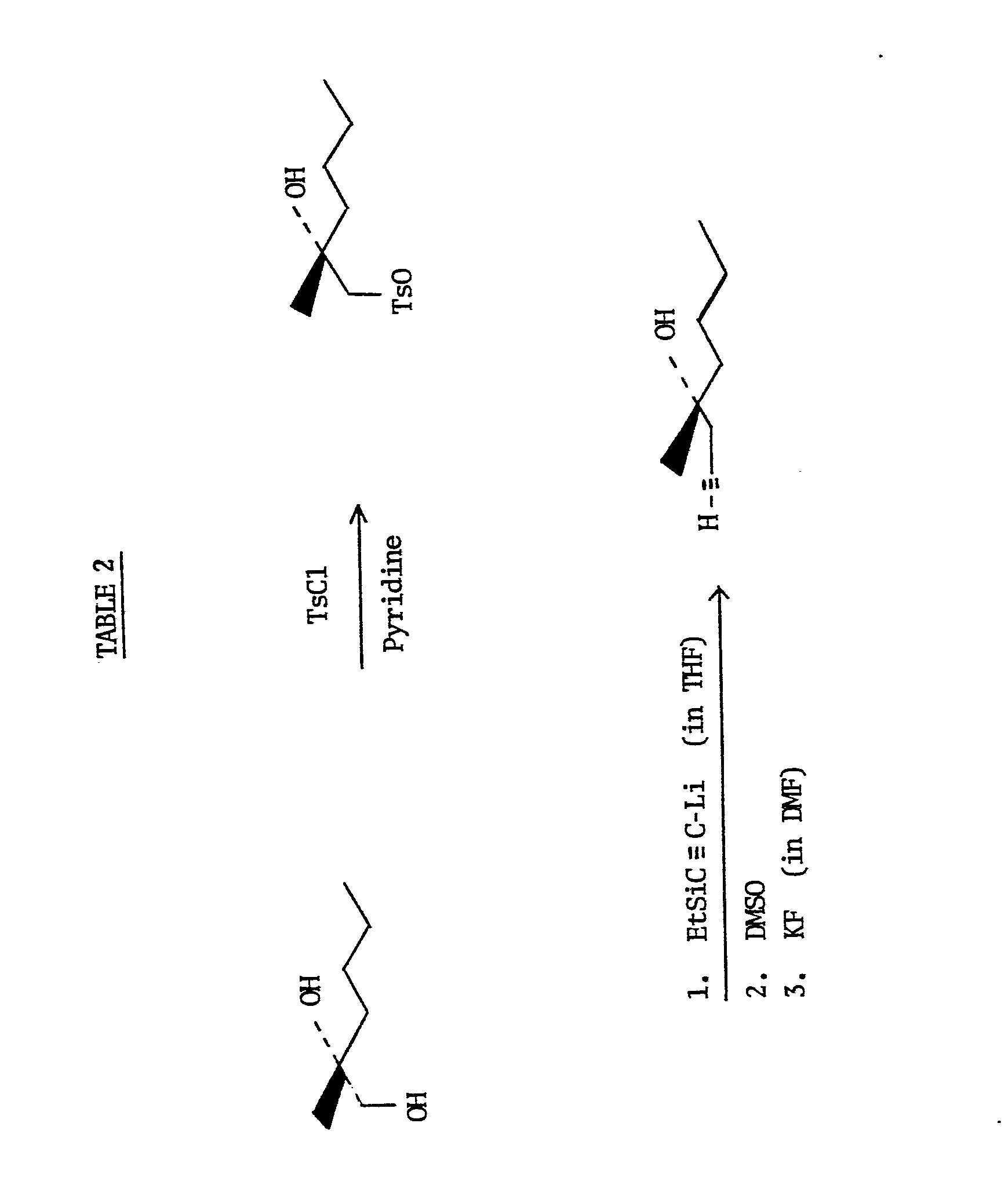
- As depicted in Table 2, (+)R-2-methyl-hexane-1,2-diol is treated with tosyl chloride in pyridine to form the monotosylate. A three equivalent excess of lithium triethylsilylacetylide (formed in situ) is added to the monotosylate forming an intermediate epoxide which is opened upon treatment with dimethyl sulfoxide (DMSO). Purification after work-up with potassium fluoride (KF) in dimethylformamide renders the desired stereospecific acetylenic alcohol, 4-methyloct-1-yn-4R-ol.
- As taught by Kluender et al, (U.S. Patent No. 4,132,738, cited supra) the above acetylenic alcohol is then converted to the corresponding iodovinyl alcohol. The hydroxyl function of the iodovinyl alcohol is protected with an acid-labile hydroxy protecting group (or alternatively, the hydroxyl group of the acetylenic alcohol can be protected prior to conversion of the alcohol to the iodovinyl compound). The hydroxy-protected iodovinyl alcohol is then lithiated with t-butylithium and reacted with a solubilized ligand complex of a copper (I) compound such as (hexamethylphosphoroustriamide)2--copper (I) pentyne to yield the corresponding organolithio-cuprate. This organolithiocuprate is then reacted with 4R-(tetrahydropyran-2-yloxy)-2--[7-tetrahydro- pyran2-yloxy)heptyl]-2-cyclopent--2-enone to form the tetrahydropyran-protected form of TR-7133. Said protected form is then hydrolyzed with a weak acid to render TR-7133. Clearly, one skilled in the art will appreciate that other prostaglandin analogs may be prepared using the optically active (+)-R-2-methyl-hexane-1,2-diol by the procedure described above or other techniques known to the art.
- The following examples are set forth as a means of illustrating the present invention and are not to be construed as a limitation thereon.
- A mechanically stirred mixture of L-proline (42.0 grams, g), NAHCO3 (148 g), H20 (680 milliliters, ml) and diethyl ether (280 ml) was maintained in an ambient temperature bath at pH 10.5-10.7 (adjusted by the addition of concentrated aqueous NaOH), then treated portionwise over 20 minutes with a solution of redistilled methacryloyl chloride (40 ml) in diethyl ether (20 ml). Additional concentrated aqueous NaOH was added as needed to keep the pH at 10.5-10.7. Upon addition of all of the methacryloyl chloride (and pH stabilization), the mixture was stirred for 20 minutes at ambient temperature. The resulting immiscible phases were separated and the aqueous phase was extracted with two 250 ml portions of diethyl ether. The combined organic extracts were washed with H20 (50 ml), and the aqueous extract was added to the aqueous phase which phase was then acidified to pH 1 with concentrated aqueous HC1 and then extracted with four 250 ml portions of ethyl acetate. The combined ethyl acetate extracts were washed with about 100 ml of brine (saturated aqueous sodium chloride solution) and then dried over Na2SO4. The resulting solution was filtered and concentrated in vacuo to about 230 ml and then heated to boiling, diluted with hexane (80 ml) and allowed to cool. Upon cooling, the desired N-methacryloyl-L-proline spontaneously crystallized as chunky white prisms (51.3 g). The concentrated mother liquor yielded a second crop of crystals (4.26 g) when crystallized as described above. A portion of the first crop was recrystallized twice from ethyl acetate to give an analytical sample, m.p. 102-104.5°C, having the following spectral characteristics:
- ir (CHCL3) 2970, 1712, 1610, 1455, 1440, 1200, 915 cm 1; nmr (CDC13) 6 11.7 (s, 1H), 5.05-5.40 (m, 2H), 4.60 (t, J=6, 1H), 3.64 (t, J=6, 2H), 1.90-2.50 (m, 4H), 1.96 (s, 3H); C13 nmr (CDC13) ppm 174.7, 171.9,140.5, 117.5, 59.1, 49.5, 28.9, 25.0, 19.6; [α]D20 = -136.41 (C = 1.111 in CHC13), the optical rotation varying with concentration.
- Anal. Calcd. for C9H13NO3: C, 59.00; H, 7.15; N, 7.65. Found: C, 58.90; H, 6.99; N, 7.67.
- 36.6 g of the title compound of Example l(a) 0 was added to 500 ml of dry (4A) dimethylformamide and was maintained at ambient temperature under an inert gas atmosphere (protected from light) and was treated with recrystallized N-bromosuccinimide (71.2 g). The resulting mixture was stirred for about 20 hours and was then poured into a mixture of saturated aqueous sodium bicarbonate (2 liters) and ethyl acetate (800 ml) and shaken vigorously. The resulting immiscible phases were separated and the aqueous phase was extracted three times with 500 ml portions of ethyl acetate. The combined ethyl acetate extracts were washed eight times with 125 ml portions of saturated aqueous Na2S203. The Na2S2O3 extracts were combined and washed with one 100 ml portion of ethyl acetate, and the ethyl acetate extracts were combined and washed three times with 330 ml portions of H20. The aqueous extracts were combined and washed with 200 ml of ethyl acetate. The ethyl acetate extracts were again combined and washed with 300 ml of brine, dried over Na2SO4, filtered and concentrated in vacuo to about 250 ml. This concentrate was then heated (to dissolve any solids) and diluted with 50 ml of isopropyl ether and allowed to cool. The title compound (of Example lb) spontaneously crystallized as fine white needles (29.6 g). Concentration of the mother liquor yielded an additional 3.9 g of product. A portion of the first crop was recrystallized from ethyl acetate to afford an analytical sample, m.p. 157-158° C, having the following spectral characteristics:
- ir (CHC13) 2980, 1757, 1670, 1358, 1070 cm-1; nmr (CDC13) δ 4.56 (m, 1H), 3.97 (d, |JAB|= 11.2, 1H) and 3.53 (d, |JAB| = 11.2, 1H) [center of pattern: 3.75, ΔvAB = 19.7Hz], 3.50-3.90 (m, 2H), 2.30-2.70 (m, 1H), 1.80-2.30 (m, 3H), 1.73 (s, 3H); C 13 nmr (CDC13) ppm 166.4, 164.3, 85.4, 58.3, 45.5, 37.9, 29.9, 24.7, 21.8; [α]D20 = -131.4 (C = 1.9745 in CHCl3).
- Anal. Calcd. for C9H12BrNO3: C, 41.24; H, 4.62; N, 5.34. Found: C, 41.58; H, 4.78; N, 5.20.
- A solution of 13.0 g of the title compound of Example l(b) in 160 ml of 48% aqueous HBr was heated in a 100-105° C bath for 16 hours and then cooled. The solution was then poured into 800 ml of brine and extracted twice with 500 ml portions of CH2C12. The combined organic extracts were washed with 300 ml of H20, and the aqueous layer was then extracted with three 500 ml portions of ethyl acetate. The ethyl acetate extracts were combined and washed with three 100 ml portions of brine, and the resulting solution was dried over Na2SO4, filtered and evaporated in vacuo. Crystallization from 125 ml of hot ethyl acetate/hexane (1:4) yielded 6.7 g of the title compound (of Example lc)as colorless rods and needles. The mother liquor was concentrated and crystallized from a minimum of hot CHCl3 to yield an additional 1.4 g of the title compound, m.p. 111.5-114.0° C. The material had the following spectral characteristics:
- ir (CHC13) 3500 (br), 2970 (br), 1722 (br), 1450, 1182, 1080 cm-1; nmr (CDC13) δ 6.80 (v.br.s, 2H), 3.87 (d, |JAB| = 10.4, 1H) and 3.39 (d, |JAB| = 10.4, 1H) [center of pattern: 3.63, ΔvAB = 21.7 Hz], 1.62 (s, 3H); C13 nmr (CDC13) ppm 177.9, 74.3, 39.6, 24.2; [a]365 = -31.2 (C=1.4 in CHC1 ); [α]D = -10.9 (C = 1.4 in CHCl3).
- Anal. Calcd. for C4H7BrO3: C, 26.25; H, 3.86.
- Found: C, 26.03; H, 3.89.
- A solution of 3.78 g of the title compound of Example l(c) in 20 ml of anhydrous THF was maintained under an inert gas atmosphere and cooled in an ice bath. To this solution was added a 1M BH3·THF solution (65 ml). The resulting reaction mixture was allowed to warm to ambient temperature and was stirred for about 20 hours. The reaction was quenched by the addition of small portions of a mixture of THF/H20 (1:1) until H2 evolution ceased, followed by the addition of water. This mixture was then heated briefly, then cooled and extracted three times with 25 ml portions of brine. The combined brine layers were extracted with 50 ml of diethyl ether. The organic extracts were then combined and dried over Na2SO4, filtered and evaporated in vacuo. Short path vacuum distillation afforded about 3.3 g of the title compound (of Example ld) as a colorless viscous syrup, boiling point (b.p.) 63-64° C (0.14 torr) having the following spectral characteristics:
- ir (CHCl3) 3400 (br), 2930, 1460, 1380, 1042, 890 cm-1; nmr (CDCl3)δ 3.61 (d, |JAB|= 6.1, 1H) and 3.53 (d, |JAB| = 6.1, 1H) [center of pattern: 3.60, ΔVAB = 6.7 Hz], 3.50 (s, 2H), 2.75 (br.s, 2H) (OH, very variable), 1.31 (S, 3H); C 13 nmr (CDCl3) ppm 72.0, 67.5, 40.4, 22.6; [α]365 = +10.72 (C = 1.501 in CHC13).
- Anal. Calcd. for C4H9BrO2; C, 28.42; H, 5.37. Found: C, 28.42; H, 5.18.
- A solution of 3.38 g of the title compound of Example l(d) in acetone (50 ml) and freshly distilled dimethoxypropane (3.0 ml) was maintained at ambient temperature under an inert gas atmosphere. To this was added a catalytic amount of toluene sulfonic acid monohydrate and the resulting reaction mixture was stirred for about 15.5 hours after which it was filtered through a plug of alumina and evaporated in vaeuo. Short path distillation at atmospheric pressure gave 3.57 g of the title compound (of Example le) as a colorless, pungent liquid (b.p. 176-179° C, 760 torr), very unstable to traces of acid. The material had the following spectral characteristics:
- ir (thin film) 2975, 2860, 1372, 1210, 1100, 1055 cm 1; nmr (DMSO-d6) δ 4.07 (d, |JAB| = 8.8, 1H) and 3.62 (d, |JAB| = 8.8, 1H) [center of pattern: 3.84, ΔvAB = 20.1 Hz], 3.49 (M, 2H), 1.36 (s, 3H), 1.34 (s, 3H), 1.31 (s, 3H); C13 nmr (DMSO-d6) ppm 109.6, 79.7, 71.9, 39.7, 27.1, 26.6, 23.2; [α]365 = -55.04 (C = 1.9075 in acetone); Rf = 0.546 (7.5% Et20 in CH2Cl2).
- A solution of 1.26 M n-propyl lithium (49.7 ml; prepared from lithium wire and dry n-propyl bromide in diethyl ether) was maintained under an inert gas atmosphere and cooled in a -40° C bath and treated with 2.85 g of CuCN (dried over P205 in vacuo). The resulting beige-colored nearly homogeneous cuprate solution was stirred for about 5 minutes at -40° C then transferred to an ice bath and stirred for an additional 15 minutes. This solution was then quickly pressed into a rapidly stirred solution of the title compound of Example 1e (2.18 g) in 10 ml of diethyl ether (similarly maintained under an inert gas atmosphere at about 0° C). The resulting mixture was stirred at 0° C for about 50 minutes and then blended into a solution of saturated aqueous NH4Cl made basic (pH 8.5-9.0) with concentrated aqueous NH40H. The resulting immiscible phases were separated and the aqueous phase was extracted with three 125 ml portions of diethyl ether. The diethyl ether extracts were combined and washed twice with 20 ml portions of brine, dried over MgSO4, filtered and evaporated in vacuo to give about 1.2 g of the title compound (of Example lf) as a pale yellow oil. This material was chromatographed on a 3/4" x 19" silica 5 gel column eluted with 1.75% diethyl ether in CH2Cl2 and the major band (Rf = 0.34) was isolated. A quick short path distillation afforded an analytical sample, b.p. 130° C (approx.) at 760 torr. The material had the following spectral characteristics:
- ir (thin film) 2930, 2860, 1455, 1370, 1205, 1055 cm-1; nmr (CDCl3) δ 3.79 (d, |JAB| = 8.2, 1H) and 3.63 (d, |JAB| = 8.2, 1H) [center of pattern: 3.71, ΔvAB = 7.5 Hz], 1.15-1.70 (m, 6H), 1.39 (s, 3H), 1.38 (s, 3H), 1.26 (s, 3H), 0.90 (t, J = 6, 3H); C13 nmr (CDC1 ) ppm 109.1, 81.4, 74.3, 40.1, 27.4, 27.2, 26.8, 24.9, 23.3, 14.0; [α]365 = +6.27 (C = 1.2065 in acetone).
- 300 mg of the title compound of Example l(f) was treated with a solution of 2N HC1/Tetrahydrofuran (1:1) at ambient temperature for about 2.5 hours. The mixture was diluted with 20 ml of diethyl ether and shaken vigorously. The immiscible phases were separated and the aqueous phase was extracted with three 15 ml portions of diethyl ether. The ether extracts were then combined and extracted once with saturated aqueous sodium bicarbonate (10 ml) and brine (10 ml), dried over sodium sulfate, filtered and evaporated in vacuo to give the crude product (178 mg). Kügelrohr distillation (<0.1 torr) afforded the desired (+)R-2--methyl-hexane-1,2-diol as a colorless, viscous oil that distilled over at between 40-90° C (pot temperature). The product was identical to that prepared by the lithium aluminum hydride reduction of (-)R-2-hydroxy-2-methyl-hexanoic acid which acid was resolved from racemic 2-hydroxy-2-methyl-hexanoic acid as described by Pappo et al, supra. The (+)R-2-methyl-hexane-1,2-diol prepared as described in this example had the following spectral characteristics:
- ir (CHC13) 3380 (br), 2940, 2920, 1460, 1375, 1030, 890 cm-1; nmr (CDC13) δ 3.43 (br.s, 2H), 2.57 (br.s, 2H) (OH), 1.20-1.60 (m, 6H), 1.16 (s, 3H), 0.92 (t, J = 6, 3H); C13 nmr (CDCl3) ppm 73.1, 69.8, 38.6, 26.0, 23.3, 14.0 (one coincidental band); [α]D = +4.03 (C = 2.5795 in CHCl3); [α]365 = + 12.54 (C = 2.5795 in CHCl3).
- By utilizing substantially analagous procedures, the stereoisomer, (-)S-2-methyl-hexane-1, 2-diol is prepared as described in the following example.
- Preparation of (-)S-2-methyl-hexane-1,2-diol
- D-Proline (50 g) was dissolved in 430 ml of 20% aqueous sodium hydroxide and the resultant solution was stirred with ice bath cooling as 217 ml ether was added followed by dropwise addition of 50 g of methacryloyl chloride in 400 ml ether over about 45 minutes. After another 30 minutes, the aqueous phase was removed and washed once with additional ether. The aqueous phase was then acidified with concentrated hydrochloric acid and extracted three times with ethyl acetate. These combined ethyl acetate extracts were evaporated in vacuo. The resultant residue was crystallized from a mixture of toluene and petroleum ether to yield the title compound, N-methacryloyl-D-proline, which was then recrystallized from acetone/petroleum ether to yield 51.5 g (53%) of purified material.
- 51.5 g of the title compound of Example 2(a) was added to 722 ml of dry dimethylformamide and was maintained at ambient temperature under argon as 100g of recrystallized N-bromosuccinimide was added. The resultant mixture was stirred for 18 hours and then poured into 1900 ml of saturated aqueous sodium bicarbonate solution. The resultant mixture was extracted three times with ethyl acetate. The combined extracts were washed with water twice, dried over sodium sulfate and evaporated in vacuo to remove solvent. The residue was dissolved in 170 ml hot ethyl acetate and 120 ml of isopropanol. Petroleum ether was added to the hot solution which was then cooled to crystallize the product which was removed by filtration and dried. The yield was 21.5 g of purified title compound of Example 2(b): m.p. 156-158° and having ir and nmr spectral characteristics identical to its enantiomer of Example l(b).
- A mixture of 5 g of the title compound of Example 2(b) and 50 ml of 48% aqueous hydrobromic acid was heated at 105°C bath temperature for 16 hours and then cooled. The resultant mixture was poured into 50 ml of saturated brine and extracted four times with 100 ml portions of ethyl acetate. The combined extract was dried over magnesium sulfate and then evaporated in vacuo to remove solvent. The residue was crystallized from ethylacetate/hexane to yield 2.7 g of purified title compound of Example 2(c) as white needles: m.p. 108-111°,[α]D+10.1°(c1.48,CHCl3), [α]365 + 28.7° (cl.48, CHC13), nmr and ir are identical to the enantiomer of lc).
- Following the procedures set forth in Example l(d) through l(g), the compound (-)S-2-methyl--hexane-1,2-diol is prepared and may be incorporated into the synthesis of TR-7134 as described, supra.
- While the present invention has described in detail a method for preparing (+)R-2-methyl-hexane-1,2-diol and (-)S-2-methyl-hexane-1,2-diol, it is to be recognized that analagous procedures can be used to prepare like-substituted alkane-diols. Accordingly, such procedures are deemed to be contemplated equivalents to the claimed method of the present invention.
Claims (6)


Applications Claiming Priority (4)
| Application Number | Priority Date | Filing Date | Title |
|---|---|---|---|
| US72357685A | 1985-04-15 | 1985-04-15 | |
| US817068 | 1986-01-08 | ||
| US06/817,068 US4633025A (en) | 1985-04-15 | 1986-01-08 | Method for preparing (+)R-2-methyl-hexane-1,2-diol |
| US723576 | 1991-07-01 |
Publications (2)
| Publication Number | Publication Date |
|---|---|
| EP0198352A2 true EP0198352A2 (en) | 1986-10-22 |
| EP0198352A3 EP0198352A3 (en) | 1989-01-25 |
Family
ID=27110823
Family Applications (1)
| Application Number | Title | Priority Date | Filing Date |
|---|---|---|---|
| EP86104593A Withdrawn EP0198352A3 (en) | 1985-04-15 | 1986-04-04 | Method for preparing (+)r-2-methyl-hexane-1,2-diol |
Country Status (3)
| Country | Link |
|---|---|
| US (1) | US4633025A (en) |
| EP (1) | EP0198352A3 (en) |
| CA (1) | CA1265819A (en) |
Cited By (11)
| Publication number | Priority date | Publication date | Assignee | Title |
|---|---|---|---|---|
| US7056935B2 (en) | 1995-06-07 | 2006-06-06 | Gpi Nil Holdings, Inc. | Rotamase enzyme activity inhibitors |
| US7253210B2 (en) | 2002-10-15 | 2007-08-07 | University Of Tennessee Research Foundation | Methylene-bridged selective androgen receptor modulators and methods of use thereof |
| US7547728B2 (en) | 2001-12-06 | 2009-06-16 | University Of Tennessee Research Foundation | Treating muscle wasting with selective androgen receptor modulators |
| US7595402B2 (en) | 2003-12-16 | 2009-09-29 | Gtx, Inc. | Prodrugs of selective androgen receptor modulators and methods of use thereof |
| US7645898B2 (en) | 2000-08-24 | 2010-01-12 | University Of Tennessee Research Foundation | Selective androgen receptor modulators and method of use thereof |
| US7705182B2 (en) | 2002-02-28 | 2010-04-27 | University Of Tennessee Research Foundation | Multi-substituted selective androgen receptor modulators and methods of use thereof |
| US7759520B2 (en) | 1996-11-27 | 2010-07-20 | University Of Tennessee Research Foundation | Synthesis of selective androgen receptor modulators |
| US7919647B2 (en) | 2000-08-24 | 2011-04-05 | University Of Tennessee Research Foundation | Selective androgen receptor modulators and methods of use thereof |
| US7968721B2 (en) | 2003-01-13 | 2011-06-28 | University Of Tennessee Research Foundation | Large-scale synthesis of selective androgen receptor modulators |
| US8008348B2 (en) | 2001-12-06 | 2011-08-30 | University Of Tennessee Research Foundation | Treating muscle wasting with selective androgen receptor modulators |
| US9493403B2 (en) | 2000-08-24 | 2016-11-15 | University Of Tennessee Research Foundation | Treating androgen decline in aging male (ADAM)-associated conditions with SARMs |
Families Citing this family (2)
| Publication number | Priority date | Publication date | Assignee | Title |
|---|---|---|---|---|
| US4922032A (en) * | 1989-04-26 | 1990-05-01 | Centro De Investigacion Y De Estudios Avanzados Del Instituto Politecnico Nacional | Process for the preparation of optically active 2-methyl-1,2-hexanediols |
| US20020042377A1 (en) * | 1995-06-07 | 2002-04-11 | Steiner Joseph P. | Rotamase enzyme activity inhibitors |
Family Cites Families (3)
| Publication number | Priority date | Publication date | Assignee | Title |
|---|---|---|---|---|
| US2078534A (en) * | 1935-05-25 | 1937-04-27 | Shell Dev | Cyclic acetals and process for producing same |
| GB1553602A (en) * | 1976-09-30 | 1979-09-26 | Tate & Lyle Ltd | Synthesis of s-3-chloro-1,2-propanediol |
| ATE43335T1 (en) * | 1980-02-14 | 1989-06-15 | Sandoz Ag | PEPTIDES CONTAINING A (1S,2R,3R)-OR (1R,2S,3S)-1NITRILO-1-CARBONYL-3-METHYL-2-OXYHEPTAN OR HEPT-5-ENE MOiety USABLE IN TOTAL SYNTHESIS OF CYCLOSPORINS, AND PROCESS FOR THEIR MANUFACTURE. |
-
1986
- 1986-01-08 US US06/817,068 patent/US4633025A/en not_active Expired - Fee Related
- 1986-03-27 CA CA000505409A patent/CA1265819A/en not_active Expired
- 1986-04-04 EP EP86104593A patent/EP0198352A3/en not_active Withdrawn
Cited By (11)
| Publication number | Priority date | Publication date | Assignee | Title |
|---|---|---|---|---|
| US7056935B2 (en) | 1995-06-07 | 2006-06-06 | Gpi Nil Holdings, Inc. | Rotamase enzyme activity inhibitors |
| US7759520B2 (en) | 1996-11-27 | 2010-07-20 | University Of Tennessee Research Foundation | Synthesis of selective androgen receptor modulators |
| US7645898B2 (en) | 2000-08-24 | 2010-01-12 | University Of Tennessee Research Foundation | Selective androgen receptor modulators and method of use thereof |
| US7919647B2 (en) | 2000-08-24 | 2011-04-05 | University Of Tennessee Research Foundation | Selective androgen receptor modulators and methods of use thereof |
| US9493403B2 (en) | 2000-08-24 | 2016-11-15 | University Of Tennessee Research Foundation | Treating androgen decline in aging male (ADAM)-associated conditions with SARMs |
| US7547728B2 (en) | 2001-12-06 | 2009-06-16 | University Of Tennessee Research Foundation | Treating muscle wasting with selective androgen receptor modulators |
| US8008348B2 (en) | 2001-12-06 | 2011-08-30 | University Of Tennessee Research Foundation | Treating muscle wasting with selective androgen receptor modulators |
| US7705182B2 (en) | 2002-02-28 | 2010-04-27 | University Of Tennessee Research Foundation | Multi-substituted selective androgen receptor modulators and methods of use thereof |
| US7253210B2 (en) | 2002-10-15 | 2007-08-07 | University Of Tennessee Research Foundation | Methylene-bridged selective androgen receptor modulators and methods of use thereof |
| US7968721B2 (en) | 2003-01-13 | 2011-06-28 | University Of Tennessee Research Foundation | Large-scale synthesis of selective androgen receptor modulators |
| US7595402B2 (en) | 2003-12-16 | 2009-09-29 | Gtx, Inc. | Prodrugs of selective androgen receptor modulators and methods of use thereof |
Also Published As
| Publication number | Publication date |
|---|---|
| US4633025A (en) | 1986-12-30 |
| EP0198352A3 (en) | 1989-01-25 |
| CA1265819C (en) | 1990-02-13 |
| CA1265819A (en) | 1990-02-13 |
Similar Documents
| Publication | Publication Date | Title |
|---|---|---|
| EP0198348B1 (en) | Process for preparing (+)s-2-hydroxy-2-methyl-hexanoic acid | |
| US4633025A (en) | Method for preparing (+)R-2-methyl-hexane-1,2-diol | |
| US6927300B2 (en) | Process for the preparation of Latanoprost | |
| CA2448631A1 (en) | Preparation of 17-phenyl- 18, 19, 20- trinor-pgf2.alpha. and its derivatives | |
| DE69204627T2 (en) | Prostaglandins. | |
| DE10145223A1 (en) | Process for the preparation of meso-zeaxanthin | |
| DE69709742T2 (en) | ASYMMETRIC SYNTHESIS OF CHIRAL BETA AMINO ACIDS | |
| US4371703A (en) | Process for the production of isosorbide-5-nitrate | |
| IE48487B1 (en) | New process for the stereo specific preparation of sexual pheromones | |
| KR0144684B1 (en) | Mono esters of dicarboxylic acids and their prepartion and use | |
| US4668822A (en) | Method for preparing (+)S-2--hydroxy-2-methyl-hexanoic acid | |
| EP0092194B1 (en) | Method of obtaining optically active half esters | |
| US4542235A (en) | Method for producing an optically active 2,2-dimethylcyclopropanecarboxylic acid | |
| CA1292012C (en) | Process for making and isolating (r)-2-hydroxy-4- phenylbutyric acid and esters | |
| GB1568017A (en) | Prostaglandins | |
| KR20080027368A (en) | Method of manufacturing Navivolol | |
| US4170596A (en) | Novel monoesters of cis-cyclopentenediol, process for preparation thereof, and process for preparation of lactones from the monoesters | |
| JPS638091B2 (en) | ||
| SU655305A3 (en) | Method of purifying dinitrile of malonic acid | |
| AU611403B2 (en) | New process for manufacturing optically active carbocycline intermediates | |
| EP0280285B1 (en) | Process for making and isolating (r)-2-hydroxy 4-phenylbutyric acid and esters | |
| US4217284A (en) | Process for preparation of optically pure lactones from monoesters of cis-cyclopentenediol | |
| SU550386A1 (en) | Method for producing substituted 1-benzyl3,4-dihydroisoquinolines | |
| JPH0611735B2 (en) | Process for producing optically active β-alkyl-γ-acyloxycarboxylic acid ester | |
| JPS6225140B2 (en) |
Legal Events
| Date | Code | Title | Description |
|---|---|---|---|
| PUAI | Public reference made under article 153(3) epc to a published international application that has entered the european phase |
Free format text: ORIGINAL CODE: 0009012 |
|
| 17P | Request for examination filed |
Effective date: 19860404 |
|
| AK | Designated contracting states |
Kind code of ref document: A2 Designated state(s): AT BE CH DE FR GB IT LI LU NL SE |
|
| RAP1 | Party data changed (applicant data changed or rights of an application transferred) |
Owner name: MILES LABORATORIES, INC. |
|
| RAP1 | Party data changed (applicant data changed or rights of an application transferred) |
Owner name: MILES INC. |
|
| PUAL | Search report despatched |
Free format text: ORIGINAL CODE: 0009013 |
|
| AK | Designated contracting states |
Kind code of ref document: A3 Designated state(s): AT BE CH DE FR GB IT LI LU NL SE |
|
| 17Q | First examination report despatched |
Effective date: 19900731 |
|
| STAA | Information on the status of an ep patent application or granted ep patent |
Free format text: STATUS: THE APPLICATION HAS BEEN WITHDRAWN |
|
| 18W | Application withdrawn |
Withdrawal date: 19910504 |
|
| R18W | Application withdrawn (corrected) |
Effective date: 19910504 |
|
| RIN1 | Information on inventor provided before grant (corrected) |
Inventor name: COREY, PAUL FREDERICK |