EP0198348A2 - Process for preparing (+)S-2-hydroxy-2-methyl-hexanoic acid - Google Patents
Process for preparing (+)S-2-hydroxy-2-methyl-hexanoic acid Download PDFInfo
- Publication number
- EP0198348A2 EP0198348A2 EP86104583A EP86104583A EP0198348A2 EP 0198348 A2 EP0198348 A2 EP 0198348A2 EP 86104583 A EP86104583 A EP 86104583A EP 86104583 A EP86104583 A EP 86104583A EP 0198348 A2 EP0198348 A2 EP 0198348A2
- Authority
- EP
- European Patent Office
- Prior art keywords
- methyl
- hydroxy
- hexanoic acid
- acid
- preparing
- Prior art date
- Legal status (The legal status is an assumption and is not a legal conclusion. Google has not performed a legal analysis and makes no representation as to the accuracy of the status listed.)
- Granted
Links
- ZASWKXAQGFWUIO-ACGXKRRESA-N CCCC[C@@](C)(C(N1C2CCC1)=O)OC2=O Chemical compound CCCC[C@@](C)(C(N1C2CCC1)=O)OC2=O ZASWKXAQGFWUIO-ACGXKRRESA-N 0.000 description 1
Classifications
-
- C—CHEMISTRY; METALLURGY
- C07—ORGANIC CHEMISTRY
- C07D—HETEROCYCLIC COMPOUNDS
- C07D207/00—Heterocyclic compounds containing five-membered rings not condensed with other rings, with one nitrogen atom as the only ring hetero atom
- C07D207/02—Heterocyclic compounds containing five-membered rings not condensed with other rings, with one nitrogen atom as the only ring hetero atom with only hydrogen or carbon atoms directly attached to the ring nitrogen atom
- C07D207/04—Heterocyclic compounds containing five-membered rings not condensed with other rings, with one nitrogen atom as the only ring hetero atom with only hydrogen or carbon atoms directly attached to the ring nitrogen atom having no double bonds between ring members or between ring members and non-ring members
- C07D207/10—Heterocyclic compounds containing five-membered rings not condensed with other rings, with one nitrogen atom as the only ring hetero atom with only hydrogen or carbon atoms directly attached to the ring nitrogen atom having no double bonds between ring members or between ring members and non-ring members with hetero atoms or with carbon atoms having three bonds to hetero atoms with at the most one bond to halogen, e.g. ester or nitrile radicals, directly attached to ring carbon atoms
- C07D207/16—Carbon atoms having three bonds to hetero atoms with at the most one bond to halogen, e.g. ester or nitrile radicals
-
- C—CHEMISTRY; METALLURGY
- C07—ORGANIC CHEMISTRY
- C07C—ACYCLIC OR CARBOCYCLIC COMPOUNDS
- C07C405/00—Compounds containing a five-membered ring having two side-chains in ortho position to each other, and having oxygen atoms directly attached to the ring in ortho position to one of the side-chains, one side-chain containing, not directly attached to the ring, a carbon atom having three bonds to hetero atoms with at the most one bond to halogen, and the other side-chain having oxygen atoms attached in gamma-position to the ring, e.g. prostaglandins ; Analogues or derivatives thereof
-
- C—CHEMISTRY; METALLURGY
- C07—ORGANIC CHEMISTRY
- C07C—ACYCLIC OR CARBOCYCLIC COMPOUNDS
- C07C51/00—Preparation of carboxylic acids or their salts, halides or anhydrides
-
- C—CHEMISTRY; METALLURGY
- C07—ORGANIC CHEMISTRY
- C07C—ACYCLIC OR CARBOCYCLIC COMPOUNDS
- C07C51/00—Preparation of carboxylic acids or their salts, halides or anhydrides
- C07C51/09—Preparation of carboxylic acids or their salts, halides or anhydrides from carboxylic acid esters or lactones
Definitions
- prostaglandins as a class have been the focus of intense investigation in recent years. Being derivatives of prostanoic acid, either naturally occurring or synthetic prostaglandins possess the ability to elicit a wide range of biochemical and physiological effects including cardiovascular, nervous, reproductive, renal and gastric system responses in animals. These responses may be brought about by the administration of doses as small as about 10 ng/kg of body weight of one or more of such prostaglandins. Early isolation of these highly active compounds was achieved principally by extraction from mammalian tissues. However, such extraction processes are typically not commercially feasible nor do they provide sufficient quantities for adequate pharmacological evaluation.
- TR-4698 16-methyl-1,11 ⁇ ,16RS-trihydroxyprost-13E-en-9-one
- TR-4698 is a prostaglandin analog which is disclosed and claimed in U.S. Patent No. 4,132,738 issued January 2, 1979 to Kluender, et al which is, as well as all other references cited herein, incorporated by reference.
- TR-4698 is a mixture of two isomers at the chiral C-16 position.
- TR-7134 16-methyl-1, 11 ⁇ ,16S-trihydroxy-prost-13E-en-9-one, hereinafter referred to as TR-7133.
- TR-7133 16-n isomer
- Such an intermediate is (+)S-2-hydroxy-2-methyl-hexanoic acid which may be prepared (as described subsequently) via an asymetric halolactonization reaction utilizing L -proline as the chiral agent. This intermediate may then be incorporated into the synthesis of TR-7134 as reviewed hereinafter.
- Jew, et al teach that when trans-2-methyl-2-butenoic acid is utilized as the starting compound, the R -isomer of the resulting 2-hydroxy-2-methyl butanoic acid is formed in high predominance to the S-isomer (approximately 95:5, respectively).
- the R-isomer of the resulting 2-hydroxy-2-methyl butanoic acid was still predominant although a shift toward the S-isomer was observed (approximately 60:40, respectively).
- the invention described herein teaches such a method for preparing (+) S -2-hydroxy - 2-methyl-hexanoic acid which may be used as described subsequently in the preparation of certain optically active prostaglandin analogs such as TR-7134.
- the method of the present invention prepares (+)S-2-hydroxy-2-methyl-hexanoic acid by utilizing a technique similar to that described by Jew et al, supra. However, rather than using an ⁇ , ⁇ -unsaturated acid as the starting material as taught by Jew et al, it has been found that 2-methylene hexanoic acid can be used as described hereinafter to prepare (+)S-2-hydrorxy-2-methyl-hexanoic acid of high optical purity.
- the present invention is directed to a method for preparing the stereospecific prostaglandin intermediate (+)S-2-hydroxy-2-methyl-hexanoic acid. Said method is accomplished by reacting 2-methylene-hexanoyl chloride with L-proline in the presence of a base to form an amide of the formula:
- This oxazine is then hydrolyzed with concentrated hydrobromic acid thereby effecting formation of (+)S-2-hydroxy-2-methyl-hexanoic acid, a valuable intermediate used in the preparation of prostaglandin analogs.
- the method of the present invention provides for the preparation of (+)S-2-hydroxy-2-methyl-hexanoic acid via an asymmetric halolactonization reaction utilizing L-proline as the chiral agent.
- the reaction scheme for the preparation of (+)S-2-hydroxy-2-methyl-hexanoic acid is depicted in Table 1.
- 2-methylene hexanoic acid is first converted to the respective acid chloride (step A) by the method of Ikakura, Sato and Matsuo, Nippon Kagaku Zasshi, 80, 502 (59); CA 55: 3427g.
- Said acid chloride is then added to an approximately equivalent amount of L-proline in a mixture of H 2 0 and diethyl ether (step B).
- the pH of the resulting mixture is maintained at about 10-11 by the addition of concentrated aqueous NaOH.
- the mixture is stirred at ambient temperature for about 15 minutes to about 2 hours followed by isolation of the resultant amide utilizing conventional extraction techniques.
- Bromolactonization is then effected (step C) by adding N-bromosuccinimide (NBS) to a solution of said amide in an aprotic polar solvent such as dimethylformamide (DMF) or dimethylsulfoxide (DMSO).
- NBS N-bromosuccinimide
- aprotic polar solvent such as dimethylformamide (DMF) or dimethylsulfoxide (DMSO).
- the resulting mixture is then stirred at ambient temperature for about 12 to about 36 hours to yield the bromolactone which is then isolated by conventional techniques such as described hereinafter.
- the bromolactone is then dehalogenated to the corresponding oxazine (step D) by heating a mixture of said bromolactone, tri-n-butyltin hydride, and benzoyl peroxide in methylene chloride at reflux temperature for about 15 to about 36 hours.
- the oxazine is then readily hydrolyzed (step E) to (+)S-2-hydroxy-2-methyl- hexanoic acid by, for example, heating said oxazine at about 100°-105° C in the presence of concentrated HBr for a time sufficient to effect said hydrolysis (typically from about 15 to about 24 hours).
- (+)S-2-hydroxy-2-methyl-hexanoic acid prepared by the method of this invention may then be utilized (by following known techniques) in the formation of certain stereospecific prostaglandin analogs, described briefly as follows. Utilizing the procedure of Pappo, et al, cited supra, the (+)S-2-hydroxy-2-methyl-hexanoic acid can be used to prepare the corresponding stereospecific acetylenic alcohol, i.e., 4-methyloct-l-yn-4S-ol. See the reaction sequence shown in Table 2.
- (+)S-2-hydroxy-2-methyl-hexanoic acid is reduced with lithium aluminum hydride to yield the corresponding diol which is subsequently treated with tosyl chloride in pyridine to form the monotosylate.
- a three equivalent excess of lithium triethylsilylacetylide (formed in situ) is added to the monotosylate forming an intermediate epoxide which is opened upon treatment with dimethyl sulfoxide.
- Purification after work-up with potassium fluoride in dimethylformamide renders the desired stereospecific acetylenic alcohol, 4-methyloct-l-yn-4S-ol.
- the above acetylenic alcohol is then converted to the corresponding iodovinyl alcohol.
- the hydroxyl function of the iodovinyl alcohol is protected with an acid-labile hydroxy protecting group (or alternatively, the hydroxyl group of the acetylenic alcohol can be protected prior to conversion of the alcohol to the iodovinyl compound).
- the hydroxy-protected iodovinyl alcohol is then lithiated with t-butylithium and reacted with a solubilized ligand complex of a copper (I) compound such as (hexamethylphosphoroustriamide) 2 -copper (I) pentyne to yield the corresponding organolithiocuprate.
- This organolithiocuprate is then reacted with 4R-(tetrahydropyran-2-yloxy)-2-[7-tetrahvdropyran-2-yloxy)heptyl]-2-cyclopent-2-enone to form the tetrahydropyran-protected form of TR-7134.
- the resulting immiscible phases were then separated, and the aqueous phase was extracted with two 200 ml portions of diethyl ether which were combined and then washed with two 100 ml portions of H 2 0.
- the aqueous extracts were added to the aqueous phase which was then acidified to pH 1 with concentrated aqueous HCl and then extracted with four 200 ml portions of ethyl acetate.
- the combined ethyl acetate extracts were washed with about 100 ml of brine (saturated aqueous sodium chloride solution) and then dried over MaSO 4 .
- the resulting solution was filtered and evaporated in vacuo to render 62.4 g of the title compound (of Example la) as a pale yellow viscous syrup having the following spectral characteristics:
- the H 2 0 extracts were combined and then back-washed with ethyl acetate.
- the combined ethyl acetate extracts were washed with four 175 ml portions of saturated aqueous Na 2 S 2 O 3 .
- the combined aqueous Na 2 S 2 O 3 extracts were back-washed with 100 ml of ethyl acetate and all ethyl acetate extracts were combined and washed with two 250 ml portions of brine and then dried (MgS0 4 ).
- a mixture of 14.75 g of the title compound of Example l(c) in 200 ml of 48% aqueous HBr was prepared and heated to about 100-105° C for 19.5 hours and then cooled. The mixture was then poured into 1 liter of brine and was extracted with two 500 ml portions of CH 2 C 12 . The CH 2 Cl 2 layers were then combined and washed with 400 ml of H 2 O (discarding the H 2 O washings), concentrated in vacuo to about 100 ml and then exhaustively extracted with saturated aqueous NaHCO 3 . The NaHCO 3 extracts were combined and acidified to pH 1 with concentrated aqueous HC1 and subsequently extracted with five 100 ml portions of ethyl acetate.
Landscapes
- Chemical & Material Sciences (AREA)
- Organic Chemistry (AREA)
- Engineering & Computer Science (AREA)
- Oil, Petroleum & Natural Gas (AREA)
- Organic Low-Molecular-Weight Compounds And Preparation Thereof (AREA)
- Pharmaceuticals Containing Other Organic And Inorganic Compounds (AREA)
- Nitrogen And Oxygen Or Sulfur-Condensed Heterocyclic Ring Systems (AREA)
Abstract
Description
- The prostaglandins as a class have been the focus of intense investigation in recent years. Being derivatives of prostanoic acid, either naturally occurring or synthetic prostaglandins possess the ability to elicit a wide range of biochemical and physiological effects including cardiovascular, nervous, reproductive, renal and gastric system responses in animals. These responses may be brought about by the administration of doses as small as about 10 ng/kg of body weight of one or more of such prostaglandins. Early isolation of these highly active compounds was achieved principally by extraction from mammalian tissues. However, such extraction processes are typically not commercially feasible nor do they provide sufficient quantities for adequate pharmacological evaluation. Synthetic methods have advanced to where sufficient quantities may be produced through complete chemical synthesis; however, this methodology suffers from the disadvantage of being essentially nonstereospecific hence leading to tedious resolution procedures which must be carried out to obtain the desired optically active isomer. It is well-known in the art that the most active prostaglandin derivatives have specific stereochemical configurations at each asymmetric carbon atom and/or double bond.
- 16-methyl-1,11α,16RS-trihydroxyprost-13E-en-9-one (hereinafter referred to as TR-4698) is a prostaglandin analog which is disclosed and claimed in U.S. Patent No. 4,132,738 issued January 2, 1979 to Kluender, et al which is, as well as all other references cited herein, incorporated by reference. TR-4698 is a mixture of two isomers at the chiral C-16 position. The 16-S isomer (i.e., 16-methyl-1, 11α,16S-trihydroxy-prost-13E-en-9-one, hereinafter referred to as TR-7134) is believed to possess superior physiological activity to that of the 16-n isomer (hereinafter referred to as TR-7133). Hence, it has become desirable to design the synthesis of an intermediate having the requisite stereochemistry, which when ultimately incorporated into the molecule, would provide the 16-S isomer only (TR-7134) rather than the racemic mixture. Such an intermediate is (+)S-2-hydroxy-2-methyl-hexanoic acid which may be prepared (as described subsequently) via an asymetric halolactonization reaction utilizing L-proline as the chiral agent. This intermediate may then be incorporated into the synthesis of TR-7134 as reviewed hereinafter.
- Various techniques have been utilized in the preparation or isolation of physiologically active prostaglandin isomers. One such technique is to utilize a resolved intermediate possessing the appropriate stereochemistry at the chiral center for incorporation into the molecule. For example, Pappo, et al in "Chemistry, Biochemistry and Pharmacological Activity of Prostanoids", edited by S.M. Roberts and F. Scheinmann, Pages 17-26, Pergammon Press, N.Y., 1978, teach the resolution of racemic 2-hydroxy-2-methyl-hexanoic acid via its naphthylethylamine salt for preparation of a chiral acetylenic alcohol. (This optically active acetylenic alcohol may then be incorporated as the "right-hand" portion of the prostaglandin analog by following known techniques). However, the classical resolution of the racemic 2-hydroxy-2-methyl-hexanoic acid is tedious at best and requires an expensive, optically active amine.
- Another approach taught by Y. Fujimoto, J. Yadev, and C. Sih in Tetrahedron Letters, 21, 1481 (1980) prepares (-)S-2-methyl-hexane-l,2-diol from (+)citramalic acid, the chiral diol then being used to prepare the corresponding optically active acetylenic alcohol. The disadvantage of this method is that the citramalic acid must be prepared from mesaconic acid using an isolated microbial enzyme.
- S-s. Jew, S. Terashima and K. Koga in Tetrahedron, 35, 2337, et seq (1970), and papers cited therein, teach the use of an asymmetric halolactonization reaction to prepare optically active a,a-disubstituted-a-hydroxy acids from α,β-unsaturated acids. However, the technique described therein suffers from the disadvantage of being unable to render the S-isomer of the resulting a-a-disubstituted-a-hydroxy acid in high optical purity. For example, Jew, et al teach that when trans-2-methyl-2-butenoic acid is utilized as the starting compound, the R-isomer of the resulting 2-hydroxy-2-methyl butanoic acid is formed in high predominance to the S-isomer (approximately 95:5, respectively). Similarly, when cis-2-methyl-2-butenoic acid was investigated as the starting material, the R-isomer of the resulting 2-hydroxy-2-methyl butanoic acid was still predominant although a shift toward the S-isomer was observed (approximately 60:40, respectively). Hence, a need still exists for a method of preparing the S-isomer of such a,a-disubstituted-a-hydroxy acids in high optical purity.
- The invention described herein teaches such a method for preparing (+)S-2-hydroxy-2-methyl-hexanoic acid which may be used as described subsequently in the preparation of certain optically active prostaglandin analogs such as TR-7134. The method of the present invention prepares (+)S-2-hydroxy-2-methyl-hexanoic acid by utilizing a technique similar to that described by Jew et al, supra. However, rather than using an α,β-unsaturated acid as the starting material as taught by Jew et al, it has been found that 2-methylene hexanoic acid can be used as described hereinafter to prepare (+)S-2-hydrorxy-2-methyl-hexanoic acid of high optical purity.
- The present invention is directed to a method for preparing the stereospecific prostaglandin intermediate (+)S-2-hydroxy-2-methyl-hexanoic acid. Said method is accomplished by reacting 2-methylene-hexanoyl chloride with L-proline in the presence of a base to form an amide of the formula:

- This amide is then reacted with N-bromosuccinimide in an aprotic polar solvent forming a bromolactone of the formula:

- Dehalogenation of said bromolactone is then achieved with tri-n-butyltin hydride in methylene chloride to form the following oxazine:
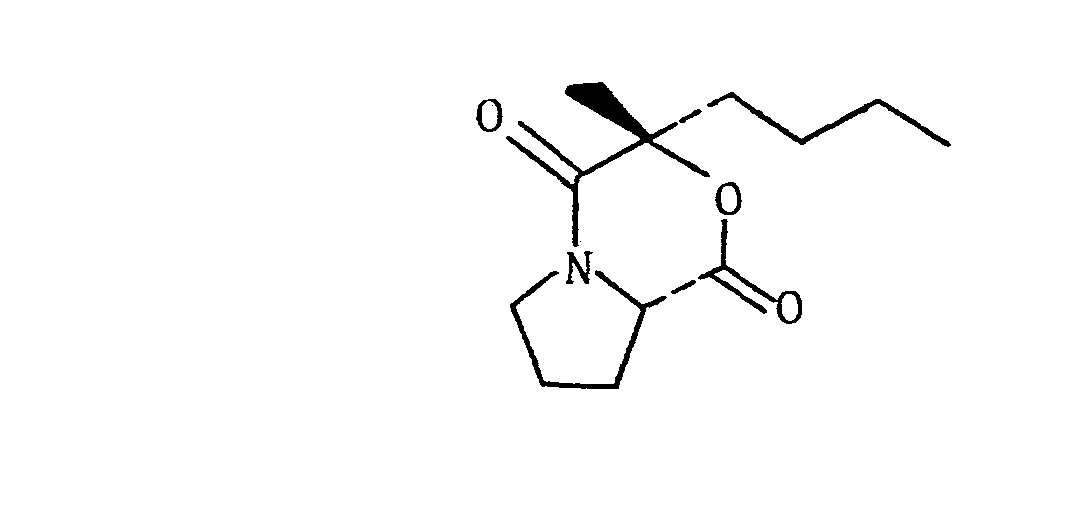
- This oxazine is then hydrolyzed with concentrated hydrobromic acid thereby effecting formation of (+)S-2-hydroxy-2-methyl-hexanoic acid, a valuable intermediate used in the preparation of prostaglandin analogs.
- The method of the present invention provides for the preparation of (+)S-2-hydroxy-2-methyl-hexanoic acid via an asymmetric halolactonization reaction utilizing L-proline as the chiral agent. The reaction scheme for the preparation of (+)S-2-hydroxy-2-methyl-hexanoic acid is depicted in Table 1.
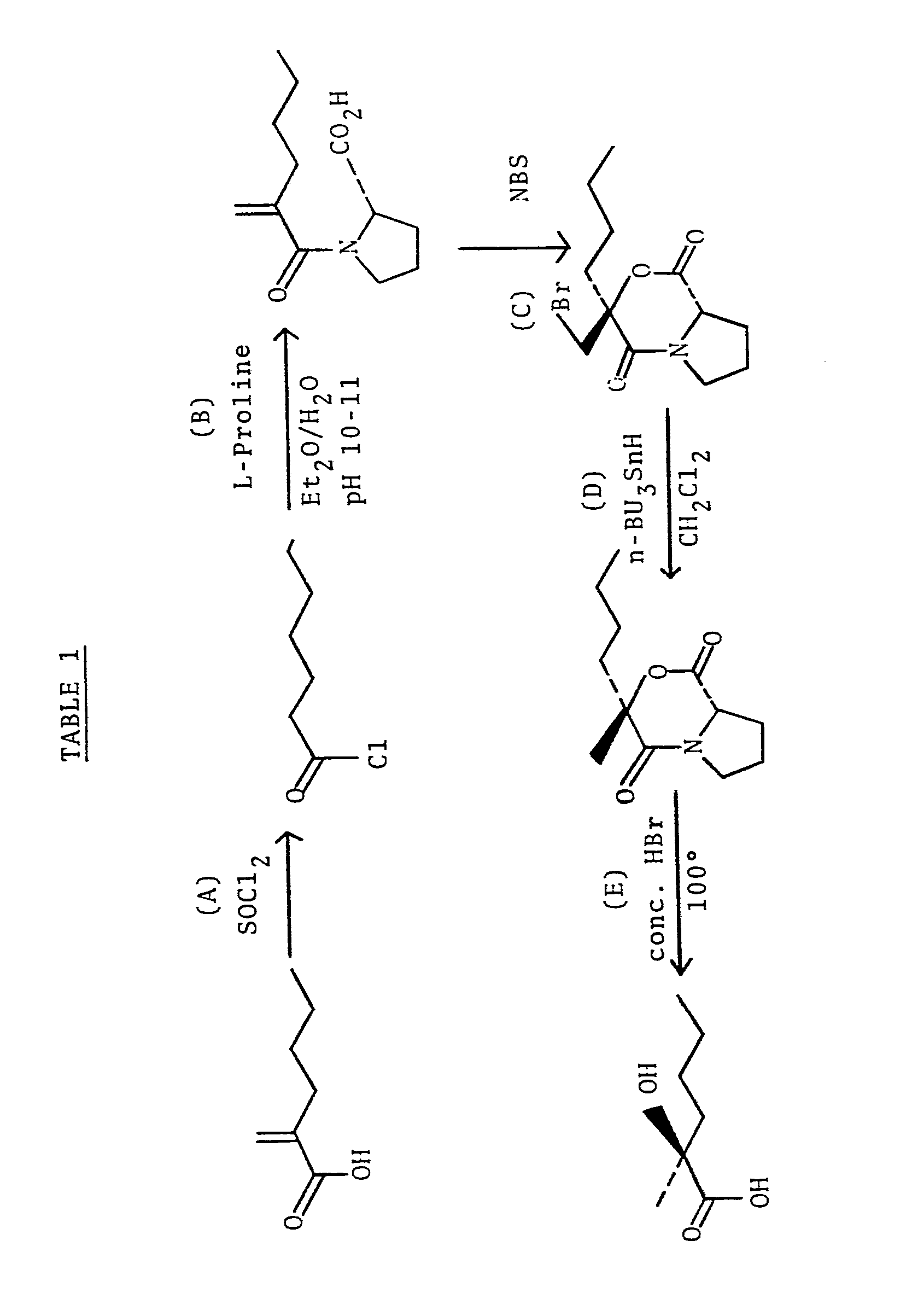
- 2-methylene hexanoic acid is first converted to the respective acid chloride (step A) by the method of Ikakura, Sato and Matsuo, Nippon Kagaku Zasshi, 80, 502 (59); CA 55: 3427g. Said acid chloride is then added to an approximately equivalent amount of L-proline in a mixture of H20 and diethyl ether (step B). The pH of the resulting mixture is maintained at about 10-11 by the addition of concentrated aqueous NaOH. The mixture is stirred at ambient temperature for about 15 minutes to about 2 hours followed by isolation of the resultant amide utilizing conventional extraction techniques. Bromolactonization is then effected (step C) by adding N-bromosuccinimide (NBS) to a solution of said amide in an aprotic polar solvent such as dimethylformamide (DMF) or dimethylsulfoxide (DMSO). The resulting mixture is then stirred at ambient temperature for about 12 to about 36 hours to yield the bromolactone which is then isolated by conventional techniques such as described hereinafter. The bromolactone is then dehalogenated to the corresponding oxazine (step D) by heating a mixture of said bromolactone, tri-n-butyltin hydride, and benzoyl peroxide in methylene chloride at reflux temperature for about 15 to about 36 hours. The oxazine is then readily hydrolyzed (step E) to (+)S-2-hydroxy-2-methyl- hexanoic acid by, for example, heating said oxazine at about 100°-105° C in the presence of concentrated HBr for a time sufficient to effect said hydrolysis (typically from about 15 to about 24 hours).
- The (+)S-2-hydroxy-2-methyl-hexanoic acid prepared by the method of this invention may then be utilized (by following known techniques) in the formation of certain stereospecific prostaglandin analogs, described briefly as follows. Utilizing the procedure of Pappo, et al, cited supra, the (+)S-2-hydroxy-2-methyl-hexanoic acid can be used to prepare the corresponding stereospecific acetylenic alcohol, i.e., 4-methyloct-l-yn-4S-ol. See the reaction sequence shown in Table 2.

- As depicted in Table 2, (+)S-2-hydroxy-2-methyl-hexanoic acid is reduced with lithium aluminum hydride to yield the corresponding diol which is subsequently treated with tosyl chloride in pyridine to form the monotosylate. A three equivalent excess of lithium triethylsilylacetylide (formed in situ) is added to the monotosylate forming an intermediate epoxide which is opened upon treatment with dimethyl sulfoxide. Purification after work-up with potassium fluoride in dimethylformamide renders the desired stereospecific acetylenic alcohol, 4-methyloct-l-yn-4S-ol.
- As taught by Kluender et al, (U.S. Patent No. 4,132,738, cited supra the above acetylenic alcohol is then converted to the corresponding iodovinyl alcohol. The hydroxyl function of the iodovinyl alcohol is protected with an acid-labile hydroxy protecting group (or alternatively, the hydroxyl group of the acetylenic alcohol can be protected prior to conversion of the alcohol to the iodovinyl compound). The hydroxy-protected iodovinyl alcohol is then lithiated with t-butylithium and reacted with a solubilized ligand complex of a copper (I) compound such as (hexamethylphosphoroustriamide)2-copper (I) pentyne to yield the corresponding organolithiocuprate. This organolithiocuprate is then reacted with 4R-(tetrahydropyran-2-yloxy)-2-[7-tetrahvdropyran-2-yloxy)heptyl]-2-cyclopent-2-enone to form the tetrahydropyran-protected form of TR-7134. Said protected form is then hydrolyzed with a weak acid to render TR-7134. Clearly, one skilled in the art will appreciate that other prostaglandin analogs may he prepared using the optically active (+)S-2-hydroxy-2-methyl-hexanoic acid by the procedure described above or other techniques known to the art.
- The following examples are set forth as a means of illustrating the present invention and are not to be construed as a limitation thereon.
- A stirred mixture of 31.5 grams (g) of L-proline, 111.0 g of NaHCO , 510 milliliters (ml) H20 and 210 ml of diethyl ether was maintained in an ambient temperature bath at pH 10.5-10.7 (adjusted by the addition of concentrated aqueous NaOH). To this mixture was added a solution of 44 g of 2-methylene-hexanoyl chloride (prepared by the method of Ikakura et al, supra) in diethyl ether (60 ml) in portions over about 20 minutes while maintaining the pH at 10.5-10.7 after which the mixture was stirred for about 0.5 hour at ambient temperature. The resulting immiscible phases were then separated, and the aqueous phase was extracted with two 200 ml portions of diethyl ether which were combined and then washed with two 100 ml portions of H20. The aqueous extracts were added to the aqueous phase which was then acidified to pH 1 with concentrated aqueous HCl and then extracted with four 200 ml portions of ethyl acetate. The combined ethyl acetate extracts were washed with about 100 ml of brine (saturated aqueous sodium chloride solution) and then dried over MaSO4. The resulting solution was filtered and evaporated in vacuo to render 62.4 g of the title compound (of Example la) as a pale yellow viscous syrup having the following spectral characteristics:
- ir (CHC13) 2950, 1720, 1610, 1445, 1210, 910 cm-1; nmr (CDCl3) δ 9.68 (br, s, 1H), 5.30 (S,1H), 5.24 (S,1H), 4.63 (t,J=7,lH), 3.63 (t,J=6, 2H), 1.70-2.50 (m, 6H), 1.10-1.70 (m, 4H), 0.91 (t, J=7, 3H); C13 nmr (CDCl3) ppm 174.3, 172.2, 145.3, 115.95, 59.2, 49.6, 33.4, 29.7, 28.5, 25.0, 22.4, 13.8; Rf (System II) = 0.308 ("System II" is defined as the organic layer from a mixture of ethyl acetate, acetic acid, isooctane, and water in a ratio of 11:2:5:10, respectively).
- A solution of N-(2-methylene-hexanoyl)-L-proline (39.3 g) in 575 ml of dry dimethylformamide was maintained at ambient temperature protected from light under an inert gas atmosphere. To this was added 62.0 g of N-bromosuccinimide and the resulting solution was stirred for 20 hours after which it was poured into a mixture of saturated aqueous NaHCO3 (2.5 liters) and ethyl acetate (700 ml) and shaken vigorously. The phases were separated and the aqueous phase was extracted with three 500 ml portions of ethyl acetate. The ethyl acetate extracts were combined and then washed with five 250 ml portions of H2O. The H20 extracts were combined and then back-washed with ethyl acetate. The combined ethyl acetate extracts were washed with four 175 ml portions of saturated aqueous Na2S2O3. The combined aqueous Na2S2O3 extracts were back-washed with 100 ml of ethyl acetate and all ethyl acetate extracts were combined and washed with two 250 ml portions of brine and then dried (MgS04). The resulting solution was filtered and the filtrate was evaporated in vacuo to yield a brown syrup which was subsequently taken up in a minimal amount of ethyl acetate and pushed through a 1.5" x 4" silica gel dry column with ethyl acetate. The eluant (about the first 250 ml) was collected and evaporated in vaeuo to give 49.6 g of residue which was crystallized from diethyl ether (50 ml) to give about 22 g of thf title compound (of Example lb) as white needles. The mother liquor from the crystallization was freed of solvent and chromatographed on silica using a 7.5% diethyl ether in CH2Cl2 solvent. The major band (Rf= 0.35; 7.5% Et20 in CH2Cl2) was isolated, evaporated in vacuo and crystallized from diethyl ether to give an additional 10.85 g of the title compound. Two recrystallizations from diethyl ether gave the analytical sample as rods or square prisms, melting point (m.p.) 73.5-74.5° C. The material had the following spectral characteristics:
- ir (CHC13) 2950, 1752, 1665, 1460, 1355 cm-1; nmr (CDC13) 6 4.40-4.70 (m, 1H), 3.87 (d, |JAB|=11.1, 1H) and 3.59 (d, |JAB|=11.1, 1H) [center of pattern: 3.73, ΔvAB= 24.59 Hz], 3.50-3.90 (m, 2H), 2.40-2.70 (m, 1H), 1.70-2.30 (m, 5H), 1.10-1.50 (m, 4H), 0.89 (t, J=6, 3H); C13 nmr (CDC13) ppm 166.4, 163.7, 88.7, 58.0, 45.1, 38.1, 37.7, 30.0, 25.9, 22.4, 21.6, 13.7; [α]D = -134.29 (C = 2.0835 in CHCI3).
- Elemental analysis for C12H18BrNO3: Calculated: C, 47.38; H, 5.96; N, 4.61. Found: C, 47.55; H, 6.21; N, 4.62.
- A solution of 25.8 g of the title compound of Example 1(b) in 700 ml of methylene chloride (prepared and purified by passage through an alumina column) was treated (at ambient temperature) with tri-n-butyltin hydride (35 ml) and benzoyl peroxide (140 mg) and the resulting mixture was then heated at reflux temperature for about 18 hours with simultaneous light irradiation. The mixture was then cooled and the solvent was evaporated under reduced pressure to give 69.9 g of a residue which was chromatographed on a 2" x 19.5" silica gel column eluted with 7.5% diethyl ether in methylene chloride. The major product band (R = 0.25; 7.5% Et20 in CH2Cl2) was isolated and the solvent removed by evaporation in vacuo. The crude product was subsequently crystallized from 60 ml of a mixture of diethyl ether/hexane (1:3) to give 16.42 g of the title compound (of Example lc), as a fine white wool, m.p. 68-69.5° C. The material had the following spectral characteristics:
- ir (CHC13) 2945, 1745, 1665, 1460, 1352, 1045 cm ; nmr (CDC13) δ 4.15-4.40 (m, 1H), 3.50-3.80 (m, 2H), 1.65-2.70 (m, 6H), 1.57 (s, 3H), 1.10-1.50 (m, 4H), 0.90 (t, J=6, 3H); C 13 nmr (CDC13) ppm 168.2, 166.9, 86.5, 57.5, 45.4, 37.8, 29.8, 25.6, 24.1, 22.8, 22.3, 13.9; [α]D = -160.35 (C = 1.2645 in CHC13).
- Elemental analysis for C12H19NO3:
- Calculated: C, 63.97; H. 8.50; N, 6.22. Found: C, 64.03; H, 8.55; N, 6.42.
- A mixture of 14.75 g of the title compound of Example l(c) in 200 ml of 48% aqueous HBr was prepared and heated to about 100-105° C for 19.5 hours and then cooled. The mixture was then poured into 1 liter of brine and was extracted with two 500 ml portions of CH2C12. The CH2Cl2 layers were then combined and washed with 400 ml of H2O (discarding the H2O washings), concentrated in vacuo to about 100 ml and then exhaustively extracted with saturated aqueous NaHCO3. The NaHCO3 extracts were combined and acidified to pH 1 with concentrated aqueous HC1 and subsequently extracted with five 100 ml portions of ethyl acetate. The ethyl acetate extracts were combined and washed with several portions of brine (until the pH was about 4) and then dried over MgSO4, filtered and the filtrate was evaporated to dryness tc give 6.4 g of (+)S-2-hydroxy-2-methyl-hexanoic acid. This material was recrystallized twice from a mixture of diethyl ether/hexane (1:10) to render the title compound having the following characteristics: m.p. = 70.5-72° C; ir (CHCl3) 2950, 1710, 1462, 1272, 1170, 1060 cm-1; nmr (CDCl3) δ 6.84 (v.br.s, 2H), 1.50-1.90 (m, 2H), 1.47 (s, 3H), 1.10-1.50 (m, 4H), 0.90 (t, J=6, 3H); C13 nmr (CDCl3) ppm 181.7, 74.9, 39.9, 25.9, 25.8, 22.8, 13.9; [α]365 = +24.05 (C = 1.537 in H2O (Lit., Pappo et al, supra: [α]365 = +23.4 (H2O).
- While the present invention has described in detail a method for preparing (+)S-2-hydroxy-2-methyl-hexanoic acid it is to be recognized that analagous procedures can be used to prepare other like-substituted alkanoic acids. Accordingly, such procedures are deemed to be contemplated equivalents to the claimed method of the present invention.
Claims (5)


Priority Applications (1)
| Application Number | Priority Date | Filing Date | Title |
|---|---|---|---|
| AT86104583T ATE49193T1 (en) | 1985-04-15 | 1986-04-04 | PROCESS FOR THE PREPARATION OF (+)S-2-HYDROXY-2METHYL-HEXANS|URE. |
Applications Claiming Priority (2)
| Application Number | Priority Date | Filing Date | Title |
|---|---|---|---|
| US72320185A | 1985-04-15 | 1985-04-15 | |
| US723201 | 1985-04-15 |
Publications (3)
| Publication Number | Publication Date |
|---|---|
| EP0198348A2 true EP0198348A2 (en) | 1986-10-22 |
| EP0198348A3 EP0198348A3 (en) | 1988-06-08 |
| EP0198348B1 EP0198348B1 (en) | 1990-01-03 |
Family
ID=24905273
Family Applications (1)
| Application Number | Title | Priority Date | Filing Date |
|---|---|---|---|
| EP86104583A Expired - Lifetime EP0198348B1 (en) | 1985-04-15 | 1986-04-04 | Process for preparing (+)s-2-hydroxy-2-methyl-hexanoic acid |
Country Status (5)
| Country | Link |
|---|---|
| EP (1) | EP0198348B1 (en) |
| JP (1) | JPS61238757A (en) |
| AT (1) | ATE49193T1 (en) |
| CA (1) | CA1249842A (en) |
| DE (1) | DE3667968D1 (en) |
Cited By (17)
| Publication number | Priority date | Publication date | Assignee | Title |
|---|---|---|---|---|
| WO2002079178A1 (en) * | 2001-03-30 | 2002-10-10 | Medigene Aktiengesellschaft | Methods for producing oxirane carboxylic acids and derivatives thereof |
| US7056935B2 (en) | 1995-06-07 | 2006-06-06 | Gpi Nil Holdings, Inc. | Rotamase enzyme activity inhibitors |
| WO2013149022A1 (en) * | 2012-03-30 | 2013-10-03 | Givaudan S.A. | N-acyl proline derivatives as food flavouring compounds |
| WO2015049275A1 (en) * | 2013-10-02 | 2015-04-09 | Givaudan Sa | Purification of n-acyl amino acids by using propylene glycol as extracting solvent |
| US10201175B2 (en) | 2012-03-30 | 2019-02-12 | Givaudan Sa | N-acylated 1-aminocycloalkyl carboxylic acids as food flavouring compounds |
| US10537127B2 (en) | 2013-10-02 | 2020-01-21 | Givaudan S.A. | Organic compounds |
| US10582715B2 (en) | 2012-03-30 | 2020-03-10 | Givaudan Sa | Powder flavour composition |
| US10645955B2 (en) | 2012-03-30 | 2020-05-12 | Givaudan Sa | N-acyl derivatives of gamma amino-butyric acid and beta alanine as food flavouring compounds |
| US10674755B2 (en) | 2013-10-02 | 2020-06-09 | Givaudan S.A. | Organic Compounds |
| US10834951B2 (en) | 2013-10-02 | 2020-11-17 | Givaudan S.A. | Organic compounds |
| US10836712B2 (en) | 2012-03-30 | 2020-11-17 | Givaudan S.A. | Organic compounds |
| US10834950B2 (en) | 2013-10-02 | 2020-11-17 | Givaudan S.A. | Organic compounds |
| US10834943B2 (en) | 2013-10-02 | 2020-11-17 | Givaudan S.A. | Organic compounds having taste-modifying properties |
| US10856563B2 (en) | 2012-03-30 | 2020-12-08 | Givaudan S.A. | N-acyl-amino acid derivatives for improvement of the flavor profile of edible compositions |
| US10913922B2 (en) | 2012-03-30 | 2021-02-09 | Givaudan S.A. | N-acylated methionine derivatives as food flavoring compounds |
| US11122826B2 (en) | 2013-10-02 | 2021-09-21 | Givaudan Sa | Organic compounds |
| US11834393B2 (en) | 2013-10-02 | 2023-12-05 | Givaudan Sa | Organic compounds having taste-modifying properties |
Family Cites Families (1)
| Publication number | Priority date | Publication date | Assignee | Title |
|---|---|---|---|---|
| JPS53108922A (en) * | 1977-03-04 | 1978-09-22 | Sumitomo Chem Co Ltd | Novel synthesis of opticallactive hydroxyacid |
-
1986
- 1986-03-24 CA CA000504794A patent/CA1249842A/en not_active Expired
- 1986-04-04 AT AT86104583T patent/ATE49193T1/en not_active IP Right Cessation
- 1986-04-04 DE DE8686104583T patent/DE3667968D1/en not_active Expired - Fee Related
- 1986-04-04 EP EP86104583A patent/EP0198348B1/en not_active Expired - Lifetime
- 1986-04-14 JP JP61084436A patent/JPS61238757A/en active Pending
Cited By (24)
| Publication number | Priority date | Publication date | Assignee | Title |
|---|---|---|---|---|
| US7056935B2 (en) | 1995-06-07 | 2006-06-06 | Gpi Nil Holdings, Inc. | Rotamase enzyme activity inhibitors |
| WO2002079178A1 (en) * | 2001-03-30 | 2002-10-10 | Medigene Aktiengesellschaft | Methods for producing oxirane carboxylic acids and derivatives thereof |
| US11091429B2 (en) | 2012-03-30 | 2021-08-17 | Givaudan Sa | Organic compounds |
| WO2013149022A1 (en) * | 2012-03-30 | 2013-10-03 | Givaudan S.A. | N-acyl proline derivatives as food flavouring compounds |
| US11832638B2 (en) | 2012-03-30 | 2023-12-05 | Givaudan Sa | N-acyl derivatives of gamma amino-butyric acid and beta alanine as food flavouring compounds |
| US10201175B2 (en) | 2012-03-30 | 2019-02-12 | Givaudan Sa | N-acylated 1-aminocycloalkyl carboxylic acids as food flavouring compounds |
| US11524933B2 (en) | 2012-03-30 | 2022-12-13 | Givaudan Sa | In or relating to organic compounds |
| US10582715B2 (en) | 2012-03-30 | 2020-03-10 | Givaudan Sa | Powder flavour composition |
| US10645955B2 (en) | 2012-03-30 | 2020-05-12 | Givaudan Sa | N-acyl derivatives of gamma amino-butyric acid and beta alanine as food flavouring compounds |
| US11492326B2 (en) | 2012-03-30 | 2022-11-08 | Givaudan Sa | Organic compounds |
| US10711230B2 (en) | 2012-03-30 | 2020-07-14 | Givaudan Sa | N-acyl proline derivatives as food flavoring compounds |
| US10836712B2 (en) | 2012-03-30 | 2020-11-17 | Givaudan S.A. | Organic compounds |
| US10913922B2 (en) | 2012-03-30 | 2021-02-09 | Givaudan S.A. | N-acylated methionine derivatives as food flavoring compounds |
| US10856563B2 (en) | 2012-03-30 | 2020-12-08 | Givaudan S.A. | N-acyl-amino acid derivatives for improvement of the flavor profile of edible compositions |
| US10834951B2 (en) | 2013-10-02 | 2020-11-17 | Givaudan S.A. | Organic compounds |
| US10834950B2 (en) | 2013-10-02 | 2020-11-17 | Givaudan S.A. | Organic compounds |
| WO2015049275A1 (en) * | 2013-10-02 | 2015-04-09 | Givaudan Sa | Purification of n-acyl amino acids by using propylene glycol as extracting solvent |
| US10975018B2 (en) | 2013-10-02 | 2021-04-13 | Givaudan Sa | Organic compounds |
| US10834943B2 (en) | 2013-10-02 | 2020-11-17 | Givaudan S.A. | Organic compounds having taste-modifying properties |
| US11122826B2 (en) | 2013-10-02 | 2021-09-21 | Givaudan Sa | Organic compounds |
| US10674755B2 (en) | 2013-10-02 | 2020-06-09 | Givaudan S.A. | Organic Compounds |
| US10537127B2 (en) | 2013-10-02 | 2020-01-21 | Givaudan S.A. | Organic compounds |
| CN105658086A (en) * | 2013-10-02 | 2016-06-08 | 奇华顿股份有限公司 | Method for purifying N-acyl amino acids by using propylene glycol as extraction solvent |
| US11834393B2 (en) | 2013-10-02 | 2023-12-05 | Givaudan Sa | Organic compounds having taste-modifying properties |
Also Published As
| Publication number | Publication date |
|---|---|
| JPS61238757A (en) | 1986-10-24 |
| EP0198348B1 (en) | 1990-01-03 |
| CA1249842A (en) | 1989-02-07 |
| ATE49193T1 (en) | 1990-01-15 |
| EP0198348A3 (en) | 1988-06-08 |
| DE3667968D1 (en) | 1990-02-08 |
Similar Documents
| Publication | Publication Date | Title |
|---|---|---|
| EP0198348B1 (en) | Process for preparing (+)s-2-hydroxy-2-methyl-hexanoic acid | |
| Bartlett et al. | Carbonate extension. A versatile procedure for functionalization of acyclic homoallylic alcohols with moderate stereocontrol | |
| Fray et al. | A short, stereoselective synthesis of the lactone precursor to 2R, 4S, 5S hydroxyethylene dipeptide isosteres | |
| DE69204627T2 (en) | Prostaglandins. | |
| US4633025A (en) | Method for preparing (+)R-2-methyl-hexane-1,2-diol | |
| DE69709742T2 (en) | ASYMMETRIC SYNTHESIS OF CHIRAL BETA AMINO ACIDS | |
| JP2691442B2 (en) | Novel proline derivative | |
| EP0044158B1 (en) | Novel optically active imidazolidin-2-one derivatives and their production | |
| DE69915110T2 (en) | PROCESS FOR THE PRODUCTION OF ARYLETHERS | |
| US4668822A (en) | Method for preparing (+)S-2--hydroxy-2-methyl-hexanoic acid | |
| DE69007245T2 (en) | Aminobutanol derivatives and process for the preparation of 3-pyrrolidinol from them. | |
| CH639953A5 (en) | Process for the preparation of novel indolyloxymethyl-2-oxazolidinone derivatives and use thereof for the preparation of 1-amino-3-(indolyloxy)-2-propanol derivatives | |
| KR0144684B1 (en) | Mono esters of dicarboxylic acids and their prepartion and use | |
| Knapp et al. | Synthesis of (-)-fortamine and (+)-2-deoxyfortamine from resolved 3S, 4S-N-carbomethoxy-3-aminocyclohexen-4-ol | |
| US4133817A (en) | 11-Oxa-prostaglandin analogs | |
| GB2036744A (en) | Eburnane derivatives | |
| EP0089037B1 (en) | Process for preparing optically active (s)-2-acetyl-7-(2-hydroxy-3-isopropylaminopropoxy)benzofuran and salts thereof | |
| US4170596A (en) | Novel monoesters of cis-cyclopentenediol, process for preparation thereof, and process for preparation of lactones from the monoesters | |
| AU611403B2 (en) | New process for manufacturing optically active carbocycline intermediates | |
| US4217284A (en) | Process for preparation of optically pure lactones from monoesters of cis-cyclopentenediol | |
| US6265209B1 (en) | Intermediates and improved processes for the preparation of neplanocin A | |
| US6177457B1 (en) | Process for the preparation of indacene compound | |
| JPS638091B2 (en) | ||
| JPH0611735B2 (en) | Process for producing optically active β-alkyl-γ-acyloxycarboxylic acid ester | |
| JP3143809B2 (en) | Method for producing hydroxylactone compound |
Legal Events
| Date | Code | Title | Description |
|---|---|---|---|
| PUAI | Public reference made under article 153(3) epc to a published international application that has entered the european phase |
Free format text: ORIGINAL CODE: 0009012 |
|
| 17P | Request for examination filed |
Effective date: 19860404 |
|
| AK | Designated contracting states |
Kind code of ref document: A2 Designated state(s): AT BE CH DE FR GB IT LI LU NL SE |
|
| RAP1 | Party data changed (applicant data changed or rights of an application transferred) |
Owner name: MILES LABORATORIES, INC. |
|
| PUAL | Search report despatched |
Free format text: ORIGINAL CODE: 0009013 |
|
| AK | Designated contracting states |
Kind code of ref document: A3 Designated state(s): AT BE CH DE FR GB IT LI LU NL SE |
|
| RAP1 | Party data changed (applicant data changed or rights of an application transferred) |
Owner name: MILES INC. |
|
| 17Q | First examination report despatched |
Effective date: 19890403 |
|
| GRAA | (expected) grant |
Free format text: ORIGINAL CODE: 0009210 |
|
| AK | Designated contracting states |
Kind code of ref document: B1 Designated state(s): AT BE CH DE FR GB IT LI LU NL SE |
|
| REF | Corresponds to: |
Ref document number: 49193 Country of ref document: AT Date of ref document: 19900115 Kind code of ref document: T |
|
| ITF | It: translation for a ep patent filed | ||
| ET | Fr: translation filed | ||
| REF | Corresponds to: |
Ref document number: 3667968 Country of ref document: DE Date of ref document: 19900208 |
|
| PLBE | No opposition filed within time limit |
Free format text: ORIGINAL CODE: 0009261 |
|
| STAA | Information on the status of an ep patent application or granted ep patent |
Free format text: STATUS: NO OPPOSITION FILED WITHIN TIME LIMIT |
|
| 26N | No opposition filed | ||
| ITTA | It: last paid annual fee | ||
| PGFP | Annual fee paid to national office [announced via postgrant information from national office to epo] |
Ref country code: SE Payment date: 19920327 Year of fee payment: 7 Ref country code: GB Payment date: 19920327 Year of fee payment: 7 Ref country code: FR Payment date: 19920327 Year of fee payment: 7 Ref country code: DE Payment date: 19920327 Year of fee payment: 7 |
|
| PGFP | Annual fee paid to national office [announced via postgrant information from national office to epo] |
Ref country code: AT Payment date: 19920330 Year of fee payment: 7 |
|
| PGFP | Annual fee paid to national office [announced via postgrant information from national office to epo] |
Ref country code: BE Payment date: 19920423 Year of fee payment: 7 |
|
| PGFP | Annual fee paid to national office [announced via postgrant information from national office to epo] |
Ref country code: NL Payment date: 19920430 Year of fee payment: 7 |
|
| PGFP | Annual fee paid to national office [announced via postgrant information from national office to epo] |
Ref country code: LU Payment date: 19920507 Year of fee payment: 7 |
|
| PGFP | Annual fee paid to national office [announced via postgrant information from national office to epo] |
Ref country code: CH Payment date: 19920513 Year of fee payment: 7 |
|
| EPTA | Lu: last paid annual fee | ||
| PG25 | Lapsed in a contracting state [announced via postgrant information from national office to epo] |
Ref country code: LU Free format text: LAPSE BECAUSE OF NON-PAYMENT OF DUE FEES Effective date: 19930404 Ref country code: GB Effective date: 19930404 Ref country code: AT Effective date: 19930404 |
|
| PG25 | Lapsed in a contracting state [announced via postgrant information from national office to epo] |
Ref country code: SE Effective date: 19930405 |
|
| PG25 | Lapsed in a contracting state [announced via postgrant information from national office to epo] |
Ref country code: LI Effective date: 19930430 Ref country code: CH Effective date: 19930430 Ref country code: BE Effective date: 19930430 |
|
| BERE | Be: lapsed |
Owner name: MILES INC. Effective date: 19930430 |
|
| PG25 | Lapsed in a contracting state [announced via postgrant information from national office to epo] |
Ref country code: NL Effective date: 19931101 |
|
| GBPC | Gb: european patent ceased through non-payment of renewal fee |
Effective date: 19930404 |
|
| NLV4 | Nl: lapsed or anulled due to non-payment of the annual fee | ||
| PG25 | Lapsed in a contracting state [announced via postgrant information from national office to epo] |
Ref country code: FR Effective date: 19931229 |
|
| REG | Reference to a national code |
Ref country code: CH Ref legal event code: PL |
|
| PG25 | Lapsed in a contracting state [announced via postgrant information from national office to epo] |
Ref country code: DE Effective date: 19940101 |
|
| REG | Reference to a national code |
Ref country code: FR Ref legal event code: ST |
|
| EUG | Se: european patent has lapsed |
Ref document number: 86104583.9 Effective date: 19931110 |
|
| PG25 | Lapsed in a contracting state [announced via postgrant information from national office to epo] |
Ref country code: IT Free format text: LAPSE BECAUSE OF NON-PAYMENT OF DUE FEES;WARNING: LAPSES OF ITALIAN PATENTS WITH EFFECTIVE DATE BEFORE 2007 MAY HAVE OCCURRED AT ANY TIME BEFORE 2007. THE CORRECT EFFECTIVE DATE MAY BE DIFFERENT FROM THE ONE RECORDED. Effective date: 20050404 |