EP0195691B1 - Process for the preparation of insulin precursors and process for the preparation of human insulin - Google Patents
Process for the preparation of insulin precursors and process for the preparation of human insulin Download PDFInfo
- Publication number
- EP0195691B1 EP0195691B1 EP86302133A EP86302133A EP0195691B1 EP 0195691 B1 EP0195691 B1 EP 0195691B1 EP 86302133 A EP86302133 A EP 86302133A EP 86302133 A EP86302133 A EP 86302133A EP 0195691 B1 EP0195691 B1 EP 0195691B1
- Authority
- EP
- European Patent Office
- Prior art keywords
- insulin
- human insulin
- lys
- yeast
- arg
- Prior art date
- Legal status (The legal status is an assumption and is not a legal conclusion. Google has not performed a legal analysis and makes no representation as to the accuracy of the status listed.)
- Expired - Lifetime
Links
- NOESYZHRGYRDHS-UHFFFAOYSA-N insulin Chemical compound N1C(=O)C(NC(=O)C(CCC(N)=O)NC(=O)C(CCC(O)=O)NC(=O)C(C(C)C)NC(=O)C(NC(=O)CN)C(C)CC)CSSCC(C(NC(CO)C(=O)NC(CC(C)C)C(=O)NC(CC=2C=CC(O)=CC=2)C(=O)NC(CCC(N)=O)C(=O)NC(CC(C)C)C(=O)NC(CCC(O)=O)C(=O)NC(CC(N)=O)C(=O)NC(CC=2C=CC(O)=CC=2)C(=O)NC(CSSCC(NC(=O)C(C(C)C)NC(=O)C(CC(C)C)NC(=O)C(CC=2C=CC(O)=CC=2)NC(=O)C(CC(C)C)NC(=O)C(C)NC(=O)C(CCC(O)=O)NC(=O)C(C(C)C)NC(=O)C(CC(C)C)NC(=O)C(CC=2NC=NC=2)NC(=O)C(CO)NC(=O)CNC2=O)C(=O)NCC(=O)NC(CCC(O)=O)C(=O)NC(CCCNC(N)=N)C(=O)NCC(=O)NC(CC=3C=CC=CC=3)C(=O)NC(CC=3C=CC=CC=3)C(=O)NC(CC=3C=CC(O)=CC=3)C(=O)NC(C(C)O)C(=O)N3C(CCC3)C(=O)NC(CCCCN)C(=O)NC(C)C(O)=O)C(=O)NC(CC(N)=O)C(O)=O)=O)NC(=O)C(C(C)CC)NC(=O)C(CO)NC(=O)C(C(C)O)NC(=O)C1CSSCC2NC(=O)C(CC(C)C)NC(=O)C(NC(=O)C(CCC(N)=O)NC(=O)C(CC(N)=O)NC(=O)C(NC(=O)C(N)CC=1C=CC=CC=1)C(C)C)CC1=CN=CN1 NOESYZHRGYRDHS-UHFFFAOYSA-N 0.000 title claims abstract description 124
- 239000002243 precursor Substances 0.000 title claims abstract description 73
- 101000976075 Homo sapiens Insulin Proteins 0.000 title claims abstract description 69
- PBGKTOXHQIOBKM-FHFVDXKLSA-N insulin (human) Chemical compound C([C@@H](C(=O)N[C@@H](CC(C)C)C(=O)N[C@H]1CSSC[C@H]2C(=O)N[C@H](C(=O)N[C@@H](CO)C(=O)N[C@H](C(=O)N[C@H](C(N[C@@H](CO)C(=O)N[C@@H](CC(C)C)C(=O)N[C@@H](CC=3C=CC(O)=CC=3)C(=O)N[C@@H](CCC(N)=O)C(=O)N[C@@H](CC(C)C)C(=O)N[C@@H](CCC(O)=O)C(=O)N[C@@H](CC(N)=O)C(=O)N[C@@H](CC=3C=CC(O)=CC=3)C(=O)N[C@@H](CSSC[C@H](NC(=O)[C@H](C(C)C)NC(=O)[C@H](CC(C)C)NC(=O)[C@H](CC=3C=CC(O)=CC=3)NC(=O)[C@H](CC(C)C)NC(=O)[C@H](C)NC(=O)[C@H](CCC(O)=O)NC(=O)[C@H](C(C)C)NC(=O)[C@H](CC(C)C)NC(=O)[C@H](CC=3NC=NC=3)NC(=O)[C@H](CO)NC(=O)CNC1=O)C(=O)NCC(=O)N[C@@H](CCC(O)=O)C(=O)N[C@@H](CCCNC(N)=N)C(=O)NCC(=O)N[C@@H](CC=1C=CC=CC=1)C(=O)N[C@@H](CC=1C=CC=CC=1)C(=O)N[C@@H](CC=1C=CC(O)=CC=1)C(=O)N[C@@H]([C@@H](C)O)C(=O)N1[C@@H](CCC1)C(=O)N[C@@H](CCCCN)C(=O)N[C@@H]([C@@H](C)O)C(O)=O)C(=O)N[C@@H](CC(N)=O)C(O)=O)=O)CSSC[C@@H](C(N2)=O)NC(=O)[C@H](CCC(N)=O)NC(=O)[C@H](CCC(O)=O)NC(=O)[C@H](C(C)C)NC(=O)[C@@H](NC(=O)CN)[C@@H](C)CC)[C@@H](C)CC)[C@@H](C)O)NC(=O)[C@H](CCC(N)=O)NC(=O)[C@H](CC(N)=O)NC(=O)[C@@H](NC(=O)[C@@H](N)CC=1C=CC=CC=1)C(C)C)C1=CN=CN1 PBGKTOXHQIOBKM-FHFVDXKLSA-N 0.000 title claims abstract description 69
- 229940125396 insulin Drugs 0.000 title claims abstract description 64
- 108090001061 Insulin Proteins 0.000 title claims abstract description 60
- 102000004877 Insulin Human genes 0.000 title claims abstract description 60
- 238000000034 method Methods 0.000 title claims description 42
- 230000008569 process Effects 0.000 title description 14
- 238000002360 preparation method Methods 0.000 title description 13
- 240000004808 Saccharomyces cerevisiae Species 0.000 claims abstract description 59
- 108091028043 Nucleic acid sequence Proteins 0.000 claims abstract description 19
- 239000001963 growth medium Substances 0.000 claims abstract description 11
- KDXKERNSBIXSRK-UHFFFAOYSA-N Lysine Natural products NCCCCC(N)C(O)=O KDXKERNSBIXSRK-UHFFFAOYSA-N 0.000 claims abstract description 10
- 239000004472 Lysine Substances 0.000 claims abstract description 7
- 230000002255 enzymatic effect Effects 0.000 claims abstract description 7
- 239000004475 Arginine Substances 0.000 claims abstract 5
- ODKSFYDXXFIFQN-UHFFFAOYSA-N arginine Natural products OC(=O)C(N)CCCNC(N)=N ODKSFYDXXFIFQN-UHFFFAOYSA-N 0.000 claims abstract 5
- 102000004142 Trypsin Human genes 0.000 claims description 21
- 108090000631 Trypsin Proteins 0.000 claims description 21
- 239000012588 trypsin Substances 0.000 claims description 21
- 102000003670 Carboxypeptidase B Human genes 0.000 claims description 17
- 108090000087 Carboxypeptidase B Proteins 0.000 claims description 17
- 102000004190 Enzymes Human genes 0.000 claims description 5
- 108090000790 Enzymes Proteins 0.000 claims description 5
- 238000004519 manufacturing process Methods 0.000 claims description 4
- 239000000243 solution Substances 0.000 claims description 4
- 239000007864 aqueous solution Substances 0.000 claims description 3
- 239000007795 chemical reaction product Substances 0.000 claims 1
- 230000009977 dual effect Effects 0.000 claims 1
- 238000012258 culturing Methods 0.000 abstract 1
- 238000011084 recovery Methods 0.000 abstract 1
- 235000014680 Saccharomyces cerevisiae Nutrition 0.000 description 54
- 239000013612 plasmid Substances 0.000 description 42
- 239000012634 fragment Substances 0.000 description 29
- 238000006243 chemical reaction Methods 0.000 description 26
- 108010076181 Proinsulin Proteins 0.000 description 24
- 238000010276 construction Methods 0.000 description 22
- 108090000623 proteins and genes Proteins 0.000 description 22
- LFQSCWFLJHTTHZ-UHFFFAOYSA-N Ethanol Chemical compound CCO LFQSCWFLJHTTHZ-UHFFFAOYSA-N 0.000 description 21
- 239000000203 mixture Substances 0.000 description 21
- 239000000047 product Substances 0.000 description 21
- 108090000765 processed proteins & peptides Proteins 0.000 description 18
- VOUAQYXWVJDEQY-QENPJCQMSA-N 33017-11-7 Chemical compound OC(=O)CC[C@H](N)C(=O)N[C@@H](C)C(=O)N[C@@H](CCC(O)=O)C(=O)N[C@@H](CC(O)=O)C(=O)N[C@@H](CC(C)C)C(=O)N[C@@H](CCC(N)=O)C(=O)N[C@@H](C(C)C)C(=O)NCC(=O)N[C@@H](CCC(N)=O)C(=O)N[C@@H](C(C)C)C(=O)N[C@@H](CCC(O)=O)C(=O)N[C@@H](CC(C)C)C(=O)NCC(=O)NCC(=O)NCC(=O)N1CCC[C@H]1C(=O)NCC(=O)N[C@@H](C)C(=O)NCC(=O)N[C@@H](CO)C(=O)N[C@@H](CC(C)C)C(=O)N[C@@H](CCC(N)=O)C(=O)N1[C@H](C(=O)N[C@@H](CC(C)C)C(=O)N[C@@H](C)C(=O)N[C@@H](CC(C)C)C(=O)N[C@@H](CCC(O)=O)C(=O)NCC(=O)N[C@@H](CO)C(=O)N[C@@H](CC(C)C)C(=O)N[C@@H](CCC(N)=O)C(O)=O)CCC1 VOUAQYXWVJDEQY-QENPJCQMSA-N 0.000 description 15
- WEVYAHXRMPXWCK-UHFFFAOYSA-N Acetonitrile Chemical compound CC#N WEVYAHXRMPXWCK-UHFFFAOYSA-N 0.000 description 15
- 108700015934 Triose-phosphate isomerases Proteins 0.000 description 12
- 238000003776 cleavage reaction Methods 0.000 description 12
- 238000000338 in vitro Methods 0.000 description 12
- 230000007017 scission Effects 0.000 description 12
- 108010075254 C-Peptide Proteins 0.000 description 11
- 241000588724 Escherichia coli Species 0.000 description 11
- 239000000872 buffer Substances 0.000 description 11
- 230000029087 digestion Effects 0.000 description 11
- 102000005924 Triose-Phosphate Isomerase Human genes 0.000 description 10
- 102000004196 processed proteins & peptides Human genes 0.000 description 10
- 230000009466 transformation Effects 0.000 description 10
- 150000001413 amino acids Chemical class 0.000 description 9
- 238000012217 deletion Methods 0.000 description 9
- 230000037430 deletion Effects 0.000 description 9
- FBPFZTCFMRRESA-FSIIMWSLSA-N D-Glucitol Natural products OC[C@H](O)[C@H](O)[C@@H](O)[C@H](O)CO FBPFZTCFMRRESA-FSIIMWSLSA-N 0.000 description 8
- 210000004027 cell Anatomy 0.000 description 8
- 239000000463 material Substances 0.000 description 8
- 239000000600 sorbitol Substances 0.000 description 8
- 108020004414 DNA Proteins 0.000 description 7
- 125000000539 amino acid group Chemical group 0.000 description 7
- 238000000746 purification Methods 0.000 description 7
- 230000028327 secretion Effects 0.000 description 7
- HEMHJVSKTPXQMS-UHFFFAOYSA-M Sodium hydroxide Chemical compound [OH-].[Na+] HEMHJVSKTPXQMS-UHFFFAOYSA-M 0.000 description 6
- 238000004128 high performance liquid chromatography Methods 0.000 description 6
- 101150033985 TPI gene Proteins 0.000 description 5
- 238000004458 analytical method Methods 0.000 description 5
- 239000007853 buffer solution Substances 0.000 description 5
- 238000005119 centrifugation Methods 0.000 description 5
- 238000012512 characterization method Methods 0.000 description 5
- 238000012545 processing Methods 0.000 description 5
- QKNYBSVHEMOAJP-UHFFFAOYSA-N 2-amino-2-(hydroxymethyl)propane-1,3-diol;hydron;chloride Chemical compound Cl.OCC(N)(CO)CO QKNYBSVHEMOAJP-UHFFFAOYSA-N 0.000 description 4
- 101000617808 Homo sapiens Synphilin-1 Proteins 0.000 description 4
- NPBGTPKLVJEOBE-IUCAKERBSA-N Lys-Arg Chemical compound NCCCC[C@H](N)C(=O)N[C@H](C(O)=O)CCCNC(N)=N NPBGTPKLVJEOBE-IUCAKERBSA-N 0.000 description 4
- ISWSIDIOOBJBQZ-UHFFFAOYSA-N Phenol Chemical compound OC1=CC=CC=C1 ISWSIDIOOBJBQZ-UHFFFAOYSA-N 0.000 description 4
- 102100021997 Synphilin-1 Human genes 0.000 description 4
- 239000007983 Tris buffer Substances 0.000 description 4
- IXKSXJFAGXLQOQ-XISFHERQSA-N WHWLQLKPGQPMY Chemical compound C([C@@H](C(=O)N[C@@H](CC=1C2=CC=CC=C2NC=1)C(=O)N[C@@H](CC(C)C)C(=O)N[C@@H](CCC(N)=O)C(=O)N[C@@H](CC(C)C)C(=O)N1CCC[C@H]1C(=O)NCC(=O)N[C@@H](CCC(N)=O)C(=O)N[C@@H](CC(O)=O)C(=O)N1CCC[C@H]1C(=O)N[C@@H](CCSC)C(=O)N[C@@H](CC=1C=CC(O)=CC=1)C(O)=O)NC(=O)[C@@H](N)CC=1C2=CC=CC=C2NC=1)C1=CNC=N1 IXKSXJFAGXLQOQ-XISFHERQSA-N 0.000 description 4
- 229940088598 enzyme Drugs 0.000 description 4
- 239000002609 medium Substances 0.000 description 4
- 229920001184 polypeptide Polymers 0.000 description 4
- 108010066381 preproinsulin Proteins 0.000 description 4
- 239000011541 reaction mixture Substances 0.000 description 4
- 238000002741 site-directed mutagenesis Methods 0.000 description 4
- 239000000725 suspension Substances 0.000 description 4
- LENZDBCJOHFCAS-UHFFFAOYSA-N tris Chemical compound OCC(N)(CO)CO LENZDBCJOHFCAS-UHFFFAOYSA-N 0.000 description 4
- 238000011144 upstream manufacturing Methods 0.000 description 4
- JKMHFZQWWAIEOD-UHFFFAOYSA-N 2-[4-(2-hydroxyethyl)piperazin-1-yl]ethanesulfonic acid Chemical compound OCC[NH+]1CCN(CCS([O-])(=O)=O)CC1 JKMHFZQWWAIEOD-UHFFFAOYSA-N 0.000 description 3
- QTBSBXVTEAMEQO-UHFFFAOYSA-N Acetic acid Chemical compound CC(O)=O QTBSBXVTEAMEQO-UHFFFAOYSA-N 0.000 description 3
- UXVMQQNJUSDDNG-UHFFFAOYSA-L Calcium chloride Chemical compound [Cl-].[Cl-].[Ca+2] UXVMQQNJUSDDNG-UHFFFAOYSA-L 0.000 description 3
- 102000053602 DNA Human genes 0.000 description 3
- 108700007698 Genetic Terminator Regions Proteins 0.000 description 3
- WQZGKKKJIJFFOK-GASJEMHNSA-N Glucose Natural products OC[C@H]1OC(O)[C@H](O)[C@@H](O)[C@@H]1O WQZGKKKJIJFFOK-GASJEMHNSA-N 0.000 description 3
- 239000007995 HEPES buffer Substances 0.000 description 3
- ROHFNLRQFUQHCH-YFKPBYRVSA-N L-leucine Chemical compound CC(C)C[C@H](N)C(O)=O ROHFNLRQFUQHCH-YFKPBYRVSA-N 0.000 description 3
- 102000003960 Ligases Human genes 0.000 description 3
- 108090000364 Ligases Proteins 0.000 description 3
- 108010076504 Protein Sorting Signals Proteins 0.000 description 3
- QAOWNCQODCNURD-UHFFFAOYSA-N Sulfuric acid Chemical compound OS(O)(=O)=O QAOWNCQODCNURD-UHFFFAOYSA-N 0.000 description 3
- 235000012538 ammonium bicarbonate Nutrition 0.000 description 3
- 230000015572 biosynthetic process Effects 0.000 description 3
- 239000001110 calcium chloride Substances 0.000 description 3
- 229910001628 calcium chloride Inorganic materials 0.000 description 3
- 235000011148 calcium chloride Nutrition 0.000 description 3
- 239000002299 complementary DNA Substances 0.000 description 3
- 238000002425 crystallisation Methods 0.000 description 3
- 230000008025 crystallization Effects 0.000 description 3
- 238000000855 fermentation Methods 0.000 description 3
- 230000004151 fermentation Effects 0.000 description 3
- 239000008103 glucose Substances 0.000 description 3
- 230000007062 hydrolysis Effects 0.000 description 3
- 238000006460 hydrolysis reaction Methods 0.000 description 3
- 239000002933 immunoreactive insulin Substances 0.000 description 3
- 238000011534 incubation Methods 0.000 description 3
- 238000002703 mutagenesis Methods 0.000 description 3
- 231100000350 mutagenesis Toxicity 0.000 description 3
- 238000003127 radioimmunoassay Methods 0.000 description 3
- 230000010076 replication Effects 0.000 description 3
- 235000011149 sulphuric acid Nutrition 0.000 description 3
- 239000006228 supernatant Substances 0.000 description 3
- 239000013598 vector Substances 0.000 description 3
- XLYOFNOQVPJJNP-UHFFFAOYSA-N water Substances O XLYOFNOQVPJJNP-UHFFFAOYSA-N 0.000 description 3
- 229920001817 Agar Polymers 0.000 description 2
- 101001047514 Bos taurus Lethal(2) giant larvae protein homolog 1 Proteins 0.000 description 2
- 102000000496 Carboxypeptidases A Human genes 0.000 description 2
- 108010080937 Carboxypeptidases A Proteins 0.000 description 2
- ZGTMUACCHSMWAC-UHFFFAOYSA-L EDTA disodium salt (anhydrous) Chemical compound [Na+].[Na+].OC(=O)CN(CC([O-])=O)CCN(CC(O)=O)CC([O-])=O ZGTMUACCHSMWAC-UHFFFAOYSA-L 0.000 description 2
- 241001524679 Escherichia virus M13 Species 0.000 description 2
- 241000206602 Eukaryota Species 0.000 description 2
- JVTAAEKCZFNVCJ-UHFFFAOYSA-M Lactate Chemical compound CC(O)C([O-])=O JVTAAEKCZFNVCJ-UHFFFAOYSA-M 0.000 description 2
- ROHFNLRQFUQHCH-UHFFFAOYSA-N Leucine Natural products CC(C)CC(N)C(O)=O ROHFNLRQFUQHCH-UHFFFAOYSA-N 0.000 description 2
- 108091034117 Oligonucleotide Proteins 0.000 description 2
- 229920005654 Sephadex Polymers 0.000 description 2
- 239000012507 Sephadex™ Substances 0.000 description 2
- VYPSYNLAJGMNEJ-UHFFFAOYSA-N Silicium dioxide Chemical class O=[Si]=O VYPSYNLAJGMNEJ-UHFFFAOYSA-N 0.000 description 2
- FAPWRFPIFSIZLT-UHFFFAOYSA-M Sodium chloride Chemical compound [Na+].[Cl-] FAPWRFPIFSIZLT-UHFFFAOYSA-M 0.000 description 2
- XSQUKJJJFZCRTK-UHFFFAOYSA-N Urea Chemical compound NC(N)=O XSQUKJJJFZCRTK-UHFFFAOYSA-N 0.000 description 2
- JLCPHMBAVCMARE-UHFFFAOYSA-N [3-[[3-[[3-[[3-[[3-[[3-[[3-[[3-[[3-[[3-[[3-[[5-(2-amino-6-oxo-1H-purin-9-yl)-3-[[3-[[3-[[3-[[3-[[3-[[5-(2-amino-6-oxo-1H-purin-9-yl)-3-[[5-(2-amino-6-oxo-1H-purin-9-yl)-3-hydroxyoxolan-2-yl]methoxy-hydroxyphosphoryl]oxyoxolan-2-yl]methoxy-hydroxyphosphoryl]oxy-5-(5-methyl-2,4-dioxopyrimidin-1-yl)oxolan-2-yl]methoxy-hydroxyphosphoryl]oxy-5-(6-aminopurin-9-yl)oxolan-2-yl]methoxy-hydroxyphosphoryl]oxy-5-(6-aminopurin-9-yl)oxolan-2-yl]methoxy-hydroxyphosphoryl]oxy-5-(6-aminopurin-9-yl)oxolan-2-yl]methoxy-hydroxyphosphoryl]oxy-5-(6-aminopurin-9-yl)oxolan-2-yl]methoxy-hydroxyphosphoryl]oxyoxolan-2-yl]methoxy-hydroxyphosphoryl]oxy-5-(5-methyl-2,4-dioxopyrimidin-1-yl)oxolan-2-yl]methoxy-hydroxyphosphoryl]oxy-5-(4-amino-2-oxopyrimidin-1-yl)oxolan-2-yl]methoxy-hydroxyphosphoryl]oxy-5-(5-methyl-2,4-dioxopyrimidin-1-yl)oxolan-2-yl]methoxy-hydroxyphosphoryl]oxy-5-(5-methyl-2,4-dioxopyrimidin-1-yl)oxolan-2-yl]methoxy-hydroxyphosphoryl]oxy-5-(6-aminopurin-9-yl)oxolan-2-yl]methoxy-hydroxyphosphoryl]oxy-5-(6-aminopurin-9-yl)oxolan-2-yl]methoxy-hydroxyphosphoryl]oxy-5-(4-amino-2-oxopyrimidin-1-yl)oxolan-2-yl]methoxy-hydroxyphosphoryl]oxy-5-(4-amino-2-oxopyrimidin-1-yl)oxolan-2-yl]methoxy-hydroxyphosphoryl]oxy-5-(4-amino-2-oxopyrimidin-1-yl)oxolan-2-yl]methoxy-hydroxyphosphoryl]oxy-5-(6-aminopurin-9-yl)oxolan-2-yl]methoxy-hydroxyphosphoryl]oxy-5-(4-amino-2-oxopyrimidin-1-yl)oxolan-2-yl]methyl [5-(6-aminopurin-9-yl)-2-(hydroxymethyl)oxolan-3-yl] hydrogen phosphate Polymers Cc1cn(C2CC(OP(O)(=O)OCC3OC(CC3OP(O)(=O)OCC3OC(CC3O)n3cnc4c3nc(N)[nH]c4=O)n3cnc4c3nc(N)[nH]c4=O)C(COP(O)(=O)OC3CC(OC3COP(O)(=O)OC3CC(OC3COP(O)(=O)OC3CC(OC3COP(O)(=O)OC3CC(OC3COP(O)(=O)OC3CC(OC3COP(O)(=O)OC3CC(OC3COP(O)(=O)OC3CC(OC3COP(O)(=O)OC3CC(OC3COP(O)(=O)OC3CC(OC3COP(O)(=O)OC3CC(OC3COP(O)(=O)OC3CC(OC3COP(O)(=O)OC3CC(OC3COP(O)(=O)OC3CC(OC3COP(O)(=O)OC3CC(OC3COP(O)(=O)OC3CC(OC3COP(O)(=O)OC3CC(OC3COP(O)(=O)OC3CC(OC3CO)n3cnc4c(N)ncnc34)n3ccc(N)nc3=O)n3cnc4c(N)ncnc34)n3ccc(N)nc3=O)n3ccc(N)nc3=O)n3ccc(N)nc3=O)n3cnc4c(N)ncnc34)n3cnc4c(N)ncnc34)n3cc(C)c(=O)[nH]c3=O)n3cc(C)c(=O)[nH]c3=O)n3ccc(N)nc3=O)n3cc(C)c(=O)[nH]c3=O)n3cnc4c3nc(N)[nH]c4=O)n3cnc4c(N)ncnc34)n3cnc4c(N)ncnc34)n3cnc4c(N)ncnc34)n3cnc4c(N)ncnc34)O2)c(=O)[nH]c1=O JLCPHMBAVCMARE-UHFFFAOYSA-N 0.000 description 2
- 238000010521 absorption reaction Methods 0.000 description 2
- 230000009471 action Effects 0.000 description 2
- 239000008272 agar Substances 0.000 description 2
- 238000003277 amino acid sequence analysis Methods 0.000 description 2
- BFNBIHQBYMNNAN-UHFFFAOYSA-N ammonium sulfate Chemical compound N.N.OS(O)(=O)=O BFNBIHQBYMNNAN-UHFFFAOYSA-N 0.000 description 2
- 229910052921 ammonium sulfate Inorganic materials 0.000 description 2
- 235000011130 ammonium sulphate Nutrition 0.000 description 2
- 125000000129 anionic group Chemical group 0.000 description 2
- 210000004899 c-terminal region Anatomy 0.000 description 2
- 238000004587 chromatography analysis Methods 0.000 description 2
- 239000013078 crystal Substances 0.000 description 2
- 125000000151 cysteine group Chemical group N[C@@H](CS)C(=O)* 0.000 description 2
- 230000000694 effects Effects 0.000 description 2
- 230000007515 enzymatic degradation Effects 0.000 description 2
- 238000012869 ethanol precipitation Methods 0.000 description 2
- 230000029142 excretion Effects 0.000 description 2
- 238000000605 extraction Methods 0.000 description 2
- 238000011049 filling Methods 0.000 description 2
- 229930182830 galactose Natural products 0.000 description 2
- 239000000499 gel Substances 0.000 description 2
- 238000001727 in vivo Methods 0.000 description 2
- 238000003780 insertion Methods 0.000 description 2
- 230000037431 insertion Effects 0.000 description 2
- 238000004255 ion exchange chromatography Methods 0.000 description 2
- 238000002955 isolation Methods 0.000 description 2
- 244000005700 microbiome Species 0.000 description 2
- 230000007935 neutral effect Effects 0.000 description 2
- 239000002773 nucleotide Substances 0.000 description 2
- 125000003729 nucleotide group Chemical group 0.000 description 2
- 235000015097 nutrients Nutrition 0.000 description 2
- 230000020477 pH reduction Effects 0.000 description 2
- 210000000496 pancreas Anatomy 0.000 description 2
- 230000037361 pathway Effects 0.000 description 2
- 239000008188 pellet Substances 0.000 description 2
- 238000013492 plasmid preparation Methods 0.000 description 2
- 229920002401 polyacrylamide Polymers 0.000 description 2
- 238000002264 polyacrylamide gel electrophoresis Methods 0.000 description 2
- 238000011160 research Methods 0.000 description 2
- 108091008146 restriction endonucleases Proteins 0.000 description 2
- 238000004007 reversed phase HPLC Methods 0.000 description 2
- 230000003248 secreting effect Effects 0.000 description 2
- 238000012163 sequencing technique Methods 0.000 description 2
- 238000013518 transcription Methods 0.000 description 2
- 230000035897 transcription Effects 0.000 description 2
- 239000007222 ypd medium Substances 0.000 description 2
- AOFUBOWZWQFQJU-SNOJBQEQSA-N (2r,3s,4s,5r)-2,5-bis(hydroxymethyl)oxolane-2,3,4-triol;(2s,3r,4s,5s,6r)-6-(hydroxymethyl)oxane-2,3,4,5-tetrol Chemical compound OC[C@H]1O[C@](O)(CO)[C@@H](O)[C@@H]1O.OC[C@H]1O[C@H](O)[C@H](O)[C@@H](O)[C@@H]1O AOFUBOWZWQFQJU-SNOJBQEQSA-N 0.000 description 1
- VHJLVAABSRFDPM-UHFFFAOYSA-N 1,4-dithiothreitol Chemical compound SCC(O)C(O)CS VHJLVAABSRFDPM-UHFFFAOYSA-N 0.000 description 1
- 101150028074 2 gene Proteins 0.000 description 1
- 241000590035 Achromobacter lyticus Species 0.000 description 1
- VHUUQVKOLVNVRT-UHFFFAOYSA-N Ammonium hydroxide Chemical compound [NH4+].[OH-] VHUUQVKOLVNVRT-UHFFFAOYSA-N 0.000 description 1
- OMLWNBVRVJYMBQ-YUMQZZPRSA-N Arg-Arg Chemical compound NC(N)=NCCC[C@H](N)C(=O)N[C@@H](CCCN=C(N)N)C(O)=O OMLWNBVRVJYMBQ-YUMQZZPRSA-N 0.000 description 1
- JQFZHHSQMKZLRU-IUCAKERBSA-N Arg-Lys Chemical compound NCCCC[C@@H](C(O)=O)NC(=O)[C@@H](N)CCCN=C(N)N JQFZHHSQMKZLRU-IUCAKERBSA-N 0.000 description 1
- 108010023063 Bacto-peptone Proteins 0.000 description 1
- 241000283690 Bos taurus Species 0.000 description 1
- OKTJSMMVPCPJKN-UHFFFAOYSA-N Carbon Chemical compound [C] OKTJSMMVPCPJKN-UHFFFAOYSA-N 0.000 description 1
- 241000700199 Cavia porcellus Species 0.000 description 1
- 108020004638 Circular DNA Proteins 0.000 description 1
- 108091026890 Coding region Proteins 0.000 description 1
- 108010008286 DNA nucleotidylexotransferase Proteins 0.000 description 1
- 238000001712 DNA sequencing Methods 0.000 description 1
- 108010014303 DNA-directed DNA polymerase Proteins 0.000 description 1
- 102000016928 DNA-directed DNA polymerase Human genes 0.000 description 1
- 102100029764 DNA-directed DNA/RNA polymerase mu Human genes 0.000 description 1
- 102100031780 Endonuclease Human genes 0.000 description 1
- 102000005593 Endopeptidases Human genes 0.000 description 1
- 108010059378 Endopeptidases Proteins 0.000 description 1
- JZDHUJAFXGNDSB-WHFBIAKZSA-N Glu-Ala Chemical group OC(=O)[C@H](C)NC(=O)[C@@H](N)CCC(O)=O JZDHUJAFXGNDSB-WHFBIAKZSA-N 0.000 description 1
- 239000006173 Good's buffer Substances 0.000 description 1
- 101000740205 Homo sapiens Sal-like protein 1 Proteins 0.000 description 1
- 102000014150 Interferons Human genes 0.000 description 1
- 108010050904 Interferons Proteins 0.000 description 1
- NVGBPTNZLWRQSY-UWVGGRQHSA-N Lys-Lys Chemical compound NCCCC[C@H](N)C(=O)N[C@H](C(O)=O)CCCCN NVGBPTNZLWRQSY-UWVGGRQHSA-N 0.000 description 1
- AFVFQIVMOAPDHO-UHFFFAOYSA-N Methanesulfonic acid Chemical compound CS(O)(=O)=O AFVFQIVMOAPDHO-UHFFFAOYSA-N 0.000 description 1
- CJUMAFVKTCBCJK-UHFFFAOYSA-N N-benzyloxycarbonylglycine Chemical compound OC(=O)CNC(=O)OCC1=CC=CC=C1 CJUMAFVKTCBCJK-UHFFFAOYSA-N 0.000 description 1
- 101710163270 Nuclease Proteins 0.000 description 1
- 102000035195 Peptidases Human genes 0.000 description 1
- 108091005804 Peptidases Proteins 0.000 description 1
- NBIIXXVUZAFLBC-UHFFFAOYSA-N Phosphoric acid Chemical compound OP(O)(O)=O NBIIXXVUZAFLBC-UHFFFAOYSA-N 0.000 description 1
- 239000004793 Polystyrene Substances 0.000 description 1
- 239000004365 Protease Substances 0.000 description 1
- 108010092799 RNA-directed DNA polymerase Proteins 0.000 description 1
- 108020004511 Recombinant DNA Proteins 0.000 description 1
- 108091081062 Repeated sequence (DNA) Proteins 0.000 description 1
- 102100037204 Sal-like protein 1 Human genes 0.000 description 1
- 229920002684 Sepharose Polymers 0.000 description 1
- 238000012300 Sequence Analysis Methods 0.000 description 1
- 238000009825 accumulation Methods 0.000 description 1
- 239000002253 acid Substances 0.000 description 1
- 150000007513 acids Chemical class 0.000 description 1
- 238000001042 affinity chromatography Methods 0.000 description 1
- 230000001476 alcoholic effect Effects 0.000 description 1
- 235000011114 ammonium hydroxide Nutrition 0.000 description 1
- 238000000137 annealing Methods 0.000 description 1
- 238000013459 approach Methods 0.000 description 1
- 125000000637 arginyl group Chemical group N[C@@H](CCCNC(N)=N)C(=O)* 0.000 description 1
- 108010068380 arginylarginine Proteins 0.000 description 1
- 108010062796 arginyllysine Proteins 0.000 description 1
- 238000003556 assay Methods 0.000 description 1
- 239000013602 bacteriophage vector Substances 0.000 description 1
- 230000004071 biological effect Effects 0.000 description 1
- 239000008280 blood Substances 0.000 description 1
- 210000004369 blood Anatomy 0.000 description 1
- FUFJGUQYACFECW-UHFFFAOYSA-L calcium hydrogenphosphate Chemical compound [Ca+2].OP([O-])([O-])=O FUFJGUQYACFECW-UHFFFAOYSA-L 0.000 description 1
- 229940041514 candida albicans extract Drugs 0.000 description 1
- 239000004202 carbamide Substances 0.000 description 1
- 229910052799 carbon Inorganic materials 0.000 description 1
- 230000008859 change Effects 0.000 description 1
- 239000003153 chemical reaction reagent Substances 0.000 description 1
- 210000000349 chromosome Anatomy 0.000 description 1
- 108090001092 clostripain Proteins 0.000 description 1
- 238000007796 conventional method Methods 0.000 description 1
- XUJNEKJLAYXESH-UHFFFAOYSA-N cysteine Natural products SCC(N)C(O)=O XUJNEKJLAYXESH-UHFFFAOYSA-N 0.000 description 1
- 230000007547 defect Effects 0.000 description 1
- 206010012601 diabetes mellitus Diseases 0.000 description 1
- 235000019700 dicalcium phosphate Nutrition 0.000 description 1
- 230000006334 disulfide bridging Effects 0.000 description 1
- 238000001962 electrophoresis Methods 0.000 description 1
- 238000005516 engineering process Methods 0.000 description 1
- 238000006911 enzymatic reaction Methods 0.000 description 1
- 150000002148 esters Chemical class 0.000 description 1
- 239000013613 expression plasmid Substances 0.000 description 1
- 238000004108 freeze drying Methods 0.000 description 1
- 239000000413 hydrolysate Substances 0.000 description 1
- 125000004029 hydroxymethyl group Chemical group [H]OC([H])([H])* 0.000 description 1
- 239000003112 inhibitor Substances 0.000 description 1
- 230000010354 integration Effects 0.000 description 1
- 229940079322 interferon Drugs 0.000 description 1
- 210000004153 islets of langerhan Anatomy 0.000 description 1
- 238000011005 laboratory method Methods 0.000 description 1
- 238000012417 linear regression Methods 0.000 description 1
- 238000009630 liquid culture Methods 0.000 description 1
- 230000004807 localization Effects 0.000 description 1
- 125000003588 lysine group Chemical group [H]N([H])C([H])([H])C([H])([H])C([H])([H])C([H])([H])C([H])(N([H])[H])C(*)=O 0.000 description 1
- 108010054155 lysyllysine Proteins 0.000 description 1
- 238000012423 maintenance Methods 0.000 description 1
- 230000014759 maintenance of location Effects 0.000 description 1
- 239000003550 marker Substances 0.000 description 1
- 230000035800 maturation Effects 0.000 description 1
- 231100000219 mutagenic Toxicity 0.000 description 1
- 230000003505 mutagenic effect Effects 0.000 description 1
- 230000035772 mutation Effects 0.000 description 1
- 108020004707 nucleic acids Proteins 0.000 description 1
- 102000039446 nucleic acids Human genes 0.000 description 1
- 150000007523 nucleic acids Chemical class 0.000 description 1
- -1 octadecyldimethylsilyl Chemical group 0.000 description 1
- 238000005580 one pot reaction Methods 0.000 description 1
- 239000002245 particle Substances 0.000 description 1
- 239000003016 pheromone Substances 0.000 description 1
- 150000008300 phosphoramidites Chemical class 0.000 description 1
- 235000011007 phosphoric acid Nutrition 0.000 description 1
- 229940012957 plasmin Drugs 0.000 description 1
- 229920002223 polystyrene Polymers 0.000 description 1
- 239000011148 porous material Substances 0.000 description 1
- 238000002953 preparative HPLC Methods 0.000 description 1
- 102000004169 proteins and genes Human genes 0.000 description 1
- 239000000700 radioactive tracer Substances 0.000 description 1
- 239000007261 sc medium Substances 0.000 description 1
- 210000002966 serum Anatomy 0.000 description 1
- 239000000377 silicon dioxide Substances 0.000 description 1
- 239000011780 sodium chloride Substances 0.000 description 1
- 239000001509 sodium citrate Substances 0.000 description 1
- NLJMYIDDQXHKNR-UHFFFAOYSA-K sodium citrate Chemical compound O.O.[Na+].[Na+].[Na+].[O-]C(=O)CC(O)(CC([O-])=O)C([O-])=O NLJMYIDDQXHKNR-UHFFFAOYSA-K 0.000 description 1
- 239000002904 solvent Substances 0.000 description 1
- 230000000087 stabilizing effect Effects 0.000 description 1
- 239000000758 substrate Substances 0.000 description 1
- 238000003786 synthesis reaction Methods 0.000 description 1
- 238000012360 testing method Methods 0.000 description 1
- 230000005030 transcription termination Effects 0.000 description 1
- QORWJWZARLRLPR-UHFFFAOYSA-H tricalcium bis(phosphate) Chemical compound [Ca+2].[Ca+2].[Ca+2].[O-]P([O-])([O-])=O.[O-]P([O-])([O-])=O QORWJWZARLRLPR-UHFFFAOYSA-H 0.000 description 1
- 235000019731 tricalcium phosphate Nutrition 0.000 description 1
- 229910000391 tricalcium phosphate Inorganic materials 0.000 description 1
- 230000001810 trypsinlike Effects 0.000 description 1
- 239000003643 water by type Substances 0.000 description 1
- 239000012138 yeast extract Substances 0.000 description 1
Images


Classifications
-
- C—CHEMISTRY; METALLURGY
- C12—BIOCHEMISTRY; BEER; SPIRITS; WINE; VINEGAR; MICROBIOLOGY; ENZYMOLOGY; MUTATION OR GENETIC ENGINEERING
- C12N—MICROORGANISMS OR ENZYMES; COMPOSITIONS THEREOF; PROPAGATING, PRESERVING, OR MAINTAINING MICROORGANISMS; MUTATION OR GENETIC ENGINEERING; CULTURE MEDIA
- C12N15/00—Mutation or genetic engineering; DNA or RNA concerning genetic engineering, vectors, e.g. plasmids, or their isolation, preparation or purification; Use of hosts therefor
- C12N15/09—Recombinant DNA-technology
- C12N15/63—Introduction of foreign genetic material using vectors; Vectors; Use of hosts therefor; Regulation of expression
- C12N15/79—Vectors or expression systems specially adapted for eukaryotic hosts
- C12N15/80—Vectors or expression systems specially adapted for eukaryotic hosts for fungi
- C12N15/81—Vectors or expression systems specially adapted for eukaryotic hosts for fungi for yeasts
-
- C—CHEMISTRY; METALLURGY
- C07—ORGANIC CHEMISTRY
- C07K—PEPTIDES
- C07K14/00—Peptides having more than 20 amino acids; Gastrins; Somatostatins; Melanotropins; Derivatives thereof
- C07K14/37—Peptides having more than 20 amino acids; Gastrins; Somatostatins; Melanotropins; Derivatives thereof from fungi
- C07K14/39—Peptides having more than 20 amino acids; Gastrins; Somatostatins; Melanotropins; Derivatives thereof from fungi from yeasts
-
- C—CHEMISTRY; METALLURGY
- C07—ORGANIC CHEMISTRY
- C07K—PEPTIDES
- C07K14/00—Peptides having more than 20 amino acids; Gastrins; Somatostatins; Melanotropins; Derivatives thereof
- C07K14/435—Peptides having more than 20 amino acids; Gastrins; Somatostatins; Melanotropins; Derivatives thereof from animals; from humans
- C07K14/575—Hormones
- C07K14/62—Insulins
-
- C—CHEMISTRY; METALLURGY
- C07—ORGANIC CHEMISTRY
- C07K—PEPTIDES
- C07K2319/00—Fusion polypeptide
- C07K2319/01—Fusion polypeptide containing a localisation/targetting motif
- C07K2319/02—Fusion polypeptide containing a localisation/targetting motif containing a signal sequence
Definitions
- Human insulin consists of two peptide chains, the A-chain containing 21 amino acid residues and the B-chain containing 30 amino acid residues.
- the A- and B-chain are joined together by two disulfide bridges connecting the cysteinyl residue at A7 to B7 and A20 to B19, respectively.
- a third disulphide bridge is formed between the cysteinyl residues A6 and A11.
- Preproinsulin Human insulin is produced in vivo in the pancreas in the form of preproinsulin.
- Preproinsulin consists of a prepeptide of 24 amino acid residues followed by proinsulin containing 86 amino acid residues in the configuration: prepeptide-B-Arg-Arg-C-Lys-Arg-A in which C is the C-peptide of 31 amino acid residues.
- the prepeptide is cleaved off and proinsulin then folds to a structure in which disulfide bridges are formed.
- the C-peptide is then excised proteolytically to give mature human insulin.
- E . coli is used as transformant organism.
- the expressed products are not secreted from the cells but accumulate intracellularly in the E . coli host organism. Accumulation of the expressed polypeptide product of the preproinsulin or modified preproinsulin type however enhances the risk of enzymatic degradation of the expressed product. Furthermore, processing, folding and establishing of disulfide bridges must apparently be done in vitro.
- the object of the present invention is to generate insulin precursors in high yields in yeast with correctly positioned disulfide bridges between the A- and B-moieties and which may be easily converted into human insulin.
- DNA-sequences encoding the precursors in question were inserted into a yeast vector system and transformed into yeast according to the technique described above and in the following detailed description.
- the gene encoding the insulin precursor was provided with a DNA-sequence encoding yeast-recognizable secretion and processing signals fused upstream to the gene for the precursor.
- a modified MF ⁇ l leader sequence was used in which the segment encoding the four last residues (Glu-Ala-Glu-Ala) of the leader was removed.
- the modified MF ⁇ l leader contains as processing signals a dibasic sequence Lys-Arg which is then fused to the 5'-terminus of the precursor encoding gene. It was found that the leader sequence was cleaved off in all the constructions, i.e. cleavage occurred at the dibasic sequence Lys-Arg upstream to all the insulin precursor genes. However, in all the insulin precursors constructions containing 2 dibasic sequences flanking the C-peptide or a modified C-peptide processing at both dibasic sites before establishment of correctly positioned disulphid bridges was observed and no single chained unprocessed precursor molecule could be isolated from the fermentation broth. Accordingly yeast can not be used as expression system for the production of insulin precursors of the proinsulin type.
- insulin precursors of the present type containing a single dibasic sequence between the A- and B-chain can easily be converted into human insulin by in vitro digestion as explained in further details later the present invention provides for an economically attractive process for generating human insulin.
- the present invention provides a method for producing insulin precursors of the general formula B-X-Y-A (I) wherein B and A are the B- and A-chains of human insulin crosslinked as in human insulin and wherein X and Y are each lysine or arginine residues in yeast by which method a yeast strain transformed with an expression vehicle comprising a DNA-sequence encoding the insulin precursor is cultivated in a suitable culture medium and the insulin precursor is recovered from the culture medium.
- Insulin precursors of the above formula (I) are B-Lys-Lys-A, B-Lys-Arg-A, B-Arg-Lys-A and B-Arg-Arg-A, the former two being preferred.
- IRI-peptides insulin immunoreactive material
- the expression products were isolated and insulin immunoreactive material (IRI-peptides) were purified and characterized by microsequence analysis. It was found that the precursors of the above formula (I) are single chain molecules wherein three disulfide bridges link the following half cystein residues: A6-A11, A7-B7 and A20-B19, i.e. the precursors are expressed in yeast with correctly positioned disulfide bridges compared to human insulin. The structure of the insulin precursors is shown in Fig. 1.
- the present invention further provides novel expression vehicles for efficient production of the above insulin precursors in a yeast host and secretion of the precursors into the nutrient medium.
- the expression vehicles comprise a replication system for stable maintenance in a yeast host, a DNA-sequence encoding the insulin precursors of the above formula (I) and promoter and terminator sequences.
- the expression vehicle may upstream to DNA-sequence encoding the desired product contain a preregion ensuring direction of the expressed product into the yeast secretory pathway and secretion of the expressed product into the growth medium.
- This preregion which might be a naturally occurring signal or leader peptide or a synthetic sequence providing secretion is generally cleaved from the desired product during secretion leaving the mature product ready for isolation from the culture broth.
- yeast MF ⁇ l leader sequence (Kurjan, J. and Herskowitz, I., Cell 30, (1982), 933 - 943).
- the expression vehicle may be a plasmid capable of replication in the host microorganism or capable of integration into the host organism chromosome.
- the vehicle employed may code for expression of repeated sequences of the desired DNA-sequence, each separated by selective cleavage sites.
- the expression of the desired DNA-sequence will be under control of a promoter sequence correctly positioned to the DNA-sequence encoding the desired product to result in expression of the desired product in the host organism.
- a promoter from a gene indigenous to the yeast host is used, e.g. the promoter of the TPI (triose phosphate isomerase) gene or the MF ⁇ l-promoter.
- the DNA-sequence for the desired product will be followed by a transcription terminator sequence, preferably a terminator sequence from a gene indigenous to the yeast host, e.g. the terminator of the TPI-gene or the MF ⁇ l-gene.
- a transcription terminator sequence preferably a terminator sequence from a gene indigenous to the yeast host, e.g. the terminator of the TPI-gene or the MF ⁇ l-gene.
- the present invention also provides novel synthetic DNA-sequences encoding the insulin precursors of the above formular (I).
- the novel DNA-sequences were constructed by in vitro loop out mutagenesis of the human proinsulin gene using chemically synthesized 30-mer oligonucleotides to delete the original C-peptide encoding sequences.
- the present type of insulin precursors can be converted into human insulin by removal of the X and Y amino acid residues by in vitro digestion with trypsin and carboxypeptidase B by a method analogous to the in vitro conversion of proinsulin into insulin described by Kemmler (Kemmler et al., The Journal of Biological Chemistry, 246 (1971), 6786-6791).
- the present invention also provides a method for enzymatically converting the insulin precursors with the above formula (I) into mature human insulin by which method an aqueous solution of the insulin precursors are treated with trypsin and carboxypeptidase B and human insulin is thereafter recovered from the solution.
- the enzymatic conversion may be carried out as a one step process by which trypsin and carboxypeptidase B are present at the same time in the reaction mixture.
- the one step reaction is preferably carried out at about neutral pH and slightly elevated temperatures.
- the yield of human insulin was about 50%.
- Better yields were obtained by a two step conversion of insulin precursors of the type B-X-Arg-A.
- trypsin is used in the first step, the digested product is isolated and is then further digested with carboxypeptidase B.
- the overall yield of human insulin was about 80%.
- the present invention provides a method for preparing human insulin by which a yeast strain transformed with a replicable expression vehicle comprising a DNA-sequence encoding the insulin precursors of the above formula I is cultured in a suitable nutrient medium, and the insulin precursors are recovered from the culture medium and converted into human insulin.
- the present invention is not intended to be restricted to the illustrated conversion with trypsin and carboxypeptidase B. If other in vitro enzyme systems with a similar specificity can be found such enzyme systems may be used as well.
- RNA purified (Chirgwin, J.M. Przybyla, A.E., McDonald, R.J. & Rutter, W.J., Biochemistry 18 , (1979) 5294-5299) from human pancreas was reverse transcribed (Boel, E., Vuust, J., Norris, F., Norris, K., Wind, A., Rehfeld, J.F. & Marcker, K.A., Proc.Natl.Acad.Sci. USA 80 , (1983), 2866-2869) with AMV reverse transcriptase and d(GCTTTATTCCATCTCTC) as 1. strand primer.
- a correct clone harbouring the plasmid was identified from the recombinants by restriction endonuclease analysis and confirmed by nucleotide sequencing (Maxam, A., & Gilbert, W., Methods in Enzymology, 65 (1980), 499-560. Sanger, F., Nicklen, S. & Coulson, A.R., Proc.Natl.Acad.Sci. USA, 74 (1977), 5463-5467).
- the 1. and 2. strand primers, GCTTTATTCCATCTCTC and CAGATCACTGTCC, used for the isolation of a human proinsulin cDNA clone were synthesized by semiautomatic column synthesis using the phophotriester approach on a polystyrene support (H. Ito, Y. Ike, S. Ikata, and K Itakura Nucleic Acids Research 10 , (1982), 1755 - 769).
- Genes encoding the four insulin precursors B-Lys-Lys-A, B-Lys-Arg-A, B-Arg-Lys-A and B-Arg-Arg-A were made by insertion of a fragment encoding the linear human proinsulin sequence B-C-A in circular single stranded M-13 bacteriophage vector and site specific mutagenesis of the human proinsulin sequence with chemically synthesized 30-mer deletion primers, KFN41, KFN4, KFN42 and KFN18, respectively, and an "universal" 15-mer M13 dideoxy sequencing primer (K. Norris et al., Nucl.Acids.Res., 11 (1983), 5103-5112).
- a double stranded restriction fragment (Xbal-EcoR1) was cut out of the partly double stranded circular DNA and ligated into pUC13 or pT5.
- Xbal-EcoR1 double stranded restriction fragment
- the four mutagenic deletion primers KFN4, KFN18, KFN41 and KFN42 were synthesized on an automatic DNA synthesizer (Applied Biosystems Model 380 A) using phosphoramidite chemistry and commercially available reagents. (S.L. Beaucage and M.H. Caruthers (1981) Tetrahedron Letters 22 , 1859 - 1869). The oligonucleotides were purified by polyacryl amide gel electrophoresis under denaturing conditions.
- the four deletion primers are as follows:
- TPI P Triose Phosphate Isomerase Gene of Saccharomyces cerevisiae . J.Mol.Applied Genet. 1 (1982) 419-434
- MF ⁇ l leader sequence J. Kurjan and I. Herskowitz,. Structure of a Yeast Pheromone Gene (MF ⁇ ): A Putative ⁇ -Factor Precursor Contains four Tandem Copies of Mature ⁇ -Factor. Cell 30 (1982) 933-943) and the transcription termination sequence from TPI of S . cerevisiae TPI T .
- These fragments (TPI T ) provide sequences to ensure a high rate of transcription for the insulin precursor encoding gene and also provide a presequence which can effect the localization of insulin precursor into the secretory pathway and its eventual excretion into the growth medium.
- the expression plasmids further comprise the yeast 2 ⁇ origin of replication and a selectable marker LEU2.
- the modified expression units were transferred to a stable, high copy number yeast plasmid CPOT, (ATCC No. 39685), which can be selected merely by the presence of glucose in the growth medium.
- Plasmid CPOT is based on the vector Cl/l which has been modified by substituting the original pBR322 Bgl1 - BamH1 fragment with the similar Bgl1 - BamH1 fragment from pUC13 and subsequent insertion of the S.pombe TPI gene (POT) as a BamH1 - Sal1 fragment to give CPOT.
- Cl/l is derived from pJDB 248, Beggs et al., Nature 275, 104-109 (1978) as described in EP patent application 0103409 A.
- Plasmids prepared as described above were transformed into S . cerevisiae strains carrying deletions in the TPI gene by selecting for growth on glucose. Such strains are normally unable to grown on glucose as the sole carbon source and grows very slowly on galactose lactate medium. This defect is due to a mutation in the triose phosphate isomerase gene, obtained by deletion and replacement of a major part of this gene with the S. cerevisiae LEU 2 gene. Because of the growth deficience there is a strong selection for a plasmid which contains a gene coding for TPI.
- yeast strains containing plasmids encoding different insulin precursors were grown on YPD medium (Sherman, F. et al., Methods in Yeast Genetics, Cold Spring Harbor Laboratory 1981). For each strain, two cultures of 1 litre each in a baffled flask of 2 litres were shaken at 30°C until they reached an OD at 600 nm of approx. 15 (approx. 48 h). After centrifugation the supernatant was removed for further analysis.
- Immunoreactive insulin was measured by radioimmunoassay (Heding, L., Diabetologia 8 (1972), 260-266) by use of semisynthetic human insulin (NOVO Industri A/S) as standard for constructions 1-6. Semisynthetic human insulin or the insulin precursor in question was used for constructions 7-10.
- B-Arg-Arg-C-peptide-Lys-Arg-A human proinsulin
- IRC immunoreactive C-peptide
- the conversion of the insulin precursors into human insulin can be carried out either by a two step enzymatic process: or a combined one step process in which trypsin and carboxypeptidase B are present at the same time in the reaction mixture.
- the enzymatic conversion is conducted in an aqueous solution of the insulin precursors.
- the trypsin type is not material to practice of this invention. Trypsin is a well characterized enzyme available in high purity, notably from bovine and porcine pancreas. Enzymes with trypsin-like specificity, e.g. plasmin, clostripain and Achromobacter lyticus protease may also be used.
- carboxypeptidase B which does not contain carboxypeptidase A activity. This can be achieved by purification of commercially available carboxypeptidase B, e.g. by affinity chromatography or ion-exchange chromatography. Alternatively carboxypeptidase A inhibitors such as ⁇ -amino-n-capronic acid or carbobenzoxyglycine can be added to the digest mixture.
- the one step conversion is preferably carried out at sligthly elevated temperatures (from 35-40°C) and at a pH of from 7-8.
- the trypsin and carboxypeptidase B concentration is preferably about 5 ⁇ g/ml and substrate concentration is about 1 mg/ml.
- the trypsin-digestion is preferably carried out at high pH.
- high pH in the range of 11 - 12
- the lysine amino acid residues in the insulin precursor molecule e.g. B29-Lys and B31-Lys in B-Lys-Arg-A, Fig. 1
- pKa for lysine residue is approximately 9.0
- cleavage with trypsin does not occur.
- the B32-arginine residue 12
- Cleavage at the B22-arginine residue does only occur at very low velocity probably due to steric hindrance.
- a stable pH-value during the tryptic digestion of is critical for a high yield of Several different buffer systems have been tried with the aim of stabilizing the pH at 11.8-11.9.
- the buffer system HPO4 ⁇ /PO4 ⁇ which is normally used at high pH-values has a good buffer capacity at pH 11.8.
- this buffersystem suffers from three main drawbacks.
- Ca++ (which might be present in order to stabilize the trypsin) will be precipitated because the solubility product of Ca3(PO4)2 and CaHPO4 is relatively low.
- Optimal conditions for the tryptic digestion of into was found to be about 20 mg/ml of 200 ⁇ g/ml of trypsin; buffer solution: 37.5 mM NaOH (resulting pH as measured at 25°C was 11.86); temperature about 4°C and time of incubation about 180 min. The yield was 90.5% for
- the product of tryptic conversion can be purified by a number of conventional methods e.g. preperative HPLC, absorption chromatography, and ion-exchange chromatography. can be nearly quantitatively converted into (human insulin) by digestion with caboxypeptidase B.
- Plasmid pMT342 is the yeast vector pMT212 with an inserted TPI p -MF ⁇ l leader-BCA-TPI T -sequence. The construction of pMT342 and pMT212 is described in European patent application No. 0068701 A. Plasmid pM215 was constructed by subcloning the EcoR1-Xba1 fragment containing the proinsulin coding sequence B-C-A from p285 (ATCC No.
- P285 contains the insert TPI p -MF ⁇ l leader-B-C-A-TPI T and has been deposited in yeast strain Z33 (ATCC No. 20681).
- the DNA was ligated to EcoR1-Xba1 cut pUC13.
- the ligation mixture was transformed into an E . coli (r ⁇ m+) strain and plasmids were prepared from a number of transformants. Plasmid preparations were cut with EcoR1 and Xba1 and those preparations showing bands at both 0.5 and 0.6 kb were retransformed into E . coli. From the retransformation a transformant harbouring only pUC13 with a 0.5 kb insert was selected.
- the construction of pMT579 is shown in Fig. 2.
- the Xbal-EcoR1 insert from pMT579 was provided with TPI promotor and TPI terminator by ligation of a 0.5 kb Xba1-EcoR1 fragment of pMT579 with a 5.5 kb Xba1-EcoR1 fragment of pT5.
- pT5 harbouring the insert TPI p -MF ⁇ l leader-B-C-A-TPI T
- Fig. 3 The resulting plasmid pMT583 containing the insert TPI p -MF ⁇ l leader-(minus Glu-Ala-Glu-Ala)-B-Lys-Arg-A-TPI T was then cut with BamH1 and partially with Sph1 and the 2.1 kb fragment was inserted in CPOT cut with BamH1 and Sph1.
- the resulting plasmid pMT585 was used for transformation of yeast.
- the construction of pMT583 and pMT585 is shown in Fig. 3.
- the B-C-A encoding fragment from pMT462 was converted into B-Arg-Arg-A by a procedure analogous with the procedure described in example 1 by site specific mutagenesis with a mixture of the 30mer deletion primer KFN18 and the "universal" 15-mer M13 primer as illustrated in Fig. 5.
- the sequence of the EcoR1-Xba1 insert of plasmid pMT599 was confirmed by the Maxam-Gilbert method to encode MF ⁇ l leader-(minus Glu-Ala-Glu-Ala)-B-Arg-Arg-A.
- the Xba1-EcoR1 insert from pMT599 was provided with the TPI promoter and TPI terminator by ligation of a 0.5 kb Xba1-EcoR1 fragment of pMT599 with a 5.5 kb Xba1-EcoR1 fragment of pT5.
- the resulting plasmid pMT602 containing the insert TPI p -MF ⁇ l leader-(minus Glu-Ala-Glu-Ala)-B-Arg-Arg-A-TPI T was then cut with BamH1 and partially with Sph1 and the 2.1 kb fragment was inserted in CPOT cut with BamH1 and Sph1.
- the resulting plasmid pMT611 was used for transformation of yeast.
- the construction of plasmid pMT611 is shown in Fig. 5.
- the B-C-A encoding fragment from pMT462 was converted into B-Lys-Lys-A by a procedure similar to the procedure described in example 1 by site specific mutagenesis with a mixture of the 30mer deletion primer KFN41 and the "universal" 15-mer M13 primer as illustrated in Fig. 6.
- Plasmid pMT652 was cleaved with Xba1-EcoR1 and the 0.5 kb fragment was ligated with a 7.8 kb Xba1-Kpn1 and a 4.3 kb Kpn1-EcoR1 fragment of pMT644.
- the resulting plasmid pMT650 contains the insert TPI p -MF ⁇ l leader (minus Glu-Ala-Glu-Ala)-B-Lys-Lys-A-TPI T and furthermore contains the TPI coding gene (POT) from CPOT.
- the construction of plasmid pMT650 is illustrated in Fig. 6 and the construction of pMT644 is shown in Fig. 4.
- Plasmids pUC12 and pUC18 used for the construction of pMT644 were constructed as described for pUC13 (Vieira et al.. ibid .)
- Plasmid p601 contains the insert TPI p -MF ⁇ l leader -B'A-TPI T with flanking Bgl2 and a BamH1 sites.
- B'A stands for B(1-29)-A(1-21), where B(1-29) is a shortened B-chain of human insulin from Phe B1 to Lys B29 and A(1-21) is the A-chain of human insulin.
- the construction of a DNA-sequence encoding B'A is described in European patent application No. 0068701 A.
- pMT650 was used for transformation of yeast.
- Plasmid pMT658 was constructed as described for pMT650 in example 3 with the exception that the 30mer deletion primer KFN42 was used instead of KFN41. Also, a more direct construction of the pMT644 derivative was chosen: after in vitro mutagenesis, i.e. after filling in with Klenow polymerase and ligation with T4 ligase, the partly double stranded DNA was digested with Apa1, EcoR1 and Xba1 and ligated to a 7.8 kb Xba1-Kpn1 and a 4.3 kb Kpn1-EcoR1 fragment of pMT644. The ligation mixture was transformed into E .
- coli r ⁇ m+
- plasmid preparation showing Xba1-EcoR1 fragments at both 0.6 and 0.5 kb was retransformed into E . coli to give a strain harbouring a plasmid pMT658 containing the 0.5 kb but not the 0.6 kb EcoR1-Xba1 fragment.
- pMT658 contains the insert TPI p -MF ⁇ l leader-(minus Glu-Ala-Glu-Ala)-B-Arg-Lys-A-TPI T .
- the sequence of the B-Arg-Lys-A coding segment was verified by Maxam-Gilbert DNA-sequencing.
- the construction of pMT658 is illustrated in fig. 7. pMT658 was used for transformation of yeast.
- S . cerevisiae strain MT501 (E2-7B X E11-3C a/ ⁇ , ⁇ tpi/tpi, ⁇ pep 4-3/pep 4-3) was grown on YPGaL (1% Bacto yeast extract, 2% Bacto peptone, 2% galactose, 1% lactate) to an OD 600nm of 0.6.
- 0.1 ml of CAS-resuspended cells were mixed with approximately 1 ⁇ g of plasmid pMT585 and left at room temperature for 15 minutes.
- the transformed microorganisms MT 593, MT 616, MT 655 and MT660 were deposited by the applicant with Deutsche Sammlung von Mikroorganismen (DSM), Griesebachstrasse 8, D-3400 Göttingen, on January 16, 1985 and accorded the reference numbers DSM 3194, DSM 3195, DSM 3198, and DSM 3199, respectively.
- DSM being an international depository authorized under the Budapest Treaty of 1977 affords permanence of the above deposits and accessibility thereto by the public in accordance with Rules 9 and 11, respectively, of the above treaty.
- Yeast strain MT 593 (DSM 3194) was grown on YPD medium.
- a one liter culture in a 2 liter baffled flask was shaken at 30°C to an OD 600nm of 15.
- After centrifugation expression products from 815 ml of supernatant were isolated as follows: A column (1.5 x 9 cm) of LiChroprep® RP-18 (Merck, art. 9303) was washed with 30 ml of 50 mM NH4HCO3 containing 60% (v/v) ethanol. The column was equilibrated with 50 ml of 50 mM NH4HCO3. 95 ml of 96% ethanol were added to 815 ml of the yeast supernatant and the mixture was pumped through the column over night (flow 45 ml/h).
- the column was washed with 15 ml of 0.1 M NaCl and then with 15 ml of H2O and peptide material was eluted with 50 mM NH4HCO3 containing 60% (v/v) of ethanol.
- the eluate from the previous step was concentrated to 250 ⁇ l by vacuum rotation and peptides were further purified by reverse phase HPLC on a 5 ⁇ Waters Novapak C-18 column (3.9 x 150 mm).
- the A and B buffers were 0.1% TFA in H2O and 0.07% TFA in acetonitrile, respectively.
- the column was equilibrated with 25% B at a flow of 0.75 ml/min and the peptides were eluted with a linear gradient (1% acetonitrile per min) and detected at 276 nm.
- the main peak eluted with a retention time of 13.15 minutes and peptide material from this peak was isolated by lyophilization of the eluate.
- the peptide material was characterized as described in example 8.
- the yield in each step of the purification was determined by radioimmunoassay as previously described, and Table 2 summarizes the purification. The overall yield was 39%.
- B-Lys-Lys-A, B-Arg-Lys-A and B-Arg-Arg-A from yeast strains MT 655 (DSM 3198), MT 660 (DSM 3199) and MT 616 (DSM 3195), respectively
- B-Lys-Arg-A was purified as described in example 6.
- the amino acid composition of the peptide was determined as follows: 139.6 ⁇ g (19 nmol) was hydrolysed in 100 ⁇ l 6 N HCl for 24 h at 110°C. The hydrolysate was analyzed on a Beckman Model 121 M amino acid analyser. The following amino acid composition was found:
- Peptide material was purified from the above mentioned yeast strains as described in example 6.
- the peptides were submitted to amino acid sequence analysis as described in example 8. From the sequence results (not shown) it could be concluded that the dibasic sequences linking the B- and A-chain were Lys-Lys (MT 655), Arg-Lys (MT 660) and Arg-Arg (MT 616), respectively.
- Purified peptides were submitted to amino acid analysis as described in example 7. The amino acid compositions were found in accordance with the theory (results shown only for B-Lys-Lys-A).
- the yield as determined by HPLC was 91.5% of and the main part of the remaining 8.5% was undigested
- the insulin precursor intermediate was converted into human insulin by digestion with carboxypeptidase B (40 ⁇ g/ml) at 37°C for 40 h.
- carboxypeptidase B 40 ⁇ g/ml
- To the digest mixture was then added ethanol to a final concentration of 60% (v/v) and human insulin was purified from the mixture by anionic exchange chromotography on a QAE-Sephadex (Pharmacia) column as described by Schlichtkrull et al. (Horm.Metab.Res.Suppl., Ser. 5 (1974) 134-143).
- B-Lys-Lys-A 10 mg was converted to human insulin as described in Example 10.
- the overall yield of human insulin as judged from HPLC was 48%.
- the other products were identified as Lys-Ao-insulin (42%), Des-B30-insulin (9%) and minor unidentified components (1%).
- Human insulin was prepared as described in example 11 and characterized in the following analysis:
Landscapes
- Health & Medical Sciences (AREA)
- Life Sciences & Earth Sciences (AREA)
- Chemical & Material Sciences (AREA)
- Genetics & Genomics (AREA)
- Organic Chemistry (AREA)
- Mycology (AREA)
- Zoology (AREA)
- Engineering & Computer Science (AREA)
- General Health & Medical Sciences (AREA)
- Biophysics (AREA)
- Biochemistry (AREA)
- Molecular Biology (AREA)
- Biotechnology (AREA)
- Gastroenterology & Hepatology (AREA)
- Wood Science & Technology (AREA)
- Bioinformatics & Cheminformatics (AREA)
- Proteomics, Peptides & Aminoacids (AREA)
- General Engineering & Computer Science (AREA)
- Biomedical Technology (AREA)
- Medicinal Chemistry (AREA)
- Microbiology (AREA)
- Endocrinology (AREA)
- Toxicology (AREA)
- Diabetes (AREA)
- Physics & Mathematics (AREA)
- Plant Pathology (AREA)
- Peptides Or Proteins (AREA)
- Preparation Of Compounds By Using Micro-Organisms (AREA)
- Medicines That Contain Protein Lipid Enzymes And Other Medicines (AREA)
- Medicines Containing Material From Animals Or Micro-Organisms (AREA)
- Saccharide Compounds (AREA)
- Management, Administration, Business Operations System, And Electronic Commerce (AREA)
- Ultra Sonic Daignosis Equipment (AREA)
- Medicines Containing Antibodies Or Antigens For Use As Internal Diagnostic Agents (AREA)
Abstract
Description
- Human insulin consists of two peptide chains, the A-chain containing 21 amino acid residues and the B-chain containing 30 amino acid residues. The A- and B-chain are joined together by two disulfide bridges connecting the cysteinyl residue at A7 to B7 and A20 to B19, respectively. A third disulphide bridge is formed between the cysteinyl residues A6 and A11.
- Human insulin is produced in vivo in the pancreas in the form of preproinsulin. Preproinsulin consists of a prepeptide of 24 amino acid residues followed by proinsulin containing 86 amino acid residues in the configuration: prepeptide-B-Arg-Arg-C-Lys-Arg-A in which C is the C-peptide of 31 amino acid residues.
- During excretion from the islet cells the prepeptide is cleaved off and proinsulin then folds to a structure in which disulfide bridges are formed. The C-peptide is then excised proteolytically to give mature human insulin.
- Several attempts have been made to produce insulin, and especially human insulin by means of the recombinant DNA technology. In European patent publication No. 0055945 A the preparation of proinsulin or miniproinsulins from E. coli is described. The process includes expression of a chimeric polypeptide, in vitro cleavage of the chimeric polypeptide, and in vitro formation of disulfide bonds between the A- and B-chain and excision of the bridging chain between the A- and B-chain to give human insulin. In European patent publication No. 68701 the preparation of modified proinsulins with a more or less shortened C-peptide by transformation of E. coli is suggested.
- The above methods suffer from several drawbacks mainly stemming from the fact that E. coli is used as transformant organism. The expressed products are not secreted from the cells but accumulate intracellularly in the E. coli host organism. Accumulation of the expressed polypeptide product of the preproinsulin or modified preproinsulin type however enhances the risk of enzymatic degradation of the expressed product. Furthermore, processing, folding and establishing of disulfide bridges must apparently be done in vitro.
- A more convenient system for expression of mammalian polypeptides seems to be eukaryote cells and several attempts have been made to express foreign genes in eukaryotes, especially in yeast. Expression of interferon in yeast is described in European patent publication No. 0060057 A and expression and secretion in yeast of proteins heterologous to yeast is described in European patent publication Nos. 0088632A, 0116201 A and 0123544 A.
- A method for expressing "pre"-proinsulin in yeast and processing and secretion of the expressed "pre"-proinsulin is described in European patent publication No. 0121884 A. It has, however, been shown by the applicants that insulin precursors of the proinsulin type are sensitive to enzymatic degradation in yeast resulting in very low yields, if any, of secreted proinsulin or mature insulin. In yeast it has been shown that human proinsulin and proinsulin analogous with a more or less shortened C-peptide are particularly sensitive to enzymatic cleavages at the two dibasic sequences flanking the C-peptide region. Apparently these cleavages occur before the establishment of the S-S bridges, resulting in formation of C-peptide, A-chain and B-chain.
- The object of the present invention is to generate insulin precursors in high yields in yeast with correctly positioned disulfide bridges between the A- and B-moieties and which may be easily converted into human insulin.
- Several insulin precursors of the proinsulin type including proinsulin have been investigated (see the following table 1). DNA-sequences encoding the precursors in question were inserted into a yeast vector system and transformed into yeast according to the technique described above and in the following detailed description. The gene encoding the insulin precursor was provided with a DNA-sequence encoding yeast-recognizable secretion and processing signals fused upstream to the gene for the precursor. In the present study a modified MFαl leader sequence was used in which the segment encoding the four last residues (Glu-Ala-Glu-Ala) of the leader was removed. The modified MFαl leader contains as processing signals a dibasic sequence Lys-Arg which is then fused to the 5'-terminus of the precursor encoding gene. It was found that the leader sequence was cleaved off in all the constructions, i.e. cleavage occurred at the dibasic sequence Lys-Arg upstream to all the insulin precursor genes. However, in all the insulin precursors constructions containing 2 dibasic sequences flanking the C-peptide or a modified C-peptide processing at both dibasic sites before establishment of correctly positioned disulphid bridges was observed and no single chained unprocessed precursor molecule could be isolated from the fermentation broth. Accordingly yeast can not be used as expression system for the production of insulin precursors of the proinsulin type.
- Surprisingly it has now been found that when the A- and B-chains of human insulin are linked with only one dibasic sequence (constructions 7-10 in table 1) no cleavage at the dibasic sequence occurs in yeast and single chained insulin precursors with correctly positioned disulphide bridges are obtained in high yields in the fermentation broth from a yeast strain transformed with a DNA-sequence encoding the insulin precursor in question. The present invention seems the more surprising as complete cleavage at Lys-Arg was observed in the leader sequence positioned upstream to the precursor encoding gene.
- As insulin precursors of the present type containing a single dibasic sequence between the A- and B-chain can easily be converted into human insulin by in vitro digestion as explained in further details later the present invention provides for an economically attractive process for generating human insulin.
- In its first aspect the present invention provides a method for producing insulin precursors of the general formula
B-X-Y-A (I)
wherein B and A are the B- and A-chains of human insulin crosslinked as in human insulin and wherein X and Y are each lysine or arginine residues in yeast by which method a yeast strain transformed with an expression vehicle comprising a DNA-sequence encoding the insulin precursor is cultivated in a suitable culture medium and the insulin precursor is recovered from the culture medium. - Insulin precursors of the above formula (I) are B-Lys-Lys-A, B-Lys-Arg-A, B-Arg-Lys-A and B-Arg-Arg-A, the former two being preferred.
- When cultivating such transformed yeast strains high yields of all of the four insulin precursors were isolated from the culture broth, B-Lys-Lys-A and B-Lys-Arg-A being expressed in the highest yields. Accordingly, from an expression level point of view these two precursors would be the preferred ones.
- The expression products were isolated and insulin immunoreactive material (IRI-peptides) were purified and characterized by microsequence analysis. It was found that the precursors of the above formula (I) are single chain molecules wherein three disulfide bridges link the following half cystein residues: A6-A11, A7-B7 and A20-B19, i.e. the precursors are expressed in yeast with correctly positioned disulfide bridges compared to human insulin. The structure of the insulin precursors is shown in Fig. 1.
- The present invention further provides novel expression vehicles for efficient production of the above insulin precursors in a yeast host and secretion of the precursors into the nutrient medium. The expression vehicles comprise a replication system for stable maintenance in a yeast host, a DNA-sequence encoding the insulin precursors of the above formula (I) and promoter and terminator sequences.
- The expression vehicle may upstream to DNA-sequence encoding the desired product contain a preregion ensuring direction of the expressed product into the yeast secretory pathway and secretion of the expressed product into the growth medium. This preregion which might be a naturally occurring signal or leader peptide or a synthetic sequence providing secretion is generally cleaved from the desired product during secretion leaving the mature product ready for isolation from the culture broth.
- A well suited leader sequence for yeast is the yeast MFαl leader sequence (Kurjan, J. and Herskowitz, I., Cell 30, (1982), 933 - 943).
- The expression vehicle may be a plasmid capable of replication in the host microorganism or capable of integration into the host organism chromosome. The vehicle employed may code for expression of repeated sequences of the desired DNA-sequence, each separated by selective cleavage sites.
- The expression of the desired DNA-sequence will be under control of a promoter sequence correctly positioned to the DNA-sequence encoding the desired product to result in expression of the desired product in the host organism. Preferably a promoter from a gene indigenous to the yeast host is used, e.g. the promoter of the TPI (triose phosphate isomerase) gene or the MFαl-promoter.
- The DNA-sequence for the desired product will be followed by a transcription terminator sequence, preferably a terminator sequence from a gene indigenous to the yeast host, e.g. the terminator of the TPI-gene or the MFαl-gene.
- The present invention also provides novel synthetic DNA-sequences encoding the insulin precursors of the above formular (I). The novel DNA-sequences were constructed by in vitro loop out mutagenesis of the human proinsulin gene using chemically synthesized 30-mer oligonucleotides to delete the original C-peptide encoding sequences.
- The present type of insulin precursors can be converted into human insulin by removal of the X and Y amino acid residues by in vitro digestion with trypsin and carboxypeptidase B by a method analogous to the in vitro conversion of proinsulin into insulin described by Kemmler (Kemmler et al., The Journal of Biological Chemistry, 246 (1971), 6786-6791).
- Accordingly, the present invention also provides a method for enzymatically converting the insulin precursors with the above formula (I) into mature human insulin by which method an aqueous solution of the insulin precursors are treated with trypsin and carboxypeptidase B and human insulin is thereafter recovered from the solution.
- The enzymatic conversion may be carried out as a one step process by which trypsin and carboxypeptidase B are present at the same time in the reaction mixture. The one step reaction is preferably carried out at about neutral pH and slightly elevated temperatures. The yield of human insulin was about 50%. Better yields were obtained by a two step conversion of insulin precursors of the type B-X-Arg-A. In such two step conversion trypsin is used in the first step, the digested product is isolated and is then further digested with carboxypeptidase B. By carrying out the trypsin digestion at high pH, for instance in the range of 11-12, and at low temperature (about 4°C) the overall yield of human insulin was about 80%. To obtain a high yield in the tryptic digestion at high pH the amino acid residue placed at position B32 (see fig. 1) must be argenine (Y = Arg in formula I) as this residue is still mainly positively charged and accessible to tryptic cleavage. Accordingly, the precursor B-Lys-Arg-A might be the most preferred precursor as it is expressed in high levels in yeast and can be converted into human insulin in very high yields.
- Finally the present invention provides a method for preparing human insulin by which a yeast strain transformed with a replicable expression vehicle comprising a DNA-sequence encoding the insulin precursors of the above formula I is cultured in a suitable nutrient medium, and the insulin precursors are recovered from the culture medium and converted into human insulin.
- The present invention is not intended to be restricted to the illustrated conversion with trypsin and carboxypeptidase B. If other in vitro enzyme systems with a similar specificity can be found such enzyme systems may be used as well.
- The invention is further illustrated with reference to the accompanying drawings in which
- Fig. 1 illustrates the structure of the insulin precursors of formula (I),
- Fig. 2 illustrates the preparation of plasmid pMT579,
- Fig. 3 illustrates the preparation of plasmid pMT585,
- Fig. 4 illustrates the preparation of plasmid pMT644,
- Fig. 5 illustrates the preparation of plasmid pMT611,
- Fig. 6 illustrates the preparation of plasmid pMT650,
- Fig. 7 illustrates the preparation of plasmid pMT658,
- Fig. 8 illustrates the in vitro conversion of B-Lys-Arg-A into human insulin.
- Total RNA purified (Chirgwin, J.M. Przybyla, A.E., McDonald, R.J. & Rutter, W.J., Biochemistry 18, (1979) 5294-5299) from human pancreas was reverse transcribed (Boel, E., Vuust, J., Norris, F., Norris, K., Wind, A., Rehfeld, J.F. & Marcker, K.A., Proc.Natl.Acad.Sci. USA 80, (1983), 2866-2869) with AMV reverse transcriptase and d(GCTTTATTCCATCTCTC) as 1. strand primer. After preparative urea-polyacrylamide gel purification of the human proinsulin cDNA, the second strand was synthesized on this template with DNA polymerase large fragment and d(CAGATCACTGTCC) as 2. strand primer. After S1 nuclease digestion the human proinsulin ds. cDNA was purified by polyacrylamide gel electrophoresis, tailed with terminal transferase and cloned in the PstI site on pBR327 (Sorberon et al., Gene 9, (1980), 287-305) in E. coli. A correct clone harbouring the plasmid was identified from the recombinants by restriction endonuclease analysis and confirmed by nucleotide sequencing (Maxam, A., & Gilbert, W., Methods in Enzymology, 65 (1980), 499-560. Sanger, F., Nicklen, S. & Coulson, A.R., Proc.Natl.Acad.Sci. USA, 74 (1977), 5463-5467).
- The 1. and 2. strand primers, GCTTTATTCCATCTCTC and CAGATCACTGTCC, used for the isolation of a human proinsulin cDNA clone were synthesized by semiautomatic column synthesis using the phophotriester approach on a polystyrene support (H. Ito, Y. Ike, S. Ikata, and K Itakura
Nucleic Acids Research 10, (1982), 1755 - 769). - Genes encoding the four insulin precursors B-Lys-Lys-A, B-Lys-Arg-A, B-Arg-Lys-A and B-Arg-Arg-A were made by insertion of a fragment encoding the linear human proinsulin sequence B-C-A in circular single stranded M-13 bacteriophage vector and site specific mutagenesis of the human proinsulin sequence with chemically synthesized 30-mer deletion primers, KFN41, KFN4, KFN42 and KFN18, respectively, and an "universal" 15-mer M13 dideoxy sequencing primer (K. Norris et al., Nucl.Acids.Res., 11 (1983), 5103-5112). A double stranded restriction fragment (Xbal-EcoR1) was cut out of the partly double stranded circular DNA and ligated into pUC13 or pT5. By transformation and retransformation of E. coli, transformants harbouring plasmids containing the desired gene were identified.
- The four mutagenic deletion primers KFN4, KFN18, KFN41 and KFN42 were synthesized on an automatic DNA synthesizer (Applied Biosystems Model 380 A) using phosphoramidite chemistry and commercially available reagents. (S.L. Beaucage and M.H. Caruthers (1981) Tetrahedron Letters 22, 1859 - 1869). The oligonucleotides were purified by polyacryl amide gel electrophoresis under denaturing conditions. The four deletion primers are as follows:

- Genes encoding the human insulin precursors were combined with fragments coding for the TPI promoter (TPIP) (T. Alber and G. Kawasaki. Nucleotide Sequence of the Triose Phosphate Isomerase Gene of Saccharomyces cerevisiae. J.Mol.Applied Genet. 1 (1982) 419-434), the MFαl leader sequence (J. Kurjan and I. Herskowitz,. Structure of a Yeast Pheromone Gene (MFα): A Putative α-Factor Precursor Contains four Tandem Copies of Mature α-Factor. Cell 30 (1982) 933-943) and the transcription termination sequence from TPI of S. cerevisiae TPIT. These fragments (TPIT) provide sequences to ensure a high rate of transcription for the insulin precursor encoding gene and also provide a presequence which can effect the localization of insulin precursor into the secretory pathway and its eventual excretion into the growth medium.
- The expression plasmids further comprise the yeast 2µ origin of replication and a selectable marker LEU2.
- During in vivo maturation of α-factor in yeast, the last (C-terminal) six amino acids of the MFα leader peptide (Lys-Arg-Glu-Ala-Glu-Ala) are removed from the α-factor precursor by the sequential action of an endopeptidase recognizing the Lys-Arg sequence and an aminodipeptidase which removes the Glu-Ala residues (Julius, D. et al. Cell 32 (1983) 839-852). To eliminate the need for the yeast aminodipeptidase, the sequence coding for the C-terminal Glu-Ala-Glu-Ala of the MFαl leader was removed via in vitro mutagenesis.
- In a preferred construction the modified expression units were transferred to a stable, high copy number yeast plasmid CPOT, (ATCC No. 39685), which can be selected merely by the presence of glucose in the growth medium. Plasmid CPOT is based on the vector Cl/l which has been modified by substituting the original pBR322 Bgl1 - BamH1 fragment with the similar Bgl1 - BamH1 fragment from pUC13 and subsequent insertion of the S.pombe TPI gene (POT) as a BamH1 - Sal1 fragment to give CPOT. Cl/l is derived from pJDB 248, Beggs et al., Nature 275, 104-109 (1978) as described in EP patent application 0103409 A.
- Plasmids prepared as described above were transformed into S. cerevisiae strains carrying deletions in the TPI gene by selecting for growth on glucose. Such strains are normally unable to grown on glucose as the sole carbon source and grows very slowly on galactose lactate medium. This defect is due to a mutation in the triose phosphate isomerase gene, obtained by deletion and replacement of a major part of this gene with the
S. cerevisiae LEU 2 gene. Because of the growth deficience there is a strong selection for a plasmid which contains a gene coding for TPI. - The yeast strains containing plasmids encoding different insulin precursors were grown on YPD medium (Sherman, F. et al., Methods in Yeast Genetics, Cold Spring Harbor Laboratory 1981). For each strain, two cultures of 1 litre each in a baffled flask of 2 litres were shaken at 30°C until they reached an OD at 600 nm of approx. 15 (approx. 48 h). After centrifugation the supernatant was removed for further analysis. Immunoreactive insulin (IRI) was measured by radioimmunoassay (Heding, L., Diabetologia 8 (1972), 260-266) by use of semisynthetic human insulin (NOVO Industri A/S) as standard for constructions 1-6. Semisynthetic human insulin or the insulin precursor in question was used for constructions 7-10. For the insulin precursor, B-Arg-Arg-C-peptide-Lys-Arg-A (human proinsulin) the expression level of immunoreactive C-peptide (IRC) was measured by use of a human C-peptide radioimmunoassay (Heding, L.G. Diabetologia 11, (1975) 541-548. In this assay ¹²⁵I-Tyr-human-C-peptide was used as tracer and a guinea pig anti-human-C-peptide serum, M1228 (Faber, O.K. et al., Hoppe-Seyler's Z. Physiol.Chem. 357 (1976) 751-757, which reacts equally well with human C-peptide and human proinsulin was used as antibody. Human proinsulin was used as standard (Kruse, V. et al.,
Diabetologia 27, (1984) 414-415). The expression levels of immunoreactive insulin and immunoreactive C-peptide in the fermentation broth of the transformed yeast strains are summarized in Table 1.
- It appears from table 1 that there is a striking difference in the expression levels of the precursors used in the present invention and precursors of the proinsulin type, i.e. containing a pair of dibasic amino acid flanking the C-peptide or a modified C-peptide.
- The conversion of the insulin precursors into human insulin can be carried out either by a two step enzymatic process:
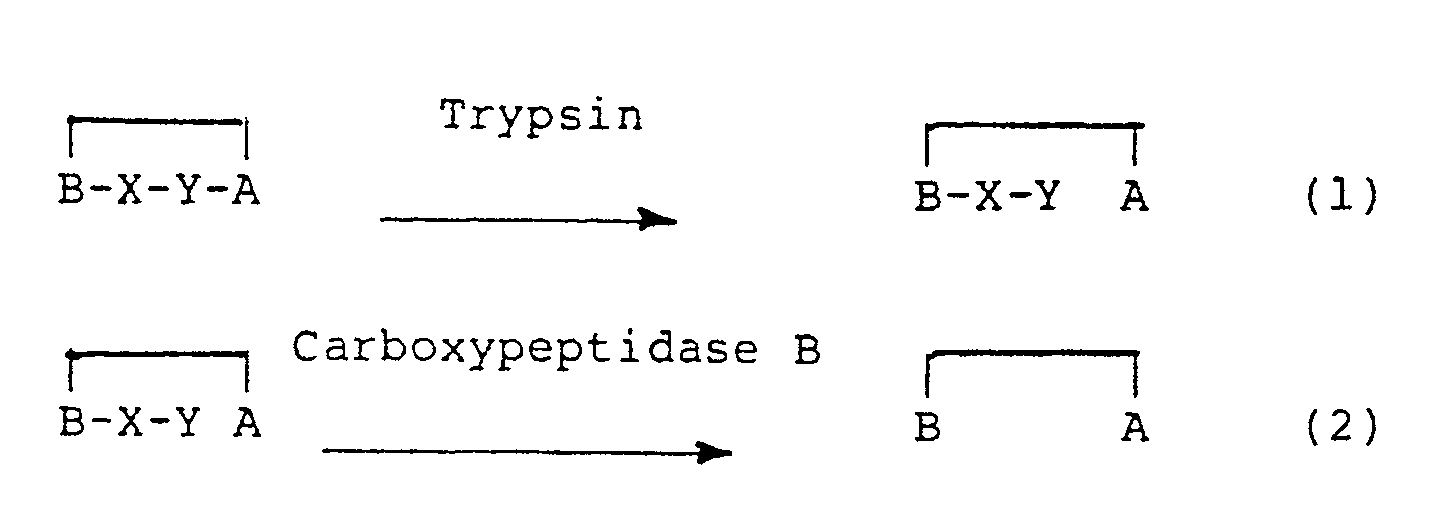
or a combined one step process in which trypsin and carboxypeptidase B are present at the same time in the reaction mixture. - In the above formulas and part of the following text the disulfide bridging between the A- and B-chain is illustrated by a bracket

for better illustration of the enzymatic cleavage process. In the above formulas
is the one chain insulin precursor (Fig. 1);
is the two chain insulin precursor intermediate in which the peptide bond between residue No. 32 (Lys or Arg) and residue No. 33 (Al = Gly) has been hydrolyzed;
is human insulin. In the remaining formulas of the type B-X-Y-A it is understood that the A- and the B-chains are connected by disulfide bridges as in native insulin. - The enzymatic conversion is conducted in an aqueous solution of the insulin precursors. The trypsin type is not material to practice of this invention. Trypsin is a well characterized enzyme available in high purity, notably from bovine and porcine pancreas. Enzymes with trypsin-like specificity, e.g. plasmin, clostripain and Achromobacter lyticus protease may also be used.
- To obtain a high conversion yield it is important to use highly purified carboxypeptidase B which does not contain carboxypeptidase A activity. This can be achieved by purification of commercially available carboxypeptidase B, e.g. by affinity chromatography or ion-exchange chromatography. Alternatively carboxypeptidase A inhibitors such as ε-amino-n-capronic acid or carbobenzoxyglycine can be added to the digest mixture.
- The one step conversion is preferably carried out at sligthly elevated temperatures (from 35-40°C) and at a pH of from 7-8. The trypsin and carboxypeptidase B concentration is preferably about 5 µg/ml and substrate concentration is about 1 mg/ml.
- In the two step conversion process the trypsin-digestion is preferably carried out at high pH. At high pH (in the range of 11 - 12) the lysine amino acid residues in the insulin precursor molecule (e.g. B29-Lys and B31-Lys in B-Lys-Arg-A, Fig. 1) are nearly uncharged (pKa for lysine residue is approximately 9.0) and cleavage with trypsin does not occur. However, in e.g.

the B32-arginine residue (pKa = 12) is still mainly positively charged and thus accessible to tryptic cleavage. Cleavage at the B22-arginine residue does only occur at very low velocity probably due to steric hindrance. A stable pH-value during the tryptic digestion of
is critical for a high yield of
Several different buffer systems have been tried with the aim of stabilizing the pH at 11.8-11.9. The buffer system HPO₄⁻⁻/PO₄⁻⁻⁻ which is normally used at high pH-values has a good buffer capacity at pH 11.8. However, this buffersystem suffers from three main drawbacks. First: the pH of a solution of HPO₄⁻⁻ /PO₄⁻⁻⁻ is very sensitive to temperature variations and a change from e.g. 25°C to 4°C may decrease the pH value with 0.7 pH units. Second: Ca⁺⁺ (which might be present in order to stabilize the trypsin) will be precipitated because the solubility product of Ca₃(PO₄)₂ and CaHPO₄ is relatively low. Third: it is not possible to acidify the digest mixture (to stop the reaction) momentaneously due to the action of the buffer systems HPO₄⁻⁻ /H₂PO₄⁻ and H₂PO₄⁻⁻ /H₃PO₄. This system will during acidification result in neutral pH for a period of time in which trypsin immediately will create the undesired product des(B30)insulin. As a result of these drawbacks the rather unusual buffer system H₂O/OH⁻ has been used. This system does not suffer from the above mentioned drawbacks. Optimal conditions for the tryptic digestion of
into
was found to be about 20 mg/ml of
200 µg/ml of trypsin; buffer solution: 37.5 mM NaOH (resulting pH as measured at 25°C was 11.86); temperature about 4°C and time of incubation about 180 min. The yield was 90.5% for
- The product of tryptic conversion

can be purified by a number of conventional methods e.g. preperative HPLC, absorption chromatography, and ion-exchange chromatography.
can be nearly quantitatively converted into
(human insulin) by digestion with caboxypeptidase B. Optimal conditions for this conversion was found to be about 5 mg/ml of
and about 5 µg/ml of carboxypeptidase B; buffer solution: 50 mM TRIS HCl, pH = 9.3, temperature about 37°C and time of incubation about 30 min. The yield was 99.5% for the conversion of
- The conversion of the insulin precursor

into human insulin was followed quantitatively by reverse phase high pressure liquid chromatography (HPLC) and is illustrated in fig. 8. - Referring to fig. 8,

was dissolved to a concentration of 5 mg/ml in 50 mM TRIS-HCl buffer, pH = 9.3 and digested with 5 µg/ml carboxypeptidase B (Boehringer) at 37°C. Aliquots were removed from the digest mixture at t = O(A), t = 2 min. (B), t = 5 min. (C), and t = 30 min. (D), acidified to pH = 1.5 with 4 N HCl and analysed by HPLC on a 5 µ Nucleosil® RP C-18 column (4 x 200 mm) equilibrated and isocratically eluted with 33 mM (NH₄)₂SO₄, 1.5 mM H₂SO₄ containing 29.4% (v/v) acetonitrile at 30°C at a flow rate of 1 ml/min. Peptides were detected by UV-absorption at 214 nm. The conversion was completed after 30 min. and ethanol was added to the digest mixture to 60% (v/v).
was purified by anionic exchange chromatography on a QAE-Sephadex® column as described by Schlichtkrull, J. et al., (1974) Horm.Metab.Res.Suppl., Ser. 5, p. 134-143.. B: B-chain, A: A-chain, K: Lys, R: Arg. It appears from fig. 8 that the product from the trypsin digestion
was nearly quantitatively converted into
by digestion with carboxypeptidase B. - The conversion of the insulin precursors into human insulin are given in examples 10, 11, and 12 and the characterization of the human insulin in example 13.
- A 4.3 kb EcoRV-Xbal and a 3.3 kb EcoR1-EcoRV fragment from pMT342 were ligated to a 0.6 kb EcoR1-Xbal fragment of pM215. Plasmid pMT342 is the yeast vector pMT212 with an inserted TPIp-MFαl leader-BCA-TPIT-sequence. The construction of pMT342 and pMT212 is described in European patent application No. 0068701 A. Plasmid pM215 was constructed by subcloning the EcoR1-Xba1 fragment containing the proinsulin coding sequence B-C-A from p285 (ATCC No. 20681) into pUC13 (constructed as described for pUC8 and pUC9 by Vieira et al., Gene 19: 259-268 (1982)) and subsequent in vitro loop-out removal of the 12 bases coding for Glu-Ala-Glu-Ala at the junction between MFαl leader and proinsulin B-C-A. P285 contains the insert TPIp-MFαl leader-B-C-A-TPIT and has been deposited in yeast strain Z33 (ATCC No. 20681).
- Ligation of the above fragments from pMT342 and pM215 gives plasmid pMT462 harbouring the insert MFαl leader (minus Glu-Ala-Glu-Ala)-B-C-A. For converting the B-C-A encoding fragment into a B-Lys-Arg-A encoding fragment the modified site specific mutagenesis procedure (K. Norris et al., ibid.) was used. A 0.6 kb EcoR1-Xba1 fragment from pMT462 encoding MFαl leader-(minus Glu-Ala-Glu-Ala)-B-C-A was inserted into phage M13 mp10 RF (Messing, J. and Vieria, J. (1983) Unpublished results) DNA cut with Xba1-EcoR1. Single strand M13 phage containing the above EcoR1-Xba1 insert was incubated with the 30-mer deletion primer KFN4 and the "universal" 15-mer M13 primer d(TCCCAGTCACGACGT) (New England Biolabs), heated to 90°C for 5 minutes and slowly cooled to room temperature in order to allow annealing. Then partly double stranded DNA was made by addition of a d-NTP-mix, Klenow Polymerase and T4 ligase. After phenol extraction, ethanol precipitation and resuspension, the DNA was cut with restriction enzymes Apal, Xba1 and EcoR1. After another phenol extraction, ethanol precipitation and resuspension, the DNA was ligated to EcoR1-Xba1 cut pUC13. The ligation mixture was transformed into an E. coli (r⁻m⁺) strain and plasmids were prepared from a number of transformants. Plasmid preparations were cut with EcoR1 and Xba1 and those preparations showing bands at both 0.5 and 0.6 kb were retransformed into E. coli. From the retransformation a transformant harbouring only pUC13 with a 0.5 kb insert was selected. The sequence of the EcoR1-Xba1 insert of this plasmid, pMT579, was then confirmed by the Maxam-Gilbert method to encode MFαl leader-(minus Glu-Ala-Glu-Ala)-B-Lys-Arg-A. The construction of pMT579 is shown in Fig. 2. The Xbal-EcoR1 insert from pMT579 was provided with TPI promotor and TPI terminator by ligation of a 0.5 kb Xba1-EcoR1 fragment of pMT579 with a 5.5 kb Xba1-EcoR1 fragment of pT5. The construction of pT5 harbouring the insert TPIp-MFαl leader-B-C-A-TPIT is illustrated in Fig. 3. The resulting plasmid pMT583 containing the insert TPIp-MFαl leader-(minus Glu-Ala-Glu-Ala)-B-Lys-Arg-A-TPIT was then cut with BamH1 and partially with Sph1 and the 2.1 kb fragment was inserted in CPOT cut with BamH1 and Sph1. The resulting plasmid pMT585 was used for transformation of yeast. The construction of pMT583 and pMT585 is shown in Fig. 3.
- The B-C-A encoding fragment from pMT462 (see example 1) was converted into B-Arg-Arg-A by a procedure analogous with the procedure described in example 1 by site specific mutagenesis with a mixture of the 30mer deletion primer KFN18 and the "universal" 15-mer M13 primer as illustrated in Fig. 5. The sequence of the EcoR1-Xba1 insert of plasmid pMT599 was confirmed by the Maxam-Gilbert method to encode MFαl leader-(minus Glu-Ala-Glu-Ala)-B-Arg-Arg-A. The Xba1-EcoR1 insert from pMT599 was provided with the TPI promoter and TPI terminator by ligation of a 0.5 kb Xba1-EcoR1 fragment of pMT599 with a 5.5 kb Xba1-EcoR1 fragment of pT5. The resulting plasmid pMT602 containing the insert TPIp-MFαl leader-(minus Glu-Ala-Glu-Ala)-B-Arg-Arg-A-TPIT was then cut with BamH1 and partially with Sph1 and the 2.1 kb fragment was inserted in CPOT cut with BamH1 and Sph1. The resulting plasmid pMT611 was used for transformation of yeast. The construction of plasmid pMT611 is shown in Fig. 5.
- The B-C-A encoding fragment from pMT462 (see example 1) was converted into B-Lys-Lys-A by a procedure similar to the procedure described in example 1 by site specific mutagenesis with a mixture of the 30mer deletion primer KFN41 and the "universal" 15-mer M13 primer as illustrated in Fig. 6.
- After filling in with Klenow polymerase and ligation with T4 ligase the partly double stranded DNA was digested with Apa1, EcoR1 and Xba1 and ligated with the 5.5 kb Xba1-EcoR1 fragment from plasmid pT5 (see example 1). After transformation and retransformation into E. coli, a plasmid pMT652 containing the insert MFαl leader-(minus Glu-Ala-Glu-Ala)B-Lys-Lys-A was isolated and the sequence of the insert confirmed as described above.
- Plasmid pMT652 was cleaved with Xba1-EcoR1 and the 0.5 kb fragment was ligated with a 7.8 kb Xba1-Kpn1 and a 4.3 kb Kpn1-EcoR1 fragment of pMT644. The resulting plasmid pMT650 contains the insert TPIp-MFαl leader (minus Glu-Ala-Glu-Ala)-B-Lys-Lys-A-TPIT and furthermore contains the TPI coding gene (POT) from CPOT. The construction of plasmid pMT650 is illustrated in Fig. 6 and the construction of pMT644 is shown in Fig. 4. Plasmids pUC12 and pUC18 used for the construction of pMT644 were constructed as described for pUC13 (Vieira et al.. ibid.) Plasmid p601 (see Fig. 4) contains the insert TPIp-MFαl leader -B'A-TPIT with flanking Bgl2 and a BamH1 sites. B'A stands for B(1-29)-A(1-21), where B(1-29) is a shortened B-chain of human insulin from PheB1 to Lys B29 and A(1-21) is the A-chain of human insulin. The construction of a DNA-sequence encoding B'A is described in European patent application No. 0068701 A. pMT650 was used for transformation of yeast.
- Plasmid pMT658 was constructed as described for pMT650 in example 3 with the exception that the 30mer deletion primer KFN42 was used instead of KFN41. Also, a more direct construction of the pMT644 derivative was chosen: after in vitro mutagenesis, i.e. after filling in with Klenow polymerase and ligation with T4 ligase, the partly double stranded DNA was digested with Apa1, EcoR1 and Xba1 and ligated to a 7.8 kb Xba1-Kpn1 and a 4.3 kb Kpn1-EcoR1 fragment of pMT644. The ligation mixture was transformed into E. coli (r⁻ m⁺) and plasmid prepared from a number of transformants. One plasmid preparation showing Xba1-EcoR1 fragments at both 0.6 and 0.5 kb was retransformed into E. coli to give a strain harbouring a plasmid pMT658 containing the 0.5 kb but not the 0.6 kb EcoR1-Xba1 fragment. pMT658 contains the insert TPIp-MFαl leader-(minus Glu-Ala-Glu-Ala)-B-Arg-Lys-A-TPIT. The sequence of the B-Arg-Lys-A coding segment was verified by Maxam-Gilbert DNA-sequencing. The construction of pMT658 is illustrated in fig. 7. pMT658 was used for transformation of yeast.
- S. cerevisiae strain MT501 (E2-7B X E11-3C a/α,Δ tpi/tpi,Δpep 4-3/pep 4-3) was grown on YPGaL (1% Bacto yeast extract, 2% Bacto peptone, 2% galactose, 1% lactate) to an OD600nm of 0.6.
- 100 ml of culture was harvested by centrifugation, washed with 10 ml of water, recentrifuged and resuspended in 10 ml of 1.2 M sorbitol, 25 mM Na₂EDTA pH = 8.0, 6.7 mg/ml dithiotreitol. The suspension was incubated at 30°C for 15 minutes, centrifuged and the cells resuspended in 10 ml of 1.2 M sorbitol, 10 mM Na₂EDTA, 0.1 M sodium citrate pH = 5.8, 2 mg Novozym® 234. The suspension was incubated at 30°C for 30 minutes, the cells collected by centrifugation, washed in 10 ml of 1.2 M sorbitol and in 10 ml of CAS (1.2 M sorbitol, 10 mM CaCl₂, 10 mM Tris (Tris = Tris(hydroxymethyl)-aminometan) pH = 7.5) and resuspended in 2 ml of CAS. For transformation 0.1 ml of CAS-resuspended cells were mixed with approximately 1 µg of plasmid pMT585 and left at room temperature for 15 minutes. 1 ml of 20
% polyethylenglycol 4000, 10 mM CaCl₂, 10 mM Tris pH = 7.5 was added and the mixture left for further 30 minutes at room temperature. The mixture was centrifuged and the pellet resuspended in 0.1 ml of SOS (1.2 M sorbitol, 33% v/v YPGaL, 6.7 mM CaCl₂, 14 µg/ml leucine) and incubated at 30°C for 2 hours. The suspension was then centrifuged and the pellet resuspended in 0.5 ml of 1.2 M sorbitol. 6 ml of top agar (the SC medium of Sherman et al., (Methods in Yeast Genetics, Cold Spring Harbor Laboratory, 1981) with leucine omitted and containing 1.2 M sorbitol plus 2.5% agar) at 52°C was added and the suspension poured on top of plates containing the same agar-solidified, sorbitol containing medium. Transformant colonies were picked after 3 days at 30°C, reisolated and used to start liquid cultures. One such transformant MT593 (=MT501/pMT585) was chosen for further characterization. - Plasmids pMT611, pMT650 and pMT658 were transformed into S. cerevisiae strain MT501 by the same procedure as above and the transformants MT616 (= MT501/pMT611), MT655 (= MT501/pMT650) and MT660 (= MT501/ pMT658) were isolated.
- The transformed microorganisms MT 593, MT 616, MT 655 and MT660 were deposited by the applicant with Deutsche Sammlung von Mikroorganismen (DSM), Griesebachstrasse 8, D-3400 Göttingen, on January 16, 1985 and accorded the reference numbers DSM 3194, DSM 3195, DSM 3198, and DSM 3199, respectively. DSM being an international depository authorized under the Budapest Treaty of 1977 affords permanence of the above deposits and accessibility thereto by the public in accordance with Rules 9 and 11, respectively, of the above treaty.
- Yeast strain MT 593 (DSM 3194) was grown on YPD medium. A one liter culture in a 2 liter baffled flask was shaken at 30°C to an OD600nm of 15. After centrifugation expression products from 815 ml of supernatant were isolated as follows:
A column (1.5 x 9 cm) of LiChroprep® RP-18 (Merck, art. 9303) was washed with 30 ml of 50 mM NH₄HCO₃ containing 60% (v/v) ethanol. The column was equilibrated with 50 ml of 50 mM NH₄HCO₃. 95 ml of 96% ethanol were added to 815 ml of the yeast supernatant and the mixture was pumped through the column over night (flow 45 ml/h). - The column was washed with 15 ml of 0.1 M NaCl and then with 15 ml of H₂O and peptide material was eluted with 50 mM NH₄HCO₃ containing 60% (v/v) of ethanol. The eluate (4.5 ml) was concentrated to 1.1 ml by vacuum centrifugation (Savant vacuumcentrifuge) in order to remove the ethanol, and the volume was adjusted to 10 ml with 25 mM HEPES buffer at pH = 7.4. The sample was applied to an antiinsulin sepharose column (2.5 x 4.5 cm) which prior to the application had been washed with 20 ml of NaFAM buffer (Heding, L., Diabetologia 8 (1972), 260-66) and with 10 ml of 25 mM HEPES buffer pH = 7.4. After the application the column was allowed to stand for 30 min. at room temperature and thereafter washed with 40 ml of 25 mM HEPES buffer, pH = 7.4. The peptide material was eluted with 20% acetic acid and the pH of the eluate was adjusted to 7.0 with NH₄OH.
- The eluate from the previous step was concentrated to 250 µl by vacuum rotation and peptides were further purified by reverse phase HPLC on a 5µ Waters Novapak C-18 column (3.9 x 150 mm). The A and B buffers were 0.1% TFA in H₂O and 0.07% TFA in acetonitrile, respectively. The column was equilibrated with 25% B at a flow of 0.75 ml/min and the peptides were eluted with a linear gradient (1% acetonitrile per min) and detected at 276 nm. The main peak eluted with a retention time of 13.15 minutes and peptide material from this peak was isolated by lyophilization of the eluate. The peptide material was characterized as described in example 8. The yield in each step of the purification was determined by radioimmunoassay as previously described, and Table 2 summarizes the purification. The overall yield was 39%.

- The above mentioned yeast strains were grown as previously described in example 6 and expression products were purified from the different supernants essentially as described in example 6. Table 3 summarizes the overall yields.

- B-Lys-Arg-A was purified as described in example 6. The amino acid composition of the peptide was determined as follows: 139.6 µg (19 nmol) was hydrolysed in 100 µl 6 N HCl for 24 h at 110°C. The hydrolysate was analyzed on a Beckman Model 121 M amino acid analyser. The following amino acid composition was found:

- Approximately 5 nmol peptide material was subjected to amino acid sequence analysis. The sequence analysis was performed with a Gas Phase Sequencer (Applied Biosystem Model 470 A) as descbribed by Moody, A.J., Thim, L. and Valverde, I. (FEBS Lett., 172 (1984), 142-148). The following results were found:

- Peptide material was purified from the above mentioned yeast strains as described in example 6. The peptides were submitted to amino acid sequence analysis as described in example 8. From the sequence results (not shown) it could be concluded that the dibasic sequences linking the B- and A-chain were Lys-Lys (MT 655), Arg-Lys (MT 660) and Arg-Arg (MT 616), respectively. Purified peptides were submitted to amino acid analysis as described in example 7. The amino acid compositions were found in accordance with the theory (results shown only for B-Lys-Lys-A).

- 10 mg B-Lys-Arg-A was dissolved in 10 ml of 0.23 M TRIS-HCl buffer pH = 7.5. The solution was heated to 37°C and 50 µg trypsin (NOVO Industri A/S) and 50µg carboxypeptidase B (Boehringer) both dissolved in 100 µl of water was added to time zero. Aliquots of the reaction mixture were removed to time 0 min., 2 min., 10 min., 40 min., and 80 min. The enzyme reaction was stopped by acidification of the samples to pH = 2.5 with 1 M HCl.
- The conversion of B-Lys-Arg-A into human insulin was followed by reverse phase HPLC on a 5 µ RP C-18 column (4 x 200 mm) of Nucleosil (Macherey Nagel). The A buffer consisted of 25% acetonitrile adjusted to pH = 3.5 with H₂SO₄ and the B buffer was 45% acetonitrile, 0.15 M (NH₄)₂SO₄, 1.5 mM H₂SO₄. The eluation was performed in an isocratic system using a mixture of 80% A-buffer/20% B-buffer at a flow of 1 ml/min. The temperature of the solvents and column was 30°C and peptides were detected at 214 nm.
- The optimal yield in the above one step process was obtained after 10 min of incubation. At this time the reaction mixture consisted of: 45% human insulin, 10% Des-B30-insulin and 45% Arg-Ao-insulin. In order to increase the yield of the conversion a two step process was designed (Example 11).
- 26.4 ml of H₂O was added to 471 mg

The mixture was chilled to 4°C and 3.0 ml of 0.25 M NaOH was added whereby the insulin precursor was dissolved. 6 mg of trypsin (NOVO Industri A/S) in 200 µl of water was added. The reaction was carried out at 4°C for 5 h and stopped by the addition of 600 µl of 4 N HCl. The yield as determined by HPLC (method given in Example 10) was 91.5% of
and the main part of the remaining 8.5% was undigested
The product
was purified by preparative HPLC on a column (5 x 25 cm) of octadecyldimethylsilyl substituted silica (average particle size: 15 µ, pore size: 100 Å). The column was equilibrated and eluted (isocratic) with 0.185 M KCl/0.6 mM HCl (pH = 3.15) containing 37% (v/v) ethanol at a flow rate of 2 l/h. B-Lys-Arg A eluted at 4.3 column volumes and was isolated from the alcoholic pool by a crystallization procedure previously described for crystallization of human insulin B-30 esters (Markussen, J. (1984) in "Diabetes Research Vol I, Laboratory Methods Part B" p. 403-411, eds. Larner and Pohl). - The crystals were lyophilized and dissolved in 50 mM TRIS-HCl buffer (pH = 9.3) in a concentration of 10 mg/ml. The insulin precursor intermediate was converted into human insulin by digestion with carboxypeptidase B (40 µg/ml) at 37°C for 40 h. To the digest mixture was then added ethanol to a final concentration of 60% (v/v) and human insulin was purified from the mixture by anionic exchange chromotography on a QAE-Sephadex (Pharmacia) column as described by Schlichtkrull et al.
(Horm.Metab.Res.Suppl., Ser. 5 (1974) 134-143). - The yields at the different steps of the conversion including the purifications are given in Table 7.
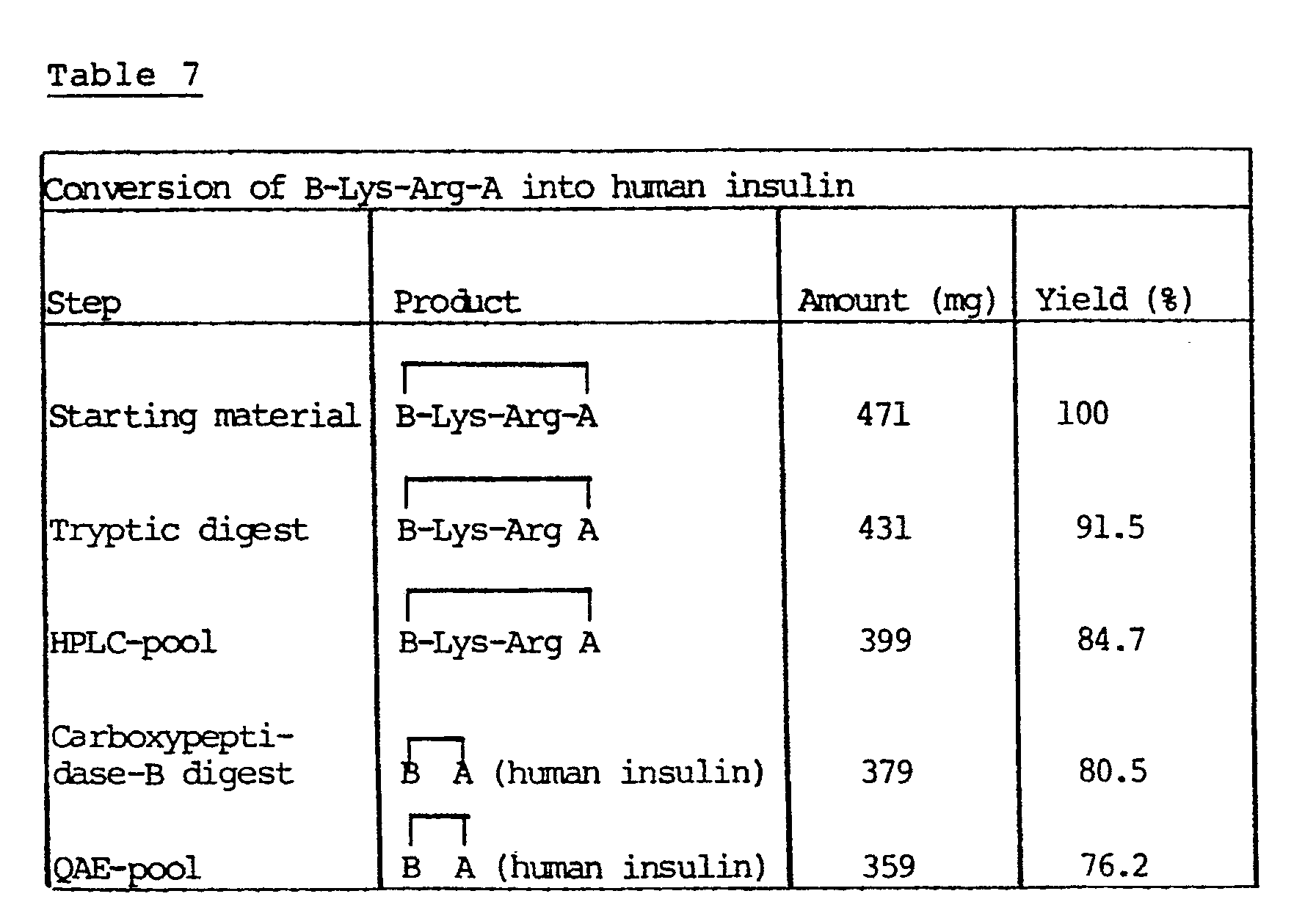
- 10 mg of B-Lys-Lys-A was converted to human insulin as described in Example 10. The overall yield of human insulin as judged from HPLC was 48%. The other products were identified as Lys-Ao-insulin (42%), Des-B30-insulin (9%) and minor unidentified components (1%).
- Human insulin was prepared as described in example 11 and characterized in the following analysis:
- a) The human insulin shows only one band on basic disc electrophoresis in urea-containing polyacrylamide gels (Method described by Schlichtkrull et al., Horm.Metabol.Res., Suppl. Ser. 5 (1974) 134-143). The band migrated as pancreatic human insulin.
- b) Regular shaped rhombohedral crystals were obtained by crystallization of the human insulin in the presence of Zn⁺⁺ (Method described by Schlichtkrull, Acta Chem.Scand. 10 (1956) 1459-1464).
- c) The biological activity of the human insulin was determined in a mouse blood sugar depletion test. The estimated potency was 28.1 I.U./mg (p 0.05 confidens limits: 25.7-30.7 I.U./mg) using the 4th International Standard for insulin.
- d) The amino acid composition of the human insulin was determined after hydrolysis at 110°C for 24 h, 48 h and 96 h in 6N HCl and the values for Thr, Ser, Pro and NH₃ were determined by linear regression (t = 0). The values for Val and Ile were extrapolated to indefinite time of hydrolysis. The value for 1/2 Cys was determined after hydrolysis for 24 h in 4M methansulfonic acid. The amino acid composition is given in Table 8.

Claims (8)
- DNA-sequence encoding a human insulin precursor of the formula
B-X-Y-A (I)
wherein B and A are the B- and A-chain of human insulin crosslinked as in human insulin and wherein X and Y are each lysine or arginine. - Replicable expression vehicle capable of expressing a DNA-sequence according to claim 1 in yeast.
- A method of producing human insulin precursors of the formula
B-X-Y-A (I)
in which B and A are the B- and A-chain of human insulin crosslinked as in human insulin and X and Y are each lysine or arginine, wherein a yeast strain transformed with an expression vehicle comprising a DNA-sequence encoding the insulin precursor is cultivated in a suitable culture medium and the insulin precursor is recovered from the culture medium. - A method for producing human insulin wherein a yeast strain transformed with an expression vehicle comprising a DNA-sequence encoding an insulin precursor of the formula
B-X-Y-A (I)
in which B and A are the B- and A-chain of human insulin crosslinked as in human insulin and X and Y are each lysine or arginine, is cultivated in a suitable culture medium and the insulin precursor is recovered from the culture medium and converted into human insulin by enzymatic treatment. - A method according to claim 4, wherein the insulin precursor of the formula
B-X-Y-A (I)
in which B and A are the B- and A-chains of human insulin crosslinked as in human insulin and X and Y are each a lysine or arginine, is converted into human insulin by treating an aqueous solution of the insulin precursor with trypsin and carboxypeptidase B, and thereafter recovering the human insulin from the solution. - A method according to claim 5 further comprising a one-step dual enzyme treatment with trypsin and carboxypeptidase B.
- A method according to claim 5 further comprising treating the insulin precursor with trypsin and thereafter treating the reaction product with carboxypeptidase B.
- A method according to claim 7 further comprising conducting the trypsin treatment at a pH in the range of pH 11-12.
Priority Applications (1)
| Application Number | Priority Date | Filing Date | Title |
|---|---|---|---|
| AT86302133T ATE69266T1 (en) | 1985-03-22 | 1986-03-21 | METHODS OF PRODUCTION OF INSULIN PRECURSORS AND METHODS OF PRODUCTION OF HUMAN INSULIN. |
Applications Claiming Priority (2)
| Application Number | Priority Date | Filing Date | Title |
|---|---|---|---|
| DK1293/85 | 1985-03-22 | ||
| DK129385A DK129385A (en) | 1985-03-22 | 1985-03-22 | PEPTIDES AND PREPARATION THEREOF |
Publications (2)
| Publication Number | Publication Date |
|---|---|
| EP0195691A1 EP0195691A1 (en) | 1986-09-24 |
| EP0195691B1 true EP0195691B1 (en) | 1991-11-06 |
Family
ID=8103207
Family Applications (1)
| Application Number | Title | Priority Date | Filing Date |
|---|---|---|---|
| EP86302133A Expired - Lifetime EP0195691B1 (en) | 1985-03-22 | 1986-03-21 | Process for the preparation of insulin precursors and process for the preparation of human insulin |
Country Status (16)
| Country | Link |
|---|---|
| EP (1) | EP0195691B1 (en) |
| JP (3) | JPH0648993B2 (en) |
| AT (1) | ATE69266T1 (en) |
| AU (1) | AU586855B2 (en) |
| CA (1) | CA1340823C (en) |
| DE (1) | DE3682303D1 (en) |
| DK (1) | DK129385A (en) |
| ES (2) | ES8802402A1 (en) |
| FI (1) | FI87801C (en) |
| GR (1) | GR860764B (en) |
| IE (1) | IE58842B1 (en) |
| MX (1) | MX163837B (en) |
| NO (1) | NO172646C (en) |
| NZ (1) | NZ215570A (en) |
| PT (1) | PT82241B (en) |
| ZA (1) | ZA861953B (en) |
Cited By (8)
| Publication number | Priority date | Publication date | Assignee | Title |
|---|---|---|---|---|
| US7056701B2 (en) | 1992-01-31 | 2006-06-06 | Aventis Behring L.L.C. | Hormone and albumin fusion protein |
| US7141547B2 (en) | 2001-12-21 | 2006-11-28 | Human Genome Sciences, Inc. | Albumin fusion proteins comprising GLP-1 polypeptides |
| US7202059B2 (en) | 2001-02-20 | 2007-04-10 | Sanofi-Aventis Deutschland Gmbh | Fusion proteins capable of being secreted into a fermentation medium |
| US7268112B2 (en) | 2000-03-24 | 2007-09-11 | Genetech, Inc. | Use of insulin for the treatment of cartilaginous disorders |
| US7507414B2 (en) | 2000-04-12 | 2009-03-24 | Human Genome Sciences, Inc. | Albumin fusion proteins |
| US7521424B2 (en) | 2003-01-22 | 2009-04-21 | Human Genome Sciences, Inc. | Albumin fusion proteins |
| US7638618B2 (en) | 2001-02-20 | 2009-12-29 | Sanofi-Aventis Deutschland Gmbh | Nucleic acids encoding a hirudin and pro-insulin as superscretable peptides and for parallel improvement of the exported forms of one or more polypeptides of interest |
| WO2010016069A1 (en) * | 2008-08-07 | 2010-02-11 | Biocon Limited | A process for preparation of insulin compounds |
Families Citing this family (35)
| Publication number | Priority date | Publication date | Assignee | Title |
|---|---|---|---|---|
| DK58285D0 (en) * | 1984-05-30 | 1985-02-08 | Novo Industri As | PEPTIDES AND MANUFACTURING AND USING THEREOF |
| EP0208418B1 (en) * | 1985-06-12 | 1991-10-30 | Lubrizol Genetics Inc. | Modified zein |
| PH25772A (en) * | 1985-08-30 | 1991-10-18 | Novo Industri As | Insulin analogues, process for their preparation |
| DK437786D0 (en) * | 1986-09-12 | 1986-09-12 | Nordisk Gentofte | insulin precursors |
| US5426036A (en) * | 1987-05-05 | 1995-06-20 | Hoechst Aktiengesellschaft | Processes for the preparation of foreign proteins in streptomycetes |
| DE3837271A1 (en) * | 1988-11-03 | 1990-05-10 | Hoechst Ag | PROCESS FOR THE SELECTIVE CLEARANCE OF FUSION PROTEINS |
| CA1340772C (en) * | 1987-12-30 | 1999-09-28 | Patricia Tekamp-Olson | Expression and secretion of heterologous protiens in yeast employing truncated alpha-factor leader sequences |
| DK336188D0 (en) * | 1988-06-20 | 1988-06-20 | Nordisk Gentofte | propeptides |
| US6875589B1 (en) | 1988-06-23 | 2005-04-05 | Hoechst Aktiengesellschaft | Mini-proinsulin, its preparation and use |
| DE58906966D1 (en) * | 1988-06-23 | 1994-03-24 | Hoechst Ag | Mini-proinsulin, its production and use. |
| EP0367163B1 (en) * | 1988-11-03 | 1996-01-03 | Hoechst Aktiengesellschaft | Process for producing an insulin precursor in streptomyces |
| US5716927A (en) * | 1988-12-23 | 1998-02-10 | Novo Nordisk A/S | Insulin analogs having a modified B-chain |
| DE3844211A1 (en) * | 1988-12-29 | 1990-07-05 | Hoechst Ag | NEW INSULINE DERIVATIVES, THE PROCESS FOR THEIR PRODUCTION, THEIR USE AND A PHARMACEUTICAL PREPARATION CONTAINING THEM |
| PT93057B (en) * | 1989-02-09 | 1995-12-29 | Lilly Co Eli | PROCESS FOR THE PREPARATION OF INSULIN ANALOGS |
| DK134189D0 (en) * | 1989-03-20 | 1989-03-20 | Nordisk Gentofte | INSULIN COMPOUNDS |
| DE69001248T2 (en) * | 1989-05-04 | 1993-10-14 | Genentech Inc | METHOD AND COMPOSITIONS FOR INSULATING HUMAN RELAXIN. |
| CZ283234B6 (en) * | 1990-09-05 | 1998-02-18 | Hoechst Aktiengesellschaft | Hydrolysis process of pre-proinsulin amino acid chain |
| TW224471B (en) * | 1991-11-26 | 1994-06-01 | Lilly Co Eli | |
| US6001604A (en) * | 1993-12-29 | 1999-12-14 | Bio-Technology General Corp. | Refolding of proinsulins without addition of reducing agents |
| ATE350053T1 (en) * | 1994-12-29 | 2007-01-15 | Ferring Int Ct Sa | PRODUCTION OF HUMAN INSULIN |
| KR0150565B1 (en) * | 1995-02-15 | 1998-08-17 | 김정재 | A process for preparing human proinsulin by recombinant dna technology |
| AU5724996A (en) * | 1995-05-05 | 1996-11-21 | Eli Lilly And Company | Single chain insulin with high bioactivity |
| GB9513967D0 (en) * | 1995-07-08 | 1995-09-06 | Univ Leicester | Insulin |
| KR100381494B1 (en) * | 1997-06-30 | 2003-07-22 | 바이오 테크놀로지 제네랄 코오포레이션 | Generation of human insulin |
| AU9162398A (en) * | 1997-08-22 | 1999-03-16 | Boehringer Mannheim Gmbh | Process for producing insulin precursor proteins |
| DE19930676B4 (en) | 1999-07-02 | 2006-01-19 | Sanofi-Aventis Deutschland Gmbh | Process for stabilizing insulin, insulin derivatives and / or their precursors in complex mixtures when they are stored in aqueous solvents |
| AR025646A1 (en) | 2000-09-13 | 2002-12-04 | Beta Lab Sa | RECOMBINANT METHYLOTROPHIC YEAST strain, PRODUCERS OF AN INSULIN PRECURSOR, DNA CONSTRUCTIONS AND METHOD TO OBTAIN THE CEPA. |
| US7312192B2 (en) * | 2001-09-07 | 2007-12-25 | Biocon Limited | Insulin polypeptide-oligomer conjugates, proinsulin polypeptide-oligomer conjugates and methods of synthesizing same |
| AR072563A1 (en) * | 2009-07-15 | 2010-09-08 | Beta Lab Sa | A PROCEDURE FOR OBTAINING ASPARTIC INSULIN USING A PICHIA PASTORIS LEAVES CEPA |
| PL239062B1 (en) * | 2016-01-22 | 2021-11-02 | Inst Biotechnologii I Antybiotykow | Method for producing insulin and its derivatives and the hybrid peptide used in this method |
| BR112019004314A2 (en) * | 2016-09-06 | 2019-05-28 | Chemical & Biopharmaceutical Laboratories Of Patras S A | proinsulin derivatives |
| KR102646845B1 (en) * | 2018-08-08 | 2024-03-14 | 주식회사 대웅제약 | A Method for Producing Long-acting Insulin Analog Derivatives as an Active Form Using Clostripain |
| KR102666154B1 (en) | 2018-08-08 | 2024-05-20 | 주식회사 대웅제약 | Long-acting Insulin Analog and Derivatives Thereof |
| CN113226284B (en) * | 2018-09-25 | 2024-12-03 | 美药星制药股份有限公司 | Highly purified recombinant human insulin (RHI) API and its production method |
| KR20200080747A (en) * | 2018-12-27 | 2020-07-07 | 주식회사 폴루스 | An Enzymatic Conversion Composition for Producing Insulin from Proinsulin and a Method for Producing Insulin from Proinsulin Using the Same |
Family Cites Families (5)
| Publication number | Priority date | Publication date | Assignee | Title |
|---|---|---|---|---|
| ZA811972B (en) * | 1980-03-27 | 1982-11-24 | Lilly Co Eli | Process for producing an insulin precursor |
| NZ199391A (en) * | 1981-01-02 | 1985-12-13 | Genentech Inc | Chimeric polypeptides comprising a proinsulin sequence,and preparation by recombinant dna technique;production of human insulin |
| DE3209184A1 (en) * | 1982-03-13 | 1983-09-15 | Hoechst Ag, 6230 Frankfurt | METHOD FOR CONVERTING PRAEPROINSULIN ANALOGS TO INSULINES |
| DK172738B1 (en) * | 1983-04-07 | 1999-06-21 | Chiron Corp | Method for expressing mature insulin and DNA structure for use in the method |
| DK58285D0 (en) * | 1984-05-30 | 1985-02-08 | Novo Industri As | PEPTIDES AND MANUFACTURING AND USING THEREOF |
-
1985
- 1985-03-22 DK DK129385A patent/DK129385A/en not_active Application Discontinuation
-
1986
- 1986-03-17 ZA ZA861953A patent/ZA861953B/en unknown
- 1986-03-20 JP JP61060995A patent/JPH0648993B2/en not_active Expired - Lifetime
- 1986-03-20 MX MX1947A patent/MX163837B/en unknown
- 1986-03-20 CA CA000504650A patent/CA1340823C/en not_active Expired - Fee Related
- 1986-03-21 IE IE73786A patent/IE58842B1/en not_active IP Right Cessation
- 1986-03-21 EP EP86302133A patent/EP0195691B1/en not_active Expired - Lifetime
- 1986-03-21 AU AU55005/86A patent/AU586855B2/en not_active Ceased
- 1986-03-21 FI FI861198A patent/FI87801C/en not_active IP Right Cessation
- 1986-03-21 NO NO861120A patent/NO172646C/en not_active IP Right Cessation
- 1986-03-21 AT AT86302133T patent/ATE69266T1/en not_active IP Right Cessation
- 1986-03-21 ES ES553231A patent/ES8802402A1/en not_active Expired
- 1986-03-21 GR GR860764A patent/GR860764B/en unknown
- 1986-03-21 DE DE8686302133T patent/DE3682303D1/en not_active Expired - Lifetime
- 1986-03-21 NZ NZ215570A patent/NZ215570A/en unknown
- 1986-03-21 PT PT82241A patent/PT82241B/en not_active IP Right Cessation
- 1986-11-28 ES ES557227A patent/ES8708251A1/en not_active Expired
-
1993
- 1993-05-24 JP JP5121394A patent/JPH088871B2/en not_active Expired - Lifetime
-
1995
- 1995-07-14 JP JP7178875A patent/JP2553326B2/en not_active Expired - Lifetime
Cited By (20)
| Publication number | Priority date | Publication date | Assignee | Title |
|---|---|---|---|---|
| US7094577B2 (en) | 1992-01-31 | 2006-08-22 | Aventis Behring L.L.C. | Insulin and albumin fusion protein |
| US7056701B2 (en) | 1992-01-31 | 2006-06-06 | Aventis Behring L.L.C. | Hormone and albumin fusion protein |
| US7410779B2 (en) | 1992-01-31 | 2008-08-12 | Novozymes Biopharma Uk Limited | Fusion polypeptides of human serum albumin and a therapeutically active polypeptide |
| US7268112B2 (en) | 2000-03-24 | 2007-09-11 | Genetech, Inc. | Use of insulin for the treatment of cartilaginous disorders |
| US7507414B2 (en) | 2000-04-12 | 2009-03-24 | Human Genome Sciences, Inc. | Albumin fusion proteins |
| US7638618B2 (en) | 2001-02-20 | 2009-12-29 | Sanofi-Aventis Deutschland Gmbh | Nucleic acids encoding a hirudin and pro-insulin as superscretable peptides and for parallel improvement of the exported forms of one or more polypeptides of interest |
| US7202059B2 (en) | 2001-02-20 | 2007-04-10 | Sanofi-Aventis Deutschland Gmbh | Fusion proteins capable of being secreted into a fermentation medium |
| US7847079B2 (en) | 2001-12-21 | 2010-12-07 | Human Genome Sciences, Inc. | Albumin fusion proteins |
| US7592010B2 (en) | 2001-12-21 | 2009-09-22 | Human Genome Sciences, Inc. | Albumin fusion proteins |
| US7141547B2 (en) | 2001-12-21 | 2006-11-28 | Human Genome Sciences, Inc. | Albumin fusion proteins comprising GLP-1 polypeptides |
| US7238667B2 (en) | 2001-12-21 | 2007-07-03 | Human Genome Sciences, Inc. | Albumin fusion proteins |
| US8071539B2 (en) | 2001-12-21 | 2011-12-06 | Human Genome Sciences, Inc. | Albumin fusion proteins |
| US8252739B2 (en) | 2001-12-21 | 2012-08-28 | Human Genome Sciences, Inc. | Albumin fusion proteins |
| US8513189B2 (en) | 2001-12-21 | 2013-08-20 | Human Genome Sciences, Inc. | Albumin fusion proteins |
| US8993517B2 (en) | 2001-12-21 | 2015-03-31 | Human Genome Sciences, Inc. | Albumin fusion proteins |
| US9221896B2 (en) | 2001-12-21 | 2015-12-29 | Human Genome Sciences, Inc. | Albumin fusion proteins |
| US9296809B2 (en) | 2001-12-21 | 2016-03-29 | Human Genome Sciences, Inc. | Albumin fusion proteins |
| US7521424B2 (en) | 2003-01-22 | 2009-04-21 | Human Genome Sciences, Inc. | Albumin fusion proteins |
| WO2010016069A1 (en) * | 2008-08-07 | 2010-02-11 | Biocon Limited | A process for preparation of insulin compounds |
| US9090705B2 (en) | 2008-08-07 | 2015-07-28 | Biocon Limited | Process for preparation of insulin compounds |
Also Published As
| Publication number | Publication date |
|---|---|
| DK129385D0 (en) | 1985-03-22 |
| NO861120L (en) | 1986-09-23 |
| ES8802402A1 (en) | 1988-05-16 |
| JPH0648993B2 (en) | 1994-06-29 |
| NO172646C (en) | 1993-08-18 |
| JPH0823985A (en) | 1996-01-30 |
| PT82241A (en) | 1986-04-01 |
| ES553231A0 (en) | 1988-05-16 |
| JPH06133777A (en) | 1994-05-17 |
| JP2553326B2 (en) | 1996-11-13 |
| FI87801B (en) | 1992-11-13 |
| NO172646B (en) | 1993-05-10 |
| JPS61221200A (en) | 1986-10-01 |
| PT82241B (en) | 1988-11-30 |
| FI861198A0 (en) | 1986-03-21 |
| IE860737L (en) | 1986-09-22 |
| FI87801C (en) | 1993-02-25 |
| ZA861953B (en) | 1986-11-26 |
| IE58842B1 (en) | 1993-11-17 |
| AU586855B2 (en) | 1989-07-27 |
| EP0195691A1 (en) | 1986-09-24 |
| GR860764B (en) | 1986-07-21 |
| AU5500586A (en) | 1986-09-25 |
| CA1340823C (en) | 1999-11-16 |
| ATE69266T1 (en) | 1991-11-15 |
| MX163837B (en) | 1992-06-25 |
| FI861198L (en) | 1986-09-23 |
| NZ215570A (en) | 1989-07-27 |
| ES557227A0 (en) | 1987-10-01 |
| DK129385A (en) | 1986-09-23 |
| JPH088871B2 (en) | 1996-01-31 |
| DE3682303D1 (en) | 1991-12-12 |
| ES8708251A1 (en) | 1987-10-01 |
Similar Documents
| Publication | Publication Date | Title |
|---|---|---|
| CA1340823C (en) | Insulin precursors, process for their preparation and process for the preparation of human insulin | |
| US4916212A (en) | DNA-sequence encoding biosynthetic insulin precursors and process for preparing the insulin precursors and human insulin | |
| US5102789A (en) | Production of epideramal growth factor in pichia pastoris yeast cells | |
| Thim et al. | Secretion and processing of insulin precursors in yeast. | |
| EP1377608B1 (en) | Insulin precursors and a process for their preparation | |
| AU3692889A (en) | Insulin analogues | |
| IL114160A (en) | Dna constructs encoding heterologous proteins and processes for the heterologous protein production in yeast | |
| US4826763A (en) | Process for preparing glucagon or fragments or derivatives thereof in yeast | |
| US7105314B2 (en) | Method for making human insulin precursors | |
| WO2002079251A2 (en) | Method for making human insulin precursors | |
| DK158270B (en) | Process for preparing human insulin precursors and human insulin, and also DNA sequences and plasmids for use in these processes | |
| WO2004085472A1 (en) | Method for making human insulin precursors and human insulin | |
| DK157938B (en) | DNA sequence for insulin precursors, vectors containing this sequence, yeast strains which are transformed with the vectors, and also a process for preparing the insulin precursors and a process for preparing human insulin |
Legal Events
| Date | Code | Title | Description |
|---|---|---|---|
| PUAI | Public reference made under article 153(3) epc to a published international application that has entered the european phase |
Free format text: ORIGINAL CODE: 0009012 |
|
| AK | Designated contracting states |
Kind code of ref document: A1 Designated state(s): AT BE CH DE FR GB IT LI LU NL SE |
|
| 17P | Request for examination filed |
Effective date: 19870130 |
|
| 17Q | First examination report despatched |
Effective date: 19890807 |
|
| RAP1 | Party data changed (applicant data changed or rights of an application transferred) |
Owner name: NOVO-NORDISK A/S |
|
| RAP1 | Party data changed (applicant data changed or rights of an application transferred) |
Owner name: NOVO NORDISK A/S |
|
| GRAA | (expected) grant |
Free format text: ORIGINAL CODE: 0009210 |
|
| AK | Designated contracting states |
Kind code of ref document: B1 Designated state(s): AT BE CH DE FR GB IT LI LU NL SE |
|
| REF | Corresponds to: |
Ref document number: 69266 Country of ref document: AT Date of ref document: 19911115 Kind code of ref document: T |
|
| REF | Corresponds to: |
Ref document number: 3682303 Country of ref document: DE Date of ref document: 19911212 |
|
| ITF | It: translation for a ep patent filed | ||
| ET | Fr: translation filed | ||
| PLBE | No opposition filed within time limit |
Free format text: ORIGINAL CODE: 0009261 |
|
| STAA | Information on the status of an ep patent application or granted ep patent |
Free format text: STATUS: NO OPPOSITION FILED WITHIN TIME LIMIT |
|
| 26N | No opposition filed | ||
| EPTA | Lu: last paid annual fee | ||
| EAL | Se: european patent in force in sweden |
Ref document number: 86302133.3 |
|
| REG | Reference to a national code |
Ref country code: GB Ref legal event code: IF02 |
|
| PGFP | Annual fee paid to national office [announced via postgrant information from national office to epo] |
Ref country code: AT Payment date: 20030312 Year of fee payment: 18 |
|
| PGFP | Annual fee paid to national office [announced via postgrant information from national office to epo] |
Ref country code: NL Payment date: 20030327 Year of fee payment: 18 |
|
| PGFP | Annual fee paid to national office [announced via postgrant information from national office to epo] |
Ref country code: LU Payment date: 20030328 Year of fee payment: 18 |
|
| PGFP | Annual fee paid to national office [announced via postgrant information from national office to epo] |
Ref country code: BE Payment date: 20030514 Year of fee payment: 18 |
|
| PG25 | Lapsed in a contracting state [announced via postgrant information from national office to epo] |
Ref country code: LU Free format text: LAPSE BECAUSE OF NON-PAYMENT OF DUE FEES Effective date: 20040321 Ref country code: AT Free format text: LAPSE BECAUSE OF NON-PAYMENT OF DUE FEES Effective date: 20040321 |
|
| PG25 | Lapsed in a contracting state [announced via postgrant information from national office to epo] |
Ref country code: BE Free format text: LAPSE BECAUSE OF NON-PAYMENT OF DUE FEES Effective date: 20040331 |
|
| BERE | Be: lapsed |
Owner name: *NOVO NORDISK A/S Effective date: 20040331 |
|
| PG25 | Lapsed in a contracting state [announced via postgrant information from national office to epo] |
Ref country code: NL Free format text: LAPSE BECAUSE OF NON-PAYMENT OF DUE FEES Effective date: 20041001 |
|
| NLV4 | Nl: lapsed or anulled due to non-payment of the annual fee |
Effective date: 20041001 |
|
| PGFP | Annual fee paid to national office [announced via postgrant information from national office to epo] |
Ref country code: SE Payment date: 20050304 Year of fee payment: 20 |
|
| PGFP | Annual fee paid to national office [announced via postgrant information from national office to epo] |
Ref country code: FR Payment date: 20050308 Year of fee payment: 20 |
|
| PGFP | Annual fee paid to national office [announced via postgrant information from national office to epo] |
Ref country code: GB Payment date: 20050316 Year of fee payment: 20 Ref country code: CH Payment date: 20050316 Year of fee payment: 20 |
|
| PGFP | Annual fee paid to national office [announced via postgrant information from national office to epo] |
Ref country code: DE Payment date: 20050317 Year of fee payment: 20 |
|
| PG25 | Lapsed in a contracting state [announced via postgrant information from national office to epo] |
Ref country code: IT Free format text: LAPSE BECAUSE OF NON-PAYMENT OF DUE FEES;WARNING: LAPSES OF ITALIAN PATENTS WITH EFFECTIVE DATE BEFORE 2007 MAY HAVE OCCURRED AT ANY TIME BEFORE 2007. THE CORRECT EFFECTIVE DATE MAY BE DIFFERENT FROM THE ONE RECORDED. Effective date: 20050321 |
|
| PG25 | Lapsed in a contracting state [announced via postgrant information from national office to epo] |
Ref country code: GB Free format text: LAPSE BECAUSE OF EXPIRATION OF PROTECTION Effective date: 20060320 |
|
| REG | Reference to a national code |
Ref country code: GB Ref legal event code: PE20 |
|
| EUG | Se: european patent has lapsed |