EP0195247A1 - Trisubstituted benzoic acid intermediates - Google Patents
Trisubstituted benzoic acid intermediates Download PDFInfo
- Publication number
- EP0195247A1 EP0195247A1 EP86101898A EP86101898A EP0195247A1 EP 0195247 A1 EP0195247 A1 EP 0195247A1 EP 86101898 A EP86101898 A EP 86101898A EP 86101898 A EP86101898 A EP 86101898A EP 0195247 A1 EP0195247 A1 EP 0195247A1
- Authority
- EP
- European Patent Office
- Prior art keywords
- acid
- mole
- sub
- alkylthio
- reaction
- Prior art date
- Legal status (The legal status is an assumption and is not a legal conclusion. Google has not performed a legal analysis and makes no representation as to the accuracy of the status listed.)
- Granted
Links
- BIQHBLDVQHCXRB-UHFFFAOYSA-N CC(C=CC(C1Cl)C(O)=O)=C1Cl Chemical compound CC(C=CC(C1Cl)C(O)=O)=C1Cl BIQHBLDVQHCXRB-UHFFFAOYSA-N 0.000 description 1
Images

Classifications
-
- C—CHEMISTRY; METALLURGY
- C07—ORGANIC CHEMISTRY
- C07C—ACYCLIC OR CARBOCYCLIC COMPOUNDS
- C07C321/00—Thiols, sulfides, hydropolysulfides or polysulfides
- C07C321/24—Thiols, sulfides, hydropolysulfides, or polysulfides having thio groups bound to carbon atoms of six-membered aromatic rings
-
- C—CHEMISTRY; METALLURGY
- C07—ORGANIC CHEMISTRY
- C07C—ACYCLIC OR CARBOCYCLIC COMPOUNDS
- C07C323/00—Thiols, sulfides, hydropolysulfides or polysulfides substituted by halogen, oxygen or nitrogen atoms, or by sulfur atoms not being part of thio groups
-
- C—CHEMISTRY; METALLURGY
- C07—ORGANIC CHEMISTRY
- C07C—ACYCLIC OR CARBOCYCLIC COMPOUNDS
- C07C317/00—Sulfones; Sulfoxides
-
- C—CHEMISTRY; METALLURGY
- C07—ORGANIC CHEMISTRY
- C07C—ACYCLIC OR CARBOCYCLIC COMPOUNDS
- C07C323/00—Thiols, sulfides, hydropolysulfides or polysulfides substituted by halogen, oxygen or nitrogen atoms, or by sulfur atoms not being part of thio groups
- C07C323/64—Thiols, sulfides, hydropolysulfides or polysulfides substituted by halogen, oxygen or nitrogen atoms, or by sulfur atoms not being part of thio groups containing thio groups and sulfur atoms, not being part of thio groups, bound to the same carbon skeleton
- C07C323/65—Thiols, sulfides, hydropolysulfides or polysulfides substituted by halogen, oxygen or nitrogen atoms, or by sulfur atoms not being part of thio groups containing thio groups and sulfur atoms, not being part of thio groups, bound to the same carbon skeleton containing sulfur atoms of sulfone or sulfoxide groups bound to the carbon skeleton
Definitions
- the herbicidal compounds can have the following structural formula wherein R , R 1 , R 2 , R 3 , R 4 and R 5 are hydrogen or C 1 -C 4 alkyl; R 6 is chlorine, C 1 -C 4 alkoxy or C 1 -C 4 alkylthio; and R 7 is C 1 -C 4 alkyl; and n is the integer 0 or 2.
- herbicides can be prepared by reacting a dione of the structural formula wherein R, R 1 , R 2 , R 3 , R 4 and R 5 are as defined with a mole of trisubstituted benzoyl cyanides of the structural formula wherein R 6 and R 7 are as defined above.
- the trisubstituted benzoyl cyanides can be prepared from their corresponding tri-substituted benzoyl chlorides which are preparable frcm their corresponding tri-substituted benzoic acids, according to processes described in detail hereinafter.
- This invention relates to novel trisubstituted benzoic acid intermediates which are useful in the preparation of certain herbicidal 2-(2,3,4-trisubstituted benzoyl)-1,3-cyclohexanediones, described hereto- for.
- the intermediate benzoic acids of this invention have the following structural formula wherein R 6 is chlorine, C 1 -C 4 alkoxy or C l -C 4 alkylthio, n is the integer 0 or 2; and R 7 is C l -C 4 alkyl, preferably C 1 -C 3 alkyl.
- R 6 is chlorine, methoxy or ethoxy or propoxy; n is 2; and R 7 is methyl or ethyl.
- the intermediate compounds of the present invention can be prepared by the general method shown in Figure 1 of the drawing with R, R', R" and R"' being C 1 -C 4 alkyl groups.
- RX alkylating agent
- the two reactants and the potassium carbonate are combined in a suitable solvent such as acetonitrile.
- the reaction mixture is heated to about 80°C for 1-3 hours.
- the reaction product is recovered by conventional techniques.
- reaction (B) the 1-(C 1 -C 4 -alkylthio)-2,3-dichlorobenzene (1 mole) and acetyl chloride (2 moles) are reacted along with 2 moles of aluminum chloride or zinc chloride added slowly in a suitable solvent such as ethylene chloride or methylene chloride at a temperature of about 0 to 5°C for 1-2 hours.
- a suitable solvent such as ethylene chloride or methylene chloride
- Aqueous and solvent layers form and are separated.
- the desired 4-(C1-C4-alkylthio)-2,3-dichloroacetophenone is recovered from the solvent by conventional techniques.
- the novel intermediate compouds, 4-(C 1 -C 4 -alkylthio)-2,3-di chlorobenzoic acid can be prepared in reaction step (C) by oxidizing a mole anount of the 4-(C 1 -C 4 -alkylthio)-2,3-dichloroacetophenone prepared in reaction step (B) with at least a mole anount of iodine in pyridine followed by hydrolysis with sodium hydroxide in a manner as described by L.C. King, J. Amer. Chem. Soc., 66, 894 (1944).
- the desired intermediate compounds are recovered by conventional techniques.
- reaction step (D) another novel intermediate compound 4-(C 1 -C 4 - alkylsulfonyl)-2,3-dichlorobenzoic acid can be prepared in reaction step (D) by oxidizing a mole anount of 4-(C 1 -C 4 -alkylthio)-2,3-dichloroaceto- phenone prepared in reaction step (B) with at least 5 moles of an oxidizing agent such as sodiun hypochlorite in a suitable solvent such as dioxane by heating a solution of the reactants to 80°C. After an exothermic reaction, the mixture is cooled and acidified with hydrochloric acid. The desired intermediate which is a precipitate is recovered by filtration.
- reaction step (E) 4-(C 1 -C 4 -alkylsulfonyl)-2,3-dichlorobenzoic acid prepared in reaction step (D) is dissolved in a 20% aqueous solution of sodium hydroxide and heated at reflux for 5-10 hours. The resulting mixture is cooled and acidified with an acid such as concentrated hydrochloric acid. The crude acid is recovered by extracting it with ethyl acetate, followed by drying over magneisun sulfate and remving the ethyl acetate under vacuum. The desired novel intermediate product, 4-(C 1 -C 4 - alkylsulfonyl)-2-chloro-3-hydraxybenzoic acid, is obtained by recrystallization from ethyl acetate.
- reaction step (F) 1 mole of 4-(C 1 -C 4 -alkylsulfonyl)-2-chloro-3-hydroxybenzoic acid prepared in reaction step (E) and an alkylating agent (R'X) (2 moles) such as C 1 -C 4 alkyl iodide, e.g., ethyl iodide, are reacted along with a slight mole excess of an acid acceptor such as potassium carbonate.
- the two reactants and the acid acceptor are canbined in a suitable solvent such as dimethylformanide and heated at 50-100°C for 7-24 hours. After cooling, the reaction mixture is partitioned between ethyl acetate and 5% potassium carbonate.
- the ethyl ester of 4-(C 1 -C 4 - alkylsulfonyl)-3-(C 1 -C 4 -alkoxy)-2-chlorobenzoic acid is recovered from the ethyl acetate layer by conventional techniques. Basic hydrolysis of the ester yields the desired intermediate acid.
- reaction step (G) mole anounts of 3-(C 1 -C 4 -alkoxy)-4-(C 1 -C 4 -alkylsulfonyl)-2-chlorobenzoic acid prepared in reaction (F) and di-C l -C 2 -alkyl sulfate (R'') 2 SO 4 along with 3 moles of potassium carbonate are stirred at room temperature for 0.5-1.5 hours in a suitable solvent such as dimethylformamide to form the alkyl ester of the starting trisubstituted benzoic acid.
- a suitable solvent such as dimethylformamide
- reaction step (H) a mole amount of 4-(C 1 -C 4 -alkylsulfonyl)-2,3-dichlorobenzoic acid (obtained in reaction step (D)), 5 moles of sodium hydroxide and 4 moles of C l -C 4 alkyl mercaptan (R'SH) in water are heated at reflux for 24 hours. After cooling, the reaction mixture is acidified with concentrated hydrochloric acid and extracted with methylene chloride. Two layers form and are separated. The methylene chloride layer is dried over magnesium sulfate.
- the methylene chloride is stripped under vacuum to give a mixture of novel intermediate 4-(C 1 -C 4 -alkylsulfonyl)-3-(C 1 -C 4 -alkylthio)-2-chlorobenzoic acid and novel intermediate 3,4-bis(-C 1 -C 4 -alkylthio)-2-chlorobenzoic acid.
- the two benzoic acids are esterified to the methyl ester with methanol and sulfuric acid in an ethylene dichloride solvent by the procedure recited in Clinton and Laskowski, J. Amer. Chen. Soc., 70, 3135 (1948).
- the esters are then separated by standard chrcmatographic techniques. Basic hydrolysis of the separated esters give the desired acids.
- the first acid, 4-(C 1 -C 4 -alkylsulfonyl)-3-(C 1 -C 4 -alkylthio)-2-chloro-benzoic acid is obtained in higher anounts
- reaction step (I) mole amounts of 3-(C 1 -C 4 -alkylthio)-4-(C 1 -C 4 -alkylsulfonyl)-2-chlorobenzoic acid prepared in reaction (H) and dialkyl sulfate (R")2SO4 along with 3 moles of potassium carbonate are stirred at room temperature for 0.5-1.5 hours in a suitable solvent such as dimethylformamide to form the ethyl ester of the starting trisubstituted benzoic acid.
- a suitable solvent such as dimethylformamide
- Example 2 The 4-ethylthio-2,3-dichloroacetophenone prepared in Example 1 was oxidized to the corresponding acid enploying iodine-pyridine and sodium hydroxide in a manner as described by L.C. King, J. Amer. Chem. Soc., 66, 894 (1944). m.p. 204-206°C.
- the intermediate benzoic acids of this invention can easily be converted to their respective acid chlorides and then to their acid cyanides by the following two reactions.
- a mole of oxalyl chloride in a suitable solvent such as methylene chloride at a temperature of 20 to 40°C for 1 to 4 hours is heated with a mole of the intermediate acid according to the following reaction scheme: wherein n, R 6 and R 7 are as defined.
- the corresponding benzoic acid cyanide can be easily be prepared from the benzoic acid chloride by reaction with cupous cyanide at a temperature of 150 to 220°C for 1 to 2 hours according to the following reaction:
- step (1) mole anounts of the dione and substituted benzoyl chloride are used, along with a slight mole excess of triethylamine.
- the two reactants are canbined in a solvent such as methylene chloride.
- the triethylamine is slowly added to the reaction mixture with cooling. The mixture is stirred at room temperature for several hours.
- step (2) a mole of the enol ester intermediate is reacted with 1 to 4 moles of the triethylanine, preferably 2 moles of the triethylanine and up to 0.5 mole, preferably 0.1 mole of a cyanide source (e.g., potassium cyanide or acetonecyanohydrin).
- a cyanide source e.g., potassium cyanide or acetonecyanohydrin
Landscapes
- Chemical & Material Sciences (AREA)
- Organic Chemistry (AREA)
- Organic Low-Molecular-Weight Compounds And Preparation Thereof (AREA)
- Agricultural Chemicals And Associated Chemicals (AREA)
- Acyclic And Carbocyclic Compounds In Medicinal Compositions (AREA)
- Pharmaceuticals Containing Other Organic And Inorganic Compounds (AREA)
- Steroid Compounds (AREA)
- Cephalosporin Compounds (AREA)
- Cosmetics (AREA)
Abstract
Description
- Certain 2-(2-substituted benzoyl)-1,3-cyclohexanedione herbicides are described in U.S. Patent Application Serial Nos. 532,869, filed September 16, 1983; 587,331, filed March 7, 1984; 634,408, filed July 31, 1984; 532,882, filed September 16, 1983; 566,077, filed December 27, 1982; and 640,791, filed August 17, 1984 and are incorporated herein by reference.
- The herbicidal compounds can have the following structural formula

integer 0 or 2. - These herbicides can be prepared by reacting a dione of the structural formula


- A slight mole excess of zinc chloride (ZnCl2) is used in a suitable solvent such as methylene chloride along with the two reactants. A slight mole excess of triethylamine is slowly added to the reaction mixture with cooling. The resulting mixture is stirred at roan temperature for several hours and the reaction product is worked up by conventional techniques.
- The trisubstituted benzoyl cyanides can be prepared from their corresponding tri-substituted benzoyl chlorides which are preparable frcm their corresponding tri-substituted benzoic acids, according to processes described in detail hereinafter.
- This invention relates to novel trisubstituted benzoic acid intermediates which are useful in the preparation of certain herbicidal 2-(2,3,4-trisubstituted benzoyl)-1,3-cyclohexanediones, described hereto- for. The intermediate benzoic acids of this invention have the following structural formula

integer 0 or 2; and R7 is Cl-C4 alkyl, preferably C1-C3 alkyl. - Preferably R6 is chlorine, methoxy or ethoxy or propoxy; n is 2; and R7 is methyl or ethyl.
- The novel intermediate having the structural formula

- The intermediate compounds of the present invention can be prepared by the general method shown in Figure 1 of the drawing with R, R', R" and R"' being C1-C4 alkyl groups.
- Referring to Figure 1 and particularly to Reaction Steps (A) through (I), consider the following: Generally in reaction step (A) mole remounts of 1-mercapto-2,3dichlorobenzene and an alkylating agent (RX) such as C1-C4 alkyl halide, e.g.,= ethyl chloride are reacted along with a slight mole excess of an acid acceptor such as potassiun carbonate. The two reactants and the potassium carbonate are combined in a suitable solvent such as acetonitrile. The reaction mixture is heated to about 80°C for 1-3 hours. The reaction product is recovered by conventional techniques.
- For reaction (B), the 1-(C1-C4-alkylthio)-2,3-dichlorobenzene (1 mole) and acetyl chloride (2 moles) are reacted along with 2 moles of aluminum chloride or zinc chloride added slowly in a suitable solvent such as ethylene chloride or methylene chloride at a temperature of about 0 to 5°C for 1-2 hours. After the reaction mixture is allowed to warm to room temperature, it is added to a mixture of ice and 2 normal hydrochloric acid. Aqueous and solvent layers form and are separated. The desired 4-(C1-C4-alkylthio)-2,3-dichloroacetophenone is recovered from the solvent by conventional techniques.
- The novel intermediate compouds, 4-(C1-C4-alkylthio)-2,3-di chlorobenzoic acid, can be prepared in reaction step (C) by oxidizing a mole anount of the 4-(C1-C4-alkylthio)-2,3-dichloroacetophenone prepared in reaction step (B) with at least a mole anount of iodine in pyridine followed by hydrolysis with sodium hydroxide in a manner as described by L.C. King, J. Amer. Chem. Soc., 66, 894 (1944). The desired intermediate compounds are recovered by conventional techniques.
- In the alternative, another novel intermediate compound 4-(C1-C4- alkylsulfonyl)-2,3-dichlorobenzoic acid can be prepared in reaction step (D) by oxidizing a mole anount of 4-(C1-C4-alkylthio)-2,3-dichloroaceto- phenone prepared in reaction step (B) with at least 5 moles of an oxidizing agent such as sodiun hypochlorite in a suitable solvent such as dioxane by heating a solution of the reactants to 80°C. After an exothermic reaction, the mixture is cooled and acidified with hydrochloric acid. The desired intermediate which is a precipitate is recovered by filtration.
- In reaction step (E) 4-(C1-C4-alkylsulfonyl)-2,3-dichlorobenzoic acid prepared in reaction step (D) is dissolved in a 20% aqueous solution of sodium hydroxide and heated at reflux for 5-10 hours. The resulting mixture is cooled and acidified with an acid such as concentrated hydrochloric acid. The crude acid is recovered by extracting it with ethyl acetate, followed by drying over magneisun sulfate and remving the ethyl acetate under vacuum. The desired novel intermediate product, 4-(C1-C4- alkylsulfonyl)-2-chloro-3-hydraxybenzoic acid, is obtained by recrystallization from ethyl acetate.
- In reaction step (F), 1 mole of 4-(C1-C4-alkylsulfonyl)-2-chloro-3-hydroxybenzoic acid prepared in reaction step (E) and an alkylating agent (R'X) (2 moles) such as C1-C4 alkyl iodide, e.g., ethyl iodide, are reacted along with a slight mole excess of an acid acceptor such as potassium carbonate. The two reactants and the acid acceptor are canbined in a suitable solvent such as dimethylformanide and heated at 50-100°C for 7-24 hours. After cooling, the reaction mixture is partitioned between ethyl acetate and 5% potassium carbonate. The ethyl ester of 4-(C1-C4- alkylsulfonyl)-3-(C1-C4-alkoxy)-2-chlorobenzoic acid is recovered from the ethyl acetate layer by conventional techniques. Basic hydrolysis of the ester yields the desired intermediate acid.
- In reaction step (G), mole anounts of 3-(C1-C4-alkoxy)-4-(C1-C4-alkylsulfonyl)-2-chlorobenzoic acid prepared in reaction (F) and di-Cl-C2-alkyl sulfate (R'')2SO4 along with 3 moles of potassium carbonate are stirred at room temperature for 0.5-1.5 hours in a suitable solvent such as dimethylformamide to form the alkyl ester of the starting trisubstituted benzoic acid. Next, 2 moles of C1-C4 alkylmercaptan (R"'SH) is added to the reaction mixture and stirred for several days at roan temperature, whereby the 4-(C1-C4-alkylsulfonyl) group of the ester is replaced with a C1-C4-alkylmercaptan group. The reaction mixture is partitioned between methylene chloride and water. The methylene chloride is concentrated in vacuo to yield the crude ester of the desired benzoic acid. After basic hydrolysis of the ester, the desired 3-(C1-C4-ahkoxy)-4-(C1-C4-alkylthio)-2-chlorobenzoic acid is obtained.
- In reaction step (H) a mole amount of 4-(C1-C4-alkylsulfonyl)-2,3-dichlorobenzoic acid (obtained in reaction step (D)), 5 moles of sodium hydroxide and 4 moles of Cl-C4 alkyl mercaptan (R'SH) in water are heated at reflux for 24 hours. After cooling, the reaction mixture is acidified with concentrated hydrochloric acid and extracted with methylene chloride. Two layers form and are separated. The methylene chloride layer is dried over magnesium sulfate. The methylene chloride is stripped under vacuum to give a mixture of novel intermediate 4-(C1-C4-alkylsulfonyl)-3-(C1-C4-alkylthio)-2-chlorobenzoic acid and novel intermediate 3,4-bis(-C1-C4-alkylthio)-2-chlorobenzoic acid. The two benzoic acids are esterified to the methyl ester with methanol and sulfuric acid in an ethylene dichloride solvent by the procedure recited in Clinton and Laskowski, J. Amer. Chen. Soc., 70, 3135 (1948). The esters are then separated by standard chrcmatographic techniques. Basic hydrolysis of the separated esters give the desired acids. The first acid, 4-(C1-C4-alkylsulfonyl)-3-(C1-C4-alkylthio)-2-chloro-benzoic acid, is obtained in higher anounts.
- In reaction step (I), mole amounts of 3-(C1-C4-alkylthio)-4-(C1-C4-alkylsulfonyl)-2-chlorobenzoic acid prepared in reaction (H) and dialkyl sulfate (R")2SO4 along with 3 moles of potassium carbonate are stirred at room temperature for 0.5-1.5 hours in a suitable solvent such as dimethylformamide to form the ethyl ester of the starting trisubstituted benzoic acid. Next, 2 moles of C1-C4 alkylmercaptan (R"'SH) is added to the reaction mixture and stirred for several days at room temperature, whereby the 4-(C1-C4-alkylsulfonyl) group of the ester is replaced with a C1-C4-alkylmercaptan group. The reaction mixture is partitioned between methylene chloride and water. The methylene chloride is concentrated in vacuo to yield the crude ester of the desired benzoic acid. After basic hydrolysis of the ester, the desired 3-(C1-C4-alkylthio)-4-(C1-C4-alkylthio)-2-chlorobenzoic acid is obtained.
- The following series of examples teach the synthesis of representative compounds of this invention. The structures of all compounds of the examples and tables were verified by nuclear magnetic resonance (nmr), infrared spectroscopy (ir) and mass spectroscopy (ms).
-
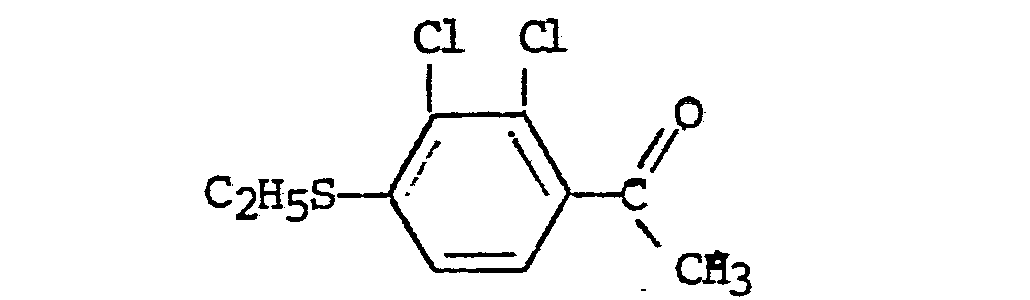
- To a solution of the 2-ethylthio-2,3-dichlorobenzene (0.5 moles) and 78.5 grans (g) (1.0 mole) acetyl chloride in 500 milliliters (ml) of methylene chloride at 5°C was added aluninum chloride (133.5 g, 1.0 mole) portionwise, over a period of 1.0 hour. The reaction was allowed to warm to roan temperature, and then it was slowly poured into a mixture of ice and 2N hydrochloric acid. The layers were separated and the methylene chloride layer was washed with 5% NaOH and water. After drying over magnesium sulfate, the methylene chloride was removed in vacuo to afford the acetophenone (114 g, 90%) as a tan solid with m:p. 53-55°C.
- Additional compounds were prepared by the sane procedure as described in Example 1 and are listed in Table 1.

-

- The 4-ethylthio-2,3-dichloroacetophenone prepared in Example 1 was oxidized to the corresponding acid enploying iodine-pyridine and sodium hydroxide in a manner as described by L.C. King, J. Amer. Chem. Soc., 66, 894 (1944). m.p. 204-206°C.
- Additional compounds were prepared by the same procedure as described in Example 2 and are listed in Table 2.

-

- A vigourously stirred mixture of the 4-ethylthio-2,3-dichloro- acetophenone prepared in Example 1 (0.25 mole), dioxane (200 ml), and 5% sodium hypochlorite (1860 ml, 1.25 mole) was slowly heated to 80°C, whereupon an exothermic reaction commenced. After the exotherm (80-100°C) had subsided the reaction mixture was cooled and acidified with concentrated hydrochloric acid. Filtration of the resulting precipitate then afforded the desired acid. m.p. 170-172°C.
- Additional ccmpounds were prepared by the same procedure as described in Example 3 and are listed in Table 3.

-

- A solution of the 4-ethylsulfonyl-2,3-dichlorobenzoic acid prepared in Example 3 (0.35 mole) in 500 ml of 20% sodium hydroxide was heated at reflux for 7 hours. After cooling, the aqueous solution was acidified with concentrated hydrochloric acid and extracted twice with ethyl acetate. The ethyl acetate extracts were combined, dried over magnesium sulfate, and concentrated in vacuo to afford the crude acid. Recrystallization of the crude acid frcm ethyl acetate afforded the desired pure acid as white crystals. m.p. 188-192°C.
- Additional compounds were prepared by the sane procedure as described in Example 4 and are listed in Table 4.

-

- A mixture of the 2-chloro-4-ethylsulfonyl-3-hydroxybenzoic acid prepared in Example 4 (0.075 mole), ethyl iodide (0.5 mole), and potassium carbonate (0.1 mole) in dimethyl formamide (150 ml) was heated at 90°C for 7 hours. After cooling, the reaction mixture was partitioned between ethyl acetate and 5% potassium carbonate. The ethyl acetate layer was then washed with brine, dried over magnesium sulfate, and concentrated in vacuo to afford the crude ethyl ester of the desired benzoic acid. Hydrolysis of the ester to the acid was accomplished by stirring the ester (0.075 mole) with a base such as sodium hydroxide (0.1 mole) in ethanol (100 ml) at roan temperature for 16 hours. The reaction mixture was acidified with 2N HC1, and then partitioned between methylene chloride and water. The methylene chloride layer was dried over magnesium sulfate and concentrated in vacuo to afford the acid as an oil.
- Additional compounds were prepared by the sane procedure as described in Example 5 and are listed in Table 5.

-

- A mixture of the 3-ethoxy-4-ethylsulfonyl-2-chlorobenzoic acid (0.1 mole), potassium carbonate (0.3 mole) , diethylsulfate (0.1 mole) and dimethylforanide (150 ml) was stirred at roan temperature for 1 hour to give the ethyl ester. Then ethylmercaptan (0.2 mole) was added and the reaction mixture was stirred for 4 days at roan temperature to replace the 4-ethylsulfonyl group with a 4-ethylthio group. The reaction mixture was partitioned between methylene chloride and water, and the methylene chloride layer concentrated in vacuo to afford the crude product ester. Hydrolysis of the ester to the acid was accomplished by stirring the ester (0.1 mole) with a base such as sodium hydroxide (0.1 mole) in ethanol (100 ml) at roan temperature for 16 hours. The reaction mixture was acidified with 2N hydrochloric acid, and then partitioned between methylene chloride and water. The methylene chloride layer was dried over magnesiun sulfate and concentrated in vacuo to afford the acid. m.p. 116-120°C.
-

- A solution of the 4-ethylsulfonyl-2,3-dichlorobenzoic acid prepared in Exanple 3 (0.2 mole), ethyl mercaptan (0.8 mole), sodium hydroxide (1 mole) in water (300 ml) was heated at reflux for 24 hours. After cooling, the reaction mixture was acidified with concentrated hydrochloric acid and extracted with methylene chloride. The layers were separated, and the methylene chloride layer was dried over magnesium sulfate. Evaporation of the methylene chloride in vacuo then afforded a mixture of the acids which were esterified to the methyl esters with methanol and sulfuric acid in ethylene dichloride by the procedure of Clinton and Lawkowski, J. Amer. Chen. Soc., 70, 3135 (1948). The esters were then separated via standard chromatographic techniques. Basic hydrolysis of each methyl ester then afforded the 3,4-bis-ethylthio-2-chlorobenzoic acid, m.p. 73-75°C and 2-chloro-4-ethylsulfonyl-3-ethylthio-benzoic acid oil.
- Additional compounds were prepared by the sane procedure as described in Example 7 and are listed in Tables 6 and 7.


- The intermediate benzoic acids of this invention can easily be converted to their respective acid chlorides and then to their acid cyanides by the following two reactions. First, a mole of oxalyl chloride in a suitable solvent such as methylene chloride at a temperature of 20 to 40°C for 1 to 4 hours is heated with a mole of the intermediate acid according to the following reaction scheme:

- The corresponding benzoic acid cyanide can be easily be prepared from the benzoic acid chloride by reaction with cupous cyanide at a temperature of 150 to 220°C for 1 to 2 hours according to the following reaction:

- The above-described acid chlorides can be reacted with a 1,3-cyclohexanedione to prepare the above-described
herbicidal 2,3,4-trisubstituted benzoyl-1,3-cyclohexane diones according to the following two- step reaction:
- Generally, in step (1) mole anounts of the dione and substituted benzoyl chloride are used, along with a slight mole excess of triethylamine. The two reactants are canbined in a solvent such as methylene chloride. The triethylamine is slowly added to the reaction mixture with cooling. The mixture is stirred at room temperature for several hours.
- The reaction product is worked up by conventional techniques.

- Generally, in step (2) a mole of the enol ester intermediate is reacted with 1 to 4 moles of the triethylanine, preferably 2 moles of the triethylanine and up to 0.5 mole, preferably 0.1 mole of a cyanide source (e.g., potassium cyanide or acetonecyanohydrin). The mixture is stirred in a reaction pot for about one hour at roan temperature and the desired product is recovered by conventional techniques.
Claims (10)


Priority Applications (1)
| Application Number | Priority Date | Filing Date | Title |
|---|---|---|---|
| AT86101898T ATE40682T1 (en) | 1985-03-07 | 1986-02-14 | TRIPLE SUBSTITUTED BENZOAC INTERMEDIATE. |
Applications Claiming Priority (2)
| Application Number | Priority Date | Filing Date | Title |
|---|---|---|---|
| US709006 | 1985-03-07 | ||
| US06/709,006 US4898973A (en) | 1985-03-07 | 1985-03-07 | Trisubstituted benzoic acid intermediates |
Publications (2)
| Publication Number | Publication Date |
|---|---|
| EP0195247A1 true EP0195247A1 (en) | 1986-09-24 |
| EP0195247B1 EP0195247B1 (en) | 1989-02-08 |
Family
ID=24848089
Family Applications (1)
| Application Number | Title | Priority Date | Filing Date |
|---|---|---|---|
| EP86101898A Expired EP0195247B1 (en) | 1985-03-07 | 1986-02-14 | Trisubstituted benzoic acid intermediates |
Country Status (31)
| Country | Link |
|---|---|
| US (3) | US4898973A (en) |
| EP (1) | EP0195247B1 (en) |
| JP (3) | JPH0660158B2 (en) |
| KR (1) | KR900003789B1 (en) |
| CN (1) | CN1009086B (en) |
| AT (1) | ATE40682T1 (en) |
| AU (1) | AU585316B2 (en) |
| BG (1) | BG46455A3 (en) |
| BR (1) | BR8601007A (en) |
| CA (1) | CA1266485A1 (en) |
| CS (1) | CS270431B2 (en) |
| DD (1) | DD247216A5 (en) |
| DE (1) | DE3662042D1 (en) |
| DK (3) | DK171296B1 (en) |
| ES (1) | ES8800143A1 (en) |
| FI (1) | FI89908C (en) |
| GR (1) | GR860609B (en) |
| HU (1) | HU198905B (en) |
| IE (1) | IE59252B1 (en) |
| IL (1) | IL78058A (en) |
| MY (1) | MY101513A (en) |
| NO (1) | NO163403C (en) |
| NZ (1) | NZ215384A (en) |
| PH (1) | PH22179A (en) |
| PL (1) | PL148300B1 (en) |
| PT (1) | PT82136B (en) |
| RO (1) | RO92753A (en) |
| SU (1) | SU1436870A3 (en) |
| YU (1) | YU46000B (en) |
| ZA (1) | ZA861630B (en) |
| ZW (1) | ZW5686A1 (en) |
Cited By (10)
| Publication number | Priority date | Publication date | Assignee | Title |
|---|---|---|---|---|
| EP0369803A1 (en) * | 1988-11-18 | 1990-05-23 | Zeneca Inc. | Trisubstituted benzoic acid intermediates |
| US5001256A (en) * | 1988-11-18 | 1991-03-19 | Ici Americas Inc. | Trisubstituted benzoic acid intermediates |
| US5047572A (en) * | 1988-11-18 | 1991-09-10 | Ici Americas Inc. | Trisubstituted benzoic acid intermediates |
| US5068423A (en) * | 1988-11-18 | 1991-11-26 | Ici Americas Inc. | Trisubstituted benzoic acid intermediates |
| US5073642A (en) * | 1988-11-18 | 1991-12-17 | Ici Americas Inc. | Trisubstituted benzoic acid intermediates |
| US5075497A (en) * | 1988-11-18 | 1991-12-24 | Ici Americas, Inc. | Trisubstituted benzoic acid intermediates |
| WO1997028122A3 (en) * | 1996-02-01 | 1997-10-02 | Rhone Poulenc Agrochimie | Process for preparing diketone compounds |
| US5846906A (en) * | 1995-02-24 | 1998-12-08 | Basf Aktiengesellschaft | Herbicidally active phenyldiketone compounds |
| US6004903A (en) * | 1995-02-24 | 1999-12-21 | Basf Aktiengesellschaft | 2-Anylocyclohexanediones having improved herbicidal properties |
| EP2546240A1 (en) | 2005-12-15 | 2013-01-16 | Ishihara Sangyo Kaisha, Ltd. | Benzoylpyrazole compounds and herbicides containing them |
Families Citing this family (13)
| Publication number | Priority date | Publication date | Assignee | Title |
|---|---|---|---|---|
| JP2734579B2 (en) * | 1988-09-19 | 1998-03-30 | 日産化学工業株式会社 | Method for producing substituted benzoic acid |
| GB9310203D0 (en) * | 1993-05-18 | 1993-06-30 | Rhone Poulenc Agriculture | Compositions of new matter |
| US5101065A (en) * | 1991-02-04 | 1992-03-31 | Imperial Chemical Industries Plc | Acetophenone intermediates |
| US5153357A (en) * | 1991-02-04 | 1992-10-06 | Imperical Chemical Industries Plc | Preparation of trisubstituted benzoic acids and intermediates |
| JPH05170730A (en) * | 1991-12-25 | 1993-07-09 | Nippon Soda Co Ltd | New intermediate compound and its production |
| US6211403B1 (en) | 1997-03-24 | 2001-04-03 | Dow Agrosciences Llc | Process for preparing 2-chloro-3-alkoxy-4-alkylsulfonyl-benzoic acids and esters |
| AR012141A1 (en) * | 1997-03-24 | 2000-09-27 | Dow Agrosciences Llc | PROCESS TO PREPARE 1-ALKYL-4- (2-CHLORINE-3-ALCOXYBENZENE), INTERMEDIATE COMPOUNDS FOR APPLICATION IN SUCH PROCESS AND PROCEDURE FOR PREPARING SUCH INTERMEDIARY COMPOUNDS |
| WO2000003988A1 (en) * | 1998-07-14 | 2000-01-27 | Nippon Soda Co., Ltd. | Novel benzoic acid derivatives and processes for the preparation thereof |
| JP4592129B2 (en) * | 1998-07-14 | 2010-12-01 | 日本曹達株式会社 | Novel benzoic acid derivatives and process for producing the same |
| CN101691347A (en) * | 2009-09-28 | 2010-04-07 | 唐保清 | Preparation process of 4-(Trifluoromethylthio)benzoyl chloride |
| DE102017010478A1 (en) * | 2016-12-02 | 2018-06-07 | Merck Patent Gmbh | Thioether compounds |
| CN113387942B (en) | 2020-03-13 | 2025-08-01 | 沈阳中化农药化工研发有限公司 | Pyrazole carboxylic ester compound and application thereof |
| CN117886724B (en) * | 2023-12-25 | 2026-02-17 | 江苏好收成韦恩农化股份有限公司 | Synthesis method of 2-chloro-3-methyl-4-methylsulfonyl benzoic acid |
Citations (3)
| Publication number | Priority date | Publication date | Assignee | Title |
|---|---|---|---|---|
| DE2056912A1 (en) * | 1969-11-20 | 1971-05-27 | ||
| EP0017195A1 (en) * | 1979-03-31 | 1980-10-15 | Eisai Co., Ltd. | Derivatives of 2,5-disubstituted-cyclohexane-1,3-diones, process for preparation thereof and pharmaceutical composition containing them |
| EP0137963A1 (en) * | 1983-09-16 | 1985-04-24 | Stauffer Chemical Company | Certain 2-(2-substituted Benzoyl)-1,3-Cyclohexanediones |
Family Cites Families (9)
| Publication number | Priority date | Publication date | Assignee | Title |
|---|---|---|---|---|
| US3663615A (en) * | 1970-03-02 | 1972-05-16 | Merck & Co Inc | Nuclear sulfamoyl n-organosulfonyl benzamides |
| BE793689A (en) * | 1972-07-19 | 1973-05-02 | Renfag Sa | PROCESS FOR PREPARING 2-ALCOXY-5-ALCOYSULFONYLBENZOIC ACIDS |
| CH657849A5 (en) * | 1980-07-17 | 1986-09-30 | Ciba Geigy Ag | N-Phenylsulfonyl-N'-pyrimidinyl- and -triazinyl ureas |
| US4780127A (en) * | 1982-03-25 | 1988-10-25 | Stauffer Chemical Company | Certain 2-(substituted benzoyl)-1,3-cyclohexanediones and their use as herbicides |
| JPS58198464A (en) * | 1982-05-14 | 1983-11-18 | Seitetsu Kagaku Co Ltd | Preparation of 4-methylthio-2-alkoxybenzoic acid |
| US4816066A (en) * | 1983-09-16 | 1989-03-28 | Stauffer Chemical Company | Certain 2-(2-substituted benzoyl)-1,3-cyclohexanediones |
| US4806146A (en) * | 1984-12-20 | 1989-02-21 | Stauffer Chemical Company | Certain 2-(2-substituted benzoyl)-1,3-cyclohexanediones |
| US4681621A (en) * | 1984-12-20 | 1987-07-21 | Stauffer Chemical Company | Herbicidal 2-(2-substituted benzoyl)-1,3-cyclopentanediones |
| US4695673A (en) * | 1985-11-20 | 1987-09-22 | Stauffer Chemical Company | Process for the production of acylated 1,3-dicarbonyl compounds |
-
1985
- 1985-03-07 US US06/709,006 patent/US4898973A/en not_active Expired - Lifetime
-
1986
- 1986-02-14 DE DE8686101898T patent/DE3662042D1/en not_active Expired
- 1986-02-14 EP EP86101898A patent/EP0195247B1/en not_active Expired
- 1986-02-14 AT AT86101898T patent/ATE40682T1/en not_active IP Right Cessation
- 1986-02-27 KR KR1019860001369A patent/KR900003789B1/en not_active Expired
- 1986-03-03 CN CN86101277A patent/CN1009086B/en not_active Expired
- 1986-03-04 PH PH33475A patent/PH22179A/en unknown
- 1986-03-04 PT PT82136A patent/PT82136B/en not_active IP Right Cessation
- 1986-03-04 FI FI860900A patent/FI89908C/en not_active IP Right Cessation
- 1986-03-05 GR GR860609A patent/GR860609B/en unknown
- 1986-03-05 RO RO86122453A patent/RO92753A/en unknown
- 1986-03-05 DD DD86287607A patent/DD247216A5/en not_active IP Right Cessation
- 1986-03-05 ZA ZA861630A patent/ZA861630B/en unknown
- 1986-03-06 ZW ZW56/86A patent/ZW5686A1/en unknown
- 1986-03-06 HU HU86969A patent/HU198905B/en not_active IP Right Cessation
- 1986-03-06 NO NO860850A patent/NO163403C/en not_active IP Right Cessation
- 1986-03-06 JP JP61047467A patent/JPH0660158B2/en not_active Expired - Lifetime
- 1986-03-06 IL IL78058A patent/IL78058A/en unknown
- 1986-03-06 IE IE59186A patent/IE59252B1/en not_active IP Right Cessation
- 1986-03-06 YU YU33286A patent/YU46000B/en unknown
- 1986-03-06 AU AU54363/86A patent/AU585316B2/en not_active Ceased
- 1986-03-06 CA CA000503424A patent/CA1266485A1/en active Granted
- 1986-03-06 CS CS861564A patent/CS270431B2/en not_active IP Right Cessation
- 1986-03-06 SU SU864027161A patent/SU1436870A3/en active
- 1986-03-06 NZ NZ215384A patent/NZ215384A/en unknown
- 1986-03-07 BR BR8601007A patent/BR8601007A/en not_active IP Right Cessation
- 1986-03-07 PL PL1986258287A patent/PL148300B1/en unknown
- 1986-03-07 DK DK106186A patent/DK171296B1/en not_active IP Right Cessation
- 1986-03-07 BG BG073980A patent/BG46455A3/en unknown
- 1986-03-07 ES ES552804A patent/ES8800143A1/en not_active Expired
-
1987
- 1987-09-18 MY MYPI87001765A patent/MY101513A/en unknown
-
1989
- 1989-12-07 US US07/447,360 patent/US4966998A/en not_active Expired - Lifetime
- 1989-12-07 US US07/447,359 patent/US5097068A/en not_active Expired - Fee Related
-
1990
- 1990-09-03 DK DK199002107A patent/DK173258B1/en not_active IP Right Cessation
- 1990-09-03 DK DK199002108A patent/DK173261B1/en not_active IP Right Cessation
-
1993
- 1993-11-30 JP JP5300688A patent/JPH0748342A/en active Pending
- 1993-11-30 JP JP5300687A patent/JPH0688964B2/en not_active Expired - Lifetime
Patent Citations (3)
| Publication number | Priority date | Publication date | Assignee | Title |
|---|---|---|---|---|
| DE2056912A1 (en) * | 1969-11-20 | 1971-05-27 | ||
| EP0017195A1 (en) * | 1979-03-31 | 1980-10-15 | Eisai Co., Ltd. | Derivatives of 2,5-disubstituted-cyclohexane-1,3-diones, process for preparation thereof and pharmaceutical composition containing them |
| EP0137963A1 (en) * | 1983-09-16 | 1985-04-24 | Stauffer Chemical Company | Certain 2-(2-substituted Benzoyl)-1,3-Cyclohexanediones |
Cited By (14)
| Publication number | Priority date | Publication date | Assignee | Title |
|---|---|---|---|---|
| US5075497A (en) * | 1988-11-18 | 1991-12-24 | Ici Americas, Inc. | Trisubstituted benzoic acid intermediates |
| US5001256A (en) * | 1988-11-18 | 1991-03-19 | Ici Americas Inc. | Trisubstituted benzoic acid intermediates |
| US5047572A (en) * | 1988-11-18 | 1991-09-10 | Ici Americas Inc. | Trisubstituted benzoic acid intermediates |
| US5068423A (en) * | 1988-11-18 | 1991-11-26 | Ici Americas Inc. | Trisubstituted benzoic acid intermediates |
| US5073642A (en) * | 1988-11-18 | 1991-12-17 | Ici Americas Inc. | Trisubstituted benzoic acid intermediates |
| EP0369803A1 (en) * | 1988-11-18 | 1990-05-23 | Zeneca Inc. | Trisubstituted benzoic acid intermediates |
| WO1990005715A1 (en) * | 1988-11-18 | 1990-05-31 | Ici Americas Inc. | Trisubstituted benzoic acid intermediates |
| US6004903A (en) * | 1995-02-24 | 1999-12-21 | Basf Aktiengesellschaft | 2-Anylocyclohexanediones having improved herbicidal properties |
| US5846906A (en) * | 1995-02-24 | 1998-12-08 | Basf Aktiengesellschaft | Herbicidally active phenyldiketone compounds |
| US6696613B2 (en) | 1996-02-01 | 2004-02-24 | Rhone Poulenc Agrochimie | Process for preparing diketone compounds and precursors thereto |
| US6235942B1 (en) | 1996-02-01 | 2001-05-22 | Rhone-Poulenc Agrochimie | Process for preparing diketone compounds |
| US6525225B2 (en) | 1996-02-01 | 2003-02-25 | Rhone Poulenc Agrochimie | Process for preparing diketone compounds and precursors thereto |
| WO1997028122A3 (en) * | 1996-02-01 | 1997-10-02 | Rhone Poulenc Agrochimie | Process for preparing diketone compounds |
| EP2546240A1 (en) | 2005-12-15 | 2013-01-16 | Ishihara Sangyo Kaisha, Ltd. | Benzoylpyrazole compounds and herbicides containing them |
Also Published As
Similar Documents
| Publication | Publication Date | Title |
|---|---|---|
| EP0195247B1 (en) | Trisubstituted benzoic acid intermediates | |
| US3966826A (en) | Phenyl ethers | |
| EP0444143B1 (en) | Trisubstituted benzoic acid intermediates | |
| US5001256A (en) | Trisubstituted benzoic acid intermediates | |
| US5663365A (en) | Process for the preparation of pyrazolones | |
| US5110979A (en) | Trisubstituted benzoic acid intermediates | |
| US4028409A (en) | Process for the preparation of α-oxothiodimethylamide compounds | |
| HU209288B (en) | A new method for producing 2-(chlorine, bromine or nitro)-4-(chlorine-sulfonyl)-benzoyl-chloride | |
| US5101065A (en) | Acetophenone intermediates | |
| CA1270851A (en) | Trisubstituted benzoic acid intermediates | |
| US5047572A (en) | Trisubstituted benzoic acid intermediates | |
| US5153357A (en) | Preparation of trisubstituted benzoic acids and intermediates | |
| US5075497A (en) | Trisubstituted benzoic acid intermediates | |
| US4267388A (en) | Process for producing ethynylbenzenes | |
| US5073642A (en) | Trisubstituted benzoic acid intermediates | |
| US5068423A (en) | Trisubstituted benzoic acid intermediates | |
| US4568760A (en) | Process for the preparation of lactic acid silyl esters | |
| US4945178A (en) | Preparation of 4-carboalkoxy-1,3-cyclohexanedione type compounds | |
| KR810000816B1 (en) | Preparing process for 4-benzoyl pyrazol derivatives and its aluminum salts | |
| SU941359A1 (en) | Process for producing methylnealkyl derivatives of cyclohexanone | |
| JPH07247267A (en) | Production of phenyl ethers | |
| SE446735B (en) | PROCEDURE FOR PREPARING CERTAIN TIAZOLIDIN-4-ON ETHOIC ACID DERIVATIVES |
Legal Events
| Date | Code | Title | Description |
|---|---|---|---|
| PUAI | Public reference made under article 153(3) epc to a published international application that has entered the european phase |
Free format text: ORIGINAL CODE: 0009012 |
|
| AK | Designated contracting states |
Kind code of ref document: A1 Designated state(s): AT BE CH DE FR GB IT LI NL SE |
|
| 17P | Request for examination filed |
Effective date: 19870126 |
|
| 17Q | First examination report despatched |
Effective date: 19871105 |
|
| GRAA | (expected) grant |
Free format text: ORIGINAL CODE: 0009210 |
|
| AK | Designated contracting states |
Kind code of ref document: B1 Designated state(s): AT BE CH DE FR GB IT LI NL SE |
|
| REF | Corresponds to: |
Ref document number: 40682 Country of ref document: AT Date of ref document: 19890215 Kind code of ref document: T |
|
| REF | Corresponds to: |
Ref document number: 3662042 Country of ref document: DE Date of ref document: 19890316 |
|
| ET | Fr: translation filed | ||
| ITF | It: translation for a ep patent filed | ||
| PLBE | No opposition filed within time limit |
Free format text: ORIGINAL CODE: 0009261 |
|
| STAA | Information on the status of an ep patent application or granted ep patent |
Free format text: STATUS: NO OPPOSITION FILED WITHIN TIME LIMIT |
|
| 26N | No opposition filed | ||
| ITTA | It: last paid annual fee | ||
| EAL | Se: european patent in force in sweden |
Ref document number: 86101898.4 |
|
| NLS | Nl: assignments of ep-patents |
Owner name: ZENECA AG PRODUCTS INC.;RHONE-POULENC INC. |
|
| NLT1 | Nl: modifications of names registered in virtue of documents presented to the patent office pursuant to art. 16 a, paragraph 1 |
Owner name: AVENTIS CROPSCIENCE USA INC.;RHONE-POULENC BASIC C |
|
| REG | Reference to a national code |
Ref country code: CH Ref legal event code: PUE Owner name: STAUFFER CHEMICAL COMPANY TRANSFER- ZENECA AG PROD Ref country code: CH Ref legal event code: NV Representative=s name: BOVARD AG PATENTANWAELTE |
|
| BECA | Be: change of holder's address |
Free format text: 20000525 *ZENECA A.G. PRODUCTS INC.:1800 CONCORD PIKE P.O. BOX 15458, WILMINGTON DE 19850-5448 |
|
| BECH | Be: change of holder |
Free format text: 20000525 *ZENECA A.G. PRODUCTS INC. |
|
| BECN | Be: change of holder's name |
Effective date: 20000525 |
|
| REG | Reference to a national code |
Ref country code: FR Ref legal event code: TP Ref country code: FR Ref legal event code: CD |
|
| REG | Reference to a national code |
Ref country code: FR Ref legal event code: TP |
|
| REG | Reference to a national code |
Ref country code: GB Ref legal event code: IF02 |
|
| PGFP | Annual fee paid to national office [announced via postgrant information from national office to epo] |
Ref country code: SE Payment date: 20020206 Year of fee payment: 17 |
|
| PGFP | Annual fee paid to national office [announced via postgrant information from national office to epo] |
Ref country code: FR Payment date: 20020212 Year of fee payment: 17 |
|
| PGFP | Annual fee paid to national office [announced via postgrant information from national office to epo] |
Ref country code: GB Payment date: 20020213 Year of fee payment: 17 Ref country code: AT Payment date: 20020213 Year of fee payment: 17 |
|
| PGFP | Annual fee paid to national office [announced via postgrant information from national office to epo] |
Ref country code: CH Payment date: 20020214 Year of fee payment: 17 |
|
| PGFP | Annual fee paid to national office [announced via postgrant information from national office to epo] |
Ref country code: DE Payment date: 20020227 Year of fee payment: 17 |
|
| PGFP | Annual fee paid to national office [announced via postgrant information from national office to epo] |
Ref country code: NL Payment date: 20020228 Year of fee payment: 17 |
|
| PGFP | Annual fee paid to national office [announced via postgrant information from national office to epo] |
Ref country code: BE Payment date: 20020418 Year of fee payment: 17 |
|
| PG25 | Lapsed in a contracting state [announced via postgrant information from national office to epo] |
Ref country code: GB Free format text: LAPSE BECAUSE OF NON-PAYMENT OF DUE FEES Effective date: 20030214 Ref country code: AT Free format text: LAPSE BECAUSE OF NON-PAYMENT OF DUE FEES Effective date: 20030214 |
|
| PG25 | Lapsed in a contracting state [announced via postgrant information from national office to epo] |
Ref country code: SE Free format text: LAPSE BECAUSE OF NON-PAYMENT OF DUE FEES Effective date: 20030215 |
|
| PG25 | Lapsed in a contracting state [announced via postgrant information from national office to epo] |
Ref country code: LI Free format text: LAPSE BECAUSE OF NON-PAYMENT OF DUE FEES Effective date: 20030228 Ref country code: CH Free format text: LAPSE BECAUSE OF NON-PAYMENT OF DUE FEES Effective date: 20030228 Ref country code: BE Free format text: LAPSE BECAUSE OF NON-PAYMENT OF DUE FEES Effective date: 20030228 |
|
| PG25 | Lapsed in a contracting state [announced via postgrant information from national office to epo] |
Ref country code: NL Free format text: LAPSE BECAUSE OF NON-PAYMENT OF DUE FEES Effective date: 20030901 |
|
| PG25 | Lapsed in a contracting state [announced via postgrant information from national office to epo] |
Ref country code: DE Free format text: LAPSE BECAUSE OF NON-PAYMENT OF DUE FEES Effective date: 20030902 |
|
| EUG | Se: european patent has lapsed | ||
| GBPC | Gb: european patent ceased through non-payment of renewal fee | ||
| REG | Reference to a national code |
Ref country code: CH Ref legal event code: PL |
|
| PG25 | Lapsed in a contracting state [announced via postgrant information from national office to epo] |
Ref country code: FR Free format text: LAPSE BECAUSE OF NON-PAYMENT OF DUE FEES Effective date: 20031031 |
|
| NLV4 | Nl: lapsed or anulled due to non-payment of the annual fee |
Effective date: 20030901 |
|
| REG | Reference to a national code |
Ref country code: FR Ref legal event code: ST |
|
| PG25 | Lapsed in a contracting state [announced via postgrant information from national office to epo] |
Ref country code: IT Free format text: LAPSE BECAUSE OF NON-PAYMENT OF DUE FEES Effective date: 20050214 |