EP0194875A2 - Brettspiel - Google Patents
Brettspiel Download PDFInfo
- Publication number
- EP0194875A2 EP0194875A2 EP86301785A EP86301785A EP0194875A2 EP 0194875 A2 EP0194875 A2 EP 0194875A2 EP 86301785 A EP86301785 A EP 86301785A EP 86301785 A EP86301785 A EP 86301785A EP 0194875 A2 EP0194875 A2 EP 0194875A2
- Authority
- EP
- European Patent Office
- Prior art keywords
- playing
- symbols
- indicia
- pieces
- playing piece
- Prior art date
- Legal status (The legal status is an assumption and is not a legal conclusion. Google has not performed a legal analysis and makes no representation as to the accuracy of the status listed.)
- Withdrawn
Links
Images
Classifications
-
- A—HUMAN NECESSITIES
- A63—SPORTS; GAMES; AMUSEMENTS
- A63F—CARD, BOARD, OR ROULETTE GAMES; INDOOR GAMES USING SMALL MOVING PLAYING BODIES; VIDEO GAMES; GAMES NOT OTHERWISE PROVIDED FOR
- A63F3/00—Board games; Raffle games
- A63F3/00003—Types of board games
- A63F3/00088—Board games concerning traffic or travelling
-
- A—HUMAN NECESSITIES
- A63—SPORTS; GAMES; AMUSEMENTS
- A63F—CARD, BOARD, OR ROULETTE GAMES; INDOOR GAMES USING SMALL MOVING PLAYING BODIES; VIDEO GAMES; GAMES NOT OTHERWISE PROVIDED FOR
- A63F3/00—Board games; Raffle games
- A63F3/00697—Playing pieces
- A63F2003/00716—Connectable or stackable playing pieces or parts thereof
- A63F2003/00719—Connectable or stackable playing pieces or parts thereof with connections amongst the playing pieces or parts thereof
-
- A—HUMAN NECESSITIES
- A63—SPORTS; GAMES; AMUSEMENTS
- A63F—CARD, BOARD, OR ROULETTE GAMES; INDOOR GAMES USING SMALL MOVING PLAYING BODIES; VIDEO GAMES; GAMES NOT OTHERWISE PROVIDED FOR
- A63F3/00—Board games; Raffle games
- A63F3/00003—Types of board games
- A63F3/00006—Board games played along a linear track, e.g. game of goose, snakes and ladders, along an endless track
Definitions
- This invention relates to board game apparatuses wherein pieces are moved over a board having a pattern and, in the preferred embodiment, to transportation games.
- Games employing movement of playing pieces over a patterned game hoard are popular, and game boards with rectangular, circular, and abstract patterns have been developed for playing such games.
- Transportation games are known, and game apparatuses employing air transport, rail transport, trucking, subway, space travel, and shipping themes have been developed.
- game apparatuses have not been provided for games that require the player tg select his or her route and cargo load so as to optimally utilize, for both current and future moves, a limited amount of playing piece cargo carrying capacity.
- the present invention provides a game board apparatus for playing a strategic and entertaining game.
- a game board and two types of playing pieces are provided.
- the game board is provided with a playing surface which displays a plurality of interconnected first symbols that may represent specific geographic locations interconnected by transportation routes. At some or all of the first symbols are reversibly positioned second playing pieces that may represent passengers or cargo. Each second playing piece is marked in a manner to indicate a specific first symbol that is its destination.
- Each of two or more players employs at least one first playing piece, which may resemble an airplane or other vehicle, to transport the second playing pieces to their specified destinations, Each first playing piece can be loaded with second playing pieces in finite combination and may then be moved for a fixed distance or interval across the playing surface per turn.
- each player In moving so, each player must determine which transportation routes to take and what combination and quantity of second playing pieces to load, so that he or she will maximize the utility of the limited second playing piece carrying capacity of the first playing piece by coordinating the current load with future loads.
- the element of chance can be increased by also providing a movement determiner that randomly specifies the distance or interval of each first playing piece move per turn. Playing cards that designate particular conditions of penalty or bonus to which a first playing piece move is subject can also be provided.
- the game is over when all of the second playing pieces have been delivered to their specified destinations.
- the winner is the player who transported the greatest quantity or value of second playing pieces to their specified destinations.
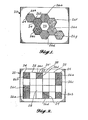
- a game board 20 is provided with a playing surface 22 upon which interconnected first symbols 24 are printed or otherwise displayed.
- a plurality of first symbols 24 are positioned in nonoverlapping arrangement over the playing surface 22.
- the first symbols 24 can be directly interconnected, as in this embodiment wherein each first symbol 24 is positioned so as to contiguously border at least one other first symbol 24.
- the first symbols 24 are distinguished one from another by first indicia 26, such as by color codes.
- each of eight first symbols 24 can be uniquely pigmented red 26a, orange 26b, yellow 26c, green 26d, blue 26e, violet 26f, gray 26g, or brown 26h.
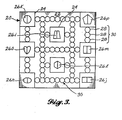
- first symbols 24 can be indirectly interconnected through second symbols 28.
- each first symbol 24 is positioned so as to contiguously border a plurality of other symbols, at least one of which is a second symbol 28.
- the first and second symbols 24, 28 are distinguished one type from the other by the absence of first indicia 26 on the second symbols 28.
- the various first symbols 24 are distinctly (but in this case not uniquely) color coded 26a-e, but the various second symbols 28 all lack corresponding pigmentation and are thereby collectively distinguished from the first symbols 24.
- One or more of the first symbols 24 can display a plurality of the first indicia 26.
- a particular first symbol 24' can display both a green first indicium 26d and a blue first indicium 26e.
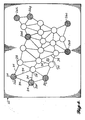
- the first and second symbols 24, 28 can be positioned in spaced arrangement over the playing surface 22 so that all of the first symbols 24 are indirectly interconnected by second symbols 28 and also so that the second symbols 28 are contiguously arranged in linear arrays 30 that extend between and connect various of the first symbols 24.
- the linear arrays 30 branch, cross, and anastomose as they interconnect the first symbols 24 in various ways.
- These particular second symbols 28 are distinguishable from the first symbols 24 by lacking first indicia 26, in this case symbolic coding 26i-p such as the heart-shaped symbol 26o, that individually distinguishes the various first symbols 24.
- These particular second symbols 28 are also distinguishable from the first symbols 24 by second indicia 32, in this case by differences in shape and size, the circular second symbols 28 having distinctly smaller dimensions and areas than the square first symbols 24.
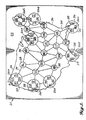
- both first and second symbols 24, 28 can be spaced in noncontiguous arrangement over the playing surface 22, in which case a plurality of third symbols 34 can be located and displayed on the playing surface 22 so as to extend between and connect various of the first and second symbols 24, 28.
- the third symbols 34 can, for example, be lines, as shown in this view, or unidirectional arrows. In this particular embodiment the third symbols 34 neither branch nor cross one another as they interconnect the first and second symbols 24, 28 in various ways.
- each of about two dozen first and second symbols 24, 28 is indirectly connected through third symbols 34 to between two and six adjacent first or second symbols 24, 28, with each of about eight first symbols 24 being connected to between two and five adjacent first or second symbols 24, 28, no more than one or two of which are other first symbols 24, and with any first symbols 24 being removed from any other first symbols 24 by no more than seven and eight intervening second symbols 28 and third symbols 34, respectively.
- the game board 20 can be used to play a transportation game, in which case any or all of the aforementioned symbols 24, 28, 34 can be superimposed over an outline map 36 of a geographical region or country.
- Second and/or first symbols 28, 24 can be positioned in spaced arrangement thereon to represent geographical locations such as population centers, cities, or airports, and third symbols 34 (or arrays 30 of second symbols 28) can be positioned so as to represent transportation routes that extend between and connect various of the geographical locations.
- the playing surface 22 is provided with an outline map 36 of the forty-eight contiguous states of the United States of America, and both first symbols 24 and second symbols 28 are superimposed in noncontiguous arrangement thereon to represent what are designated as destination and transit airports, respectively, for the purposes of the game play.
- Third symbols 34 are provided that variously interconnect the first and second symbols 24, 28 and that thereby represent air travel routes that connect the designated destination and transit airports in various ways.
- the first symbols 24 which represent destination airports are individually distinguished by color-coded first indicia 26, which in this view are indicated by reference numerals 26a-h.
- the first and second symbols 24, 28 are distinguished one type from another by the presence or absence, respectively, of the aforementioned first indicia 26 and also by second indicia 32: in this embodiment by a size differential, the first symbols 24 being distinctly larger than the second symbols 28.
- the various first and second symbols 24, 28 are also individually distinguished by third indicia 38 in the form of three-letter acronyms that correspond to standard commercial aviation industry symbols for cities or airports; for example, HOU for Houston, LAX for Los Angeles International Airport.
- the game board is configured as stated in the preceding paragraph except that an outline map 36 of either Canada or the World is provided, and the third indicia 38 are correspondingly modified to indicate population centers, cities, or airports within those geographical regions.
- Each first playing piece 40 has a lower surface 42 that is adapted for manual placement on the playing surface 22 at selected second symbols 28 and/or first symbols 24 and for travel over the playing surface 22 between first symbols 24, e.g., on third symbols 34 or arrays 30 of second symbols 28.
- Each first playing piece 40 has an upper surface 44 that is adapted for selectively receiving and carrying one or more of the second playing pieces 46 that are described below.
- the first playing pieces 40 can be configured to represent transportation vehicles such as planes, ships, and trucks, and can be made individually distinguishable by, e.g., pigmenting them with hues that preferably do not correspond with any first indicia 26.
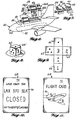
- first playing pieces 40 are configured to simulate the form and appearance of airplanes.
- the lower surface 42 of each first playing piece 40 is flat.
- the upper surface 44 of each first playing piece 40 contains a cavity 48 in the form of two slots 50, each slot 50 having the shape of a right prism with rectangular bases, that are disposed in spaced parallel array one on either side of the longitudinal axis of the first playing piece 40.
- a plurality of second playing pieces 46 of one or more sizes are also provided.
- Each second playing piece 46 is configured such that it can be received and carried by any of the first playing pieces 40.
- each second playing piece has a base 52 that is configured so as to be reversibly received and carried by any of the first playing pieces 40 and an apex 54 that is developed into a manipulable handle.
- each second playing piece 46 has a generally Y-shaped configuration so that the arms and stem of the Y define the base 52 and apex 54, respectively.
- the base 52 of each of these second playing pieces 46 has a pair of parallel legs 56 that permit upright placement of the second playing piece 46 on the playing surface 22 of the game board 20.
- the dimensions and dispositions of the legs 56 also correspond generally to those of the slots 50 in any of the first playing pieces 40 and, thus, the second playing piece legs 56 can be reversibly inserted into those slots 50.
- the length of each slot 50 preferably exceeds the length of a second playing piece base 52 by a fixed multiple, as described below.
- two sizes of second playing pieces 46 are provided: large second playing pieces 46a and small second playing pieces 46b, with the large second playing pieces 46a having bases 52a that are twice as long as the bases 52b of the small second playing pieces 46b.
- each cavity 48 in the upper surface 44 of each first playing piece 40 is correspondingly configured to reversibly receive and carry the base 52 of any of the second playing pieces 46.
- the length of each cavity 48 corresponds to or slightly exceeds five times the length of the base 52b of a small second playing piece 46b (or two and one-half times the length of the base 52a of a large second playing piece 46a).
- the cavity 48 thus configured can receive and carry the above-described second playing pieces 46 in the following finite combinations: either a maximum carrying capacity load consisting of two large 46a and one small 46b, one large 46a and three small 46b, or five small 46b; or partial loads consisting of two large 46a, one large 46a and two small 46b, four small 46b, one large 46a and one small 46b, three small 46b, one large 46a, two small 46b, or one small 46b; or none (empty).
- a minimal number of second playing pieces 46 should be provided such that there are the equivalent of two full carrying capacity loads for each first playing piece 40 employed in the game.
- this minimum number (m) of second playing pieces 46 can be stated as follows: wherein n is a positive integer that denotes the number of sizes of second playing pieces 46 that are provided, Y is the number of first playing pieces 40, and Z is the second playing piece carrying capacity of each first playing piece 40.
- each first indicium 26 should be displayed at least once on one or more of the second playing pieces 46 that are provided.
- the number of second playing pieces 46 that are provided is related to the number (X) of first symbols 24, the number of provided second playing pieces 46 being X(X - 1)n, or multiples thereof, wherein n is a positive integer, preferably either one or two, that denotes the number of sizes of second playing pieces 46 that are provided.
- n is a positive integer, preferably either one or two, that denotes the number of sizes of second playing pieces 46 that are provided.
- X(X - 1) large second playing pieces 46a and X(X - 1) small second playing pieces 46b are provided, with X being a positive integer that denotes the number of first symbols 24 on the playing surface 22 of the game board 20.
- (X - 1) of those should correspondingly display a first indicium 26, such as a particular color code, that distinguishes each of the first symbols 24.
- the aforementioned minimal number of second playing pieces 46 is selected such that the game play as described below will encompass at least two rounds of turns, that is, so that each player will have an opportunity to coordinate at least two cargo loads per game.
- the preferred number of second playing pieces 46 is selected in order to maximize the strategic choices in the game play and facilitate set up as described below.
- second playing pieces 46' are provided with an apex 54 that is developed into a token 58 that corresponds with all or part of a first indicium 26.
- the second playing pieces 46' shown in this view are capped by tokens 58 with hemiheart- shaped configurations.
- a correspondingly coded first symbol 24, such as shown in FIGURE 3 can display a first indicium 26o in the shape of a heart, in which case each token 58 corresponds with a portion, i.e., one-half, of a first indicium 26.
- Other second playing pieces 46' can similarly be provided with tokens 58 configured as other geometric forms that correspond to symbolically coded first indicia 26, such as the first indicia 26i-p shown in FIGURE 3, or portions thereof.
- a movement specifier 60 can be optionally provided.
- Various fifth and/or fourth indicia 64, 62 are displayed on the movement specifier 60, and means are provided for randomly selecting any one of the fourth or fifth indicia 62, 64.
- the fourth indicia 62 denote various first playing piece movement designations.
- the movement specifier 60 can be a standard die (not shown), in which case the fourth indicia 62 can correspond to the symbolic numeral code on the faces of the die.
- Fifth indicia 64 where optionally utilized, denote various first playing piece movement designations in combination with a playing card designation.
- a movement specifier 60 in the form of a special die is provided with three faces 66 having symbolic numeral fourth indicia 62 in the form of dots and with three faces 66 having Arabic numeral fifth indicia 64.
- the special die 60 is tossed to randomly select a fourth or fifth indicium 62, 64 on the uppermost face 66' when the die 60 comes to rest.
- a movement specifier 60 in the form of a dial spinner having either fourth indicia 62 or fourth and fifth indicia 62, 64 as described above may be provided.
- special playing cards 68 can also be optionally provided.
- the playing cards 68 display a uniform ornamental pattern 70 on their secondary surfaces 72.
- the playing cards 68 display one of various sixth indicia 76 that designate particular conditions of penalty or bonus to which a first playing piece movement designation as denoted by a fifth indicium 64 on the movement specifier 60 is subject.
- Some representative sixth indicia 76 for use in an air transportation game embodiment are presented here: 1. East coast fog, BOS, JFK and DCA CLOSED, no takeoffs or landings; 2. Midwest blizzard, ORD, MSP, MCI and STL CLOSED, no takeoffs or landings; 3.
- first and second symbols 24, 28 are not provided with third indicia 38, or if second symbols 28 are not provided on the game board 20, then first indicia 26 representing various of the first symbols 24 can be substituted for the acronyms 38 in the above-listed representative sixth indicia 76.
- the novel game is ready for play.
- the object of the game is to carry the greatest number of second playing pieces 46 to the correspondingly coded first symbols 24 and thereby accrue the most total points.
- a simple embodiment of this game is played with second playing pieces 46 of one size, such as with the small second playing pieces 46a described above that fit in finite combination of up to five per first playing piece cavity 48.
- the game apparatus is set up by selectively distributing the second playing pieces 46 on the playing surface 22 of the game board 20 such that each particular first symbol 24 has (X - 1) second playing pieces 46 positioned thereon, including one second playing piece 46 that displays each of the various first indicia 26 except for the corresponding first indicium (or plurality of first indicia) 26 displayed on the particular first symbol 24.
- the first indicia 26 comprise a color code
- a red first symbol 24 should be set up with one second playing piece 46 of every color except red
- a blue first symbol 24 should be set up with one second playing piece 46 of every color including red but excluding blue, and so on.
- the playing cards 68 are shuffled into a deck and placed, primary surfaces 74 down, at a location convenient to the players.
- the starter selects a first symbol 24 and a first playing piece 40 and positions the selected first playing piece 40 on the playing surface 22 at the selected first symbol 24. Following a predetermined order, other players select from among the remaining, unoccupied first symbols 24 and the remaining first playing pieces 40 and position their selected first playing pieces 40 on their selected first symbols 24.
- the starter then begins the play by loading his or her first playing piece, moving, and unloading, all as described below. Play continues in the predetermined order.
- a player can load any combination of second playing pieces 46 up to a maximum of, e.g., five small second playing pieces 46a into the cavity 48 of his or her first playing piece 40.
- the second playing pieces 46 that make up the load can be selected with any combination of first indicia 26 from among the various second playing pieces 46 that are available at the particular first symbol 24 at which loading occurs.
- There is no minimum load and a first playing piece 40 may be moved empty.
- the first playing piece 40 must be loaded before rolling the die 60. Once the die 60 is thrown, the player must move the first playing piece 40 without further loading, even if the first playing piece 40 is empty.
- Each first or second symbol 24, 28 visited counts as one move.
- a first or second symbol 24, 28, including that from which the player starts the turn, may not be visited twice during one turn.
- a first or second symbol 24, 28 occupied by another first playing piece 40 may not be visited. If a player cannot move the die count rolled, due to blocking by other first playing pieces 40, then the player must forfeit that move.
- a first playing piece 40 must arrive at a destination first symbol 24 by exact count.
- the game is over when all second playing pieces 46 have been delivered to correspondingly coded first symbols 24 and removed as winnings from the board 20. Each player then totals his or her winnings. The player possessing the greatest number of winnings is declared the winner. If a tie occurs the player whose first playing piece 40 ended the game at a higher ranked first or second symbol 24, 28 prevails.
- the first or second symbols 24, 28 can be ranked according to the alphabetical order of the acronyms 38 displayed thereon, e.g., ABQ, ATL, BIL, and so on.
- the game is played as described above but using first playing pieces 40 each having a maximum carrying capacity of one second playing piece 46.
- the game is played as described above but using second playing pieces 46 of two sizes, such as the small and large second playing pieces 46a, 46b.
- second playing pieces 46 of two sizes such as the small and large second playing pieces 46a, 46b.
- One large and one small second playing piece 46a, 46b displaying each noneorres- ponding first indicium 26 are positioned at each first symbol 24 to set up the game.
- the player thus has many strategic choices to make in selecting his or her route and cargo load so as to optimally utilize the limited carrying capacity of the first playing piece 40 for both current and prospective moves.
- the small second playing pieces 46b can be valued at fifty points apiece, and the large second playing pieces 46a can count as one hundred points apiece, for the purposes of totaling winnings.
- each small second playing piece 46b can represent fifty passengers, and each large second playing piece 46a can represent one hundred passengers, in which case the player who transports the most passengers by the end of the game is declared the winner.
- Special game rules can also be added in order to increase the strategic nature of the game play. For example, a player leaving no second playing pieces 46 behind when moving from a first symbol 24 may be entitled to a non-stop flight directly to any other, unoccupied first symbol 24 of choice. The player must however declare the intention to fly non-stop instead of rolling the die 60. Once the player throws the die 60 the non-stop flight privilege is forfeited, and the move must be made according to the die count rolled 62, 64 (including any applicable playing card modifications).
- a simpler but even more strategic game can be played by fixing the distance of each playing move at a certain number of first or second symbols 24, 28, e.g., three, in which case the game apparatus can be provided and used without the movement specifier 60 or the playing cards 68, for example as described with reference to FIGURES 5 and 6 alone, and preferably as described with reference to FIGURE 7 and/or 6 and either of FIGURES 1, 2, or 3.
- the playing surface 22 can be provided with one or more first symbols 24 that each display a plurality of first indicia 26, such as shown in FIGURE 2. Then game rules can specify that winnings result from the unloading thereon of second playing pieces 46 displaying either one or all of the corresponding first indicia 26.
- the first symbols 24 can display symbolic first indicia 26 such as the first indicia 26i-p shown in FIGURE 3
- the second playing pieces 46 can display tokens 58 such as those shown in FIGURE 7 that correspond to only a portion, for example one-half, of any of the first indicia 26i-p.
- the game rules can then specify that winnings must result from a simultaneous unloading of pairs of second playing pieces 46 such that they correspond in combination to the first indicium 26 at the destination first symbol 24.
Landscapes
- Engineering & Computer Science (AREA)
- Educational Technology (AREA)
- Multimedia (AREA)
- Toys (AREA)
- Confectionery (AREA)
- Massaging Devices (AREA)
- Seeds, Soups, And Other Foods (AREA)
- Credit Cards Or The Like (AREA)
Applications Claiming Priority (2)
| Application Number | Priority Date | Filing Date | Title |
|---|---|---|---|
| US712359 | 1985-03-15 | ||
| US06/712,359 US4679798A (en) | 1985-03-15 | 1985-03-15 | Board game apparatus representing transportation |
Publications (2)
| Publication Number | Publication Date |
|---|---|
| EP0194875A2 true EP0194875A2 (de) | 1986-09-17 |
| EP0194875A3 EP0194875A3 (en) | 1988-07-06 |
Family
ID=24861780
Family Applications (1)
| Application Number | Title | Priority Date | Filing Date |
|---|---|---|---|
| EP86301785A Withdrawn EP0194875A3 (en) | 1985-03-15 | 1986-03-12 | Board game apparatus |
Country Status (5)
| Country | Link |
|---|---|
| US (1) | US4679798A (de) |
| EP (1) | EP0194875A3 (de) |
| JP (1) | JPS62376A (de) |
| AU (1) | AU5444786A (de) |
| CA (1) | CA1271203A (de) |
Cited By (2)
| Publication number | Priority date | Publication date | Assignee | Title |
|---|---|---|---|---|
| US5295695A (en) * | 1993-04-22 | 1994-03-22 | Tamanini Vicki L | Method of coding gifts |
| GB2290720A (en) * | 1994-06-29 | 1996-01-10 | Paul Joseph Gregorj | Board games |
Families Citing this family (10)
| Publication number | Priority date | Publication date | Assignee | Title |
|---|---|---|---|---|
| US4958837A (en) * | 1989-06-23 | 1990-09-25 | Russell Faye Y | Travel game with a game board display screen and electronic card reader |
| US4953872A (en) * | 1989-08-03 | 1990-09-04 | Schultz Gerald C | Transportation industry game |
| US5094460A (en) * | 1990-07-20 | 1992-03-10 | Morse Stephen D | Airline travel board game |
| US5150907A (en) * | 1991-06-07 | 1992-09-29 | 1-800 Geopoly | Method of playing an educational geography game |
| US5388830A (en) * | 1991-11-21 | 1995-02-14 | Dixson; Gary V. | Method for playing a dice game |
| US5380011A (en) * | 1993-05-27 | 1995-01-10 | Jarvis; Gregg L. | Transportation game |
| US20080039169A1 (en) * | 2006-08-03 | 2008-02-14 | Seven Lights, Llc | Systems and methods for character development in online gaming |
| US20080039166A1 (en) * | 2006-08-03 | 2008-02-14 | Seven Lights, Llc | Systems and methods for multi-character online gaming |
| US20080039165A1 (en) * | 2006-08-03 | 2008-02-14 | Seven Lights, Llc | Systems and methods for a scouting report in online gaming |
| KR102334057B1 (ko) * | 2021-06-22 | 2021-12-03 | 경상남도 (교육청) | 바이러스 백신 및 치료제 전달 게임 장치 |
Family Cites Families (24)
| Publication number | Priority date | Publication date | Assignee | Title |
|---|---|---|---|---|
| US1065775A (en) * | 1913-03-17 | 1913-06-24 | Charles B Brewer | Game. |
| US2268433A (en) * | 1940-11-12 | 1941-12-30 | Smith Mabel Marie | Amusement game |
| GB645661A (en) * | 1948-10-12 | 1950-11-08 | Harold William John Critchley | Improvements in and relating to board games |
| US3223420A (en) * | 1963-03-07 | 1965-12-14 | Richard L Turner | Solar system travel game |
| US3414264A (en) * | 1965-12-20 | 1968-12-03 | Raymond L. Schriber | Game apparatus with board having differently colored game piece paths |
| US3572718A (en) * | 1967-12-04 | 1971-03-30 | Robert L Moore | Board game apparatus |
| US3582080A (en) * | 1968-05-02 | 1971-06-01 | Frank J Schick | Board game apparatus |
| US3656757A (en) * | 1970-03-30 | 1972-04-18 | James F Carroll | Farm board game apparatus |
| US3726527A (en) * | 1971-01-21 | 1973-04-10 | P Schauffler | World transport game apparatus |
| CA925533A (en) * | 1971-01-21 | 1973-05-01 | L. Moore Robert | Game construction |
| US3751039A (en) * | 1971-12-03 | 1973-08-07 | W Dykoski | Three-dimensional board game apparatus |
| US3799551A (en) * | 1972-04-13 | 1974-03-26 | R Erickson | Travel board game apparatus |
| US4078803A (en) * | 1975-07-10 | 1978-03-14 | Henry Te | Board game with animal tokens |
| US4109917A (en) * | 1976-02-19 | 1978-08-29 | Hatcher Sheila Starr | Trucking game |
| US4071245A (en) * | 1977-02-14 | 1978-01-31 | Kendrick Robert H | Board game |
| US4283059A (en) * | 1977-07-05 | 1981-08-11 | Beeder Wayne A | Board game apparatus |
| US4211419A (en) * | 1977-12-05 | 1980-07-08 | Larsen Russell E | Game board and apparatus |
| US4262907A (en) * | 1978-02-24 | 1981-04-21 | Pentagames, Inc. | Game having a game board and components to be used therewith |
| US4290608A (en) * | 1979-10-05 | 1981-09-22 | Brown Robert O | Lobster trap game |
| US4377287A (en) * | 1980-12-05 | 1983-03-22 | Erwin John R | Board game apparatus |
| US4385765A (en) * | 1981-02-23 | 1983-05-31 | Circle Games | Conquest game |
| US4411432A (en) * | 1981-08-10 | 1983-10-25 | Stevens Richard L | Travel game |
| US4426084A (en) * | 1981-08-12 | 1984-01-17 | Michel Benjamin F | Trucking simulation game |
| US4480837A (en) * | 1983-01-26 | 1984-11-06 | Poirier Kerry L | Maritime game |
-
1985
- 1985-03-15 US US06/712,359 patent/US4679798A/en not_active Expired - Lifetime
-
1986
- 1986-03-07 AU AU54447/86A patent/AU5444786A/en not_active Abandoned
- 1986-03-07 CA CA000503619A patent/CA1271203A/en not_active Expired
- 1986-03-12 EP EP86301785A patent/EP0194875A3/en not_active Withdrawn
- 1986-03-13 JP JP61056057A patent/JPS62376A/ja active Pending
Cited By (2)
| Publication number | Priority date | Publication date | Assignee | Title |
|---|---|---|---|---|
| US5295695A (en) * | 1993-04-22 | 1994-03-22 | Tamanini Vicki L | Method of coding gifts |
| GB2290720A (en) * | 1994-06-29 | 1996-01-10 | Paul Joseph Gregorj | Board games |
Also Published As
| Publication number | Publication date |
|---|---|
| JPS62376A (ja) | 1987-01-06 |
| CA1271203A (en) | 1990-07-03 |
| US4679798A (en) | 1987-07-14 |
| EP0194875A3 (en) | 1988-07-06 |
| AU5444786A (en) | 1986-09-18 |
Similar Documents
| Publication | Publication Date | Title |
|---|---|---|
| US4283059A (en) | Board game apparatus | |
| US4679798A (en) | Board game apparatus representing transportation | |
| US4809987A (en) | Board game apparatus representing destinations | |
| US4180271A (en) | Squiggle game | |
| US4055347A (en) | Board game apparatus | |
| US4049276A (en) | Board game apparatus | |
| US2823919A (en) | Racing-game apparatus | |
| US4377287A (en) | Board game apparatus | |
| US6692002B2 (en) | Board game for enhancing word building skills | |
| US3975021A (en) | Educational device employing a game situation | |
| US3565439A (en) | Double crossword game apparatus | |
| US3044779A (en) | Game | |
| US5405140A (en) | Family vacation board game | |
| US5071132A (en) | Molecular structure game | |
| US4411432A (en) | Travel game | |
| US4932666A (en) | Method of playing a travel board game | |
| US3638946A (en) | Board game apparatus | |
| US3787056A (en) | Aircraft traffic control board game apparatus | |
| US4078803A (en) | Board game with animal tokens | |
| US2211297A (en) | Apparatus for playing an indoor game | |
| US5282630A (en) | Car race game apparatus | |
| US4961582A (en) | Geographical travel game | |
| US4052071A (en) | Travel game | |
| US6123334A (en) | Airport game | |
| US4834389A (en) | Cross country board game |
Legal Events
| Date | Code | Title | Description |
|---|---|---|---|
| PUAI | Public reference made under article 153(3) epc to a published international application that has entered the european phase |
Free format text: ORIGINAL CODE: 0009012 |
|
| AK | Designated contracting states |
Kind code of ref document: A2 Designated state(s): AT BE CH DE FR GB IT LI LU NL SE |
|
| PUAL | Search report despatched |
Free format text: ORIGINAL CODE: 0009013 |
|
| AK | Designated contracting states |
Kind code of ref document: A3 Designated state(s): AT BE CH DE FR GB IT LI LU NL SE |
|
| STAA | Information on the status of an ep patent application or granted ep patent |
Free format text: STATUS: THE APPLICATION IS DEEMED TO BE WITHDRAWN |
|
| 18D | Application deemed to be withdrawn |
Effective date: 19890107 |