EP0192533B1 - Compositions de silicates alcalins et leurs emplois - Google Patents
Compositions de silicates alcalins et leurs emplois Download PDFInfo
- Publication number
- EP0192533B1 EP0192533B1 EP86400203A EP86400203A EP0192533B1 EP 0192533 B1 EP0192533 B1 EP 0192533B1 EP 86400203 A EP86400203 A EP 86400203A EP 86400203 A EP86400203 A EP 86400203A EP 0192533 B1 EP0192533 B1 EP 0192533B1
- Authority
- EP
- European Patent Office
- Prior art keywords
- compositions according
- gelling agent
- gel
- alkyl
- silicate
- Prior art date
- Legal status (The legal status is an assumption and is not a legal conclusion. Google has not performed a legal analysis and makes no representation as to the accuracy of the status listed.)
- Expired
Links
Images
Classifications
-
- C—CHEMISTRY; METALLURGY
- C09—DYES; PAINTS; POLISHES; NATURAL RESINS; ADHESIVES; COMPOSITIONS NOT OTHERWISE PROVIDED FOR; APPLICATIONS OF MATERIALS NOT OTHERWISE PROVIDED FOR
- C09K—MATERIALS FOR MISCELLANEOUS APPLICATIONS, NOT PROVIDED FOR ELSEWHERE
- C09K8/00—Compositions for drilling of boreholes or wells; Compositions for treating boreholes or wells, e.g. for completion or for remedial operations
- C09K8/60—Compositions for stimulating production by acting on the underground formation
- C09K8/84—Compositions based on water or polar solvents
- C09K8/845—Compositions based on water or polar solvents containing inorganic compounds
-
- C—CHEMISTRY; METALLURGY
- C09—DYES; PAINTS; POLISHES; NATURAL RESINS; ADHESIVES; COMPOSITIONS NOT OTHERWISE PROVIDED FOR; APPLICATIONS OF MATERIALS NOT OTHERWISE PROVIDED FOR
- C09K—MATERIALS FOR MISCELLANEOUS APPLICATIONS, NOT PROVIDED FOR ELSEWHERE
- C09K17/00—Soil-conditioning materials or soil-stabilising materials
- C09K17/40—Soil-conditioning materials or soil-stabilising materials containing mixtures of inorganic and organic compounds
- C09K17/48—Organic compounds mixed with inorganic active ingredients, e.g. polymerisation catalysts
-
- C—CHEMISTRY; METALLURGY
- C09—DYES; PAINTS; POLISHES; NATURAL RESINS; ADHESIVES; COMPOSITIONS NOT OTHERWISE PROVIDED FOR; APPLICATIONS OF MATERIALS NOT OTHERWISE PROVIDED FOR
- C09K—MATERIALS FOR MISCELLANEOUS APPLICATIONS, NOT PROVIDED FOR ELSEWHERE
- C09K8/00—Compositions for drilling of boreholes or wells; Compositions for treating boreholes or wells, e.g. for completion or for remedial operations
- C09K8/50—Compositions for plastering borehole walls, i.e. compositions for temporary consolidation of borehole walls
- C09K8/504—Compositions based on water or polar solvents
- C09K8/5045—Compositions based on water or polar solvents containing inorganic compounds
-
- Y—GENERAL TAGGING OF NEW TECHNOLOGICAL DEVELOPMENTS; GENERAL TAGGING OF CROSS-SECTIONAL TECHNOLOGIES SPANNING OVER SEVERAL SECTIONS OF THE IPC; TECHNICAL SUBJECTS COVERED BY FORMER USPC CROSS-REFERENCE ART COLLECTIONS [XRACs] AND DIGESTS
- Y10—TECHNICAL SUBJECTS COVERED BY FORMER USPC
- Y10S—TECHNICAL SUBJECTS COVERED BY FORMER USPC CROSS-REFERENCE ART COLLECTIONS [XRACs] AND DIGESTS
- Y10S106/00—Compositions: coating or plastic
- Y10S106/90—Soil stabilization
-
- Y—GENERAL TAGGING OF NEW TECHNOLOGICAL DEVELOPMENTS; GENERAL TAGGING OF CROSS-SECTIONAL TECHNOLOGIES SPANNING OVER SEVERAL SECTIONS OF THE IPC; TECHNICAL SUBJECTS COVERED BY FORMER USPC CROSS-REFERENCE ART COLLECTIONS [XRACs] AND DIGESTS
- Y10—TECHNICAL SUBJECTS COVERED BY FORMER USPC
- Y10S—TECHNICAL SUBJECTS COVERED BY FORMER USPC CROSS-REFERENCE ART COLLECTIONS [XRACs] AND DIGESTS
- Y10S516/00—Colloid systems and wetting agents; subcombinations thereof; processes of
- Y10S516/902—Gelled emulsion
Definitions
- the present invention relates to gelling compositions of alkali metal silicates in the form of microemulsions obtained using a mixture of surfactants.
- esters have the disadvantage of being poorly soluble in water, which requires vigorous stirring prior to injection in order to have a homogeneous mixture which gels uniformly.
- silicates have been used in tertiary recovery operations to plug areas with high permeability in order to prevent excessive water coming into the producing well.
- the silicate gels used until now in the petroleum industry are intended to form permanent blockages.
- the injection of a solution or emulsion of alkali silicates into a porous medium presents certain difficulties: slow propagation, risks of separation phenomena leading to non-homogeneous clogging.
- recourse is had, according to the prior art, to solutions of organic polymers.
- the object of the present invention is to solve these problems and to provide compositions which can be used for sealing and consolidating soils as well as for permanent or reversible clogging of underground formations which. are stable, easy to apply, which propagate easily in porous media and which lead to the formation of a homogeneous gel, said gel being insensitive to water, oil and drilling or treatment fluids and is resistant to the high temperatures that can be encountered in underground formations, (up to about 200 ° C).
- the alkali silicate compositions according to the invention are based on an alkali metal silicate in aqueous solution, a gelling agent and a surfactant. They are characterized in that they are in the form of microemulsions and in that the surfactant is a system consisting of a mixture of C 4 -C 30 alkylsulfoesters of acids and alkyl and / or alkaline alkenylsulfonates.
- Microemulsions and the basic principles of their formation are known. They are thermodynamically stable systems of micelles of a liquid dispersed in a continuous liquid phase, the two liquids being immiscible (MICROEMULSIONS - Theory and Practice - Published by Leon M. Prince - Academic Press - 1977).
- the aqueous phase is constituted by an alkali silicate solution and the organic phase (oil) is constituted by the gelling agent.
- the silicate concentration in the aqueous solution is determined so as to generally have a level of 1.5 to 25% by weight of silica relative to the total volume of the solution.
- any compound of known type which can be hydrolyzed under the conditions of use can be used.
- the compounds which can be used are included the alkyl esters of saturated or unsaturated aliphatic monocarboxylic, dicarboxylic or polycarboxylic acids; alkyl esters of carboxylic acids carbocyclic; dialkyl and / or trialkyl phosphates; lactones; lower alkylamides; cetoesters.
- the gelling reagent can be chosen more particularly from the alkyl diesters of C 2 -C 10 aliphatic diacids in which the alkyl group contains 1 to 6 carbon atoms and their mixtures with one another; alkyl diesters of phthalic acids in which the alkyl group contains 1 to 6 carbon atoms and their mixtures with one another; dialkyl and / or trialkyl phosphates in which the alkyl group contains 1 to 6 carbon atoms, and mixtures thereof.
- Particularly suitable gelling agents are represented by the diesters of the aliphatic diacids in C 4 ⁇ C ⁇ with a Ci-Ce alkyl group and in particular the succinate, glutarate and adipate of dimethyl, diethyl, di-n-propyl, diisopropyl, diisobutyl.
- the gelling agent can be constituted by a mixture of diesters of the abovementioned acids all having the same alkyl groups or by a mixture of diesters having different alkyl groups.
- the diester (s) can be used in admixture with other gelling reagents of known type such as, for example, ethyl acetate, ethyl glycol acetate, diacetin, triacetin, etc.
- the relative proportions of the gelling agent and of the alkaline silicate can vary between 25 and 100 equivalent functions of gelling agent per 100 equivalent functions of alkalinity provided by the silicate, ie a neutralization coefficient ranging from 0.25 to 1, preferably 0 , 4 to 0.8.
- the specific formulation Si0 2 / M 2 0 ratio, nature of the hardener, neutralization coefficient, dilution rate
- Si0 2 / M 2 0 ratio, nature of the hardener, neutralization coefficient, dilution rate will be determined in each particular case as a function of the temperature and pressure encountered in the soil or in the rock formation so as to adjust the hardness of the gel and a suitable setting time which can be between about 15 minutes and 20 hours or more at a temperature of 20 to 200 ° C.
- the setting times are not less than 10-15 minutes or more than 1 hour.
- the composition is intended for sealing deep areas, it may be desirable to choose the formulations so as to have a setting time equal to or greater than approximately 3 hours.
- the surfactant system is represented by the alkyl sulfoesters of C 4 -C 30 acids of formula R 1 OOC- (CH 2 ) n - CH (S0 3 Na) - COOR 2 , mixed with the alkyls. - And / or alkaline alkenyl sulfonates and very particularly the mixture of sodium dihexyl sulfosuccinate and a sodium olefin (C 16 -C 20 ) sulfonate.
- EACN equivalent number of alkane carbons
- the value (EACN) guides the choice of the surfactant system.
- EACN weak hardener
- the hydrophobic character will be increased (the hydrophilic character will be reduced) of the surfactant system to micro-emulate a hardener with a high (EACN).
- the consistency of the desired gel given by the concentration of silicates will impose an ionic force on the medium, an additional condition which the surfactant system must satisfy
- an anionic surfactant system of high HLB value will be used, that is to say a system whose constituents have a short hydrocarbon chain and / or little or not branched.
- dispersing agents such as rosin, hydrogenated rosin, disproportionated rosin and their alkaline soaps, rosin esters.
- the amount of surfactant system can be of the order of 0.3 to 15% by weight of active material relative to the weight of the microemulsion.
- the silicate microemulsions according to the invention are suitable for all general applications for sealing and consolidating soils and geological formations. They are easy to handle and can be injected into particularly dense terrain or into finely porous rock formations thanks to their low initial viscosity, close to that of water. They keep their fluidity and their clarity until the hydrolysis rate of the ester is sufficient to initiate the setting of the gel. The viscosity then increases rapidly until a very consistent gel is obtained.
- alkaline microemulsions are of particular interest for temporarily or permanently sealing an underground formation penetrated by a wellbore: absence of corrosion of the installations, good propagation in a porous formation due to the low surface tension, control of the viscosity of the gel and setting time, longevity or clogging, reversibility of the treatment.
- the microemulsions are used in a temporary clogging process according to which a microemulsion of an aqueous solution of alkali metal silicate, a gelling agent and at least one is injected into the formation. a surfactant, the composition is allowed to gel and the gel is maintained for the time desired for clogging, then an alkaline aqueous solution is injected, so as to destroy the gel.
- the microemulsion can be injected into the formation by any known means. After gelation and hardening, the permeability of the formation is reduced to a value low enough to seal said formation with water, oil and drilling and treatment fluids while allowing the subsequent penetration of an alkaline solution. under the temperature and pressure conditions used.
- the permeability of the formation after clogging is favorably reduced to a value generally between 1 and 10 millidarcys which. depends on the specific formulation chosen.
- the choice of formulation makes it possible to provide permanent or permanent clogging systems and permeability control systems.
- microemulsions with very high syneresis of the order of 60-80%, it is possible to consolidate a friable structure while retaining permeability to hydrocarbons or sweeping fluids.
- an alkaline solution sodium hydroxide, potassium hydroxide or lithine
- concentration of which can be between 2 and 20% is injected, the concentration of which can be between 2 and 20%.
- This solution injected under pressure, penetrates slowly into the rock, the residual permeability of which is not completely zero, and dissolves the gel as it progresses.
- the gel destruction time depends on the thickness of the treated layer, the initial formulation of the gel and the conditions of the deposit.
- the solution obtained after dissolution of the gel does not contain solid particles or clogging precipitates, which makes it possible to restore the initial permeability of the producing zone.
- an alkaline solution for example a sodium hydroxide solution , concentration between 10- 3 and 2 moles per liter.
- This soda front before clogging, ensures the perfect dissolution of the gel during unclogging by maintaining the treated area at high pH.
- the temporary sealing process can be applied in particular in drilling operations, reconditioning of wells and tertiary recovery.
- losses of sludge circulation require rapid and efficient sealing which, conventionally, is carried out using mixtures of cements or resins.
- the aqueous composition containing the silicate and the gelling agent is injected inside the areas with loss of circulation, the silicate is gelled, and after conditioning of the well, it is injected via the rod an alkaline solution so as to destroy the gel.
- the method according to the invention makes it possible to completely recover the clogged zone in order to test this zone (oil or water zone).
- the method is also applicable for drilling multiple producing zones. Conventionally, when drilling a producing area, in order not to damage this area, a mud change is carried out, which is less contaminating but less effective.
- the method according to the invention can be implemented to temporarily seal this zone, so as to continue drilling towards another producing zone, the same mud being able to be used. After destruction of the gel, the producing area is recovered.
- the injection of a microemulsion according to the invention allows, thanks to the properties of low interfacial tension between the microemulsion and the oil, to move the oil located in this area while maintaining very good clogging.
- the temporary clogging process is still applicable in operations to recondition production wells.
- the reconditioning fluids used to "kill" the well generally do a lot of damage: reduction in the absolute permeability of the formation and its permeability relative to the oil, increase in the viscosity of the reservoir fluid. It is therefore useful to protect the producing area. In the case of multiple completion, it may be necessary to isolate areas of different pressure.
- Temporary clogging by the process of the invention makes it possible to effectively isolate the producing zone or zones, then, after destruction of the gel, to return the reservoir or reservoirs to production, by restoring the initial permeability of the rock.
- Microemulsions can also be used in oil recovery processes, from tanks by water injection. During this operation, the differences in permeability are of great importance with regard to the efficiency of the recovery.
- the water injected towards the producing well preferentially travels through the zones of high permeability, to the detriment of the zones of low permeability by creating more or less quickly a water inlet ("breakthrough") in the oil reservoir with low permeability .
- a silicate microemulsion is injected through an injection well in an amount sufficient to penetrate into the most permeable areas of the formation in creating a selective clogging of these areas; after setting the gel, an alkaline solution is injected through the injection well to destroy the gel until a "breakthrough" of alkaline solution is obtained in the zone of low permeability; finally the water injection is resumed to push the oil towards one or more wells
- the quantity of alkaline solution to be injected can be controlled at the surface by the pressure drop as soon as a breakthrough occurs.
- the process has the effect of rectifying the sweeping profile of water and oil, with a decrease in water production and an increase in oil production.
- the front of alkaline silicate solution after destruction of the gel makes it possible to form surfactants in situ, to lower the surface tensions and to reduce the adsorption of the surfactants, from which it results a more efficient sweeping and a recovery in improved oil.
- Microemulsions are prepared according to the formulations given in Table 1, as follows:
- the two surfactants are introduced, with stirring, into the water. Add the silicate, then the hardener (ester).
- the sodium silicate is an aqueous solution at 41 ° Baumé, with an Si0 2 / Na 2 0 ratio equal to 3.22.
- the surfactant system is a mixture of sodium dihexylsulfosuccinate in 80% aqueous solution (Aerosol MA 80 sold by American Cyanamid) and of a C 16 _20 olefin sulfonate in 30% aqueous solution (C 18 has olefin sulfonates marketed by Ethyl Corporation).
- the R c values obtained are obtained with non-microemulsified compositions comprising the same silicate and the same hardener, with a single surfactant and in the absence of surfactant.
- Microemulsions are prepared according to the formulations given in Table 2.
- the hardener used is a mixture of succinate, glutarate and diethyl adipate (Hardener 600 NDE - Rhône-Poulenc Specialty Chemicals).
- microemulsions were prepared at constant ionic strength to allow a better comparison of the setting times.
- the ionic strength of the microemulsion produced with 25% v / v silicate was taken as a reference. When the amount of silicate was reduced, sodium chloride was added to compensate for the lack of ionic strength.
- Microemulsions are prepared according to the formulations given in Table 3, using a mixture of succinate, glutarate and n.dipropyl adipate as hardener.
- microemulsions include sodium chloride to keep the ionic strength constant.
- a microemulsion having the following composition, expressed as% w / w is prepared:
- the setting time is 3 hours at 60 ° C
- the R c of a non-microemulsified control composition is less than 1 bar.
- the setting time is 40 hours at 60 ° C.
- a microemulsion having the following composition is prepared, in% w / w:
- porous volumes (VP) of the microemulsion are injected at 25 ° C. through the carrot.
- the setting time of the microemulsion after passage through the carrot is still 1.5 hours at 60 ° C (no demixing or absorption in the rock).
- the carrot is brought to 60 ° C.
- the residual fuel permeability, measured after 16 hours, is 8 mD.
- the rock is unclogged using an 8% sodium hydroxide solution at 60 ° C under an initial pressure of 3 bars.
- the fuel permeability is 227 mD.
- the permeability is 36 mD.
- the air permeability is 440 mD.
Landscapes
- Chemical & Material Sciences (AREA)
- Inorganic Chemistry (AREA)
- Life Sciences & Earth Sciences (AREA)
- General Life Sciences & Earth Sciences (AREA)
- Engineering & Computer Science (AREA)
- Materials Engineering (AREA)
- Organic Chemistry (AREA)
- Chemical Kinetics & Catalysis (AREA)
- Soil Sciences (AREA)
- Soil Conditioners And Soil-Stabilizing Materials (AREA)
- Silicates, Zeolites, And Molecular Sieves (AREA)
Description
- La présente invention a pour objet des compositions gélifiantes de silicates de métaux alcalins sous forme de microémulsions obtenues à l'aide d'un mélange de tensio-actifs.
- L'invention concerne également l'emploi de ces microémulsions pour la consolidation des sols et pour le colmatage de formations géologiques de surface et souterraines.
- On sait que par addition aux silicates alcalins de certains réactifs organiques, on peut obtenir des gels de silice susceptibles de se transformer en une masse cohérente et dure présentant les caractéristiques d'un ciment. Parmi les nombreux réactifs préconisés, on connaît notamment les esters organiques qui en présence de silicates s'hydrolysent et relachent un composé acide pour former un gel imperméable à l'eau. Des esters de diacides particulièrement intéressants pour l'étanchement et la consolidation des sols on été décrits dans le brevet américain US-A 3 493 406. Le choix du ou des esters particuliers peut dépendre du temps de gélification souhaité dans l'application visée, donc de la vitesse d'hydrolyse des esters dans les conditions detempérature qui seront rencontrées.
- Cependant certains esters présentent l'incouvé- nient d'être peu solubles dans l'eau, ce qui nécessite une agitation énergique préalable à l'injection pour avoir un mélange homogène qui gélifie uniformément.
- L'emploi de silicates pour réduire ou supprimer la perméabilité des formations souterraines dans le traitement des puits est également connu dans la technique. Des procédés de colmatage permanent ou temporaire sont utilisés notamment dans les opérations de forage, de reconditionnement, de complétion, de stimulation de puits et de récupération tertiaire. Les silicates ont été préconisés par exemple comme additif à des mélanges de ciment ou à des résines pour boucher les zones à perte de circulation importante lors du forage ou pour éviter la communication entre plusieurs couches du réservoir lors de la cimentation des «casings». Les silicates sont également mis en oeuvre en fracturation afin d'obtenir des gels visqueux ayant des propriétés thioxotropiques. Dans ces opérations, les silicates sont employés essentiellement comme additif sans réactif gélifiant. Sous forme de gel, les silicates ont été utilisés dans les opérations de récupération tertiaire pour boucher les zones à haute perméabilité afin d'empêcher des venues d'eau trop importantes dans le puits producteur. Les gels de silicates employés jusqu'à présent dans l'industrie pétrolière sont destinés à former des colmatages permanents. Cependant, l'injection d'une solution ou émulsion de silicates alcalins dans un milieu poreux présente certaines difficultés: propagation lente, risques de phénomènes de séparation conduisant à un colmatage non homogène. Lorsque l'on désire obtenir des colmatages temporaires et reversi- bles, on fait appel, selon l'art connu, à des solutions de polymères organiques. Ces procédés ont pour inconvénients d'être peu sûrs quant à la tenue en température et à la longévité du colmatage; de plus, la destruction du gel polymère est souvent difficile à maîtriser et conduit à des perméabilités résiduelles inférieures aux perméabilités initiales.
- La présente invention a pour but de résoudre ces problèmes et de fournir des compositions utilisables pour l'étanchement et la consolidation des sols aussi bien que pour le colmatage permanent ou reversible de formations souterraines qui . soient stables, de mise en oeuvre facile, qui se propagent facilement en milieu poreux et qui conduisent à la formation d'un gel homogène, le dit gel étant insensible à l'eau, à l'huile et aux fluides de forage ou de traitement et est résistant aux températures élevées pouvant être rencontrées dans les formations souterraines, (jusqu'a environ 200°C).
- L'invention a encore pour but de proposer des compositions utilisables dans des procédés de colmatage reversible de zones pétrolifères dans lesquels les durées de colmatage et de destruction du gel peuvent être parfaitement maîtrisées en un temps contrôlé et qui permettent d'obtenir une perméabilité résiduelle sensiblement équivalente à la perméabilité initiale après un balayage limité en volume par l'agent destructeur.
- Les compositions de silicates alcalins selon l'invention sont à base d'un silicate de métal alcalin en solution aqueuse, d'un gélifiant et d'un agent tensio-actif. Elles sont caractérisées en ce qu'elles se présentent sous forme de microémulsions et en ce que l'agent tensio-actif est un système constitué d'un mélange d'alkylsulfoesters des acides en C4-C30 et d'alkyl et/ou alcénylsulfonates alcalins.
- Les microémulsions et les principes de base de leur formation sont connues. Ce sont des systèmes thermodynamiquement stables de micelles d'un liquide dispersé dans une phase liquide continue, les deux liquides étant non miscibles (MICROEMULSIONS - Theory and Practice - Edi- ted by Leon M. Prince - Academic Press - 1977).
- Dans les microémulsions selon l'invention, la phase aqueuse est constituée par une solution de silicate alcalin et la phase organique (huile) es\ constituée par l'agent gélifiant.
- Les silicates peuvent être des silicates ou polysi- licates d'un ou plusieurs métaux alcalins, de préférence de sodium, dans lesquels le rapport molaire Si02/M20 est compris entre 2 et 5 (M = métal alcalin). On peut utiliser des mélanges de silicates de rapport molaire différent et/ou de métal alcalin différent.
- La concentration en silicate dans la solution aqueuse est déterminée de manière à avoir généralement un taux de 1,5 à 25% en poids de silice par rapport au volume total de la solution.
- En tant qu'agent gélifiant du silicate, on peut employer tout composé de type connu hydrolysable dans les conditions d'emploi. Parmi les composés utilisables sont inclus les esters alkyliques des acides monocarboxyliques, dicarboxyliques ou polycarboxyliques aliphatiques saturés ou insaturés; les esters alkyliques des acides carboxyliques carbocycliques; les phosphates de dialkyle et/ou de trialkyle; les lactones; les alkylamides inférieurs; les cetoesters. Le réactif gélifiant peut être choisi plus particulièrement parmi les diesters alkyliques des diacides aliphatiques en C2-Cio dans lesquels le groupe alkyle contient 1 à 6 atomes de carbone et leurs mélanges entre eux; les diesters alkyliques des acides phtaliques dans lesquels le groupe alkyle contient 1 à 6 atomes de carbone et leurs melanges entre eux; les phosphates de dialkyle et/ou de trialkyle dans lesquels le groupe alkyle contient 1 à 6 atomes de carbone, et leurs mélanges entre eux.
- Des agents gélifiants particulièrement appropriés sont représentés par les diesters des diacides aliphatiques en C4~Cε avec un groupe alkyle en Ci-Ce et notamment les succinate, glutarate et adipate de diméthyle, de diéthyle, de di-n-propyle, de diisopropyle, de diisobutyle.
- L'agent gélifiant peut être constitué par un mélange de diesters des acides précités possédant tous les mêmes groupes alcoyles ou par un mélange de diesters possédant des groupes alcoyles différents. Le ou les diesters peuvent être utilisés en mélange avec d'autres réactifs gélifiants de type connu tels que par exemple l'acétate d'e-thyle, l'acétate d'éthyglycol, la diacétine, la triacé- tine etc.
- Les proportions relatives de l'agent gélifiant et du silicate alcalin peuvent varier entre 25 et 100 fonctions équivalentes de gélifiant pour 100 fonctions équivalentes d'alcalinité apportée par le silicate, soit un coefficient de neutralisation allant de 0,25 à 1, de préférence 0,4 à 0,8.
- A l'intérieur de ces paramètres, la formulation spécifique (rapport Si02/M20, nature du durcisseur, coefficient de neutralisation, taux de dilution) sera déterminée dans chaque cas particulier en fonction de la température et de la pression recontrées dans le sol ou dans la formation rocheuse de manière à régler la dureté du gel et un temps de prise convenable qui peut être compris entre environ 15 minutes et 20 heures ou plus à une température de 20 à 200°C.
- En consolidation des sols, il est généralement désirable que les temps de prise ne soient pas inférieurs à 10-15 minutes ni supérieurs à 1 heure. Lorsque la composition est destinée au colmatage de zones profondes, il peut être souhaitable de choisir les formulations de manière à avoir un temps de prise égal ou supérieur à environ 3 heures.
- Selon l'invention le système tensio-actif est représenté par les alkylsulfoesters des acides en C4-C30 de formule R1 OOC-(CH2)n - CH(S03Na)--COOR2, en mélange avec les alkyl- et/ou alcenyl- sulfonates alcalins et tout particulièrement le mélange de dihexyle sulfosuccinate de sodium et de a oléfine (C16-C20) sulfonate de sodium.
- Le système tensio-actif susceptible de convenir à la réalisation de la microémulsion selon l'invention peut être déterminé en calculant le nombre équivalent de carbones alcanes (EACN) de l'agent gélifiant, utilisant le loi de SALAGER Log S = k (EACN) dans laquelle S est la salinité correspondant à la force ionique de la solution de silicate. La valeur (EACN) oriente le choix du système tensio-actif. On diminuera le caractère hydrophobe (on augmentera le caractère hydrophile) du système tensio-actif pour mettre en microémulsion un durcisseur de faible (EACN). Inversement, on augmentera la caractère hydrophobe (on diminuera le caractère hydrophile) du système tensio-actif pour mettre en microémulsion un durcisseur de (EACN) élevé. La consistance du gel désiré donnée par la concentration en silicates imposera au milieu une force ionique, condition supplémentaire à laquelle le système tensio-actif devra satisfaire, conformément à la loi de SALAGER.
- Par exemple, pour microémulsionner une solution de silicate et un durcisseur de faible EACN, on utilisera un système tensio-actif anionique de valeur HLB élevée, c'est-à-dire un système dont les constituants présentent une chaîne hydrocarbonée courte et/ou peu ou pas ramifiée.
- Si l'on veut microémulsionner une solution de silicate et un durcisseur de fort EACN, on utilisera un système dont les constituants présentent une chaîne hydrocarbonnée plus longue et plus ramifiée.
- On peut encore ajouter aux microémulsions selon l'invention, des agents dispersants comme la colophane, la colophane hydrogénée, la colophane dismutée et leurs savons alcalins, les esters de colophane.
- La quantité de système tensio actif peut être de l'ordre de 0,3 à 15% en poids de matière active par rapport au poids de la micro-émulsion.
- Les microémulsions de silicates selon l'invention conviennent à toutes les applications générales d'étanchement et de consolidation de sols et formations géologiques. Elles sont d'une manipulation facile et peuvent être injectées dans des terrains particulièrement denses ou dans des formations rocheuses finement poreuses grâce à leur faible viscosité initiale, voisine de celle de l'eau. Elles gardent leur fluidité et leur limpidité jusqu'à ce que le taux d'hydrolyse de l'ester soit suffisant pour amorcer la prise du gel. La viscosité augmente alors rapidement jusqu'à obtention d'un gel très consistant.
- Ces microémulsions alcalines sont d'un intérêt tout particulier pour colmater temporairement ou définitivement une formation souterraine pénétrée par un puits de forage: absence de corrosion des installations, bonne propagation dans une formation poreuse due à la basse tension de surface, contrôle de la viscosité du gel et du temps de prise, longévité cu colmatage, reversibilité du traitement.
- Dans un aspect particulier de l'invention, les microémulsions sont utilisées dans un procédé de colmatage temporaire selon lequel on injecte dans la formation, une microémulsion d'une solution aqueuse de silicate de métal alcalin, d'un agent gélifiant et d'au moins un agent tensio-actif, on laisse gélifier la composition et on maintient le gel pendant le temps désiré pour le colmatage, puis on injecte une solution aqueuse alcaline, de manière à détruire le gel.
- La microémulsion peut être injectée dans la formation par tous moyens connus. Après gélification et durcissement, la perméabilité de la formation est réduite à une valeur suffisamment faible pour étanchéifier la dite formation à l'eau, à l'huile et aux fluides de forage et de traitement tout en permettant la pénétration ultérieure d'une solution alcaline dans les conditions de température et pression utilisées.
- La perméabilité de la formation après colmatage est favorablement réduite à une valeur comprise généralement entre 1 et 10 millidarcys qui. est fonction de la formulation spécifique choisie.
- Le procédé dans lequel le colmatage à l'aide des microémulsions de silicates selon l'invention est détruit peut être expliqué par la contraction volumétrique du gel dans la roche. Ce phénomène est appelé communément synérèse. Selon la formulation de la microémulsion (notamment la concentration en silicates) et la température du milieu, on peut obtenir des synérèses allant de 0 à 95%, la synérèse totale pouvant n'être obtenue qu'après plusieurs mois.
- Ainsi, le choix de la formulation permet de fournir des systèmes de colmatage permanent ou définitif et des systèmes de contrôle de perméabilité. En mettant en oeuvre des microémulsions à très forte synérèse, de l'ordre de 60-80%, on peut consolider une structure friable en conservant une perméabilité aux hydrocarbures ou fluides de balayage.
- Lorsque le décolmatage est nécessaire, on procède à l'injection d'une solution alcaline (soude, potasse ou lithine) dont la concentration peut être comprise entre 2 et 20%. Cette solution, injectée sous pression, pénètre lentement dans la roche dont la perméabilité résiduelle n'est pas totalement nulle, et dissout le gel au fur et à mesure de son avancement. Le temps de destruction du gel dépend de l'épaisseur de la couche traitée, de la formulation initiale du gel et des conditions du gisement. La solution obtenue après dissolution du gel ne contient pas de particules solides ni de précipités colmatants, ce qui permet de restaurer la perméabilité initiale de la zone productrice.
- Selon un mode de mise en oeuvre particulier, il peut être utile, en fonction de la nature du gisement, de procéder à une pré-injection de la zone à traiter à l'aide d'une solution alcaline, par exemple une solution de soude, de concentration comprise entre 10-3 et 2 moles par litre. Ce front de soude, devant le colmatage, permet de s'assurer de la parfaite dissolution du gel lors du décolmatage par un maintien de la zone traitée à pH élevé.
- Le procédé de colmatage temporaire être appliqué notamment dans des opérations de forage, de reconditionnement de puits et de récupération tertiaire. En cours de forage, les pertes de circulation de boues nécessitent en colmatage rapide et efficace qui, de manière conventionnelle, est effectué à l'aide de mélanges de ciments ou de résines. Selon le procédé de l'invention on injecte la composition aqueuse contenant le silicate et l'agent gélifiant à l'intérieur des zones à perte de circulation, on laisse gélifier de silicate, et après conditionnement du puits, on injecte par l'intermédiaire de la tige une solution alcaline de manière à détruire le gel. Contrairement aux procédés de l'art antérieur, le procédé selon l'invention permet de récupérer totalement la zone colmatée afin de tester cette zone (zone à huile ou à eau).
- Le procédé est également applicable pour le forage de multiples zones productrices. Conventionnellement, lors du forage d'une zone productrice, afin de ne pas endomager cette zone, on procède à un changement de boue, moins contaminant mais moins efficace. Le procédé selon l'invention peut être mis en oeuvre pour colmater temporairement cette zone, de manière à continuer le forage vers une autre zone productrice, la même boue pouvant être utilisée. Après destruction du gel, la zone productrice est récupérée.
- Dans une application traitement de puits où l'on veut colmater temporairement une zone de gisement, l'injection d'une microémulsion selon l'invention permet, grâce aux propriétés de basse tension interfaciale entre la microémulsion et l'huile, de déplacer l'huile située dans cette zone en maintenant un très bon colmatage.
- Le procédé de colmatage temporaire est encore applicable dans les opérations de reconditionnement de puits de production. Les fluides de reconditionnement utilisés pour «tuer» le puits font en général beaucoup de dégats: réduction de la perméabilité absolue de la formation et de sa perméabilité relative à l'huile, augmentation de la viscosité du fluide de réservoir. Il est donc utile de protéger la zone productrice. Dans le cas de complétion multiple, il peut être nécessaire d'isoler des zones de pression différente. Le colmatage temporaire par le procédé de l'invention permet d'isoler efficacement la ou les zones productrices, puis, après destruction du gel, de remettre le ou les réservoirs en production, en restaurant la perméabilité initiale de la roche.
- Les microémulsions peuvent encore être mises en oeuvre dans les procédés de récupération d'huile, à partir de réservoirs par injection d'eau (waterflooding). Au cours de cette opération, les différences de perméabilité ont une grande importance quant à l'efficacité de la récupération. L'eau injectée vers le puits producteur chemine préférentiellement à travers les zones de haute perméabilité, au détriment des zones de basse perméabilité en créant plus ou moins rapidement une arrivée d'eau («breakthrough») dans le réservoir d'huile à faible perméabilité. Afin d'éviter ce phénomène, selon un mode de mise en oeuvre particulier du procédé de l'invention, une microémulsion de silicate est injectée à travers un puits d'injection en quantité suffisante pour pénétrer dans les zones les plus perméables de la formation en créant un colmatage sélectif de ces zones; après la prise du gel, une solution alcaline est injectée par le puits d'injection pour détruire le gel jusqu'à obtention d'un «breakthrough» de solution alcaline dans la zone de faible perméabilité; enfin l'injection d'eau (waterflooding) est reprise pour pousser l'huile vers un ou plusieurs puits
- producteurs. La quantité de solution alcaline à injecter peut être contrôlée en surface par la chute de pression dès qu'un «breakthrough» se produit. Le procédé a pour effet de rectifier le profil de balayage de l'eau et de l'huile, avec une diminution de la production d'eau et une augmentation de la production en huile. Par ailleurs, le front de solution alcaline de silicate après destruction du gel, permet de former des surfactants in situ, de baisser les tensions superficielles et de reduire l'adsorption des surfactants, d'où il résulte un balayage plus efficace et une récupération en huile améliorée.
- L'invention est illustrée par les exemples suivants, donnés à titre non limitatif.
- On prépare des microémulsions selon les formulations données dans le Tableau 1, de la manière suivante:
- On introduit, sous agitation, les deux tensio-actifs dans l'eau. On ajoute le silicate, puis le durcisseur (ester).
- On poursuit l'agitation pendant une durée comprise entre 0 et 10% du temps de prise, jusqu'à l'obtention d'une solution limpide.
- Dans tous les essais, le silicate de soude est une solution aqueuse à 41° Baumé, de rapport Si02/ Na20 égal à 3,22. Le système tensio-actif est un mélange de dihexylsulfosuccinate de sodium en solution aqueuse à 80% (Aerosol MA 80 commercialisé par American Cyanamid) et de sulfonate d'a oléfine en C16_20 en solution aqueuse à 30% (C18 a oléfine sulfonates commercialisé par Ethyl Corporation).
- On donne comme résultats:
- a) le temps de prise à diverses températures: on mesure la viscosité en fonction du temps. Le temps de prise est défini par le point auquel la vitesse d'accroissement de la viscosité est infini.
- b) la résistance à la compression Rc d'une éprouvette de sable de Fontainebleau préalablement injectée à l'aide de la microémulsion, après 5 jours à 25°C ou 60°C.
- Comparativement, on donne les valeurs Rc obtenues avec des compositions non microémul- sionnées comprenant le même silicate et le même durcisseur, avec un seul tensio-actif et en l'absence de tensio-actif.
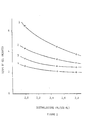
- On prépare des microémulsions selon les formulations données dans le Tableau 2. Le durcisseur utilisé est un mélange de succinate, glutarate et adipate de diéthyle (Durcisseur 600 NDE - Rhône-Poulenc Spécialités Chimiques).
- Toutes les microémulsions ont été préparées à force ionique constante pour permettre une meilleure comparaison des temps de prise.
- On a pris comme référence la force ionique de la microémulsion réalisée avec 25% v/v de silicate. Lorsque l'on a diminué la quantité de silicate, on a rajouté du chlorure de sodium pour compenser le défaut de force ionique.
- La variation des temps de prise, mesurés à 25°C, en fonction de la concentration en durcisseur est portée sur la Figure 1.
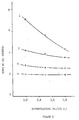
- On prépare des microémulsions selon les formulations données dans le Tableau 3 en utilisant comme durcisseur un mélange de succinate, glutarate et adipate de n.dipropyle.
- Comme dans l'exemple 2, certaines microémulsions comportent du chlorure de sodium pour conserver la force ionique constante.
- La variation des temps de prise, mesurés à 60°C, en fonction de la concentration en durcisseur est portée sur la Figure 2.
- On prépare une microémulsion ayant la composition suivante, exprimée en % poids/poids:

- Le temps de prise est de 3 heures à 60°C
- Re = 5 bars
- La Rc d'une composition témoin non micro- émulsionnée (pas d'agents tensio-actifs) est inférieure à 1 bar.
- On prépare une microémulsion ayant la composition suivante, en % p/p:

- Le durcisseur est un mélange 20/20/60 d'adipate, succinate et glutarate d'isobutyle.
- Le temps de prise est de 40 heures à 60°C.
- On prépare un microémulsion ayant la composition suivante, en % p/p:

- Le temps de prise est de 1 h 45 à 60°C.
- On utilise une carotte en grès de Berea (longueur 10,2cm - diamètre 3,9cm) ayant une perméabilité mesurée à l'air de 610 mD, une perméabilité à l'eau de 450 mD. La carotte saturée au fuel domestique a une perméabilité de 250 mD. Après désaturation à l'eau, la perméabilité à l'eau est de 45 mD. La carotte est saturée à nouveau au fuel puis désaturée avec une solution aqueuse de soude à 4% (preflush).
- On injecte, à 25°C, 5 volumes poreux (VP) de la microémulsion à travers la carotte. Le temps de prise de la microémulsion après passage à travers la carotte est encore de 1 H 50 à 60°C (pas de démixion ni absorption dans la roche).
- La carotte est portée à 60°C. La perméabilité résiduelle au fuel, mesuré après 16 heures est de 8 mD.
- On décolmate la roche à l'aide d'une solution de soude à 8% à 60°C sous une pression initiale de 3 bars. Après avoir passé 5 VP en 24 heures, la perméabilité au fuel est de 227 mD. Après désaturation à l'eau, la perméabilité est de 36 mD. Après lavage de la carotte par un solvant organique (Baltane, acétone) et dégazage sous vide, la perméabilité à l'air est de 440 mD.


Claims (11)
Applications Claiming Priority (2)
| Application Number | Priority Date | Filing Date | Title |
|---|---|---|---|
| FR8502034A FR2577205B1 (fr) | 1985-02-13 | 1985-02-13 | Compositions de silicates alcalins et leurs emplois |
| FR8502034 | 1985-02-13 |
Publications (3)
| Publication Number | Publication Date |
|---|---|
| EP0192533A2 EP0192533A2 (fr) | 1986-08-27 |
| EP0192533A3 EP0192533A3 (en) | 1986-11-12 |
| EP0192533B1 true EP0192533B1 (fr) | 1989-11-08 |
Family
ID=9316227
Family Applications (1)
| Application Number | Title | Priority Date | Filing Date |
|---|---|---|---|
| EP86400203A Expired EP0192533B1 (fr) | 1985-02-13 | 1986-01-31 | Compositions de silicates alcalins et leurs emplois |
Country Status (6)
| Country | Link |
|---|---|
| US (1) | US4799549A (fr) |
| EP (1) | EP0192533B1 (fr) |
| CA (1) | CA1267776A (fr) |
| DE (1) | DE3666855D1 (fr) |
| FR (1) | FR2577205B1 (fr) |
| NO (1) | NO163780C (fr) |
Families Citing this family (39)
| Publication number | Priority date | Publication date | Assignee | Title |
|---|---|---|---|---|
| US4930575A (en) * | 1989-03-31 | 1990-06-05 | Marathon Oil Company | Method of protecting a permeable formation |
| US5330785A (en) * | 1989-10-12 | 1994-07-19 | Plaisted Anthony C | Method for the sealing of unstable rock strata |
| US5165958A (en) * | 1989-10-12 | 1992-11-24 | Fosroc International Limited | Method for the sealing of mine stoppings |
| US5099922A (en) * | 1991-03-26 | 1992-03-31 | The Western Company Of North America | Control of gas flow through cement column |
| US5478389A (en) * | 1991-09-25 | 1995-12-26 | Loomis Family Trust | Pollution remedial composition and its preparation |
| US5608137A (en) * | 1995-01-27 | 1997-03-04 | University Of New Mexico | Polymer gel barrier containing microorganisms for containment of hazardous waste |
| US5624599A (en) * | 1995-10-10 | 1997-04-29 | Monsanto Company | Liquid hardeners for soil grouting formulations |
| US5755295A (en) * | 1996-04-19 | 1998-05-26 | Spectral Inc. | Modular drilling fluid system and method |
| GB2325478A (en) | 1997-05-24 | 1998-11-25 | Sofitech Nv | Emulsion for well and formation treatment |
| US6059036A (en) * | 1997-11-26 | 2000-05-09 | Halliburton Energy Services, Inc. | Methods and compositions for sealing subterranean zones |
| US6258756B1 (en) | 1999-01-26 | 2001-07-10 | Spectral, Inc. | Salt water drilling mud and method |
| GB2385589A (en) * | 2000-08-07 | 2003-08-27 | Sofitech Nv | Surfactant |
| US6613720B1 (en) | 2000-10-13 | 2003-09-02 | Schlumberger Technology Corporation | Delayed blending of additives in well treatment fluids |
| US6562882B2 (en) * | 2001-06-29 | 2003-05-13 | Scott Harrison | Soil formulation for resisting erosion |
| US20100125111A1 (en) * | 2001-06-29 | 2010-05-20 | Scott Harrison | Compositions and methods for resisting soil erosion and fire retardation |
| US7407993B2 (en) * | 2001-06-29 | 2008-08-05 | Terra Novo, Inc. | Compositions and methods for resisting soil erosion and fire retardation |
| US6695545B2 (en) | 2001-10-11 | 2004-02-24 | Gregory M. Boston | Soil stabilization composition |
| US6906009B2 (en) * | 2002-08-14 | 2005-06-14 | 3M Innovative Properties Company | Drilling fluid containing microspheres and use thereof |
| US7767629B2 (en) * | 2002-08-14 | 2010-08-03 | 3M Innovative Properties Company | Drilling fluid containing microspheres and use thereof |
| US20040031611A1 (en) * | 2002-08-15 | 2004-02-19 | Tianping Huang | Compositions and methods for water shut-off in subterranean wells |
| US7226895B2 (en) * | 2004-04-06 | 2007-06-05 | Baker Hughes Incorporated | Drilling fluid systems for reducing circulation losses |
| US7740068B2 (en) * | 2007-02-09 | 2010-06-22 | M-I Llc | Silicate-based wellbore fluid and methods for stabilizing unconsolidated formations |
| US20090028650A1 (en) * | 2007-07-26 | 2009-01-29 | Dennis Delamore | Composition and method for increasing resistance to erosion |
| US20090137432A1 (en) * | 2007-11-28 | 2009-05-28 | Sullivan Philp F | pH Sensitive Emulsion System |
| EA019035B1 (ru) * | 2007-12-12 | 2013-12-30 | Эм-Ай ДРИЛЛИНГ ФЛЮИДЗ ЮКей ЛИМИТЕД | Обращенные силикатные жидкости для укрепления ствола скважины |
| US20090266026A1 (en) * | 2008-04-28 | 2009-10-29 | Hannay Richard C | Method For Repairing A Utility Pole In Place |
| US7703522B2 (en) * | 2008-05-19 | 2010-04-27 | Baker Hughes Incorporated | Methods of underground formation consolidation |
| US9004169B2 (en) * | 2011-03-31 | 2015-04-14 | Baker Hughes Incorporated | Method of isolating and completing multiple zones within a wellbore |
| CA2839544A1 (fr) | 2011-06-22 | 2012-12-27 | Conocophillips Company | Prelevement et recuperation de carottes a partir de formations non consolidees ou friables |
| US8911181B1 (en) | 2013-02-15 | 2014-12-16 | FixDirt, LLC | Soil stabilization method and apparatus |
| US9551126B1 (en) * | 2014-02-12 | 2017-01-24 | Moretrench American Corporation | Methods of inhibiting subterranean groundwater flow through an opening in frozen soil |
| MX391099B (es) | 2014-03-31 | 2025-03-21 | Mi Llc | Filtrado inteligente para refuerzo de formaciones. |
| US10941326B2 (en) | 2018-02-15 | 2021-03-09 | Saudi Arabian Oil Company | Method and material for isolating a severe loss zone |
| US10745610B2 (en) * | 2018-05-17 | 2020-08-18 | Saudi Arabian Oil Company | Method and composition for sealing a subsurface formation |
| US10954427B2 (en) | 2018-05-17 | 2021-03-23 | Saudi Arabian Oil Company | Method and composition for sealing a subsurface formation |
| US11203710B2 (en) | 2019-02-21 | 2021-12-21 | Saudi Arabian Oil Company | Method and materials to convert a drilling mud into a solid gel based lost circulation material |
| US10655050B1 (en) * | 2019-02-21 | 2020-05-19 | Saudi Arabian Oil Company | Method and materials to convert a drilling mud into a solid gel based lost circulation material |
| US11124691B2 (en) | 2019-02-21 | 2021-09-21 | Saudi Arabian Oil Company | Method and materials to convert a drilling mud into a solid gel based lost circulation material |
| US10655049B1 (en) * | 2019-02-21 | 2020-05-19 | Saudi Arabian Oil Company | Method and materials to convert a drilling mud into a solid gel based lost circulation material |
Family Cites Families (19)
| Publication number | Priority date | Publication date | Assignee | Title |
|---|---|---|---|---|
| US2452021A (en) * | 1939-06-05 | 1948-10-19 | Truman B Wayne | Treatment of drilling fluids |
| US2705050A (en) * | 1953-05-25 | 1955-03-29 | Stanolind Oil & Gas Co | Settable drilling fluid |
| US3094501A (en) * | 1960-05-09 | 1963-06-18 | Dow Chemical Co | Water loss control of aqueous cement slurries by addition of quaternary ammonium polymers or sulfonium polymers |
| FR1476636A (fr) * | 1965-12-28 | 1967-04-14 | Progil | Réactifs gélifiants pour silicates solubles |
| US3591542A (en) * | 1966-06-01 | 1971-07-06 | Progil | Quick-setting cementitious compositions |
| US3640343A (en) * | 1970-05-20 | 1972-02-08 | Shell Oil Co | Stabilization of hard shaly formations with alkali metal silicate |
| US3815681A (en) * | 1972-05-24 | 1974-06-11 | Shell Oil Co | Temporarily plugging an earth formation with a transiently gelling aqueous liquid |
| US3749173A (en) * | 1972-05-30 | 1973-07-31 | Dow Chemical Co | Displacement of drilling fluids from boreholes |
| US3871453A (en) * | 1972-08-28 | 1975-03-18 | Union Oil Co | Mobility controlled caustic flooding process for highly heterogeneous reservoirs |
| US4293440A (en) * | 1975-09-15 | 1981-10-06 | Halliburton Company | Temperature gelation activated aqueous silicate mixtures and process of forming impermeable gels |
| US4140183A (en) * | 1978-02-13 | 1979-02-20 | Union Oil Company Of California | Micellar flooding process for heterogeneous reservoirs |
| DE2965466D1 (en) * | 1978-11-30 | 1983-07-07 | Ici Plc | Silicate gelling compositions for use in soil stabilisation, sealing a surface or forming a foundry sand mould, methods of use of said compositions for said purposes and mixtures for use in forming said compositions |
| US4293340A (en) * | 1979-11-05 | 1981-10-06 | Diamond Shamrock Corporation | Composition and process for stabilizing soil |
| US4301867A (en) * | 1980-06-30 | 1981-11-24 | Marathon Oil Company | Process for selectively reducing the permeability of a subterranean sandstone formation |
| US4521136A (en) * | 1981-05-21 | 1985-06-04 | Halliburton Company | Rapidly dissolvable silicates and methods of using the same |
| US4354875A (en) * | 1981-10-30 | 1982-10-19 | Diamond Shamrock Corporation | Controlling the curing time of alkali metal silicates using derivatives of glyoxal |
| DE3151680C2 (de) * | 1981-12-28 | 1985-09-26 | Dynamit Nobel Ag, 5210 Troisdorf | Gelbildendes Gemisch auf Alkalisilicat-Basis |
| IS1740B (is) * | 1982-02-05 | 1999-12-31 | Albright & Wilson Uk Limited | Samsetning á hreinsivökva |
| FR2559832B1 (fr) * | 1984-02-17 | 1986-05-30 | Rhone Poulenc Rech | Procede de colmatage reversible de formations souterraines |
-
1985
- 1985-02-13 FR FR8502034A patent/FR2577205B1/fr not_active Expired - Fee Related
-
1986
- 1986-01-31 DE DE8686400203T patent/DE3666855D1/de not_active Expired
- 1986-01-31 EP EP86400203A patent/EP0192533B1/fr not_active Expired
- 1986-02-12 CA CA000501699A patent/CA1267776A/fr not_active Expired - Fee Related
- 1986-02-12 NO NO860495A patent/NO163780C/no unknown
- 1986-02-13 US US06/828,877 patent/US4799549A/en not_active Expired - Fee Related
Also Published As
| Publication number | Publication date |
|---|---|
| EP0192533A2 (fr) | 1986-08-27 |
| US4799549A (en) | 1989-01-24 |
| EP0192533A3 (en) | 1986-11-12 |
| FR2577205B1 (fr) | 1990-04-06 |
| FR2577205A1 (fr) | 1986-08-14 |
| NO163780C (no) | 1990-07-18 |
| CA1267776A (fr) | 1990-04-17 |
| NO163780B (no) | 1990-04-09 |
| DE3666855D1 (en) | 1989-12-14 |
| NO860495L (no) | 1986-08-14 |
Similar Documents
| Publication | Publication Date | Title |
|---|---|---|
| EP0192533A2 (fr) | Compositions de silicates alcalins et leurs emplois | |
| EP0155859B1 (fr) | Procédé de colmatage réversible de formations souterraines | |
| US10844266B2 (en) | Spacer fluids and cement slurries that include surfactants | |
| CN1080362C (zh) | 提高油田和气田生产用化学药品的效率的方法 | |
| US5904208A (en) | Method of cleaning a well bore prior to cementing | |
| US5678631A (en) | Process for removing solids from a well drilling system | |
| HU191239B (en) | Method for gaining oil from underground sites by emulsion flushing | |
| US20130213659A1 (en) | Breaker and displacement fluid | |
| EP3816228B1 (fr) | Emulsion inverse pour la fracturation hydraulique | |
| FR3122656A1 (fr) | Polymere amphotérique associatif hydrosoluble comme modificateur de rheologie pour traitement souterrain | |
| US20200385626A1 (en) | Invert-emulsion oil based mud formulation using calcium salt of fatty acid as primary emulsifier | |
| EP3585836B1 (fr) | Suspension polyphasique de polymère et son utilisation | |
| US2793188A (en) | External oil phase drilling fluid emulsions | |
| FR2551451A1 (fr) | Composition d'injection pour le colmatage ou la consolidation des sols | |
| EP1412448B1 (fr) | Methode pour controler la saturation d'une formation aux abords d'un puits | |
| WO2018202750A1 (fr) | Mise en solution sous ultrasons de tensioactifs pour la recuperation assistee du petrole | |
| EP0434544B1 (fr) | Procédé et composition pour la réduction sélective de la perméabilité à l'eau dans les réservoirs d'hydrocarbures chauds et sales | |
| CN118222262A (zh) | 一种地层复合伤害多重乳液解堵体系及其制备方法 | |
| US4279305A (en) | Process for stimulating a well with a saline surfactant sulfate, alkanol and acid system | |
| Ibrahimov et al. | " LIQUIPERFPRO" REAGENT FOR INCREASING THE PERMEABİLİTY OF THE WELL BOTTOM HOLE ZONE | |
| RU2126884C1 (ru) | Состав для извлечения нефти | |
| RU2001090C1 (ru) | Состав дл добычи и транспорта нефти | |
| Taiwo et al. | Characterization of surfactant flooding for light oil using gum Arabic | |
| US2169458A (en) | Method of sealing off water and gas layers | |
| RU2768357C1 (ru) | Эмульсионно-ингибированный реверсивно-инвертный буровой раствор |
Legal Events
| Date | Code | Title | Description |
|---|---|---|---|
| PUAI | Public reference made under article 153(3) epc to a published international application that has entered the european phase |
Free format text: ORIGINAL CODE: 0009012 |
|
| AK | Designated contracting states |
Kind code of ref document: A2 Designated state(s): DE FR GB IT NL |
|
| PUAL | Search report despatched |
Free format text: ORIGINAL CODE: 0009013 |
|
| AK | Designated contracting states |
Kind code of ref document: A3 Designated state(s): DE FR GB IT NL |
|
| 17P | Request for examination filed |
Effective date: 19861121 |
|
| RAP1 | Party data changed (applicant data changed or rights of an application transferred) |
Owner name: RHONE-POULENC CHIMIE |
|
| 17Q | First examination report despatched |
Effective date: 19880819 |
|
| GRAA | (expected) grant |
Free format text: ORIGINAL CODE: 0009210 |
|
| AK | Designated contracting states |
Kind code of ref document: B1 Designated state(s): DE FR GB IT NL |
|
| ITF | It: translation for a ep patent filed | ||
| GBT | Gb: translation of ep patent filed (gb section 77(6)(a)/1977) | ||
| REF | Corresponds to: |
Ref document number: 3666855 Country of ref document: DE Date of ref document: 19891214 |
|
| PLBE | No opposition filed within time limit |
Free format text: ORIGINAL CODE: 0009261 |
|
| STAA | Information on the status of an ep patent application or granted ep patent |
Free format text: STATUS: NO OPPOSITION FILED WITHIN TIME LIMIT |
|
| 26N | No opposition filed | ||
| ITTA | It: last paid annual fee | ||
| PGFP | Annual fee paid to national office [announced via postgrant information from national office to epo] |
Ref country code: NL Payment date: 19910131 Year of fee payment: 6 |
|
| PGFP | Annual fee paid to national office [announced via postgrant information from national office to epo] |
Ref country code: DE Payment date: 19910228 Year of fee payment: 6 |
|
| PG25 | Lapsed in a contracting state [announced via postgrant information from national office to epo] |
Ref country code: NL Effective date: 19920801 |
|
| NLV4 | Nl: lapsed or anulled due to non-payment of the annual fee | ||
| PG25 | Lapsed in a contracting state [announced via postgrant information from national office to epo] |
Ref country code: DE Effective date: 19921001 |
|
| PGFP | Annual fee paid to national office [announced via postgrant information from national office to epo] |
Ref country code: FR Payment date: 19960119 Year of fee payment: 11 |
|
| PGFP | Annual fee paid to national office [announced via postgrant information from national office to epo] |
Ref country code: GB Payment date: 19960130 Year of fee payment: 11 |
|
| PG25 | Lapsed in a contracting state [announced via postgrant information from national office to epo] |
Ref country code: GB Effective date: 19970131 |
|
| GBPC | Gb: european patent ceased through non-payment of renewal fee |
Effective date: 19970131 |
|
| PG25 | Lapsed in a contracting state [announced via postgrant information from national office to epo] |
Ref country code: FR Effective date: 19970930 |
|
| REG | Reference to a national code |
Ref country code: FR Ref legal event code: ST |
|
| PG25 | Lapsed in a contracting state [announced via postgrant information from national office to epo] |
Ref country code: IT Free format text: LAPSE BECAUSE OF NON-PAYMENT OF DUE FEES;WARNING: LAPSES OF ITALIAN PATENTS WITH EFFECTIVE DATE BEFORE 2007 MAY HAVE OCCURRED AT ANY TIME BEFORE 2007. THE CORRECT EFFECTIVE DATE MAY BE DIFFERENT FROM THE ONE RECORDED. Effective date: 20050131 |