EP0192250B1 - Method of producing calcium-enriched aseptic soy bean curd - Google Patents
Method of producing calcium-enriched aseptic soy bean curd Download PDFInfo
- Publication number
- EP0192250B1 EP0192250B1 EP86102135A EP86102135A EP0192250B1 EP 0192250 B1 EP0192250 B1 EP 0192250B1 EP 86102135 A EP86102135 A EP 86102135A EP 86102135 A EP86102135 A EP 86102135A EP 0192250 B1 EP0192250 B1 EP 0192250B1
- Authority
- EP
- European Patent Office
- Prior art keywords
- calcium
- soy bean
- product
- aseptic
- coagulant
- Prior art date
- Legal status (The legal status is an assumption and is not a legal conclusion. Google has not performed a legal analysis and makes no representation as to the accuracy of the status listed.)
- Expired
Links
Images

Classifications
-
- A—HUMAN NECESSITIES
- A23—FOODS OR FOODSTUFFS; TREATMENT THEREOF, NOT COVERED BY OTHER CLASSES
- A23L—FOODS, FOODSTUFFS OR NON-ALCOHOLIC BEVERAGES, NOT OTHERWISE PROVIDED FOR; PREPARATION OR TREATMENT THEREOF
- A23L11/00—Pulses, i.e. fruits of leguminous plants, for production of food; Products from legumes; Preparation or treatment thereof
- A23L11/40—Pulse curds
- A23L11/45—Soy bean curds, e.g. tofu
Definitions
- This invention relates to a method of producing a calcium-enriched aseptic soy bean curd. More particularly, it relates to a method of producing a calcium-enriched aseptic soy bean curd in which a calcium hydroxide-sucrose complex hitherto not used as a coagulant for the soy bean curd is used for the first time as such coagulant.
- soy bean curd consisting of a mixture of magnesium chloride and magnesium sulfate, have been used as a coagulant for preparation of the soy bean curd.
- soy bean curd packaged in blow molded containers are being manufactured through using glucono-delta-lactone (abbreviated as GDL) as coagulant.
- GDL glucono-delta-lactone
- the coagulant used is of the type that need be heated to solidify the soy bean juice.
- the coagulant is added to the soy bean juice prior to UHT method (for example VTIS method) sterilization process, it is coagulated by the heat evolved during the sterilization process. Therefore, as a matter of course, the coagulant cannot be added to the soy bean juice prior to the sterilization process.
- UHT method for example VTIS method
- the coagulant cannot be added to the soy bean juice prior to the sterilization process.
- Japanese Patent Kokoku No.56-23574 it is stated that the coagulant is added to the resulting sterilized soy bean juice or to the said sterilized soy bean juice meaning that the coagulant need be added after the sterilization process.
- soy bean juice there is shown in the Japanese Patent Kokoku No. 56-50549 and the Japanese Patent Kokoku Nos.52-90622, 53-96356 and 53-133669 the method of producing calcium-enriched soy bean juice by adding calcium gluconate or calcium hydroxide to the soy bean juice during the manufacture process.
- Water-soluble calcium salts such as calcium lactate
- it has to be used in larger quantities when used for calcium fortification.
- Such addition of the larger quantities of calcium lactate results in bitter astringent taste thus greatly detracting from the flavor of the soy bean curd.
- the product cost is increased due to the higher production cost of calcium lactate.
- the present invention has been made in order to achieve these objects and provides a method of producing the calcium-enriched soy bean curd which comprises introducing a calcium hydroxide-sucrose complex into the soy bean juice as coagulant, sterilizing the resulting mixture by heating, adjusting the pH value of the sterilized product to weakly acidic, charging the sterilized product into a container under an aseptic condition, sealing the opening of the container, causing the product to be coagulated by heating. And, if necessary, introducing calcium lactate as secondary calcium source.
- Fig. 1 is a schematic view showing the coagulated protein obtained in accordance with the present invention.
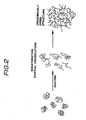
- Fig. 2 is a schematic view showing the coagulated protein obtained by the conventional method.
- the present invention has been made in order to overcome aforementioned difficulties at a time and to provide a novel and less costly coagulation system which makes it possible to add a large quantity of the calcium-containing coagulant in the pre-sterilization process and to fortify the product with calcium without deteriorating the flavor of the product.
- any of known thermally activated coagulants is unable to fulfil the object given above and hence it is necessary to evolve a coagulant that has a coagulation mechanism different from that of any of known coagulants, that does not cause the soy bean juice to be coagulated during sterilization and that can cause the soy bean juice to be coagulated by a simple operation of changing the state of the soy bean juice after sterilization.
- the present invention provides the method of producing the calcium-enriched aseptic soy bean curd which consists essentially in making use of the calcium hydroxicde-sucrose complex as new type coagulant.
- the calcium hydroxide-sucrose complex to be used in accordance with the present invention is a saccharate which is a kind of an addition product between sucrose (saccharose) and an alkali earth metal hydroxide, and may be typified by monocalcium saccharate (C12H21O11CaOH ⁇ H2O), dicalcium saccharate (C12H20O11 ⁇ (CaOH)2 ⁇ 2 to 6H2O) and tricalcium saccharate (C12H19011 ⁇ (CaOH)3 ⁇ 3 to 6H2O). These complex compounds may be obtained easily by dissolving calcium hydroxide and sucrose in water and stirring the resultant mixture.
- the complex compound per se has been known in the art, Journal of the Japanese Chemical Society, 1972, No.12, pages 2287 to 2291. However, it is not known to make use of the material as foodstuffs, to say nothing of using the material as the coagulant for the soy bean curd. That is, there lacks in literature a teaching on using the complex material as coagulant.
- the present invention provides the novel application of the complex compound as the coagulant.
- the novel coagulation mechanism of the complex compound which is completely different from the previously known one as will be described below, there results a soy bean curd which is extremely soft and excellent in flavor.
- the coagulation achieved in accordance with the present invention is occasionally termed improved coagulation.
- a calcium hydroxide-sucrose complex is added to the soy bean juice prepared customarily, with or without addition of magnesium sulfate and/or table salt in order to enhance the consistency or flavor.
- the calcium hydroxide-sucrose complex When used singly as calcium component, the calcium hydroxide-sucrose complex is preferably added in the product in an amount of 30 to 100 mg% as calcium.
- the amount lower than 30 mg % as calcium is not desirable because the curd becomes more flaccid.
- the total amount of addition of the calcium hydroxide-sucrose complex and calcium lactate to the product be in the range from 50 to 100 mg% as calcium.
- the amount of addition of sodium hexametaphosphate to the product need be in the range from 0.05 to 0.1 % in order to inhibit thickening during pH adjustment.
- the addition rate of sodium hexametaphosphate is increased linearly up to 0.05 to 0.1 % for the calcium contents in the product in the range of 50 to 100 mg%. With the contents higher than 0.1 %, the taste of the product may be lowered.
- the pH value of the resulting mixture tends to be on the alkaline side, it is adjusted to about 7.0 by making use of an aqueous solution of an organic acid or acids such as citric acid.
- the ultra high temperature sterilization process is carried out.
- a variety of sterilization processes may be used, such as VTIS method consisting in processing at 100 to 160 °C for 5 to 60 seconds.
- magnesium sulfate or table salt may be added after the sterilization resulting in the totality of bacteria contained in the curd and complex compound inclusive of spores being killed to provide an aseptic product showing prolonged shelf life.
- the calcium hydroxide-sucrose complex employed in accordance with the present invention as the new type coagulant does not solidify by the high temperature sterilization process and thus in a manner totally different from the conventional coagulants that are activated upon heating, such as calcium sulfate or calcium chloride.
- an aqueous solution of an organic acid is added under a germ-free condition into the sterilized liquid mixture for adjusting the pH value to a weakly acidic range.
- This value is preferably in the range of 5.7 to 5.9.
- the pH value lower than 5.7 the curd tends to be thickened and lowered in workability, while the gel structure becomes rough and suffers from increased water oozing.
- the pH value higher than 5.9 is not desirable because the structure tends to be softened.
- Any organic acids that are not detrimental to the starting materials, product or the coagulation process may be used singly or as a mixture. These acids may be typified by citric-, gluconic-, malic-, fumaric- or ascorbic acids.
- citric acid and ascorbic acid are preferred in view of flavor.
- Natural fruit juices rich in these acids may be used in place of these acids to provide for variegated flavor.
- Acidic fruit juices are known to lower the pH value of the soy bean juices and to cause protein sedimentation and, for this reason, addition of these fruit juices in an amount sufficient to cause their flavor to be exhibited has not been feasible with the prior-art methods. On the contrary, the present invention makes such addition possible without changing the manufacture process.
- calcium hydroxide-sucrose complex used as coagulant is insufficient to provide the required extent of calcium enrichment, calcium compounds may be added in an aseptic atmosphere after the sterilization process as at the time of pH adjustment.
- calcium compound calcium lactate is most preferred in view of taste.
- the total amount of calcium sulfate and calcium hydroxide-sucrose complex as calcium sources in the product is preferably in the range from 50 to 100 mg% ( 50 to 100 mg in 100 g of the product ) as calcium.
- the total amount less than 50 mg% is not desirable because the product curd tends to be flaccid.
- the total amount of the calcium sources higher than 100 mg% also is not desirable because the texture tends to be rough and the water oozing is also increased.
- the amount of calcium lactate in the calcium component of the product is preferably in the range from 15 to 30 mg% as calcium.
- the amount of calcium lactate in the calcium component less than 15 mg% is not desirable because the product curd becomes more or less flaccid.
- the amount of calcium lactate higher than 30 mg% is also not desirable because the product curd becomes inferior both taste and flavor.
- the product processed in this manner is charged in a container and the opening the container is sealed tightly with use of a known equipment such as aseptic charging device.
- the product thus charged in the sealed container is coagulated by heating for 20 to 60 minuites by any known methods as by using a heating coagulating tank maintained at 75 to 95 °C to provide the product curd.
- soy bean curd having a good taste and a highterto unprecedented soft creamy structure in contradiction to the aseptic soy bean curd obtained by the conventional methods.
- the presence of the above described structure may be demonstrated from the results of functional tests.
- formation of such structure may be explained by the fact that protein particles when heated in the presence of a larger amount of calcium are flocculated to larger size particles each composed of several particles found together that a loose lattice structure is formed from a number of these large size particles, as schematically shown in Fig. 1, see J. Food Sci. 43, 79 (1978).
- the structure of the soy bean curd shown therein and obtained by the conventional method consists of numerous protein particles bound together with a narrow interval between adjacent particles without several particles being previously flocculated together to larger size particles, thus giving rise to densely packed aggregation of protein particles instead of the soft flaccid structure attainable with the present invention.
- the coagulation system of the present invention is totally different from the conventional system.
- the mechanism may be explained as follows. Under the high temperature sterilizing conditions in the vicinity of neutral pH value, the calcium hydroxide-sucrose complex is in the state of a chelate compound with calcium not being ionized and hence is less likely to react with protein, so that lability and deterioration in heat resistance of the protein in the presence of calcium is avoided. It is further estimated that, as the pH value is lowered, the complex material is destructed at this stage with calcium ionization and contact with protein thus causing protein coagulation and the phenomenon termed herein as improved coagulation.
- the present invention provides a method industrially useful for the preparation of the aseptic soy bean curd having an extremely soft and mild taste and a creamy appearance through making use of a calcium complex as new type coagulant.
- the aseptic soy bean curd of the present invention can be fortified with calcium to 4 to 5 times that of the soy bean curd obtained by the conventional method by simultaneously making use of calcium lactate as secondary calcium source.
- the present invention provides for simultaneous attainment of the outstanding results such as calcium fortification, soft, creamy and good flavor, cost reduction and prolonged shelf life.
- the resulting mixture was subjected to a high temperature sterilizing treatment for 30 seconds at 140 °C by the VTIS method, followed by cooling and further mixing with 36 kg of 10% - aqueous solution of citric acid. The pH value of the resulting mixture was then adjusted to 5.75.
- the mixture was charged into a container under germ-free conditions as conventionally and the opening of the container was sealed.
- the product thus obtained was charged into a heating and coagulating tank and coagulated by treatment at 85 °C for 40 minutes to give the product soy bean curd.
- the resulting curd formed a highly satisfactory gel with less water oozing and with a mild creamy texture.
- the calcium contents in the product amounted to 100 mg% as calcium so that the curd proved to be an excellent calcium-enriched foodstuff.
- soy bean juice used in the present Example is composed of 12.0 percent of total solid contents, 5.8 percent of protein and 30 mg% as calcium, and the solution of the calcium hydroxide-sucrose complex is a solution in 43.0 kg of water of 5.0 kg of calcium hydroxide and 23.3 kg of sucrose.
- the product was subjected at 140 °C for 30 seconds to a high temperature sterilization process by the VTIS method, followed by cooling and further mixing with mixture consisting of 60 kg of 5% - aqueous solution of calcium lactate, 65 kg of 10% - aqueous solution of citric acid and 200 kg of water under an aseptic atmosphere to give a mixture having a pH value equal to 5.8. Then, 6.0 kg of water were added to the mixture.
- the resulting product was charged into a container under aseptic conditions with use of the aseptic system manufactured by Tetra Pack Co., and the opening of the container was sealed.
- the resulting product was charged into a heating and coagulating tank and coagulated at 85°C for 40 minutes to a product curd.
- the resulting curd presented a mild and creamy texture and less water oozing similarly to the product obtained in Example 1.
- the total calcium contents in the product amounted to 90 mg% thus showing that the product is also excellent as calcium-enriched foodstuff.
Landscapes
- Life Sciences & Earth Sciences (AREA)
- Agronomy & Crop Science (AREA)
- Botany (AREA)
- Health & Medical Sciences (AREA)
- Nutrition Science (AREA)
- Chemical & Material Sciences (AREA)
- Engineering & Computer Science (AREA)
- Food Science & Technology (AREA)
- Polymers & Plastics (AREA)
- Beans For Foods Or Fodder (AREA)
Description
- This invention relates to a method of producing a calcium-enriched aseptic soy bean curd. More particularly, it relates to a method of producing a calcium-enriched aseptic soy bean curd in which a calcium hydroxide-sucrose complex hitherto not used as a coagulant for the soy bean curd is used for the first time as such coagulant.
- Heretofore, calcium sulfate or "bittern" consisting of a mixture of magnesium chloride and magnesium sulfate, have been used as a coagulant for preparation of the soy bean curd. In recent years, the soy bean curd packaged in blow molded containers are being manufactured through using glucono-delta-lactone (abbreviated as GDL) as coagulant. With these methods, however, the soy bean curd may be sterilized only insufficiently and has a rather short shelf life.
- In order to obviate such drawback, a method of producing an aseptic soy bean curd packaged in a container has been shown and described in the Japanese Patent Kokoku Nos.56-23574 and 56-23577. According to this method, the soy bean juice is sterilized by the ultra high temperature treatment (UHT) system (for example the vacuum thermo injection system VTIS). Then, the coagulant (GDL) is added thereto under an aseptic atmosphere, the resulting product is subjected to aseptic blow molding and charged into a container, the open end of the container is sealed, and the packaged curd product is ultimately heated for coagulation. There has also been shown in the Japanese Patent Kokoku No.56-39865 a method according to which, in the above described method, the soy bean juice is continuously and homogeneously mixed with the coagulant (GDL).
- With these prior-art methods, the coagulant used (GDL) is of the type that need be heated to solidify the soy bean juice. As a result thereof, should the coagulant be added to the soy bean juice prior to UHT method (for example VTIS method) sterilization process, it is coagulated by the heat evolved during the sterilization process. Therefore, as a matter of course, the coagulant cannot be added to the soy bean juice prior to the sterilization process. Thus, in the aforementioned Japanese Patent Kokoku No.56-23574, it is stated that the coagulant is added to the resulting sterilized soy bean juice or to the said sterilized soy bean juice meaning that the coagulant need be added after the sterilization process.
- Addition of a large quantity of the coagulant in this manner after the sterilization process tends to pose a problem in the aseptically controlled operation of the production process. Thus a sterilization filter such as Millipore filter as described in the aforementioned publication is required.
- Also, in view of the reduced calcium intake in our present-day diet system, it has become a desideratum that a variety of foodstuffs including soy bean juice and soy bean curd be sufficiently enriched with calcium. With soy bean juice, there is shown in the Japanese Patent Kokoku No. 56-50549 and the Japanese Patent Kokoku Nos.52-90622, 53-96356 and 53-133669 the method of producing calcium-enriched soy bean juice by adding calcium gluconate or calcium hydroxide to the soy bean juice during the manufacture process.
- However, no other coagulant than GDL has been specified as coagulant in the aforementioned Japanese Patent Kokoku No.56-23574, No.23577 or No.56-39865, in which no suggestion has been made on fortifying the curd with calcium. Addition of a large quantity of a coagulant such as calcium salts other than GDL after the sterilization process also presents difficulties because calcium sulfate, one of the customary coagulants for the soy bean curd, is lower in solubility in water and hence cannot be added in larger amounts, while calcium chloride, another customary coagulant for the soy bean curd, is coagulated only inhomogeneously and results in deteriorated flavor of the soy bean curd product.
- Water-soluble calcium salts, such as calcium lactate, can be added in larger quantities after the sterilization process. However, because of the larger relative weight of the lactic acid portion of the calcium lactate molecule, it has to be used in larger quantities when used for calcium fortification. Such addition of the larger quantities of calcium lactate results in bitter astringent taste thus greatly detracting from the flavor of the soy bean curd. In addition, the product cost is increased due to the higher production cost of calcium lactate.
- In this manner, in the preparation of the aseptic soy bean curd products, considerable difficulties are presented in connection with the addition of larger quantities of calcium not only in the flavor and manufacture costs but in the product quality.
- It is therefore an object of the present invention to a provide a coagulation system of a completely new type according to which the coagulant can be introduced in the pre-sterilization process while simultaneously the target of calcium fortification may be fulfilled.
- It is a further object of the present invention to provide a method of producing a calcium-enriched aseptic soy bean curd with reduced costs and without losing the flavor.
- The present invention has been made in order to achieve these objects and provides a method of producing the calcium-enriched soy bean curd which comprises introducing a calcium hydroxide-sucrose complex into the soy bean juice as coagulant, sterilizing the resulting mixture by heating, adjusting the pH value of the sterilized product to weakly acidic, charging the sterilized product into a container under an aseptic condition, sealing the opening of the container, causing the product to be coagulated by heating. And, if necessary, introducing calcium lactate as secondary calcium source.
- Fig. 1 is a schematic view showing the coagulated protein obtained in accordance with the present invention.
- Fig. 2 is a schematic view showing the coagulated protein obtained by the conventional method.
- The present invention has been made in order to overcome aforementioned difficulties at a time and to provide a novel and less costly coagulation system which makes it possible to add a large quantity of the calcium-containing coagulant in the pre-sterilization process and to fortify the product with calcium without deteriorating the flavor of the product.
- As a result of our investigations, it has been found that any of known thermally activated coagulants is unable to fulfil the object given above and hence it is necessary to evolve a coagulant that has a coagulation mechanism different from that of any of known coagulants, that does not cause the soy bean juice to be coagulated during sterilization and that can cause the soy bean juice to be coagulated by a simple operation of changing the state of the soy bean juice after sterilization.
- Our screening tests on a variety of calcium compounds resulted in failure in finding a material showing such heat-resistant properties and the ability to fortify the product with calcium and to coagulate the soy bean protein simultaneously. Then, we directed our attention to a variety of complex compounds and, as a result of further screening tests, have arrived at a calcium hydroxide-sucrose complex which is one of the complex compounds of calcium hydroxide and sugar. Our further investigations into more detailed processing conditions of the specified complex has led to completion of the present invention.
- The present invention provides the method of producing the calcium-enriched aseptic soy bean curd which consists essentially in making use of the calcium hydroxicde-sucrose complex as new type coagulant.
- The calcium hydroxide-sucrose complex to be used in accordance with the present invention is a saccharate which is a kind of an addition product between sucrose (saccharose) and an alkali earth metal hydroxide, and may be typified by monocalcium saccharate (C₁₂H₂₁O₁₁CaOH · H₂O), dicalcium saccharate (C₁₂H₂₀O₁₁ · (CaOH)₂ · 2 to 6H₂O) and tricalcium saccharate (C₁₂H₁₉0₁₁ · (CaOH)₃ · 3 to 6H₂O). These complex compounds may be obtained easily by dissolving calcium hydroxide and sucrose in water and stirring the resultant mixture.
- The complex compound per se has been known in the art, Journal of the Japanese Chemical Society, 1972, No.12, pages 2287 to 2291. However, it is not known to make use of the material as foodstuffs, to say nothing of using the material as the coagulant for the soy bean curd. That is, there lacks in literature a teaching on using the complex material as coagulant. Thus the present invention provides the novel application of the complex compound as the coagulant. In addition, by virtue of the novel coagulation mechanism of the complex compound which is completely different from the previously known one as will be described below, there results a soy bean curd which is extremely soft and excellent in flavor. For distinction from the conventional coagulation, the coagulation achieved in accordance with the present invention is occasionally termed improved coagulation.
- In practicing the present invention, a calcium hydroxide-sucrose complex is added to the soy bean juice prepared customarily, with or without addition of magnesium sulfate and/or table salt in order to enhance the consistency or flavor.
- When used singly as calcium component, the calcium hydroxide-sucrose complex is preferably added in the product in an amount of 30 to 100 mg% as calcium. The amount lower than 30 mg % as calcium is not desirable because the curd becomes more flaccid. In case of using calcium lactate as calcium source as described later, it is preferred that the total amount of addition of the calcium hydroxide-sucrose complex and calcium lactate to the product be in the range from 50 to 100 mg% as calcium. In any case, when the amount of calcium hydroxide-sucrose complex to be added is in excess of 50 mg% as calcium, the amount of addition of sodium hexametaphosphate to the product need be in the range from 0.05 to 0.1 % in order to inhibit thickening during pH adjustment. It will be noted that the addition rate of sodium hexametaphosphate is increased linearly up to 0.05 to 0.1 % for the calcium contents in the product in the range of 50 to 100 mg%. With the contents higher than 0.1 %, the taste of the product may be lowered.
- Since the pH value of the resulting mixture tends to be on the alkaline side, it is adjusted to about 7.0 by making use of an aqueous solution of an organic acid or acids such as citric acid.
- Then; the ultra high temperature sterilization process is carried out. To this end, a variety of sterilization processes may be used, such as VTIS method consisting in processing at 100 to 160 °C for 5 to 60 seconds. If necessary, magnesium sulfate or table salt may be added after the sterilization resulting in the totality of bacteria contained in the curd and complex compound inclusive of spores being killed to provide an aseptic product showing prolonged shelf life.
- It shoud be noted that the calcium hydroxide-sucrose complex employed in accordance with the present invention as the new type coagulant does not solidify by the high temperature sterilization process and thus in a manner totally different from the conventional coagulants that are activated upon heating, such as calcium sulfate or calcium chloride.
- Then, an aqueous solution of an organic acid is added under a germ-free condition into the sterilized liquid mixture for adjusting the pH value to a weakly acidic range. This value is preferably in the range of 5.7 to 5.9. With the pH value lower than 5.7, the curd tends to be thickened and lowered in workability, while the gel structure becomes rough and suffers from increased water oozing. The pH value higher than 5.9 is not desirable because the structure tends to be softened. Any organic acids that are not detrimental to the starting materials, product or the coagulation process may be used singly or as a mixture. These acids may be typified by citric-, gluconic-, malic-, fumaric- or ascorbic acids. Above all, citric acid and ascorbic acid are preferred in view of flavor. Natural fruit juices rich in these acids may be used in place of these acids to provide for variegated flavor. Acidic fruit juices are known to lower the pH value of the soy bean juices and to cause protein sedimentation and, for this reason, addition of these fruit juices in an amount sufficient to cause their flavor to be exhibited has not been feasible with the prior-art methods. On the contrary, the present invention makes such addition possible without changing the manufacture process.
- It is also a principal object of the present invention to provide a calcium-enriched product. When the calcium hydroxide-sucrose complex used as coagulant is insufficient to provide the required extent of calcium enrichment, calcium compounds may be added in an aseptic atmosphere after the sterilization process as at the time of pH adjustment. As calcium compound, calcium lactate is most preferred in view of taste.
- The total amount of calcium sulfate and calcium hydroxide-sucrose complex as calcium sources in the product is preferably in the range from 50 to 100 mg% ( 50 to 100 mg in 100 g of the product ) as calcium. The total amount less than 50 mg% is not desirable because the product curd tends to be flaccid. The total amount of the calcium sources higher than 100 mg% also is not desirable because the texture tends to be rough and the water oozing is also increased. The amount of calcium lactate in the calcium component of the product is preferably in the range from 15 to 30 mg% as calcium. The amount of calcium lactate in the calcium component less than 15 mg% is not desirable because the product curd becomes more or less flaccid. The amount of calcium lactate higher than 30 mg% is also not desirable because the product curd becomes inferior both taste and flavor.
- The steps of calcium fortification and addition of an organic acid or acids are carried out in a known manner under aseptic conditions, e.q. in an aseptic processing chamber.
- The product processed in this manner is charged in a container and the opening the container is sealed tightly with use of a known equipment such as aseptic charging device. The product thus charged in the sealed container is coagulated by heating for 20 to 60 minuites by any known methods as by using a heating coagulating tank maintained at 75 to 95 °C to provide the product curd.
- It is an important aspect of the present invention to make use as new type coagulant of the calcium hydroxide-sucrose complex. By using such compound, there is obtained a soy bean curd having a good taste and a highterto unprecedented soft creamy structure in contradiction to the aseptic soy bean curd obtained by the conventional methods. The presence of the above described structure may be demonstrated from the results of functional tests. In addition, formation of such structure may be explained by the fact that protein particles when heated in the presence of a larger amount of calcium are flocculated to larger size particles each composed of several particles found together that a loose lattice structure is formed from a number of these large size particles, as schematically shown in Fig. 1, see J. Food Sci. 43, 79 (1978). In contrast thereto, referring to the schematic view of Fig. 2, the structure of the soy bean curd shown therein and obtained by the conventional method consists of numerous protein particles bound together with a narrow interval between adjacent particles without several particles being previously flocculated together to larger size particles, thus giving rise to densely packed aggregation of protein particles instead of the soft flaccid structure attainable with the present invention.
- In light of the above, the coagulation system of the present invention is totally different from the conventional system. Although not clarified precisely at present, the mechanism may be explained as follows. Under the high temperature sterilizing conditions in the vicinity of neutral pH value, the calcium hydroxide-sucrose complex is in the state of a chelate compound with calcium not being ionized and hence is less likely to react with protein, so that lability and deterioration in heat resistance of the protein in the presence of calcium is avoided. It is further estimated that, as the pH value is lowered, the complex material is destructed at this stage with calcium ionization and contact with protein thus causing protein coagulation and the phenomenon termed herein as improved coagulation.
- From the foregoing it is seen that the present invention provides a method industrially useful for the preparation of the aseptic soy bean curd having an extremely soft and mild taste and a creamy appearance through making use of a calcium complex as new type coagulant. In addition, the aseptic soy bean curd of the present invention can be fortified with calcium to 4 to 5 times that of the soy bean curd obtained by the conventional method by simultaneously making use of calcium lactate as secondary calcium source.
- In this manner, the present invention provides for simultaneous attainment of the outstanding results such as calcium fortification, soft, creamy and good flavor, cost reduction and prolonged shelf life.
- The description with reference to a preferrred example of the present invention is given hereinbelow. It shoud be noted that the Example is given only by way of illustration and are not intended for limiting the scope of the invention.
- To 2400 kg of soy bean juice were added 71 kg of calcium hydroxide-sucrose complex solution, 30 kg of 10% saline water and 30 kg of 5% sodium hexametaphosphate solution. To the resulting mixture were further added 81 kg of 10% - aqueous solution of citric acid and 170 kg of water for forcing the soy bean juice through pipeline. The pH value of the resulting mixture was adjusted to 7.1.
- With use of the VTIS device manufactured by Alfalaval Inc. , the resulting mixture was subjected to a high temperature sterilizing treatment for 30 seconds at 140 °C by the VTIS method, followed by cooling and further mixing with 36 kg of 10% - aqueous solution of citric acid. The pH value of the resulting mixture was then adjusted to 5.75.
- Then, with use of the aseptic charging device manufactured by Tetra Pack Co., the mixture was charged into a container under germ-free conditions as conventionally and the opening of the container was sealed. The product thus obtained was charged into a heating and coagulating tank and coagulated by treatment at 85 °C for 40 minutes to give the product soy bean curd.
- The resulting curd formed a highly satisfactory gel with less water oozing and with a mild creamy texture. The calcium contents in the product amounted to 100 mg% as calcium so that the curd proved to be an excellent calcium-enriched foodstuff.
- It is noted that the soy bean juice used in the present Example is composed of 12.0 percent of total solid contents, 5.8 percent of protein and 30 mg% as calcium, and the solution of the calcium hydroxide-sucrose complex is a solution in 43.0 kg of water of 5.0 kg of calcium hydroxide and 23.3 kg of sucrose.
- To 2400 kg of the soy bean juice having the same composition as that used in Example 1 were added 24 kg of solution of the calcium hydroxide-sucrose complex and 30 kg of the 10% - saline water. The resulting mixture was further mixed with 18.8 kg of 10% - aqueous solution of citric acid and 200 kg of water and the resulting product was adjusted to a pH value of 7.0.
- Then, with use of the VTIS device manufactured by Alfalaval Inc., the product was subjected at 140 °C for 30 seconds to a high temperature sterilization process by the VTIS method, followed by cooling and further mixing with mixture consisting of 60 kg of 5% - aqueous solution of calcium lactate, 65 kg of 10% - aqueous solution of citric acid and 200 kg of water under an aseptic atmosphere to give a mixture having a pH value equal to 5.8. Then, 6.0 kg of water were added to the mixture.
- The resulting product was charged into a container under aseptic conditions with use of the aseptic system manufactured by Tetra Pack Co., and the opening of the container was sealed. The resulting product was charged into a heating and coagulating tank and coagulated at 85°C for 40 minutes to a product curd. The resulting curd presented a mild and creamy texture and less water oozing similarly to the product obtained in Example 1. The total calcium contents in the product amounted to 90 mg% thus showing that the product is also excellent as calcium-enriched foodstuff.
- It will be noted that the solution of calcium hydroxide-sucrose complex is obtained by disolving in 14.67 kg of water of 1.67 kg of calcium hydroxide and 7.66 kg of sucrose, by mixing under followed agitation.
Claims (14)
- A method of producing calcium-enriched aseptic soy bean curd comprising the steps of
adding a calcium hydroxide-sucrose complex as coagulant to the soy bean juice;
sterilizing the resulting mixture by heating;
adjusting the pH value of the sterilized product to weakly acidic;
charging the sterilized product into a container under an aseptic condition and sealing the opening of the container;
and causing the soy bean juice coagulant mixture contained in the container to be coagulated by heating. - A method according to claim 1 characterized in that the calcium hydroxide-sucrose complex is added in an amount of 30 to 100 mg% as calcium.
- A method according to claim 1 characterized in that the pH value is adjusted so as to be 5.7 to 5.9.
- A method according to claim 1 characterized in that the pH adjustment is performed by the aseptic addition of organic acid.
- A method according to claim 1 characterized in that the organic acid is citric acid or ascorbic acid.
- A method according to claim 5 characterized in that citric acid or ascorbic acid as organic acid is added in the form of natural fruit juices.
- A method of producing calcium-enriched aseptic soy bean curd comprising the steps of
adding a calcium hydroxide-sucrose complex as coagulant to the soy bean juice;
sterilizing the resulting mixture by heating;
adding calcium lactate as additional calcium source to the sterilized mixture;
adjusting the pH value of the resulting mixture to acidic;
charging the mixture into a container under an aseptic condition and sealing the opening of the container;
and causing the soy bean juice-coagulant-calcium lactate mixture contained in the container to be coagulated by heating. - A method according to claim 7 characterized in that the total amount of addition of the calcium hydroxide-sucrose complex and calcium lactate to the product is 50 to 100 mg% as calcium.
- A method according to claim 8 characterized in that the amount of addition of calcium lactate to the product is 15 to 30 mg% as calcium.
- A method according to claim 7 characterized in that the pH value is adjusted so as to be 5.7 to 5.9.
- A method according to claim 7 characterized in that the pH adjustment is performed by the aseptic addition of an organic acid or acids.
- A method according to claim 7 characterized in that the organic acid is citric acid or ascorbic acid.
- A method according to claim 12 characterized in that citric acid or ascorbic acid as organic acid is added in the form of natural fruit juices.
- A method according to claim 2 or claim 8 characterized by the step of adding sodium hexametaphosphate, provided that the amount of the calcium hydroxide-sucrose complex exceeds 50 mg % as calcium, whereby the linear increase from 0.05 to 0.1 % of sodium hexametaphosphate coincides with an increase from 50 to 100 mg % of calcium content in the product.
Applications Claiming Priority (4)
| Application Number | Priority Date | Filing Date | Title |
|---|---|---|---|
| JP31554/85 | 1985-02-21 | ||
| JP60031554A JPS61192258A (en) | 1985-02-21 | 1985-02-21 | Preparation of calcium-enriched aseptic bean curd |
| JP60069105A JPS61227755A (en) | 1985-04-03 | 1985-04-03 | Production of calcium-enriched sterilized 'tofu' (soybean curd) |
| JP69105/85 | 1985-04-03 |
Publications (3)
| Publication Number | Publication Date |
|---|---|
| EP0192250A2 EP0192250A2 (en) | 1986-08-27 |
| EP0192250A3 EP0192250A3 (en) | 1988-08-24 |
| EP0192250B1 true EP0192250B1 (en) | 1991-08-07 |
Family
ID=26370040
Family Applications (1)
| Application Number | Title | Priority Date | Filing Date |
|---|---|---|---|
| EP86102135A Expired EP0192250B1 (en) | 1985-02-21 | 1986-02-19 | Method of producing calcium-enriched aseptic soy bean curd |
Country Status (3)
| Country | Link |
|---|---|
| US (1) | US4673583A (en) |
| EP (1) | EP0192250B1 (en) |
| DE (1) | DE3680686D1 (en) |
Families Citing this family (7)
| Publication number | Priority date | Publication date | Assignee | Title |
|---|---|---|---|---|
| JPS62163666A (en) * | 1986-01-14 | 1987-07-20 | Kikkoman Corp | Grinding of soybean |
| JPH01240164A (en) * | 1988-01-26 | 1989-09-25 | Tokuzo Yamamoto | Bean curd coagulated with vegetable juice |
| US5514387A (en) * | 1994-11-29 | 1996-05-07 | Nabisco, Inc. | Calcium-enriched baked good production and method of making |
| US5863590A (en) * | 1996-06-25 | 1999-01-26 | Tetra Laval Holdings & Finance S.A. | Method for producing an aseptic packaged tofu product |
| US20040170724A1 (en) * | 2003-02-28 | 2004-09-02 | Kraft Foods Holdings, Inc. | Mineral complexes of lactobionic acid and method of using for mineral fortification of food products |
| RU2249972C2 (en) * | 2003-06-09 | 2005-04-20 | Закрытое акционерное общество "Завод плавленых сыров "КАРАТ" | Method for producing of canned sterilized curdle |
| US7267832B2 (en) * | 2004-02-18 | 2007-09-11 | Kraft Foods Holdings, Inc. | Amorphous water-soluble calcium citrate salts and method of making and using same |
Family Cites Families (8)
| Publication number | Priority date | Publication date | Assignee | Title |
|---|---|---|---|---|
| JPS44770Y1 (en) * | 1965-03-06 | 1969-01-13 | ||
| US4000326A (en) * | 1974-07-31 | 1976-12-28 | Morinaga Milk Industry Co., Ltd. | Method of manufacturing an aseptic soya bean curd |
| JPS5921586B2 (en) * | 1976-08-11 | 1984-05-21 | 森永乳業株式会社 | Method for producing cotton-like tofu |
| JPS5661969A (en) * | 1979-10-22 | 1981-05-27 | Showa Sangyo Kk | Production of starting material composition for soybean curd or its fried product |
| JPS5733020A (en) * | 1980-08-04 | 1982-02-23 | Honda Motor Co Ltd | Supercharger device in autobicycle |
| US4427710A (en) * | 1981-12-23 | 1984-01-24 | Nissin Shokuhin Kabushiki Kaisha | Method of manufacturing an instant bean curd or tofu, and the toju made by such method |
| JPS58126750A (en) * | 1982-01-19 | 1983-07-28 | Kesayoshi Wakabayashi | Preparation of konjak having high digestibility, nutrient and moisture absorption |
| US4514433A (en) * | 1982-10-22 | 1985-04-30 | Kikkoman Corporation | Process for producing an aseptic packed tofu |
-
1986
- 1986-02-19 EP EP86102135A patent/EP0192250B1/en not_active Expired
- 1986-02-19 DE DE8686102135T patent/DE3680686D1/en not_active Expired - Lifetime
- 1986-02-21 US US06/831,529 patent/US4673583A/en not_active Expired - Fee Related
Also Published As
| Publication number | Publication date |
|---|---|
| EP0192250A3 (en) | 1988-08-24 |
| EP0192250A2 (en) | 1986-08-27 |
| DE3680686D1 (en) | 1991-09-12 |
| US4673583A (en) | 1987-06-16 |
Similar Documents
| Publication | Publication Date | Title |
|---|---|---|
| US4430349A (en) | Artificially sweetened gelled yogurt | |
| RU2218800C2 (en) | Calcium-enriched food product and method for producing the same | |
| US4906482A (en) | Method of making calcium fortified soy milk and the calcium fortified soy milk | |
| DE60210509T2 (en) | METHOD FOR PRODUCING A MEAT SUBSTITUTE PRODUCT, MEAT SUBSTITUTE PRODUCT AVAILABLE ACCORDING TO THIS METHOD AND PRODUCT-FINISHED MEAT SUBSTITUTE PRODUCT | |
| US20060024412A1 (en) | Shelf-stable acidified food compositions and methods for their preparation | |
| US20050186312A1 (en) | Shelf-stable foodstuffs and methods for their preparation | |
| US4828869A (en) | Process for the manufacture of packed aseptic soybean curd | |
| US5912032A (en) | Process of producing calcium-supplemented milk drinks | |
| US4140811A (en) | Method for manufacturing rough textured soya bean curd | |
| US4673583A (en) | Method of producing calcium-enriched aseptic soy bean curd | |
| JPS58162274A (en) | Protein-containing fruit juice drink and method for producing the same | |
| JPS61216653A (en) | Calcium-fortified soymilk and its manufacturing method | |
| JPH03240470A (en) | Fruit juice beverage and production thereof | |
| JPS59205937A (en) | Production of longterm preservable aromatic beverage based on acid milk serum | |
| US20050153021A1 (en) | Calcium-fortified protein-based beverage containing calcium (lactate) gluconate citrate | |
| KR20190127268A (en) | Method for manufacturing milk with high protein and calcium contents and low fat and cholesterol by only 100% pure milk | |
| JP3083579B2 (en) | Calcium fortified beverage and method for producing the same | |
| US4883682A (en) | Process for the preparation of a sterilized casein-based liquid composition | |
| JPH0517824B2 (en) | ||
| DE602004010182T2 (en) | CALCIUM-ENRICHED DRINK ON PROTEIN BASE CONTAINING CALCIUM (LACTAT) GLUCONATCITRATE | |
| JPH0446545B2 (en) | ||
| JP3783752B2 (en) | Magnesium fortified dairy products | |
| CN1026857C (en) | Process for the manufacture of food products containing added sterile water-insoluble mineral salts | |
| JPH0221783B2 (en) | ||
| JPH05184292A (en) | High calcium fortified milk drink and method for producing the same |
Legal Events
| Date | Code | Title | Description |
|---|---|---|---|
| PUAI | Public reference made under article 153(3) epc to a published international application that has entered the european phase |
Free format text: ORIGINAL CODE: 0009012 |
|
| AK | Designated contracting states |
Kind code of ref document: A2 Designated state(s): BE DE FR GB IT NL |
|
| PUAL | Search report despatched |
Free format text: ORIGINAL CODE: 0009013 |
|
| AK | Designated contracting states |
Kind code of ref document: A3 Designated state(s): BE DE FR GB IT NL |
|
| 17P | Request for examination filed |
Effective date: 19890221 |
|
| 17Q | First examination report despatched |
Effective date: 19900727 |
|
| GRAA | (expected) grant |
Free format text: ORIGINAL CODE: 0009210 |
|
| AK | Designated contracting states |
Kind code of ref document: B1 Designated state(s): BE DE FR GB IT NL |
|
| REF | Corresponds to: |
Ref document number: 3680686 Country of ref document: DE Date of ref document: 19910912 |
|
| ET | Fr: translation filed | ||
| ITF | It: translation for a ep patent filed | ||
| PLBE | No opposition filed within time limit |
Free format text: ORIGINAL CODE: 0009261 |
|
| STAA | Information on the status of an ep patent application or granted ep patent |
Free format text: STATUS: NO OPPOSITION FILED WITHIN TIME LIMIT |
|
| 26N | No opposition filed | ||
| PGFP | Annual fee paid to national office [announced via postgrant information from national office to epo] |
Ref country code: GB Payment date: 19960301 Year of fee payment: 11 |
|
| PGFP | Annual fee paid to national office [announced via postgrant information from national office to epo] |
Ref country code: DE Payment date: 19960820 Year of fee payment: 11 |
|
| PGFP | Annual fee paid to national office [announced via postgrant information from national office to epo] |
Ref country code: NL Payment date: 19960827 Year of fee payment: 11 |
|
| PGFP | Annual fee paid to national office [announced via postgrant information from national office to epo] |
Ref country code: FR Payment date: 19960828 Year of fee payment: 11 Ref country code: BE Payment date: 19960828 Year of fee payment: 11 |
|
| PG25 | Lapsed in a contracting state [announced via postgrant information from national office to epo] |
Ref country code: GB Effective date: 19970219 |
|
| PG25 | Lapsed in a contracting state [announced via postgrant information from national office to epo] |
Ref country code: BE Effective date: 19970228 |
|
| BERE | Be: lapsed |
Owner name: MEIJI MILK PRODUCTS CY LTD Effective date: 19970228 |
|
| PG25 | Lapsed in a contracting state [announced via postgrant information from national office to epo] |
Ref country code: NL Effective date: 19970901 |
|
| GBPC | Gb: european patent ceased through non-payment of renewal fee |
Effective date: 19970219 |
|
| PG25 | Lapsed in a contracting state [announced via postgrant information from national office to epo] |
Ref country code: FR Effective date: 19971030 |
|
| PG25 | Lapsed in a contracting state [announced via postgrant information from national office to epo] |
Ref country code: DE Effective date: 19971101 |
|
| NLV4 | Nl: lapsed or anulled due to non-payment of the annual fee |
Effective date: 19970901 |
|
| REG | Reference to a national code |
Ref country code: FR Ref legal event code: ST |
|
| PG25 | Lapsed in a contracting state [announced via postgrant information from national office to epo] |
Ref country code: IT Free format text: LAPSE BECAUSE OF NON-PAYMENT OF DUE FEES;WARNING: LAPSES OF ITALIAN PATENTS WITH EFFECTIVE DATE BEFORE 2007 MAY HAVE OCCURRED AT ANY TIME BEFORE 2007. THE CORRECT EFFECTIVE DATE MAY BE DIFFERENT FROM THE ONE RECORDED. Effective date: 20050219 |