EP0191409B1 - Slip casting method - Google Patents
Slip casting method Download PDFInfo
- Publication number
- EP0191409B1 EP0191409B1 EP86101459A EP86101459A EP0191409B1 EP 0191409 B1 EP0191409 B1 EP 0191409B1 EP 86101459 A EP86101459 A EP 86101459A EP 86101459 A EP86101459 A EP 86101459A EP 0191409 B1 EP0191409 B1 EP 0191409B1
- Authority
- EP
- European Patent Office
- Prior art keywords
- mold
- slip
- casting method
- slip casting
- binder
- Prior art date
- Legal status (The legal status is an assumption and is not a legal conclusion. Google has not performed a legal analysis and makes no representation as to the accuracy of the status listed.)
- Expired
Links
- 238000000034 method Methods 0.000 title claims description 40
- 238000007569 slipcasting Methods 0.000 title claims description 26
- 229920005989 resin Polymers 0.000 claims description 58
- 239000011347 resin Substances 0.000 claims description 58
- XLYOFNOQVPJJNP-UHFFFAOYSA-N water Substances O XLYOFNOQVPJJNP-UHFFFAOYSA-N 0.000 claims description 48
- 239000011230 binding agent Substances 0.000 claims description 34
- CSCPPACGZOOCGX-UHFFFAOYSA-N Acetone Chemical compound CC(C)=O CSCPPACGZOOCGX-UHFFFAOYSA-N 0.000 claims description 33
- 238000005266 casting Methods 0.000 claims description 29
- LFQSCWFLJHTTHZ-UHFFFAOYSA-N Ethanol Chemical compound CCO LFQSCWFLJHTTHZ-UHFFFAOYSA-N 0.000 claims description 23
- OKKJLVBELUTLKV-UHFFFAOYSA-N Methanol Chemical compound OC OKKJLVBELUTLKV-UHFFFAOYSA-N 0.000 claims description 18
- 235000019441 ethanol Nutrition 0.000 claims description 14
- 239000003960 organic solvent Substances 0.000 claims description 12
- 239000002245 particle Substances 0.000 claims description 12
- YXFVVABEGXRONW-UHFFFAOYSA-N Toluene Chemical compound CC1=CC=CC=C1 YXFVVABEGXRONW-UHFFFAOYSA-N 0.000 claims description 11
- 229920002689 polyvinyl acetate Polymers 0.000 claims description 11
- 239000011118 polyvinyl acetate Substances 0.000 claims description 11
- 239000000020 Nitrocellulose Substances 0.000 claims description 10
- FJWGYAHXMCUOOM-QHOUIDNNSA-N [(2s,3r,4s,5r,6r)-2-[(2r,3r,4s,5r,6s)-4,5-dinitrooxy-2-(nitrooxymethyl)-6-[(2r,3r,4s,5r,6s)-4,5,6-trinitrooxy-2-(nitrooxymethyl)oxan-3-yl]oxyoxan-3-yl]oxy-3,5-dinitrooxy-6-(nitrooxymethyl)oxan-4-yl] nitrate Chemical compound O([C@@H]1O[C@@H]([C@H]([C@H](O[N+]([O-])=O)[C@H]1O[N+]([O-])=O)O[C@H]1[C@@H]([C@@H](O[N+]([O-])=O)[C@H](O[N+]([O-])=O)[C@@H](CO[N+]([O-])=O)O1)O[N+]([O-])=O)CO[N+](=O)[O-])[C@@H]1[C@@H](CO[N+]([O-])=O)O[C@@H](O[N+]([O-])=O)[C@H](O[N+]([O-])=O)[C@H]1O[N+]([O-])=O FJWGYAHXMCUOOM-QHOUIDNNSA-N 0.000 claims description 10
- 229920001220 nitrocellulos Polymers 0.000 claims description 10
- 230000015572 biosynthetic process Effects 0.000 claims description 9
- 238000007711 solidification Methods 0.000 claims description 9
- 230000008023 solidification Effects 0.000 claims description 9
- 125000005395 methacrylic acid group Chemical group 0.000 claims description 8
- 239000004793 Polystyrene Substances 0.000 claims description 7
- 229920002223 polystyrene Polymers 0.000 claims description 7
- 239000004372 Polyvinyl alcohol Substances 0.000 claims description 6
- 229920001893 acrylonitrile styrene Polymers 0.000 claims description 6
- 239000007864 aqueous solution Substances 0.000 claims description 6
- 229920002301 cellulose acetate Polymers 0.000 claims description 6
- 229920006217 cellulose acetate butyrate Polymers 0.000 claims description 6
- 229920002451 polyvinyl alcohol Polymers 0.000 claims description 6
- 229920000036 polyvinylpyrrolidone Polymers 0.000 claims description 6
- 239000001267 polyvinylpyrrolidone Substances 0.000 claims description 6
- 235000013855 polyvinylpyrrolidone Nutrition 0.000 claims description 6
- SCUZVMOVTVSBLE-UHFFFAOYSA-N prop-2-enenitrile;styrene Chemical compound C=CC#N.C=CC1=CC=CC=C1 SCUZVMOVTVSBLE-UHFFFAOYSA-N 0.000 claims description 6
- 229920002153 Hydroxypropyl cellulose Polymers 0.000 claims description 4
- 229920003171 Poly (ethylene oxide) Polymers 0.000 claims description 4
- 239000002202 Polyethylene glycol Substances 0.000 claims description 4
- 229920000122 acrylonitrile butadiene styrene Polymers 0.000 claims description 4
- 229920001577 copolymer Polymers 0.000 claims description 4
- 239000001863 hydroxypropyl cellulose Substances 0.000 claims description 4
- 235000010977 hydroxypropyl cellulose Nutrition 0.000 claims description 4
- 229920000554 ionomer Polymers 0.000 claims description 4
- 229920000609 methyl cellulose Polymers 0.000 claims description 4
- 239000001923 methylcellulose Substances 0.000 claims description 4
- 229920001223 polyethylene glycol Polymers 0.000 claims description 4
- -1 polypropylene Polymers 0.000 claims description 4
- 229920005990 polystyrene resin Polymers 0.000 claims description 4
- 239000004800 polyvinyl chloride Substances 0.000 claims description 4
- 229920000915 polyvinyl chloride Polymers 0.000 claims description 4
- 239000000126 substance Substances 0.000 claims description 3
- 229920002134 Carboxymethyl cellulose Polymers 0.000 claims description 2
- 229920000084 Gum arabic Polymers 0.000 claims description 2
- 239000004743 Polypropylene Substances 0.000 claims description 2
- 241000978776 Senegalia senegal Species 0.000 claims description 2
- 229920002472 Starch Polymers 0.000 claims description 2
- 239000000205 acacia gum Substances 0.000 claims description 2
- 235000010489 acacia gum Nutrition 0.000 claims description 2
- 229920006243 acrylic copolymer Polymers 0.000 claims description 2
- 239000003292 glue Substances 0.000 claims description 2
- 229920001200 poly(ethylene-vinyl acetate) Polymers 0.000 claims description 2
- 229920001748 polybutylene Polymers 0.000 claims description 2
- 239000004417 polycarbonate Substances 0.000 claims description 2
- 229920000515 polycarbonate Polymers 0.000 claims description 2
- 229920001155 polypropylene Polymers 0.000 claims description 2
- 239000008107 starch Substances 0.000 claims description 2
- 235000019698 starch Nutrition 0.000 claims description 2
- 239000001993 wax Substances 0.000 claims description 2
- 150000001298 alcohols Chemical class 0.000 claims 1
- 239000003849 aromatic solvent Substances 0.000 claims 1
- 239000003759 ester based solvent Substances 0.000 claims 1
- 150000002148 esters Chemical class 0.000 claims 1
- 150000003613 toluenes Chemical class 0.000 claims 1
- 239000002904 solvent Substances 0.000 description 26
- 239000000463 material Substances 0.000 description 16
- 239000010440 gypsum Substances 0.000 description 15
- 229910052602 gypsum Inorganic materials 0.000 description 15
- VYPSYNLAJGMNEJ-UHFFFAOYSA-N Silicium dioxide Chemical compound O=[Si]=O VYPSYNLAJGMNEJ-UHFFFAOYSA-N 0.000 description 8
- PNEYBMLMFCGWSK-UHFFFAOYSA-N aluminium oxide Inorganic materials [O-2].[O-2].[O-2].[Al+3].[Al+3] PNEYBMLMFCGWSK-UHFFFAOYSA-N 0.000 description 8
- 238000010521 absorption reaction Methods 0.000 description 6
- 239000000203 mixture Substances 0.000 description 5
- 239000002002 slurry Substances 0.000 description 5
- 239000000243 solution Substances 0.000 description 5
- 239000003232 water-soluble binding agent Substances 0.000 description 5
- 239000011368 organic material Substances 0.000 description 4
- 229920002401 polyacrylamide Polymers 0.000 description 4
- 239000000843 powder Substances 0.000 description 4
- 239000004576 sand Substances 0.000 description 4
- 230000008961 swelling Effects 0.000 description 4
- XEKOWRVHYACXOJ-UHFFFAOYSA-N Ethyl acetate Chemical compound CCOC(C)=O XEKOWRVHYACXOJ-UHFFFAOYSA-N 0.000 description 3
- CPLXHLVBOLITMK-UHFFFAOYSA-N Magnesium oxide Chemical compound [Mg]=O CPLXHLVBOLITMK-UHFFFAOYSA-N 0.000 description 3
- 239000000919 ceramic Substances 0.000 description 3
- 239000003085 diluting agent Substances 0.000 description 3
- 238000001035 drying Methods 0.000 description 3
- 230000000694 effects Effects 0.000 description 3
- 238000005245 sintering Methods 0.000 description 3
- UOCLXMDMGBRAIB-UHFFFAOYSA-N 1,1,1-trichloroethane Chemical compound CC(Cl)(Cl)Cl UOCLXMDMGBRAIB-UHFFFAOYSA-N 0.000 description 2
- OKTJSMMVPCPJKN-UHFFFAOYSA-N Carbon Chemical compound [C] OKTJSMMVPCPJKN-UHFFFAOYSA-N 0.000 description 2
- 239000000654 additive Substances 0.000 description 2
- 230000000996 additive effect Effects 0.000 description 2
- 230000002411 adverse Effects 0.000 description 2
- 229920001971 elastomer Polymers 0.000 description 2
- 125000005909 ethyl alcohol group Chemical group 0.000 description 2
- 239000010419 fine particle Substances 0.000 description 2
- 238000010438 heat treatment Methods 0.000 description 2
- 238000002156 mixing Methods 0.000 description 2
- 230000036961 partial effect Effects 0.000 description 2
- 230000002829 reductive effect Effects 0.000 description 2
- 239000000377 silicon dioxide Substances 0.000 description 2
- 239000004945 silicone rubber Substances 0.000 description 2
- 230000007704 transition Effects 0.000 description 2
- 229910052845 zircon Inorganic materials 0.000 description 2
- GFQYVLUOOAAOGM-UHFFFAOYSA-N zirconium(iv) silicate Chemical compound [Zr+4].[O-][Si]([O-])([O-])[O-] GFQYVLUOOAAOGM-UHFFFAOYSA-N 0.000 description 2
- HZAXFHJVJLSVMW-UHFFFAOYSA-N 2-Aminoethan-1-ol Chemical compound NCCO HZAXFHJVJLSVMW-UHFFFAOYSA-N 0.000 description 1
- ZOXJGFHDIHLPTG-UHFFFAOYSA-N Boron Chemical compound [B] ZOXJGFHDIHLPTG-UHFFFAOYSA-N 0.000 description 1
- XTXRWKRVRITETP-UHFFFAOYSA-N Vinyl acetate Chemical compound CC(=O)OC=C XTXRWKRVRITETP-UHFFFAOYSA-N 0.000 description 1
- 238000010420 art technique Methods 0.000 description 1
- 229910052796 boron Inorganic materials 0.000 description 1
- 229910052799 carbon Inorganic materials 0.000 description 1
- 239000011248 coating agent Substances 0.000 description 1
- 238000000576 coating method Methods 0.000 description 1
- 238000007796 conventional method Methods 0.000 description 1
- 238000005336 cracking Methods 0.000 description 1
- 238000002425 crystallisation Methods 0.000 description 1
- 230000008025 crystallization Effects 0.000 description 1
- 230000018044 dehydration Effects 0.000 description 1
- 238000006297 dehydration reaction Methods 0.000 description 1
- 238000000280 densification Methods 0.000 description 1
- 238000007865 diluting Methods 0.000 description 1
- 239000002270 dispersing agent Substances 0.000 description 1
- 238000009826 distribution Methods 0.000 description 1
- 239000000839 emulsion Substances 0.000 description 1
- 125000001495 ethyl group Chemical group [H]C([H])([H])C([H])([H])* 0.000 description 1
- 230000008020 evaporation Effects 0.000 description 1
- 238000001704 evaporation Methods 0.000 description 1
- 238000011049 filling Methods 0.000 description 1
- 238000007654 immersion Methods 0.000 description 1
- 230000002401 inhibitory effect Effects 0.000 description 1
- 238000004898 kneading Methods 0.000 description 1
- 239000000395 magnesium oxide Substances 0.000 description 1
- 238000004519 manufacturing process Methods 0.000 description 1
- 239000013528 metallic particle Substances 0.000 description 1
- 125000002496 methyl group Chemical group [H]C([H])([H])* 0.000 description 1
- 239000012778 molding material Substances 0.000 description 1
- 239000003002 pH adjusting agent Substances 0.000 description 1
- 229920000058 polyacrylate Polymers 0.000 description 1
- 238000009877 rendering Methods 0.000 description 1
- 229920002631 room-temperature vulcanizate silicone Polymers 0.000 description 1
- 239000012047 saturated solution Substances 0.000 description 1
- 238000007493 shaping process Methods 0.000 description 1
- 229920002379 silicone rubber Polymers 0.000 description 1
- 239000007787 solid Substances 0.000 description 1
- 239000007921 spray Substances 0.000 description 1
- 238000005507 spraying Methods 0.000 description 1
- 125000003944 tolyl group Chemical group 0.000 description 1
Images


Classifications
-
- B—PERFORMING OPERATIONS; TRANSPORTING
- B28—WORKING CEMENT, CLAY, OR STONE
- B28B—SHAPING CLAY OR OTHER CERAMIC COMPOSITIONS; SHAPING SLAG; SHAPING MIXTURES CONTAINING CEMENTITIOUS MATERIAL, e.g. PLASTER
- B28B1/00—Producing shaped prefabricated articles from the material
- B28B1/26—Producing shaped prefabricated articles from the material by slip-casting, i.e. by casting a suspension or dispersion of the material in a liquid-absorbent or porous mould, the liquid being allowed to soak into or pass through the walls of the mould; Moulds therefor ; specially for manufacturing articles starting from a ceramic slip; Moulds therefor
-
- C—CHEMISTRY; METALLURGY
- C04—CEMENTS; CONCRETE; ARTIFICIAL STONE; CERAMICS; REFRACTORIES
- C04B—LIME, MAGNESIA; SLAG; CEMENTS; COMPOSITIONS THEREOF, e.g. MORTARS, CONCRETE OR LIKE BUILDING MATERIALS; ARTIFICIAL STONE; CERAMICS; REFRACTORIES; TREATMENT OF NATURAL STONE
- C04B35/00—Shaped ceramic products characterised by their composition; Ceramics compositions; Processing powders of inorganic compounds preparatory to the manufacturing of ceramic products
- C04B35/622—Forming processes; Processing powders of inorganic compounds preparatory to the manufacturing of ceramic products
- C04B35/626—Preparing or treating the powders individually or as batches ; preparing or treating macroscopic reinforcing agents for ceramic products, e.g. fibres; mechanical aspects section B
- C04B35/63—Preparing or treating the powders individually or as batches ; preparing or treating macroscopic reinforcing agents for ceramic products, e.g. fibres; mechanical aspects section B using additives specially adapted for forming the products, e.g.. binder binders
- C04B35/632—Organic additives
- C04B35/634—Polymers
-
- B—PERFORMING OPERATIONS; TRANSPORTING
- B22—CASTING; POWDER METALLURGY
- B22F—WORKING METALLIC POWDER; MANUFACTURE OF ARTICLES FROM METALLIC POWDER; MAKING METALLIC POWDER; APPARATUS OR DEVICES SPECIALLY ADAPTED FOR METALLIC POWDER
- B22F3/00—Manufacture of workpieces or articles from metallic powder characterised by the manner of compacting or sintering; Apparatus specially adapted therefor ; Presses and furnaces
- B22F3/22—Manufacture of workpieces or articles from metallic powder characterised by the manner of compacting or sintering; Apparatus specially adapted therefor ; Presses and furnaces for producing castings from a slip
-
- B—PERFORMING OPERATIONS; TRANSPORTING
- B28—WORKING CEMENT, CLAY, OR STONE
- B28B—SHAPING CLAY OR OTHER CERAMIC COMPOSITIONS; SHAPING SLAG; SHAPING MIXTURES CONTAINING CEMENTITIOUS MATERIAL, e.g. PLASTER
- B28B1/00—Producing shaped prefabricated articles from the material
- B28B1/26—Producing shaped prefabricated articles from the material by slip-casting, i.e. by casting a suspension or dispersion of the material in a liquid-absorbent or porous mould, the liquid being allowed to soak into or pass through the walls of the mould; Moulds therefor ; specially for manufacturing articles starting from a ceramic slip; Moulds therefor
- B28B1/261—Moulds therefor
- B28B1/262—Mould materials; Manufacture of moulds or parts thereof
- B28B1/263—Plastics
-
- C—CHEMISTRY; METALLURGY
- C08—ORGANIC MACROMOLECULAR COMPOUNDS; THEIR PREPARATION OR CHEMICAL WORKING-UP; COMPOSITIONS BASED THEREON
- C08J—WORKING-UP; GENERAL PROCESSES OF COMPOUNDING; AFTER-TREATMENT NOT COVERED BY SUBCLASSES C08B, C08C, C08F, C08G or C08H
- C08J7/00—Chemical treatment or coating of shaped articles made of macromolecular substances
- C08J7/02—Chemical treatment or coating of shaped articles made of macromolecular substances with solvents, e.g. swelling agents
Definitions
- the present invention relates to a slip casting method in which a slip (slurry) of particles such as ceramic particles or metallic particles is cast to form a casting.
- the prior art techniques related to the present invention include one disclosed in GB-A-1,482,436.
- a desired mold is prepared by forming a partial mold with a complicated shape from a solvent-soluble organic material and another partial mold with a simple shape from gypsum, and assembling both of them.
- considerations are not given to the fact that a difference in the density of a green body may sometimes be produced between the organic portion and the gypsum portion depending on the shape and size of the casting to adversely affect the reliability on strength and dimensional accuracy of the casting, and workability.
- a method of forming a slip cast article comprising pouring slip into a mold having at least two parts, a first part being capable of drawing vehicle from the slip, and a second part being composed of an organic material which is not reactive with the slip and which is capable of binding the solid particles of the slip; allowing the slip to consolidate within the mold; treating the casting and the second part with a solvent which is capable of dissolving the organic material and which is at least partly miscible with the slip vehicle, the treatment being continued until the second part has dissolved and the solvent and dissolved organic material has penetrated into the article; and drying the article.
- an object of the present invention is to provide a slip casting method which makes it possible to remove the mold immediately after solidification of a slip to prevent a casting from undergoing cracking, and which is suited to production of a casting having a complicated shape.
- a slip. casting method comprising casting a slip containing water or an organic solvent as the medium into a mold and removing the mold after solidification of the slip, characterized in that there is used a mold formed from an aggregate which particles are insoluble in that medium of the slip and an organic binder being soluble in the medium of the slip.
- any fine particles may be used as the aggregate of the mold in so far as they are insoluble in the medium of the slip.
- Usable aggregates include alumina (AI 2 0 3 ), magnesia (MgO), zircon sand, silica sand, and resin powders insoluble in the medium of the slip.
- the first embodiment of the present invention is related to a casting method comprising casting a slip containing water as the medium into a mold and removing the mold after solidification of the slip, wherein the above-mentioned mold is formed with a water-soluble organic binder.
- Water-soluble synthetic organic binders that can be used include polyvinyl alcohol (PVA), water-soluble isobutane-maleic anhydride copolymers, polyacrylamide (PAAm), polyethylene oxide (PEO), polyvinylpyrrolidone (PVP), water-soluble vinyl acetate copolymers, acrylic copolymers, polyethylene glycol (PEG), methylcellulose (MC), carboxymethylcellulose (CMC), hydroxypropylcellulose (HPC), and water-soluble waxes.
- PVA polyvinyl alcohol
- PAAm polyacrylamide
- PEO polyethylene oxide
- PVP polyvinylpyrrolidone
- acrylic copolymers acrylic copolymers
- PEG polyethylene glycol
- MC methylcellulose
- CMC carboxymethylcellulose
- HPC hydroxypropylcellulose
- Water-soluble synthetic organic binders such as starch, glue, and gum arabic may also be used.
- the blending proportion of the aggregate, the binder, the aqueous saturated solution of the water-soluble resin, and diluting water is determined case by case with due consideration for workability in formation of the mold, dry strength of the mold, absorbability of a solvent (water) in the slip by the mold, collapsibility of the mold after water absorption, etc. and, hence, cannot be uniformly determined.
- effective countermeasures include (i) making the wall of the mold as thin as possible, (ii) providing a hollow(s) inside thick-walled master mold and core, (iii) adding water into the mold from outside to improve the collapsibility of the mold, and (iv) combining the measures (i), (ii), and (iii) properly.
- Provision of one or a number of adequate hollows in the master mold and core (the above-mentioned measure (ii)) entails rendering the mold wall thin as well. Besides, it further provides an effect of facilitating addition of water from outside, which corresponds to the above-mentioned measure (iii). These act effectively on collapse and removal of the mold.
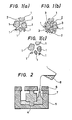
- the aggregate particles 1 of the mold are covered with the water-soluble organic binder 2, when they are in a non-dried state (see Fig. 1(a)).
- the dried and solidified mold an innumerable number of micropores 3 are formed inside due to the evaporation of water.
- water as the medium of the slip intrudes into the micropores 3 according to capillarity to dissolve the water-soluble binder 2.
- the binding power of the binder 2 is drastically weakened to make the aggregate particles respectively independent (see Fig. 1(c)).
- the mold undergoes transition to a collapsible state gradually from the interface thereof with the slip to the deep portion thereof, as it absorbs water.
- the slip increases its density to increasingly solidify, as it releases the water as the medium.
- a green body is finally formed.
- the mold since a mold is softened as it absorbs water, the mold never inhibits minute deformation such as shrinkage occurring in the course of formation of a green body. In other words, since the green body does not undergo any external force from the mold (i.e. a master mold and a core), no stress is produced in the green body, leading to no appearance of cracks at all.
- the mold since all the portions of the mold in contact with the slip absorb water necessary for collapse and removal thereof from the slip in such a way as to provide a uniform thickness of a layer into which water is absorbed.
- the mold is formed by tamping a kneaded mass of aggregate particles, a water-soluble binder, and water.
- the shaping time can be shortened if flowability is imparted to the mold material.
- another flowability-imparting method comprising preparing an alcohol solution of a water-soluble binder which is stable in the form of a hydrate at ordinary temperatures, and adding thereto water in an amount necessary for being fixed as water of crystallization in binder molecules or in a slightly smaller amount than that.
- a sinter according to slip casting can be obtained without any limitation of the shape thereof.
- the second embodiment of the present invention is related to a casting method comprising casting a slip containing an organic solvent as the medium into the mold and removing the mold after solidification of the slip, wherein the above-mentioned mold is formed from a mixture of an aggregate and a binder soluble in the solvent as the medium of the slip.
- any fine particles may be used as the medium of the slip in so far as they are insoluble in the medium of the slip.
- a solvent-soluble binder is used in the form of an organic resin dissolved in an admixture solvent.
- organic resin one soluble in an organic solvent as the medium of the slip must be chosen.
- any acetone- ⁇ soluble resins can be used as the organic resins, which include acrylonitrile-styrene copolymers, an ABS resin, methacrylic resins, polyvinyl acetate, vinyl acetate type resins, cellulose acetate type resins, cellulose nitrate type resins, cellulose acetate butyrate type resins, polyvinyl chloride resins, and polystyrene resins.
- any ethyl alcohol-soluble resins can be used as the organic resin, which include acrylonitrile-styrene copolymers, methacrylic resins, polyvinyl acetate, cellulose acetate type resins, cellulose nitrate type resins, cellulose acetate butyrate type resins, and polystyrene resins.
- any methyl alcohol-soluble resins can be used as the organic resin, which include polyvinyl acetate, methacrylic resins, cellulose acetate type resins, cellulose nitrate type resins, cellulose acetate butyrate type resins, and ionomers.
- any toluene-soluble resins can be used as the organic resins, which include acrylonitrile-styrene copolymers, an ABS resin, methacrylic resins, polyvinyl acetate, polycarbonate, cellulose nitrate type resins, polyvinyl chloride resins, ethylene-vinyl acetate copolymers, ionomers, polypropylene, polybutylene, and polystyrene.
- the organic resin content of the binder vehicle a mixture of an organic resin and an admixture solvent
- the strength of the mold is higher, leading to improvements in the surface stability and surface smoothness of the mold and facilitation of handling of the mold.
- the mold absorbs the solvent as the medium of the slip to lose the binding power thereof, however, excessive addition of the binder is not essentially preferred.
- the amount of the admixture solvent in the binder gives great influences on the workability of the mold formation. When the amount of the admixture solvent is too small for the aggregate, the mold material assumes a state close to that of grains. On the other hand, when the amount of the admixture solvent is too large, it assumes a state close that of a slurry.
- the amount of the admixture solvent should be adequately chosen though it depends on the method of preparing a mold, the filling method or the casting method.
- the blending proportion of the components constituting the mold material varies depending on various conditions such as the properties and particle size distribution of the aggregate, the kinds of organic resin and admixture solvent, the shape and size of the mold to be formed, and the method of forming the mold.
- the optimum values are experimentally determined case by case.
- 5 to 30 parts by weight of the organic resin contained in the binder vehicle, 5 to 30 parts by weight of the admixture solvent, and an adequate amount of a diluent may be added to 100 parts by weight of the aggregate.
- the diluent may be the same as the admixture solvent, but may be of a different kind in so far as it is uniformly miscible with the solvent and does not adversely affect the properties of the binder vehicle.
- the diluent may be either methyl alcohol, or any one of ethyl alcohol, acetone, and ethyl acetate.
- a thin-walled mold can be collapsed only with a solvent contained in a slip.
- a thick-walled mold can not secure a necessary amount of a solvent for effecting collapse thereof.
- the same countermeasures as in the above-mentioned first embodiment are effective.
- a predetermined amount of a solvent is added to the mold from outside by spraying or the like to effectively promote the collapse of the mold. More effective collapse of the mold can be achieved by combining the measures (1) and (2).
- the pheonomenon that the mold is rendered easily collapsible can be illustrated in substantially the same manner as in the case of the aforementioned mold formed by binding the aggregate with the water-soluble binder.
- An increase in the amount of the admixture solvent is, in principle, effective for imparting flowability to the mold material. Even when the admixture solvent is not ethyl alcohol but is, for example, acetone or toluene instead, addition of ethyl alcohol is still effective.
- acetone or toluene may be satisfactory from the viewpoint of imparting flowability to the mold material.
- ethyl alcohol is rather desirable from the viewpoint of a working environment.
- the mold undergoes transition to a collapsible state gradually from the interface thereof with the slip to the deep portion thereof, as it absorbs water.
- the slip increases its density and solidifies, as it releases the water as the medium. Thus a green body is finally formed.
- the green body shrinks in the course of a subsequent solvent removal step, whereas the mold swells due to absorption of water thereby, though the extent of swelling is slight. Since a common gypsum mold will not decrease its strength even when it absorbs water in the slip, cracks are liable to appear in a green body formed using the gypsum mold owing to a stress produced in the course of shrinkage of the green body and swelling of the mold, namely the master mold and core.
- a master mold and a core soften sequentially from the interface thereof with a slip toward the inner portion thereof without inhibiting shrinkage and deformation of a green body occurring in the course of formation of the green body.
- no stress is produced in the green body.
- the green body does not undergo any external force from the mold (master mold and core). Therefore, no cracks appear at all.
- the mold does not harden again unless the ' solvent evaporates.
- a core 4 as shown in Fig. 2 was formed from the above-mentioned mold material, and gypsum master molds 5 and 6 were formed.
- the core 4 was sufficiently dried and hardened at 100°C.
- the gypsum master molds 5 and 6 were sufficiently dried at 60°C. Subsequently, these master molds and core were assembled to form a predetermined mold hollow.
- an alumina slip 8 prepared by uniformly admixing 100 parts of A1 2 0 3 having an average diameter of 2 um, 16 parts of water, and minute amounts of a peptizer and a pH adjuster was cast into the above-mentioned hollow 7 of the mold, and allowed to stand for 1 hour. After solidification of the slip, the gypsum master molds 5 and 6 were removed. Since the core 4 absorbed water in the slip and hence the binding power thereof was drastically reduced, it could be easily collapsed and removed. No appearance of cracks was recognized at all in a green body formed.
- a mold material 100 parts of A1 2 0 3 (grain size of 0.061-0.043 mm) and 20 parts of a 5% aqueous solution of polyacrylamide (PAAm) were kneaded to prepare a mold material.
- a core was formed using a separately prepared wooden pattern in substantially the same manner as in Example 1, and then sufficiently dried and hardened at 100°C. It was assembled with separately formed gypsum master molds 5 and 6.
- a Sialon slip 8 prepared by uniformly admixing 100 parts of Sialon powders, 40 parts of water, a peptizer, and a sintering assistant was cast into the hollow 7 of the assembled mold, and allowed to stand for 1 hour. It was observed that the core 4 was easily removed as in Example 1, and that no appearance of cracks was recognized in a green body.
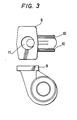
- a casing as shown in Fig. 3 was prepared by slip casting.
- This casing has a very complicated shape including a flange 9, a groove 10 for fastening, and an inside spiral passage 11. Therefore, it could not be formed according to a slip casting method using a conventional mold.
- the water-collapsible spiral core according to the present invention had already sufficiently absorbed water in the slip, resulting in drastic reduction of the binding power of the mold. Thus it was easily collapsed and removed.
- the resulting alumina green body was air-dried and further dried at 100°C to completely remove liberated water. It was then gradually heated from ordinary temperatures to 1,700°C at which heating was continued for 2 hours. Thus an alumina sinter casing having good mechanical properties without any cracks was obtained.
- a screw rotor as shown in Fig. 4 was formed according to the present invention.
- a pattern of the same screw rotor as shown in Fig. 4 was separately foam-molded from foamable polystyrene by using a metallic mold.
- the whole surface, except for the top portion 15, of this pattern 12 was coated with a one-pack type RTV silicone rubber with a thickness of about 50 pi-R, followed by hardening of the rubber.
- an insoluble coating film 13 was formed.
- the top portion of the pattern was disposed on a pattern plate not shown in the figure, and a wooden flask was placed around the pattern. Subsequently, a mold material 14 prepard by uniformly admixing 100 parts of AI 2 0 3 particles and 40 parts of a 5% aqueous emulsion of polyvinyl acetate was filled around the rotor pattern. Thereafter, acetone was sprayed from over the top portion 15 of the pattern 12 to shrink the foamed polystryene pattern to about 1/30 of the original volume. As they remained as such, the resulting mold was dried and hardened at 100°C. Thereafter, acetone was sprayed over the polystryene pattern again, and the pattern was picked out and removed together with the rubber film outside the mold. The mold was then dried and hardened at 100°C.
- This Sialon green body was slowly dried in air and further dried in a furnace of 100°C to completely remove liberated water. Thereafter, it was gradually heated form ordinary temperature up to 1.800°C at which heating was continued for 2 hours to effect ordinary pressure sintering. Thus a homogeneous Sialon rotor sinter was obtained.
- a mold material 100 parts of A1 2 0 3 (grain size of 0.061-0.043 mm), 15 parts of a 30% solution of cellulose nitrate (solvent:acetone), and 15 parts of acetone were uniformly admixed to prepare a mold material.
- a core 4 as shown in Fig. 2 was formed from the above-mentioned mold material, and sufficiently dried and hardened at 100°C.
- the core and gypsum master molds 5 and 6 separately prepared and dried at 60°C were assembled to form a predetermined mold hollow.
- the core 4 could be easily removed, and no appearance of cracks was recognized at all in a green body.
- A1 2 0 3 100 parts of A1 2 0 3 (grain size of 0.061-0.043 mm) and 50 parts of a 20% trichloroethane solution of polystyrene were uniformly admixed and kneaded to prepare a mold material. Using wooden patterns separately prepared, a core 4 and master molds 5 and 6 as shown in Fig. 2 were formed from the above-mentioned mold material, and then sufficiently dried and hardened with hot air of 70°C, followed by assembling in the same manner as in Example 5.
- the mixture was put into 50 parts of acetone as the dispersing medium, and 2 parts of a dispersant (monoethanolamine) was added to 100 parts of the resulting mixture.
- a dispersant monoethanolamine
- the mixture thus obtained was homogeneously mixed by a vibration mill to prepare an SiC slip 8.
- the slip was cast into the hollow of the above-mentioned mold, and allowed to stand for 1 hour.
- Example 5 The same ceramic slip as in Example 5 was cast into the hollow, and allowed to stand for 1 hour.
- the core 4 lost the binding power thereof due to the ethyl alcohol, and could be very easily removed.
- Example 6 The same slip as in Example 6 was cast into the same hollow of a mold as in Example 7, and allowed to stand for 1 hour.
- the core 4 lost the binding power thereof due to acetone contained in the slip, and could be very easily removed. Thus a good green body was obtained.
- a resin pattern having the same shape as an SiC sinter as shown in Fig. 8(a) was formed.
- Master molds 18 and 19 were formed using the pattern and a separately prepared flask, followed by assembling as shown in Fig. 8(a).
- the master mold 18 was one formed by kneading 100 parts of A1 2 0 3 (grain size of 0.061-0.043 mm), 60 parts of a 20% trichloroethane solution of polystyrene, and 30 parts of ethyl alcohol to prepare a slurry, casting the slurry into the flask, and drying the cast slurry.
- the resulting green body was sintered under predetermined conditions to obtain a complete, high-density SiC sinter 21.
- Example 9 100 parts of alumina (grain size of 0.061-0.043 mm), 20 parts of a 37% aqueous solution of polyacrylate, and 20 parts of water was uniformly mixed. Master molds 18 and 19 were formed from the resulting mold material and assembled in the same manner as in Example 9. The same SiC slip as in Example 6 was cast into the formed mold hollow, and allowed to stand for 0.5 hour. As a result, the binding power of the mold was drastically lost. When acetone was sprayed from the outside of the mold in order to further expedite the collapse of the mold, a good crack-free green body was obtained in a shorter time than that in Example 9.
Landscapes
- Engineering & Computer Science (AREA)
- Chemical & Material Sciences (AREA)
- Ceramic Engineering (AREA)
- Manufacturing & Machinery (AREA)
- Mechanical Engineering (AREA)
- Organic Chemistry (AREA)
- Dispersion Chemistry (AREA)
- Materials Engineering (AREA)
- Structural Engineering (AREA)
- Inorganic Chemistry (AREA)
- Health & Medical Sciences (AREA)
- Chemical Kinetics & Catalysis (AREA)
- Medicinal Chemistry (AREA)
- Polymers & Plastics (AREA)
- Mold Materials And Core Materials (AREA)
Description
- The present invention relates to a slip casting method in which a slip (slurry) of particles such as ceramic particles or metallic particles is cast to form a casting.
- Particularly, it relates to a casting method suitable for forming a casting having a complicated shape.
- In slip casting of a hollow casting having a hollow portion of a complicated shape, specifically a casting requiring a core with a shape complicated enough to make it impossible to draw out the core by inversely inclining the casting, use of a gypsum mold makes the removal of the core difficult or impossible.
- The prior art techniques related to the present invention include one disclosed in GB-A-1,482,436. According to this technique, a desired mold is prepared by forming a partial mold with a complicated shape from a solvent-soluble organic material and another partial mold with a simple shape from gypsum, and assembling both of them. In this method, however, considerations are not given to the fact that a difference in the density of a green body may sometimes be produced between the organic portion and the gypsum portion depending on the shape and size of the casting to adversely affect the reliability on strength and dimensional accuracy of the casting, and workability.
- Further known is from the GB-A-1,594,033 a method of forming a slip cast article comprising pouring slip into a mold having at least two parts, a first part being capable of drawing vehicle from the slip, and a second part being composed of an organic material which is not reactive with the slip and which is capable of binding the solid particles of the slip; allowing the slip to consolidate within the mold; treating the casting and the second part with a solvent which is capable of dissolving the organic material and which is at least partly miscible with the slip vehicle, the treatment being continued until the second part has dissolved and the solvent and dissolved organic material has penetrated into the article; and drying the article.
- In view of the above, an object of the present invention is to provide a slip casting method which makes it possible to remove the mold immediately after solidification of a slip to prevent a casting from undergoing cracking, and which is suited to production of a casting having a complicated shape.
- In accordance with the present invention, there is provided a slip. casting method comprising casting a slip containing water or an organic solvent as the medium into a mold and removing the mold after solidification of the slip, characterized in that there is used a mold formed from an aggregate which particles are insoluble in that medium of the slip and an organic binder being soluble in the medium of the slip.
- Any fine particles may be used as the aggregate of the mold in so far as they are insoluble in the medium of the slip. Usable aggregates include alumina (AI203), magnesia (MgO), zircon sand, silica sand, and resin powders insoluble in the medium of the slip.
- The first embodiment of the present invention is related to a casting method comprising casting a slip containing water as the medium into a mold and removing the mold after solidification of the slip, wherein the above-mentioned mold is formed with a water-soluble organic binder.
- Water-soluble synthetic organic binders that can be used include polyvinyl alcohol (PVA), water-soluble isobutane-maleic anhydride copolymers, polyacrylamide (PAAm), polyethylene oxide (PEO), polyvinylpyrrolidone (PVP), water-soluble vinyl acetate copolymers, acrylic copolymers, polyethylene glycol (PEG), methylcellulose (MC), carboxymethylcellulose (CMC), hydroxypropylcellulose (HPC), and water-soluble waxes. One or more organic substances among them are used in the form of an aqueous solution thereof. Natural water-soluble binders such as starch, glue, and gum arabic may also be used.
- The blending proportion of the aggregate, the binder, the aqueous saturated solution of the water-soluble resin, and diluting water is determined case by case with due consideration for workability in formation of the mold, dry strength of the mold, absorbability of a solvent (water) in the slip by the mold, collapsibility of the mold after water absorption, etc. and, hence, cannot be uniformly determined.
- To set up some definite criterion, however, 5 to 70 parts by weight of the binder and an adequate amount of water for improvement of formability of the mold may be added to 100 parts by weight of the aggregate particles.
- When a slip containing water as the medium is cast into the above-mentioned mold, the mold can be collapsed only with the water contained in the slip when the mold has a comparatively thin wall. Where the mold has a thick wall, however, a sufficient amount of water enough to collapse the mold cannot be secured only from the slip. In this case, effective countermeasures include (i) making the wall of the mold as thin as possible, (ii) providing a hollow(s) inside thick-walled master mold and core, (iii) adding water into the mold from outside to improve the collapsibility of the mold, and (iv) combining the measures (i), (ii), and (iii) properly.
- Provision of one or a number of adequate hollows in the master mold and core (the above-mentioned measure (ii)) entails rendering the mold wall thin as well. Besides, it further provides an effect of facilitating addition of water from outside, which corresponds to the above-mentioned measure (iii). These act effectively on collapse and removal of the mold.
- Also addition of water in the form of a spray is an effective method of water addition. Alternatively, according to another method of collapsing and removing the mold, the mold after slip casting i.e. mold and green body, is allowed to stand in a high-humidity chamber for a predetermined time to effect moisture absorption by the mold.
- A phenomenon that, when a slip containing water as the medium is cast into a mold formed by solidifying aggregate particles with the aid of a water-soluble organic binder, the slip is solidified due to absorption of water in the slip by the mold while at the same time the mold becomes easily collapsible will be illustrated with reference to Figs. 1 (a), (b), and (c) as follows.
- The
aggregate particles 1 of the mold are covered with the water-solubleorganic binder 2, when they are in a non-dried state (see Fig. 1(a)). In contrast, in the dried and solidified mold, an innumerable number ofmicropores 3 are formed inside due to the evaporation of water. When the slip is cast into the mold as mentioned just above, water as the medium of the slip intrudes into themicropores 3 according to capillarity to dissolve the water-soluble binder 2. Thus the binding power of thebinder 2 is drastically weakened to make the aggregate particles respectively independent (see Fig. 1(c)). - When this phenomenon is viewed macroscopically, the mold undergoes transition to a collapsible state gradually from the interface thereof with the slip to the deep portion thereof, as it absorbs water. On the other hand, the slip increases its density to increasingly solidify, as it releases the water as the medium. Thus a green body is finally formed.
- The green body shrinks little by little in the course of a subsequent dehydration step, whereas the mold is apt to swell due to absorption of water thereby though the extent of swelling is slight. Since a common gypsum mold will not decrease its strength even when it absorbs water from the slip, cracks are liable to appear in a green body formed using the gypsum mold owing to a stress produced in the course of shrinkage of the green body and swelling of the mold.
- By contrast, according to the present invention, since a mold is softened as it absorbs water, the mold never inhibits minute deformation such as shrinkage occurring in the course of formation of a green body. In other words, since the green body does not undergo any external force from the mold (i.e. a master mold and a core), no stress is produced in the green body, leading to no appearance of cracks at all.
- Therefore, even where the mold has a complicated shape because of a complicated shape of a casting (especially even where a core having a complicated shape is used), the mold becomes collapsible uniformly in all the portions since all the portions of the mold in contact with the slip absorb water necessary for collapse and removal thereof from the slip in such a way as to provide a uniform thickness of a layer into which water is absorbed.
- Where the amount of water only contained in the slip is insufficient for removal of the mold as in the case of a large thickness of the mold wall, addition of water from outside is effective as described above.
- The mold is formed by tamping a kneaded mass of aggregate particles, a water-soluble binder, and water. The shaping time can be shortened if flowability is imparted to the mold material.
- In imparting flowability to the molding material, an increase in the water content is, in principle, effective. However, a large amount of water is not easy to evaporate.
- Accordingly, there is preferably adopted another flowability-imparting method comprising preparing an alcohol solution of a water-soluble binder which is stable in the form of a hydrate at ordinary temperatures, and adding thereto water in an amount necessary for being fixed as water of crystallization in binder molecules or in a slightly smaller amount than that.
- As described above, since softening of the mold proceeds simultaneously with solidification of the slip, a ceramic casting having a complicated shape without any cracks can be very easily formed.
- Immersion of the mold and the green body in warm water prior to sintering is not necessary unlike conventional methods. A sinter according to slip casting can be obtained without any limitation of the shape thereof.
- The second embodiment of the present invention is related to a casting method comprising casting a slip containing an organic solvent as the medium into the mold and removing the mold after solidification of the slip, wherein the above-mentioned mold is formed from a mixture of an aggregate and a binder soluble in the solvent as the medium of the slip.
- Just as in the above-mentioned first embodiment, any fine particles may be used as the medium of the slip in so far as they are insoluble in the medium of the slip.
- A solvent-soluble binder is used in the form of an organic resin dissolved in an admixture solvent.
- As the organic resin, one soluble in an organic solvent as the medium of the slip must be chosen.
- More specifically, where the organic solvent as the medium of the slip is acetone, any acetone- ·soluble resins can be used as the organic resins, which include acrylonitrile-styrene copolymers, an ABS resin, methacrylic resins, polyvinyl acetate, vinyl acetate type resins, cellulose acetate type resins, cellulose nitrate type resins, cellulose acetate butyrate type resins, polyvinyl chloride resins, and polystyrene resins.
- Where the organic solvent as the medium is ethyl alcohol, any ethyl alcohol-soluble resins can be used as the organic resin, which include acrylonitrile-styrene copolymers, methacrylic resins, polyvinyl acetate, cellulose acetate type resins, cellulose nitrate type resins, cellulose acetate butyrate type resins, and polystyrene resins.
- Where the organic solvent as the medium is methyl alcohol, any methyl alcohol-soluble resins can be used as the organic resin, which include polyvinyl acetate, methacrylic resins, cellulose acetate type resins, cellulose nitrate type resins, cellulose acetate butyrate type resins, and ionomers.
- Where the organic solvent as the medium is toluene, any toluene-soluble resins can be used as the organic resins, which include acrylonitrile-styrene copolymers, an ABS resin, methacrylic resins, polyvinyl acetate, polycarbonate, cellulose nitrate type resins, polyvinyl chloride resins, ethylene-vinyl acetate copolymers, ionomers, polypropylene, polybutylene, and polystyrene.
- As the organic resin content of the binder vehicle (a mixture of an organic resin and an admixture solvent) is higher, the strength of the mold is higher, leading to improvements in the surface stability and surface smoothness of the mold and facilitation of handling of the mold. In this embodiment wherein the mold absorbs the solvent as the medium of the slip to lose the binding power thereof, however, excessive addition of the binder is not essentially preferred. The amount of the admixture solvent in the binder gives great influences on the workability of the mold formation. When the amount of the admixture solvent is too small for the aggregate, the mold material assumes a state close to that of grains. On the other hand, when the amount of the admixture solvent is too large, it assumes a state close that of a slurry. Thus the amount of the admixture solvent should be adequately chosen though it depends on the method of preparing a mold, the filling method or the casting method.
- As described above, the blending proportion of the components constituting the mold material, including the proportion of the binder relative to the mold aggregate and the proportion of the organic resin and the admixture solvent in the binder vehicle, varies depending on various conditions such as the properties and particle size distribution of the aggregate, the kinds of organic resin and admixture solvent, the shape and size of the mold to be formed, and the method of forming the mold. Thus the optimum values are experimentally determined case by case. To show some definite criterion, however, 5 to 30 parts by weight of the organic resin contained in the binder vehicle, 5 to 30 parts by weight of the admixture solvent, and an adequate amount of a diluent may be added to 100 parts by weight of the aggregate. In this case, the diluent may be the same as the admixture solvent, but may be of a different kind in so far as it is uniformly miscible with the solvent and does not adversely affect the properties of the binder vehicle. For example, when methyl alcohol is used as the admixture solvent for a polyvinyl acetate resin, the diluent may be either methyl alcohol, or any one of ethyl alcohol, acetone, and ethyl acetate.
- A thin-walled mold can be collapsed only with a solvent contained in a slip. However, a thick-walled mold can not secure a necessary amount of a solvent for effecting collapse thereof. In this case, the same countermeasures as in the above-mentioned first embodiment are effective. Specifically, (1) it is desirable to make the wall of the mold thin by providing a hollow(s) in the master mold and core.
- In the case of a relatively thick-walled mold, (2) a predetermined amount of a solvent is added to the mold from outside by spraying or the like to effectively promote the collapse of the mold. More effective collapse of the mold can be achieved by combining the measures (1) and (2).
- Also in this embodiment, the pheonomenon that the mold is rendered easily collapsible can be illustrated in substantially the same manner as in the case of the aforementioned mold formed by binding the aggregate with the water-soluble binder.
- An increase in the amount of the admixture solvent is, in principle, effective for imparting flowability to the mold material. Even when the admixture solvent is not ethyl alcohol but is, for example, acetone or toluene instead, addition of ethyl alcohol is still effective.
- An increased amount of acetone or toluene may be satisfactory from the viewpoint of imparting flowability to the mold material. However, ethyl alcohol is rather desirable from the viewpoint of a working environment.
- As described above, the mold undergoes transition to a collapsible state gradually from the interface thereof with the slip to the deep portion thereof, as it absorbs water. On the other hand, the slip increases its density and solidifies, as it releases the water as the medium. Thus a green body is finally formed.
- The green body shrinks in the course of a subsequent solvent removal step, whereas the mold swells due to absorption of water thereby, though the extent of swelling is slight. Since a common gypsum mold will not decrease its strength even when it absorbs water in the slip, cracks are liable to appear in a green body formed using the gypsum mold owing to a stress produced in the course of shrinkage of the green body and swelling of the mold, namely the master mold and core.
- By contrast, according to the present invention, a master mold and a core soften sequentially from the interface thereof with a slip toward the inner portion thereof without inhibiting shrinkage and deformation of a green body occurring in the course of formation of the green body. Thus no stress is produced in the green body. In other words, the green body does not undergo any external force from the mold (master mold and core). Therefore, no cracks appear at all.
- Once it is softened and rendered easily collapsible, the mold does not harden again unless the' solvent evaporates.
- As described above, according to the present invention, since softening of the mold proceeds simultaneously with solidification of the slip, a casting with complicated shapes of an external appearance and a hollow(s) which has hitherto experienced a serious difficulty in formation thereof, in other words, a casting requiring a master mold and a core which have a large unevenness or a complicated shape, can be very easily formed without appearance of cracks.
-
- Figs. 1(a), (b), and (c) are illustrative views demonstrating that a mold absorbs water or an organic solvent to become easily removable.
- Fig. 2 is an illustrative view showing an example of the casting method according to the present invention.
- Figs. 3 and 4 are views of external appearances of parts castable according to the present invention.
- Figs. 5 to 7 are illustrative views showing an example of the casting method according to the present invention, which concerns formation of the part shown in Fig. 4.
- Figs. 8(a) and (b) are illustrative views showing another example of the casting method according to the present invention, which concerns formation of the part shown in Fig. 4.
- The following Examples will further illustrate the present invention.
- 100 parts (by weight; the same will apply hereinbelow) of A1203 (grain size of 0.061-0.043 mm) and 20 parts of a 5% aqueous solution of polyvinyl alcohol (PVA) were uniformly admixed to prepare a mold material.
- Using wooden patterns separately prepared, a
core 4 as shown in Fig. 2 was formed from the above-mentioned mold material, andgypsum master molds core 4 was sufficiently dried and hardened at 100°C. Thegypsum master molds - Subsequently, an
alumina slip 8 prepared by uniformly admixing 100 parts of A1203 having an average diameter of 2 um, 16 parts of water, and minute amounts of a peptizer and a pH adjuster was cast into the above-mentioned hollow 7 of the mold, and allowed to stand for 1 hour. After solidification of the slip, thegypsum master molds core 4 absorbed water in the slip and hence the binding power thereof was drastically reduced, it could be easily collapsed and removed. No appearance of cracks was recognized at all in a green body formed. - 100 parts of A1203 (grain size of 0.061-0.043 mm) and 20 parts of a 5% aqueous solution of polyacrylamide (PAAm) were kneaded to prepare a mold material. A core was formed using a separately prepared wooden pattern in substantially the same manner as in Example 1, and then sufficiently dried and hardened at 100°C. It was assembled with separately formed
gypsum master molds Sialon slip 8 prepared by uniformly admixing 100 parts of Sialon powders, 40 parts of water, a peptizer, and a sintering assistant was cast into the hollow 7 of the assembled mold, and allowed to stand for 1 hour. It was observed that thecore 4 was easily removed as in Example 1, and that no appearance of cracks was recognized in a green body. - Utilizing the method and mold of the present invention, a casing as shown in Fig. 3 was prepared by slip casting. This casing has a very complicated shape including a
flange 9, agroove 10 for fastening, and aninside spiral passage 11. Therefore, it could not be formed according to a slip casting method using a conventional mold. - 100 parts of zircon sand (grain size of 0.061-0.043 mm) and 15 parts of a 5% aqueous solution of polyvinylpyrrolidone (PVP) were uniformly admixed to prepare a mold material. The mold material was then filled into a separately prepared rigid silicone rubber core box to form a spiral core, followed by sufficient drying at 100°C. The core was assembled with a separately prepared splittable gypsum master mold to form a mold. Subsequently, the same alumina slip as in Example 1 was cast into the mold, and allowed to stand for 2 hours.
- Thereafter, the gypsum master mold was removed. The water-collapsible spiral core according to the present invention had already sufficiently absorbed water in the slip, resulting in drastic reduction of the binding power of the mold. Thus it was easily collapsed and removed.
- The resulting alumina green body was air-dried and further dried at 100°C to completely remove liberated water. It was then gradually heated from ordinary temperatures to 1,700°C at which heating was continued for 2 hours. Thus an alumina sinter casing having good mechanical properties without any cracks was obtained.
- A screw rotor as shown in Fig. 4 was formed according to the present invention.
- Where such a shape is to be produced according to the conventional slip casting method using a gypsum mold, the mold must be splitted into a large number of pieces, resulting in reduction of dimensional accuracy, formation of a large number of burrs, breakage of a green body during the removal of the mold, etc. Thus a large difficulty is encountered in practicing casting. Thus, a pattern of the same screw rotor as shown in Fig. 4 (see Fig. 5) was separately foam-molded from foamable polystyrene by using a metallic mold. The whole surface, except for the
top portion 15, of thispattern 12 was coated with a one-pack type RTV silicone rubber with a thickness of about 50 pi-R, followed by hardening of the rubber. Thus aninsoluble coating film 13 was formed. - The top portion of the pattern was disposed on a pattern plate not shown in the figure, and a wooden flask was placed around the pattern. Subsequently, a
mold material 14 prepard by uniformly admixing 100 parts of AI203 particles and 40 parts of a 5% aqueous emulsion of polyvinyl acetate was filled around the rotor pattern. Thereafter, acetone was sprayed from over thetop portion 15 of thepattern 12 to shrink the foamed polystryene pattern to about 1/30 of the original volume. As they remained as such, the resulting mold was dried and hardened at 100°C. Thereafter, acetone was sprayed over the polystryene pattern again, and the pattern was picked out and removed together with the rubber film outside the mold. The mold was then dried and hardened at 100°C. - The
same Sialon slip 17 as in Example 2 was cast into the hollow 16 of the formed mold. Water contained in the slip was absorbed by the casting mold to solidy the slip. The mold of this Example became very easily collapsible to the drastically reduced binding power of the mold resulting from absorption of water thereby. Thus a green body was obtained without any damages to the screw portion of the rotor. - This Sialon green body was slowly dried in air and further dried in a furnace of 100°C to completely remove liberated water. Thereafter, it was gradually heated form ordinary temperature up to 1.800°C at which heating was continued for 2 hours to effect ordinary pressure sintering. Thus a homogeneous Sialon rotor sinter was obtained.
- 100 parts of A1203 (grain size of 0.061-0.043 mm), 15 parts of a 30% solution of cellulose nitrate (solvent:acetone), and 15 parts of acetone were uniformly admixed to prepare a mold material. Using a wooden pattern separately prepared, a
core 4 as shown in Fig. 2 was formed from the above-mentioned mold material, and sufficiently dried and hardened at 100°C. The core andgypsum master molds - Subsequently, a slip of a fine MgO powder in a medium of ethyl alcohol was cast into the hollow, and allowed to stand for 1 hour.
- Since the cellulose nitrate resin as the binder of the
core 4 was dissolved in ethyl alcohol as the medium to soften the mold, thecore 4 could be easily removed, and no appearance of cracks was recognized at all in a green body. - 100 parts of A1203 (grain size of 0.061-0.043 mm) and 50 parts of a 20% trichloroethane solution of polystyrene were uniformly admixed and kneaded to prepare a mold material. Using wooden patterns separately prepared, a
core 4 andmaster molds - 100 parts of a fine SiC powder, 3 parts of an inorganic carbon additive (gas black), and 1.5 parts of a densification assistant (boron-containing additive) were admixed.
- Subsequently, the mixture was put into 50 parts of acetone as the dispersing medium, and 2 parts of a dispersant (monoethanolamine) was added to 100 parts of the resulting mixture.
- The mixture thus obtained was homogeneously mixed by a vibration mill to prepare an
SiC slip 8. The slip was cast into the hollow of the above-mentioned mold, and allowed to stand for 1 hour. - Since the polystyrene as the binder of the mold was dissolved in acetone as the medium to soften the mold with loss of the binding power thereof, the
core 4 and themaster molds - 100 parts of silica sand (grain size of 0.061-0.043 mm), 15 parts of a 48% solution of a polyvinyl acetate resin in a solvent of methyl alcohol, and 15 parts of ethyl alcohol were uniformly mixed. A
core 4 andmaster molds - The same ceramic slip as in Example 5 was cast into the hollow, and allowed to stand for 1 hour. The
core 4 lost the binding power thereof due to the ethyl alcohol, and could be very easily removed. - Thus a good green body was obtained.
- The same slip as in Example 6 was cast into the same hollow of a mold as in Example 7, and allowed to stand for 1 hour. The
core 4 lost the binding power thereof due to acetone contained in the slip, and could be very easily removed. Thus a good green body was obtained. - A resin pattern having the same shape as an SiC sinter as shown in Fig. 8(a) was formed.
Master molds master mold 18 was one formed by kneading 100 parts of A1203 (grain size of 0.061-0.043 mm), 60 parts of a 20% trichloroethane solution of polystyrene, and 30 parts of ethyl alcohol to prepare a slurry, casting the slurry into the flask, and drying the cast slurry. - The same SiC slip as in Example 6 was cast into the hollow 20, and allowed to stand for 1 hour.
- Since the polystyrene as the binder of the mold was easily dissolved in acetone as the medium to soften the mold with loss of the binding power thereof, the
master molds - The resulting green body was sintered under predetermined conditions to obtain a complete, high-
density SiC sinter 21. - 100 parts of alumina (grain size of 0.061-0.043 mm), 20 parts of a 37% aqueous solution of polyacrylate, and 20 parts of water was uniformly mixed.
Master molds
Claims (17)
Applications Claiming Priority (4)
| Application Number | Priority Date | Filing Date | Title |
|---|---|---|---|
| JP21696/85 | 1985-02-08 | ||
| JP60021696A JPS61181611A (en) | 1985-02-08 | 1985-02-08 | Slip casting molding method and mold |
| JP24323/85 | 1985-02-13 | ||
| JP60024323A JPS61185412A (en) | 1985-02-13 | 1985-02-13 | Slip casting molding method and mold for molding |
Publications (2)
| Publication Number | Publication Date |
|---|---|
| EP0191409A1 EP0191409A1 (en) | 1986-08-20 |
| EP0191409B1 true EP0191409B1 (en) | 1989-12-20 |
Family
ID=26358778
Family Applications (1)
| Application Number | Title | Priority Date | Filing Date |
|---|---|---|---|
| EP86101459A Expired EP0191409B1 (en) | 1985-02-08 | 1986-02-05 | Slip casting method |
Country Status (4)
| Country | Link |
|---|---|
| US (1) | US4871497A (en) |
| EP (1) | EP0191409B1 (en) |
| KR (1) | KR890003502B1 (en) |
| DE (1) | DE3667627D1 (en) |
Cited By (2)
| Publication number | Priority date | Publication date | Assignee | Title |
|---|---|---|---|---|
| CN102862213A (en) * | 2012-09-26 | 2013-01-09 | 云南永丰源普洱瓷有限公司 | Slip casting method and slip casting mould capable of preventing neck of product from being broken |
| WO2026006576A1 (en) * | 2024-06-26 | 2026-01-02 | Saint-Gobain Ceramics & Plastics, Inc. | Composition for making ceramic object and method of using |
Families Citing this family (27)
| Publication number | Priority date | Publication date | Assignee | Title |
|---|---|---|---|---|
| EP0243502A4 (en) * | 1985-10-21 | 1990-02-22 | Koransha Kk | Mold for pad molding of powder. |
| JPS63147605A (en) * | 1986-07-28 | 1988-06-20 | 株式会社日立製作所 | Manufacture of mold for slip casting and slit casting molding method |
| JPS63309403A (en) * | 1987-06-12 | 1988-12-16 | Nkk Corp | Mold for casting and molding of slurry |
| US5021213A (en) * | 1989-06-22 | 1991-06-04 | Nkk Corporation | Method of casting powder |
| CH681516A5 (en) * | 1989-09-13 | 1993-04-15 | Asea Brown Boveri | |
| US5069714A (en) * | 1990-01-17 | 1991-12-03 | Quebec Metal Powders Limited | Segregation-free metallurgical powder blends using polyvinyl pyrrolidone binder |
| DE59104523D1 (en) * | 1990-03-14 | 1995-03-23 | Asea Brown Boveri | Sintering process with a shape from a compliant ceramic body. |
| EP0446665A1 (en) * | 1990-03-14 | 1991-09-18 | Asea Brown Boveri Ag | Process for the production of a shaped product from metallic or ceramic powder |
| JPH0813446B2 (en) * | 1990-05-30 | 1996-02-14 | 株式会社日立製作所 | Slip casting method |
| US5262100A (en) * | 1990-07-11 | 1993-11-16 | Advanced Plastics Partnership | Method of core removal from molded products |
| US5089186A (en) * | 1990-07-11 | 1992-02-18 | Advanced Plastics Partnership | Process for core removal from molded products |
| US5248552A (en) * | 1990-07-11 | 1993-09-28 | Advanced Plastics Partnership | Molding core |
| JP2767657B2 (en) * | 1990-08-22 | 1998-06-18 | アドバンスト セラミックス コーポレーション | Non-aqueous binder composition and method for slip casting or cold forming |
| CA2052301A1 (en) * | 1990-10-01 | 1992-04-02 | Hiroshi Uchida | Method of producing patterned shaped article |
| US5203936A (en) * | 1991-12-16 | 1993-04-20 | W. R. Grace & Co.-Conn. | Clean burning green ceramic tape cast system using polyisobutylene binder |
| JP2846257B2 (en) * | 1994-11-01 | 1999-01-13 | 日本碍子株式会社 | Self-absorbent molding method and molded product obtained by the method |
| US5861115A (en) * | 1995-03-29 | 1999-01-19 | Ngk Insulators, Ltd. | Method for freeze molding |
| US5592686A (en) * | 1995-07-25 | 1997-01-07 | Third; Christine E. | Porous metal structures and processes for their production |
| US5985197A (en) * | 1997-04-23 | 1999-11-16 | Radius Engineering, Inc. | Method of manufacturing a composite golf club head |
| US6340509B1 (en) | 1997-04-23 | 2002-01-22 | Radius Engineering, Inc. | Composite bicycle frame and method of construction thereof |
| US8734715B2 (en) | 2011-01-13 | 2014-05-27 | Ut-Battelle, Llc | Method for the preparation of ferrous low carbon porous material |
| CN102225456B (en) * | 2011-06-24 | 2012-11-28 | 吴耀祖 | Fired mold manufacturing method |
| JP6137614B2 (en) * | 2012-05-14 | 2017-05-31 | 株式会社リコー | 3D modeling method and 3D modeling apparatus |
| DE102012023423A1 (en) * | 2012-11-29 | 2014-06-05 | Oliver Puckert | Producing ceramic/metal body used for dental device, by removing binder comprising cellulose acetate from green body consisting of ceramic/metal powder, heat treating green body with acetone and then debinding using acetone, and sintering |
| FR3072378B1 (en) | 2017-10-12 | 2019-11-08 | Commissariat A L'energie Atomique Et Aux Energies Alternatives | DEVICE AND METHOD FOR MANUFACTURING CRYOGENIC CERAMIC PIECES |
| JP7144603B2 (en) * | 2019-04-25 | 2022-09-29 | 日本碍子株式会社 | Manufacturing method of three-dimensional sintered body |
| CN117816961A (en) * | 2023-07-31 | 2024-04-05 | 南京科润新能源设备有限公司 | A near-net forming method for new kneading block material |
Family Cites Families (15)
| Publication number | Priority date | Publication date | Assignee | Title |
|---|---|---|---|---|
| DE415091C (en) * | 1921-05-21 | 1925-06-13 | Ton & Steinzeugwerke Akt Ges F | Process for the production of ceramic goods by means of the casting process under pressure |
| US1846279A (en) * | 1928-02-06 | 1932-02-23 | Morgan Crucible Co | Means for molding articles from alpha slip or plastic mass |
| US2303303A (en) * | 1941-04-14 | 1942-11-24 | Scovill Manufacturing Co | Form for slip-casting ceramics and method of making the same |
| US2494403A (en) * | 1945-09-19 | 1950-01-10 | United States Gypsum Co | Mold composition |
| GB1205952A (en) * | 1967-02-21 | 1970-09-23 | British Ceramic Res Ass | Improvements relating to the manufacture of ceramic articles |
| FR1597279A (en) * | 1968-12-27 | 1970-06-22 | ||
| US3848040A (en) * | 1969-04-17 | 1974-11-12 | Corning Glass Works | Apparatus and method for forming slii cast bodies with cavities |
| GB1390033A (en) * | 1971-09-17 | 1975-04-09 | Schwarzheide Synthesewerk Veb | Moulds for ceramic products |
| FR2255149B1 (en) * | 1973-12-20 | 1977-07-08 | Ford France | |
| US4127629A (en) * | 1976-07-28 | 1978-11-28 | Norton Company | Process of forming silicon carbide bodies |
| CA1076329A (en) * | 1976-12-22 | 1980-04-29 | John M. Nicholson | Method of manufacturing a slip cast article |
| JPS5757727A (en) * | 1980-09-24 | 1982-04-07 | Unitika Ltd | Production of porous vinyl alcohol polymer molding |
| BR8403113A (en) * | 1983-07-18 | 1985-09-03 | Duolite Int Inc | PROCESS FOR THE PREPARATION OF HIGHLY POROUS RESINS, POROUS POLYMER PRODUCTS AND FUNCTIONED RESIN PRODUCT |
| WO1985002578A1 (en) * | 1983-12-14 | 1985-06-20 | Will Guenther | Shaping of ceramic materials |
| KR890004247B1 (en) * | 1984-04-02 | 1989-10-28 | 가부시기가이샤 히다찌세이사꾸쇼 | Slip casting molding method and molding mold |
-
1986
- 1986-02-01 KR KR1019860000682A patent/KR890003502B1/en not_active Expired
- 1986-02-05 EP EP86101459A patent/EP0191409B1/en not_active Expired
- 1986-02-05 DE DE8686101459T patent/DE3667627D1/en not_active Expired - Lifetime
- 1986-02-10 US US06/827,637 patent/US4871497A/en not_active Expired - Fee Related
Cited By (3)
| Publication number | Priority date | Publication date | Assignee | Title |
|---|---|---|---|---|
| CN102862213A (en) * | 2012-09-26 | 2013-01-09 | 云南永丰源普洱瓷有限公司 | Slip casting method and slip casting mould capable of preventing neck of product from being broken |
| CN102862213B (en) * | 2012-09-26 | 2015-10-28 | 深圳市国瓷永丰源瓷业有限公司 | A kind of prevent product neck from rupturing filling forming method and injection forming mould |
| WO2026006576A1 (en) * | 2024-06-26 | 2026-01-02 | Saint-Gobain Ceramics & Plastics, Inc. | Composition for making ceramic object and method of using |
Also Published As
| Publication number | Publication date |
|---|---|
| KR890003502B1 (en) | 1989-09-23 |
| KR860006416A (en) | 1986-09-11 |
| EP0191409A1 (en) | 1986-08-20 |
| US4871497A (en) | 1989-10-03 |
| DE3667627D1 (en) | 1990-01-25 |
Similar Documents
| Publication | Publication Date | Title |
|---|---|---|
| US4871497A (en) | Slip casting method | |
| KR900003344B1 (en) | Method for preparing slipcasting mould | |
| US4812278A (en) | Process for preparing mold | |
| JPS6349343A (en) | Core and its production and production of mold for investment casting | |
| US3426834A (en) | Expendable pattern for precision investment casting | |
| US4883621A (en) | Method for forming cast article by slip casting | |
| US805144A (en) | Process for making molds. | |
| JPH01262041A (en) | Manufacture of mold and core | |
| JP2001001104A (en) | Coating composition | |
| GB2349601A (en) | Boron carbide cast bodies | |
| JPS61181611A (en) | Slip casting molding method and mold | |
| JPH037486B2 (en) | ||
| JPH0663684A (en) | Production of ceramic core for casting | |
| JPH0636954B2 (en) | Composition for easily disintegrating mold | |
| JPS60253505A (en) | Manufacturing method of ceramic products | |
| JP2723149B2 (en) | Core for pressure casting | |
| JPS6358082B2 (en) | ||
| JPH043884B2 (en) | ||
| JPS61112602A (en) | Mold for ceramics molding | |
| JP2772090B2 (en) | Ceramic shell mold and core for reactive metal casting | |
| JPS62259637A (en) | Mold making method | |
| JPS61163810A (en) | Method of molding powder | |
| JPS612507A (en) | Porous durable mold and manufacture thereof | |
| JPS6223705A (en) | Mold for slip casting | |
| JPH0469844B2 (en) |
Legal Events
| Date | Code | Title | Description |
|---|---|---|---|
| PUAI | Public reference made under article 153(3) epc to a published international application that has entered the european phase |
Free format text: ORIGINAL CODE: 0009012 |
|
| 17P | Request for examination filed |
Effective date: 19860205 |
|
| AK | Designated contracting states |
Kind code of ref document: A1 Designated state(s): DE FR GB SE |
|
| 17Q | First examination report despatched |
Effective date: 19880822 |
|
| GRAA | (expected) grant |
Free format text: ORIGINAL CODE: 0009210 |
|
| AK | Designated contracting states |
Kind code of ref document: B1 Designated state(s): DE FR GB SE |
|
| PGFP | Annual fee paid to national office [announced via postgrant information from national office to epo] |
Ref country code: SE Payment date: 19900109 Year of fee payment: 5 |
|
| REF | Corresponds to: |
Ref document number: 3667627 Country of ref document: DE Date of ref document: 19900125 |
|
| ET | Fr: translation filed | ||
| PLBE | No opposition filed within time limit |
Free format text: ORIGINAL CODE: 0009261 |
|
| STAA | Information on the status of an ep patent application or granted ep patent |
Free format text: STATUS: NO OPPOSITION FILED WITHIN TIME LIMIT |
|
| 26N | No opposition filed | ||
| PG25 | Lapsed in a contracting state [announced via postgrant information from national office to epo] |
Ref country code: SE Effective date: 19910206 |
|
| EUG | Se: european patent has lapsed |
Ref document number: 86101459.5 Effective date: 19911008 |
|
| REG | Reference to a national code |
Ref country code: GB Ref legal event code: IF02 |
|
| PGFP | Annual fee paid to national office [announced via postgrant information from national office to epo] |
Ref country code: GB Payment date: 20020125 Year of fee payment: 17 |
|
| PGFP | Annual fee paid to national office [announced via postgrant information from national office to epo] |
Ref country code: FR Payment date: 20020219 Year of fee payment: 17 |
|
| PGFP | Annual fee paid to national office [announced via postgrant information from national office to epo] |
Ref country code: DE Payment date: 20020425 Year of fee payment: 17 |
|
| PG25 | Lapsed in a contracting state [announced via postgrant information from national office to epo] |
Ref country code: GB Free format text: LAPSE BECAUSE OF NON-PAYMENT OF DUE FEES Effective date: 20030205 |
|
| PG25 | Lapsed in a contracting state [announced via postgrant information from national office to epo] |
Ref country code: DE Free format text: LAPSE BECAUSE OF NON-PAYMENT OF DUE FEES Effective date: 20030902 |
|
| GBPC | Gb: european patent ceased through non-payment of renewal fee | ||
| PG25 | Lapsed in a contracting state [announced via postgrant information from national office to epo] |
Ref country code: FR Free format text: LAPSE BECAUSE OF NON-PAYMENT OF DUE FEES Effective date: 20031031 |
|
| REG | Reference to a national code |
Ref country code: FR Ref legal event code: ST |